
10
Wherein Afro-Eurasians stray into other world zones • China nearly launches the Industrial Revolution • An Afro-Eurasian disease in a long line of diseases kills millions • The Turks inadvertently cause the next rise of complexity • Slavery continues • And the costs of complexity are made palpable by and for humanity.
BY 1200 AD THE WORLD POPULATION was approximately 400 million, but not without the dips and declines of secular cycles. For instance, in 1 AD the world population was roughly 250 million. But after the decline and collapse of the Roman Empire, Han China and numerous other agrarian states, the world population had shrunk to 200 million by 600 AD. By 1200 AD, the world had recovered and massively surpassed its ancient maximum.
The land-based and seaborne Silk Roads had unified Afro-Eurasia into a fairly robust network of collective learning with shared ideas and innovations (and, horrifically, diseases). The other three world zones – the Americas, Australasia and the Pacific – had not yet entered this network to spur on collective learning to be even faster. The unification of the world zones into a single web of collective learning would harness the innovative power of all humans on Earth and set humanity on a collision course for modernity, with all the higher complexity it has brought.

THE MEDIEVAL ORIGINS OF GLOBALISATION
An agrarian state gained the overwhelming majority of its wealth (that is, energy flows) from agriculture. Landlords would have a share of the crops produced, or would collect rents, and central governments would collect taxes and tributes. But thanks to the Silk Roads, that was changing. Merchants were making more money and were becoming increasingly influential. The Italian merchant states of Venice, Genoa and Florence had become the wealthiest in Europe despite their small size, the spice traders and Tamil kings of Ceylon and South India managed to achieve the same dynamic, and the bustling international spice trade brought increasing wealth and power to the Srivijaya kingdom in Indonesia. All were smaller states that wielded tremendous wealth simply by account of commerce, which in many ways outstripped states of a similar size that relied on tax income from the land.
In the eleventh century, the start of the Crusades brought Europe into closer contact with the Middle East. The Vikings made temporary forays into North America. In 1271 AD, Marco Polo travelled across Central Asia on a perilous journey to China, and when he published his account of these travels in 1300 AD, European society was shocked at the level of riches in East Asia, intensifying the motivation of European merchants to trade there.
And there was a very good reason to be motivated to trade in China. Equal interest did not exist along the Silk Roads. Europe and Africa were eager to access Asian markets in order to obtain what they could not produce themselves – silks, spices, pottery and so on. The successive Muslim caliphates of the Middle East were still making quite a packet of cash playing middlemen for Chinese goods and Indian spices, since they dwelt along the only trade routes to the East (nobody had rounded the Cape of Africa yet). China, however, produced the most desirable goods and in large quantities and thus had a dominant position in the entire network of trade. Just as modern globalisation has been driven by a wealthy and technologically advanced West, the medieval origins of globalisation were driven by a wealthy and technologically advanced China.
THE FIRST GREAT DIVERGENCE
Long before the West raced ahead of the rest of the world economically and technologically in the nineteenth century, China had done the same centuries earlier, to the point that it could have had an industrial revolution. This was entirely down to collective learning, driven by the number of potential innovators, people who could come up with a new innovation in their lifetimes. The larger the population of humans, the more rolls one has at the dice every generation.
Between 500 and 1100 AD, with the spread of wet rice production in southern China, the carrying capacity absolutely exploded. Per hectare, traditional varieties of rice support around six people compared to three people on a hectare of wheat. This intensified in the Song dynasty (960–1276 AD). The Song government introduced a high-yield strain of rice from Vietnam. They appointed ‘master farmers’ from local communities, and disseminated new farming techniques and knowledge of new tools, fertilisers and irrigation methods. The Song also introduced tax breaks on newly reclaimed land and low-interest loans for farmers to invest in new agricultural equipment and crops. The Chinese government distributed 3000 printed copies of Essentials of Agriculture and Sericulture to landowners in order to improve crop yields. Wet rice farming by this method produced two to three crops a year.
During the 900s and 1000s AD under the Song dynasty, the carrying capacity of China increased from 50 to 60 million to 110 to 120 million (nearly half the world’s population), with record high population densities, such as 5 million people farming an area of 65 by 80 kilometres. By 1100 AD, China constituted 30 to 40 per cent of the population of the globe, compared to Europe, which constituted 10 to 12 per cent.
Chinese collective learning advanced by leaps and bounds. For instance, the annual minting and use of coin currency was increased greatly under the Song dynasty. They introduced paper currency. Farming techniques improved: use of manure became more frequent, new strains of seed were developed, hydraulic and irrigation techniques improved, and farms shifted to crop specialisation. Coal was used to manufacture iron (the same iron process that fuelled early British industrialisation), and production increased from 19,000 tonnes per year under the Tang (618–907 AD) to 113,000 tonnes under the Song. The Song dynasty was the first to invent and harness the power of gunpowder. Textile production showed the first ever signs of mechanisation.
It is interesting to speculate what modern history would have looked like if the Industrial Revolution had happened in China. Certainly the socio-political history of the world would have looked decidedly different, with Chinese ships arriving off the coasts of America and Australia, perhaps with the intent of colonising there (and inadvertently passing on deadly Afro-Eurasian diseases), and the Age of Imperialism happening at the expense, rather than to the profit, of Europe.
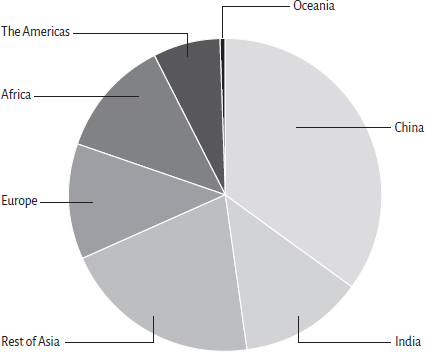
Share of the world population c.1100 AD
THE BLACK DEATH AND SECULAR CYCLES
Thanks to collective learning, innovations in agriculture and the opening up of new lands to farming, the world population ballooned from 300 million in 1100 to 400 million by 1200. The common population was fairly prosperous, with low rents and decent wages, ate meat semi-regularly and were in fairly rude health by pre-modern standards. Agrarian civilisations were fairly stable (internally at least), compared to the periods that came before and after.
But population growth began to outstrip agricultural innovation. Between 1200 and 1300, the population only grew to 432 million. Population strain was starting to set in. The standard of living for the agrarian peasantry declined: they ate less meat, their wages shrank, their rents rose, smallholding farmers had to sell their land and elites set up huge estates as their numbers multiplied several times.
From 1315 to 1317, the Great Famine of Europe killed an estimated 15 per cent of Europe’s population. A famine in China in 1333–37 carried off similar numbers. The common population declined and the elite incomes that depended on them were reduced, and some elites even became impoverished. Politics destabilised across the world, with an increased number of elite rebellions, assassinations and palace coups.
But much worse was on the way, courtesy of the Silk Roads. The Black Death was an extremely deadly disease caused by the bacterium Yersinia pestis, carried by fleas, which in turn are carried by rats. Once bitten by an infected flea, a human develops swollen lymph nodes around the groin, which are painful at the touch. As the bacteria works its way through the human blood-stream, plague victims experience fever, weakness, delirium, headache, bloody vomiting and the death of flesh and internal organs, which can turn black and gangrenous. Death usually occurs within a week to ten days, and death was the outcome for roughly 80 per cent of bubonic plague victims. If the plague turned pneumonic, the death rates was between 90 and 95 per cent; very often people with pneumonic plague died within just two to three hours of catching it.
The Silk Roads transported the Black Death east and west. Sporadic outbreaks occurred in China in the 1340s and a more severe pandemic swept across all of China between 1353 and 1354. The resulting population downturn, elite infighting and state collapse led to the overthrow of the Yuan dynasty in favour of the Ming in 1368. Plague and a depression phase reduced the Chinese population from 120 to 140 million in 1200 to 65 million people by 1393.
The Black Death also spread to Persia from Central Asia by 1335, killing an estimated 30 to 50 per cent of the population, including the ruler of the Ilkhanate, which had dominated the region since the fragmentation of the Mongol Empire in 1256–59. This caused the collapse of the khanate into several rival kingdoms. From 1338 to 1344, the Black Death spread across the trade routes of the Golden Horde to the north, killing an estimated 30 to 70 per cent of the population.
In 1344, an already infected army of the Golden Horde besieged the Genovese-held Crimean trade port of Kaffa. The Golden Horde placed plague corpses onto catapults and flung the bodies over the city walls, in one of the first recorded instances of biological warfare in human history.
The Black Death managed to get on board Genovese trading ships and began to infect the Mediterranean. The disease arrived in the port of Constantinople in 1347 and then spread overland across Anatolia, reaching Damascus in 1348, where an estimated 2000 people died per day. That same year the Black Death reached Egypt, where it killed an estimated 50 per cent of the population of Cairo. Due to the Muslim tradition of making a pilgrimage to Mecca, the Black Death arrived in their holiest of cities in 1349.
Back in 1347, the Genovese traders had also travelled on to Greece, Sicily, Sardinia, Corsica and Marseille. In 1348, traders reached England, Ireland and northern France. In 1349, the Black Death rushed through southern Spain and got as far as Morocco. Infected ships arrived at Bergen in Norway. The plague spread from England to Scotland, from Norway to Sweden, and from France to the Holy Roman Empire in 1350. Poland and Russia were hit in 1351 and 1353. Only the small, cold-dwelling population of Finland was spared.
In 1300, the world population had been 432 million. By 1400, from a mixture of famine and plague and the decades of violent instability that usually follow depopulation, the world population had shrunk to 350 million people.
An intriguing side-effect of population collapse, however, is that life becomes quite prosperous again for the common people. A shortage of labour means higher wages, an abundance of land left over by the dead means lower rents and sustainable peasant farms, while food is cheap because there are fewer people buying it. The peasantry might even possess what we would call a ‘disposable income’ for a few modest luxuries. The common people of Afro-Eurasia had a high standard of living and a larger ‘real wage’ than in any period prior to the Industrial Revolution.

Plague doctor
THE AGE OF CHINESE EXPLORATIONS
After the Black Death, the Ottoman Turks shut down much of the overland trade on the Silk Roads. The disruption of the network of exchange prompted explorers at either end of the Afro-Eurasian supercontinent to find new routes by sea.
In 1403, the Ming dynasty began construction of a gigantic fleet of warships and merchant vessels that dwarfed anything else in the world at the time. The Chinese exploration fleet was composed of 317 ships, some of them approximately 120 metres high, with three or four decks, carrying a massive army of 28,000 men to, shall we say, add weight to trade negotiations.
Starting in 1405, numerous expeditions were launched. The Chinese fleet sailed around South-East Asia and to India on several occasions. They sailed down and conducted trade in Indonesia. They made landfall in Arabia and East Africa on several occasions. In total, seven expeditions were made.
The final voyage ended and returned home in 1433. At this point China, already a mighty empire with many natural resources and luxury goods, turned to isolationism. If these voyages had continued, it is not unreasonable to speculate that the Chinese could have eventually sailed around the southern tip of Africa, perhaps even achieving direct trade with Europe. It is also possible the Chinese could have moved further south from Indonesia to Australia. And perhaps the Chinese could even have navigated the Pacific, taking them to the Americas.
THE AGE OF EUROPEAN EXPLORATIONS
In the fifteenth century, European states could not gain as much income from taxing the farming population as they had prior to the Black Death, and so merchants and commercialism began to be looked upon more favourably. Yet the Ottoman Turks had shut down much of the trade via the Silk Roads in their bid to conquer Europe. The Europeans recoiled West.
By the 1420s, the Portuguese and Spanish had landed in the Canaries, Madeira and the Azores, and charted a good distance down the seemingly unending African continent. In the 1440s and 1450s, Portugal began a great deal of trade with the Mali Empire. Portugal gained access to pepper, ivory, gold and the African slave trade. Bartolomeu Dias reached the Cape of South Africa in 1488. And in 1498, Vasco da Gama rounded Africa and reached India, and brought back a cargo of spices. Bypassing the hostile Ottomans, da Gama was able to purchase his cargo for 5 per cent what it would have cost him buying from eastern Mediterranean sources.
The problem with sailing around Africa is that near the equator one hits a region called the ‘doldrums’. This is a long stretch of ocean where the winds are frequently too weak to propel sail, and where ships were frequently hit with dangerous storms.
Alternatives were already being sought. In 1492, Ferdinand of Aragon and Isabella of Castile commissioned an expedition led by Genoese explorer Christopher Columbus (little did they know the voyage had already been made by the Vikings nearly 500 years earlier). Columbus left Castile in August, sailed west, and reached the Bahamas in October. He went on to visit Cuba and Hispaniola. Upon the native populations, Columbus established a regime of enforced slave labour, sexual slavery and mutilation for disobedience; all the while the island populations were gradually wiped out by European diseases. To his dying day, Columbus was certain that he had landed in Asia.
In 1519, the Spanish monarchy commissioned Portuguese explorer Ferdinand Magellan to take five ships, sail south of the Americas and enter the Pacific, whereupon Magellan crossed the vast ocean and reached the Philippines, where he was killed in 1521. Only one ship managed to return to Spain, in 1522, under command of Juan Sebastian del Cano, being the first crew to circumnavigate the globe.
The sixteenth century set off an explosion of European and colonial merchant ventures to Asia and the Americas, with states, private investors and individuals seeking vast fortunes. Habsburg Spain dominated these trade networks and the acquisition of colonies in some of the most mineral-rich parts of South and Central Americas. Other prominent nations that joined the colonial effort were England, France and the Netherlands, with even a few attempts to set up colonies by Scotland. The nations of Central and Eastern Europe largely missed out on the Age of Explorations due to local wars and their geographic locations.
From 1519 to 1521, Hernán Cortés led a few hundred Spanish conquistadors, armed with gunpowder weapons and a cocktail of diseases against the Aztecs. As a result of the high death rates of Aztecs at the hands of European disease and Cortes allying with various local enemies of the Aztecs, all of Mexico fell into Spanish hands within a few short years. In 1532, Francisco Pizarro led a similar expedition against the Incan Empire, and was also aided by gunpowder weapons and the horrible ravages of European disease. However, the Incan Empire stretched across vast and difficult terrain and the Spanish did not fully conquer the empire until 1572, as the result of a long and gruelling war of annihilation.
THE SLAVE TRADE
In the Caribbean and South America, Europeans had stumbled across a climate that was ideal for sugar plantations. The question was finding enough labour to engage in such gruelling work. Lower-class Europeans weren’t the answer. Only indentured servants shipped over to the Americas could possibly be forced into it. And they soon moved on after their contract was up, and there certainly weren’t the numbers of people willing to do it. The Spanish and Portuguese initially tried forcing the native inhabitants of the Americas to do it. But they knew the countryside and frequently escaped back to their people. Those who stayed often died of Afro-Eurasian diseases. So the Portuguese utilised the slave trade with African rulers they had entered into half a century earlier.
Slavery had existed since the inception of agrarian states 5500 years ago. There had been slavery in Europe, in Africa and in Asia. The Aztecs and the Incans had held slaves. As had the Chinese, Koreans and Indians. Of the roughly 55 billion people who lived in the Agrarian Era, an estimated 3 to 10 billion of them may have been slaves.
Europeans were no strangers to slavery. The Romans had owned huge plantations across the Mediterranean world operated by millions of slaves. The Middle Ages blurred the lines between slavery and serfdom, which wasn’t much better (though it certainly was an improvement). In fact, serfdom was an early medieval perversion of older systems of slavery, even in its name: ‘serf’ being derived from the Latin servus (slave). To the east, Russia did not abolish serfdom till 1861.
The kingdoms of West Africa had been engaging in the Muslim slave trade for several centuries by the fifteenth century, with the forced transport of people across the Sahara. The demand for African slaves had increased since the number of Europeans captured and enslaved by Muslims had slowly declined since the eleventh century. The Africans themselves primarily derived their slaves from peoples they conquered in war (but debt or birth into a slave kin-group were also causes for slavery), and Africans either kept them or sold them off across the Silk Roads. When the Portuguese opened up trading relations with African rulers in the 1440s, the slave trade was extended to them as well.
The horrors of transportation killed 10 to 20 per cent of Africans moved across the Atlantic. The route-march east across the Sahara claimed 25 to 50 per cent of those sold or captured. In total, 11 to 14 million Africans were taken west across the Atlantic in just 400 years, and 10 to 17 million Africans were taken east across the Sahara over 1100 years. An average of 5 to 15 per cent of the population were slaves in the agrarian states of Africa.
Slavery was the rule of agrarian states. Absence of slavery was the exception. From the perspective of the chained, across the globe, it had been a hideous 5000 years.
The Portuguese were responsible for 45 per cent of all slaves taken during the Atlantic slave trade. Their former colony, Brazil, was the destination of 35 per cent of all slaves in the Atlantic trade and also one of the last of these countries to abolish slavery, in 1888. The Spanish account, for roughly 15 per cent of all African slaves, transporting most of them to South America and their Caribbean island holdings. They also made more determined use of Native American slavery, particularly in their mining operations. The French transported 10 per cent of African slaves to their holdings in the Caribbean, mostly plantations. The Dutch did the same with 5 per cent of the total number.
In the seventeenth and eighteenth century, forced plantation slave labour expanded from sugar to include the production of tobacco (another highly addictive product) and cotton for textiles. This made slave labour desirable for farms in the southern half of the Thirteen Colonies. As such, the British imported 15 per cent of the total number of African slaves to their Caribbean plantations and approximately 10 per cent were imported to lives of bondage in the future United States, for a total of 25 per cent of the slave trade.
In the 1500s, an estimated 400,000 to 500,000 Africans were enslaved by Europeans (1 per cent of Africa’s population). In the 1600s, this number increased to 1 to 1.5 million (2.5 per cent). In the 1700s, 5 to 8 million people (10 per cent) were bought, bound, packed into appalling conditions in ships and sent to the Americas.
It was the horrific scale of the 1700s that finally sparked the abolitionist movement in Great Britain. A thirty-year public and parliamentary campaign led to the British abolition of the slave trade in 1807, making further purchase and transportation illegal. And the British Navy became actively engaged stopping the transportation of African slaves by other nations. Nevertheless, the remaining slaver Atlantic states succeeded in transporting an additional 3 to 4 million slaves from Africa in the 1800s (4–5 per cent of Africa’s population). The British Empire abolished slavery itself in 1833, and slowly, either by brutal civil war, gruesome revolution or peaceful legislation, the rest of the Atlantic nations followed suit in the subsequent decades.
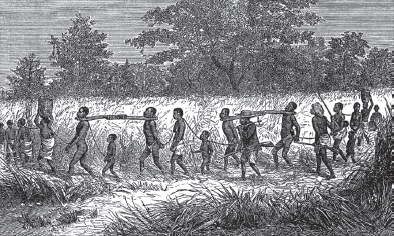
The African slave trade
In Africa itself, slavery continued, particularly in North Africa, where slavery was given a religious and ethnic justification. In the late nineteenth century, European imperialism and intervention attempted to expunge slavery from Africa itself, but very slowly and often ineffectively. Or, depending on the colonial power, even half-heartedly. Or prolonged it.
Even today, in the postcolonial era, slavery in Africa is still a problem. In modern Nigeria, there are 700,000; in Ethiopia, 650,000; in the Congo, 500,000; and in total roughly 5 to 10 million people leading lives effectively as slaves in Africa. Beyond Africa, there are 12 to 14 million de facto slaves in India, 2 million in Pakistan and 3 million in China. There are currently 47 million slaves worldwide, which is roughly the population of Spain.
ECOLOGICAL IMPERIALISM
Europeans brought to the Americas and Australasia all their domesticated farm animals, a necessary ingredient for settler colonies. Sheep and cattle were bred so prodigiously that they quickly became some of the most common mammals to be found in either world zone. In the Americas, by 1600 there were 20 million sheep and cattle.
When humans arrived in the Americas 12,000 years ago, they hunted American horse species to extinction. Once Europeans arrived, they reintroduced the horse. Some horses were obtained by Native Americans. As a result, the lifeways of Native Americans in the Great Plains were radically changed. Many cultures switched from agrarian cultures that had existed in the Great Plains for thousands of years to become nomadic foragers once again. Prior to the horse, Native Americans would camouflage themselves with pelts and crawl along the ground to get close enough to herds of buffalo. When they got near, they’d spear a buffalo before the herd started to stampede away. With the arrival of the horse, Native Americans could now keep pace with the buffalo and spear them as they chased them, or else herd them off the edge of cliffs. By the nineteenth century, the Great Plains peoples had kept horses as a keystone of their culture for 300 years. Long enough that some Native American accounts depict the horse as always being in the Americas and part of their way of life.
New World crops in turn impacted Afro-Eurasia. In terms of caloric intake, maize bequeaths more than wheat and only falls short of rice per square kilometre. An example would be potatoes, which is not only quite good on the caloric front but actually enriches the soil with nutrients as they grow. Maize and potatoes also come with the advantage that they are easier to prepare and cook than something like wheat or rice. The Americas also gave the world tomatoes, yams and squashes that were similarly high-yield per square kilometre. The European carrying capacity, where American crops were adopted, increased by 20 to 30 per cent. In China, the population was starting to experience mass famines in the 1630s, but adoption of American crops prevented another mass famine from happening until the nineteenth century, during which time the Chinese population increased from 150 to 330 million people.
Disease utterly destroyed the inhabitants of the Americas and Australasia. For thousands of years, at this point, Afro-Eurasia had been host to 90 per cent of the human population, most of whom were living in densely packed agrarian states where basic hygiene and germ theory were conspicuously absent. Inhabitants of Afro-Eurasia had developed genetic resistances to diseases over hundreds of generations, but the populations of the Americas and Australia had no such biological resistance. European colonists brought over smallpox, typhoid, cholera, measles, tuberculosis, whooping cough and numerous influenzas. While these were still deadly to Europeans, the impact on indigenous populations with no resistance was much worse.
In the Americas, Afro-Eurasian diseases are estimated to have wiped out 90 per cent of the population between 1500 and 1620. Some 50 million people were killed in a world populated by 500 to 580 million. Just by the simple act of Europeans showing up. And that was done in the space of a century. In 1620, only 5 million Native Americans remained in North and South America. This was an unsurpassed obliteration of human civilisation the equal of which cannot be found in human history. Afro-Eurasian diseases would continue to wreak havoc on Native American populations throughout the nineteenth and into the twentieth century.
In Australia, the cocktail of Afro-Eurasian diseases reduced the Aboriginal Australian population by at least 73.75 per cent between 1788 and 1900. Most scholars today agree on a pre-contact population of around 800,000. In 1850, the population had already shrunk to only 200,000 people. In 1900, the Aboriginal population was 90,000. Using Butlin’s calculations, that European expansion of farmland caused an upper limit of 100,000 Aboriginal Australians to starve to death, and using Reynolds’ estimate for the unrecorded number of Aboriginals who died in frontier violence against recorded European deaths, that makes 73.75 per cent of the population reduction being from disease, 12.5 per cent from starvation and 2.5 per cent from frontier violence in a little over a century.
Imagine if, in the space of a century, 8 billion people on Earth started dying until there was only 800 million left. Cut down the population number of your own nation to 10 per cent if that strikes closer to home. That was the cost of the unification of the world zones. While American crops were raising the carrying capacities of Europe and Asia, sending their populations soaring, the populations of the Americas and Australasia were being reduced at nightmarish rates. Even writing this now, I can barely conceive of the devastation and suffering wrought by such biological terror.
ON THE VERGE OF THE ANTHROPOCENE
Reflect back on the journey of complexity thus far. The firestorms of the Big Bang and exploding stars. The hellish formation of the Earth. The blood-soaked evolution of species. The propensity of primates for murder. The deprivations and disease of the Agrarian Era. And now this. Complexity is not synonymous with ‘progress’. All of our comforts and conveniences today have come at a tremendous cost that most people can barely contemplate.
Complexity exists in a Universe beset on all sides by the Second Law of Thermodynamics. With every threshold of complexity has come destruction and, where there is consciousness, suffering. Nothing about our current point in history was predestined. It has not been a routine march towards air-conditioning and iPhones. It has been a struggle. A blind struggle. That struggle continues today. But with a little more foresight.
The fascinating part of this history is that with every increase of complexity comes the mounting possibility of final victory over the Second Law and the tremendous natural burdens we have shouldered for 13.8 billion years.