
PART FOUR
The present to 1040 years from now
12
Wherein humanity’s destiny in the Anthropocene is one of four broad possibilities • The natural future of the Universe sees complexity fade • The potential of complexity in the Deep Future may lead to the rise of super-civilisations • The end of the Universe will be either the Big Freeze, Big Rip, Big Crunch or Big Save.
THE UNIVERSE BEGAN AS A WHITE-HOT SPECK of energy within which all the ingredients for everything we see around us – whether by our own eyes or by powerful microscopes and telescopes – already existed. According to the First Law of Thermodynamics, which states that nothing (on the Newtonian scale at least) is created or destroyed but only changes form, we are the Universe. Just a highly complex, conscious and self-aware part of it. One totality. Looking at itself. That fact alone is worth celebrating. We have been given the gift, however flawed our vision, of looking into the great beyond. Not many clumps of atoms can claim that honour.
When the physical laws of the Observable Universe became coherent 10–35 seconds after the Big Bang, so too emerged tiny dots of unequally distributed energy. The Second Law of Thermodynamics began to force these dots to even out by sending energy from where there is more to where there is less in order to achieve a cosmos with equally distributed energy. Energy flows created stars, diverse chemicals, organisms and societies. All complexity in the Universe was created, sustained and increased in complexity by energy flows. From sunlight to photosynthesising plants. From table to mouth. From gas pump to jet engine. In a Universe that is 99.9999999999999 per cent dead, tiny dots in the cosmos have been getting progressively more complex. Regardless of where things go from here, we are lucky to be along for this part of the ride, where complexity is higher than at any point in the past 13.8 billion years. Not just lucky in a sentimental sense but a mathematical sense of several quintillion to one.
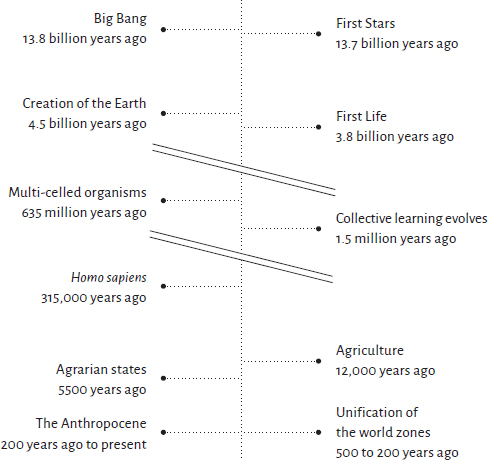
The overarching trend of universal history is complexity, and the overarching trend of human history is collective learning – which in turn increases complexity. Using these two trends, we can make some forecasts about the future on short and long time scales. This is somewhat rare in the field of historical studies. Moreover, it is only in the future where the trends of complexity and collective learning really bear fruit and make the meaning of the upward trend clear for the reader.
So where exactly is our story likely to go next?
PREDICTING THE FUTURE
When predicting the future, you must not predict one future but several. And then assess each scenario based on their plausibility. These multiple futures, regardless of their exact detail, fall on a spectrum.
1.Projected future: What science says is happening. Things play out how current trends suggest they play out. It is business as usual, where we assume no major change to variables or behaviours, and no dynamic discoveries. The projected future may not even be the most likely future, since new discoveries and changes in variables do eventually occur, but it forms an important baseline for our forecasting. For instance, a projected future would involve the outcome of greenhouse gas emissions and global industrial growth continuing at current rates.
2.Probable future: What science says could happen. Where variation or change within the bounds of known science indicates where trends might go. The probable future is the projected future’s margin for error, or margin for variation. A probable future refers to something that science already understands but which hasn’t yet come to pass: for example, transition to and heavier reliance on solar technologies and less reliance on fossil fuels.
3.Possible future: What science might discover. Where a discovery as yet unknown to science alters a future outcome, or where we can’t scientifically explain in detail how everything will work. We are not visionary engineers capable of predicting technological progress 200 years from now. Imagine how difficult it would have been in 1800 AD to predict the existence of the internet, or its societal effects. A possible future has an unknown variable like an algebra equation: ‘present + x = outcome’. In fact, like an algebra equation, we can use the known variables to get a clearer picture of what the value of x actually is. Major advances in AI or nuclear fusion or quantum computing innovations (which we do not yet know how to fully engineer) would fall into this category.
4.Preposterous future: What science says can’t happen. Where an outcome seems to openly defy the laws of known science, contradicting all available data or understanding. It plays an important role in prediction because it clearly defines what a possible future is by mere contrast. It prevents speculation about technology going too overboard. But it can also serve to predict technologies that are currently too mind-boggling. The Moon landing might have seemed preposterous to someone in 1800 AD, before rocketry or even human flight. An example of a preposterous future today is a technology that defies the Second Law of Thermodynamics.
In fact, on a long enough timescale, complexity can turn the preposterous into the possible, then the probable, and even the projected. If nothing else, the only way to figure out the limits of the possible is by going beyond them to the impossible.
ANALYSING THE NEAR FUTURE
It is actually easier to predict the Deep Future, which has timescales of billions and trillions of years, than it is to predict the Near Future on timescales of hundreds or thousands of years. This is entirely down to complexity. Cosmological changes in the wider Universe that take billions of years to occur deal with relatively simple systems and calculations. Provided we have the right data, we know how long the Sun will live and how long it will take Andromeda to combine with the Milky Way, despite the fact that those things are billions of years away. Humanity is a much more complex system. Each individual human is capable of billions of different behaviours. In aggregate of billions of people, this makes for quite the calculation – one which no supercomputer is capable of. It is very difficult to predict what inventions humanity will stumble upon, and how these inventions will affect people’s behaviour in society. Finally, humanity’s interactions with nature (something that is also very complex) make it difficult to predict the rise of diseases or natural disasters.
Even though the events of the next century are difficult to predict, all the possible outcomes of the Near Future over the next 100 to 300 years fall into four broad categories. They relate to whether human complexity rises, stabilises, gracefully decreases or collapses.
1.Technological breakthrough: Where human society does not hit a limit to its current modes of production in the next 100 to 300 years and rates of innovation keep pace with growth of the human population. Perhaps it involves the economically viable distribution of nuclear fusion power, making energy cheap enough even for the poorest countries to develop, with an exponential increase on the limits of energy and production globally, and without the corresponding degradation of the biosphere that comes with fossil fuels. But such a breakthrough also includes those scenarios where humanity hands the reins of future complexity to artificial intelligence. That is, collective learning sets off another jump in complexity.
2.Green equilibrium: Where human society over the next 100 to 300 years does not develop a major technological breakthrough in the Near Future (by no means a guarantee, since the first agriculture and Industrial Revolution are 12,000 years apart) and lives within its means to avoid total degradation of the biosphere. This may include technological innovation at a smaller scale, along with some good planning, government policy and a shift to more sustainable forms of production. Human complexity does not increase significantly, nor does it decrease.
3.Creative descent: Where human society invokes a form of policy that actually reduces human production and consumption in order to ward off environmental or demographic disaster. It is a deliberate unravelling of human complexity. Examples of scenarios within this category include radical population control and reduction, dismantling of heavy industry, restrictions on car and air travel, restrictions on energy consumption and production rather than their replacement with renewable forms, rationing of food and clothing, and so on. Over a long enough period of descent, human complexity more closely resembles the agrarian states of 300 years ago than society today.
4.Collapse: Involving every conceivable doomsday scenario. Environmental disaster, nuclear war, superbugs, an asteroid impact or a super-volcanic eruption. This category covers every scenario where human complexity dramatically declines, regardless of the cause.
Take a moment and ask yourself which future is the most likely? Why? For nearly two decades, the public discussions about climate change have prompted a notable rise in pessimism in developed countries. After two years of a global pandemic that resulted, among other things, in job losses and a spike in mental health issues, that pessimism may well have increased.
However, on a long enough timescale, collective learning will prompt another breakthrough in technology. Human complexity simply has to endure the scenario that occurs for long enough without collapsing for this to take effect. In that sense, humanity’s great task in the twenty-first century is to survive it. In all likelihood, we shall, which means that complexity might continue to increase for many millennia to come – with all the astounding new breakthroughs that implies.
In the wider context of rising complexity in the Universe, what happens in the twenty-first century may determine whether the trend continues or ends here. In that sense, the generations alive today and those that will be born in the next few years stand at a pivotal moment in history. It is a period where human actions will have a magnified impact, much more than any king, peasant, farmer or forager spread across the last 315,000 years. In a very real material and temporal sense, what you do in your life matters, and potentially may echo into the future – in a way that very few individual actions have done before.
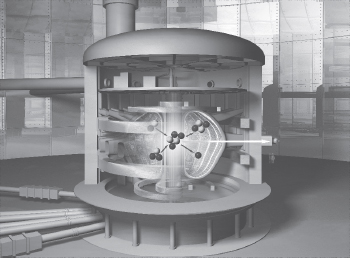
A hydrogen reactor
THE ‘NATURAL’ DEEP FUTURE
Analysis of the Deep Future falls into two broad streams. The first is the ‘natural’ projected/probable futures of the Earth and the Universe, where higher complexity like biology or society have no impact on the processes of cosmology. The second stream is a series of possible/preposterous futures where complexity continues to increase for millions, billions and even trillions of years beyond the current stage of human technology on Earth to the point where the wider cosmos is affected and manipulated by us.
According to current data, here are the natural projected/probable things that will happen in the Deep Future:
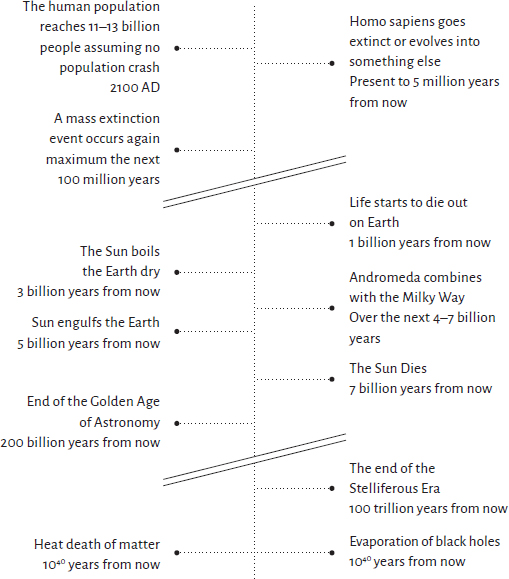
1.1 billion years from now, death of the biosphere: Mass extinction events happen every 100 million years on average. But so far they have not yet succeeded in ending the world, just in wiping out a large percentage of existing species. The Deep Future is much more certain. In about a billion years, the Sun will begin to exhaust its fuel. Its luminosity will increase, CO2 levels will decrease, and this means plants on Earth over the following years will find it harder and harder to do most forms of photosynthesis and thus sustain complex life on our tiny rock. Life would struggle and decline from the 1-billion-year mark onward. That’s nearly twice the amount of time that separates us from the Cambrian Explosion 541 million years ago. That’s a great deal of time for multi-celled species to continue to evolve and change for a period of time nearly double what separates us from our jawless fish vertebrate ancestors. Even if humans go extinct, it is entirely possible that another species capable of collective learning could evolve during that time and then in a few hundred thousand years match or surpass our current level of complexity.
2.3 to 7 billion years from now, death of the Earth and the Sun: At the 3-billion-year mark, the Sun will grow larger and larger until it boils the surface of the Earth dry. Once we get to an Earth’s surface with a temperature greater than 100°C (212°F), we can be pretty sure that’s it for life on Earth. Perhaps some single-celled organisms could still exist in the cracks of the Earth, but that is a clear decline of complexity and the end of the tale in our biosphere. Then the Sun will grow so large it will engulf the Earth, burning and absorbing whatever is left. The planet itself will be destroyed. The Sun may also bloat up to destroy Mars. But it will never get so large that it goes beyond that, leaving the Asteroid Belt and the gas giants largely unscathed. After that, the Sun will shrink back and eventually extinguish itself. If our descendants are still around in such a massive number of years, we are likely to be incredibly advanced in technology to the point of being godlike. We will either have left the Earth to terraform and live on the moons of Jupiter and Saturn, or we may well have macro-engineered the Sun so it has a replenished supply of hydrogen to burn, or we may have left the solar system for other planets, abandoned the galaxy entirely or evolved to somehow not require a planet to live on at all.
3.200 billion years from now, end of the Golden Age of Astronomy: As dark energy continues to accelerate the expansion of the Universe past the speed of light, we would no longer get to see the light from other galaxies. If we were to lose the knowledge of Big Bang cosmology, our galaxy would be all we’d see. Or think exists. We’d revert to the idea that the Universe had no start date, is static and eternal. The Milky Way would be our entire Universe. That is why a number of scientists refer to the current age where we can see evidence for the Big Bang, and can see other galaxies, as the Golden Age of Astronomy. We are lucky to have been born at such an early stage in the Universe, where, relatively speaking, the cosmos is still in its infancy, being only 13.8 billion years old in a Universe that will live on for many trillions of years.
4.100 trillion years from now, the end of stars: Once the Universe is trillions of years old, all new star formation will have ceased in all the galaxies of the Universe, and only the smallest slow-burning stars will still be burning. By the time we reach 100 trillion years from now, the last of these tiny, slow-burning stars will have died. At this point there will be no conventional energy flows to sustain life on planets, and it will become difficult for any moderately advanced seafaring societies to find enough energy flows to sustain or increase their complexity. One alternative would be to use the radiation that comes from black holes, but this does not emit in such generous amounts as a star. The saving grace of this projection is the astounding lengths complexity could have reached after trillions of years of collective learning (or whatever more rapid process supersedes it).
5.1040 years from now, heat death of matter: This is a 1 with forty zeros, or 10 duodecillion years from now. Or to put it another way, a trillion multiplied by a trillion, multiplied by another trillion, plus four more zeros. Or to put it yet another way, nearly three times the length of time that separates us from the end of stars. At this point, not only will stars have disappeared but the very fabric of planets and asteroids will have crumbled. All molecular combinations in the Universe will have long since decayed and only singular atoms will remain. Except these will have gradually decayed into simpler and simpler atoms too. Once we are down to just hydrogen atoms, these too will decay back into energy and the Universe will be nothing but a void filled with weak radiation becoming more and more evenly distributed thanks to the Second Law of Thermodynamics. The energy flows that created complexity so far in our story will have finished their work and all complexity in the Universe will have come to an end. This is what I meant when I said that the Second Law is at once the creator and destroyer of worlds. What we will have left is a blank eternity, with no change, no events, no history. Not just the end of the world, but the end of our story. The end of all history. 1040 years from now, even black holes will have emitted all their radiation and evaporated into thinly distributed energy as well.
This scenario is known as the ‘Big Freeze’ and is the projected end to the history of complexity in the Universe according to our current data. This is built on the idea that the Universe will continue accelerating and expand forever.
There are also two probable futures for the end of the Universe, if we observe new rates of expansion in the Universe which alter the data we use to make predictions. If the Universe is accelerating faster in expansion than we currently observe, then we have the ‘Big Rip’ scenario, where the Universe expands so quickly it increases the space between galaxies, then overpowers the force of gravity and tears galaxies apart, then overpowers the nuclear forces that hold atoms together, and rips stars, planets and organisms apart. This could happen in as little as 20 billion years from now. I say ‘little’, but that is still a heck of a long time.
The second probable future is the ‘Big Crunch’, where the acceleration of the expansion of the Universe actually slows down and reverses itself, eventually squeezing all galaxies in the Universe back together, and then further back into the white-hot singularity with which our story began. If this sets off yet another Big Bang, this leads to the corollary ‘Big Bounce’ scenario, where the Universe expands again and is reborn over and over. Very poetic and appealing. Data doesn’t currently reflect this, but if the expansion of the Universe slowed down and reversed itself, this could take somewhere between 50 and a few hundred billion years.
As grim as the ‘Big Freeze’ scenario may sound, with its ‘dying with a whimper’ aesthetic, it actually gives complexity the maximum amount of time (trillions upon trillions upon trillions of years) to continue to increase and find a solution to the mortality imbued in the Universe by the Second Law of Thermodynamics. In that sense, we should actually be popping the champagne that the ‘Big Freeze’ thus far seems to be the most likely outcome of our story.
THE DEEP FUTURE OF COMPLEXITY
Consider how ‘young’ the 13.8-billion-year Universe is in terms of the 100 trillion years it will exist before all the stars burn out, and the trillions upon trillions upon trillions of years before the heat death of matter. Consider the tiny amount of time that biological complexity has existed on Earth (3.8 billion years) and the even more infinitesimal amount of time that humanity has existed in literate states and societies (5500 years). Finally, consider how far collective learning and scientific progress has accelerated in the past 200 years.
That is such a small percentage of the amount of time that the Universe will exist that it is negligible. It is not even worth expressing in a percentage, given all the zeros that will go in front of it. And if complexity continues to accelerate (as it currently is), then once we start to consider where it could go in thousands or millions of years, to speak nothing of billions or trillions, then a highly advanced society could conceivably impact the natural evolution of the Universe.
Assuming that complexity continues to increase, this outcome is not only possible but it gradually becomes probable or even projected.
Yet it is almost impossible to predict what such advanced complexity would look like. Humans have difficulty speculating what technology will look like a decade from now, much less what it will look like on the timescale of thousands or millions of years. But there is one way in which we can gain an idea of just how complex and powerful those super-civilisations would be someday.
At the beginning of this book, we explored a metric for complexity – the density of energy flows that create, sustain and increase complexity. The Sun achieves 2 erg/g/s, an average photosynthesising organism 900 erg/g/s, a dog 20,000 erg/g/s, human foraging societies 40,000 erg/g/s, agrarian states 100,000 erg/g/s, nineteenth-century industrial society 500,000 erg/g/s and society today 2 million erg/g/s. With a quantifiable metric such as this, we are able to project how complex super-civilisations would be in the Deep Future, and even estimate how long it would take us to reach that point.
With each increase in energy flows came an increase in the structural intricacy of complexity: from a blob of hydrogen atoms to a single cell with DNA, to multi-celled organisms composed of a network of trillions of cells, to the networks of humans, their domestic animals and all our machines which form a society. Also, at each increase of energy density comes the ability of humans, at least, to consciously manipulate the laws of physics and alter the environment around them to ensure their continued survival.
Without having the faintest idea of what science or miraculous inventions would arise in such super-civilisations, the trends we have so far observed in our story imply that complexity could become so advanced that it would start influencing the structure of galaxies and cosmological evolution itself.
SUPER-CIVILISATIONS
In 1964, Russian astronomer Nikolai Kardashev proposed a scale by which we could evaluate advanced civilisations based on how much energy they harnessed. The various stages on this scale are measured by harnessing the equivalent of all the energy of a planet, star or galaxy. Note that does not necessarily mean that a planet, star or galaxy must be the actual source of such energy, but simply that a super-civilisation has somehow generated the equivalent of such energy.
1.Type I Civilisation (Planet): In the Anthropocene, humans are actually quite close to harnessing the energy equivalent of an entire planet. We are currently a ‘0.7’ civilisation or higher. So if we project a little into the future, our average free energy rate density would be 2,600,000 erg/g/s. In fact, that is such a small increase in average energy flows for society one can quite adequately speculate what such a society would look like: a planet without much larger a population, with more abundant energy sources to sustain their complexity (for example, a population of 10 billion with nuclear fusion reactors all living at a standard of living akin to the developed world today or better). If we project the accelerating rate of increasing complexity for humanity from the foraging era to today, the calculation indicates that humanity will achieve a Type I civilisation in 300 years or less. Purely by looking at the numbers, humanity’s future looks fairly bright. Assuming we can keep complexity from backsliding. This is precisely why the current generations alive today are so pivotal in our story.
2.Type II Civilisation (Star): At this point, we have moved from projected and probable futures to the possible futures where science does not yet have the precise knowledge to explain what technology would get us to this stage. The stage at which humanity (or whatever we turn into) harnesses the energy equivalent of a star may conjure up images of a Dyson sphere. This is where we surround a star with panels that absorb all the energy it gives off, rather than the small fraction of the energy it throws off into the entire Universe and hits plants or solar panels or other energy sources here on Earth. The free energy density of a super-civilisation that harnesses the energy equivalent of a star is approximately 70,200,000,000 erg/g/ – a major leap forward in complexity compared to modern society. And considerably more structurally intricate and capable of manipulating the surrounding environment and/or the fundamentals of physics in the Universe. That is roughly the same degree of difference in complexity that separates a single-cell organism from a World War II Spitfire engine. It is distinctly possible by this point that humans may be ‘trans-human’ or ‘post-human’. Perhaps humans will have managed to reverse the effects of biological aging, or even uploaded their consciousnesses to computers to live on forever, either as a collective consciousness or individual cyborgs, with such advanced calculating power that collective learning, communication and new inventions blaze along at blinding speed. Again, according to the current rate of acceleration of complexity, this would take us another 25,000 years at most. 25,000 years ago, human foragers were spread across Africa, Europe, Asia and Australasia. It is roughly twice the space of time that separates us from agriculture. In terms of the total life expectancy of complexity in the Universe, even 25,000 years is an insignificant fraction of trillions upon trillions upon trillions of years. Even if we just consider the 100 trillion years where stars will still burn, that is 0.00000000025 per cent of the time we would have to reach this stage.
What these numbers make clear is something astrobiologists and SETI-enthusiasts (those engaged in the search for extra-terrestrial intelligence) already suspected: that it may take billions of years for complexity to get started in the Universe, but once it gets going, the time between each breakthrough gets smaller and smaller and smaller.
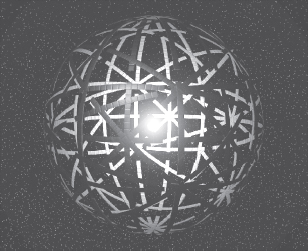
Dyson sphere
This leaves an insane amount of time for complexity to rise somewhere in the Universe – even if it doesn’t happen with our particular species.
3.Type III Civilisation (Galaxy): If our hypothetical super-civilisation finds that harnessing the power of a single star isn’t enough to manipulate the most fundamental laws of physics in the Universe, then they could always move on to harness the energy equivalent of the 200 to 400 billion stars that exist in the Milky Way galaxy. Such a powerful super-civilisation would have 14,000,000,000,000,000,000,000,000 erg/g/s (14 septillion) in free energy density. That is greater in terms of complexity than the difference between a single subatomic particle and modern society. Such a super-civilisation would essentially make our entire society and its powers look as complex as a quark. At this point we are talking about a society that has indisputably godlike powers to the point that it could probably manipulate an entire galaxy, if not the fundamental laws of the Universe itself, to suit its interests. If we use the same rate of acceleration of complexity, as massive as this number is, this could be achieved in less than 100,000 years. The same amount of time that separates us from Homo sapiens first migrating out of Africa. Even if these projections are off, physicists have previously estimated it would take between 5 and 50 million years for us to reach every solar system in the galaxy (assuming it is impossible to move faster than the speed of light). Or roughly the same amount of time that separates us from our last common ancestor with chimpanzees or with primates. Even 50 million years is a tiny fragment of the amount of time life on Earth has existed, much less the length of time that stars and galaxies will continue to exist.
If we literally harness the stars in a galaxy to achieve such power levels, we may well have to move stars around into some sort of ‘energy grid’. This is called galactic macro-engineering. If there is extremely advanced life elsewhere in the Universe that has already beat us to this point, we may be wrong in looking for radio signals from other societies. We may want to be looking among the 400 billion galaxies out there for signs of galactic structures that seem to have no natural explanation.
4.Type IV Civilisation (Universe): We are now firmly in the realm of the preposterous future. While it may be physically possible to travel across the Milky Way galaxy, we would need some physics-defying technology to enter every single galaxy in the Observable Universe. If somehow this was achieved, however, we would harness approximately 6,000,000,000,000,000,000,000,000,000,000,000,000 erg/g/s (6 uno-dectillion). There is no point of comparison for complexity here. We exhausted that with Type III civilisations. Nothing exists in the Universe so far that is so simple or so complex that we could contrast this in complexity to our current society. But given we have a numerical value, we can still calculate how long it would take us to reach this level. The results of the calculation are surprising. Assuming we can overcome the many physical and technological barriers with our previous godlike Type II and Type III civilisations, we could achieve Type IV in 200,000 years or less. According to this calculation, we’d go from our current Type 0.7 to a Type IV civilisation in roughly 325,000 years. Just a little bit more than the period of time that Homo sapiens has been known to exist, and an extremely small fragment of time during which complexity can exist in the Universe. Even if these calculations are way off and the acceleration of complexity slows down significantly somewhere along the line, we can afford to be off by almost nine orders of magnitude before all the stars in the Universe burn out.
It is highly unlikely a super-civilisation would need to harness this much power in order to achieve environment-manipulating ability to bend or break the physical laws of the Universe. It is highly likely such an ability would already be achieved at Type II or Type III.
5.Type V Civilisation (Multiverse): Since we have come this far, we might as well go all the way. Assuming that a so-called Multiverse, as described in Chapter 1, exists, and that it is possible to somehow traverse an eternity of inflationary space and unite all the energy flows from universes (where there exists such a thing as energy) in some sort of network (which would require us to thoroughly bend the properties of space and time), a Type V civilisation harnesses all the energy flows of all the universes out there. Unfortunately, it is impossible to give a free energy number for this. Not just because the number would be insanely large. The number may well be infinite if the number of universes in the Multiverse is infinite. And without a finite number, it is impossible to project how long it would take, since traversing an infinite amount of universes would take an infinite amount of time. In that sense, if complexity could ever possibly get that far, we’d achieve what is essentially a ‘singularity’ of complexity, where it runs towards infinity, past an event horizon of invention, where anything and everything is possible.
If the statement that we probably wouldn’t need to go this far to manipulate the fundamental properties of our Universe applies to Type IV civilisations, then that goes infinitely more times over for a Type V.
THE ‘BIG SAVE’
We have so far covered the three outcomes for the ‘natural’ end of the Universe, where complexity has no impact on cosmological evolution: the Big Freeze, the Big Rip and the Big Crunch/Bounce. Presumably all advanced civilisations in these scenarios don’t get much further than their own planets and eventually just go extinct. Which anyone will tell you is distinctly possible.
But the alternative futures where complexity continues to accelerate and does not suddenly stop at some point reveals one final endgame for our universal story. The scenario where a super-civilisation that is a Type II, Type III or Type IV actually grows so capable at manipulating its surrounding environment that it can somehow defy the Second Law of Thermodynamics and extend the life of complexity beyond its natural end date. In other words, the ‘Big Save’.
Given how quickly such a super-civilisation could be reached, relative to the current age of the Universe or how much time the Universe has to exist in the Big Rip, Big Crunch/Bounce and especially the Big Freeze scenarios, it is not unreasonable to add this possibility to the list.
Consider that in the last 635 million years that multicellular species have existed on Earth, at least one species out of an estimated 10 billion of them has produced collective learning to such a degree that societies were created. And most of that work was done in the past 12,000 years. Many astrobiologists agree that there could be up to 300 million habitable planets in the Milky Way galaxy. Assuming they all produce multi-celled life (which they wouldn’t), that still would mean that an organism capable of collective learning would be unlikely to arise somewhere else in the Milky Way. However, when you also factor in the number of galaxies in the Observable Universe (approximately 400 billion), if you assume an average of 300 million habitable planets per galaxy, then the odds of another species being capable of becoming a super-civilisation get quite a lot higher. And when you consider that there are trillions of years for such a species to arise again, when it took only 13.8 billion for us to arrive, the odds get overpowering. Even if humanity goes extinct somewhere in the Near Future (a possibility one can sense simply by turning on the news these days), there are good odds that a Type II, Type III or Type IV Civilisation could arise elsewhere in the Universe.
That is why the Big Save has to be considered in any horizon scan done for the endgame of the Universe, alongside the much more predictable natural endings.
In a Big Save scenario, we would attain either a Type II, III or IV super-civilisation (whatever was required technologically) and engage in one of three activities to prolong our complexity beyond the projected natural end of the Universe:
1.Escape: Assuming a Multiverse exists, we could simply leave for a universe that wasn’t quite so old or whose physical properties did not include the Second Law of Thermodynamics killing complexity by exhausting all energy flows.
2.Manipulate: Assuming a Multiverse does not exist or it is physically impossible to travel to other ‘coffee-cup rings’ on the beige table of the cosmos, a powerfully complex super-civilisation might be able to manipulate the fundamental properties of the Universe (or rewrite them) in order to defy the Second Law of Thermodynamics. This seems to be the most likely case. A form of technology that generates perpetual motion (locally or universally) in order to undo the natural end of things.
3.Create: Most compatible with the Big Crunch, but not exclusive of the Big Freeze or Big Rip, if we could somehow manipulate space-time, we’d simply recreate the Big Bang, but pre-coded with conditions that produce physical laws and a distribution of matter and energy much friendlier to complexity than our own Universe.
All of the Big Save scenarios fall into the realm of the ‘preposterous’ future, since they require not just an invention of something we don’t currently understand (a ‘possible’ future) but achieving something that currently science says would be physically impossible. Yet it is only by riding the line of the preposterous that we find out what truly is possible.
If we look at the short amount of time it would take to achieve the level of a super-civilisation, the long life ahead of complexity in the Universe and the immense complexity of those super-civilisations as shown by the numbers, it is worth bearing in mind. Things that would have seemed preposterous to humans living only a few centuries ago – instantaneous communication, travelling faster than the speed of sound or landing on the Moon – have been achieved by modern society. The demand on us isn’t that heavy: just to stick around for another 20,000 to 300,000 years and see what might happen.
THE ANSWER MAY NOT BE 42
I write at a time of extreme hardship and pessimism globally. Our population is experiencing strain (not entirely due to a pandemic but certainly worsened by it) and the worst political factionalism in living memory. A person of an anxious disposition may think this sounds suspiciously and dangerously like the downturn of a secular cycle.
It is therefore with great pleasure that I can talk not only about the Anthropocene but the end of the Universe with a great deal of optimism, buoyancy and hope. The same patterns that have propelled us through the history of all existence seem to imply good and honest chances of surviving not only in the Near Future but into the Deep Future as well. And not just surviving but thriving. Perhaps even unravelling more of the great mysteries of the Universe. That is the supreme potential of human society, knowledge and endeavour. It is extremely valuable.
Our actions in this day and age may hold the secret to launching a magnificent array of astounding things, which, on the timescales of the history of the Universe, are very close to hand indeed. And if any amount of optimism is to be applied to longevity technology or transhumanism, it is possible that either we or our children will be able to take part in that great adventure firsthand. That is the tremendous gift that all the exertions of the past have handed to us and that we may pass on to others.
We have explored at a leap and a bound the history of 13.8 billion years. But this story may only just be beginning.
Be brave, be good to each other.
Acknowledgements
I would like to thank David Christian for training me, giving me innumerable opportunities and sticking by me in good and bad times, particularly in the most current disasters brought on by the pandemic.
I would also like to thank my parents, Susan and Greg Baker, for their boundless support and patience, and for supporting me in pursuit of a rather unusual field.
I’d like to thank Jason Gallate for the crucial moral support these past several months and for reading through drafts of this book. You literally saved my life.
In that respect I’d also like to thank Karen Stapley and Matt Diteljan for reading through drafts of this book and giving useful feedback that vastly improved its quality.
Lastly, I’d like to thank Milo. He knows why.