
11
Wherein the British start burning coal for steam power • Mass production kicks off a blizzard of scientific and economic innovation • The rest of the world endeavours to catch up • The world enters a new geological epoch known as the Anthropocene.
THE INDUSTRIAL REVOLUTION IS ANOTHER remarkable threshold of complexity that leads us to the immense transformations of modernity – whether we are discussing the Cambrian-style explosion of new technologies, revolutions of thought and doctrine, or the radical alteration of the lifeways of every human on this planet. To say nothing of how it opened the door to another geological epoch, the Anthropocene, in which humans are impacting the planet more rapidly and drastically than any single species in 3.8 billion years of life. The Anthropocene is a geological period which follows the Holocene (the period that began at the end of the last ice age). The term is derived from anthropos, the Greek for human.
We are now living at unprecedented levels of complexity in the history of the known Universe. In terms of structural intricacy, the unified global system of modernity contains an unprecedented number of people (7.9 billion at time of writing), who are all potential innovators in a system of collective learning. And these human minds are united by almost instantaneous communication, transportation and unprecedented levels of literacy. Sustaining this web of knowledge are immensely intricate networks of trade, supply, laws and energy production, and a wider diversification of labour than ever before. In terms of energy flows, the free energy rate density of society has increased from an average of 100,000 erg/g/s in the Agrarian Era to 500,000 erg/g/s in the industrial nineteenth century, to 2 million erg/g/s in developed societies today.
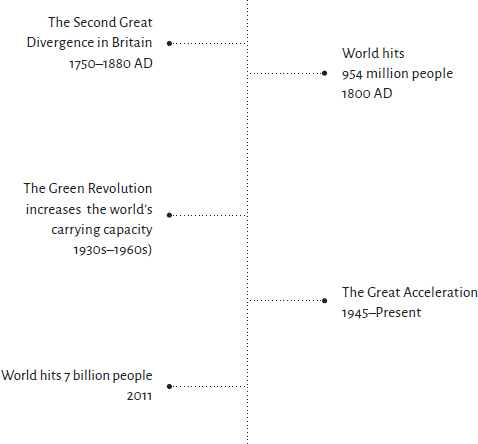
THE SECOND GREAT DIVERGENCE
The first key ingredient was the harnessing of fossil fuels for industrial production. Fossil fuels include coal, oil and gas. They are so-called because they are actually the remains of living things that perished between 10 and 600 million years ago. Coal is made from the giant trees that fell to the ground starting 350 million years ago and got compressed by plate tectonics to form hard, thick layers of coal in rock beds. When burned, coal released the aggregated energy of billions of plants. Thus, fossil fuels far outstripped the energy output of human labour, animal labour or the burning of wood, when harnessed by industrial machinery. This powered the Industrial Revolution of the eighteenth and nineteenth centuries, and still powers much of the human energy grid today.
Oil similarly forms from single-celled creatures – and some multi-celled creatures – that died hundreds of millions of years ago and were compressed by tectonic pressure into a form of sludge. Or pockets of gas, which is a by-product of the fossilisation process of oil, when the pressure forces out all the residual gas inside the organisms.
The Industrial Revolution began in Great Britain in the eighteenth century. The continued refinement of the steam engine between 1712 and 1775, faster production of textiles in spinning machines compared to hand-weaving, the better refinement of iron in larger quantities: all these set off the initial spark of mass production. Britain’s textile industry drove down the price of cotton textiles by 100 per cent between 1750 and 1800. Britain became the world’s leading iron and steel producer by 1820. Coal production increased by 600 per cent between 1750 and 1870. Already by 1800, the rate of British manufacturing was three times higher than that in any agrarian state on Earth. Despite its tiny population, this made Britain the richest nation on the planet.
Farming was no longer as dominant an area of British society. By 1750, roughly 50 per cent of the British economy was built on commercial ventures. Between 1750 and 1850, the number of farmers dropped from 60 per cent of the population to 30 per cent of the British population. A great diversification of labour followed in the nineteenth century, with more specialists such as engineers, lawyers, scientists and entrepreneurs contributing to collective learning than ever before. This set off a further explosion of innovation. A similar phenomenon occurred in every nation that has industrialised.
Britain’s lead continued to grow until roughly 1880, when it produced 23 per cent of the world’s goods, despite it being tiny in terms of population (approximately 2 to 2.5 per cent of the world’s total population in 1880). By comparison, in 1880, China represented 30 per cent of the world’s population but only produced 12 per cent of the world’s manufactured goods, whereas in 1800 it had produced about 33 per cent of the world’s manufactured goods, roughly proportionate to its population size as an agrarian economy.
THE WORLD TRIES TO CATCH UP
The British had a head start on industrialisation over the rest of the world by at least a few decades (in some cases over a century). Britain was able to hold out against Napoleon, his allies and the United States in the Napoleonic Wars and War of 1812, defeated the once mighty China in the First Opium War of 1839–42 and gradually forged the largest empire in human history.
With the advantages of industrialisation becoming more and more apparent, other countries endeavoured to replicate it. Belgium was already industrialising in the 1820s and 1830s. France began industrialising in the 1840s but with mixed success – only achieving 8 per cent of the world’s total manufacturing compared to Britain’s 23 per cent in 1880. They caught up later. Kind of. Prussia began industrialising in the 1850s, with the other German states lagging behind, but after unification in 1871, they pursued industrialisation with gusto. Germany would surpass Britain’s industrial capacity in the 1910s and ’20s. Industrial capacity levels and the incidence of the two world wars are no accident.
The United States was the first power to clearly surpass Britain in terms of industrial production. After the end of the Civil War in 1865, the United States invested in a period of settlement in the west and heavy industrialisation in the north, and let vast numbers of immigrants into the country. By 1880 the population had grown to 50 million, outstripping Britain in numbers, and the United States produced 15 per cent of the world’s manufacturing goods. By 1900, the US population had grown to 76 million people, and it produced 25 to 30 per cent of the world’s manufacturing. Britain was eclipsed and the United States’ lead would only increase.
The modern ingredients for superpower status were clear: have the largest population size possible, provided it was fully industrialised and developed. It is why the nations numbering 1.5 billion people dominate the other 6.5 billion today, and why nations such as China and India continue to industrialise in earnest. Imagine if 1.4 billion Chinese were as industrialised as 330 million Americans today.
Beyond the West were two other early industrialisers eager to even the score and maintain a prominent place on the global stage. Russia tried to industrialise in the nineteenth century, but in 1900 only 5 per cent of the population were industrial workers and the Russian share of total global production was only 8.9 per cent, despite it having a population of 136 million people. It would require World War I, the rise of the Soviet Union and the bloody excesses of Stalin to force a greater degree of industrialisation – and even then the total Russian world share of manufactured goods increased only marginally.
Japan was somewhat more successful. The Japanese embarked on a period of rapid modernisation and industrialisation after the Meiji Restoration of 1868. The central government invited in Western experts, crafted a fairly Western-looking constitution and heavily subsidised all attempts at factory production. By doing so, Japan transformed from a feudal society to a modern one within half a century. Japan had a fairly large population from which they could build a large industrial economy. However, in 1900, Japan made only 2.5 per cent of the world’s industrial output, and this share did not grow significantly until after World War II. After that, the Japanese ‘economic miracle’ allowed its large industrialised population to become incredibly wealthy and it still enjoys the position of third place in the world, after the United States and China, today.
The unification of the world zones, the power of fossil fuels and the imbalance of trade and scientific advancement allowed larger empires than ever before to be forged, and vast swathes of land and the majority of the world’s population to be controlled by relatively small armed forces of Europeans, Americans and Japanese. By 1914, roughly 85 per cent of the world’s surface had fallen under foreign imperial control.
Two world wars and scores of revolutions have not really altered this imbalance. The United States and Soviet Union wielded immense imperial power (directly and indirectly) in the Cold War. The US has dominated the world stage since 1989. China is currently expanding its influence across Asia, Africa, Europe, Australasia and the Americas with rapid success. Even the French retain an oft-overlooked but significant amount of imperial influence in West Africa. The bulk of the world’s nations remain dominated by a few. Anyone who thinks the age of empires ended in the mid-twentieth century ought to look again. Empire is simply conducted more by stealth and with slightly better PR.
THE GREAT ACCELERATION
From 1870 to 1914, the average annual rate of growth of the world’s exports was 3.4 per cent and the average annual rate of growth of GDP per capita was 1.3 per cent. The disastrous period of the two world wars from 1914 to 1945 saw the average annual rate of growth of exports shrink to 0.9 per cent and the average annual rate of growth of GDP per capita to 0.91 per cent. Thereafter, the nuclear bomb made warfare between Great Powers too costly. As a mildly ironic result of the creation of the most devastating weapons in world history, the period 1945 to the present has been one of the most ‘peaceful’ (relatively speaking) in world history for at least 5500 years. Possibly far longer, when one considers the skirmishes and raids of Early Agrarian societies, and the 10 per cent murder rate of foraging societies stretching back 315,000 years to the birth of Homo sapiens.
As such, the period 1945 to present has been one of unprecedented growth in terms of exports, GDP, population and complexity. This period is known as the ‘Great Acceleration’. From 1945 to 2020, the average annual rate of growth of exports has been 6 per cent and the rate of growth of global GDP has been an average of 3 per cent. Let that settle. Most of the ‘busy work’ of human complexity has happened in the past seventy years. Still within living memory for some.
Today the United States still holds the lead, with a population of approximately 330 million, producing roughly 25 per cent of the world’s GDP. China now has 16 per cent of global GDP from a still-industrialising population of approximately 1.4 billion. Of the next-largest economies, Japan is 5.8 per cent and Germany 4.3 per cent. The much larger Russian population, by contrast, constitutes only 1.8 per cent of global GDP. The combined GDP of the United Kingdom, Australia, Canada and New Zealand is 6.8 per cent of global GDP, which may be of interest should they engage in CANZUK-based unification in the wake of Brexit. India has a large population of 1.35 billion but currently produces only 3.3 per cent of the world’s GDP as it lags behind China in industrialisation. In regard to both China and India, the growth of their GDP is really just the adjustment back into proportion with their share of the world population, reversing the Second Great Divergence of the nineteenth century. Provided such enormous populations don’t provide an obstacle to further economic growth somewhere in the near future.
Globally, the world population has increased from 2.5 billion in 1945 to 7.9 billion today (although by the time most of you read this book it will probably have reached 8 billion). It took 315,000 years for the world population to achieve its first billion people, it took 100 years for the second billion, and further billions were added every few decades. The Green Revolution from the 1930s to the 1960s produced a number of highly effective chemical fertilisers, pesticides and artificially enhanced grain and rice, raising the global carrying capacity. While regions such as India and China experienced horrific famines in the nineteenth and early to mid-twentieth centuries, their populations have been able to explode since then, soaring into the billions.
The world’s GDP output was US$2.7 trillion in 1914, $33.7 trillion in 1997, $63 trillion in 2008, and is $87 trillion at the time of writing. In terms of food production, total grain output has increased from 400 million tonnes in 1900 to over 2 billion tonnes today. The amount of irrigated land increased from 63 million hectares in 1900 to 94 million hectares in 1950 and 260 million hectares today.
Within a very short amount of time, the world has more people producing more stuff than at any point in the last 315,000 years of human history, working in a global system more complex than anything in the past 13.8 billion years. We now live in a network of 7.9 billion potential innovators, within an instantaneous communications network of email and the internet. This bodes well for the acceleration of collective learning into the future, especially as more educational and career opportunities are created for the inhabitants of developing economies.
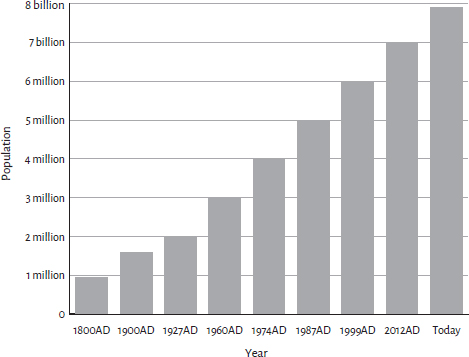
Population explosion in the Anthropocene
THE ANTHROPOCENE
By several metrics humans are now the dominant environmental and geological force on the face of the Earth. Not since the Great Oxygenation Event 3 to 2.5 billion years ago have biological organisms had such a profound impact on the Earth’s evolution.
There is a debate about when the Anthropocene truly begins. Some date it to the start of agriculture 12,000 years ago, when the immense deforestation from clearing land for farming fields may already have increased carbon emissions, and when humans began terraforming landscapes and domesticating and breeding millions upon millions of new animal species. Most proponents of the Anthropocene concept do not consider these changes significant enough to constitute an entirely new geological era. Others date the start of the Anthropocene to the beginning of the Industrial Revolution circa 1750 or 1800, due to the increase of carbon emissions and the role of technology transforming the environment more than ever before. Others still place the start of the Anthropocene with the Great Acceleration, since most human growth has happened since 1945, and because of the commencement of nuclear weapons testing, which has disrupted the atomic clocks of decaying isotopes around the world.
In terms of pure annual rates of extinction, humans are responsible for an extinction rate as fast as any of the five mass extinctions that have occurred in the past 550 million years, causing some to say that humans are driving a sixth mass extinction in the Anthropocene. Beyond that, human use of fresh water has increased by ten times since 1900, which may threaten to completely dry up the Earth’s aquifers, upon which both human and other life depends. We have put 70 per cent of the world’s coral reefs at risk. In the past seventy years, we have increased the carbon dioxide content of the atmosphere to over 400 parts per million, higher than anything in the past 3 million years. A lot of this seems to imply a tremendous influence on the Earth system, and none of it seems to bode particularly well.
On the issue of climate change, we have increased the average global temperature by about 1° Celsius since the start of the Industrial Revolution, and we are approaching the same average temperature as the Medieval Warm Period a thousand years ago. If we cross the threshold of more than a 4° increase in the average global temperature, we run the risk of melting the frozen methane stores in the oceans and in Siberia, kicking off a runaway greenhouse effect that could take us to a 5° or 6° increase. In the long term, these increases could reduce arable cropland, starving the population, obliterating still more biodiversity and flooding many highly populous regions with rising seas.
Another concern in the Anthropocene is the sheer growth of the human population. Happily, industrialisation seems to slow down population growth in developed and developing economies alike. Nevertheless, the world population is set to reach 9 billion people by 2050, and somewhere between 10 and 13 billion people by 2100. With most of that population growth happening in regions of the world that are poorest and least equipped to deal with overpopulation – primarily Sub-Saharan Africa. This raises a lot of problems. Either we slow population growth by rapid industrialisation or we don’t industrialise (good luck convincing Africa, India and China) – and we run the risk of a Malthusian disaster occurring in regions already nearest to the margins. Already 65 per cent of the world’s current global emissions are produced by the developing world. The only long-term solution seems to be technologies such as hydrogen fusion, which would flood the world with cheap sources of energy that had comparatively little environmental impact, so that the world’s poor could industrialise and raise their living standards to their heart’s content, without risking a global meltdown.
From a bird’s eye perspective, it is supremely unsurprising that the first burst of growth following a new threshold of complexity should be followed by a period of strain. We saw it shortly after the adoption of agriculture. We are too early in the Anthropocene to have experienced severe strain. In every stage of evolutionary history, species have exhausted their environments and had to compete for resources and energy flows by adapting their traits. And, ultimately, complexity guzzles all energy flows in the Universe until energy is used up and complexity itself dies.
The question for humanity in the Anthropocene is whether we can innovate in time to avoid another collision with the carrying capacity and another period of horrific decline and mounting death. Whether in this Golden Age we shall ascend to even further heights or descend into an Iron Age of war, or a new Dark Age of obliteration.
That brings us to discussion of the future in the final chapter, in terms of the next few centuries, the next few million years and the next trillion, trillion, trillion years in the life of the Universe.