
PART ONE
13.8 billion to 3.8 billion years ago
1
Wherein all the ‘stuff’ in the Universe appears • Space appears to give us somewhere to put all that ‘stuff’ • Time appears and makes it possible for that ‘stuff’ to change form (i.e. have a history) • All that ‘stuff’ is primordial energy and matter that transforms into the diverse range of things around us.
BANG.
13.8 billion years ago, a tiny, hot, white speck appeared. It was so small that at first it could not have been seen by the naked eye or anything except the most powerful of modern microscopes, had they existed.
This was the appearance of the space-time continuum and the extremely hot, densely packed energy within it. Nothing existed outside of it. All the ingredients for everything in the Universe were within it. They have simply changed form since then, as if the Universe were a ball of clay, shaped and reshaped into myriad forms over billions of years.
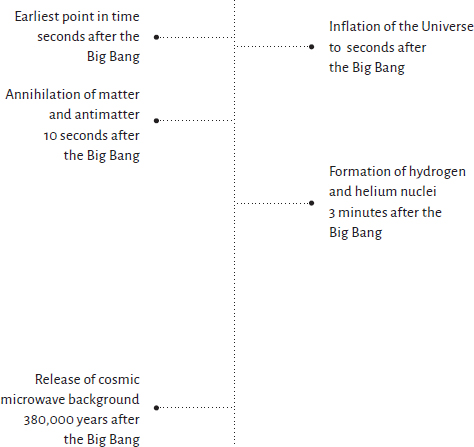
The absolute first date in all of history is 10–43 seconds after the Big Bang, or 1.0 with the decimal place moved to the left forty-three times:
0.0000000000000000000000000000000000000000001
A tiny sliver of a second. It is the smallest possible chunk of time that we can measure. A smaller fraction of time would be physically meaningless, because nothing in the Universe can move fast enough to show that even the slightest change has happened in a smaller amount of time. 10–43 seconds is the amount of time it takes for light to travel the smallest amount of distance at the quantum level. Any smaller snapshot of time (for instance, 10–50 seconds) looks exactly the same as 10–43 seconds. It is like the first frame of a film.
The Universe was smaller than an atom or even one of the particles that make up that atom. Because of the pressure of everything in the Universe being contained within that small space, it was incredibly hot. Up to 142,000,000,000,000,000, 000,000,000,000,000 Kelvin or 142 novillion (so hot it is practically the same in both Celsius and Fahrenheit). The laws of physics themselves could not stay coherent. The Universe was so hot that the very laws that make it work were in a ‘melted’ form. It was true, unadulterated chaos. Alice in Wonderland and a pint of LSD.
A tiny fragment of a second later by 10–35 seconds after the Big Bang, the Universe had expanded to the size of a grapefruit. It would have become visible to the naked eye. It cooled below 11.3 octillion Kelvin. This was cool enough for the four fundamental forces of physics to ‘harden’ into their current form. Gravity, electromagnetism and the strong and weak nuclear forces became coherent. We were now a Universe governed by physical laws. If they had hardened into a slightly different balance, the Universe would have evolved completely differently.
During this time, a ripple at the quantum level made tiny pinpricks of energy clump together. Energy in the Universe was just ever so slightly unequally distributed. These clumps of energy would evolve into all the matter, complexity, stars, planets, animals and ‘stuff’ in the Universe, including you.
By 10–32 seconds after the Big Bang, the Universe was about a metre wide, and the heavy lifting was over. The clock was wound, its mechanisms were set in motion and it began to tick. In the first split second, our destiny was already etched into the very fabric of the cosmos. And the rest, as they say, is history.
For the next 10 seconds, the Universe grew to 10 light years wide, swirling with tiny particles which had congealed from pure energy as the Universe continued to cool to 5 billion Kelvin. They were quarks and anti-quarks, positrons and electrons. The opposites of each other. Matter and antimatter. Much of the matter bumped into the antimatter and exploded in a flash, turning back into energy. Only one-billionth of the matter could not find an antimatter partner, and it is only this tiny fraction of matter that forms all the ‘stuff’ in the Universe we see today. Here, within the first 10 seconds of the story, is a miracle that saved us from non-existence.
Over the next three minutes, the Universe continued to expand. It was over 1000 light years wide: a sea dominated by thick, merciless radiation. The surviving quarks were forged together by the still-intense heat into protons and neutrons. These protons and neutrons were in turn forged into the core of hydrogen and helium atoms (the nucleus). Hydrogen and helium were the simplest and first of all the elements to exist. Hydrogen requires only a single proton as its nucleus. Helium requires more ingredients and was therefore in the minority. The Universe cooled below 100 million Kelvin – too quickly for many of the other elements to be created (only trace amounts of lithium and beryllium). Heavier elements would have to wait for the creation of stars many millions of years later.
The Universe continued to expand and cool for thousands of years, longer than Homo sapiens has existed. By 380,000 years after the Big Bang, the Universe was over 10 million light years wide and it had cooled to 3000 Kelvin – twice as hot as lava and enough to melt gold or cause a diamond to drip like an ice cube on a summer’s day. The heat was still enough to obliterate most complexity, but it was cool enough for hydrogen and helium nuclei to capture electrons and become fully-fledged atoms. The Universe began to fill with clouds of gas.
The Universe had also become less dense, allowing photons of light to travel freely through the thick soup of radiation and particles for the first time. There was a blinding flash of light, as these photons headed in every conceivable direction. This flash of light is known as the cosmic microwave background (CMB) and can be detected in every direction in the Universe today. In fact, if you set your radio or TV to collect only static, about 1 per cent of that static will be from the CMB. It is the first baby picture of the Universe and the first visible artefact of our deep past.
HOW DO WE KNOW THE BIG BANG HAPPENED?
We know the Big Bang happened for several reasons. For starters, we can’t find anything in the Universe – either on Earth or through a telescope – that is confirmed to be older than 13.8 billion years old, which is the current estimated age of the Universe. If the Universe was infinite and eternal, we’d be tripping over stuff that was 105 billion or 802 trillion years old.
Second, the fact that normal matter in our Universe is mostly hydrogen and helium is exactly what you’d expect to see if the expanding Universe was super-hot for a few brief minutes but then cooled down quickly without time for many heavier elements to form. Again, if the Universe was infinitely old and infinitely big, we’d have no clear explanation why the chemical composition of the Universe is the way it is. In an infinite Universe with an eternity of stars blowing up in supernovas, there would be no clear reason not to expect just as much gold to exist in the Universe as hydrogen.
Third, in the 1920s Edwin Hubble was mapping the cosmos and discovered that most galaxies are heading away from us as space expands. Logically extrapolating from that, and calculating backwards, Hubble figured out that all the galaxies in the Universe must have been smooshed together at a single fixed point.
Despite this discovery, the Big Bang theory was not the dominant theory of cosmology for decades. Which leads us to the fourth and most crucial piece of evidence: the cosmic microwave background that emerged 380,000 years after the Big Bang. If the Big Bang theory were true, then after a few thousand years of the Universe expanding, the crush of matter and plasma and radiation would be spread out enough for light to be able to travel freely, and there would be a brilliant flash across the cosmos. In the 1940s, physicists predicted we should be able to see the remnants of this flash everywhere in the sky. This is precisely what was discovered in 1964 by two radio engineers, Arno Penzias and Robert Wilson, who weren’t even looking for it. They were trying to eliminate all the static on a highly sensitive radio antenna, but they couldn’t get rid of a small hiss, and after many calibrations, and having shot the pigeons that shat on the antenna, a physicist from Princeton told them what they had found. From that point on, the Big Bang became the dominant explanation for the start of the Universe and all the work that has happened since has only confirmed or clarified the general framework of this theory.
WHAT DOES THE UNIVERSE LOOK LIKE?
In the first split second after the Big Bang, the Universe inflated from the size of a quantum particle to that of a grapefruit. Within a second, it was larger than our solar system. Four years later, it was bigger than the Milky Way.
The Universe, as we know it, is currently 93 billion light years across. Which means there are stars and galaxies that were born billions of years ago that are so far away their light hasn’t had a chance to reach us, since only 13.8 billion years have elapsed since the start of the Universe. The stuff we can see looking out from Earth is called the Observable Universe, but there are a lot of things beyond that horizon which we cannot see.
Moreover, because light takes time to travel from a distant object, the further away we look, the further we are looking into the past. For instance, a neighbouring galaxy, Andromeda, is 2 million light years away. So when you look at it through a telescope, you are seeing it as it existed roughly when Homo erectus started roaming the Earth and sabre-toothed tigers were still a cause for concern.
The Observable Universe can be seen looking in any direction from Earth; in that sense, the Observable Universe is a sphere. However, that is not the shape of the entire Universe. Physicists have determined that the Universe has ‘zero curvature’, which means it does not bend back on itself at some point. It stretches on and on, like a table-top in any direction, constantly expanding for all eternity. The Observable Universe is just one patch on it: like the ring left by a coffee cup on a table. And Earth is just one tiny fibre of wood lodged somewhere inside that coffee ring. The colour of the Universe is beige, assuming we were looking at the entire Universe from a great distance with human eyes. If you were to look at the mixture of light from all the stars in the Observable Universe blended together, as if you were zoomed out and looking at the whole thing at once, the colour of our cosmic bubble would be beige. Cosmologists have tried to jazz it up by calling the tone ‘cosmic latte’, but it’s really just beige. Personally, I like the fact the Universe is beige; it renders the cosmos slightly less intimidating.
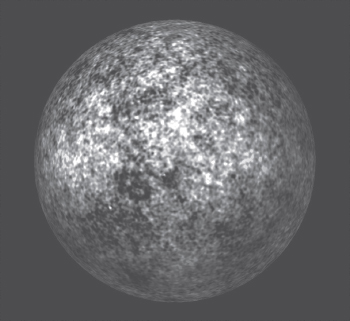
Cosmic microwave background (CMB)

The Observable Universe
WHAT IS THE MULTIVERSE?
Permit me to get a little weird for a moment. One inevitable consequence of the Big Bang model (the most accepted model currently) is a phenomenon called ‘eternal inflation’, which means that while our coffee ring of the Observable Universe has popped out of inflation and is expanding more slowly than in the first split second, other parts of the table-top may still be expanding at that speed. And there will be other coffee rings (that is, other so-called universes) with physical laws and variations in historical events entirely different to our own. And this process would stretch on forever. This collection of diverse ‘universes’, each roughly the size of our ‘Observable Universe’, is known as the Multiverse.
But the term Multiverse is a misnomer: it’s all the same Universe, just different patches or coffee stains on the table, with different physics. There are an almost infinite number of variations of physical laws (10500 or nearly six times the number of atoms in the Observable Universe) and each one of those sets of physical laws could yield many different historical results. This means – if the hypothesis is true – there is another ‘universe’ out there where you are reading this sentence 1.5 seconds earlier. There is another universe where you were not born at all. There is yet another universe where no stars exist. There is a universe where World War II didn’t happen. And one where your face looks like fairy floss and the footpath looks like pizza. Every possible variation you could imagine and quite a bit more besides.
If this hypothesis is true, we should be able to confirm it once the light from the nearest other ‘universes’ that have appeared (if they have such a thing as light) finally reaches us …
… in about 3 trillion years.
HOW CAN WE UNDERSTAND THE BIG BANG?
If trying to understand how our Universe began gives you an existential headache, it’s not your fault. Humans evolved within an older Universe with fixed rules, as did our brains and perceptions, so it is not so easy for our brains to grasp an event that precedes the establishment of the physics we have intuitively come to know. We are evolved to instinctually understand the world enough in order for our species to survive: what goes up must come down, cause and effect, chickens come from eggs and eggs from chickens. The rest takes a bit more time and reflection.
Imagine a speck. A tiny speck. This is the Big Bang singularity 13.8 billion years ago at 10–43 seconds. All energy and matter were contained within that speck. All the ingredients for the rest of our story. But whatever you do, don’t imagine that there is space outside the speck. Space is a property of our Universe and exists entirely inside it. As the Universe expands, more space is created. Don’t even imagine pitch blackness outside the speck, like we see at night between the stars. That is space. At the moment of the Big Bang there was nothing but the speck.
In fact, get a piece of paper and a pen and draw a tiny dot in the middle of the paper. Then take a pair of scissors and cut off all the extra paper outside the dot. That is the early Universe. The primordial atom containing all of time, space and energy, which has grown into the tabletop that is still expanding today.
WHAT HAPPENED BEFORE THE BIG BANG?
Time didn’t exist before the Big Bang; thus, there was no ‘before’ the Big Bang. It would be like claiming you introduced your mother and father to each other: nonsensical.
Space also did not exist before the Big Bang. ‘Before’ the Big Bang, there was no space for anything to happen and there wasn’t any time for it to happen either. After the Big Bang, the Universe expanded from the microscopic to its current size of 93 billion light years across (and growing). Space is a post–Big Bang phenomenon. Time is post–Big Bang too. ‘Before’ the Big Bang, if there is no space for anything to move, there is no space for anything to change. And if there is no change, there are no events, and no history. Nothing that could be measured by time in any meaningful way.
So ‘before’ the Big Bang there was no space, no change and no ‘stuff’ that moved or was transformed. Nada, zip, zilch. If anything existed prior to the Big Bang, it would have behaved in a way completely foreign to humans, and to the fundamental laws of the Universe itself as we now know it. It would not have behaved in a sequence of cause and effect – of past, present and future.
Hence, our history begins with the Big Bang.
HOW DO YOU GET SOMETHING FROM NOTHING?
There’s a deeply ingrained bit of human logic that says: if you create something, its building blocks have to come from somewhere else. This is what the First Law of Thermodynamics boils down to: matter and energy are neither created nor destroyed, they simply change form. Yet the Universe seems to have appeared out of nowhere.
But at the moment of the Big Bang, the Universe was so insanely hot (142 novillion Kelvin), its physical laws did not yet exist. This includes the First Law and the general notion that something has to come from somewhere.
Furthermore, the Big Bang at 10–43 seconds was so small it was at the quantum scale. Things operate differently in the quantum realm. Little ripples of energy known as virtual particles appear and disappear at that scale all the time. They are currently doing so in between the atoms that form your skin. Popping in and out of existence as if from nowhere. And this is established physics within our Universe, so ‘something from nothing’ is not really so unthinkable a proposition for the start of the cosmos. Perhaps our Universe emerged in a similar way to virtual particles.
There’s also the consideration that before the existence of time, you don’t have the traditional sequence of cause-and-effect with which humans have evolved and expect to see. There is no physical law obliging the Universe to have emerged from something else.
And further still, we humans don’t really know what nothing is – beyond the meanings we ourselves have invented. As a shorthand expression, ‘nothing’ means the absence of something specific. The concept of nothing works in the context of I have ‘nothing’ in my pint glass and ‘nothing’ in my wallet to buy another beer. Within true blue physics, however, it is impossible for ‘absolutely nothing’ to exist anywhere in the Universe – even in the deepest regions of space. Everywhere the Universe either has ‘stuff’ like stars and planets and gas or at the very least the weak hum of radiation. Your wallet may not have money in it, but it has air, a debit card, some old ticket stubs, dust, and perhaps even a dead fly. Scientists can’t even create artificial spaces where there is truly nothing. It is physically impossible to create what is called a ‘zero energy vacuum’ or a void that doesn’t even have radiation. So where does ‘nothing’ actually exist? We appear to have invented ‘nothing’ out of thin air.
‘Nothing’ being physically impossible in our Universe, we are making a huge assumption and leap of logic that ‘nothing’ (a concept humans invented and cannot replicate) existed ‘before’ the Big Bang. In fact, the grammar of that statement is all wrong. We have no reason to expect that ‘nothing’ as a concept truly exists somewhere outside the Universe and that it preceded the Big Bang when time didn’t even exist yet. By saying ‘something from nothing’ we are making huge assumptions that we are not scientifically or logically entitled to make.
We have to unlearn some of our most basic concepts to understand the workings of a primeval Universe without the same rules it has now. The primate brain runs up against concepts we didn’t need to understand in order to survive and evolve. Our brains aren’t wired that way. It is like trying to send your friend a text using your toaster.
SEEKING ANSWERS AT THE BEGINNING
If you find yourself hit by a wave of existential disquiet and dissatisfaction about the mysteries of the Big Bang, consider the following:
1.We did not even confirm the Big Bang happened until sixty years ago. Imagine how many answers we will discover about the start of the Universe after another 100 or even 1000 years of scientific endeavour.
2.If the answers to this puzzle are foreign to our primate brains and foreign to the fundamental physics of this Universe, then the answers (when we discover them) might sound like gibberish to us. They may not satiate the emotional and philosophical void and search for meaning we have assumed they would fill.
3.We may be looking for satisfaction in the wrong place by looking to the beginning of the story. Perhaps if we seek to add meaning to our lives, we must look at the present or perhaps even towards how we would like the story to end. In our own lives, we at least enjoy some measure of control over our own destiny. And if humanity continues to exist, our science and technologies continue to develop and our overall complexity continues to increase, who knows what profound superhuman impact we will have on the story in a thousand, a million or a billion years?
Philosophical satisfaction and existential meaning are frequently derived not from obsessing over our childhood traumas or what happened in the world before we entered it, but by making good and honourable use of the time given to us. If the earliest moments of the Universe prove anything, it is that seemingly tiny changes can be writ large into the fabric of the cosmos.