2
Wherein the first hydrogen and helium atoms get sucked together into clouds • Those clouds become so tightly packed that the atoms fuse together • Fusion creates huge nuclear explosions that birth the first stars • Stars fuse hydrogen and helium into carbon, nitrogen, oxygen and other elements, up to the twenty-sixth element of iron • The stars blow up in supernovas, creating heavier elements such as gold, silver and uranium • All ninety-two naturally occurring elements are created by these terrifying H-bombs in the sky.
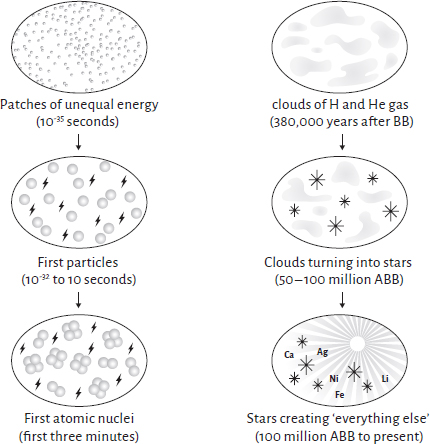
AS WE HAVE SEEN, 10–43 SECONDS AFTER THE BIG BANG, the Universe rapidly expanded from the size of a quantum particle to the size of a grapefruit. For perspective, if the same rate of expansion had continued to happen, that grapefruit would have grown to the size of the current Universe in a fraction of a second rather than taking 13.8 billion years to do so. During that split second, tiny inequalities in energy appeared. Just a little bit more energy in dots sprinkled all over the cosmic grapefruit, differing from the almost equal distribution of energy found elsewhere in the Universe. It is those tiny dots with just a little bit more energy that spawned stars, galaxies, planets and all the complexity that forms our history. Without these inequalities, complexity in the Universe would have been born ‘dead’. And this short history would be a great deal shorter.
As energy within those dots congealed into subatomic particles, the first matter emerged and the Universe continued to expand and cool.
Filled with a cloud of hydrogen and helium gas, the Universe continued to cool as it expanded to just a little above absolute zero, where it remains today. The vast majority of space from this point forward remained simple and cold, and there was no heat to forge further complexity beyond hydrogen and helium. Most of space was filled only with weak radiation. It was only in tiny pockets where inequalities in matter and energy reigned that things began to heat up.
THE FIRE-SOAKED ORIGINS OF STARS
For millions of years, enormous clouds of hydrogen and helium floated through the ever-expanding cosmos. There was not much else among the gloom, and the Universe seemed pretty homogenous. Dull, dead and without much change or history.
Over the course of 50 to 100 million years after the Big Bang (or, very roughly, the amount of time that separates you from Tyrannosaurus rex), gravity sucked hydrogen and helium gas together into increasingly dense clouds. Eventually the pressure at the core of these clouds became so intense that hydrogen atoms were smashed together and their nuclei fused. That is to say, the pressure overcame the usual nuclear repulsion that keeps atoms separate. Nuclear fusion (the same process that causes an H-bomb, or hydrogen bomb, to explode) let off a huge burst of energy and suddenly these clouds were transformed into gigantic fireballs generating heat and throwing it out into the Universe as energy. The first stars were born. This fusion lasted as long as the stars had more gas to guzzle.
Fusion in the heart of a star achieves a minimum of 10 million Kelvin (about 25,000 times the temperature of a hot summer’s day). For the first time since the first three minutes after the Big Bang, some new elements were created.
Billions of stars were born across the Universe. The first generation of stars that emerged 50 to 100 million years ago were huge because of the fresh supply of gas in their neighbourhoods – about 100 to 1000 times as massive as our Sun. Because of their size, they did not live for more than a few million years. But when they blew up, their materials were sucked back together into second-generation stars, which were smaller but could live for longer – into the billions of years.
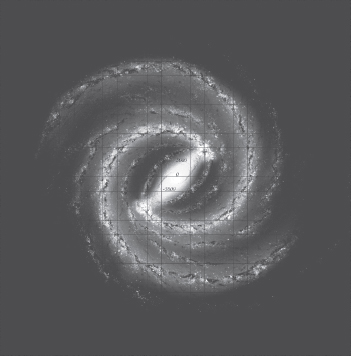
Gravity began to attract stars to each other, and they formed clusters that were 30 to 300 light years across. These clusters merged into even bigger ones. From 13.7 to 10 billion years ago, these mergers continued in our region of space to create the Milky Way, which is roughly 100,000 light years across. Our galaxy contains about 200 billion stars. And the same process of galactic mergers occurred all over the Universe, forming the estimated 400 billion galaxies that exist in the Observable Universe.
The Milky Way
THE CREATION OF GALAXIES
From 13 billion to 10 billion years ago, different kinds of galaxies came into being. Spiral galaxies (like our own Milky Way) form 60 per cent of the estimated 400 billion galaxies in the Observable Universe. They do the majority of star formation. But their bulbous cores contain such a concentration of stars that they are hostile to the formation of life, with supernovas ripping through the sector far too frequently. It is only at the arms of spiral galaxies, where our solar system has drifted, that star systems are distant enough from each other to form life.
Lenticular galaxies (such as the Sombrero Galaxy) have the same bulge but no arms. They make up roughly 15 per cent of galaxies in the Universe. They have very little star formation.
Elliptical galaxies (such as Hercules A) have no bulge at the centre and stars are more evenly distributed. They are ‘dying’ galaxies and very little new star formation happens within them. They constitute 5 per cent of all galaxies in the Universe.
Irregular galaxies are the hodgepodge of malformed galaxies which are not easily categorised. They make up 20 per cent of all galaxies. Most of them are quite small and are usually misshapen by the gravitational pull of another galaxy while they are forming. Some currently have no explanation.
As for the number of galaxies in the Observable Universe, 400 billion is the established estimate. However, recent studies suggest that the number could be between 1 and 10 trillion. This – considerably higher – number increases the odds that complex life might be evolving somewhere else out there. Each galaxy can contain millions, billions or even trillions of stars. That is quite a few rolls of the evolutionary dice.
THE LIFESPAN OF STARS
The size of a star determines how long it lives, because of how quickly it burns its fuel. Stars that are over eight times the size of the Sun go supernova. Stars that are smaller than that die without exploding and creating heavier elements. The largest stars burn for only a few million years, slightly smaller stars might burn for a few hundred million years, even smaller stars might burn for a few billion years, and the smallest, slowest-burning stars can burn for a potential 100 billion to several trillion years.
The first generation of stars to form after the Big Bang were huge and blew up billions of years ago. The second generation of stars, created from the exploded remnants, contained heavier elements that were created in the bellies of the first generation of stars. Most of the second-generation stars have also died in the past 13 billion years, but many of them are still detectable in the Universe and within the Milky Way galaxy.
The third generation of stars is only a few billion years old. They possess a vast diversity of heavy elements created in the previous two generations. The third generation is also likely to have more planets orbiting them because of the abundance of elements that would have formed a ring of dust around them and eventually turned into planets. Thus, third-generation stars (like our Sun) are the best bet for further complexity.
COSMIC FLORA AND FAUNA
Our Sun is a Yellow Dwarf, a kind of star that lasts 4 to 15 billion years and represents 10 per cent of the stars in the Universe. Slightly smaller stars, called Orange Dwarfs, live 15 to 30 billion years and make up another 10 per cent. Red Dwarfs are the smallest stars (about 5 to 50 per cent the mass of the Sun) and make up 70 per cent of all the stars in the Universe. Red Dwarfs can last hundreds of billions of years – or even trillions, depending on how small and slow-burning they are. None of these stars explode in a supernova when they die, but slowly burn down and flicker out.
When a star like our Sun burns up all its hydrogen and helium fuel, it starts burning through progressively heavier elements in its core. As a result of this process, Yellow Dwarfs bloat like a dead cow in a wet field and become Red Giants. After another billion years or so, they shrink back and become White Dwarfs – the skull and bones of stars like ours which have stopped fusing atoms in their cores. These dwarfs last for another few million years before finally flickering out completely. Red Giants and White Dwarfs make up approximately 5 per cent of stars in the Universe.
The remaining 5 per cent of stars are decidedly rarer but much more essential to complexity. These are the stars that blow up in supernovas. Supergiant stars only burn for between a few million years and a few hundred million years (depending on their size). These Supergiants are capable of fusing all the atoms in the periodic table up to iron – the twenty-sixth element. Thereafter, no star’s core burns hot enough to fuse anything more. Once the Supergiants run out of fuel, their massive structures collapse in on themselves, letting off a huge explosion – a supernova. The supernova itself burns so hot that during the process even heavier elements are forged, such as gold, silver and uranium. Supernovas are responsible for producing the ninety-two naturally occurring elements in the Universe. The fact that some elements (such as gold) only exist because of the supernovas of less than 5 per cent of stars is why these elements are so rare.
When stars blow up in supernovas, they leave behind neutron stars as their dead remnants. Neutron stars are extremely dense and heavy and don’t burn very brightly. If two neutron stars smash into each other, they can create even more of the heavy elements. They are also tiny, being only a few dozen kilometres across. All that mass in such a small space makes them very vulnerable to turning into black holes.
A black hole is essentially a pile of matter with such a high mass that the gravity sucks it in on itself. Their gravity begins to suck in matter around them, distorting the space in their neighbourhoods. While black holes may just be sloppy piles of matter, there are some hypotheses that black holes warp space and time around them to such an extent they may have bizarre properties. For instance, they may break down the laws of physics, make the passage of time incoherent or perhaps even link to other dimensions or other universes.
STARS WITH CHEMISTRY
The periodic table currently holds 118 elements. While ninety-two elements are found naturally around the Universe, any of the higher elements that form in nature would almost immediately degenerate into lower forms. Higher elements have been created in human laboratories, the most recent one being #118, Oganesson, created by a Russian–American team in 2002.
Complexity rose within stars as they went through their life-cycles. Then they died and flung those elements out into the Universe again. They would form the building blocks for further complexity. An almost innumerable number of combinations of chemicals. To date, there are an estimated 60 to 100 million chemicals out there.
A chemical is built upon a combination of elements strung into a higher structure: a molecule. This can create a structure such as H2O (two hydrogen atoms and one oxygen atom) to make water, or a structure such as SiO2 (one silicon and two oxygen) to make quartz, the most common mineral on Earth, or it can create a manmade structure such as C2H4 (two carbon, four hydrogen) to make polyethylene, the world’s most common plastic.
Then there are more complex chemicals, such as organic proteins, which are immense tangles of thousands of atoms, like the protein dubbed ‘Titin’, the chemical formula of which is C169723H270464N45688O52243S912 and which gives your muscles their elasticity. The technical name of this chemical is roughly 190,000 letters long and takes somewhere between three and four hours to fully read out loud. Such is the immense scope for complexity once elements start forming into molecules! Same goes for the chemical formulas for the bases of DNA (adenine, guanine, cytosine and thymine), which encode genetic traits and allow organic material to self-replicate, evolve and become alive.
Once the ninety-two naturally occurring elements in the cosmos emerged and started combining into different chemicals, the Universe had all the ingredients it needed to create the complexity we see around us today.
But what is complexity?
THE UNIFYING PATTERN OF ALL HISTORY
The unifying pattern of all history over 13.8 billion years is increasing complexity. It is the process that created us and is, in turn, the process through which we create. After the Big Bang, the first particles of matter appeared and slowly transformed into stars. These stars would create all the chemicals that compose the Earth (including life). The same increase of complexity defines human history – from foraging, to ancient agriculture, to modernity. It is very rare in the chaos of history to find a thread that stretches across all events from beginning to end. Increasing complexity is the only such trend that has yet been identified.
A complex thing is composed of matter, intricately woven like a tapestry. It is sustained in its shape by flows of energy that ‘feed’ it. For instance, stars require more gas to burn. Humans require food. Mobile phones require batteries. It is all the same principle – we need flows of energy to keep from dying. That is a general rule of all complexity throughout the Universe.
Matter and energy were born within the white-hot speck of the Big Bang 13.8 billion years ago. All the ingredients for all the stuff we see around us was there at the beginning. The history of the entire Universe boils down to a history of their perpetual transformation into new and brilliant forms.
No new matter and energy were added to the Universe after the Big Bang. This is the First Law of Thermodynamics acting in full force: nothing new is created, nor is anything old totally destroyed. That means the atoms that make up your body existed in some form at the beginning of the Universe and have continued to exist and evolve across the cosmos over 13.8 billion years. You are, after a fashion, 13.8 billion years old.
And after you die, those atoms will split off in different directions and continue to evolve in the Universe again. From a certain point of view, we are the Universe, one totality, and we are blessed – briefly – to be a self-aware part of it. As if the Universe were looking at itself in a mirror.
THE MECHANICS OF COMPLEXITY
Complexity is an ordered structure that is created and sustained by the flow of energy. A hydrogen atom is a structure composed of one proton and one electron. A water molecule is a structure of two hydrogen and one oxygen atoms. A human brain is a form of complexity, as is the toaster that a human brain invented. The human web of 8 billion people, involving trade and information exchange, is one of the most complex systems of all.
The greater the diversity of building blocks in a form of complexity and the more intricately it is constructed, the more complex it is. A star has a lot of hydrogen atoms in it, but it is not particularly complex; it is just a big disordered lump of them. Contrast that to a dog, which has a much more complex tangle of chemicals, DNA, liver cells, brain cells, blood vessels and highly complex respiratory, circulatory and nervous systems. Move a few thousand atoms of hydrogen from the core of the Sun to its surface and it keeps running as if nothing happened. Replace a dog’s brain cells with its liver cells and the dog is not going to be chasing birds anymore.
In order for any form of complexity to be created, some energy needs to be used. Like welding a car engine together in a factory. In order for that complexity to be sustained, you need more energy flow. Like eating food in order to stop from starving and dying. And in order for something to increase in complexity, it needs more energy flows altogether. If those energy flows cease, the structure decays and the thing gradually dies. A car sputters out and stops, a plant withers away and dies, a civilisation collapses into abandoned ruins. This is also why complexity can be measured in the density of energy that is flowing through it.
The more structurally intricate a form of complexity is, the greater the amount of free energy density it requires. The simplest and oldest complexity in the Universe, like a star, doesn’t require that much energy per gram, whereas the products of billions of years of biological evolution or culture burn through a higher density of energy flows.
|
COMPLEX SYSTEMS |
ENERGY FLOWS (ERG/G/S) |
|
The Sun |
2 |
|
A Supergiant star near to supernova |
120 |
|
Algae (photosynthesising) |
900 |
|
Cold-blooded reptiles |
3000 |
|
Fish and amphibians |
4000 |
|
Multi-celled plants (e.g. trees) |
5000–10,000 |
|
Warm-blooded mammals (average) |
20,000 |
|
Australopithecines (early primates) |
22,000 |
|
Human foragers (Africa) |
40,000 |
|
Agricultural society (average consumption) |
100,000 |
|
Nineteenth-century textile machine |
100,000 |
|
Nineteenth-century society (average) |
500,000 |
|
A Model-T automobile (c.1910) |
1,000,000 |
|
A vacuum cleaner (present) |
1,800,000 |
|
Modern society (average consumption) |
2,000,000 |
|
Average airplane |
10,000,000 |
|
A jet engine (F-117 Nighthawk) |
50,000,000 |
THE BIRTH OF COMPLEXITY
A split second after the Big Bang, there were slight ripples in space-time (quantum fluctuations) that created clumps of energy unequally distributed across the cosmos. You can see these clumps recorded in the ‘snapshot’ of cosmic background radiation 380,000 years after the Big Bang. As a result of these clumps, energy congealed into the first particles of matter. If it weren’t for this unequal distribution of energy, complexity would not exist.
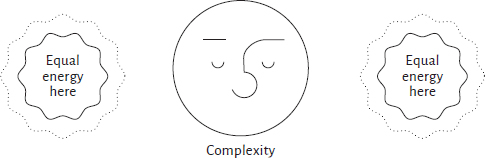
In order for complexity to exist, you need energy flows to create and sustain it. In order to have energy flow, you need to have flow from where there is more energy to where there is less.
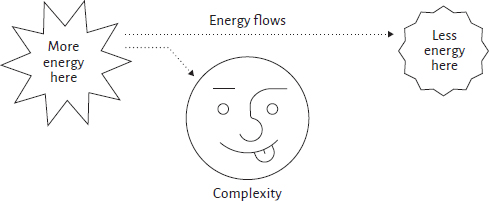
If all energy were equally distributed at the start of the Universe, there would be no need for energy to move. Nothing would have changed. Nothing would have happened. There would have been no complexity, just a blank cosmos of thinly distributed radiation from start to finish. In a nutshell, there would have been no history.
Instead, the first clumps of unequally distributed matter and energy created the first stars. These stars created all the other naturally occurring elements in the periodic table. These elements came together to form molecules and planets. On one such planet, Earth, more of these molecules came together to create life. And some of that life evolved consciousness and the ability to invent stuff and continually tinker with and improve upon those inventions.
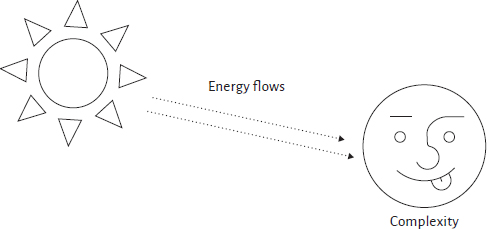
All the while, from stars, to life, to technology, we required more energy flows to create, sustain and increase complexity. And so tiny pockets of the cosmos have been getting more complex over the past 13.8 billion years. That is the unifying theme of all history. The Big Bang created unequal amounts of energy across the cosmos, then for 13.8 billion years energy has been evening itself out again, and as a result of that we had energy flow and all the wondrous things that emerge from that.
THE DEATH OF COMPLEXITY
However, there is some irony to the increase of complexity in history. The reason why energy flows from stars to feed plants, which nourish animals, to give energy to brains in the human web is because of the Second Law of Thermodynamics. That law compels energy to want to even itself out – and it can only do that by flowing from where there is more energy to where there is less. In the short term, this energy flow can create complexity. But ultimately because the energy flow evens itself out, there is no more energy flow left, which kills complexity.
It is the principle which creates life and in exchange eventually takes life. Only death pays for life. This sounds like philosophy, but it is also a universal reality.
Only in tiny pockets of the Universe where there has been an unequal distribution of energy does complexity continue to rise. In the rest of the Universe, about 99.9999999999999 per cent of space is already dead, unable to generate more complexity. This is why the clumping of energy in the first split second of the Universe was so crucial to our existence.
The more complex something is, the more energy flow it requires and the faster it uses up energy flows. For example, a dog requires more energy flow per day than a tiny colony of bacteria. And a car requires so much energy that it needs to use the stockpiled energy of millions of years of organic material crushed underground and transformed into oil and petrol. Dogs poo, cars spew smoke out of their exhaust pipes, and some of that waste cannot be used again. Ever.
Eventually the Universe will run out of energy completely. After trillions upon trillions of years. So in reality, complexity is just a by-product of a longer tale in history, in which the Universe is trying to revert back to a realm of equally distributed energy. The endgame is a Universe that is nothing more than a weak orb of radiation. A quiet cosmos with no history, no change and no complexity. This is a state referred to as heat death.
The collapse of complexity is a threat throughout our story, and we will come back to the menace of heat death as we approach the end of our tale. For now, just remember that the source of our existence is also the source of our potential non-existence. The Second Law of Thermodynamics is at once the creator and the destroyer of worlds.
The only way the Second Law could be defied is by a super-civilisation many millions of years of scientific progress from now becoming so complex that it can manipulate the fundamental laws of the Universe itself.