
6
Wherein mammals fill the niches left empty by the dinosaurs • Primates evolve bearing decidedly familiar traits • Humans split off from our last common ancestors with the Great Apes • We start walking on two legs and our brains get bigger • We start accumulating more information with each generation than is lost by the next.
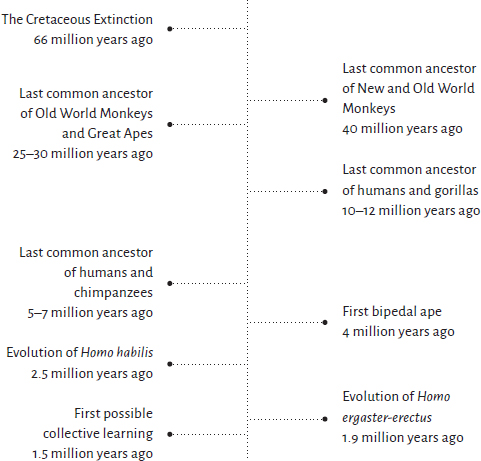
66 MILLION YEARS AGO, the world was a wasteland. Chilly and dry. The landscape was littered with dead plants and animals, rotting away in the sun and gradually being covered by layers of dust and dirt. Large species had been heavily hit in the Cretaceous extinction event, because of the collapse of the food chain. Aside from turtles and crocodiles, the land was now populated by tiny creatures like birds and mammals.
The boom-bust cycles of biological evolution continued as they always had. The ecological niches of the world had been swept clean. A rapid evolution of mammals filled them again. At first, mammals resembled mice or chipmunks. They were mostly under 50 centimetres long and weighed under a kilogram. They nibbled on plants and ate bugs. They burrowed into the ground to hide or concealed themselves in trees. These mammal survivors would diversify and dominate the Earth as the dinosaurs, Sauropsids, amphibians and Arthropods had done before them. And the vicious Darwinian cycle might have continued without any sign of increasing complexity for hundreds of millions more years. But this time there was something new on the horizon …
By 60 million years ago, the climate had warmed up again. The world was warm. North America and Eurasia were tropical. The majority of the Earth was covered in forests, with deserts at the equator. At the poles, there was little or no ice. And the mammals had begun to grow.
The ancestor of elephants at this time was no larger than a dog, but it would gradually evolve to become the world’s largest land mammal. At the same time, a similarly sized mammal had begun to hunt fish and red meat, using sharp teeth for tearing the flesh of prey. By 42 million years ago, these predators had evolved into two branches with canine and feline characteristics: the ancestors of wolves, foxes and bears or lions, tigers and jaguars, respectively.
55 million years ago, a small mammal the size of a cat evolved to periodically spend time in the water and even submerge itself. This mammal was the ancestor of hippos and whales. The ancestors of whales began to spend more and more time in the oceans, first in shallow waters, later being able to dive deeper and eat scores and scores of krill and fish. By 40 million years ago, their transformation into whales was complete.
Also 55 million years ago, the ancestor of the horse – multi-toed and around the size of a dog – dwelt in the forests. It crept quietly and nimbly among the trees and the brush on the forest floor. Once the climate cooled and dried, these creatures began running increasingly on the dominant third toe. Over time, the other toes receded significantly, giving horses their characteristic hooves. They no longer crept through the forest but travelled vast distances.
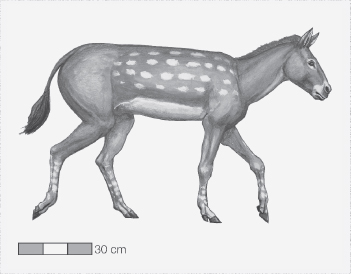
Ancestral horse
In a relatively short amount of time – a few dozen million years – mammals rapidly filled environmental niches and grew from tiny sizes to form the bulk of the world’s megafauna and the building blocks for the familiar species we know today.
Fifty-five million years ago was also when the primates emerged. They began as small tree-dwelling mammals with grasping hands and front-facing eyes. These traits were particularly useful to avoid tumbling from the trees. The front-facing eyes, for instance, permitted primates stereoscopic vision and depth perception, which is particularly crucial when judging a leap from one branch to another. In order to process all that 3D information, primates required increasingly larger brains.
Primates colonised the Americas and, separated by the vast Atlantic 40 million years ago, they continued to evolve there into the New World monkeys. They had flatter noses and side-facing nostrils, longer tails useful for grasping things, and most species do not have opposable thumbs. New World monkeys were also more likely to observe monogamous relationships.
Conversely, in most species of Old World monkeys, polygynous relationships were most common. Females of most species stayed with their mothers for life, while the males grew up and found their own harem of females, chasing off all other males in extremely aggressive displays.
In Africa, 25 to 30 million years ago, the line of the Great Apes diverged from the Old World monkeys. Great Apes were the ancestral species of chimpanzees, bonobos, gorillas, orangutans and humans.
Within primates are instinctual traits that humans retained or discarded. Figuring out the ones we retained can tell us a lot about what lies at the core of our own evolutionary wiring, which underlies many (if not all) of our actions and how we build our societies.
GORILLA ‘WARFARE’
Humans split off from the evolutionary ancestors of gorillas about 10 to 12 million years ago. While gorillas may look threatening, most gorilla aggression comes in the form of intimidation and displays, though they can make a very good job of defending themselves if mere threat doesn’t cover it. By and large, it is warfare by bravado.
Gorilla hierarchies typically have female gorillas stay with the same group for life, while male gorillas are driven out by the leader of the group, the silverback, when they come of age, to wander as bachelors until they can construct female-populated groups of their own or supplant an existing silverback of another group. Male competition led to a high degree of sexual dimorphism, an evolutionary process where notable sexual differences gradually appear between biological sexes, with male gorillas being significantly larger on average than the females. Male gorillas also tend to kill infants that they did not sire, in order to increase the chances that their own DNA will become dominant instead.
Female gorillas make sure to form relationships with males to gain protection from these predators, not to mention the protection of their young from infanticide. Females which are kith and kin tend to stick together in sisterhood, being very supportive of each other’s interests and safety. Female gorillas which are not related tend to compete aggressively.
Male gorillas are more likely to be hostile to each other, even when they are related. Competition and hostility are more common. With one notable exception. When male gorillas have been booted by a silverback from a female-populated group, they sometimes band together rather than roaming around solo, and when in exile they are much friendlier to one another, even engaging in mutual grooming and friendly wrestling. Some gorillas even eschew the harem completely and engage in the occasional bout of gay sex.
OUR CLOSEST COUSINS
Chimpanzees are our closest surviving evolutionary cousins. We share 98.4 per cent of our DNA with them. We split off from chimps through a last common ancestor about 5 to 7 million years ago. Chimps are smaller than humans, about 100 to 120 centimetres in height. But they are typically much stronger and more aggressive. Chimps have a brain that is three times smaller than a human’s. Nevertheless, we can see a lot of similar instincts and behaviours in them. Not to mention inventiveness, genius and group politics. Chimps eat plants and insects, and not infrequently they are sighted hunting colobus monkeys. Males go around in packs to gain access to this food and to protect their territory from other groups of chimps. It is likely that territoriality is a trait passed down from our last common ancestor with chimps, but that sort of behaviour is hardly unusual in animals. What is novel is the organised way chimps do this.
Unlike gorillas, it is entirely common practice for chimp groups to be composed of a collection of males with a leader and a corresponding group of females, which also arrange themselves in a hierarchy. The leader of a chimp group can be the strongest and most aggressive, but not always. The chief must also be the most manipulative and savvy at maintaining alliances to support his rule. A chimp Machiavelli. As a result, it is sometimes the case that the leader is not the biggest bruiser per se, but a leaner, weaker politician who has managed to convince others to do his bidding. Other males have been known to team up and launch a violent revolution that overthrows and replaces the leader. This looks decidedly more like human politics.
Females have their own firm pecking order: some dominate, others submit to other females. The female dominance hierarchy also extends to offspring. Aggression towards a high-ranking daughter, even while she is young and weak, is punished by the dominant mother and her allies. The daughter is thus protected until she reaches the point where she can start forming dominance alliances of her own. There is a whisper of the hereditary principle in this behaviour, where one can gain additional privileges in a hierarchy because of who your parents are.
Meanwhile, chimp male dominance is entirely dependent on acceptance by the hierarchy of females. If they don’t like you, you cannot be the group’s leader. If you are already the leader and females turn against you, they will help to overthrow you and put a new male in your place. Even this has echoes of the ‘soft power’ held by elite women (such as Roman empress Livia Drusilla) in human history before modernity.
If you are higher up in the hierarchy, you get priority access to mates and food. Chimpanzee hierarchies are noticeably complex relative to these of other primates, and a larger brain was required by evolution to cope with all the social interactions necessary to maintain alliances.
Like many primates, chimps use tools. They fashion sticks to fish termites out of the ground for food. They use rocks as hammers. They use leaves as sponges to soak up water. They use branches as levers. They even fashion banana-leaf umbrellas. These techniques are taught, passing from adult to child. This counts as a form of social learning. Even a form of culture. They do not, however, build on these inventions generation after generation. Otherwise, over 5 million years chimp ‘termite fishing’ would doubtless have reached an industrial scale.
Chimps have language. Most chimp communication is carried out by gesture, but they do have a limited range of vocalisations. The limit is imposed by the chimp’s physiology restricting the range of noises they can make and also their brain capacity. In captivity, chimps have shown a remarkable aptitude for memorising a wide range of written symbols.
Chimpanzees can also be highly violent. Male chimpanzees band together, roam their territory and see if they can find a lone chimp to beat up. They set about kicking and hitting the lone chimp. It is common practice for chimps to start tearing off bits of flesh – particularly the ears, bits of the face and, most shockingly, the genitalia. Warfare among chimpanzees is not a thing. They don’t have the numbers or the coordination. But they are perfectly happy to patrol their territory and brutalise strangers. Coordinated violence on out-group individuals certainly is a trait held in common with humans.
BONOBOS
Chimpanzees are male-led and quite aggressive, because sex is distributed according to hierarchy. In dramatic contrast is their close cousin (and ours) the bonobo. Approximately 2 million years ago, two groups of ancestral chimpanzees were separated into different environments by a growing Congo River. The chimps to the south (which became bonobos) evolved radically different habits. Bonobos live in a female-led hierarchy where sexual activity is rife. Males are often physically stronger, but on the very rare occasion where a male shows aggression towards a female, a sisterhood of bonobos gang up on him and put a stop to it. Sometimes they scare him off with hoots and shouting. Sometimes they break his fingers. Females can also be violent towards each other when enforcing the hierarchy. But overall violence is a lot less due to the profusion of sex.
Rare for most primates, bonobos can have sex ‘face to face’, engage in fellatio and cunnilingus and perform ‘French kisses’. Bonobos are highly sexed and masturbate every few hours. When greeting each other, bonobos have a tendency to touch each other’s engorged genitals in what is referred to as a ‘bonobo handshake’ in order to reduce initial tensions. Because sexual activity is more common in bonobo groups, there is less reason for male aggression in the first place. When two groups of bonobos meet in the woods, the males in the group might get a little tense at first, but then the females from the two groups cross over and start having sex with the strange males. The intergroup tension, which among chimps would lead to fighting, ends in an orgy among bonobos.
It is therefore perhaps unfortunate that humans are more closely related to chimpanzees than bonobos. But while aggression, war and male competition are all present in humans, we seem to share a lot of sexual habits with bonobos and we even engage with ‘make love, not war’ on occasion (though relative to instances of ‘making war’, the more hippie periods of human history are considerably rarer).
But what is open to question is how many of the familiar chimpanzee traits humans inherited from their last common ancestor and which ones were culturally invented by humans much later. If the more negative aspects of human societies are founded on evolutionary wiring, they might never be expunged. If they are culturally derived, then they can be unlearned in the space of a generation or two. So one must also ask: how did we continue to evolve in the 5 million years that separate us from chimps?
BIPEDALISM
5 million years ago, our ancestors still dwelt in African forests. Our last common ancestor with chimpanzees walked on the ground with bowed legs, using its arms on the ground for balance. It was better suited for quickly climbing trees to avoid predators (of which there were many in Africa) than for covering long distances on flat ground.
4 million years ago, the climate entered one of its dry phases. The forests shrank back, leaving woodlands and eventually the wide, open savannah of East Africa. Primates that ventured away from the forests to find food could no longer scamper up trees for safety and they had to range farther and farther to find food. As a result, our ancestors started to walk upright on two legs, evolving bipedalism.
Some of our first bipedal ancestors, the Australopithecines, were short, standing only about a metre tall, or just above three and a half feet. They looked a lot like chimpanzees, only bipedal. Australopithecines were largely herbivores, with teeth adapted for grinding tough fruits, leaves and other plants (which humans have inherited despite our later adoption of meat-eating). They may have occasionally scavenged meat from corpses, but they weren’t really equipped to consume raw meat and did not yet have control of fire to cook it.
Because Australopithecines were bipedal, this freed up their hands for regular use of an even wider range of gestures, widening their range of language. Most communication happened by gestures and facial expressions, rather than vocally via grunts and yelps. Even today, many anthropologists and psychologists assert that the vast majority of human communication still happens via subtle gestures communicating sophisticated emotions and mental states, rather than by words. Free hands also allowed Australopithecines to carry tools and transport them from place to place. Enhanced language and more regular use of tools put evolutionary pressure on Australopithecines to increase their brain capacity to keep up.
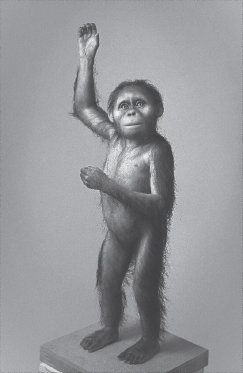
‘Lucy’, one of the oldest known human ancestors
HOMO HABILIS
By 2.5 million years ago, Homo habilis evolved. Homo habilis did not stand much taller than Australopithecines, and their brains were only slightly bigger. But there seems to have been an increase in intelligence and inventiveness. Homo habilis were known to have hit flakes off stones to use them for cutting. And making stone flakes is difficult. Human archaeologists have tried to re-enact this activity and it is tricky, requiring a lot of trial and error. It requires some pretty beefy intellect, intentionality and the patience of a craftsperson. But there were limits. As important a breakthrough as stone-working was, we see very little sign of technological improvement over the million years that Homo habilis existed. We see invention. But we don’t see the accumulation of invention generation after generation to make those cutting implements better or more diversified.
As for the social complexity of Homo habilis, it was arguably similar to that of Australopithecines or chimpanzees. Their groups remained quite small. But 2 million years ago, population growth caused Homo habilis groups to run into other groups more frequently. This put pressure on the brain to manage more frequent and complex social interaction, including alliance building, so that violence would not break out every time groups met. Strategies included gift-giving and intergroup marriage. The latter was particularly effective since it prompted two groups to have an interest in the continuation of a combined line of DNA. It is around 2 million years ago that evolutionary anthropologists estimate that monogamy (long held by New World monkeys) began to evolve in our own family tree in Africa. The fact that Homo sapiens have both successful and unsuccessful attempts at monogamy, in addition to polygamy and promiscuity, is testament to two strands of evolutionary wiring being in conflict with each other.
Another way primates bonded with each other and formed alliances was by grooming: picking the bugs and dirt out of someone’s hair. We see this in our last common ancestors with Old World monkeys, going back 40 million years. But as group numbers grew, we couldn’t groom everyone. There wasn’t enough time in the day. So we began to ‘gossip’ or small-talk.
Homo habilis still had a very restricted range of sounds to form speech. But gesture allowed some communication, added to which they used pleasing sounds such as hums, grunts and yells to convey displeasure. There was an evolutionary advantage to socialising, putting selective pressure on these communication abilities to grow.
This may have been reinforced by sexual selection. Females may have chosen males who were able to express themselves in ways that either charmed them or convinced groups to follow them. Since the last common ancestor with chimps 5 million years ago, mating preference had been given to those males who were able to form alliances and ranked high in the group.
The pressure on enhanced communication to deal with growing social complexity had a profound impact on brain growth, which manifested in our next major ancestral species.
HOMO ERECTUS
1.9 million years ago Homo ergaster-erectus evolved. There is debate over where both ergaster and erectus should be classified in a single species that looks pretty similar. Homo ergaster usually refers to the earliest versions of the species that existed in Africa, while Homo erectus refers to the species as it travelled across the Old World. For simplicity, I will simply refer to both as Homo erectus. But this is not a position on the current debate about the taxonomic classification.
Homo erectus was taller than Homo habilis. It had perfected the art of bipedal locomotion. Homo erectus was definitely more comfortable crossing long distances than Homo habilis. In fact, Homo erectus would present a challenge to human bipeds today in stamina and running speed. Their facial structure looked far more human; if you saw one wearing clothes on a bus you might be forgiven for not really noticing anything unusual about them. Their body hair had receded significantly from that of earlier primates, leaving melanin of the skin protecting them from the African sun’s harsh rays. In fact, in most major phenotypical aspects, Homo erectus was exceedingly human.
There is some evidence that Homo erectus lived in larger social groups than earlier ancestral species, and encountered other groups more frequently. There is also evidence that they had controlled use of fire and were able to cook and eat meat. The consumption of meat was crucial to further brain development, since it packed more energy in a single morsel than a comparatively larger amount of vegetation. The most notable aspect of Homo erectus is that they had a decidedly bigger brain, roughly twice that of Homo habilis and 70 per cent that of modern humans.
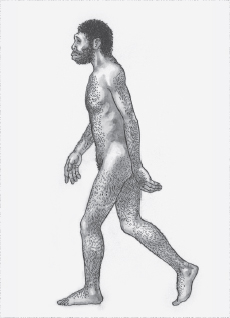
Homo erectus
A population boom led Homo erectus out of Africa and across southern and eastern Asia. They adapted to deserts, forests, and coastal and mountain regions. A species this adaptable certainly had to be advanced in intelligence. They became the first pan–Old World human species and they continued to exist for hundreds of thousands of years.
THE FIRST COLLECTIVE LEARNING?
There was very little technological improvement in the toolkit of Homo erectus in the first millennia after it evolved 1.9 million years ago. Then, 1.78 million years ago, Homo erectus invented a new kind of tear-drop axe in East Africa. This could just have been a one-off. For thousands of years Homo erectus did not tinker with or improve this tool. That was in keeping with every primate tool-user before them. Chimps, Australopithecines and Homo habilis were all bright enough to come up with new tools and to pass the techniques on to their offspring, but not to improve them generationally.
Yet with Homo erectus 1.5 million years ago in East Africa, we see the first glimmer of evidence of a revolutionary new ability. Homo erectus began to improve their hand-axes in quality, and converted them into multipurpose picks, cleavers and other kinds of implements.
This is hugely important in our story. It was the first sign of tinkering, accumulation of innovation, and improvement of technology generation after generation. Something known as collective learning.
Why does this matter? If there is a limit to how much one can invent, a species more or less stays the same for thousands of years until biological evolution changes them. Even with tool use, they are still stuck in the slow process of natural selection in order to raise complexity. However, if a species like Homo erectus could improve on existing technologies by tinkering with them – and with no major genetic change or evolution – and also spread out from their traditional habitats across the world, this is the sign of something new. It means this species was no longer dependent on biological evolution or the cruel Darwinian world to increase its complexity.
We have made the first tentative steps into the ‘cultural realm’, where the complexity-generating process of collective learning blazes along at a faster speed than biological evolution. Like express highways built atop older winding roads.
And collective learning had only just begun to evolve. A trickle would soon become a flood.