
PART THREE
315,000 years ago to present
7
Wherein Homo sapiens evolve from a long lineage • Collective learning is more powerful than ever before • Roughly 25 billion of us live in foraging communities spread over 98 per cent of human history • A genetic bottleneck reduces our gene pool to less than 10,000 individuals • Shortly thereafter we migrate across the world.
ACCUMULATION, THAT SINGLE WORD, more than any other, sums up what makes Homo sapiens different. The ability to accumulate more information with each generation than is lost by the next, also known as collective learning. Humans didn’t get to where we are today because we are all super-geniuses. A cursory glance at politicians, celebrities or perhaps your in-laws is proof enough of that. A human raised alone in the wild would not have any remarkable advantage over other animals. Also, humans can only invent so much stuff in a single lifetime – when they’re not too busy trying to survive, that is, which most people were throughout the majority of history.
Yet with generation after generation of invention, humans became something novel and unique in the biosphere. Like building blocks laid one upon the other. Slowly but surely, inventions stacked up, leading to dramatic changes in complexity within a few thousand years. In the blink of an eye in evolutionary time, humans have gone from stone tools to skyscrapers. That is the power of collective learning.
Isaac Newton said he stood on the shoulders of giants when it came to his own work on gravity (although, arguably, this was just rhetoric to cover up plagiarism). In reality, the ‘giants’ are actually composed of thousands and millions of inventors throughout human history. That is why the ability to accumulate innovation is what makes humans so unique. More so than just our raw brainpower or capacity for language and abstract thought. We have an unparalleled talent for remembering details of the past. Remembering our history.
FROM HOMO ERECTUS TO HOMO SAPIENS
Homo erectus showed the first sign of collective learning 1.5 million years ago. It was a very humble start. Homo erectus took tens of thousands of years to make moderate improvements to their stone axes. Nevertheless, collective learning had appeared in our evolutionary repertoire. Provided natural selection considered collective learning useful to survive, the skill would only grow more powerful with each new species.
Homo antecessor evolved 1.2 million years ago and moved into Europe in large numbers, requiring innovation to deal with the frigid and foreign environments there. They were about the same size in terms of height and body weight as Homo sapiens, but they had slightly smaller brains and a much more limited form of language.
Homo heidelbergensis evolved about 700,000 years ago in Africa and slowly spread over Europe and West Asia. They had even larger brains, which could fall roughly on the low end of the human average. It is likely they had a fairly acute sense of being able to distinguish sounds in speech, like modern humans, and a pretty intricate form of communication.
The Neanderthals appeared approximately 400,000 years ago and had brain sizes that rivalled that of modern humans, though they appear to have had limited capacity for abstract thought (contemplating and communicating things that aren’t actually there).
Homo antecessor, Homo heidelbergensis and the Neanderthals all show clear signs of collective learning. They presided over the first systematised and regular use of fire in hearths, the first blade tools, the earliest wooden spears and the earliest use of composite tools where stone was fastened to wood. Homo heidelbergensis became the first hominine to colonise all of Eurasia. Neanderthals even adapted to climes that made clothing and other cultural innovations necessary for insulation and warmth. They manufactured complex tools, with prepared stone cores, producing a variety of implements – sharp points, scrapers, hand-axes, wood handles – with deliberate use of high-quality stone materials, and countless variations and improvements over time. All this invention and expansion across the Old World is a clear sign of collective learning growing evolutionarily stronger.
Then, 315,000 years ago, people that were anatomically identical to Homo sapiens first appeared in Africa. Why did Homo antecessor, Homo heidelbergensis and the Neanderthals all go extinct while Homo sapiens did not? Simply because Homo sapiens was the most talented at collective learning. For example, once Homo sapiens entered regions already populated by the Neanderthals, we outcompeted them for resources, likely killed many of them and notably also interbred with them (outside of Africa, a substantial amount of our DNA today includes Neanderthal genes).
Homo sapiens had the most advanced collective learning, the most diverse toolkits and were the most adaptable to new environments. We had big brains, a greater capacity for language and we were more capable of abstract thought, as evidenced by the fact that we alone painted cave art, used body paints, played music, wore decorative jewellery and demonstrated symbolic thinking. All of these traits complemented our capacity for collective learning as we built up huge knowledge bases about how to forage and survive in the hostile environments of the Paleolithic Earth.
Collective learning has two main drivers which make it stronger the more they are enhanced:

1.population numbers: The number of potential innovators in a population. Not all of them will conjure an improvement in technology, doctrine or philosophy in their lifetimes. But the more people you have, the more rolls of the dice there are to increase the probability that one of those people will come up with either a minor or major innovation.
2.connectivity: In order to build on the ideas of the past, humans need access to them. This means either access to repositories of oral or written knowledge, or communication with other humans who possess that knowledge. Perhaps even collaboration with them. While today, with instantaneous communication via the internet and the equivalent wealth of knowledge of the Great Library of Alexandria being available on your phone, it is difficult to imagine what limitations in connectivity might have imposed on innovation. But for the majority of human history, one of the biggest things holding innovation back was access to the pool of wider human knowledge. For the first 300,000 years of our existence, our communities were limited to a few dozen foragers.
As we shall see, much of the story of human history is the intensification of both population numbers and connectivity, and the resulting acceleration. Look at how little humans have changed biologically over the past 10,000 or even 100,000 years. But consider how vastly our lifestyles have shifted in the same space of time. Everything is accelerating.
How do we assign a date for the start of Homo sapiens? First, there are the Omo remains, discovered in East Africa between 1967 and 1974. Radiometric dating puts the oldest of these remains of anatomically identical Homo sapiens at 195,000 to 200,000 years old. Then, in 2017, we discovered more Homo sapiens remains in Morocco, dated to approximately 315,000 ago or older. So currently, 315,000 years old is the best supported start date for our species. But this number could grow larger in the coming years if new discoveries are made.

It is unlikely Homo sapiens underwent a rapid genetic change subsequent to 315,000 years ago that significantly enhanced its intellect or capacity for collective learning. They were using decorative beads in Africa prior to the Second Great Migration 64,000 years ago, mining for new materials 100,000 years ago, fishing 120,000 years ago, and using body paints around 300,000 years ago. So we’ll be operating on the assumption that anatomically identical Homo sapiens started 315,000 years ago, with only minor genetic changes (such as skin colour, hair colour, eye colour, and much later lactose tolerance and varying tolerances for alcohol) in the subsequent millennia. But no change was so profound that it required classification as a different species or subspecies.
STONE AGE HUMANS
We now properly enter the realm of human history. For the majority of human history – an estimated 95 to 98.5 per cent of our entire existence – we dwelled in small groups of foragers, ranging across the Earth hunting and gathering food. The historical actors in this part of the story were anatomically identical to modern humans, with the same range of emotions and capacity for invention that we possess today. As such, it’s easier for us to feel empathy with those in this part of the story, than the living beings of earlier periods. These people were us. If we had been born in that era, we would have behaved the same way. But human foragers lived very different lifestyles, in a world hit with ice ages and populated by a terrifying range of megafauna, from sabre-toothed tigers to carnivorous 3-metre-tall kangaroos. The past is indeed another country, if not another planet.
Taking the 315,000-year date as our starting point, approximately 100 billion humans have lived and died on the surface of the Earth since the origin of our species. Of those, 16 to 20 billion have lived since the start of the Industrial Revolution 250 years ago, with nearly 8 billion alive today, at the time of writing. An additional 55 billion are estimated to have lived between the beginning of agriculture 12,000 years ago and the Industrial Revolution. That’s 71 to 75 billion people out of 100 billion.
That leaves approximately 25 to 29 billion people who lived between 12,000 and 315,000 years ago – the foraging era. For the majority of that time, most humans lived in Africa, and only in the past 64,000 to 100,000 years have a substantial number of humans lived in the rest of the world. We know that the Earth can only support about 6 to 8 million foragers living at any given time. For the overwhelming majority of the Paleolithic, our numbers were a lot fewer than 500,000.
Biologically and instinctually speaking, humans are best suited to the foraging lifestyle. It is what we were wired for. All the vast changes of the past 12,000 years since the invention of agriculture have not left enough time for us to evolve and catch up.
In short, we are cavemen in fancy shoes.
THE ICE AGES
The past 2.5 million years have seen numerous waves of cooling and heating, with long glacial periods (ice ages) interspersed with so-called interglacial periods (such as the one we are in now). There have been two or three ice ages since Homo sapiens evolved in Africa 315,000 years ago. During an ice age, large parts of North America, Europe and Asia are covered ice sheets, the average global temperature drops, previously lush climates in other regions of the world such as Africa dry out, and the sea level drops.
The second-to-last ice age started 195,000 years ago, when Homo sapiens were alive and well in Africa. It continued for a further 60,000 years, until an interglacial period began 135,000 years ago. This interglacial lasted for just 20,000 years, until approximately 115,000 years ago (interglacial periods are generally shorter than glacial ones). The ‘Last Glacial Period’ began 115,000 years ago and it was a particularly long one, lasting just over 100,000 years. It was in this world that humans migrated out of Africa and across the Earth.
At the height of the last ice age, about 30 per cent of the Earth’s terrestrial surface was covered with ice. Where ice sheets did not spread, colder temperatures made forests turn to woodland or even deserts. Winters lasted longer than they currently do. While most humans 115,000 years ago lived in Africa, the conditions there were much more frigid than those experienced in Africa today.

The world at the Last Glacial Maximum
THE GENETIC BOTTLENECK
Homo sapiens’ foraging method of finding food remained the same for thousands of years: roam a territory hunting and gathering until the flora and fauna of the region become depleted, then move onto another region while the previous one naturally replenishes itself. Using this method, the entire surface of the Earth can support only 6 to 8 million foragers.
As human populations in Africa grew, they needed to find more food to support them. The answer to this problem was not to intensify the amount of food produced in Africa but to ‘extensify’ – by travelling further and further afield.
This may have prompted the First Great Migration of humans out of Africa 100,000 years ago into the Middle East, with some indications that they reached as far as India. These regions were still out of reach of the ice sheets. Despite this migration, the vast majority of humans remained in Africa.
We have indications in our DNA histories that human genetic diversity shrunk dramatically before the Second Great Migration. One possible explanation is the supervolcanic eruption that occurred during this period at Mount Toba 74,000 years ago. In the middle of the island of Sumatra, in present-day Indonesia, was a volcano. Where this volcano once stood there is now a lake. Or rather, a crater.
Mount Toba exploded with the force of 1.5 million Hiroshima-sized bombs and with the force of the nuclear arsenals of every single country in the world today. Multiplied by at least three. The eruption threw an unprecedented amount of rock into the atmosphere, scattering rubble and magma far and wide on a continental scale. A layer of volcanic ash, an average of 15 centimetres thick, settled over everything in South and East Asia, but also in India, Arabia and as far as East Africa. Much more ash was flung up into the atmosphere, darkening the skies and obstructing sunlight in an era already beset by an Ice Age. What followed may have been a decade of perpetual winter for the entire globe. It may well have reduced the population to 10,000 people. Or even as few as 3000.
In the past decade, the Toba hypothesis has been disputed by several scientists. I am still waiting for an alternative explanation for the bottleneck that is evident in our DNA. Hold on for the second edition!
Regardless, the genetic bottleneck tells us something very important about race. In a nutshell, humans today come from at most 10,000 people only a few tens of thousands of years ago. That is not enough time for significant genetic differences to occur between ethnicities. In fact, compared to other primates, modern humans today have an extremely low amount of genetic diversity. There is more genetic diversity between two groups of chimps separated by a few hundred miles than in the entire human race. We are not exactly an inbred species, but we are all pretty damn closely related.
THE SECOND GREAT MIGRATION
By 64,000 years ago, we headed out of Africa for a second time. Humans spread from Africa through the Middle East, down into India and Indochina within just a few thousand years. By approximately 60,000 years ago, humans had figured out how to use the land bridge that existed in Indonesia at the time (due to lower sea levels from the Ice Age) to make their way by foot and by rafting into Australia.
Stone-age seafaring is no easy task. The entry of humans into Australia is the foraging equivalent of landing on the Moon. Humans gradually spread across Australia over the next 20,000 years, heading into Tasmania by 40,000 years ago via another land bridge.
Also around 40,000 years ago, humans went north into colder climates, crossed the Caucasus Mountains and entered Russia, quickly making their way into Europe from the east. Most impressively, humans continued to spread into increasingly colder climates, and were in ice-age Siberia by at least 20,000 years ago. Consider the survival skills necessary in such an environment.
The entry of humans into the Americas requires a more searching statement. We are less sure exactly of how people got there. It seems clear that humans would have crossed the Bering Strait (which was then yet another land bridge) between Siberia and Alaska between 20,000 and 15,000 years ago, perhaps following herds of animals they hunted. But during the ice age there were huge ice sheets that would have prevented humans from travelling beyond Alaska. Then between 15,000 and 12,000 years ago, as ice sheets retreated, a passage may have opened up for foragers to travel through, moving south through the Americas. Another hypothesis is that humans may have bypassed the ice sheets by slowly rafting down the Pacific Coast. Or it may have been a mixture of the two. Either way, Homo sapiens became the first and only species of our genus to inhabit the Americas.
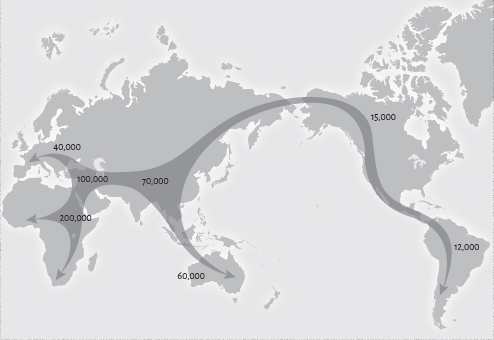
Human migration 100,000 to 12,000 years ago
OLD-FASHIONED WIRING
Humans were extremely well attuned to life as foragers, having existed in that state for 315,000 years and having evolved from previous hominines that also foraged for their existence. But we had to cope with potentially damaging situations that would end our genetic line there and then. Our instincts evolved accordingly.
In many ways, human instincts are designed to exist in small foraging communities. For example, take social anxiety. In modernity, there isn’t really any good reason to have anxiety prior to giving a talk to a crowd of strangers or being nervous before a first date. There are millions of people out there in your city. You can humiliate yourself in front of hundreds of audience members or potential mates, and still go out the next day and try again with a different group.
This was not the case for foragers in the Paleolithic. A group of humans might be a few dozen in number, and you would spend your entire life with them. If you made a fool of yourself in front of a large crowd of people, you might be socially ostracised, which would reduce your access to food and mates, or you might be thrown out of the group altogether if they disliked you enough. If you made a fool of yourself in front of a prospective mate, they might tell all the others, and your DNA would be rudely ejected from the gene pool forever. In fact, this sort of danger within a small, close-knit social hierarchy goes back at least as far as our last common ancestor with chimpanzees, 5 million years ago.
In that context, it makes sound evolutionary sense to have an instinct that agitates humans in social situations. Much of our instincts have evolved in a similar way. And many of them are ill-suited to modernity.
FORAGING LIFE AND SOCIETY
Foraging means hunting and gathering. By and large, due to sexual dimorphism (differences in average body size and strength), male humans hunted and female humans gathered. But we know from studying modern foraging groups over the past two centuries that there would have been overlap between the two groups. Some females possessed the athleticism and specialised knowledge to be hunters; some males possessed the required knowledge of plants to be gatherers and/or were too old or infirm to hunt. Further, an individual might have been personally predisposed to one activity or another, just as today different people prefer different jobs. But exceptions do not make the average, and generally women gathered and men hunted. This general pattern goes back at least 2 million years.
On average, 60 per cent of food for foraging groups came from gathering. This was due to the feast-or-famine nature of hunting: you could go days without meat, then have a bonanza of several carcasses at once. Some social theorists have interpreted this percentage as indicating that females had equal ‘hard power’ in foraging groups, if not full egalitarianism in both political power and roles. But this is contradicted by modern studies of foragers. It also ignores sexual dimorphism and the fact that men are exceedingly more violent both towards women and each other. In short, it is no good bringing in a bunch of nuts and berries if a man can bash your head in with a rock. Human power hierarchies were/are not based on production alone – if they were, the farming peasant class would have ruled in the Middle Ages – but instead, on coercion, tradition and group loyalties.
But foraging societies also defy simple dichotomy. A low-ranking female was valued higher than a low-ranking male. If a female assaulted a male, there might be very little consequence; if a male simply insulted a female, he could be killed by other males in a foraging group. The only exceptions were the male leaders of a group, who could usually get away with more because of their rank. Power and rank mattered more than gender.
By and large, many foragers maintained monogamous relationships (particularly in ritualised marriages), but a few high-ranking men might practise polygyny (having more than one wife) due to their social status, and usually with religious justification. Beyond that, sexual and romantic relationships were just as turbulent and irrational in foraging communities as they are today. Emotionally, these humans were similar to modern ones, and thus probably experienced the same degree of emotions, from strong infatuations to tumultuous break-ups, jealousies and infidelities, all of which likely contributed to interpersonal violence.
Violence was more common in the foraging world than in any subsequent period. Studies of Paleolithic skeletons that show signs of deliberately inflicted violence as a cause of death indicate a ‘murder rate’ of approximately 10 per cent. Most of these corpses were male. This is much higher than the murder rate in any modernised country – or any society in the last 5000 years.
The typical foraging tribe went extinct every 200 years, on average – either due to genocide or through one cultural group of humans being conquered or absorbed by another group. A single human culture did not occupy a tract of land for thousands and thousands of years. Instead, for the majority of human history, biological or at the very least cultural genocide was the rule, not the exception.
When injury or sickness occurred, it was frequently a death sentence. And when foragers entered a region where food was scarce, they were at risk of starving. Simple things such as a broken bone, infected wound or rotten tooth could kill you. Infant mortality was high, with 50 per cent of children dying before the age of five. Furthermore, the fact that foragers had to be constantly on the move to find enough food for everyone meant that infanticide rates were quite high: around 25 per cent.
On the upside, collecting food only took up part of a forager’s day. The average work day was 6.5 hours for foragers, compared to 9.5 hours on average for agrarian peoples, and the standard 8 hours for modern cubicle jockeys. The surplus time was used in socialisation rituals of various kinds, including feasting by the campfire, dancing and the all-important politics of mating.
As a result of all the different sources of food, the diverse diets of humans (when times were good) actually left foragers quite healthy. The nomadic life also meant there was little opportunity for as many viruses and contagious diseases to grow, meaning foragers were much healthier than humans in the subsequent agrarian period. All told, one could reasonably make the argument that humans lived better in the foraging era than at any time prior to the days of developed countries in modernity.
By the time humans had spread across the world 12,000 years ago, we had multiplied into a population of 6 to 8 million people. While humans had already proven themselves a highly adaptive and powerful species, and the sophistication of their ideas and toolkits were unprecedented in the Homo genus, a great revolution was just around the corner. It would not only put humans on a course towards ancient and modern history but trigger a great acceleration in just 12,000 years – a blink of an eye in the timescales we have covered so far – and the acceleration has not stopped but only grown faster in modern times. It is worth bearing in mind that we stand on the precipice of further revolutions with potentially godlike and Universe-changing results. And it all started here, with a few million clever primates chipping tools out of stone.