

Onaisy lies th’ head that wears a crown.
THEODORE ROOSEVELT TOOK his second oath of office in sharp, cold sunshine on 4 March 1905. Exactly four years before, he had stood on this same Capitol platform, watching President McKinley being sworn in by this same little Chief Justice. Then, heavy rain and a dogged phalanx of mostly incumbent Old Guard Republicans had reinforced his sense of having been forced into political immobility. Now, a blustering wind tore at his hair and speech cards as he stepped forward to address the crowd. It tossed the dozens of flags rising to either side of him, so violently that some wrapped around their staffs in tight spirals of red, white, and blue. Other flags, suspended between the marble columns behind him, whipped and cracked. The caps of several Annapolis and West Point cadets went spinning through the air. Women clutched at their hats (none more determinedly than Alice Roosevelt, who wore a flimsy white-and-black satin wheel, undulant with ostrich plumes), while men jammed their toppers down. The whole scene, from the ten-acre crush of spectators in the plaza to hundreds more onlookers perched dangerously on every one of the Capitol’s upper protuberances (not to mention boys clambering in trees, and a whirl of pigeons around the dome), was one of constant movement, as if Roosevelt’s energy had animated the entire body politic.
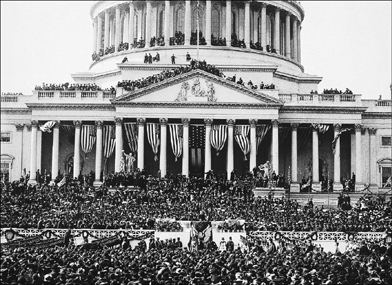
“THE WHOLE SCENE … WAS ONE OF CONSTANT MOVEMENT.”
Roosevelt’s Inauguration, 4 March 1905
“My fellow citizens, no people on earth … with gratitude to the Giver of Good … under a free government … things of the body and the things of the soul … justice … power …” The wind snatched at his shouted phrases, now muffling them, now hurling them at one group of listeners, while others heard not a word.
Roosevelt read with difficulty, his silk pince-nez ribbon slapping the side of his face. Nobody, with the exception of his wife and Dr. Rixey, knew that he was losing sight in his left eye—the legacy of a recent boxing blow. He was obliged to keep a tight grasp on his cards with both hands. Close observers noticed a strange, heavy gold ring on his left third finger. It contained a strand of Abraham Lincoln’s hair. John Hay had given it to him with a request that he wear it when he was sworn in: “You are one of the men who most thoroughly understand and appreciate Lincoln.”
Hay could not have made a gesture more certain to move Roosevelt, whose worship of the Emancipator was admixed with pride that Theodore Senior had once been an habitué of Lincoln’s White House—indeed, had met the young John Hay there. The effect of the gift was to imbue the President, at least temporarily, with a Lincolnesque devotion to the Constitution as “a document which put human rights above property rights.”
Unremarked in Roosevelt’s letter of thanks to Hay (which had expressed “love” for the first time in his male, non-family correspondence) was the fact that some sort of valediction was implied: if not from President to President, then at least from the man who had served them both, in youth and age, and was now palpably ceding his last responsibility as Secretary of State. Roosevelt had declined Hay’s pro forma resignation, but clearly any settlement of the Russo-Japanese War was going to have to be put into younger, stronger hands—hands calmed, one hoped, by this precious token of statesmanship.
“Much has been given us,” the President bellowed, leaning forward into the wind, “and much will rightfully be expected of us.”

THE LENGTH OF HIS Inaugural Address was in reverse proportion to the size of those expectations. He spoke for no more than six minutes, employed few rhetorical flourishes, and said nothing of substance. Thousands of spectators cheered with some bewilderment, not understanding that the President, with a new Senate convening in special session and foreign ministries looking to him to mediate the Russo-Japanese War, was deliberately presenting as bland a public face as possible.
Afterward, Roosevelt joked to Henry Cabot Lodge, “Did you see Bacon turn pale when he heard me swear to uphold the Constitution?” Senator Augustus Bacon of Georgia, a strict constructionist, overheard this remark, as intended. “On the contrary, Mr. President, I never felt so relieved in my life.”
Count Cassini led the diplomatic corps offstage, his chest virtually armor-plated with gold and silver orders. A commensurate glittering defensiveness had begun to characterize St. Petersburg’s attitude toward any peace overture that might be construed as further meddling by the United States in Russian affairs. So impregnable was this breastwork that John Hay could not answer when Minister Takahira asked if Cassini believed external peace might help Russia achieve internal peace, or vice versa.
At two o’clock, the President entertained two hundred guests at lunch in the White House, while thirty-five thousand Rough Riders, Negro Republicans, Harvard alumni, anthracite miners, Indians (Chief Geronimo prominent in war paint and feathers), cowboys, Grand Army veterans, ward heelers, Filipino scouts, Oyster Bay neighbors, and bandsmen massed at the eastern end of Pennsylvania Avenue. High above the banners and placards being readied for display (WE HONOR THE MAN WHO SETTLED OUR STRIKE) floated an enormous and not very threatening Big Stick.
During the ensuing parade, which lasted three and a half hours, Roosevelt scorned his glass-enclosed reviewing stand and stood alone in the constant wind, waving his tall hat, bowing, clapping, and laughing. Whatever tomorrow’s newspapers might say about him being still the youngest of Presidents, he was now the same age Theodore Senior had been when he had died—a sobering thought to his sisters, if not to himself. Four more years of strenuous responsibility loomed. Nor was he as constantly healthy as he pretended to be. The “Cuban fever” he shared with so many of these Rough Riders (trotting by with rebel yells) had to be kept down with drugs; his joints were stiffening, no matter how much he exercised; and his blood pressure, always abnormally high, was being worsened by hardening arteries.
“The President will of course outlive me,” Hay wrote in his diary, “but he will not live to be old.”
ON 10 MARCH, Roosevelt decided it was time “to let the Japanese Government understand that we should be glad to be of use” in any effort to arrive at a negotiated settlement. He cautioned Hay that this stated willingness must not sound too much like an “offer.” If he was to be a peacemaker, he could not let the Tsar think he had solicited the job. Hay obediently bypassed Takahira and gave Lloyd C. Griscom, the young United States Minister to Japan, carte blanche to leak the President’s availability.
The leak coincided with the Japanese capture of Mukden, after weeks of savage fighting. Even Count Cassini had to admit to feelings of despair. He came to see Hay, who was preparing to leave for Europe, and spoke at such length about Russia’s “tremendous sacrifices and misfortunes” in wartime that the Secretary, losing patience, asked, “When will come the time of your diplomats?”
Cassini sank into even deeper gloom. “We are condemned to fight. We cannot honestly stop.”
Hay left Washington on 17 March and journeyed north to New York. So, by a separate train, did Roosevelt. The Secretary went to stay overnight in his daughter’s suite at the Lorraine Hotel. He had no sooner settled in than a crescendo of hooves in the street below signaled the approach of the presidential cavalcade. Hay got to a window in time to see his employer sweep by, en route to Delmonico’s restaurant.
Roosevelt was in town to give away his niece Eleanor to his fifth cousin Franklin, in a Roosevelt-Roosevelt marriage sure to elicit press wisecracks about “King Theodore’s” proliferating dynasty. He seemed sublimely unconscious of the young man’s hero-worship of him. (Franklin had sat unnoticed, a handsome and angular figure, among the crowd of special guests at the Inauguration.) Nor did he realize—or care—that in giving Eleanor away, he inevitably attracted more attention than she did. His presidential gravitas was by now so charged that he took for granted a centripetal clustering wherever he moved or stood.
To that end, he had authorized the construction of a vast new salon at Sagamore Hill. It was to be big enough to accommodate the many delegations who came to see him every summer, and grand enough to impress the envoys of emperors.
THE PRESIDENT TOOK a midnight train back to Washington. He was back at his desk before John Hay, too weak to walk, could be wheeled aboard the SS Cretic. For the next few crucial months, Theodore Roosevelt would be in sole charge of the foreign policy of the United States.
A situation of extraordinary complexity presented itself. Morocco had suddenly become a factor in the Russo-Japanese War. Kaiser Wilhelm II was again using a small state’s weakness to aggrandize his own empire. This time, however, der Allmächtige had cloaked his power play in the guise of an initiative seemingly in the interest of Sultan Abd al-Aziz. He proposed to Roosevelt, in a letter delivered by Ambassador von Sternburg, that the United States and Germany “combine to compel” France to observe an open-door policy in North Africa. Such a combination would amount to a direct challenge to the Franco-British “Entente Cordiale,” which in effect shut Germany out of both Morocco and Egypt.
France, of course, was Germany’s traditional enemy (as Mr. Perdicaris had discovered in his own household), and currently very vulnerable because her ally, Russia, was distracted with war elsewhere. In singling out France’s efforts to obtain a commercial and military monopoly in Morocco, Wilhelm cleverly made her seem no less greedy than Russia in Manchuria. This put Roosevelt in the difficult position of having to agree with him, or seem hypocritical in demanding free trade elsewhere. If the President did so agree—to the detriment of Théophile Delcassé’s most cherished strategic dream, a “Triple Entente” among London, Paris, and St. Petersburg—Germany could not only strengthen its own North African presence, but also woo France away from Russia, and gain immensely in European influence. Great Britain, in turn, might begin to bristle for war, since the English were convinced that the Kaiser had designs on their homeland.
Roosevelt’s first instinct was to stall. He did not want to seem ungrateful for help France had given him in his own little Moroccan adventure, ten months before. More seriously, he felt his peacemaking credentials with the Japanese would be compromised if they saw him being manipulated by the Tsar’s cousin. Then, on 31 March, Wilhelm made a surprise visit to Tangier and aggressively repeated his demand for an international solution to the Moroccan problem.
“The Kaiser has had another fit,” Roosevelt wrote Hay. “What a jumping creature he is, anyhow!”
Von Sternburg was fobbed off with a noncommittal note that was more applicable to the Far Eastern situation. When, inevitably, Wilhelm jumped again, Roosevelt was prepared to say that the United States would not agree to any parley on Morocco without France’s consent.
April came with no sign of willingness by either Russia or Japan to take the first formal step toward peace. Both sides were afraid of “losing face.” However, they kept hinting, mainly through French intermediaries, that they were weary of war. Envoys of the various alliances besieged Roosevelt. In just one week he had to listen to Takahira, Cassini (twice), von Sternburg (three times), Jusserand, and Sir H. Mortimer Durand, a “worthy creature of mutton-suet consistency” who to his annoyance had been appointed Great Britain’s latest ambassador, instead of Cecil Spring Rice. None would commit their own countries to anything, yet they expected him to squeeze commitments out of others. Exasperated—“I wish the Japs and Russians could settle it between themselves”—Roosevelt decided to go ahead with a long-planned hunting trip in search of western wolves and bears. He needed to satisfy his ebbing yet still compulsive blood-lust. Presumably nothing decisive would happen in the Far East until Russia’s Baltic Fleet struck the blow St. Petersburg so counted on. That might not be until May.
Rather than leave the White House in charge of Vice President Fairbanks, who had been relegated to near-total obscurity since the Inauguration, Roosevelt assigned crisis-management powers to William Howard Taft. “I am not entirely satisfied with the foreign situation,” he admitted to Hay, “but there isn’t anything of sufficient importance to warrant my staying.”
Rumors proliferated that Taft was the President’s chosen successor. Edith Roosevelt worried about the growing fondness of each man for the other. When Theodore asked Taft for advice, what he usually got was approval. “They are too much alike.” She felt that her husband had been better served during his first term by the cool counsel of Philander Knox and Elihu Root. His natural ebullience tended toward explosiveness unless periodically checked. He might joke about having Big Bill around to “sit on the lid,” but politically speaking Root had packed more weight. Taft wanted to love and be loved. Consequently, he was easy to push, easy to hurt. Already Roosevelt showed a cheery tendency to bully him. “Here, Will, look at this …” (a flattering portrait of old Chief Justice Fuller) “… looks as if you might have to wait a long time.”
At any rate, Taft could be relied on. The President stayed in Washington just long enough to hand him a new, reorganized Isthmian Canal Commission. Then he quit town, leaving instructions that he be wired at any change in the international situation.
THE FIRST IMPORTANT telegram to reach him at “Camp Roosevelt,” outside New Castle, Colorado, was dated 18 April. It reported that Minister Takahira had been to see Taft, and dropped the merest hint that Roosevelt would be acceptable to the Japanese government as a mediator. Apparently, Delcassé was trying to insinuate himself into the negotiatory process. He had undertaken to bring the belligerents together, “provided that Japan would consent to eliminate from the negotiations certain conditions humiliating to Russia.” These included cession of territory and the payment of any indemnity.
Tokyo did not feel confident in the French Minister’s impartiality, since France was allied with Russia, and had ambitions in China herself. But the news that St. Petersburg was now willing to talk peace had prompted Takahira to say to Taft that his government recognized “that the friendly offices of some Power might be necessary” to initiate a peace conference. At the same time, the President of such a Power must understand that the Japanese would negotiate directly, or not at all, and under no advance pledges whatsoever.
Roosevelt wired back to Taft his agreement with Tokyo’s scruples, but added two of his own: Japan must continue her support of the Open Door in Manchuria, and press for full restoration of that province to China. He said nothing about “friendly offices,” since he had not yet been asked to provide them.
While awaiting Takahira’s reaction, he brooded upon an urgent letter von Sternburg had sent him about the Morocco matter. Wilhelm II, unaware that Roosevelt was high in the Rocky Mountains, cut off from the nearest telegraph office by thirty miles of snowdrifts and greasy mud, was asking him to find out if the British government intended to back up France in her attempt to dominate North Africa. Roosevelt detected a note of querulousness, familiar to him from the days of the Venezuela crisis, but was not unsympathetic to the Kaiser’s request. France certainly was abusing the independence of Morocco, as guaranteed by the 1880 Madrid Conference, and Britain, in his opinion, grossly overestimated German Foreign Office aims in Europe.
“I do not care to take sides between France and Germany in the matter,” he wrote Taft on 20 April. “At the same time, if I can find out what Germany wants, I shall be glad to oblige her if possible.” He authorized the Secretary to sound out Sir Mortimer Durand, if “the nice but somewhat fat-witted British intellect will stand it.”
With that, Roosevelt returned to the purpose of his presence in Colorado: the pursuit of bears. He had already killed a big black one (exactly the same weight as Secretary Taft), breaking both its hips with one bullet, and its back with another. In a departure for him, he was hunting with hounds and terriers, some of whom were so mauled by bobcats and lynxes that they could do little afterward but lie around and bleed. It was interesting to watch the pack get revenge when a cat fell off a dead branch, right into a circle of snapping jaws: the Tsar’s imminent predicament.
One little dog, a black-and-tan runt named Skip, adopted Roosevelt and took to sleeping at the foot of the presidential bed, growling at all comers.
The country was wild and steep and, because of its altitude, still in the grip of winter. White peaks massed above the camp—a clutch of tents and one log cabin, pitched in a grove of bare aspens and great spruces beside a rushing, ice-rimmed brook. Each day, Roosevelt and his hunting companion, Dr. Alexander Lambert of New York, rode out after an early breakfast, accompanied by guides and twenty or thirty dogs, and remained ten or twelve hours in the saddle, returning ravenous to the cook tent and falling into bed afterward in the cabin.
Roosevelt had been pleasantly surprised, during his earlier wolf hunt in Oklahoma, to find that he still had plenty of physical vitality. (“One run was nine miles long and I was the only man in at the finish except the professional wolf hunter Abernathy.”) Going without lunch for weeks had reduced his weight, while leaping and sliding down mountain ravines gave him the exultant, if illusory, sense of being young again. On 24 April, he killed another bear, and on 25 April yet another, a small female, breaking her neck with a single bullet. Then he began to feel ill.
Late that evening, a telegram in cipher from Taft arrived by special messenger at the White House communications center in Glenwood Springs. After it was decoded overnight, William Loeb found that it contained the text of a secret cable from Baron Jutaro Komura, the Japanese Foreign Minister, to Takahira.
You are hereby instructed to convey to the President through the Secretary of War cordial thanks of the Imperial Government for his observation and at the same time to declare that Japan adheres to the position of maintaining the Open Door in Manchuria and of restoring that province to China. Further you will say that the Imperial Government, finding that the views of the President coincide with their own on the subject of direct negotiations, would be highly gratified if he has any views of which he is willing or feels at liberty to give … in order to pave the way for the inauguration of such negotiation.
Taft added, in a postscript to Roosevelt: “Letter from Griscom today says Denison of Japanese Foreign Office says they are anxious to effect peace through you.… Cassini has sulked ever since your departure. Would it be wise to suggest beginning through him or through Jusserand?”
Loeb felt unable to trust any messenger with such a document, and decided to deliver it himself. He took a train to New Castle, then hired a mustang and a horse wrangler and ascended the mountain there. Arriving at Roosevelt’s camp late that afternoon, he handed the telegram over.
The President read it, and at once became deeply thoughtful. At dinner, Loeb and Lambert both noticed that Roosevelt was not himself. He said little and had no appetite. The telegram was clearly weighing on him. Before going to bed, he wrote a letter to Philip B. Stewart, the organizer of his hunt, saying that he was not well and would be returning to Washington earlier than planned.
At 9:00 P.M., Loeb accompanied him and Lambert to the log cabin. The night was cold, and clouds obscured the mountain. Snowdrifts covered the creek bottom. Loeb was assigned a bunk with thick blankets. Before blowing out his candle, he saw Skip snuggling against the President for extra warmth.
Around midnight, Loeb was awakened by the sound of footfalls scrunching in the drifts outside. Roosevelt’s bunk was empty. Fresh snow was falling outside the cabin’s open door. Not for several moments did Loeb make out the pajama-clad figure of the President of the United States walking barefoot to and fro in the whiteness, with Skip clasped in his arms.
Incredulous, Loeb called out. Roosevelt stopped and turned. “Is that you, Billy?”
Loeb could see that he was completely disoriented with Cuban fever. The President allowed himself to be led back inside, but held fast to Skip. Loeb silently prodded Lambert awake. They treated Roosevelt with lemon juice, calomel, and quinine, then tucked him into bed like a child, the dog still close to his chest.
The next morning at eight, he was dressed and ready for breakfast. He looked seedy, but talked for an hour about the Japanese proposal, as if not quite sure how to respond. Certainly he did not intend to come running back. He dictated a telegram for Loeb to send Taft from Glenwood Springs:
Am a good deal puzzled by your telegram and in view of it and the other information I receive I shall come in from my hunt and start home Monday, May eighth instead of May fifteenth as I had intended. This will be put upon ground of general condition of public business in Washington, so as to avoid talk about the Russian-Japanese matter. Meanwhile ask Takahira if it would not be advisable for you to see Cassini from me and say that purely confidentially, with no one else to know at all, I have on my own motion directed you go to him and see whether the two combatants cannot come together and negotiate direct.
A spell of bad weather set in. Roosevelt spent the next few days recovering from his malaria and reading Pierre de La Gorce’s Histoire du Second Empire. Jules Jusserand, who understood better than anyone else in Washington that the key to the President’s heart was his mind, had made sure that he packed all seven volumes, along with Albert J. M. de Rocca’s Mémoires sur la guerre des Français en Espagne.
Roosevelt read at less than his usual breakneck speed, hampered by rusty French and the occlusion of his left eye. In the process, he pondered every word, and was “struck by certain essential similarities in political human nature, whether in an Empire or a Republic, cis-Atlantic or trans-Atlantic.”
This was not quite the reaction Jusserand had hoped for. It was altogether too large-minded for a President whose sympathy France needed in Morocco and the Far East. At least, though, Roosevelt was not reading Clausewitz, or samurai sagas, or Ieronim Pavlovich Taburno’s Pravda o Voine.
WHAT NONE OF THE diplomats appreciated, as they obeyed their instructions, was Theodore Roosevelt’s lifelong obsession with balance. He loved the poised spin of the big globe in his office, the rhythm of neither-nor sentences, the give-and-take of boxing, the ebb and flow of political power play. His initial tilt in the Russo-Japanese War (“Banzai! How the fur will fly when Nogi joins Oyama!”) had straightened like the needle of a stepped-off scale. He instinctively sought neutrality now, as more and more potentates yielded to parochial fears: the Tsar of defeat and deposition, the Mikado of impoverishment, the Kaiser of encirclement, King Edward VII of invasion, Sultan Abd al-Aziz of serfdom, Delcassé an end to la glorie de la France—not to mention whatever Korea’s impotent Emperor and China’s aged Empress must be feeling.
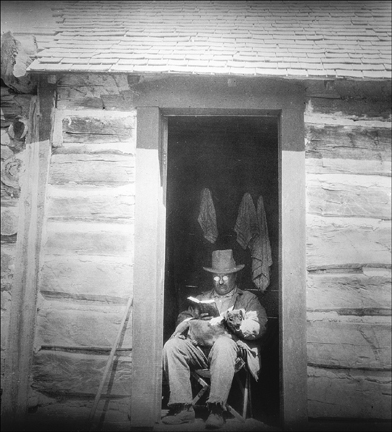
“THE KEY TO THE PRESIDENT’S HEART WAS HIS MIND.”
Roosevelt reading with Skip in Colorado, May 1905
Although Roosevelt had plainly been irresponsible in heading west at such a time, his isolation had the effect of making him seem all the more “above” the fray, eminently desirable as a peacemaker. And in remaining aloof, at least for a while longer, he kept all parties guessing as to how he would proceed.
ROOSEVELT HAD BEEN interested to discover, after killing his third black bear, that “in her stomach … there were buds of rose-bushes.” His task now was to corner the biggest bear of his career, badly worried by yellow hounds, and bring forth the flowers of peace. He had already tried, and failed, to do so through George von Lengerke Meyer, his new ambassador to St. Petersburg. Meyer had managed to see Nicholas II and present an offer of mediation worded almost as delicately as Hay’s earlier murmurings to Takahira. But Tsarina Alexandra had monitored the interview, and Nicholas, cowed by her fierce stare, had changed the subject without committing himself.
The Tsarina’s problem with peace was a double loss of face for Russia, if her husband was seen as suing for peace out of weakness. Not only would Japan look like an external victor, but Russia’s peace party, dominated by the formidable Count Sergei Witte, would gain great power within the Empire. And there was always the imponderable of revolutionary discontent, seething among intellectuals and the peasantry.
“Did you ever know anything more pitiable than the condition of the Russian despotism in this year of grace?” Roosevelt wrote Hay. “The Tsar is a preposterous little creature as the absolute autocrat of 150,000,000 people. He is unable to make war, and he is now unable to make peace.”
The only Russian left who might still effectively make both was Admiral Rozhdestvenski. His fleet was stronger than Japan’s, and Roosevelt noted that France had given him a base in Eastern waters. But in the coming battle, “my own belief is that Japanese superiority in morale and training will more than offset this.”
A steady succession of snowstorms and blizzards made Roosevelt rather regret his self-enforced sojourn on New Castle Mountain. On 6 May, he was at last free to descend to Glenwood Springs. He subsequently recorded in “A Colorado Bear Hunt,” his first piece of published nature writing as President,
As we left ever farther behind us the wintry desolation of our high hunting-grounds we rode into full spring. The green of the valley was a delight to the eye; bird songs sounded on every side, from the fields and from the trees and bushes beside the brooks and irrigation ditches; the air was sweet with the springtime breath of many budding things.