

Thim was th’ modest days iv the raypublic, Hinnissy.
It’s different, now that we’ve become a wurruld power.
ROOSEVELT’S SOJOURN IN the mountains had understandably caught the attention of the popular press. Humorists such as the poet Wallace Irwin made the most of it—noting that Dr. Lambert had been invited along as much for his camera as for his company:
“Come hither, Court Photographer,”
The genial monarch saith,
“Be quick to snap your picture-trap
As I do yon Bear to death.”
“Dee-lighted!” cries the smiling Bear,
As he waits and holds his breath.
The fact that an urgent telegram had been delivered by William Loeb was also noted. But Roosevelt so adroitly concealed its content that the message was thought to be about further mischief-making by Cipriano Castro:
But as he speaks a messenger
Cries, “Sire, a telegraft!”
Which he opens fore and aft,
And reads, “The Venezuelan stew is boiling over—TAFT.”
Irwin did not doubt, therefore, that the President had decided to return home early to “spank” a Latin American republic, as lustily as he had done in 1903. This misperception suited Roosevelt’s purposes. The longer the press thought he was concerned only with Monroe Doctrine matters (Santo Domingo would prove to be the first test of his Corollary), the better he could secretly answer the biggest challenge of his career.
So backward, backward from the hunt
The monarch lopes once more.
The Constitution rides behind
And the Big Stick rides before
(Which was a rule of precedent
In the reign of Theodore).

THE BATTLE OF Tsu Shima on 27 May 1905 was the greatest naval engagement since Trafalgar. Russia’s Baltic Fleet was annihilated in a holocaust of two thousand shells per minute. Japan sank twenty-two Russian ships, including four new battleships, and captured seven others. She lost only three torpedo boats in the process, and killed four thousand men. Admiral Rozhdestvenski was taken prisoner. The Tsar’s humiliation was complete. Only his limitless supply of military manpower, and the nearly eight thousand miles separating Tokyo from St. Petersburg, served to protect the Romanoff dynasty from rout.
Roosevelt was awed by how decisively Japan had proved herself “a civilized, modern power”—civilization, to him, being synonymous with strength. Although he confessed to Cecil Spring Rice that he loathed the Tsarist form of government, he felt a deep sympathy for ordinary Russians and their culture, so much more congenial to him than that of Nippon. If this culture was to survive Tsu Shima, and not regress into some dark age of the Russian soul, Nicholas II must be coaxed at once into the peace process.
His cousin Wilhelm would seem the likeliest agent to prevail on him, except that the Kaiser, currently obsessing about France and Great Britain, was not averse to having Nicholas tied up in Manchuria a while longer. Ambassador Cassini did not seem to know what was going on in St. Petersburg, insofar as he could be trusted: “What I cannot understand about the Russian,” Roosevelt complained, “is the way he will lie when he knows perfectly well that you know he is lying.” Jusserand was both adorable and adoring, and certainly influential on the Quai d’Orsay—which in turn exerted great influence upon the Russian Foreign Ministry. But France, right now, was preoccupied with the frightening prospect of war with Germany over Morocco. Théophile Delcassé could hardly be expected to lean on a weak but friendly Emperor in the East when a strong and extremely hostile one was demanding his resignation in the West.
So the diplomatic whirlpool spun its rounds.
ROOSEVELT PUT ALL his hopes on George von Lengerke Meyer. Although the United States Ambassador had been in St. Petersburg only seven weeks, he was already irreplaceable, the kind of man Kipling envisaged as being able to “walk with kings.” The way Meyer bore himself had much to do with his effectiveness. No aristocratic American rode a horse better, with so straight a back and so poised a top hat. All the Brahmin airs—Beacon Hill, Harvard, Essex County, oars and polo, cigars and buckshot, severity and solemnity—emanated from his manly person. He had worked for the right shipping companies, married the right woman, and sat on the right committees in the Massachusetts Legislature. After four years as Ambassador to Italy, Meyer already had the desired “envoy” look: sleek fine brow, clipped mustache, a face at once open and noncommittal. Only the overlarge, long-fingered hands were strange, more suited to a cellist, or masseur. But cello-playing and massage arts were not incompatible with royal diplomacy. He was just old enough to have graduated one year ahead of Theodore Roosevelt, and just enough inferior, in whatever imponderables determine clubmanship, to have made the A.D., but not the Porcellian. Decent, discreet, comfortingly dull, he lacked the imagination to be afraid of anything except failure to do his duty.
Roosevelt had already spelled that duty out, in detail:
I want a man who will be able to keep us closely informed, on his own initiative, of everything we ought to know; who will be, as an Ambassador ought to be, our chief source of information about Japan and the war—about the Russian feeling as to the continuance of the war, as to the relations between Russia and Germany and France, as to the real meaning of the movement for so-called internal reforms, as to the condition of the army, as to what force can and will be used in Manchuria … and so forth.
In other words, the President wanted Meyer to look at the war through Russian eyes. He, Roosevelt, already had his own American take on it, communicated frankly enough to whiten Hay’s last gray whiskers:
I am not inclined to think that Tokyo will show itself a particle more altruistic than St. Petersburg, or for the matter of that, Berlin. I believe that the Japanese rulers recognize Russia as their most dangerous permanent enemy, but I am not sure that the Japanese people draw any distinctions between the Russians and other foreigners, including ourselves. I have no doubt that they include all white men as being people who, as a whole, they dislike, and whose past arrogance they resent; and doubtless they believe their own yellow civilisation to be better.…
For years Russia has pursued a policy of consistent opposition to us in the East, and of literally fathomless mendacity. She has felt a profound contempt for England and Japan and the United States, all three, separately and together. It has been impossible to trust to any promise she has made. On the other hand, Japan’s diplomatic statements have been made good. Yet Japan is an oriental nation, and the individual standard of truthfulness in Japan is low. No one can foretell her future attitude. We must, therefore, play our hand alone.… Germany and France for their own reasons are anxious to propitiate Russia, and of course care nothing whatever for our interests. England is inclined to be friendly to us and is inclined to support Japan against Russia, but she is pretty flabby and I am afraid to trust either the farsightedness or the tenacity of purpose of her statesmen; or indeed of her people.
After only two meetings with the Tsar, Meyer was unable to convey anything more “Russian” than the fact that nobody knew what His Majesty was going to do. This was not enough for Roosevelt. Tsu Shima afflicted him with a new sense of urgency in saving Russia from double collapse, abroad and at home. Even the Japanese seemed to be in a hurry, dropping their usual circumlocutions when they asked, on 31 May, if the President would “directly and entirely of his own motion and initiative … invite the two belligerents to come together for the purpose of direct negotiation.” Roosevelt guessed that Tokyo’s resources were depleted, after fifteen months of all-out war.
At all costs, Nicholas II must be prevailed upon before his generals divined the same thing. Moving with a secrecy so extreme that only Edith and William Loeb knew of Japan’s request, Roosevelt summoned Cassini. He told him to convey to the Tsar his frank opinion that the war was “absolutely hopeless for Russia.” If His Majesty would agree to the idea of a peace conference, he thought he “would be able to get” the assent of Japan.
The move was pro forma, because he doubted that Cassini would have the courage to transmit such a message. His next step was to order Meyer to call on the Tsar “at once,” and express the same sentiments even more forcefully.
Count Lamsdorff, the Russian Foreign Minister, fussed when Meyer asked for an immediate audience with the Tsar. His Majesty was in the country, at Tsarsköe Selò; the royal family was about to celebrate Her Majesty’s birthday; His Majesty never received diplomats on such occasions; the imperial calendar for the next few days was full. Meyer then used the plainest possible language. The President of the United States had cabled him that morning with a proposition that only the Emperor and Autocrat of All the Russias could receive. And since Her Majesty’s birthday was not until tomorrow, 7 June, he, Meyer, was quite ready to take a train to Selò now.
Lamsdorff did not like being hustled, but at two o’clock the following afternoon, Meyer found himself alone with Nicholas II. After thanking the gravely courteous monarch for receiving him “on such a day,” he presented an oral paraphrase of Roosevelt’s cable.
This was a mistake. The Tsar, with no formal language to react to, merely said that he needed time to “ascertain what his people really wanted.” He continued to laud the uma of Mother Russia as if unaware that the Empire’s revolutionary movement now included representatives of every social class. Meyer listened patiently, then asked, “Will Your Majesty allow me to read my instruction?”
Now it was the Tsar’s turn to listen, sentence by sentence, to Roosevelt’s actual words:
It is the judgment of all outsiders, including all of Russia’s most ardent friends, that the present contest is absolutely hopeless and that to continue it would only result in the loss of all of Russia’s possessions in East Asia. To avert trouble, and as he fears, what is otherwise inevitable disaster, the President most earnestly advises that an effort be made by … representatives of the two Powers to discuss the whole peace question themselves, rather than for any outside Power to do more than endeavor to arrange the meeting—that is, to ask both Powers whether they will not consent to meet.
As Meyer read on, stressing Roosevelt’s principal points—complete secrecy, an unprompted invitation, no outside participants—the Tsar listened in silence. From somewhere on an upper floor came the piping sounds of the Romanoff children playing. Outside in the palace gardens, lilacs bloomed in the full beauty of Russian spring.
If Russia will consent to such a meeting the President will try to get Japan’s consent, acting simply on his own initiative and not saying that Russia has consented …
Meyer was able to read this sentence with sincerity because he did not know, any more than Nicholas did, that the initiative had in fact already come from Japan.
… and the President believes he will succeed. Russia’s answer to this request will be kept strictly secret, as will all that has so far transpired, nothing being made public until Japan also agrees. The President will then openly ask each Power to agree to the meeting, which can thereupon be held. As to the place of the meeting, the President would suggest some place between Harbin and Mukden; but this is a mere suggestion. The President earnestly hopes for a speedy and favorable answer to avert bloodshed and calamity.
Meyer finished reading, but no answer came. Nicholas sat mute through a series of further appeals, improvised by the increasingly desperate Ambassador. He showed emotion only once, when Meyer remarked that if Japan proved obstinate or greedy at the conference table, Russians would unite behind their sovereign. At this, the Tsar made a half gesture, as if wanting to touch him.
“That is my belief, and I think you are absolutely right,” Nicholas said.
Meyer made much of his own friendship with Roosevelt, extending back to Harvard days, and said that the President was acting, as he always had, “from the highest motives.” He understood that it was agonizing for a Commander-in-Chief to put aside “pride and ambition” in a time of national adversity, but that the saving of “possibly hundreds of thousands of lives” would justify it, and win His Majesty world respect. The alternative was to go on fighting a horde of fanatic Orientals who, unlike “Christian” soldiers, had no fear of death—indeed, had an obsessive worship of it.
Protocol required that the Tsar, not Meyer, signal the end of the interview. Three o’clock approached, but Nicholas still made no move. At last he said, “If it will be absolutely secret as to my decision, should Japan decline, or until she gives her consent, I will now commit to your President’s plan.… Do you suppose,” he added, “that President Roosevelt knows, or could find out in the meantime and let us know, what Japan’s terms are?”
MEYER’S JOYFUL BOMBSHELL hit the White House the next day with no outside reverberation whatsoever. Not until 10 June, after both belligerents had accepted Roosevelt’s formal “invitation,” did the press get official word of what had been going on, and who was responsible for the sudden decrease in international tension. The London Morning Post hailed the emergence of a new world peacemaker:
Mr Roosevelt’s success has amazed everybody, not because he succeeded, but because of the manner by which he achieved success. He has displayed not only diplomatic abilities of the very highest order, but also great tact, great foresight, and finesse really extraordinary. Alone—absolutely without assistance or advice—he met every situation as it arose, shaped events to suit his purpose, and showed remarkable patience, caution, and moderation. As a diplomatist Mr Roosevelt is now entitled to take high rank.
Strangely, the President was nowhere to be seen at the time of the announcement. He had, in fact, left town the day before on a mysterious trip to Rapidan, Virginia, allegedly to spend the weekend with some friends. His real destination was a nearby dacha in dense forest that Edith Roosevelt had acquired as a hideaway for them both. The Tsar and Tsarina would have found it somewhat confining, since it consisted of one rough-cut, stone-chimneyed boarded box, with two smaller boxes upstairs. The pitched roof was overlong in front, creating a shaded “piazza” at mosquito level. Edith called the place Pine Knot, after the most noticeable feature of its interior decoration.
Here, as the news of the forthcoming peace conference reverberated through Europe and Asia, the President and his wife relaxed in solitude, hearing nothing but birdsong and the trickle of a spring. “It really is a perfectly delightful little place,” Roosevelt wrote Kermit. “Mother is a great deal more pleased with it than any child with any toy I ever saw, and is too cunning and pretty, and busy for anything.” Since Edith’s culinary industry extended mainly to boiling water for tea, he served a breakfast of fried eggs and bacon, a dinner of two fried chickens with biscuits and cornbread, plus cherries and wild strawberries for dessert. The following morning, by way of variety, he fried eggs and beefsteak. Roosevelt noted, almost with surprise, that two such meals a day were “all we wanted,” and he worked off some of the effects by cutting down trees.
HIS UNCHARACTERISTIC CIRCUMSPECTION lasted after he returned to work on 12 June. “The President is usually a very outspoken personage, but for ten days he has been absolutely dumb,” complained George Smalley, the Washington correspondent of The Times of London. “The State Department has not known what is going on. The Cabinet does not know—Taft excepted.”
What was “going on” was a new phase of negotiations so delicate as to make the previous ones seem easy. Russia and Japan each felt that they had lost face in agreeing to talk peace, and each now sought to regain it by disagreeing as much as possible on all follow-up details, such as where to meet and when, and how to ensure equal negotiatory strength. Roosevelt was by no means “dumb” in his official communications with both foreign ministries, addressing them in a third-person style that nicely mixed courtesy and contempt for their posturing:
The President feels most strongly that the question of the powers of the plenipotentiaries is not in the least a vital question, whereas it is vital that the meeting should take place if there is any purpose to get peace.… The President has urged Russia to clothe her plenipotentiaries with full powers, as Japan has indicated her intention of doing. But even if Russia does not adopt the President’s suggestion, the President does not feel that such failure to adopt it would give legitimate ground to Japan for refusing to do what the President has, with the prior assent of Japan, asked both Powers to do.
There was a world of sensitivity in his use of the words assent and asked. He did not want even to hint on paper that he considered the war to have been “the triumph of Asia over Europe.” But in plain speech to Cassini, he did not hesitate to state that he had not sympathized with Russia from the start of the war, and considered her entire military effort to have been “a failure.” She would lose no matter how long she kept on fighting, so she had better start making concessions now. To Takahira, he said that obstinacy over peace terms would prolong the war at least another year and cost Japan untold “blood and money.” Japan had already won so much, “the less she asked for in addition the better it would be.”
Smalley was wrong about Taft being well-informed on the President’s current diplomacy. Since coming back from Colorado, Roosevelt had confided only in members of his secret du roi: Edith, Henry Cabot Lodge, Speck von Sternburg, and Jules Jusserand. Even to such intimates, he told only what he wanted to tell. Like a mirror-speckled sphere at a prom, sending out spangles of light, he beamed fragmentary particulars at different dancers. They circled beneath him (or did he revolve above them?) in movements of accelerating, apparently random intricacy. The resultant sweep and blur was enough to make any bystander dizzy, because it looked centrifugal; Roosevelt, however, felt only a centripetal energy, directed inward.
As he mediated between Russia and Japan, he was secretly doing the same between Germany and France. Wilhelm II had become so strident in calling for a conference on the Moroccan question (ranting about a Franco-British plot to contain the Reich) that Roosevelt saw the danger of a “world conflagration” that would make the war in the Far East look like a border skirmish. The French government must accept the idea of a conference. He was accepting it himself, if only to make Wilhelm feel wanted. “Let not people in France take it amiss if I am found particularly flattering toward the Emperor,” he told Jusserand, before handing Speck von Sternburg a memo of near-Levantine obsequiousness.
The French Ambassador himself needed stroking, because his superior and patron, Delcassé, had just resigned over the Morocco problem. Roosevelt made a point of consulting Jusserand as if he were an honorary Cabinet officer, and told a bewildered congressman, “He has taken the oath as Secretary of State.”
Another—and surprised—recipient of presidential confidences was Sir Mortimer Durand, unaware that Roosevelt privately rated his intelligence at “about eight guinea-pig power.” A summons to the White House at 10:00 P.M.; the Washington Monument dark against the full moon; fireflies striking sparks over the lawn; magnolia blossoms stirred by the southern breeze. A long wait, then one of the President’s patented sudden entrances. Two cane chairs drawn up on the porch. A torrent of Rooseveltian talk.
“He told me,” Sir Mortimer informed Lord Lansdowne, “that he wished me to know the exact course of the recent negotiations, England being the ally of Japan.… He had told no single person except Taft [sic]—Hereafter a month or so hence, he might tell Lodge and one or two others, i.e. everyone.”
The British Ambassador might have been less beguiled by this frankness had he been aware that Roosevelt had already given Lodge almost a mirror version of it. (“You are the only human being who knows … except Edith, though I shall have to in the end tell both John Hay and Taft.”) Lodge, in turn, did not know some of the things that Sir Mortimer now knew: that the President had “lashed out savagely” when Count Cassini implied that Russia was going along out of sheer magnanimity, and had told Takahira to be content with the Tsar’s willingness to appoint plenipotentiaries, because the very word meant “persons with full powers.”
So with speech both soft and hard, white lies and colorful confidences, Roosevelt coaxed the peace process along. Durand noted how happy he was that June, how proud of his quiet game, and how “perfectly confident of success.”
JUSSERAND HAD NO sooner gotten used to being teasingly addressed as “John Hay” than the real owner of the name sailed home to claim it. “Cordial congratulations on your peacemaking,” Hay wrote after disembarking in New York. “You do not need any Secretary of State.”
The weather in the capital was already hot, and Roosevelt urged Hay to go straight on to his place in New Hampshire. Hay, however, seemed determined to come south.
“I suppose nothing will keep John away from Washington,” the President wrote Clara Hay. “But he must not stay here more than forty-eight hours.… He must rest for this summer.”
She knew as well as Roosevelt that Hay would not see another. His German “cure” had been ineffectual, and he hardly had the strength to walk, let alone work. Some obscure desire to reconnect with the scenes of his youth in the nation’s capital drove him. In the mid-Atlantic, he had dreamed of reporting back to the White House and being greeted not by Theodore Roosevelt, but by Abraham Lincoln. The vision had filled him with an overpowering melancholy.
“I am going to Washington simply to say Ave Caesar to the President,” Hay wrote, in the last of his letters to Henry Adams.
A White House dinner invitation awaited him when he got in on 19 June. He declined, but crossed the square later and found the Roosevelts still at the table. Refusing to be tempted by ice cream, fruit, and coffee, he joined the President on the same porch that had recently accommodated Durand. Roosevelt was in cordial humor, and gave Hay a full report on the peace negotiations. As they talked, there was a strange guttural sound in the darkness, and an owl flew over their heads. It perched on a window ledge and looked down on them with an expression that struck Hay as wise, yet also full of scorn.
NEWS OF THE SECRETARY’S death on 1 July from a coronary thrombosis reached Roosevelt that day, just after he had moved to Sagamore Hill for the summer. Simultaneously, William Howard Taft headed to San Francisco, accompanied by Alice Roosevelt and a large Congressional party, to embark on a slightly mysterious “goodwill tour” of the Far East.
Taft’s renewed assignment to diplomatic business underlined a need, now critical, for a strong Secretary of State—someone who could be relied on to restore morale at the State Department after more than two years of moribund leadership. “Elihu,” the President said after Hay’s funeral, “you have got to come back into my Cabinet.”
Root sat silent, eyes downcast. In his seventeen months away from the government, he had attained happiness and wealth at the New York bar. His wife, who hated Washington, was re-established in Manhattan society, and Thomas Hastings was building them both a splendid town house on Park Avenue. Listening to the President’s words, Root felt nothing but an immense tiredness.
He exchanged glances with Roosevelt, then heard himself accepting.
ROOSEVELT WAS QUITE willing to ease Root’s return to service by relieving him of responsibility for the current peace negotiations. Apart from an emerging consensus that the conference might possibly be held in Washington, as more neutral than any other major world capital, Russia and Japan seemed more determined than ever to find reasons to go on fighting.
A sense gathered among scholars of foreign policy that more had passed than the last nineteenth-century Secretary of State, and more was coming than the mere settlement of a Far Eastern quarrel. Other current developments presaged ill for world peace: a sudden decline in French diplomatic prestige, triggered by Delcassé’s resignation; a reciprocal increase in the strategic power of Germany; mutiny aboard the battleship Potemkin at Odessa, along with enough riots and strikes elsewhere in Russia to convince George Meyer that the Tsar’s subjects were in a prerevolutionary state; a loss of imperial will in Britain, in the wake of the Boer War debacle (to Roosevelt’s exasperation, Lord Lansdowne would not even lean on Japan, his Far Eastern ally, to moderate her peace terms, as Delcassé had done on his ally, Russia). Flabby Sir Mortimer, with his disinclination to shin up large, steep obstacles in Rock Creek Park, struck Roosevelt as a pretty good symbol of a culture that had lost its force.
Wilhelm II seemed to feel differently. In a manipulative letter, dated 13 July, he warned Roosevelt that the British were opposed to “the great work that the President is so ardently pursuing for the benefit of the whole world.” They sought an indefinite prolongation of the war, in order to weaken both belligerents and ultimately bring about the partition of China.
Roosevelt was reinforced in his own opinion that Lord Lansdowne did not really want peace. Cecil Spring Rice tried to make him understand that the Foreign Minister could not force an ally into accepting peace terms contrary to that ally’s interest. Had Lansdowne done so, “we would have broken our word.” But this did not mean Britain looked for a settlement so humiliating for the Tsar that it would amount to a military defeat. “If Russia is excluded from the Pacific she must seek an exit for her energies elsewhere—in Persia, Afghanistan, or in the Near East.”
“Now, oh best beloved Springy,” Roosevelt replied, “don’t you think you go a little needlessly into heroics when you say that … ‘honor commands England to abstain from putting any pressure whatever on Japan to abstain from action which may eventually entail severe sacrifices on England’s part?’ ” He did not notice the French having any such shrinking scruples about their alliance with Russia, even though they had more to worry about in eastern Europe than the British in Asia Minor.
My feeling is that it is not to Japan’s real interest to spend another year of bloody and costly war in securing eastern Siberia, which her people assure me she does not want, and then to find out that she either has to keep it and get no money indemnity, or else exchange it for a money indemnity which, however large, would probably not more than pay for the extra year’s expenditure and loss of life.… Practically the only territorial concession they wish from Russia is Sakhalin [Island], to which in my judgment they are absolutely entitled.
Knowing he could rely on Spring Rice’s discretion, he wrote that Lord Lansdowne and Prime Minister Balfour “ought to know” that it had been Japan, not any other power or person, that had first asked him to intervene in the crisis. Their precious ally, therefore, was probably in a less advantageous position than they imagined.
Roosevelt’s admiration for Japan had by now passed its peak. He was still amazed that the little Island Empire had managed to humiliate Russia on land and sea, while actually increasing her exports and building up her industrial might. The very efficiency with which she had accomplished such miracles, however, made him wonder what future expansion Japan was capable of. Eight years before, in a strategic question posed to planners at the Naval War College, he had written, Japan makes demands on Hawaiian Islands. This country intervenes. What force will be necessary to uphold the intervention, and how should it be employed? Now, he was even more convinced that the United States had to commission more warships, build them bigger, and launch them faster. Or what had happened at Tsu Shima might happen in Pearl Harbor—and not too far ahead, either:
In a dozen years the English, Americans and Germans, who now dread one another as rivals in the trade of the Pacific, will have each to dread the Japanese more than they do any other nation.… I believe that Japan will take its place as a great civilized power of a formidable type, and with motives and ways of thought which are not quite those of the powers of our own race. My own policy is perfectly simple, though I have not the slightest idea whether I can get my own country to follow it. I wish to see the United States treat the Japanese in a spirit of all possible courtesy, and with generosity and justice.… If we show that we regard the Japanese as an inferior and alien race, and try to treat them as we have treated the Chinese; and if at the same time we fail to keep our navy at the highest point of efficiency and size—then we shall invite disaster.
The oracular tone of this “posterity letter,” addressed to Spring Rice, betrayed anger and embarrassment over an upsurge of anti-Japanese prejudice in California. Members of the state legislature had officially declared all immigrants from Japan to be “immoral, intemperate, [and] quarrelsome.” Roosevelt considered this resolution, passed unanimously, to be “in the worst possible taste.” He was afraid that it might compromise his image as a neutral broker between what Ambassador Cassini was pleased to call the “white” and “yellow” parties to the peace conference. He asked Lloyd Griscom to inform the Japanese Foreign Office that the vote in Sacramento did not represent American popular feeling.
HAPPILY, THE PRESIDENT could rely on two more effective emissaries to communicate this message in a way certain to beguile Prime Minister Taro Katsura’s government. Alice, now twenty-one, and Taft were an odd couple to send halfway around the world on a steamer named, significantly enough, the Manchuria. But her floaty-hatted, butterfly charm and the Secretary’s jovial purposefulness (as palpable, yet unbruising, as his embonpoint) had captivated huge crowds in Honolulu.

“FLOATY-HATTED, BUTTERFLY CHARM AND … JOVIAL PURPOSEFULNESS.”
Alice Roosevelt and William Howard Taft en route to Japan, 1905
A complement of about thirty members of Congress and their wives, plus staff and servants, gave Taft’s party the air of a presidential delegation—which in fact it almost was. He insisted that his main purpose was to take the congressmen on a tour of the Philippines (putting paid, presumably, to any lingering illusions they might have about the readiness of islanders for independence), but Roosevelt had asked him to visit Japan first, for public as well as secret reasons.
Alice was by now an assured celebrity, inured to the flare and smell of press photography, and incessant speculation about her romantic intentions. She was, if anything, wilder than ever, smoking cigarettes whenever she felt like it, mastering the abdominal jiggles of the hula, and occasionally firing impromptu fusillades with her pocket revolver. Taft felt obliged to remind her that he was responsible to the President for her conduct abroad.
When they arrived in Tokyo on 25 July, Alice dazzled the Japanese to such an extent that the Congressional wives might just as well not have disembarked. For all her independent Western ways, she took to the local culture at once, lunching with the Mikado, posing prettily with Princesses Nashimoto and Migashi-Fushimi, and sitting cross-legged for hours without fatigue.
She was also present when Taft dined with Prime Minister Katsura, but had no idea that the two men were engaged in business that directly affected her father’s peacemaking. On 27 July, they agreed on a “memorandum of conversation,” which Taft thought important enough to flash to the White House, in a cable of Brobdingnagian length.
Although the memorandum was only agreed on, not agreed to, it was plainly an informal declaration of intent regarding the security concerns of Japan in East Asia, and of the United States in the eastern Pacific. Since the conversation enjoyed executive privilege—Taft representing his President, Katsura his Emperor—legislators in neither country were required to ratify it, or even know about it. Unenforceable yet morally binding, friendly yet wary, its importance lay in its timing, just weeks before the presumed negotiation of a peace treaty that would recognize Japan as a power of the first rank. Taft wanted a statesman’s assurance that Hawaii and the Philippines would not be menaced in future years. Katsura wanted Korea.
As the Prime Minister observed, Korea had been “the direct cause” of the Russo-Japanese War. Japan was entitled to suzerainty over the peninsula as “the logical consequence” of her military successes. Allowing Koreans to mismanage their destiny, as they had in the past, would merely invite further wars, or an indefinite extension of this one.
Regarding the Philippines—which Katsura understood was a subject of peculiar importance to Taft—Japan’s “only interest” would be to see the archipelago governed “by a strong and friendly nation like the United States.” If the word like conveyed a slight hint of ambiguity, Taft did not seem to notice it, so encouraged was he by the Prime Minister’s emphatic tone.
Taft said that, in his judgment, “President Roosevelt would concur” with Japan’s views on Korea. However, he cautioned that he had no authority to nullify the American-Korean protection treaty of 1882. The most he could do, if the Prime Minister needed further evidence of concurrence, would be to communicate the substance of their conversation to Roosevelt and Elihu Root—who had just been sworn in as Secretary of State, and whom he felt some “delicacy” in supplanting.
“If I have spoken too freely or inaccurately or unwittingly,” Taft wired Root afterward, “I know you can and will correct it.… Is there any objection?”
Roosevelt answered with two terse sentences.
YOUR CONVERSATION WITH COUNT KATSURA ABSOLUTELY CORRECT IN EVERY RESPECT. WISH YOU COULD STATE TO KATSURA THAT I CONFIRM EVERY WORD YOU HAVE SAID.
As far as Roosevelt was concerned, Korea was better off as a Japanese colony than a Russian one, or even a Chinese one. And American interests were greatly enhanced. Unless Count Katsura was as big a liar as Count Cassini, he knew now that Japan would not take advantage of the fragility of the Philippines’ civil government. Hawaii, too, was safe. Japan’s postwar development of Korea should create another immigrant market, and slow the “yellow” influx that Californians were objecting to. Last, a gratified Japanese delegation to the peace conference must surely, now, listen to his pleas for magnanimity toward the Russians.
ALICE, UNAWARE OF why Katsura smiled at her with such satisfaction, passed her five days in Tokyo in a daze half ecstatic and half erotic. Her philandering idée fixe, Congressman Nicholas Longworth, was a member of Taft’s party, and dancing with him on warm nights aboard ship had reduced her to a state of almost desperate lust. “Oh my heart my heart. I can’t bear it. I don’t know what’s the matter with me.… He will go off and do something with some horrible woman and it will kill me off.… Oh my blessed beloved one my Nick.” She kept reminding herself that he was bald and had a roll of fat at the back of his neck, but in vain; one moment alone with him in some dark corner, and she was again in raptures.
At a dinner entertainment at the Maple Club, she tapped Lloyd Griscom on the shoulder. “Do you see that old, bald-headed man scratching his ear over there?”
“Do you mean Nick Longworth?”
“Yes. Can you imagine any young girl marrying a fellow like that?”
Since her father had never once mentioned her mother to her, she had no way of knowing that Theodore Roosevelt had had a similar conversation, at a similar event, when he, too, had been twenty-one, despairingly in love with Alice Hathaway Lee. Her determination was as great now as his had been then.
“Why, Alice, you couldn’t find anybody nicer,” Griscom said.
On the night of 29 July, she stood with Taft on the balcony of Shimbashi station and waved good-bye. Her last impression of Tokyo was a medley of thousands of paper lanterns, densely packed people, grinning—or snarling—teeth, and barking roars of“Banzai! Banzai! Banzai!” The roars were interspersed with a chant that, so far as Alice could make out, meant, “Japan a thousand years, America a thousand years.”
ALTHOUGH ROOSEVELT, on the whole, breathed more freely when Alice was in another hemisphere, he missed her company. Of all his children, she was the only one with an original intelligence. He identified with her quirky reading tastes, her strong passions, her ravenous curiosity. Vicariously, half enviously, he lived through “Alice’s Adventures in Wonderland” (as the press kept reporting them), and sent her one of his quaint “picture letters,” a mix of deliberately naïve drawings and allusive prose. It included a sketch of his daughter and the Empress Dowager of China exchanging ceremonial puffs of opium.
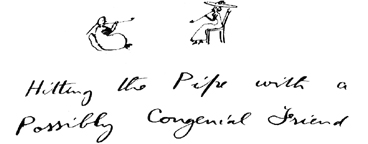
At the top of the page, over another drawing of Alice being pursued by bicycle cops, he depicted himself as a toothily grinning, vaguely Oriental sun flapping two beneficent wings:

At the time of the sketch, his wings were still beating in vain with regard to an armistice between Russia and Japan, and also to the fraught issue of an indemnity, which Katsura’s government seemed determined to demand. But July had otherwise seen a heartening accelerando of diplomatic developments, as if the peace conference, so long discussed and dreamed of, was suddenly so urgent that it had to take place at once. In short order, the two powers appointed their full delegations, separately confided (to Roosevelt only) the extent of their possible concessions, and announced that they would meet in early August on American soil—the United States being, at least symbolically, halfway between Europe and Asia. The initial introductions would be performed at Oyster Bay by President Roosevelt.
Washington was, of course, no longer a suitable location for the conference proper. Tempers were likely to be hot enough without the aggravating factor of Potomac humidity. Roosevelt volunteered to find “some cool, comfortable and retired place,” where there would be “as much freedom from interruption as possible.” Many East Coast seaside towns made bids to host the conference. Only one met his stipulations, while also offering the security and communications facilities necessary for a major diplomatic event: Portsmouth, New Hampshire.
The pretty little town boasted a navy yard—strictly speaking, in Kittery, across the bay in Maine—and ample hotel accommodations for both delegates and press. Authorities at the yard made available a big, dignified, vaguely Petrovian building with its own railway siding, and plenty of exposure to sea breezes. Its oblong design, centering on a pedimented entrance facade, was symmetrical enough to satisfy the most stickling insistence on equal space. It was the architectural equivalent of a joint communiqué.
Kogoro Takahira, who had been named as Japan’s junior plenipotentiary to the conference, approved Portsmouth without hesitation. So did his opposite number and new colleague on Embassy Row in Washington, Baron Roman Romanovich von Rosen. (Count Cassini, having lied to Roosevelt once too often, had been tactfully recalled by the Tsar.) Their respective governments followed up with such alacrity that Alice, steaming west on her first crossing of the Pacific, had bypassed the Japanese delegates steaming east; and long before her father’s self-portrait reached her, the Russian team had arrived in New York from Cherbourg.
AT SIX AND A half feet tall, Russia’s senior plenipotentiary was a delight to cartoonists, who imagined him crushing, or bear-hugging, his tiny Japanese adversaries to death. Yet Sergei Iulievich Witte was more adept at commercial negotiations than at the often dangerous business of ending a war. He was a former finance minister and railroad man, convinced that gold, not gunpowder, was the final arbiter of all questions. As such, he had become so identified with the “peace party” in his homeland that Nicholas II at first absolutely declined to appoint him. Only when two other nominees quailed before the challenge had the Tsar yielded to the urgings of Witte’s supporters.
Henry Adams had met Witte in St. Petersburg a few years before and recognized him as an archetypal Slav, except for an inherited streak of Dutch phlegmatism. “He is quite ignorant. Of the world outside Russia, and especially of America, he knows little. He fears Germany, detests England, and clings to France. He is a force; a rather brute energy, a Peter-the-Great sort of earnestness.” More recent reports described Witte as the ablest man in Russia, a “most bitter enemy” of reform, and a likely leader of the government, were the Tsar not so afraid of him.
Roosevelt had hoped that Marquis Hirobumi Ito would head the Japanese delegation, since he was a revered former statesman, and had the same pragmatic views about peace as Witte. But to the further joy of cartoonists, Katsura appointed the puniest-looking officer in his government, Baron Jutaro Komura. The Foreign Minister was delicately boned and wizened, although he was only forty-eight, with eyes black as calligrapher’s ink, and nervous, jerky gestures, as if swatting at imaginary gnats. He had the pallid look of a man who lived largely on seaweed. Lloyd Griscom had learned not to underestimate him. Komura was, like Takahira, a Harvard graduate, and he had the advantage over Witte in that his mind was “remarkably Western in its comprehension of world affairs.” Not only that, he had served as a diplomat in St. Petersburg, Washington, Peking, and Seoul—the power centers in the current war. If he had any weakness as a negotiator, it was the common Japanese one of being “apprehensive lest somebody might get the better of him.”
The four plenipotentiaries were each assisted by six accredited aides, of economic, diplomatic, or military persuasion. Together with their clerical staffs, security officers, and countless hangers-on, they invested New York City with an unusual amount of diplomatic pomp as the fifth of August, the day they were to meet at Oyster Bay, drew near.
That solemn engagement did not prevent first Komura and Takahira, then Witte and Rosen from paying advance visits to the President at Sagamore Hill. The Japanese party came an hour earlier than arranged, in their high silk hats and frock coats. They waited for a while on the porch until they heard a shouted greeting from the trees far below and saw their host approaching in knickerbockers and a collarless brown shirt. He was waving an ancient hat.
After Roosevelt had changed, he escorted them into the “North Room,” a new adjunct to the house, designed by C. Grant LaFarge for the reception of important visitors. It had been completed just six weeks before: a space both deep and high, sunken four steps down from the first-floor walkway, and stretching forty polished feet to its farther windows (a spread eagle cawing silently between them). Although the woodwork and vaulted ceiling were of heavy Philippine hardwoods and the walls lined with simulated leather, there was plenty of natural light, thanks to two other west-facing windows. These were set into a square, bookshelved reading alcove. Two black bison heads glowered on either side of the east fireplace, and extrusions of horn and fur elsewhere reminded Komura that the President was a man who liked blood. Ionic columns subtly evoked his statesmanship; flags and military mementos his heroism in Cuba; a blurry painting by P. Marcius Simons, entitled Where Light and Shadow Meet, his sense of universal harmony; and three small carved initials, paired with his own, signaled the presence of a woman in the house.
“Framed” thus in Komura’s view, Roosevelt said frankly that he was concerned that Japan might ask for too much at Portsmouth. Russia should be given some opportunity to negotiate. The Baron replied by reading him a list of demands, many of which were nonnegotiable. Russia must recognize Japan’s “paramount” interests in Korea, withdraw all troops from Manchuria, and sacrifice her trade and transport privileges there. Russia should also pay an indemnity for war costs. The Liaotung Peninsula must become Japanese, as must Sakhalin Island—Japan’s latest territorial prize—and the railroad to Port Arthur. Russia must never again maintain a large naval fleet in “the Extreme East,” and must sacrifice to Japan her few remaining warships, stuck in neutral ports. She should allow Japanese fishing boats into her home waters.
Arrogant though these terms may have sounded in a large quiet room, with Sergei Witte thirty miles away, they were not as harsh as they could have been. Komura indicated the possibility of some flexibility on some points. His idea of generosity, however, was not to insist that Russia level every last brick of her fortifications around Vladivostok. Roosevelt suggested that the latter port did not need to be disarmed, if Japan was going to take over the Port Arthur railway. As for the indemnity, he said he had heard “from France” that Witte would not hear of it. Komura and Takahira should perhaps propose reparation in principle at first, rather than rapping out hard numbers of yen.
The Baron did not object to any of Roosevelt’s comments, saying only that Japan had a right to be indemnified. The possibility of a compromise at Portsmouth floated faintly in the air, like one of Alice’s peace puffs. But it lasted about as long. After Komura and Takahira had taken their leave, Roosevelt heard again from his French source (Philippe Bunau-Varilla, of all people, communicating through Francis B. Loomis) that Witte had vowed to “break off” the peace conference within ten days if Japan did not make acceptable concessions. On the other hand, Russia “would consider paying at least part of Japan’s expenses in the war.”
Roosevelt was worried enough by Witte’s semantics to write his friend Kentaro Kaneko—not a member of the Japanese delegation, but actively fronting for it in New York—and urge “that great care be used about the word indemnity and that it possibly be avoided.” Doubtless remembering how he had persuaded George Perkins and Robert Bacon to accept an “eminent sociologist” on the Coal Strike Commission, he added, “If he does not object to reimbursing Japan … it does not make the slightest difference to you whether it is called an indemnity or not.”
The Russian plenipotentiaries, less courteous than the Japanese, did not deign to visit Sagamore Hill until 4 August—or, by their calendar, 27 July. To them, it was the name day of the Empress Marie Feodorovna. All Roosevelt knew was that in fewer than twenty-four hours, he had to introduce both delegations at a welcoming ceremony aboard the Mayflower. And he still did not know officially what Witte’s terms were going to be.
His guests arrived straight from an emotional service at the Russian Orthodox Church in Manhattan. Roosevelt had no way of knowing whether the Slavonic melancholy that Witte discharged like fog over the Volga was endemic, or merely a reaction to the uninspiring send-off from their priest: “May God help you and grant you wisdom. Just now we all feel lost and do not know what to do or what the future will bring.”
Still less could he guess that Witte and Rosen felt “lost,” too, torn diplomatically between personal awareness that Russia was beaten in the war, and Nicholas II’s insistence that she was not. Their country was in the first throes of a slow revolution that they knew to be unstoppable. At best, the revolution could be postponed if they could negotiate a foreign peace that would enable the Tsar’s ministers to deal undistractedly with the war developing in streets and basements back home. Failure at Portsmouth would mean a contraction of Russia’s borders, even as her social structure rotted. Just afew days ago, Sakhalin Island had been occupied by Japanese forces. That made one of the most explicit of their instructions—not under any circumstances to give up Sakhalin—already redundant, and enhanced their sense of doom.
Paradoxically, the sense persuaded them that they were “one man with one mind, one will and one heart beating for our country.” To save Russia, or at least preserve their Russia for another decade or two, they faced a task that transcended even the dictates of the Tsar. Fatalism—and Baron Rosen’s suspicion that it had been Japan, not Theodore Roosevelt, that had pressed for this conference—made them formidable.
Witte was enormous enough, with his double-jointed, oncoming gait, to convey a sense of careless power. His gaze was not so much to be returned as endured, and he spoke bad French with torrential rapidity. Roosevelt could not help being impressed. They lunched and talked for two and a half hours, the ambassador (a polished and vapid presence) translating. “We are not conquered,” Witte said, “and can therefore accept no conditions which are not suitable to our position. Consequently, first of all, we shall not agree to pay any indemnity.”
This was not a promising beginning. However, Witte handed over a letter from Nicholas II that at least allowed for some concessions, such as recognition of modified rights for Japan in Korea, and transfer of the Liaotung Peninsula, providing China agreed. Russia’s “interior condition,” Witte allowed, was serious, but “not such as it is thought to be abroad.” Her plenipotentiaries were willing to negotiate what she had lost so far, in a fair fight, as long as the Japanese did not gamble on more of the same. If they did, “Weshall carry on a defensive war to the last extremity, and we shall see who will hold out the longest.”
Witte watched Roosevelt closely as he responded. He could see that the President, like most Americans, was pro-Japanese, and confident that Baron Komura would prevail at Portsmouth. Yet some doubts gradually began to show—Roosevelt was not a good concealer—along with some embarrassment at having misjudged the validity and force of Russian feelings.
Roosevelt said that he was convinced that peace was in the interest of both belligerents. Therefore, at the last resort, Russia should agree to pay an indemnity. He had personally tried to get Japan to moderate her demands, but the choice appeared to be war or money.
The plenipotentiaries went back to New York even more pessimistic than they had been in the morning. “It was clear that the President has very little hope of a peace treaty,” Witte cabled Count Lamsdorff, “and he therefore expresses the opinion that it is necessary in any case to arrange matters in such a manner that, in the future, when either of the parties wishes it, it will be possible to begin negotiations anew without difficulty.”
THE FUNDAMENTAL EQUIVALENCE, yet fighting difference, between Tweedledum and Tweedledee had occurred to Roosevelt in previous apparently irreconcilable disputes. By the time the sun rose over Long Island Sound the next morning, he knew that the powers he was about to bring together were both financially drained and split internally, for all their shows of solidarity, by “war” and “peace” factions. So much for twinship. But, as they would soon discover at Portsmouth, a monstrous crow was bearing down upon them. All the more reason then for him to treat them today with such impartial courtesy as to make them aware that from next Wednesday on they must resolve their own quarrel.
He sent two identical cruisers to New York to pick up the delegations. Oyster Bay began to tremble with the activity of small craft—cutters, yachts, gigs, wherries, skiffs—jiggling for vantage points around the Mayflower, anchored white and aloof about a quarter of a mile offshore. Nearby stood the Dolphin, Sylph, and Galveston. For connoisseurs of marine display, it was the spectacle of 17 August 1903 re-enacted, but minus the overmastering presence of battleships: a panoply of peace rather than war. The weather was sunny and humid, the bay soon filling with hazy light as the shadow of Cove Neck withdrew and crept up the slope of Sagamore Hill.
Shortly after noon, a concatenation of cannon fire announced the President’s arrival aboard the Mayflower. He climbed the gangway in his usual statesman’s frock coat and silk hat, with only a white waistcoat conceding the heat. The deck of the yacht glittered like a ballroom with bemedaled uniforms and polished brass fittings. From then on, the cannon salutes were almost continuous, as first the Japanese and then the Russian plenipotentiaries left their own ships and approached Roosevelt’s via a lane of open water. To general surprise, Witte was bowing and grinning as spectators yelled his name. Precisely as each party came up the side of the Mayflower, its flag joined the Stars and Stripes lolling aloft.
The President did not welcome his guests above, but waited below, flanked by admirals and adjutants, in a paneled salon while protocol officers conducted the formalities on deck. Since Komura and Takahira had arrived in the United States before Witte and Rosen (and also gotten out to Sagamore Hill sooner), they were escorted down first, trailed by their suite. Roosevelt greeted them, then left them seated in an anteroom as Witte and Rosen descended into the salon.
Inevitably, Assistant Secretary of State Herbert H. Peirce mispronounced some of the Russian names. Roosevelt, smiling and ejaculating his famous “dee-lighted,” at least recognized that of Fedor Fedorovich Martens, a St. Petersburg law professor whose works he knew and praised. After presenting his own aides, he told Witte that he would like to introduce the members of the opposing delegation.
The door to the other salon opened, and fifteen black-coated Japanese filed in. Witte felt the moral pain of an envoy, invested with the dignity of the world’s largest empire, being confronted by his betters in war. An observer was struck by the absolute expressionlessness of the faces on either side. “Baron Komura,” Roosevelt said, “I have the honor to present you to Mr. Witte and Baron Rosen.”
As the President handled the plenipotentiaries, the other delegates shook hands, then retired to opposite sides of the room in awkward silence. Roosevelt alone seemed at ease, talking warmly and incisively, nudging his guests by degrees toward an open door, through which was visible a buffet table and no chairs. Then, briskly, like a Park Avenue hostess, he said, “Mr. Witte, will you come in to lunch with Baron Komura?”
Asia and Russia crossed the threshold together, escorted by the United States.
THE LUNCH, eaten standing up by everybody except the President and plenipotentiaries, was cold. So was the wine—refreshingly so, on a day so hot. Problems of precedence were negated by the general absence of seats. Those set aside for Roosevelt were grouped so casually in a corner that nobody sitting with him seemed to notice who faced left, and who right. To Komura, he spoke English, and to Witte, his own variety of French, loose in grammar yet fluid and comprehensible.
Other guests conversed less easily. They kept talking, however, until champagne was served (by Chinese waiters substituting for the Mayflower’s normal staff of Japanese). The President rose, raised his glass, and said loudly to everybody in the room, “Gentlemen, I propose a toast to which there will be no answer and which I ask you to drink in silence, standing.”
The last stipulation, at least, was bound to be obeyed.
Roosevelt went on, staring hard at Witte. “I drink to the welfare and prosperity of the sovereigns and to the peoples of the two great nations whose representatives have met one another on this ship. It is my most earnest hope and prayer, in the interest not only of these two great powers, but of all civilized mankind, that a just and lasting peace may speedily be concluded between them.”
After the requisite hush and sipping, conversation continued with gradually increasing bonhomie. (“How is Madame Takahira?” “I hope the Baroness is well.”) A young reporter from the Sun syndicate, to whom Roosevelt had awarded one of the most prized exclusives in journalism, realized that all belligerents were human.
For the first time it was borne in upon me that wars were not only not necessary, but even ridiculous; that they were wholly man-made.… [I] questioned Socrates’ conclusion that to know the good is to practice it. Humanity is simply not built like that. Except for a few savage or half-savage tribes, we all know that war profits no one, that its only result in the world, in the words of Croesus, is that “In war the fathers bury their sons, whereas in peace the sons bury their fathers,”—the normal course. But we are no more normal than we are certain to practice the good if we know it. Those bits of wisdom from the Greek world are two and a half millennia old, but they only emphasize our persistent unwisdom.
When lunch was over, Roosevelt and his chief guests posed for a formal photograph. Some of the chagrin he had seemed to feel the previous day, for misjudging the Russians, made him place Witte and Rosen on his right. Or was it, more subtly, his intuition that when the dread indemnity question was raised, Witte would be the only negotiator wise enough to give in? Throughout the reception, he had been more amiable to Witte than to Komura.
The latter, dwarfed and sickly looking on the President’s left, remained impassive. But a camera caught an expression of real hurt on Takahira’s face.
AT TWENTY MINUTES to three, Roosevelt bade farewell to everyone, put his silk hat back on, and left the Mayflower, to another twenty-one-gun salute. His preliminary diplomatic work was done. The Japanese exited next, and were ferried to the Dolphin. Their counterparts remained aboard the much larger host ship, which hoisted Russian colors and prepared to sail for Portsmouth. A change in the displacement of the delegations would seem to have occurred. But the much smaller Dolphin weighed anchor first, as if determined to establish precedence. The Mayflower let her go, then followed at leisure. Witte and his aides reappeared on deck in light summer clothes.
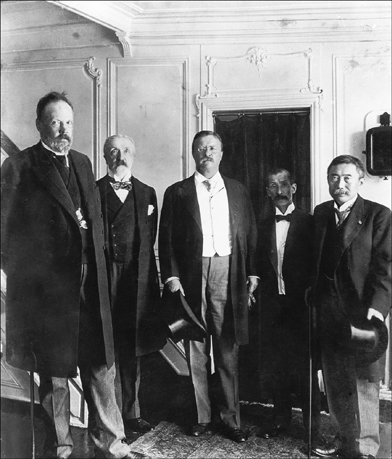
“WHEN LUNCH WAS OVER, ROOSEVELT AND HIS CHIEF GUESTS POSED FOR A FORMAL PHOTOGRAPH.”
Left to right: Sergei Witte, Baron Rosen, the President, Baron Komura, and Ambassador Takahira, 5 August 1905
That evening, a guest at Sagamore Hill thought the President looked weary but content. “I think we are off to a good start,” Roosevelt said, admitting that he had been afraid of making a slip during the day. “I know perfectly well that the whole world is watching me, and the condemnation that will come down on me, if the conference fails, will be world-wide too. But that’s all right.”
THE FIRST INDICATION that something had gone seriously wrong at Portsmouth came on Friday, 18 August, when Kentaro Kaneko hurried out to Oyster Bay from New York. The self-important Baron, who served as a messenger from Komura, was beginning to irritate reporters with his almost daily pilgrimages up Sagamore Hill. They suspected that Kaneko was none too bright. He could hardly order a cup of tea without mentioning his Harvard education, and reverently quoted the President’s aphorisms (“The railroad train is doubtless stronger than a bull, but that doesn’t say the train wants a bull on the track”) as if he understood them.
His news today, however, was urgent. The peace negotiations were on the verge of deadlock. Witte, whose overbearing garrulousness (and clever cultivation of American press opinion) grated more and more on Komura, was insisting that Russia would give up no territory and pay no indemnity. Japan had moderated her peace terms at Roosevelt’s suggestion, dropping Vladivostok and changing the word indemnity to reimbursement, but Witte was plainly hardening, rather than commensurately softening, Russian attitudes. He refused in particular to concede Sakhalin, which he described as “a watchman at our gates.” All he was willing to consider was some sort of arrangement recognizing Japanese economic interest in the island.
Later that evening, Roosevelt received related news from George Meyer in St. Petersburg. It indicated that Witte was acting on royal authority. Nicholas II, who had made plain at Tsarsköe Selò how precious Sakhalin was to Russia, was increasingly under the sway of war advocates. To them, an indemnity under any name would be an admission that the Motherland was conquered. No Japanese jackboot had yet trodden her soil—unless one counted the non-continental mass of Sakhalin.
Roosevelt detected a resurgence of the Russian lack of logic that had so infuriated him with Count Cassini. His Majesty would not give up Sakhalin, yet Sakhalin was already occupied by the Japanese. Russia was not conquered—she had merely been beaten in every land battle of the war, and lost almost all of her navy. Her soil was undefiled, but if she did not soon treat with Japan, she could say good-bye to eastern Siberia.
A fantasy began to grow in him. He would like to march the Tsar and his ministers to the end of Cove Neck, and “run them violently down a steep place into the sea.” But reality beckoned. The peace conference would soon founder if Russia could not be persuaded to sacrifice some of her “honor.” He told Kaneko that he would appeal, if necessary, to the Tsar, and enlist the aid of the Kaiser and President Loubet of France as well.
The courier returned home satisfied. That night, Roosevelt, having heard from Speck von Sternburg that Britain and France were conspiring to step in as peacemakers, sent a telegram to the Russian delegation in Portsmouth, in care of Herbert H. Peirce. It was galvanizing enough for the Assistant Secretary to wake Baron Rosen up at 2:00 A.M. and tell him he was expected at Sagamore Hill in the early afternoon.
All diplomatic niceties, evidently, were being waived in this hour of crisis. The President of the United States was no longer a neutral mediator between belligerents. He was prepared to intervene, and to do so peremptorily. Rosen had no choice but to obey his summons.
Roosevelt was playing tennis in white flannels when Rosen found him at four o’clock. Disconcertingly, he kept returning to the game at pauses in their conversation, as if to mime the serves and returns of diplomatic dialogue. He said that three of Russia’s principal concerns at Portsmouth—imprisoned war vessels, naval limitation, and Japanese control of Sakhalin—were resolvable, in his opinion. Japan would back down on the first two, and the Tsar must accept the last as a fait accompli. Occupied ground was enemy ground.
“We Americans,” Roosevelt said, by way of example, “are ensconced at Panama and will not leave.”
It was not the most fortunate comparison, but Rosen was more interested in what the President proceeded to say about Sakhalin. Roosevelt seemed to know that Witte had reluctantly begun to talk about dividing the island—the northern half to be Russian and strategic, the southern Japanese and commercial.
He asked Rosen if his delegation would transmit a proposal to the Tsar as “an idea expressed in private conversation” with the President. This was that Russia should buy her half from Japan, as holders of the real estate in question. Without even mentioning the word indemnity, a negotiable quantity of money would begin to flow in Tokyo’s direction. The talks would be reanimated, tempers would cool, and the unmentionable could perhaps be submitted to allies for arbitration.
Rosen, politely masking his resentment at being manipulated, agreed to carry the proposal back north for his chief to relay to St. Petersburg. Witte reluctantly obliged on 21 August, advising Count Lamsdorff, “If it is our desire that in the future America and Europe side with us, we must take Roosevelt’s opinion into consideration.” On Monday, the President felt uneasy enough about Russian duplicity to cable Meyer and ask him, once again, to read a personal message to Nicholas II:
I earnestly ask your Majesty to believe in what I am about to say and to advise. I speak as the earnest well-wisher of Russia and give you the advice I should give if I were a Russian patriot and statesman.… I find to my surprise and pleasure that the Japanese are willing to restore the northern half of Sakhalin to Russia, Russia of course in such case to pay a substantial sum for this surrender of territory by the Japanese and for the return of Russian prisoners. It seems to me that if peace can be obtained substantially on these terms, it will be both just and honorable.… If peace is not made now and war is continued, it may well be that, though the financial strain upon Japan would be severe, yet in the end Russia would be shorn of those east Siberian provinces which have been won by her by the heroism of her sons during the last three centuries. The proposed peace leaves the ancient Russian boundaries absolutely intact. The only change will be that Japan will get that part of Sakhalin which was hers up to thirty years ago. As Sakhalin is an island it is, humanly speaking, impossible that the Russians should reconquer it in view of the disaster to their navy; and to keep the northern half of it is a guarantee for the security of Vladivostok and eastern Siberia to Russia. It seems to me that every consideration of national self-interest, of military expediency and of broad humanity makes it eminently wise and right for Russia to conclude peace substantially along these lines, and it is my hope and prayer that your Majesty may take this view.
Roosevelt used the words substantial and substantially with little consideration for an Emperor whose idea of conciliation was “not an inch of land, not a rouble of indemnities.” The cable went off, coded to cheat Russian surveillance, with carbon copies referred to the ambassadors of Germany and France. He sent a much colder message to Baron Kaneko: “I think I ought to tell you that I hear on all sides a good deal of complaint expressed among the friends of Japan as to the possibility of Japan’s continuing the war for a large indemnity.” Then, putting his trust in the hands of Meyer, he soothed himself by reflecting that Ramses II had not scrupled to treat with the Hittites in 1272 B.C., after years of militant blustering.
“I cannot trust myself to talk about the Peace Conference,” Henry Adams wrote Elizabeth Cameron from Paris. “I am too scared. Literally I am trembling with terror.… The general débâcle must now begin.”
THE SIGHT OF Sergei Witte standing huge and rumpled to the right of the President of the United States did not beguile Nicholas II, when, on 23 August, Meyer showed him a batch of photographs from the Mayflower. Nor was the Tsar disposed to be reasonable, as he had been during their last interview. He remarked rather peevishly that his cousin Wilhelm had just sent him a letter urging peace, and added that it was “quite a coincidence” that such missives always seemed to precede audiences with the American Ambassador.
“Russia is not in the position of France in 1870,” Nicholas said, refusing again to pay any indemnity. Meyer had to argue for two hours before he consented to pay at least “a liberal and generous amount” for the care and maintenance of Russian prisoners of war. This encouraged the Ambassador to press him on Sakhalin. Nicholas at last said that Japan could keep “that portion” of the island she had once had clear title to.
On the same day, Roosevelt, who by now had become a one-man electrical storm of cables to St. Petersburg, Peking, Paris, London, and Tokyo, again wrote Kaneko. Dropping all diplomatic politesse, he went to the edge of brusqueness in implying that Japan was being both greedy and inconsiderate at the conference table. Another year of war would merely “eat up more money than she could at the end get back from Russia.” Then followed a moral lecture, in language a Nipponese aristocrat was not used to hearing:
Ethically it seems to me that Japan owes a duty to the world at this crisis. The civilized world looks to her to make peace; the nations believe in her; let her show her leadership in matters ethical no less than matters military. The appeal is made to her in the name of all that is lofty and noble; and to this appeal I hope she will not be deaf.
The letter was wired to Tokyo, while Meyer, at Roosevelt’s insistence, kept pressuring the Tsar for further concessions. Both initiatives failed, or seemed to fail. In the absence of changed instructions, the peace conference went into recess.
ON FRIDAY, 25 August, Roosevelt shocked most of his countrymen by dropping to the floor of Long Island Sound in one of the Navy’s six new submarines, appropriately named the Plunger. He remained beneath the surface (lashed with heavy rain) long enough to watch fish swim past his window. Then, taking the controls, he essayed a few movements himself, including one which brought the ship to the surface rear end up.
Once again, he seemed to be miming, albeit unconsciously, the progress of negotiations at Portsmouth, where the issue of the indemnity had become a dead weight. The afternoon following his dive marked the low point of the conference, with Witte and Komura staring at each other in silence, smoking cigarette after cigarette, for eight minutes. Rumors spread over the weekend that the Russians were asking for their hotel bills. On Monday, Roosevelt concluded that he could do nothing more. According to Meyer, Japan’s fanatic insistence on compensation—at a scarcely conceivable 1.2 billion yen—had so enraged the Russian people that “even the peasants” supported their sovereign’s refusal to pay.
On Tuesday, 29 August, Witte suddenly placed a sheet of paper on the table. He said it contained Russia’s final concessions. They were less, not more, generous than the concessions Japan could have accepted a week before, from the hands of the Tsar. Russia would pay no indemnity. Japan might have south Sakhalin, but only if she gave up the north, “sans aucune compensation.”
Komura sat impassive. Silence grew in the room. Witte took up another piece of paper and began to tear bits off it—a habit, intolerable to Japanese sensibilities, that he had indulged throughout the conference. Eventually, Komura said in a tight voice that the Japanese government wanted to restore peace, and bring the current negotiations to an end. He consented to the division of Sakhalin and withdrew the claim for an indemnity.
Witte accepted this acceptance, and said that the island would be cut at the fiftieth degree of latitude north. The Russo-Japanese War was over.
HENRY J. FORMAN, the young reporter whom Roosevelt had permitted on board the Mayflower, had accompanied the President on a quick trip to Wilkes-Barre, Pennsylvania, earlier in the summer of 1905. The occasion had been a routine appearance before coal miners, in a parklike square cut across by ropes, like a giant spider’s web. For some extraordinary reason, as John Mitchell addressed the crowd, bound around by the ropes, it had begun to sway from side to side, in an almost hydraulic movement that gathered force frighteningly. Mitchell, sweating, begged the crowd to keep still, lest the ropes break and people be trampled to death. But the swaying continued. Alarm was visible on the faces of those in front of the speaker stand, as if they could not help themselves.
Then Roosevelt was announced. Holding up his arms to a roar of acclaim, he began to speak. Forman could not remember what he said, only that the crowd all at once “froze to attention.”
The peace the President had made possible at Portsmouth was the result of just such an inexplicable ability to impose his singular charge upon plural power. By sheer force of moral purpose, by clarity of perception, by mastery of detail and benign manipulation of men, he had become, as Henry Adams admiringly wrote him, “the best herder of Emperors since Napoleon.”
After the Treaty of Portsmouth was signed on 5 September, he allowed himself a characteristic moment of self-congratulation. “It’s a mighty good thing for Russia,” he allowed, “and a mighty good thing for Japan.” And, with a thump of his chest, “a mighty good thing for me, too!”