

I’m not so much troubled about th’ naygur whin he lives among his opprissors as I am whin he falls into th’ hands iv his liberators.
EDITH KERMIT ROOSEVELT was waiting in the yellow-wheeled family wagon when her husband’s train steamed into Oyster Bay station on 1 July 1906. She positioned herself, as always, slightly aloof, letting a width of cinder road intervene between the carriage door and the door of the depot, where the usual crowd of villagers was jostling.
The President emerged, caught sight of Kermit first, and kissed him. Then he began to shake hands while Edith sat with Quentin beside her, wrapped in her private role as wife and mother.
She was not quite forty-five and not quite slender, a calm, contented woman who had gotten what she wanted by simply waiting for it—as she waited now for the only man she had ever loved. The fact that she was not the only person in his romantic history had long since ceased to hurt her, as far as anyone knew, but with Edith, “far” was not much. The averted gaze, the set mouth, the careful expressionlessness she gave to the world outside her world revealed little and invited nothing. To children other than her own, she appeared as “a remote goddess … as calm and imperturbable as a Buddha.” Born into the same wealthy haut-bourgeois circles as Theodore, and having become, at age four, his intimate friend, she had acquired a sense of privilege that never left her, even though her alcoholic father’s money had dissipated with such quickness that she remembered a childhood more shabby than genteel.
There had never been any question in her mind, as she grew up, that “Teedie” would marry her. When he chose someone prettier and richer, Edith had simply counted the days until fate would return him to her. She would have counted fifty years, if necessary. In the event, five were enough. Edith had reacted to Theodore’s aberrant liaison much as she had to her father’s drinking, by simply editing it out of her book of life. The name of Alice Hathaway Lee was not to be mentioned, even in the index; no illustrations of that sweet, blank face were necessary; a quick cut from 1880 to 1885 would speed the narrative nicely. There had remained the awkward subplot of a stepdaughter, but at last, thanks to Nick Longworth, it was part of another tale.
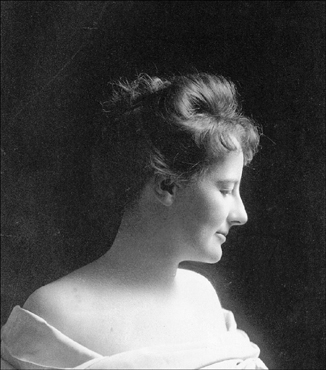
“A REMOTE GODDESS … CALM AND IMPERTURBABLE AS A BUDDHA.”
The President’s favorite photograph of Edith Kermit Roosevelt
Episcopalian, erudite, conservative, intensely private, and—when her serenity was threatened—a formidable adversary, Edith struck most strangers as snobbish. The impression was in part correct (Archie and Quentin had to research the antecedents of all their would-be friends) but caused mostly by her New England reserve. She did not consider herself superior, so much as separate from hoi polloi. In receiving lines, she let the President do the glad-handing, while she stood clutching a nosegay, smiling only slightly, her sapphire eyes cool. What they saw, they saw without mercy. Mediocrity bored her, as did class resentment. “If they had our brains,” she was wont to say of servants, “they’d have our place.”
Yet within a silken web of family, social, and political connections, almost all spun about her by Theodore, Edith was frank, warm, unassuming, and loyal. Henry Adams found her “sympathetic” and greatly preferred her company to that of the President. “She has bad taste, and that too is a comfort.” To Ray Stannard Baker, she was “a singularly attractive woman, of rare refinement and charm of manner.” Jules Jusserand informed his government that she was “certainly adorned with most precious and charming qualities”—adding, by way of explanation, that she was of French descent.
Edith was well-read enough to hold her own in conversation with Adams and Henry Cabot Lodge. “She is not only cultured, but scholarly,” Roosevelt boasted. Her intellectual interests were more sophisticated than his, inclining toward belles-lettres and aphoristic essays, and she loved the theater, to which he reacted as if caged. Whereas his idea of a sublime musical experience was “The Stars and Stripes Forever,” played by the full Marine band, hers was a recital in the East Room by Ernestine Schumann-Heink. Edith did not equate such occasions with fashion; her taste in clothes was at best severe, and she cared little for intermission gossip. Yet she enjoyed entertaining, whether brilliantly at diplomatic dinners in Washington, or messily at mosquito-infested picnics with her children, the largest and worst of whom, she joked, was Theodore.
His attitude toward her—beyond the fact, clear to all, that they personified every syllable of the marriage vow—was one of doglike adoration. He looked to her for porch company, for approving pats and hugs, and sometimes, guiltily, for discipline when he had done something wrong. She could bring him up short, during one of his indiscreet monologues, by giving off a special quietness that he could sense within seconds. “Why, Ee-die, I was only going to say …”
Her attitude toward him was complementary, yin to his yang. Theodore represented “the fire of life” (an image from Walter Savage Landor that she often cited), and she warmed both hands at him. Deeply domestic, she accepted his compulsive need for public attention, knowing that he could stay home only so long before the urge to hunt or fight or orate would take him away again. She had enough quiet humor to suffer his idiosyncrasies—the yodels of falsetto laughter, the mad rock-climbs, woodsmen and their wives invited to stay over in the White House—even though he often outraged her sense of propriety.
“You only have to live with me,” she periodically reminded him, “while I have to live with you.”

HE DID NOT LOOK well this July day, with his limp and obvious need for rest after seven months of legislative wrangling. Edith had thought him “jaded” a month before, and others had noticed even earlier signs of exhaustion. Whenever he was tired, his internal pressure tended to spew, geyserlike. There had been an outburst, to Sir Mortimer Durand’s face, about the “damned little Jew” of a British journalist who had accused him of paying court to the Kaiser. William E. Chandler had also been scalded, after politely asking if the White House had shown “good faith” in negotiating with both parties during the rate-bill fight. And Norman Hapgood, a journalist guilty of suggesting that Roosevelt sometimes denied his own press leaks, was currently in receipt of a presidential letter that came close to a demand for armed satisfaction.
Nervous fatigue could be allayed in the soothing environs of Sagamore Hill. But Roosevelt had more chronic physical problems to face up to—or more accurately, to play down. He admitted to Kermit and Ethel that his steadily dimming left eye was causing him “a little difficulty,” and that his ankle sprain was complicated by rheumatism. His weight hovered obstinately around two hundred pounds, no matter how much he exercised.
“He is certainly the most enduring man I have ever known,” Gifford Pinchot reported to Irving Fisher, a concerned fitness expert, “and it seems to me equally certain that his endurance can have little to do with his diet.” The President consumed whatever was put before him, with a partiality for meat over vegetables: “I should say that he ate nearly twice as much as the average man.”
Fisher, who had been studying the nutritional theories of Russell H. Chittenden, replied, “It is clear to me that the President is running his machine too hard.… In another decade or two … I would almost risk my reputation as a prophet in predicting that he will find friction in the machine, which will probably increase to almost the stopping point.”
Edith sweetly served cakes, ice cream, and lemonade on the Fourth of July. The Oyster Bay Pilot thereafter noticed an unprecedented number of presidential rowing excursions. Roosevelt was also seen haying with his farmworkers, sweating hugely in white clothes and forking loads so large he had to center himself underneath before lifting them.
“J’ESSAIE DE FAIRE circuler le sang à travers le marbre,” Auguste Rodin declared in August 1906, after getting permission to sculpt the President on a forthcoming visit to America. “I try to make the blood circulate through the marble.”
Theodore Roosevelt was sanguine in every sense of the word, physiological and psychological. He was ruddy and excitable, flush-faced, susceptible to cuts and grazes. (“Theodore,” Edith remarked, after he collided with the Sagamore Hill windmill, “I wish you’d do your bleeding in the bathroom.”) The medieval humor sanguis expressed his character exactly: courageous, optimistic, affectionate, ardent. His apparent fatigue in the summer of 1906 was the result of overstimulation rather than overwork. For more than a year now, he had prevailed too easily against too many opponents, and found himself more than equal to the largest tasks. As a result, he had begun to receive regular boosts of journalistic hyperbole, intoxicating enough to contravene the Pure Food and Drug Act. “It is now universally recognized by experienced politicians of all parties,” The Washington Post reported, “… that he has more political acumen in one lobe of his brain than the whole militant tribe of American politicians have in their combined intelligence; that his political perception, so acute as to amount almost to divination, is superior to that of any American statesman of the present or immediate past era.”
With so much success in his system, and nothing—for the moment—to restrain him, Roosevelt was fast approaching a level of executive hypertension. His reaction, then, was more or less predictable on 16 August, when he received a telegram from the mayor and citizens of Brownsville, Texas, a depressed, dust-baked outpost on the Rio Grande:
At a few minutes before midnight on Monday, the 13th, a body of United States soldiers of Twenty-fifth United States infantry (colored), numbering between 20–30 men, emerged from the garrison inclosure, carrying their rifles and abundant supply of ammunition, also begun [sic] firing in town and directly into dwellings, offices, stores, and at police and citizens. During firing, one citizen, Frank Natus, was killed in his yard, and the lieutenant of police, who rode toward the firing, had his horse killed under him and was shot through the right arm, which has since been amputated at the elbow. After firing about 200 shots, the soldiers retired to their quarters. We find that threats have been made by them that they will repeat this outrage. We do not believe their officers can restrain them.… Our condition, Mr. President, is this: our women and children are terrorized and our men are practically under constant alarm and watchfulness. No community can stand this strain for more than a few days. We look to you for relief; we ask you to have the troops at once removed from Fort Brown and replaced by white soldiers.
Roosevelt ordered a full report on the incident from the War Department. Supplementary details were already appearing in the press. The black battalion—three companies minus a fourth on separate assignment—had arrived in Brownsville fewer than three weeks before, and racial tensions had been rising ever since. Soldiers had been denied access to local bars, shoved off sidewalks, beaten, and warned that their brains might be blown out. On the eve of the riot, the usual “large” Negro had tried to force himself on the usual “respectable” white woman. She could not describe his face, but had total recall of his khaki trousers.
As a result of warnings from downtown, Major Charles W. Penrose, the battalion’s white commander, had placed all his men under curfew the following night. Yet about fifteen of them had allegedly found a key to the barracks and gone on their murderous rampage downtown—even though a call to arms, begun while the bullets were still flying, found all soldiers present or accounted for. The culprits must have sprinted back as soon as they heard the bugle and snuck into line in time to holler “Present” when the roster was read.
Only one voice of authority expressed doubt as to such a scenario. Brigadier General William S. McCaskey, commander of the Army’s Southwestern Division, cautioned the War Department in a telegram received on 18 August:
CITIZENS OF BROWNSVILLE ENTERTAIN RACE HATRED TO AN EXTREME DEGREE … PROVOCATION GIVEN THE SOLDIERS NOT TAKEN INTO ACCOUNT.
Some damaging hard evidence, however, indicated that the allegations were not altogether fanciful. Major Penrose reported that he had been presented with seventy or more Army-rifle shell casings that matched those clean rifles. Exhibit B was a dropped soldier’s cap. Regretfully but unanimously, Penrose and his four white junior officers concluded that men of the Twenty-fifth Infantry must be guilty.
Roosevelt waited no longer than 20 August before deciding, on the basis of a second appeal from the Brownsville citizens’ committee, that Fort Brown should be “temporarily abandoned.” He ordered the battalion to march to nearby Fort Ringgold, pending a full investigation by the Capitol Army Chief of Staff. No sooner had he done so than a preliminary report from the Assistant Inspector General of the Southwestern Division persuaded him to move them much farther, beyond posse range. Major Augustus P. Blocksom confirmed most of Major Penrose’s findings, and unequivocally described the rioters as “soldiers.” Blocksom allowed that no positive identifications had been made, but, in words not calculated to delay the President’s action, warned of possible “mob violence” if the soldiers were not moved soon.
Roosevelt then sent the bulk of the battalion to quarantine in Fort Reno, Oklahoma. Twelve suspects fingered by another Army inspector were to be held in the guardhouse at San Antonio, while he awaited further evidence of their guilt from Major Blocksom.
It came on 29 August, and was unequivocal. “That the raiders were soldiers of the Twenty-fifth Infantry cannot be doubted,” Blocksom wrote. Their commanding officers were not responsible for permitting the violence, since at first sound of gunfire downtown they had imagined the fort was being attacked, and issued a defensive call to arms. Only when the mayor of Brownsville showed them the casings the next morning had they realized their misapprehension. Major Penrose was now conscientiously trying to identify the perpetrators himself, but could not get a single black interviewee to name names. It was clear to Blocksom that the men, veterans and juniors alike, were engaged in a conspiracy to obstruct justice. If they did not break ranks soon, they should all “be discharged from the service and debarred from reenlistment in the Army, Navy and Marine Corps.”
Blocksom added a personal observation that “the colored soldier is much more aggressive in his attitude on the social equality question than he used to be.”
THE SAME COULD BE said of Theodore Roosevelt. Over the last year and a half, his Negro policy had noticeably hardened. He remained incapable of the race hatred of Benjamin R. Tillman, or even the patrician disdain of Owen Wister. Yet he had no quarrel with those whites in Brownsville who believed that blacks were “inferior socially.” Nor, with another round of congressional elections looming, did he want to jeopardize his new popularity in the South. That region’s white voters had welcomed him extravagantly last fall, in part because he had atoned for his early radicalism. His one outburst against “lynch law” was forgiven, if only because it had been provoked by the Governor of Arkansas.
More ominously, he had begun to sound a theme that played well in Brownsville: “The colored man who fails to condemn crime in another colored man … is the worst enemy of his own people, as well as an enemy to all the people.”
THE PRESIDENT’S SANGUIS was again in evidence on 3 September, when a fighting fleet three miles long saluted him in Long Island Sound. “By George! Doesn’t the sight of those big warships make one’s blood tingle?”
It was the greatest naval display of his presidency so far. Three out of every four of these white leviathans had been built since the war with Spain. During his first term alone, Congress had authorized thirty-one new vessels, including ten battleships. Two new all-big-gun battleships were due to begin construction in the fall. The United States Navy, fifth in the world when he took office, was now third. Admittedly, that ranking had been rendered academic by Great Britain’s recent introduction of HMS Dreadnought, a ten-gun, turbine-driven monster stronger, quicker, and smoother than anything else afloat. But the mere fact that sea power was entering a new age augured well for Roosevelt’s future defense proposals. Already, thanks to Dreadnought, he had been authorized by Congress to build a battleship of unlimited displacement, and guns as heavy as it could carry.
He looked forward to sailing on the newest of his completed battleships, the Louisiana, in a couple of months’ time. Construction of the Panama Canal was well under way, and he wanted to see “the dirt fly” with his own eyes. In the meantime, he braced for the likelihood that a few of these white ships might soon be required for active duty in Cuba—exactly the last place he wanted to send them, at a time when the Democratic Party was looking round for a fall campaign issue.
An uprising by “liberals” had taken place on the island eighteen days before, in protest against alleged election-rigging by President Tomás Estrada Palma and his regime of “moderates.” The fighting since then had been fierce enough to make both party names jokeworthy. But what was less funny was the obligation of the United States to intervene in any such dispute, under an amendment attached years before to a bill long since forgotten, by Senator Orville Platt of Connecticut. The Platt Amendment in effect made Cuba an American protectorate, should she ever become unable to govern herself, and thus invite the greedy interest of foreign powers.
Having fought for the liberty of Cubans in 1898, bestowed it himself in 1902, and preached the “moral” virtues of a reciprocity treaty with them, Roosevelt was unwilling to see any more cartoons of himself in Rough Rider uniform. For a day or two after the naval review, an amnesty offer by Estrada Palma encouraged hopes of peace. But the insurrection could not be quelled, and on 8 September came the inevitable request for naval intervention by the United States.
Roosevelt authorized the dispatch of two warships, along with a harsh warning by Assistant Secretary of State Robert Bacon that the President considered intervention to be “a very serious thing.” Before landing any Marines, he would have to be “absolutely certain” that the Cuban government was indeed helpless.
“Just at the moment I am so angry with that infernal little Cuban republic that I would like to wipe its people off the face of the earth,” he wrote to Henry White on 13 September. “All that we wanted from them was that they would behave themselves and be prosperous and happy so that we would not have to interfere.” It was particularly galling to be called back there just after Elihu Root, who had made the improvement of North-South relations his priority as Secretary of State, had told Latin Americans: “We wish for no victories but those of peace; for no territory except our own; for no sovereignty except the sovereignty over ourselves.”
Roosevelt’s annoyance reflected the fact that both Cuban factions were gambling on seeing the Stars and Stripes rise again over Havana—the moderates because they hoped to be kept in power, the liberals because they believed they would consequently get a free and fair election. Thus, he was presented with a paradox of foreign policy. By not intervening, he would encourage civil war; by intervening, he would strengthen both sides, and therefore have to stay.
To his further annoyance, he heard that Bacon had, against instructions, authorized the landing of a party of Marines in Cuba. The Assistant Secretary was the best-looking man in the Administration, if not its brightest. “You had no business to direct the landing of those troops without specific authority from here…,” Roosevelt furiously cabled him. “Unless you are directed otherwise from here the forces are only to be used to protect American life and property.”
Hoping still to avoid direct intervention, he summoned Bacon and Taft to Oyster Bay for a crisis meeting. His latest Secretary of the Navy, Charles J. Bonaparte, joined them. Bonaparte was a small man with a large signature, fully six inches long, proclaiming that the blood of the great Emperor flowed in his veins. He was therefore something of an expert on foreign adventures, and, as a lawyer well-read in history, qualified to warn of their consequences. Bonaparte had not approved of Roosevelt’s youthful jingoism, but otherwise identified with him as a fellow patrician bent on reform.
It was agreed that the President should make a final appeal to Cubans to “sink all differences” and “remember that the only way they can preserve the independence of their republic is to prevent the necessity of outside interference.” Roosevelt sent a letter to this effect to the Cuban minister in Washington, and released it to the press. He announced also that Bacon and Taft were being dispatched immediately to Havana, in the hope that they could broker some sort of truce.
THE FIRST DAY of fall found the President in limbo at Sagamore Hill. A final week of vacation stretched ahead, with no visitors on his calendar, and no news yet of any break in the Brownsville investigation—except that a grand jury in San Antonio had failed to indict any of the twelve main suspects. Roosevelt consequently had time to ponder three important replacement problems.
That of a successor to Justice Brown was the most urgent, with the Supreme Court due to reconvene in October. Once again, Taft had turned him down. Or rather, Helen Taft had begged Roosevelt not to appoint her husband. She was already mentally redecorating the White House. Taft sounded sincere in protesting a continued sense of obligation toward the Philippines (where an Army unit commanded by General Leonard Wood had recently slaughtered six hundred of his “little brown brothers,” against a resurgence of Moro violence). Yet he sounded just as sincere in saying that he would jump at the job of Chief Justice. Behind Taft’s jolly-fat-man facade, there lurked a love for titles.
For much of the summer, Roosevelt had hesitated between appointing William Henry Moody and Horace H. Lurton, a Democrat recommended by Taft. He favored the Attorney General, except that Moody came from the same state as Oliver Wendell Holmes, Jr. Not only that, the Antitrust Division of the Justice Department was just beginning what promised to be an exciting prosecution of the Standard Oil Company; any move of Moody would seem either precautionary or defensive. So Lurton had loomed as the next Justice until Henry Cabot Lodge, to whom all Democrats were lepers, entered a passionate protest against him. The President, accordingly, remained undecided.
He was much more certain of the absolute necessity of getting a new British Ambassador to replace Sir Mortimer Durand. During last year’s peacemaking efforts, and again during the Algeciras Conference, he had been maddened by Durand’s disinclination to unbend in private conversation. He interpreted it as stupidity. (Actually, the Ambassador was a shy but perceptive man, well aware that Roosevelt equated “privacy” with persuasion.) Sir Mortimer also disliked slogging through the thickets of Rock Creek Park, another essential locale for diplomatic dialogue. Without doubt, the British government must recall him. But how, and how soon, could such a delicate matter be arranged? And what chance was there of Cecil Spring Rice being sent instead? Answers would not be forthcoming until the arrival in early October of a possible intermediary, Arthur Lee, MP, secretly summoned from England.
The least urgent yet most momentous question Roosevelt had to consider was that of his own successor. Mrs. Taft did not know it, but his personal preference always had been for Elihu Root. “I would walk on my hands and knees from the White House to the Capitol to see Root made President. But I know it cannot be done. He couldn’t be elected.” The Secretary of State was considered by many who knew him to be a great man—something never said of Taft. Intellectually formidable, tireless, brave, unbeatable in any negotiation, Root was hampered by his identity as a corporate lawyer. However honorable, that was simply the wrong thing to be at a time when Roosevelt himself had declared war on laissez-faire.
Taft was warm dough to Root’s cold iron. He presented no hard edge to the public, or indeed to the President, who imagined that the dough could be permanently imprinted “T.R.” There were other possible Republican candidates, of course, such as Speaker Cannon and Senator Foraker on the right, and Senator Beveridge on the left. Roosevelt was not averse to flattering any of them in front of reporters, but as long as Chief Justice Fuller stayed alive, he saw his successor in Taft.
The Washington Post joked that he did not really need one. “There is but one man who can prevent the Republican party from nominating Theodore Roosevelt for re-election in 1908, and that man is Theodore Roosevelt himself.”
JOSEPH B. FORAKER gave early notice of being as much a presidential scourge in the next session of Congress as he had been during the last. In an unctuous telegram received just before Roosevelt’s departure from Oyster Bay on 28 September, he wrote, “I fear it may be unwelcome to call your attention to the fact that under our treaty with Cuba … consent is given to the United States, not to the President, to intervene on certain specified grounds.” Congressional approval was required before troops could be sent and local authority usurped. “Pardon me for saying this is an awfully serious matter, with far-reaching serious consequences.”
Roosevelt could not deny the treaty, nor the serious view Foraker took of everything, even jokes. He replied with polite restraint. “I am sure you will agree with me that it would not have been wise to summon Congress to consider the situation in Cuba, which was changing from week to week and almost from day to day.… You, my dear Senator, are the last man to advocate my playing a part like President Buchanan or failing to take the responsibility that the President must take if he is fit for his position.” So far, he had taken only “tentative” steps toward intervention, and would look to Congress for a “permanent policy” in December. In the meantime, he reserved his right to intervene directly if necessary. There had been a near-total breakdown of government in Havana, with Estrada Palma insisting on full American control rather than any power-sharing with the insurrectos.
Privately, Roosevelt seethed at the censorious tone of Foraker’s telegram. The Senator had known him since his first participation in a Republican presidential convention, at Chicago in 1884. They had been fellow sponsors of a resolution nominating a black man as temporary chairman of the proceedings. Since then, their relations had been formal rather than friendly, although Foraker had supported Roosevelt’s nomination for the vice presidency and publicly praised him for entertaining Booker T. Washington. Now, however, Foraker had presumed to question his authority as Commander-in-Chief.
“He is a very powerful and very vindictive man,” Roosevelt wrote Lodge, “and he is one of the most unblushing servers and beneficiaries of corporate wealth within or without office that I have ever met. It is possible that he has grown to feel so angry over my course, that is, over my having helped rescue the Republican party and therefore the country from the ruin into which, if he had his way …”
Lodge was so used to Theodore’s eruptions that he did not notice, or choose to notice, incipient signs of executive paranoia. He was more concerned with protecting the President in the event of any open clash with Foraker. After many years of side-by-side service in the Senate, Lodge knew that “Fire Alarm Joe” could be a dangerous adversary.
Foraker was now sixty years old. Tall and spare, with steel-gray hair and more steel, apparently, infusing his spine, he personified the railroads he defended. As a result, he was often caricatured as the ultimate Old Guard reactionary. If Roosevelt’s predominant humor was blood, Foraker’s was phlegm: his coldness repelled as much as it intimidated. Only in oratory, at which he excelled, did he live up to his nickname. He was primarily a negative force, resistant to change.
IN ONE OF THE few light moments of a grim summer, the President responded to a request from Attorney General Moody as to the correct orthography of Justice Department press releases. “I can only advise you to follow the example of the younger Mr. Weller just prior to the moment when he was in such unseemly fashion advised by the elder Mr. Weller how to spell his own name—and this to the great scandal of the court.”
“Simplified Spelling” was now, by presidential edict, compulsory usage in all Administration documents. Roosevelt had become a convert of a philological reform movement emanating from Columbia University. An impressive phalanx of academics with letters trailing after their names sought to remove as many letters as possible from words that only a typesetter could love. They cited the carefree irregularities of spelling in past centuries (pointing out that the Swan of Avon himself never seemed to know how to spellShakespeare), and asked why contemporary stylists had become so obsessed with standardization. The answer was, of course, that unpronounced letters caused confusion—hence, incredibly, 1,690 variants of the noun diarrhea, a word of common significance if there ever was one. Spelling, free of ambiguities, they argued would do away with the need of standardization, and schoolchildren and civil servants could take exams without fear.
In its Circular number 6 for the summer of 1906, Columbia’s Simplified Spelling Board, flush with a gift of ten thousand dollars from Andrew Carnegie, declined to propose “any change in the spelling of proper names, especially of surnames,” thus ensuring that their donor would not feel obliged to sign any future checks Andru Karnegi. The President, similarly content not to become Rozevelt, embraced the Board’s recommendations with the enthusiasm of a man of letters who had long since objected to the practice of putting a u in honor.
It seemed to him that Circular number 6 and its predecessors justified the adoption of some “very moderate and common-sense” spelling reforms, which would keep the government in step with “the ablest and most practical educators of our time”—men such as Thomas R. Lounsbury, Professor of English at Yale University. In a letter to the Public Printer of the United States, Roosevelt ordered simplified spelling of some three hundred frequently used words. Such changes, he argued, were “but a very slight extension of the unconscious movement which has made agricultural implement makers and farmers write plow instead of plough … just as all people who speak English now write bat, set, dim, sum, and fish, instead of the Elizabethan batte, sette, dimme, summe, andfysshe.”
There could be little protest against these examples—certainly not by menu writers in Chinatown, where dim sum was already approved usage. But Roosevelt’s appended list of new spellings caused a sensation in bureaucratic Washington:
addresst blusht comprize deprest egis fagot gazel kist partizan phenix pur ript snapt thru vext winkt
Soon, the nation’s newspapers were vying with one another to coin new, sarcastic simplifications, until Harper’s Weekly complained, “THIS IS TU MUTCH.” Members of Congress and the Supreme Court announced their absolute unwillingness to go along. Roosevelt seemed to sense defeat, even as he insisted that he would continue to use the new styles himself. He told the Public Printer that none of his changes should be considered permanent. “If they do not ultimately meet with popular approval they will be dropt, and that is all there is about it.”
ON 29 SEPTEMBER, President Estrada Palma and his entire Cabinet resigned, leaving Taft with no alternative under the Platt Amendment but to issue a declaration of intervention by the United States. He established himself as the temporary executive of a “Cuban” administration, “conforming as far as may be to the Constitution of Cuba,” and operating under the Cuban flag. Roosevelt had insisted on that last touch. He told Taft that the role of the United States must simply be to ensure that Cuba stayed solvent and stable until she could once again govern herself. To that end, American troops would guard the island’s treasury and maintain order in her towns. A simultaneous agreement with the liberals guaranteed that all insurrectionary activities would cease, pending free and legal elections.
In his last official act before returning to Washington from Oyster Bay, Roosevelt sent Taft six thousand additional troops. “I congratulate you most heartily upon the admirable way you have handled the whole matter,” he cabled, adding that he had instructed the State Department to continue Cuban foreign relations “as if no change had occurred.” It was crucial that all islanders understood that he had intervened only because the government had collapsed. “I am most anxious that there should be no bloodshed between Americans and Cubans.”
Back in the White House on 1 October, he chafed at not having Taft at hand to help him decide finally between Moody and Lurton for the Supreme Court. He did not trust his own judgment on matters of Constitutional import, and in this case could hardly ask the Attorney General for an opinion.
Even more critical was the ugly matter of Brownsville. Ideally, Taft should be in charge of it, as Secretary of War. But until a provisional governor could be installed, somewhere around midmonth, Roosevelt would have to supervise the Army’s ongoing investigation. It was fraught with political risk. Color had become an issue in the congressional campaign, after the recent outbreak, in Atlanta, of some of the worst race violence on record. Twenty black men had been killed and hundreds wounded at the hands of a mob crazed by reports of “an unusual number” of Negro assaults on white women. Roosevelt remained silent on the massacre. He did not even mention race relations in his “platform” address of the season, a somewhat repetitive-sounding denunciation of corporate greed, delivered on 4 October in Harrisburg.
Only those with ears attuned to the clang of Rooseveltian clichés detected a new overtone of impatience with executive restraints. He paid homage, for the gratification of his audience, to the Pennsylvanian jurist and Founding Father James Wilson (1742–1798), and cited Wilson’s belief that “one uniform and comprehensive system of government and laws” arose in response to frequently conflicting decisions of state and federal judges. That super-jurisdiction was, in effect, the will of “the sovereign people” who, in 1906, were determined “to assert their sovereignty over the great corporations of the day.”
To Henry Cabot Lodge, knowing Roosevelt’s tendency to use the word sovereign as if it were a personal pronoun, such statements sounded more like Nietzsche than Wilson. But the Senator worried only that his old friend was bearing down too hard on businessmen as opposed to radical agitators. Had Lodge a deeper knowledge of Wilson’s philosophy, he might have come across a ruminative passage that was practically pure Theodore: “If I am asked … how do you know that you ought to do that, of which your conscience enjoins the performance? I can only say, I feel that such is my duty. Here investigation must stop; reasoning can go no farther.”
Propelled by just such a sense of moral certainty, hearing answers rather than questions and inviting no argument, Roosevelt decided it was time to bring the Brownsville affair to a conclusion. He ordered his new Inspector General, Ernest A. Garlington, to proceed to Oklahoma and Texas and interview the quarantined members of the Twenty-fifth Infantry personally. “If the guilty parties cannot be discovered, the President approves the recommendation [by Major Blocksom] that the whole three companies implicated in this atrocious outrage should be dismissed and the men forever debarred from reenlisting in the Army or Navy of the United States.”
WHILE AWAITING GENERAL Garlington’s report, the President played host to Arthur Lee. His old friend arrived from England on 12 October, rather mystified at having been summoned across the Atlantic without explanation.
Roosevelt, who made no small talk, immediately broached the subject. “I have had to finally abandon any attempts to do confidential business through the present British Ambassador, and must do it through someone else.”
As a member of the government Sir Mortimer Durand represented, Lee was at once put into a delicate diplomatic position. Roosevelt made him understand that something more important than protocol was at stake. The United States and Great Britain “ought to be in specially intimate relations,” but had reached a virtual standstill because of Durand’s imprisonment in his own culture. “He doesn’t begin to understand us.”
At present, fortunately, the international situation was quiet, and no difficult negotiations loomed between Washington and London. “I say this, however,” Roosevelt went on, “and cannot say it too emphatically, that if any difficult question does arise, your government will have to send over, specially, someone with whom we can work, to deal with it. This is not merely my view, but that of Root, and also of Taft—who will probably be the next President.”
Lee stayed at the White House for several days, during which time he was permitted to read the private correspondence Roosevelt had had with other ambassadors during the Portsmouth and Algeciras conferences. “I cannot help but deplore the gradual waning of British prestige and popularity over here, during the last three years,” the President said, knowing that his words would be repeated throughout Whitehall, “and the eclipse of the British Embassy by the French and German missions—both of which are exceptionally well filled.”
Edith Roosevelt contributed her own quiet propaganda over dinner. “You remember, of course, that in your time here, and until Sir Michael Herbert died, it was never spoken of in Washington except as ‘the Embassy.’ ” Lee remembered well, and with nostalgia. In 1899, he had been military attaché to Sir Julian Pauncefote, and engaged to marry an American heiress. It was largely to Ruth Lee’s fortune that he owed his current comfortable place in British society. Now Mrs. Roosevelt seemed to be suggesting that the pair of them could restore 1300 Connecticut Avenue to the center of Washington’s haut monde. “Hardly any of the right kind of people go there,” Edith pursued. “The Durands do practically nothing in the way of entertaining—and that little so poorly that people do not care to go.”
Lee left the White House with an official note from Roosevelt, practically appointing him to the British foreign service. He did not know that a letter recalling Sir Mortimer was already on its way. Sir Edward Grey had heard so many presidential complaints about Durand from Henry White that a more cerebral Ambassador was being looked for. This did not augur well for Lee—who in any case sat on the wrong side of the House of Commons.
Sir Mortimer was thunderstruck when Grey’s letter arrived on 21 October. Twice that night he came down to reopen his dispatch box “to assure myself that I had not dreamt the whole thing.” He had not. His diplomatic career was over.
Edith Roosevelt had chosen the right qualifier to describe the way the Durands entertained. Sir Mortimer was not a wealthy man, and for two years had spent dollars as if they were shillings, just to fulfill his mission. He had given up polo, books, hunting, and traded in his life-insurance policy. Even so, he was penniless.
“I must try to take it like a gentleman,” he wrote in his diary.
BY NOW, TAFT was back in Washington, having installed Charles E. Magoon as Provisional Governor of Cuba. The crisis that had so upset Roosevelt seemed to have been resolved without force, and with the happy acquiescence of most islanders. No date was yet set forCuba libre segundo, but Taft and Magoon both understood that it had to occur before the President left office.
Senator Foraker was forced to acknowledge that the Administration had behaved honorably toward a sister republic. Perhaps now, he suggested in a campaign speech, the Administration would find the time to address some problems closer to home, such as that of race relations. “It is important to protect Cubans in Cuba, but it is even more important to protect Americans in America.”
Ignoring him, Roosevelt commandeered Taft and Root for five days of tense consultations about the Supreme Court matter. Three sitting Justices and four Senators helped him decide that William H. Moody would be his third appointee to the Bench. The official announcement was delayed, for propriety, until after the elections, but Moody’s name was leaked on 24 October, to the great satisfaction of voters from Massachusetts.
General Garlington’s Brownsville report reached the War Department around the same time. It was remarkable for a lack of evidence so total as to inculpate him for word-spinning. He stated that during exhaustive interviews with the main suspects in San Antonio, he had encountered nothing but “a wooden, stolid look” as each soldier, in turn, “positively denied any knowledge” of the affair. This, to an investigating officer brought up in Greenville, South Carolina, could mean only the opposite. He had called them all back in groups and made sure they understood the President’s ultimatum: if no man confessed or informed, all would be adjudged guilty. They remained silent.
Garlington had then proceeded to Fort Reno and interviewed the troops held in quarantine. Again, he was frustrated by the conspiratorial caginess he took to be typical of black men: “The secretive nature of the race, where crimes to members of their color are charged, is well known.” He concluded “that the firing into the houses of the citizens of Brownsville … was done by enlisted men of the Twenty-fifth Infantry,” and recommended that every man in the battalion be held responsible for the crimes of the few. As the President had stipulated, they should be dishonorably discharged.
On 30 October, Roosevelt summoned Booker T. Washington to the White House, in a clear indication that he was worried about how Negro voters might react. Election Day was just one week away, and the political situation nationwide was volatile. The Democratic Party had recovered from its debacle under Alton B. Parker two years before, and—as Senator Foraker gloomily observed—stood to gain from progressive/conservative infighting among Republicans. Race and labor were key issues, with the Industrial Workers of the World fanning radical discontent among Western miners, and Southern whites wildly agitated by the Atlanta riots. (In Tennessee, rumors circulated of “Negro companies drilling by night.”) William Randolph Hearst was showing alarming strength as the Democratic nominee for Governor of New York, against Roosevelt’s personal candidate, Charles Evans Hughes, a coldly brilliant Republican lawyer.
Washington listened with misgivings as the President told him that he was about to dismiss 167 Negro soldiers, without honor and without trial. He had just been in Atlanta, and sensed that Roosevelt was making a terrible mistake. American blacks would have trouble understanding why “our friend” (as Washington always called him) should rush to judgment at such a time, without giving a single man of the Twenty-fifth Infantry a chance to testify in court. Even more distressing was the likelihood that redneck racists everywhere would applaud Roosevelt’s willingness to act on what passed for evidence in lynch country: unsubstantiated charges of rape, instant identifications of black men last seen in darkness, the “wooden, stolid look” of Negro terror, and a few dozen shell casings ejected from clean rifles.
WASHINGTON’S DISTRESS GREW after leaving the Executive Office. On 3 November, he wrote begging Roosevelt not to do anything precipitous about Brownsville until they could meet again. “There is some information which I must put before you before you take final action.” But his letter arrived at the wrong psychological moment. Roosevelt’s blood was up, after two days of hunting wild turkey at Pine Knot. It was Election Eve, and he was about to leave for New York, where Elihu Root (speaking on White House authority) had just come within one syllable of saying that the President held William Randolph Hearst responsible for the death of William McKinley.

“HE WOULD HAVE LOST HIS SEAT, AND VERY LIKELY HIS WIFE.”
Mr. and Mrs. Nicholas Longworth, ca. 1906
Root’s statement had pulverized the Democratic campaign, not to mention Hearst’s chances of running for President in 1908. Roosevelt could not wait to get to a voting booth to add to the rout. He had no interest in belaboring Brownsville any further. “You can not have any information to give me privately to which I could pay heed, my dear Mr. Washington,” he wrote, “because the information on which I act came out of the investigation itself.”
With that, he left for Oyster Bay by overnight train. His discharge order, dated 5 November 1906, was not released for another thirty-six hours, until after Republicans had gone to the polls to elect Hughes Governor of New York, and re-elect Congressman Nicholas Longworth in Cincinnati. Had just half of Nick’s three-thousand-odd black constituents voted against him, he would have lost his seat, and possibly his wife.
Across the nation, Roosevelt’s popularity helped contain the Democratic surge. The GOP lost twenty-eight seats in the House, but retained its working majority, and gained four seats in the Senate. It won Massachusetts and Ohio, and Roosevelt was pleased to see Frank R. Gooding, Idaho’s antiradical Governor, re-elected in a rebuff to the Western Federation of Miners. Representative James Wadsworth was punished for opposing last spring’s Meat Bill, and sent back to the farm to inspect his own beeves at leisure. Sales ofThe Jungle notwithstanding, socialist candidates suffered everywhere.
“Well, we have certainly smitten Ammon hip and thigh,” Roosevelt wrote to Alice.
Meanwhile, blacks fresh from the polls pondered his Special Order number 266, as transmitted by the War Department:
By direction of the President, the following-named enlisted men [in] Companies B, C, and D, Twenty-fifth Infantry, certain members of which organizations participated in the riotous disturbance which occurred in Brownsville, Tex., on the night of August 13, 1906, will be discharged without honor from the Army by their respective commanding officers and forever debarred from reenlisting in the Army or Navy of the United States, as well as from employment in any civil capacity under the Government.
There followed 167 names, including that of First Sergeant Mingo Sanders, who had fought in Cuba in ’98, and remembered dividing rations of hardtack and bacon with Colonel Roosevelt after the Battle of Las Guasimas; Corporals Solomon P. O’Neil, Temple Thornton, and Winter Washington; Cooks Leroy Horn and Solomon Johnson; Musicians Joseph Jones, Henry Odom, and Hoytt Robinson; and Privates Battier Bailey, Carolina De Saussure, Ernest English, Thomas Jefferson, Willie Lemons, Joseph Shanks, John Slow, Zacharia Sparks, William Van Hook, and Dorsie Willis.
BOOKER T. WASHINGTON was not surprised by the swiftness and unanimity of black reaction. For the last five years, he sadly noted, Theodore Roosevelt had been the idol of America’s ten million Negroes. Now, within days—“I might almost say hours”—the President had become a pariah.
Telegrams of protest began to flow into the White House, not all from blacks. Roosevelt replied to one with an arrogance of tone and language that increasingly reflected his attitude to criticism: “The order in question will in no way be rescinded or modified. The action was precisely such as I would have taken had the soldiers guilty of the misconduct been white men.… I can only say that I feel the most profound indifference to any possible attack which can be made on me in this matter.”
On 16 November, the first dishonorable-discharge papers were served on men of the Twenty-fifth Infantry. Roosevelt’s name was mentioned at a black convention that day, and was received in complete silence. But by then the President was in Panama, in the depths of the Culebra Cut, watching the dirt fly.
HE HAD SEEN CULEBRA looming over the Louisiana’s white bow before he saw anything else of the Isthmus. Too low to be a cordillera, too high for any rock-splitters in the world—save those of the United States—it was already carved half open. Imaginations less vivid than his would have no difficulty picturing the day, perhaps no more than six or seven years off, when the continental spine would be snapped, and North and South America, paradoxically, brought closer together by a mutual highway of water. A new age of wealth and Pacific connections was coming to all those invisible Latin republics lying off to his left, while el Coloseo del Norte would be able to speed battleships as big as this one, and bigger and bigger, through her own secure conduit!
In the meantime, there was the vital question of yams.
Roosevelt heard about them in the cockpit of a Bucyrus steam shovel, which attracted him so irresistibly that he had stopped his open-sided train and clambered aboard, careless of mud. (Edith watched him seek out the driver’s seat, her expression veiled by what looked like a small meatsafe of mosquito netting.) While a cameraman snapped away, the President asked about workforce morale. The shovel operator said it was not good among the nineteen thousand black laborers, mostly British West Indians, who did most of the digging in the cut. No number of monster machines could compensate for the loss of these men, should discontent send them home. (American Negroes were deemed not strong enough to work in tropical heat.)
Food was part of the problem. Panama yams, sold in the labor-camp commissary, did not compare to those of Jamaica. There appeared to be a direct correlation between yam quality and productivity along the line, perilous to the future of world commerce.
Roosevelt proceeded through the cut in rain so torrential that the Mount Hope Reservoir, not yet ready for use, began to fill up. He stopped at the sump to observe the copulatory heavings and thrustings of an excavation plow, but food remained on his mind, and he kept asking workers about their diet. At Rio Grande, he heard that the government-issue vegetables tasted worse, and cost more, than those in private stores. Seizing one complainer, he escorted him into the camp commissary. The clerk remained stoic at the sight of a burly President in a white suit and mud-spattered canvas leggings.

“HE CLAMBERED ABOARD, CARELESS OF MUD.”
Roosevelt mounting a steam shovel, Panama Canal Zone, November 1906.
“Let me see your yams,” Roosevelt said, firing off monosyllables like a repeater rifle. “Here is a yam that does not look right to me. This man says you sell him rotten yams.”
“Yes, sir, and it’s not surprising,” the clerk replied. “Yams may go bad in a few hours in this climate.” He explained that yams were susceptible to spoilage in great heat. In Panama, as elsewhere around the globe, the doctrine of caveat emptor applied. If a customer found rot-specks on any purchased yam, he could always bring it back for exchange.
Roosevelt appealed to his informant. “Mr. President,” came the reply, in lilting Caribbean English, “I does not incline to demean my personal dignity by comporting myself with such bally, humiliating condescension.”
Taking the hint, Roosevelt got back on his train and headed south on the tracks that Colonel Shaler, three years before, had closed to the Colombian tiradores. He called halts so often en route that the fingers of Theodore P. Shonts, president of the Canal Zone’s governing commission, drummed with nervousness. By the time he got to Panama City, in a cacophony of steam whistles, Roosevelt had been touring sites and asking questions for almost ten hours. His cotton blouse was dark with sweat, and his leggings encrusted enough to make him waddle. But he exulted in everything he had seen and heard.
Much of it had been squalid, rather than magnificent. The black labor force was so disease-prone that Shonts was thinking of bringing in Chinese coolies. Perhaps sanitary and nutritional reforms would help. Certainly, flush toilets would. Roosevelt felt that government mess facilities, run by married couples from Jamaica or Barbados, might eradicate dirt-floor cooking sheds. And if West Indians would only stop sleeping in the same wet clothes they worked in, their alarming mortality rate (eighty-five pneumonia deaths in the last month alone) would surely improve.
The President, as H. G. Wells had noticed, was incapable of seeing negatives except in positive translation. The sheer extremity of Panama’s challenges—meteorological, technological, geological, psychological—was wine to his head. He could not wait, the next morning, to get back to the Culebra Cut, even though rain was falling heavier than ever, and a landslide near Paraíso diverted his train. Dynamiters blew the top off a bluff for him. Steam shovels ate rock. A choir of “Zonian” schoolchildren sang “The Star-Spangled Banner.” John Stevens, chief engineer, stood him on a hilltop, map in hand, and verbally built a new town in minutes.
All around them, flash cascadas ran down the slopes, and villages lay half drowned, as if the canal was already rising. Descending to the floor of Gatun Dam, Roosevelt was struck by the thought that in a few years’ time, ocean liners would be floating in water a hundred feet above his head.
“STEVENS AND HIS MEN,” the President wrote Kermit a few days later, “are changing the face of the continent, are doing the greatest engineering feat of the ages, and the effect of their work will be felt while our civilization lasts.”
He was returning home on the Louisiana, with two other war vessels in convoy, able for the first time to visualize the true enormity of his achievement in Panama. What he had made possible, Stevens was making real. The chief engineer was just his kind of person: “a big fellow, a man of daring and good sense, and burly power.”
Kermit, who was expected to keep this letter for posterity, may have recognized the unconscious, if slightly enlarged, self-portrait his father always painted when he described someone he admired. Stevens was actually five years older and an inch taller than the President, but the key words, perhaps, were daring and burly power.
A newer element in Roosevelt’s letter was what the Kaiser might call the Erdenton, or earth note. Its implication, again unconscious, seemed to be that Stevens and his technicians, “so hardy, so efficient, so energetic,” were not the only Americans changing the face of the world in 1906. Theodore Roosevelt, too, wanted to leave his impress on civilization.
That made the cable that awaited him at Ponce, Puerto Rico, on 21 November all the more annoying:
NEW YORK REPUBLICAN CLUB AND MANY OTHERS APPEALING FOR A SUSPENSION OF THE ORDER DISCHARGING COLORED TROOPS UNTIL YOUR RETURN.… MUCH AGITATION ON THE SUBJECT AND IT MAY BE WELL TO CONVINCE PEOPLE OF FAIRNESS OF HEARING BY GRANTING REHEARING. TAFT.
If press reports were to be believed, Taft had actually granted such a suspension, pending the President’s return. Roosevelt was quick to countermand it. “Discharge is not to be suspended,” he wired back, “unless there are new facts of such importance as to warrant your cabling me. I care nothing whatever for the yelling of either the politicians or the sentimentalists.”
While he continued his voyage north (bypassing Cuba), Army processors obediently reduced the ranks of the Twenty-fifth Infantry to zero. The last “Brownsville raider” surrendered his uniform on 26 November, a few hours before Roosevelt got back to Washington.
BY NOW, A BURGEONING editorial consensus had begun to express dismay at the insubstantiality of the War Department’s reports on Brownsville. The New York Times noted that there was “not a particle of evidence” in any of them to justify dismissal without honor. Read in sequence, the documents showed that every authority concerned, from Major Penrose to the President, had proceeded on an assumption of guilt and challenged the soldiers to prove their own innocence.
This case was made most forcefully by the Constitution League, a new, progressive, multiracial alliance dedicated to fighting discrimination and disfranchisement. Financed for the most part by the sort of rich white goo-goos Roosevelt despised—men lacking in “burly power”—it found in Brownsville the cause it was looking for, and began an independent investigation.
At the end of November, Gilchrist Stewart, a black attorney for the League, came to Washington to present Roosevelt with a four-page memorandum of reasons why the discharged soldiers might be innocent. William Loeb, forewarned, made the President unavailable, so Stewart presented the memorandum to Joseph B. Foraker instead.
The Senator, too, was looking for a cause, now that railroad rate regulation was a fait accompli and Cuba no longer a scare. He had aspirations to succeed Roosevelt in the White House. If he could find some way of discrediting Taft as presidential heir apparent—for that matter, discrediting Roosevelt, too—he was sure that he was good-looking and eloquent enough, and popular enough in corporate boardrooms, to be nominated in 1908. Brownsville offered him both the means and end of this grand plan.
Beyond ambition, and in contrast to his otherwise negative disposition, Foraker had a passion for racial justice. As a young Union soldier, he had wanted the Civil War to go on “until slavery is abolished, and every colored man is made a citizen, and is given precisely the same civil and political rights that the white man has.” Political opponents accused him of caring only for the Negro voters of Ohio. He certainly never professed any particular fondness for blacks in general. Senator Foraker merely felt the same about the Constitution in 1906 as Private Foraker had felt in 1862.
He was so electrified by the Constitution League’s memorandum that he began to amass his own archive of Brownsvilliana at home, muttering as he studied letters and clippings. Julia Foraker recognized the signs: her husband was planning a resolution on the subject as soon as Congress reconvened.
ROOSEVELT’S SIXTH ANNUAL Message, delivered on 4 December, was notable for the fervor of its condemnation of race hatred, in particular the “bestial” nature of lynch law.
The members of the white race … should understand that every lynching represents by just so much a loosening of the bands of civilization; that the spirit of lynching inevitably throws into prominence in the community all the foul and evil creatures who dwell therein. No man can take part in the torture of a human being without having his own moral nature permanently lowered. Every lynching means just so much moral deterioration in all the children who have any knowledge of it, and therefore just so much additional trouble for the next generation of Americans.
Unfortunately for the President, these fine words had a hollow ring in the upper chamber, where Senator Foraker had already introduced his Brownsville resolution. It “directed” the Secretary of War to supply the Senate with every official document pertaining to the case, along with the service records of every black man dismissed.
The resolution was approved, giving Taft no choice but to comply. Resentfully, he complained to reporters that the Commander-in-Chief of the United States Army was empowered to dismiss soldiers without honor. Foraker’s response, measured and scholarly, made Taft sound like a whiner. Roosevelt indeed had that privilege, but the articles of war did not permit him to inflict it “as a punishment—as though it had been in pursuance of the sentence of a court martial.” Taft, as a former judge, must surely remember that “no man can be deprived of life, liberty, or property without due process of law.”
Roosevelt remained silent. He closeted himself with the original Brownsville report of Major Blocksom, rereading it carefully. Its findings did not alter his conviction as to the guilt of the men. But after studying another view of the case, by a retired Union Army general, he betrayed the first trace of regret over the hastiness of his action. He wrote Taft a confidential note, saying he was now “uncertain whether or not the officers of the three colored companies … are or are not blamable,” and asking for “a thoro investigation” to clarify his thinking.
ALL IN ALL, this was not a propitious moment for Theodore Roosevelt to be officially informed that he had just won the Nobel Peace Prize, for his work in ending the Russo-Japanese War. “I am profoundly moved and touched …,” he cabled the chairman of the Nobel Committee. “What I did I was able to accomplish only as the representative of the Nation of which for the time being I am President.”
He added that, upon reflection, he had decided to donate the prize money—almost thirty-seven thousand dollars—to “a foundation to establish at Washington a permanent Industrial Peace Committee.”
To Kermit, he explained that after consultation with Edith, he could not accept as a personal gift a sum of money earned as a public figure. “But I hated to come to the decision, because I very much wisht for the extra money to leave to all you children.”
SIR MORTIMER DURAND’S last public view of Roosevelt occurred at a Gridiron dinner on 8 December. He thought that the President’s laughter seemed strained, and noticed a flash of anger when somebody joked about a possible third term.
“Now don’t let us have any damn nonsense,” Roosevelt said, raising a hand to quiet the crowd. “When I made that declaration on the night of my election, I knew what I was about.”
He continued with his speech, his voice constantly breaking into falsetto. Durand studied the bulldog profile, the bared teeth, and strange neck scar.
It is not beautiful, but there is nevertheless an undeniable strength about it—It is a vehement, rather vulgar strength—and some allowance must be made for the divinity that doth hedge a king—but there is strength of a kind. He is not quite a gentleman—but he is fitted for success in the world.
A good motto for him, Durand thought, would be Rem facias rem, si possis recte, si non quocunque modo rem—“The thing, get the thing, fairly if possible, if not, then however it can be gotten.” Roosevelt believed himself to be righteous, and his nature was to believe things with such passion that he took no prisoners when contradicted. “I regard him as a man who might at any time be extremely dangerous, for neither his temper nor his honesty can be trusted.”
As if in proof, Roosevelt the righteous attacked on 19 December, with a special message to the Senate totally upholding the Blocksom report. “Scores of eyewitnesses” in Brownsville had established beyond any doubt that “lawless and murderous” Negro soldiers had “leaped over the walls from the barracks and hurried through the town,” blasting away with their guns “at whomever they saw moving.” The testimony of those who watched in horror was “conclusive,” and there was the corroborative evidence of Army-issue “shattered bullets, shells and clips.”
As to the shared guilt of all the men he had discharged, there was “no question” of their complicity in “shielding those who took part in the original conspiracy of murder.” Roosevelt searched, rather too hastily, for words to communicate the dastardliness of their crime. “A blacker,” he wrote, “never stained the annals of our Army.”
He used his strongest language in repudiating Foraker’s assertion that the dishonorable discharge was not a legitimate punishment. The only thing wrong with it was that it was “utterly inadequate” in this case: “The punishment meet for mutineers and murderers such as those guilty of the Brownsville assault is death; and a punishment only less severe ought to be meted out to those who have aided and abetted mutiny and murder and treason by refusing to help in their detection.”
Foraker responded on the floor of the Senate with a speech that limited itself to facts. He said that only eight, not “scores,” of witnesses claimed to have seen Negro soldiers rioting. He demonstrated the invalidity of every precedent and legal argument Roosevelt and Taft had cited for the discharges. He looked for hard evidence of a conspiracy, found none, and noted that General Garlington had had no better luck.
Few listening could doubt that a political war was being declared. It would probably last as long as the President continued to bluster and the Senate continued to probe—strife between executive and legislative, impetuosity and due process. Fortunately, Christmas was coming, and New Year’s Day with its traditional courtesies, so there was time for both sides to weigh the costs of battle.
“WHEN YOU TURNED those niggers out of the army at Brownsville,” Owen Wister asked Roosevelt, “why didn’t you order a court of enquiry for the commissioned officers?”
The two old friends were out walking together, along the shore of the Potomac.
“Because I listened to the War Department, and I shouldn’t,” Roosevelt replied. He paused. “Of course, I can’t know all about everything.”
Defensively, he launched into a long disquisition on the fickleness of financial advisers. Wister heard him out.
“And so, the best you can do is to stop, look, and listen—and then jump.”
“Yes. And then jump. And hope I’ve jumped right.”