

We’ve been staggerin’ undher such a load iv mateeryal wealth that if we can’t dump some iv it I don’t know what’ll happen to us. We ar-re so rich that if we were anny richer we’d be broke.
THE NEW YEAR of 1907 found Theodore Roosevelt at the peak of his Presidency. With Cuba peaceful and the Senate irresolute, for the moment, on Brownsville, he could luxuriate in his Nobel Prize and congratulate himself on the fact that if he so much as winked, a popular majority would form to re-elect him in 1908. He was still only forty-eight years old. America was unprecedentedly prosperous. The national product had become so “gross” that railroads were hard put to supply enough cars, and banks enough cash, to move it. As a result, prices were rising—but so were wages.
All this good economic news redounded to the credit of the man in the White House. Attendees at his annual New Year’s reception observed only one note of grimness in the smiles and handshakes he exchanged with more than eight thousand visitors. It occurred when he greeted Senator Foraker.

THE FOLLOWING MORNING, Roosevelt had an hourlong legislative conference with Speaker Cannon and Congressman Longworth. He did not indicate to the press, if indeed he even realized, that exactly one quarter of a century had passed since he first attended such a conference in Albany, as the freshman assemblyman from the Silk Stocking district.
Then, as ever since, his obsession had been to find and hold the center of power. In 1882, he had watched a small group of Tammany mavericks parlay eight votes out of 128 into an operating advantage that had effectively immobilized the state government for more than three weeks. Roosevelt had never forgotten his early lesson in the application of physics to political process. A mass of opinion on one side was quantifiably irrelevant, if balanced by an equal and contrary mass on the other. The same went for any number of masses, large or small, as long as they balanced circularly. Only the slightest pressure, applied by whoever stayed in medias res, was necessary to tilt the opposites to and fro, or for that matter hold them still. That was power: operating freedom, not force.
He saw that his legislative balancing act now was going to be especially delicate through 4 March, when the Fifty-ninth Congress would end. With a much more Democratic Congress due in December, he was going to be losing many old allies (most seriously, Senator Spooner) and gaining, if not enemies, at best an equal number of newcomers more likely to cultivate his heir apparent than himself. Those Republicans re-elected would by the same token not have to worry, anymore, about contradicting an enormously popular President. Even the representatives among them now knew that they would see out his second term.
To maintain his centricity, therefore, he was going to have to be less confrontational and more accommodating as his power slowly waned. When decisive action was necessary, he could always resort to a privilege he understood better than any President before him: that of the executive order.
On 14 January, Roosevelt moved to quell a fierce Senate debate over whether he had exceeded his authority in dismissing the Brownsville soldiers. He sent Congress another special message on the subject, much less aggressive than his first. Although he still insisted that he had acted correctly, he allowed for the first time that he was prepared to readmit any dischargee who “shows to my satisfaction that he is clear of guilt, or of shielding the guilty.” This was not of much comfort to those who believed that the burden of proof should lie on the other side, but it persuaded a majority of the Senate that the President had not broken any law.
Foraker, undeterred, pressed for, and won, a full investigation.
NEXT, THE PRESIDENT tried to counter “this belief in Wall Street that I am a wild-eyed revolutionist.” He had always jumped at chances to show plutocrats that he had no objection to the formation of trusts of any size, as long as they consented to scrutiny by the Bureau of Corporations.
Such an opportunity presented itself when George W. Perkins arranged for Judge Elbert H. Gary, chairman of U.S. Steel, and Cyrus H. McCormick, president of International Harvester, to meet discreetly with Roosevelt’s incoming and outgoing Corporations Commissioners, Herbert Knox Smith and James Garfield. The encounter took place in a New York hotel on 18 January. Perkins, who was fluent in both federal and boardroom English, acted as interpreter.
Judge Gary praised the work of the Bureau of Corporations under Garfield, and said that President Roosevelt’s overall supervision had helped make it a bastion of “private rights.” He added that he hoped the agency would be as willing to cooperate with International Harvester in the future as it had been with his own company in the past.
This was a discreet allusion to a deal that Gary had concluded with Roosevelt and Garfield more than a year before. Faced with a bureau investigation of U.S. Steel, he had undertaken to open up the giant trust’s books, on condition that only the President could decide whether there was anything there worth prosecuting. The agreement had worked well enough to avoid any antitrust action by the Justice Department.
Now Congress was calling for a bureau probe into allegations that McCormick’s company was monopolistic. Perkins and Gary asked, as board members, if the President would extend International Harvester the same kind of most-favored-trust status. Garfield was quite sure that Roosevelt would. And so was Roosevelt, when he heard. Gentlemen’s agreements were an accepted part of his code of behavior, as was the discretion they entailed. All Americans needed to know, in this case, was that he knew all about a giant trust that already controlled 85 percent of the national reaper and harvester market.
IF MEMBERS OF THE Gridiron Club, welcoming Roosevelt to their annual dinner on 26 January, wondered how he could possibly top his previous performances before them, they soon found out. He arrived at the New Willard Hotel looking unusually grim, and the club president, Samuel G. Blythe, saw that entertaining him was not going to be easy.
When Roosevelt took his seat next to Blythe, he noticed that by chance or, more likely, design, Joseph Foraker had been placed in front of them, at a table perpendicular to the main table. He thus could look forward to several hours of studying the Senator’s haughty profile, while Foraker did not have to look at him.
Oysters were served, then clear green-turtle soup. Between spoonfuls, the President leafed through a souvenir booklet of caricatures of prominent guests. Each sketch was accompanied by jokey captions. One beneath Foraker’s portrait arrested his attention:
All coons look alike to me.
Blythe saw the presidential jaw tighten, and got an impression of slowly rising fury. Roosevelt waited for the planked shad to be served, then leaned over and said, “I would like to speak now, if it can be arranged.”
Service was halted, and Blythe rose to announce the President of the United States. Diners laid down their forks in surprise.
Roosevelt began cordially enough, with compliments to his hosts, then swung on a “Millionaire’s Row” of financiers and lectured them on corporate control. His manner became peremptory. Men of wealth, he said, were going to have to learn to live with the reforms undertaken by his Administration. (J. Pierpont Morgan listened glowering, three places to his left.) The only alternative was a takeover of Wall Street by “the mob, the mob, the mob.”
Then, picking up his souvenir program, Roosevelt read aloud, “J. B. Foraker sez, sez he, ‘All coons look alike to me.’” He threw the booklet down in disgust. “Well, all coons do not look alike to me.”
These words were delivered in a near shout. Roosevelt stared straight into Foraker’s eyes and launched into a passionate rationale for his Brownsville action. The shad grew cold as he attacked Foraker for questioning an executive decision by the Commander-in-Chief of the United States Army. Senate debate on the subject was “academic,” because he had “all power” vested in himself in such matters. And “all” meant what it said. Nobody else had any power of review of the discharges.
Diners from the back of the room stood up and crowded the aisles. Foraker sat fidgeting. After half an hour, Roosevelt ended with a few conciliatory words, and sat down amid cheers.
Blythe was faced with the choice of proceeding with the evening’s set program, already in disarray, or honoring the American rule that nobody ever speaks after the President. He elected to abandon form altogether. Once, as a boy, he had driven twenty-nine miles in a springless wagon to hear “Fire Alarm Joe” orate. He had an idea that Foraker might respond if asked to do so with the right combination of wit and suddenness.
“The hour for bloody sarcasm having arrived,” Blythe announced, “I take the liberty of calling upon Senator Foraker for some remarks.”
Foraker stood up, stark white in the face. He said that he was “embarrassed” at having to follow the President. But, Roosevelt having so clearly singled him out by word and gesture, he would respond.
The sarcasm most people were waiting for did not materialize at once. (Neither did the next course.) Foraker spoke at length in defense of his own hands-off attitude to corporate control, earning napkin waves of approval from Millionaires’ Row. Then at last he mentioned the word Brownsville, and proceeded to justify his nickname.
Never before, at the Gridiron or anywhere else, had a President been challenged before an audience. Foraker was an unusually handsome man, more than six feet tall, and his unsmiling demeanor and effortless command of language made everything he said sound oracular. Napkins fluttered elsewhere in the room as he observed, in the words of the Fourteenth Amendment, that “all persons” looked alike to him, black or white, male or female, old or young.
He noted that the President had said earlier, in reference to big businessmen, that “no man was either so high or so low that he would not give him the equal protection of the law if innocent of offense against the law.” If so, where was equal protection for the innocents of Brownsville? Roosevelt had himself admitted that many “absolutely innocent” soldiers had been branded as criminals in his discharge order. First Sergeant Mingo Sanders, with twenty-six years of service and a record of bravery in battle, was left dependent and disgraced “when he was nearing the time when he would have a right to retire on pay, without honor”—even though Foraker knew, and had reason to believe Roosevelt knew, “that he was as innocent of any offense against the law of any kind whatever as the President himself.”
Roosevelt half rose from his seat. Blythe had to restrain him, saying that he would have “a chance for rebuttal” after the Senator finished. Foraker proceeded to squander his great moment, going on so long that Roosevelt again tried to interrupt, and was again held back.
Foraker grew maudlin. There had been a time, as the President well knew, “when I loved him as though one of my own family.” He still had “an affectionate regard for him,” and had for the most part “cordially supported all the measures of his Administration.” At last he sat down. Such a hubbub ensued, with members crowding to congratulate him, that Blythe’s gavel was unable to restore calm. Then Foraker heard a familiar high-pitched voice, and saw the President standing, appealing to be heard.
The noise subsided to a buzz that continued throughout Roosevelt’s rebuttal. It muted what was, to attentive listeners, an exquisitely lethal moment, when he suggested that Foraker’s defense of the Brownsville rioters was consistent with the Senator’s enthusiastic backing, some years before, of a convicted double murderer for United States Marshal.
It was now nearly midnight, and 266 uneaten dinners had coagulated in the Willard kitchen. The buzz of conversation continued, but an air of unresolved disharmony hung over the tables. Uncle Joe Cannon got up in an attempt to clear it. “If the floor of this great hall should suddenly cave in, and all the people here be precipitated to the cellar … it would not deter the progress of the United States.”
There was little applause. Roosevelt sat fiddling with a fork until Blythe called for a concluding song, then declared the Twenty-second Annual Dinner of the Gridiron adjourned.
WHATEVER SHAKY REPUTATION for confidentiality the club had managed to preserve after Roosevelt’s “Man with the Muckrake” speech was demolished by the Roosevelt-Foraker clash. A detailed account, with “exit interviews,” was published in The Washington Post.The scandal was immense, the political consequences immediate.
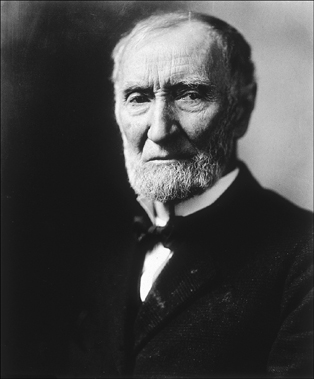
“IF THE FLOOR OF THIS GREAT HALL SHOULD SUDDENLY CAVE IN …”
Speaker Joseph Cannon, ca. 1907
Roosevelt jeered at Winthrop Murray Crane’s concern that the alienated Foraker would cause “a split” in the Republican Party, big enough to elect a Democrat in 1908.
“I call that a splinter,” he said.
Far from aggravating the party’s inner tensions, he felt that he had moved at just the right time to prevent a split. Fate had conspired to put in his way a provocative cartoon caption, a row of financiers, and Foraker himself—the man most likely to get Wall Street’s vote in 1908, if something lethal was not done to him soon—in front of the most power-packed audience Washington could muster. It had been a rhetorical opportunity irresistible even to a President who loved to eat. His lecture to the plutocrats andsegue to an attack on Foraker had branded the Senator as an apologist for wealth, if only by association. Conversely, by his reiteration of the War Department’s case against the Twenty-fifth Infantry, he had shown himself to be someone who stuck to moral principles. Distasteful though the spectacle of a President and Senator squabbling had been to some guests, Roosevelt’s “favorite audience”—a mythical grizzled farmer reading a newspaper at fireside—would probably see a confrontation of Right v. Wrong, or Executive v. Legislative, or Authority v. Anarchy, or whatever other antitheses suggested themselves.
Closer to home, political professionals saw an effective blow in favor of Taft against Foraker for the nomination in 1908. The Secretary (who had accompanied Roosevelt to the Gridiron dinner) was actually a reluctant party to the Brownsville discharges. He had been on vacation at the time of the incident, and the first prosecutorial steps had been taken in Oyster Bay. Taft’s subsequent attempt to suspend the discharges and get a “rehearing” of the evidence against the soldiers had been prompted by an emotional appeal on their behalf from the president of the National Association of Colored Women. Most recently, he had annoyingly drawn Roosevelt’s attention to a conflict in the testimony of the eyewitness who “saw” black soldiers kill Frank Natus, and suggested that the Senate be informed.
These scruples were, however, kept confidential, so Taft had come away from the New Willard looking more than ever a loyal Cabinet officer unbeholden to Wall Street, who just happened to hail from the same state as Senator Foraker.
By the time the Senate Committee on Military Affairs began its investigation of Brownsville on 4 February, Foraker was about as welcome at the White House as Benjamin Tillman had been in 1902. He and his wife began to notice signs of social pariahdom. Friends stopped visiting their house by daylight. James Garfield, a regular dinner giver, sent no invitations, complaining that Foraker was “trouble.” A “journalist” of strange ubiquity was seen making notes whenever the Forakers went out. Most ominously, Foraker discovered—in an experience, again, not new to Tillman—that his mail was being opened and read.
Roosevelt showed no outward concern about the committee hearings, which promised to last, on and off, for at least a year. He had the assurance of Foraker’s colleagues that, whatever new evidence might come to light, he was entitled, as Commander-in-Chief, to uphold his own discharges.
A VISITOR TO THE White House on 13 February found the President discussing race relations of a far more complex sort with Root and Taft. For the last four months, “Yellow Peril” agitation had been violently resurgent in California, precipitated by the San Francisco Board of Education’s decision to segregate Japanese schoolchildren. The order made no distinction between the children of long-term, Americanized Japanese residents and those of immigrant laborers fresh off the boat—currently disembarking, or swimmingashore, at the rate of one thousand per month. Any child with sloe eyes on the West Coast would now learn what it was like to be a black child in Alabama.
Roosevelt sat on the front edge of his chair, talking vehemently, as usual, while Taft lounged, twiddling his thumbs. Root stretched out his legs and gazed, for perhaps the thousandth time in his life, at Theodore over steepled forefingers. The visitor, State Senator Everett Colby of New Jersey, was struck by the quizzical expression on each Secretary’s face. Roosevelt was giving his views on immigration, and veering, in a way Root knew only too well, toward a monologue on the “splendid qualities” of Nipponese culture and customs.
Since the Treaty of Portsmouth, Japan had been justifiably proud of its accession to first-power status. Any declaration of prejudice by a Pacific Rim nation (which was how California was viewed through Eastern eyes) was an insult too painful to be borne. In the words of William Sturgis Bigelow, one of the President’s principal advisers on Far Eastern affairs, “They don’t care—broadly speaking—what is done to them as long as it does not seem to be done to them as Japanese.”
Roosevelt had tried, and failed, to make the Golden State observe the Golden Rule. Some of the most passionate language in his last Message to Congress had been devoted to a plea for respect for Japan as “one of the greatest of civilized nations.” He noted that San Franciscans had been happy to accept one hundred thousand dollars in earthquake-emergency aid from the Japanese in 1906, before shutting their relatives out of the city school system and abusing them in other ways, simply “because of their efficiency as workers.” This last remark had hit home with local labor unions, who were the real agitators in San Francisco, desperate to repatriate every “coolie” in the city. When Roosevelt followed up with a request for a new immigration act, “specifically providing for the naturalization of Japanese who come here intending to become American citizens,” the San Francisco Chronicle had called him unpatriotic, and the Californian congressional delegation began to act like ambassadors from a besieged country.
Senator Tillman, meanwhile, was seized by an apocalyptic vision of the Administration integrating “Mongolian” schoolchildren with white ones in the West, then doing the same with black schoolchildren in the South. He shouted himself so hoarse on the subject of race that London’s St. James Gazette seriously questioned his sanity.
Roosevelt decided on a moderation of his attitude, not just to soothe redneck neuroses, but because of the much more dangerous mood of the Japanese government. Tokyo’s response to the San Francisco segregation order had been a formal complaint against the “stigma and odium” it entailed. Such language was not to be ignored, coming from a war-hardy Pacific nation at a time when the United States battle fleet was entirely concentrated in the Atlantic. And Culebra was not yet cut.
The result was a gathering war scare in Washington, stirred up by the anti-Japanese rhetoric of Senator George C. Perkins of California. Roosevelt the balancer sought to steady both sides by attaching to a pending immigration bill an amendment that would significantly reduce the number of Japanese arriving in America from Hawaii. Its language, authored by Root, gave him power to deny entry by “any aliens” to both the United States and her insular possessions. The last phrase was vital, because Hawaii had become a cornucopia of coolie labor. Yesterday’s pineapple pickers were today’s almond hullers and tomorrow’s stokers for the Northern Pacific Railroad.
“Why should I have to pay a fireman six dollars a day for work that a Chinaman would do for fifty cents?” James J. Hill asked Finley Peter Dunne, over lunch at Au Savarin in New York. “Let down the bars!”
To win passage, the exclusion amendment needed advance approval from Japan. That authoritarian empire was able to restrict emigration of her nationals by simple denial of exit permits. In fact, she had already discreetly promised Root she would do so, if the San Francisco school ban was rescinded. Once the immigration bill was passed (nowhere citing the Japanese as “Japanese”), Tokyo would cooperate with Washington to keep the flow of cheap labor at an acceptable level.
The only flaw in this commitment was something hard for imperialistic minds to understand: the government of a federal republic, while able to wage war, could not tell a local school board what to do. Negotiation, not coercion, was required. Hence the presence of Roosevelt’s two most persuasive Cabinet officers at the White House on 13 February 1907. They were in the midst of an extraordinary six-day series of meetings with Mayor Eugene E. Schmitz of San Francisco, trying to convince him and members of his school board that their action stood, as Root put it, “in the way of an international agreement.”
Schmitz, who was currently under indictment for embezzlement and extortion, was not unwilling to make a deal, if he could return home with dignity enhanced. Cowed by the President, beguiled by Taft, and outclassed by Root, he agreed to readmit Japanese children to the San Francisco school system, providing they spoke some English and were not overaged. And he could boast, if he wanted, that he had helped initiate a “Gentlemen’s Agreement” between the United States and Japan that would determine Pacific policy for as far ahead as anyone could see.
SINCE ROOSEVELT’S ADMIRATION of the Japanese was based in large part on their fighting qualities, he did not delude himself that a stately exchange of diplomatic notes was enough to counter the threat posed by Admiral Togo’s navy. In the glow of peacemaking at Portsmouth, he had briefly decided that the American fleet was large enough—his first term had seen it double in planned size. One new battleship a year, from 1905 on, seemed all that was necessary to compensate for the attrition of older vessels.
He had even gone along with the Tsar’s recent efforts—understandable, in view of the near obliteration of the Russian Navy—to bring about a Second Hague Conference, which might slow the battleship race among Britain, France, the United States, Germany, and Japan. The idea of arms limitation appealed to Roosevelt in theory. However, “I do not feel that England and the United States should impair the efficiency of their navies if it is permitted to other Powers, which may some day be hostile to them, to go on building up and increasing their military strength.”
This ambivalence between containment and competition had abruptly modulated toward the negative immediately after the San Francisco school order. In a letter to Sir Edward Grey, Roosevelt wrote that “the race question” was an “immediate source of danger” in Japanese-American relations, and worriedly admitted that “in the event of war we should be operating far from our base.” He was thinking of the Philippines, but also of the long-term threat to Hawaii and the West Coast posed by battleships like the Satsuma, a dreadnought under construction in the Yokosuka shipyard.
To his current demand for an all-big-gun battleship of “at least eighteen thousand tons,” he added a request that Congress fund it along with last year’s vessel, funds for which had not yet been appropriated. He released for publication letters to the chairmen of both naval-affairs committees, urgently arguing “the superior value of battleships of large displacement, high speed, and great gunpower.”
On 15 February, there was a brief flurry of budgetary protest in the House of Representatives. But with the war scare at its height, few lawmakers wanted to look irresolute. The President got his dreadnoughts. Three days later, the immigration bill was passed with the exclusion amendment intact, trans-Pacific tensions subsided, and Roosevelt handed the by-now-tired subject of arms limitation over to Elihu Root.
AS THE END OF the session approached, Roosevelt had to deal with a new challenge thrown on his desk by Senator Charles W. Fulton, Republican of Oregon. On 22 February, Fulton attached to the Agricultural Appropriations bill an amendment proposing that every public tree, sapling, or sprout in six northwestern states, totaling some sixteen million acres, be withdrawn from the President’s protection and placed at the disposal of Congress. Or, as Fulton (infuriated by two years of land encroachment by Chief Forester Gifford Pinchot) put it: Hereafter no forest reserve shall be created, nor shall any addition be made to one heretofore created, within the limits of the States of Oregon, Washington, Idaho, Montana, Colorado, or Wyoming except by act of Congress. On 25 February, the amendment was enacted and sent to the White House for signature.
Roosevelt let it lie on his desk.
The bulk of the American public had probably not noticed that in his last Message to Congress, he had for the first time used the plain word Conservation as a subject heading. There had been Forest Conservation and Water Conservation in his First Message, but they had denoted specific and separate programs, on par with Reclamation in 1903 and Public Lands in 1905. Conservation, by itself, was at once more general and more philosophical—religious even, a writ preaching the common sanctity of wood and water and earth and flora and fauna. It even had its menorah: the many-armed drainage basin, WJ McGee’s “harmonious interrelationship of parts,” purging the countryside of pollution, restoring the ravages of erosion, imposing order on human settlement, controlling floods, nurturing species, and generating power.
Roosevelt had virtually asked for a fight over forest reserves. It was he—working always with Pinchot, a favored member of the Tennis Cabinet—who had persuaded Congress in 1905 that forest care was a form of crop management, and should be transferred from the Department of the Interior to that of Agriculture. In the process, the Forest Bureau, run by bureaucrats, had become the Forest Service, run by foresters. Pinchot had used its enlarged budget and semiautonomous powers to acquire control of grazing licenses, hydroelectrical leases, and even police summonses in the national parks. He had stretched the meaning of the word forest so much that some westerners wondered when the Great Salt Lake was going to need his urgent protection.
The wonder was that the Transfer Act had not precipitated a fight at the beginning, rather than the end, of the Fifty-ninth Congress. But Roosevelt’s interim blitz of regulatory legislation, and other distractions such as Brownsville and the Cuba intervention, had enabled Pinchot to slink expertly through government groves, adding twenty million acres to his domain, and a proportionate increase of revenue to the budget of the Forest Service. He left few tracks, until his acquisitions were announced by presidential proclamation.
There was something pantherlike about the Chief Forester, with his long, lean walk and hypnotic stare. Acquaintances differed on the exact quality of that gaze: it was erotic to some women, while men tended to see an idealism bordering on fanaticism. “The eyes do not look as if they read books,” Owen Wister wrote, “but as if they gazed upon a Cause.” Not that Pinchot was unlettered. He had the right cultural credentials: Exeter, Yale, postgraduate study at the École Nationale Forestière in France, and research spells in the ancient woodlands of Switzerland and Germany. And he was, to Roosevelt’s approval, a New England gentleman, rich and well-connected, with a strong social conscience.
The two men had known each other since the 1890s. What the President especially liked was Pinchot’s killer instinct, coupled with the fact that he fought cleanly. That made him all the more dangerous, because he was invulnerable to charges of corruption. He did have an Achilles’ heel, and Roosevelt recognized it with some amusement: “Pinchot truly believes that in case of certain conditions I am perfectly capable of killing either himself or me. If conditions were such that only one could live, he knows that I should possibly kill him as the weaker of the two, and he, therefore, worships this in me.”
President and Forester, fighting together, were an adroit combination. This became evident when Roosevelt, still holding off on the Agricultural Appropriations bill, managed to co-opt all the public lands Senator Fulton thought he had saved from being saved. A forced draft of Administration clerks—some of them working forty-eight-hour shifts—completed by Saturday, 2 March, all the paperwork necessary for the President to proclaim twenty-one new forest reserves, and eleven enlarged ones, in the six states specified.
He immediately signed these executive orders, knowing that Congress had no power to stop them except by a formal vote—which he would at once veto. Thus came into existence, along with others, the national forests of Holy Cross and Montezuma, Colorado; Medicine Bow, Colorado and Wyoming; Priest River, Idaho and Washington; Big Belt, Big Hole, and Otter Forest, Montana; Toiyabe, Nevada; Blue Mountain, Oregon; Olympic Forest, Washington; Rainier, Washington; Cascade, Washington; and Bear Lodge, Wyoming. Only after the last acre was reserved did Roosevelt sign the Agricultural Appropriations Act, allowing Fulton’s now worthless clause to float over his proud Theodore Roosevelt.
ON 4 MARCH, the political season whistled to an end, literally, with some sifflation from the rostrum of the House by Representative Frank B. Fulkerson (R., Missouri). James Bryce, the new Ambassador from Great Britain, listened enchanted as the slender stream of sound filled the great hall, and the hands of the clock converged on noon. Then Uncle Joe Cannon reached for his gavel, and banged the Fifty-ninth Congress out of existence.
Simultaneously, a reshuffled Roosevelt Cabinet took office. No names made headlines, since the President had announced his appointments and reappointments before the last election. For the sake of continuity in congressional relations, he had kept most officers in their old jobs until now. One new face was that of Oscar S. Straus as Secretary of Commerce and Labor—the first Jew in Cabinet history. (Washington dinner-table opinion was divided as to whether Roosevelt had chosen Straus as a signal of goodwill toward the business community, or of contempt toward Russia, where the plague of pogroms had become endemic.)
A stranger choice, for the gossips, was that of Ambassador George von L. Meyer to succeed George B. Cortelyou as Postmaster General. Why should so suave and successful a diplomat, who hobnobbed with the Kaiser and the King of Italy, forsake the gilded halls of St. Petersburg for the Post Office’s bleary corridors? Cortelyou, who seemed to be promoted every time the President put on weight, was now Secretary of the Treasury. Charles J. Bonaparte continued as Attorney General, his former job at the Navy Department being taken over by Victor H. Metcalf, while James R. Garfield became Secretary of the Interior.
Cortelyou had been at the Treasury only ten days when he was tested even more severely than Leslie Shaw had been during the “rich man’s panic” of 1903. Prices on the New York Stock Exchange, rendered unstable by a worldwide overexpansion of credit, plummeted without warning on 14 March. The Dow Jones Industrial Average declined by one quarter. Several big businesses went bankrupt. Doubts that the President’s former note-taker could handle such an emergency were swiftly dispelled when Cortelyou deposited twelve million dollars’ worth of Treasury gold in New York banks to replenish the money drain. This Morgan-like gesture saved Morgan himself from having to do something similar. It also pre-empted an emergency plan by E. H. Harriman and four other financiers to make twenty-five million available at the first hint of a crash. The speed and certainty with which Cortelyou acted helped to arrest the stock slide and turn it into a slow, but manageable decline. He won instant respect on Wall Street, and no more jokes were made about his stenographic past.
Roosevelt scoffed that the quasi-panic had been “a demonstration arranged by Mr. Harriman to impress the Administration.” Few financiers were prepared to believe that the Southern Pacific tycoon would make so expensive a gesture of protest against government regulation. A mild recession did seem to be in the making, though, and Jacob H. Schiff wrote to the President, begging him to do something statesmanlike before things got worse.
Schiff—silver-bearded and courtly, with the accent of his native Germany still heavy on his tongue—was one of Roosevelt’s few Democratic supporters, and, as such, not inclined to mince words. “We are confronted by a situation not only serious, but which, unless promptly taken in hand and prudently treated, is certain to bring great suffering upon the country,” he wrote. It was not so much a money crisis as a loss of confidence, brought about belatedly by last year’s regulatory reforms. Investors were afraid to risk funds in railroad stocks, out of fear that the Sixtieth Congress might be even more amenable to reform than the Fifty-ninth. With no Congress at all sitting for the next eight months, that fear was bound to intensify. Railroad securities would fail to sell, and railway improvement and construction programs would be canceled by nervous executives, causing both devaluation and deterioration. Schiff suggested that Roosevelt “bring together a committee representative of the railroad interests and the Interstate Commerce Commission,” along the lines of his successful coal-strike conference of five years before. Its job would be to discuss whatever future regulatory legislation the President had in mind, so that an endorsed program could be presented to Congress. “This will speedily restore confidence and dispel the clouds that are gathering over us in so threatening a manner.”
Roosevelt wrote back to say that J. Pierpont Morgan had recently tried to get some railroad executives, including Harriman, to visit the White House, but none had shown. He was therefore disinclined to call a conference. “Sooner or later they will realize that in their opposition to me for the last few years they have been utterly mistaken … that nothing better for them could be devised than the laws I have striven for and am striving to have enacted.”
Harriman would only say, enigmatically, to reporters, “This has been an unusual winter, both as to politics and as to weather.”
SO HAD IT BEEN for the President. The perfect conditions, meteorological and political, that had brightened his New Year’s Day (excepting always the dark cloud of Brownsville) had become unsettled almost at once. Now Jake Schiff was talking of more and bigger clouds, and a financial storm to come. A phrase in Schiff’s latest letter was disquieting: “your stern and uncompromising attitude in important questions.”
Roosevelt had tried to be more moderate, and restrain his natural force—and indeed succeeded in doing so much of the time. But men such as Foraker brought out the primitive in him. It was a quality lesser men recognized and admired—witness the macabre artifact coming his way (according to The New York Times) from deepest Texas: a silver-mounted, jewel-studded big stick, carved by the citizens of Brownsville in his honor.
More rational admirers, including Henry Cabot Lodge and James Garfield, thought they detected signs of exhaustion in the President. On an excursion to Cambridge, he had spoken so mechanically, as if spinning some internal Edison cylinder, as to scotch a nascent campaign by William James to make him president of Harvard in 1909. “Althou’ he praised scientific research,” the philosopher complained, “there wasn’t otherwise a single note of innovation or distinction in anything he said.” Few knew that at the very end of winter, the Roosevelts had nearly lost their son Archie to diphtheria. The boy’s nine-day struggle for life, including at least one heart failure, took its emotional toll.
Spring came late to the White House grounds, less benignly than Roosevelt had ever seen it, with frigid air coming down from Canada to wither the magnolia blossoms. Every tree bore its dead brown load, and other buds stayed dormant. When Roosevelt ventured his first tennis game of the season, with Pinchot, Garfield, and Jusserand, a snow squall struck. They grimly played four sets. The following day, cold rain fell.
Normally, in short-session years, April and May were pleasant months for the President and his Cabinet, with no congressional liaison to worry about and plenty of time to talk policy. But this change of season brought an unwelcome flowering of bad political news. The Immigration Act seemed to be having no effect on the flow of Japanese coolies into California. Consequently, the Yellow Peril was again being proclaimed in San Francisco. In Ohio, Joseph B. Foraker announced his opposition to Taft’s undeclared presidential candidacy. This was tantamount to launching his own campaign for nomination by the state GOP. Disturbingly, he began to court Ohio’s black voters, who were enough upset about Brownsville to back him.
In early May, a compromise was advanced by George B. Cox, Cincinnati’s former political boss, who offered to unite the party behind Taft for President and Foraker for another term as Senator. Foraker accepted this arrangement, knowing it left him quite free to run for President. Taft rejected it on the ground that he would be seen as a deal maker. The unhappy result for him was to make Foraker a stronger candidate than ever, while fueling rumors that Taft lacked political ambition.
It also revived talk about Roosevelt’s own presumed secret agenda. “At the moment,” he wrote Kermit on 15 May, “I am having a slightly irritating time with well-meaning but foolish friends who want me to run for a third term.” He did not mention his elder daughter, who preferred the phrase second elective term. Going along with their plans would make him the virtual overlord of the next Congress, and, probably, the longest-serving President in history (yet by no means the oldest: if he served through to March 1913, he would still be only fifty-four).
Nor did he mention to anybody, unless to Edith Roosevelt in utter privacy, that nine tenths of him wanted to run again. And that nine tenths was reason, not emotion. He could not account for the moral particle that stopped him, except to describe it vaguely as a “still, small voice.”
Having thus made, or remade, one of the fateful decisions of his life, Roosevelt left Washington with Edith and Archie for a few days at Pine Knot. The weather, though still crisp, was clear, and he took his field glasses to do some bird-watching.
HE SAW THEM ON 18 May, for the first time in twenty-five years—another reminder that tempus fugit. There were about a dozen, unmistakable with their pointed tails and brown-red breasts, flying in characteristically tight formation to and fro before alighting on a tall, dead pine. He compared them to some mourning doves in the field beyond; and there was no question of the difference between the two species. All his ornithological training told him that he was looking at the passenger pigeon “Ectopistes migratoria—described on page 25 of the 5th volume of Audubon,” a bird generally accepted to be on the edge of extinction.
He had collected and cataloged a specimen as a boy, noting even then that it was becoming rare on Long Island. Once it had been the most abundant feathered thing in the world, so prolific that a single flock, in 1832, had been assessed at more than two and a quarter billion birds. Old frontiersmen remembered passenger pigeons literally blotting out the sun. In 1856, the Ohio legislature had declared, “The passenger pigeon needs no protection.”
Thus encouraged, hunters had succeeded in obliterating it to such an extent that, by the end of the nineteenth century, shootings became almost as rare as sightings. W. B. Mershon’s valedictory The Passenger Pigeon, in press even as Roosevelt watched his flock circling and settling, recorded the last bird killed in Wisconsin in 1900.
Twice more that afternoon, the passenger pigeons swooped over Pine Knot. Their large size and rapid, circular movements seemed confirmatory, but they did not perch again, and vanished as quickly as they had come. Roosevelt stayed at the cabin for three more days, walking and riding with Edith through the woods from noon to sunset, and saw no evidence that he had not been dreaming.