

Q D’ye think he wants a third term?
A I do not.
OYSTER BAY. Oyster Bay. Oyster Bay. Oyster Bay. Oyster Bay. Oyster Bay. Oyster Bay …
The agreeable monotony of Roosevelt’s schedule for late June 1907 was interrupted on the twenty-seventh by a captain from the General Board of the Navy and a colonel from the Army War College. They accompanied Victor H. Metcalf, the Secretary of the Navy, and Postmaster General George von L. Meyer, who had definitely not come to discuss rural free delivery. Meyer’s presence, indeed, helped explain his real role in the Cabinet, which was to advise the President on questions of extreme diplomatic delicacy.
Five weeks before, after returning to Washington from Pine Knot, Roosevelt had been exasperated to hear that anti-immigrant riots had broken out in San Francisco. “Nothing during my Presidency has given me more concern than these troubles,” he wrote Kentaro Kaneko. He argued that what was happening in California was nothing new. Nor was it essentially racial: it had plenty of precedents in European history over the last three centuries. France’s Huguenots, for example, had been as white as their coreligionists in Great Britain, but when they immigrated there, they had excited “the most violent hostility,” indistinguishable from what had happened at the Golden Gate. Then as now, mobs of workmen caused most of the trouble, expressing labor’s chronic fear of being devalued by competition. Now as not then, hope lay in the increased ability of “gentlemen, all educated people, members of the professions, and the like” to visit one another’s countries and “associate on the most intimate terms.” This was the particular responsibility of elected representatives. “My dear Baron, the business of statesmen is to try constantly to keep international relations better, to do away with the causes of friction, and to secure as nearly ideal justice as actual conditions will permit.”
Meyer himself could not have put the case with more finesse. But the fact remained that coolies were still coming, and having their faces beaten in. The Immigration Act was still not working as it should, the San Francisco Police Board had taken up where the school board had left off, reactionary newspapers were screaming, and Japanese opposition leaders were calling for war.
Elihu Root did not take the last threat seriously. He wrote Roosevelt to say that alarmists had their own agenda, but “this San Francisco affair is getting on all right as an ordinary diplomatic affair.… There is no occasion to get excited.”
Roosevelt was not so sure. Japan had behaved with commendable restraint during the early months of the crisis. Recently, however, he had begun to detect “a very, very slight undertone of veiled truculence” in her communications concerning the Pacific coast. He heard from members of his secret du roi that the Japanese war party really did think the United States was beatable. The Office of Naval Intelligence reported evidence of Japanese war preparations, including purchase orders for nearly eighty thousand tons’ worth of armored vessels from Europe, and a twenty-one-thousand-ton dreadnought from Britain. (So much for any chance of a disarmament agreement at the Second Hague Peace Conference, now in session.)
His responsibility as Commander-in-Chief was to look to the nation’s defenses. Hence the arrival at Sagamore Hill of two top military strategists. He had asked them to bring him contingency plans, “in case of trouble arising between the United States and Japan.”

COLONEL W. W. WOTHERSPOON and Captain Richard Wainwright proved to be little more than messengers, delivering a somewhat obvious finding by the Joint Board of the Army and Navy. The board stated that because Japan’s battleships were all in the Pacific, and those of the United States in the Atlantic, the latter power should “take a defensive attitude” in any confrontation, until its heavy armor could be brought around Cape Horn.
Roosevelt said, for the record, that he did not believe there was any real chance of a war with Japan. Then he approved the only controversial aspect of the Joint Board’s report: a recommendation by Admiral Dewey that “the battle fleet should be assembled and despatched for the Orient as soon as practicable.”
The idea was not new. For at least two years, the Navy had considered transferring the fleet from one ocean to the other as a tactical exercise, but had never managed to decide the extent of the move, or the logistics of support. Fuel supplies were a particular problem, and the West Coast of the United States was short on bases. Dewey calculated that it would take at least ninety days to mount an emergency battle presence in the Pacific. “Japan could, in the meantime, capture the Philippines, Honolulu, and be master of the sea.”
Roosevelt considered the options, and his own as President and Commander-in-Chief. He had just seventeen months left in office, and wanted to make a grand gesture of will, something that would loom as large historically in his second term as the Panama Canal coup had in his first. What could be grander, more inspirational to the Navy, and to all Americans, than sending sixteen great white ships halfway around the world—maybe even farther? And what better time than now, when positive news was in such short supply?Wall Street’s stock slide in March had caused many brokerage houses to fail and bank reserves to drop. Foreign markets had also begun a steady decline, with stocks plummeting in Alexandria and Tokyo, Frenchmen hoarding more gold than usual, and even the Bank of England low on cash. Jacob Schiff had said that “uncertainty” lay at the bottom of all distrust. All the more reason, then, to make one highly visible arm of the United States government look quite certain of itself, as it moved from sea to shining sea.
The massive deployment appealed to Roosevelt as diplomacy, as preventive strategy, as technical training, and as a sheer pageant of power. There was also the enormity of the challenge. He had private information that neither British nor German naval authorities believed he could do it. Well, he would prove them wrong. “Time to have a show down in the matter.”
He issued a series of orders to Secretary Metcalf. The Subic Bay coal stockpile in the Philippines must be enlarged at once. Defense guns must be moved there from Cavite. Four armored cruisers of the Asiatic Fleet were to be brought back to patrol the West Coast. And finally—Roosevelt’s operative order, climaxing ninety minutes of talk—the Atlantic fleet would set sail from Hampton Roads, Virginia, in October, destination San Francisco.
When someone asked how many battleships would make the trip, Roosevelt said that depended on how many there were in service at the time. If fourteen, he would send fourteen; if sixteen, then sixteen. He wanted them “all to go.”
Metcalf was authorized to announce the dispatch of the “Great White Fleet”—as it soon became known—appropriately on the Fourth of July. But the news was too big to hold, in view of the tense state of American-Japanese relations. By the time the Secretary issued his statement, Ambassador Aoki had already moved defensively to say that Japan did not regard Roosevelt’s gesture as “an unfriendly act.”
His Excellency thus avoided sounding overjoyed at the prospect of an enormous alteration in the balance of naval power in the Pacific. And Roosevelt, by intimating that San Francisco would be the fleet’s farthest port of call, encouraged Californian alarmists to think it was being dispatched for their protection. They would have been less comforted if they had known that he was privately talking to Henry Cabot Lodge about sending it on “a practice cruise around the world.”
THE CONNECTION JACOB Schiff had tried to draw for Roosevelt earlier in the year, between persecution of men of property and loss of investor confidence, was dramatically demonstrated at the beginning of August, when Judge Kenesaw Mountain Landis of the United States District Court fined the Standard Oil Company of Indiana more than twenty-nine million dollars in an antirebate case. John D. Rockefeller, Sr., said that the judge would be dead before he ever saw a dime of his fine. Within a week, the stock market slumped again.
Conservatives blamed Roosevelt and his “fool Attorney General” for jamming regulatory levers into the American economic machine. The New York Times declared that Landis’s ruling exemplified “that spirit of vindictive savagery toward corporations that, until recently, possessed the minds of … persons in authority.” A sheaf of concerned-citizens’ letters was delivered to Sagamore Hill, variously accusing the President of orphanicide, old age abuse, cruelty to women, and “Rough Rider methods” sure to bring on hard times. An anonymous postcard asked if he was aware that he had ruined every single industry in the forty-six states.
Roosevelt, who had been enjoying himself with plans for the fleet cruise (“go thru the Straits of Magellan; have thirty days’ target practice in the Pacific”), was forced to reply to some of the more important missives. “You say that the verdict against the Standard Oil Company has done great damage,” he wrote to Henry Lee Higginson, the Boston banker, “and you advise me to let the public know that the prosecutions will not be pushed.… I cannot grant illegal immunity.”
He chose to call the economic contraction of 10 August a “flurry,” rather than a “panic,” and used sensible logic against his accusers, asking why, if Wall Street’s disarray was his fault, markets in France, Britain, Germany, and Canada were failing in exactly the same way. “The present trouble is worldwide.”
This was true enough, but behind his show of unconcern lay a sense that the money men might be right in predicting a real crash to come. He addressed a letter to his “fool Attorney General,” who was preparing to prosecute International Harvester under the Sherman Act. Bonaparte seemed to have forgotten about last January’s agreement between the trust and the Bureau of Corporations on a cooperative “investigation,” which was even now under way. One such probe by one government agency was surely enough. “Please do not file the suit until I hear from you,” Roosevelt instructed.
With that, he resumed his interrupted vacation and a reading of Guglielmo Ferrero’s five-volume The Greatness and Decline of Rome. He was struck by the similarity of many conditions endemic to ancient imperial and modern industrial civilizations. “As I am fighting hard to better some of these very conditions just at the moment,” he wrote George Otto Trevelyan, “the book has a certain grim attractiveness for me, in the present as well as the past tense.”
ONE THING THE ROMANS had understood very well was the role of fresh water in sluicing, sanitizing, irrigating, and beautifying both landscapes and townscapes. Old Father Tiber had been the fons et origo of a spreading web of canals, viaducts, underground pipes, and fountains that linked communities more effectively than any system of law.
WJ McGee, the visionary environmental scholar and proponent of the “interrelationship of parts” (as his compressed initials suggested) had long dreamed of a similar water-based network making one massive hydrosystem of the United States. Earlier in the year, he had found Gifford Pinchot a willing ally in persuading Roosevelt to appoint an Inland Waterways Commission that would prepare “a comprehensive plan for the improvement and control of the river systems of the United States.” The Commission, chaired by McGee, was due to report within a year. In the meantime, to publicize its work, it was sponsoring inspection trips of major lakes and rivers. Roosevelt delightedly accepted an invitation to cruise down the Mississippi on a paddle steamer with Pinchot and other commission members in the early fall. He thought he might combine it with a bear hunt in the canebrakes of Louisiana, to get himself in shape for dealing with the critters of the Sixtieth Congress.
By the time he came on board at Keokuk, Iowa, on 1 October, the steamer’s passenger complement had expanded to include some twenty state governors, and Pinchot and McGee were consumed with a new idea, which they wanted him to articulate en route, at Memphis. It was that a great conference on conservation should be held at the White House in the spring of 1908—the first such gathering in the history of any nation—and that every governor in the country would be asked to attend.
A sense that the President was about to announce something enormous gathered as the USS Mississippi, accompanied by a flotilla of lesser ships, thrashed its way south. Crowds lined both banks, craning for a sight of Roosevelt on deck. At night, when the river’s humid mists made navigation difficult, they burned huge bonfires to light his way. They took off their hats as he passed, and refrained from cheering lest they disturb his sleep.
Roosevelt made his announcement at Memphis on 4 October, tersely, in the course of an address to the Deep Waterways Convention. “It ought to be among the most important gatherings in our history,” he said, adding that the time had come to make “an inventory of the natural resources which have been handed down to us.” The rest of his speech amounted to a summary of McGee’s enviromental philosophy. “There is an intimate relation,” he said, “between our streams and the development and conservation of all the other great permanent sources of wealth.”
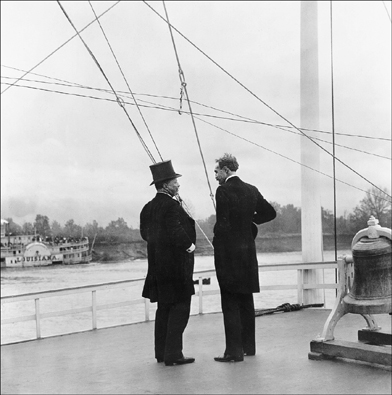
“THE PRESIDENT WAS AGAIN ABOUT TO ANNOUNCE SOMETHING ENORMOUS.”
Roosevelt and Gifford Pinchot on the Mississippi River, October 1907
The impact of this statement might have been greater if the New York Stock Exchange, which most Americans associated more clearly with wealth, had not again begun to show signs of deep unrest. Over the next two weeks, as the President lunged after bear in the canebrakes around Stamboul, Louisiana, some prices dropped to record lows, and others jiggled crazily. The initial cause of panic was a failure by two speculators, F. Augustus Heinze and Charles W. Morse, to take over the United Copper Company. They succeeded only in bankrupting two brokerage houses, another mining concern, and a bank. These implosions, headlined across the country, revealed to the Street that Heinze and Morse had been funded in their venture by the august Knickerbocker Trust, the very name of which signaled stability and money old and hard as bedrock.
The bedrock showed signs of crumbling on the afternoon of Friday, 18 October, as panicking Knickerbocker investors hacked out their gold deposits. Over the weekend, J. Pierpont Morgan, working like a tycoon possessed, organized two relief committees of financiers (one headed by the ubiquitous George W. Perkins) to raise funds and decide which trusts, sure to fail over the next few days, merited saving for the stability of the national economy. New York banks were at the height—or rather, the depth—of their annual currency shortage. This contributed to what James Bryce described as “a simultaneous deficiency of capital and confidence.”
On Monday, 21 October, as the President headed home with deliberate slowness, to avoid even sharper panic, rumors circulated that the Knickerbocker had only ten million dollars left in cash. With sixty million loaned out, the trust might be unable to issue good checks past midday Tuesday. Well before that hour, Morgan saw its reserve dwindle to two million dollars, and coldly decided to let it collapse. “I can’t go on being everybody’s goat.”
By the time Roosevelt got back to the White House on Wednesday afternoon, money was almost unobtainable on Wall Street, call loan rates had risen to 125 percent, and the entire credit structure of the United States was under siege. Morgan and George Cortelyou (forsaking all governmental dignity to serve as the great man’s aide) were holding off hordes of desperate raiders. Overnight, the Secretary agreed to deposit twenty-five million dollars in Treasury funds in national banks—more than twice as much as his pledge of seven months before.
Roosevelt seemed unaware of how acute the situation was. Radiant and purified from his hunt, he patrolled the Executive Office with his hands behind his back, regaling all comers with his exploits in the canebrakes.
“Do I look as though those Wall Street fellows were really worrying me?”
“No, Mr. President, you certainly do not.”
“I’ve got them,” he said through his teeth, “on the run.”
It was exchanges such as this that persuaded some men that Roosevelt was fiscally retarded.
By now, most of the nation’s premier plutocrats were volunteering their help to Morgan, including E. H. Harriman, Henry Clay Frick, and John D. Rockefeller, Sr., who offered, incredibly, half of all his securities. At 1:30 P.M. on Thursday, 24 October—too late for Roosevelt to do anything except try to catch up, in briefing after briefing, with what had happened during his absence—the panic reached a point of almost terminal hysteria. The President of the New York Stock Exchange told Morgan that his institution would have to shut down. Morgan told him to wait, and summoned the chief executives of the city’s largest banks. Among them, they pledged twenty-five million dollars to keep the Exchange open through three o’clock. Stocks rebounded at once, and the “Roosevelt Panic of 1907” began to abate.
The President was gracious enough, on Friday, to issue a statement of congratulation to Cortelyou and “those conservative and substantial businessmen who in this crisis have acted with such wisdom and public spirit.” He used the words confidence and calm as often as possible, and managed to allay public nervousness, if not the unavoidable impression that he had been away from his desk, playing in the canebrakes, while conscientious financiers had been saving the American economy. For once they were not—and for a while yet were relieved of being—“malefactors of great wealth.”
ALTHOUGH A TOTAL crash had been averted, the crisis on Wall Street was by no means over. The next business week, starting on Monday, 28 October, was equally fraught, with New York City on the verge of defaulting for lack of cash to borrow, and another major financial institution, the Moore & Schley brokerage house, threatening to go the same way as Knickerbocker Trust. Morgan and his men came to the aid of the city, and devised an emergency plan to save Moore & Schley by persuading U.S. Steel to buy it—or rather, to buy the collateral shares for its loans, which were invested in the Tennessee Coal and Iron Company. Elbert H. Gary did not seem to like this idea, which involved trading a large amount of U.S. Steel gold bonds for Tennessee Coal’s lower-rated stock. Nor did Frick, who worried that Roosevelt might seize on the acquisition as an excuse for yet another antitrust prosecution. The President had shown himself quite ready to bite the hand that fed him after begging for corporate campaign donations in 1904.
Judge Gary said he would endorse the Morgan plan, but only if Roosevelt endorsed it, too. He liked the President, and believed him to be a pragmatic man, responsive to reasoned argument. Early on Monday, 4 November, he and Frick visited the White House for breakfast. Roosevelt was so impressed by their willingness to consummate an undesirable deal in order to forestall a “general industrial smashup,” that he agreed within twenty minutes to let them go ahead. Immediately after their departure, he let Attorney General Bonaparte know that the acquisition had his approval.
The New York Stock Exchange had not yet opened when Gary called George Perkins to advise him of Roosevelt’s goodwill. Perkins passed on the news just before nine o’clock. Relief flooded the market, and within hours prices began to rally.
ON 11 NOVEMBER, Roosevelt signed forty-six copies of a document, which more than any other he had ever written could justifiably be called a “posterity letter,” in that it addressed itself, with the utmost urgency, to the future. It was his promised call for a national conservation conference. One copy went to each state and territorial governor, and a further five hundred copies to a cross-section of the most influential men in the country, from members of Congress and Justices of the Supreme Court to industrial tycoons and editors of major newspapers.
“It seems to me time for the country to take account of its natural resources,” the President wrote, “and to enquire how long they are likely to last.”
The suggestion that anything so unquantifiable as the mineral and vegetal and hydrological wealth of one of the world’s largest nations might, in fact, be rendered into an “account” was almost as shocking as the cold, hard tone of Roosevelt’s last seven words. He wrote with the finality of a man who had, with his own eyes, seen the last few flutterings of a species that had once been capable of blackening the sky.
“We are prosperous now,” he continued, not even bothering to qualify his statement. Wall Street’s current recession was as trivial, historically speaking, as a waver in one of a redwood’s hundreds of growth rings. “We should not forget that it will be just as important to our descendants to be prosperous in their time as it is to us to be prosperous in our time.” He repeated what he had said at Memphis about the gravity of the responsibility Americans had to pass on to their children a protected natural heritage. For more than a century, that endowment had been “depleted and in not a few cases exhausted,” especially in the northeastern states. The situation was already so serious that it was a matter for all government, not merely the federal government, to face:
I have therefore decided, in accordance with the suggestion of the Inland Waterways Commission, to ask the Governors of the States and Territories to meet at the White House on May 13, 14, and 15 [next], to confer with the President and with each other upon the conservation of natural resources.
It gives me great pleasure to invite you to take part in this conference.… I shall also invite the Senators and Representatives of the Sixtieth Congress to be present at the sessions as far as their duties will permit.
The matters to be considered at this conference are not confined to any region of groups of States, but are of vital importance to the Nation as a whole and to all the people. These subjects include the use and conservation of the mineral resources, of the resources of the land, and the resources of the waters in every part of our territory.…
Facts, which I cannot gainsay, force me to believe that the conservation of our natural resources is the most weighty question now before the people of the United States. If this is so, the proposed conference, which is the first of its kind, will be among the most important gatherings in our history in its effects upon the welfare of all our people.
WALL STREET’S currency drought lasted through November. Cortelyou, whose commitment of Treasury funds into the New York banks had increased to $69 million, got presidential permission to raise $150 million more in government and Panama bonds, just to keep the market buoyant. Not for at least a year, in expert opinion, would stocks rise back to pre-1907 levels. But a short recession after seven fat years seemed preferable to seven lean years, such as had followed the depression of 1893.
Roosevelt wrote Kermit to say that blame for the economic downturn would inevitably center on himself and his regulatory policies. He might have to spend the rest of his presidency answering to the two classes of people always most vociferous in hard times: the bewildered and the guilty. However, “I am absolutely certain that what I have done is right and ultimately will be of benefit to the country.”
His Seventh Annual Message to Congress, delivered on 4 December, rang throughout with the same unapologetic note. “There may be honest differences of opinion as to many government policies; but surely there can be no such differences as to the need of unflinching perseverance in the war against successful dishonesty.”
BY NO HINT OF a frown, or a yawn, did he ever suggest that such routine work had become boring for him. But his animation whenever he mentioned Admiral Robley Evans’s battle fleet, now assembling at Hampton Roads, Virginia, for its pre-Christmas departure, was palpable. With 348,000 tons of white-painted armor and gunmetal ready to sail at his command, and most of the civilized world waiting to see if such an armada could possibly hold together for more than a few days at sea, executive paperwork offered few compensatory charms.
Except, perhaps, the pleasure of striking four names off his annual Christmas-card list: Mr. E. H. Harriman, Mrs. Harriman, and the Misses Harriman.
THE SIXTIETH CONGRESS, dominated even more than the Fifty-ninth by Speaker Cannon and Senator Aldrich, made immediately plain that it intended to stand as a conservative battlement against whatever progressive onslaughts—or Constitution-defying executive orders—Roosevelt might throw against it. Congressmen who prided themselves on their personal rectitude disliked the now habitual preachiness (more bully than pulpit) with which the President told them what laws to pass. They recalled Tom Reed’s famous jibe, “If there is one thing for which I admire you more than anything else, Theodore, it is your original discovery of the Ten Commandments.”
Cannon and Aldrich, respectively self-appointed as the protectors of laissez-faire on Capitol Hill, had had their worst fears of Roosevelt’s financial irresponsibility confirmed by the stock-market slump. Eugene Hale, chairman of the Senate Committee on Naval Affairs, issued a statement saying that Congress would not appropriate funds to send the Great White Fleet on its way. Roosevelt countered by informing him that the Navy already had enough money in hand, and enough coal in store, to transfer its ships at least from one ocean to another—indeed, possibly as far as the Philippines. Congress was welcome to leave the fleet there—halfway around the world—if it wanted. As for his standing order to sail, “I am Commander-in-Chief, and my decision is absolute in the matter.”
This early skirmish established what would likely be the style of the two remaining legislative seasons of Roosevelt’s presidency: increasing obstructionism on Capitol Hill, more resort to surprise tactics at the other end of Pennsylvania Avenue. Power attrition on both sides was the key factor. Only Senator Allison remained of Aldrich’s aging leadership. Orville Platt was dead, and John Spooner retired, a casualty of the LaFollette insurgency in Wisconsin. Cannon’s almost complete control of the House could not be denied, but if progressivism continued to change American attitudes toward government, he ran the risk of soon being perceived as a reactionary tyrant, determined to subvert the will of the people.
Roosevelt remained a formidable force, by virtue of his popularity, tactical skill, and unequaled political intelligence. But he had not much more than six months left as the leader of the Republican Party. By next June, a new claimant to that title would be nominated, and in less than a year, a new President elected. Senator Foraker was already a declared candidate, and “Uncle Joe” was not saying no to rumors that he might run, too. Senators LaFollette and Beveridge were separately wondering if they should mount token candidacies, to test the strength of the progressive movement, while William Howard Taft remained an oddly apathetic heir apparent.
Never again—unless Roosevelt withdrew his vow not to seek a third term—would “Theodore Rex” dominate the political scene as completely as he had for the last three years. And on 11 December, he removed all lingering doubts as to the seriousness of his post-election statement that he would not accept another nomination for President. “I have not changed and shall not change the decision thus announced.”
MONDAY, 16 DECEMBER, broke sunny, sharp, and clear over the James River estuary after a weekend of heavy rain. All sixteen ships of the battle fleet lay waiting for him, blindingly white in the eight o’clock light, as the Mayflower creamed into the Roads and proceeded past each gold-curlicued bow. The air drummed with 336 cannon blasts, not quite dividing into twenty-one-gun strophes.
“By George!” Roosevelt exulted to Secretary Metcalf. “Did you ever see such a fleet and such a day?”
When the presidential yacht came to anchor, gigs and barges brought aboard “Fighting Bob” Evans—a surprisingly small, fierce-faced man, limping with rheumatism—four rear admirals, and sixteen commanding officers. Roosevelt made no speech after shaking all their hands, only drawing Evans aside for a few minutes and muttering to him with earnest, snapping teeth. Bystanders watched the admiral’s cocked hat bobbing like a gull as Roosevelt bit off sentence after sentence. What scraps of dialogue floated on the breeze were mostly banal: “I tell you, our enlisted men … perfectly bully … best of luck, old fellow.”
Less audibly, the President was giving Evans secret orders to stay in the Pacific for several months, then proceed home via the Indian Ocean and Suez Canal. Cameras clicked as the two men bade each other farewell. The commanders returned to their ships, and, as the Mayflower got under way for Cape Henry, one by one the battleships weighed anchor and hauled around in stately pursuit. They overtook Roosevelt at the mouth of Chesapeake Bay and ground past him in a perfectly spaced, three-mile-long column. He watched with intent seriousness, periodically doffing his top hat, until the Kentucky, the last unit of the Fourth Division, moved by in a vast white wall, all its sailors saluting.