

Divvle a bit do I care whether
they dig th’ Nicaragoon Canal
or cross th’ Isthmus in a balloon.
WALTER WELLMAN, REPORTER, was strolling beside the Potomac one day early in 1902 when a horsewoman rode past at a sedate clip. Presently, another rider followed, cantering to catch up with her. The stiff beard and haughty posture identified him as Senator Henry Cabot Lodge. Then came the noise of a big stallion moving at full gallop. Wellman stepped out of the way as it drummed by in a spray of gravel. The bespectacled rider was waving an old campaign hat and laughing with pleasure. “Ki-yi!” he screamed, galloping on. “Ki-yi!”
To Wellman and other Washington correspondents, Roosevelt’s recreational antics were a welcome diversion from politics. The President was variously reported to have marched twenty miles through heavy rain (in Norfolk jacket, corduroy knickers, yellow leggings, and russet shoes), swum nude across the freezing river, and climbed with fingers and toes up the blast holes of a disused quarry. His habit of forcing luncheon guests to accompany him on afternoon treks did not endear him to those who would have preferred to remain behind with the wine and walnuts.
Foreign offices in Britain and Europe worried that their representatives might not be up to the physical hazards of dealing with Theodore Roosevelt. Junior diplomats campaigned for postings to his court, on the basis of common youth and strength. The essential qualification was perhaps best expressed by Cecil Spring Rice, Roosevelt’s former best man and now a British Commissioner in Egypt: “You must always remember that the President is about six.”
Charles William Eliot of Harvard University confirmed that Roosevelt “had always been a boy.” A former Secretary of State, Richard Olney, was reminded of the prophecy of Ecclesiastes: Woe to thee, O land, when thy King is a child and thy princes eat in the morning. He copied the words out, adding, “The last part of the sentence may be regarded as an extraordinary forecast of the present White House lunches.”
It was the lunches, indeed, that made Roosevelt exercise so hard. He enjoyed entertaining as much for the food as for the conversation, and shamelessly hogged both. Talking relieved his mind, but eating had no such purgative effect. The Washington social season was at its height, and whatever fat he burned off during the afternoon was restored, even added to, at nightly receptions and gala dinners. The presidential shirtfront continued to swell with flesh and animal vitality. Roosevelt’s monologues grew so uninhibited that some guests wondered what the stewards were serving him. “Theodore is never sober,” Henry Adams observed, “only he is drunk with himself and not with rum.”
Adams was back in town from Europe, gossipy and peevish as ever after a long stay abroad. He was more saddened than amused by a reunion of the old Hay-Adams circle around Roosevelt’s table. “None of us have improved,” he wrote afterward. Hay seemed slower and more formal, Lodge looked dangerous with ambition, while the President had become increasingly dogmatic. “He lectures me on history as though he were a high school pedagogue.”
The Fifty-seventh Congress, Adams predicted, would not reward Roosevelt with any worthwhile legislation. Other, less grudging observers were not so sure. The President was obviously an adroit politician. Speed was his most astonishing characteristic, combined improbably with thoroughness. Four naval officers gave him an oral briefing, then found, on returning to work, that he had forwarded detailed summaries of their testimony for signature.
Roosevelt made it a point of honor to answer all letters upon receipt, dictating with such rapidity that his stenographers had to operate in shifts. Often he did so while hand-correcting documents already in typescript. (“It makes the letter more personal.”) He hesitated only when he had replied to someone in anger. Usually, a milder version went forth, while the original was filed for posterity.
The President was also a cornucopia of policy notes, press releases, instructions, and memoranda. A joke went around that if the mutilated remains of his grandmother were discovered in his cellar, Roosevelt would immediately produce written evidence that he was elsewhere at the time of the crime. His documentary caution extended to tracking down letters of his youth, and asking owners to keep them private. Again and again, White House reporters were reminded that the President must never be quoted. Even paraphrases of his remarks had to be submitted for approval.
This managerial compulsion did not surprise old Washington hands. They had long been aware of the “boy’s” maturity of purpose, as of his precocious talent. “Roosevelt,” declared Grover Cleveland, “is the most perfectly equipped and the most effective politician thus far seen in the Presidency.”

ON FRIDAY, 3 JANUARY, Mark Hanna issued a press statement on “the present status of the canal question.” Why Hanna—a member of the Senate Committee on Interoceanic Canals, but not an active one—should suddenly espouse this subject was a mystery to newsmen. They supposed that a man so tied to Great Lakes shipping and transcontinental railroads might work to quash the idea of any Isthmian waterway—as the directors of Northern Securities were said to be doing. Yet here he was proclaiming himself a canal man, and hinting at his own preference.
Hanna said that, contrary to general belief, the Isthmian Canal Commission was “impressed with the superior advantages of the Panama route.” It had recommended Nicaragua “to bring the Frenchmen to terms.” And indeed, the Compagnie Nouvelle du Canal de Panama now seemed likely to announce a reduced price for its rights and holdings. Accordingly, “a powerful group of Senators” stood ready to transform the pending Canal Bill in Panama’s favor.
At least one reporter—the ubiquitous Walter Wellman—already had a shrewd idea of what the price would be. Wellman did not merely represent the Chicago Record-Herald in Washington; he was something of a political operator and go-between. Acting on behalf of the “powerful group,” he had cabled Philippe Bunau-Varilla, chief negotiant for the Compagnie in Paris: COMMITTEE SENATE PROBABLY ACCEPT OFFER FORTY MILLIONS. IMPERATIVE NOT HIGHER. MOVE QUICKLY.
On the very morning Hanna’s statement was published, a return cable confirmed that the Compagnie would sell all rights and assets for forty million dollars. Admiral John G. Walker, chairman of the Isthmian Canal Commission, delivered the offer to the State Department at noon. Secretary Hay received it without comment. Roosevelt, too, remained silent.
ON 9 JANUARY, the House of Representatives voted overwhelmingly for Nicaragua, 308 to 2. Senator John Tyler Morgan (D., Alabama) announced that his Committee on Interoceanic Canals would consider the House bill at once, with a view to recommending its passage into law.
The old man could barely control his excitement. After twelve years of invoking visions of a blue, all-American canal, closer to home than France’s muddy “ditch,” he saw his dream trembling on the verge of reality. The South would have its renaissance as ships of a hundred nations, Nicaragua bound, put in at Gulf ports and loaded rich cargoes of Alabama coal, Mississippi cotton, Tennessee lumber, Florida beef, and Georgia peaches.
Mark Hanna jerked him back to reality at a meeting of the Committee on Thursday, 16 January:
|
HANNA |
I want the report on Nicaragua delayed until the Panama offer has been considered. |
|
MORGAN |
It is not worth waiting for. |
|
HANNA |
Well, the President thinks it is worth waiting for. |
|
MORGAN |
What do you mean by that? |
|
HANNA |
I mean that the President has asked Admiral Walker to call the Canal Commission together so it can make a supplemental report for him, which he intends to send to Congress. |
|
MORGAN |
Don’t believe anything of the kind. |
|
HANNA |
Suppose you ask the President. |
Morgan hurried to the White House. Roosevelt said that in view of France’s new offer, the Canal Commission should be given a chance to “reconsider” its original finding.
Shocked and depressed, Morgan tried to get Admiral Walker to appear before his Committee for an emergency briefing on Friday. But Walker said he was too busy. The President wanted a new, unanimous report, deliverable to the White House “not later than tomorrow evening.”
Experience had taught Roosevelt that a Saturday press release was sure of front-page treatment on Sunday or Monday morning—papers on those days being traditionally short of news. The supplemental report was delivered and released on schedule. Its impact was all that he could have desired. COMMISSION SAYS PANAMA IS BEST, proclaimed the New York Herald.
The commission thinks it has a good bargain.… [It] recites the advantages and the disadvantages of the two routes, showing that the Panama route would be 134.6 miles shorter than the Nicaragua route, with fewer locks and less curvature; that the time of transit through Panama would be twelve hours, against thirty-three hours at Nicaragua … that there is already a railroad at Panama which would be very servicable in building the canal; that two artificial harbors would have to be constructed at Nicaragua and only one would be necessary at Panama.
The commission … finds now that the reduced offer of the Panama company has made the estimated cost of construction of the Nicaraguan canal $45,630,704 greater than Panama, and the estimated cost of maintenance and operation $1,300,000 greater.
White House messengers transmitted the report to Congress on 20 January. A “Panama boom” began in the Senate, with Aldrich, Allison, and Platt joining Hanna, Spooner, and Lodge on the list of converts. But most of their colleagues awaited the recommendation of Senator Morgan’s committee. Morgan himself declared that Theodore Roosevelt was the true author of the new report. “I will strive to defeat it.”
For the rest of the week, tension prevailed on Capitol Hill. Groups of well-dressed, whispering men gathered in the byways of the Senate, their numbers increasing daily as trains from New York, Chicago, and the South brought fresh infusions of lobbying power. On Wall Street, Edward H. Harriman began to buy up Panama Canal bonds at 6 percent.
Meanwhile, the shock effect of the “boom” reached as far as Panama City. Separatists there panicked, realizing that an American decision to funnel the world’s commerce through their territory would bind them forever to Colombia. If they could only break from Bogotá in time, the golden waterway might be theirs in perpetuity.
OF ALL THE WELL-DRESSED whisperers who thronged the Capitol in the last weeks of January 1902, none wore finer cloth, or whispered more urgently, than William Nelson Cromwell of New York City, and Philippe Bunau-Varilla, of Paris. Although they were but newly acquainted (Bunau-Varilla was just off a transatlantic steamer), they lobbied for Panama like lifelong partners.
Cromwell was the more talkative of the two, at ease in an atmosphere of intrigue. Pop-eyed, cherubic, curly-haired, he had a cute dimple in his pink chin, and his speech fanned a soft, silvery mustache. If the silver was deceptive (he was only forty-seven), the gold elsewhere on his person was genuine, betokening a former Brooklyn boy. Cromwell had earned millions as a trust attorney and American counsel for the Compagnie Nouvelle. But these riches were nothing compared to the commissions and fees he hoped to earn, should Congress accept the Compagnie’s new offer. Even at the reduced price of forty million dollars, it would still be the biggest real-estate deal in history.
If Cromwell’s relations with the Compagnie Nouvelle were mercenary, Bunau-Varilla’s were evangelical and censorious. Passionate in his devotion to French canal technology, he could spit at the incompetents who had mismanaged the great scheme in Panama. “Asines,” he called them, “—donkeys, absurd people.”
It was hard for Americans not to laugh at Bunau-Varilla bristling, so Gallic was he in his gamecock fierceness, all frown and spiked mustaches. Had he stood a foot taller, he might have looked as formidable as he in fact was. He had the bruising willpower and aristocratic intelligence of the best French education d’élite. Yet he had earned that privilege through scholarships. His great wealth, like Cromwell’s, was self-made. Bunau-Varilla was secretly a bastard of humble birth.
Now forty-two years old, he had been inspired in youth by Ferdinand de Lesseps, architect of Suez, and architect manqué of Panama. Bunau-Varilla had gone to the Isthmus as a civil engineer in 1885, and within a year, through sheer drive, had become head of de Lesseps’s vast, floundering project. He had resigned early enough to avoid association with the collapse of the old Compagnie Universelle du Canal Interoceanique, and late enough to become a major stockholder in the Compagnie Nouvelle du Canal de Panama.
Bunau-Varilla therefore stood to make even more money, presumably, than Cromwell on the sale of the Compagnie Nouvelle’s assets in 1902. But above profit, above even travail pour la patrie, Bunau-Varilla cherished “this great Idea” of a canal linking the Atlantic and the Pacific oceans. As an engineer, he was convinced that Panama was the only feasible route. As a lobbyist, he passionately preached its advantages. The New York Sun espoused his cause and proclaimed him “an idealist of the first grade.”
ON 24 JANUARY, Roosevelt attended his first Gridiron Club dinner as President of the United States. Mark Hanna was another guest of honor. Both men laughed heartily as an actor impersonating an obsequious Frenchman bowed, scraped, and presented the Senator with a gold brick labeled PANAMA.
AT THE END OF the month, there was an ominous delay in Senate action on the Canal Bill. Senator Morgan announced that his committee was not satisfied as to why the Isthmian Canal Commission had changed its recommendation. Furthermore, he would chair an investigation into the legality of the Compagnie Nouvelle’s proposed transfer of rights.
It was all very well for French stockholders to offer “their” property to the United States—but what if Congress paid the forty million dollars, then found that they lacked authority to sell? Colombia had only temporarily ceded France the rights to cut a canal across Panama, and the rights might not be transferable to another power. Morgan insinuated that the “Panama boom” was a nuisance tactic, organized by railroad men who wanted no canal at all.
With new hearings scheduled through spring, it became clear that the Canal Bill would not resurface in Congress until shortly before the summer recess. Legislators turned their attention to more immediate issues: tariff adjustments for the Philippines, reciprocity with Cuba, a quixotic resolution for the direct election of senators. Few noticed, as the bill slipped off the calendar, that it had acquired an unobtrusive amendment, giving the President of the United States the final choice of route. Roosevelt was quick to reward the author of the amendment with Washington’s most valuable coinage: free White House access. “When you come here,” he wrote John Coit Spooner, “always come straight to my room.”
With that, Panama faded from the news, and its lobby from the Capitol. Only Cromwell and Bunau-Varilla remained behind to plot future legislative strategy. They believed that the dry words of the Spooner Amendment would flower like seeds in better political weather. Other Panama promoters, less optimistic, felt that the President had tried to bully Congress and failed.
Jokes began to circulate that “Terrible Teddy” was good for nothing but dining with black men and exercising the diplomatic corps. When the jokes reached Princeton, the beaky professor who had interviewed Roosevelt at Buffalo made a public demand that he be treated with more respect. “He really determines an important part of the destinies of the world,” Woodrow Wilson said. Americans would discover soon enough that Theodore Roosevelt was “larger” than they knew, “a very interesting and a very strong man.”
THE PRESIDENT CLIMBED carefully up the beanstalk, an ax in his belt. He clenched his teeth as he tried to separate a tangle of branches above him. High in the sky, on a spreading crest of leaves, sat a giant, gorging and grinning. The giant’s knife was sharp and eager over an array of heaped platters. Roosevelt, peering through thick lenses, sensed rather than saw what the dishes contained: helpless, trussed human beings.
From outer space, a pen flew in, loaded with ink. It scratched across the giant’s belly, THE TRUSTS, and wrote over Roosevelt’s head, WILL JACK REACH THE OGRE?
A FEW DAYS AFTER Edward Kemble’s cartoon appeared in Life, Roosevelt told a friend, “The time has come when my course has to be definitely shaped.”
It was 5 February 1902. He had been in office nearly five months, listening to advice and experimenting with power, not always successfully. His gesture toward Booker T. Washington looked, in retrospect, more courageous than wise; his reform appointments would show only long-term effects; veterans were upset with him over General Miles; and as for the fine phrases of his First Message to Congress, he heard no chinks from masons immortalizing them in marble. Signs of creeping disillusionment were evident in the press, and on Capitol Hill.
Any fool could tell what the public expected of him. Jack must reach, and grapple with, the ogre of Combination. Mail poured daily into the White House, urging him to prosecute various trusts under the Sherman Act. He had referred possible suits to the Attorney General, but in all cases save one, Knox saw no grounds for legal action. This exceptional case looked strong enough to go all the way to the Supreme Court, yet it was fraught with political risk. Roosevelt and Knox were careful not to identify “it” in their communications. “Am giving it constant attention,” the latter had telegraphed from Florida, “to the end that your wishes, with which I am in full sympathy, can be creditably executed.”
Now, eight weeks later, Knox was back in town, but still hedging over his opinion. Roosevelt decided to insist upon it. The Attorney General begged one more week. He canceled all his social engagements from 5 February on, citing “a public duty that will admit of no postponement,” and plunged, with renewed energy, into research. As far back as A.D. 483, he found, the Emperor Zeno had directed the Praetorian Prefect of Constantinople, No one may presume to exercise a monopoly of any kind … and if anyone shall presume to practice a monopoly, let his property be forfeited and himself condemned to perpetual exile.
Plunging deep into sociological theory, Knox postulated the “underlying laws” that linked all social and industrial movements, and the common-law “sanctions” that prompted them. Was it rash of the President to seek sanctions of his own? Knox found enlightenment—as Roosevelt himself had done, years earlier—in Benjamin Kidd’s Social Evolution. The British philosopher argued that laissez-faire economics might suit one stage in a nation’s development, but not necessarily the next. Some governmental tamping-down should follow a period of explosive growth. Nor was discipline incompatible with democracy. As Knox himself put it, “Uncontrolled competition, like unregulated liberty, is not really free.”
What, then, of the Constitution? Knox brooded over Supreme Court rulings on the Sherman Act. U.S. v. Trans-Missouri Freight Association (1897) had concluded that combination in restraint of interstate trade was unlawful “whether reasonable or not.” YetU.S. v. E. C. Knight (1895) had condoned some monopolistic practices, and made them difficult to prosecute at the federal level. Knox felt that Knight had been badly argued. He saw reversal possibilities in Justice John Harlan’s lone dissent. (“Combinations, governed entirely by the law of greed … threaten the integrity of our institutions.”) And Harlan still sat on the Court.
For once in his cautious career, Knox felt impelled to advise a policy of risk. Even if Roosevelt’s suit failed, it would point up the “moral dualism” in contemporary American society, whereby big businessmen exhibited one set of values at home, and another set, tending toward barbarism, at the office. If the suit succeeded, it would more or less guarantee the President a second term. And if he, Philander Chase Knox, argued it before the Supreme Court, persuasively and brilliantly …
The Attorney General’s astigmatism gave some people the impression that his one eye focused on immediate business, while the other contemplated dreamy horizons, visible only to himself. “Sleepy Phil” was indeed looking beyond books and briefs in 1902—toward the Governorship of Pennsylvania, or to a seat in the Senate, if only old Matt Quay would die. Farther off, in 1908 or 1912, Knox saw an even more pleasing prospect: the job of his current client.
Before the week was over, he was ready with a fourteen-page opinion. He delivered it personally to Roosevelt. “If you instruct me to bring such a suit, I can promise you we shall win it.”
THE PRESIDENT GAVE only one vague hint of his impending action in the days following. “Mr. Hanna,” he said after breakfast on Tuesday, 18 February, “what do you think about the Northern Securities Company?”
Hanna, preoccupied with plans for a business trip to New York, replied that the great trust was “the best thing” that could have happened to the Northwest. As a shareholder and old friend of James J. Hill, he could hardly have said less. That evening, he left town.
ON THURSDAY, 20 FEBRUARY, the Senator returned to Washington, and found his train full of trust attorneys. He ran into Knox’s predecessor, John W. Griggs, in the parlor car, and asked what was taking him to the capital. Griggs realized that Hanna had not yet seen the morning newspapers.
“The government has brought a suit against the Northern Securities Company.”
Hanna was thunderstruck. Knox’s overnight statement read:
Within a very short time a bill will be filed by the United States to test the [combination of] the Northern Pacific and Great Northern systems through the instrumentality of the Northern Securities Company. Some time ago the President requested an opinion as to the legality of this merger, and I have recently given him one to the effect that, in my judgment, it violates the provisions of the Sherman Act of 1890, whereupon he directed that suitable action should be taken to have the question judicially determined.
The statement was typical of Knox in its precise, chilly brevity. It was typical, too, of Roosevelt in its timing. A popular but jurisdictionally weak state suit against Northern Securities, initiated by Governor Samuel R. Van Sant of Minnesota, was about to be thrown out of court. By announcing his own federal suit now, Roosevelt would benefit from the likely publicity. Henceforth he, and not the Governor, would be seen as David battling the Wall Street Goliath.
Knox’s willingness to invoke the Sherman Act was concussive in its effect on financial markets. Even as Hanna stood listening to Griggs in the parlor car, J. P. Morgan was working to avoid a panic on Wall Street. At first, Morgan had refused to believe the news from Washington. But there had been such a wild rush to sell at 9:00 A.M., accompanied by reports of “demoralized” exchanges in London, Paris, and Berlin, that his instinctive reaction was to counterbuy. More stocks fell off the board during the first hour than in a normal day’s trading. Morgan bought steadily through lunchtime, and around three o’clock prices began to rally.
It had been a near thing. The floor was loud with denunciations of Theodore Roosevelt. Not since President Cleveland’s Venezuela Note in 1895 had stockbrokers been so taken by surprise. An investor who knew the Attorney General rang to ask why he had not gotten “a friendly tip in advance.” Back over the line came Knox’s curt reply, “There is no stock ticker in the Department of Justice.”
Shortly afterward, all telecommunications with Washington were broken. A violent snowstorm descended over the Atlantic seaboard, coating the Northeastern grid with ice. Wires snapped by the thousand, hanging from their poles in tinkling festoons. By the time Hanna and Griggs reached the capital, Pennsylvania Avenue was muffled with snow.
BEFORE NIGHTFALL THE following day, seven representatives of the House of Morgan had arrived in town, including Morgan himself. He marched through the Arlington Hotel’s slushy entrance under a testudo of umbrellas. A spokesman announced that the chairman had come south to dine with his old friend Senator Depew and a group of mutual acquaintances prominent in politics, finance, and industry. Morgan called this occasional fraternity the “Corsair Club.” The name, taken from his yacht, had waggish associations with piracy, not to mention his image as captain of the United States economy.
If the purpose of the dinner was convivial, it failed miserably. Henry Adams described the general mood as “black,” and reported that “Pierpont sulked like a child.” When, at ten o’clock, a telephone call from the President invited Depew to bring his guests around for a visit, Morgan had to be coaxed to go along. Thirteen Corsairs piled into a series of hacks and automobiles and drove four blocks through the still-falling snow. Roosevelt received them with polite formality. Responding in kind, they stayed off the subject of Northern Securities.
He was intelligent enough to know they came only because a presidential invitation could not be declined. Until forty-eight hours before, these men had stood with him. Now they stood shoulder to shoulder against him, legionnaires of the established economic order, bristling with wealth, courteously hostile behind their breastplates of boiled cotton. Depew. Morgan. Perkins. Rockefeller. Steele. Hanna. Cassatt. Their very names spelled power. So did that of Elihu Root—a Corsair too, and no longer Roosevelt’s automatic ally.
The Secretary of War was a bitter man that night. It was humiliating for him to have been surprised by Wednesday’s announcement. The knowledge that other Cabinet colleagues had been surprised too only emphasized Knox’s sudden ascendancy. Root was convinced that Roosevelt must have “some personal reason” for eschewing his counsel.
Either that, or as Henry Adams put it, “Theodore betrays his friends for his own ambition.”
SURE ENOUGH, it was Knox, not Root, who sat at the President’s elbow when J. P. Morgan returned to the White House alone the next morning, Saturday, 22 February. Aware, perhaps, that lava was rolling his way, Roosevelt needed the protection of a cool, hard legal front.
There was something volcanic about Morgan. The hot glare and fiery complexion, flushing so deep that the engorged nose seemed about to burst, the smoldering cigar, the mountainous shoulders—merely to look at him was to register tremors.
Yet interlocutors soon discovered that Morgan’s sparks and smoke were a kind of screen, concealing someone essentially quiet and shy, almost clerical. As a youth, he had dreamed of becoming a professor of mathematics; he was equally attracted to the rituals of the Episcopal Church, in which he had served as a vestryman for forty years. But he was also the inheritor of a family bank, and had a lightning ability to figure large sums of money. These endowments, plus his involuntary power of domination, made him de ipsethe nation’s financial leader. He sought relief from numbers by collecting indiscriminate quantities of great or ghastly art. His Madison Avenue library bulged with uncut volumes. Occasionally, in country homes, Morgan would fumble at a passing woman.
Whatever qualms the President may have had in granting an interview, he had little difficulty handling Morgan. Or at least Roosevelt chose not to remember any, when recounting the conversation afterward. Morgan had seemed less furious than puzzled. Why had the Administration not asked him to correct irregularities in the new trust’s charter?
|
ROOSEVELT |
That is just what we did not want to do. |
|
MORGAN |
If we have done anything wrong, send your man to my man and they can fix it up. |
|
ROOSEVELT |
That can’t be done. |
|
KNOX |
We don’t want to fix it up, we want to stop it. |
|
MORGAN |
Are you going to attack my other interests, the Steel Trust and others? |
|
ROOSEVELT |
Certainly not—unless we find out that in any case they have done something that we regard as wrong. |
Alone with Knox later, Roosevelt mused, “That is a most illuminating illustration of the Wall Street point of view.” Morgan could think of the President of the United States only as “a big rival operator” with whom to cut a deal.
THE HOUSE OF MORGAN was reduced to pleading, in the weeks that followed, that its chairman be spared the indignity of public testimony. He was old; his honor was vital to the nation’s credit. Roosevelt asked Knox if it was necessary to include Morgan in the suit. “Well, Mr. President, if you direct me to leave his name out I will,” the Attorney General said. “But in that case I will not sign my name to the bill.”
Knox’s formal complaint, dated 10 March 1902, accordingly listed James J. Hill and J. Pierpont Morgan as defendants. E. H. Harriman, who stood to make more out of the merger than both principals, was granted technical anonymity as an “associate stockholder.” But Assistant Attorney General James M. Beck, assigned by Knox to brief the Eighth Circuit Court on the case, named Harriman as one of “the great triumvirate” seeking to impose upon the Northwest a monopoly “infinite in scope, perpetual in character.”
OF THE THREE DEFENDANTS, Hill was the angriest and most determined to fight all the way to the Supreme Court. Morgan and Harriman suggested a settlement, in order to protect their other interests. But Hill insisted on contesting the government’s suit. “There is nothing in the operation of the Northern Securities Company that violates the Sherman Law or the laws of any other state.” The two railroads named by Knox had been cooperating amicably for twenty years. Indeed, in regions where they could have competed, the Great Northern and Northern Pacific had charged mostly identical rates. Was this the “restraint of trade” Roosevelt sought to prosecute? Hill was damned if he was going to dismantle the world’s greatest transport combination because of “political adventurers who have never done anything but pose and draw a salary.”
Roosevelt’s action won support from both sides of the political field alike, as a much-needed check on the ramifications of U.S. v. E. C. Knight. Liberals welcomed a blow struck by authority against monopoly. Conservatives were confident that the Supreme Court would reaffirm that holding-company combinations were both legal and benign.
Roosevelt uttered no predictions and made no boasts. He accepted full responsibility for the suit, even excusing the original plaintiffs in Minnesota. “I am rather inclined to think it was as much a surprise to them as to anyone.” He was content, after seizing public attention, to let Northern Securities v. U.S. have due process. The case was unlikely to reach the Supreme Court before the winter term of 1903–1904; time enough for trumpeting then, if he won. Until another large matter arose to challenge his powers, he could return to routine presidential affairs.
He pretended to be bored by the state visit of Prince Heinrich of Prussia (“I shall take him out to ride in the rain—and I hope it will rain like hell!”), but obviously enjoyed playing host amid pomp and ceremony. Prince Heinrich was the brother of Kaiser Wilhelm II, and an admiral in the German Navy, so Roosevelt was able to pump him on European politics and naval affairs. When a providential downpour came, he was touched by the efforts of “the wretched creature” to gallop at full speed behind him. Heinrich was rewarded with the most elaborate stag dinner ever seen in Washington.
Alice Roosevelt—debutante of the season, and glowing prettier by the day as the richest bucks in town vied for her favor—attracted even more attention than the royal visitor. Gorgeous in white lace and “Alice blue” velvet, she smashed champagne over a new, American-built yacht, which the Prince had come to pick up for his brother. Heinrich, enchanted, returned home and recommended that Fraulein Alice be invited to visit the Kaiser’s court. But Roosevelt decided she should go to London instead, as his representative at King Edward VII’s coronation.
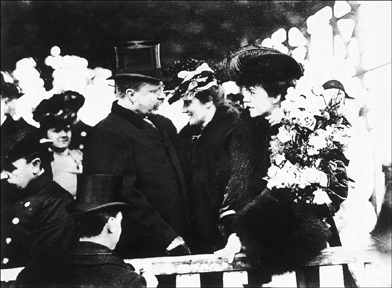
“ROOSEVELT … TOLD THE DISAPPOINTED GIRL
SHE WOULD HAVE TO STAY HOME.”
Father and daughter at the launching of the Kaiser’s yacht, 25 February 1902
He regretted the impulse when a British newspaper counseled that Alice be treated as “the oldest daughter of an Emperor.” A Washington scandal sheet began to make arch references to “the Crown Prin—beg pardon—daughter of the President.” Roosevelt was annoyed by these intimations of antirepublicanism, and told the disappointed girl she would have to stay home.
In the meantime, he basked in popular praise. Previous Presidents had sued the trusts with various success, but none had done so voluntarily, and with such virile force. He had acted, on grounds few lawyers considered valid, at the height of the greatest merger movement in history.
For these reasons, his old friend Owen Wister placed the Northern Securities suit “at the top of all Roosevelt’s great and courageous strokes in the domain of domestic statesmanship.” Whether fated for good or ill, it had excited public optimism at the very moment that public pessimism saw no end to the tyranny of wealth. “I think that to make up his mind to take this first step, to declare this war, on the captains of industry, was a stroke of genius; and I more than think—I know—that it marked the turn of a rising tide.”