

It looks to me as if this counthry was
goin’ to th’ divil.
“CHAOS! EVERYWHERE!” Henry Watterson exulted on 13 March 1902. The veteran Democratic pundit was visiting Washington to scout out future opportunities for his party. “For the first time these thirty years,” he reported, “it is the Republicans who are at sea.”
Rival hands were tugging at the wheel of the ship of state. One pair belonged to President Roosevelt, who was responsible for last month’s violent tack to port; the other to Senator Hanna, who wanted to resume the course set by President McKinley. “Both compass and rudder are still intact,” wrote Watterson, enjoying his metaphor. “But there are two pilots aboard, and rocks ahead.”
On the very day these remarks were published in The Washington Post, the Washington Times printed a front-page, foot-high photograph of Hanna, captioned THE MAN OF THE HOUR. Since the caption was very large, and the copyright date 1901 very small, readers were persuaded that the Senator was his old self again. Massive, placid, benign, he loomed from the page, dwarfing the masthead. Gone—or at least refined by studio lighting—was his former porcine flabbiness. Here was Statesmanship, glowing on the fine brow and in the magnificent eyes; here was Solidity and Sound Money.
Hanna’s presidential stock had been rising on Wall Street since the Northern Securities suit. Bankers and industrialists took his candidacy in 1904 for granted. So did Old Guard politicians in Washington. They estimated that he already had enough delegates to be nominated on the first ballot. His mail was thick with appeals for him to declare, and not all were typed on corporate stationery. “While we admire the presidint Theodore Roosevelt,” one correspondent scrawled, “there are such things as being to strenuous, what we wan is a man of the people.”
Hanna dismissed the campaign talk as “amusing,” but did not discourage it. His backers, led by Senator Nathan B. Scott and other probusiness members of the Republican National Committee, were serious. Laugh as he might—“that smile would grease a wagon,” a henchman said—he had to be impressed when five hundred members of the Society of Ohio rose in his honor, waving starched napkins and hailing him as “the next President of the United States.”
Deep in his soul, Hanna did not want the job. He was sixty-four and ailing. Every ascent of the Capitol steps in the March wind worsened his bursitis and packed more calcium around his knees. Grief for McKinley still tormented him, as did remorse over their occasional quarrels. He was prone to periods of melancholy, lasting weeks at a time; during these fits, he could not recognize his own son in the street. As for ambition, he had only to watch Roosevelt lustily working the crowd at White House receptions to realize that his senatorial seat suited him much better than the Presidency.
That chair, which he filled so amply it seemed a polished, creaking part of him, emanated prestige rather than power. Hanna had been in the Senate only five years, and was thus junior to more than half of his colleagues. Senator Spooner made more brilliant speeches in a week than Hanna had in his whole career. He could never hope to match the parliamentary skills of an Aldrich or an Allison. Henry Cabot Lodge’s orations sounded like Greek to him, and indeed some phrases were.
Yet Hanna’s web of influence stretched in so many directions—to the grass roots of party politics, to labor unions and trade associations and countless loyal offices in the civil service—that the Senate leaders granted him extraordinary privileges. They could hardly slight a man whom four out of five voters (according to a recent poll) believed to be “the greatest living American.” It was understood that “Uncle Mark” called upon nobody, except the President of the United States. He received callers in the Capitol’s vice-presidential suite. When he rose to speak on one of the issues he had made his own—shipping subsidies, labor relations, immigration reform—the Senate always filled, and he was listened to with a hush that sounded louder than applause.
Such eminence, plus a fat portfolio and a box of honor in Cleveland’s Hanna Theater, were all that he asked from life. But he must soon campaign for re-election. Clearly, presidential rumors would be to his advantage in rallying the Ohio Republican Party; he should not deny them too vehemently. His disclaimer, when it came, was mild: “I am not in any sense a candidate, and trust my friends will discourage any movement looking toward that end.”
The newspapers published this statement in small print, while they headlined a more immediate threat to Roosevelt’s authority.

AFTER THREE MONTHS, Nelson A. Miles still bore on his cheek the angry red of reprimand. He wanted revenge on the President and the Secretary of War. Thanks to continued access to War Department materials, he thought he now had a lethal weapon: secret reports of atrocities perpetrated by American forces against the insurrectos in the Philippines. Here was an issue which could embarrass Roosevelt and Root, rally all anti-imperialists, and make a political hero of himself. Miles took care, however, not to raise the issue in such a way as to risk further charges of insubordination. As a preliminary move, he granted an interview to Henry Watterson.
The Commanding General, Watterson reported, had been refused permission to visit the Philippines, where he wanted to conduct an inquiry into the insurrection, now more than three years old. Watterson did not state what, exactly, Miles supposed the inquiry might reveal. But he implied that dark truths were being suppressed, to Roosevelt’s likely political cost. “As events are lining up in Congress, the paramount issue, the issue of issues, in 1904 will be the Philippines.”
The White House remained silent as amplifications of the story spread nationwide on 17 March. Then a furious denunciation of Miles appeared in the Boston Herald. Nobody familiar with Rooseveltian invective could doubt who was the “very highest possible authority” cited:
General Miles’s most recent effort to recall himself to public attention … is so palpably an effort in his own behalf that the mere statement of it ought to suffice to convince the country of his insincerity.… His whole effort is to discredit the Administration. He is becoming daily more and more of an intriguer, and therefore more and more useless as the head of the Army.… There is absolutely no truth in the statement that the President and Secretary Root fear General Miles, or are personally uneasy because of anything he may do.
Not content with this, Roosevelt dictated an open letter to Miles, full of recriminations. “I do not like the clear implication … that brutalities have been committed by our troops in the Philippines.” He admitted that there had been “sporadic cases” of violence against prisoners. But these were inevitable in war, as the general must surely remember from the days when he was tracking Geronimo. “In the Wounded Knee fight the troops under your command killed squaws and children as well as unarmed Indians.”
The letter was deemed too confrontational to send, let alone publish, so he unbosomed himself in a series of memoranda to Elihu Root. He wanted the record to show that Miles had once approached him in an “utterly fatuous” attempt to run against William McKinley. “To my mind his actions can bear only the construction that his desire is purely to gratify his selfish ambition, his vanity, or his spite.”
The memos were classified Confidential, Private, and Personal. Root filed them, knowing such strictures, in Roosevelt’s parlance, usually meant “Hold for Publication.” He had hardly done so, indeed, before Congress asked for documents relating to Miles’s insinuations, and the President sanctioned their release.
Root wrote separately to Henry Cabot Lodge, whose Senate Committee on the Philippines was considering a transition from military to civil government in the archipelago. He acknowledged forty-four cases of documented cruelty, of which thirty-nine had already resulted in convictions under the military justice system. Aside from these isolated lapses, “the war in the Philippines has been conducted by the American army … with self-restraint, and with humanity, never surpassed, if ever equaled, in any conflict.”
Root’s words masked embarrassment, for he knew that Miles had gotten hold of a secret report that indicated otherwise. It came from the military governor of Tayabas, Major Cornelius Gardener, and described how the barrios of that once-peaceful province had been brutalized by American soldiers. Gardener spoke of “deep hatred toward us,” and, more disturbingly, of reciprocal prejudice against the Filipinos: “Almost without exception, soldiers, and also many officers, refer to the natives in their presence as ‘niggers’, and the natives are beginning to understand what ‘nigger’ means.”
So damning was the Gardener Report that Governor William Howard Taft had suppressed it for seven weeks, on the hopeful ground that it might be “biassed.” Root was guilty of delay himself, having sent his copy back to Manila, by slow sea mail, for “verification.” He had done so, however, for sensibly strategic reasons. The insurrection was in fact almost over, and a final surrender by holdout guerrillas was expected within weeks. The honor of American arms, of Republican foreign policy, demanded a clean, decisive victory.
GENERAL MILES MOVED adroitly during the next few weeks. He made no attempt to leak the Gardener Report, beyond letting Democrats in Congress know it existed. They began to press for its publication. Meanwhile, he set about sabotaging another aspect of Administration policy. Tall and dignified in his coruscating uniform, he dominated the Senate Committee on Military Affairs hearings on the Army Bill.
This measure, the most profound review of American military organization in more than a century, was the fruit of several years’ hard labor by Elihu Root. It sought to make line and staff officers interchangeable, to promote by merit rather than seniority, and to create a general staff answerable to the Secretary of War. More to the point, it also sought to abolish the system whereby Root administered, and Miles commanded, the Army on a coequal basis. Root wanted a vertical structure that sent power down from himself to a Chief of Staff. The office of Commanding General would therefore be abolished. Root counted on the approval of the American people, in view of their “ingrained tendency … to insist upon civilian control of the military arm.”
Miles reminded the Senate Committee that the American people also had a prejudice against authoritarianism. He glittered to great effect while portraying Roosevelt and Root as executive upstarts who wished to create a monarcho-militarist court, like that of the Kaiser in Germany. The concept of a general staff was “utterly subversive to the interests of the military establishment.” Miles hitched back his epaulets and declared in martyred tones that he would rather resign than submit to “despotism” from the White House.
Senator Joseph Hawley, the chairman of the committee, was himself a retired major general. He praised Miles’s testimony as “unanswerable,” and allowed that the Army Bill, as presently drafted, would receive no further consideration. GENERAL MILES WINS, The Washington Post blazed, while Watterson congratulated the American people on escaping “an Act to make the President of the United States a military dictator.”
Root’s expressionless calm in the face of this defeat boded ill for Miles. Few doubted that the Commanding General would be dismissed for insubordination. Yet day after day went by with no action by the White House. March gave way to April. Miles and Root continued to work in their opposing suites in the War Department, striding past each other in contemptuous silence.
Roosevelt was struggling with contrary impulses of rage and caution. Miles was “a perfect curse,” but his huge popularity both inside and outside Congress could not be ignored. To dismiss him now might sabotage the Army Bill forever, and set Miles up as a sentimental favorite for the Democratic presidential nomination.
Perhaps, after all, he should be allowed to visit the Philippines. The thought of Miles having to endure a forty-nine-day ocean voyage was pleasing, and with luck his visit would coincide with the mosquito season. But what atrocities might he uncover there, to the detriment of Roosevelt’s own candidacy in 1904? “It is getting to be a case,” the President complained, “of whether I can longer permit great damage to the Army for the sake of avoiding trouble to myself.”
LODGE’S COMMITTEE ON the Philippines reluctantly published the Gardener Report on 11 April. It caused instant national outrage. Two days later, the Anti-Imperialist League released the even more shocking confession of a Major C. M. Waller, on trial for genocide in Samar:
|
Q |
Had you any orders from General [Jacob H.] Smith to kill and burn? If so, state all that he said. |
|
A |
“I wish you to kill and burn. The more you kill and the more you burn, the better you will please me.” Not once only, but several times … |
|
Q |
Did you ever ask General Smith whom he wished you to kill? |
|
A |
Yes. He said he wanted all persons killed who were capable of bearing arms, and I asked if he would define the age limit. |
|
Q |
What did General Smith say? |
|
A |
“Ten years.” |
Waller also quoted a written order from the general: “The interior of Samar must be made a howling wilderness.”
No sooner had the phrases kill and burn and howling wilderness registered on the American conscience than a third, water cure, came out of the Committee hearings. Witness after witness testified to widespread use by American soldiers of this traditional torture, developed by Spanish priests as a means of instilling reverence for the Holy Ghost:
A man is thrown down on his back and three or four men sit on his arms and legs and hold him down and either a gun barrel or a rifle barrel or a carbine barrel or a stick as big as a belaying pin … is simply thrust into his jaws … and then water is poured onto his face, down his throat and nose … until the man gives some sign of giving in or becomes unconscious.… His suffering must be that of a man who is drowning, but who cannot drown.
Other reports spoke of natives being flogged, toasted, strung up by their thumbs, and tattoed “facially” for identification.
Amid mounting cries of revulsion, the President swung into action. He met with his Cabinet on 15 April, and demanded a full briefing on the Philippine situation. Root said defensively that one officer accused of water torture had been ordered to report for trial. Roosevelt was not satisfied. His entire insular policy was in danger, not to mention his reputation for decent governance. He directed Root to flash a cable to Major General Adna Chaffee, Commander of the Philippines Army:
THE PRESIDENT DESIRES TO KNOW IN THE FULLEST AND MOST CIRCUMSTANTIAL MANNER ALL THE FACTS.… FOR THE VERY REASON THAT THE PRESIDENT INTENDS TO BACK UP THE ARMY IN THE HEARTIEST FASHION IN EVERY LAWFUL AND LEGITIMATE METHOD OF DOING ITS WORK, HE ALSO INTENDS TO SEE THAT THE MOST VIGOROUS CARE IS EXERCISED TO DETECT AND PREVENT ANY CRUELTY OR BRUTALITY, AND THAT MEN WHO ARE GUILTY THEREOF ARE PUNISHED. GREAT AS THE PROVOCATION HAS BEEN IN DEALING WITH FOES WHO HABITUALLY RESORT TO TREACHERY MURDER AND TORTURE AGAINST OUR MEN, NOTHING CAN JUSTIFY OR WILL BE HELD TO JUSTIFY THE USE OF TORTURE OR INHUMAN CONDUCT OF ANY KIND ON THE PART OF THE AMERICAN ARMY.
Roosevelt also ordered the court-martial of General Smith, “under conditions which will give me the right of review.” These gestures, which coincided with the surrender of Miguel Malvar, the last uncaptured Filipino guerrilla leader, relieved pressure on the White House, if not the War Department. Tired and depressed, the Secretary sailed for a working vacation in Cuba.
CALLS FOR ROOT’S resignation followed him across the water. When General Smith admitted, on 25 April, to having authorized the slaughter of Filipino boys, even loyal Republicans were revolted. “It is almost incredible,” the Philadelphia Press commented, “that an American officer of any rank could have issued an order so shameful, inhuman, and barbarous.” Root was accused of a cover-up, or at least a reluctance to prosecute Army cruelty. “If we are to ‘benevolently assimilate’ Filipinos by such methods,” remarked the New Orleans Times-Democrat, “we should frankly so state, and drop our canting hypocrisy about having to wage war on these people for their own betterment.”
Roosevelt again made no effort to help his beleaguered Secretary. Relations between them had been strained since the Northern Securities suit. Root’s mood was not improved by his awareness that the President had known at least “the essence” of General Smith’s murderous policies for four months. Their tacit understanding had been that commanders such as Smith should be allowed to end the war quickly, with not too many questions asked.
Like all conservatives, Root disliked being called a reactionary. He sought to build policy on “good and essential” truths, historically tested. One such truth was that democracy had not succeeded in Asia—except, after a fashion, among the sophisticated Japanese. Most Filipinos were “but little advanced from pure savagery.” For every case of water torture the anti-imperialists might name, he could cite instances where American boys had been mutilated and burned alive—sometimes after honoring a white flag. One could no more trust than treat with the insurrectos; they were “Chinese” in their obtuseness. Miguel Malvar’s surrender document stated that all his people wanted was “independence under a protectorate.” This pathetic desire to be both liberated and looked after suggested that Kipling had been right about the White Man’s Burden. America had a moral duty toward her “new-caught sullen peoples, half-devil and half-child.” They had been taught the harsh discipline of war, and must now adapt to the milder discipline of civil government.
In formulating his attitude toward Filipinos, Root relied on the dispatches of William Howard Taft. The Governor was a convert to the “moral mandate” philosophy. When first sent to the archipelago in 1900, he had been an anti-imperialist. Massive, patient, capable, radiating goodwill, he had both charmed and reassured the enemy, whom he embraced collectively as “our little brown brother.” American soldiers in the field sang over their campfires:
He may be a brother of Big Bill Taft,
But he ain’t no brother of mine.
Taft had succeeded so well in the Philippines, as diplomat and executive, that his conversion to imperialism passed almost unnoticed. Only recipients of his classified dispatches understood how deeply he despised the people he governed.
Filipinos, Taft wrote, were “the greatest liars it has ever been my fortune to meet.” The educated minority were “ambitious as Satan and quite as unscrupulous.” The rest—some six and a half million peasants and jungle tribesmen—were inferior to “the most ignorant negro,” and “utterly unfit” for self-government. “They need the training of fifty or a hundred years before they shall even realize what Anglo-Saxon liberty is.”
These sentiments, while not uncommon, had force coming from a man widely believed to be of presidential caliber. Root chose not to reveal that it had been Taft who had initially delayed the Gardener Report. Silent, stern, and loyal, he expressed no chagrin over Roosevelt’s lack of sympathy. Solace was available in the form of a historic task in Havana. Under soothing fans in the Palacio del Gobernador, Root negotiated the final details of Cuban independence.
THE PRESIDENT REMAINED oddly optimistic, although he had more reasons than Root to be gloomy. For the first time since his accession to power, he began to feel real opposition building up against him in Congress. Republican conservatives in the House had reacted contemptuously to an Administration measure aimed at giving Cuba tariff reciprocity as a present for independence. Democratic senators were using Root’s refusal to resign as an excuse to block passage of the Philippines civil-government bill. And on Wall Street, rumors that Attorney General Knox was going to proceed against the “Beef Trust” had strengthened corporate longings for a President Hanna.
“Theodore is a total, abject, hopeless failure,” Henry Adams reported with satisfaction. “He was always what we, in the language of praise, called a damn fool, and he has become a damn nuisance.… At this rate, he will bring the government to a standstill in a year.”
If so, the members of his Cabinet did not seem too worried. On 24 April they invited him to join them on a stag cruise in celebration of John D. Long’s retirement as Secretary of the Navy. Long himself acted as host aboard USS Dolphin.
The little white yacht glided down the Potomac on the evening breeze. She gave off sounds of band music, while a huge, air-filled dolphin swung at her masthead. When the boat returned after dinner, Long’s guests were seen standing on deck in white ties and tails, drinking brandy and coffee, under strings of colored lights. A Navy fiddler began to play bluegrass tunes. The President seized Philander Knox and began to dance. John Hay, tiny, dapper, and white-bearded, launched into a sedate two-step, while Leslie Shaw and Henry Payne “shook down” with Midwestern skill. At the climax of the reel, James Wilson, an awkward six foot three, disgraced the Department of Agriculture by falling down. Roosevelt’s high-pitched laughter could be heard across the water. “Get up, you old cornstalk!”
His good cheer may have been helped by an awareness that the Fifty-seventh Congress was dying, while his Administration was becoming stronger and more Rooseveltian. The appointments of Shaw as Treasury Secretary and Clay Payne as Postmaster General had been political rather than ideological. Long’s retirement (which he had accepted “with regret” but alacrity) gave him the opportunity to hire Representative William Henry Moody of Massachusetts, a forty-eight-year-old expansionist and “big navy man,” who could be relied on to keep the flag flying over the Philippines.
SPRING CAME TO the capital in an efflorescence of azaleas, dogwood, and magnolia, affecting even the dyspeptic Adams with a sense of rising sap and “restless maternity.” Newlywed couples strolled the Mall—Washington now outranked Niagara as a sexual shrine—holding hands and asking directions in a rich variety of accents. The air grew daily warmer. Mockingbirds began to sing on the White House grounds. Roosevelt and his wife took to sitting on the South Portico, talking of the things that had linked them since childhood: flowers, poetry, the tales of Uncle Remus. They breathed the scents of the garden, and watched the moon whitening the Washington Monument.
An especial closeness linked them this season, because Edith felt maternal pangs stirring within her. The President boasted to complete strangers that he expected “a most important event in his household,” come October.
ELIHU ROOT RETURNED from Cuba to find a virulent pamphlet making the rounds, entitled “Secretary Root’s Record: Marked Severities in Philippine Warfare.” Published by the Anti-Imperialist League, it was more spiteful than accurate, and Roosevelt decided that the time had come for a counteroffensive. He summoned Henry Cabot Lodge and asked him to defend Root on the floor of the Senate.
When Lodge rose to do so on 5 May, every seat in the chamber was taken. He began by admitting “with deep regret” that a number of American soldiers had tortured and killed Filipino guerrillas. No effort would be spared to bring the guilty to judgment. “But why,” he asked rhetorically, “did these things happen?”
He began to read an official catalog of horrors that soon had his audience wincing. Some American prisoners of war had had their eyes slashed, their ears cut off, and their bowels hacked out. Others had been slow-roasted, dismembered with axes, buried alive, and stoned to death. Drowning men had been used for target practice. Medics had been knifed in the back as they tended the wounded. Lodge could not bring himself to report publicly, as he did in private, that some captives had been castrated and gagged with their own testicles. “Perhaps,” he drawled in his dry voice, “the action of the American soldier is not altogether without provocation.”
Over the next few days, a barrage of pro-Administration statements, interviews, and editorials appeared in the Republican press. Reasonable voices were heard suggesting that the Army should be allowed to complete its current investigations, notably that of General Smith, before Elihu Root was held to further account. Groaningly, the big Philippines civil-government bill began to move toward passage. It promised a legislative assembly, an independent judiciary, and an expanding array of civil rights. Senate Republicans closed ranks behind it.
Only George F. Hoar of Massachusetts—stately, white-haired, Ciceronian—joined the Democratic opposition in calling for a declaration of total independence for the Filipinos. His eloquence was such that Roosevelt interrupted a Sunday walk to pluck at his toga. “I sympathize with—I sympathize with you,” the President said, stuttering in his earnestness. “I agree with you entirely, but how can I make any declaration just now? You respect Governor Taft? Don’t you?”
Hoar evaded the question, but, like Senator Hanna, could not help being beguiled by the questioner. “Everybody that knows President Roosevelt knows his sincerity,” he wrote the veteran anti-imperialist Carl Schurz.
ROOSEVELT’S DESIRE TO hold on to the Philippines, for strategic and idealistic reasons, did not affect his corresponding urge to let go of Cuba, the independence of which he and the Rough Riders had fought for in 1898. What better time to do so than now—and who more fitting to represent him at the transition ceremony than his old comrade, the military governor of the island, Brigadier General Leonard Wood?
A few seconds before noon on 20 May 1902, Wood clicked to attention in Havana’s Palacio del Gobernador, before an audience of local dignitaries. “Sirs,” he read, “under the direction of the President of the United States I now transfer to you as the duly elected representatives of the people of Cuba the government and control of the island—”
On the roof of the palace, Lieutenant Frank McCoy prepared for flagstaff duty. The Stars and Stripes hung above him, its folds barely heaving. Below, in the Plaza de Armas, a dense crowd sweated with anticipation. Thousands more Cubans jammed the adjoining streets and every balcony, turret, and tree with a view. Even the harbor swarmed. Boats heavy with spectators jostled at anchor, under a shimmer of bunting.
“—and I hereby declare the occupation of Cuba by the United States and by the military government of the island to be ended.” Wood saluted President Tomás Estrada Palma and handed over the documents of transfer.
From far across town, the Cayabas cannons boomed. Lieutenant McCoy remained at attention. He had to count forty-five concatenations, one for every state of the Union, before he hauled down a flag that he would have preferred to keep flying. Both he and General Wood felt they were abandoning a “saved” people to perdition.
By any standards, Wood’s two-and-a-half-year governorship had been a spectacular success. A trained surgeon, he had transformed Cuba from one of the world’s most pestilential countries into one of its healthiest. He had achieved the “miracle” of eliminatingStegomyia fasciata. As a result, Cuba was free of yellow fever for the first time in almost two centuries. The miracle had not happened gently. Doors barred against Wood’s sanitation teams had been smashed open, hidalgos forced to pick up their own litter, and public defecators horsewhipped at the scene of the crime. Buildings in Havana and Santiago de Cuba had been purged with disinfectant so strong that “even insects came out of the ground to die.” But, thanks to this draconian treatment, Havana was now a more sanitary city than Washington, D.C.
The cannons continued to thud as the crowd grew restless. Cubans had mixed feelings about what was happening. The old “Cuba-Libre” coalition—intellectuals, radicals, and peasants—welcomed the departure of the yanquis. Yet what Wood called the island’s “better class”—businessmen, teachers, merchants, plantation owners—regretted the hasty withdrawal of funds and social services. Wood, after all, had built three thousand new schools. He had paved Havana’s dirt streets, and transformed its parks from dangerous jungles into safe gardens. He had catacombed the city with new sewer systems, water mains, and conduits for power and communications. He had even protected the Cuban economy from exploitation by American entrepreneurs.
What protection, the “better class” wanted to know, could President Palma guarantee? Who would teach in the new schools, and out of what textbooks? Who would buy the sugar sacks already crowding every warehouse?
The forty-fifth cannon blast sounded. Lieutenant McCoy stepped to the flagstaff and undid the halyards. Old Glory seemed reluctant to descend. It sank a few feet, then the cords snagged, and it briefly rose.
There were groans and catcalls in the plaza. McCoy pulled till the cloth tumbled about him. To thunderous cheers, General José Miguel Gomez, hero of the war against Spain, appeared on the roof to hoist the colors of Cuba Libre. But the cords snagged again, and Gomez asked for a lighter flag. It fluttered aloft amid screams, tears, and ragged blasts of artillery.
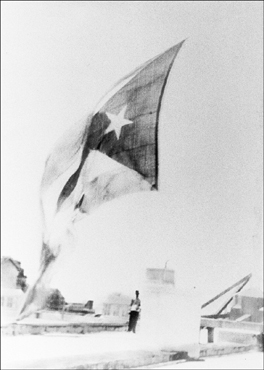
“IT FLUTTERED ALOFT AMID SCREAMS, TEARS, AND
RAGGED BLASTS OF ARTILLERY.”
Independent Cuba raises her flag, 20 May 1902
As soon as protocol permitted, General Wood bade President Estrada Palma farewell. He drove down to the harbor, escorted by troopers of the Seventh Cavalry, and boarded the USS Brooklyn. The white cruiser weighed anchor at four o’clock. A hundred thousand pairs of eyes watched it steam north past the wreck of the Maine, upon which some grateful islander had tossed a chain of flowers.