

What’s all this about Cubia an’ th’ Ph’lipeens?
What’s beet sugar?
THEODORE ROOSEVELT’S TOTAL lack of inhibition—some said, of decorum—was much discussed at Washington dinner tables in the spring of 1902. Whether exercising, working, or pricking the bubbles of solemnity around him, he seemed unconcerned by his growing reputation as “the strangest creature the White House ever held.”
On 28 May, he was seen hanging from a cable over the Potomac, presumably in some effort to toughen his wrists. Owen Wister caught him walking behind John Hay on tiptoe, bowing like an obsequious Oriental. This might or might not have been connected with the fact that Roosevelt was currently studying jujitsu. White House groundsmen, unaware that he was a published ornithologist, were puzzled by his habit of standing under trees, motionless, for long periods of time. Hikers in Rock Creek Park learned to take cover when he galloped by, revolver in hand; he had a habit of “popping” shortsightedly at twigs and stumps with live ammunition.
Petitioners visiting the Executive Office learned to keep talking, because the President usually had an open book on his desk, and was quite capable of snatching it up when the conversation flagged. One day, the French Ambassador, Jules Cambon, found Roosevelt supine on the sofa, kicking his heels in the air. Cambon invited him to attend the dedication of an American monument to Comte de Rochambeau, whereupon Roosevelt, still kicking, yelled, “All right! Alice and I will go! Alice and I are toughs!”
On another occasion he appeared in George Cortelyou’s antechamber and jumped clean over a chair. He encouraged his big horse, Bleistein, to similar arts of levitation at the Chevy Chase Club. Photographs of them airborne together soon appeared in theWashington Times. Roosevelt was delighted—“Best pictures I’ve ever had taken!”—and passed out autographed copies to his Cabinet.

“THEODORE ROOSEVELT’S TOTAL LACK OF INHIBITION …
WAS MUCH DISCUSSED AT WASHINGTON DINNER TABLES.”
Graduation ceremony at United States Naval Academy, 1902
Hay, who as Secretary of State stood next in line to succeed Roosevelt, pretended to be annoyed at Bleistein’s easy clearance of the rails. “Nothing ever happens,” he complained.

ROOSEVELT MIGHT HAVE said the same about the Fifty-seventh Congress. Only one of the requests in his First Annual Message had been enacted: the establishment of a permanent Census Bureau. Senators Aldrich and Allison were maddeningly vague about what remained on the calendar. The President despaired of being able to affect them with any sense of social urgency. Friends took the brunt of his impatience. “Get action; do things; be sane,” he snapped at a former Rough Rider. “Don’t fritter away your time.… Be somebody; get action.”
Behind the harsh ejaculations lay anger at his failure to “get action” himself—in particular the Philippines civil-government bill, which he needed to show that the Administration’s colonial policy in the Far East was as enlightened as it had been in the Caribbean. It galled him that Senator Hoar was still calling for Philippine independence, in tones of majestic condemnation:
You have wasted six hundred millions of treasure. You have sacrificed nearly ten thousand American lives—the flower of our youth. You have devastated provinces. You have slain uncounted thousands of the people you desire to benefit.… I believe—nay, I know—that in general our officers are humane. But in some cases they have carried on your warfare with a mixture of American ingenuity and Castilian cruelty.
Hoar was addressing himself to Republican imperialists generally, but the words you and your sounded uncomfortably specific, as far as Roosevelt was concerned.
At Arlington National Cemetery, on Memorial Day, the President came to the defense of his Philippines policy. “Oh my comrades,” he cried at grizzled ranks of Civil War veterans, “the men in the uniform of the United States who have for the last three years patiently and uncomplainingly championed the American cause in the Philippine Islands, are your younger brothers, your sons.” They were fighting to impose “orderly freedom” upon a fragmented nation, according to rules of “just severity” sanctioned by Abraham Lincoln. On Mindanao as at Gettysburg, “military power is used to secure peace, in order that it may itself be supplanted by the civil power.”
Roosevelt reminded his audience that legislation to that effect was now before Congress. There was scattered applause. “We believe that we can rapidly teach the people of the Philippine Islands … how to make good use of their freedom.”
The year’s first hot sun beat down on bald heads and bright medals. A breeze came off the Potomac, stirring hundreds of flags up the hill, and swaying the oaks over Roosevelt’s head. Invisible choirs of seventeen-year cicadas buzzed in counterpoint to his voice. Perhaps Filipinos would govern themselves the next time locusts sang at Arlington. Perhaps not. “When that day will come,” Roosevelt shouted, “it is not in human wisdom to foretell.”
For the time being, America’s global interests mandated a continuing presence in Manila. “The shadow of our destiny …”
He had been working on his speech for weeks, in an attempt to make it the first great oration of his Presidency. But another shadow darkened his face, and he improvised a sudden, disastrous apologia for the recent military scandals:
Is it only in the army in the Philippines that Americans sometimes commit deeds that cause all other Americans to regret? No! From time to time there occur in our country, to the deep and lasting shame of our people, lynchings carried on under circumstances of inhuman cruelty and barbarity—cruelty infinitely worse than any that has ever been committed by our troops in the Philippines—worse to the victims, and far more brutalizing to those guilty of it.
Had he spat upon the porch of the Custis-Lee Mansion, he could not have more effectively unified Democratic opposition to the Philippines bill. The ugly word lynchings, which he had so far avoided using in public, sounded deliberately provocative. “I do not think the South will care much for Mr. Roosevelt after this,” said an outraged Dixie Senator. “He is dead so far as my section is concerned.”
Sure enough, when the bill came up for vote on 3 June, the Senate divided along party lines. The Republican majority prevailed (Senator Hoar alone dissenting), but Roosevelt took no credit for the vote. Neither could he console himself with Northern reaction to his outburst: even the New York newspapers called it “indiscreet,” “unfortunate,” and “in extremely bad taste.” Bruised and rueful, he hoped for passage of his Cuban reciprocity bill, as a sign that Congress was not totally hostile toward him.
ANOTHER MEASURE, HOWEVER, had precedence in the legislative logjam. On Wednesday, 4 June, Senator Morgan called for the reading of House Resolution 3110, “To provide for the construction of a canal connecting the waters of the Atlantic and Pacific Oceans.” Despite January’s Canal Commission turnaround on Panama, Morgan was confident that the Nicaragua route would prevail. His own Committee on Interoceanic Canals had reported in favor of it, seven to four. Parliamentary rules required a reading of Senator Spooner’s half-forgotten amendment to the resolution:
Be it enacted & c. That the President of the United States is hereby authorized to acquire, for and on behalf of the United States, at a cost not exceeding $40,000,000, the rights, concessions, grants of lands [etc.] owned by the New Panama Canal Company, of France.… The President is hereby authorized to acquire … a strip of land, the territory of the Republic of Colombia, ten miles in width, extending from the Caribbean Sea to the Pacific Ocean … and to excavate, construct, and to perpetually maintain, operate and protect thereon, a canal, of such depth and capacity as will afford convenient passage of ships of the greatest tonnage and draft now in use.
Morgan laid down his copy of the amendment with an old man’s tremor, and made his final, weary plea for the Nicaragua route. He had no new technological arguments to present. Instead, he spent half an hour condemning Panama as a cesspool of racial and political squalor. He expressed Alabaman disgust for its “low grade” population. Panamanians were not only unclean, but unstable: they lived—always had lived—in “a chronic state of insurrection and violence” against the authority of Bogotá.
Senator Hanna sat listening, the stillest man in the room. Morgan pointed out that the Treaty of New Granada (1846) actually obligated the United States to hold Colombia together, in exchange for railroad rights across the Isthmus. A commitment was a commitment.
Storming on, the withered little Senator waxed prophetic. Should Washington show the least inclination to ignore the treaty, “There is no doubt that Panama would eagerly seek protection under the folds of the flag of the United States.” And should an American President be so rash as to extend that flag, “It would poison the minds of the people against us in every Spanish-American republic in the Western Hemisphere.”
As soon as Morgan sat down, Hanna was on his feet. “Mr. President, I desire to give notice that I will address the Senate tomorrow at two o’clock on the pending bill.”
WHEN SENATORS RECONVENED on 5 June, they were surprised to find the chamber festooned with maps and diagrams. One twenty-foot projection, hanging from the visitors’ gallery, showed red and black dots splotching Central America. The dots represented volcanoes, active and extinct. Those in red were lined up mainly with Nicaragua. Panama was dot-free.
Hanna entered to a whirring of press telephones. Latecomers hurried to their seats as he sorted a mass of books and papers. He began to speak in his customary lackluster style. “Mr. President, the question of transportation is one of the important items of the day.”
The chamber settled down to being informed rather than entertained. Not for Hanna the old-fashioned eloquence of Senator Hoar. He deemed it irrelevant to a new, statistical century. Of his eighty-eight listeners, forty-one were for Nicaragua, thirty-five for Panama, and twelve undecided. Data, not dramatics, would get him the ten further votes he needed. “I was once,” he admitted, “in favor of the Nicaragua Canal.” But after two years of reflection, “I have been forced by stubborn facts and conditions to change my mind.”
For the next one and a half hours, Hanna funneled his “stubborn facts” like wheat into the Senate granary. Every dry grain had its kernel of persuasion. “The Panama route is forty-nine miles long, as against one hundred eighty-three miles of the Nicaragua.… Trade winds blow every day in the year from sixteen to twenty knots across the Nicaragua route.… The annual cost of operating the Nicaragua Canal is one million, three hundred and fifty thousand dollars, or, say one million, three hundred—”
“Oh, do make him sit down,” came a woman’s voice from the gallery. It was a cry of concern more than boredom: Hanna’s arthritis was visibly tormenting him. He said that he would conclude his speech the next day.
Polls in smoke-filled rooms that night indicated that the majority of senators favoring Nicaragua had already diminished. Cromwell and Philippe Bunau-Varilla lobbied like men possessed, while Senator Morgan’s lieutenants tried to fight attrition with scandal. They whispered that French shareholders of the Compagnie Nouvelle would not see a dime of the forty-million-dollar transfer fee, and that President Roosevelt, Secretary Hay, and Senator Spooner were the likely beneficiaries, along with Hanna, Cromwell, and Bunau-Varilla. Even “Princess Alice” was rumored to be in on the deal.
HANNA RESUMED HIS speech as soon as the Senate reopened for business on Friday, 6 June. Pointing to the splotched volcanic map, he said he wished to discuss “the burning question” of igneous activity in the Caribbean region. Just the previous month, Mont Pelée in Martinique had erupted, killing forty thousand people. Panama was “exempt” from this kind of danger. Not so Nicaragua, which lay along an almost continuously volcanic tract extending northwest from Costa Rica. Senator Morgan’s canal would cut straight across that tract—“probably the most violently eruptive of any in the Western Hemisphere.” Mount Momotombo, a hundred miles from the proposed route, had blown up only two months prior to Pelée. Had it done so with equal force, it would have precipitated “enough cinders and lava … to fill up the basin of Lake Managua.”
For another hour, Hanna cited alarming seismological, social, and navigational evidence against Nicaragua. Even as he spoke, Mont Pelée was erupting again. Reports of his speech in the evening newspapers jostled news of sky-darkening clouds and six-foot fluctuations of sea level.
AS LONG AS THE canal debate lasted, the President kept his own counsel. Two senators visited him with learned arguments for Nicaragua, and he listened to them solemnly, scribbling on a notepad. Had they been able to look over his shoulder, they would have seen that he was merely doodling the names of his children, over and over again.
MEANWHILE, HIS CUBAN reciprocity bill was being lobbied to death. The House of Representatives had authorized him to grant a 20 percent tariff reduction on all Cuban exports to the United States—with the exception of refined sugar, which could come in free. But this last, seemingly generous provision guaranteed opposition in the upper chamber. Senators beholden to the American refining industry—mainly Easterners, mainly Democrats—objected to foreign favoritism, while Senators from states that produced beet sugar—mainly Westerners, mainly Republicans—condemned the bill as antiprotectionist. “I wish,” Roosevelt sighed, “that Cuba grew steel and glass.”
Common sense suggested that he leave trade policy to such experts as Nelson Aldrich. But his always active conscience (“In this particular case of reciprocity a moral question is concerned”) plagued him. And morality aside, he believed that commercial sweets would reconcile Cubans to the sour taste of a United States garrison at Guantánamo.
On 13 June, Roosevelt took the bold step of sending Congress a “Special Message on Cuba.” He did so knowing that the Message could well fail, and advertise to the world that he had no power of presidential persuasion. It might even lead to a general tariff battle, a split party, and defeat for himself in 1904. His hope against hope was that the warring senators would be shamed into a compromise. “Cuba is a young republic,” he wrote, “still weak, who owes to us her birth, whose future, whose very life, must depend on our attitude toward her.”
Some senators detected a note of self-identification in this appeal, and guffawed as it was read aloud. Meanwhile, sugar-heavy freighters wallowed in the island’s ports, symbols of prosperity held in check.
ANOTHER CAUSE DEAR to Roosevelt’s heart—reclamation of the arid West—was preoccupying the House that same day. He did not want to have a second Special Message laughed at, so he wrote a passionate letter to the chairman of the House Appropriations Committee:
My dear Mr. Cannon: I do not believe that I have ever before written to an individual legislator in favor of an individual bill, but I break through my rule to ask you as earnestly as I can not to oppose the [National Reclamation Bill]. Believe me this is something of which I have made a careful study, and great and real though my deference is for your knowledge of legislation, and for your attitude in stopping expense, yet I feel from my acquaintance with the Far West that it would be a genuine and rankling injustice for the Republican party to kill this measure. I believe in it with all my heart from any standpoint.… Surely it is but simple justice for us to give the arid regions a measure of relief, the financial burden of which will be but trifling.… I cannot too strongly express my feeling upon this matter.
Faithfully yours,
THEODORE ROOSEVELT
Representative Joseph (“Not One Cent for Scenery”) Cannon was Congress’s leading anticonservationist. In Illinois, where he hailed from, well-watered corn thrust tall out of the nation’s richest soil. But the President spoke for a harsher, more remote West, where recent settlers struggled to fertilize the desert. He had tasted enough alkali dust as a young rancher in the Badlands to understand the desperation of stockmen unable to breed, farmers unable to reap or sow.
For a quarter of a century, environmental pioneers had urged the construction of vast irrigation systems to collect and distribute Western floodwaters. John Wesley Powell and WJ McGee noted that the arid lands thus reclaimed—one third of the total area of the United States—could be sold to farmers and ranchers, and the profits recycled for further reclamation. But Congress had responded with unenforceable public land laws, allowing a “water monopoly” to grow up in the West. This combination levied extortionate rates where supply was meager, and dried out established communities in order to irrigate speculative tracts elsewhere.
Roosevelt expressed “keen personal pride” in the reclamation measure. It seemed to him properly to combine federal responsibility with private enterprise, in that water rights would be sold, deposit-free and interest-free, to small farmers, who would eventually repay the government out of the profits from their irrigated property. Although it was offered in the appropriate name of Francis G. Newlands (D., Nevada), the President felt that it had grown out of the irrigation proposals of his First Annual Message, and he protested vehemently when Newlands claimed authorship.
Cannon ignored Roosevelt’s letter, but a majority of the House, responding to strong White House pressure, voted in favor of the bill. The Senate followed suit. On 17 June 1902, Roosevelt delightedly signed the National Reclamation Act into law. It funded a six-hundred-man civil-engineering force within the National Geological Survey, and conjured up, like some glittering grail of future prosperity, a vision of dams and aqueducts bejeweling the country’s unwatered tracts. “They must be built for permanence and safety,” the President urged, “for they are to last and spread prosperity for centuries.”
Reclamationists spoke almost drunkenly of supporting a new population of one hundred million, and creating such opportunities for American producers as to make the current economy seem like penury. Mark Hanna praised the act as Theodore Roosevelt’s first major legislative achievement, and said that its importance would grow with the years. “People have not paid much attention to this business.… It’s a damn big thing.”
DURING THE NEXT two days, the Senator, grumbling “he was two thirds crazy, he was so tired,” launched a final blitz for Panama votes. Bunau-Varilla conducted a simultaneous propaganda campaign, sending every Senator a Nicaraguan postage stamp showing the live cone of Momotombo. “An official witness,” he typed beneath, “of the volcanic activity of the Isthmus of Nicaragua.” Cromwell lobbied in his own secretive fashion. One by one, the ten votes Hanna needed slipped from the Nicaragua checklist. When it was clear that Panama would prevail, the slippage became an avalanche. The final tally, on 19 June, was 67 to 6 in favor of a Panama canal.
By a margin of 44 to 34, the Senate also approved the Spooner Amendment. Theodore Roosevelt, nine months President of the United States, was handed power to join the world’s largest oceans. Forty million dollars—the largest sum in real-estate history, dwarfing the Louisiana Purchase—was placed at his disposal, plus $130 million in construction funds. Exultant, he forecast that the Panama Canal would be “the great bit of work of my administration, and from the material and constructive standpoint one of the greatest bits of work that the twentieth century will see.”
ROOSEVELT’S EUPHORIA WAS short-lived, because two days later a delegation of Republican leaders informed him that his Special Message on Cuba had failed. Hearteningly, though, Senators Aldrich, Platt, Hanna, Spooner, and Foraker had all backed him up. But the party’s endemic inability to agree on tariff reciprocity had defeated even them. He had to take what comfort he could in widespread admiration for his goodwill toward Cuba and his “spectacular courage.” Even the New York Evening Post, not usually complimentary, had called him “a brave man and a real President.”
Somewhat cheered, Roosevelt left town on 24 June to accept an honorary degree from Harvard. Early next morning, the sun-tipped spires and elms of his alma mater appeared across the Charles. After a reunion breakfast in Back Bay with members of the Class of 1880, he crossed Harvard Bridge in a plush carriage. He relaxed comfortably against its cushions in his white waistcoat, a Porcellian Club button at his breast, squinting at the bright water. Then the familiar elms of Cambridge dappled his silk hat, and bugle calls and cheers heralded his approach to Harvard Yard. Here, twenty-five years before, he had nursed the first great sorrow of his life; twenty-four years before, wheezed asthmatic over Rhetoric and Comparative Anatomy; twenty-three years before, suffered agonies over a girl from Chestnut Hill. As long as I live, I shall never forget how sweetly she looked, and how prettily she greeted me.…
Grief; disease; desire. And now, even more privately, Edith’s failure to carry her latest baby to term. Only the most masculine activism could dispel these feminine frailties. Roosevelt burst from his carriage like a bear. At the welcoming ceremony in Massachusetts Hall, he stood erect and talkative, his big chest nudging the presidential robes of Charles William Eliot.
Outside in the Yard, the Class of 1902 was yelling for “Teddy.” Stimulated by the sound of cheers and press of flesh, Roosevelt began to radiate his famous electricity. He joined the Commencement procession. Deputy marshals Owen Wister and Woodbury Kane, ’82, followed him.
|
WISTER |
When we were in college, you didn’t used to like him much. How do you feel now? |
|
KANE |
If he and I were crossing the Brooklyn Bridge, and he ordered me to jump over, I’d do it without asking why. |
|
ROOSEVELT |
(calling) What are you fellows dangling behind for? Come alongside! |
|
WISTER |
(hurrying to catch up) Unconditional surrender? |
|
KANE |
Absolutely, old man. |
The President’s behavior after receiving his honorary LL.D. was so archetypal as to imprint itself on the eyes and ears of many observers. Dr. Eliot escorted him to a guest suite to change, and watched with fascination as he tore off his coat and vest and slammed a large pistol on the dresser. Eliot asked if it was his habit to carry firearms. “Yes, when I am going into public places.”
At the Alumni Banquet, Roosevelt spied Senator Hoar and plumped down beside him like an impulsive boy. He whispered a confession, saying it was his “dearest wish” to do what the Senator wanted in the Philippines.
Dr. Eliot began to speak, interrupting them. At the first mention of the word millions, so dear to university presidents, Roosevelt’s attention wandered. Finance meant no more to him than the music of Chopin. He suppressed a yawn, and swiveled in his seat, staring at pictures on the walls. When John D. Long introduced him with a joke about his inability to sit still in any position of power, Roosevelt shook from head to foot with laughter. Moments later, he was leaning over the high table at an angle of thirty degrees, his teeth still bared, but no longer in mirth.
John Hay, seated nearby, knew what was coming. Harvard, to Theodore, was a temple defiled by mugwumps, who congregated here to exchange the dull coins of anti-imperialism. Sure enough, Roosevelt launched into a stentorian defense of his island administrations, and of the public servants who sacrificed their careers to help “weaker friends … along the stony and difficult path of self-government.” Clapping his hands for emphasis, he bit three names out of the air: “Elihu Root … Will Taft … General Wood!” Root could be earning fabulous fees as a corporate lawyer in New York, Taft could be a Justice of the Supreme Court, and Wood, in a more mythologically inclined culture, would be celebrated as “a hero mixed up with a sun god” for the miracles he had performed in Cuba.
Hay, listening, sensed a thought in many old heads: He is so young, and will be with us for many a day to come. The President’s forehead wriggled, his pince-nez flashed, and his harsh voice skipped from baritone to squeak, as pent-up loyalties poured out. With a final lunge across the linen, he roared, “I can show my appreciation in no way save the wholly insufficient one of standing up for them and their works, and that I do!”
He dropped back to his seat, drenched with sweat, and got a standing ovation. Hay marveled at his power to transform a skeptical audience. Even Dr. Eliot was moved. “He has genius, force, originality.” Old Edward Everett Hale, who had attended more Commencements than any man present, babbled that the President had made “a speech to be remembered … for centuries.”
Roosevelt had to attend four more functions, and make three more speeches, before he could retire to his private car. Pale with exhaustion, he vomited and went straight to bed. He was asleep before the train left Boston.
WASHINGTON WAS SHUTTERING up for the summer when he got back. Edith and the children had left for Oyster Bay. Even the White House was barred to him, on account of extensive restoration and refurbishment by the architect Charles McKim. Carpenters were busy salvaging historic bits of floorboard, and plaster dust floated out of every window. It would not be habitable again until the fall.
He took up temporary residence a few doors away, at 22 Jackson Place, and signed a last-minute stack of bills, none of them his. Legislation, Roosevelt realized, was not his forte. Public leadership was. Invitations were flooding in for him to address audiences in New England in August, in the Midwest in September, in the far West whenever he cared to come. He accepted them indiscriminately, even a grotesque summons from Los Angeles, singed across the shoulders of a calfskin.
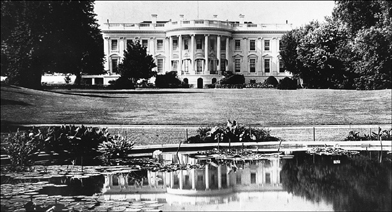
“THE CAPITAL DROWSED INTO ITS ANNUAL DOLDRUMS.”
Theodore Roosevelt’s White House in summer
Congress adjourned on the first day of July. The capital drowsed into its annual doldrums. Hardly a hoofbeat disturbed the shimmering pavements, and cicadas hummed in Lafayette Square. Roosevelt, dressed in white from head to foot, had one final, purgative duty to perform: a proclamation of amnesty in the Philippines. It had to be written around the fact that the Moros of Mindanao were not yet subjugated. They were fanatic Muslims, and could be conveniently differentiated from other Filipinos. Elsewhere, Pax Americana ruled throughout the archipelago. In a lame attempt to equate civil government with independence, Roosevelt postdated the declaration “July Fourth, 1902.”
Only then did he feel free to join his family on the shores of Long Island Sound.