
7
Gilad Ben-Nun
Scholars interested in the history of modern international law have been for quite some time puzzled by a fascinating conundrum of disproportionality. The crude over-representation of Eastern European Jewish international jurists in the drafting of the world’s most important international multilateral legal treaties has been perplexing scholars for nearly two decades. As Stefan Troebst has recently reiterated, modern international law’s very prosopography reads more like a mitteleuropäischer (Central European) geographical survey.1
A precursory (and by no means exhaustive) survey of the drafting history of these treaties reveals this disproportion of Jewish jurists. Leo Pasvolsky’s drafting of the United Nations (UN) Charter (1942–1945);2 Hersch Lauterpacht’s formulation of crimes against humanity in Nuremberg’s International Military Tribunal (1945–1956);3 Raphael Lemkin’s drafting of the Convention on the Prevention and Punishment of the Crime of Genocide (1948, hereinafter the Genocide Convention);4 René Cassin’s important role in the drafting of the Universal Declaration of Human Rights (1948) and the European Convention for Human Rights (1950), which later earned him the Nobel peace prize;5 George Cahen-Salvador, Rabbi Dr Georg Cohn, and Valeri Nissim Mevorah’s drafting of the 4th Geneva Convention relative to the Protection of Civilian Persons in Times of War (hereinafter the 4th Geneva Convention) and its Common Article 3 (1949),6 and Jacob Robinson, Paul Weis, and Rabbi Dr Isaac Lewin’s drafting of the Convention Relating to the Status of Refugees (hereinafter the Refugee Convention) and its non-refoulement principle (1951) and their elaboration of the Convention relating to the Status of Stateless Persons (1954, hereinafter the Convention on Statelessness) all fall into this category.7 To claim that Jewish international jurists played a meaningful role in the making of some of the world’s most important international legal treaties post-World War II would be an understatement.
Attempting to answer the conundrum inherent in this Jewish disproportionality, eminent scholars, such as Carole Fink, Mark Mazower, Philippe Sands, and others, have all provided some very convincing arguments why the Jewish participation was so significant in the making of modern international law. Grossly oversimplified here, their arguments stress the amalgamation of Jewish emancipation during the nineteenth century, which facilitated the entry of Jews into university law faculties, and the traumas of discrimination and persecution as a minority, which, in turn, triggered an enhanced Jewish will to “universally” defend ethno-national minorities per se, as in Fink’s words: “defending the rights of others”.8 To my mind, these explanations hold a fundamental core of ontological validity that is hard to dispute.
In a recent address, Lord David Neuberger, the outgoing president of the United Kingdom Supreme Court, stresses the contributions Jews have made to this court since World War II.9 His habitual quotation from religious Jewish and Talmudic sources and his reiteration of the fact that English liens (the predecessor to mortgage laws in today’s UK) derive from the Talmudic laws of contracts is no surprise to those acquainted with his biography.10 The disproportionate number of Jews who have sat on the UK’s highest judicial bench, with no less than eight Jewish judges serving on it between 1951 and today, seems to further confirm his point.11 While the general question as to why Jews excel in law and judicial instances is a perennial one, according to Lord Neuberger at least, this excellence has to do with a combination of specific and intertwined factors. These include a strong Jewish emphasis on education – which served as a partial answer to the disadvantages of persecution over the ages – coupled with a textual tradition of Talmudic debate on judicial and legal interpretation.12
Setting aside his other points, in this chapter I would like to briefly delve into Lord Neuberger’s postulation concerning the impact of Talmudic learning upon the biography and intellectual development of Jewish jurists. I opt to limit myself to the realm of modern international law and focus on what I see as an additional, plausible factor that might help to explain the rather disproportionate role played by East-Central European Jewish international jurists in the drafting of some of the international legal treaties mentioned above.
Following up on Lord Neuberger’s insight into the importance of the Talmudic tradition for Jewish excellence in different legal fields, in this study I want to underscore the “specific” importance associated with the knowledge of multiple languages, which was a mutual characteristic of virtually all the Jewish international jurists discussed here. As I demonstrate below, the polyglot linguistic abilities that these jurists brought with them to drafting tables probably provided them with certain specific technical capacities needed for the drafting of international legal treaties, probably more so when compared to domestic legal realms. In some cases, their multilingual capacities might have even brought their respective governments (or non-governmental organizations [NGOs]) to send “them” – and not other delegates – to those drafting tables in the first place.
To most of these Jewish jurists, their development of multilingual capacities was intimately related to their own biography and upbringing. Virtually all of these Jewish jurists had been given a strong upbringing in Talmudic legal learning from a young age, which later in their lives dovetailed with a formal training in modern international law, usually via the pursuit of a doctorate in this field from German-speaking Central-European universities, which were now open to Jews following their emancipation.13 This dual character of their education – Talmudic law and modern international law – meant that these jurists were forced to master a thorough knowledge of multiple languages. On the one hand, their native Eastern European background implied that they were conversant in both Slavic and Germanic languages. Their modern international law education would require a very strong command of French (the diplomatic language of the late nineteenth and early twentieth centuries par excellence), in addition to English and Italian. On the other hand, their Jewish religious upbringing and Talmudic learning demanded fluency in Hebrew and Aramaic (at the very least). Thus, by the later stage of their professional lives, when these Jewish jurists came to sit at these legal drafting tables, they were already distinctly polyglot and, hence, well accustomed to multilingual working environments. With international law being far more prone to multilingual problems than other branches of law (most certainly domestic law being mostly based on a single language, as it were), these Jewish jurists’ polyglot competencies rendered them indispensable to the drafting of these treaties. As we shall see, specific evidence of this indispensability exists regarding the coordination of the French and English texts of the Refugee Convention and the Convention on Statelessness.
To be sure, Jews were certainly not (by any means) the only polyglot people in Eastern Europe. Armenians, Mennonites, Orthodox Christians, and Catholics were probably just as much so. If there was ever a multicultural, multilingual, and multiconfessional world region (prior to the horrors of World War II and its violently, horrifying ethnic un-mixing of peoples), then East-Central Europe, with the Balkans, would surely count as one of the most humanly diversified of those world regions. So why the Jews?14
I think that part of the answer has to do specifically with their “Talmudic background”. In a nutshell, and continuing where Lord Neuberger left off, my argument is as follows: being brought up with a strong Talmudic learning experience not only exposed these Jewish international jurists to another set of languages (Semitic ones: Hebrew, Aramaic, and, of course, their native Yiddish), but also cultivated in them certain modes of thought processing that – once imprinted upon them at a young age – remained part and parcel of the way they analysed text.
As I have argued elsewhere, Talmudic law and international law share three fundamental similarities in their structural nature.15 Both systems of law are devoid of a permanently active legislator and rely primarily upon the existence of a judiciary with “interpretative faculties” for their functioning. Both progress through “interpretation” of their original legislative sources from bygone eras: law-making treaties (traités-lois) for international law or the Torah for Talmudic jurists. Lastly, and in contrast to domestic legal systems, both international law and Talmudic law famously suffer from a limitation in their ability to apply measures of coercion to effectuate their decisions and rulings.
With specific regard to linguistic competencies, a cardinal feature of Talmudic learning concerns the drifting of the scholar “between different languages” so as to come to a better understanding of the original ancient text of the Torah (the Pentateuch – the first five books of the Hebrew Bible – and Moses’s Jewish law code – as set forth in Genesis, Exodus, Leviticus, Numbers, and Deuteronomy). The reading and comprehension of virtually any passage in the Torah demands a strong knowledge of Hebrew, being the language of the main text. Alongside this Hebrew text, each book of the Pentateuch carries Onkelos’s authoritative Aramaic translation of the Hebrew text (which dates back to the first century ad), upon which much relies if one comprehends the true meaning of unused words from a bygone era and from a language largely unspoken for well over two millennia, that is to say Hebrew. In addition, there are the languages of the immediate translations of the Torah: Greek (the so-called Alexandrian Septuagint of the third to second century bc) and later Latin (St. Jerome’s Vulgate from the fourth century ad). Lastly, there are the vital Jewish sources written in Arabic – in what is known as “Arabia” (Arabic text) – albeit written with a Hebrew alphabet as opposed to an Arabic one. “Arabia” is very similar to Yiddish – in that the latter is a Germanic-Hebrew mixture, yet written with Hebrew characters. It is worth noting that both Maimonides and Rabbi Judah Halevi (author of the famous Kuzari), for example, wrote an overwhelming majority of their entire corpuses in “Arabia”. With its linguistic proximity to Hebrew and being a direct derivative of Aramaic, the knowledge of Arabic was, and is, not something out of the ordinary for average Talmudic scholars.
Seeing that perhaps some of the readership might not be fully conversant with Talmudic law as such, I begin this paper with a very brief (and grossly oversimplified) explanation of the nucleus of Talmudic law by highlighting four so-called “Talmudic traits”, which help to explain the later work of these jurists. I continue with a concrete exploration of documented instances where the Talmudic background of these Jewish jurists specifically influenced twentieth-century international legal treaties: Jacob Robinson’s drafting of the UN Convention on the Declaration of Death of Missing Persons (1950), hereinafter the Declaration of Death Convention) and Rabbi Isaac Lewin’s authorship of the non-refoulement principle in the Refugee Convention. I conclude this paper with Robinson’s own testimony about multilinguality, coupled with one contemporary example of the problematics of parallel versions of international treaties, wherein the change of language brings about a radical departure – with radical and far-reaching political and legal implications – from the wording of binding international documents.
1 A Short Word on Concepts and Methods
Hebrew-speaking Orthodox Jews, such as the Jewish international jurists discussed in this study, would most certainly have read the Torah by following its long-standing and canonized categorization into 52 blocks of text – one for each calendar week of the year. These blocks of text, which are usually named according to the first words in that week’s reading, are called Parshiot (in singular Parasha פרשה). This canonized reading of the text, and the division of the Torah into Parshiot, was already customary during the Second Temple period, as evidenced by the parts of the Torah found in the Dead Sea Scrolls (first century ad).
By contrast, the division of the entire Jewish Bible (and the Christian Bible for that matter) into chapters and verses was only conducted some 1,400 years later, in fourteenth-century England, with the first “official” Bible to use the chapter-and-verse division being the so-called Geneva Bible of 1560. Moving towards the Jewish usage of Parshiot, the King James Bible, unlike other Christian Bibles, follows the book order of the Jewish Old Testament yet also incorporates the now common partitioning into chapters and verses. In order to fully understand the way in which these jurists referred to Jewish religious legal sources, one must always recall that they read the biblical text in its Hebrew original, while possessing a full understanding of its etymology of wordings “prior” to the translation of these words into non-Semitic languages.
Lastly, there lies the issue of the Torah reading alongside its authoritative commentaries. As Rabbi Lord Jonathan Sacks has recently expounded, one of the major problems of many religious extremists these days concerns their tendency to read ancient sacred texts “literally” without reference to their authoritative commentaries. Nowadays, this is certainly true for some followers of the Abrahamic faiths, who make the mistake of reading the Torah, the Christian Gospels, or the Holy Quran literally. It applies equally to extremist followers of other ancient religions, such as contemporary extremist Hindus in Kashmir or Sinhala Buddhists in Sri Lanka, who also resort to reading Vedas or Sutras in their “literal” manner. Wishing to avoid this pitfall, and in line with the long-standing Orthodox Jewish requirement of always reading the biblical text “through” its canonized commentators, I shall rely for my understanding of my reading of the text in this study upon the interpretation of the Bible’s most authoritative and universally undisputed commentator – Rashi (Rabbi Shlomo Itzhaki [1040–1105]).
2 Three Talmudic Legal Traits
Risking the pitfalls inherent in any generalization, especially about the Talmud (being two separate collections of first- to fourteenth-century rabbinical teachings: the Babylonian and the Jerusalemite Talmuds), one can single out three key legal characteristics that generally run through most of the Talmudic literature:
a. A cherishing of legal “debate”: the Talmud attaches a primordial importance to legal “debate” and to its variety of arguments, especially when these include “dissenting” legal opinions;
b. The “explicit” overridingness provided “human” judicial interpretation “on earth” – over and above any specific “written”, or laid down, scriptural law;
c. The explicit religious Jewish obligation to contribute to the gentile and non-Jewish majoritarian societies within which Jews dwell (at least until the Messiah’s theoretical coming);
Regarding point (a), as Prof. Moshe Halbertal succinctly puts it, the Talmud’s signal trait is its debate and disagreement16 (מחלוקת). This entire corpus is one long series of debates and legal argumentation, from its opening disagreement as to when one ought to say the morning prayer (with the rabbis expressing three opposing opinions thereof in Zeraim- 'זרעים\ ברכות א' א) until its very last question concerning Kosher honey (Taharot- 'טהרות\ עוקצים ג' יא). Correspondingly, consensus within the Talmud usually merits no more than two to three words. Debate, on the other hand, with its myriad of concurring and dissenting opinions, can carry on for several pages.
A classic example of Talmudic unanimity can be observed in the protections of the migrant stranger or refugee to be accorded under Jewish law. Displaying consensus on the absolute need for this protection, given is mentioned 46 times in the Torah (more than any vulnerable human category), the Talmudic unanimity is expressed in the habitual wording “the rabbis have exclaimed” (תנו רבנן), which is followed, in this case, by the decree of protecting the refugee simply because “harming him is evil”.17 Three words (in the original Hebrew) for consensus – no more.
By contrast, debate and disagreement, which are much more salient to the Talmud, are extensively elaborated. While disagreement was cherished, the rabbinical sages were equally clear about the “procedural manners” through which debates were to be handled, how judicial verdicts were to be arrived at, and what the consequences were for those sages who broke with Talmudic legal procedure. The very blueprint for correct Talmudic judicial procedure and the grave penalties for the rabbis who dared to infringe upon it are laid out in Tractate Baba Mezi’a page 59b. As the late author Amos Oz rightfully stresses in his work compiling a series of essays: “if you read just one Talmudic page in your life, make it Baba Mezi’a 59b”.18
As with so many Talmudic passages, a cardinal debate concerning a fundamental issue – in this case, the interpretative faculties of judges under Jewish law – was centred on an entirely mundane and seemingly dull question as to whether a certain oven was Kosher for cooking or not (“Akhnai’s oven”). Arguing against the Sanhedrin’s majority, and after all measures of legal argumentation had been exhausted, Rabbi Eliezer decided, as a measure of last resorts, to summon the Almighty’s divine intervention to prove the validity of his dissenting minority opinion. When he claims that should he be correct, a tree shall move from its premises – and the tree does so – the majority of the rabbis react by stressing that “no proof can be brought from the trees”. When he then claims that should he be correct, water shall flow uphill backwards – and it does – the rabbinical majority reacts by stressing that “no proof can be brought from the water”. When, finally, Rabbi Eliezer claims that should he be correct, the Almighty himself shall render his calling – whereupon a heavenly voice cries out that in all the matters of the Halakha (Jewish law), the Blessed One agrees with Rabbi Eliezer, Rabbi Joshua (Eliezer’s greatest rival) rises and quotes from Deuteronomy 30:12, stressing that the Torah is no longer “in the heaven” (לא בשמים היא).
Therein follows the most important Talmudic “procedural” legal guideline: “majority rule”. As asserted by Rabbi Jeremiah, “the Torah had already been given at Mount Sinai; we pay no attention to a Heavenly Voice, because Thou hast long written in the Torah at Mount Sinai [quoting Exodus 23:2] ‘after the majority to wrest judgment’”.19 As Amos Oz explains: “The Torah was now a human domain. A majority judgment beats the Almighty in a scholarly argument. No less.”20 Rabbi Eliezer, who refused to agree with the majority, thus was thus excommunicated, stripped entirely of his judicial title, condemned to solitude, and died the cruellest of deaths – alone and in silence. So severe was the penalty upon the abrogator of the Talmudic due process and judicial procedure.
Thus, to point (b), the importance associated with the principles derived from “Akhnai’s oven” concerning Talmudic law’s dependence on judicial due process and the overridingness of human judicial opinion over any of the law’s written dead letters simply cannot be overstated. Once “Akhnai’s oven” made it into the Talmud, virtually all subsequent commentators and interpreters followed suit concerning its overridingness of living judicial interpretation over the dead-letter law.
One of the most famous examples of the subsequent impact this Talmudic insistence on the freedom of earthly judges to interpret the Torah’s scripture had upon future generations of Jewish thinkers is to be found in Rashi’s commentary on the Torah.21 In his commentary on “Akhnai’s oven”, Rashi pointed his readers to his commentary on the Torah’s very last verse, in its last three words “in the sight of all Israel” (Deutoronomy 34:12 -לעיני כל ישראל). Recalling how Moses broke God’s own first set of the Ten Commandments, Rashi set out to answer one of Judaism’s greatest theological difficulties: by what right did Moses dare to break the stone tablet of the Ten Commandments, which God himself crafted with his own finger (באצבע אלוהים)? Rashi’s explanation is truly astounding:
[T]hat Moses’s heart brought him to break the stone tablets before their eyes […] and the Blessed One – he agreed with Moses and told him: That which you have broken – well and good that you have broken!22
Moses holds the most basic tenet of Jewish law (if not of all humanity – the Ten Commandments) made by God himself. Yet, upon his descent from Mount Sinai, as he sees the Golden Calf, he decides to break the tablets in front of the amazed Jewish people’s very eyes. The message is clear – the text of the Ten Commandment shall remain the same. However, its application on earth shall be up to Moses, the first rabbinical sage and Judaism’s first judge. If the application of the Almighty’s most profound law requires the shattering of this very law, then the Almighty shall concur with Moses’s decision as the judge applying that law on earth – post eventum, after Moses had already taken his decision to break the tablets. The law – being eternal – was made by God. Nevertheless, its application here on earth is not his, as the legislator, to control.
Concerning point (c), a dominant Talmudic trait that likely drove many of the Jewish international jurists mentioned above to engage in worldly affairs and attempt to “defend the rights of others” has to do with the explicit and absolute religious Jewish obligation to contribute to the gentile and non-Jewish majoritarian environments within which Jews dwell (at least until the theoretical coming of the Jewish Messiah and the end of days).23 The religious responsibility bestowed upon Jews to endeavour to secure the prosperity and well-being of the non-Jewish societies within which they dwell derives directly from the prophet Jeremiah’s commandment to the first Jewish exiles in Babylon (576 bc):
Now these are the words of the letter that Jeremiah the prophet sent from Jerusalem […] to all the people whom Nebuchadnezzar had carried away captive to Babylon […] Thus saith the Lord […] Build ye houses, and dwell in them; and plant gardens, and eat their fruit […] And seek the peace of the city where I have caused you to be carried away captives, and pray unto the Lord for it: for in its peace thereof shall you have peace.24
Jeremiah’s “letter to the exiles of Babylon”, as this passage came to be known, resonated with diasporic Jews through the ages. The Jews, so long as they dwelt amongst the gentiles, have a religious obligation (“Thus saith the Lord”) to do all in their power for the betterment and flourishment of their surroundings. It is worth noting here that – to this day – Jewish participation in the armed forces, for example, of the US or the UK, or indeed in the German armed forces during World War I draws its theological grounding from this decree by Jeremiah. The same goes for any religious Orthodox Jewish prayer offered in favour of the security and well-being of foreign heads of state, as in the common prayer held to this day for the health and security of the US president or the prayer for the Queen’s well-being in the UK, as is said in all Orthodox synagogues across those countries.
The Talmudic sages expanded upon Jeremiah’s commandment and added to it the “three oaths” of the Tractate of Ketubot 111a ('כתובות קי''א א). The sages interpreted Jeremiah’s decree as a two-way bond between Jews and gentiles, seeing as Jews would always remain a minority within their non-Jewish surroundings. The Jews would take three oaths: not to repossess the Land of Israel by force through unwarranted mass immigration, not to rebel against the world’s nations, and not to attempt to forcefully cajole the coming of the Messiah. In return, the world’s nations swore not to harm and persecute the Jews. Needless to say, the Talmudic sages were also exercising their fair share of “wishful thinking” in their interpretation here, as Jewish fanaticism and Rome’s harsh retaliation during the destruction of the Second Temple and the exile during the second century ad left harsh psychological scars upon the sages. This measure of wishful thinking, of the exiles assuming they will return to Israel in the near future, can be clearly felt when one reads certain passages of the Talmud – especially the Babylonian (so-called “exiled”) Talmud, which is the only one that includes Ketubot’s three oaths. These are not mentioned at all in the Jerusalemite Talmud, which as its name implies – was written by the sages already present in the holy land, as opposed to their exiled Babylonian peers.
3 Dovetailing International Law and Talmudic Law
In an interesting passage written in 1950 and addressed to Moshe Sharett, the Israeli foreign minister, and Walter Eytan, the director general of the Israeli foreign ministry, Jacob Robinson makes reference to the Talmudic background of several of the Jewish delegates who were engaged in the drafting of what would become the Refugee Convention:
5. A few words about the Jewish participation in this committee: USA was represented by Mr. Louis Henkin, who is the son of a rabbi [Yosef Eliyahu Henkin], an authority in the Talmudic family law (the last issue of Talpiot carries an article by him on Agunoth), and himself an observant Jew. Formerly secretary of Supreme Court Justice Felix Frankfurter, he has a sharp Talmudic mind and was very good in drafting […] the IRO [International Refugee Organization,] was represented by Dr. Paul Weis (formerly with the World Jewish Congress in London) […] in addition, the Jewish organizations with the so-called consultative statues were also present […] rabbi Dr. Lewin of Agudath Israel, and rabbi Dr. Perlzweig of the WJC [World Jewish Congress] also addressed the meeting.25
The crux of the matter here concerns the disproportionate impact that Jewish international jurists “who stemmed from religious or observant Jewish backgrounds” from East-Central Europe had on the development of modern international law. This biographical aspect set these jurists apart from, for example, their contemporary German-Jewish peers, such as Hans Kelsen, Hermann Kantorowicz, Erich Kaufmann, Hans Morgenthau, or Leo Strauss.26 The defining feature of these Jewish international jurists concerns their hybrid educational background, which included a mixture of Jewish religious teachings of Talmudic law alongside a strong “secular” international legal training.27 This educational background is distinctly different from the completely secular education that Kelsen and Kantorowicz received, as these German jurists “were not” versed in Jewish religious teachings in any manner and most notably “did not” possess the linguistic skills (Hebrew and Aramaic) that came with this religious upbringing. Given the prevalence of their “classic” occidental Enlightenment-based education, Kaufmann, Strauss, and especially Morgenthau sided rather crudely with political realism (which in the case of Morgenthau was almost Machiavellian naked).28
A glimpse at the biographies of those mentioned in Robinson’s passage (including the author himself) strongly confirms this point. Robinson was born in Lithuania in 1881 and was given the “classical” Jewish Talmudic upbringing, completed his doctorate in public international law from the University of Warsaw in 1917, and published his first major studies, which cemented his international acclaim as an expert, on minority issues in Berlin in German.29 Nehemiah Robinson, Jacob’s younger brother and later director of the WJC legal department, was born in Lithuania in 1898 and was given the same Talmudic upbringing as his older brother. He then went on to complete his doctorate (in German) in international law and economics at the law faculty of the University of Jena in 1927.30 Louis Henkin (mentioned above by Robinson for his “sharp Talmudic mind” as the US delegate to the Economic and Social Council, was born in Belarus in 1917, emigrated to the US in 1923, received his father’s Talmudic education, enrolled for a first degree at New York’s Yeshiva University, and then attended Harvard Law School. Rabbi Dr Isaac Lewin, who represented the ultra-Orthodox Jewish political party Agudath Israel, was the son of Poland’s chief rabbi Aaron Lewin. Born in Wieliczka in 1906, Lewin received his rabbinical Talmudic ordination in 1935 and went on to complete his doctorate in international law (and, interestingly enough, in Catholic religious canon law) in Łódź in 1937. Maurice Perlzweig was born in Poland (to liberal Reform Jews) in 1895 and was also given a Talmudic upbringing. He is the only one in Robinson’s list “not” to have received a legal education but rather a humanistic one, graduating from the University of Cambridge in 1927 with a degree in Oriental and Semitic languages (Hebrew, Aramaic, Syriac, and Arabic).31 Perlzweig was specifically sent to Cambridge because there were other Jewish scholars there who, in addition to his “secular” university curriculum, could “together instruct me in what was then called ‘rabbinics’ that is to say Talmud, Mishna, Gemara, Midrash, and later Hebrew literature”.32
While one could carry on at length concerning this prosopographical sketch, the point is essentially this: most Jews who later participated in the drafting of international legal treaties had the usual mixture of Talmudic learning in addition to secular international law training as their educational background. From a Jewish perspective, what is interesting is that these jurists represented the entire rich spectrum of Central-European Jewry prior to its annihilation in the Holocaust: from Reform Judaism (Perlzweig), to “modern Orthodox” Jews (the Robinsons), to the ultra-Orthodox Haredi community (Isaac Lewin). Interestingly enough, there seemed to have been a consensus as to the mutual benefit and perhaps even “complementarity” of Talmudic and secular religious training “all across” these Jewish strata. This, by the way, is also true for René Cassin, who, while not an Eastern European, was given the same Jewish religious upbringing (being prepared for his bar mitzvah by his uncle, the rabbi of Strasbourg, and with his mother remaining an observant Jew her entire life), notwithstanding the fact that Cassin himself chose to distance himself from these religious Jewish aspects after puberty.33 One sometimes gets the feeling that today, at the very least, Judaism’s ultra-Orthodox strata tend to be far less open to the world than back in Rabbi Lewin’s days.
This complementarity comes across rather starkly in something that Robinson refers to in his passage concerning authority of Louis Henkin’s father in Talmudic family law: the issue of Agunoth. At the very same time that Robinson began his drafting of the Refugee Convention, the WJC had just managed to secure the agreement for the Declaration of Death Convention (1950) – a convention that since then has long been forgotten.34 From 1948 onwards, the WJC worked tirelessly to develop a convention that would compel states to issue death certificates for victims of World War II. While the general problems related to the lack of death certificates for missing deceased persons (in terms of property rights, inheritance claims, etc.) were clearly expressed by the WJC, a somewhat unique Jewish Talmudic perspective of this problem was known, albeit not explicitly mentioned in the organization’s publications: the problem of Agunoth.35
Under religious Jewish law, a married woman whose husband cannot be located or whose death cannot be confirmed is considered “trapped” (“anchored” in literal translation). This entrapment is because, in the case of her remarriage to another man, were her first husband to unexpectedly reappear, the woman would have committed one of the worst felonies under Talmudic marital law (being betrothed to two husbands), also resulting in the illegitimacy of her children who were conceived during her second marriage. The problem of Agunoth was especially acute after the European Jewish Holocaust. In the article written by Louis Henkin’s father, quoted by Robinson, reference is made to the rabbinical acceptability of the death certificates issued by European states to deceased Jews, following the protocol of the now endorsed UN convention, thereby clearing the way to use these non-Jewish documents as a legitimate proof of death according to Jewish law and “freeing” these widowed women who survived the Holocaust.
The point here is one of conjunction between international law and Talmudic law. Robinson was directing the drafting of a modern international legal treaty under the UN’s auspices (the Declaration of Death Convention) while simultaneously securing the specific “religious” needs of Jews who had survived the Holocaust under the precepts of Orthodox Talmudic family law. Being well versed in both fields, Robinson neither had a problem nor saw any contradiction in coordinating his efforts so as to answer the needs of both legal systems simultaneously for the benefit of all the people who perished during World War II and remained unidentified – Jews and non-Jews alike.
4 Rashi, Hebrew Linguistics, and Isaac Lewin’s Drafting of the Non-Refoulement Principle
The last decade has seen a considerable widening of our understanding of the driving forces – and drafting forces – that helped shape the wording of the Refugee Convention.36 As Glynn, myself, and others have all demonstrated, the role of Jewish international jurists, such as Paul Weis, Jacob and Nehemiah Robinson, Isaac Lewin, Louis Henkin, and others, in the making of this convention was absolutely paramount for its wording and adoption.37 The Refugee Convention’s offspring, the Convention on Statelessness and, indeed, the very nature and existence of the United Nations High Commissioner for Refugees (UNHCR) and its Executive Committee, were also heavily influenced by the work of these Jewish drafters.38
The entire elaboration of the Refugee Convention’s non-refoulement principle (today enshrined in Article 33), from its earliest draft at the United Nations Economic and Social Council’s Ad Hoc Committee on Statelessness and Related Problems, Status of Refugees and Stateless Persons (hereinafter Ad Hoc Committee on Statelessness) in February 1950 to its final endorsement at the Geneva Plenipotentiaries’ Conference in July 1951, was one long and continuous effort on behalf of the Jewish delegates: Isaac Lewin, Paul Weis, and, most importantly, Jacob Robinson (in his final compromise on the limitation to non-refoulement as evidenced by Article 33, paragraph 2).39 From the vantage point of Jewish law, the most important issue concerns the fact that the non-refoulement principle itself, as elaborated by Rabbi Isaac Lewin, was premised upon ancient biblical Jewish legal principles of refugee protection. As Lewin explained to the ad hoc committee’s delegates, the prophet Amos
considered the prohibiting of sending refugees back, to be binding rule of international law of his time. He once said that God would never forgive Philistine Gaza and Phoenician Tyre for the crime of expelling the Jewish refugees, who had found asylum in their countries, delivering them to the enemy, the Kingdom of Edom.40
Knowing full well that many of the delegates present would ponder the relevance of a biblical textual quotation to the affairs at hand, Lewin stressed that, in his view, the non-refoulement principle was not restricted to the tenets of Jewish law but rather applied universally to all mankind:
It is obvious that since Amos reprimanded Gaza and Tyre, which were not bound by Jewish law; for that sin – he considered their act a violation of international law. We therefore have a precedent for the present convention dating back from the eighth century B.C.41
Evidence that Lewin’s address, which drew upon biblical sources, was seen as somewhat esoteric (to say the least) can be found in the fact that this address cannot be found anywhere in the Refugee Convention’s meticulously ordered official records of that treaty’s travaux préparatoires, having been deleted by that record’s UN editors. Nevertheless, given Lewin’s important role in the international making, and eventual adoption, of the non-refoulement principle, his observations regarding the relevance of Amos’s biblical prophecy seems to merit further exploration here.
One conundrum that certainly deserves clarification concerns Lewin’s rather anachronistic observation concerning some sort of biblical “violation of international law”. Taking Martti Koskenniemi, Richard Tuck, and Stephen Neff – being undisputed authorities on the history of international law – at their word, international law (in its current form) is an invention that dates to the eighteenth century or, at best, to the late fifteenth and early sixteenth centuries.42 Lewin, who had a doctorate in international law, later single-handedly drafted the UN General Assembly’s Declaration on the Elimination of all Forms of Intolerance and of Discrimination Based on Religion or Belief, and in 1981, he was awarded the UN Peace Medal (the highest peace prize worldwide second only to the Nobel Peace Prize) – surely he knew a thing or two about international law.43 This makes his seemingly anachronistic claim all the more interesting to examine.
The first step towards understanding Lewin’s alleged anachronism requires an understanding of how he himself came to read the biblical book of Amos. Being his father’s son (Aaron Lewin – Poland’s chief rabbi), Isaac Lewin could not help but read Amos in the original Hebrew of the standard Pentateuch’s printed page. As with all biblical texts present in any ultra-Orthodox Haredi house such as his, at the bottom of the biblical Hebrew text sat, as always, Rashi’s authoritative commentary on the Bible. Onkelos’s translation of the biblical text into Aramaic sat to the right of the text. To understand Lewin’s legal observations about Amos, we must recall the “multilingual manner” in which he, as an ultra-Orthodox Jew, approached it.
The history of the Hebrew language – like that of the Jewish people – is old and somewhat peculiar. Having originated in the Middle East somewhere around 2,000 bc, the language was routinely spoken for about 1,500 years before gradually descending into the realm of a sacred (yet linguistically dead) language (around 500 bc). This is rather similar to Sanskrit in India, Geʽez in Ethiopia, or even Latin for the Catholic Church. In all such cases, while the “dead language” remains that of the codified sacred text (Vedas in Sanskrit for Hinduism or the Ethiopian prayer book in Geʽez), the daily discourse of people shifts to vernacular languages: Hindi for the people of the Indian subcontinent, Amharic or Tigrinya for the communities in Ethiopia, or indeed Aramaic for the Jews.
While the etymological and linguistic relationships between the mother tongue and its vernacular offspring remain deep and intertwined, culturally speaking the people often lose their full capacity to understand the original sacred text as the centuries progress and the people move away from the ever more stagnating sacred language. This veering away is even evident in the Bible itself. The book of Daniel – the last to be included into the sanctified Old Testament codex (probably incorporated into it around 400 bc) – is written, in fact, overwhelmingly in Aramaic, not Hebrew. The Mishna (first and second centuries ad), being the earliest of Talmudic texts, is in and of itself one large exercise in extending the use of the written Hebrew language. Being written in Hebrew was seen as an exercise in the continuity and extension of the sacred language. Nevertheless, the language’s rabbinical protagonists most certainly “did not” speak Hebrew amongst themselves, rather using a mixture of Aramaic and especially Greek – the latter being the Near East’s lingua franca following its Hellenistic conquest by Alexander the Great in 332 bc.
As with Luther’s translation of the Christian Bible, stemming largely from his wish to bring the sacred text closer to the understanding of commoners and thereby facilitating their participation, a similar process took place during the first and second centuries ad with the translation of the Bible into Aramaic and Greek. Seeing the dangers inherent in translating a sacred text (which in some parts is assumed to embody the direct words of God himself), these translations were undertaken strictly and only by officially authorized bodies. This was the case with the Greek translation of the Hebrew Bible (the Septuagint, named after the 70 Jewish sages in Alexandria who allegedly undertook the translation around the third century bc). It was also the case with Onkelos’s translation of the Torah into Aramaic in the first century ad. One should stress that the translation of the Bible into English (the King James Version) followed exactly the same procedure some 1,500 years earlier by Onkelos, with the work by King James’s seventeenth-century Oxford scholars Thomas Holland and Richard Brett largely depending upon Onkelos’s own Aramaic translation.44
With the Talmud being largely an Aramaic text (which interprets its Hebrew nucleus of the Mishna), the next – and by far most important commentary for understanding the Torah’s original Hebrew text – was Rashi’s eleventh-century commentary, which he composed in Western Europe between Troyes, Worms, and Mainz. Written entirely in Hebrew (so as to continue the legacy of writing sacred texts in the sacred language), Rashi, nevertheless, explicitly references Onkelos’s Aramaic translation many times within his Hebrew text, in most cases to substantiate his own reading of the biblical text.45 In addition, and seeing as his readership was firstly the pupils in his own yeshiva in Worms, Rashi incorporates in many instances transcriptions of medieval French and German words (in Hebrew letters with inverted commas) into his Hebrew text to facilitate better understanding for his students – seeing as these were the languages they spoke daily in and around today’s Rhineland-Palatinate.
As the printing revolution of the sixteenth century engulfed the Jewish textual world, a standardized version of the Torah was introduced. The text, along with the punctuation as originally laid down in the Aleppo Codex (the tenth century’s most accurate version of the Hebrew Bible, later consecrated by Maimonides), was printed, together with Onkelos’s Aramaic translation on the right side and Rashi’s commentary on the bottom (Figure 146). This has remained the layout of all Orthodox Jews’ Pentateuch to this day.
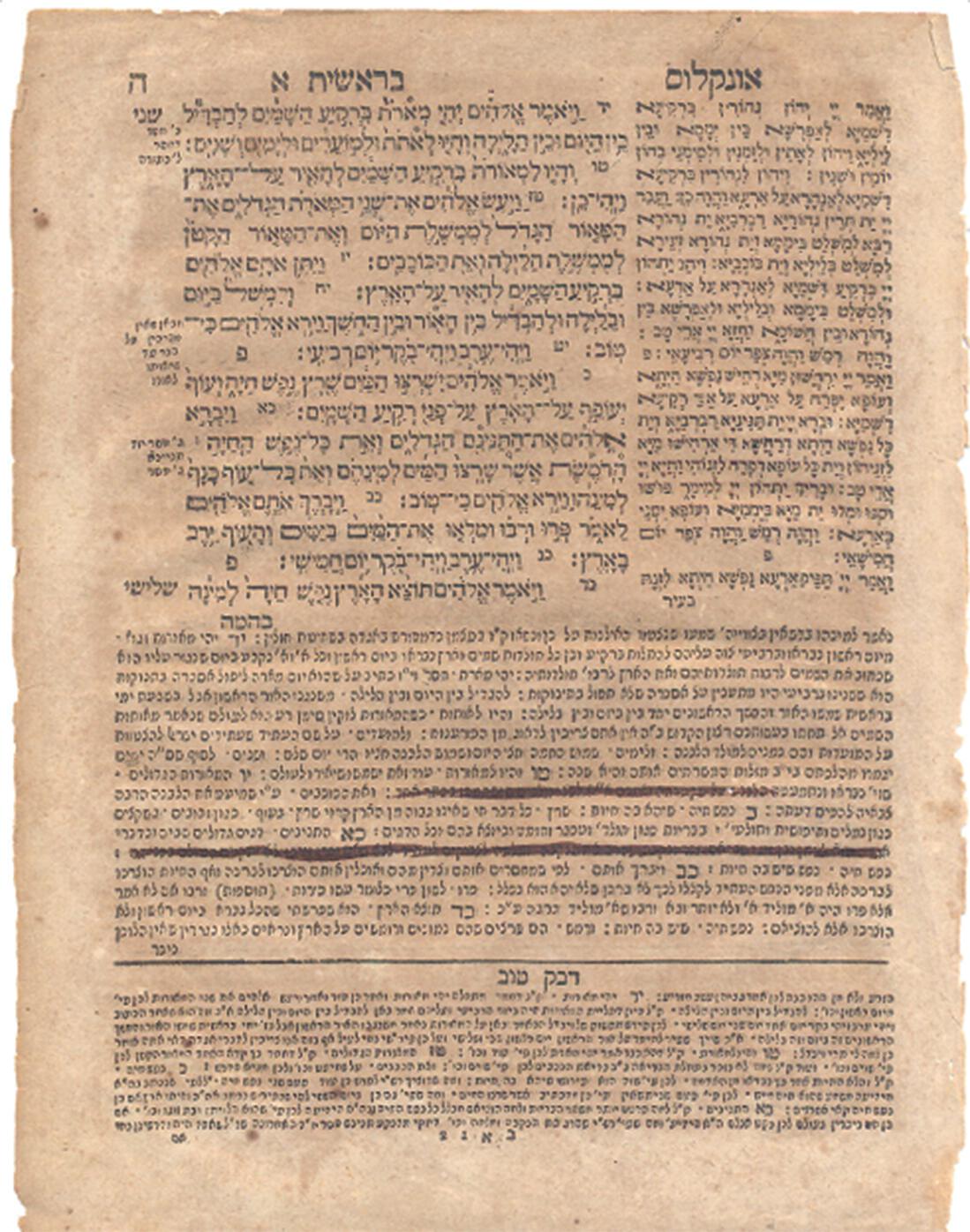
Figure 1: A Printed Copy of the Torah (Genesis 1), Amsterdam 1749. Onkelos’ Aramaic translation on the right column, Rashi’s commentary at the bottom.
With all that clarified, we can now return to Lewin’s reading of Amos in February 1950. There is virtually no doubt that when Isaac read Amos in preparation for his speech before the UN’s Ad Hoc Committee on Statelessness, he used a similar Hebrew textual version to the one shown above. In his address, he did not mention the exact chapter and verse to which he was alluding. Nevertheless, given the brevity of the book of Amos and the fact that Tyre is mentioned in it only once in relation to Edom, his insistence upon a first precedent (of sorts) for an international legal norm guaranteeing the protection of refugees could only stem from that prophet’s referral to the words “whole captivity” and “brotherly covenant”. This, in fact, corresponds to Amos 1:9:
Thus saith the LORD; For three transgressions of Tyre, and for four, I will not turn away the punishment thereof; because they delivered up the whole captivity [גלות שלמה] to Edom, and remembered not the brotherly covenant [ברית אחים]
Lewin’s reference to the expulsion of refugees and their deliverance into the hands of their tormentors stems from the Hebrew words גלות שלמה. This is correctly translated as “entire exiled people”. The King James version mistakenly translates גלות שלמה as “whole captivity”. The correct translation only appears in very modern translations of the Bible, such as the Holman Christian Standard (2004). This mistranslation originates in the earliest Greek Septuagint translation of the Old Testament from Alexandria, where גלות was translated into the Greek word αιχμαλωσία, which was later carried forward into St. Jerome’s Vulgate translation of the Bible into Latin (from the Greek). St. Jerome correctly translated the Greek αιχμαλωσία as the Latin Captivitatem. From there, the path to the King James version’s “whole captivity” was short.
Yet, not all was incorrect with St. Jerome’s translation of αιχμαλωσία into Captivitatem. For St. Jerome, who was born in the Roman province of Dalmatia, passed most of his life as a monk in Bethlehem, speaking both fluent Aramaic and Hebrew, in addition to his native Greek and Latin. So much so was the Christian originator of the Vulgate conversant with the languages of the biblical Near East, that he managed to capture a notion that we today as modern readers of Hebrew have lost concerning the meanings underpinning of the words גלות שלמה – “entire exiled people”. Fortunately, though, St. Jerome’s underlying understandings were indeed captured by Rashi – as one ought to have expected from the most venerable of all Jewish biblical commentators. Regarding the words גלות שלמה in Amos 1:6, Rashi explains:
גלות שלמה: the captivity of Israel for that it shall be complete, so that not one soul would be able to escape, thus performed the people of Tyre who would stand on the roads and at the cross roads, and would capture those fleeing and would then deliver them unto Edom.
Rashi’s clarification is vital to understanding the plight of refugees. In Lewin’s reading, the responsibility for biblical protection of refugees lay not only upon those who persecuted refugees but also upon those who merely handed refugees over to those who would later persecute them. This specific meaning is revealed in his reading of Rashi’s explanation of גלות שלמה – “whole captivity” or “entire exiled people”. To Lewin, the responsibility of states to protect persecuted refugees according to the Refugee Convention he was drafting was not only from their tormentors but also from the people who were merely aiding their tormentors, in that they turned back those persecuted. With Lewin’ entire family perishing in the Holocaust in Poland and him sitting at the UN Ad Hoc Committee’s drafting table only five years after the end of World War II, he knew all too well how many Jews were turned back into the hands of the Nazis by non-German collaborators within the occupied areas of Europe. Rashi’s clarification of what took place during biblical times, which Amos referred to in his prophecy, literally unfolded in front of Lewin’s own eyes five years earlier. It is this aspect of “collaboration” that St. Jerome so masterfully captured in his Vulgate translation of Captivitatem, to which Lewin alluded in his quoted text from Amos.
The severity of the deed executed by the people of Tyre, and which earned them Amos’s wrath, was not only the abrogation of some vague ethical principle (not turning refugees back into the hands of their tormentors). Rather, it was the concrete abrogation of a certain regional diplomatic pact between two previous formidable kings, which Tyre reneged upon. Lewin’s reference to some early form of international law concerns Amos’s reference to the abrogation of a “brotherly covenant” and God’s reprimanding thereof. As Rashi explains, these words refer to the regional political pact between the pagan King Hiram of Tyre and the Jewish King Solomon in Jerusalem. This pact is mentioned in 2 Samuel 5:11, 1 Kings 5:14–25, and also 1 Kings 9:10–16, whereby both kings referred to one another as “my brother”, hence the “brotherly covenant”.
The conjunction between the expulsion of exiles back to their tormentors (Edom), which was undertaken by the same people whose king had previously concluded this agreement with the Jewish King Solomon, and the abrogation of an existing regional diplomatic agreement – in addition to the infringement upon the more general moral principle of not turning refugees back into the hands of their tormentors – lay at the heart of Lewin’s seemingly anachronistic claim in favour of some sort of a biblical notion of international law.
5 Conclusion: The Eastern European Jewish Linguistics of Modern International Law
In 1928, Jacob Robinson published the first of several bibliographies he would publish during his life on topics concerning international law, with the last one being published ten years prior to his passing in 1967. This first bibliography was dedicated to the protection of minorities – a topic close to Robinson’s heart and one in which he had become a recognized international legal authority.47 In the preface to this bibliography, Robinson explains:
This bibliography is polyglot. Works presented here, in the languages which the editor can read freely include publications in: Russian, Lithuanian, Latvian, Polish Ukrainian, Czech, German, Dano-Norwegian, Swedish, Dutch, French, Italian, Catalan, Rumanian, Spanish, Bulgarian, English, Hebrew and Yiddish (sources in the last two languages have been transcribed into Latin characters from the Hebrew alphabet). Notwithstanding the editor’s limited knowledge of Hungarian, he has nevertheless endeavoured to include those Hungarian publications known to him.48
Personal testimonies of people who were associated with Robinson speak of a very timid man, who, despite his almost encyclopaedic knowledge, was a rather reserved and quiet person. Bragging was hardly his “cup of tea”. His statement above should be taken more as a statement of fact – as to the sources included in his bibliography, along with his recognition of his own linguistic shortcomings. In all probability, Robinson’s linguistic skills might not have been that different from those of other Jewish peers he most likely knew during his lifetime. In all likelihood, Nehemiah Robinson, his younger brother, spoke many of these languages mentioned above. André Mandelstam – who served as the dragoman (interpreter) for the Russian embassy in Istanbul, spoke some 15 tongues (including Turkish and Arabic), and with whom Robinson was well acquainted – would not have been any less multilingual. Given their similar biographies to Robinson, Hersch Lauterpacht, Raphael Lemkin, or Rabbi Dr Georg Cohn might have mastered somewhat fewer languages than Robinson, yet not to any radical degree. The minute one was born into an educated Jewish household in East-Central Europe in the late nineteenth or early twentieth century, one’s multicultural and multiconfessional surroundings, coupled with the duality of Talmudic and international law education, meant that one would simply be compelled to become conversant in so many languages.49
Notes
1
S. Troebst, “Eastern Europe’s Imprint on Modern International Law”, in: A. Ciampi (ed.), History and International Law: An Intertwined Relationship, Forwarded by ICJ Judge Giorgio Gaja, Cheltenham and Camberley: Edward Elgar Publishers, pp. 34–36. For a good bibliography concerning many of these Jewish international jurists, see S. Troebst, “Speichermedium der Konflikterinnerung. Zur osteuropäischen Prägung des modernen Völkerrechts”, Zeitschrift für Ostmitteleuropa-Forschung 61 (2012), pp. 417–420, n. 48–63. On the more general rise of modern international law as a phenomenon of the twentieth century, see M. Koskenniemi, The Gentle Civilizer of Nations: The Rise and Fall of International Law 1870–1960, Cambridge: Cambridge University Press, 2001.
2
On Leo Pasvolsky’s constitutive role in the drafting of the UN Charter at the Brookings Institute under the orders of the then US secretary of state, Cordell Hull, see S. C. Schlesinger, Act of Creation: The Founding of the United Nations, New York: Basic Books, 2004, pp. 43–44.
3
P. Sands, East-West Street: On the Origins of Genocide and Crimes Against Humanity, New York: Weidenfeld and Nicolson, 2017, pp. 115–137, 275–315.
4
Ibid., pp. 137–207. See also M. Lewis, The Birth of New Justice: The Internationalization of Crime and Punishment, 1919–1950, Oxford: Oxford University Press, 2014, pp. 181–229.
5
J. Winter and A. Prost, René Cassin and Human Rights: From the Great War to the Universal Declaration, Cambridge: Cambridge University Press, 2013, pp. 221–265.
6
On the role of Georges Cahen-Salvador, Georg Cohn, and Nissim Mevorah in the making of the 4th Geneva Convention for civilians (1949), see G. Ben-Nun, The 4th Geneva Convention for Civilians: The History of International Humanitarian Law, London: Bloomsbury Books, 2020. On their specific role in the making of the Common Article 3 of the 4th Geneva Convention, see G. Ben-Nun, “Treaty after Trauma: Protection for All in the 4th Geneva Convention”, in: Ciampi (ed.), History and International Law, pp. 103–134.
7
On Jacob Robinson and Paul Weis’s instrumental roles in the drafting of the Refugee Convention, see G. Ben-Nun, “The Israeli Roots of Article 3 and Article 6 of the 1951 Refugee Convention”, Journal of Refugee Studies 27 (2014), pp. 101–125. On Lewin’s drafting of the non-refoulement principle, see G. Ben-Nun, “The British-Jewish roots of Non-Refoulement and Its True Meaning for the Drafters of the 1951 Refugee Convention”, Journal of Refugee Studies 28 (2015), pp. 93–117, n. 101–103. On Jacob Robinson’s important role in the drafting of the Convention on Statelessness, see G. Ben-Nun, “From Ad-hoc to Universal: The International Refugee Regime from Fragmentation to Unity 1922–1954”, Refugee Survey Quarterly 34 (2015), pp. 23–44.
8
C. Fink, Defending the Rights of Others: The Great Powers, the Jews, and International Minority Protection, 1878–1938, Cambridge: Cambridge University Press, 2004. See also M. Mazower, No Enchanted Palace: The End of Empire and the Ideological Origins of the United Nations, Princeton: Princeton University Press, 2009, pp. 104–149; Sands, East-West Street, pp. 141–191.
9
Lord Neuberger, “The Jewish History of the Supreme Court”, Address delivered to the Jewish Civil Servants’ Network, 17 May 2017, https://www.supremecourt.uk/docs/speech-170517.pdf (accessed 11 December 2019).
10
J. Shapiro, “The Shetar’s Effect on English Law – A Law of the Jews Becomes the Law of the Land”, Georgetown Law Journal 71 (1983), pp. 1179–1200.
11
Neuberger, The Jewish History of the Supreme Court, p. 3, § 10.
12
Ibid., p. 2, §5, pp. 10–11, § 28.
13
Up until the late eighteenth century, Jews were either prohibited from attending European universities on account of their faith, or significantly hampered in doing so thanks to stringent numerical quotas of Jewish students entitled for enrolment. The emancipation of Jews in Europe, which took place from the early nineteenth century onwards, entailed their growing right to attend universities and secular higher education. On emancipation and its impacts upon Jewish communities, see D. Sorkin, Jewish Emancipation: A History Across Five Centuries, Princeton: Princeton University Press, 2019.
14
One should stress here that, while this chapter examines the Eastern European Jewish contributions to modern international law, it by no means implies that non-Jews from this region did not contribute equally to the development of this field. If anything – it is to the contrary. From Fyodor Martens’s initiation and chairmanship of the Hague Conventions for War on Land (1899, 1907), to Platon Morozov’s fight against the UK and the US delegates in favour of a wide and universal reading of the 4th Geneva Convention and its Common Article 3, to Grigorii Tunkin’s fight for universal rights as the leading Soviet jurist present at the elaboration of the great Human Rights Covenants (for Civil and Political Rights 1966, and for Economic and Social Rights 1970), Eastern European non-Jewish jurists have had a signal (if not outright primordial) impact on the making of modern international law and, especially, on humanitarian and human rights law. For Martens’s impact, see L. Mälksoo, “F. F. Martens and His Time: When Russia Was an Integral Part of the European Tradition of International Law”, European Journal of International Law 25 (3) 2014, pp. 811–829. On Platon Morozov’s work in favour of Common Article 3 and later in its application when he was a judge on the bench of the International Court of Justice in Nicaragua v the United States (1986), see Ben-Nun, The 4th Geneva Convention for Civilians, pp. 103–106, 170–219. On Grigorii Tunkin’s vital work, see R. E. Fife, “Creative Forces and Institution Building in International Law”, in: Ciampi (ed.), History and International Law, pp. 11–16.
15
G. Ben-Nun, “How Jewish is International Law?”, Journal of the History of International Law 23 (2021) 2, pp. 249–281.
16
M. Halbertal, Editor’s Introduction to the Six Orders of the Mishna, Tel Aviv: Am Hasefer & Yediouth Aharonot Publishers, 2004, p. iii.
17
“בבא מציעא, נט' ב,”מפני שסורו רע'.
18
A. Oz and F. Oz-Salzberger, Jews and Words, New Haven: Yale University Press, 2012, p. 20.
19
Ibid., p. 19.
20
Ibid.
21
D. Krochmalnik, H. Liss, and R. Reichman (eds.), Raschi und sein Erbe (Schriften der Hochschule für Jüdische Studien Heidelberg), Heidelberg: Universitätsverlag Winter, 2007.
22
Rashi on the Torah, Deuteronomy 34:12 (own translation; exclamation mark in the eleventh-century original). The original Hebrew reads:
לשעיני כל ישראל: שנשאו לבו לשבור את הלוחות שנאמר ואשברם לעיניכם, והסכימה דעתו של הקב''ה לדעתו, ש מר, אשר נאשברת – ישר כוחך ששבר!ת
23
C. Fink, Defending the Rights of Others: The Great Powers, the Jews, and International Minority Protection, 1878–1938, Cambridge: Cambridge University Press, 2006. From the vast literature that has appeared in recent years, see the following. On Jewish jurists’ actions in favour of persecuted Armenians following their genocide in 1915, see D. Kevonian, “André Mandelstam and the Internationalization of Human Rights (1869–1949)”, in: P. Slotte and M. Halme-Tuomisaari (eds.), Revisiting the Origins of Human Rights, Cambridge: Cambridge University Press, 2015, pp. 239–266. On Raphael Lemkin’s work in favour of Armenians, see Sands, East West Street, pp. 141–191. On Rabbi Maurice Perlzweig and Peter Benenson’s involvement in the establishment of Amnesty International, see J. Loeffler, Rooted Cosmopolitans: Jews and Human Rights in the Twentieth Century, New Haven: Yale University Press, 2018, pp. 215–229.
24
Jeremiah 29:7.
25
Israel State Archives (ISA), Foreign Ministry Files (MFA) reference ISA/RG 93.38/1-31. Jacob Robinson to Walter Eytan, RE: Ad Hoc Committee on Statelessness and Related Problems – Final Report, 21 February 1950, Doc. 133, p. 5 § 5.
26
On the impact of émigré German-speaking jurists on Great Britain, see J. Beatson and R. Zimmermann (eds.), Jurists Uprooted: German-Speaking Emigre Lawyers in Twentieth-Century Britain, Oxford: Oxford University Press, 2004. In the case of Israel, the fact that well over 40 per cent of the first cadre of its Supreme Court’s judges were either German or European Jews has been well documented (see F. Oz-Salzberger and E. Salzberger, “The Secret German Sources of the Israeli Supreme Court”, Israel Studies 3 [1998], pp. 159–192).
27
G. Ben-Nun, Seeking Asylum in Israel: Refugees and the History of Migration Law, London: I. B. Tauris, 2017, pp. 58–59. On the difference between Eastern and Western European Jewish jurists and their approaches to international law, with the German-speaking “secular” ones being far more inclined to realism, and with their counterparts being far more attuned to moralistic outlooks, see Ben-Nun, “How Jewish is International Law?”.
28
For a good discussion of Kelsen, Kaufmann, and Morgenthau, see R. Paz, A Gateway between a Distant God and a Cruel World: The Contribution of Jewish German-Speaking Scholars to International Law, Leiden: Brill, 2012.
29
J. Robinson, Das Minoritäten-Problem und seine Literatur. Kritische Einführung in die Quellen und die Literatur der europäischen Nationalitätenfrage der Nachkriegszeit, unter besonderer Berücksichtigung des völkerrechtlichen Minderheitenschutzes, Berlin and Leipzig: Institut für ausländisches öffentliches Recht und Völkerrecht in Berlin/Walter de Gruyter & Co., 1928.
30
N. Robinson, Die Finanzwirtschaft Litauens als eines neuen Staats, Prague: Buchdruckerei Mercy & Sohn, 1928.
31
See M. Perlzweig’s own memoires available on the website of Columbia University Library: The Reminiscences of Dr. Maurice L. Perlzweig, vol. 3, p. 139 (p. 138 in the source), http://www.columbia.edu/cu/libraries/inside/ccoh_assets/ccoh_4074305_transcript.pdf (accessed 11 December 2019).
32
Ibid., p. 139.
33
G. Adams, Political Ecumenism: Catholics, Jews, and Protestants in De Gaulle’s Free France 1940–1945, Montreal: McGill-Queen’s University Press, 2006, pp. 69–70.
34
United Nations Treaty Series (UNTS), vol. 119 (1952), p. 99, https://treaties.un.org/doc/Publication/UNTS/Volume%20119/volume-119-I-1610-English.pdf (accessed 11 December 2019).
35
N. Robinson, The United Nations and the World Jewish Congress, New York: Institute for Jewish Affairs & International Press, 1955, pp. 28–35.
36
T. Einarsen, “The Drafting History of the 1951 Convention and the 1967 Protocol”, in: A. Zimmermann, J. Dörschner, and F. Machts (eds.), The 1951 Convention Relating to the Status of Refugees and its 1967 Protocol: A Commentary, Oxford: Oxford University Press, 2011, pp. 37–74.
37
I. Glynn, “The Genesis and Development of Article 1 of the 1951 Refugee Convention”, Journal of Refugee Studies 25 (2012), pp. 135–140. For the relationship between all these jurists and Jacob Robinson’s central role in the making of this convention, see G. Ben-Nun, “The Israeli Roots of Article 3 and Article 6 of the 1951 Refugee Convention”, Journal of Refugee Studies 27 (2014), pp. 101–126.
38
On the shift from the Refugee Convention to the making of the Convention on Statelessness (which only came into force in 1960), see G. Ben-Nun, “From Ad Hoc to Universal: The International Refugee Regime from Fragmentation to Unity 1922–1954”, Refugee Survey Quarterly 34 (2015), pp. 23–44. On the nexus between the drafters of the Refugee Convention and their work in favour of the UNHCR and its Executive Committee (against strong French and US pressures), see G. Ben-Nun, “The Expansion of International Space: UNHCR’s Establishment of Its Executive Committee (‘ExCom’)”, Refugee Survey Quarterly 36 (2017), pp. 54–73. For an adversarial, albeit extremely well-researched perspective on the Jewish (and especially Israeli) contribution to the making of the Refugee Convention, see R. Giladi, “A ‘Historical Commitment’? Identity and Ideology in Israel’s Attitude to the Refugee Convention 1951–1954”, International History Review 37 (2015), pp. 745–767.
39
Ben-Nun, The British-Jewish Roots of Non-Refoulement, pp. 107–113.
40
Ben-Nun, Seeking Asylum in Israel, p. 59.
41
Ibid., p. 59.
42
For the point of view of international law as a nineteenth- to twentieth-century endeavour, see M. Koskenniemi, The Gentle Civilizer of Nations: The Rise and Fall of International Law 1870–1960 (new edn), Cambridge: Cambridge University Press, 2010. For a point of view that stretches further back to international law’s fifteenth- to sixteenth-century origins, see R. Tuck, The Rights of War and Peace, Oxford: Oxford University Press, 2001. For the recent broadest and most authoritative account of international law’s history, see S. Neff, Justice among Nations: A History of International Law, Cambridge: Harvard University Press, 2014.
43
For the text of Lewin’s drafted UNGA Res. 36/55 of 25 November 1981, see the website of the UN High Commissioner for Human Rights, https://www.ohchr.org/EN/ProfessionalInterest/Pages/ReligionOrBelief.aspx (accessed 11 December 2019).
44
G. Steiner, “The Book”, in: Idem, Language and Silence: Essays 1958–1966, London: Faber & Faber, 1967, p. 218.
45
On Rashi’s specific contribution to the linguistic development of Hebrew and the impact his commentary had on the developers of nineteenth-century modern Hebrew, such as Bialik and Agnon (sitting between Odessa, Leipzig, and Bad Homburg), see C. Gamliel, Linguistics in Rashi’s Commentary, Jerusalem: The Bialik Institute at the Hebrew University Press, 2010, pp. 197–226 (in Hebrew).
46
Wikimedia Commons, “Rashi’s Commentary on the Torah”, https://he.wikipedia.org/wiki/%D7%A4%D7%99%D7%A8%D7%95%D7%A9_%D7%A8%D7%A9%22%D7%99_%D7%9C%D7%AA%D7%95%D7%A8%D7%94#/media/%D7%A7%D7%95%D7%91%D7%A5:Rhashi_mechicot.jpg (accessed Sep. 2020)
47
Robinson, Das Minoritäten-Problem. See also J. Robinson, Kommentar der Konvention über das Memelgebiet, Kaunas: Verlag Spaudos Fondas, 1934.
48
Robinson, Das Minoritäten-Problem und seine Literatur, p. 7.
49
On the notion of “Democratic Diplomacy” post-World War I and its radical departure from past diplomatic practices, see G. Ben-Nun, “The Subjugation of International Law to Power Politics and Mystery of State (‘Arcana Imperii’) in Shakespeare’s Henry V”, in: D. Carpi and F. Ost (eds.), As You Law It: Negotiating Shakespeare, Berlin: De Gruyter, 2018, pp. 87–104, at 101, n. 27.