
8
Klemens Kaps
Note: This chapter relies on results obtained in the framework of the research projects Connectors between a Polycentric Empire and Global Markets, 1713–1815, led by the author and financed by the Austrian Science Fund (FWF), P 28612-G28, and Res Publica Monarquica. La Monarquía hispánica, una estructura imperial policéntrica de repúblicas urbanas [Monarchican Republic. The Hispanic Monarchy, a Polycentric Imperial Structure of Urban Republics], led by Manuel Herrero Sánchez (Universidad Pablo de Olavide de Sevilla) and financed by the Spanish Ministry of Science and Innovation, GC2018-095224-B-100.
The conquest and colonization of the Americas between the fifteenth and seventeenth century have been traditionally portrayed as a largely Western European enterprise. This orientation still serves narratives in handbooks and shapes specialized studies on the colonial Americas and their interactions with the corresponding colonial centres in Europe during the early modern period.1 However, intriguing historical scholarship in the framework of “Atlantic history” or the “Atlantic system”2 in recent years has called attention to the manifold and intricate webs of interaction between colonial empires in the Americas, highlighting the fluid boundaries, flexible loyalties, and hybrid identities of imperial actors. Such webs of interaction emerged particularly from commercial exchange, which was one of the major channels of economics, together with political and cultural transregional and translocal interactions across the Atlantic Ocean.3 However, scholars have also shown the crucial role of numerous actors in transatlantic trade that clearly transcend the sociopolitical boundaries of what can be considered the Western European maritime powers – Portugal, Spain, the Netherlands, France, and England – revealing the involvement of merchants and sailors from a range of other European areas in this colonial trade. This is most prominent in the case of the Spanish Empire, whose imperial economy could not have functioned without the intense participation of foreign merchants, bankers, and sailors, or without a range of non-Spanish commodities that were dispatched from Spain to Spanish America.4
While recent research has shed a lot of light on Genoese businessmen and on Dutch, Flemish, Hanseatic, Tuscan, French, and British traders,5 the eastern part of the European continent received less attention. Klaus Weber has studied traders who migrated from Habsburg-governed Bohemia and settled in the port city of Cádiz,6 Spain’s only mercantile hub legally entitled to trade with Spanish America between 1680 and 1765–1778 from the 1720s onwards. In addition, other works mention the key role of imports – for example, the Baltic region for shipbuilding, Upper Hungarian copper, and Silesian and Bohemian linen exports – supplying to a great degree Spanish American markets.7 However, there is still a lack of detailed studies on the involvement of Eastern European regions in the Spanish transatlantic trade.
These examples are the starting point for this chapter, which aims to analyse the forms and impacts of the multiple economic connections as well as mutual commercial influences and interactions between Spain’s Atlantic system and Eastern European regions during the eighteenth century as part of the larger process of early modern globalization. Trade connections are understood both in their material dimension of commodity flows, and in terms of the social sphere of merchants, sailors and their networks conducting these transactions. One important aspect in this regard is to scrutinize older but partially still persistent notions according to which Eastern Europe was considered a remote area for Atlantic trade, which is often linked to its peripheral economic profile.8
Without questioning the unequal character of the global division of labour that came into existence with the Atlantic expansion of the two Iberian monarchies in the fifteenth and sixteenth centuries and the relatively unfavourable position Eastern European regions had within this division,9 this chapter takes a close look at micro-structures and micro-places10 in order to demonstrate that Eastern Europe was a far more complex world region and that different of its territories fulfilled various and changing functions in the globalizing economy. Focusing on the protoindustrial production located in East-Central European regions, such as Silesia and Bohemia, the differentiated production geography and trade patterns with Spanish America will be revealed while underlining that some East-Central European regions could benefit from participation in the Atlantic colonial trade – acting as core rather than peripheral spaces.
Firstly, a broader overview will be developed to contextualize both world regions regarding their productive and mercantile profiles, showing the different forms and extent of commercial interaction between Eastern European regions and the Spanish Empire. In the following two sections, the trade connections between Eastern European regions and the Spanish Empire through the two main routes – the Baltic Sea and the Mediterranean Sea – will be considered, and a case will be made for the relevance of the Mediterranean despite the common interpretation of its demise. The next section will focus on commodity flows, with a specific focus on the commodity chains of linen and glass, arguing for a more complex division of labour than a clear-cut core-periphery pattern. In the final section, the mediators of these commodity flows will be scrutinized more in depth, paying attention to transcultural networks and the role of Eastern European actors within them. In this part, I will include examples that follow the concept of “global micro-history”,11 promoting an understanding of these transactions, the intricate web of commodity chains tying together production and consumption zones, and the actors and their social embeddedness to mediate these exchanges.
Thus, although this chapter focuses on specific trade flows between Eastern European and Spanish American regions, it places them within the broader spatial and social “commercial web”12 of the early modern global economy, which transcends regional and imperial borders. In that sense, the chapter follows the paradigmatic guidelines developed around the concept of “translocality”,13 aiming at analysing relationships between spaces of different scales and between geographical distance and density. It will therefore be shown that within Europe, similar to places and regions in Asia and Africa, areas considered a lesser part of globalization narratives, such as Eastern Europe, were part of a multilayered web of mutual connections and influences, a web that was characteristic of the early modern global economy. The manner in which these links were, to a high degree, silenced and hidden in both areas will be critically revisited, based on both recent research and new source material relating to, above all, regions under the rule of the Habsburgs. The chapter will therefore focus on how connections and interlinkages on the translocal and transregional levels14 – driven by integration processes of global scope and mediated through “portals of globalization”15 that served as nodes and gateways of cross-border connections – created important configurations and spaces of agency that fostered and impacted socioeconomic changes in the eighteenth-century Spanish Atlantic and Eastern Europe.
Whereas the translocal approach understands global entanglement as a multifocal process of interaction, taking an actors’ perspective from below instead of an elitist viewpoint and subscribing to a heterogeneous globalization process,16 the transregional approach underlines the idea that entanglement occurs in a multilayered spatial web stretching from the local through the regional to the transregional and to the global level. Even though all these spatial levels are mutually influenced by this integration process, both approaches break with the traditional national view that makes empires and states the logical starting points and actors of cross-border entanglements of a global scope. Instead, different urban centres serve as condensed nodes that foster and manage these interactions, with state policies acting as an important factor regarding the regulations and institutions of these cities. The term “region” is certainly vague and can be applied not only to spatial entities within a state but also to smaller spaces that transcend political boundaries. Another term with an ambiguous meaning is “world regions”.17 Both terms will be applied in this text – Eastern Europe and Spanish America can be considered world regions, which can again be subdivided into several regions.
This chapter takes into account both land and sea trade centres between Eastern Europe and the Spanish Atlantic, with a particular focus on commercial harbours in the Baltic Sea, the Mediterranean Sea, and the Atlantic Ocean – such as Gdańsk/Danzig, Trieste/Trst, Genoa, Barcelona, Cádiz, and Veracruz – that served as connecting nodes for commercial interactions, merchant networks, and commodity flows between land and sea. While the maritime harbours were bound together by shipping traffic through maritime spaces of contact, they were as well connected to places in the interior adjacent to the coast and far beyond the immediate hinterlands, where, in many cases, rivers such as the Elbe, Oder, Vistula, or Dnjepr facilitated access and served as extensions of maritime spaces. However, the hinterlands varied over time according to improving infrastructures, such as roads and customs policies.
Major trade centres in the interior of the states analysed, such as Mexico City, Madrid, Cracow, Vienna, or Belgrade, played an important role in this integration process. These portals of globalization were connected in multifaceted ways to smaller commercial towns that orchestrated production on the local level and the commercialization of the respective goods.18 This underlines a functional hierarchy according to which there were primary portals of globalization, such as Cádiz, Marseilles, Hamburg, Genoa, or Amsterdam in commodity trade and London and Amsterdam in financial services. They could, however, only function through their connections with smaller but still transregionally important port cities that were linked to more remote production areas, such as Trieste, Gdańsk, Veracruz, or Lima. As they did not manage such a broad range and density of commodity and money flows, they could be classified as “secondary portals of globalization”. This hierarchy was certainly far from stable, as the rise of London to the status of a financial centre (replacing Amsterdam) over the course of the eighteenth century shows, as well as the rise of Cádiz, Hamburg, and Trieste, albeit differing in intensity and scope.19 Apart from such nodes in the global network of commercial exchanges, local harbours can be identified that were tied to these port cities by cabotage trade along the coastlines in the vicinity, delivering local products to these big port cities, which were mainly destined for local consumption but could serve as additional commodities in long-distance trade.
1 Apparently Distant, but Tied Together: Geographies of Commodity Entanglement between Eastern Europe and the Spanish Atlantic in the Eighteenth Century
One of the reasons for the relative neglect of Eastern Europe, both in material terms and in reference to actors, is certainly the complex trade geography. Roughly speaking, regions in the eastern part of Europe wanting to access Spain and its colonies overseas were confronted with a bifurcated trade geography. The first route ran from the Baltic Sea through the North Sea and the Atlantic Ocean and involved prominent harbours located along the south-eastern Baltic coast, such as Gdańsk, Stettin/Szczecin, Memel/Klaipėda, Königsberg/Kaliningrad, Riga, Archangelsk, and, later in the eighteenth century, St. Petersburg on the one end of this commercial exchange. At the other end of the mercantile shipping routes lay mainly ports located on the northern Spanish coast, such as La Coruña, Santander, Bilbao, and San Sebastián. The Andalusian maritime shipping area between the Bay of Cádiz and Sanlúcar de Barrameda, connected through the Guadalquivir River inland as far as Seville, was certainly the most prominent destination as a connecting point to the coveted colonial trade. Due to the strict regulation of Spain’s colonial trade, commodities had to be dispatched through the harbour of Seville and, since 1680, through Cádiz. This holding time for Spanish and other European products before dispatch to Spanish America was quite different from other temporary layovers in harbours on the route from the Baltic Sea to the Iberian Peninsula. This is due to the fact that the specific regulations of Spain’s institutionalized colonial trade, often referred to as a “monopoly”, required that the further movement of commodities from the Iberian Peninsula to Spanish America was conducted exclusively by legally entitled merchants and sailors who generally had to be Spanish subjects (with only a few exceptions).
Mercantile shipping also followed a sophisticated administrative system that, until 1739 in the case of Peru and as late as 1776 in the case of the rest of the American dominions, was organized in the framework of a convoy shipping system that had to follow a standardized shipping route. This route went through the port cities of Veracruz, Cartagena de Indias, and, on the return trip, Havana, from where commodities were traded into the interior, whereas the trade fairs of Panama and Portobelo (later replaced by Jalapas) were two key intermediary channels in Central America. Only the so-called “free trade” reforms of the second half of the eighteenth century made this system more flexible by allowing new harbours in both peninsular Spain and Spanish America to participate in this trade (see Figure 1).20
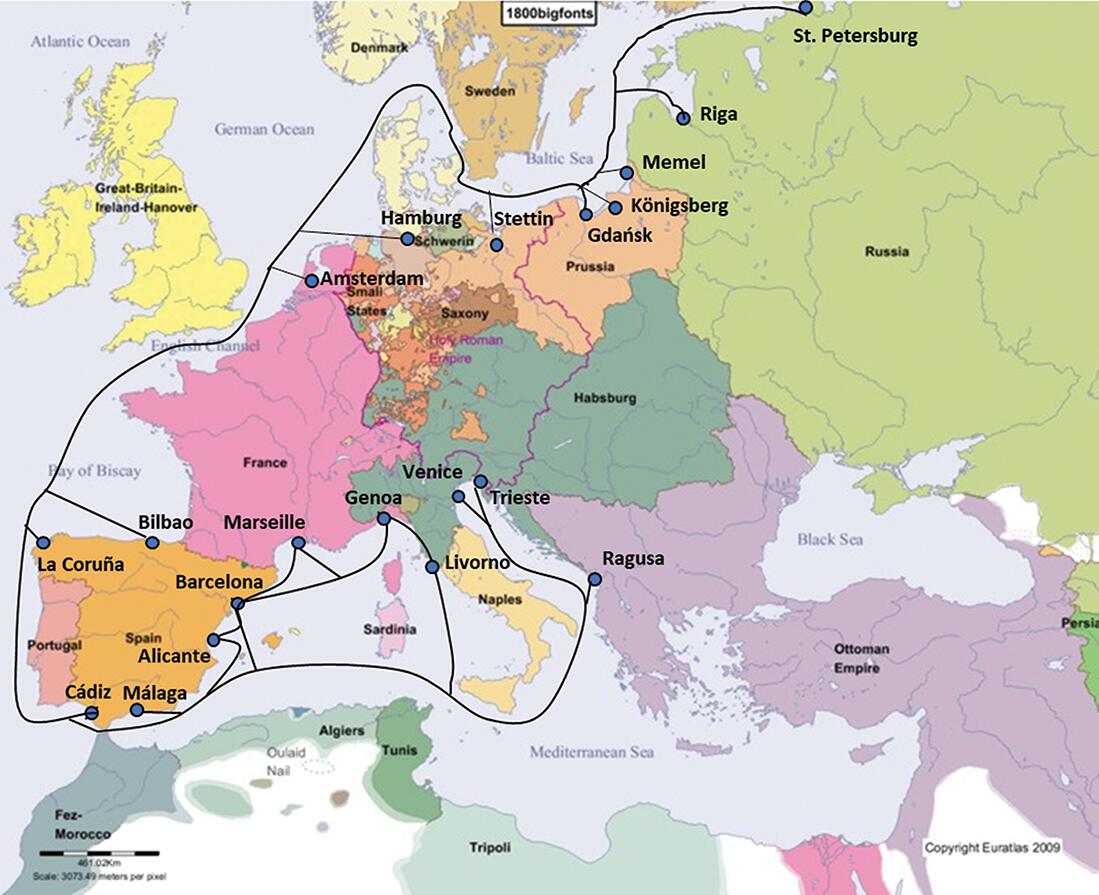
Figure 1: Commercial Harbours and Shipping Routes between Eastern Europe and the Iberian Peninsula (Source: © Euratlas; own elaboration).
The second route relevant for the access of Eastern European regions to Spain and Spanish Atlantic markets was the Mediterranean Sea, where Italian ports from Genoa through Livorno to Venice were the most important gateways. For particular territories in south-eastern Europe, ports located along the eastern coast of the Adriatic Sea, such as Ragusa/Dubrovnik, Bocche di Cattaro/Boka kotorska, and Durazzo/Durrës, served as access channels to maritime trade. Many of them were ruled by the Republic of Venice, at least over a substantial part of the early modern period, and most of them had to rely on the cooperation with larger port cities to channel commodities to Spanish Atlantic markets. Finally, harbours in the Ottoman Empire, mainly on the Greek peninsula, were important connecting points, and Ottoman-governed territories located even further east used the alternative and geographically more remote route through the Black Sea and, subsequently, the Bosporus River in Constantinople and the Dardanelles Strait to access the Mediterranean Sea.
This short and condensed outline of maritime shipping routes connecting Eastern European regions through a range of entrepôts to trade flows directed towards the Spanish Empire demonstrates that Eastern European regions are hardly visible in the sources as places of origin of key commodities that were exported to Spain. This absence in the sources is due to the geographical remoteness of Eastern Europe and the long journey from there, which included many layovers. Shipping both from south-eastern Baltic and Mediterranean harbours relied on numerous layovers on the way to the Iberian Peninsula in order to load cargo as well as food and water for the crew or to reload a part of the cargo due to customs duty regulations in Spain.21 Many sources ignore these exchanges implicitly, privileging large “portals of globalization”, such as Hamburg, Amsterdam, and Antwerp in the north and Venice, Livorno, and Genoa in the south.
Eastern European products often became part of commodity chains that ended up in Western European territories or beyond without their origin being registered (with the exception of Silesian linen and Bohemian glass that were produced within these regions or within a cross-border area including also Saxony, Austria, south-western Poland and Northern Hungary). Since most raw materials did not need a label of origin to be marketed successfully, their provenance is absent in the sources. Last but not least, most mediation centres on the way to Spain were located beyond Eastern Europe; therefore, Hamburg and Amsterdam appear as the exporters of commodities that had been shipped there from further east. Only when there was direct traffic were the connections to eastern Baltic harbours visible in the sources (such direct traffic seems to have increased over the course of the eighteenth century).
2 Part I: Dynamic Eastern Europe’s Commercial Connections with the Atlantic World – From the South-eastern Baltic to the Spanish Atlantic
This trade geography experienced important changes concerning both the intraregional hierarchy of port cities and trade routes on the macro-regional level. New trade centres emerged, such as Hamburg in the late seventeenth century and St. Petersburg, Stettin, and Trieste in the eighteenth century – the last three spurred greatly by mercantilist policies. The shift of the colonial harbour from Seville to Cádiz in 1680 and the transfer in 1717 of the two main institutions regulating the colonial trading system – the Casa de la Contratación and the Consulado – also transformed the trade geography. An even more profound change was initiated by a “free trade” system, permitting 9 Spanish harbours to trade directly with the Spanish-governed Caribbean Islands in 1765 before a sweeping reform of the colonial trade system (implemented in 1778) allowed 13 harbours on the Iberian Peninsula and 22 in Spanish America to trade directly with each other.22
These new competitors precipitated the decline of older nodes in remote trade. Venice gradually lost ground to Trieste; Stettin and Memel grew at the expense of Polish-governed Gdańsk.23 Spain’s “free trade” system diverted some trade flows from the traditional big ports of transatlantic colonial trade to newly licensed ports: on the Iberian Peninsula, Barcelona, La Coruña, Málaga, and Santander conducted some of the transatlantic trade flows, although the leading position of Cádiz remained virtually untouched. Between 1778 and 1796, Cádiz handled 76.4 per cent of exports to Spanish America and 84.2 per cent of imports.24 Within the Spanish American harbours, the ports in New Spain – Veracruz and Honduras – maintained their overall share compared to the period from 1717 to 1778 by handling about 40 per cent of commodities arriving from Cádiz. Similarly, the Caribbean Islands preserved their relative position, whereas Venezuela and Cartagena de Indias lost their advantage to the Río de la Plata region and the Pacific coast.25
This reordering of the hierarchy of port cities was caused by different factors, such as state border regimes, wars, transport infrastructure, and a shifting product geography. However, changes in the transregional division of labour were most important. The colonization of the Americas and the growth of Atlantic trade fostered the deterioration of the core region of the European economy between northern Italy and southern Germany at the turn of the sixteenth to the seventeenth century and its gradual replacement by the Netherlands and England. This shift is believed to have precipitated the marginalization of Eastern Europe and the Mediterranean Sea both in the European and the emerging global economy26 – an interpretation that has been questioned in the last few years, and my research contributes to this reconsideration.27
Both reasons for change – political regulation and shifts in the transregional division of labour – brought problems and opportunities. In some cases, the emergence of new harbours supported stronger direct trade connections between Eastern European regions and the Iberian Peninsula in the eighteenth century, as sources on the micro-level, such as merchants’ letters, notary files, or port books (in addition to other customs-related sources) reveal. Thus the trade activity of Amsterdam merchants further strengthened the ties with the Baltic region, as is proved by the intense mercantile shipping traffic that linked Gdańsk, the leading port city of the Polish-Lithuanian Commonwealth, with Cádiz. As Ana Crespo Solana has shown by compiling these data, this trade was conducted to a great extent on Dutch ships acting as intermediaries, especially between the late 1730s and the late 1760s (see Table 128).
Table 1:Maritime traffic between Cádiz and Gdańsk by Dutch merchant ships, 1738–1767.
|
Year |
Ship |
Carrying capacity (tons) |
Route |
|
1738 |
De Jacob |
Amsterdam-Cádiz-Gdańsk |
|
|
1738 |
De Juffrouw María |
Amsterdam-Gdańsk-Riga-Cádiz |
|
|
1738 |
De Agneta María |
Amsterdam-Gdańsk-Cádiz |
|
|
1739 |
De Vijverhoff |
680 |
Amsterdam-Gdańsk-Cádiz |
|
1746 |
De Stadt Amsterdam |
Gdańsk-Cádiz-Gdańsk |
|
|
1747 |
De Jonge Nicolaes |
Gdańsk-Cádiz-Amsterdam |
|
|
1747 |
De Hermanusy Jacob |
Gdańsk-Cádiz-Amsterdam |
|
|
1747 |
Tempel Salomon |
Gdańsk-Cádiz-Sanlúcar |
|
|
1747 |
De Jonge Cornelis |
Gdańsk-Cádiz-Amsterdam |
|
|
1749 |
Het galjootschip T. Schwandrif |
360 |
Amsterdam-Gdańsk-Sound-Cádiz-Cartagena del Levante |
|
1750 |
San Pedro |
200 |
Amsterdam-Gdańsk-Cádiz |
|
1750 |
Oude Wagens |
380 |
Amsterdam-Gdańsk-Sound-El Ferrol-Cádiz |
|
1750 |
De Vriendschap |
380 |
Amsterdam-Gdańsk-Sound-El Ferrol-Cádiz |
|
1750 |
De Vrouw María |
400 |
Amsterdam-Gdańsk-Cádiz |
|
1750 |
De Vlugge Duijf |
Amsterdam-Gdańsk-Cádiz |
|
|
1763 |
De Twee Jonge Jannen |
Amsterdam-Gdańsk-Cádiz |
|
|
1763 |
De Vrouwe Christina |
360 |
Amsterdam-Gdańsk-Cádiz |
|
1767 |
De Anna Catharina |
Amsterdam-Gdańsk-Cádiz |
|
|
1767 |
Dorp Oudeboom |
Amsterdam-Gdańsk-Cádiz |
|
|
1767 |
De Eendracht |
260 |
Amsterdam-Gdańsk-Cádiz |
|
1767 |
De Goede Vreede |
220 |
Amsterdam-Gdańsk-Cádiz |
|
1767 |
De Jonge Jeltje |
210 |
Amsterdam-Gdańsk-Cádiz |
|
1767 |
De Gestadige Jager |
220 |
Amsterdam-Gdańsk-Cádiz |
This interaction was a key part of the renewed trade prosperity between Spain and the south-eastern Baltic region after 1742, putting an end to the conflictive period between the War of the Spanish Succession and the Great Northern War up to the War of the Polish Succession, when the active commercial exchange that had marked the relationship between both areas in the late seventeenth century had been virtually severed. This new phase of prosperity lasted for several decades in the eighteenth century and perdured even the First Partition of Poland-Lithuania in 1772.29
In fact, Gdańsk continued to largely resist political measures, such as a high customs duty introduced by Prussia in 1775 and levied on the Vistula River in front of the city, aiming to divert trade flows to other harbours in the area, such as Elbling/Elbląg or Stettin, which were under Prussian control at that time. Despite these difficulties, which resulted in a massive reduction of maritime traffic and trade conducted through the harbour,30 ships from Gdańsk still continued to enter the harbour of Cádiz in a considerable number in the years 1773–1774 and 1777–1778, respectively– although the numbers were clearly lower than in 1771 (see Graph 1).31
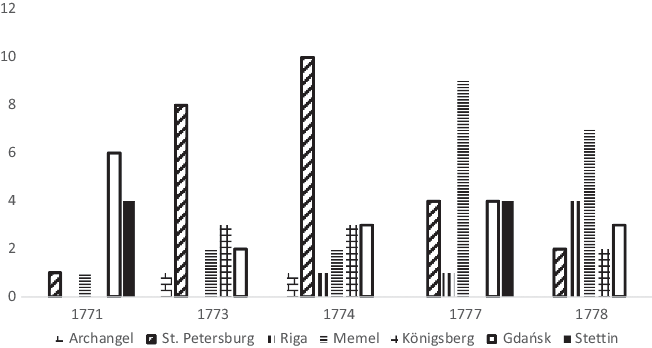
Graph 1: Number of Ships entering Cádiz from South-eastern Baltic Harbours, 1771–1778.
At the same time, mercantile shipping from a range of south-eastern Baltic harbours, such as Stettin and Königsberg, to Cádiz increased as well, pointing to a rise of imports that Cádiz acquired from the area (although the statistics do not consider the loading capacities of ships). However, this new boom went hand in hand with a notable shift in the intraregional trade geography: the number of ships leaving from Gdańsk to Cádiz shrank, whereas Memel, Königsberg, and St. Petersburg particularly dispatched increasing numbers of ships. This traffic, however, does not reflect the whole trade that Eastern European regions located around the Baltic Sea and North Sea coastline conducted with Spain in the late eighteenth century. Hamburg, for example, channelled an important volume of commodities, mainly from East-Central European regions, particularly Silesia and Bohemia.32
3 Part II: Reshuffling of Eastern Europe’s Commercial Routes with the Atlantic – East-Central European Connections through the Much-Deplored Mediterranean
The northern route connecting Eastern European regions located in the Russian Empire, the Polish-Lithuanian Commonwealth, Prussia, and the northern provinces of the Habsburg Monarchy relied on port cities in the region, creating maritime economies, images, and brands with some reference to the regions of origin of the exported commodities. The situation along the southern Mediterranean route was quite different. Most harbours were much more difficult to access because the Alps served as a physical barrier, while long navigable rivers connecting the interior with the coastlines were largely absent. Multiple political and customs barriers between the small Italian states and the Eastern European regions – belonging to different imperial states, particularly the Ottoman and the Habsburg Empires – made commodity transport even more time – consuming and costly. Genoa was one option as a gateway for Bohemian traders. Venice also represented an alternative for merchants for directing Bohemian products towards the Mediterranean Sea. Both routes ran through the trade fairs of Linz, with Augsburg and Nuremberg acting as connecting points for the route to Genoa.33 Ports on the Adriatic Sea were even more relevant as access points to global markets for the Hungarian regions, Croatia, and Carniola. Here, Venice served as the predominant connection for long-distance trade up to the early eighteenth century. The Republic of Venice had successfully defended its trade monopoly in the northern Adriatic Sea against repeated attempts by the Archduke of Austria since the 1520s to convert the small harbours located at the Habsburg-governed Adriatic coast between Trieste and Carlopago/Karlobag into commercial ports.34
However, from 1684 to 1718, the geopolitical reordering after the wars between the Habsburg Emperor and the Ottoman Empire and after the War of the Spanish Succession, as well as after Venice’s increasing loss of control over cabotage trade in the northern Adriatic Sea, placed the Habsburg rulers in a more favourable position. Charles VI could create the legal framework to launch the harbours under his sovereignty as commercial ports. The famous decree of free shipping in the Adriatic Sea (1717) and the declaration of free ports, first of Trieste and Fiume/Rijeka (1717/1719), then of Porto Ré/Kraljevica (1722), Buccari/Bakar, Zengg/Senj, and Carlopago (all in 1725), laid the groundwork for a new geography and density of long-distance maritime trade from the north-eastern Adriatic Sea.35
According to the information provided by the French consul in Cádiz, at least two ships had already circulated between Trieste and Cádiz in 1728 and 1729, one of which sailed under the imperial flag.36 In the following decades, Trieste was transformed into a major hub for long-distance trade, including shipping traffic with Spain.
While this early maritime traffic seems to be closely linked to the state-supported mercantile projects around the Ostend Company, which was granted far-reaching privileges for direct access to Spain’s colonial trade system in the Treaty of Vienna (1725),37 mercantile shipping connections linked Trieste to Cádiz and a range of other Spanish ports from Barcelona through Mallorca and Alicante as far as the Canary Islands in the following decades. Many layovers and the reloading of the transported cargo in the port of Genoa and in the Sicilian ports, Naples, and Livorno make it difficult to trace the real number of merchant ships circulating between Trieste and Spanish harbours in the course of the eighteenth century. However, direct mercantile shipping traffic between Trieste and Spanish harbours expanded since the first two voyages in the 1720s (see Graph 2).38
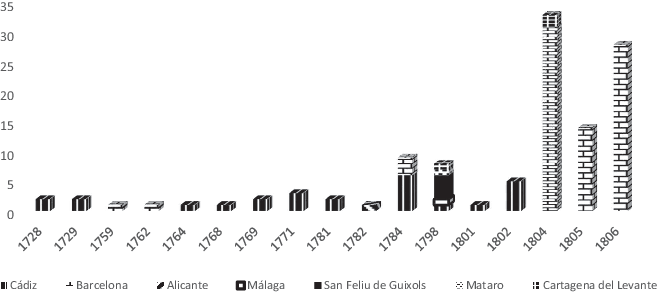
Graph 2: Number of Ships circulating between Trieste and Spanish Port Cities, 1728–1806.
After shipping stabilized, connecting with new harbours, such as Barcelona, during the 1750s and 1760s and withstanding the interruptions of maritime traffic by warships and corsairs in the Mediterranean Sea during the Seven Years’ War,39 the data reveals a temporary slowdown in the later 1770s. However, this certainly does not mark the end of direct merchant ship voyages between Trieste and Cádiz after 1776, as older literature has claimed.40 Quite the contrary, direct shipping traffic between the Habsburg Adriatic coast and Spain took place during the late 1770s, as a ship from Fiume reaching Cádiz in 1778 demonstrates.41 And the early 1780s marked the breakthrough for Trieste’s direct trade connection with Spanish harbours, now stretching to Alicante, Cartagena del Levante, and Málaga.
This rise in direct commercial shipping began during the American War of Independence, peaking after the war and remaining a lasting trend. During the American War of Independence and the Napoleonic Wars, several smaller Catalan ports entered Trieste’s commercial geography in Spain, and the number of ships between the Habsburg Adriatic coast and Spain continued to rise, even more so after the turn of the nineteenth century. The new importance of Barcelona was certainly linked to the port’s access to colonial trade after 1778, while the wars and their consequences opened the gateway from Trieste direct towards the other side of the Atlantic basin.
In 1797, the Spanish government introduced the regulation of “neutral trade”, permitting all harbours in friendly or neutral countries to trade directly with Spanish American ports using ships flying any neutral flag. This measure was to guarantee supplies for the colonies in the face of disrupted shipping traffic between the Iberian Peninsula and Spanish America during the Napoleonic Wars and the shipping blockade imposed by Great Britain. Licensed merchants in the merchant guild at Cádiz, supported by reports of abuses in the system of licenses for this trade, successfully lobbied for exemption from the measure in 1799. However, they could not prevent the rule from being reintroduced only a few years later, albeit in a somewhat changed form. The juxtaposition between Spanish American and peninsular Spanish interests led to a cycle of derogations and re-introductions of the “neutral trade” rule, also opening up the space to allow ships under the Austrian flag to travel directly to Spanish American ports.42
In 1802, an Austrian ship entered the port of Genoa from La Guaira with a valuable cargo of coffee, leather, indigo, and Málaga wine – a part of which was consigned to a trading house in Genoa while the rest was dispatched to Trieste.43 On 17 July 1804, an English ship captured the Austrian ship La Bella Giuditta in the Caribbean.44 A year later, the Austrian frigate La Prudencia entered the harbour of Havana, seeking to settle accounts regarding a transaction made on Puerto Rico, coming from the Danish-ruled island of St. Thomas after obtaining notice of the reintroduction of “neutral trade” by the Cuban colonial administration. The captain, Marcos G. Tarabocchia, took a considerable cargo of Cuban sugar on board before starting the return trip to Trieste.45
These examples of Austrian merchant ships reaching Spanish American harbours directly during the Napoleonic Wars show that, in the context of the crumbling Spanish colonial trading system, merchants in Trieste could establish direct trade links with Spanish American possessions, which, until then, had to be mediated through traders settled in the officially licensed port cities on the Iberian Peninsula. This meant that Triestinian merchants could acquire colonial products, such as sugar, coffee, or indigo, directly from colonial harbours, such as Havana or La Guaira, facilitating a considerable increase in profits for traders and shipowners. However, the Iberian Peninsula was not completely isolated from its colonies, at least before Spain’s occupation by Napoleonic troops in 1808. It was precisely during the wars that two Triestinian traders established successfully themselves in Spanish harbours. Firstly, José Platner started to work in Barcelona as a commercial employee for the trading house Arabet Gautier Manning, whose main partner was the imperial consul in Alicante. Platner advanced later to become a partner in his own right.46 Secondly, Juan Zangopulo, from a Greek background, acted as consignee for ships usually captained by Greeks under the Ottoman flag, which connected the eastern Mediterranean Sea with Cádiz and Spanish America during wartime.47
But the wars also had adverse effects, for example the repeated interception of ships under the Habsburg imperial flag on their way from Trieste to Spanish harbours, especially Barcelona. According to a report (dated 12 October 1793) by the imperial vice-consul in Barcelona, José Sauri y Trias, English privateers had captured three ships under the imperial flag at Toulon coming from Trieste and having loaded Hungarian grain that was sent by the Jewish Triestinian trading house Grassin Vita Levi to its correspondents in Barcelona, Juan Bacigalupi and Durán y Gasso.48 In 1794, the polacre Nostra Signora di Loretto was chartered from Trieste to Barcelona but was intercepted by a Sardinian ship in San Remo. Trieste’s insurance company Camera di Assicurazioni authorized Girolamo de Benedetti of San Remo to liberate the ship through the intervention of the Sardinian authorities.49 In September 1801, the brigantine Maria Elena was chartered by several Triestinian trading houses to ship its cargo to Barcelona under the imperial flag, but got stuck in Palermo. The trading houses involved, Michele Giuseppe Faraone and Vedova d’Antonio Perez, represented by Carlo de Maffei, entitled Giovanni Battista Mattei of Palermo to recover the cargo and to decide whether it should be sent to Barcelona on another ship or returned to Trieste.50
These examples demonstrate that, in addition to the direct involvement of Trieste in Spain’s Atlantic commercial system, shipping traffic between the Habsburg Adriatic harbours and the Iberian Peninsula also grew at the turn of the eighteenth to the nineteenth century. Trieste’s increasing direct traffic with port cities in the Spanish Empire only partially affected the intermediary role that other Mediterranean ports, notably Genoa, had played in Trieste’s participation in long-distance maritime trade. This can be seen in the figures showing the shipping traffic between Genoa and Spanish port cities after the 1770s. Thus, Genoa still occupied a leading position for commercial shipping to Cádiz amongst the western Mediterranean ports during the 1770s (see Graph 3).51
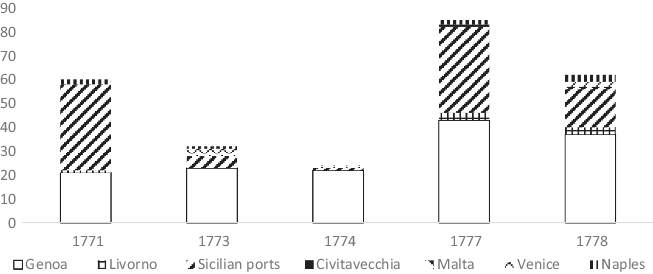
Graph 3: Number of Ships arriving in Cádiz from various Western Mediterranean Ports, 1771–1778.
Although Genoa could maintain a key role as an intermediary port for trade with mainland Spain and the Spanish Atlantic in the Mediterranean, its significance gradually shrank in the last decades before the dissolution of the Republic of Genoa in 1805 and after the city of Genoa had become part of the Kingdom of Sardinia-Piedmont after 1815. Genoa’s trade only expanded again in the 1840s.52
Parallel to Genoa’s diminishing role in the mediation of commercial interactions with Spain, Trieste managed to integrate itself into these trade flows and gradually took over an increasing share of this trade – a tendency that culminated in the disruption of maritime shipping traffic and the collapse of Spain’s colonial trading system during the Napoleonic Wars. While East-Central European regions were increasingly linked via Trieste and, eventually, also via the Croatian harbours under Habsburg rule to Spain and its Atlantic system, harbours such as Ragusa, Durazzo, and Bocche di Cattaro were important intermediary centres for south-eastern territories.53
Ragusa started to develop and tighten its links to Trieste, less as a port and increasingly as an important provider of transport services. This can be seen in the rising number of ships under the flag of the Republic of Ragusa that linked Trieste to harbours in the Mediterranean Sea and the Atlantic Ocean. In December 1765, Carlo Brentani from the trading firm Brentani e Longhi of Genoa approved a charter contract with the Ragusan ship captain Biaggio Buck to travel to Trieste with his polacre La Pellegrina and acquire a cargo of grain, which he should afterwards transport to Livorno or Genoa.54 In 1775, ships under the Ragusan flag carried 10.7 per cent of the overall volume of imported commodities to Trieste, although they transported only 1.4 per cent of exports from Trieste.55 Spanish ports were an important destination for Ragusan ships. In Cádiz, the number of Ragusan ships arriving was considerable, reaching 30 to 40 vessels a year. Therefore, in 1782, the imperial consul, Paolo Greppi, asked the Court and State Chancellery in Vienna for permission to assume the office of the deceased Ragusan consul in Cádiz, in addition to his current post, in order to boost his income through consular taxes on arriving ships.56 Ragusan ships were also used by merchants for shipping goods between Cádiz and Trieste directly. Thus the trading firm Ruepprecht y Cía of Cádiz chartered the Ragusan vessel Cleopotra, captained by Josef Cavovich, in 1796 to ship a portion of cargo to Trieste.57
This tendency underlines the important position Trieste attained as a commercial hub, linking Eastern European commodity markets to the Spanish Atlantic in the late eighteenth century. The dense merchant networks that worked smoothly at the turn of the eighteenth to the nineteenth century were built up no later than the 1730s and 1740s. According to an official document that circulated within the Supreme Commercial Intendancy, Trieste’s superior administrative office in commercial and shipping affairs, after the Seven Years’ War several local trading firms maintained business ties with the Canary Islands as early as 1746. Amongst them, the company Rocci e Balletti stands out, which exported two crates of stockings from Bohemia and Trieste to the Canary Islands.58 Giacomo Balletti was one of the leading merchants in Trieste: he had immigrated to the city from Ferrara, was the consul of Malta, and, from 1756, acted as director of the merchant guild for many years. In 1772, Balletti was elected director of the first Triestinian insurance company.59 Well before that date, Balletti was at the centre of one of the most ambitious attempts to intensify Trieste’s trade with Cádiz and Spanish colonial trade. As a director of the Compagna del Commercio di Spagna, he was one of the bigger shareholders and responsible for the company’s branch, which was run by the Genoese merchant Giorgio Fedriani in a partnership with Balletti’s son-in-law, Giuseppe Luca Langwieder (Languider) in Cádiz. Although the branch seems to have failed by the mid-1770s, the enterprise was a successful connection between East-Central Europe and the Spanish Atlantic through Trieste for several years.60
In 1764, the company sent commodities amounting to 38,104.9 florins to Cádiz. Amongst the products the company delivered to Cádiz were linen textiles – mainly from Bohemia but also from Upper and Lower Austria, Styria, and Carniola (13,338.9 florins in sum) – and woollen products from Moravia (1,272.5 florins), which, together with other textiles from Lower Austria and Trieste, accounted for nearly the half of the cargo. Furthermore, metal products from Styria, Carinthia, and Lower Austria and glass from Bohemia and Styria were delivered. On its way back to Trieste, the ship commanded by the Genoese ship captain Giuseppe di Gaetano di Gezzo loaded commodities from Spain, such as grapes from Málaga, honey and red wine from Alicante, and colonial products at Cádiz, including indigo from Guatemala, cacao from Caracas, sugar from Havana, and tobacco from the Royal Tobacco Factory in Seville.61 The Triestinian trading firm François & Tomasich – which, in 1768, had opened a branch in Cádiz, run by Giovanni Tomasich,62 who is classified as coming from Croatia in the Cádiz population census of 1773 – failed by 1772.63 However, Triestinian merchants intensified their links with the Spanish Atlantic during the following years, relying on well-established agents in the Andalusian port city. The dense networks between the Habsburg Adriatic and the Spanish Atlantic thus weakened traditional intermediary centres and fostered the integration of East-Central European regions with the Spanish Atlantic in the second half of the eighteenth century.
4 Commodity Flows From Eastern Europe to the Spanish Atlantic System: Colonial Economies Beyond Clear-Cut Core-Periphery Structures
The commodities traded through the transport routes and portals of globalization described so far, both by land and by sea, followed a complex geography of the division of labour. Traditionally, the integration of both Eastern Europe and the Americas into the nascent world economy during the sixteenth and seventeenth centuries has been framed as a process of peripherialization. According to this interpretation, most prominently developed by Immanuel Wallerstein, but also supported by Peter Kriedte, Zsigmond Pál Pach, and Robert DuPlessis,64 the conquest and colonization of the Americas brought about a massive expansion of delivery and export markets in raw materials on the other side of the Atlantic Ocean. In response to the emergence of Atlantic colonial markets, the shift of the economic core towards Western European countries in the course of the sixteenth century mentioned above led to the foundation of an intra-European division of labour in a global transatlantic context.
Eastern European regions, most notably the western regions of the Russian Empire, the Polish-Lithuanian Commonwealth, Hungary, and Carniola, provided key raw materials – such as timber, pitch, hemp and flax (often in the form of ropes and sails), copper, and mercury – in this spatial economic order, which were paramount for the Atlantic expansion and the construction of maritime empires from Western Europe. Most of these commodities were of crucial importance for the construction of ships. Mercury, as a substance for amalgamation, and copper-based tools fostered the silver extraction in Mexican and Peruvian silver mines and contributed to the silver circuits within the Spanish Empire and on a global level, stretching across Europe – as far as Russia and the Ottoman Empire – and reaching China. Meat and grain imports from Moldova, Transylvania, Hungary, and the Polish-Lithuanian Commonwealth improved the provision of foodstuffs in all Atlantic economies, fostering specialization in agriculture and the expansion of manufacturing production, especially in the Netherlands.65
At the same time, the influx of America’s silver to Seville and its distribution throughout Europe spurred the “price revolution” in the sixteenth century and contributed to the demise of silver and gold mining in East-Central European regions, such as Tyrol, Bohemia, Silesia, Hungary, and Poland-Lithuania, in the sixteenth and early seventeenth centuries.66 Accordingly, the Atlantic expansion reinforced a hierarchical division of labour in that period, in which competitive pressures between two peripheral macro-regions, the Americas and Eastern Europe, played an important role. While the spatial scope and the timing of Eastern Europe’s integration into the Atlantic system have been controversially discussed, some research has shown that even East-Central Europe did not face marginalization from international trade flows as had been stated earlier.67
Atlantic markets and transatlantic trade entered into a new phase of prosperity and expansion in the eighteenth century, in which Eastern European regions were heavily involved. Parallel to the development concerning transport routes and maritime trade centres, commodity flows also showed a solid base of continuity upon which profound changes occurred. Newly commercialized commodities emerged alongside the expansion of older products that could acquire new forms. Traded volumes rose massively, having a severe impact on the geographies of production and consumption. On the one hand, the continuities of Eastern Europe’s involvement in the Spanish Atlantic system are strongly visible on the macro-level: the mining products – copper and mercury, so necessary for the functioning of the silver-based colonial extractive economy – and shipbuilding materials played a paramount role in the commercial expansion of Eastern European regions. Grain moved from the Polish-Lithuanian Commonwealth and Russia through the Baltic Sea as well as from Hungary, the Banat of Temésvar/Timişoara, and Croatia through Trieste and Fiume and, passing through Genoa to Spain, improving the food supply of the population on the Iberian Peninsula. Hungarian and Croatian grain were “soft cereals”, which were consumed mainly in Catalonia, while “hard cereals” traded from the Ottoman Empire and the Black Sea region passing through Sicily were highly popular in Spain’s colonies overseas.68 In addition, new products appeared, such as potash, which was produced, amongst others, in the vicinity of the Habsburg Adriatic coast and exported to Barcelona as well as to Marseille, Ostend, Hamburg, London, and Glasgow.69 In the Baltic region, animal hides from Moscow emerged as an important commodity that was shipped to Cádiz.70
While the export trade of grain, potash, and hides shows a continued and maybe even extended role of vast East European regions as peripheral spaces, the picture becomes more complex when the focus is shifted to the commodities of mining and shipbuilding. Copper from the mines in Upper and Lower Hungary and mercury extracted in Idrija, Carniola, were exported not only to Spain but also to other European states – such as Portugal, France, and the Netherlands – and the Ottoman Empire.
With the change in the Habsburg’s commercial policy concerning the support of its Adriatic seaports, both copper and mercury were exported through Trieste to France, Spain, and Portugal; Amsterdam also regained a part of the copper business after the 1730s. The royal regalia system that regulated both mining products therefore maintained its production geography in the north-east and the south of the Habsburg dominions and at the same time reorganized the trade geography and commercial organization of the distribution of both products by closing its depots in Venice, Regensburg, Wrocław, and Gdańsk and by redirecting exports mainly through Trieste.71
Exports of Upper Hungarian copper and Carniolan mercury gained the most importance towards the end of the eighteenth century in Spain under this new form of distribution. In 1782, the imperial consul in Cádiz, Greppi, concluded a very profitable deal with the Swedish consul for delivering copper plates to the Spanish navy in order to cover the hulls of warships.72 The consignments of the copper deal comprised a delivery amounting to 195,402 florins and making up 71 per cent of all exports that left Trieste directly for Spain between 1 November 1782 and 31 October 1783.73
Two years later, Greppi struck a five-year contract with the Spanish minister of the Indies, José de Gálvez, for mercury deliveries from Idrija at 12,000 Castilian quintals a year, which were destined for the Spanish American mines.74 Greppi was exempted from any customs duties when importing the mercury to Cádiz from Trieste75 while guaranteeing the treasury of the Imperial Court Chamber of Coinage and Mining in Vienna a profit of 900,000 florins for the mercury sales in 1786.76 This deal contributed decisively to an expansion of mercury production in Idrija and an unprecedented growth of the profits of Greppi’s own company.77
Thus, two East-Central European mining regions participated substantially in the perpetuation and expansion of the Spanish Atlantic imperial economy during the eighteenth century; exports to Spain generated a considerable amount of profits not only for the state treasury and the merchant company involved but also for local and regional economies – for workers and carters as well as inns and farms in the northern part of the Kingdom of Hungary and in western Carniola. They represent important incentives for development in these two regions rather than a clear-cut peripheral status. Even though Swedish production sites were strong competitors of the Hungarian copper mines, Hungary could still defend an important market share in the Spanish Atlantic. Idrijan mercury, in turn, had an important position on several export markets and benefitted from the fire in Europe’s largest mercury mine in Almadén in Andalusia in 1755. The closure of this important mine for several decades created an opportunity for exports from Idrija that, together with the mine of Huancavélica in the Viceroyalty of Peru, supplied the mercury for Spanish American mines in the last one and a half decades of the eighteenth century.78
Similar to mining products, shipbuilding materials were also basic components for the functioning of the Spanish imperial system across the Atlantic. The commodities of timber, pitch, flax, and hemp were imported in vast quantities to Spain, especially after government programmes for rebuilding the Spanish navy were initiated after the War of the Quadruple Alliance and after the defeat of the Spanish Armada at Cape Passaro in 1720. In contrast to copper and mercury, it was not the Mediterranean-linked East-Central European but the Baltic region that served as the primary region for the import of ship-building materials. While repeated warfare had blocked this trade in the first decades of the eighteenth century, the Spanish ports started to import a growing portion of timber from the south-eastern Baltic region in 1742, which, in sum, represented 60 per cent of all identifiable cargo passing on merchant ships through the Sound toll station in the Kingdom of Denmark directly to the Iberian Peninsula. The largest part of these deliveries consisted of timber for shipbuilding (29.46 per cent), which underlines the link these imports had with the programme of expanding the Spanish navy. Grain, the key export product of the sixteenth and seventeenth century, played a less central role (21.37 per cent) in all these deliveries. Hemp even had a vanishingly tiny share (1.66 per cent), although it was still delivered to Spain especially for its use in sails or ropes on ships.79 These figures, which comprise only the direct maritime trade between the south-eastern Baltic ports and those in mainland Spain, still indicate a certain shift in the trade pattern in comparison to earlier periods.
Although Dutch merchants lost their dominant role in the Baltic trade throughout the eighteenth century to merchant ships sailing under the British flag and a number of other flags,80 both Dutch merchants and the port of Amsterdam continued to play an important intermediary role for Spanish imports from the Baltic region (see Table 1). While Amsterdam-based merchants maintained strong links with Gdańsk, they also traded with partners in Russian port cities, such as Riga, Narva, and St. Petersburg. Not only timber and grain but also other shipbuilding materials were exported from all these harbours through Amsterdam to Cádiz and other Spanish Mediterranean ports, thus showing a much more diversified commodity structure of these deliveries than direct trade relations would suggest.81
Imports reaching Spain from St. Petersburg since the 1770s, composed of an important share of linen, hemp, and pitch, were increasingly transported to the Iberian Peninsula on Spanish ships that emerged in the Baltic Sea in the last decades of the eighteenth century. However, the poor quality of Russian linen and ropes impeded their sale in Cádiz, limiting their export market to Bilbao, as the Spanish consul in St. Petersburg, Antoni Colombí, pointed out in a report to state secretary Count Floridablanca in 1791.82 This underlines that the Russian Empire covered only a part of the vast amount of hemp, together with its products such as sails and ropes, that the Spanish shipping sector, including the navy, needed in the course of the eighteenth century.83 The remaining needs were supplied by other Eastern European regions where sails and ropes were produced, which encompassed the south-western part of the Polish-Lithuanian Commonwealth and the south of Bohemia. While sailcloth from Bohemia was exported to Spain and Spanish America through Trieste in the late eighteenth and early nineteenth century,84 sails from southern Poland, which, after 1772, was incorporated into the Habsburg Empire as the Kingdom of Galicia, were exported mainly to Gdańsk along the Vistula River from where they reached the Iberian Peninsula. In 1783, the Spanish navy’s shipbuilding arsenal in Cádiz received timber, pitch, linen, and sailcloth dispatched from St. Petersburg, Riga, and Gdańsk by Spain’s envoy in Russia, Pedro de Normande.85
Linen bags, which were used for grain shipments, were also exported in the same way, thus underlining the intertwined production for export to Atlantic markets.86 In addition, timber for shipbuilding and potash were delivered on the Vistula River from the Galician area to Gdańsk, showing how far the hinterland of Baltic ports and the attractions of the Atlantic markets reached into the interior of Eastern Europe in the eighteenth century.87 Furthermore, the processing of these deliveries, such as woven sailcloth and potash, challenges the classic narrative that raw material exports are characteristic of Eastern European regions, turning them into peripheries. While the production of sails and potash was carried out under precarious conditions in protoindustrial peasant households, it nevertheless provided income for impoverished small producers in agriculturally disfavoured and remote rural areas in Eastern Europe.
5 Reversing the Traditional Pattern: Complex Hierarchical Divisions of Labour in the Economies of Linen and Glass
consistentlyThe production of sails, bags, and ropes reveals a hitherto largely ignored dynamic: Eastern European regions were able to slightly improve their production profile through their interaction with Atlantic markets, of which Spain’s imperial territories made up an important share. These trends were even stronger in the case of the production of two commodities – glass and linen textiles. While glass production was mainly located in Bohemia, with a strong focus in the north of the region, linen was produced in a vast region stretching from the south-western part of the Polish-Lithuanian Commonwealth alongside the Carpathian Mountains, through the neighbouring regions of Upper and Lower Hungary, Silesia, Bohemia, and Upper Austria, to Saxony. In addition to hemp, flax was often used as raw material, and the woven cloth was characterized by a differentiated range of products and quality that met a variety of demands ranging from veils, tablecloths, towels, and napkins to sails and bags. Correspondingly, the spatial division of labour within this large area, which was separated by several state borders between Saxony, Prussia, the Habsburg Monarchy, and Poland-Lithuania, was complex and followed different commodity chains according to the kind of cloth produced.88
Accordingly, products of the highest quality, such as veils, towels, tablecloths, and shirts were produced in a transregionally organized commodity chain between Saxony, Silesia, Bohemia, and the outmost western part of the south-western Polish linen-producing region at the estate of Andrychów. Within this division of labour, peasant households were engaged in spinning yarn and weaving cloth as subcontractors in putting-out systems, only sometimes small-commodity production prevailed. While these basic production activities can be found in all the East-Central European linen regions, the refining steps of the process, such as fulling, bleaching, and dyeing as well as the commercialization of the finished products were carried out in specialized production centres located mainly in Silesia and Saxony.
This division of labour was not static. Bleacheries and dyeing facilities in Bohemia, for example, were built after Silesia had become part of Prussia, and a small linen-producing cluster was set up in south-western Poland around the village of Andrychów within the estate of Andrychów to the west of Cracow. Peasant households there started to engage in the dyeing, fulling, printing, and bleaching of linen at the turn of the eighteenth to the nineteenth century. In contrast to these high-quality products destined for household consumption, sails and bags were produced in a different chain, which was largely regionally, sometimes even locally, organized and was concentrated in southern Bohemia, Upper and Lower Hungary, and all of south-western Poland beyond the Andrychów area. Both production geographies were not neatly separated but overlapped as demonstrated by the acquisition of yarn in the Carpathian area, east of Cracow, for the Andrychów production site.89
These different linen products were destined for local, regional, and transregional markets of global scope. Silesian linen had been a key commodity in the exports of the English Royal African Company to Africa as part of the so-called triangle trade since the 1670s. Overall, more than three-quarters of Silesian linen exports were destined for the Western European maritime powers and their overseas colonial markets between 1748 and the early 1790s.90 While Silesian and Saxon linen exports were mostly directed towards England, passing through Hamburg, the share of Spanish Atlantic markets was far larger than the official numbers suggest. Much of this linen fabric ended up in Spain and its colonies through smuggling and through the intermediation of the British merchant community in Cádiz.91
While Hamburg’s role as a transmitter for Silesian and Bohemian linen fabric grew during the eighteenth century, the southern route through the Mediterranean Sea, with its commercial hubs Genoa and Venice, continued to function as an important gateway.92 The Mediterranean commercial channel was gradually redirected through Trieste. Silesian linen was stowed on the ships the Second Oriental Company sailed from Trieste to Lisbon already in 1723,93 and Silesian linen was again part of the cargo of grain, Bohemian glass, and steel the Catalan skipper Pedro Recaséns shipped to Barcelona in 1759.94 Moreover, the tiny part of Silesia that remained under Habsburg rule after 1748 conducted a remarkable export of different linen products through Trieste to Spain, France, England, the Netherlands, and the Ottoman Empire during the 1760s.95 Bohemia’s connection with the southern maritime export route to Spain was even stronger. The merchant Johann Georg Palm, from Rumburk in northern Bohemia, who was strongly involved in linen exports from Bohemia to England during the 1730s, sent a consignment of linen through the Habsburg Adriatic port cities in 1736 on behalf of a Bohemian linen manufactory.96
Bohemian traders maintained far-reaching and diversified business during the 1760s with traders in Spain,97 where Cádiz was a major destination for consignments of Bohemian linen, which is demonstrated by the shipment carried out by Triestinian Compagna del Commercio di Spagna in 1764.98 Meanwhile, commodity chains that linked Bohemia to Silesia and Saxony and the export trade through Hamburg continued to play a predominant role: between 1782 and 1791, 55 per cent of Bohemia’s linen exports went to Silesia, 10 per cent to Saxony, 24 per cent to Spain and Portugal, and 11 per cent to Italy.99 The Mediterranean region seems to have attracted one-third of Bohemia’s linen exports in the late eighteenth century. This bifurcated geography of Bohemia’s linen trade seems to have been the response to the massive production of linen fabric that surpassed the finishing capacities of the region. Nevertheless, there was no product-specific specialization of trade routes, so both fine linen sorts (veils) and sails were exported through Trieste as mentioned above.100
Southern Polish linen was exported to Atlantic markets mainly through Gdańsk, although after the First Partition of Poland-Lithuania in 1772 and the customs war that Prussia waged against Gdańsk, the southern route through Trieste became an alternative gateway for Galician linen. While it is difficult to accurately assess the change in Galicia’s linen export geography, the route through the Baltic Sea seems to have remained significant. At least 80 per cent of all linen leaving Gdańsk for export in the early 1800s came from Galicia. The high-quality products from the Andrychów production site were particularly relevant for export to Spain, and they made their way even to America (though it is not entirely clear whether to the British or Spanish colonies).
While linen was one of the main commodities that moved from Europe across the Atlantic Ocean in the eighteenth century, indications in ship registries and official statistics rarely state the precise origin of the cloth traded over long distances. This is due to the complex division of labour, in which Silesia’s position may have been somewhat challenged both in refining and distribution but seldom in marketing. East-Central European linen fabric was therefore mainly marketed as “Silesian linen” and “linen from Hamburg” in Spanish America; sometimes the description of “German linen” appears, perhaps indicating Westphalian production. Only the denominations “imperial” and “Flemish” linen suggest a closer relationship with production sites in the Habsburg dominions at first glance, although, in practice, Silesian and Hamburg linen utilized Bohemian linen and some intermediate components such as yarn from this north-western Habsburg region.101 However, these categories were rarely applied coherently and consistently in Spanish ship registers for colonial trade.
Still, a sample for the year 1782, which I compiled from 88 out of 104 existing registers for all Spanish harbours licensed to trade with Spanish American ports, shows that the linen categories with East-Central European links – exported from Cádiz, La Coruña, Barcelona, and Santander to Havana, Veracruz, Caracas, La Guaira, Cartagena de Indias, Montevideo, Buenos Aires, and Lima – amounted to a value of 1.2 million reales de vellón (approximately 183,707.9 florins).102 While the real volume of East-Central European and western German linen exports to Spanish America clearly exceeds these numbers, these official data underline the significance of East-Central European linen for the supply of Atlantic markets in the late eighteenth century.
Similarly, crystal glass from Bohemia was shipped across the Atlantic Ocean, although it did not have a similar dominant position in the commodity structure as linen.103 In sum, important regions of East-Central Europe could benefit from the interaction with the Spanish Atlantic and fulfilled production tasks of protoindustrial core regions.
6 Connectors Between Eastern Europe and the Spanish Atlantic
The commodity export of Eastern European regions would have been impossible without the interaction of various kinds of actors who organized the intermediation in a widely spun and intricate web of social relationships (some of them have been mentioned in the previous sections). In the following section, I will give a brief systematic overview of the profiles and roles of the different actors who managed the commodity and monetary flows between the Spanish Atlantic and Eastern Europe. While Western European actors dominated the exchanges in the Baltic Sea and the Mediterranean – such as Dutch merchants and sailors, Spanish diplomats and traders, British sailors and skippers, and Italian merchants and sailors – Eastern European actors played an important part in trading and shipping. Thus, merchants from the Russian Empire were present in Cádiz already by 1723, when Jakov Mateevich Evreynov and Aleksey Veshnyakov were appointed Russian consuls in the Andalusian port city, a process that was similar in all other Spanish ports. In the same year, Ivan Andreevich Shcherbatov was appointed as Russian consul in Cádiz, employing Russian merchant Lev Semenikov as his assistant.104 This politically driven expansion of Russian trade was linked to mercantilist projects that had a company at its core that should conduct trade with China through Cádiz, an activity that came to an end in the late 1720s together with the consular representation.105
The Swedish-born Russian subject Johann Georg Brandenburg had run a trading house in Cádiz from the late 1750s and obtained an appointment as Russian consul from Tsarina Catherine II in 1764.106 The Russian mercantile community, according to the official lists sent during the 1770s to the Spanish Chamber of Commerce and its section responsible for controlling foreigners, was to a high degree comprised of people with Russian last names, such as Jorge Popodimoff, Juan Estamatachi, Jorge Jurturi, or Antonio Candioto, but had the Swede George Weidling as vice-consul.107 This underlines the strong links with Swedish trade and the territories of the Swedish state and displays the fluidity of legal categories. However, the number of merchants from Russia in Cádiz rose in the late eighteenth century: in 1773, the population census of Cádiz mentions four Russian subjects as citizens; by 1791, this number had risen to 17.108 Keeping in mind a cautious view of territorialized, not to mention national, identities, the rising number of Russian subjects settling in Cádiz underlines the increasing mercantile influence of Russia that stretched from the Baltic Sea on the one hand to the Mediterranean Sea on the other after the Treaty of Küçük Kaynarca had been concluced in 1774, and from both further on towards the Spanish Atlantic. This calls into question notions of Russia’s passivity in global trade and highlights the discourse of backwardness towards the Eastern European world region as part of the process of the well-known “invention of Eastern Europe”.109
The role of Eastern European actors as managers of commodity flows with the Spanish Atlantic was not limited to Russian subjects. The merchant Juan Francisco Czaikowski from Gdańsk was active in Cádiz as a partner of the commercial firm Simon Ludendorff y Compañía, whose main partners came from Stettin and Ückermünde. As Czaikowski declared in his will in 1827, in crisis-hit and impoverished Cádiz, he was still waiting for a credit amounting to 33,000 silver reales to be paid back by the trading house Baldase in Havana.110 This proves that Eastern European actors integrated directly with transatlantic mercantile networks and underlines once again the complex translocal relationships that linked merchants from the western edge of the south-eastern Baltic region between Ückermünde, Stettin, and Gdańsk, where political boundaries vanished with the Second Partition of Poland-Lithuania in 1793, which brought Gdańsk under Prussian rule.
Even denser networks spanning from their regions of origin through the North Sea to the Iberian Peninsula and from Cádiz across the Atlantic Ocean managed to build up a large community of Bohemian traders in Cádiz. This group engaged in exporting glass from their region of origin to which they were closely tied to in business, social, and cultural affairs alike, but quickly expanded to other branches of trade, such as linen or colonial goods. In the late eighteenth and early nineteenth centuries, four Bohemian merchants also travelled to Lima and Mexico City, and the branch office that the powerful company Hiecke Zinke y Compañía opened in the vice-royal capital of New Spain was a booming success for several years. Only protectionism and changing market conditions after Mexico’s independence led to the failure of the branch.111
Eastern European merchants integrating in different ways with transatlantic commercial networks were more prominent on the Baltic route than on the Mediterranean route; however, they were far from absent on this second route, demonstrated by the example of the Croatian merchant Giovanni Tomasich and the activities of Bohemian traders who also traded through the Mediterranean.
However, the Mediterranean route differed from the northern gateway regarding the direct implication of sailors in commercial exchanges. Especially the eastern Adriatic coast played an important role in this respect. The Republic of Ragusa and the Bocche di Cattaro are prime examples of the importance of south-eastern European connectors for the Atlantic economy in the eighteenth century. Ragusan sailors sometimes entered into Austrian service or sailed under the Austrian flag, and they played an important role in the Habsburg Monarchy’s maritime expansion at the turn of the eighteenth to the nineteenth century. The Austrian ship La Prudencia (already mentioned above), landing in Cuba after having stopped at St. Thomas and Puerto Rico, was commanded by captain Marcos G. Tarabocchia, whose firm was located in Trieste.112 Genoese customs registers from 1779 classify Tarabocchia as a Ragusan citizen.113 The same is true for sailors from Venetian Dalmatia and even for the Adriatic territories governed by the Habsburgs before the reshuffling of the political landscape in the area after 1797. The ship captain Mateo Felipe, from Zengg/Senj/Segnia, settled in Cádiz, from where he undertook voyages to Puerto Rico and Cuba with the two ships he owned, thus becoming part of the Spanish colonial maritime system at the turn of the eighteenth to the nineteenth century. When Felipe lay ill in bed and drew up his will in November 1809, he declared that the ongoing trips be completed and the accounts be settled with his agents in Puerto Rico while he appointed his mother in Senj as his heir.114
To conclude, it is important to take a look at the complex and intertwined connections of local contexts to the transatlantic networks. The examples of Russian, Polish, Croatian, and Bohemian merchants as well as Ragusan and Croatian sailors represent the top of a pyramidal system that reaches far into the hinterlands of Silesia, Bohemia, Galicia, or Hungary, where putting-out agents of both Western European origin, such as Dutch, Swiss, and British as well as of local or regional backgrounds organized peasant households in gathering resources for commodity production for far-flung Atlantic markets. These putting-out merchant-capitalists (Verleger) organized the spinning of yarn, the weaving of linen fabric, and sometimes completed finishing processes in manufactories, such as bleaching, fulling, and dyeing. While the commodity chains were complex and varied, particularly at the end of the chain towards the finished product, the merchants mobilized resources bound to the feudal agrarian system and thus mobilized the labour of peasants and smallholders.
Sometimes, however, these putting-out systems could not be properly organized by outsiders, such as the failure of the merchant Karl Gottlieb Litzke and his counterpart/competitor Fridolin Jenny in Galicia underlines. Both traders originated beyond Eastern Europe – in Hamburg and in Gladis in eastern Switzerland, respectively – and migrated to the Galician commercial towns of Jarosław and Cracow respectively, where they engaged in the linen business. While Litzke successfully operated a linen manufactory in Jarosław between the 1770s and 1795, where he conducted the refinery processes of linen to be sold mainly to the imperial Habsburg army, Jenny faced failure in his attempt to move into the organization of a putting-out system in Central Galicia in the mid-1780s. Jenny’s one-time success in 1785 in exporting linen fabric woven in the circle of Rzeszów to a value of 40,000 florins through Trieste to Marseille displays the cultural and social hierarchies in these exchanges.115 When Jenny had sold the cloth successfully to the French army, he was asked to mention the producer in Westphalia or Silesia, where the cloth was thought to come from. According to a contemporary observer, Jenny’s resistance to revealing the true origin of the linen, that being the Galician peasant producers, whose name alone would have discredited the quality of the product, would have impacted its marketing success. Back in Galicia, Jenny invested in weaving looms and tools in order to turn the one-time success into a steady business. But when he returned to the Rzeszów area a few months later, the observer bitterly remarked, he allegedly found that the peasants had destroyed their looms and bargained the yarn in exchange for liquor at the local tavern owned by a Jewish innkeeper.116
Complaints about the embeddedness of peasant households in Galicia in local habits and networks, often underpinned with strong anti-Semitic arguments against allegedly all-dominant Jewish traders, underlines that translocal commercial connections were not a unilineal “success story” and followed clear-cut mechanisms. Negotiations and diverse interests played an important role. Without doubt, many Eastern European producers and petty traders were not present on the mental map of eighteenth-century big players in the portals of globalization in the most important ports on the routes from the Baltic Sea and the Mediterranean to the Spanish Atlantic. This, however, should not lead us to overlook the intertwined and complex role of Eastern European actors in the economic network with the Spanish Atlantic in the eighteenth century. We should rather recognize the intricate web that tied Eastern European regions to Spanish Atlantic ones. Hierarchies were, without any doubt, very much present; however, Eastern European regions, particularly in East-Central Europe, could gain an important economic and social advantage from their interaction with the Spanish Atlantic over the course of the eighteenth century.
7 Conclusions
Eastern European regions appear to have been linked to the Spanish Atlantic system to a considerable degree during the eighteenth century, contrasting with the older and classic but still influential narratives. The evidence, case studies, and examples presented in this chapter reveal that a binary scheme between an Eastern European periphery and a Western European core during the early modern times is far too simple to grasp the complex socioeconomic hierarchies of the nascent world economy. While the analytical toolkit associated with the study of a global division of labour, such as the works of Wallerstein, Braudel, and others, is still useful for analysing the unequal economic and power relations between the eastern part of the European continent and other world regions, it has to be adapted in several ways. Amongst them, the consideration of multiple spatial relations and economic profiles, such as the ties between the Spanish American colonies and Eastern European regions, stands out, but also the role of actors and their networks is paramount in understanding the emergence, transformation, and perpetuation of the translocal and transregional spatial division of labour in which Eastern Europe and Spanish America were connected via two main trading routes and multiple portals of globalization and intermediaries.
In this line, the chapter points out that Eastern European regions were far from limited to a classic peripheral function as providers of raw materials and foodstuffs to Western markets. Quite the contrary, semifinished and finished manufactures played an important role, improving the living standards of subaltern peasant households in remote rural areas and spurring a virtual protoindustrial boom in some regions, such as Silesia or Bohemia. And still, the delivery of raw materials had, in some cases, spillover effects for economic prosperity and economic changes, as the mining areas of Upper Hungary and Carniola have demonstrated. Furthermore, the chapter underlines that the integration of Eastern European regions with Spanish American markets was not an issue exclusively of Western European merchants, investors, and sailors. Rather, Eastern European actors could integrate not only with transregional networks based on Spanish ports and stretching out to the Atlantic world, but were also part of a complex immigration process towards Spanish port cities such as Cádiz and Barcelona, thereby playing a significant role in tying their regions of origin to Spanish American markets.
Last but not least, the chapter has shown that this process of transregional and translocal connections was not a linear undertaking but a multipolar negotiation between different interests. As the example of the frustrated attempts of integrating some areas of Habsburg Galicia into a transregional commodity chain of linen production tied to global markets demonstrates, the rejection of local producers to integrate with the capitalist logic of distant markets should not be read as a failure of “backward” actors not capable to understand the benefits of profit and commerce. Rather, we see here the case of rejecting the enlargement of borders and markets and the preference for localized structures and trust. This and many other issues, to which this chapter could only allude, need further research in the framework of global history that rests heavily on translocal and transregional concepts.
Notes
1
See, e.g., J. H. Elliott, “The Seizure of Oversea Territories by the European Powers”, in: H. Pohl (ed.), The European Discovery of the World and Its Economic Effects on Pre-Industrial Society, 1500–1800. Papers of the 10th International Economic History Congress International Economic History Congress, Stuttgart: Franz Steiner Verlag, 1990, pp. 43–61; P. Emmer, “In Search of a System: The Atlantic Economy 1500–1800”, in: H. Pietschmann (ed.), Atlantic History. History of the Atlantic System 1580–1830, Göttingen: Vandenhoeck & Ruprecht, 2002, pp. 169–17; Ph. T. Hoffman, Why Did Europe Conquer the World?, Princeton: Princeton University Press, 2015.
2
H. Pietschmann, “Historia del sistema atlántico: Un marco de investigación en Hamburgo”, Memoria y Civilización 1 (1998), pp. 139–164.
3
M. Herrero Sánchez and I. Pérez Tostado, “Conectores del mundo atlántico: Los irlandeses en la red comercial internacional de los Grillo y Lomelín”, in: I. Tostado Pérez and E. Hernán García (eds.), Irlanda y el Atlántico Ibérico. Movilidad, participación e intercambio cultural [Ireland and the Iberian Atlantic. Mobility, participation and cultural exchange], Sevilla: Albatros Ediciones, 2010, pp. 307–321; I. Lobato Franco and J. M. Oliva Melgar (eds.), El Sistema Comercial Español en la Economía Mundial (Siglos XVII–XVIII). Homenaje a Jesús Aguado de los Reyes [ The Spanish Commercial System in the World Economy (17th–18th Century). Homage to Jesús Aguado de los Reyes], Huelva: Universidad de Huelva, 2013; A. Games, “Cohabitation, Suriname-Style: English Inhabitants in Dutch Suriname after 1667”, William & Mary Quarterly 72 (2015) 2, pp. 195–242; J. Cañizares-Esguerra, Entangled Empires: The Anglo-Iberian Atlantic, 1500–1830, Philadelphia: University of Pennsylvania Press, 2018.
4
A. García-Baquero González, “Los extranjeros en el tráfico con Indias: Entre el rechazo legal y la tolerancia funcional”, in: M. B. Villar García and P. Pezzi Cristóbal (eds.), Los extranjeros en la España Moderna, Actas del I coloquio internacional celebrado en Málaga del 28 al 30 de noviembre de 2002 [Foreigners in Modern Spain], Vol. 1, Málaga: Ministerio de Ciencia e Innovación, 2003, pp. 73–99.
5
M. Herrero Sánchez, “La república de Génova y la Monarquía Hispánica (siglos XVI–XVII)”, Hispania LXV/1 (2005) 219, pp. 9–20; C. Brilli, Genoese Trade and Migration in the Spanish Atlantic, 1700–1830, Cambridge: Cambridge University Press, 2016; J. J. Iglesias Rodríguez, El árbol de Sinople. Familia y patrimonio entre Andalucía y Toscana en la Edad Moderna, Sevilla: Universidad de Sevilla, 2008; F. J. Zamora Rodríguez, La ‘Pupilla dell’occhio della Toscana’ y la posición hispánica en el Mediterráneo occidental (1677–1717) [The ‘Pupilla dell’occhio della Toscana’ and the Hispanic Position in the Western Mediterranean (1677–1717)], Madrid: Fundación Española de Historia Moderna, 2013; K. Weber, Deutsche Kaufleute im Atlantikhandel 1680–1830. Unternehmen und Familien in Hamburg, Cádiz und Bordeaux, Munich: C. H. Beck, 2004; T. Weller, “Las repúblicas mercantiles y el sistema imperial hispánico: Génova, las Provincias Unidas y la Hansa”, in: M. Herrero Sánchez, Y. R. Ben Yessef Garfía, C. Bitossi, and D. Puncuh (eds.), Génova y la Monarquía Hispánica [Genoa and the Hispanic Monarchy], vol. 2, Génova: Società Ligure di Storia Patria, 2011, pp. 627–656; A. Crespo Solana, Mercaderes atlánticos. Redes del comercio flamenco y holandés entre Europa y el Caribe [Atlantic merchants. Flemish and Dutch trade networks between Europe and the Caribbean], Córdoba: Universidad de Córdoba, 2009; B. Arnaud, Les marchands français de Cadix et la crise de la Carrera de Indias (1778–1828), Madrid: Casa de Velázquez, 2017; J. I. Martínez Ruíz, “¿Cádiz, Jamaica o Londres? La colonia británica de Cádiz y las transformaciones del comercio inglés con la América española (1655–1750)”, Studia Historica / Historia Moderna 33 (2011), pp. 177–202.
6
Weber, Deutsche Kaufleute, pp. 133–143.
7
A. Crespo Solana, El comercio marítimo entre Amsterdam y Cádiz (1713–1778) (Estudios de Historia Económica nº 40), Madrid: Banco de España, 2000; Idem, Entre Cádiz y los Países Bajos. Una comunidad en la ciudad de la ilustración, Cádiz: Fundación Municipal de Cultura del Ayuntamiento de Cádiz, 2001; Z. P. Pach, “The East-Central European Aspect of the Overseas Discoveries and Colonization”, in: Pohl, The European Discovery, pp. 178–194; H. Pohl, Die Beziehungen Hamburgs zu Spanien und dem spanischen Amerika in der Zeit von 1740 bis 1806 (Vierteljahrschrift für Sozial- und Wirtschaftsgeschichte, Beiheft 45), Wiesbaden: Franz Steiner Verlag, 1963, pp. 127–139; W. Zorn, “Schwerpunkte der deutschen Ausfuhrindustrie im 18. Jahrhundert”, Jahrbücher für Nationalökonomie und Statistik 173 (1961), pp. 422–447, at 427–430.
8
I. Wallerstein, The Modern World System I. Capitalist Agriculture and the Origins of the European World-Economy in the Sixteenth Century, New York et al.: Academic Press, 1974, pp. 308, 323–324; M. Zeuske, Sklaven und Sklaverei in den Welten des Atlantiks 1400–1940. Umrisse, Anfänge, Akteure, Vergleichsfelder und Bibliographien, Münster: LIT, 2013, p. 195.
9
Wallerstein, Modern World System I; B. Hausberger, Historia mínima de la globalización temprana [Minimal history of early globalisation], Ciudad de México: Colegio de Mexico, 2018.
10
Zeuske, Sklaven, pp. 176, 180.
11
F. Trivellato, “Is There a Future for Italian Microhistory in the Age of Global History?” California Italian Studies 2 (2011). p. 1.
12
M. Schulte-Beerbühl and J. Vögele (eds.), Spinning the Commercial Web. International Trade, Merchants and Commercial Cities, c. 1640–1939, Frankfurt am Main: Peter Lang, 2004.
13
U. Freitag and A. v. Oppen, “Introduction. ‘Translocality’: An Approach to Connection and Transfer in Area Studies”, in: U. Freitag and A. v. Oppen (eds.), Translocality. The Study of Globalising Processes from a Southern Perspective, Leiden and Boston: Brill, 2010, pp. 1–21.
14
M. Middell (ed.), The Routledge Handbook of Transregional Studies, London: Routledge, 2019.
15
M. Middell and K. Naumann, “Global History and the Spatial Turn: From the Impact of Area Studies to the Study of Critical Junctures of Globalization”, Journal of Global History V (2010) 1, pp. 149–170.
16
Freitag and v. Oppen, “Introduction”, p. 1, 3–4, 8.
17
A. Komlosy, Globalgeschichte. Methoden und Theorien, Wien et al.: Böhlau, 2011, pp. 165–188, 211–247.
18
Zeuske, Sklaven, pp. 193–194; W. Drobesch, “Il ruolo di Trieste tra i porti marittimi e fluviali austriaci (1719–1918)”, in: R. Finzi, L. Panariti, and G. Panjek (eds.), Storia economica e sociale di Trieste, vol. II: La città dei traffici 1719–1918 [Economic and social history of Trieste, vol. II: The city of traffic 1719–1918], Trieste: Lint, 2003, pp. 349–367; G. Borruso, C. Bradaschia, and G. Borruso, “Le infrastrutture di trasporto terrestre a sostegno dei traffici portuali triestini”, in: ibid., pp. 759–806; D. Schwara et al., Kaufleute, Seefahrer und Piraten im Mittelmeerraum der Neuzeit. Entgrenzende Diaspora – verbindende Imaginationen. Unter Mitarbeit von L. Müller, P. Krebs, I. Haag, and M. Gosteli, München: Oldenbourg Verlag, 2011, pp. 152–155.
19
M. Bustos Rodríguez, Cádiz en el sistema atlántico. La ciudad, sus comerciantes y la actividad mercantil (1650–1830) [Cadiz in the Atlantic system. The city, its merchants and commercial activity (1650–1830)] Cádiz: Silex, 2005; G. Felloni, “Organizzazione portuale, navigazione e traffici a Genova: un sondaggio tra le fonti per l’età moderna” [Port organization, navigation and trade in Genoa: a survey among the sources for the Early Modern Age], Atti della Società Ligure di Storia Patria, XLIII (2003) 1, pp. 337–364; K. Newman, “Hamburg in the European Economy, 1660–1750”, Journal of European Economic History 14 (1985), pp. 57–93; L. Neal, The Rise of Financial Capitalism, International Capital Markets in the Age of Reason, Cambridge: Cambridge University Press, 1990, p. 20; M. Schulte-Beerbühl, Deutsche Kaufleute in London. Welthandel und Einbürgerung (1600–1818), München: Oldenbourg Verlag, 2007; N. Wiecker, Der iberische Atlantikhandel. Schiffsverkehr zwischen Spanien, Portugal und Iberoamerika, 1700–1800, Stuttgart: Steiner, 2012.
20
A. García-Baquero González, Cádiz y el Atlántico, 1717–1778: El comercio colonial español bajo el monopolio gaditano [Cadiz and the Atlantic, 1717–1778: Spanish colonial trade under the Cadiz monopoly], Cádiz: Excelentísima Diputación Provincial de Cádiz, 1988, Vol. 1, pp. 104f., 160–165, 266; M. Alfonso Mola, “The Spanish Colonial Fleet (1492–1828)”, in: Pietschmann (ed.), Atlantic History, pp. 365–374; J. R. Fisher, Economic Aspects of Spanish Imperialism in America, 1492–1810, Liverpool: Liverpool University Press, 1997, pp. 71f.
21
Crespo Solana, El comercio marítimo, p. 97; C. Vassallo, Corsairing to Commerce. Maltese Merchants in XVIII Century Spain, Malta: University Publishers, 1997, pp. 191, 194.
22
C. Martínez Shaw, “Bourbon Reformism and Spanish Colonial Trade, 1717–1778”, in: Pietschmann (ed.), Atlantic History, pp. 375–386, at 382f.; A. Crespo Solana, La casa de la contratación y la intendencia general de la marina en Cádiz, Cádiz: Servicio de Publicaciones de la Universidad de Cádiz, 1996.
23
R. Reichert, “El comercio directo de maderas para la construcción naval española y de otros bienes provenientes de la región del Báltico sur, 1700–1783”, Hispania, LXXVI (2016) 252, pp. 129–158, at 135–137; D. Andreozzi, “‘La gloria di un dilatato commercio’. L’intrico delle politiche e lo sviluppo di Trieste nell’Adriatico centro settentrionale (1700–1730)”, Mélanges de l’École française de Rome – Italie et Méditerranée modernes et contemporaines 127 (2015) 1, pp. 2–18, http://mefrim.revues.org/2125; E. Faber, Litorale Austriaco. Das österreichische und kroatische Küstenland, Trondheim and Graz: Steiermärkisches Landesarchiv, 1995.
24
J. R. Fisher, Commercial Relations between Spain and Spanish America in the Era of Free Trade, 1778–1796, Liverpool: Liverpool University Press, 1985, pp. 49, 65.
25
Ibid., p. 55; García-Baquero González, Cádiz y el Atlántico, Vol. 1, pp. 267f. The comparison is not entirely accurate as the shares after 1778 are in reales de vellón in comparison to tons before, while exports from Cádiz after 1778 only reflected a part, albeit the vast majority, of colonial trade.
26
P. Kriedte, Spätfeudalismus und Handelskapital. Grundlinien der europäischen Wirtschaftsgeschichte vom 16. bis zum Ausgang des 18. Jahrhunderts, Göttingen: Vandenhoeck & Ruprecht, 1980, p. 90; Z. P. Pach, Hungary and the European Economy in Early Modern Times, Aldershot: Routledge, 1994, pp. 257–259; F. Braudel, La Méditerranée et le monde méditerranéen a l’époque de Philippe II, Paris: Colin, 1966, Vol. II, p. 517.
27
D. Andreozzi (ed.), Mediterranean Doubts. Trading Companies, Conflicts and Strategies in the Global Spaces (XV–XIX centuries) (Economic History Frameworks, vol. 2), Palermo: NDF, 2017; M. Herrero Sánchez and K. Kaps (eds.), Merchants and Trade Networks in the Atlantic and the Mediterranean, 1550–1800: Connectors of Commercial Maritime Systems, London: Routledge 2017; S. D. Aslanian, From the Indian Ocean to the Mediterranean. The Global Trade Networks of Armenian Merchants from New Julfa (California World History Library, 17), Berkeley: University of California Press, 2011; F. Trivellato, The Familiarity of Strangers: The Sephardic Diaspora, Livorno, and Cross-Cultural Trade in the Early Modern Period, New Haven: Yale University Press, 2009; R. Pieper, “Der Mittelmeerraum als Mittler zwischen Orient und Okzident im 16. und 17. Jahrhundert”, in: S. Karner (ed.), Wirtschaft und Gesellschaft. Festschrift für Gerald Schöpfer zum 60. Geburtstag, Graz: Leykam, 2004, pp. 69–85; K. Weber and M. Schulte-Beerbühl, “From Westphalia to the Caribbean: Networks of German Textile Merchants in the Eighteenth Century”, in: A. Gestrich and M. Schulte-Beerbühl (ed.), Cosmopolitan Networks in Commerce and Society 1660–1914, London: German Historical Institute, 2011, pp. 53–98.
28
Source: Crespo Solana, El comercio marítimo, pp. 120–122, 126, 129, 131–134.
29
Reichert, “El comercio directo”, pp. 133–137, 139–144, 147.
30
Ibid., pp. 140, 150f.; E. Cieślak, “The Influence of the First Partition of Poland on the Overseas Trade of Gdańsk”, in: W. G. Heeres and J. A. Faber (eds.), From Dunkirk to Dantzig: Shipping and Trade in the North Sea and the Baltic, 1350–1850: Essays in Honour of J. A. Faber, Hilversum: Uitgeverij Verloren, 1988, pp. 203–215, at 204–206, 209.
31
Estado General de las Embarcaciones, que han entrado, y salido en esta Bahía de Cadiz, en el Año de la fecha, tanto de America, como de Europa, for the years 1771, 1773, 1774, 1777 and 1778. Stored at: Archivio di Stato di Trieste (hereafter ASTS), C.R.S. Intendenza 253, fol. 458; Archivo General de Indias (hereafter AGI), Consulados 97/13; Österreichisches Staatsarchiv (hereafter ÖStA), Haus-, Hof- und Staatsarchiv (hereafter HHStA), Staatenabteilung (hereafter StAbt), Spanien Diplomatische Korrespondenz (hereafter DK) 109, fol. 82; 111/14, fol. 16.
32
Pohl, Die Beziehungen Hamburgs, pp. 127–133.
33
J.V. Polišenský, “Bohemia, Genoa and the Atlantic”, in: R. Belvederi (ed.), Atti del IIº Congresso Internazionale di Studi Storici. Rapporti Gènova-Mediterraneo-Atlantico [Proceedings of the Second International Conference of Historical Studies. The Relations Genoa-Mediterranean-Atlantic], Genova: Università di Genova, 1988, pp. 313–319, at 315; P. Balcárek, “La Moravia e Genova dal Cinquecento fino all’Ottocento”, in: ibid., pp. 437–452, at 440–441.
34
P. Gasser, “Karl VI., Triest und die Venezianer”, Mitteilungen des Österreichischen Staatsarchivs, Sonderband, Vol. 3, Wien, 1997, pp. 17–109, at 21–33; Braudel, La Méditerranée, Vol. I, pp. 117f.
35
D. Andreozzi, “Tra Trieste, Ancona, Venezia e Bologna. La canapa e il commercio nell’Adriatico del ‘700” [Between Trieste, Ancona, Venice and Bologna. Hemp and trade in the Adriatic Sea in the 18th century], in: D. Andreozzi and C. Gatti (eds.), Trieste e l’Adriatico. Uomini, merci, conflitti [Trieste and the Adriatic. People, Commodities, Conflicts] (Quaderni storici del Dipartimento di Scienze Politiche Università degli Studi di Trieste, 3), Trieste: EUT, 2005, pp. 153–201, at 160; J. Pešalj, “Making a Prosperous Peace: Habsburg Diplomacy and Economic Policy at Passarowitz”, in: C. Ingrao, N. Samardžić, and J. Pešalj (eds.), The Peace of Passarowitz, West Lafayette/Indiana: Purdue University Press, 2011, pp. 141–157, at 144f., 147f.; D. Frigo, “Le “Disavventure della Navigazione”: Neutralità Veneziana e Conflitti Europei nel primo Settecento’”, in: D. Andreozzi (ed.), Attraverso i Conflitti: Neutralità e Commercio fra età Moderna ed età Contemporanea [Through Conflicts: Neutrality and Commerce between Early Modern and Modern Age], Trieste: EUT, 2017, pp. 53–74, at 55f.; E. Ianiro, Veneti e Ottomani nel XVIII secolo [Venetians and Ottomans in the 18th century], Venezia: Marsilio Editori, 2014, p. 92.
36
Archives Nationales, Affaires Étrangères (hereafter AE) /B/I/234, fol. 282–286, 307–308; AE/B/I/236, fol. 151–153.
37
C. Storrs, The Spanish Resurgence, 1713–1748, New Haven and London: Yale University Press, 2016, pp. 6, 109f.; Crespo Solana, Mercaderes atlánticos, pp. 57–59, 63–72; V. León Sanz, “Al servicio de Carlos VI. El partido español en la corte imperial”, in: J. Albareda Salvadó (ed.), El declive de la Monarquía y del Imperio español [The decline of the Monarchy and the Spanish Empire], Barcelona: Crítica, 2015, pp. 225–275, at 245f.
38
Sources: J. Pradells Nadal, Diplomacia y comercio. La expansión consular española en el siglo XVIII [Diplomacy and trade. Spanish consular expansion in the 18th century], Alicante: Universidad de Alicante, 1992, pp. 419f.; P. Vilar, La Catalogne dans l’Espagne moderne. Recherches sur les fondements économiques des structures nationales. Vol. III: La formation du capital commercial, Paris: SEVPEN, 1962, p. 135; Archivo Histórico Nacional (hereafter AHN), Estado, 3648; AN, AE/B/I/234, fol. 282–286, 307–308, AE/B/I/236, fol. 151–153; ASTS, Intendenza, 253, fol. 52–53, 99, 228, 457; Intendenza 868, fol. 127f.; C.R. Governo 392; ÖStA, HHStA, StAbt Spanien, DK 117 (1785–1786), no. 42, fol. 7, 9–10; El Diario de la Vigía 1797–1802.
39
U. Cova, Commercio e navigazione a Trieste e nella monarchia asburgica da Maria Teresa al 1915 [Commerce and Shipping in Trieste and the Habsburg Monarchy from Maria Theresa until 1915], Udine: Del Bianco, 1992, pp. 50–52, 68–69.
40
A. Beer, “Die österreichische Handelspolitik unter Maria Theresia und Joseph II.”, in: Archiv für österreichische Geschichte 86 (1899), pp. 1–204, at 75.
41
ÖStA, HHStA, KA StAbt Spanien DK 111/4, no. 4, fol. 16: Estado General de las Embarcaciones, que han entrado, y salido en esta Bahía de Cadiz, en el Año de la fecha, tanto de America, como de Europa. Cadiz, y Diciembre 31 de 1778.
42
Pohl, Die Beziehungen Hamburgs, pp. 254, 264, 274; J. Ortiz de la Tabla y Ducasse, “Comercio neutral y redes familiares a fines de la época colonial”, Relaciones de poder y comercio colonial: nuevas perspectivas 394 (1999), pp. 143–172, at 143, 145–147.
43
H.-T. Niephaus, Genuas Seehandel von 1746–1848. Die Entwicklung der Handelsbeziehungen zur Iberischen Halbinsel, zu West- und Nordeuropa sowie den Überseegebieten, Köln and Wien: Böhlau, 1975, p. 117.
44
Cova, Commercio e navigazione, p. 123.
45
AGI, Ultramar, 199, N. 676.
46
M. Aglietti, L’istituto consolare tra Sette e Ottocento. Funzioni istituzionali, profilo giuridico e percorsi professionali nella Toscana granducale [The Consular Institution between the 18th and 19th century. Institutional Functions, judicial Profile and professional Trayectories in Grand Ducal Tuscany] (Storia e Politica, 10), Pisa: ETS, 2012, p. 139, reference 318; P. Gasser, “Triests Handelsversuche mit Spanien und die Probleme der Österreichischen Schiffahrt in den Jahren 1750–1800, Teil 2”, Mitteilungen des Österreichischen Staatsarchivs 37 (1984), pp. 172–197, at 188–189.
47
Archivo Histórico Provincial de Cádiz (hereafter AHPC), Protocolos Notariales (hereafter PN) de Cádiz, 2/432, fol. 264–265; 7/1372, fol. 77–80; E. Martín Corrales, “Greek-Ottoman Captains in the Service of Spanish Commerce in the Late Eighteenth Century”, in: M. Fusaro, C. Heywood, and M.-S. Omri (eds.), Trade and Cultural Exchange in the Early Modern Mediterranean. Braudel’s Maritime Legacy, London and New York: Tauris Academic Studies, 2010, pp. 203–222.
48
Gasser, “Triests Handelsversuche Teil 2”, pp. 193–194.
49
ASTS, Archivio Notarile, 286, fol. 14: Procura: Jacobo Alessandro Vital e Giovanni Drosso Plastarà a Girolamo de Benedetti di San Remo.
50
ASTS, Archivio Notarile, 289, fol. 92: Procura: Li Signori Carlo de Maffei ed altri a Giovanni Battista Mattei di Palermo.
51
Estado General de las Embarcaciones, que han entrado, y salido en esta Bahía de Cadiz, en el Año de la fecha, tanto de America, como de Europa, for the years 1771, 1773, 1774, 1777 and 1778. Stored at: ASTS, C.R.S. Intendenza 253, fol. 458; AGI, Consulados 97/13; ÖStA, HHStA, StAbt, Spanien DK 109, fol. 82; 111/14, fol. 16.
52
Niephaus, Genuas Seehandel, pp. 124–228.
53
C. Luca, “The Dynamics of Commercial Activity in the Ottoman Port of Durazzo during the Consulate of Zorzi (Giorgio) Cumano (1699–1702)”, in: M. Denzel, J. de Vries, and Ph. Robinson Rössner (eds.), Small Is Beautiful? Interlopers and Smaller Trading Nations in the Pre-Industrial Period. Proceedings of the XVth World Economic History Congress in Utrecht (Netherlands), Stuttgart: Franz Steiner Verlag, 2011, pp. 179–200; Schwara et al., Kaufleute, pp. 148–152.
54
Archivio di Stato di Genova (hereafter ASG), Notai Antichi 13989, N. 337.
55
Own calculations according to W. Kaltenstadler, “Der österreichische Seehandel über Triest im 18. Jahrhundert”, Vierteljahrsschrift für Sozial- und Wirtschaftsgeschichte 56 (1969), pp. 1–104, at 95.
56
Archivio di Stato di Milano (hereafter ASMi), Dono Greppi, carteggio 382, Paolo Greppi a Antonio Greppi, Cadice, 26 Febraio 1782.
57
AHPC, PN de Cádiz, 25/5790, fol. 214–215.
58
ASTS, C.R.S. Intendenza Commerciale, b. 479: Dimostrazione del Commercio Che diverse Nazioni fanno con l’America spagnola per mezzo dell’Isole Canarie, e di quello che potrebbe introdurvisi da felicissimi Stati Austriaci, fol. 25.
59
P. Gasser, “Triestiner Handel vor 1790. ‘Corpo Mercantile’, die Anfänge der Handelsbörse und die Opposition Fiumes”, in: Mitteilungen des Österreichischen Staatsarchivs 24 (1971), pp. 245–279, at 249–250; Faber, Litorale Austriaco, p. 152; L. Panariti, “Assicurazione e banca. Il sistema finanziario triestino (secc. XVIII–XIX)”, in: Finzi, Panariti, and Panjek, Storia economica, vol. II, pp. 369–458, at 392.
60
ÖStA, HHStA, StAbt Spanien, DK 105/4, fol. 467; ASTS, C.R.S. Intendenza Commerciale, b. 253, fol. 362; T. Lutman, “Handel Triestu w 1775 r. w świetle memorjału Paskwala Ricciego” [Trieste’s Trade in 1775 in the light of a Report by Pasquale Ricci], in: Studia z historij społecznej i gospodarczej poświęcone prof. dr. Franciszkowi Bujakowi [Studies in Social and Economic History dedicated to Prof. Dr. Franciszek Bujak], Lwów 1931, pp. 317–345, at 332.
61
ÖStA, Finanz- und Hofkammerarchiv (hereafter FHKA), Neue Hofkammer (hereafter NHK), Kommerz Litorale Akten, 856, fol. 491: Aufzeichnung der von der Spanischen Handelskompagnie am 13. August 1764 nach Spanien transportierten Waren. ASTS, Notai, b. 322, fol. 158.
62
Tomasich appeared as Juan Thomasich (sometimes also Thomasick) in the Cádiz notary files.
63
ASTS, Notai, b. 322, fol. 274–275; Archivo Histórico Municipal de Cádiz (hereafter AHMC), L.1006.
64
Wallerstein, Modern World System I; Idem, The Modern World System II: Mercantilism and the Consolidation of the European World-Economy, 1600–1750, New York: Academic Press, 1980; Idem, The Modern World System III. The Second Era of Great Expansion of the Capitalist World Economy, 1730–1840s, Cambridge: Academic Press, 1989; Kriedte, Spätfeudalismus; Pach, Hungary; R. S. DuPlessis, Transitions to Capitalism in Early Modern Europe, Cambridge: Cambridge University Press, 1997.
65
M. Díaz Ordóñez, “Las nuevas periferias americanas en la circulación de cáñamo y jarcia para la construcción naval militar española en el siglo XVIII”, Magellánica – Revista de Historia Moderna 6 (2019) 11, pp. 181–202, at 185–191; D. Adamczyk, Zur Stellung Polens im modernen Weltsystem der frühen Neuzeit (Schriftenreihe Studien zur Geschichtsforschung der Neuzeit, Vol. 21), Hamburg: Verlag Dr. Kovač, 2001, pp. 138f.; Pach, “The East-Central European Aspect”, pp. 181f.; E. Crailsheim and E.-M. Wiedenbauer, “Central Europe and the Atlantic World: The Mines of Idria and the American Demand for Mercury (1556–1646)”, in: R. Pieper and P. Schmidt (eds.), Latin America and the Atlantic World. El mundo atlántico y América Latina (1500–1850). Essays in Honor of Horst Pietschmann, Köln et al.: Böhlau, 2005, pp. 297–318; R. Pieper and P. Lesiak, “Redes mercantiles entre el Atlántico y el Mediterráneo en los inicios de la guerra de los treinta años”, in: A. Ibarra and G. del Valle Palvón (eds.), Redes sociales e instituciones comerciales en el imperio español siglos XVII a XIX [Social networks and commercial institutions in the Spanish empire, 17th to 19th centuries], México: Universidad Nacional Autónoma de México, 2007, pp. 19–39, at 21.
66
G. Otruba, “Schlesien im System des österreichischen Merkantilismus. Die Auswirkungen des Verlusts Schlesiens auf die österreichische Wirtschaft”, in: P. Baumgart and U. Schmilewski (eds.), Kontinuität und Wandel. Schlesien zwischen Österreich und Preußen, Sigmaringen: Thorbecke, 1990, pp. 81–118, at 88f.
67
Kriedte, Spätfeudalismus, p. 90.
68
Reichert, “El comercio directo”; B. Hendrich, Ein Wirtschaftsbild Genuas-Venedigs-Livornos um die Mitte des 18. Jahrhunderts nach den Reiseschilderungen des Grafen Karl von Zinzendorf, PhD thesis, Wien 1965, p. 47; Gasser, “Triests Handelsversuche Teil 2”, p. 193; Z. Herkov, “Über den Seehandel und die Handelsmarine in der Adria zur Zeit Kaiserin Maria Theresias mit besonderer Berücksichtigung des Kroatischen Küstenlandes”, in: G. Mraz (ed.), Jahrbuch für Österreichische Kulturgeschichte 10: Maria Theresia als Königin von Ungarn, Eisenstadt: Institut für Österreichische Kulturgeschichte, 1984, pp. 319–337, at 334–335; ÖStA, FHKA, NHK, Kommerz Litorale Akten, 871.
69
Arxiu Històric de la Ciutat de Barcelona (hereafter AHCB), Fondo Comercial, Gloria A-212; ASTS, Intendenza Commerciale, 592A; Herkov, “Über den Seehandel”, p. 334.
70
Crespo Solana, Entre Cádiz, p. 257.
71
W. Kaltenstadler, “Der österreichische Seehandel über Triest im 18. Jahrhundert, Teil 1”, Vierteljahrsschrift für Sozial- und Wirtschaftsgeschichte 55 (1968), pp. 481–500, at 498–500; R. Pieper, “Zur Anbindung Innerösterreichs an die atlantischen Märkte in der Frühen Neuzeit (1670–1758)”, in: U. Tischler-Hofer and R. Zedinger (eds.), Kuppeln – Korn – Kanonen. Unerkannte und unbekannte Spuren in Südosteuropa von der Aufklärung bis in die Gegenwart. Für Harald Heppner, Innsbruck et al.: Studienverlag, 2010, pp. 175–186, at 77.
72
G. Liva, “L’Archivio Greppi e l’attività della filiale di P. G. a Cadice nella corrispondenza commerciale (1769–1799)”, Archivio Storico Lombardo CXXII (1995), pp. 431–487, at 464–465; Archivo Histórico Provincial de Cádiz (hereafter AHPC), Protocolos notariales (PN) de Cádiz, 21/5113, fol. 278–279.
73
ÖStA, FHKA, NHK, Kommerz Litorale Akten Nr. 850 (share represents calculation by the author).
74
AGI, Indiferente General 1788.
75
AHPC, Ordenes Reales para la Aduana de Cádiz, libro 40, fol. 263, exp. 154.
76
ÖStA, FHKA, NHK, Hofkammer für Münz- und Bergwesen (MBW), Akten II. Abt. 882, fol. 63–72.
77
H. Weitensfelder, “Bunte Metalle – vergiftete Umwelt: Auswirkungen von Bergbau und Verhüttung in historischer Perspektive”, in: E. Bruckmüller and V. Viniwarter (eds.), Umweltgeschichte. Zum historischen Verhältnis von Natur und Gesellschaft (Schriften des Instituts für Österreichkunde, 63), Wien: öbv & hpt, 2000, pp. 40–53, at 48; Liva, “L’Archivio Greppi”, pp. 466–468.
78
Pieper, “Zur Anbindung”, pp. 179f.; Weitensfelder, “Bunte Metalle”, pp. 47–48.
79
Reichert, “El comercio directo”, pp. 144–151.
80
L. Beutin, Der deutsche Seehandel im Mittelmeergebiet bis zu den Napoleonischen Kriegen, Neumünster: Karl Wachholtz Verlag, 1933, pp. 99–101, 103.
81
Crespo Solana, El comercio marítimo, pp. 74, 93–95, 104; Idem, Entre Cádiz y los Países Bajos. Una comunidad en la ciudad de la ilustración [Between Cadiz and the Netherlands. A Community in the City of Light], Cádiz 2001, pp. 257, 288, 301.
82
A. M. Schop Soler, Die spanisch-russischen Beziehungen im 18. Jahrhundert, Wiesbaden: Otto Harrassowitz, 1970, pp. 198–203, 230.
83
Díaz Ordóñez, “Las nuevas periferias”; Idem, “Los pros y los contras de la guerra como motor de la globalización del cáñamo en América en el siglo XVIII”, in: A. J. Rodríguez Hernández, J. Arroyo Vozmediano, and J. A. Sánchez Belén (eds.), Comercio, guerra y finanzas en una época en transición (siglos XVII–XVIII) [Trade, War, and Finance in a Time of Transition (17th–18th centuries)], Valladolid, 2017, pp. 61–90; Idem, “Radiografía de un fracaso angloespañol: El cáñamo, un producto que debería haber llegado de América durante los siglos XVI–XIX”, Obradoiro de Historia Moderna 27 (2018), pp. 263–289.
84
H. Zeitlhofer, Besitzwechsel und sozialer Wandel. Lebensläufe und sozioökonomische Entwicklungen im südlichen Böhmerwald, 1640–1840 (Wirtschafts- und Sozialhistorische Studien, 36), Wien: Böhlau, 2014, p. 107.
85
AHPC, Ordenes Reales para la Aduana de Cádiz, libro 38, fol. 94, no. 75.
86
J. Rohrer, Bemerkungen auf einer Reise von der Türkischen Gränze über die Bukowina durch Ost- und Westgalizien, Schlesien und Mähren nach Wien, Wien: Anton Pichler, 1804, pp. 197f.
87
Ibid., pp. 66f.
88
Weber, Deutsche Kaufleute, p. 72; Zorn, “Schwerpunkte”, pp. 427–430; Pohl, Die Beziehungen Hamburgs, pp. 127–139; M. Kulczykowski, Andrychowski ośrodek płócienniczy w 18 i 19 wieku [The Andrychów Linen Production Centre in the 18th and 19th century], Wrocław: Zakład narodowy im. Ossolińskich, 1972, pp. 12, 14f., 20, 88; Zeitlhofer, Besitzwechsel, pp. 104–111; Rohrer, Bemerkungen, pp. 195–197; Idem, Versuch über die slawischen Bewohner, Theil 1, Wien: Anton Pichler, 1804, p. 110.
89
E. K. Bacon, Austrian Economic Policy in Galicia, 1772–1790, PhD thesis, University of Chicago, 1975, p. 47, reference 1; B. Smutny, “Johann Ludwig Graf von Harbuval und Chamaré. Manufakturunternehmer und Merkantilist der Theresianischen Ära in Böhmen”, in: I. Cerman and V. Luboš (eds.), Adel und Wirtschaft. Lebensunterhalt der Adeligen in der Moderne, München: Martin Meidenbauer, 2009, pp. 85–119; Kulczykowski, Andrychowski ośrodek, pp. 15, 22, 90, 97, 129, 134; H. Zeitlhofer, Besitzwechsel, pp. 106f.
90
Kriedte, Spätfeudalismus, pp. 103, 166; A. Steffen, “A Fierce Competition! Silesian Linens and Indian Cottons on the West African Coast in the Late Seventeenth and Early Eighteenth centuries”, in: J. Wimmler and K. Weber (eds.), Globalized Peripheries. Central and Eastern Europe in a Rethinking of the Atlantic World, 1680–1860, Martlesham and Rochester: The Boydell Press, 2020, pp. 57–79.
91
K. Weber and M. Schulte-Beerbühl, “From Westphalia to the Caribbean: Networks of German Textile Merchants in the Eighteenth Century”, in: A. Gestrich and M. Schulte-Beerbühl (eds.), Cosmopolitan Networks in Commerce and Society 1660–1914, London: German Historical Institute London, 2011, pp. 53–98, at 56–57.
92
Kriedte, Spätfeudalismus, p. 157; Niephaus, Genuas Seehandel, pp. 69, 92.
93
H. Benedikt, “Finanzen und Wirtschaft unter Karl VI”, in: Der Donauraum 9 (1964), pp. 42–58, at 48.
94
Pradells Nadal, Diplomacia y comercio, p. 416.
95
ASTS, C.R.S. Intendenza, 587–590; ÖStA, FHKA, NHK, Kommerz Litorale Akten, 856.
96
A. F. Pribram, Das böhmische Commerzcollegium und seine Thätigkeit. Ein Beitrag zur Geschichte des böhmischen Handels und der böhmischen Industrie im Jahrhunderte nach dem westfälischen Frieden (Beiträge zur Geschichte der deutschen in Industrie in Böhmen, VI), Prag: Verlag des Vereines für Geschichte der Deutschen in Böhmen, 1898, p. 125.
97
ASTS, C.R.S. Intendenza, 587–590.
98
ASTS, C.R.S. Intendenza, 589; ÖStA, FHKA, NHK, Kommerz Litorale Akten, 856, fol. 491.
99
H. Hassinger, “Der Außenhandel der Habsburgermonarchie in der zweiten Hälfte des 18. Jahrhunderts”, in: F. Lütge (ed.), Die wirtschaftliche Situation in Deutschland und Österreich an der Wende vom 18. zum 19. Jahrhundert, Stuttgart: Gustav Fischer, 1964, pp. 61–98, at 68.
100
ASTS, C.R.S. Intendenza, 587–590; ÖStA, FHKA, NHK, Kommerz Litorale Akten, 856; Zeitlhofer, Besitzwechsel, p. 107.
101
According to the Flemish merchant Guillaume Schamps in 1752, linen from the Habsburg monarchy was packed as Flemish linen. W. v. d. Driesch, Die ausländischen Kaufleute während des 18. Jahrhunderts in Spanien und ihre Beteiligung am Kolonialhandel, Köln and Wien: Böhlau, 1972, pp. 428.
102
Own calculation according to the data compiled on the basis of the single ship registers AGI, Indiferente General, 2173 and 2174. For an overview of the aggregate date on the basis of all ship registers as well as methodological issue and source criticism, see J. R. Fisher, Commercial Relations between Spain and Spanish America in the Era of Free Trade, 1778–1796, Liverpool: University of Liverpool 1985. Conversion of reales de vellón to florins according to C. Storrs, The Spanish Resurgence, 1713–1748, New Haven and London: Yale University Press, 2016.
103
Weber, Deutsche Kaufleute, pp. 133–143.
104
Schop Soler, Die spanisch-russischen Beziehungen, pp. 35, 40.
105
Ibid., pp. 42–43; Archives Nationales (AN), Paris, Affaires Étrangères (AE)/B/I/234, fol. 34.
106
Schop Soler, Die spanisch-russischen Beziehungen, pp. 122–123; Bustos Rodríguez, Cádiz, pp. 438–439.
107
AHN, Estado 629/3, Exp. 64.
108
Bustos Rodríguez, Cádiz, p. 114.
109
L. Wolff, Inventing Eastern Europe. The Map of Civilization on the Mind of the Enlightenment, Stanford: Stanford University Press, 1995.
110
AHPC, PN de Cádiz, 23/5411, fol. 314–317; Weber, Deutsche Kaufleute, pp. 359–360.
111
Ibid., pp. 133–143; B. Badura, “Apuntes sobre los orígenes del comercio vidriero entre Bohemia y México (1787–1839)”, Historica 9 (1964), pp. 69–134.
112
AGI, Ultramar, 199, N.676.
113
ASG, Casa di San Giorgio, Portofranco, 183,00093 (sala 37, 93), fol. 30.
114
AHPC, PN de Cádiz, 4/951, fol. 261–270.
115
Rohrer, Versuch, Theil 1, pp. 149–150; Bacon, Austrian economic policy, pp. 68–69, 114–120; M. Kulczykowski, Kraków jako ośrodek towarowy Małopolski zachodniej w drugiej połowie XVIII wieku [Cracow as a Commodity Centre in Western Little Poland in the second half of the 18th century], Warszawa: Państwowe Wydawnictwo Naukowe, 1963, p. 98.
116
Rohrer, Versuch, Theil 1, pp. 150–151.