
9
Thus, unless the residence time of carbon (tree residence) is maintained or enlarged, faster growth does not mean there is more carbon sequestered.
Korner, 2017
Transpiration recharges atmospheric moisture, affecting rainfall and recharge of ground water for transpiration, affecting local and global temperatures, causing cooling.
Ellison et al., 2017
In the near future, tropical forests are likely to become carbon sources, owing to continued forest loss and the effects of climate change on the ability of the remaining forests to capture excess carbon dioxide.
Mitchard, 2018
9.1Introduction
This chapter provides a review of interactive forest-related factors that influence the temperature of the atmosphere. Factors revisited and expanded from previous chapters include carbon dioxide, carbon accumulation, deforestation and afforestation, evaporation and transpiration, albedo, BVOCs, and ozone (Bonan, 2008; Mackey et al., 2013; Unger, 2014; Ellison et al., 2017). Occurring together, and influenced by many other factors, they constitute the system by which forests cool or warm the atmosphere.
9.2Forest-related Factors That Influence Atmospheric Temperature
9.2.1Carbon Accumulation
Tree leaves remove carbon dioxide from the air through photosynthesis. Carbon gain, or sequestration, depends on the rate of photosynthesis being greater than the rate of respiration. The difference between them may be small, and it is the fixed carbon that can accumulate and be stored in wood, biomass, and soil (Mackey et al., 2013; Griffin and Prager, 2017). The accumulated or stored carbon is carbon that was previously in the atmosphere as carbon dioxide. It has been estimated that the terrestrial biosphere (primarily trees) currently removes approximately 20% of anthropogenic carbon dioxide from fossil fuel combustion (Arneth et al., 2017).
Given the slowly continuing increases in carbon dioxide in the atmosphere, tree planting and forest cover increases would seem to be an effective strategy to fix even more atmospheric carbon dioxide and lower the air temperature. This strategy has been widely promoted and adopted, from the local to national and global levels. The Paris Agreement and the UN REDD+ program advocate protecting and restoring forests and planting new ones. The Bonn Challenge and the Trillion Trees Program are sponsoring international tree planting programs. These are all designed to try to keep average global temperature increase at 1.5 °C and below 2.0 °C. The strategy begins with planting small tree seedlings or saplings, or with direct seeding in the tropics. The number of trees that survive is more important than the number planted. Depending on species and conditions, these young trees will require many years to reach large canopy size. Growth rate and maturity will affect their function to remove carbon dioxide from the air and function as sinks for stored carbon. Given the considerable interest in tree planting in the hope of partially mitigating global warming, it is worthwhile to revisit the views and conclusions of Mackey et al. (2013) about tree growth rates and stages, and carbon accumulation and storage.
· Young trees are planted: net uptake of carbon dioxide (sink) exceeds respiration, rapid growth, carbon accumulates in woody biomass and soil.
· Progress toward maturity: net sink begins to decline, and growth rate decreases in relation to respiration rates.
· Maturity: photosynthesis and respiration approach balance; small differences could allow some sink activity.
Korner (2017) concludes that faster tree growth does not mean that more carbon will be sequestered. Fast-growing trees in the tropics have short life spans and low wood density. Once new forests reach maturity and full carbon storage capacity, additional carbon will not be sequestered. The carbon residence time in wood storage determines carbon sequestration. Centuries-old trees with stored carbon in wood should be protected. New tree plantings should consist of slow-growing tree species (Korner, 2017).
Carbon accumulation in forests is strongly dependent on nutrient availability. It has been noted that forests growing in high-nutrient soils have high GPP and NPP. Forests growing on nutrient-poor soils lose much of GPP to respiration (Fernandez-Martinez et al., 2015). Evergreen eucalyptus trees did not grow well in phosphorus-deficient soils, but did when phosphorus was added (Ellsworth et al., 2017). Craine et al. (2018) examined foliar nitrogen patterns from samples obtained from a 37-year time period. They concluded that foliar nitrogen had declined by 9%. Global warming promotes a longer growing season, particularly for trees, and greater demands for nitrogen may slow future growth and carbon sequestration. Wieder et al. (2015) modeled future nitrogen and phosphorus limitations to 2100. They projected a 19% reduction in NPP for nitrogen limitation alone, and 25% if both nitrogen and phosphorus were limited.
Canopy air temperature has recently been shown to influence GPP in a tropical forest (Pau et al., 2018). They used near-continuous thermal imaging to monitor canopy temperatures in a well-documented tropical forest. Canopy temperatures were as high as 34 °C, and as much as 7 °C above air temperature, with evergreen canopies cooler than deciduous canopies. Results from eddy covariance towers indicated that estimated GPP canopy temperatures had more influence than air temperature or vapor pressure deficit. They noted that GPP began to slow at canopy temperatures above 28–29 °C, increasing to 31–32 °C. From their results, they concluded that in a warming climate, canopy temperatures might increase by as much as 40% over air temperatures, with possible adverse effects on GPP.
Tropical forests are expected to benefit from elevated carbon dioxide by increasing biomass, which should provide extensive negative climate forcing and atmosphere cooling through development of large carbon sinks. This has stimulated the use of models, satellite imagery, long-term plot observations, and tree ring growth analyses to determine whether this expectation is being realized. From their model and analysis, Schimel et al. (2015) conclude that there is significant uptake of carbon dioxide and growth in tropical forests. Others disagree with their conclusion. Long-term growth stimulation was not found (Groenendijk et al., 2015; Baccini et al., 2017). Brienen et al. (2015) found more faster-growing, shorter-lived trees and increased tree mortality. Using tree ring growth analysis, van der Sleen et al. (2014) found biomass increase but did not attribute the growth stimulation to carbon dioxide, ascribing it instead to increased efficiency of water-use.
Long-term carbon accumulation in temperate forests is also an area of interest. Most European forests are planted and managed for wood production. This changes the structure and function of the forests. Long-term forest records are available, and productivity trends can be established. Carbon sink saturation has been noted in European forests and is at least partially attributable to the effects of long-term forest management and replacement of deciduous trees with conifers (Nabuurs et al., 2013; Naudts et al., 2016). Using forest inventory data and modeling, Zhu et al. (2018) examined the possible future influence of climate change on the increasing North American forest carbon sink, developing as a result of recovery from deforestation. Overall growth is predicted to be limited, suggesting the beginning of carbon saturation. In the 2080s, forest carbon sequestration is predicted to be only 22% of current levels.
9.2.2Deforestation and Afforestation
Deforestation – by tree harvests for wood and fuel, and conversion of forests to cropland, pastures, and industrial and urban areas – significantly reduces carbon accumulation and the forest sink for carbon from carbon dioxide. Crowther et al. (2015) estimate that there are 3.04 trillion trees in the world and that approximately 15 billion are removed by humans each year. They also estimate that the number of trees in the world has been reduced by 46% since civilization began. The Industrial Revolution also greatly increased deforestation and began the imbalance between the land and ocean sinks for carbon dioxide. Deforestation is considered to be the second largest source of anthropogenic carbon dioxide, after fossil fuel combustion. Combustion of forest biomass and microbial decomposition of tree debris left behind after tree harvest contribute approximately 20% of anthropogenic carbon dioxide (van der Werf et al., 2009).
Afforestation to increase carbon accumulation in trees is the goal of numerous large global tree planting programs. Some are in response to deforestation and are meant to replace forests. The purpose of others is to plant uniform plantation forests to stabilize soil and provide scheduled wood harvests. Most of these are located in China and have been reviewed here and in Chapter 8. Compared with natural forests, plantation forests store 25% less carbon in tree biomass and soils (Mackey et al., 2013). The effect of these tree planting programs on keeping average global temperature increase at 1.5 °C and below 2.0 °C is considered to be small. There is insufficient space available to plant enough trees to do this without drastic conversion of cropland and natural ecosystems (Arora and Montenegro, 2011; Boysen et al., 2017). Even if there were large reductions of croplands and natural areas for tree planting, the capacity of land to store carbon is finite (Mackey et al., 2013). Drake et al. (2016) drew a significant conclusion regarding carbon dioxide storage:
It is possible for elevated carbon dioxide to cycle through an ecosystem without stimulating net carbon dioxide storage.
Drake et al., 2016
9.2.3Evaporation and Transpiration
Considered collectively as evapotranspiration, evaporation from surfaces and via leaf stomata contributes water vapor to the atmosphere. This influences rainfall, which may then be evaporated from leaves or soil, soak into the ground, or be taken up by plants and transpired, to complete the terrestrial water cycle (Ellison et al., 2017). Evaporative cooling occurs when liquid water changes state and in the process changes sensible heat to latent heat. Latent heat flux results in a local cooling effect (Ban-Weiss et al., 2011). More than 80% of evapotranspiration is transpiration, and it is the major source of water vapor for local air cooling (Jasechko et al., 2013). Transpiration is the most important evaporative part of the water cycle (Kirschbaum and McMillan, 2018). Transpiration generally decreases with increasing latitude (Li et al., 2015).
Transpiration depends on available soil water and soil water recharge. With drought increasing worldwide, transpiration rates may decrease. Transpiration is also affected by many factors, including carbon dioxide, air temperature, sunlight, shading, canopy structure, vapor pressure deficit, wind speed and boundary layer resistance, stomatal conductance, leaf and canopy area, available water and soil nutrients, and foliar pathogens and insects (Kirschbaum and McMillan, 2018).
Forest fires are increasing globally, especially in boreal areas. Large forest fires destroy trees and eliminate transpiration, resulting in land surface temperature increase (Liu et al., 2018). Burned areas require many years for planted or natural forests to return to previous transpiration levels.
In experiments with tree responses to elevated carbon dioxide exposures, it was noted that partial to near-complete stomatal closure occurred quickly (Long, 2012). This would decrease transpiration and increase water-use efficiency, while maintaining a steady state level of carbon dioxide for photosynthesis, resulting in increased growth and biomass. Farrior et al. (2015) examined results from experiments and models, and constructed a possible mechanism by which increased water-use efficiency, due to partial stomatal closure in response to elevated carbon dioxide, could result in increased carbon accumulation in forest trees. They proposed that, with increased water-use efficiency, trees in soil-water-limited forests were able to decrease the extent and amount of fine roots needed to search for and transport limited soil water, resulting in greater investment in carbon storage in woody biomass.
Kirschbaum and McMillan (2018) investigated how two opposing biophysical factors in the future might affect transpiration. Increased temperature might increase the vapor pressure deficit and increase transpiration. Increased water-use efficiency from increased carbon dioxide exposure would cause partial stomatal closure, reducing transpiration. They concluded that stomatal opening reduction caused by carbon dioxide would produce a stronger reduction in transpiration than the stimulatory effect of increased temperature on increased transpiration.
Leggett and Ball (2018) have proposed that a global atmospheric temperature slowdown is in progress, with observed average air temperatures not always consistent with those resulting from most climate simulation models. When actual temperatures are subtracted from the predicted model temperatures, they perceived a “temperature gap.” From their analysis, they concluded that the ocean heat sink and evapotranspiration were the cause of the differences between modeled air temperature and recorded temperatures. Most of the evaporative effect was due to transpiration. Zeng et al. (2017) attributed global greening to a 12% reduction in surface warming during the past 30 years. Increased evapotranspiration was considered to be responsible for 70% of the effect.
Water vapor from transpiration also influences low cloud cover, increasing albedo and cooling (Ellison et al., 2017). Doutriaux-Boucher (2009) used a coupled climate carbon cycle model for a 5-year period to look at how carbon-dioxide-caused stomatal closure would affect low cloud cover. Reduction in the low cloud cover over land would result in additional incursion of incoming shortwave radiation, causing a 10% increase in carbon-dioxide radiative forcing.
9.2.4Albedo
Light reflection by land, trees, and low clouds affects the incidence of incoming solar radiation and affects air and land surface temperatures. Albedo values from 0 to 1.00 indicate the intensity of light reflectance. Clean new snow has values approaching 1.0, followed by open grassland at 0.25, deciduous trees at 0.15–0.18, and conifers at 0.08–0.15. Low albedo values – that is, less light reflection by forests – result in positive radiative forcing and warming, especially in boreal regions (Betts, 2000; Bonan, 2008; Mykleby et al., 2017). This may override any negative radiative forcing from carbon sequestration (Betts, 2000).
Tree species differ in their albedo effect. Deciduous trees with high albedo include birch, aspen, and poplar. Norway spruce has very low albedo, with Scots pine at intermediate level (Mykleby et al., 2017). Afforestation of open areas with deciduous trees would result in less decrease in albedo than conifers. Deforestation would increase albedo and might lead to cooling (Gibbard et al., 2005). The influence of albedo on warming increases with latitude, especially in and approaching boreal forest areas (Li et al., 2015).
9.2.5Biogenic Volatile Organic Compounds and Ozone
BVOCs are naturally released by tree leaves. Isoprene is released from deciduous tree leaves. Its formation is dependent on temperature and light, and its rates of emission vary with tree species. Monoterpenes are associated with conifers. Monoterpenes are constitutive, meaning that release from leaves is associated with temperature.
Release of BVOCs increases with increasing atmospheric temperature. They are indirectly involved in atmospheric cooling through their role in low cloud formation and resulting negative feedback. Paasonen et al. (2013) have provided a pathway for low cloud formation. Chemically active BVOCs are oxidized on release by ozone or the hydroxyl ion (OH). The products condense on existing aerosol particles, which act as cloud condensation nuclei, leading to droplets which form clouds. Albedo of clouds reflects incoming solar radiation, resulting in cooling. Using a global atmospheric model, Spracklen et al. (2008) calculated that boreal forests double the regional cloud condensation nuclei and increase cloud cover, resulting in cooling. However, from historical records, Unger (2014) concluded that reduction of BVOCs through conversion of forests to agricultural land increased surface albedo and resulted in cooling. The involvement of BVOCs in ozone formation, ozone’s prolongation of methane in the atmosphere, and aerosol formation are considered to be negatives for BVOCs (Unger, 2014). In addition to reflecting incoming shortwave radiation during daylight hours, low clouds can also retain some of the infrared radiation returning to space, enhancing the greenhouse effect.
BVOCs from trees, mainly isoprene, also participate in the photochemical oxidant cycle, at above-background levels that damage leaves and reduce photosynthesis and thus biomass and carbon accumulation. Ozone and ozone injury in forests are declining in northern Europe and the eastern United States, but increasing in the western and Pacific northwest United States, influenced by long-range transport of ozone and precursors from Asia. Ozone and ozone injury continue to increase in Asia.
9.3Determination of Atmospheric Cooling and Warming by Forests
Determining how forests affect local and global temperatures goes well beyond results from experiments with trees. Models and satellite imagery, sometimes including results from experiments, and eddy covariance towers are examples of methods and technology used to analyze complex systems. The focus of many investigations has been on predicting future global temperature. There are a few examples of results that indicate what is occurring now. How forests relate to atmospheric cooling and warming has been considered in Chapters 1 and 6. Further consideration is given here of some examples that relate methods to conclusions.
9.3.1Examples from Models and Satellite Imagery
9.3.1.1Cooling
Models can be used to predict future cooling and warming. Bala et al. (2007) modeled the influence of drastic deforestation on temperature. Evapotranspiration and cloud cover decreased, causing warming, but albedo increased, to result in net cooling. Models have also been used to predict the influence of afforestation on temperature. Shen et al. (2015) used simulation modeling of increasing vegetative growth in Tibetan Plateau grasslands. Conversion to trees would result in lower albedo and warming, partially offset by increased evapotranspiration. Swann et al. (2010) modeled afforestation of bare ground in the high-altitude Arctic with deciduous trees. Tree canopy decreased surface albedo and increased warming, but the effect of increased transpiration was stronger than that of albedo change, resulting in negative forcing and cooling.
9.3.1.2Warming and Cooling
Models can also be used to assess the current status of forests and cooling and warming. Zeng et al. (2017) used modeling to assess the influence of increased global greening on warming during the past 30 years. They related areas of LAI increase to a decrease in average global temperature by 0.09 °C since 1982 and proposed a total 12% decrease in land surface warming. The degree to which Chinese plantation forests cool the atmosphere is controversial. Very large, mostly deciduous forests with lower albedo could cause warming. Peng et al. (2014) used satellite imagery measurements of forests and adjacent non-forest land areas to compare temperatures. They concluded that increased evapotranspiration resulted in daytime cooling, offsetting albedo effects, with only a slight increase in nighttime temperature.
Gibbard et al. (2005) simulated land cover changes that would result in either cooling or warming. Global tree removal would lead to a global average temperature increase of 1.3 °C. If the trees were replaced with grasslands, an average cooling effect of 0.4 °C would occur. Schultz et al. (2017) used modeling to explore the effects of deforestation on the diurnal asymmetry of temperature in relation to forest types. Deforestation increases warming during the day, with cooling at night. Daytime warming is due to increased solar radiation and decreased evapotranspiration and latent heat flux. Nighttime cooling results from release of heat stored during the daytime by turbulence. Reduction of evapotranspiration from deforestation in the tropics results in localized warming. Deforestation in boreal areas results in nighttime cooling, as deforested areas have higher albedo and cool faster.
9.3.1.3Warming
Cao et al. (2010) modeled how increasing carbon dioxide to 800 ppm would increase atmospheric warming. Elevated carbon dioxide would decrease stomatal opening and reduce canopy transpiration, reducing latent heat flux to the atmosphere. This would affect atmospheric water vapor and clouds. An 8% decrease in transpiration would lead to a mean atmospheric warming of 0.1 °C.
9.3.2Examples of Cooling and Warming from Other Methods
9.3.2.1FLUXNET USA and Canada
Lee et al. (2011) used FLUXNET (forest eddy covariance towers) and adjacent weather stations in the United States and Canada to record surface air temperatures in open land and adjacent forested areas. Forest air temperatures were higher than in adjacent open land. The effect was strongest north of 45° N. Nighttime temperatures were not related to albedo change. Open land cools more than forested land. They hypothesized that at nighttime, tree-caused turbulence drew atmospheric heat to the forest surface.
9.3.2.2FLUXNET Europe
Tang et al. (2018) developed an extensive European network of 48 sites to carry out an empirical analysis of how forests influence on local temperatures is affected by season and ambient background temperature. Each forest site was paired with an adjacent forest area and a weather station and flux tower. MODIS spectoradiometry was used for land surface and air temperatures. In general forests in Northeast Europe generally increased land surface and air temperatures, while decreasing them in other areas. Daytime cooling prevailed in summer, with night warming in cold seasons. Effects of forests on local temperature were negatively correlated with ambient background temperatures. The cooling influence of forests was strongest during heat waves.
9.3.2.3Cooling by Urban Trees
Cooling from shade from urban trees is most effective when air temperatures are very high. In a recent investigation, Rahman et al. (2018) followed air temperature reductions by two common street trees, European linden (Tilia cordata) and black locust (Robinia pseudoacacia), for a growing season. Linden has larger leaves and greater sapwood area, resulting in a transpiration rate 3 times that of locust. As the season progressed and became warmer, temperature reductions for locust canopies progressed from 1.5 °C to 0.5 °C, and for linden from 1.8 °C to 1.3 °C.
9.3.2.4Warming from Forest Management
European forests have been planted and managed for several centuries. Abundant records of planting, management, inventory, and productivity are available. Naudts et al. (2016) reviewed historical records for forest inventory and productivity and related this to a current warming atmosphere. They found that the long-term trend in replacing slower-growing deciduous forest trees with darker, faster-growing conifers has changed the albedo of the forests. Managed conifer forests absorb more incoming solar radiation, which might increase atmospheric temperature by 0.12 °C. They concluded that less carbon is stored in today’s well-managed forests than in the past.
9.4Forest Cooling and Warming by Latitude and Forest Types
Tropical, temporal, and boreal are the major forest types of the world. Using results from simulation and carbon cycle models (Bonan, 2008) and satellite observations (Li et al., 2015), these forest types have been characterized in relation to their characteristics, effectiveness in carbon storage, and atmospheric cooling and warming. Interactions between albedo and evapotranspiration, influenced by rain and snowfall, determine the immediate cooling or warming (Li et al., 2015). Anderson et al. (2011) summarized the characteristics of major forest types and non-forested areas in summer and winter, including their effects on reflection of solar radiation and latent and sensible heat flux, and how this would likely affect atmospheric cooling (Figure 9.1). A summary of all of these assessments is presented here.
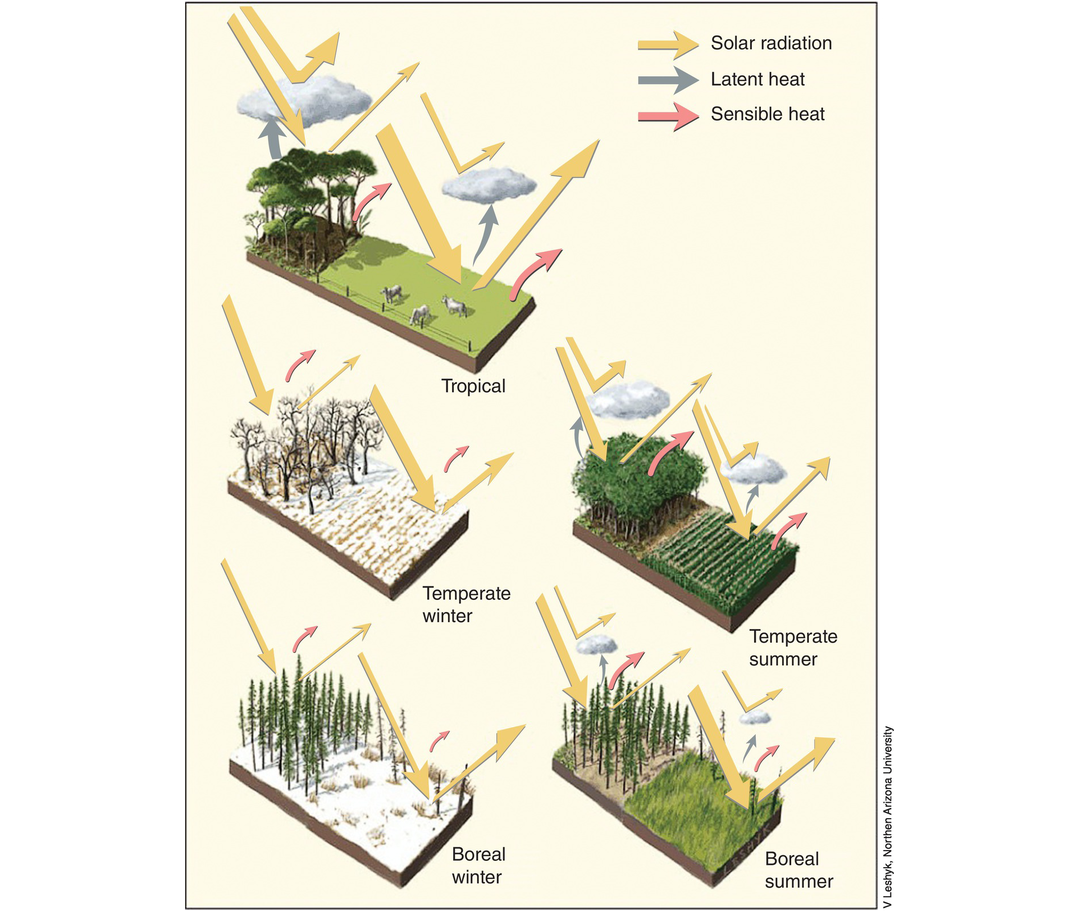
Figure 9.1
Effects of forest and non‐forest ecosystems on surface energy fluxes in tropical, temperate winter, temperate summer, boreal winter, and boreal summer scenarios.
Forests have greater heat fluxes than non‐forest ecosystems, resulting from their greater surface roughness. Tropical rainforests have large latent heat fluxes that result in the development of clouds, which reflect solar radiation back to space. Temperate and boreal forests have major seasonal variations in energy fluxes and can reduce seasonal cooling by masking snow.
From R. G. Anderson et al. Frontiers in Ecology and Environment, Biophysical considerations in forestry for climate protection. Copyright © (2011) by John Wiley & Sons, Inc. Adapted by permission of John Wiley & Sons, Inc.
9.4.1Tropical Forests
Tropical forests have the strongest air-cooling effect that continues throughout the year, as many trees are evergreen and continue growing. Evapotranspiration rate is very high, resulting in cooling and increased rain. The albedo of the trees causes air warming. The rate of evapotranspiration offsets warming caused by low albedo. Carbon storage is high, but is affected by drought, deforestation, and fires.
9.4.2Temperate Forests
Temperate forests contain both deciduous trees and conifers. As a result, albedo is higher than tropical forests, and evapotranspirational cooling is lower. Moderate cooling in summer and moderate warming in winter results in net cooling. Again, carbon storage is high, but affected by deforestation, drought, fires, and insects.
9.4.3Boreal Forests
Conifers in boreal areas have low albedo and low rates of evapotranspiration, resulting in low latent heat flux. Deciduous trees have higher albedo and higher latent heat flux. Overall, boreal forests warm somewhat with snow in winter and have moderate to weak cooling in summer. Carbon storage is low in trees, but high in soils and permafrost. Carbon storage is affected by frequent fires and logging.
9.5Conclusions
A large, wide-ranging body of literature was reviewed for assembly of the chapters that make up this book. A series of conclusions from the chapters that relate to background and research is presented in relation to the greenhouse effect, global warming, and the role of trees and forests in cooling or warming the atmosphere. These are followed by an answer to the question “Do forests cool or warm the atmosphere?” and a discussion of how this answer might change in the future.
9.5.1The Anthropocene: A New Epoch
Humans are significantly and directly influencing the physical and biological factors that regulate the functions of the Earth. This has resulted in continuing global warming. A new epoch, the Anthropocene, has been proposed to replace the Holocene. Global warming will continue as population growth and human needs and desires continue to grow.
9.5.2Carbon Dioxide
Carbon dioxide levels have risen from approximately 278 ppm, before the Industrial Revolution, to elevated levels at more than 400 ppm now. This is due to emissions from fossil fuel combustion, cement production, and deforestation. Forests and the oceans absorb much of the elevated carbon dioxide. What remains in the atmosphere, around 40%, is persistent anthropogenic carbon dioxide. This is the most prevalent non-condensable gas that regulates the greenhouse effect and global warming. Carbon dioxide thus controls the temperature of the Earth, and its reduction is essential to reduce temperature and global warming.
9.5.3Forests and Anthropogenic Carbon Dioxide
Models estimate that 20–30% of anthropogenic carbon dioxide is removed from the atmosphere by forests, through increased photosynthesis and transpiration and some carbon sequestration, resulting in some atmospheric cooling. This negative forcing by forests is considered a partial mitigation of present global warming.
Forests are not able to remove all the remaining anthropogenic carbon dioxide from the atmosphere. To do that, most cropland and natural ecosystems would have to be converted to forests. This would require 60% or more of US cropland.
9.5.4Trees and Future Elevated Carbon Dioxide
Many have proposed that trees might be able to continue to slow or even eliminate future global warming by using present and future increasing carbon dioxide for photosynthesis, transpiration, and carbon sequestration. A very large number of experiments have been conducted during the past 30-plus years, using predicted future levels of carbon dioxide exposures, ranging from 500 to 800 ppm. Experimental design and duration, exposure regimes, and the young age of the trees typically used prevent extrapolation of the results to large trees or to the forest. Initial growth stimulation from elevated carbon dioxide exposure either did not occur or was not sustained in the absence of sufficient soil nutrients, mainly nitrogen and phosphorus, and growth could also be limited by acclimation. These limits on growth could also limit possible increases in the partial mitigation of future global warming by forests.
Results from multi-year Web-FACE experiments with mature trees in Switzerland showed that elevated carbon dioxide did not increase tree growth. Similar results were found from several FACE experiments. There is also evidence that combined ozone plus carbon dioxide exposures could reduce or eliminate biomass gain caused by elevated carbon dioxide. It seems unlikely that increased growth and carbon sequestration by future forests will significantly increase the partial mitigation of global warming in the future by reducing carbon dioxide.
9.5.5Deforestation
Deforestation is the second largest source of carbon dioxide. Deforestation, particularly in tropical forests, continues as harvesting, land-use change, drought, bark beetle infestations, and fires increase. This reduces forest biomass for photosynthesis, transpiration, and carbon sequestration. Albedo increases in cleared areas result in cooler air temperatures. That increasing albedo, from very numerous, very large-scale afforestation and reforestation programs, especially with conifers, could increase air temperature would seem to be worth investigating.
9.5.6Tree Planting: Reforestation
In response to widespread deforestation, large-scale tree planting programs for reforestation have been proposed by the Paris Agreement conference, and others are in various states of implementation, sponsored by the United Nations, several international conservation groups, and national governments. The goal of long-term reforestation is to re-establish forests to increase forest biomass and carbon sequestration, and reduce or maintain global temperature. In some early tree planting programs, inappropriate tree species were used, and many new trees died. Credibility in reporting the extent and results of tree planting programs can be a problem.
9.5.7Tree Planting: Afforestation and Plantations
New areas are being used for tree planting to establish huge plantations of mostly single-species, fast-growing trees, especially in China. It has been estimated that these sequester 25% less carbon in trees and soils than native forests. Balancing transpirational cooling against warming from canopy albedo may be a problem. Many seem to be intended for scheduled harvests for wood. Encouraging natural reforestation by seeding or encouraging native tree species to regrow seems less expensive and labor-intensive, and a better long-term ecological strategy.
9.5.8Tree Planting: Long Life Matters
Tree species, growth rate, and wood storage capacity determine long-term carbon sequestration. Fast-growing, short-lived trees produce biomass quickly and sequester some carbon, but it mostly goes back into the atmosphere when they die. Slow-growing, long-lived trees sequester more carbon and retain it in wood. Carbon sequestration by trees is largely determined by how long carbon remains stored in living trees. Old-growth mature forests are living carbon reservoirs.
9.5.9Atmospheric Cooling and Warming
9.5.9.1Photosynthesis, Transpiration, and Albedo
Carbon dioxide, transpiration, and albedo determine atmospheric cooling or warming by forests. The physiological role of trees in forests in cooling or warming the atmosphere is determined by stomatal conductance and gas exchange. Carbon dioxide diffuses inward and is used in photosynthesis, with some carbon sequestered in wood. Photosynthesis thus promotes cooling by increasing the terrestrial carbon land sink. Water vapor diffuses outward in transpiration which results in evaporative cooling. Transpiration cools the air, promotes low cloud, and regulates the terrestrial hydrological cycle. The physical role of trees and forests in cooling or warming the atmosphere is determined by albedo. Low tree albedo levels, especially in dark conifer forests, result in low reflection of incoming solar radiation, and this can warm the atmosphere. The balance between transpiration and albedo directly determines cooling or warming of the atmosphere by forests.
9.5.9.2BVOCs and Ozone: Roles in Cooling and Warming
BVOCs from trees can increase atmospheric cooling by forming cloud condensation nuclei that lead to formation of low clouds. BVOCs from trees, mostly isoprene, are also part of the photochemical oxidant cycle that results in ozone formation above normal background levels. The raised ozone levels can injure leaves, reducing photosynthesis and biomass and carbon accumulation. BVOCs here may indirectly contribute to warming. Elevated ozone may reduce growth stimulation in response to elevated carbon dioxide. Ozone and ozone injury are declining in northern Europe and the eastern United States, but increasing in the Pacific Northwest, aided by long-range transport of ozone and precursors from Asia. Ozone and ozone injury continue to increase in Asia. Ozone remains a problem in forest health.
9.5.9.3Factors That Affect Cooling and Warming
Geographical, biological, environmental, and cultural factors affect the extent of atmospheric cooling and warming by forests. Latitude, growing season, forest species and species composition, available soil water and nutrients (especially nitrogen), BVOCs, ozone, fires, bark beetles, and drought affect growth and biomass production.
9.5.9.4Latitude and Forest Types
Results from models and satellite imagery have led to conclusions that latitude, tree species, and types of forest strongly affect cooling or warming of the atmosphere by forests. Boreal forests are largely coniferous, have low to moderate carbon storage, low transpiration and low albedo, and seasonal warming effects. Temperate forests have more carbon storage and transpiration, higher albedo, and moderate summer cooling and some winter warming. Tropical forests have the greatest cooling effects from year-round growth and photosynthesis and transpiration. Transpirational cooling is greater than the warming effects of the lower albedo of tree canopies. Carbon storage is usually assumed to be high, but this is currently questioned, and some people now consider that different tropical forests can be carbon sinks, carbon-neutral, or carbon sources (or are predicted soon to become carbon sources). These conflicting conclusions are of grave concern, as tropical forests are considered to be major sources of atmospheric cooling and carbon storage.
9.5.10Evidence of Cooling and Warming
Most of what is known or concluded about the role of forests in cooling and warming the atmosphere results from indirect evidence from models, satellite imagery, and spectral radiometry and lasers in various combinations.
9.5.10.1Shade
The air in the interior of many forests is cooler because of the shade. People instinctively seek shade in forests and parks, even under single trees, as refuge from high temperatures. There is evidence that the extent of tree plantings, canopy size, nature, and tree species determines atmospheric cooling in cities. The benefits of tree canopy temperature reduction are most effective when ambient air temperatures are high. Urban trees that shade buildings reduce energy use for cooling and thus carbon dioxide emissions from power plants.
9.5.10.2Forest Inventories and Forest Management
The nature of tree species influences atmospheric warming and cooling. Forest inventory data have been used to determine long-term trends in the effects of forest management and forest tree composition in Europe. Long-term replacement of deciduous trees over time with faster-growing dark conifers, mostly spruce, increased forest albedo and resulted in a small calculated increase in air temperature. Reduced growth and early carbon sink saturation has also been noted. Forest management is good for scheduled wood production, but the tree species used can have a definite effect on warming the atmosphere.
9.5.10.3FLUXNET Tower Forest Open Space Comparisons
Direct evidence has been obtained from extensive studies comparing surface temperatures and carbon dioxide concentrations between open land and lower-albedo adjacent forests, using eddy covariance FLUXNET tower systems. In general, forests have higher air temperatures, especially at night, than adjacent open areas.
9.6Do Forests Cool or Warm the Atmosphere?
The current answer to this question depends on the kinds of trees and forests and where they are. The latitude determines the length of the growing season, and the kind and color of the trees. This affects photosynthesis and the balance between transpiration and albedo that determines atmospheric cooling or warming by forests. Atmospheric cooling by forests decreases with distance from the equator, with the greatest cooling from tropical forests.
An answer about the future role of forests in partial mitigation of global warming by atmospheric cooling is less certain. The forests that provide partial mitigation of global warming now are under great pressure from deforestation, fires, drought, ozone, and insects. New evidence indicates that foliar nitrogen levels are decreasing as a result of extended growing seasons and increased photosynthesis. The role of tropical forests is controversial as to whether they are carbon-neutral, carbon sinks, or carbon sources. How this will affect forests in maintaining their current partial mitigation of global warming is not clear. It seems unlikely that forests will provide additional mitigation of global warming in the future.