
AS CHRISTMAS CAME to Europe in 1989, those who had long lived under the yoke of communism had many reasons to celebrate. In quick and unexpected succession, the authoritarian governments that had ruled over the eastern half of the continent since shortly after the Second World War had peacefully collapsed. Citizens who had long resisted communism’s countless injustices had begun to take their place in the governing chambers of Warsaw, Budapest, and Prague. On the night of November 9, the Berlin Wall had fallen, vanquishing the most oppressive symbol of Europe’s division and Eastern Europe’s captivity. East German citizens, separated for four decades from their freer and richer countrymen in West Germany, had begun to use a new slogan of unity—“Wir sind ein Volk” (We are one people)—and German reunification looked to be a real possibility for the first time since the early postwar years. In Moscow, Soviet general secretary Mikhail Gorbachev’s launch of glasnost and perestroika had transformed Soviet society, set Eastern Europe free to choose its own fate, and allowed all Europeans to imagine a future in which they lived in one “common European home” rather than two antagonistic blocs. In Washington, former US president Ronald Reagan had worked with Gorbachev to strive for a world free of nuclear weapons, and his successor, George H. W. Bush, would soon speak of a “new world order” that might yet deliver permanent peace and prosperity to a weary but hopeful world. Taken together, the evidence of political progress was so swift and overwhelming that observers had begun to speak of 1989 as an annus mirabilis, a year of miracles. After decades of stolid oppression, winds of hope and renewal were in the air.
But László Kézdi did not care. The end of the Cold War may have been a momentous development in the grand scheme of history, but it was little solace for Kézdi, a Hungarian pensioner living in Budapest, as he watched his economic security evaporate before his eyes. The Hungarian government was making life across the country worse with each passing day, and Kézdi could feel it. Government officials had announced that pensioners would be receiving a Christmas bonus to ease their economic woes, but the temporary cash infusion paled in comparison to the rising cost of everything in Hungarian society. By mid-December, Kézdi was fed up, and he took to the pages of one of the country’s leading newspapers to express his displeasure in an open letter to the nation’s chief financial official. “Minister of Finance László Békesi!” he began. “I am turning to you with the following respectful request: With the Christmas bonus . . . please also send me an appropriately long and sturdy rope as an extra gift. I do not think I need to detail what purpose this rope will serve.”1
Kézdi explained that he had earned his current state pension through forty-two years of hard work. Under the communist government, that pension had provided Kézdi with a comfortable, if unglamorous, life. But now the times were changing. Recently, the government had begun to raise prices on everything. Gas, electricity, mortgages, food, public transportation, and even medicine were all becoming more expensive. These price increases left Kézdi in a desperate bind, he wrote, unable to afford “a decent human life.” The grim prospects left him “no choice” but to contemplate the end of his days and make his special request. “Respected Mr. Békesi!” he concluded, “to lighten the burden on the state budget, I repeat my request: Please issue the extra bonus, a strong rope, to me. Thank you in advance, László Kézdi.”2
It was no accident that Kézdi’s biting missive appeared at a time of profound political change. Economic discipline—broadly defined as government policies that intentionally cause domestic economic hardship—was the cause of Kézdi’s sarcastic anger, and it was a potent political force in the last two decades of the Cold War.3 Nine years earlier, in the most powerful country on earth, the chairman of the United States Federal Reserve, Paul Volcker, had felt the brunt of a similar backlash. As his restrictive monetary policy put millions of Americans out of work and forced the country into the deepest recession of the postwar period, construction workers had expressed their anger by mailing the Fed chairman unused two-by-fours from houses they could no longer build. Car salesmen sent coffins to the Federal Reserve full of keys to unsold cars, and farmers blocked the Fed’s front entrance with their tractors to protest the rising costs of doing business.4 The stiff resistance to his policies led Volcker to conclude that policy makers always try to avoid causing economic downturns because “that is when the political flak ordinarily hits.”5
Despite their efforts at avoidance, leaders on both sides of the Iron Curtain were hit with the political flak of economic discipline many times in the 1970s and 1980s. This book is a history of why those moments of discipline arrived and how they produced two of the defining global transformations of the twentieth century: the peaceful end of the Cold War and the rise of neoliberal capitalism. Scholars have produced insightful work on both of these transformations, but they have not yet understood them as interconnected products of a shared history—specifically, the history of the world economy in the late twentieth century. Historians of neoliberalism—which I will define as a political ideology that to increase the free flow of goods and capital across state borders, increase inequality within nation-states, and limit the state’s role in the provision of economic and social security for its citizens—have long traced its intellectual history, but they have paid less attention to how its rise intersected with the Cold War.6 Scholars of the end of the Cold War have produced three decades of insightful scholarship, but they have generally given short shrift to the role of the global economy in causing the Cold War’s demise.7
This book aims to recover that role by focusing on three of the forces that dominated global political economy in the late twentieth century: energy, finance, and economic discipline.8 All three forces rose to prominence in the wake of the oil crisis of 1973, which is where our story will begin, and their intertwined histories over the following two decades significantly contributed to the end of the Cold War and the rise of neoliberal capitalism.
The histories of energy, finance, and economic discipline provide powerful analytical tools for examining these transformations because their widespread emergence in the 1970s and 1980s profoundly shifted the political, economic, and ideological terrain on which the Cold War was fought. When the conflict began in the 1940s, democratic capitalist and state socialist governments had raced to expand the social contracts that prevailed in their societies in order to win the hearts and minds of their populations. They had raced, in other words, to promise their people a better life and deliver on that promise. After the economic horrors of the Great Depression gave rise to fascism and world war, it was a fundamental premise of political life in both East and West after 1945 that a government’s chief domestic responsibility was to harness the forces of industrial modernity to improve the economic security and well-being of its people. Democratic capitalism and state socialism stridently disagreed about what mix of security and prosperity was best—unable to match the West’s prosperity, communist governments promised their citizens greater economic security—but their difference was one of degree, not of kind. Whether communist or capitalist, governments in the first two and a half decades in the Cold War raced to expand their social contracts.
I call this shared political terrain of the first half of the Cold War “the politics of making promises.” Capitalist and communist states competed with each other by offering their people two different versions of industrial modernity, two different sets of government promises. To be sure, governments did not make promises to all their citizens equally; the politics of making promises most often reinforced the racial, ethnic, and gender hierarchies that prevailed within countries. Nevertheless, welfare states emerged across the West in the middle of the century to redistribute the economic gains of the market, and governments empowered labor unions to allow the working class to share equitably in the benefits of industrial capitalism.9 In the East, Soviet leader Nikita Khrushchev used the Soviet Union’s decade of stellar economic growth and scientific advancement in the 1950s to declare that the country would reach communism—the final stage of economic advancement and social organization in Marxism-Leninism—by 1980. Along the way, the Communist Party would modernize the country through government-directed industrialization and provide its citizens with job security, housing, social mobility, plentiful food, quality education and health care, longer vacations, and shorter work hours.10 These conveniences were the fodder of postwar political legitimacy, and the two sides in the Cold War based their claim to superiority on their governments’ ability to provide a bountiful and equitable distribution of industrial modernity’s good life.
The economic crises of the 1970s upended the material basis of this competition and made the politics of making promises untenable. The emergence of energy and finance as potent forces in the global economy transformed the Cold War from a competition to expand social contracts into a competition to discipline them. Energy and financial markets placed immense pressure on governments on both sides of the Iron Curtain to adjust their domestic economies to meet the demands of the global marketplace. These adjustments came in many guises: deindustrialization, the drive to increase energy efficiency, competition with the newly industrialized nations of East Asia, and the broad shift from what economists call extensive economic growth (the production of more output by increasing inputs of capital, labor, and land) to intensive economic growth (the production of more output through a more efficient use of those inputs). Despite their varied forms, all these adjustments pointed in a single direction: policies of economic discipline.
This made capitalist and communist governments’ cardinal challenge in the 1970s and 1980s diametrically different from the one that had prevailed since 1945. Rather than racing to increase the well-being of their people, governments in both East and West were forced at times to decrease the economic prosperity and security in their societies. Rather than making promises, governments were forced to break them. Like the economic pressures to which they responded, these broken promises came in many forms: cutting subsidies to powerful interest groups, shutting down unprofitable companies, laying off redundant workers, imposing monetary and fiscal austerity, and liberalizing trade and capital flows. Despite these varied forms, breaking promises was always and everywhere an extremely difficult political act. No government, whether capitalist or communist, could take pleasure or pride in seeing it through. After 1973, however, this new “politics of breaking promises” became the terrain on which democratic capitalism and state socialism waged their contest, and the stakes of this new struggle were nothing short of existential. Governments that could successfully impose economic discipline without inviting a destabilizing social backlash would survive; those that could not would collapse.
Thus, this book argues the Cold War began as a race to make promises, but it ended as a race to break promises. Democratic capitalism prevailed in the Cold War because it proved capable of breaking promises and imposing economic discipline. Communism collapsed because it could not. Neoliberalism rose as the Cold War waned because its promarket, anti-statist rhetoric provided governments with an ideological framework for breaking promises. Electoral democracy and neoliberal ideology gave Western states the political and ideological tools to meet the challenge of breaking promises. Lacking these tools, the communist states of the Eastern Bloc democratized their political systems and reformed their ideology in the 1980s as a means of imposing economic discipline. The end of the Cold War, then, was a triumph of broken promises because it was the challenge of imposing economic discipline that ultimately brought the conflict to its end and gave rise to the neoliberal global economy of the late twentieth century.

Before proceeding, it is perhaps best to define what I mean by the end of the Cold War. What was it, and what is required to explain it?11 I have come to believe that the end of the Cold War involved four distinct processes that unfolded at the end of the 1980s:12 the end of the nuclear and conventional arms races between the Soviet Union and the United States,13 the end of the global ideological competition between democratic capitalism and state socialism,14 the peaceful collapse of communist states in Eastern Europe (with the brief exception of Romania) and the Soviet Union,15 and the reunification of Germany.16
Two things immediately stand out about these processes. First, they occurred both within and between nation-states. Second, they involved change in material and ideational structures—or, put more simply, power and identity. Each of the processes that comprised the end of the Cold War took place on a continuum of these four traits. The end of the nuclear arms race serves as an illustrative example. It clearly depended on both diplomacy between the superpowers and domestic politics within each state. But it also depended on significant changes in the relative standing of superpowers in the international system and changes in how the Soviet leadership understood its place in the world. The revolutions of 1989 were a different mix of changes in power and identity both within and between nation-states. A perquisite for the revolutions’ occurrence was the Soviet Union’s decision to refrain from intervening to stop them—a change between states—but they were also crucially determined by developments within Eastern European countries. The revolutions resulted from changes in material power—energy and capital markets, I will argue—but also from changes in how state socialist governments understood the socialist identity they had long espoused.
Thus, the first challenge in writing the history of the end of the Cold War is that it requires an explanation that integrates change across these dimensions—domestic politics and international relations, as well as power and identity. In the specific context of the end of the Cold War, this challenge means that explaining the end of the Cold War as a geopolitical conflict requires an explanation of the collapse of communism as a system of governance. The fact that so much of the end of the Cold War was determined by processes of domestic change means any history of it that only considers developments in international relations will be incomplete. The same holds true for material and ideational structures. Any explanation that considers only one or the other will be inherently limited. Therefore, the history of the end of the Cold War must include explanations across all four dimensions: change both within and between nation-states and change in both power and identity.
The second challenge of explaining the end of the Cold War is that it stands out in history for one profound reason: at every step of the way, those in possession of imperial and authoritarian power willingly and peacefully gave it up. This exceptional development occurred both within and between nation-states. The Soviet Union retreated from its pursuit of global confrontation with the United States as well as its empire in Eastern Europe, and at the same time, political leaders throughout the Eastern Bloc gave up power peacefully within their own societies (with Nicolae Ceauşescu in Romania again serving as a brief exception). This unique and fundamental characteristic of the end of the Cold War is what made it so difficult to predict before it occurred and continues to make it so difficult to explain in retrospect. Therefore, explanations of the end of the Cold War that lack a compelling reason for why those in possession of imperial and authoritarian power consistently gave it up in the late 1980s will remain incomplete.
A third challenge of the history of the end of the Cold War is timing. The Cold War persisted for four decades, long enough for one of its most perceptive observers to title it a period of “long peace” between the Great Powers.17 Then suddenly, in the late 1980s, it disappeared. The question of timing is therefore of predominant importance. Any compelling explanation of the end of the Cold War must attend not only to the question of why but also to the question of why then.
The last challenge of the history of the end of the Cold War is to explain the character of its principal outcome: the emergence, with varying degrees of success, longevity, and legitimacy, of electoral democracies and neoliberal market economies in the nation-states that formerly comprised the Eastern Bloc. In retrospect, it is easy to take these outcomes for granted, but as the end of the Cold War unfolded, few believed them to be foregone conclusions. Since neoliberal market economies and electoral democracies were not the only possible outcomes, why did they emerge? Answering this question is the final challenge of writing the history of the Cold War’s end.
This book meets these challenges on the basis of two foundations: the use of new and illuminating evidence from archives on both sides of the former Iron Curtain and the formulation of a new framework for connecting economic and political change in the late Cold War. This new framework begins from the conviction that the oil crisis of 1973 dramatically increased the importance of energy resources and financial markets in international politics. This increase was so decisive that it spurred a fundamental change in the global competition between democratic capitalism and state socialism: it privatized the Cold War.
For the first two and a half decades of the Cold War, energy and financial markets played relatively small roles in the politics of making promises in both East and West. Until its collapse in 1971, the Bretton Woods system pegged Western currencies to each other at fixed values and controlled the flow of short-term capital across national borders in the Western world. The global financial markets that would come to play such a large role in the 1970s and 1980s—known as the Euromarkets—did not exist in the 1940s, hardly existed by the end of the 1950s, and remained relatively small throughout most of the 1960s. The Eastern Bloc did not participate in the Bretton Woods system, but its member states maintained even firmer control over trade and finance than their Western counterparts. Eastern Bloc currencies were not convertible into each other or Western currencies, which meant they too were completely under governmental control. And other than a few banking outposts in the West that were used to conduct international trade, the bloc as a whole remained isolated from the nascent development of the Euromarkets.
As for energy, it was cheap and plentiful in the capitalist world and cheap and scarce in the communist world until the early 1970s. This simultaneous ubiquity in the West and scarcity in the East ironically made it less important in both blocs than it would become after 1973. In the West, oil’s low price and uninterrupted flow allowed governments to build mass-consumption industrial societies after the Second World War that showed little regard for oil’s use or country of origin. Only after 1973 would Western societies awaken to the implications of their fervent consumption of a commodity whose price and production levels they did not control.18 In the East, the Soviet government spent the 1950s searching its vast hinterland for oil deposits, and in the 1960s, it struck black gold in western Siberia, where it found some of the largest oil fields in the world. Developing these fields took time, so it was only in the early 1970s, right before the oil crisis struck, that the Soviet Union and, by extension, the entire Eastern Bloc enjoyed “for the first time the luxury of cheap and efficient energy.”19 After the oil shock, this luxury would fill the Kremlin’s coffers through oil and natural gas exports to the world market, and energy would become the material basis of Soviet power. This was squarely a post-1973 development, however. For the first two and a half decades of the Cold War, neither energy nor finance played a significant role in the race to make promises in both East and West.
Instead of energy or finance, both Eastern and Western states based their power and legitimacy before 1970 on something else: industrialized economic growth. As shown in Figure I.1, the global economy experienced a historically unique period of high growth in the three decades following the Second World War. Nothing like it had come before, and nothing like it has come since.20
Because of this growth, people around the world, but particularly within the Eastern and Western Blocs, experienced sustained increases in their standard of living on a scale never before seen in human history. In the capitalist world, this period would be remembered under a number of names that signal its uniqueness: the West Germans called it the Wirtschaftswunder (the economic miracle), the French called it les trente glorieuses (“the glorious thirty” years), and historians now simply refer to it as “the golden age” of capitalism.21 Not to be outdone, the Eastern Bloc matched the growth of the capitalist West during this period. Over the entire period 1950–1973, per capita GDP grew at an average annual rate of 4.1 percent in Western Europe, 2.5 percent in the United States, 3.8 percent in Eastern Europe, and 3.4 percent in the Soviet Union.22 The two blocs, of course, were not economic equals. The West began the postwar period as a vastly richer territory and remained vastly richer in the early 1970s. Moreover, mass consumption became a reality in the West while it remained only a far-off aspiration in the East. But for the first two decades of the Cold War, Eastern Bloc governments could credibly claim to be matching or exceeding the growth of the West.
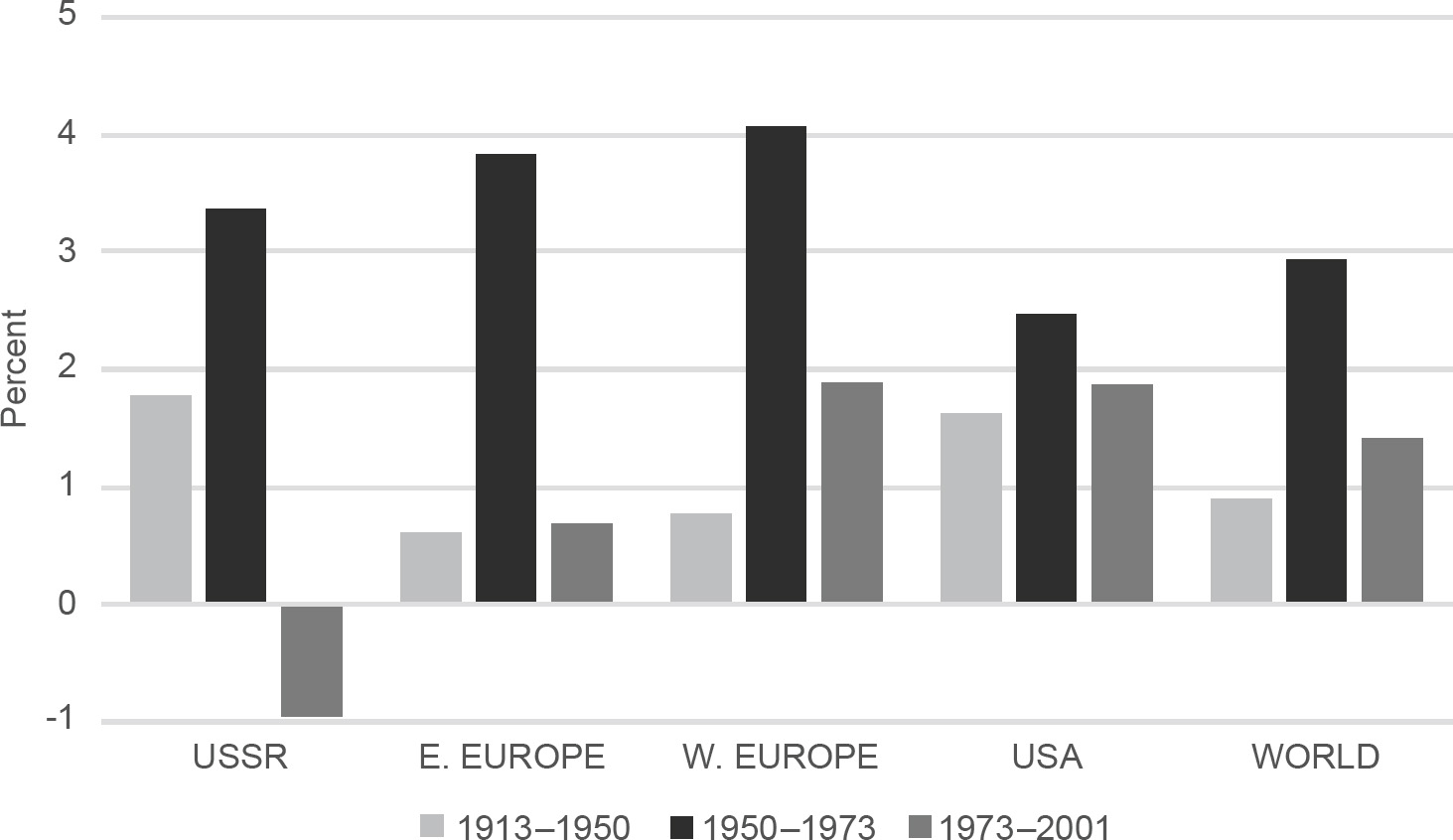
Figure i.1 Average annual per capita economic growth in three periods.
Data source: Angus Maddison, The World Economy: Vol II, Historical Statistics (Paris: OECD, 2006), 640, table 8b.
Perhaps the most famous moment in this early race to make promises came in 1959, when Soviet first secretary Nikita Khrushchev and US vice president Richard Nixon met in Moscow for their famous impromptu “Kitchen Debate.” As they toured an American exhibition hall meant to show off the many material benefits of the capitalist way of life, the two leaders began debating the merits of their respective systems. In front of a global TV audience, Nixon sang the praises of his system, which could provide “any steel worker” with an affordable home complete with a dishwasher and color television. Khrushchev boasted that under communism, workers were “entitled to housing” and stated that in another seven years the Soviet Union would be “at the level of America, and after that we’ll go farther. As we pass you by, we’ll wave ‘hi’ to you, and then if you want, we’ll stop and say, ‘please come along behind us.’”23 For its first twenty-five years, then, the Cold War was a competition between two systems of government promises underwritten by unprecedented economic growth.
Then, around 1970, something unexpected happened. Contrary to the confident predictions of both democratic capitalism and state socialism, economic growth in both systems severely stagnated. The causes of this stagnation were manifold. The rapid economic gains accompanying postwar reconstruction were exhausted; extensive growth had run its course; workers’ incomes bulged in the late 1960s while their employers’ profits cratered; and most importantly, productivity began a long-term decline from which it has yet to recover.24 Normally, international historians only focus on the rigid economic stagnation of the Eastern Bloc during the 1970s and 1980s. But “The Great Slowdown” and “The Descent of Growth” are subtitles in the leading histories of capitalism, not communism, for the period after 1970.25 Only in the 1980s, after growth had recovered slightly and inflation had significantly receded in capitalist countries, did Western confidence in the natural superiority of capitalism over communism return. Throughout the 1970s, the West’s economic problems appeared equally intractable to any of those bedeviling the East.26
It was in this context of slower growth that the oil crisis of 1973 burst onto the scene and changed the world economy and the Cold War forever. The fourfold increase in the price of the world’s most important commodity (Figure I.2) gave birth to both the pressure to break promises and the means of avoiding that pressure. On the one hand, the price shock made the energy-intensive industrialized economies of both East and West obsolete and ignited the long-term transition to a deindustrialized developed world. Countless bankruptcies, job losses, and moments of austerity over the next three decades flowed from this fundamental change in the global economy. On the other hand, that same fourfold increase accelerated the development of two vast pools of wealth—global capital markets and energy resources—that nation-states could use to avoid making the difficult transition to a world of high energy prices.
The meteoric rise of financial and energy wealth in the 1970s gave rise to the defining feature of the privatized Cold War: nation-states’ guns and butter became dependent on finance and oil. As long as states had access to either global capital markets or energy wealth, they could continue to fund their foreign and domestic policies and delay adjusting to the shocks of the oil crisis. They could, in other words, continue to fight the Cold War abroad and make promises at home.
If, however, states lost access to one or both of these pools of wealth, then they would have to implement the politics of breaking promises to regain the favor of capital markets or outlast a downturn in world energy prices. Breaking promises could force governments to alter both their domestic and foreign policies through cutbacks on commitments to domestic constituencies, international allies, or national defense. In the chapters that follow, we will observe instances of all three.
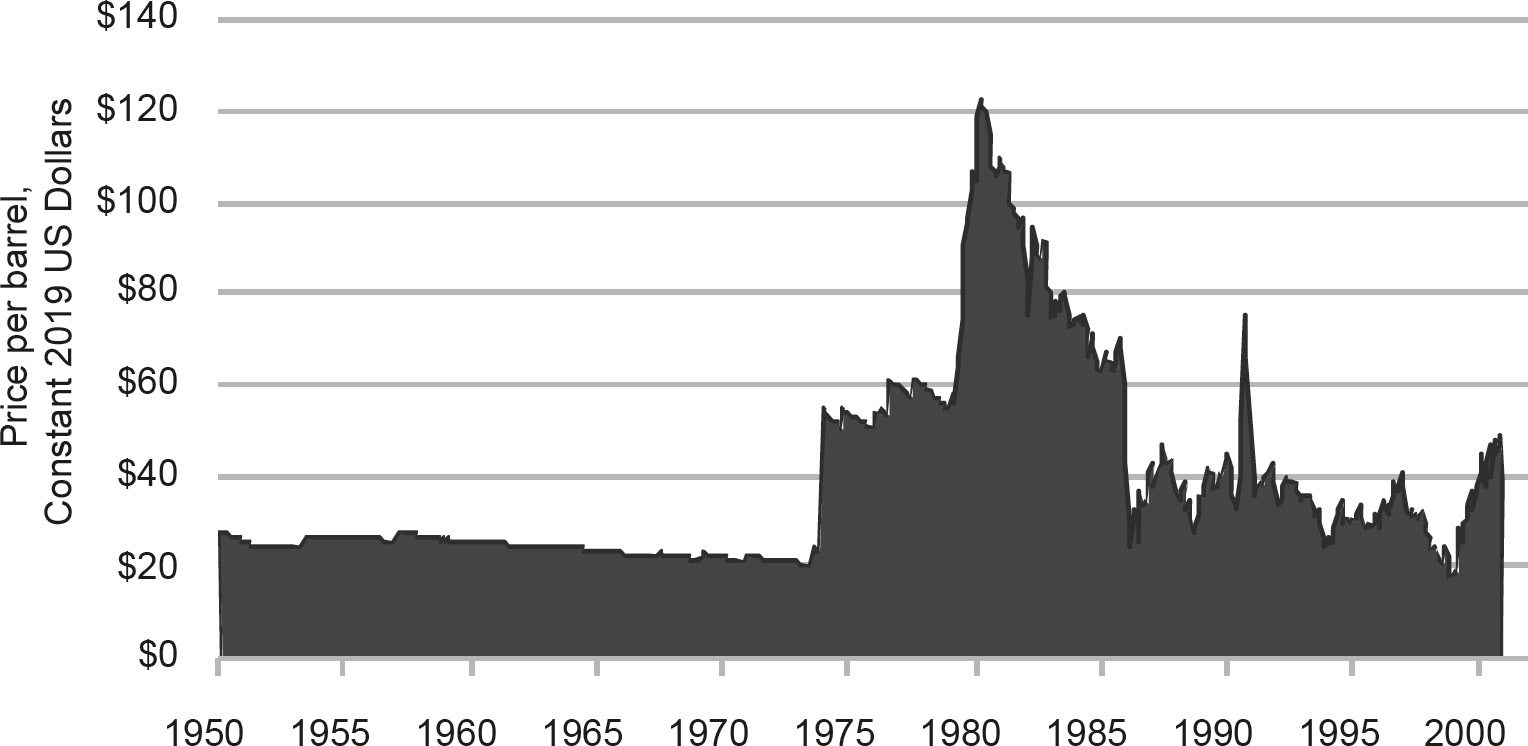
Figure i.2 The world price of oil in the second half of the twentieth century.
Extracted and reformatted from “Crude Oil Prices—70 Year Historical Chart,” MacroTrends, accessed Jun5, 2021, https://www.macrotrends.net/1369/crude-oil-price-history-chart.
This meant that at the heart of the privatized Cold War was a social question: how to discipline the postwar social contracts that had developed in both the East and the West after the Second World War. States’ ability to break promises would prove to be the key difference between those states that survived and those that went extinct. Placing this social question at the center of the privatized Cold War means that ideology and domestic politics are essential components of its history. National leaders needed to justify revisions to the social contract in ideological terms to domestic constituencies. To meet this challenge, political leaders transformed their state’s governing ideologies and domestic political structures during the privatized Cold War. As we will see, the success or failure of these transformations proved decisive.
Therefore, on the fundamental question of the relationship between economic and political change, this book adopts a very particular point of view, and it is here that the history of the Cold War intersects with the history of neoliberalism. In the privatized Cold War, the economic challenge of breaking promises drove governments to adopt political and ideological “new thinking” in both East and West. Cold War historians normally identify “new thinking” as the particular idealistic movement that arose among the reformers around Mikhail Gorbachev in the Soviet Union. But when one pulls back from the particular context of Soviet history, it is clear that many governments on both sides of the Iron Curtain adopted new thinking of various types during the 1970s and 1980s. These new forms of thinking emanated from diverse ideological traditions, but they shared one commonality—they were all approaches to implementing economic discipline. They were all, in other words, neoliberal approaches to governance.
This is not to say that change in the global economy completely determined the creation of new thinking, but rather to argue that it drove the adoption of new thinking within governments and societies. Whether it was Thatcherism in Great Britain, monetarism and deregulation in the United States, perestroika and glasnost in the Soviet Union, or roundtable democratization in Poland and Hungary, governments in power adopted these forms of new thinking because they appeared to provide the ideological and political means required to achieve the end of breaking promises.
Margaret Thatcher and Mikhail Gorbachev are often held up as paragons of opposing types of “new thinking” in the 1980s: Thatcherism and perestroika, respectively. But Gorbachev’s and Thatcher’s own thinking on the relationship between perestroika and Thatcherism suggests more similarities than first meet the eye. In 1987, the general secretary recounted to his comrades in the Soviet Politburo his recent interactions with Western European leaders, Thatcher most prominent among them. “They too are carrying out a perestroika,” he told his comrades. They “act harshly . . . the capitalist way,” he continued, and the Soviets had “a different situation and different ideas.” But, he said, “we too cannot flinch.”27 Two years later, Thatcher also saw a parallel. In a 1989 meeting with Gorbachev, she told the general secretary that she empathized with the immensity of his challenges because she had launched “an analogous perestroika” in her country.28 Energy and finance thrust the challenge of breaking promises onto nation-states after 1973, and domestic political orders and ideologies adjusted to meet the challenge.
They converged, in fact, toward neoliberalism. By the late 1980s, governments on both sides of the Iron Curtain were trying to increase the free flow of goods and capital across their borders, governments on both sides were trying to limit the state’s role in the provision of economic and social security for their citizens, and governments on both sides were trying to increase inequality within their states. Thatcher’s and Gorbachev’s comparisons to each other were not mere word play; they were instead mutual recognitions of a shared challenge and even a shared goal—carrying out painful domestic economic reforms in the hope of relaunching economic growth in their countries.
Though the domestic challenge of breaking promises ultimately determined nation-states’ fate in the privatized Cold War, developments at the international level were of vital importance as well. Indeed, through energy and financial markets, developments in the international system were what forced governments to address the challenge of breaking promises domestically. Although these changes occurred at the international level that did not mean they were necessarily products of interstate relations. The privatized Cold War was a world in which state and nonstate actors vied for influence and control. Many changes in energy and financial markets were outside the control of any particular nation-state. In the privatized Cold War, nonstate economic and financial actors were often as important as, and many times even more important than, governments. This was the period when the nebulous but all-important opinion of “the market” began to decide the fate of nations.
Governments could not fully control energy or financial markets, but they could wield power in the privatized Cold War by altering other states’ access to energy or finance. Statecraft in this new international system consisted of granting or denying other states’ access to energy and financial resources, and late Cold War diplomacy reflected this reality. In the 1970s, the Soviet Union and its Western adversaries fought a quiet battle for control of Eastern Europe through energy and capital markets—the Soviets by granting its bloc allies growing and subsidized deliveries of oil and natural gas, and the West by granting Eastern Bloc states growing and subsidized access to global capital markets. In the 1980s, the process reversed. The Soviet influence over the bloc waned as the growth and subsidy of its energy deliveries tapered off, and the West’s influence increased as it sought to attach conditions to the Eastern Bloc’s access to credit.
Therefore, statecraft mattered in the privatized Cold War. But the power of diplomacy was always limited by the fact that nation-states, even very powerful ones like the United States and the Soviet Union, could never completely control other states’ access to finance and energy. The opinions of global market actors always existed alongside Cold War statecraft, and together they were the two key international determinants of any state’s access to energy and finance in the privatized Cold War.
It will not surprise the reader that this privatized Cold War framework closely maps onto the dimensions of change identified at the beginning of this introduction. The privatized Cold War produced changes within and between states, as well as changes in power and identity. This close alignment means that the framework I have outlined can potentially explain the collapse of communism as a system of governance and, in so doing, can explain the end of the Cold War as a geopolitical conflict.
Providing such an explanation will be the central task of the chapters that follow. The book is divided into two parts. Part 1 is devoted to explaining the emergence of capital markets and energy resources as decisive forces in international politics and the shift from making to breaking promises in East and West after the oil crisis of 1973. Its overriding message is a straightforward one: between 1973 and 1985, democratic capitalist states successfully met the challenge of breaking promises and communist states did not. This disparity left Western governments in a strong domestic position by the mid-1980s and gave them leverage in the form of sovereign debt over many of the socialist states of Eastern Europe. This debt would prove decisive to the Cold War’s end. In Part 2 I take up the four processes identified earlier as central to the end of the Cold War: the end of the nuclear and conventional arms race, the end of the global ideological competition, the collapse of state socialist governments, and the reunification of Germany. Here we will see how the intertwined histories of energy, finance, and economic discipline produced the dramatic events we now call the collapse of communism and the end of the Cold War.
Though I discuss many countries throughout the Eastern and Western Blocs, I have focused this history on Poland, Hungary, East Germany, and the Soviet Union in the East and Great Britain, the United States, and to a lesser extent West Germany in the West. The focus on events in Washington, Moscow, Bonn, and London hopefully begs no questions. But the choice of Poland, Hungary, and East Germany out of the states in Eastern Europe requires further explanation. I focus attention on these three countries because they initiated the seismic changes of 1989. Other countries in the region had their own unique histories of debt, energy, and economic discipline—Romania, for example, infamously paid back its debt at a severe cost to its own people, while Czechoslovakia escaped severe Western financial dependence—but they were not the countries leading the push for change in 1989. In order to explain the stunning developments of that year, one needs to explain the particular course of events in Warsaw, Budapest, and East Berlin.
There is one other country whose absence from the book deserves explanation. Since the late 1970s, the People’s Republic of China has accomplished its remarkable rise to global power by doing many of the things the communists in this book failed to do: introducing market reforms, jettisoning the content of its ruling ideology, and, most tragically, violently repressing its citizens’ calls for change in 1989. In this way, it would appear to present a significant challenge to the argument presented here. But it is important to recall that China began its reforms from a very different starting point than the Soviet Union, the countries of Eastern Europe, or, for that matter, the developed nations of the West. Rather than being an industrialized country where manufacturing and heavy industry formed the backbone of the economy, China in the 1970s was an overwhelmingly rural and agrarian society where over 80 percent of the population still lived in the countryside.29 Instead of having a politically sclerotic government where entrenched bureaucratic and economic interests resisted reform, China in the 1970s had just emerged from the Cultural Revolution, in which the state’s governing hierarchies, ideology, and daily life had been thrown into disarray. And because chaos and destitution were such widely shared experiences across China in the 1970s, large sections of the population (beginning, most importantly, with the country’s farmers) clamored to be set free from the state’s economic control.30 These differences did not rigidly predestine the course of reform in Beijing, but they did make the Chinese transformation altogether different from the countries under consideration here. The politics of breaking promises were not absent in China, but overall, the reform experience was one of managing industrialization and economic growth, not deindustrialization and economic discipline.31
Through the countries this book does focus on, it aims to provide a new interpretive framework for understanding the end of the Cold War and the rise of neoliberalism as interrelated products of global economic change in the late twentieth century. To do that, it will finally have to answer the three questions identified at the outset: Why did the holders of imperial and authoritarian power in the Eastern Bloc willingly give it up? Why did they do so at the end of the 1980s? And why did electoral democracies and neoliberal market economies emerge from the ashes of state socialism?
My answers to these questions rest in the politics of breaking promises. In the global economy that prevailed after the oil crisis of 1973, the only practical purpose of the Soviet empire in Eastern Europe was to insulate socialist states from the pressure of breaking promises. This insulation, which came in the form of subsidized energy and other raw material deliveries, was extremely costly. By the early 1980s, the Soviet leadership decided that protecting its allies from the pressures of the global economy was in fact too costly, and they committed themselves to lowering these costs, even if it meant risking the loss of the empire itself. When Gorbachev informed his allies of the repeal of the Brezhnev Doctrine, he was not self-consciously liquidating the Soviet empire but rather breaking the promise the Soviet Union had made to its allies since the oil crisis to protect them from the disciplining demands of the global economy. When the empire crumbled in 1989, Soviet leaders peacefully accepted the result because they no longer believed that protecting Eastern Europe from the challenge of breaking promises was in the Soviet Union’s national interest.
The loss of Soviet imperial protection from the global economy, however, did not automatically lead the holders of authoritarian power in the Eastern Bloc to peacefully give up their power within communist states. Instead, they gave up their power in the late 1980s in order to gain the political legitimacy they believed was necessary to implement the politics of breaking promises within their own countries. Beginning with Gorbachev’s launch of perestroika and glasnost and extending through the roundtable negotiations in Poland and Hungary, communist leaders proactively tried to legitimize their power so they would, in turn, be able to discipline their domestic social contracts. When it became clear to communist leaders that their attempts to legitimize their power would, in fact, result in their loss of power, they chose not to violently prevent that loss because they understood that the challenge of breaking promises would still remain. Under the politics of breaking promises, there were no spoils for the powerful and victorious, only costs. Communist leaders chose to let their successors bear the burden of the costs that came with breaking promises.
These stunning events in the Soviet empire and within communist states happened when they did because the global history of energy and capital markets made the challenge of breaking promises unavoidable within the Eastern Bloc by the late 1980s. Access to Soviet energy and Western capital markets allowed bloc governments to delay the task of disciplining their social contracts throughout the 1970s. But the advantage of Soviet oil deliveries to Eastern Europe and Western capital markets’ confidence in the region peaked in the early 1980s and never fully recovered. Thus, the timing of the end of the Cold War was a product not only of individual agency and historical contingency but also of structural developments in the international system dating back to the oil crisis.
Electoral democracy and neoliberal market economies emerged in the East after the collapse of communism for the same reason they survived in the West during the last two decades of the Cold War—they were the best political and economic systems for breaking promises. Democratic capitalist states were not immune from the challenges that befell the communist world in the late Cold War. They too had to rewrite their postwar social contracts in the 1970s and 1980s. But they succeeded where the East failed because their political systems and ideological traditions gave them a number of decisive advantages.
First, although Western governments made numerous promises to their people during the first three decades of the Cold War, they never promised to control every aspect of their society and economy. Even at the height of postwar Keynesian planning, democratic capitalist governments maintained a distinction between “the state”—an area of society they controlled—and “the market”—an area of society they regulated but did not fully control.32 This stood in stark contrast to their communist counterparts, who proudly claimed that the very foundation of their power and legitimacy rested precisely on their control of the entire state, society, and economy. Democratic capitalist governments made fewer promises to their people, and this meant they had fewer promises to break.
Breaking promises nevertheless did not come easy in the West. Indeed, over the course of the 1970s, many of the smartest observers of Western governments believed that democracies’ persistent inability to impose economic discipline might prove to be their fatal flaw.33 The experience of the 1980s proved the exact opposite to be true. The rise of Margaret Thatcher in the United Kingdom and Ronald Reagan in the United States demonstrated that the potent combination of electoral democracy and neoliberal ideology could produce a stronger and more adaptable state than socialist authoritarianism in the era of breaking promises. Though elections forced democratic governments to respond to the interests of their populations, they also provided democracies with a peaceful and stable way to transform their governing ideology. Thatcher and Reagan radically departed from the ideological paradigms of postwar Britain and the United States, but in both countries, the state itself survived. Authoritarianism provided state socialist governments with no such mechanism for stably reforming and adapting their ideology. As soon as Gorbachev tried to reform the governing ideology of the Soviet Union, it produced severe instability throughout the socialist world and ultimately led to the Socialist Bloc’s collapse.
If elections provided Western states the political means to break promises, neoliberalism provided the ideological ends. Once in power, Thatcher and Reagan revived the rhetorical tradition of economic liberalism that had lay dormant in the West during the heyday of Keynesian promise making in the postwar period. With its championing of individualism and criticism of all forms of government intervention, this neoliberalism provided an expedient ideological framework to justify breaking promises. Here, again, state socialism’s ideological tradition provided no such recourse. Gorbachev attempted to craft an ideology of breaking promises through perestroika, but he consistently struggled to place it within the tradition of Marxism-Leninism. Eventually, he simply abandoned Marxism-Leninism altogether.
All this suggests a peculiar and troubling kind of Western triumph in the Cold War, but it is the only kind of triumphalism the end of the Cold War can teach us. We should have no problem stating that the West won the Cold War, but we should recognize clearly why it did. Democratic capitalism prevailed because it proved capable of imposing economic discipline on its own citizens. Communism collapsed because it could not. And neoliberal democracy emerged in both East and West from the Cold War’s ashes because it was the best ideological system for breaking promises. The triumph of broken promises is a theme to which we will return in the conclusion. But first, we must begin with the crisis that forever changed the global economy and the Cold War. In the early 1970s, the price of oil suddenly quadrupled, and the world was never again the same.