
CHAPTER 10
IN THE DAYS after the Berlin Wall fell, West German chancellor Helmut Kohl did everything in his power to temper his dreams of German unity. The scenes of East Germans crossing into West Berlin and West Germans standing atop the Wall were joyous signs that a better, freer life for all Germans might take shape. But a politician of Kohl’s stature and experience needed no reminder that his nation’s fate did not ultimately lie in German hands. Since the defeat of Hitler’s armies in 1945, it had been the victorious powers of the Second World War—the United States, Soviet Union, Great Britain, and France—that held legal jurisdiction over German lands, and it had been the world’s two superpowers that held ultimate control over the so-called German question. The Cold War had begun in the late 1940s because neither the Soviet Union nor the United States was willing to let the totality of German power fall into the other’s hands, and over four dangerous decades, both sides had threatened the world with nuclear annihilation to prevent the delicate balance of power in the heart of the European continent from changing.
Jubilant though it was, the fall of the Berlin Wall had not altered this well-worn reality. The Soviet Union still maintained 380,000 troops on East German territory. Under any theory of politics, narrative of history, or tenet of ideology, the Kremlin had no reason to retreat from German soil, at least not without extracting significant concessions from the West. Moscow’s right to determine Germany’s fate was both the ultimate prize for its victory over Nazism and its ultimate security guarantee against future Western aggression. Kohl, therefore, tried to be realistic about the prospects for change. “It would take five or ten years to achieve unity,” he told his close aide Horst Teltschik. “Even if unity was not achieved until the end of this century, it would still be a historic stroke of luck.”1
He need not have been so modest. Eleven short months later, on October 3, 1990, the chancellor stood in front of the Brandenburg Gate in Berlin surrounded by throngs of citizens to celebrate the unification of their country. Rather than being a long and tortured affair, the process of unification had been surprisingly quick and easy. And rather than making concessions to facilitate the Kremlin’s agreement, Kohl and his allies in the Bush administration had gotten everything they desired: quick and peaceful unification, the promised removal of all Soviet armed forces from German territory, and the accession of the newly unified Germany to the North Atlantic Treaty Organization (NATO). Their victory had been complete, and the global balance of power had peacefully and fundamentally shifted in the West’s favor.
How could this process unfold with such speed and amity after decades of rancor and danger? History tells us that changes in the balance of power are usually violent and destructive occurrences, so the reunification of Germany stands out as an anomaly. In accounting for the stunning turn of events, scholars and former policy makers have largely focused on the agency of diplomatic elites and the contingency of the diplomatic processes that led to German unity. If not for men like George H. W. Bush and Helmut Kohl, and their deputies James Baker and Horst Teltschik, these authors claim, German unification may not have happened at all or may not have unfolded on Western terms.2
This chapter takes a different view. The actions of Western diplomatic elites and processes of international statecraft were indeed important factors in German unification, particularly in consolidating Western governments behind the goals of perpetuating NATO and keeping a united Germany fully integrated into the alliance. But the ultimate causes of the peaceful shift in the balance of power did not lie in the West. They lay, instead, in two aspects of Eastern political economy: the collapse of the East German state and economy after the fall of the Berlin Wall and Mikhail Gorbachev’s unwillingness to implement the politics of breaking promises in the Soviet Union.3 These were the causes propelled unification forward with such shocking speed, and these were the sources of the Kremlin’s precipitous turn to pliability on the German question after decades of intransigence.
Consider the view from Gorbachev’s Kremlin. Given that neither he nor any other leading Soviet official wanted to use violence in Central Europe, Gorbachev would have needed to implement two policies with significant economic consequences to resist German unity.4 First, he would have had to divert substantial resources from the Soviet economy to prevent the collapse of the German Democratic Republic (GDR). The fall of the Berlin Wall transformed German unification from an intractable geopolitical impasse into an immediate economic challenge. The unrelenting march of hundreds of thousands of East German citizens westward created a sieve in the East German economy and society. Only governments that could slow this exodus and arrest the economic collapse had the power to determine the speed and direction of events. The West German government obviously held such power; if the Soviets had wanted to resist the rush to German unity, they would have needed to exert such power too.
Second, Gorbachev would have had to impose the politics of breaking promises in the Soviet Union. Because of the collapse in world energy prices and Gorbachev’s failure to impose economic discipline in the first five years of perestroika, by early 1990 Western banks would only lend to Moscow with the support of their governments. This meant that the Kremlin’s access to hard currency depended on the political opinion prevailing in Western capitals. If Gorbachev had meaningfully resisted German unity on Western terms, Western goodwill would have quickly evaporated, and Moscow would have lost all access to global capital markets. Out of pure financial necessity, the politics of breaking promises would no doubt soon have followed.
Gorbachev, therefore, faced a choice between supporting the Soviet social contract at home and securing the Soviet empire abroad. To save the empire abroad, the Soviet leader would need to impose economic discipline at home; and to avoid imposing economic discipline at home, he would need to give up the empire abroad. He would either need to discipline or retreat. Throughout the process of German unification, Gorbachev consistently chose to retreat from abroad to minimize economic discipline at home. As long as he did so, Western policy makers were pushing against an open Soviet door in Central Europe in late 1989 and 1990. Unless the Soviet leader was willing to break promises at home, there was no plausible alternative to Washington’s and Bonn’s most ardent desires: a peaceful Soviet retreat from the European continent and a united Germany in NATO. Without economic discipline in the Soviet Union, German reunification on Western terms was inevitable.
Dealt the winning hand by history, West German and American policy makers played it skillfully. Alone among Western leaders, George H. W. Bush fully supported Kohl’s drive for German unity as long as the West German chancellor promised to keep Germany in NATO and American troops in Germany. Kohl was happy to make this deal, and the Americans’ support steeled his conviction as he aggressively used the tools of the privatized Cold War to seal German unity. Kohl well understood the leverage hard currency and credit market access gave him in East Germany and the Soviet Union, and he used it to great effect. To win the hearts and minds of the East German population, he offered them unlimited access to the scarcest good the GDR had known: the deutsche mark. And to secure Soviet acquiescence, he offered Gorbachev over DM 20 billion in grants and loans to facilitate the Soviet Army’s departure from German soil and the Kremlin’s acceptance of a united Germany in NATO. On October 3, 1990, Germans united and the Cold War ended—not with a bang, but with a checkbook.

“History left us with good cards,” Kohl told Bush after the Berlin Wall fell. “I hope with the cooperation of our American friends we can play them well.”5 Kohl and Bush had plenty of reasons to like their hand. The capitalist perestroika that had unfolded in the West since the Volcker Shock at the turn of the 1980s had left the Western world in a resurgent economic position, and Western governments maintained a stability and self-confidence born of renewed material prosperity. The biggest beneficiary of this renewal was the Federal Republic of Germany (FRG). Perhaps Bush summarized Bonn’s economic position best when he told Kohl simply, “You’ve got deep pockets.”6
Mikhail Gorbachev’s Soviet Union, by contrast, found itself by the autumn of 1989 in economic free fall. Four years into Gorbachev’s tenure in the Kremlin, his unwillingness to impose economic and financial discipline on Soviet society had left the country mired in socioeconomic crisis. Shortages of basic goods were mounting, and the population’s patience with reform was waning. Worst of all—and as was true with all instances of the politics of breaking promises—the solution to the country’s economic problems appeared to be politically impossible. “What is the solution?” Soviet premier Nikolai Ryzhkov rhetorically asked the Politburo in February 1989. “Price increases? But this means social tension that threatens perestroika.”7
Even without price increases, social tension in an economy of profound shortage was not long in coming. In July 1989, a wave of strikes involving over 170,000 miners broke out across the country. The miners walked off the job in protest over declining living and working conditions and only returned to work after the Kremlin partook in a new round of promises to improve housing, work environments, and the supply of food. How these promises could possibly be kept given the prevailing economic crisis was anyone’s guess, but the strikes served as a warning of the resistance that would greet any attempt to impose economic discipline.8 Gorbachev, like Ryzhkov, was at a loss for what to do but urgently aware that something must be done. “We have a year, maximum two” to fix the economy, he told the Politburo at the end of June. “Otherwise, we’ll have to resign.”9
If prices were left untouched, only the world market could fill the yawning void between supply and demand in the economy. By the start of 1989, however, this too was becoming problematic. A burgeoning hard currency crisis had begun to compound the domestic economy’s litany of foibles. This was a novel development for the Kremlin. Though its allies had dealt with severe sovereign debt problems throughout the 1970s and 1980s, the Soviet Union’s vast natural resources had allowed it to avoid any significant dependence on Western capital. But the oil price collapse of 1985–1986 and the economic reforms of the early years of perestroika had not been kind to Moscow’s balance of payments (see Figure 10.1 for the decline in Soviet hard currency energy export earnings). By early 1989, serious questions had emerged on global capital markets about the Soviet Union’s creditworthiness. In March, Yuri Moskovskii, president of Vneshekonombank, the Soviet foreign trade bank, wrote to Ryzhkov, “The growing debt of the Soviet Union is increasingly becoming the object of close attention and speculation in the Western press.” As a result, he concluded, banks had recently “shown a more cautious attitude towards providing untied loans [i.e., loans not connected to a specific trade or investment project] to the Soviet Union.”10
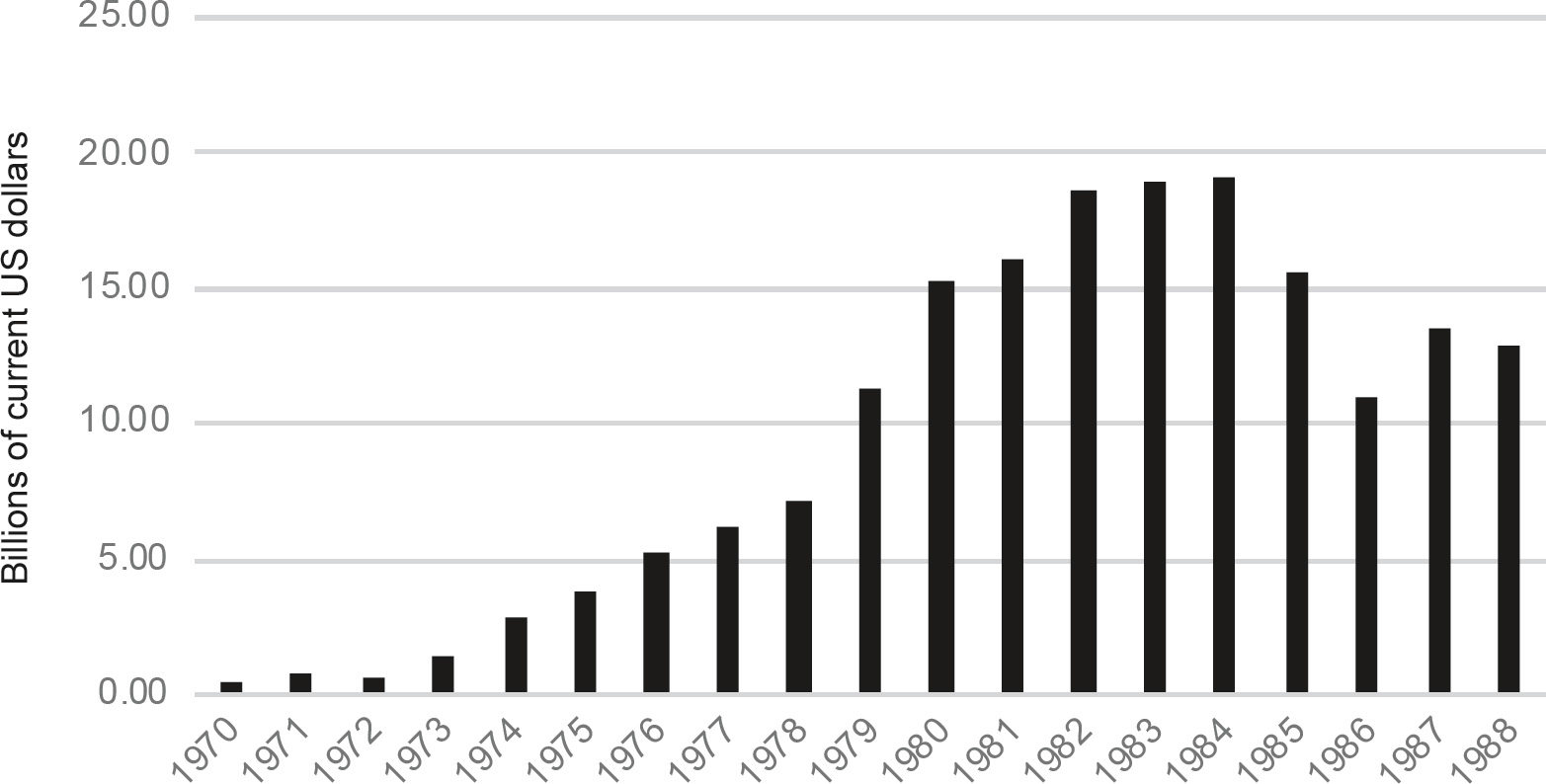
Figure 10.1 Soviet hard currency energy export earnings.
Data source: Central Intelligence Agency, Soviet Energy Data Resource Book, May 1990, CIA Online Reading Room, accessed February 20, 2020, https://www.cia.gov/library/readingroom/docs/DOC_0000292332.pdf, 7.
The problem was not the absolute level of Soviet debt but rather the dramatic rate of its increase. Soviet net hard currency debt increased 150 percent from $16 billion to $40 billion between 1985 and 1989.11 To the gatekeepers of the world’s capital, this appeared to signal that the Kremlin had lost all control of its own balance of payments. One Western banker likened Soviet enterprises’ explosive demand for imports to “children on a shopping spree.”12
By the summer of 1989, the sound of Moskovskii’s alarm had risen to a fever pitch. On August 12, he again wrote Ryzhkov, this time with a much more urgent warning. Global capital holders, he warned, had begun to adopt a “wait and see policy” in their lending to the Soviet Union because the “the USSR’s credit risk is already considered to be increased.” He assured Ryzhkov that the bank was doing everything in its power to raise more funds on global capital markets, but problems were beginning to mount. Global capital holders’ doubts were “already adversely affecting practical results.”13
Against this backdrop Gorbachev traveled to Bonn in June 1989 for his first visit to West Germany. From his earliest days in the Kremlin, Gorbachev had hoped to build a strong relationship with the Federal Republic, and he had always seen economics as the foundation of that relationship. Speaking to the Politburo in July 1986, he had declared that economic relations were “the most important part” of the Soviet–West German relationship, and he encouraged his comrades to explore joint ventures, economic cooperation, and loans with West German firms.14 Over the next three years, the two sides further developed their economic relationship, including a DM 3 billion loan from Deutsche Bank to the Soviet state in 1988.15 As the Soviet Union’s domestic crises became acute, Gorbachev’s desire to tap the wellspring of West German economic power grew in equal measure.16 Kohl and the West German business community stood ready to oblige. In their first bilateral meeting, Kohl told Gorbachev, “The Federal Republic is aware of its role as your country’s largest Western economic partner. We are ready to expand our cooperation.”17
Gorbachev returned home to a country where cooperation was ever more elusive. The political reforms of glasnost and perestroika had opened the way for the Soviet Union’s many peoples to rekindle their national identity, and by 1989, nationalist movements from the Baltics to the Caucasus were pushing for independence. Gorbachev attempted to craft a response to the nationalists’ challenge at a special Central Committee Plenum on Nationalities in September. But even as he tried to forge a new political foundation for Soviet unity, he remained committed to the belief that the economy would ultimately determine perestroika’s fate. “If we could take the tension out of the consumer market, a lot would clear up,” he told former West German chancellor Willy Brandt in October. “If social tension continues to grow and living conditions continue to deteriorate, then any match can suffice. That is why the fate of perestroika depends on how we manage to untie these knots: the market and finances.”18
As the crisis in East Germany reached its crescendo in early November, the trials of the outer empire and the travails of the domestic social contract converged on the crowded agenda of the Soviet Politburo. On November 1, Egon Krenz shocked Gorbachev with the news that the GDR was $26 billion in debt to the West (even if it actually wasn’t). Two days later, the Politburo learned it would have to import an additional thirty-six million tons of grain from abroad just to make it through the rest of 1989. Ryzhkov gave voice to the widespread dismay in the chamber. “Why can’t we feed ourselves? From year to year we buy more and more abroad, and the situation is getting worse!” At the same meeting, they addressed the deteriorating situation in the GDR. Gorbachev admitted that the Soviet Union’s resource constraints left no choice but to cooperate with the Federal Republic on German issues. The Soviet domestic crisis was too severe to even contemplate saving East Germany on their own.19
A week later, on the same day the Berlin Wall fell, the overlapping economic and nationality crises within the Soviet Union dominated the Politburo agenda. Everyone agreed that improving the economy was the only way to save perestroika and the union, but they tiptoed around the issues that stood the best chance of delivering improvement: price reform and the introduction of free markets. “We can’t let go of prices,” Gorbachev repeated yet again. As for the market, it would eventually be necessary, but “if we immediately ‘introduce’ it today, all the people will go out and sweep away the government.” Ryzhkov agreed, noting that the introduction of a free market between the union’s republics “would mean chaos” that threatened the very core of the union itself. In other words, breaking promises was the quickest route to the failure of perestroika and the collapse of the union, and therefore, it could not be done. Instead, Gorbachev declared that “emergency measures” should be taken to “reduce the severity of the financial situation and reduce social tension.”20
Reducing social tension would no doubt require access to global capital markets, which was hanging by a thread. By November, the Soviet banking system lacked enough hard currency to pay the country’s entire import bill, and soon Soviet bankers were informing the leadership that the country had amassed 2 billion rubles in arrears to foreign companies.21
The country’s domestic social contract and international creditworthiness had now become fully intertwined. If the Kremlin’s credibility on global capital markets faltered any further, its standing with the Soviet people would swiftly falter too, and the union itself would be in grave danger. As the fall of the Wall removed all constraints from the movement of East German citizens, the precarious yet powerful relationship between the world’s capital and the Soviet people imposed new constraints on Gorbachev’s every move.
The fall of the Berlin Wall unleashed the full power of Eastern Bloc peoples to determine their own destiny. In the weeks following November 9, the dominos of Communist Party rule fell in quick succession in Czechoslovakia, Bulgaria, and Romania. On the same night the Wall fell, leading members of the Bulgarian Communist Party removed the country’s long-time leader, Todor Zhivkov, in a palace coup. His replacement, Petar Mladenov, hoped to stabilize communist rule by charting a path of one-party reform, but the Bulgarian people had other ideas. Mass protests began in Sofia in mid-November, and in mid-December, Mladenov announced that the Communist Party would abandon one-party rule.
Events moved even more quickly in Czechoslovakia. When riot police violently suppressed a student demonstration in Prague on November 17, hundreds of thousands of Czechoslovaks took to the streets in the days that followed to demand the Communist Party’s ouster. A mere seven days later, General Secretary Miloš Jakeš resigned, and his successors tried in vain to chart a reformed communist path. Here, too, the people showed little patience for the authorities’ plans and continued to demand radical political change. Without a turn to Soviet-sponsored violence, their efforts could not be stopped, and the regime soon collapsed. In mid-December, the first noncommunist government since the 1940s took its seat in Prague, and on December 29, the great Czech playwright and dissident Václav Havel was elected president of the country.
History’s course took a more violent, but no less speedy, path in Romania. On December 16, the country’s Hungarian minority in the town of Timişoara began protesting the eviction of a dissident pastor, László Tőkés. Their efforts were met with violent repression, and over the coming days, many answered this violence with rioting in the streets. On December 21, Nicolae Ceauşescu tried to reestablish his preeminence over the nation with a speech to adoring masses in Bucharest, but few Romanians still adored him. The crowd unexpectedly interrupted the dictatorial ruler with boos and jeers, and protests quickly spread throughout the capital. Elements of the army soon began supporting the protesters, leading to violent clashes with those who still supported the regime. Ceauşescu and his wife fled the capital early on December 22 but were quickly caught and arrested. On Christmas Day, 1989, they met a grisly end, as a hastily convened tribunal tried and convicted them of numerous crimes and had them summarily executed by firing squad.
As the dominos of the Soviet empire fell around them, East Germans did not wait passively for history to come to them. They too realized the power that now lay in their hands, and they set about using their voices and feet to alter the trajectory of their nation. The opening of the Wall turned the previous stream of East Germans heading westward into a veritable flood. In November alone, 130,000 East German citizens decided to permanently emigrate to the FRG.22 Those who stayed behind were no less decisive for their immobility. Protesters continued to turn out by the hundreds of thousands, and a mere four days after the fall of the Wall, they quickly added a call for unification, “Wir sind ein Volk” (We are one people), to their persistent demand for democratic recognition, “Wir sind das Volk” (We are the people).23 Collectively, those who left and those who stayed spurred the precipitous collapse of the East German economy and state, which, in turn, became the driving force behind the rush to unification. As such, they—more than any diplomat or world leader—constituted the most potent force in the Cold War during late 1989 and early 1990.24 If any government, East or West, also wanted to play a role in deciding the future of the GDR, it would now have to win the East German people’s hearts, capture their minds, and control their feet.
This inconvenient truth applied with greatest force to the East German communist government itself. Party leader Egon Krenz did not last long in a country of open borders and free assembly. His best efforts to distance himself from the cruelties and corruptions of the Honecker era fooled no one, and in early December, the party forced him to resign as part of a rushed attempt to gain legitimacy in the eyes of the population.
This left the creaking ship of state in the hands of Hans Modrow, the Dresden party chief. Unlike Krenz, Modrow came by his reformist sympathies sincerely, and he fully understood the scale and nature of the challenge he faced: to impose the politics of breaking promises in a system losing its legitimacy and workforce with astounding speed. As Modrow wrote in his memoirs, he had long campaigned from his seat in Dresden to revise the GDR’s ruinous price subsidies and build a socialist economy that prioritized “companies’ profitability” and individuals’ “personal responsibility.”25 Once in office in Berlin, he believed that the “true fate of the GDR” lay in revising its “price and subsidy system.”26 But like every politician in both East and West who had tried to break promises, he found that “the more we dealt with it [the issue of subsides] in government, the clearer the challenge associated with it became.”27 To successfully meet that challenge, the new East German leader concluded he would need time, popular support, and external financing, three things in frightfully short supply after the fall of the Wall.
Modrow knew better than to begin his search for external support in Moscow. Since the oil cutbacks of 1981, East German officials had experienced little more than a decade of disappointment in their economic dealings with the Kremlin. So, like the emigrants he aimed to stop, Modrow turned west. On November 17, he called for a “treaty community between two sovereign states” to formalize the West Germans’ support for the GDR. His was a vision very similar to the one Krenz had tried to project in his secret negotiations with Bonn before the fall of the Wall—willing to take the Federal Republic’s money, but highly resistant to accepting any conditions that might infringe on East German sovereignty. Even in the early days after the fall of the Wall, East German sovereignty was already a flimsy foundation on which to resist the financial power of the Federal Republic. But until the West Germans called the question on East German statehood and publicly projected a path to unity, the fiction of airtight East German sovereignty could persist.
Providing such a path was the purpose of Helmut Kohl’s famous Ten-Point Plan. Speaking to the Bundestag on November 28, the chancellor declared that his government would henceforth aim to “develop confederative structures” between the two German states with the eventual aim of “creating a federation.” He provided no timeline for the creation of these structures but rather conditioned them on the existence of “a democratically legitimized government in the GDR.” In the meantime, future economic aid to the GDR would only come if the country “opens itself up to Western investment, if it creates conditions for a market economy and enables private economic activity.” Conscious of the leverage implicit in his words, the chancellor hastened to add that these stipulations were “not preconditions” but rather “plainly and simply the objective requirement if assistance is to have any chance of taking hold.” And conscious of the provocation to the bipolar Cold War order implicit in his proposal, Kohl made it clear that any move toward a united Germany would happen in conjunction with efforts to deepen European integration, overcome the division of Europe, and build—in Gorbachev’s phrase—a “common European house.”28
The world was none too soothed. To prevent the ten points from being leaked by his ministers or watered down by his allies, Kohl did not inform anyone except the Bush administration of his plans.29 This made his Bundestag speech an unwelcome surprise for leaders on a continent with dark memories of powerful German leaders launching unilateral initiatives to unite the German people. For Margaret Thatcher in London and François Mitterrand in Paris, Kohl’s actions raised the prospect that a united Germany might make a habit of not consulting with its allies and neighbors. Given Germany’s expansionist history, who knew where that could lead. Would a united Germany pay anything more than lip service to the project of European integration? Would it remain committed to NATO? Would it accept the postwar borders that had given roughly 20 percent of its territory in the east to a rebuilt Poland? Thatcher and Mitterrand were eager to find out, and until they had answers, they committed themselves to resisting Kohl’s unilateral rush to unity.
Only the Americans appeared to be untarnished by the scars of history. Alone among world leaders, George H. W. Bush welcomed the prospect of a unified German nation.30 He steadfastly believed that the fount of European security during the Cold War had been the presence of American forces in Germany under the institutional umbrella of NATO. As long as Kohl was willing to support the perpetuation of those foundational security structures in the emerging post–Cold War world, he would have the American president’s full support. The chancellor gave these assurances in a phone call with Bush the day after his announcement of the ten points, and the two leaders were off and running.31
Under the cover of American diplomatic support and the East German people’s unrelenting destruction of their own state through demonstration and emigration, Kohl stymied the fledgling French and British attempt to slow or resist German unity. London and Paris could not hope to match Bonn’s financial power to control the collapse of the GDR, so they were powerless to alter the root cause of the drive to unity. And without the Americans on their side, they could not mount a meaningful diplomatic challenge to Kohl’s plans. Mitterrand was quicker to see this stubborn reality than Thatcher, but eventually both fell in line.32
Responsibility for resisting German unity therefore returned to the same place it had always been: the Kremlin. Like every other world leader not in Washington, Gorbachev had been forced to learn of Kohl’s “objective” requirements for aid and “stabilizing” plans for confederative structures from the news. He saw them as anything but disinterested statements of self-evident facts. “These are ultimatums that have been put to an independent and sovereign state,” he thundered to West German foreign minister Hans-Dietrich Genscher. A cascade of questions followed to signal the fundamental issues at stake. “A confederation presupposes unified defense and foreign policy,” Gorbachev fumed. “Where will the FRG be then? In NATO? In the Warsaw Pact? Or will it perhaps become neutral? And what does NATO mean without the FRG? Have you thought everything through?”33
No, the West Germans had not. But given the Soviets’ situation, Kohl and his government had guessed they did not need to. Their preponderance of power to determine the broad course of unification was coming clearly into view. They knew, for instance, that the supply situation in the Soviet Union was “very critical” and that Gorbachev was “critically reliant on external support.” And they concluded, as did Gorbachev, that the general secretary’s popularity was “diminishing among the [Soviet] population due to a lack of material results.” The relevant consideration, therefore, was not what the Soviet Union might do to stop unification but rather what the nations of the West should do economically to help Gorbachev remain in power.34 In such a situation, Gorbachev would no doubt noisily protest the pace of change in East Germany, but he was unlikely to take drastic measures to stop it. “Recourse to the armed forces would be inconceivable,” the West German permanent representative to East Berlin wrote in early December, because “the GDR cannot expect outside help.”35
The only outside help the East Germans could expect—and, indeed, would absolutely need—was that of global capital markets. As the full scale of reforming the East German economy became clear, policy makers in Bonn quickly realized that even the deep coffers of the Federal Republic could only cover a small sliver of what would be required to reform the GDR. To have any chance of successfully reforming, the GDR would need private capital, and lots of it. “Economic cooperation with the GDR . . . is essentially concerned with the question of how billions of deutsche marks worth of capital can flow from the Federal Republic to the GDR,” an internal West German strategy document noted in early December. Relying on private capital made breaking promises within the GDR an absolute necessity. The memo noted that a number of “requirements for private capital” would need to be included in any East German economic reform: a credible announcement of market-based reforms and monetary discipline, legal conditions for the participation of private capital in East German companies, and an investment protection agreement that would guarantee the right to transfer profits out of the country. These would all be needed because “by far the largest part of the GDR’s capital needs would have to be provided by private western investors.”36
But breaking promises was best done in an environment of political legitimacy, and events in the GDR continued to confirm that Modrow’s government had none. In the weeks after Kohl’s ten-points announcement, East Germans on the ground continued to set the pace of change. Every day, some 2,000 people left for the West, and every week, protests in Leipzig, Dresden, and East Berlin drew over 100,000 calls for German unity. In response, the communists attempted to save themselves through great feats of political cannibalism. In early December, the entire Politburo and Central Committee resigned, the party jettisoned the name Sozialistiche Einheitspartei Deutschland (SED) in favor of “the Party of Democratic Socialism,” and Modrow’s government arrested every leader of the old guard it could get its hands on.37 The tumult reached such a roaring pitch that outside observers began to doubt that any government could have a significant influence over the course of events. “The pace and direction of the revolution in the GDR will be dictated by the people of the GDR,” the British ambassador wrote on December 6, and “influenced, if at all, by the FRG.”38
Kohl reached a similar conclusion when he landed in Dresden for a meeting with Modrow on December 19. Officially, he had come to Dresden to talk about money. Modrow wanted a lot of it—DM 15 billion in 1990 alone to cover the government’s bills and support the flagging economy. As always, Kohl came ready with conditions that would need to be implemented before aid of this magnitude would follow. Specifically, the cornerstones of democratic governance and neoliberal economics—a law ensuring free elections and a legal framework to allow and protect foreign investment in the GDR—were prerequisites for aid. These remained bogged down in the GDR’s tumultuous politics, so the chancellor maintained that he could not provide the substantial aid Modrow wanted until conditions on the ground reflected his demands.39 The two sides agreed to continue negotiations, and Kohl departed to address an adoring crowd of 100,000 East Germans in central Dresden about the promise of German unity.40
Here, again, the West’s power of omission was at work. In order for events to continue going his way, the West German chancellor did not need to provide any aid. After all, the people crossing the inter-German border were headed in his direction, and the thousands that gathered in central Dresden were chanting to join his country. Like Western creditors before him, Kohl could wait for conditions on the ground to conform to his demands before releasing the purse strings.
Gorbachev had no such luxury. If he wanted to influence the course of events in Germany, he would have to intervene quickly and massively to prevent the collapse of the GDR. After Gorbachev’s piqued reaction to Kohl’s ten points, Soviet leaders continued to send menacing signals about their potential for action in Germany. In December, Foreign Minister Shevardnadze reminded the international community that the Four Powers had “at their disposal a considerable contingent of armed forces equipped with nuclear weapons on the territory of the GDR and the FRG.”41 The implicit threat was lost on no one. However, as the Soviet leadership had already concluded in Poland in 1981 and experienced in Afghanistan throughout the decade, military intervention carried its own enormous material costs—costs they had been unwilling to bear for many years. The fall of the Berlin Wall had not altered this basic unwillingness.42
Therefore, if Soviet leaders had wanted to mount an actual threat to Kohl’s plans for unity, they would have had to do so through economic means. They would have had to reinforce their empire’s basic purpose in Eastern Europe since the oil crisis of 1973: to insulate socialist states from the pressure of breaking promises. Such reinforcements would have reversed more than a decade of Soviet foreign policy that had sought to lessen the material burden of empire, but desperate times called for desperate measures. In the context of late 1989 and early 1990, insulating the GDR from the pressure to break promises would have required the adoption of three economic policies: the imposition of economic discipline within the Soviet Union to lessen the country’s import dependence and divert resources to the GDR, the willingness to forgo all Western economic aid to the Soviet Union to maximize Soviet diplomatic leverage and maneuverability on the German question, and the delivery of increased and subsidized amounts of energy, hard currency, and other goods to the GDR. Saving the GDR from the politics of broken promises, in short, would have required imposing that same politics within the Soviet Union.
Gorbachev wanted no part of such a strategy. Rather than implementing these three policies, he pursued their exact opposite to preserve his foremost priority, perestroika. Since his first days in office, Gorbachev had always viewed his foreign policy as a means to the domestic end of transforming and strengthening the Soviet Union. Though his circumstances had significantly deteriorated by the end of 1989, this guiding light had not. “To be or not to be—1990 will be decisive for perestroika,” he told the Politburo on January 2, 1990. “First of all, we need to take care of stabilizing the economy.”43
The economy, as ever, needed discipline. Government economists told the leadership that incomes across the country had risen 40 percent faster than consumption in 1989, a sure sign Soviet citizens were caught in an inflationary spiral shackled to fixed prices that were too low.44 In 1989, the military had remained stubbornly resistant to budget cuts, total price subsidies had reached a ruinous record of 93 billion rubles, and the budget deficit had remained dangerously high at 8.5 percent of GDP.45 To return the economy to health, advisers recommended balancing the budget and generally implementing “measures to strengthen discipline in the economy.”46
Gorbachev—reacting to the perennial challenge of imposing discipline with his perennial political instinct to avoid it—recognized the need for reform but saw no political path to pursue it. Separatist emergencies in Lithuania and Azerbaijan, mass protests on the streets of Moscow, and bitter feuding between reformers and hard-liners in the leadership dominated Soviet politics in the early months of 1990. Amid the tumult, Gorbachev could not find the personal will or political consensus to take immediate action in the economy. Instead, he delegated the task of developing a comprehensive economic reform plan to Ryzhkov and focused his attention on the perpetually changing vectors of the Soviet political scene.47 This left the country’s plummeting economic trajectory unchanged and left no resources available for the tasks of imperial maintenance. “We have no grain and we have no foreign currency,” Ryzhkov concluded in February. “The situation is hopeless.”48
If there was hope, it was in the West. Rather than pivoting toward austerity to resolve the Soviet Union’s economic crisis, Gorbachev pivoted westward. Even as he was trying to resist the West Germans’ rush to unity, he confirmed West German projections of his internal weakness by requesting emergency food aid. Kohl and his team sensed an opportunity to improve “the climate of relations” with Moscow. They snapped into action to find Gorbachev as much food aid as possible. Later that night in a conversation with his close advisors, Kohl concluded that gestures like food aid contributed “more to security in Europe than new weapon systems.” In light of the gesture’s evident power, he vowed to “help Gorbachev comprehensively.”49
The same Soviet circumstances that drove Kohl to help Gorbachev comprehensively also prevented Gorbachev from helping Modrow even modestly. The continued flow of subsidized oil to the GDR would have been the sine qua non of any serious Soviet defense of East Germany. Instead, at the final meeting of Comecon on January 9–10, 1990, the Kremlin not only failed to support the GDR, but it pulled the plug on the entire economic edifice of its empire. Ryzhkov, who headed the Soviet delegation, at last resolved the tension between allied stability and Soviet national interest by demanding full payment for Soviet raw materials in hard currency. After almost two decades of internal debate over the merits and demerits of subsidizing their empire, the Soviet government had finally and definitively chosen to cut the empire free. For Modrow, who headed the East German delegation, the implications were plain to see. “What had previously looked like an alliance could not be maintained,” he later wrote. “My conclusion was . . . that only an orientation towards the Federal Republic was a real alternative for us.”50
Paying for Soviet oil in hard currency would make survival in East Berlin difficult enough, but not receiving Soviet oil at all would make it simply impossible. This soon became the GDR’s fate. By the end of 1989, Soviet oil production had stagnated so much that the Kremlin struggled to meet its delivery commitments to its few remaining allies. In January 1990 alone, the GDR received 508,000 fewer tons of oil than had been agreed to with the Soviets. This put the country on pace for a roughly 30 percent drop in Soviet oil deliveries in 1990, a development that would, Modrow plaintively concluded, have “huge negative consequences” for all facets of economic and political life in the GDR. “Can we count on help [with oil]?” he asked Gorbachev and Ryzhkov directly in a meeting at the Kremlin at the end of the month. “This is a very difficult problem for us,” Ryzhkov replied. “Oil production has dropped by 17 million tons. We are in a difficult position.” Modrow returned to East Berlin empty-handed, with only his thoughts of a westward orientation to keep him company.51
The Soviet choice between the empire abroad and the social contract at home was therefore desperate but real. Saving the empire—or even slowing its dissolution—would have required significant economic discipline at home, while avoiding discipline at home required relinquishing the empire abroad. For Gorbachev and the rest of the Soviet leadership, the choice was clear. Rather than impose discipline domestically, refrain from accepting Western aid internationally, and increase material support for the GDR in its hour of need, they did the exact opposite in the hope of preserving perestroika. This choice—to prioritize the domestic Soviet economy and the well-being of the Soviet people over the maintenance of the empire—was not a radical departure from recent Soviet priorities but rather a continuation of them. By 1990, the circumstances had changed, but the principle remained the same.
It is little wonder, then, that when Gorbachev finally convened a key group of Soviet leaders on January 26 to discuss policy on German unity, no one even mentioned the idea of saving the GDR. “The SED’s days are numbered,” KGB chairman Vladimir Kriuchkov said. “We have to start getting our people used to a reunification of Germany.” The process was “unstoppable,” Ryzhkov seconded. “We cannot maintain the GDR. All barriers have already been torn down. Their economy is destroying them. . . . Preserving the GDR is unrealistic.” On this, everyone agreed.
Where opinions differed was on how best to accomplish what Gorbachev called “the most important thing”: to prevent a united Germany from remaining in NATO. The exchange of views went round and round for four hours, and a number of priorities emerged. First, it was important to “drag the process out” as long as possible, Gorbachev said, to provide time for domestic and international adjustment to the new state of affairs. Second, it was important for the Soviet military to begin to plan their retreat from German territory. There were over 300,000 troops in the GDR, 100,000 of them officers with families. This made the impending retreat as much a challenge to the Soviet economy as it was to the country’s international prestige. “We have to put them somewhere!” Gorbachev’s aide Anatolii Cherniaev exclaimed to his diary. In the meantime, however, “nobody should expect a united Germany to join NATO,” Gorbachev said. “The presence of our armed forces will not allow that. And we can withdraw them if the Americans also withdraw their armed forces.”52
Gorbachev’s line of thinking had formed the backbone of the Cold War balance of power: the Soviets and Americans both had troops in the two Germanies, and neither side would retreat unless the other did as well. For over four decades, this line of thinking had perpetuated peace among the great powers but also precluded progress. And even at this late hour in the Cold War, this line of thinking evidently still held sway over the minds of men in the Kremlin and remained the circle the Western leaders had not yet been able to square. How could they get the Soviets to go home while allowing the Americans to stay right where they were? The Cold War could not come to a definitive end without an answer, so Western policy makers turned their attention to this question in February 1990. Their answer—a two-pronged approach that involved making reforms to NATO to give the alliance a nonmilitary visage and paying the Soviets to leave Europe and accept Germany in NATO—proved to be a strikingly successful final act in the privatized Cold War. Its success depended on an unprecedented state of Soviet affairs: bankruptcy.
The first act of paying the Soviets to leave was not directed at the Soviets at all. It was, instead, directed at those East Germans on the street who continued to set the pace of change. The dawn of a new year had done nothing to slay the twin-headed hydra of emigration and demonstration destroying the GDR from within. Indeed, the pace of change had only quickened. Emigration, which had shown signs of plateauing at the end of 1989, picked up in early 1990 as 1,500 people left permanently for the West every day.53 Calls for political reform grew in strength and urgency, and the socialist economy began to lose all purchase on the minds of East Germans. After transitioning their calls for democratic recognition to demands for German unity, protesters now simply demanded a currency worth something. “If the DM doesn’t come to us,” they began to warn, “we’ll go to it.”54
Realizing he could no longer even pretend to govern without the support of the people, Modrow moved up the date for the country’s first free elections from May to March and asked the country’s nascent opposition roundtable to form a “Government of National Responsibility” with him in the interim. As the state’s authority collapsed around him, the East German leader took to hoping the GDR could simply make it to the March elections without descending into complete chaos. In talks with West German officials in early February, Modrow began to darkly warn that “he could not exclude collapse and chaos within two weeks.”55
It fell to Bonn to prevent the worst from happening. Modrow continued to plead for DM 15 billion to stabilize the country until the election, but Kohl remained skeptical that more deutsche marks in the hands of communists would solve the GDR’s problems.56 Instead, he and his ministers began to heed the calls of the East German people and contemplate putting the deutsche mark directly in their hands.57 Since the fall of the Wall, policy makers had always viewed an economic and monetary union between the two German states in which the deutsche mark would become the official currency of both countries as an eventual step on the road to unity. But like everything else, this idea took on new urgency as the collapse of the GDR accelerated and East German elections moved ever closer. By early February, Kohl was ready, as he recalled in his memoirs, “to provide an unusual, even revolutionary response to unusual, even revolutionary events in the GDR,” and on February 6, he announced his intention to begin negotiations on a currency union immediately.58
It was a decision of monumental importance. West German politics, East German politics, and the waning international politics of the Cold War would never again be the same. First, much like his announcement of the ten points in November, Kohl’s announcement of the currency union bolstered the chancellor’s bona fides as the preeminent West Germany politician fighting for unification. As he jostled with his political rivals in Bonn for position in the national elections approaching at the end of 1990, this reinforcement of his image as the chancellor of unity paid enormous political dividends.59
Large though it was, this boost in Kohl’s political fortunes was nothing compared to the gains his allies made within the GDR. The day before the currency union announcement, Kohl had launched a coalition of East German political parties—the Alliance for Germany—to stand in the elections now set for March 18. The conventional wisdom held that Kohl’s left-leaning rivals, the Social Democratic Party (SDP), would hold a natural electoral advantage in the socialist GDR. But the commitment to currency union immediately gave Kohl’s Alliance an unmatched calling card—a new politics of making promises—to run on in the approaching election. The Alliance’s election platform called for exchanging East German marks into deutsche marks at a one-to-one ratio for at least some of each East German’s savings. The exact arrangement would not be decided until after the election, but the one-to-one offer began to paint a rosy picture of economic life in a united Germany.
During a month of campaigning across the GDR, Kohl finished the picture off with the glossy veneer of the Federal Republic’s welfare state. In a newly united Germany, he told swelling crowds across the country, pensions would be protected, the social safety net would soften the shocks of adjustment to the market, and living standards would soon reach the levels of the FRG. To make this vision a reality as quickly as possible, the chancellor and his East German allies also committed to uniting the two countries through Article 23 of the Federal Republic’s constitution. Rather than spend tedious time forging a whole new German state and constitution, Article 23 would allow the FRG to simply take over the GDR.60 Many observers decried this as a new Anschluss in the Hitlerite tradition, but East Germans liked what they heard, and on March 18, they delivered Kohl a surprising and resounding victory. The Alliance won 48 percent of the vote, and the head of the East German Christian Democratic Union (CDU), Lothar de Maizière, became the GDR’s new prime minister. The mandate for change within the two German states was now undeniable.
But there were still those 380,000 Soviet troops, as well as the prickly matter of Germany’s relationship to NATO. Here, too, Kohl’s announcement of the deutsche mark’s impending extension to the GDR proved to be of enormous consequence. The reason was subtler than the public politicking of political campaigns but no less fundamental. As Gorbachev had told the Soviet leadership in January, the troops were supposed to be the Kremlin’s ultimate trump card in the negotiations over a united Germany’s military status. But in order to station troops in East Germany, the Soviet Union had to pay them, and in order to pay them in a GDR run on the deutsche mark, the Kremlin would need mountains of hard currency it increasingly did not have. Unless Kohl was willing to pay the Soviets’ bills—he was, but only if they were leaving—the military anchor of the Soviet empire would turn into an albatross on the Soviet budget as soon as the currency union was implemented. In one fell swoop, Kohl had accomplished with deutsche marks what four decades of Western military policy had not: he had made the Soviet military position in Central Europe untenable.61
The Americans did not want this opportunity to go to waste. As the process of unification accelerated in early 1990, so too did American efforts to secure their own position in Europe through NATO. “This is a rare period in which we can seek to achieve a fundamental shift in the strategic balance, particularly in Europe,” National Security Advisor Brent Scowcroft wrote to President Bush at the start of the year.62 This shift would be for naught, however, if the administration did not find a way to perpetuate its own power on the continent. “We are entering the end-game of the Cold War,” Scowcroft continued a month later, and “when the end-game is over, the North Atlantic Alliance and the U.S. position in Europe [must] remain the vital instruments of peace and stability that we inherited from our predecessors.”63 Germany was the anchor of the American presence in Europe, so bringing a unified German state into the alliance was of paramount importance. But it would not be enough. The times were changing, and if NATO was to survive, it would have to change with them—or at least appear to do so. And this meant giving its military structure a new semblence of political purpose. “European security is increasingly being seen as more a political problem than a military one,” American officials concluded. “Accordingly, NATO must respond by enhancing its political role.”64
This was the message US secretary of state James Baker brought to Moscow in early February. Important details of the Western powers’ position on Germany’s membership in NATO remained in flux. Baker, for instance, assured Gorbachev that the alliance’s jurisdiction would not expand to cover East German territory, only to later backtrack on this commitment.65 But his overriding message for the Soviet leader was a clear and tough sell: American forces should remain on the continent because they were a “force of stability,” a united Germany should join NATO because it would be less dangerous as an ally of Washington than as an independent power in the heart of Europe, and the alliance itself would no longer threaten the Soviet Union because it would become “far less of [a] military organization” and “much more of a political one.” This was, in so many words, a request that the Soviets forget the Cold War and trust the Americans. “Neither the president nor I intend to extract any unilateral advantages from this process,” Baker assured his hosts.66
Gorbachev, to say the least, remained unconvinced. Hollow assurances of benign intent—particularly when they were obviously contradicted by the very proposals he was supposed to accept—did nothing to change his thinking. But he figured that a long path of diplomatic maneuvering lay ahead, so it was not worth fighting Baker on the details (something for which he would later be criticized). During Baker’s visit, both sides agreed to establish a “two-plus-four” forum composed of the two German states and the Four Powers to work through the diplomatic and security aspects of German unification. This would be the forum, Gorbachev thought, for the Kremlin to state its views and exert its leverage. For now, therefore, it was only worth stating what appeared to be obvious. “It goes without saying,” Gorbachev told Baker, “that a broadening of the NATO zone is not acceptable.”67
Of more immediate concern was the prospect of German monetary union. Gorbachev had the opportunity to discuss Kohl’s new proposal when the chancellor arrived in Moscow on Baker’s heels. Gorbachev wanted to know when would it happen. “I cannot answer this question,” Kohl replied. “If I had been asked about it at the end of December, I would have replied that such a transition would take several years. . . . But now I’m not being asked. People decide everything with their feet.” As a result, Kohl said, it could probably begin “in a few weeks, perhaps in a few months.” Neither openly acknowledged the significance of this prospect, but Gorbachev allowed himself to gesture at it obliquely. Unification raised an extensive “catalog of questions,” he said as their conversation came to a close. “You are planning to introduce the deutsche mark in the GDR. But we have our armed forces there, and their pay is tied to the other mark. Here we have something to think about.” Kohl answered with the same veil of ambiguity. “We will not shy away from any questions,” he assured Gorbachev.68
This was not a throwaway line for the West German chancellor. He and his team had thought seriously about how they could and should use their economic leverage to shape the Kremlin’s decision-making. On the eve of his travels to Moscow, Kohl received a memo from his foreign policy aide, Teltschik, laying out the geopolitical rationale for economic support for Moscow. “Fundamentally, it is important to make clear to the SU [Soviet Union] that . . . a united, economically strong . . . Germany is a more interesting partner than the GDR in decline.” Only through economic integration with the West, Teltschik projected, would the Kremlin “support comprehensive security structures.”69 Among friends, Kohl put the point more bluntly. Germany’s NATO membership “may end up being a matter of cash,” he told President Bush and Secretary of State Baker when he met them at Camp David in late February. “They [the Soviets] need money.”70
They did indeed. But this was not a perennial condition of Soviet affairs. Throughout the Cold War, the Kremlin had not conducted a mercenary foreign policy, and its two decades of generous energy subsidies to Eastern Europe was proof enough that Soviet leaders did not usually think of their national security interests as simple “matters of cash.” The Soviet drive for money was instead a condition unique to the spring of 1990 and a product of the Kremlin’s loss of creditworthiness on global capital markets. Private capital holders had shut the door on the Kremlin, and this gave Western governments power to shape Soviet decision-making in ways they previously could not. Germany’s NATO membership became a “matter of cash” because, quite simply, the Kremlin had nowhere else to get it.
Soviet bankers had done their level best to keep Moscow’s lines of credit open as long as possible. While the Wall was falling and the Cold War order was collapsing throughout Eastern Europe, the Kremlin’s money men had traveled the world to hunt vigilantly for new sources of capital. From November 1989 to April 1990, they took fifty-four trips to the beating hearts of global finance. In the boardrooms of Goldman Sachs and Chase Manhattan in New York, Morgan Grenfell and National Westminster Bank in London, Deutsche Bank and Commerzbank in Frankfurt, Dai-Ichi Kangyo Bank and Fuji Bank in Tokyo, and the sovereign wealth fund of Kuwait, Soviet bankers attempted to breathe new life into capitalists’ souring image of perestroika’s communist renaissance. Time and again, the banks turned them away. Moskovskii, president of the foreign trade bank, reported in April 1990 that his officials could no longer issue bonds or take out syndicated loans because there had been a “constant strengthening of foreign creditors’ negative attitude toward the provision of funds . . . to the Soviet Union.” Soviet officials had partially compensated for this drop in foreign confidence by increasing borrowing on a short-term basis, and 50 percent of the new money flowing into the Soviet Union came in the form of short-term interbank deposits. But these could be withdrawn at a moment’s notice, leaving the country “dangerously dependent” on the whims of far-flung, foreign, and fickle financial institutions.71
Soviet officials well understood that the danger in dependency lay in the Western political conditionality that would surely accompany a loss of market access. In late February 1990, the Soviet leadership asked Gosbank officials to study the government’s options as it confronted global capital’s dwindling confidence. Officials reported back in April that the prospects were not pretty. Rescheduling the country’s debt was not a palatable choice because it would inevitably lead the Kremlin into the hands of the International Monetary Fund (IMF). Officials wrote, “As the experience of countries forced to take this path in the eighties (Mexico, Brazil, a number of Latin American countries, as well as Poland and Yugoslavia)” shows, . . . the postponement of paying off external debt has adverse economic and political consequences.” Therefore, in the opinion of the bank, rescheduling the country’s debt was “an unacceptable measure that could inflict economic and political damage on an unpredictable scale.” Borrowing directly from Western governments was little better. “External borrowing at the intergovernmental level [is] fraught with great material and political damage to our country,” they wrote. As a general rule, they continued, borrowing from other governments “significantly limits the sovereignty of the borrowing country.” Soviet borrowing from Western countries was bound to be even worse because the attachment of “tough political conditionality” to the loans would be “inevitable.” Such borrowing should “only be used as a last resort when no other sources of foreign currency are available.”72
By April, the time for financial last resorts arrived at the very moment the question of Germany’s membership in NATO was coming to a head. On the domestic front, Soviet officials reported that the country was now behind on its payments for imports of everything from bread to medicine.73 Foreign companies were withholding deliveries until payment arrived, so the foundations of the Soviet social contract were now under severe threat. Foreign banks left no doubt about what they would need before extending any further credit. “Private capital will not risk coming here in any form,” a Deutsche Bank representative told Politburo member Alexander Yakovlev on April 4, “without guarantees and support from . . . governments.”74 Therefore, banks recommended that the Kremlin appeal directly to European governments. In another meeting with Deutsche Bank on April 27, the bankers told their Soviet counterparts that if the Soviet request came from a leading official like Ryzhkov, Shevardnadze, or Gorbachev himself, Western governments would likely be supportive. Desperate for money and unable to find it, Soviet bankers sent word of this idea up the bureaucratic ladder to the highest levels of the leadership.75
At the same time, hard-line members of the party and foreign policy elite pressed Gorbachev to maintain a firm line on what remained of the German question. In early April, the prevailing Politburo opinion was one of obstinate resistance to any inclusion of Germany in NATO. “It is illusory [for the US] to believe that under pressure the USSR would put up with an effective Anschluss of the GDR, with the breakdown of the military political balance in the centre of Europe,” the group said in its guidance for Shevardnadze’s ongoing negotiations with the Americans. “The President [Bush] should be told clearly that we cannot agree to see the united Germany in NATO.”76 On April 18, the leading Soviet expert on German affairs, Valentin Falin, wrote to Gorbachev urging that the West Germans not be spared from a more pugnacious approach. Washington and Bonn knew that Moscow’s “freedom of maneuver” was “currently extremely limited” and therefore believed they could press their “long-standing claims to the maximum without the risk of a serious confrontation.” They were angling to present the Soviet Union with a “fait accompli” on Germany’s military status that it would not be able to resist or refuse. Falin encouraged Gorbachev to disabuse them of these dangerous notions. “You have to use every effort to show the Europeans and especially the Germans that their hopes can be betrayed once more,” he wrote. The “prerequisite for success,” he told Gorbachev, was “firmness.”77
One of the conditions to which Moscow would adhere most firmly was its economic relationship with the GDR. Soviet officials feared the harm that would befall their economy if a unified Germany chose not to trade with the Soviet Union at the same level as the GDR. The day after Falin’s memo to Gorbachev, the Kremlin demanded in a memorandum to Bonn that the Federal Republic assume the GDR’s economic obligations to the Soviet Union.78 This played right into Kohl’s strategy for shaping Soviet decision-making through economics. At a meeting with the Soviet ambassador to Bonn on April 23, the chancellor not only agreed to cover the GDR’s economic obligations to Moscow but also expressed interest in signing a new treaty with the Kremlin that would place the two countries’ economic cooperation on a “comprehensive and long-term basis” after unification was complete.79 The ambassador dutifully reported Kohl’s vision back to Moscow.80
By late April, then, the choice between discipline at home and retreat from abroad had arrived on Gorbachev’s desk in the form of two different piles of memos laying out two widely divergent policies. In one pile, Soviet bankers warned him that the country was on the verge of losing all access to hard currency unless he made a direct appeal to Western governments for state-sponsored loans. Soviet diplomats in Bonn reported that Kohl had all but confirmed his willingness to support such loans. Soviet financial officials knew this appeal would invite Kohl and the broader Western coalition to attach political conditions to the loans, but it was a risk they felt the country had to take. Without hard currency, the government would not be able to import the food and medicine that comprised the foundation of the Soviet social contract, and economic discipline would soon follow.
In the other pile, party hard-liners and foreign policy officials urged Gorbachev to stand firm in resisting Germany’s inclusion in NATO. They warned him that the country’s security and prestige were on the line. Unless he disrupted Western governments’ machinations on the German question, the Soviet Union would be presented with a fait accompli and forced to accept a united Germany in the Atlantic alliance. The balance of power would irrevocably shift in the West’s favor, and the Soviet Union’s 380,000 troops would retreat under a cloud of humiliating geopolitical defeat. If he chose, instead, to stand his ground, he would lose the goodwill of Western governments and be forced to impose austerity domestically, but at least he would salvage the nation’s pride and security on the international stage. It was now up to Gorbachev to choose between these two dreadful options.
In early May, he chose retreat over discipline. In the Politburo on May 3, to appease the hard-liners, he still blustered about stonewalling German membership at all costs. “Do not let Germany into NATO and that’s that!” he roared.81 But the next day he sent Shevardnadze to Bonn for the first foreign ministers’ meeting of the “two-plus-four” with a secret request for massive new West German loans. In a meeting with Kohl, Shevardnadze reaffirmed his government’s resistance to German membership in the alliance, but he “did not rule out that a compromise could be found.” As a discreet signal of the Kremlin’s growing flexibility, Shevardnadze encouraged Kohl to meet with Gorbachev in Moscow in July, after the upcoming Communist Party congress. He did not broach the topic of loans until the very end of their meeting, and the issue was so sensitive that it was not recorded in the official minutes. Shevardnadze made it clear that the request came directly from Gorbachev himself, and he did his best to put the patina of pride on his supplication. “Because the Soviet Union is a rich country, there is no risk with such loans,” he said. But the Federal Republic’s willingness to grant the loans was nevertheless “important.” Recognizing the sensitivity of the request, Kohl agreed to address the issue himself as soon as he possibly could.82
Few officials in either Bonn or Moscow knew of Shevardnadze’s request, but those who did understood its political importance. The Soviet ambassador to Bonn, Yuli Kvitsinskii, recalled feeling “very displeased.” Sending the foreign minister to Bonn “and having him beg for money,” Kvitsinskii later wrote, “meant that, whether we wanted it or not, we indicated a connection between the solution of the German question and the granting of credit.”83 For precisely this reason, Kohl’s aide Teltschik was elated. “Quick help for the Soviet Union,” he wrote, “the second time this year after the food aid in January, could improve the climate and also be helpful in solving major political problems.”84
The Soviets soon followed Shevardnadze’s meeting with a formal request for DM 20 billion in loan guarantees, and Kohl met with leading West German bankers on May 8 to discuss it. Collectively, they concluded they could not provide DM 20 billion in guarantees, but they could fund DM 5 billion and work to get other countries to contribute as well. So as not to embarrass Gorbachev, Kohl believed this needed to be discussed with the Soviet leadership in private, so he sent Teltschik and the bankers on a top-secret mission to Moscow.85
On May 14, the entire Soviet leadership stood ready to discuss the dire state of the Soviet economy with their West German guests. In morning meetings with Ryzhkov, Shevardnadze, Moskovskii, and Kvitsinskii, Teltschik and the bankers heard about the Kremlin’s economic and financial problems in “great detail.”86 Ryzhkov confided that it was not the union’s many past and present economic problems that concerned him, but rather its coming hardships. Over the previous few months, he had been hard at work evaluating plans for the country’s transition to a market economy, and under any reform scenario, economic hardship for the Soviet population was inevitable. This hardship would only increase if Moscow could not access global capital markets, so Western governments’ loan guarantees could play the vital role of softening the blow of the market transition. The country had “to go through a very complicated stage,” he told the West Germans. “It was during this time that the USSR needed help to keep the situation stable.” The transition to the market could be done without “outside help,” but then the government would “have to lower the standard of living of the population and restrict imports.” They wanted to do this “under no circumstances” because “it could destroy all the hope that people place in perestroika.”87 The more access to hard currency the government had, the fewer promises it would need to break, and Ryzhkov was intent on breaking as few as possible.
Teltschik lent a sympathetic ear, but he had come to Moscow for a very particular purpose: to tie the granting of West German loans to a satisfactory resolution to the German question. In his memoir, Teltschik recalled making clear to Ryzhkov and Shevardnadze that the West German government saw its financial support “as part of the overall package, which should help to solve the German question.”88 The Soviets received the message loud and clear. Kvitsinskii remembered that the West Germans’ attempt to link their financial support to the German question “was not to be overlooked.”89
After lunch, Gorbachev tried in vain to keep the two issues separate. Perhaps sensing the leverage the meeting implied, he began his conversation with a distinction he hoped would hold up under pressure. “It would not be acceptable for the Soviet Union to be dependent, especially politically,” he said. “On the other hand, everyone in this world is interdependent.” The Soviet Union had abundant resources with which to repay its debts, he assured his guests. All it needed was “oxygen in order to survive two or three years.” He was particularly concerned that “the financial situation” did not allow the government “to fully develop social programs.” If he could use Western government-sponsored loans to improve the social situation, that would “open up great prospects for not letting market prices out of control.” He did not launch into an extended critique of Germany’s potential membership in NATO, but he nevertheless maintained that a solution should be found to Europe’s many security issues in which “nobody’s security interests are diminished.” Perhaps the best solution, he speculated, would be for both alliances to dissolve.90
Kohl saw things differently. After Teltschik returned to Bonn, Kohl told his advisers, “The message to Gorbachev must be that the federal government would help if it had been made clear beforehand that the two-plus-four talks would be successfully concluded.” He “could not vouch for loans on such a scale, if no consideration was linked to that.”91 On May 22, he made this message explicit in a letter to Gorbachev announcing his willingness to issue DM 5 billion in loan guarantees. Such an amount was “a considerable political effort on the part of the Federal Government,” he wrote. Therefore, “I link it with the expectation that your government, will do everything in the same spirit as part of the two-plus-four process to bring about the necessary decisions that will enable the issues at stake to be resolved constructively.” He asked Gorbachev to confirm that this arrangement would work for him and committed himself to work on the Soviets’ behalf to campaign for loan guarantees from other Western governments.92
News that Gorbachev was now looking for Western governments to sponsor loans quickly made its way to Washington. When Baker arrived in Moscow in mid-May, the Soviet leader gave him the same basic pitch about needing oxygen that he gave Teltschik and the West German bankers.93 The secretary of state reported to Bush that Gorbachev would “hit you up” for credits when the two leaders met in Washington at the end of the month.94 The administration therefore spent the last week of May debating what the National Security Council called “the $20 billion question”: should the United States essentially pay for a peaceful change in the global balance of power? Should it pay Gorbachev to leave Central Europe?95 Scowcroft was crystal clear about the historic stakes in a memo to the president on May 29:
This is—and you should view it as such—a strategic choice about whether economic assistance is a direct and expeditious means by which to secure the victory of the West in the Cold War by obtaining the unification of Germany in NATO and the withdrawal of the Soviet military from Central and Eastern Europe. . . .
When one thinks of the extraordinary amount of money that we have spent in forty-five years to contain Soviet communism, $20 billion to secure its final demise in Europe is less daunting. If—and it is a big if—Gorbachev were willing to take these terms, financial assistance could in effect seal the armistice in the Cold War on our terms.96
Amazingly, the rest of the administration had no interest. Even the prospect of winning the Cold War—the organizing principle of all US foreign policy since the 1940s—was not a big enough development to justify opening the American checkbook. For a US government that had grown accustomed to imposing stringent conditionality on all manner of debtor countries in the 1980s, it appeared there were still many more political conditions for the Kremlin to meet. There were the ongoing problems with Lithuania. Leaders in Vilnius had declared independence from the Soviet Union in March, and Gorbachev had responded with an oil and gas embargo meant to coerce them back to the negotiating table. Add to that the Soviet Union’s continued support for the eternal bugaboo of America’s Cold War politics—Fidel Castro’s Cuba—and the administration saw no geopolitical way or reason to justify aiding the Soviet leader.97
Beyond politics, there was still the dismal state of the Soviet economy. Gorbachev had been unable or unwilling to impose the kind of discipline that market reform required, and the US Treasury was not in the habit of supporting half-hearted socialism. “The Soviets seem to lack any sense of the true magnitude of reforms that are required,” Treasury secretary Nicolas Brady wrote Bush on May 24.98 The United States would expect something “along the lines of an IMF austerity program” in exchange for any aid, and Gorbachev had given no sign this was something he could deliver.99 Only once the socialist perestroika really started to resemble a capitalist perestroika would US economic conditionality be met. So, for reasons of both politics and economics, the Bush administration had little more than a “purely symbolic” trade deal to offer Gorbachev when he arrived in Washington.100
Lucky for the Americans, Gorbachev was not conditioning the withdrawal of Soviet troops and his acceptance of Germany in NATO on a precise amount in Western loans. The circumstances did not give him that luxury. His gambit was instead one that sought to extract as much economic gain as possible from decisions he believed he would eventually have to make anyway.101 In his secret meeting with Teltschik and the bankers, Gorbachev discussed his determination to carry out domestic economic reform as follows: “If you ask whether or not we [will] go the path we have chosen without Western support, there is only one answer: we will, and no one will stop us.” But without the support of the West, he added, his domestic political opponents could “sabotage” perestroika by “increasing tensions in society and discontent among the working people.”102 Whether it was DM 5 billion or $20 billion, Western financial support would only aid this campaign to ward off perestroika’s many saboteurs.
So too would cutting costs in East Germany. By mid-May, German monetary union had been set for July 1, which meant that the burden of stationing Soviet forces there was about to skyrocket. The East German government put the cost at DM 1.25 billion just for the remainder of 1990 when they presented Soviet officials with a bill for that amount in mid-June. The Kremlin knew sums this large were nowhere to be found, so at the end of the month, the Politburo instructed all organs of the Soviet government to prepare for negotiations with both German states on financial and economic issues. Their goal should be “reducing to the minimum Soviet expenditures in foreign currency to pay for the stay of the Soviet group of forces on the territory of Eastern Germany in 1991.”103 It was time to cut losses and make for the exits.
Of course, Western leaders did not know this yet, and the West Germans were not about to take any chances. On June 9, Gorbachev responded with vague affirmation to Kohl’s letter linking the DM 5 billion in loans to cooperation on the German question. His letter was light on specifics, but it reaffirmed his interest in meeting with Kohl in July, which gave West German officials confidence that they could “expect something in return” for the loans.104 In the meantime, they thought it wise to continue to up their offer. In June, they signed an agreement with Moscow to cover the DM 1.25 billion cost of stationing Soviet troops in the GDR through the end of 1990 and allowed Soviet troops stationed in the GDR to exchange their savings from East German marks to deutsche marks at the favorable rate of two to one.105 At the end of the month, they finalized DM 5 billion in loan guarantees to keep Moscow financially afloat. The route of retreat back to Moscow would be a difficult one for the pride of the Soviet Army, but at least it would be gilded in hard currency.
The Americans would not partake in the gilding, but they were happy to lead the second half of the Western strategy to keep the United States in Europe: NATO reform. Since Baker had first attempted in February to convince Gorbachev there was nothing to fear from an alliance that would become a “political” organization, American officials had rounded out the picture with a series of policy proposals meant to make the West’s burgeoning military superiority appear less threatening. When Baker visited Gorbachev in May, he presented him with a list of nine reforms to that effect. Beyond reforming NATO into a political organization, they ranged from limiting the size of the German armed forces to establishing a formal transition period after unification that would allow Soviet forces to withdraw from eastern Germany before NATO moved in.106 In June, Shevardnadze strongly hinted that a reformed NATO would be an easier sell to the Soviet people, so all eyes turned to an alliance summit in London scheduled for early July.107
Washington and Bonn left nothing to chance. When the allies converged on the British capital, they were presented with a communiqué crafted by the two governments with the Soviet public in mind. It stated that NATO and the Warsaw Pact were no longer adversaries and promised that NATO would never “be the first to use force.” It committed to replacing the risky Cold War military doctrine of “flexible response,” which had sought to deter a Soviet conventional attack through the prospect of nuclear escalation, with a policy that made nuclear weapons “truly into weapons of last resort.” Conventional forces in both East and West would be dramatically reduced through the ongoing Conventional Forces in Europe (CFE) process, and the NATO troops that remained on the continent would be reorganized into multinational units. As the Warsaw Pact changed (and soon melted away), the nations that comprised it, including the Soviet Union, would be welcome to send diplomatic representation to NATO headquarters in Brussels. The alliance would not budge on its foundational goals—keeping the United States’ military in Europe and bringing a united Germany into NATO—but it aimed to make these bedrocks appear less menacing.108
For Gorbachev, these changes were enough, or at least the best to be hoped for, as he pursued his primary goal of transforming the Soviet Union. When the party congress opened in Moscow, he and Shevardnadze parried attacks on their foreign policy with the crutch of a reformed NATO. The new-look Atlantic alliance had paved the way for “a safe future for the entire European continent,” they told the Soviet press.109 Many of their comrades stridently disagreed, but with Boris Yeltsin rising in Russia as a nationalist challenger to the union’s core, party members saw Gorbachev as the best hope for holding the country together and dutifully reelected him general secretary.110
Gorbachev was now free to pursue the two most politically difficult tasks on his agenda: discipline and retreat. As the German question came to a head in the summer of 1990, so too did the Soviet domestic debate over how to transition to a market economy. Policy makers and the public alike were well aware that the move to a market economy would imply economic discipline of many kinds, making it an extremely difficult political issue for the Soviet leadership. Ryzhkov’s mere mention in May 1990 of a planned increase in the price of bread had set off a wave of panic buying among consumers and a chorus of derision among politicians. The prime minister had hastily retracted his proposals for further study, and he and Gorbachev had publicly committed to providing a new plan for the country’s market transition by September. Thus, when Helmut Kohl arrived in Moscow on July 14 with hopes of resolving the German question once and for all, the search was on inside the Kremlin for the most politically feasible way to achieve the politically impossible task of transitioning to the market.
Both Soviet and West German policy makers knew that German money could be decisive in meeting this challenge. As Kohl and his team departed Bonn on July 14, Finance Minister Theo Waigel informed the chancellor that the Soviets had already burned through the DM 5 billion in guaranteed loans. This gave them hope that their continued financial assistance could finally seal the deal on a German settlement.111
Gorbachev did not make them wait long for a breakthrough. At Kohl and Gorbachev’s first meeting on July 15, the chancellor proposed the terms of their debate: he needed a plan for Soviet troop withdrawal from Germany and Gorbachev’s assent to Germany’s membership in NATO, and, in return, he would be willing to limit the size of Germany’s armed forces and offer further economic support for Moscow. Gorbachev, in turn, wanted to ensure that Germany would accept its border with Poland and forswear the development of biological, chemical, and nuclear weapons. Kohl had already affirmed both these positions and had no problem affirming them once again.
Then the diplomatic and legal ballet began. Gorbachev granted that a united Germany could join NATO but stipulated that “NATO’s structures” should not extend to East German territory while Soviet troops were still there. The troops’ presence, in turn, would be extended for three or four years on the legal basis of their current rights of occupation. Kohl saw both promise and problem in this proposal. He had gained the long-sought Soviet recognition of Germany’s right to join NATO, but he could not consider Germany fully sovereign while Soviet troops continued to occupy the country. More to the point, he could not ask the German people to fund their own occupation by a foreign power. Far better, he thought, if Moscow renounced its Four Power rights at the moment of unification, along with the other Western countries, and the two sides negotiated a separate agreement to address the Soviet troops’ presence. If the Soviets granted Germany complete sovereignty, Kohl told Gorbachev that he looked forward to providing funding for the withdrawal and resettlement of the Soviet Army and signing a broad treaty of cooperation. With little leverage of his own, Gorbachev gave way to the chancellor’s vision.112
As a sign of the two parties’ growing goodwill, Gorbachev had invited Kohl to travel with him to his hometown of Stavropol in the Russian Caucasus. So, on the afternoon of July 15, the two leaders and their senior advisors headed south. In the mountain village of Archys outside the city, the diplomatic ballet continued as the two sides wound their way toward final agreement. Gorbachev and Shevardnadze tried in vain to get the West Germans to agree that NATO’s military structures would never extend to the GDR. Kohl was willing to prohibit NATO’s nuclear weapons and foreign troops from ever being stationed on East German territory, and he offered to cap the German army at 370,000 soldiers, but he demanded that NATO’s full structures extend to the former GDR once the Soviets left. Gorbachev once again gave way.113
If this was as good as the diplomatic deal was going to get for the Soviets, Gorbachev thought it was time to talk money. His deputy, Stepan Sitarian, laid bare how German monetary union had destroyed the Soviet position in East Germany. He did so through the only Soviet product as valuable around the world as the deutsche mark—oil. He stated, “The maintenance of Soviet armed forces in the GDR currently costs the equivalent of 6 million tons of oil. If no changes are made, the stationing of the Soviet troops in the future will cost the equivalent of 17 million tons in DM.” This was as much as the Kremlin had annually supplied to the entire GDR, he said, so clearly some significant form of compensation would be required. Kohl offered to sign a “transfer agreement” to cover the Soviets’ additional costs associated with the introduction of the deutsche mark and the challenge of resettling troops in the Soviet Union. Financial officials from both sides could surely work out the details, he thought. The two leaders could instead focus on the big picture—a comprehensive treaty that would give Soviet-German relations “a new quality” and make unification “profitable for both sides.” With assurances of future financial compensation, Gorbachev agreed, and the two leaders went out to tell the world of their accord.114
Soviet leaders did what they could to dilute the optics of selling their empire for hard currency, but the reality proved difficult to avoid. Since June, Cherniaev had been warning Gorbachev to avoid the appearance that “the German[s] quickly won him over with loans,” and after the July summit, he maintained that “it is not the bait (loans) but the fact that it is pointless to resist” that caused Gorbachev to give in. Others in the Soviet leadership recognized that the futility of opposition and the allure of loans were not opposing, but rather mutually reinforcing, forces. “We cannot stop the unification,” Shevardnadze told his aide when asked on the plane ride back from Stavropol why Gorbachev had quickly given in to Kohl. “In addition, our economic situation and nationalities situation are catastrophic. . . . It is either: return to the cold war, or: peace in Europe.” If the Kremlin gave Europe peace by granting the Germans unity, then perhaps the Germans would continue to keep the Soviet economy afloat. “Five billion marks from [the] Germans are saving us from bankruptcy,” Shevardnadze continued. “Ryzhkov warned that in half a year we would be bankrupt.”115
The West Germans had saved the Soviet Union from financial catastrophe, and now Soviet leaders hoped they would also ease the country’s transition to the market. While the West Germans celebrated Kohl’s breakthrough and rushed to finish unification by autumn, the debate within the Soviet leadership over the speed and scope of transitioning to the market reached a fever pitch. In late July, Gorbachev formed a team of academic economists and government policy makers to build a consensus on the shape of market reform. No one doubted that the move to the market would require that promises be broken and discipline imposed. But how many promises and how much discipline remained open questions whose answers depended in part on whether the Soviet Union maintained access to global capital markets. Under various reform scenarios, officials projected consumer price increases of 50–150 percent, unemployment numbers ranging from twenty-five to seventy million people, declines in real wages of 10 percent over five years, and a fall in output of 12–15 percent in 1991. Economic growth would not return until 1994 or 1995.116 Losing access to hard currency would only sharpen the severity of the blows to the Soviet economy and society. “A binding external constraint,” Gosplan officials concluded, “would reduce the availability of imported inputs, and so reduces output further still.”117 As Gorbachev and Ryzhkov had recognized since the spring, access to hard currency was not required to carry out market reforms, but it was required if they wanted to smooth the treacherous politics of reform by lessening the coming blow to Soviet living standards.
The riches of retreat from Germany were just the lifeline they needed. Against the backdrop of the market reform debate, Soviet policy makers began calculating just how many deutsche marks the transfer agreement with Bonn should include. When the two sides reconvened for negotiations in late August, the Soviets demanded close to DM 20 billion to cover the stationing, transport, and resettlement of their troops. The West Germans had come to the meeting with the meek sum of DM 5–6 billion in mind, which left a gaping hole between the two sides that only Kohl and Gorbachev could close.118
For the two leaders, talking about money proved to be much more contentious than talking about NATO. On September 7, Kohl called Gorbachev to increase the West German offer to DM 8 billion. Gorbachev told him emphatically that such an offer was a “dead end.” As a warning shot across the German bow, he mentioned the upcoming final round of the “two-plus-four” negotiations, where Bonn would still need Moscow’s formal approval before Kohl’s dreams of unity could be realized. Given the paltry West German offer, he wondered aloud if he should tell Shevardnadze to withhold Soviet approval. Kohl got the message, and he told Gorbachev he would call him back after “think[ing] things over again.”119
After a desperate search of every last inch of the state’s coffers, he called back on September 10 with an offer of DM 12 billion. The tension of unmet expectations hung on the phone line. Gorbachev dropped all pretense that the money would be used to pay for the troop transition and appealed to the coming challenges of transitioning to the market. “You know that the situation in our country is very difficult,” he told Kohl. “We need to decisively correct the economic situation. . . . I am in a very difficult position and cannot bargain. . . . I think 15–16 billion [deutsche] marks will still be found.” Kohl was also at the end of his leash. “I don’t want to haggle. My proposal is reasonable and realistic,” he responded. “The new stage” in Soviet-German relations that would come after German unity was completed, he assured Gorbachev, would be full of material benefits for the Soviet Union. Right now, however, all he could offer was DM 12 billion.
Gorbachev had built the entirety of perestroika’s foreign policy on a foundation of trust between East and West, but now, in the breach, he could show none toward Kohl’s rosy vision of the future. “I don’t know what to tell you,” he told the chancellor heavily. “Maybe we have to think about going back to the beginning or extending the deadlines.” He absolutely could not budge; the challenge of breaking promises awaited him at home. “We are now compiling a list of stabilization measures” for the economy, he said. “Among other things, tough measures are planned with regard to internal processes. I am in a difficult position and you have to see it.” After five years of concessions to Western interests, Gorbachev was now making a final stand in the hope of softening the coming blow of discipline at home.
Kohl realized the contest of wills was his to lose, and he reached for a loan to bridge the gap between his means and Gorbachev’s ends. What if he added an interest-free loan of DM 3 billion? he asked Gorbachev. That would bring the Kremlin’s total access to hard currency from the deal to DM 15 billion. Gorbachev, at last, had gotten what he needed. “I shake your hand, Mr. Chancellor,” he said, and the deal was done.120
The final steps of German unification and the end of the Cold War were not long in coming. On September 12, the foreign ministers of the six “two-plus-four” countries signed a final agreement in Moscow, and the four victorious powers of the Second World War gave up their rights to determine Germany’s destiny. On October 3, Kohl celebrated with throngs of German citizens in front of the Brandenburg Gate as the Federal Republic absorbed the GDR and a united Germany took its place among nations. A month later, on the one-year anniversary of the fall of the Berlin Wall, Gorbachev and Kohl signed bilateral treaties regulating the removal of Soviet troops from Germany by 1994 and inaugurating a hopeful new era of bilateral cooperation. A week after that, the signing of the Treaty on Conventional Armed Forces in Europe on November 17 in Paris enshrined the Soviet military retreat from the European continent and the end of the Cold War conventional arms race.121 The problem that had inaugurated the Cold War as a geopolitical conflict—the United States’ and Soviet Union’s militarized disagreement over the postwar fate of German power—had been definitively resolved.
All the while, the challenge of breaking promises in the Soviet Union went unmet. After months of deliberation, Gorbachev delayed the transition to the market yet again in the fall of 1990 until the eternally elusive political consensus could be built around the necessity of reforms. Cherniaev wrote in his diary in mid-September 1990 that Gorbachev continued “asking everyone for money and loans” so that he could defer the challenge of economic discipline to yet another day.122
The Cold War might end in defeat. The balance of power might shift to the east. And the Soviet Army might retreat back to Moscow. But for the man inside the Kremlin, the political costs of those historically unprecedented developments were nothing compared to the herculean task of breaking promises to the Soviet people.