
CHAPTER 5
“WE WERE UNDER attack,” János Fekete, the Hungarian state banker, told Euromoney in 1982 in reference to his country’s fate.1 Amid the rising Cold War tensions of the early 1980s, Fekete could have been excused for using such language to describe the military policies of Ronald Reagan. The new US president had campaigned on a policy of strident anticommunism and had launched a massive expansion and modernization of the US military in his first year in office. Both the United States and the Soviet Union had recently developed a new generation of intermediate-range nuclear weapons—the so-called Euromissiles—that were capable of hitting their targets, and thus starting World War III, in less than ten minutes. Cold War tensions were at their highest point since the early 1960s, and people across the world had begun to consider the prospect of superpower war to be all too frighteningly real.
But the attack Fekete was referring to had nothing to do with military hardware, and the attackers he identified had no connection to the United States. They were, instead, the central banks of Libya, Iran, and Iraq, and their weapon of choice had been money. In late December 1981, each had withdrawn the $200–$300 million in hard currency they had on deposit in Budapest, precipitating a general run on the Hungarian National Bank. Soon, financial institutions from every corner of the world were pulling their money out of the Communist Bloc as a whole. “The door to the Euromarket,” Euromoney noted, “had closed on Comecon: quietly, politely, but firmly. Sometime during the winter, banks across the globe had . . . decided . . . that they wished to cut their exposure to Comecon by as much as possible.”2 By the time spring arrived, foreign banks had withdrawn $1.1 billion from Hungary and left Budapest with a measly $374 million to make the country’s mounting debt payments.3 Fekete found it difficult to stomach the injustice the global financial system had visited upon his country. “We were attacked,” he lamented, “without any reason.”4
There were, in fact, many reasons why international capital holders attacked Hungary and the rest of the communist world in the spring of 1982. The bank run on Budapest was just one piece of an economic Cold War that unfolded in the early 1980s against the backdrop of the capitalist perestroika. Beginning with the Polish Crisis in 1980 and extending through Mikhail Gorbachev’s accession to power in the Soviet Union in 1985, the two superpowers renewed their military competition and once again looked to energy and finance to influence their allies and adversaries.
This new economic Cold War had three components. First, faced with mounting economic problems at home and geopolitical crises on their imperial periphery, Soviet leaders came to the historic decision that the burden of empire had become too much to bear, and they committed themselves to lightening that burden, even if it meant risking the loss of the empire itself. The Polish Crisis was a watershed moment in this respect. In the crucible of the crisis, Soviet leaders decided they would not invade Poland to crush Solidarity and even expressed a willingness to accept a Solidarity-led government in Warsaw. They decided, in other words, to repeal the Brezhnev Doctrine, their long-standing policy that they would intervene in allies’ affairs to “protect” socialism from foes both foreign and domestic. At the same time, in recognition of the growing limits of their material capabilities, they cut back the energy resources they delivered to the rest of Eastern Europe. Allied governments in the region stridently protested the Soviet decision and warned that the cutbacks would leave them dangerously exposed to Western financial and political pressure. But Soviet leaders held firm to their conviction that the interests of the Soviet domestic economy were now more important than the political stability of their allies. It was a historic revision of Soviet national interest that would have profound effects on the last decade of the Cold War.
Second, the Reagan administration entered office with a keen awareness of the growing limits of Soviet material capabilities and aimed to exacerbate them. Reagan and his team attempted to force the Soviet leadership to choose between the three competing demands on its diminishing resources: its military, its allies, and its own population. Through the military buildup that bore his name, Reagan aimed to compel Soviet leaders to choose between continuing the arms race and maintaining support for their allies and domestic population. And through a coordinated campaign to limit Soviet access to Western financial markets and restrict Soviet energy sales on the world market, the administration aimed to cut off the Kremlin’s access to the energy and financial wealth required to fund its military, diplomatic, and domestic commitments. They aimed, in short, to force Moscow to confront the politics of breaking promises.
It was a strategy that produced decidedly mixed results. The military buildup did have its intended effect on Soviet decision-making when Gorbachev began to seek arms control agreements on American terms in the mid-1980s to free up resources for the Soviet civilian economy. But the administration’s efforts to restrict Soviet access to financial markets and energy wealth proved to be an abject failure. The United States’ allies in Europe and Asia roundly rejected Washington’s plans to restrict the Communist Bloc’s access to capital markets, and they continued to buy Soviet energy in exchange for billions of dollars in hard currency. At this level of diplomacy and policy, the administration’s energy and financial efforts produced little more than transatlantic rancor.
And yet, as Fekete described so indignantly, the Communist Bloc still lost access to international capital markets, and the Soviets were nonetheless forced to choose among their military, their allies, and their own people in the early 1980s. At the same time that the Reagan administration was mounting its failed campaign to restrict the Communist Bloc’s access to global capital markets, the forces at the heart of the capitalist perestroika—the Volcker Shock and the Reagan financial buildup—were achieving this result of their own accord. The international financial system attacked the communist world for the same reason it attacked debtor countries in the Global South at the same time: the high interest rates and budget deficits in the United States began to monopolize the world’s capital, and there was little left for everyone else. And though the administration failed to restrict Moscow’s energy sales on the world market, the Soviets’ own domestic economic problems forced them to confront the choice of breaking promises to their military, allies, or citizens, just as the administration hoped.
The result was a perfect storm of crisis that produced the third element of the economic Cold War: the bailouts of Eastern Europe. The decline in subsidized Soviet energy and the scarcity of global capital left debtor countries of the region unable to pay their debts and in search of a lifeline. Time and again, they turned to the Soviet Union for aid, only to be spurned by Moscow. This left them with no choice but to seek Western aid, and in the early 1980s, Western governments and institutions bailed them out of their financial distress. These bailouts signaled a dramatic shift in the Cold War balance of power. If, through the 1970s, Eastern Europe had been within the Soviet Union’s economic sphere of influence—as the bankers’ “umbrella theory” posited—then from the early 1980s onward, the region came to rest under the economic umbrella of the West. From that point on, it was Western governments and institutions rather than the Soviet Union that provided decisive economic aid to the region, and it was policy makers in Washington and Bonn who attached conditions to their support. This conditionality would, in time, provide the West with a powerful tool to force the communist leaders of Eastern Europe to confront the politics of breaking promises.

By the late 1970s, the Soviet economy had ground to a halt. After averaging 5.2 percent from 1966 to 1970 and 3.7 percent from 1971 to 1975, economic growth had slowed to an anemic 0.8 percent in 1979. A string of three consecutive bad harvests forced the Kremlin to buy massive amounts of grain on the world market. After importing only $100 million worth of grain in 1970, Moscow was forced to import $3–$4 billion of grain every year by the late 1970s just to maintain Soviet citizens’ meager standard of living. To pay for this rising import bill, the Soviet leadership had relied on the simultaneous boom in their energy production and world market prices to export oil and natural gas for mountains of hard currency. Soviet hard currency export revenues from oil and natural gas had risen from $444 million in 1970 to $3.6 billion in 1975 to $11 billion in 1979.5 But by the end of the decade, the domestic oil industry found itself in crisis. Its problems were both geographical and technological: Soviet oil men had tapped all the country’s easily accessible oil, and future growth would have to come from regions geographically and technologically more difficult to exploit.6 The rapid expansion of the Soviet natural gas industry partially offset oil’s stagnation, but the oil industry remained far larger, so its troubles could not be papered over.
Much like the first oil crisis of 1973, the second oil crisis of 1979 arrived in Moscow as a potent double-edged sword. The sudden 150 percent increase in world oil prices boosted the value of Soviet energy exports at precisely the moment Moscow needed hard currency to keep its faltering economy afloat. But it also, once again, exploded the size of the subsidy the Soviet Union was providing to its allies for energy deliveries. Indeed, the size of the Soviet energy subsidy reached its peak in the late 1970s and early 1980s (Figure 5.1). The combination of rising costs of energy extraction, rising energy demands from Eastern Europe, and now the rising subsidy for energy deliveries combined to produce an overwhelming material burden on Moscow.7
If the Soviets’ allies in Europe presented a long-term structural challenge, their new enemies in Afghanistan constituted an immediate and debilitating threat. When the Politburo reluctantly authorized the Afghanistan invasion in December 1979, it committed 30,000 troops to what was expected to be a quick and easy campaign to overthrow the government and stabilize a loyal socialist government in its place. Events quickly defied expectations. From virtually its first day in the country, the Soviet Army faced widespread resistance from broad swaths of Afghan society and a ruthlessly determined insurgency that would become known the world over as the mujahideen. Within a year, Moscow had committed 115,000 troops and spent an estimated $2.7 billion on military operations, but the conflict settled into a stubborn stalemate with no end in sight.8
Amid these dreary conditions and darkening horizons, the onset of crisis in Poland in August 1980 was a most unwelcome development. Initially, Soviet officials were happy to bear the traditional burden of supporting an ally at a time of need. The USSR should “lend all possible economic assistance to enable the Poles to make it through this trying time,” Brezhnev told his Politburo colleagues in October 1980. “No matter how burdensome it will be for us, we should do it.”9 In line with the general secretary’s conviction, officials put together multiple aid packages in the fall of 1980 and early 1981 that eventually totaled some $4 billion worth of energy, raw material, and food deliveries as well as debt deferrals and hard currency aid.10
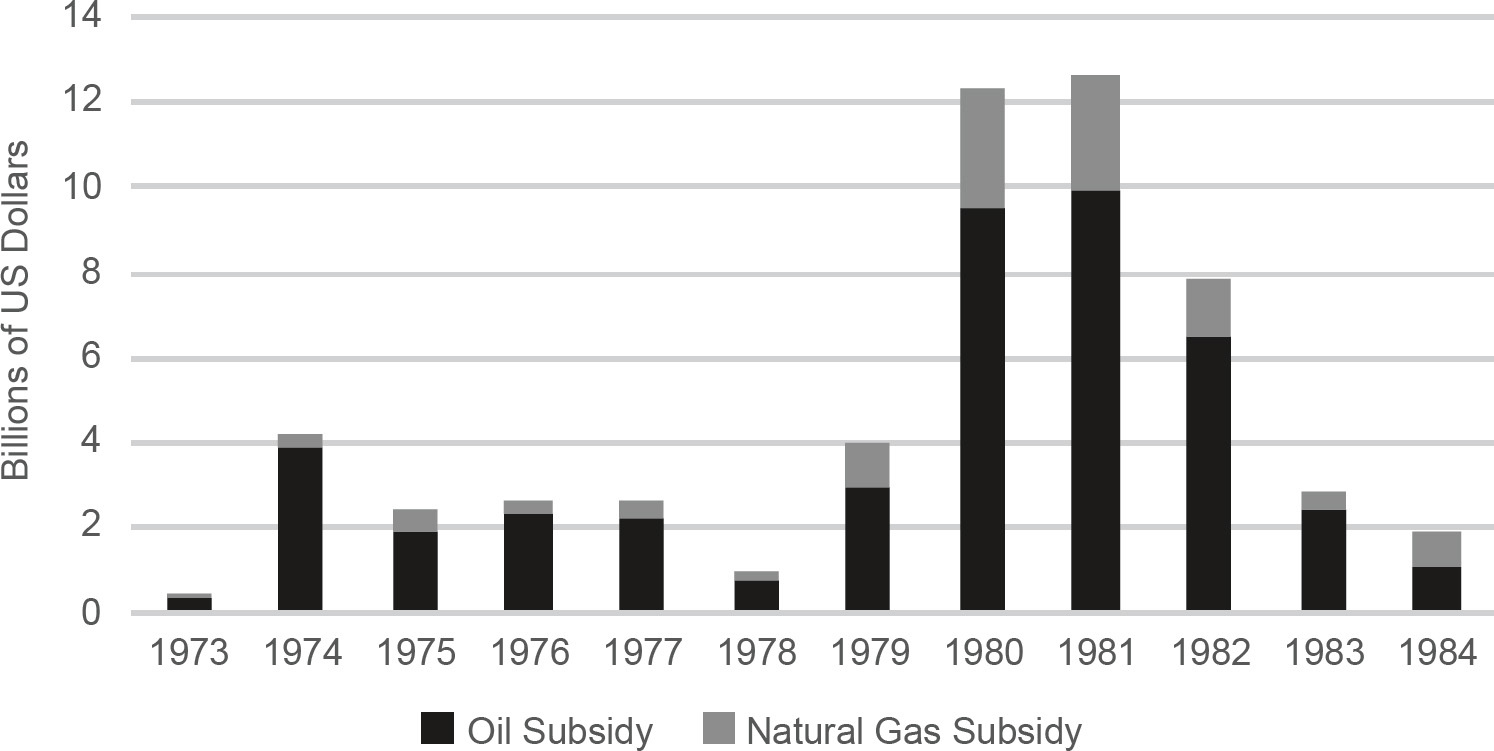
Figure 5.1 The estimated annual Soviet oil and natural gas price subsidy.
Data sources: “Übersicht über die Preisentwicklung für Erdöl ab 1972,” undated but 1985, DE/1/58747, BArch Lichterfelde, and PlanEcon, Inc., Soviet and East European Energy Databank (Washington, DC: PlanEcon, Inc., 1986).
In doing so, however, they also repeatedly bumped up against the limit of their material capabilities, which spurred them to fundamentally rethink the place of Eastern Europe in the country’s national interest. The first limit arrived in October 1980, when the Poles asked the Kremlin to increase their oil and hard currency support so Warsaw could meet its mounting debt payments to the West. The Politburo decided it could meet the request, but only if it simultaneously decreased oil deliveries to other bloc countries for the coming year. There simply was no extra capacity in the Soviet economy to draw on.11 The allies were none too pleased, but they eventually acquiesced on the understanding that the cutbacks were a temporary measure that would be repealed once Polish leaders had defeated Solidarity’s “counterrevolution.” With the extra hard currency from oil sales on the world market, Soviet officials kept the Polish government precariously afloat through the depths of the 1980–1981 winter.
But as they did, they continued to notice and lament the limits, burdens, and opportunity costs of supporting their ally. In late March 1981, as the Bydgoszcz crisis came to a head and observers both in Poland and the West feared that Soviet military intervention was imminent, officials in Moscow had money, rather than guns, on their minds. Ivan Arkhipov, first deputy prime minister in charge of economic affairs, told the Politburo his ministers could not meet all the Polish requests for raw materials because they were “simply unable to give a larger quantity.” The Poles had asked for a further $700 million to service their debt to the West, but “of course,” Arkhipov said, the USSR could not “possibly come up with such a sum.” The endless stream of requests was beginning to weigh on even the most ardent socialist internationalists. Foreign Minister Andrei Gromyko complained that the Poles did not “attach much importance to the supplies of raw materials from the Soviet Union.” This spurred Arkhipov to point out the massive opportunity the Soviet Union was missing by providing subsidized oil to its allies. “We supply Poland with 13 million tons of oil at 90 rubles per ton. If one considers that the world price per ton is 170 rubles, then we receive from the Poles 80 rubles less per ton. We could sell all that oil for hard currency and the earnings would be colossal.”12
This was also true for the oil Moscow was delivering to the rest of the bloc. And in the spring and summer of 1981, the Soviet leadership decided the burden of these deliveries had become too great, and they resolved to rebalance socialist economic relations in their favor. For too long, they reasoned, the Soviet economy had suffered in the name of allied stability; the time had come to prioritize their own economic interests. Oil was the linchpin of Soviet support for its allies, so it would also be the linchpin of economic rebalancing. As we have seen, Soviet officials had already informed bloc leaders in the late 1970s that they could not continue to increase annual oil deliveries in the 1980s. Now, in 1981, they told their allies they would, in fact, have to substantially reduce annual oil deliveries in the years ahead. Well aware of how important oil was to the economic and political stability of the bloc countries, the Kremlin worked throughout the summer to prepare its allies for the news.
Brezhnev’s annual summer meetings in Crimea with each bloc leader provided the perfect opportunity to lay the groundwork. “The healthy economic development of the . . . allies is vitally important,” the general secretary told Erich Honecker in August, but “just as vital, we think, is the economic health of our own country.” The current Soviet subsidy of Eastern Europe was not striking the right balance between these vital interests. “Our economists, Erich,” Brezhnev continued, “have calculated that the fraternal countries’ direct benefit from imports of fuel and raw materials from the USSR in the last five years amounted to 15 billion rubles and will amount to almost 30 billion rubles over the coming five years.” The Soviet economy could no longer bear this “big sum.” Brezhnev promised to do everything he could to aid the German Democratic Republic (GDR)’s continued economic development but also admitted he was “seriously concerned” the USSR would not be able to meet its scheduled energy deliveries in the years ahead.13
Four weeks later, the general secretary confirmed that his fears had come true. In letters to East Berlin, Budapest, Prague, and Sofia, Brezhnev reported that the Soviet energy industries would miss their production targets and the Politburo had decided to cut back energy deliveries to the rest of the bloc in the years ahead. He tried to make both the Kremlin’s burden and its bind clear. “As you know,” he wrote Honecker, “we supply the European member states of the CMEA [Council of Mutual Economic Assistance] with more than 72 million tons of crude oil per year, 7 million tons of petroleum products, 29 billion meters of gas” as well as coal, coke, and electric energy. “As you also know, we are forced to sell substantial quantities of crude oil and petroleum products to capitalist countries in order to obtain currency for the purchase of grain and food.” With Soviet agriculture on the verge of its third consecutive bad harvest, officials in Moscow had concluded they would need to sell some of the oil previously meant to go to Eastern Europe on the world market in order to get the hard currency required to continue their massive grain imports. The Kremlin’s commitments to their allies and their own people had come into direct conflict, and Brezhnev had chosen the Soviet people. He pleaded for the allies’ understanding. “I beg you, Erich,” he wrote to Honecker, “to show understanding. . . . The current situation forces us to take such a step.”14
None of the allies took the news well, but Honecker was particularly upset. Even the slightest cutback in Soviet oil deliveries would, he wrote to Brezhnev, “undermine the foundations of the existence of the German Democratic Republic.”15 When Soviet Politburo member Konstantin Rusakov arrived in East Berlin to try and calm the East German’s fears, Honecker got straight to the point: the oil decreases would lead directly to austerity in the GDR, and with the economic powerhouse of West Germany right next door, that was simply unacceptable. The oil reductions were such a monumental setback that “the stability of the GDR is no longer guaranteed,” he told his Soviet counterpart. Soviet bureaucrats had announced that the reduction would amount to two million fewer tons of oil per year for the GDR (a reduction from nineteen to seventeen million tons annually), and this quantity quickly took on political and social significance in Honecker’s mind. “I request that you ask Comrade Leonid Ilyich Brezhnev,” he concluded bitterly, “whether these two million tons of oil are worth destabilizing the GDR and destroying our people’s trust in the party and state leadership.”16
Rusakov arrived ready with a litany of retorts. The Soviet Union was “almost in last place in comparison to the standard of living in all socialist countries,” he reminded the East German leader. The leadership in Moscow could no longer justify asking the Soviet people to sacrifice for the good of other socialist countries. “If we need to tighten our belts even more, our people may ask us: what about the socialist brother countries? Why do the Soviet people always have to stay in such a bad position?” And that was not all. The USSR also had to provide military security for all the nations of the Socialist Bloc, so austerity in the Soviet Union would not just be a threat to “the standard of living of the population, but also the weapons of our army.”17 Soviet leaders were not unsympathetic to the East Europeans’ plight—Brezhnev had “cried” while signing the letters announcing the reductions, Rusakov said—but bloc leaders needed to remember that the USSR had helped them many times in the past when they faced troubles. “Now we are asking you all for your help,” Rusakov said. “We . . . don’t see any other way.”18
Rusakov returned to Moscow, and the Kremlin went ahead with the energy cutbacks in spite of their allies’ protests. As we will see, it was a decision laced with significant implications for the allies’ financial and political relations with the West and thus the Soviet Union’s control over its sphere of influence.
Against the backdrop of this growing material burden, the question of military intervention in Poland continued to hang over Soviet deliberations through the spring of 1981. In the heated early months of the crisis, Brezhnev and the other leaders of the Warsaw Pact had come to the brink of authorizing a joint invasion of Poland in December 1980 before ultimately deciding to give the Polish leadership more time to resolve the situation. During the Bydgoszcz crisis in March 1981, Soviet leaders had again allowed the Poles to think they were on the verge of invading, even though they never seriously considered it.19 In April, they continued to hold menacing meetings with Polish leaders that were meant to galvanize them to mount a decisive crackdown by implying a Soviet invasion was imminent.20
But was it? Through the spring, not even Soviet leaders themselves knew the answer. That changed in June 1981 when the political and military leadership met to resolve the question once and for all. In two separate meetings, the Soviet General Staff and Politburo decided the burden of intervention would be too great. The combination of Solidarity’s grassroots support in Polish society, the growing burden of the war in Afghanistan, economic problems at home, and the specter of crippling Western sanctions convinced Soviet leaders that military intervention in Poland was not in the Soviet Union’s national interest. As Mikhail Suslov, the chief ideologue of the party and a leading conservative, reportedly said, “Under no circumstances, even if the Polish leadership requests, will we send Soviet and other troops into Poland. If a new leadership comes to power [Solidarity], we will cooperate with it. . . . Introduction of troops would be a catastrophe for Poland and, yes, for the Soviet Union.”21 To maintain the illusion of military pressure, Soviet leaders did not inform their Polish counterparts of this decision, but internally the die had now been cast. No matter the circumstances, Soviet troops would not enter Poland.22
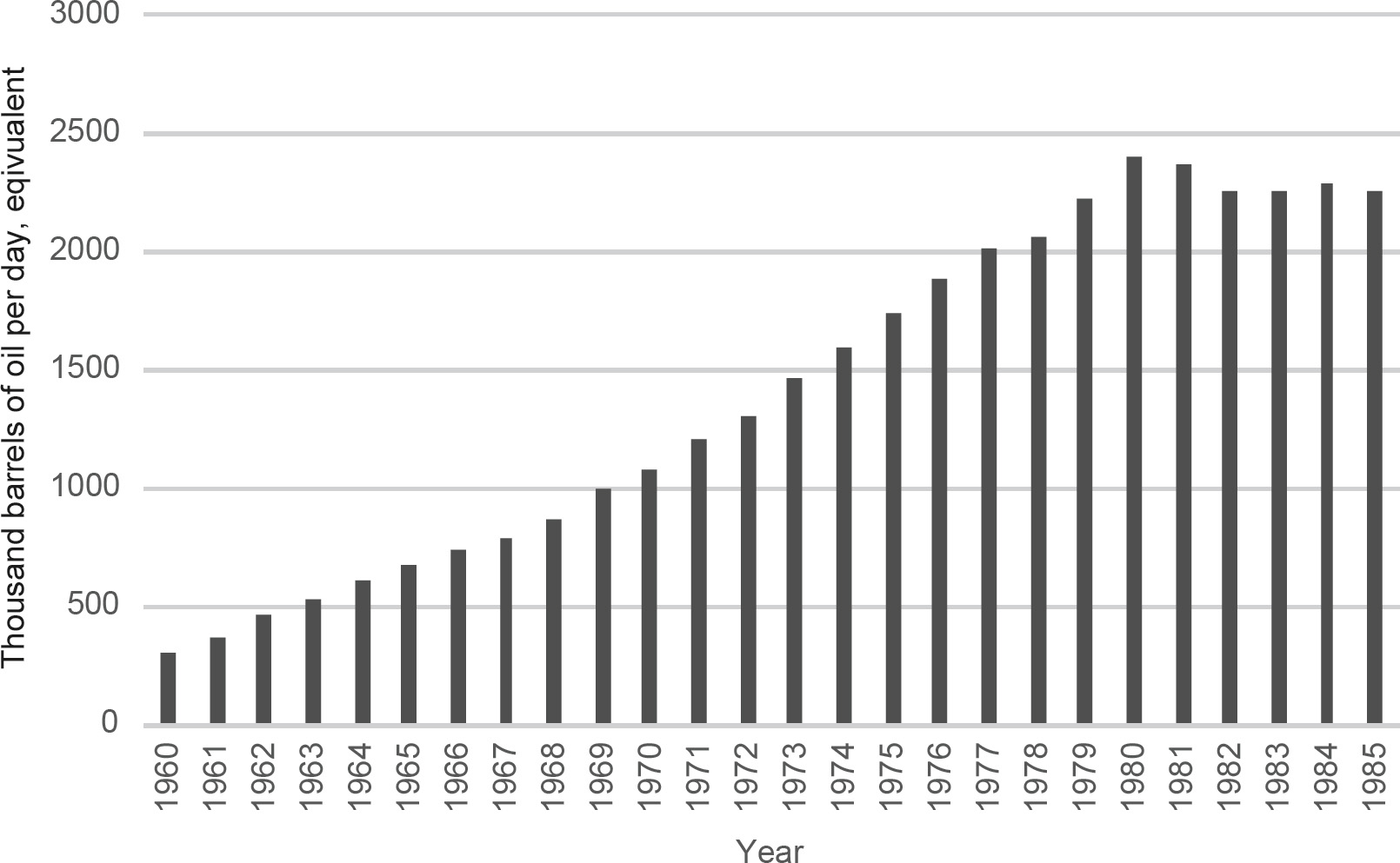
Figure 5.2 Soviet energy exports to the so-called CMEA Six: East Germany, Hungary, Poland, Czechoslovakia, Bulgaria, and Romania.
Data source: PlanEcon, Inc., Soviet and East European Energy Databank, Vol. II, Table “USSR—Primary Energy Balance,” U-3.
With the military option off the table, Soviet leverage over Poland came to rest primarily in the economic sphere. Soviet officials attempted to use economic aid as a coercive lever to force the Polish leadership to implement martial law.23 Poland’s hard currency debt, however, made economic leverage work both ways. Because Poland was shut out of global capital markets and the Soviets could not cover all its financial needs, the Polish leadership was reliant on Western governments for the hard currency needed to pay for grain imports and debt service. They had to be ever mindful of Western opinion when dealing with Solidarity.24 Polish officials maintained constant contact with Western diplomats about further economic aid, and in Washington, the National Security Council even began to consider the merits of a multiyear aid package worth billions of dollars.25
It was plain to see that if Polish leaders cracked down on Solidarity, no Western aid would be forthcoming. So, as he prepared his plan for martial law, General Jaruzelski made its implementation contingent on increases in Soviet aid to compensate for the Western shortfall that would surely follow. On December 7, 1981, six days before he would declare martial law, Jaruzelski told Brezhnev on the phone that he “would need to be sure of [Soviet] economic assistance” before making a final decision.26 Brezhnev immediately sent the chairman of the State Planning Committee, Gosplan, Nikolai Baibakov to Warsaw to see what the Polish leader had in mind; he returned to the Politburo on December 10 with a long list of 350 items totaling some 1.4 billion rubles. When combined with the aid the Soviet Union already planned to give to Poland in 1982, this would bring Moscow’s total aid to 4.4 billion rubles in the year ahead. Baibakov informed his comrades that they would only be able to meet the Polish request by taking resources “from state reserves or by limiting supplies to domestic markets.” To make matters worse, Jaruzelski had delayed the date of implementing martial law and hinted he would only go through with it if he could count on Soviet military support. At the eleventh hour, the question of military intervention had been reopened, and responsibility for defeating Solidarity’s “counterrevolution” appeared to have fallen back into the Kremlin’s lap.27
But the Soviet leaders did not budge. Unlike previous crackdowns in 1953, 1956, and 1968, they maintained their newfound commitment to prioritizing developments within the Soviet Union over those within the broader Socialist Bloc. Yuri Andropov, the formidable head of the KGB and future general secretary of the party, delivered the definitive declaration that drew the unanimous support of his Politburo colleagues:
Jaruzelski is rather persistently placing economic demands before us and conditioning the implementation of Operation “X” [martial law] on our economic aid; and . . . he is raising the question, albeit indirectly, of military assistance. . . . As far as economic assistance, of course it will be difficult to do that on the scale they are requesting. Apparently something needs to be done. . . . [But] we do not intend to introduce troops into Poland. That is the proper position, and we must adhere to it until the end. I don’t know how things will turn out in Poland, but even if Poland falls under the control of Solidarity, that’s the way it will be. . . . We must be concerned above all with our own country and about the strengthening of the Soviet Union. That is our main line.28
The Brezhnev Doctrine was now dead. After claiming the stability of socialist governments in Eastern Europe to be in the Soviet Union’s national interest for over three decades, Soviet leaders had come to accept the possible overthrow of a socialist government in order to focus on development at home. They were willing to countenance limited economic aid to their ally in a time of need, but even that willingness had been called into question by the broader decision to cut back energy supplies to the rest of their allies in the region. The burden of empire had grown too great, and Soviet leaders were now committed to extracting themselves from that burden, whatever the political costs and risks might be.29
The declaration of martial law in Poland kept the world from learning of this historic revision to the Soviet national interest. News of martial law arrived in Washington not as a sign of Soviet retreat but as an omen of renewed Soviet aggression. Upon hearing of the crackdown, Ronald Reagan confided to his diary, “Our intelligence is that it was engineered & ordered by the Soviet[s]. If so, and I believe it is, the situation is really grave.”30 As tanks took up positions on the streets of Warsaw and thousands of Solidarity members were summarily arrested, the president and his team began to debate what response would match the gravity of events.
They did so against the backdrop of their own long-running effort to develop a more aggressive American strategy toward the Soviet Union and the broader Communist Bloc. Reagan had risen to the presidency as a strident critic of the superpower détente that had developed in the 1970s. In his mind, the diplomatic effort to improve East-West relations and stabilize the Cold War had only weakened the West militarily, subsidized the Communist Bloc economically, and provided Moscow with diplomatic cover to spread its influence abroad and continue its military buildup at home without fear of Western retribution. Using all the tools of American hard and soft power, Reagan entered the Oval Office determined to rectify what he perceived as a decade of relative American decline and subsidized Soviet advance.
The strategy that emerged was well attuned to the dynamics of the privatized Cold War. Though the administration did not, of course, use the term, its Cold War strategy was premised on exploiting the relationship at the heart of the privatized Cold War: nation-states’ access to guns and butter had become dependent on finance and energy. Reagan and his cabinet understood that communist governments in general, and the Soviet government in particular, relied on finance and energy to fund foreign and domestic promises, and they believed they could use the tools of American statecraft to force the communist world to confront the politics of breaking promises. If Soviet leaders had to choose between the three competing demands on their increasingly scarce resources—their military, their allies, and their citizens—then American officials believed that one day, they just might choose their own citizens over their arms and allies.
This strategy played out to greatest effect in the military arena. Reagan wasted little time in delivering on his campaign promise to significantly increase US military spending. Though it was, in fact, Jimmy Carter who began to increase US military spending in the wake of the Soviet invasion of Afghanistan, Reagan significantly extended and accelerated Carter’s initiatives. The US defense budget surged over 40 percent from 1980 to 1986, and the Pentagon developed a new generation of conventional and nuclear weaponry. B-1 and B-2 bombers, the MX intercontinental ballistic missile, Trident nuclear submarines and their Trident II nuclear weapons, F-117 Stealth fighters, and Apache attack helicopters became the cornerstones of a new, more technologically advanced global fighting force.31
To be sure, these weapons were meant to serve real security purposes and restore the strategic leverage Reagan believed the United States had frittered away over détente’s decade. But they also served a critical economic function by drawing the Soviet Union into a new round of the arms race that it would not be able to afford. US intelligence agencies had concluded by 1981 that Soviet economic performance had “deteriorated to the point that, if military expenditures continue to expand as in the past, there will be few if any resources left with which to raise living standards.”32 Reagan and his cabinet meant to exacerbate Moscow’s guns-versus-butter dilemma by applying the full weight of the United States’ economic capacity to the task of military modernization. Indeed, for US officials the arms race was ultimately an economic, rather than military, competition. As Reagan said in late 1981, the purpose of the military buildup was to “threaten the Soviets with our ability to outspend them, which the Soviets knew we could do if we chose. Once we [have] established this, we [can] invite the Soviets to join us in lowering the level of weapons on both sides.”33
All they needed was time. Demonstrating the full depth of the United States’ pockets would take many years, so the administration felt little urgency, upon entering office, to immediately engage the Soviets in arms control negotiations. In the wake of the Soviet invasion of Afghanistan, Jimmy Carter had withdrawn the second Strategic Arms Limitation Treaty (SALT II) from Senate consideration, and Reagan saw no reason to reintroduce it. The president also reaffirmed the North Atlantic Treaty Organization (NATO)’s 1979 “dual-track” decision to deploy a new generation of intermediate-range nuclear forces (INF) in Europe by 1983 while also negotiating INF limitations with Moscow. He put his own stamp on this process in November 1981 when he offered to forgo deploying new American intermediate missiles if the Soviets would remove those they had already put in place, a proposal that became known as the “zero option.” Many arms control advocates accused the president of intentionally proposing something unrealistic so the United States would be able to go ahead with the deployments when the Soviets inevitably rejected the offer. But Reagan had long been convinced of the ultimate irrationality and inhumanity of nuclear weapons, and he entered office with a sincere conviction to one day reduce and eventually eliminate them altogether. This motivated his decision to discard the concept of Strategic Arms Limitation Treaty (SALT) negotiations, which had dominated the arms control agenda in the 1970s, in favor of Strategic Arms Reduction Treaty (START) negotiations, which were launched in 1982.
All the while, Reagan remained in no hurry to reach a bad, or even merely an inconsequential, arms control deal with the Kremlin. The more time his military buildup had to strain Soviet resources, Reagan reasoned, the more convinced Moscow would become that it needed to conduct arms negotiations on American terms. If the Soviets “saw that the United States had the will and determination to build-up its defences [sic] as far as necessary,” he told Margaret Thatcher in 1983, “the Soviet attitude might change because they knew they could not keep up.”34
Reagan’s economic approach to the military buildup and his genuine belief in nuclear abolition came together in his 1983 announcement of the Strategic Defense Initiative (SDI). Quickly dubbed “Star Wars” by its critics, SDI aimed to make the Soviet nuclear threat obsolete by developing a ballistic missile shield capable of shooting down incoming Soviet nuclear weapons. Reagan declared it his “personal hope” that SDI could “bring an end to nuclear war,”35 but most of his advisors were simply interested in it as an extension of their broader effort to spend the Kremlin into submission.36 The program would play to all the United States’ strengths—technology, research and development, and, most importantly, money—and the Soviets would find it very difficult to keep up. “SDI gives us a great deal of leverage on the Soviet Union,” Reagan told his own National Security Council (NSC), and his advisers very much agreed.37 In a world where Moscow was already struggling to feed its people and fight the Cold War at the same time, countering the American attempt to gain the upper hand through strategic defenses was a budgetary challenge the Kremlin could ill afford.
Here, too, the effects would not be immediate. Administration officials understood that SDI would only challenge the Soviet Union if it could be sustained over many years, so it could not be counted on to immediately bring the Soviets to the bargaining table. What could have an immediate effect on Soviet decision-making, however, was the Kremlin’s access to hard currency through energy and financial markets. As they waited for their military buildup to restore the strategic balance and strain Soviet resources, Reagan administration officials zeroed in on energy and finance as a means of crippling their foe. “The period of U.S. military vulnerability,” National Security Advisor Richard Allen wrote to Reagan in November 1981, “can to some extent be offset by Western exploitation of Soviet Bloc economic and social vulnerabilities.” Limiting the Soviets’ access to hard currency, he wrote, “will make their civilian vs. military choices more difficult and increase the likelihood of internal unrest in the satellites.”38
This was no mere guesswork. Throughout the early 1980s, American intelligence agencies provided the administration with a stream of reports that discussed the deteriorating Soviet material predicament with astonishing accuracy. At the same time that officials in Moscow were dealing with their allies’ blowback over the announced cuts in energy supplies in the fall of 1981, the Central Intelligence Agency (CIA) delivered a report to the Reagan administration that concluded the Soviet Union’s growing economic problems would force the Kremlin to make “increasingly tough and politically painful choices regarding resource allocation.”39 After overzealously projecting in 1977 that Soviet oil production would peak in the early 1980s, the CIA now foresaw stagnant production through the middle of the 1980s and a decline thereafter. Though the growth of natural gas production would offset some of oil’s decline, analysts knew—like Soviet planners in Moscow—that it would not fully compensate for the loss. To make matters worse for Moscow, energy prices were now widely expected to decline in the 1980s after their decade of explosive growth in the 1970s.40
For intelligence officials, these structural trends meant Western countries could have a real impact on Soviet behavior by restricting Moscow’s access to credit and not buying its energy. “The reduced availability of hard currency and energy,” the CIA concluded in 1982, “would make more difficult the decisions Moscow must make among key priorities in the 1980s—sustaining growth in military programs, feeding the population, modernizing the civilian economy, supporting its East European clients, and expanding (or maintaining) its overseas involvements.”41 The Soviet economic situation was so bad, and its resulting political implications so acute, that intelligence officials even concluded in the early 1980s that “a new leadership by mid-decade will feel greater pressure to reduce the growth of defense expenditures to free up labor, capital, and materials—resources urgently needed in key civilian sectors.”42 The world did not yet know the name Mikhail Gorbachev, but American intelligence officials believed that a figure like him might soon emerge.
This was music to the administration’s ears. The sum total of this intelligence presented American policy makers with a simple conclusion and an important question. “The Soviet economy is in trouble,” CIA director William Casey told the National Security Council. “The question is do we want to make it harder for them?”43 Their answer was most assuredly yes. As the crisis in Poland dragged on during their first year in office, officials at the highest level of the administration debated how best to combat the Soviet Union politically by hurting it economically.44
Foremost at issue was a massive new natural gas pipeline Western Europeans were building to increase Soviet natural gas deliveries to Europe. Since the early 1970s, Western European companies and banks, led by the West Germans, had participated in four pipeline developments that brought increasing amounts of Soviet natural gas to the continent. East-West energy trade had become a cornerstone of European détente and West Germany’s Ostpolitik. Even as the Soviet-American détente collapsed in the late 1970s, Soviet and West German officials pushed ahead with their negotiations on a new Siberian pipeline, finalizing an agreement in 1981. For both sides, this new pipeline held immense political and economic significance. Politically, it was the cornerstone of Western European governments’ attempts to keep détente alive in Europe even as it evaporated between the superpowers. Economically, the pipeline was expected to double the Soviets’ annual natural gas deliveries to Western Europe and provide Moscow with an additional $6 billion a year in hard currency when it came online in 1984.45 Everything about it, then, looked disastrous to a Reagan administration intent on ending the economic interdependence of détente and diminishing the Soviets’ hard currency earnings.
The question in Washington was whether the United States should risk a rift with its European allies in the hope of delivering a decisive blow to Moscow’s economic prospects. Advocates of halting the pipeline in the Department of Defense and CIA believed the potential benefits far outweighed the risks. Led by Defense Secretary Casper Weinberger, this group saw preventing the pipeline’s construction as a strategic necessity on par with the US military buildup. “The pipeline is just as militarily significant as a plane,” Weinberger told the NSC.46 The administration’s entire attempt to strain Soviet decisions about resource allocation would make little sense if Washington allowed the construction of a pipeline that would ease those constraints by giving the Soviets billions of dollars every year in energy sales.47
Secretary of State Alexander Haig led the charge in opposition. Though he shared Weinberger’s desire to weaken the Soviet Union economically, he believed that Western European governments would view any attempt to halt the pipeline as an infringement on their sovereignty. Moreover, he was not at all convinced it was within the administration’s power to stop the pipeline. European banks and companies had more than enough capital and technology to build the pipeline without American involvement, so it was not clear to Haig that placing American sanctions on the pipeline’s construction would have a material effect. Throughout 1981, these two poles within the administration fought a pitched bureaucratic battle to determine American policy.
Jaruzelski’s declaration of martial law tipped the scales in Weinberger’s direction. Because Reagan and most of the world believed Jaruzelski’s actions were directed from Moscow, the administration’s debate following the crackdown centered on how it could weaken both Warsaw and Moscow in response. At the end of 1981, Reagan announced sanctions against Poland and prohibited US companies from participating in the Siberian pipeline. This, however, left an important issue unresolved, because it became clear in early 1982 that the key question was whether or not Reagan’s sanctions on the pipeline applied “extraterritorially”—that is, to US subsidiaries and licensees in Europe that were actually involved in the pipeline’s construction. In a world of multinational corporations and complex technology licensing agreements, it meant little for Reagan to prohibit companies in the territorial United States from participating in the pipeline. Administration officials quickly realized, therefore, that the question of extraterritoriality was where the rubber would actually meet the road. If not extended to US subsidiaries and licensees in Europe, the sanctions would be useless; if the sanctions were extended, they would compel the Western Europeans to halt the pipeline against their will.48
Recognizing the political ire such a move would surely spark in Europe, Reagan delayed his decision on extraterritoriality and instead launched a diplomatic effort to restrict Moscow’s access to the other great pool of global wealth: international capital markets. If the Europeans did not want to stop buying Soviet energy, perhaps they would instead agree to restrict Moscow’s access to credit. In March 1982, the president sent senior diplomat James Buckley on a tour of Western European capitals to drum up support for this alternative method of weakening the Kremlin’s hard currency position. Though the quid pro quo was not made explicit, it was plain for all to see: if the Europeans agreed to restrict Soviet access to credit, the administration would not extend their pipeline sanctions to US subsidiaries and licensees in Europe.
European officials politely received Buckley but firmly and consistently rebuffed his entreaties.49 They quickly pointed out the hypocrisy of the United States asking Europe to suspend its energy ties to Moscow while its own grain sales to Moscow went untouched. The previous summer, Reagan had repealed the grain embargo Jimmy Carter had placed on the Soviet Union after the Afghan invasion, and in the months following martial law, there had been no mention of bringing the restrictions back. If the White House was so intent on hurting Moscow, European leaders concluded, perhaps it should limit its own trade before asking Europe to do the same.50 Buckley optimistically reported to the NSC after his trip that he sensed a growing understanding in Europe “that easy money helps the USSR solve its critical problems,” but it was clear that no one across the Atlantic shared Washington’s urgent desire to use finance or energy as weapons in the ever-chillier Cold War.51
This left Reagan in a difficult position. Since the declaration of martial law in December 1981, he had told the world he would use the tools of economic statecraft to punish the Soviets and Poles for what he took to be their shared aggression against Solidarity. And yet as spring came to Washington in 1982, martial law remained in effect, Lech Wałęsa remained in jail, and Moscow’s access to energy wealth and capital markets appeared to remain unimpeded. If his administration allowed the pipeline sanctions to remain toothless and failed to restrict Moscow’s access to credit, Reagan told the NSC, “we will lose all credibility.” Not only that, but a golden opportunity would be lost to cripple the Kremlin at its most vulnerable. “The Soviet Union is economically on the ropes,” he continued. “This is the time to punish them.”52
So punish them he did. American and European diplomats made a last-ditch effort to find a satisfactory compromise on the issue of credit controls at the Versailles G7 summit in June 1982, but Reagan remained unsatisfied. In a now-famous speech to the British Parliament after the summit, he laid out his economic understanding of the Soviet predicament. “In an ironic sense Karl Marx was right,” he told British lawmakers. “We are witnessing today a great revolutionary crisis, a crisis where the demands of the economic order are conflicting directly with those of the political order. But the crisis is happening not in the free, non-Marxist West, but in the home of the Marxist-Leninism, the Soviet Union.” Brimming with confidence in the moral and material superiority of democratic capitalism, he concluded, “The march of freedom and democracy . . . will leave Marxism-Leninism on the ash-heap of history.”53 Upon his return to Washington, he announced that American sanctions on the Siberian pipeline would indeed apply to US subsidiaries and licensees in Europe. If the Soviet Union was in a “great revolutionary crisis” on account of its abysmal economy, Reagan had decided the West should push it into full-blown revolution.
There was just one problem: it didn’t work. The only revolts the expanded pipeline sanctions caused were within the US government and among US allies. Because Reagan failed to consult Secretary of State Haig before making his decision, Haig resigned immediately. And because Reagan went ahead with the sanctions in spite of the reservations of his European allies, they all howled in revolt and soon defied the American order. As the summer wore on, they began construction on the pipeline in defiance of the sanctions. Reagan came to regret the transatlantic dispute he had caused, and when he brought George Schultz on as his new secretary of state in July 1982, he charged him with finding a face-saving way out of the diplomatic crisis. In the first of many delicate rounds of diplomacy during his tenure at Foggy Bottom, Schultz got the Europeans to agree to cosmetic changes and future consultations on their credit and energy policies, and in return, Washington repealed the pipeline sanctions in November 1982. By all appearances, East-West economic policy returned to the way it had been.54
Beneath the surface, however, major changes were afoot. Structural shifts in the global economy produced exactly what Reagan’s statecraft could not. The Volcker Shock and the Reagan financial buildup denied the communist world more capital than Reagan could ever have dreamed of restricting through diplomatic channels, and the long-term decline in global energy prices that began in 1980 weakened Soviet energy wealth far more than the pipeline sanctions ever would have.
The macro effects of this story can be seen in Figure 5.3. After running substantial current account deficits in the 1970s, the Communist Bloc began running significant current account surpluses in the 1980s. This meant that after being a substantial capital importer for most of the 1970s, the communist world—like the Global South—became a capital exporter in the 1980s when the Reagan financial buildup began to monopolize the world’s capital. After importing a net total of $40.5 billion from 1973 to 1981, the Soviet Union and Eastern Europe exported a net total $31.2 billion from 1982 to 1989.55 The same broad transition in global capital flows that allowed the United States to erase its choice between guns and butter in the 1980s significantly hardened that choice for the communist world. The pivotal year was 1982. At the very moment the Reagan administration was trying and failing to diplomatically restrict communist access to energy wealth and capital markets, the unexpected course of its domestic economic policy—the potent combination of high interest rates and massive tax cuts—was achieving the very same result at a magnitude far greater than anyone on the National Security Council could have ever hoped.
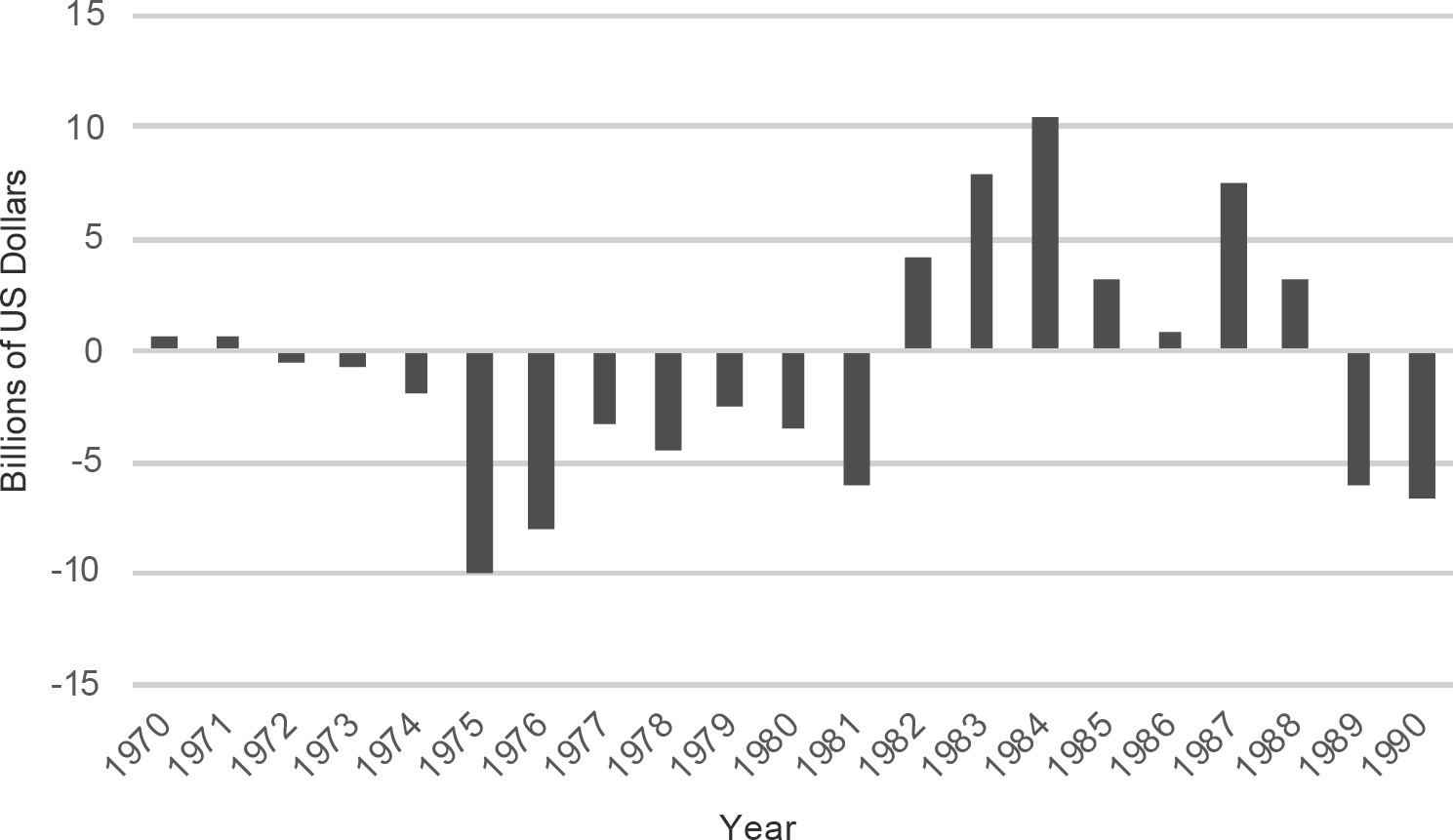
Figure 5.3 The collective current account balance of the Soviet Union and the CMEA Six. A negative value signifies a net annual capital import, and a positive value signals a net annual capital export.
Data source: Appendix table C.10 in United Nations, Economic Commission for Europe, Economic Survey of Europe in 1990–1991, 249.
What the Volcker Shock and the Reagan financial buildup did for capital flows, market forces did for energy wealth. Capitalist societies had spent the years after the 1973 oil crisis trying to conserve energy and develop new energy sources, and their collective efforts began to pay off in the early 1980s. Global energy supply began to outstrip global demand, and prices began to fall.56 After peaking at a nominal price of $39.50 a barrel in the summer of 1980, oil prices began an almost decade-long slide, dropping to $13.50 a barrel in the fall of 1988. Punctuated by a precipitous collapse in fall of 1985 that would come to be known simply as “the counter shock,” this decline in prices deprived oil-exporting countries, including the Soviet Union, of billions of dollars every year in hard currency earnings.
The combined effect of these two historic transformations in capital flows and energy prices for the Communist Bloc was profound. Within the span of a few short years in the early 1980s, the favorable trends on global capital and energy markets that had lifted the bloc in the 1970s evaporated, and highly adverse trends took their place. As much as capital and energy markets helped the Communist Bloc in the 1970s, they equally hurt the bloc in the 1980s. Indeed, though no one could know it at the time, we can conclude in retrospect that the material capabilities of the Communist Bloc peaked in 1980 and never again recovered. Through the Volcker Shock and the Reagan financial buildup, American policy makers had a significant hand in spurring this historic transformation. They simply did not realize how they were doing it.
For the governments of Eastern Europe, these structural transformations arrived not as gentle shifts in long-term trends but as wrenching crises fraught with political and economic consequences. Warning bells began to sound in the weeks before Jaruzelski declared martial law. Ten days before tanks rolled into Warsaw, Alexander Schalck-Golodkowski, the shadowy leader of East Germany’s Kommerzielle Koordinierung (KoKo) department, which was charged with earning hard currency for the state coffers, informed the leadership that foreign banks had begun withdrawing their short-term deposits from the state bank at an alarming rate. To “prevent the insolvency of the GDR,” he wrote, the country would have to take extraordinary measures to reduce imports, increase exports, and gain access to more hard currency.57 Around the same time, the central banks of Libya, Iran, and Iraq began their flight from the Hungarian National Bank, and soon the bloc as a whole found itself under sustained attack from the international financial system.58 By the early months of 1982, hard currency was fleeing at such a rate that even Czechoslovakia, which had built up very little debt in the 1970s, was on the brink of insolvency.59
Communist officials quickly concluded the capital flight was a coordinated Western attack in retribution for the declaration of martial law in Poland. Reagan’s diplomatic efforts to stop the Siberian pipeline and coordinate Western credit restrictions in response to martial law lent credence to their conclusion. “The USA’s policy of confrontation,” Schalck wrote Honecker in March 1982, “has led in recent weeks to the imposition of a total credit boycott . . . the enemy is now concentrating all its efforts on quickly achieving the insolvency of the GDR.”60 Vladimir Alkhimov, chairman of the Soviet state bank, Gosbank, echoed his East German counterpart at a bloc meeting in April. “The U.S. is currently conducting a comprehensive currency war against the socialist countries,” he told his comrades. “The aim is to organize the insolvency of the socialist countries.”61
We have already seen, however, that Reagan’s economic diplomacy in response to martial law failed on all counts. Though Reagan certainly intended to use energy and finance to weaken the Soviet Union, his allies did not share his goals, and they rejected his efforts at every turn. Instead of the Reagan administration, it was, in the words of one International Monetary Fund (IMF) official, “a couple hundred panic stricken bankers” from commercial and central banks around the world who launched the financial assault on the communist world.62 They did so not out of Cold War animus—they had, after all, gleefully loaned money to communist countries for over a decade—but rather out of frightened concern for their balance sheets. As a group of commercial bankers explained to a gathering of Polish and Western officials, “Western banks cannot be asked to make political and social judgements. The financial community must be concerned solely with problems of economics.” Bankers reacted to the political context of the Cold War, but they did not themselves care about the West’s fight against communism. They were only interested in “stability and predictability,” the bankers said, and the crisis in Poland had demonstrated that the communist world might not be able to ensure either. Reagan’s bellicose rhetoric in the wake of martial law only added to their uncertainty about the future of East-West economic relations. Banks “remain, in the final analysis, financial, with responsibilities to their shareholders,” they told the gathering. “They are not political and social agencies.”63 Communism had simply become a bad bet, and the banks were now looking to take their money elsewhere.
Even if communist officials mistook the ultimate source of the attack, there was no mistaking its ultimate effect: the threat of imminent bankruptcy. Communist financial officials regularly produced projections of their country’s future hard currency needs and resources, and as hundreds of millions of dollars fled the bloc in the early months of 1982, those projections quickly turned sour. In East Germany, for instance, Schalck ran the numbers in March and concluded there was a 1.5 billion valutamark (VM) (roughly $700 million) financing gap in the first half of the year that could not be filled through new credits from Western banks “because of the credit boycott.” He informed the leadership that he could use the state’s hard currency reserves to cover the gap until June but stated that the day when the country would run out of money was now in sight. “At the end of the second quarter, there will be no more credits available,” he wrote, “and we will have to declare the insolvency of the GDR to capitalist banks.”64
Only a miraculous infusion of new capital could thwart the inexorable drive toward insolvency, and only one country in the Socialist Bloc was capable of making such miracles happen: the Soviet Union. As their countries hemorrhaged capital in early 1982, Eastern European financial officials rushed to Moscow in the hope of receiving financial reinforcements. After the oil cutbacks of the previous summer, they knew that the provision of new economic aid was unlikely, but they hoped the gravity of their predicament would change the Kremlin’s calculus.
It was not to be. Having already stretched their resources to the limit to help Jaruzelski restart the Polish economy after martial law, the Soviet leadership now confessed that they simply did not have the resources to help any further. “The USSR can no longer step into the breach,” senior Soviet financial officials told their bloc comrades in March 1982. “The Soviet people no longer understand why we give credits to all [other] countries when the shelves in their own shops are empty.”65 A month later, as Reagan ramped up plans to restrict communist access to capital markets, Soviet officials recognized the need to coordinate a bloc-wide response to the American initiative, but they stopped short of doing so because they knew it would stoke their allies’ hopes for more aid. “It would be seen by some as paternalism,” Alkhimov, the Gosbank chairman, said, “and all countries would come with the expectation that the SU [Soviet Union] will provide financial aid, which is not possible.”66 In what would prove to be the start of a trend that spanned the 1980s, Eastern European officials were forced to return from Moscow empty-handed and deal with their crises on their own.
This left the communist governments of Eastern Europe with an uninviting set of options. Declaring insolvency was theoretically possible, but the Polish government’s fate had demonstrated the dangers of admitting to the world that debts could no longer be repaid. Since Warsaw had done so in early 1981, it had not received any new loans without the help of Western governments, and even those had been for the barest of essentials, like grain. All Western financing for capital investments that might actually improve the Polish economy had long since ceased to flow in Warsaw’s direction. A more radical option was the possibility of coordinating a bloc-wide default in order to damage the Western financial system and gain leverage over the banks. Like the debtors of the Global South, the Communist Bloc was in a state of mutually assured destruction with its Western creditors in 1982. Communist debt occupied enough space on Western banks’ balance sheets that many banks (particularly West German banks) would likely have become insolvent if forced to write down communist debt as a loss.67 But no evidence has emerged to suggest that communist leaders even remotely considered the possibility of declaring a collective default.68 Some Western financial policy makers worried about this eventuality, but most concluded it was unlikely because, as one British central banker wrote, default “would take Comecon decades to live down.”69 Communist leaders apparently shared this perception, concluding that insolvency was to be avoided at all costs.
Maintaining solvency would require two things that were as unpalatable as they were unavoidable: domestic austerity and Western aid. Both carried significant risks. The more austerity communist governments imposed on their people, the more they ran the risk of sparking another Polish Crisis. Western aid would lessen this risk by providing a fresh infusion of capital and reopening access to global capital markets. But it came with its own peril of surrendering the nation’s sovereignty to the Communist Bloc’s ideological and geopolitical enemies. The choice between austerity and Western aid, then, was a matter of deciding which risk—domestic instability or the loss of international sovereignty—was the lesser of two evils. Each government in the region navigated this choice differently in the 1980s. Hungary, Poland, and East Germany pursued greater Western aid to minimize the risk of austerity, while Romania chose the path of draconian austerity to maintain its sovereignty. But in each case, the government’s decision was primarily driven by its opinion of one institution: the International Monetary Fund.
At first glance, the IMF represented everything about the capitalist system the communist world sought to resist. It was the institutional embodiment of capitalist class power and generally sought to impose a capitalist perestroika on debtor economies.70 But the IMF also had money and was willing to share it, two traits not easily scoffed at in an environment of financial scarcity. So, as foreign capital fled and Moscow failed to answer its allies’ pleas for help, a wide-ranging debate broke out within the bloc on the merits and demerits of turning to the IMF for help.
Hungary pressed the issue. Since the heady early days of détente, János Fekete had carried out a decade-long dalliance with the Fund to lay the groundwork for a potential membership.71 But János Kádár had always declined to take the final step on account of Soviet resistance. Since Joseph Stalin had declared the IMF a tool of Western imperialism in the early postwar period, the Kremlin had maintained a standing prohibition on any member of the Communist Bloc joining the Fund, and only maverick socialist states like Tito’s Yugoslavia (a member since 1945) and Ceauşescu’s Romania (a member since 1972) had dared to defy the Kremlin.72 The oil cutbacks in summer 1981 directly led to a change in Kádár’s thinking. Upon hearing of the cutbacks, he authorized Fekete to move forward with final membership negotiations. And in an important sign of how the energy cutbacks had diminished Moscow’s political power within the bloc, he did not ask Soviet leaders for permission but simply informed them of his decision after the fact.73
The Kremlin did not like the insubordination but could do little apart from register its objection. “The IMF is an instrument entirely under the influence of the aggressive forces of the United States,” Alkhimov lectured a meeting of bloc officials in the spring of 1982. Trying to solve the bloc’s financial problems through the Fund would prove “illusory,” he warned, because the United States was only interested in seeing socialist countries declare their “insolvency.” The Hungarians begged to differ. They not only believed that the IMF was not interested in seeing socialist countries become insolvent, but also that it was, in fact, the only way for the socialist countries to avoid insolvency and the extreme austerity that would come with it. The head of the Hungarian National Bank told his comrades that the choice facing the Politburo in Budapest could not have been any clearer. The party leadership either had “to drastically reduce living standards or try to obtain further loans through the IMF. They have chosen the latter.”74
Western financial institutions rewarded them for their choice. From 1982 to 1984, the West provided Budapest with the financial bailout the Soviets no longer could afford. The first infusion of $210 million came in March and April 1982 from the Bank for International Settlements (BIS), an institution that acted as a sort of central bank for central banks. Fekete used these funds to fight off the Libyan, Iraqi, and Iranian capital flight, and the country successfully maintained its solvency through the summer by the skin of its teeth. Under pressure from the IMF and Western governments, commercial banks then stepped in with a new syndicated loan in August to stem the tide even further.75 In December, Hungary came to terms with the IMF on its first short-term financing agreement, and the Fund dispersed roughly $500 million from its coffers.76 With the Fund on board, banks’ confidence in Budapest temporarily returned in 1983, and when it again began to falter later that year, the IMF stepped in once again with a fresh infusion of $450 million in January 1984.77 When Hungary joined the Fund, it also joined the World Bank, which granted it over $700 million in loans from 1982 to 1985.78 All told, Western institutions funneled almost $2 billion to Budapest in its moment of greatest economic need. While the world watched tensions between Moscow and Washington descend to new lows in the early 1980s, few noticed as Western financial institutions quietly completed the first bailout of Eastern Europe and, subtly but fundamentally, shifted the balance of power in the Cold War.
All the while, a single question dominated Hungary’s negotiations with the IMF. Indeed, it would define the last decade of the communist state’s existence: how much austerity could the government get the Hungarian people to peacefully accept? The BIS, the IMF, and the World Bank relieved Budapest of the most extreme austerity pressure associated with insolvency but did not eliminate it entirely. As with any country, the IMF’s primary goal in Hungary was to turn the country into a net capital exporter—in financial parlance, to create a current account surplus—so the country could begin to repay its debts, which would require the imposition of domestic discipline. The essence of a relationship with the IMF, then, lay in striking a balance between the austerity and adjustment the Fund wanted and the domestic stability the government needed.
Negotiating this balance was a political process with political implications, so Hungary’s relationship with the IMF ultimately revolved around questions of political power. In their talks with Budapest, IMF officials proposed a number of ways to achieve what was, in essence, the politics of breaking promises: price increases, subsidy cuts, the closure of loss-making enterprises, a reduction in the state budget deficit, and a devaluation of the national currency, the forint.79 Each of these policies carried with it a risk of domestic unrest, and it was by this political standard that the Hungarian leadership decided which measures it could implement and which it would resist. The government “needed to think over the social-political implications” of each IMF demand, József Marjai, the deputy prime minister in charge of the Hungarian economy, told the Fund in 1982. The leadership “did not want to jeopardize political stability. They wanted to choose those policies against which social opposition was the least strong.”80 In Hungary’s case, this meant the government was reluctant to reduce its financial support for housing, transportation, and consumer prices but was willing to devalue the forint, reduce business investment, and hold down workers’ wages.81 These measures were enough to garner the two short-term financing agreements from the IMF in late 1982 and early 1984, but they precluded agreement on a long-term arrangement that would have provided Budapest with larger sums.82 The Fund stood ready to pay Hungarian leaders to take the politics of breaking promises as far they wanted to go, but the leadership consistently balked at the political implications of economic discipline.83
Then, in the spring of 1984, Kádár rejected a continuation of the politics of breaking promises altogether. “Believe me,” he told the party’s Central Committee in April 1984, “we cannot exist with 0.5% growth in national income, and it cannot win the support of the masses.” In place of IMF austerity, he ordered a return to the 2.5–3 percent growth that had prevailed in the 1970s and asked Fekete to find a way to make it happen.84 Lucky for them, the two IMF agreements and World Bank funding had been enough to reestablish Hungary’s creditworthiness, and the country was able to return to its former borrowing ways.85 By the time 1985 dawned on the Danube, the good life had returned to Hungary. All that remained to be seen was how long global capital markets would allow it to last.
Events unfolded very differently in East Berlin, primarily because the East German leadership held a very different view of the IMF. Where Hungarian leaders saw the Fund as an important, if also problematic, source of capital, East German leaders saw it as nothing other than an existential threat to the very existence of the GDR. “To be or not to be, that was the question,” Alexander Schalck wrote in his memoirs in reference to his country’s fate in the early 1980s. “We did not want to expose socialism to the dictates of the International Monetary Fund.”86 Both during the Cold War and after, it was taken as axiomatic that East Germany was financially dependent on West Germany. This dependence was real, but it was also a choice. The East German leadership chose to increase its reliance on Bonn in the late Cold War to avoid having to deal with the IMF. As in Hungary, maintaining solvency in the GDR required some combination of domestic austerity and foreign aid, and the Federal Republic’s aid was much preferable to the IMF’s because it came with dramatically different strings attached.87
The Fund, as we have seen, sought to impose the politics of breaking promises on debtor economies in order to turn them into capital exporters. The West Germans, by contrast, were not interested in reforming the East German economy but rather in opening East Germany’s borders. Ostpolitik was premised on the idea that greater flows of goods, people, and information across the intra-German border would produce a more peaceful European continent and one day reunite the German people. Bonn therefore attached conditions to its aid aimed at increasing these flows across the German divide. The choice between the IMF and the Federal Republic of Germany (FRG) was a matter of determining which condition—the politics of breaking promises or more open German borders—was a bigger threat to the stability and legitimacy of the state. Choosing between open borders and breaking promises would prove to be the defining challenge of the GDR’s final decade.
For East German leaders, there was much not to like about the idea of more porous German borders. They were, after all, the ones who had built the Berlin Wall precisely to eliminate the border’s pores altogether. But they believed that breaking promises was worse. Throughout the last decade of the Cold War, they would continuously choose to increase the porousness of their borders in order to avoid disciplining their domestic social contract. That was how difficult and dangerous the challenge of austerity was—even the men who had built the world’s most infamous symbol of border security proved willing to sacrifice that security to avoid breaking promises at home.
In the early 1980s, the full consequences of this choice were only dimly felt, but they did influence the form of the West’s bailouts of East Germany. While Fekete negotiated with the IMF to exchange Fund financing for domestic austerity in Hungary, Schalck negotiated with the FRG to exchange West German deutsche marks for a more porous German border. On orders from Honecker himself, Schalck was quick to make the GDR’s allergy to austerity clear. Any credit “must come without conditions such as those issued by . . . the International Monetary Fund,” he told his West German interlocutor, Franz Josef Strauß, in one of their first meetings. The GDR had not joined the Fund, he said, precisely because “that would mean lowering the standard of living.” Instead, he could offer the FRG two concessions that would make intra-German travel marginally easier and the militarized German border marginally more humane: West German schoolchildren would no longer have to make the minimum hard currency payment required to enter the GDR, and the East German government would dismantle the automatic shooting devices that barbarically populated its side of the border.88
Strauß, the head of the West German conservative party in Bavaria and the country’s leading Cold Warrior, was willing to accept these paltry concessions in pursuit of his larger purposes of stabilizing the GDR at a time of rising Cold War tensions and, as he later said, getting “the GDR as dependent on the D-Mark as a drug addict is on heroin.”89 The result was two billion-mark loans (the so-called Milliardenkredite) to the GDR in 1983 and 1984. Officially, the West Germans attached no conditions to the loans, but when the GDR eliminated the minimum exchange requirement for children in late 1983 and dismantled the last of the automatic shooting devices in late 1984, everyone on both sides of the Iron Curtain knew why.90
Eliminating a few guns along an already heavily militarized border and allowing children to enter the GDR for free may not sound like much in exchange for 2 billion deutsche marks, and in concrete terms, it certainly was not. But symbolically, the loans and their concessions contained immense importance. First, like the Fund’s involvement in Hungary, the Milliardenkredite signaled to global capital markets that the GDR had a new and very wealthy lender of last resort, the Federal Republic. In the banks’ search for “stability and predictability,” few countries could match the West German powerhouse’s steadfast credibility, and this immediately rubbed off on East Berlin’s access to capital. Just a month after the announcement of the first loan, Schalck was already writing to Honecker that the “negotiating environment” between the East German state bank and foreign banks had already “relaxed.” The KoKo chief was so confident the billion-mark loans would alter banks’ willingness to lend to the GDR that he did not even use them to pay off the country’s debt, putting them instead on deposit in KoKo’s foreign bank accounts to save for a rainy day.91
As in Hungary, this return to creditworthiness on international markets allowed the GDR’s leaders to return to the politics of making promises at home. Austerity and all its challenges could once again be deferred. The diplomatic import of the loans was no less profound. The Milliardenkredite cemented the terms upon which the future inter-German relationship would rest: since the GDR was resistant to exchanging financial aid for domestic austerity, it would instead bargain over increases in the movement of people across the German border.
Moscow, of course, was none too pleased. For the Kremlin, the loans signaled, yet again, that the West was stepping in to fill the material void in Eastern Europe left by the Soviet Union’s diminishing resources.92 Soviet leaders maintained no illusions about the political meaning of their ally’s growing dependence on West Germany. As the third general secretary in three years, Konstantin Chernenko, told Honecker in 1984, the loans represented “additional financial dependence of the GDR on the FRG” that strengthened Bonn’s leverage over East Berlin.93 If the Federal Republic was now going to serve as the GDR’s financial protector, who knew what concessions they might one day tie to assistance.
There was a way for the Kremlin to prevent this threatening prospect: repeal the energy cutbacks from the early 1980s and increase them for the remainder of the decade. But like Brezhnev and Andropov, Chernenko viewed this as both materially impossible and strategically unwise. “We understand the significance of Soviet oil and oil products for [Comecon] member countries,” he told the Politburo in 1984. “Here we should help them, but only according to our capabilities. They are such that the maximum we can possibly do [for the 1986–1990 Five-Year Plan] is maintain supplies at the 1985 level.”94 The Kremlin therefore had its own material shortcomings to blame for its allies’ growing dependence on the West. It was Honecker who had warned Brezhnev that the oil cutbacks risked destabilizing the bloc, and the bailouts of Eastern Europe were merely bloc leaders’ attempts to avoid that instability.
The bailouts were also a collective product of the many profound changes that had swept the world since the start of the decade. The tectonics of the global economy and the Cold War had fundamentally shifted. Beginning with the second oil crisis, the onset of the Volcker Shock, and the Soviet invasion of Afghanistan in 1979, a conjuncture of events around the world had conspired to produce dramatic changes in world energy and capital markets that had, in turn, directly affected the material and ideological balance of power in the Cold War. The potent combination of the Volcker Shock and the Reagan financial buildup had at once deprived the world of capital and unbound the United States from material limits. Ronald Reagan had begun to plumb these newfound material depths to produce a military buildup the Soviet Union would find difficult to match. Unfolding side by side, the Polish Crisis and the Thatcher revolution had demonstrated that democratic capitalism could produce a stronger and more legitimate state than socialist authoritarianism in the era of breaking promises. Reagan and Thatcher had introduced the language of neoliberal self-reliance to make an ideological virtue out of government-imposed discipline. And Western policy makers had skillfully managed the capitalist perestroika to unwind the economic interdependence of the 1970s and replace it with a world in which Western creditors—be they the IMF, the US Treasury, or the Federal Republic of Germany—held exorbitant leverage over the many debtor nations of the Global South and the Communist Bloc.
All the while, the Soviet Union was supposed to be the material and ideological fount of opposition to this worldwide turn toward breaking promises. Resisting capitalism’s disciplinary pressures had been its founding mission and remained its raison d’être. But its own material failings, in energy and agriculture above all, had deprived it of the resources required to mount an effective resistance, and its ideology of socialist authoritarianism had left it responsible for the promise to control every aspect of the state, economy, and society. The crisis in Poland had exposed the dangers of trying to break promises in a dictatorship of the proletariat, particularly when the proletarians themselves no longer believed they had any say in the dictatorship. The decade-long fall in global energy prices that began in 1980 was compounding the Kremlin’s domestic energy problems and had left Soviet leaders with brutally hard choices between funding their allies, the military, or their own people. The financial crises in Poland, Hungary, and East Germany had made the limits of Moscow’s support for its allies in Europe clear but had left the Soviet choice between guns and butter untouched. As the Kremlin cycled through three aged general secretaries in Brezhnev, Andropov, and Chernenko, the Soviet Union’s response to the new era of breaking promises remained on hold. It would fall to their successor, a young party secretary from the Soviet countryside named Mikhail Gorbachev, to chart a new path. On the eve of his election on March 10, 1985, not even Gorbachev himself knew where this new path would lead. All he did know was what he told his wife that night as he waited to become the leader of the worldwide socialist vanguard: “We just can’t go on living like this.”95