
ONE
IN 1803 THE PORTUGUESE STATESMEN RODRIGO DE SOUZA COUTINHO, CHIEF OF the Royal Treasury, offered Prince Regent Dom João an evaluation of the European “political situation.” In the current war between France and Great Britain, he warned, the Portuguese monarchy’s own “independence” was at stake. The maintenance of neutrality appeared increasingly illusive and, as a result, Portugal and other small European states were on the verge of being lost within the “monstrous colossus” of Napoleon’s empire. In contrast to the treacherous diplomacy and belligerence within Europe, however, “the interior situation” of the prince regent’s “vast dominions” beyond Europe was characterized by “public prosperity and tranquility.” Indeed, Souza Coutinho observed, “Portugal alone” was “no longer the best and most essential Part of the Monarchy.” Consequently, he then proposed, if a war were to leave Portugal devastated, “its Sovereign and its People could still go and create a powerful Empire in Brazil.” This new empire would serve as a base from which Dom João could both reconquer “all that had been lost in Europe” and punish “the cruel enemy” who had refused to recognize his honorable attempt to remain outside such ignoble wars.1
Although, at the time, such a dramatic proposal was rejected, less than four years later Souza Coutinho’s vision of an American empire became the basis of a new imperial politics in the Portuguese world.2 In 1807 the crown decided to transfer the royal court to Rio de Janeiro and an extraordinary inversion of the political, economic, and cultural hierarchies that had guided three centuries of European expansion began to take shape. The meanings and consequences of this inversion will be examined throughout this book. Here, I begin with a survey of the ideological and historical foundations for the ideal of an American empire. Souza Coutinho indeed was neither the first nor the last to promote the establishment of a New World court and capital. Initially proffered in the sixteenth century, the vision of Brazilian potential both prompted and shaped an eighteenth-century critique of the Portuguese imperial ethos. While in the 1790s Souza Coutinho strove to transform this critique into a long-term program for imperial reform, it was in the first crisis-ridden years of the nineteenth century that he and other Portuguese statesmen made the ideal of American empire a reality.
RENOVATION, COMMERCE, AND THE AMERICAN CONTINENT: EIGHTEENTH-CENTURY IMPERIAL DISCOURSE
The idea of creating a Portuguese royal court in the New World appears to have emerged first in the 1580s. After the Spanish King Philip II successfully claimed his right to a vacant Portuguese throne, a counselor to the Prior do Crato, Philip’s Portuguese challenger, identified Brazil as a possible haven for an exiled court. France, however, was chosen instead.3 This same recommendation then was restated in the 1640s, as the Union of Crowns that Philip had created came to an end. Concerned with the continuing threat that Spain posed to the new, independent Portuguese monarchy of the House of Braganza, royal counselors, including the Jesuit missionary António Vieira, advised the crown to go and establish a new kingdom in America.4 In this case, however, the creation of an American court figured not as a short-term solution to crisis, as it had in the 1580s, but rather as the foundation for an entirely new imperial era.
To explain this foundation Vieira appealed to the ideal of imperial renewal. “The image of the empire as the object of successive ‘renovations’ over time,” as Anthony Pagden has explained, was central to the political identity of modern empires who saw their origins in Rome. Empire was, in this sense, the means to a Providential end: a true, universal Christendom, the culmination of a series of passages through spiritual and historical stages. Although within Europe, Spain was most frequently the subject of this at times prophetic “translation of empire,”5 Vieira invoked Portugal’s own local messianic tradition to reveal that the Portuguese monarchy was the universal Fifth Empire of the Book of Daniel. Drawing on the work of a popular prophet named Bandarra and on the political culture of Sebastianism, the belief that King Sebastião, reportedly killed in the disastrous battle at El-Ksar el-Kebir (Morocco) in 1578, would return to liberate Portugal from Spanish rule, Vieira claimed that it was the Duque de Braganza, Dom João IV (1640–1656), rather than a resurrected Sebastião, who represented the foretold messianic incarnation. The new king was, as Vieira explained, the head of an everlasting empire that could be brought to fruition in America.6 Indeed, for Vieira, as Thomas Cohen has argued, the New World, where he had lived as a missionary, represented nothing less than “a locus of prophecies that the Portuguese ha[d] been uniquely chosen to reveal,” a blessed place where the renovation of empire and both the temporal and spiritual triumph of the monarchy finally could be achieved. It was a vision that followed from what Cohen argues Vieira had earlier recognized as “a fundamental truth”: that the cherished and hierarchical “distinctions between the metropolitan center and the colonial periphery” were “an impediment to the imperial enterprise” rather than its solid foundation. Following the death of his patron João IV, however, Vieira’s endorsement of popular prophecy and his insistence on the New World’s privileged place in postbiblical history went the way of his other controversial counsel (such as tolerance for New Christians), as both he and the king were investigated by the Inquisition (the king posthumously). Years later, in 1667, Vieira then was censured by both the Pope and the Holy Office of Coimbra.7
Although Vieira’s predictions were discounted and the victory of a messianic Portuguese monarch appeared more and more remote, the geopolitical vulnerability of Portugal within Europe that had supported Vieira’s vision remained a matter of particular concern for royal counselors as the seventeenth century drew to a close. Wars fought during the Iberian Union had left the empire in disarray and Portuguese statesmen now faced the sad fact that, as one advisor to the British crown noted, after the Dutch drove Portugal out of the East Indies, its “figure” in Europe collapsed. Portugal, in other words, had ceased to be a symbol of imperial glory to become instead, as Pagden has argued, a negative example of the close association between the maintenance of “reputation” and the maintenance of power.8 In facing imperial crisis, however, the Portuguese crown was not alone. The seventeenth-century conflicts with the Dutch had taken a toll on the Spanish monarchy as well. With the end of the War of Succession (1701–1714), Spain lost its European imperial possessions and, as Pagden notes, its ideological claims to a universal empire. Without its European empire Spain’s position as a metropolis was also jeopardized. As Montesquieu observed in his The Spirit of the Laws (1748), while “the Indies and Spain [were] two powers under the same master,” the Spanish crown, “the Indies [were] the principal one to a secondary one.” Indeed, Spain and Portugal together formed a case study of the causes and effects of the demise of imperial power, one that by the end of the eighteenth century had drawn the attention of not only Montesquieu, but also Diderot, David Hume, and Adam Smith.9
Spanish statesmen responded to this imperial crisis by advancing many of the observations made by their critics. Along with their British and French counterparts, as Pagden has shown, Spanish theorists articulated what amounted to a move away from honor to public welfare in imperial discourse and practice, “a shift from the considerations of rights and legitimacy to a concern with interests and benefits.” In the process, they came to see commerce, rather than conquest, as the source of modern world power. To increase the empire’s potential, the Spanish minister of finance, Pedro Rodriguez Campomanes (1723–1803), argued that it was necessary to redefine the scope of commercial relations within the Spanish territories. Opening trade to all subjects of the Spanish crown, he explained, would not only expand commerce and therefore lead to an increase in profits, but also, in the process, bring the empire’s constituent parts closer to one another. A new commercial equity, in other words, would promote a new sense of unity. However, neither equitable commercial relations nor economic unity implied the end of fundamentally imperial purposes. Thus, Campomanes also reconfigured “the Kingdoms of the Indies” as “ultramarine provinces” and “colonies,” communities that existed to serve the commercial interests of the metropolis above all. “[F]or the first time,” Pagden writes, “Spanish Americans began to be defined in terms which made them clearly part of a periphery.” The defense of a universal monarchy (monarchia universalis) had been supplanted by a hierarchical “calculation of benefits.”10
Eighteenth-century Portuguese statesmen faced their empire’s crisis with similar attempts to redefine its ethos. However, in their case, prevailing over loss (of much of their Asian enterprise) and restoring the Portuguese crown’s prestige were facilitated by the late seventeenth-century discovery of gold and diamonds in Brazil. Indeed, in the first half of the eighteenth century these new sources of revenue financed a splendorous renovation of the monarchy’s “figure” both within the Portuguese empire and beyond: João V’s self-styled reign (1706–1750) as a Portuguese “Sun King.” As Portuguese historian Rui Bebiano explains, the rhetorical aim of João V’s official state art was “to reflect a new image of the kingdom that would celebrate the prestige and glory of the absolutist monarchy.” The monarch’s undivided authority, unrivaled piety, and sublime “magnificence” were displayed emblematically not only in Portugal, but in the rest of Europe as well, as royal marriage contracts were celebrated outside Portugal with the construction of monuments to the Portuguese king. Rome, in particular, became the focus of a “spectacular diplomacy” that culminated in the lavish ambassadorial entry of the Marquês de Fontes in 1716. In Lisbon, as Angela Delaforce notes, the procession of gilded allegorical carriages was reported as Dom João’s “Roman triumph.”11
João V’s intense relations with and emulation of the Vatican harkened back to an older, providentialist translation of empire. Lisbon was recast as a “New Rome” and an explicitly messianic idiom figured prominently in panegyric accounts of his reign.12 Yet, like their counterparts elsewhere in Europe, mid-eighteenth-century Portuguese statesmen and memorialists began to privilege commerce in redefining the empire. As Spanish theorists rejected the “spirit of conquest” that had inspired early territorial expansion, the Portuguese too ceased to write their empire as a crusade. They celebrated the mercantile dimensions of empire that, as Richard Helgerson has argued, the great sixteenth-century poet Luiz de Camões had sought to suppress in favor of epic aristocratic achievement. Thus, as one panegyrist insisted, the reign of João V was a time when the nobles of Portugal “lived in peace within their palaces, when, without threats, commerce flourished within the Kingdom and its Colonies … when Portuguese fleets navigated the globe undaunted, and brought to the Court the riches of Brazil and the fruits of Asia.”13 In this case, however, proffering the image of the origins of Portuguese commercial wealth as equally Brazilian and Asian, Dom João V’s panegyrist produced another suppression of imperial reality. As Brazil had become both literally and figuratively the jewel in the Portuguese crown, the remaining eastern dominions waned. Indeed the Portuguese faced the same dilemma that Montesquieu attributed to Spain: the empire was so overwhelmingly American that the rest, including the metropolis itself, appeared increasingly insignificant.
To one Portuguese diplomat this American preeminence was evident even before the bulk of Brazilian mineral wealth had been reaped. In a secret memorandum that prefigured Montesquieu’s own claim of an inversion within the early modern empires, Luiz da Cunha, ambassador to Paris and delegate to the negotiations of the Treaties of Utrecht, noted that while Brazil was virtually a continent, Portugal was but an “ear of land.” The solution to this problem, Cunha then proposed, was to move the Portuguese court to Brazil, where João V could take the title of “Emperor of the West.”14 Although Cunha defended his claims by citing a similar proposal made to Philip V by the Spanish Duque de Medina Sidonia during the course of the Utrecht negotiations, he also anticipated that such a plan would be of greater interest in Portugal, considering the Portuguese crown’s more acute predicament within Europe. The Methuen Treaty (1703), Cunha noted, gave the English command of the Port wine industry, a fact, he argued, that meant that if the crown remained in Europe it would “always be dependent on England.” And for Cunha, such a relegation of the Portuguese to the domain of another empire was a fate far worse than an inversion of hierarchies within the dominions of the Portuguese crown. His “empire of the west” thus represented an attempt to arrest this trend and counter the idea that, as Louis XV’s minister, the Duc de Choiseul, declared a few years later, “Portugal must be regarded as an English colony.” As Cunha also argued, however, Portugal’s problematic relationship with Great Britain was not the crown’s only concern. Historically, the Portuguese monarchy had been the victim of Spanish imperial expansion and, although the House of Braganza had enjoyed over half a century of independence, it was still the case, as Cunha warned, that “the conquest of this Kingdom [Portugal]” by Spain was but a campaign away. It was a fact, he insisted, that meant that even with an increase in revenue and a larger army and navy in Portugal the king would “never sleep in peace and security.”15
While Cunha’s vision of a New World empire thus began with an analysis of Portugal’s problematic position within Europe, it also depended on more than a simply defensive understanding of imperial politics. For, as Cunha also claimed, harkening back to Vieira, a move to the New World amounted to a providential translation of empire. Rather than the fruition of an imminently perfect spiritual empire, however, a royal court in Brazil would establish a translation of imperial ethos and geography from European conquest to American prosperity. Providence, Cunha explained, had provided for the “reciprocal lack of certain products in one and the other hemisphere, so that nations would communicate and form … the Universal Republic” and provide for the spread of Christianity to “those no less [God’s] creatures than those of Europe.” This first moment of empire, nevertheless, had come to an end and, as Cunha argued, there now seemed to be nothing produced in Portugal that could not be produced in Brazil. At the same time there was “no application or industry” sufficient to produce in Portugal the resources of Brazil. It was therefore “safer and more convenient,” he concluded, “to be where one has everything in abundance, than where one has to wait for what one lacks.”16 History triumphed over exegesis in the endeavor to define the monarchy’s imperial destiny. And although the American court as the capital of the empire was an element of Providential design, its legitimacy derived from the reasoned practice of commerce that such a reorganization of empire would allow.17
As Cunha sought to solve Portugal’s predicament within a shifting European imperial discourse, his proposal of a new western empire also reflected his understanding of the specific nature of the Portuguese empire and of the important ways in which it differed from that of the Crown of Castile. The early modern Spanish empire was, like the ancient empires that served as its inspiration, land based, forged through expansion from a political and geographic center within the Iberian peninsula and beyond. Across the Atlantic, this pattern was reproduced, as Spanish settlements radiated outward from colonial capitals in Mexico and Peru. In contrast, the Portuguese empire was, as António Manuel Hespanha and Maria Catarina Santos have argued, oceanic, a global network of sea routes, commercial outposts, and missions that stretched from Macau to Brazil. Travel and trade, rather than extended settlement, shaped an imperial enterprise that while initially inspired by the spirit of crusade and beheld as the source of honor and glory, nevertheless was driven by “the logic of pragmatism” rather than “the splendor of power.”18 While the Spanish monarchs, “kings of a sedentary majesty,” ruled their empire from “a powerfully constituted center,” the nexus of the Portuguese empire was not a city, but the sea itself; and the political capital of the empire was necessarily a port.19
To defend an empire in which the sea constituted its “very body,” Portuguese imperial discourse sought to establish the right of dominion over navigation, rather than of settlement per se. This doctrine of mare clausum was put forth systematically in the 1620s by Frei Serafim de Freitas, a professor of canon law at the University of Valladolid, who challenged the attack on Portuguese interests made by Grotius in Mare Liberum (1608), and the general notion that according to natural law the seas were common, by asserting the right of original possession, the divinely sanctioned legitimacy of papal donation and conquest through just war, as well as the more tenuously sustained idea that a prince was not subject to natural law. The practical counterpart of this ideological justification for imperial expansion, in turn, was an “architecture of empire,” the nautical sciences, that strove to guarantee the viability of sea routes rather than control of expansive territories.20 This relative lack of concern with effective territorial occupation was also evident in imperial administration. Rather than reproducing traditional European modes of organizing an expanding exercise of power, such as an overarching network of officials with more or less clearly defined duties, the Portuguese empire comprised various ad hoc and in some cases relatively autonomous administrative arrangements (town councils, factory-fortresses, as well as even more indirect rule established in peace treaties). Even in Brazil, where the Portuguese presence most resembled the kind of settlement found in Spanish America, imperial administration was piecemeal, tenuous, and sparse. While the Spanish monarchy attempted to centralize royal authority within the New World at the beginning of its American enterprise by extending the institution of the viceroyalty, used first in the Kingdoms of Catalunya and Aragon, the governor-general of Brazil came to be called “viceroy” only in the eighteenth century and even then his authority over the other captains-general remained considerably more limited than his Spanish counterpart.21 Such administrative plurality, as Hespanha and Santos have argued, amounted to a flexible imperial structure that allowed for the exploitation of local circumstances. As a consequence, the Portuguese crown could build and maintain an extensive empire in spite of the limited resources of the Kingdom of Portugal itself.22
For eighteenth-century statesmen, such as Luiz da Cunha, the oceanic and plural nature of the Portuguese empire also meant that its political capital could be located in any of its constituent parts without jeopardizing commercial or political interests. As Cunha explained, “the union of the two Portuguese dominions,” in this case Europe and America, was made by “the interests of commerce.” Thus, moving the royal court to Brazil would not imply a change in the relationship between the crown and the other parts of the empire because trade routes between the Americas, Africa, Asia, and Europe would remain the same. Cunha, in other words, saw that, as Valentim Alexandre has recently argued, although Portugal was historically “the center around which all political and economic activity turned,” its position was not “the result of the definitive triumph of the nation,” but rather represented “a reversible option, dependent upon geo-strategic considerations.”23 The principal political goal of such strategic considerations, in turn, was the enhancement of the power of the crown, the figure in which all differences and pluralities were resolved. This understanding of empire was a significant departure from that of the eighteenth-century Spanish. While Campomanes, for example, challenged the ideal of a transatlantic community “embodied in the legal person of the king,”24 the Portuguese reconfiguration of empire relied precisely on a defense of not only the historic transoceanic monarchy but also the transoceanic community of vassals and the network of commercial interests over which it presided.
Yet, if Cunha’s “empire of the west” provided continuity with the historic, oceanic Portuguese empire, making the latter’s commerce “safer” and more “convenient,” it also represented a rupture in Portuguese imperial history. Moving the empire’s political center to Brazil, Cunha claimed, would serve as a point of departure for the transformation of the crown’s American dominions, for a more rational administration of Brazil’s economy, and a more thorough exploitation of its resources through additional “discoveries.” As Cunha also foresaw, territorial losses in Europe could be compensated with territorial expansion in the New World. Rio de la Plata could replace Portugal, Cunha explained, whereas Chile could replace the Algarve, a “not impractical exchange,” he added, that would serve the interests of both Iberian crowns.25 American potential thus both responded to and displaced European vulnerabilities. An empire centered in the New World, once simply imagined as a refuge from the conflicts and intrigues of sixteenth-century Europe, now not only furthered the principle of oceanic commerce (both Atlantic and, considering interest in Chile, Pacific) but also promised to bequeath the land-based empire of “continental” dimensions that the Portuguese crown had been denied in Europe.
THE EIGHTEENTH-CENTURY PRACTICE OF EMPIRE
Although in the 1730s as Cunha was writing there was, of course, no transfer of the court, his idea that the key to a renewal of the Portuguese crown’s global power was the development of America’s potential became the basis for forging a new imperial politics in the second half of the eighteenth century. In part, these politics focused on the establishment of the borders between the territories of the Portuguese and Spanish crowns in South America and featured the “resurgence of controversy,” as Demétrio Magnoli has described it, “over the phantasmagoric Meridian of Tordesillas.” The Portuguese crown, inspired by the discovery of gold within its American territories, began to defend and further its interests there with on-the-ground reconnaissance and cartographic study. According to Magnoli, these superior efforts, when compared to those of the rival Spanish crown, then culminated in 1750 in the Portuguese diplomatic victory of the Treaty of Madrid, negotiated by Alexandre de Gusmão. The Treaty of Madrid displaced the Treaty of Tordesillas (1494) by upholding the principle of uti possidetis (occupation) in Africa and Asia as well as in the New World. Thus, the size of Portuguese territory in America doubled to include the vast basin of the Amazon River, while an exception to the principle of occupation was applied in the Rio de la Plata: the Portuguese relinquished claims to the Colônia do Sacramento in exchange for the Territory of the Seven Missions. Although this exception and the southern borders of Portuguese America continued to generate disputes, the new western borders endured.26
It was then left to João V’s successor, José I (1750–1777), to respond to the administrative imperatives created by the treaty. This task was pursued energetically by his Prime Minister, Sebastião José de Carvalho e Melo, future Marquês de Pombal, with a systematic reform of the empire’s administration and economy. Pombal, like Cunha, was a former diplomat and his political abilities had been noted by Cunha himself in his political testament.27 Although he did not foresee Portugal relinquishing its metropolitan status, Pombal shared Cunha’s concern with Portugal’s vulnerability within Europe. To end what Cunha had characterized as dependency on England, Pombal promoted manufacturing to reduce imports and established the Alto Douro Company to curtail the English control of the wine industry, contradicting conventions established in earlier treaties.28 Beyond Europe, Pombal similarly sought to develop local colonial economies in the interest of both security and imperial trade. Under the administration of Francisco Innocencio de Souza Coutinho (1764–1772), for example, attempts were made to diversify Angola’s economy beyond the narrow function of slaving depot. Yet it was Brazil, above all, that became the focus of Pombal’s imperial reforms. To replace the income from a once lucrative yet now diminished American mining economy, and to establish in practice the sovereignty guaranteed in principle by the Treaty of Madrid, he furthered the settlement of the American territories beyond the coast and of the Amazon River region in particular. There, to diversify and commercialize an agriculture that was comprised primarily of extractive and subsistence activities, the crown promoted the expanded use of African slave labor; the creation of trading companies; the settlement of Azorean immigrants; reforms of government, education, and building within indigenous villages (aldeias); and the foundation of new towns based on standards of planning that evinced an enlightened spacial and administrative order.29
Fiscal and administrative reforms that Pombal initiated in Portugal were also extended to Brazil as a whole. In recognition of the growing economic and strategic importance of the Brazilian south and to further shore up Portuguese control of its frontier territories there, the capital was moved from Salvador, Bahia to Rio de Janeiro. Auxiliary cavalry and infantry regiments were raised throughout Brazil, juntas da fazenda (exchequer boards) were established in each captaincy, and additional administrative reforms were achieved by enlisting Brazilian-born elites. The Lisbon junta de comércio (commercial board) also began to aid local manufactories in Brazil: a foundry, a leather factory, and the cultivation of silk. Ships were no longer obligated to sail within the fleet system, giving merchants more flexibility in accommodating supply and demand. In response to the British seizure of Havana in 1762, Pombal also sponsored a series of projects aimed at fortifying the neglected Brazilian coast. Foreigners, furthermore, were strictly barred from Brazil’s ports, a move consistent with Pombal’s quest to minimize the role of “foreign,” principally English, commercial middlemen within the empire’s economy.30
Pombal guaranteed the legacy of his imperial administration by reforming Portuguese education. In the 1770s the curricula at the faculties of law and medicine of the University of Coimbra were revised and additional faculties of mathematics and philosophy, which included the natural sciences, were created. Natural science, in particular, as a tool for understanding the laws and economy of nature, became a crucial matter of state, the basis for further reasoned reform that would promote “public prosperity” and the “good of society.” In 1764, to ensure access to the learning required for such inquiries in the Portuguese world, Pombal appointed Domenico Vandelli (1735–1816), an Italian medical doctor and correspondent of Linnaeus, to the University of Coimbra.31 Vandelli recruited several students and when the crown founded a Royal Academy of Sciences in 1779 natural science was featured in its correspondence and proceedings. As the author of a congratulatory prologue to the Academy’s Memórias posed the question of its members’ inspiration: “In a century in which more than ever, Nature has rewarded its studious observers with riches previously hidden on the surface, below the surface and in the atmosphere of the Earth, how could the Portuguese remain idle?”32
Such a rhetorical question not only celebrated the potential achievements of the Academy, but also alluded to the local scientific status quo against which its members struggled. Investigation limited by religious and political orthodoxies had left, and still threatened to leave, the Portuguese removed from the currents of innovation and enlightenment that the scientists of other imperial powers were freer to pursue. Accordingly, while some statesmen denounced the confluence of subversive political thought and science, the Academy’s members responded by arguing that the viability of the Portuguese imperial enterprise rested upon their inquiries. As the Academy’s founder, the Brazilian-born abbot José Correa da Serra, explained, “the sad experience of the past” showed “the need to study, because for many years we saw the substance and riches of the nation go to others in exchange for foodstuffs, which could either be grown in our territories or acclimatized with little effort.”33 In the wake of Pombal’s fall from power, José Luiz Cardoso explains, the Academy, evincing the complex legacy of Pombaline reform itself, also fostered a systematic reflection on the Portuguese economy based on an engagement with physiocratic theory that included an emerging critique of royal intervention in markets and regimes of property and production associated with Pombaline mercantilism, making this mercantilism, as Fernando Novais has argued, “enlightened.”34 The Academy’s members’ interest in identifying the conditions necessary for the development of agriculture also coincided with efforts to promote a more comprehensive exploitation of the Portuguese empire’s natural resources. The “first step that a nation must make in order to take advantage of its resources,” Correa da Serra advised, “is to get to know its territory and its potential, what it contains, what it produces.”35 As was the case with Cunha and Pombal, for natural scientists in late eighteenth-century Portugal the imperial territories of most consequence were beyond Europe, in Africa and, above all, in America. “If from Brazil we could take useful resources,” asked the Academy’s correspondent Joaquim de Amorim Castro, “what advantages would the state not gain and what amount of trade would not be generated?”36 To achieve what Vandelli characterized as “an exact Natural History of such a vast continent,” the crown then sponsored a series of scientific expeditions led by Vandelli-trained Coimbra graduates.37 With these expeditions, known as viagens filosóficas, the crown promoted experimental cultivation and the first systematic acclimatization of tropical plants, an enterprise that already had proven to be lucrative for the Dutch, French, and British, Portugal’s rivals in Asia and America.38
Furthering the diversification of the imperial economy initiated earlier by Pombal, together with other inquiries and correspondence between students of natural science in Portugal and Brazil, the scientific expeditions also reinforced Cunha’s vision of Brazil’s continental dimensions and economic potential among the Portuguese imperial elite. This indeed was the case of Rodrigo de Souza Coutinho, statesman, theorist of empire, and student of natural science. As a diplomat, and later as Minister of the Navy and Overseas Affairs (1796–1801), he picked up where Pombal left off and promoted the Prime Minister’s plan to counter Portugal’s political weakness within Europe by developing the territories of Portuguese America. Convinced of the need to exploit Brazil’s uncharted resources, Souza Coutinho sought to secure and protect royal sponsorship for botanical studies and inquiries into new modes of cultivation and production. He established a new printing house, A Casa Literária Arco do Cego, to edit and translate work on tropical agriculture. Its director, a Brazilian-born priest named José Mariano da Conceição Velloso, was entrusted with the task of creating a compendium of botanical products in the Portuguese territories in order to promote a productive integration of the empire’s resources.39
As Souza Coutinho was aware, a more expansive and thorough exploitation of the crown’s American territory also required dedication to the kind of administrative and political reforms initiated by Pombal. To this effect, in an address delivered in 1797 he proposed a series of innovations in the administration of Brazil. Administrative and judicial checks and balances, together with higher standards and better salaries for colonial officials, he argued, would facilitate a more efficient and impartial royal governance. A better educated and more closely supervised colonial clergy, he further suggested, would also be necessary if the crown intended to complete the royal mission of bringing Brazil’s indigenous people into the fold of Catholicism and civilization and so fulfill the monarchy’s desire to consolidate the “greatness of its dominions.”
What amounted to a second effort to colonize Brazil, however, would be useless, Souza Coutinho insisted, without other reforms that integrated America and the rest of the empire. To achieve this integration and what he described as a “mutual and reciprocal defense,” Souza Coutinho focused on military and administrative personnel. In a plan that recalled the seventeenth-century Spanish statesman Oli-vares’ “union of arms,” he argued that soldiers for the metropolitan armies should be recruited from all overseas territories so that “the monarchy [would] be defended equally by all the parts that constituted the whole.” While a more thorough military presence would also ensure Brazil’s defense, the “naturalization” of metropolitan recruits stationed there through marriage to local women, he further speculated, then would promote “even more the consolidation, and reunion of all of the parts of the monarchy.” These and other forms of unity and integration, Souza Coutinho asserted, would guarantee that “a Portuguese born in the four parts of the world see himself only as Portuguese.”40 This new version of Spain’s older union of arms, however, also depended on a crucial divergence from Spanish imperial politics. Whereas the Spanish had excluded American-born Spaniards from higher office, Souza Coutinho sought to integrate Brazilians into senior levels of imperial administration. Indeed, while he served on the royal cabinet, a number of Brazilians, including some who earlier had shown signs of political disaffection, were given administrative responsibilities not only within Brazil, but in Africa and Portugal as well. This, Souza Coutinho argued, restored the empire’s initial design. While Portugal, he explained, was the “natural” “place of reunion” for the empire’s scattered constituent parts, it was not geographic and political hierarchy, but rather the original, “inviolable and sacrosanct principle of unity,” expressed here in an imperial elite, upon which both the monarchy and the empire were based.41
Souza Coutinho’s quest to restore the empire’s vitality made him Pombal’s preeminent late eighteenth-century heir. Like Pombal, Souza Coutinho recognized the role of commerce in establishing and maintaining the monarchy’s power and he sought to enhance imperial commerce using scientific inquiry and a reasoned exploitation of American resources above all. Faced with the limits of the Kingdom of Portugal and with the continental dimensions of Brazil, they both strove to bring Portugal and its “most essential colony” closer than ever before. Perhaps they surmised that marginalizing and alienating Brazilian-born elites or creating a federation, as the Conde de Aranda proposed for the territories of Spain, were luxuries that the Portuguese could not afford.42 Indeed, Portugal, it seemed, when compared with the other European states had most to lose. Although England had survived the loss of the thirteen North Atlantic colonies, Souza Coutinho explained, without its American empire Portugal would not be so fortunate. If with Brazil Portugal could enjoy wealth of continental dimensions, “reduced to itself,” he concluded in an often-quoted ministerial address, it “would soon be a province of Spain.”43
CRISIS AND THE CONSUMMATION OF AN IDEAL
Even as Souza Coutinho’s reformist vision established continuities with Pombal’s attempts to reinvigorate the Portuguese imperial enterprise, Souza Coutinho also faced new challenges to the empire. By the end of his term as Minister of the Navy and Overseas Affairs he had witnessed not only the achievement of North American independence, but also the French and Haitian Revolutions. Consequently, the challenge for Portuguese imperial statesmen had become not only to revitalize the empire but to preserve it within a now revolutionary Atlantic world. This task, as Souza Coutinho knew, was further complicated by Portugal’s well-known geopolitical vulnerability.
The Portuguese crown initially responded to the political crises provoked by Europe’s revolutionary wars by establishing neutrality, an active neutrality achieved by cultivating relations with various European monarchies. A precedent for this turn-of-the-nineteenth-century neutrality had been set during the North American war of independence, when the Portuguese crown had supported neither the British nor the North American cause. A series of marriages among Portuguese and Spanish royalty in the course of the eighteenth century, including that of Dom João with the Spanish Fernando VII’s sister, Carlota Joaquina, also served to mitigate potential hostilities within the Iberian peninsula and undermined the inevitability of an alliance with Spain’s enemy, Great Britain. In both 1796 and 1803 the Portuguese crown also made formal pledges to maintain a position of neutrality with regard to escalating conflicts between the British and the French.
The maintenance of neutrality, however, depended on more than the will of the Portuguese crown. In 1801 Napoleon demanded that the Portuguese close the empire’s ports to the British. When the Portuguese did not comply, relations with Spain were undermined altogether, as Spanish troops invaded Portugal on Napoleon’s behalf. The short and humiliating conflict known as the “War of the Oranges” resulted in the loss of Olivença and in a treaty that stipulated, among other things, the closing of Portuguese ports to the English. Additional negotiations with the French led to the signing of a treaty the same year that reaffirmed the future closure of Portuguese ports, prohibited the Portuguese from aiding France’s enemies, enlarged French Guiana at the expense of territory in northern Brazil, and stipulated a regular payment to Napoleon’s regime.44
It was in this context that Portuguese statesmen began to reconsider the creation of the kind of American empire proposed by Luiz da Cunha. During negotiations with the French, the Marquês de Alorna recommended to the crown that it announce its intentions to remove itself to Brazil. As Alorna speculated, if the Portuguese monarch merely threatened to go and be emperor of his vast territories in America, which, he added, could easily be extended to include the colonies of Spain, the French might withdraw their demands. If on the contrary the bluff failed to work, considering the European state of affairs he concluded that the prince regent might just as well establish his residence abroad.45 The Conde de Ega also sustained that the time had come to move the royal court. It was not only the Kingdom of Portugal, he explained, but the empire itself that was at stake. “Either Portugal closes its ports to the English and risks the temporary loss of its colonies,” he wrote, “or the Prince Our Lord … will go and establish a new monarchy in the New World.” In this case, he argued, the prince regent would not only avoid a disastrous servitude to the French, but could himself become “an emperor of much greater stature.”46 Only two years later, Souza Coutinho issued his own endorsement of the transfer of the court, similarly insisting, as we saw at the beginning of this chapter, that the creation of a New World empire would allow the Portuguese crown to punish Napoleon for his refusal to honor its noble position of neutrality.47
The notion that the transfer of the court to Brazil was a brilliant move to remove the crown from European conflict and forge a greater and more independent empire was, however, not shared by the Portuguese court as a whole. While the idea alienated members of the nobility without interests in Brazil, it was also perceived as catering to British concerns and, hence, as jeopardizing whatever possibility of neutrality that remained. Indeed, the proponents of the transfer of the court often acknowledged their sympathies for an Anglo-Portuguese alliance in the war. Ega suggested that if forced to choose it was better to be an ally than an enemy of Great Britain, the monarchy most capable of encroaching on Portugal’s empire. Souza Coutinho also reportedly acted in favor of a pro-British faction at court. This apparent alignment between those supporting the transfer of the court and Britain then was confirmed when the British crown itself announced its support for the plan to establish the Portuguese capital in Brazil. In 1806 and 1807, acting to avoid a Napoleonic annexation of the Iberian Peninsula, the British stepped up diplomatic efforts to promote this position in Lisbon, instructing the British representative Viscount Strangford to give weight to the faction at court that supported both the British and a transfer of the court. An anonymous pamphlet, written in French and published in London in 1807, reiterated earlier remarks attributed to William Pitt in support of a Portuguese-American empire.48 And, by mid-November 1807, Sir Sidney Smith was stationed off the port of Lisbon with a squadron, a force of 7,000 men, and orders to either escort the royal family to Brazil or blockade the port and save the Portuguese fleet if Lisbon were to fall to the French.
In the meantime, the French also pressured the Portuguese crown to dismantle its policy of neutrality. If the British would not sign a treaty, Napoleon pledged, French troops would occupy Portugal. In response, Portuguese royal counselors both continued to pursue negotiations with the French and maintained conversations with Strangford about a possible departure from Lisbon. In one final attempt to avoid war with France, the Portuguese attempted to comply with Napoleon’s demands by simulating hostilities with Britain. Strangford’s passport was revoked and the British were denied access to Portuguese ports, while secret negotiations with the British crown established compensation for any confiscations. These intense and, at times, convoluted diplomatic efforts were, however, then abandoned altogether in late November 1807, when news reached Lisbon that French armies under the leadership of Junot had crossed the Spanish-Portuguese border. Opposition to a transfer of the court crumbled and by the time Strangford returned to Lisbon, only days after leaving, the royal family and nobility had boarded their ships.49 The prince regent established a regency, counseled against armed resistence to the French, and assured his vassals that Portugal would endure his absence only “until the general peace” was attained.50 Then, together with their British escort, he and the courtiers set sail for Rio de Janeiro, the Brazilian viceregal capital.
With the transfer of the court, Brazil thus became the short-term haven for a beleaguered Portuguese monarchy foreseen in the late sixteenth century. Yet, the departure of the prince regent was inspired as well by more recent imperial discourse and practice. As envisioned and fostered by Souza Coutinho, the move to America was predicated on an optimistic appraisal of the possibilities of reorganizing imperial space and redefining the empire’s ethos. And this imperial renewal depended, above all, on the crown’s perception of Brazil as an essential and central part of the monarchy’s dominions; a continent of resources that, as eighteenth-century statesmen had sustained, reasoned and scientific inquiry could transform into a great empire of commercial wealth and utility. Less than a year later, the Portuguese crown’s “Declaration of War against the French,” drafted by Souza Coutinho in his more powerful position as Minister of Foreign Affairs and War, reflected the force of this promise of imperial renovation in the New World. With it the prince regent addressed Napoleon and the monarchs of Europe not from a humiliating exile, but rather, as the declaration described it, from the “bosom of a new Empire, that [he] was going to create.”51
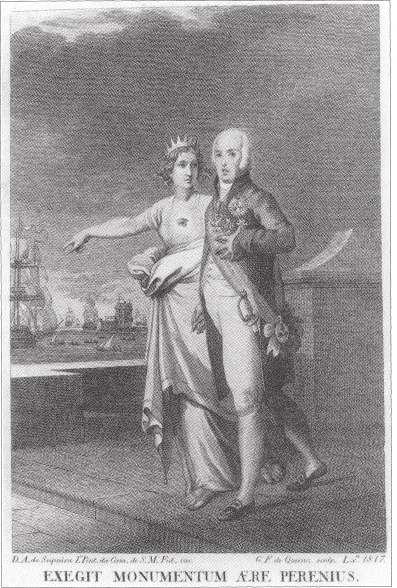
FIGURE 1: Domingos Anótnio de Sequeira, “Exegit monumentum aere perenius,” from José Anótnio Sá, Defeza dos Direitos Nacionaes e Reaes da Monarquia Portugueza (Lisbon: Impressão Régia, 1816). Copy and permission obtained from the General Research Division, The New York Public Library, Astor, Lenox and Tilden Foundations. With the epigraph “He has produced a monument more everlasting than bronze,” borrowed from Horace, Carmina III, 30.1, and modified so as to suggest Dom João as the heir of Augustus, Sequeira invoked the imperial renewal that the transfer of the court promised.
Yet, as we shall see, even as the prince regent and his courtiers celebrated the salvation of the independent monarchy and the empire, they also began to consider that the transfer of the court represented more fundamental and potentially threatening change; what Ega had described as “the greatest of all revolutions of the general political system.”52 For the Portuguese crown to achieve what one British observer hailed as a “brighter glory in the Western sphere,”53 the legitimacy of the monarchy and the empire would have to be redefined in ways that accounted for recent developments. The new court of Rio de Janeiro became a crucial site in which these redefinitions were forged.
NOTES
1. Rodrigo de Souza Coutinho, “Quadro da Situação Política da Europa …” (August 16, 1803), in Ângelo Pereira, D. João VI, príncipe e rei v. 1 (Lisbon: Empresa Nacional de Publicidade, 1953), 127–136.
2. Souza Coutinho’s proposal was rejected by Portuguese courtiers, nobles, and merchants who, without extensive properties in Brazil, saw nothing to be gained by moving the Portuguese capital to the New World. Soon after Souza Coutinho resigned from his post. See Kenneth Maxwell, “The Generation of the 1790s and the Idea of Luso-Brazilian Empire,” in Colonial Roots of Modern Brazil, ed. Dauril Alden (Berkeley: University of California Press, 1973), 141; and Andrée Mansuy Diniz Silva, “Introdução,” in Rodrigo de Souza Coutinho, Textos políticos, económicos e financeiros (1783–1811) t. 1 (Lisbon: Banco de Portugal, 1993), xlviii.
3. See Luiz da Cunha, Instrucções inéditas de D. Luiz da Cunha a Marco António de Azevedo Coutinho (1736) (Coimbra: Imprensa da Universidade, 1930), 208–209; and Joaquim Veríssimo Serrão, Do Brasil filipino ao Brasil de 1640 (São Paulo: Companhia Editora Nacional, 1968), 13–15.
4. Ana Cristina Bartolomeu de Araújo, “O ‘Reino Unido de Portugal, Brasil e Algarves’ 1815–1822,” RHI 14 (1992), 234; Maria de Lourdes Viana Lyra, A Utopia do Poderoso Império, Portugal e Brasil: Bastidores da Política, 1798–1822 (Rio de Janeiro: Sette Letras, 1994), 107–108, 120–124; C.R. Boxer, The Dutch in Brazil, 1624–1654 (Oxford: Clarendon, 1957), 204–207; and Luiz Norton, A côrte de Portugal no Brasil (São Paulo: Companhia Editora Nacional, 1938), 18–19. According to Norton, Vieira made references to these recommendations in a letter written in Bahia in 1691.
5. On the translation of empire in early modern discourse see Anthony Pagden, Lords of All the World: Ideologies of Empire in Spain, Britain and France, c. 1500-c. 1800 (New Haven: Yale University Press, 1995), 15, 27, 42–43; idem, Spanish Imperialism and the Political Imagination: Studies in European and Spanish-American Social and Political Theory, 1513–1830 (New Haven: Yale University Press, 1990), 37–63; and Frances A. Yates, Astraea: The Imperial Theme in the Sixteenth Century (London: Ark Paperbacks, 1975), 4.
6. Lyra, Utopia, 108. Portuguese medieval messianic legends were strengthened by the apocalyptic literature of Kabbalists who emigrated to Portugal after their expulsion from Spain in 1492. The legend of a hidden king (o Encoberto) residing on a mysterious western island, destined to return to create an everlasting empire, was embellished by the sixteenth-century popular poetry of a reportedly New Christian shoemaker known as Bandarra. See Gonçalo Annes Bandarra, As trovas do Bandarra (Porto: Imprensa Popular de J.L. de Souza, 1866); Carole A. Myscofski, When Men Walk Dry: Portuguese Messianism in Brazil (Atlanta: Scholars Press, 1988), 48, 52, 55–57; and Anótnio Pires Machado, D. Sebastião e o Encoberto (Lisbon: Fundação Calouste Gulbenkian, [1969]), 78, 84–87. On António Vieira’s messianism, see Luiz Reis Torgal, Ideologia política e teoria do estado na restauração v. 1 (Coimbra: Biblioteca Geral da Universidade, 1981), 306–310; and Vieira, “Sermão dos Bons Anos,” in Obras Escolhidas v. 10, eds. António Sergio and Hernâni Cidade (Lisbon: Livraria Sá da Costa, 1954), 166. Vieira elaborated these ideas in Esperança de Portugal, Quinto Império do Mundo (1659), História do Futuro (1664), and Clavis Prophetarum (1677).
7. Thomas Cohen, The Fire of Tongues: António Vieira and the Missionary Church in Brazil and Portugal (Stanford: Stanford University Press, 1998), 1, 119–129, 145–146, 157; and Myscofski, When Men Walk Dry, 108–109.
8. Pagden, Lords, 111; John Oldmixon cited in idem.
9. Pagden, Lords, 70, 122, 152, 164–167; Charles de Secondat, Baron de Montesquieu, The Spirit of the Laws (1748) (New York: Cambridge University Press, 1989), 396 (part 4, chapter 22). For Adam Smith’s understanding of the Iberian empires see his An Inquiry into the Nature and Causes of The Wealth of Nations (1776), Chapter 7, “Of Colonies.” Smith’s work, as we shall see in Chapter 6, had a particular resonance for Portuguese statesmen following the transfer of the court.
10. Pagden, Lords, 116, 124–125, 157. For a recent analysis of Spanish imperial reform in America see Jeremy Adelman, Republic of Capital: Buenos Aires and the Legal Transformation of the Atlantic World (Stanford: Stanford University Press, 1999).
11. Rui Bebiano, D. João V: poder e espectáculo (Aveiro: Livraria Estante: 1987); Angela Delaforce, “Lisbon: ‘This New Rome’: Dom João V of Portugal and Relations between Rome and Lisbon” and Marco Fabio Apolloni, “Wondrous Vehicles: the Coaches of the Embassy of the Marquês de Fontes,” in The Age of the Baroque in Portugal, ed. Jay Levenson (Washington, DC/New Haven: National Gallery/Yale University Press, 1993); António Filipe Pimentel, “Absolutismo, Corte e Palácio Real—Em torno dos palácios de D. João V,” in Arqueologia do Estado, Jornadas sobre Formas de Organização e Exercício dos Poderes na Europa do Sul. S.XVII-S.XVIII (special issue of História e Crítica) (Lisbon, 1988). See also António Caetano de Souza, História Genealogica da Casa Real Portugueza t. 8 (1749) (Coimbra: Atlantida, 1951), 1–178. Under the aegis of the newly created Royal Academy of History, João V solicited and then sponsored the publication of Caetano’s monumental history of the Portuguese monarchy, which includes a description of the Viennese commemoration of the king’s engagement to the Hapsburg princess Maria Anna, as well as of her arrival at Lisbon.
12. See Delaforce, “Lisbon: ‘This New Rome.’” For images of João V as messiah see also António da Costa, “Sermão nas Sumptuosas Exéquias do Serenissimo Senhor D. João V … ,” and António de Oliveira, “Estatua de Ouro, que o Muito Alto e Muito Poderoso Rey … Erigio nas Immortaes e Gloriosos Acções,” in João Jorge de Barros, Relação Panegyrica das Honras Funeraes que as Memórias do Muito Alto Poderoso Senhor Rey Fidelissimo D. João V consagrou a Cidade da Bahia, Corte da América Portuguesa … (Lisbon: Régia Officina Sylvaniana, e da Academia Real, 1753). On João V’s uses of liturgical ceremony to renovate the image of royal power, see also Pimentel, “Absolutismo,” 693, 694.
13. João Jorge de Barros, “Relacção Panegyrica das Honras Funeraes,” in Relação Panegyrica, 14–16, 22. On Camões, see Richard Helgerson, Forms of Nationhood: The Elizabethan Writing of England (Chicago: Chicago University Press, 1992), 155–163.
14. Cunha, Instrucções, 211–212.
15. Cunha, Instrucções, 207, 211, 219; Duc de Choiseul cited in Kenneth Maxwell, Pombal: Paradox of the Enlightenment (New York: Cambridge University Press, 1995), 111.
16. Cunha, Instrucções, 213–214; 218. Cunha’s claims concerning the role played by trade in the advancement of a spiritual empire are similar to observations made by Vieira. See Vieira, Livro anteprimeiro, cited in Cohen, 162: “for if God in his providence had not enriched those lands with those many treasures, no amount of religious zeal would have been sufficient to bring the faith to them.”
17. As Norbert Kilian notes, residents of the British colonies in North America expressed a similar sense of American preeminence; a recognition that, as one speculated, “this vast Country will, in Time, become the greatest Empire that the world has ever seen.” John Adams similarly imagined that “After many more centuries when the colonies may be so far increased as to have the balance of wealth, numbers and powers in their favor, the good of empire [shall] make it necessary to fix the seat of government here; and some future GEORGE … may cross the Atlantic, and rule Great Britain by an American parliament.” Nor did the commercial dimensions of this American empire preclude understanding its history in providential terms. “Westward the course of empire takes its way,” wrote Bishop Berkeley, “The first four Acts already past, …” See Adams and Berkeley cited in Norbert Kilian, “New Wine in Old Skins? American Definitions of Empire and the Emergence of a New Concept,” in Theories of Empire, 1450–1800, ed. David Armitage (Brookfield: Ashgate/Variorum, 1998), 315, 317.
18. António Manuel Hespanha and Maria Catarina Santos, “Os poderes num império oceânico,” in História de Portugal: O Antigo Regime v. 4, ed. António Manuel Hespanha (Lisbon: Estampa, s.d.), 395, 398; Helgerson, Forms of Nationhood, 160; and Sanjay Subrahmanyam, The Portuguese Empire in Asia, 1500–1700, A Political and Economic History (London: Longman, 1993), 47, 50–51, 107–112. The King of Portugal ruled over not only his “conquests,” but also the “navigation and commerce of Ethiopia, Arabia, Persia, and India.” In a report written in Pará Francisco de Souza Coutinho also noted the “different system” of the Spanish territories and, in particular, that the Viceroy of New Granada lived in Santa Fé de Bogotá “very far from sea ports.” “I judge,” he continued, “that that which is superior should exist on the coast, and not in the interior, and it is not in the interior that they [the Spanish] encounter dangers, nor there that they need forces except those necessary to keep the peace. …” See F. de Souza Coutinho to R. de Souza Coutinho, September 20, 1797, BNRJ Ms. I–28,25,30.
19. Pagden, Lords, 45; Hespanha and Santos, “Os poderes,” 395; Fernando Bouza Álvarez, “Lisboa Sozinha, Quase Viúva. A cidade e a mudança da corte no Portugal dos Filipes,” Pençélope:Fazer e Desfazer a História 13 (1994), 86–87.
20. See Frei Serafim de Freitas, Do justo império asiático dos Portugueses (1625) 2 v. (Lisbon: Instituto Nacional de Investigação Cientítica, 1983); Hespanha and Santos, “Os Poderes,” 396–397; Ana Maria Ferreira, “‘Mare Clausum, Mare Liberum’: Dimensão doutrinal de um foco de tensões políticas,” Cultura e História 3 (1984): 315–357; C.H. Alexandrowicz, “Freitas Versus Grotius” and G.D. Winius, “Millenarianism and Empire: Portuguese Asian Decline and the ‘Crise de Conscience’ of the Missionaries,” in Theories of Empire, ed. Armitage, 239–259, 261–174.
21. The viceroy, according to Heloísa Liberalli Bellotto, was a “viceroy without a viceroyalty.” See her “O Estado Português no Brasil: Sistema Administrativo e Fiscal,” in Nova História da Expansão Portuguesa. O Império Luso-Brasileiro, 1750–1822 v. 8, ed. Maria Beatriz Nizza da Silva (Lisbon: Estampa, 1986), 276; Guy Martinière, “Implantação das estruturas de Portugal na América, (1620–1750),” in Nova História da Expansão Portuguesa. O Império Luso-Brasileiro, 1620–1750 v. 7, ed. Frédéric Mauro (Lisbon: Estampa, 1991), 172–177. James Lockart and Stuart Schwartz have explained the different approaches to the administration of empire by characterizing Brazil’s early colonization as similar to that of the Spanish American periphery. See their Early Latin America: A History of Colonial Spanish America and Brazil (New York: Cambridge, 1983), 181.
22. Hespanha and Santos, “Os Poderes,” 398.
23. Valentim Alexandre, Os sentidos do império: questão nacional e questão colonial na crise do antigo regime português (Porto: Afrontamento, 1993), 810.
24. Pagden, Lords, 125.
25. Cunha, Instrucções, 215, 217.
26. Demétrio Magnoli, O corpo da pátria: imaginacão geográfica e política externa no Brasil (1808–1912) (Sáo Paulo: UNESP, 1997), 71–77; Andrée Mansuy-Diniz Silva, “Imperial Reorganization, 1750–1808,” in Colonial Brazil, ed. Leslie Bethell (New York: Cambridge University Press, 1994), 244–269.
27. Maxwell, Pombal, 1.
28. With the Methuen Treaty in 1703 Portugal agreed to admit British woolen cloth and other woolen manufactures free of duty. In exchange England was to admit Portuguese wine at one-third less than the duties on French wine. See Alan K. Manchester, British Preeminence in Brazil Its Rise and Decline. A Study in European Expansion (1933) (New York: Octagon, 1964) 24, 43–44.
29. C.R. Boxer, The Portuguese Seaborne Empire, 1415–1825 (London: Hutchinson, 1969), 194; Manuel Nunes Dias, “Política Pombalina na colonizção da Amazonóa (1755–1778),” Studia 23 (April 1968), 7–32; Alexandre Lobato, “A Política Ultramarina Portuguesa no Século XVIII,” Ultramar (Lisbon) 30, v. 8 (1967), 81–113; Roberta Marx Delson, New Towns for Colonial Brazil: Spatial and Social Planning of the Eighteenth Century (Ann Arbor: University Microfilms International/Dellplain Latin American Studies, 1979). The presence of royal officials in indigenous villages replaced the recently expelled Jesuits.
30. Maxwell, Pombal, 88–89, 114, 118–130.
31. Maxwell, Pombal, 96–100; William J. Simon, Scientific Expeditions in the Portuguese Overseas Territories (1783–1808) (Lisbon: Instituto de Investigação CientíficaTropical, 1983), 5; Warren Dean, With Broadax and Firebrand: The Destruction of the Brazilian Atlantic Forest (Berkeley: University of California Press, 1995), 118.
32. [Anonymous], “Prologo,” Memórias da Academia Real das Sciencias de Lisboa 1 (1797). The Academy’s motto, Nisi utile est quod facimus, stulta est gloria (If what we do is not useful then our glory is foolish), also reflected its members’ dedication to the scientific promotion of “public utility.”
33. José Correa da Serra, “Discurso Preliminar,” in Memórias Econômicas da Academia Real das Sciencias de Lisboa para o adiantamento da Agricultura, das Artes e da Indústria em Portugal e suas Conquistas 1 (1789), viii; Dean, With Broadax, 120.
34. José Luiz Cardoso, “Economic thought in late eighteenth-century Portugal: physiocratic and Smithian influences,” History of Political Economy 22, n. 2 (1990), 432–2; idem, O Pensamento económico em Portugal nos finais do século XVIII, 1780–1808 (Lisbon: Estampa, 1989); Fernando A. Novais, Portugal e Brasil na Crise do Antigo Sistema Colonial (São Paulo: Hucitec, 1979), 228–230.
35. Correa da Serra, “Discurso,” viii.
36. Joaquim de Amorim Castro, “Memória sobre a cochonilha do Brasil,” Memórias Econômicas 2 (1790), 143. Vandelli shared this enthusiasm for the potential resources of “the overseas territories.” See Vandelli, “Memória sobre algumas producções das conquistas, as quaes são pouco conhecidas, ou não se aproveitão,” Memórias Econômicas 1 (1789), 206.
37. Vandelli to Martinho de Melo e Castro (Minister of Navy and Overseas Affairs), June 22, 1778, in Simon, Appendix I. Alexandre Rodrigues Ferreira surveyed the Amazon region (1783–1792), collecting specimens and experimenting with the collection of hemp. Manuel Galvão da Silva served as secretary of government of Mozambique (1783–1793) while also traveling and collecting mineral specimens. The naturalist Joaquim José da Silva served as secretary of government in Angola (1783–1808), where he assembled an herbarium and collected plants and animals to be shipped to Lisbon. During this time, other less structured inquiries were made regarding Brazilian mineralogy and agriculture as well. To standardize its correspondents’ ad hoc participation and collection of specimens, the Academy published guidelines, Breves instrucções aos correspondentes da Academia das Sciencias de Lisboa sobre as remessas do produtos, e noticias pertencentes a História da Natureza para formar hum Museo Nacional (Lisbon: Régia Officina Typografica, 1781). On the expeditions see Simon, Scientific Expeditions. On natural science reports see the Academy’s Memórias; José Joaquim Roiz, Documentos dos Arquivos Portugueses que Importam ao Brasil (Lisbon) n. 5 (January 1945), 2–3; and “Carta muito interessante do advogado da Bahia, José da Silva Lisboa, Para Domingos Vandelli … “ABN 32 (1910), 494–505.
38. This effort was enthusiastically championed by Correa da Serra who argued that surveying Brazil’s resources and acclimatizing new plants was the Academy’s “patriotic” duty. See his “Discurso,” viii. To gain further knowledge of the empire’s resources, Vandelli organized a botanical garden at the Ajuda palace that was to serve as a clearing house. See Dean, With Broadax, 118. The scientific endeavors of men born in Brazil and then educated in Europe are analyzed in Maria Odila da Silva Dias, “Aspectos da Ilustração no Brasil,” RIHGB 278 (January–March 1968), 105–170.
39. As the son of a high-ranking imperial official, Souza Coutinho enjoyed the personal blessings of Pombal, his godfather, as well as access to an education that reflected the Prime Minister’s vision of a well-educated, well-trained, and reform-minded nobility. His father served as governor of Angola during Pombal’s administration. His dedication to natural science was reflected in his charter membership of the Linnaean Society of London. See Ângelo Pereira, D. João VI, principe e rei v. 3 (Lisbon: Emprensa Nacional de Publicidade, 1956), 86; Kenneth Maxwell, “The Generation of the 1790s,” 133; Dean, With Broadax, 118–121; Lyra, Utopia, 83–88; and Guilherme Pereira das Neves, “Del Imperio Luso-Brasileño al Imperio del Brasil (1789–1822),” in De los Imperios a las Naciones Iberoamerica, et. al. A. Annino (Zaragoza: Ibercaja, 1994), 169–193.
40. Rodrigo de Souza Coutinho, “Memória sobre o Melhoramento dos Domínios de Sua Magestade na America” (1797), Brasilia (Coimbra) 4 (1949), 407–422. Also in 1797, Francisco de Souza Coutinho submitted a proposal for similar reforms in “the governments of the North of our America.” See Francisco de Souza Coutinho to Rodrigo de Souza Coutinho, September 20, 1797, BNRJ Ms. I–28,25,30. See also Rodrigo de Souza Coutinho, “[Discurso feito] na abertura da Sociedade Real Maritima, em 22 de Dezembro de 1798,” in Marquês do Funchal, O Conde de Linhares (Lisbon: Typografia Bayard, 1908), 105–115. On Olivares and the union of arms see J.H. Elliott, Imperial Spain, 1469–1716 (New York: Meridian, 1963), 326–328. I thank Antonio Feros for calling my attention to the similarity between Olivares’ and Souza Coutinho’s proposal.
41. Souza Coutinho, “Memoria sobre o Melhoramento dos Dominios,” 406. On the Bourbon administrative elite’s disdain for American-born Spaniards see David Brading, The First America: The Spanish Monarchy, Creole Patriots, and the Liberal State, 1492–1867 (New York: Cambridge University Press, 1991), 477; and John Lynch, “The Origins of Spanish American Independence,” in The Independence of Latin America, ed. Leslie Bethell (New York: Cambridge University Press, 1987), 24–27. On the Brazilian-born imperial elite see Maxwell, “Generation,” 138–144; Roderick Barman, Brazil: The Forging of a Nation, 1798–1852 (Stanford: Stanford University Press, 1988), 119; and José Murilo de Carvalho, “Political Elites and State Building: The Case of Nineteenth-Century Brazil,” Comparative Studies in Society and History 24, n. 3 (July 1982), 395.
42. Pagden, Lords, 124–125, 194.
43. Souza Coutinho, “Memoria sobre o Melhoramento dos Dominios,” 406. See also a report by Francisco de Souza Coutinho to Rodrigo de Souza Coutinho, September 20, 1797, BNRJ Ms. I–28,25,30. The report was inspired by the need to promote “the conservation of the colonies” in spite of “opposing efforts by foreign enemies” and “internal disorder” by way of a “regular administration of civil and criminal justice, with public economy, and by maintaining political relations in accordance with the established system.”
44. Manchester, British, 55.
45. On the Marquês of Alorna, José Manuel de Souza, see Lyra, Utopia, 109.
46. See Ega cited in Araújo, “O ‘Reino Unido,’” 235.
47. Souza Coutinho, “Quadro da Situação Política,” in Pereira, D. João VI v. 1, 127–136.
48. British support for a transfer of the court dated back at least to 1762 when British forces helped the Portuguese repel a Spanish invasion. At that time, commentary suggested that in the event that Spain and France occupied Portugal’s capital the British could escort the Portuguese king “his treasures, and all that of his family and faithful subjects” across the Atlantic and in doing so themselves gain direct access to Brazil. See Punch’s Politicks (London, 1762) cited in Maxwell, Pombal, 112. The anonymous pamphlet of 1807 proclaimed that it was “in Brazil that Portugal is a power.” There the Prince Regent would build “the inexpugnable bulwark against the tyranny of Europe. …” See the citation in Tobias Monteiro, História do império. A elaboração da independência (Rio de Janeiro: Briguiet, 1927), 54. According to Monteiro, this pamphlet, Reflexions sur la conduit du Prince Regent de Portugal (London: F. Harper, 1807), was published in June. Monteiro notes that its language recalled earlier formulations attributed to William Pitt, as well as Strangford’s subsequent account of the royal family’s departure. Monteiro, however, does not cite a Portuguese version of the tract published in Coimbra after the Prince Regent’s departure, apparently as an apologia. See Reflexões sobre a Conducta do Principe Regente de Portugal (Coimbra: Real Imprensa da Universidade, 1808). At that time the author was identified as the Portuguese Francisco Soares Franco. See pp. 7–8 for identical passages. Pitt’s plan for Portuguese America was also integrated into Joaquim Rafael do Valle’s Manifesto Juridico, e Politico a Favor da Conducta do Principe Regente N.S., e dos Direitos da Caza de Bragança, contra as usurpações Francezas desde a Epoca da injusta invasão de Portugal (Rio de Janeiro: Impressão Régia, 1811), 18.
49. One contemporary account of the debates among Portuguese courtiers in 1807 is found in Anonymous, “Jornada do Sr. D. João 6° ao Brazil em 1807,” in Ângelo Pereira, Os filhos de el-rei D. João VI (Lisbon: Empresa Nacional de Publicidade, 1946), 101–116. On the diplomatic context of the transfer of the court see Alan K. Manchester, “The Transfer of the Portuguese Court to Rio de Janeiro,” in Conflict and Continuity in Brazilian Society, eds. Henry H. Keith and S.F. Edwards (Columbia, SC: University of South Carolina Press, 1969) and idem, British Preëminence, 54–68; Ana Cristina Araújo, “As Invasões franceses e a afirmação das ideias liberais,” in História de Portugal: O Liberalismo v. 5, eds. Luiz Reis Torgal and João Lourenço Roque (Lisbon: Estampa [n.d.]), 17–24; David Francis, Portugal, 1715–1808, Joanine and Rococo Portugal as Seen by British Diplomats and Traders (London: Tamesis, 1985), 245–286.
50. “[Cópia do] Decreto que o Principe Regente de Portugal foi servido deixar em Lisboa para a boa direção do Governo na sua ausência para o Rio de Janeiro,” November 25, 1807, BNRJ Ms. I–3,19,69.
51. “Manifesto de Declaração de Guerra aos Francezes,” May 1, 1808, ([Rio de Janeiro]: Impressão Régia, [1808]). Also published as Manifesto, ou Exposição Fundada, e Justificativa do procedimento da Corte de Portugal a respeito da França desde o principio da Revoluço até a epoca da Invasão de Portugal … (Rio de Janeiro: 1808), reprinted in Souza Coutinho, Textos, t. 2, 335–343. The counsel received regarding this document is transcribed in Pereira, D. João VI v. 1, 19–34. The implications of this language were apparent to the Marquês de Angeja who advised that “it would be convenient to omit on the first page the words ‘from the new Empire that he will create’; because I am persuaded that this expression denotes few hopes of His Royal Highness returning to possess Portugal.”
52. Ega cited in Araújo, “O ‘Reino Unido,’” 235.
53. [John Wolcot], The Fall of Portugal; or The Royal Exiles, A Tragedy in Five Acts (London: Longman, Hurst, Rees and Orme, 1808), 20.