
TWO
IN MARCH 1808, AFTER TWO MONTHS AT SEA AND A STOP AT SALVADOR, BAHIA, Portuguese Prince Regent Dom João and his convoy sailed into Guanabara Bay, an exceptional natural harbor known for both its “capaciousness and security” and spectacular natural environs. As the ships passed through a narrow entrance between two hills, the bay suddenly widened into what appeared to be “an extensive lake.” From a distance, the royal exiles could behold the rugged mountains that surrounded the bay and the white sandy beaches and transparent blue water that lay at their feet. As they drew closer, passengers could discern the city of São Sebastião of Rio de Janeiro itself, nestled among rocky hills and lush vegetation. The city’s border closely followed the bay’s winding coastline, with building extending to nearby hills that left, as one late eighteenth-century visitor noted, “[a]lmost every eminence in the vicinity of the town … crowned with a castle or a fort, a church or a convent.” The resulting contrast of whitewashed fortifications and churches, with the stony, brown hills and green foliage was striking.1
It was here, in this pleasantly incongruous setting, that the prince regent and his courtiers would set out to make their visions of political salvation and imperial renewal a reality. And it was with Rio de Janeiro’s residents that they would negotiate the terms for constructing the new royal court and a new imperial politics. While a few of the statesmen who accompanied the prince regent had served previously in Brazil, most of the royal exiles knew little of Rio de Janeiro, apart from a general perception of life in the colonies as inferior.2 For the exiles their arrival at the city thus was a discovery, one which, as the cleric Luiz Gonçalves dos Santos claimed in an epigraph to a history of his native Rio de Janeiro, recalled that most emblematic Portuguese discovery, Vasco da Gama’s voyage to Asia in 1498. Just as the earlier Portuguese mariners, Gonçalves dos Santos pointed out with words borrowed from the poet Luiz de Camões (c. 1524–1580), the exiled courtiers came “from the far off Tagus.” Writing in a similarly triumphant tone, the exiled Marquês de Bellas also found the comparison of da Gama’s voyage and the royal journey to Brazil to be compelling and likened the prince regent to da Gama’s sponsor, King Manuel.3
Yet if, as the courtiers had learned from Camões, Vasco da Gama was greeted by the residents of India ostensibly eager both to trade and to learn of the God who had “certainly brought him,” when the courtiers themselves prepared to disembark, and begin their lives in the New World, they could only wonder: what and who would they encounter? This chapter provides answers to this question with an overview of the eighteenth-century city of Rio de Janeiro. For Rio de Janeiro’s residents the eighteenth century was a time of new political preeminence and economic prosperity, based on plantation agriculture, an expanding international and internal trade, and the traffic in and use of African slaves. Politics and commerce also linked the newly named capital of Brazil to the larger Atlantic world. By the end of the eighteenth century, this world had become revolutionary. Living and governing in Rio thus meant grappling with the consequences and experiencing what one resident described as “dangerous times.”
THE CAPITAL OF PORTUGUESE AMERICA
In contrast to its spacious natural environment, the city of Rio de Janeiro was small; an intimate, densely constructed setting about one and one-half miles long and three-quarters of a mile wide. The eighteenth-century urban environment began at the Terreiro do Palácio, a large and reportedly “handsome square” that opened up onto the bay. To the right of its docks, the terreiro was bordered by the arches of Teles, the remains of an elite residence destroyed in a fire that was now home to a tavern keeper and reputed to be a haven for petty thieves and prostitutes. To the left was the simple, rectangular, two-story building that housed the viceroy and served as the seat of government. Nearby, completing the square’s perimeter, were the Carmelite convent and the city’s jail. The terreiro also contained the pelourinho, a stone pillar used for public whippings. At its edge near the quay stood a “luxurious” public fountain.4
Disembarking at the terreiro’s docks, visitors confronted a host of activities and glimpsed both the city’s economic and political dimensions as well as its social and cultural hierarchies. During the day, the busy square was filled with African and African-Brazilian slaves. Some loaded and unloaded goods at the docks and carried them back and forth from stores and warehouses. Others, under the watch of guards, waited in long lines for water from the fountain to be carried back to their owners’ houses. The administrative responsibilities that the city encompassed were evident in the presence of magistrates and other royal officials, making their way along the sidewalks that criss-crossed the square to and from meetings with the viceroy. The guarantee of order and the consequences of justice then were further revealed in the daily scene of shackled prisoners begging for alms at the prison’s door, as well as in the occasional acts of exemplary corporal punishment at the pelourinho.5
Leaving the terreiro from the left, the Rua da Misericórdia wound back toward the bay, along the foot of Castle Hill, to a compound of fortifications and buildings that were part of the city’s original mid-sixteenth-century settlement. There both a colégio and the church of Bom Jesus dos Perdões stood as reminders of the Society of Jesus, the powerful religious order that had built them and indeed dominated the church and missionary effort in Brazil until its expulsion in the middle of the eighteenth century. The Church of São Sebastião was there as well, demonstrating that saint’s long-standing patronage of the city and its residents. Nearby, among other churches and barracks, was the Santa Casa da Misericórdia (The Holy House of Mercy), the local chapter of the most prestigious lay brotherhood in the Portuguese world.6 The Misericórdia’s careful selection of its members, based on lineage, wealth, and profession, provided the city’s elite with an institutionalized measure of status. The Rio de Janeiro chapter was over two hundred years old and by the eighteenth century it included a hospital and a recolhimento (retreat) that functioned as an orphanage, as a place of seclusion for married women whose husbands were temporarily absent from the city, and, at times, as a penitentiary for elite women who had strayed from their families’ moral demands. Modeled after their counterparts in Lisbon, both the Misericórdia and the recolhimento together signified the ability of the city’s elites to reproduce not only metropolitan institutions but also metropolitan virtues: piety, charity, sobriety, and purity.7
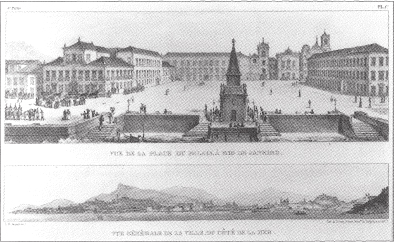
FIGURE 2: Jean Baptiste Debret, “Vue de la Place du Palais à Rio de Janeiro” and “Vue Générale de la Ville, du Côté de la Mer,” from Debret, Voyage Pittoresque et Historique au Brésil, sejour d’un Artiste Français au Brésil v. 3 (Paris: Firmin Didot Fréres, 1839). Copy and permission obtained from the Print Collection, Miriam and Ira D. Wallach Division of Arts, Prints and Photographs, The New York Public Library, Astor, Lenox and Tilden Foundations. In the view of the largo do paço (above), the viceregal palace is to the left. In the middle of the docks stands the public fountain.
Returning to the northwest corner of the terreiro, the Rua Direita, one of the city’s busiest streets, led away from the older nuclear settlement toward São Bento’s hill and the Benedictine Monastery atop, where within its seventeenth-century chapels ornate, gilded altars, painted images, and intricate jacarandá wood grates and furniture displayed the mastery of European and local artists.8 Beyond both the Rua Direita and the terreiro, a grid of narrow, “well-paved,” but often dirty, streets and largos (squares) extended northwest to the foot of Conceição hill, southwest to the hills of Santo António and Santa Teresa, and west to the Campo de Santa Anna, a large meadow surrounded on three sides by houses and gardens. Most streets were both commercial and residential. Many were named after prominent nearby landmarks, such as the Rua da Cadeia (jail), or the Rua do Rosario, which began at the Rua Direita and ended in front of the Church of the Rosary, home of the city’s largest black brotherhood. Other street names, such as Rua do Sabão (soap) and Rua dos Ourives (goldsmith), evincing what Angel Rama described as the “metonymic displacement” typical of colonial Latin American city streets, indicated the primary object of exchange or service offered. The Rua do Ouvidor (magistrate), in turn, was named after its most famous resident, the local circuit judge, who since the mid-eighteenth century enjoyed a residence on the corner of the Rua da Quitanda (grocer). Such residential buildings were reportedly “of good appearance.” Most were two-storied, stone houses and many featured latticed-covered balconies that provided both shelter from the tropical summer sun and more famously, according to visitors to the city, a place from which women of distinction could discreetly greet passersby.9
In the eighteenth century this built environment had greatly expanded. Fortification, in particular, became a priority, as the century that opened with the French sack of Rio in 1711 also witnessed the British capture of Havana in 1762. Reforms of existing structures were accompanied by a series of new projects supervised by the Swedish military engineer Jacob Funck. An expansion of the city’s civilian infrastructure also began in the 1730s with the construction of a two-tiered aqueduct, extending from the hill of Santa Teresa to the city’s center, completed under the supervision of the Conde de Bobadela (Governor, 1733–1763) and the Portuguese architect and engineer José Fernandes Pinto Alpoim, whose other projects in Rio included a hospital and residences for the governor and bishop. Major urban reforms then followed in the administrations of the Marquês de Lavradio (Viceroy, 1769–1779) and his successor, Luiz de Vasconcellos e Souza (Viceroy, 1779–1790). By the end of the eighteenth century, Rio de Janeiro featured new public fountains, roads, bridges, corrals, and slaughtering facilities.10
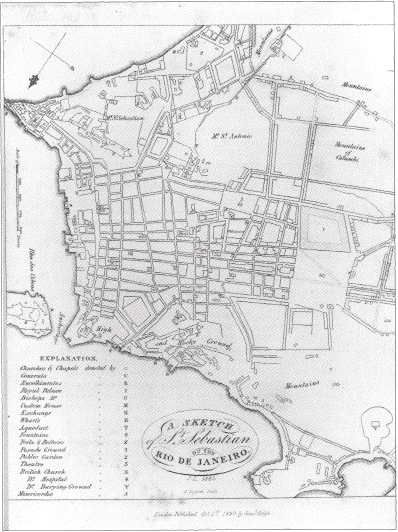
FIGURE 3: John Luccock, “A Sketch of San Sebastian,” from John Luccock, Notes on Rio de Janeiro and the southern parts of Brazil … (London: Samuel Leigh, 1820). Copy and permission obtained from the General Research Division, The New York Public Library, Astor, Lenox and Tilden Foundations. The map runs from south to north. Before the arrival of the court, Luccock noted, the city was contained within narrow boundaries.
Another addition to the cityscape, the newly reformed customs house, demonstrated the link between the fertile Brazilian countryside and the world beyond its shores that Rio de Janeiro provided.11 Indeed, life in the eighteenth-century city revolved around its bustling port. Beginning in the late seventeenth century, proximity to the new mining region of Minas Gerais gave the city strategic importance. In the second half of the eighteenth century Rio’s port then surpassed Bahia’s in volume to become firmly established as both the principal entrepot between Brazil and other parts of the empire and a major center of distribution for other regions of the colony.12 The increasing importance of Rio’s port also meant that the city became the focus of metropolitan attentions. In 1763 the Portuguese crown formally recognized the city’s preeminence by moving the capital of Portuguese America there from Salvador. In the last decades of the eighteenth century, although the mining economy waned, trade remained lucrative. Rio’s merchants exported to Portugal rice, sugar, cotton, coffee, hides, wood, and whale oil. From Lisbon arrived wine, wheat, flour, olives, salt, and manufactures to be sold in the city and, in many cases, reexported to other areas of Brazil. The economic growth generated by transatlantic trade was also accompanied by an expansion of production for internal consumption and interregional trade. Manioc from Bahia and Santa Catarina and charque (jerked beef) from Rio Grande do Sul were imported to Rio to be both consumed locally and distributed to nearby plantations.13
The wealth generated by trade was reflected in the city’s steadily expanding marketplace and notable commercial vitality.14 Rio’s streets reportedly were lined with “shops of every kind” and crowded with pedestrians and slave-borne sedan chairs. By 1799 the city had over 1,300 registered commercial establishments, including boticas (pharmacies), casas de cafe (coffee houses), casas de pasto (eating houses), and tobacco shops. Taverns were found along the Rua São José. Wholesalers were concentrated on the Rua dos Pescadores and the Rua Direita, where in 1794 almost one hundred stores were located. In these “large and commodious” shops the city’s residents could find regional products, as well as both legally and illegally imported European manufactures, including linens, silks, and silverware.15 By the turn of the nineteenth century, the city’s prosperity and well-being were even more dramatically manifest in an attractive Passeio Publico (public promenade). Built and maintained with African labor, it featured tile-covered benches, decorated pavilions, granite fountains, and marble statues designed by the famous Afro-Brazilian sculptor known as Mestre Valentim.16 Its gardens boasted numerous examples of European and indigenous commercial crops and its main pavilion was lined with murals which, one English visitor explained, displayed “the principal productions to which that country was indebted for its opulence.” There, he noted, “the gay society of Rio, after taking exercise in the evenings in the walks, often after hearing songs and music, [sat] down to partake of banquets, accompanied, sometimes, by music and fireworks.”17
Those who partook of such moments of leisure and who, more generally, reaped the benefits of commerce were, however, the fortunate and the few. Indeed, although artisans, soldiers, and servants managed to avoid indigence, the majority of the city’s residents were poor. An “enormous economic differentiation,” Florentino and Fragoso explain, existed even among the propertied of Rio de Janeiro. As their recent study of postmortem inventories shows, at the end of the eighteenth century only 11 percent of the city’s and nearby region’s property owners controlled 75 percent of its wealth. This narrowly distributed wealth, in turn, depended on an expanding use of slave labor. Between 1790 and 1808 an average of almost 10,000 Africans, primarily from the regions of the Congo and Angola, arrived per year at the port of Rio de Janeiro.18 By the second half of the eighteenth century the existing slave market near the city’s center could scarcely accommodate new arrivals. In response to this increase, and so that the city’s residents might avoid what he construed to be demoralizing encounters with the growing number of “disease-ridden and naked” Africans arriving to Brazil after a brutal transatlantic voyage, the Marquês de Lavradio had moved the market to Valongo, a more isolated northwestern district beyond Conceição Hill. There Africans were kept in warehouses until they were sold.19 While most African slaves were then sent outside the city to work as agricultural laborers or miners, many remained in Rio as personal servants, dock workers, vendors, and artisans. As a result, by the end of the eighteenth century the growing population of Rio de Janeiro was as African as it was European. Indeed, in 1780 almost half of the captaincy’s 200,000 inhabitants were enslaved. The other half comprised Portuguese and Brazilian-born whites, and people of color, a category that could include people of African and mixed ancestry born free as well as freed slaves.20 Of the 45,000 to 60,000 people who lived in the city of Rio itself, 45 percent were identified as “white,” 35 percent were slaves, and 20 percent were “freed pardos” (of mixed African and European ancestry) and “freed blacks.”21
For royal officials in the city and its hinterland, this diverse and growing population meant increased threats to the maintenance of order and royal authority. More slaves meant more incidents of slave rebellion, flight, and the consequent formation of runaway communities—quilombos—on the margins of Portuguese settlement. In these cases, royal government in Rio, local municipal governments in the region, and slave owners turned to capitães do mato (bush captains), bounty hunters drawn from the ranks of white settlers and free people of color, paid for retrieving runaways dead or, preferably, alive. According to one report, the Conde de Bobadela was particularly zealous of these matters, seeking to provide regulation and local auxiliary forces for the expeditions. To maximize the exemplary effects of punitive expeditions against quilombos, slaves who died resisting a return to slavery were beheaded and “these heads were placed on posts in the principal towns” for all to behold “until time consumed them.”22
While waging this war against runaway slaves, royal officials also trained their attentions on the specter of vagrancy (vadiagem). As one royal official explained his perception of the threat in 1798, vagrants “rob[bed] from the public the services that all vassals” owed to the king.23 The problem of vagrancy, however, was not unique to the eighteenth century. From its inception the Portuguese empire was, as Russell-Wood has characterized it, “a world on the move”; it demanded the “constant flux and reflux of people” that resulted from both voluntary and involuntary journeys to missionize, to trade, and to settle. Consequently, as Laura de Mello e Souza has argued, the Portuguese crown promoted and depended on itinerancy even as it marginalized and criminalized itinerants. Often, the indigent in Portugal were recruited forcefully for military service that entailed a series of transitory assignments, while those associated with criminal activity, including vagrancy itself, were sentenced to punitive exile in one of various destinations in the ultramar.24 Officials in eighteenth-century Rio de Janeiro, nevertheless, overlooked these historic and imperial dimensions of vagrancy, and the poverty of those accused of being vagrant, in favor of what they perceived to be particularly local and Brazilian circumstances. Although the juiz de fora (district crown judge) Balthazar da Silva Lisboa claimed the “luxury, limitless prostitution and vagrancy” in Rio were symptomatic of a reigning climate of moral decadence found in eighteenth-century Portugal as well,25 royal officials more often conflated the category of vagrant, legally defined as anyone without a “master” or an “office,” with people of color in general. “Judgments of indolence,” as Mary Louise Pratt has noted of Spanish America, “remained quite compatible with the labor-intensive forms of servitude,” which, in this case, sustained both Brazil’s and the empire’s economy.26 Thus, Viceroy Vasconcellos e Souza and his successor the Conde de Resende (Viceroy, 1790–1801) warned of the connections among vagrancy, “unspeakable, extravagant acts,” and “mulattos and blacks.” The “innumerable Individuals who come here [Rio de Janeiro] without occupation,” Resende reported in 1798, “are poor people and mostly Mulattos and Blacks” who “abuse their liberty indulging in every sort of vice and passing their lives in complete inaction, either because they do not have any means to earn their living or because they are not subjected to anyone who looks after their conduct.”27 Other administrative reports in turn focused on what were perceived to be the structural dimensions of vagrancy and stressed that it was the excessive number of slaves that produced both an idle and corrupt elite and a population of unoccupied slaves, held as symbols of wealth, rather than as productive labor. Slaves who had acquired skills, it was also argued, contributed to vagrancy by taking jobs away from free men with the same training.28
To solve what they perceived to be the mounting problem of vagrancy and to curtail the range of threats to the city’s social and political hierarchies ostensibly posed by people of color, royal officials limited “gatherings” of “blacks and mulattos” and met infractions with incarceration and forced service to the crown. Vasconcellos boasted that the funds generated by the labor of vagrants provided for the maintenance of public works.29 His predecessor Lavradio also had promoted the institution of the terços dos homens pardos (regiments of men of color). These regiments not only contributed to security and defense, argued Lavradio, but also provided members with necessary examples of discipline, obedience, and respect. Indeed, Lavradio advised his successor in 1779, the establishment of effective royal authority among the region’s poor and itinerant inhabitants was a matter deserving particular attention and “the greatest care.” For “an anxious spirit” may appear among these people, he warned, and “talking to them in a language that they find more appealing, and coaxing them into insolence, they [will] quickly forget what they owe to follow his flag.”30 Thus, for royal officials Rio de Janeiro’s eighteenth-century growth and prosperity brought a sense of vulnerability and an increasing awareness of the challenges of governance. As we shall see below, as the eighteenth century drew to a close these potential threats to the city’s political and social order would only increase.
“TRÊMULO JARDIM, CIDADE ERRATICA”: EIGHTEENTH-CENTURY RIO DE JANEIRO AS SPECTACLE
Both the cityscape and the commercial and social routines of Rio de Janeiro’s residents were momentarily transformed by public commemorations.31 Together with annual religious festivals and processions, residents celebrated the arrival of new royal and ecclesiastical authorities with the appropriate displays of pomp. In 1747, for example, for the ceremonial entrance of the new bishop, Frei António do Desterro Malheiro, residents staged an elaborate procession along flower-lined streets, past windows decorated with silk and tapestries, through seven triumphal arches, each one invoking a classical virtue. The celebration culminated at the city’s cathedral, where a mass was held and the bishop formally assumed his new post. Festivities then continued into the night with luminaries and music.32 Similar commemorations marked the beginning of a new viceregal government. Like the bishop, the viceroy formally “took possession” of his office in the cathedral before religious officials, members of the city’s town council, distinguished residents, and “the people of this City” who all gathered to witness a reading of the orders that nominated the crown’s new representative in Brazil.33 Although both the bishop and the viceroy had powers that extended beyond the city of Rio de Janeiro, such commemorations were primarily local affairs. Consequently, they heightened the city’s residents’ sense of living together in the capital of Portuguese America.
In contrast, public commemorations of the royal life cycle, of the sovereign’s birth, his or her Acclamation to the throne, marriage and death, sought to reaffirm the existence of a larger imperial political community to which the city’s residents also belonged. The commemorations of a royal birth, for example, staged simultaneously throughout the Portuguese dominions, were intended to reveal an essential relationship between the empire’s parts and its whole. As one memorialist in Rio suggested, unity and relations of reciprocity were expressed in both collective and individual gestures. While the residents prayed for the distant “king and kingdom,” they also “congratulated each other,” he explained, “as if each one of them contained all of the happiness of the State.”34 The lavish celebrations of the royal life cycle, in this sense, allowed the city’s residents both to witness the splendor of royalty as it was revealed in processions and festive ephemera, and to participate in a performance intended for an imagined imperial audience. Rio de Janeiro, in other words, became what one memorialist described as the “extraordinary spectacle … a brilliant garden, impassioned City” that the whole empire could behold. As accounts of such celebrations were published subsequently in Lisbon, recognition of the city’s allegiance, wealth, and status among the crown’s other dominions was guaranteed.35
This transformation of Rio de Janeiro as spectacle into text often implied bringing both local and imperial tensions to the surface. While, as was the case in local festivals, royal commemorations encompassed a careful display of the hierarchies that existed among Rio’s residents, as a text they also established the city’s status within the empire with boasts of an ostensibly collective luxury and opulence. This collectivity, in turn, was expressed as an imminent transcendence of social boundaries. As one resident-memorialist described the commemoration of the birth of Maria I’s first-born son in 1762, all of Rio’s residents appeared “to be so well-dressed that the nobles were distinguished from the common people only by their faces and by their names, rather than by their attire.” Even the impoverished Franciscan friars became emblems of luxury and, as the memorialist further explained to his distant readers with a reversal of imperial geography, it “appeared as if Rome had been left with only the sovereignty of its land, as the attentions of the Vatican were transferred to Rio de Janeiro.”36 Thus, the celebration of an all-encompassing imperial monarchy was eclipsed by the celebration of the city itself.
The tension between the staging of local allegiances and the metropolitan discourse of imperial unity, described in Chapter 1, intensified in the early 1790s as residents witnessed an extraordinary counterpoint to their lavish commemorations of monarchy, empire, and Rio de Janeiro: the ritual punishment of political dissidence. In 1789 officials discovered a plot to overthrow Portuguese royal government in Brazil in the name of “liberty” and republicanism. Although the center of the conspiracy, apparently inspired by French philosophy and North American tracts, was the nearby region of Minas where the accused conspirators lived, it was the city of Rio de Janeiro, as the viceregal capital, that hosted the royal alçada (special court) convened to adjudicate the case and where the final spectacle of judgment took place.37 For Rio’s residents, as one royal judge surmised, it was a tense and uncertain time. After initial inquiries, the scope of the investigation had expanded to include the city, as officials pursued their suspicions of local collaboration. Fear and the desire to avoid costly entanglements also reduced the intense trade between the city’s merchants and the Minas elite. Indeed, in 1792, with the alçada drawing to a close, it became impossible, as an anonymous memorialist recalled, “to hide the oppression” that was felt. “Many retired to the countryside,” he reported, “communications diminished,” and the city’s streets were emptied.38
When the day of sentencing finally arrived, those who remained in Rio awoke to find a well-orchestrated show of force in auxiliary and European regiments stationed throughout the city. The ceremony of judgment, a veritable drama in three acts, began with the reading of the sentence over the course of eighteen hours within the tribunal’s chambers, where the viceroy, judges, defendants, priests, and guards were gathered. The figure of an army lieutenant, Joaquim José da Silva Xavier, known as Tiradentes (tooth-puller), took center stage. Tiradentes was the most admittedly republican of the defendants and, according to royal officials, he had confessed to playing a central role in both the plotting and spreading word of the rebellion. For him, full and exemplary punishment was the order of the day. Tiradentes was to be hanged and quartered. His head would be displayed in Minas Gerais, his body parts placed at the entrance to the captaincy, and his home would be destroyed. The other defendants, the judge then explained, were to be given punishments that were similarly severe.39 The second act then began with the defendants’ pleas for reconsideration and culminated, as one resident recalled, with an orchestrated surprise. With the accused and other royal officials gathered once again in the tribunal’s chambers, the judge proceeded to the podium and produced a previously drafted letter of royal clemency that he had brought with him from Lisbon. The merciful monarch, the letter revealed, would spare the lives of ten defendants and banish them to Africa instead. Tiradentes alone would be hanged. News of such a magnanimous act reportedly was received throughout the city with both relief and euphoria.
As Kenneth Maxwell has argued, Tiradentes provided the crown with a helpful scapegoat. On the one hand, because he was neither as wealthy nor as socially prominent as the other defendants, revealing him as the leader “minimiz[ed] and ridicul[ed] the objectives of the movement.” On the other hand, his public punishment provided the crown with an opportunity to reaffirm the nature and scope of royal authority and to suggest that similar plotting would produce a similar response. Thus, royal officials seized on the opportunity presented by the tribunal and provided a lesson in political loyalty that aimed to deflect any feelings of sympathy for the defendants that Rio’s residents may have harbored.40 Accordingly, the final act of the spectacle of judgment began with a swift execution only two days later, followed by commemorative festivities that lasted almost a week. A mass was held to give thanks that Rio had been spared from the ignoble plans for revolution and, as a friar who had witnessed the proceedings explained, “to persuade the people to be faithful and loyal to their pious and merciful sovereign and to pray that God would protect both her life and the empire.” Allegory then made the lessons of the Minas conspiracy even clearer. During one commemoration participants beheld the image of a forceful, just, and merciful monarch, flanked by Hercules and Astrea, confronting the figure of “America” who, kneeling at the foot of the throne, “reverently” offered a platter of hearts that “signified the love and fidelity of Americans.” Completing the scene were the conspirators themselves represented by the figure of a naked, kneeling Indian, “pledging allegiance to the sovereign and begging for mercy.” A savage, treasonous America thus was rendered helpless by the powerful Portuguese crown. And just as early Portuguese settlers and missionaries had instructed the Brazilian coastal Indians, this spectacle of adjudication and punishment taught that although disobedience could lead to death, in contrast, humiliation, sacrifice, and allegiance paved the way to reconciliation and redemption. Rio de Janeiro, having weathered the threat of treason, was saved. Once again consumed by images of an invincible monarchy and a unified empire, its residents were bestowed with the knowledge that, as the anonymous memorialist explained, the pardon of the Minas conspirators derived from both “absolute power and absolute piety” and the sovereign vision of clemency that “extended itself … from sea to sea, embracing finally the extremities of the earth.”41
“DANGEROUS TIMES”
The pardon for the conspirators was not, the memorialist also claimed, “the effect of ordinary and common causes.” It was, on the contrary, an extraordinary “act of absolute power” for extraordinary and “dangerous times.”42 The independence of the United States had challenged both the nature of the relationship between Europe and America and the virtue of monarchy, leaving Portuguese royal officials to wonder whether, or simply when, the residents of Brazil would find their experiences to be analogous to those of the thirteen British colonies, as the Minas conspirators reportedly had. After all, although the Inconfidência Mineira, as the conspiracy came to be known, was squarely defeated, by the time Tiradentes was hanged and the rest of the conspirators banished, similar claims to “liberty” had inspired a successful revolution in France. And, even as revolutionaries there began the process of constructing a new republican government, in the French colony of Saint Domingue slaves began an ultimately successful campaign to rid that island of both the institution of slavery and the population of white landowners. Indeed, by the turn of the nineteenth century the Atlantic had become a world where empire, monarchy, and slavery, the once apparently durable foundations of politics, society, and economy in Rio de Janeiro and Brazil, had been forsaken.
Although between the inconfidência in Minas and arrival of the court in 1808, Rio de Janeiro witnessed no serious threat to the authority of the Portuguese crown, events in the United States, France, and Haiti did begin to reshape the city’s political culture. For royal officials it was time that called for shoring up defenses. Rio de Janeiro’s busy port, they feared, made the city particularly vulnerable to revolutionary ideas. As the city had neither a printing press nor a vigorous book trade through which such ideas could be disseminated,43 officials focused on the people suspected of endorsing insurgent agendas. Existing restrictions on foreigners—visitors to the city from beyond the Portuguese empire—were strictly enforced. As the British diplomat John Barrow reported of a visit to Rio de Janeiro in the early 1790s, the viceregal government did not to allow “any stranger to remain on shore after sunset” or “walk the streets in the daytime, without a soldier at his heels.”44
The most energetic response to the threat of revolution, however, focused on vassals of the Portuguese crown: an invasive inquest of suspected local dissidence led by the Viceroy Conde de Resende. Resende had arrived in Rio as the Minas investigations were beginning and had presided over the execution of Tiradentes. As these events unfolded, correspondence received from his advisors in Lisbon informed him of French advances in Europe.45 Convinced that the city was vulnerable to a now clearly expanding sphere of revolutionary influence, Resende decided that rather than wait for an insurrection he would go on the offensive. Thus, in 1794 he ordered a broad investigation to determine who “with scandalous liberty, had dared to include in his discourse subjects offensive to religion, and to speak of European public affairs with praise and approbation for the present French system” and who “beyond such scandalous discourses had taken steps to form or suggest a seditious plot.”46 The unstated targets of the investigation were the members of a local literary society, established in 1786 with the assistance of the Viceroy Vasconcellos e Souza so that its members might “not forget … what they had learned in other countries” and share new knowledge of “public interest” and “utility.” Its members had stopped meeting during the investigation into the Minas conspiracy, but in 1794 they were instructed by Resende himself to reconvene.47 The fact that Resende gave these orders only a few months before the formal investigation began later led to speculation that he had set a trap. It was also the case, however, that the society’s members were less than grateful for his gesture, for Resende and his administration were the preferred subjects of their often satirical commentary.48 Shortly after making contact with informants, Resende had heard enough rumor and accusation to make arrests.
The most prominent defendants in the investigation were Mariano José Pereira da Fonseca and Manuel Inácio da Silva Alvarenga. A native of Rio de Janeiro, Fonseca was sent at the age of eleven to study at the Royal College at Mafra in Portugal. From there he went on to receive degrees in mathematics and philosophy at the University of Coimbra. When he returned to Rio, only a few years before the investigation began, he took with him a well-established reputation and the friendship of several courtiers. Upon resettling in the city, he established a business using the inheritance received from his father, a successful merchant. At the same time, hoping to continue his intellectual pursuits, he sought out Silva Alvarenga and urged him to reconvene the city’s literary society.49 Silva Alvarenga, in turn, was born in Minas, and identified as the son of a musician and a woman of color. In spite of his more modest origins, he also studied at Coimbra, where he received a degree in canon law. Before returning to Brazil he distinguished himself as a poet and established alliances with people close to the Marquês de Pombal. Back in Minas as captain-major of a militia of men of color, he also began to work as a lawyer in the region’s capital. In 1782 he then left Minas to take a position as Royal Professor of Rhetoric in Rio de Janeiro. There his residence became an intellectual focal point, providing a venue for informal discussions as well as the more structured meetings of the literary society.50
Among the other nine defendants were a professor of Greek, a doctor, a surgeon, a property owner, a goldsmith, and several artisans. Almost half of the accused were Portuguese, while most of those born in Brazil were from the region and city of Rio. Beyond their interest in the literary society, they appear to have had little in common, with the possible exception being, as David Higgs has observed, that most were older, unmarried men, with fewer domestic responsibilities that would impinge on their opportunities to both attend meetings and at other times “stand about engaged in speculative chat.” The investigation also involved sixty-five witnesses, including Resende’s informants. They too had mixed professional backgrounds and birthplaces. The overwhelming majority of all those involved in the investigation (defendants, spies, and voluntary and involuntary witnesses) were male and white. Although few were near the top of the local social hierarchy, few were at the bottom.51 Among these men who fueled Resende’s sense of impending peril, many were well read and well informed about events on both sides of the Atlantic. Fonseca’s not surprisingly well-stocked library featured a selection of dictionaries, grammars, and atlases, as well as works on medicine, natural science, theology, law, economy, travel literature, and poetry. Testimony also revealed that European newspapers and pamphlets, together with works by Raynal and Mably and Rousseau’s Emile, circulated among the defendants, and their letters, confiscated along with their possessions, shared speculations about the future and made clever references to forbidden authors.52
Along with reading books and worldly correspondence, the men under investigation had kept up on current affairs and debates by attending the meetings of the literary society, held in Alvarenga’s house, where “discourses in the French language” were read aloud and where, as a clandestinely drafted charter stipulated, no one would enjoy “superiority” and discussions would be “conducted in a democratic mode.”53 There lawyers joined shopkeepers and soldiers with, as Higgs has noted, little if any “systematic separation between the world of the rich and poor, of loyal and disloyal, of long-established and newly arrived.”54 Interest in discussing politics was not, however, confined to the formal society itself. Other private residences as well as public and semipublic places also served as venues for conversation and debate: “the house of Dr. José da França and his pharmacy on the Rua Direita,” “the docks by the [viceregal] Palace,” “the stairs of the church of the hospice,” “Dom Manuel’s beach, behind the boiler,” and the Amarante pharmacy which, as one informant reported, was regularly transformed into “an assembly house.”55 New inquiries into the nature of politics thus were associated with emerging forms of sociability and new delineations of social space. The meaning of the house itself, István Jancsó explains, “the privileged locale of private life” was “enriched” by gatherings of literary societies while the city’s poorer residents appropriated public spaces, such as street corners and shops, for their private discussions of public affairs. In this range of private places made public and public places made private, residents exchanged ideas and considered books they had read as well as those about which they had only heard, creating a continuum of literacy and orality that accounted for, as Jancsó argues, the printed text, the written and copied text, and the spoken word.56
Among the preferred topics of conversation and debate were the French Revolution and the revolutionary wars. Consequently, foreign-language newspapers and the city’s few French residents were regarded as important sources of information.57 In passionate discussions of French actions, Resende’s defendants reportedly appealed to both general principle and history. A tailor recalled a conversation in which several of the accused argued that “the law of the French is just and sacred because it is taken from Holy Scripture, that as a king can kill men, so can men kill the king.” Along these lines, the goldsmith, Antonio Gonçalves dos Santos, has offered another defense of the regicidal French. “The death of the king of France was just,” he explained, “because his oath to the assembly was false.” The master-carpenter, João da Silva Antunes, in turn, down-played the revolutionary regime’s injustices as actions common to other governments as well. Those “who the assembly had punished,” he argued, “were traitors who didn’t want to respect the new laws, and if [the revolutionaries] had confiscated sacred vessels and lamps from the churches, this was nothing new, because the [Portuguese] King Dom Sebastião had done the same thing when he went to Africa.”58
Comments on the French revolution and the revolutionary wars also led to criticism of other European governments. Jacob Miliete, a Frenchman residing in Rio, insisted that French aggression was just because “the kings of Europe were all thieves,” an argument that others reportedly found convincing. Francisco António, in turn, argued that the fight against France was unjust because it was motivated only by royal self-interest. “The war that the other kings were waging against [France],” he claimed, “was not motivated by devotion [to their vassals],” but rather by the will “to rid themselves of what sooner or later they would experience.” The Portuguese monarchy too faced similar charges of self-interest and wrongdoing, as memories of the Minas conspiracy were fresh. Antunes was known to have said that the conspirators’ sentences were unjust. The plot, he claimed, had been invented by the government as a ploy to confiscate the property of the wealthy defendants.59 Members of the literary society, including Alvarenga and Fonseca, speculated on potential support for the conspiracy as well, suggesting “that the Minas conspiracy defendants were treated like rebels because they were unsuccessful, but if they had succeeded, they would have been heroes.”60
Many of the most heated and uneasy debates involved the question of religion. In one such discussion, the pharmacist Dr. França provocatively claimed that “there were no such things as miracles and that not even the saints could perform them.” According to Resende’s informants, it was this kind of transgression, linked to a dangerous exposure to foreign ideas, that led some to unequivocally support the arrests. Indeed, a Franciscan friar close to the viceroy, reportedly angered by Alvarenga’s satire of the clergy, provided the first denunciation of the literary society’s members.61 Yet Alvarenga and the literary society’s members did not focus their attacks on religious faith or dogma per se. Rather they challenged what they perceived to be the excessive influence of the church in government and education as well as embarrassing examples of fanaticism. At one of their meetings, Silveira Frade reported to Re-sende, “after having read some discourses in French against the Sovereignty of Monarchs, they said that the kingdom had been given over to friars.” Several members also denounced the prince regent’s disgracefully superstitious act of sending for holy water from the Jordan River so that the princess would conceive, and on another occasion, in Frade’s house, João Marques, a professor of Greek, attacked Portuguese King João V as “a bad king, fanatic and ignorant.”62
Marques’ remark also revealed an interest in the nature of monarchy and the question of political authority in the wake of the French Revolution and French republicanism. Indeed, one defendant claimed, the French Revolution had shown that “bad governments should be shaken and cast off.”63 The “laws of the French were good,” the wood carver Francisco António asserted, “because of the equality that they introduced among men,” adding “that only when the French arrived here would such things be set straight.”64 Silva Alvarenga, in turn, was accused of having argued similarly that “the plan of the French was the best that one could believe and that no one had the obligation to obey only one man.”65 The lieutenant José da Costa Cravador had gone further and “praised republics” saying that they were better than monarchies,66 while another, Frade reported, had said that soon “there would be no more crowned heads because the people had opened their eyes and discovered their rights.”67
Reflections on political authority in the Portuguese world, however, did not always conclude with unqualified endorsements of republicanism. Frade, the informant, made self-serving claims that in conversations with the accused he had always maintained that “the liberty implied in republics is [not in harmony with] the customs of our nation, which has always been accustomed to obey one sovereign. The sovereigns of Portugal,” he testified he had insisted, “had always been fathers of the country and they loved their people like children.”68 For most, however, no longer reassured by such a simple paternalism, to defend monarchy meant both to attack specific instances of tyranny and corruption and to recognize the popular origins of the Portuguese crown’s sovereignty and the limits of paternal authority. Francisco António, for example, praised the French because their actions could be seen as just within the framework of the old regime. Because kings received their power from the people, he explained, “a tyrannical king should die on the gallows, as any other wrongdoer.”69 Kingship, in other words, could be just but it was no longer sacred. The cross was sacred but “the king is like anyone of us,” Francisco António had responded to the carpenter Manuel Pereira Landim’s claim that kings were “earthly gods.” Alvarenga too was overheard declaring that “liberty had been given by God to men,” rather than to kings.70 Thus, as the soldier Joaquim Cardoso had explained, the “rights of a nation were superior to those of any king, because upon the nation were based the rights of the king and not the rights of the nation upon the king.”71 In a discussion near the docks, the caixeiro (clerk) Manuel da Costa Santos had given the most detailed analysis of the crisis of the old regime. “All kingdoms,” he explained, “had statutes, and so the Kingdom of Portugal has the Laws of Lamego and when [kings] took possession of [the throne], they took an oath to conserve peace among the people.” But “after time had passed,” Santos continued, “their intent became to be the lords over all of the vassals’ property, because of the bad counselors they had, because all that nobles want is to have everything for themselves.” For the monarchy the challenge presented to kingship by the French Revolution, therefore, was not insurmountable. Kings simply needed to respect popular sovereignty, to rid their councils of the corrupt, and, as Francisco António insisted, to learn how to govern.72
Years of confinement, interrogation, and cross-examination thus yielded evidence of curiosity about the French Revolution and European affairs, at times irreverent discussion of the church and royal government, and understandings of monarchy decidedly more complex than those offered by official commemorations. There was, however, no proof of conspiracy. In the meantime letters from Fonseca’s influential friends in Lisbon protested and pleaded for royal intervention on his behalf. Finally, in 1797, the new Minister of Overseas Affairs, Rodrigo de Souza Coutinho, wrote to Resende and instructed him that the defendants should be either released or sent to Lisbon. In response to this ultimatum, the presiding judge ended the investigation and, after restating his accusations, his discoveries, and the gravity of the subject at hand, he reluctantly recommended their release. After all, he conceded in a carefully worded reassertion of the merits of his case, the alternative to release, sending the defendants to Lisbon, would lead to a more public affair, and it was not in the crown’s best interest, he reminded his superior, to allow the French to discover that their “abominable principles” had sympathizers in Brazil.73
At a time when “‘speaking about’ was as disconcerting as ‘speaking against,’”74 it is not surprising that the image of heady discussions that emerged from the witnesses’ and defendants’ depositions alarmed royal officials in Rio. For even considering the inevitable fabrications and exaggerations of sycophantic informants, as well as the ultimate absence of a conspiracy, both the radical proposals as well as the commentary on monarchy challenged the image of a simply loyal populace upon which, Portuguese royal officials believed, the maintenance of empire depended. Within Rio de Janeiro there were people of varying rank and status who wanted to talk about politics and, more specifically, about the revolutionary transatlantic context and the future of monarchy. Such discussions, reinvigorated by incoming news from Europe, amounted to what David Higgs has characterized as “layers and forms of disrespect for the status quo at a time when the reverberations of the Jacobin experiment in France sounded throughout the Atlantic world.”75 And as the Minas conspiracy suggested, discussions and disrespect could lead to systematic criticism and to a questioning of the very “organization of power” by those who, as Janscó argues, having glimpsed “the politics of the future in the interstices of the present,” were prepared to endorse new forms of government even when this implied sedition.76
Indeed, within one year after the Rio defendants were released, the possibilities of a well-articulated and revolutionary challenge to the imperial regime had extended into the core of colonial society itself. This time, however, the stage for insurrection was Salvador, Bahia, where in 1798 popular rebels, including slaves and free people of color, openly inspired by the French Revolution, called for both independence from Portugal and the end of “discrimination between white, black and mulatto.”77 Punishment was exemplary and, in this case, four of the leaders were executed. Yet the message of the rebellion, now institutionalized as the colony of Saint Domingue became an independent Haiti, could not be suppressed. Although slave owners in Rio de Janeiro were spared a similar rebellion, in the city the significance of these events was manifest. Just one year after Haitian independence, in 1805, the image of the Haitian General Jean Jacques Dessallines appeared on the medallions of several members of Rio’s black militia. It was “notable,” wrote a horrified local magistrate in an order to have the portraits “ripped from their chests,” that such an image should be worn by cabras and freedmen who were skilled at handling artillery. Equally notable, as the historian Luiz Mott has argued, was the speed with which news of Haiti’s independence reached Brazil. Alongside, and perhaps at times in conjunction with, the formal and informal channels through which members of Rio de Janeiro’s literary society had debated the merits of revolution, slaves and free people of color had formed their own networks to exchange ideas about a changing Atlantic world.78
The eighteenth century had brought Rio de Janeiro growth, prosperity, and political preeminence. Yet, by the 1790s it had become clear to colonial officials and elites that this prosperity and further integration into the Atlantic had come at a price. Rio de Janeiro was now part of a world in which empire, monarchy, and slavery had been successfully challenged. Although the decade leading up to the prince regent’s arrival at the city saw no overt challenge to royal government, the city’s residents did seek to understand what these developments meant for their lives. As we shall see in the following chapters, in the 1810s their debates then were both reinvigorated and transformed. Their increasingly urban yet intimate Rio de Janeiro, the residents learned in the first days of 1808, would serve as the Portuguese prince regent’s new royal court.79 Upon receiving “the unexpected news,” as one resident recalled, “everything here changed.”80
NOTES
1. For descriptions of arrival at Rio de Janeiro in the late eighteenth century see George Staunton, An authentic account of an embassy from the King of Great Britain to the Emperor of China … (London: Robert Campbell, 1799), 78; James Wilson, A missionary voyage to the southern Pacific Ocean, performed in the years 1796, 1797, 1798, in the Ship Duff, commanded by Captain James Wilson, Compiled from journals of the officers and missionaries … (London: Chapman, 1799), 34; and John Barrow, A Voyage to Cochinchina, in the years 1792 and 1793 … (London: Cadell and Davies, 1806), 77. “If the Portuguese of Rio have done but little towards improving nature,” Barrow arrogantly commented, “they are entitled at least to the negative merit of not having disfigured her.”
2. In the early eighteenth century, Luiz da Cunha attempted to counter prevailing notions of American inferiority and difference with claims that Brazil’s cities were settled by “many and good Portuguese” who relied on slave labor only as the people of Lisbon did, while Brazil’s indigenous people (tapuyos do sertão) “differed only in color from the rustic people of [Portugal’s] provinces.” See Luiz da Cunha, Instrucções inéditas de Dom Luiz da Cunha a Marco António de Azevedo Coutinho (Coimbra: Imprensa da Universidade, 1930), 217–218.
3. Luiz Gonçalves dos Santos, Memórias para servir à História do Reino do Brasil t. 1 (1825) (Belo Horizonte/São Paulo: Itatiaia/EDUSP, 1981), 167. Gonçalves dos Santos cites the sixteenth-century epic poem by Luiz de Camóes, Os Lusíadas (1572), Canto VII, est. 30–31; [José Vasconcellos e Souza], the Marquês de Bellas, [parecer (plan for reforms)], n.d. [ca. 1808], transcribed in Ȃngelo Pereira, D. João VI, principe e rei v. 3 (Lisbon: Empresa Nacional de Publicidade, 1956), 40. Sérgio Buarque de Holanda also argued that the arrival of the court inaugurated a “new discovery of Brazil” produced by foreigners rather than by the Portuguese exiles. See his “A herança colonial—sua desagregação” in História geral da civilização brasileira t. 2, v. 1, ed. Sérgio Buarque de Holanda (São Paulo: DIFEL, 1985), 13.
4. Barrow, Voyage, 77, 79; Gilberto Ferrez, 0 Paço da Cidade do Rio de Janeiro (Rio de Janeiro: Fundação Nacional Pró-Memória, 1985), 15, 25; Brasil Gerson, História das ruas do Rio de Janeiro (Rio de Janeiro: Editôra Souza, n.d.), 33, 38–39; Luiz Edmundo, O Rio de Janeiro no tempo dos vice-teis (Rio de Janeiro: Editôra Aurora, 1951), 18, 504; and Clarival do Prado Valladares, Rio, análise iconográfica do barroco e neoclássico remanentes no Rio de Janeiro v. 1 (Rio de Janeiro: Bloch Editores, 1978), 39 and figure 378. See also the letter of an anonymous crew member in the royal convoy to Brazil, transcribed in Ȃngelo Pereira, Os filhos de elrei D. João VI (Lisbon: Empresa Nacional de Publicidade, 1946), 127. The terreiro is also referred to as the Largo do Carmo, Terreiro do Carmo, and Largo do Paço. The residence of Francisco Barreto Teles de Meneses burned in a fire in 1790.
5. Staunton, An authentic account, 79; J.H. Tuckey, An Account of a voyage to establish a colony at Port Philip in Bass’s Strait, on the south coast of New South Wales, in his Majesty’s Ship Calcutta, in the years 1802–3–4 (London: Longman, Hurst, Rees and Orme, 1805), 50. Inmates were maintained by their families. Those who had no nearby family or who were too poor to count on such maintenance were allowed to beg. See Edmundo, Rio de Janeiro, 472.
6. The Misericórdia, founded in Lisbon at the end of the fifteenth century, assisted orphans, widows, prisoners, and the infirm. See C.R. Boxer, The Golden Age of Brazil, 1695–1750, Growing Pains of a Colonial Society (Berkeley: University of California Press, 1962), 135–137. The classic work on the Misericórdia at Salvador, Bahia is A.J.R. Russell-Wood, Fidalgos and Philanthropists: The Santa Casa da Misericórdia da Bahia, 1550–1755 (Berkeley: University of California Press, 1968).
7. One eighteenth-century English visitor described the recolhimento as a place where “the incontinent fair weep for, and atone for their faults.” See Tuckey, An Account, 48. On recolhimentos in late colonial Brazil see Leila Mezan Algranti, Honradas e devotas: mulheres da Colônia: Condição feminina nos conventos e recolhimentos do Sudeste do Brasil, 1750–1822 (Rio de Janeiro: José Olympio, 1993). On the city’s growth beyond the original settlement, see Gerson, História das ruas, 11–15; and Nestor Goulart Reis Filho, Contribuição ao estudo da evolução urbana do Brasil (1500–1720) (São Paulo: Livraria Pioneira/EDUSP, 1968), 117.
8. Valladares, Rio, figures 10–62. The jacarandá is a dark-wooded tree indigenous to Brazil.
9. Angel Rama, The Lettered City, trans. and ed. John Charles Chasteen (Durham: Duke University Press, 1996), 25–26. The largo refers to a widening of a thoroughfare, James Holston explains, and reflects the “street system of public spaces” in urban colonial Brazil. See James Holston, The Modernist City: An Anthropological Critique of Brasilia (Chicago: University of Chicago Press, 1989), 109. On Rio de Janeiro’s streets and other features of the urban environment see Planta da Cidade de S. Sebastião do Rio de Janeiro levantada por ordem de Sua Alteza Real o Principe Regente Nosso Senhor no anno de 1808 … (Rio de Janeiro: Impressão Régia, 1812); Staunton, An authentic account, 79; Tuckey, An Account, 45, 64–65; Edmundo, Rio de Janeiro, 11–12, 26; Gerson, História das ruas, 46–48, 56–57, 64–65, 83, 192; J.M.P.S., Definição da amizade … (1816), in O Rio de Janeiro na literatura Portugueza, ed. Jacinto Prado Coelho (Lisbon: Comissão Nacional das Commemorações do IV Centenário do Rio de Janeiro, [1965]), 113; G.M. Keith, A voyage to South America, and the Cape of Good Hope in His Majesty’s Gun Brig, The Protector (London: Richard Phillips, 1810), 21; Wilson, A missionary voyage, 33; Barrow, Voyage, 84, 92–93, 95; and Dauril Alden, Royal Government in Colonial Brazil, with Special Reference to the Administration of the Marquis of Lavradio, Viceroy, 1769–1779 (Berkeley: University of California Press, 1968), 48. English visitors to Rio often speculated about the function of the lattices and many commented on women’s habit of tossing flowers from their balconies, a custom that was apparently in decline in the early years of the nineteenth century.
10. Carlos Lemos, José Roberto Teixeira Leite, and Pedro Manuel Gismonti, The Art of Brazil (New York: Harper & Row, 1983), 86–88; Staunton, An authentic account, 79; Luiz de Almeida Portugal, Marquês de Lavradio, “Relatório … entregando o governo a Luiz de Vasconcellos e Souza, que o succedeu no vice-reinado,” RIHGB 16 (January 1843), 414; Luiz de Vasconcellos e Souza, “Officio … com a cópia da relação instructiva e circunstanciada, para ser entregue ao seu successor,” RIHGB 14 (July 1842). On fortification projects see correspondence from Jacob Funck and his assistant, Francisco João Rossio, in “Capitania do Rio de Janeiro, Correspondência de varias authoridades e avulsos,” RIHGB 65, pt. 1 (1902), 183–204; Alden, Royal Government, 52, 222–223, 428; and David Kendrick Underwood, “The Pombaline Style and International Neo-classicism in Lisbon and Rio de Janeiro” (Ph.D. dissertation, University of Pennsylvania, 1988). Underwood places Rio’s reform projects within the context of urban reform in Pombaline Portugal that gained momentum after the earthquake of 1755.
11. See the report on the customs house project in Vasconcellos e Souza, “Officio,” 164. On this and other aspects of the port’s infrastructure that were frequently reformed, see Corcino Medeiros dos Santos, Relações comerciais do Rio de Janeiro com Lisboa (1763–1808) (Rio de Janeiro: Tempo Brasileiro, 1980), 92–102.
12. Between 1796 and 1807 the port of Rio accounted for 38 percent of all imports and 34 percent of all exports. See João Fragoso and Manolo Florentino, O Arcaísmo como Projeto: Mercado Atlântico, Sociedade Agrária e Elite Mercantile no Rio de Janeiro, c. 1790—c. 1840 (Rio de Janeiro: Diodorim, 1993), 38–39. Fragoso and Florentino base their analysis on data furnished by José Jobson Arruda, O Brasil no comércio colonial (São Paulo: Ática, 1980), as well as on their respective monographs: João Luiz Ribeiro Fragoso, Homens de Grossa Aventura: Acumulação e Hierarquia na Praça Mercantil do Rio de Janeiro (1790–1830) (Rio de Janeiro: Arquivo Nacional, 1991); and Manolo Garcia Florentino, Em Costas Negras: Uma História do Tráfico Atlântico de Escravos entre a África e o Rio de Janeiro (Séculos XVIII e XIX) (Rio de Janeiro: Arquivo Nacional, 1993).
13. Fragoso and Florentino, Arcaísmo, 41; Eulalia Maria Lahmeyer Lobo, História do Rio de Janeiro (do capital comercial ao capital industrial financeiro) v. 1 (Rio de Janeiro: IBMEC, 1978), 55, 60–61.
14. Staunton, An authentic account, 79. Staunton observed that the economy was “thriving,” dwellings were in “good condition,” the markets were well stored, and many buildings were new. Contemporary statistics compiled by António Duarte Nunes, a lieutenant in an artillery regiment, also indicate economic and commercial vitality. In 1792 there were 110 wholesale establishments and 1,007 lojas de varejo e oficinas (retailers and workshops). In 1794 the number of wholesale establishments rose 13 percent to 126, and retailers were up 8 percent to 1,098. In 1799, although the number of registered wholesalers declined 23 percent to 97, the number of registered retailers and offices rose 16 percent to 1,311. See [Antonio Duarte Nunes], “Almanaque da cidade do Rio de Janeiro para o ano de 1792,” RIHGB 266 (Jannuary-March 1965), 207–209; idem, “Almanaque da cidade do Rio de Janeiro para o ano de 1794,” RIHGB 266 (January-March 1965), 276–279; idem, “Almanaque da cidade de S. Sebastião do Rio de Janeiro [1799],” RIHGB 267 (April-June 1965), 194–198. An earlier, less detailed, report stated that in 1789 there were 2,107 commercial establishments registered in the city. See “Memórias públicas e econômicas da cidade de São Sebastião do Rio de Janeiro para o uso do vice-rei Luiz de Vasconcellos, por observação curiosa dos annos de 1779 até o de 1789,” RIHGB 47, pt. 1 (1884), 44–45.
15. Wilson, Missionary Voyage, 35; Barrow, Voyage, 85, 96; Nunes, “Almanaque … para o ano de 1794,” 219–250, 276–279; J.M.P.S., Definição 113; Staunton, An authentic account, 89; and Tuckey, An Account, 86–87. According to Tuckey trade was good in spite of what he identified as numerous obstacles, including no legal direct trade with foreigners and the lack of a bank. On the commercial district see also Gerson, História das ruas, 42. One Portuguese informant complained that the port of Rio was inundated with English textiles. See Amador Patricio de Maia to Martinho de Melo e Castro, Rio de Janeiro, February 15, 1794, in “Capitania do Rio de Janeiro, Correspondência de varias authoridades,” 272. Although some English textiles were legally imported by Portuguese merchants, many were not, and the crown’s efforts to curtail contraband apparently had limited success. Jobson estimates that between 1796 and 1808 17 percent of all imports were contraband. See José Jobson de Andrade Arruda, “A circulação, as finanças, e as flutuações económicas,” in Nova História da Expansão Portuguesa. O Império Luso-Brasileiro, 1750–1822 v. 8, ed. Maria Beatriz Nizza da Silva (Lisbon: Estampa, 1986), 168. For a more recent analysis of contraband in the colonial economy, see Ernst Pijning, “Controlling Contraband: Mentality, Economy and Society in Eighteenth-Century Rio de Janeiro” (Ph.D. dissertation, The Johns Hopkins University, 1997).
16. Valladares, Rio, figures 584–591; and Lemos et al., Art in Brazil, 93–95.
17. Staunton, An authentic account, 82–83; Barrow, Voyage, 81–84.
18. Fragoso and Florentino, Arcaísmo, 42, 51, 72–75; Florentino, Em Costas Negras, 52. Fragoso’s and Florentino’s estimates are similar to those of Dauril Alden, who, synthesizing a variety of sources, concluded that between 1796 and 1790, 8,900 Africans arrived per year, while between 1801 and 1805 that number increased to 10,500. See Dauril Alden, “Late Colonial Brazil, 1750–1808,” in Colonial Brazil, ed. Leslie Bethell (New York: Cambridge University Press, 1987), 294. For comments on poverty see also Wilson, A missionary voyage, 35; and Tuckey, An Account, 55.
19. Lavradio. “Relatório,” 450–451. Commenting on the spectacle of arriving Africans, Lavradio wrote: “Honest persons did not dare approach their windows; and those who were innocent learned there what they did not, and should not, know.”
20. Estimates of the population of Brazil at the turn of the nineteenth century vary between 2.5 and 4 million inhabitants. See Estatísticas Históricas do Brasil (Rio de Janeiro: IBGE, 1990), 30–31. According to Alden between 1772 and 1782 the captaincy of Rio de Janeiro had 215,678 inhabitants, 14 percent of Brazil’s total population of 1,555,200. In 1780 approximately 50 percent of the population in the captaincy of Rio was enslaved, a ratio that also was exhibited in the city, where around 25 percent of the captaincy’s inhabitants lived. See Dauril Alden, Royal Government, 46, 497. To one British visitor in Brazil in 1805 the region appeared overwhelmingly African. He estimated that the captaincy’s population included 37,000 white persons and 629,000 “blacks,” a category that included both slaves and free persons of color. See Keith, A voyage, 22.
21. These estimates are from a 1799 census. See Mary Karasch, Slave Life in Rio de Janeiro, 1808–1850 (Princeton: Princeton University Press, 1987), 61–62. Barrow estimated that in the early 1790s the city’s population was 60,000, including slaves. Barrow, Voyage, 85. Alden gives the figure of 51,000. See Royal Government, 46. Elsewhere Alden points out that the city of Rio, growing at a rate of 9 percent per year, along with several other cities in Brazil, was larger than most North American cities. Regarding categories used to describe the population, it is important to note that both formal and informal racial categories in Brazil have been historically fluid and that official estimates have seldom employed categories consistently. Furthermore, few contemporary population estimates mention the indigenous population, which, according to Alden, comprised 2 percent of the captaincy’s population at the end of the colonial period. See Alden, “Late Colonial Brazil,” 289–290.
22. Paulo Fernandes Viana [police intendant], “Ofício expedido ao Ministro de Estado dos Negócios do Reino,” November 11, 1818, ANRJ Códice 323 v. 5, f68v. On runaway communities see Flávio dos Santos Gomes, Histórias de Quilombolas: Mocambos e Comunidades de Senzalas no Rio de Janeiro Século XIX (Rio de Janeiro: Arquivo Nacional, 1995). On official perceptions of the threat posed by runaways and the bush captains enlisted to capture them see also A.J.R. Russell-Wood, “Ambivalent Authorities: The African and Afro-Brazilian Contribution to Local Governance in Colonial Brazil,” The Americas 57, n. 1 (July 2000), 17, 26–31. As Russell-Wood explains, the requirement that bush captains return from their expeditions with the heads of dead slaves also ensured against the collection of payment based on false claims.
23. José Feliciano da Rocha Gameiro [da Mesa da Inspecção] to Rodrigo de Souza Coutinho, Rio de Janeiro, April 28, 1798, in “Capitania do Rio de Janeiro, Correspondência,” 277–281.
24. A.J.R. Russell-Wood, The Portuguese Empire, 1415–1808: A World on the Move (Baltimore: The Johns Hopkins University Press, 1998), 59–122; Laura de Mello e Souza, Desclassi-ficados do ouro: a pobreza mineira no século XVIII (Rio de Janeiro: Graal, 1982), 57–66. In the early eighteenth century, for example, gypsies, for centuries stigmatized as wanderers regardless of whether they lived in communities, were expelled forcefully from Portugal and banished to Africa and Brazil where they pursued both itinerant activities and formed settled communities. See Bill M. Donovan, “Changing Perceptions of Social Deviance: Gypsies in Early Modern Portugal and Brazil,” Journal of Social History 26, n. 1 (Fall 1992): 33–53.
25. Balthazar da Silva Lisboa to Martinho de Mello e Castro [Minister of Overseas and Navy], Rio de Janeiro, January 1, 1788, in “Capitania do Rio de Janeiro, Correspondência,” 228–230. Silva Lisboa complained that in Brazil inadequate jurisdictional boundaries made law and order difficult to establish.
26. Mary Louise Pratt, Imperial Eyes: Travel Writing and Transculturation (New York: Routledge, 1992), 153.
27. Vasconcellos, “Officío,” 34; [Resende] cited in Patricia Ann Aufderheide, “Order and Violence: Social Deviance and Social Control in Brazil, 1780–1840” (Ph.D. dissertation, University of Minnesota, 1976), 88; Mello e Souza, Desclassificados, 58.
28. Aufderheide, “Order and Violence,” 85–87. Guild rules applied only to free men.
29. Vasconcellos, “Offício,” 35.
30. Lavradio, “Relatório,” 423–424, 430. The terços were first organized in 1766, during the administration of the Conde da Cunha. See Elysio de Araújo, Estudo histórico sobre a policia da capital federal de 1808–1831 v. 1 (Rio de Janeiro: Imprensa Nacional, 1898), 8. On the black militia experience in Brazil see also Hendrik Kraay, “The Politics of Race in Independence-Era Bahia, The Black Militia Officers of Salvador, 1790–1840,” in Afro-Brazilian Culture and Politics, Bahia, 1790s-1990s, ed. Hendrik Kraay (New York: M.E. Sharpe, 1998), 30–56. As Russell-Wood explains, the service of Africans and Afro-Brazilians in law enforcement also responded to a dearth of white settlers willing or able to assume such duties. See “Ambivalent Authorities,” 24.
31. Barrow, Voyage, 96. English travel accounts often describe the religious and political commemorations in Rio as excessive. According to Barrow, the lives of Rio’s residents seemed “divided between sleep and ceremony.”
32. Relação da entrada que fez o excellentissimo, e reverendissimo D.F. António do Desterro Malheyro, bispo do Rio de Janeiro (Rio de Janeiro: António Isidoro da Fonseca, 1747).
33. The last “Auto da posse do Governo Geral e Vice Reinado deste Estado do Brasil” occurred only three years before the prince regent’s arrival, when the Conde dos Arcos, Marcos de Noronha e Brito (1771–1829) assumed the post. Between 1763, when the capital was moved to Rio, and the arrival of the court, there were seven changes of viceregal government. See “Autos de posse… ,” ANRJ Códice 774, v. 1.
34. Epanafora festiva, ou relação summaria das festas, com que na cidade do Rio de Janeiro, capital do Brasil se celebrou o Feliz Nascimento do Serenissimo Principe da Beira … (Lisbon: Miguel Rodrigues, 1763), 4. There are several notices of local commemorations of the House of Braganza. See Relaçam da Aclamação que se fez na capitania do Rio de Janeiro do Estado do Brasil … ao Senhor Rey Dom joão IV… (Lisbon: Jorge Rodrigues, 1641), facsimile published in Boletim Internacional de Bibliografia Luso-Brasileira 6, n. 2 (1965): 433–447, and transcribed in RIHGB 5 (1843), 319–327. Based on official sources, Baltazar da Silva Lisboa’s history of Rio also recounts a number of royal commemorations. See his Annaes do Rio de Janeiro (Rio de Janeiro: Seignot-Plancher, 1834–5).
35. Epanafora, 16: “insólito espectéculo de trêmulo jardim, Cidade erratica.” On the rise of printed accounts of commemorations see Roy Strong, Art and Power: Renaissance Festivals, 1450–1650 (Berkeley: University of California Press, 1984), 21–22.
36. Epanafora, 6, 9.
37. Kenneth R. Maxwell, Conflicts and Conspiracies: Brazil and Portugal, 1750–1808 (New York: Cambridge University Press., 1973), 115–140, 190. As a friar who accompanied the adjudication of the conspirators reported, one of the proposed emblems for the new republic bore the slogan libertas quae sera tamen. See “Ultimos momentos dos Inconfidentes de 1789, Pelo Frade Que os assistio de confissão,” Anuário do Museu da Inconfidência (Ouro Preto) ano II (1953), 237.
38. Anonymous, “Memória do exito que teve a Conjuração de Minas e dos fatos relativos a ela. Acontecidos nesta cidade do Rio de Janeiro Desde o dia 17 até 26 de Abril de 1792,” Anuário do Museu da Inconfidência (Ouro Preto) ano II (1953), 228; Maxwell, Conflicts, 192.
39. “Memória,” 231. The scene is also described in Maxwell, Conflicts, 190, 198.
40. “Ultimos momentos,” 234, 239; “Memória,” 227–229; Maxwell, Conflicts, 192.
41. “Ultimos momentos,” 243; “Ceremônias religiosas em regozijo de se ter descoberto a conjuração,” in Autos de Devassa da Inconfidência Mineira v. 6 (Rio de Janeiro: Ministério da Educação, 1937), 407–408; “Memória,” 223.
42. “Memória,” 223–224.
43. In 1747 António Isidoro da Fonseca, a Lisbon printer, established a press in Rio de Janeiro. Fonseca managed to print as many as three pamphlets and a broadside before the crown ordered that the press be returned to Portugal. The most notable work published was the Relação da entrada que fez … D.F. Antonio do Desterro Malheyro, cited above. “Fonseca secured permission from the Bishop himself,” Laurence Hallewell explains, “who granted it in the mistaken belief that further sanction was not needed in the case of an insubstantial work (obra volante).” See Laurence Hallewell, Books in Brazil: a History of the Publishing Trade (Metuchen, NJ: Scarecrow, 1982), 15–16. See also the royal decree of July 6, 1747, reprinted as “Prohibição do uso da imprensa no Brasil nos tempos coloniais,” RIHGB 47, pt. 1 (1884), 167–168.
44. Barrow, Voyage, 85–86; Wilson, A missionary voyage, 33; Tuckey, An Account, 51. “Idlers,” Tuckey reported, were either sent to the Ilha das Cobras, or to Lisbon as prisoners.
45. David Higgs, “Unbelief and Politics in Rio de Janeiro During the 1790s,” Luso-Brazilian Review 21, n. 1 (1984), 13–14.
46. Autos da Devassa—prisão dos letrados do Rio de Janeiro (Niterói/Rio de Janeiro: Arquivo Público do Estado do Rio de Janeiro/UERJ, 1994), 36.
47. Manuel Inácio Silva Alvarenga, Autos da Devassa, 127.
48. Higgs, “Unbelief,” 15.
49. Afonso Carlos Marquês dos Santos, No rascunho da nação: inconfidência no Rio de Janeiro (Rio de Janeiro: Secretaria Municipal de Cultura, 1992), 86, 92–93.
50. Marques dos Santos, Rascunho, 85, 90, 95; Alvarenga, Autos da Devassa, 128–29.
51. Marques dos Santos, Rascunho, 85–88, 95; Higgs, “Unbelief,” 22–23.
52. See “Rellação dos livros aprehendidos ao bacharel Mariano José Pereira da Fonseca,” RIHGB 63 (1901), 15–18; and confiscated letters in Autos da Devassa, 116–120, including an anonymous letter dated “Constantinople, February 20, 1791” in which the author waxed philosophical on Mercier’s L’An deux mille quatre cent quarante: “in the year 2,440, a time when the rights of man and of the citizen will be respected … in which all of the new hemisphere will divide into two republics, one encompassing all of the north, and the other all of the middle.” José Honório Rodrigues claimed that Mercier was well known in Brazil and indeed another of his works was found in Fonseca’s library. See Rodrigues, Independência: revolução e contra-revolução v. 1 (Rio de Janeiro: Francisco Alves, 1975–76), 5. On Mercier, including an excerpt of L’An in English, see also Robert Darnton, The Forbidden Best-Sellers of Pre-Revolutionary France (New York: Norton, [1995]). Although a definitive history of the book trade, libraries, and reading in colonial Brazil has yet to be written, a number of studies have begun to provide a more detailed understanding of these practices. See Eduardo Frieiro, O diabo na livraria do cónego (Belo Horizonte: Itatiaia, 1957); E. Bradford Burns, “The Enlightenment in Two Colonial Brazilian Libraries,” Journal of the History of Ideas 25, n. 3 (July-September 1964), 430–438; Nancy Naro, “Leitores e reformadores: alguns aspectos comparativos da cultura do livro em relação à independência do Brasil e da américa inglesa,” Revista da Sociedade Brasileira de Pesquisa Histórica 3 (1986–87), 17–28; and a special edition of Acervo 8, n. 1–2 (January-December 1995).
53. The handwritten notes on the charter, apparently drafted by Silva Alvarenga, are cited in István Jancsó, “A sedução da liberdade: cotidiano e contestação política no final do século XVIII,” in História da Vida Privada no Brasil v. 1, eds. Fernando Novais e Laura de Mello e Souza (São Paulo: Companhia das Letras, 1997), 413.
54. Higgs, “Unbelief,” 24.
55. Autos da Devassa, 38, 40–41. Taverns were also notorious places of gathering. After 1790, keepers were ordered by the town council to keep their doors closed to avoid “public scandal.” Edmundo, Rio de Janeiro, 67–68, 86.
56. Jancsó, “Sedução da liberdade,” 394, 403.
57. Foreign residents may have served as occasional translators. As Janscó notes, as there were few Portuguese translations of eighteenth-century works originally written in French and English, men without knowledge of these languages, such as Tiradentes, were known to seek amateur translations, which, in turn, were copied and circulated. See Janscó, “Sedução da liberdade,” 406.
58. Delgado, Autos da Devassa, 42, 45, 51.
59. Delgado, Autos da Devassa, 44–45, 49; Manuel Pereira Landim, Autos da Devassa, 53.
60. Frade, Autos da Devassa, 47. This observation can be seen as particularly insightful when one considers that a century later Tiradentes became the symbol of the new Brazilian republic. Interest in the crown’s affairs further encompassed questions of imperial diplomacy and politics. Sending Portuguese troops to assist the Spaniards in a battle against the French, for example, was judged by Alvarenga to be folly. See Delgado, Autos da Devassa, 41.
61. Rodolfo Garcia, “Introdução à Edição de 1941,” in Autos da Devassa, 28; Marquês dos Santos, Rascunho, 85.
62. Frade, Autos da Devassa, 38; Delgado, Autos da Devassa, 42.
63. Jacinto Martins Pamplona Corte Real, Autos da Devassa, 61.
64. António Lopes, Autos da Devassa, 60.
65. José Bernardo da Silveira Frade, Autos da Devassa, 40.
66. António Fernandes Machado, Autos da Devassa, 69.
67. Frade, Autos da Devassa, 41.
68. Frade, Autos da Devassa, 46.
69. Landim, Autos da Devassa, 53–54.
70. Delgado, Autos da Devassa, 44; Landim, Autos da Devassa, 54.
71. Corte Real, Autos da Devassa, 61.
72. Delgado, Autos da Devassa, 43.
73. Marques dos Santos, Rascunho, 103, 105. David Higgs has uncovered connections between the investigation of the Rio academy and an inquisitorial investigation in 1796 focused on a “conventicle of impious men” who met in the pharmacy of José Luiz Mendes on the Rua Direita. Perhaps not coincidentally, the Inquisition acted on a denunciation received two years earlier, just as Resende’s investigation was getting under way. In fact, Mendes had previously provided the royal judge with testimony that established that his pharmacy was a place where “European affairs” were discussed. Unlike the judicial inquiry, however, the inquisitorial investigation was carried through to a prescribed end. In 1799, confronted with his references to French materials and his criticism of superstition and fanatical piety, Mendes appeared in an expiatory ceremony and promised that his shop would no longer serve as a place of gathering. See José Luiz Mendes, Autos da Devassa, 93; Higgs, “Unbelief,” 15–16, 18–20; idem, “Nota sobre um documento acerca da história político-religiosa do Rio de Janeiro no período da revolução francesa,” RHI 9 (1987), 439–449; and idem, “‘A Luceferina Assembleia’: Rio de Janeiro nos anos 1790 [Sumário contra José Luiz Mendes, boticário, morador na cidade do Rio de Janeiro e outros],” (manuscript, April 2000).
74. Arlette Farge, Subversive Words: Public Opinion in Eighteenth-Century France, trans. Rosemary Morris (University Park: The Pennsylvania State University Press, 1992), viii.
75. Higgs, “Unbelief,” 26.
76. Janscó, “Sedução da liberdade,” 390.
77. João de Deus do Nascimento, a conspirator in the so-called Tailors’ Conspiracy of 1798, cited in Roderick Barman, Brazil: The Forging of a Nation, 1798–1852 (Stanford: Stanford University Press, 1988), 36. For a narrative of the rebellion see Luiz Henrique Dias Tavares, História da sedição intentada na Bahia em 1798: (“A Conspiração dos Alfaiates”) (São Paulo: Pioneira/Ministério da Educação e Cultura, 1975).
78. See Luiz R.B. Mott, “A revolução dos negros do Haiti e o Brasil,” História: Questóes e Debates (Revista da Associação Paranaense de História, Curitiba) 3, n. 4 (June 1982), 57–58. For the history of these networks in the North Atlantic see Peter Linebaugh and Marcus Rediker, The Many-Headed Hydra: Sailors, Slaves, Commoners, and the Hidden History of the Revolutionary Atlantic (Boston: Beacon Press, 2000), especially Chapter 7. “The mobility of sailors and other maritime veterans,” they observe, “ensured that both the experience and the ideas of opposition carried fast.” The term cabra, which means goat, is a derogatory reference to a person of color of mixed ancestry.
79. Brought by the ship “Voador” that arrived at Rio on January 14, 1808. See Gonçalves dos Santos, Memórias, 167.
80. Relação das festas que se fizerão no Rio de Janeiro quando o Principe Regente Nosso Senhor e toda a sua Real Familia chegarão pela primeira vez a’ quella Capital … (Lisbon: Impressão Régia, 1810), 4–5.