
SEVEN
IN 1821 THE DEVOTED ROYAL CHRONICLER LUIZ GONÇALVES DOS SANTOS RESOLVED to suspend the writing of his monumental Memórias of Dom João’s reign in Brazil. It had become too difficult, he explained, to “commemorate events that happened in the midst of such a restlessness of spirit and interests difficult to reconcile.”1 The most “extraordinary” of these events to which Gonçalves dos Santos referred was Dom João’s pledge of allegiance to a new constitution in February of that year. The concerted and ultimately successful demand for a written constitution had emerged only a few months earlier in August 1820. At that time, a diverse group of property owners, merchants, low ranking military officers, magistrates, clergy, and some members of the nobility in Porto, Portugal called on the king to return to Lisbon and proclaimed the “regeneration” of the Portuguese nation by convoking the Cortes, a formerly consultative institution representative of the kingdom as manifest in the reunion of the three estates (clergy, nobility, and the people), for the deliberative task of writing a new constitution.2 “Long Live our Good Father,” read one proclamation from 1820, “Long Live the Cortes, and with them the Constitution.”3 The slogan made clear both the movement’s loyalty to the monarchy and the fact that this loyalty depended on the king’s own allegiance to the Cortes and a new constitution that, in turn, would circumscribe royal power and restrict it to the role of executor. The nation rather than the crown would be sovereign. The crown then recognized the legitimacy of the movement and the Cortes after constitutionalists in Rio de Janeiro staged a rebellion in February demanding Dom João’s allegiance to the new “constitutional system.”
This chapter examines the process of establishing this “system” in the New World court. In Rio de Janeiro news of the Porto rebellion provoked debate and speculation among royal officials and residents about what this event would mean for the future of the monarchy, the new empire of open ports, and the Kingdom of Brazil. Having witnessed, and in some cases supported, the initial triumph of constitutionalism secured by the local February rebellion noted above, the city’s residents proceeded to forge their own critique of absolutist government and their own experience of the politics of constitutionalism in an assembly convened the following April. Although the crown sought to suppress these politics, characterizing them as “anarchy” and “seditious machinations,” when Dom João returned to Portugal, he nevertheless left his pledge to a new constitutional government in Brazil intact. In the weeks and months that followed, constitutionalism became a transatlantic discourse founded on appeals to universal principles of liberty, equality, and popular sovereignty, forged in sermons, prayers, and speeches made locally, and in pamphlets and newspapers published in both Portugal and Brazil. It was a “creed,” as Raymundo Faoro has argued, that offered the possibility of “an ideological embrace that would homogenize the whole empire.”4 Yet constitutionalism also had a particular resonance within Rio de Janeiro. The promise of a political “regeneration” embedded within tradition and history recalled the vision of political renewal that defined the New World empire and the New World court after 1808. In offering a more just and direct relationship between the people and the king, constitutionalism also reinforced claims to the exercise of rights made by Rio’s residents following Dom João’s arrival. Consequently, whereas in Portugal constitutionalism featured a reaction against the “new order of things” created by the transfer of the court, motivated by the fear of what in Portugal was construed to be the state of being “a colony of a colony,”5 in Rio de Janeiro constitutionalism was another step toward achieving this new order. The end of absolute royal power, in other words, followed from the end of “the old colonial system.” As these divergent interpretations of the meaning of constitutionalism took shape, they then challenged the transatlantic political community that constitutionalists in both Portugal and Brazil, each in their own ways, had sought to “regenerate.”
“GREAT AND EXTRAORDINARY EVENTS”: THE TRIUMPH OF CONSTITUTIONALISM IN THE NEW WORLD COURT
On the morning of February 26, 1821 Rio’s residents awoke to the sound of ringing bells and shots fired from nearby forts to find troops stationed at the Largo do Rocio and artillery, “well stocked with powder and shot,” placed at the intersections of many of the city’s streets. The previous night Portuguese troops stationed in Brazil after the Peninsular War, together with a group of supporters described by witnesses as “citizens of all classes,” had convened to stage a revolt. As the rebel leadership then made known, they wanted the king’s pledge to accept the constitution being written in Lisbon, whose norms would apply equally in Portugal and Brazil. Around five o’clock in the morning, Dom João’s heir, Prince Dom Pedro, appeared before the troops and the now large group of people gathered in the square and presented a new royal decree in which the crown basically accepted the rebels’ demands. At the insistence of those gathered, “some words that did not please the people were scratched out and others were substituted by the prince, such as approve the Constitution in the version that arrives from Portugal…” (emphasis in original). A list of names was given to the prince to present to Dom João, from which he was to choose a new government. When the prince then returned to the Rocio from the palace in São Cristovão he proceeded “among thousands of vivas from the People and the Troops” to the theater’s veranda where he read the decree along with the names of those chosen to comprise the new royal cabinet. These ministers, as one witness reported, along with “a great number of persons of all classes who were gathered there,” were called on to solemnly swear to defend the new constitution. At the insistence of those assembled, the prince then returned to the royal palace so that he could escort Dom João to the city’s center where an official royal audience was held, followed by a “great gala” at the theater and a festive illumination of the city for nine days.6 The “happy events” of “the memorable, marvelous day of February 26” were hailed as having guaranteed Rio’s place in the new constitutional order. As one resident poet proclaimed, it signaled the “dawn of liberty” in Brazil.7
Both the rebellion and the crown’s response represented the culmination of intense speculation and expectation that had consumed royal officials and the city’s residents since October 1820, when news of the constitutionalist rebellion in Porto reached the court of Rio. As a steady stream of rumor and news had followed, including one accurate report that the rebellion had spread to Lisbon, the crown remained publicly impassive.8 Within the palace royal counselors divided over how the crown should respond to the constitutionalists’ agenda, which included a call for the return of the king to Lisbon. Royal Minister Tomás António Vila Nova Portugal led the faction opposed to concessions to the Portuguese constitutionalists. Insisting on the fundamental illegality of the Cortes and arguing that another member of the royal family should be sent in Dom João’s place, he made his case through policy statements (pareceres) and a pamphlet published anonymously in French by the Royal Press entitled “Le Roi et la Famille Royale de Bragance doivent-ils dans les circonstances présentes, retourner en Portugal, ou bien rester au Brésil?” (Should the King and the Royal Family in the present Circumstances Return to Portugal or Instead Stay in Brazil). Probably written by Geine de Cailhé, a French resident who worked as an adviser and informant for the police intendancy, the pamphlet asserted that the departure of the king would lead to Brazil’s independence from Portugal and generally reinforced Vila Nova Portugal’s contention that in offering a solution to the crisis the crown, above all, needed to show the constitutionalists in Portugal that “Brazil was not to be a colony” and to “assure the Brazilians that nothing will be resolved without consideration for their interests.” The new court of Rio de Janeiro, Vila Nova Portugal hoped, would serve, as it had in 1807–1808 and during the republican insurgency of 1817 in the Brazilian northeast, as absolute monarchy’s haven, providing a base from which the crown could reestablish its undivided authority in Portugal.9 An opposing strategy for responding to constitutionalist demands was championed by the Conde de Palmela, a recently arrived diplomat, who argued that the Porto rebellion was not an isolated instance of revolutionary sympathies, but rather part of a general trend toward representative government that the monarchy could no longer resist. According to Palmela, the crown therefore needed to take the lead in crafting the new political order: a constitutional monarchy with a royal residence alternating between America and Europe.10
As the impasse among royal counsel continued, rumor of constitutionalist advances and of the crown’s possible response spread through Rio’s streets. A more imposing escort exhibited during Dom João’s visit to one neighborhood was interpreted as a sign of insecurity, Cailhé informed the police intendant. Rumors that the king had signed a constitution also circulated and caused “commotion.” Cailhé’s pamphlet itself reportedly provoked further discussion and, according to one British diplomat, led many to endorse action “in Unison with the Constitutionalists” rather than Vila Nova Portugal’s conservative position. With frustration and trepidation Dom João’s counselors exchanged reports of incendiary conversations on the Passeio Público, of the proliferation of pamphlets and handwritten pasquinades, and of the spread of support for the Porto rebellion among the city’s residents. The king, in response, retreated from public view. Even the birth of his grandson, the future heir to the throne, was kept secret for fear that the announcement would be transformed into an occasion to declare constitutionalist allegiances.11
Amid this atmosphere of expectation, the rebellion of February 26 then was precipitated more directly by two events. First, on February 17, Rio’s residents received news of a garrison revolt in Bahia and the subsequent establishment of a junta de governo in Salvador that recognized the Lisbon Cortes, a move that paradoxically sacrificed, the royal counselor Silvestre Pinheiro Ferreira surmised, the political integrity of Brazil in an attempt to preserve the political integrity of the empire as a whole under the aegis of a constitution.12 This institutionalized advance of constitutionalism within American territory also challenged Rio’s status as the political center of the empire and made the crown’s irresolution seem all the more imprudent. Second, on February 22, having barely absorbed the news from Bahia, Rio’s residents then learned of the crown’s position in relation to the constitutionalists in Portugal. Hoping to end debate on constitutionalism and the Cortes’ actions and to quell suspicions of its own incertitude, the crown acknowledged the call for political change. Yet it also denied the deliberative nature of the Cortes and instead affirmed its own authority to preside over the deliberations in Portugal, to “listen to the representations and complaints of the Peoples,” and “establish the reforms and improvements and the Laws that can consolidate the Portuguese Constitution.” The “just and appropriate measures to consolidate the Throne and ensure the happiness of the Portuguese Nation” further included the return of Prince Dom Pedro to Portugal, “provided with the Authority and necessary Instructions to immediately execute the measures and provisions that [His Highness] Judges convenient, with the purpose of reestablishing the general tranquility of that Kingdom.”13
As Roderick Barman has observed, as the crown thus set out to reestablish its authority over Portugal and the unity of the empire, the decree also suggested an alternative to transatlantic constitutionalism and called into question the United Kingdom itself. For the constitution, the decree also asserted, could not be “equally adaptable and convenient in all its articles and essential points to the Population, locality and other circumstances so ponderous and in need of attention in this Kingdom of Brazil.” Therefore, the crown called for a meeting of representatives from Brazil to convene in Rio de Janeiro “so that gathered here … they not only examine and consult which of these articles are adaptable to the Kingdom of Brazil, but also propose to Me the other reforms, improvements, establishments and other measures that they understand to be essential or useful… ,”14 Separating political reform in Portugal from reform in Brazil, the crown considered, would weaken the constitutionalist movement as a whole. If, on the contrary, the constitutionalists were to triumph in Portugal, Brazil, at least, as Vila Nova Portugal hoped, would remain within the absolute monarchy’s domain.
Raising as many questions as it answered, however, the decree failed to meet the crown’s goal of ending local debates on constitutionalism. Indeed, rather than curtail speculation on the future of the monarchy, the status of the new court within the empire, and the political rights of its residents, the observer José Aréas reported, the decree’s publication provoked “a very great discussion in public” and galvanized both opposition and support for constitutionalism. As the Marquês de Alegrete reported to Dom João, now “nothing appear[ed] that [did] not make the excitement grow.” As one opponent of constitutionalism surmised, “after the eighteenth [the date of the decree] nothing could be fixed.” “Beware of the insolence—Viva a Constituição and death to all those who do not approve it—,” he warned, for it was not “the golden pearl of our Beloved and Good Sovereign.” This threatening defiance of which the resident warned was manifest, in another instance, in a slogan that defaced a copy of the decree posted outside the palace. “It is not an attribute of the king to give law to the people,” its author proclaimed, “but rather from [the people] to receive it.” A new round of pasquinades also “circulated,” according to Cailhé, including a call to arms: “To arms citizens, take up arms / You shouldn’t lose another moment / Because if kings don’t understand reason / Arms will make the kings.” To make matters worse for the crown, persistent division within the court was made public with the resignation of the Conde de Palmela, who then returned to the royal cabinet only after he made it known that he had not approved the decree and indeed judged it to be irresolute, a failure to squarely address the demand for legislative representation.15 This new, tentative, and unsatisfactory state of affairs, however, also proved to be short lived, as the rebellion came just days later, undercutting the decree’s evasive definition of the nature of constitutional reform entirely.
As Tobias Monteiro, Neill Macaulay, and Roderick Barman have noted, some residents suspected that Dom Pedro had fostered the rebellion in an attempt to “anticipate the revolution” and save the monarchy with himself at its head. As Aréas claimed, it was said that if the king had not consented to the rebels’ demands, “the troops were resolved to acclaim his son Pedro IV.”16 Apologists for the rebellion, however, explained that any support exhibited by Dom Pedro was solicited strategically by the real leadership, men who, as Cecilia Helena de Salles Oliveira has argued, included landowners and merchants who perceived their own interests to be limited by the politics of absolutism and, more specifically, by an alliance of certain royal cabinet members and other landowners and merchants wealthier than they. The decree announcing that Dom Pedro would depart for Portugal and, implicitly, that Dom João would remain, together with a subsequent decree that enlisted absolutist courtiers, including Vila Nova Portugal, for a Junta de Cortes for Brazil, she explains, appeared to foreclose the possibility of reform that would allow them to promote their own political and economic power in Rio and, therefore, demanded a response.17
Yet the staging of the rebellion, as contemporary witnesses noted, also required and made manifest a broader, although divided, base of support and a complex alignment of both conservative and constitutionalist agendas with “European” and “American” “interests” related, as was the case following the court’s arrival, to the perceived location of these interests rather than place of birth. On the one hand, a diverse group of residents of Rio who were unsatisfied with the conservative position that the crown had assumed, one that clearly bore the mark of Vila Nova Portugal’s influence, saw the rebellion as a way to guarantee the deliberative authority of the Cortes and the inclusion of Brazil in the new constitutional order. On the other hand, the troops, and those Pinheiro Ferreira identified as “Europeans” objected, more specifically, to the creation of a second constitutional regime in Brazil. According to Aréas, this group also included “the caixerada of the city,” primarily Portuguese-born commercial clerks. Having formed allegiances to the new regime in Portugal quickly, on February 26 they acted out of fear, Pinheiro Ferreira surmised, that Brazil would assume a position “different from that which the Cortes of the metropolis had decreed.”18 There were, however, also other “Europeans,” including courtiers and royal servants who opposed the rebellion as a revolutionary attack on royal authority. This group included the absolutist Vila Nova Portugal, as well as the more moderate Pinheiro Ferreira himself, who nevertheless was obliged to assume a post in the new royal government. According to Pinheiro Ferreira, a more radical “Brazilian party” had emerged in support of the rebellion as well. Their support, Pinheiro Ferreira lamented, was strategic rather than principled, for they sought “to promote Brazil, without attending to the needs of Portugal” in the process of reform.19
Written in the days following the rebellion, the accounts of Aréas and Pinheiro Ferreira testify as much to the rebellion’s effects as to its causes; to the perception of “factions,” “parties,” and “interests” that had been embodied publicly and, both men feared, permanently, with catastrophic consequences for the monarchy. Indeed, in spite of official claims that the rebellion and the crown’s subsequent decree together resolved the question of the future of constitutionalism in the Portuguese world, in the city’s streets questions about both supporters and opponents and their motivations persisted. In the first days of March fear of factions and opposition to a “Brazilian party,” in particular, or what Aréas characterized as the “pretext of a Brazilian reaction in favor of independence,” mounted and led the crown to arrest the magistrates Luiz José de Carvalho e Mello and João Severiano Maciel da Costa, the Visconde de São Lourenço, and the Almirante Rodrigo Pinto Guedes, placing them in what was characterized officially, with references to threats to their personal security, as protective custody. Under uncertain circumstances they were released a few days later on March 16, “restored to the bosom of their [royal] offices,” and the need for the arrests was attributed to “obscure machinations” that had whipped up “popular hatreds” and taken advantage of the “enthusiasm that in all classes of the residents of this Capital” had resulted from “the memorable day of February 26.”20
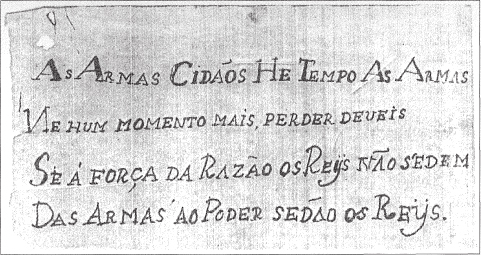
FIGURE 13: Anonymous, “To arms citizens, it is time to take up arms. You should not lose another moment. If to the force of reason kings do not cede, kings will give in to the power of arms” (AHI Lata 195 Maço 6 Pasta 13). Permission granted by the Arquivo Histórico do Itamaraty, Rio de Janeiro. The brevity and small format (15 cm x 8 cm) of the pasquinade may have lent itself to memorization and discreet circulation.
By this time the crown also had made public the decision that in compliance with the demands of the constitutionalists in Portugal DOM João would return to Europe, leaving behind Dom Pedro “in charge of the Provisional Government of this Kingdom of Brazil, until the General Constitution of the Nation is established within it.”21 Subsequently, the public declarations of interests that Pinheiro Ferreira and Aréas found so troublesome intensified. By the end of March hundreds had registered their opposition to Dom João’s departure by signing collective petitions. How could the king leave “the most interesting part of [the] monarchy” and “suffocate the giant in its crib,” asked a group of merchants and property owners. The town council, in turn, submitted the largest petition, both arguing that an American court was in the general interest of “the monarchy and the nation” and announcing the fears of certain residents. “Imagine the hunger of the many families whose daily subsistence depends on employment in the Royal House,” these petitioners demanded of Dom João. Others, signing the petition of the corpo do comércio, even more clearly stated what was at stake in the court’s return to Lisbon: “It is not in the order of things,” they asserted, “that Brazil so abandoned, remains united to Portugal much longer.”22
Although Pinheiro Ferreira dismissed these petitions as either “an eternal monument of good spirit” or the opportunistic designs of the “revolutionary party” seeking to secure its own influence after the king’s departure, he also conceded that they were the product of a continued sense of uncertainty about Brazil’s political future. Failing to calm “the fury of ambition,” the crown’s response to constitutionalism had provoked further debate and speculation instead, “in the city’s barracks, cafes, and stores along the Rua Direita and Quitanda,” places that had become a “theater for the most uninhibited speech.” The crown’s allegiance to a new constitution notwithstanding, the city’s residents lived “a restlessness” and an uncertainty about “the new order of things.” “All foresee,” Pinheiro Ferreira lamented, “that nothing that exists today can be preserved. But what will be the changes that are taking shape?” he imagined the city’s residents asking both themselves and each other. “Who will be the victims of the reforms? And will [these reforms] be for the good or for the misfortune of the State?”23 In other words, how would the crown and the constitution reconcile the royal family’s return to Portugal with Brazil’s new status as kingdom and the political and economic expectations and practices that had accompanied the construction of a new royal court in Rio de Janeiro? Would the crown continue to behold the prosperity and well-being of Rio de Janeiro and Brazil as its principal concern, or would “the old colonial system” be revived? Rather than providing answers, the rebellion and the crown’s response had inspired questions. And while the rebellion may have been the work of certain groups and “interests,” its effects, the “enthusiasm” decried by royal counselors, had transcended these groups, mobilized residents, and transformed politics in the city.
To respond to this enthusiasm and uncertainty, Pinheiro Ferreira counseled the crown to call for a meeting of electors, local elites already in the city for the purpose of selecting deputies to the Lisbon Cortes, during which a royal minister would present an “exposition of the text and spirit” of the instructions and powers that Dom João had given to the prince, as well as the names of those who would serve Dom Pedro as royal ministers. The electors, in turn, would be called on to advise the crown on these instructions. Thus, Pinheiro Ferreira hoped, the crown would firmly and resolutely establish the “new order of things,” reassure the city’s residents that the monarch recognized their rights, and eliminate the need for continued speculation and debate. The king then approved Pinheiro Ferreira’s plan with certain modifications. Rio’s ouvidor (circuit judge), rather than a royal minister, was ordered to preside over the meeting. And although Pinheiro Ferreira had recommended that the crown find a “decent and discreet room” in which to hold the meeting, the praça do comércio (the merchant’s exchange), a large and “majestic” building in the city’s center near the edge of Guanabara Bay, was chosen instead. This more spacious venue allowed for a more public meeting. Thus, the ouvidor also ordered the construction of bleachers within the building so that other residents could view the proceedings. Indeed, the edital of March 29 that officially convoked the electors stated that residents who wished to attend could do so as long as a certain decorum was maintained, noting as well that if during the meeting they wished to “make some reflections” they could submit a written note.24
According to one anonymous memorialist, the news that “the electoral junta was going to deliberate about the new government” spread quickly through the city. In response, he claimed, “the citizens gained confidence” and many resolved to attend “so that the selection of a government was not left in the hands of a small number [of people].” Many attendees, he also reported, “immediately wrote many memórias, in which each one explained one’s sentiments, correlated them and displayed them publicly.” Subsequently, on April 21, when the parish electors then convened, the “gathering of the people” was so great, one elector recalled, “that they took over the front door, the back door and the sides of the praça [building].” Many, as the memorialist noted, had “carried their reflections on paper to present them before the junta.”25
The meeting then formally was begun as the ouvidor proceeded to read aloud the decree that contained the list of people who would form Dom Pedro’s government after Dom João’s departure. Almost immediately, however, there were signs that the meeting would not proceed as Pinheiro Ferreira had planned. A group of spectators demanded a rereading of the decree and, according to various accounts, soon after began to shout “loudly, over and over again,” that they wanted the Spanish Constitution of 181226 “until the Constitution of the Lisbon Cortes arrive[d].” According to witnesses in a subsequent inquiry, the ouvidor then conceded that he had lost control of the gathering and proceeded to recruit José Clemente Pereira, juiz de fora of Praia Grande, along with others, to draft a document that stated the demand for the king’s allegiance to the Spanish Constitution, which the electors then were called on to sign. A deputation was nominated to present the statement to Dom João. After the deputation departed, further demands were advanced. First, a group within the praça called for the nomination of “secretaries of state.” Accordingly, the electors were asked to provide lists of nominees. Joaquim Gonçalves Ledo, Manuel José de Souza França, and the royal preacher Januário da Cunha Barbosa, themselves attending the meeting as electors, reportedly assumed responsibility for tabulating the results. Second, it was decided that another deputation would be sent to order the commander of the city’s forts to stop “the departure of all and any ships.”
As most witnesses testified, the meeting endured its most tense moments after these deputations had been dispatched, as those gathered waited for news of the king’s response and grappled with rumors that troops were marching toward the praça. This tension dissipated, however, when the palace deputation returned and announced that Dom João had consented to their demands in a new royal decree. With shouts and waving handkerchiefs, the gathering commemorated its victory, “shouting Long Live the Spanish Constitution, the Royal Decree and the King.” In spite of the late hour, the decree was printed and quickly distributed. As the author of an anonymous memoir explained, for those assembled the decree was “the most important artifact of all the events of this day.” With it the king recognized “the legislative power that the junta had assumed,” and “agreed to the votes of [his] subjects” (subditos). The crown became de facto “merely an executive power,” for “not even after the decree had been signed was the junta ordered to disband.”27
As was the case in the rebellion, witness accounts and testimony in a subsequent investigation of the assembly reveal a complex set of motivations and agendas at work in the praça. Pinheiro Ferreira, in an analysis that departed somewhat from the division of constitutionalist Europeans and revolutionary Brazilians of the February rebellion, contended that there were three “distinct factions” represented there, each “with great ramifications among the people and the troops.” The first, composed of “Europeans and Brazilians,” he explained, was concerned about the future government of Dom Pedro, a man who they saw as “endowed with great qualities, but without experience” and unfortunately surrounded by men who did not support “the cause of Brazil.” For them the Spanish Constitution was a way of stopping “European despotism” from dominating the future royal government of Brazil and eroding gains made since 1808. As one witness similarly testified, this group included José de Souza França and Joaquim Gonçalves Ledo, an elector who, as we have seen, was enlisted to record the assembly’s nominations and, as Salles Oliveira argues, had participated in the February rebellion. He played a “great role” in the assembly, the witness further explained, having “conceived of the best way to take power away from His Majesty to be swearing in the Spanish Constitution and nominating a Government of men chosen by the people.”28
A second faction, which, as Pinheiro Ferreira noted, was ultimately victorious, was comprised of supporters of Dom Pedro and the royal minister the Conde dos Arcos. According to Pinheiro Ferreira, this group saw Dom Pedro’s regency as the beginning of a new “golden age” for Brazil. More interested in establishing their influence than in defending a written constitution, they hoped that the king would leave the prince with “broad authority so that they could do … all that they understood to be for the good of this kingdom’s interests.” To guarantee this position, according to Salles Oliveira, Arcos had arranged for the meeting of electors to take place a day earlier than first scheduled so that Dom Pedro’s regency could be consolidated in the absence of electors from the city’s hinterland, due to arrive at Rio only the following day, who supported Ledo’s opposition to the regency.29 However, as Salles Oliveira further explains, a smooth implementation of this plan was foiled by Ledo who, together with the ouvidor, Joaquim José Queirós, had secured the larger venue of the praça and then mobilized the city’s residents to attend. According to witnesses, “with hands joined” in “secret meetings,” they also secured the support of “Doctor Macamboa,” the Lisbon-born cleric Marcelino José Alves Macamboa, who had participated in the rebellion of February 26 and was known to oppose the Conde dos Arcos.30 The more moderate Macamboa, in turn, was also joined in what Pinheiro Ferreira called a “European faction” by radical constitutionalists who wanted to form a local government loyal to the Cortes in Lisbon, men identified in the inquiry as João Pereira Ramos, a surgeon known as “Cavaquinho,” and Luiz Duprad, a native of Lisbon who, in subsequent testimony, was characterized as the most passionate defender of a written constitution, having used “the most insidious and abusive words against royal authority.”31 The total attendance of the assembly, however, was not contained within these three groups. As witnesses testified, both electors and other residents of the city came to the praça with a range of expectations and emergent understandings of what the new “constitutional system” would mean.
While the assembly thus comprised both divergent political goals and provisional alliances and featured a confrontation between supporters of Arcos and Ledo, those gathered in the praça did share a desire to define the nature of sovereignty in Brazil. Rather than a simple bid to retain the king in Rio, as some historians have argued, the assembly represented an attempt to establish the future practice of politics in his absence. As the author of the anonymous memoir explained, the assembly’s move to close the port was meant to stop “the departure of their sovereign until the new state of things was consolidated” (emphasis added).32 As several witnesses also testified, the urgency to establish a de facto constitutional government was motivated by a sense that the accomplishments of the February rebellion were tentative, or, even worse, that the representative principles it defended had been betrayed. According to the anonymous memorialist, allegiance to an unwritten constitution and a new royal cabinet notwithstanding, royal government in Rio continued along “the same arbitrary course.” For him, February 26 was “a farce,” “a soporific medicine” with which the crown hoped to dupe Rio’s residents, “binding them to a constitution that would be made two thousand leagues away, and in which the [royal] cabinet had hopes of securing influence by way of its agents.” Duprad had expressed similar suspicions openly during the assembly, declaring that he came on behalf of “the people to protest that they did not confide in the government that the King Our Lord had left behind … the people having been deceived by the changes of February 26.” And at another point in the meeting, when some of those gathered agreed to adjourn until the following day, others, “disillusioned by the twenty-sixth of February,” insisted on completing the nomination of a government.33 In this context of distrust and seemingly fleeting promises, Dom João’s concessions and the new decree then represented the achievement of more durable rights in the future that the February rebellion had only promised.
The victory, however, proved to be short-lived. Although the king had pledged allegiance to the Spanish Constitution, the Conde dos Arcos and Dom Pedro, having lost control of the assembly and fearing for the future of the regency, later convinced him to disperse the gathering using force. In contrast to the February rebellion, those who championed the interim enforcement of the Spanish Constitution had not secured the support of Portuguese troops who, accordingly, remained at the disposal of the crown. The leaders of the deputation sent to close the city’s ports were arrested and soldiers were sent marching toward the praça. When the troops reached the building, those who remained inside were trapped by a battalion reportedly twenty-five rows wide that proceeded to discharge fifty shots at the door before entering with bayonets drawn. The results, not surprisingly, were injuries and an undetermined number of fatalities. The magistrate José Clemente Pereira reportedly suffered bayonet wounds, and, as several witnesses testified, Miguel Feliciano Souza, a wine merchant on the Rua de São Pedro, was killed in a confrontation with a soldier. According to the author of the anonymous memoir, the number of casualties was even higher. “Other common people,” he wrote, “were indiscriminately killed, and a larger number, having jumped into the sea to escape, met the death that they had tried to avoid amidst the waves.” “The cadavers,” he claimed, were then “clandestinely taken to the navy arsenal and there they were secretly buried.”
In the days that followed the repression, arrests were made and Dom João refused to consider the list of nominated counselors. An investigation focused on Duprad, Macamboa, and Nogueira Soares, while Ledo and others who had assumed positions of leadership within the assembly were spared from punishment. In the meantime the king revoked his earlier pledge of allegiance to the Spanish Constitution and characterized those who comprised the deputations and the assembly as “men with evil intentions … who wanted anarchy.” Subsequent decrees confirmed Dom Pedro’s “broad powers” and warned the residents of Rio de Janeiro against the “passions and the fury of factions” and of the “seditious machinations” employed “to deceive you with the presumption of National Representation.”34 Then, three days later, Dom João, the royal family, and the courtiers called on to join them, boarded a convoy of ships anchored in Rio’s harbor. In contrast to the very public disembarkation thirteen years earlier, the boarding was discreet, beginning only after dark. The next day the convoy then unceremoniously departed for Portugal.35
The violence and uncertainty of the preceding weeks formed a tragic counterpoint to Dom João’s formerly celebrated public presence in the city and threatened to undermine the ideal of political renewal and prosperity that the New World court and empire had come to embody. Divergent understandings of what Vila Nova Portugal characterized as the “interests” of Brazil and those of Portugal had called into question the future of the United Kingdom. Yet, the ambivalent legacy of Dom João’s Brazilian reign also included the crown’s pledge to the yet-to-be-written constitution, secured by the February rebellion. Consequently, what Gonçalves dos Santos foresaw to be “a new epoch in the annals of Portuguese America” would be defined initially by the new constitutional order and its politics.36
“THE NEW ORDER OF THINGS”: POLITICS AND PAMPHLETS IN RIO DE JANEIRO
The constitutionalism that transformed Rio de Janeiro’s political landscape in the last months of Dom João’s residence was the product of both transatlantic discourses and local practices, what Aréas disdainfully referred to as “the customary violence invented lately”: open mobilization and public demands for change.37 Above all, constitutionalism promised to ensure the exercise of popular sovereignty. For some residents of the city and its hinterland, according to Salles Oliveira, this defense of representative government was linked to demands for changes in the structure of internal markets. “Words and rhetoric,” she writes of one constitutionalist newspaper, “simultaneously constituted instruments for mobilization, and enunciated the foundational knowledge and practices of bourgeois domination.” Constitutionalism, in this sense, served to give a broader segment of the elite formal access to power.38 Yet constitutionalism was not a simple instrument to defend certain interests; it also entailed a process of political representation. As the mobilization both before and during the April Assembly reveals, the proclamation of national sovereignty initiated a complex struggle to define what, precisely, this meant. Beginning in 1821, defenders of constitutionalism with diverse origins and agendas sought to reshape the perception of interests, both material and political, and enact what they regarded to be a new politics.39
While, as we have seen, the triumph of constitutionalism in Rio de Janeiro was guaranteed by the February rebellion, its meanings and its consequences for the monarchy were forged in a political culture of handwritten pasquinades and, increasingly since the transfer of the court, of print. Pamphlets, read clandestinely before and then openly after February, offered understandings of what was to be lost and what was to be gained with a new written constitution.40 Many such pamphlets were published by the city’s Royal Press, which became officially constitutionalist following the rebellion and the end of prior censorship, a transformation that then was consecrated when, along with its Lisbon counterpart, Rio’s press was renamed as “National.” Beginning in March 1821, when the publication of the two-page Constituição Explicada was announced, the National Press published reprints of constitutionalist works published first in Lisbon, as well as songsheets, works by local pamphleteers, and imprints of Rio’s constitutional sermons and performances. Indeed, as was the case during the Peninsular War, political pamphlets formed the majority of Royal/National Press publications. After 1821, however, the overall volume of publication also increased, so that almost as many titles were published in 1821 and 1822 as in the twelve preceding years combined.41 What thus amounted to an unprecedented proliferation of political pamphlets was further bolstered by an August 1821 decree that lifted any remaining restrictions on the press and by the establishment of additional presses within the city, such as the Nova Oficina Tipográfica, later renamed as Oficina de Moreira e Garcez, and the Tipografia do Diario, which published one of the many new newspapers that began to circulate as well. Book sellers also seized the opportunity to supply an increasing demand for pamphlets imported from Lisbon, Bahia, and Europe, including Rousseau’s The Social Contract, a work that, as the announcement of the sale of one French edition noted, “formerly prohibited, in the present circumstances” had “become very interesting.”42 Like those published during the war, most pamphlets and newspapers were short—many only a few pages long—and, as Lúcia Neves has shown, inexpensive, more or less the price of a loaf of bread, a pound of flour, or a bar of soap.43
The purchase of pamphlets was limited, of course, to those who could read, a minority of the city’s residents. Yet the larger impact of political pamphlets was not confined to readers. In eating houses, pharmacies, and other private and public places of gathering, the intendancy’s informants reported, Rio’s residents listened to recitations or heard conversations about the messages and meanings of constitutionalist works.44 Indeed, while, as Raymundo Faoro has argued, the “political context of 1820 explains the content” of such pamphlets,45 the pamphlets themselves also produced the political context of Rio de Janeiro in 1821. Pamphlets were, in other words, part of the city’s political culture and they linked that political culture to the larger transformations in the Portuguese and Atlantic worlds. Works by local authors and reprints of texts first published in Portugal were recognized as important tools by both constitutionalists and their detractors, ones that revealed “the truth” or, as one “faithful friend of the friends of the king” denounced, served as dangerous weapons in the hands of “rogues” who threatened cherished hierarchies, “propagating their [constitutionalist] sentiments even to blacks who can read” (patentiando os seus sentimentos até os negros que souberem ler).46
The constitutionalist messages of these pamphlets and pasquinades began with a critique of absolutist government, “a science of deception” manifest in the self-interest and corruption of counselors who endangered both the monarch and the nation.47 In Rio de Janeiro, as we saw in Chapter 2, expressions of this critique had been made by local artisans and men of letters in the 1790s; and in the 1810s they echoed in episodes of dissident commentary investigated by the police intendant. Following the arrival of news of the Porto rebellion, and in the midst of speculation about the crown’s response to the declarations made there, local public criticism of absolutist government mounted and became more sharply defined. In the days leading up to the February rebellion, handwritten verses and other compositions that circulated among the city’s residents denounced royal officials, many of whom were ousted on February 26, as “sycophants” and “thieves.” The royal minister Tornás António Vila Nova Portugal, in particular, was often at the center of these attacks, figured as a “demonic” “enemy of the nation.” His and other royal officials’ “vain counsel” against the crown’s recognition of the constitutionalist movement was identified as both an obstacle to Brazilian happiness and prosperity—the “spring from which all of your [Brazilians’] misfortunes have come”—and, as one satirical petition entitled “Tomás, you should present this to the king” claimed, the cause of the empire’s demise. “If you still want to Reign,” the petitioner explained to the king:
Look blessed João,
You should go to Portugal
And sign the constitution.
If you don’t hurry
To your native country
Oh’ João behold you’ll lose
Brazil, and Portugal.
A sarcastic composition entitled “Commemoration of the ignorance of this Court” similarly indicted the royal cabinet and its corruption, declaring not only “Long Live the King Dom João, all of the Royal Family, and the new Constitution,” but also “death to all thieves.”48 These “false friends” and “Perfidious Favorites and Counselors of Kings,” as one pamphleteer further explained, had duped both the people and the king into thinking that royal power was limitless. Consequently, “bewildered by the resounding melody of applause,” the absolute monarch could not “hear the clamor for justice.”49
Constitutionalism, in turn, as pamphleteers proclaimed, promised to broaden the king’s “horizon” and liberate Rio’s residents from the abjection that absolutist government had created. To do so, it affirmed the power of the Cortes and thus limited royal power. As the chaplain Francisco da Mai dos Homens preached in a sermon published in 1821, a written constitution established the division of power that “Ministerial and Courtier preponderance” had “shackled.”50 As a consequence, proclaimed one poet during a commemoration in Rio’s royal theater, the “people of Brazil” now “liberated from repression [could] breathe freely”51 This liberation from absolutism was also defined as a more direct and open relationship between the king and the people. Indeed, the adoption of a written constitution, as the author of one pamphlet explained, was an act of political “union” between the king and the people.52 Thus, along with ending the machinations of “corrupt favorites,” constitutionalism also destroyed hierarchies that had inhibited this union. It tore down the “Walls, trenches, gates of bronze,” as one pamphleteer defined them, that had “deprived the humble Citizen entrance into the Sanctuary of the Court.”53 As the magistrate Maciel da Costa explained, “national representation” therefore meant that “supplications will not be merely loose pieces of paper … subject to the despotism and ignorance of irresponsible ministers.”54 Indeed, this new and open politics had been manifest in the February rebellion itself when, as Pinheiro Ferreira lamented, hierarchies were “disorganized” and “the respect of the inferior classes of society” for their superiors, of “even” slaves for their masters, was “absolutely annihilated,” jeopardizing, he surmised, the “majesty of the throne.” Following the rebellion, he recalled, residents began to appear before Dom João not to request the grace of royal patronage, but rather to make demands “in the name of the people.” Exhibiting what Pinheiro Ferreira judged an unnerving “presumption,” they presented the king with a list of persons who should form a council to be consulted regarding all “public affairs.”55
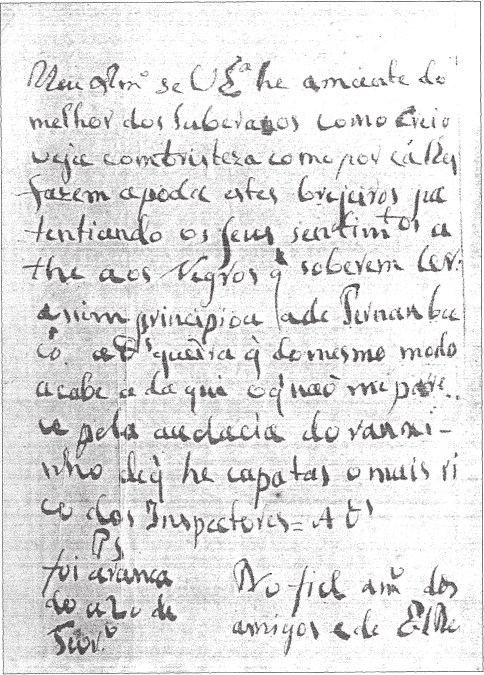
FIGURE 14: An unsigned note (AHI Lata 195 Maço 6 Pasta 13). Permission granted by the Arquivo Histórico do Itamaraty, Rio de Janeiro. An anonymous note denounced “rogues” who disseminated the message of constitutionalism “even to blacks who can read.”
While the destruction of political hierarchies was advanced by constitutionalists in both Portugal and Brazil, in Rio de Janeiro such an affirmation of a more frank relationship between the king and “the people” resonated within the city’s residents’ claims to a new status before the crown following the transfer of the court, with what Gonçalves dos Santos described as the more equitable exercise of their “rights” previously denied by geographic distance. Local readings of a transatlantic constitutionalist discourse, in other words, perceived absolutism and the “old colonial system” as analogous. Both had usurped and “monstrously” distorted an original and just order of things. Absolutism obfuscated the people’s own “nobility” and “deceptively” arrogated the power of the Cortes and “man’s inalienable right to natural liberty,” just as colonial monopolies undermined the “natural” practice of free trade and colonial government separated the city’s residents from their monarch, making “the execution of [the royal] will impossible.”56
These continuities and affinities between constitutionalism and the political discourse of the 1810s in Rio were both framed and authorized by the historic link between national politics and religion. While champions of the New World court claimed that Rio could be a bulwark against revolutionary impieties and a place for the monarchy’s and the nation’s political and moral renewal ordained by Providence itself, constitutionalists pledged to defend the “Holy Catholic Religion” and deliver it from the corruption of the old regime.57 As the Portuguese pamphleteer José Joaquim Lopes de Lima argued, constitutionalism would end the church’s subservience to a decadent papacy, for in the “servile system,” he explained, a “bishop” was a “mere executor of the Pope’s orders,” whereas in the “liberal system” he recovered his position as “sovereign executor of the Law of God within his Diocese.”58 Eliminating aberrations and purifying the church then demanded the abolition of the “diabolical” Inquisition and, especially, of the “superfluous” hierarchy that had arisen out of the proliferation of ecclesiastical offices. Although, as the author of one constitutional sermon contended, “the Prelates [who] are and should be, men of God, vigilant judges” had nothing to fear, in pamphlets the corcunda (absolutist, literally “hunchback”) clergy and members of religious orders were emblematic of the kind of corruption that had enabled the French invasion and then proliferated in its aftermath. “Friars” were, as Lima classified them, a “middle term between the two sexes, with the vices of one and the other.”59 Constitutionalism, in turn, like the transfer of the court, offered a restoration of piety and virtue.
As was the case in the political discourse of the transfer of the court, in constitutionalism religious principle and religious history also served to define and justify political change. If it were true, one pamphleteer argued, that “the King governs the Kingdom as God governs his Church,” it followed, therefore, that such a government “should be with a Cortes, and a Constitution because God wrote the Decalogue which is a Constitution.”60 These religious foundations for constitutionalism, not surprisingly, were invoked even more clearly by members of the clergy who had adopted constitutionalist allegiances. “We give to the King what belongs to the King; that is we give him what our ancestors gave,” the author of the constitutional sermon cited above explained, “and we take from him what was unfairly usurped.” “None of this,” he then reassured his listeners and readers, “infringes upon the Holy Religion, that we profess.”61 The clergy’s public participation in the people’s instruction in “recent reforms,” solicited by the Lisbon Cortes and, in Rio de Janeiro, taken up by some who had ardently defended the monarchy and its move to Brazil during the Peninsular War, then further elucidated the connections between “political regeneration” and salvation.62 More intimate modes of religious expression, in turn, provided a framework for the enunciation of constitutional allegiances. In one pamphlet, for example, when a group of constitutionalists convince a group of absolutists of the error of their ways, conversion and “regenerative” reconciliation are achieved through a formal penitence and an “Affirmation of the Constitutional Faith,” followed by the recitation of the fifteen “Commandments of Constitutional Law,” the “Articles of the Holy Constitutional Faith,” the “Constitutional Creed,” the “Our Constitutional Father,” “Constitutional Ave Maria,” and finally the “Save the Constitutional Queen.”
This “constitutional catechism” integrated the foundations of constitutionalism and Catholicism. Thus, the commandments included not only “Honor God and the Roman Catholic Apostolic Religion,” but also “Keep holy Sundays and the feast days that the Constitution declares.” Similarly, the articles of the constitutional “faith” both recognized religion as “the Roman Catholic Apostolic” and declared that “liberty consists in each doing what the Law does not prohibit.” The catechism also sacralized constitutionalism by placing references to constitutionalism within recognizably Catholic rites. The initial words of the Lord’s Prayer thus became “Portuguese Constitution, which is in our hearts, hallowed be thy name,” just as the Ave Maria became “Ave Constitution, full of grace, and wisdom … blessed is the fruit of your womb: Holy Constitution, Mother of the Portuguese.”63
The ritualized pronouncement of constitutionalist allegiances, found as well in oaths and commemorative verses, also served as a point of departure for the integration of other religious and constitutional practices. As Maria Candida Proença has argued, commemorations of the anniversaries of the Porto and February rebellions were sacralized, just as religious festivals were constitutionalized in such acts as listening to a constitutional sermon during mass and the more extraordinary election of deputies that, as a draft of the constitution specified, was to take place on a Sunday, within a church and within a liturgical framework, preceded by a mass, followed by a Te Deum. Indeed, a meeting of the electoral junta in Rio de Janeiro in May 1821 was, Januário da Cunha Barbosa argued, “an act as religious as it was civil,” one that “balanced religion and politics.” “Who,” he asked those gathered for the preceding mass, “would not unite within such an August Assembly, the glory of religion and the glory of the Pátria?”64 While, as Lúcia Neves has argued, such uses of religious genres and contexts allowed constitutionalists “to reach a wider public,”65 they were also an integral part of engendering the constitutional order itself. Just as the recitation of the traditional catechism called into being a community of Catholics, participating in the rituals of constitutionalism effectively created a recognizable community of patriotic, as well as pious, Portuguese. In this sense, even as the appropriation of Catholic rites attested to constitutionalism’s recognition of tradition, the act of reformulating those rites, of substituting words and phrases with others, of adding “commandments,” revealed that constitutionalists recognized that existing rituals and practices (those of Catholicism and monarchy) in and of themselves did not sufficiently express the constitutionalist ideal. Constitutionalists did not, to be sure, embark on the development of purely civic rituals, as was the case of revolutionaries in France. Yet they did recognize that constitutionalist politics entailed the creation of new political bonds.66
Notwithstanding their novelty, such bonds, like the new American court, were regarded by constitutionalists as the products of history. As Zilia Osório de Castro explains, Portuguese constitutionalism evinced an “historically based rationality”; it sought not to recover the past, but rather to use the past to make the present, including innovations, legitimate.67 Thus, along with religion, constitutionalists on both sides of the Atlantic called on Portuguese history to prove constitutionalism’s “truth” and reveal the foundations for a national regeneration. As one “glorious constitutionalist” explained to a “defeated corcunda” in a published “dialogue,” the Cortes had the right to “make and unmake kings” because it had elevated Afonso Henriques, João I, and João IV to the throne.68
Historically, however, the rights and powers of the Cortes had not been so clearly defined. As it came to coexist with more recent political institutions associated with royal governance, its “juridical-constitutional foundation” became, as Pedro Cardim explains, “imprecise.” By the eighteenth century the Cortes’ privilege of convening to deliberate over “constitutional” questions and preside over royal succession clearly had eroded. Royal succession took place with the enunciation of an oath alone and even in moments of crisis—Dom João’s assumption of the regency and the transfer of the court—and in spite of counsel and “opinion” to the contrary, the crown did not convene the Cortes. The challenge for constitutionalism thus became the recovery of what Cardim calls “the memory of [the Cortes’] elective capacities.”69 Indeed, emerging out of the political culture of the Napoleonic invasion and the transfer of the court in which the ideal of renewal was paramount and the meaning of history and tradition was both embraced and contested, constitutionalists defined strategically both the past and future of popular sovereignty. As one pamphleteer thus explained, the king had not “descended from the Heavens,” but rather, as “the wisest, and most distinguished of Citizens,” had been “elected” to serve as “trustee, and administrator of the Laws.” Although hereditary succession then had replaced this original election, kingship, constitutionalists insisted, continued to be defined in this way. The king, therefore, was not a “Lord” or “Father,” but rather the “first Magistrate of the Republic.”70
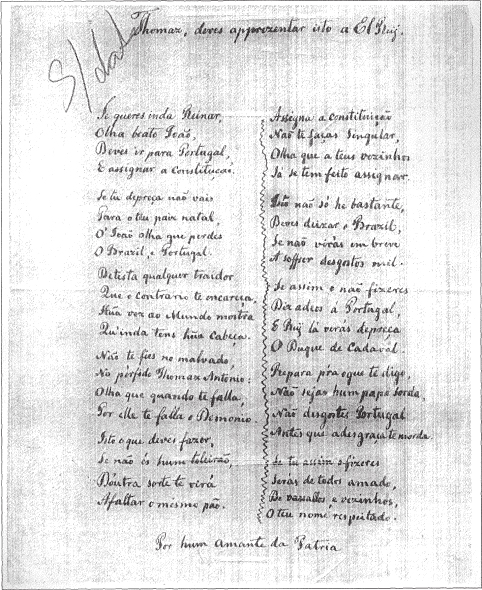
FIGURE 15: Anonymous, “Tomás, you should present this to the king,” signed “By a lover of the pátria” (AHI Lata 195 Maço 6 Pasta 13). Permission granted by the Arquivo Histórico do Itamaraty, Rio de Janeiro. A satirical petition denounced the absolutist royal counselor Tomás António Vila Nova Portugal.
Rhetorically, this recovery of the history of the monarchy and political representation obscured by absolutism meant that constitutionalists then could assert that “the Kings are Kings when and where the Peoples want,” without, as one pamphleteer explained, attacking “royal dignity” or the institution of monarchy per se.71 Indeed, like royal officials who defended the new empire and United Kingdom, constitutionalists sought to achieve the monarchy’s “salvation,” a project that, in turn, came with its own historic legitimacy and heroism, having been manifest in the seventeenth-century war for independence from Spain and then most recently in the national struggle against Napoleon. Invoking a refrain used during the Peninsular War, one constitutionalist pamphleteer made these continuities explicit. In 1820, just as in 1808, he suggested, “To defend the Pátria / To give one’s life for the King” was “for the valiant Portuguese / Character, Custom, and Law.”72
The defense of monarchy and the invocation of religion, history, and tradition did not, however, preclude an embrace of change. Constitutionalism, after all, aimed not to “restore” an ancient order, but rather to “regenerate” politics. And this regeneration appeared, in certain moments, to depend on significant juridical-institutional transformations. As one pamphleteer explained, “the ancient method of convoking Cortes, while it is indeed legal, is not appropriate for the present epoch.” “Laws are like everything else that with time grows old,” he continued, “and as laws have the aim of regulating customs, it followed that if customs changed, the laws should change as well.” The mandate of constitutionalism, therefore, was to make laws “more in agreement” with what one pamphleteer described as “the ideas of the century.”73
Evoking “the ideas of the century,” the pamphleteer also revealed the influence of the Enlightenment and the French Revolution in Portuguese constitutionalist discourse. As we have seen, in the late eighteenth and early nineteenth centuries royal officials sought to carefully limit, and in certain cases criminalized, engagement with French political thought and interest in French revolutionary politics and its spheres of influence. Constitutionalism and, most importantly, the press freedoms its supporters secured broke down these limits and, building on an earlier censored engagement with eighteenth-century thought and politics, allowed for a more open consideration of what the Enlightenment and the French Revolution meant in their own terms. Whereas royal officials in the 1790s and 1810s had sought to ensure the residents’ allegiance to His Majesty, “Our Lord” and “Common Father,” constitutionalists celebrated the triumph of contractual government over paternal rule; they praised the new political agency of “the people”; they hailed the rise of “the public” as the defeat of narrow, private interests associated with absolutism.74 They proclaimed the inversion of existing political hierarchies that allowed the nation to assume its sovereignty. As one constitutionalist pasquinade declared:
From the people to the king, power is given,
Thus the people can legislate,
If upon this notice the king does yield,
To arms his inert power will be ceded.
Constitutionalists also grappled with two of the French Revolution’s most emblematic principles: liberty and equality. As one pamphleteer contended, although liberty could not be construed as “absolute,” it was “natural.” Man was born “free” and this freedom then was circumscribed first by his relationship to God and then by his relationship with his wife, his children, and other men.75 The “more relationships one has,” he explained, “the more duties and obligations one has: and the more duties one has, the fewer freedoms one has.” However limited, these liberties and rights were equally possessed by all. Adam and Eve themselves were “perfectly equal,” he argued, in that they had not only “equal liberty,” but also “equal relations” and “equal duties.” In other words, liberty and equality were “always relative” to one another.76 Or, as another pamphlet more succinctly explained, the “equality of the rights of all citizens” corresponded to the “equal weakness of all before the law.” This kind of Rousseauian shorthand was used as well, as constitutionalists then explained the law or the “fundamental law” as the expression of “the general will of the people” and of the covenant, or constitution, through which equality and rights were established.77
These rights and “civil liberty,” in turn, coincided with the “nobility of the Citizen,”78 a “free vassal,” as one constitutional catechism explained, born or naturalized “in the lands that belonged to the Crown of Portugal in any part of the world.”79 Citizen, in this sense, acquired the word vassal’s designation of a national political identity, as in what the intendant referred to awkwardly in 1818 as “vassals of the United States of America.”80 Prior understandings of citizens as the well-regarded members of an urban community who fulfilled their duties to God and sovereign also expanded to include what the Visconde do Rio Secco referred to as both “respect for constituted authorities” and love of “Sovereign and Pátria.” Indeed, as one pamphleteer contended, although the status of vassal initially qualified one to be a citizen, citizenship then displaced vassalage altogether, as the new order displaced the old.81 Both citizens and vassals had “rights” and virtues. Yet a vassal was dependent on the crown, whereas a citizen was an equal member of the sovereign nation. In contrast to vassals, citizens thus retained the privilege of deliberating on the future of the political body. As a guide to the first constitutional elections explained, “a citizen of the people” was “circumspect,” one who assumed responsibility for ensuring the “happiness of the Pátria” above individual interests.82 Thus, several of those who petitioned the king to retain the court in Brazil added “citizen” to previously established identities—“Businessman and Citizen” or “Citizen and Knight of the Order of Christ”—suggesting that the other title did not sufficiently express the civic nature of their gesture. The anonymous author of the April Assembly memoir concluded by signing “a citizen” as well, invoking both a sense of prerogative and signaling that the account was the product of public, rather than personal, interest.83 Indeed, both the equitable and actively deliberative nature of citizenship had been manifest in the April Assembly itself, as “barriers that separated the people from the electors” were disregarded and residents who were once defined as spectators transformed themselves into orators.84
In calling attention to new terms and changing roles and identities, constitutionalists also promoted the idea that the creation of a new political order depended on the creation of a self-consciously new political language, a rhetorical discourse that sought not to simply reflect recent events, but rather to persuade and shape the perception of interests as a way of reconstituting the political order itself, in this case making “the nation,” rather than the king, sovereign.85 In other words, to be a constitutionalist was to speak as a constitutionalist. Consequently, pamphlets themselves often served explicitly to translate the old absolutist language into a new constitutionalist one. A graphic juxtaposition, or “parallel,” of political categories using a list of synonyms and antonyms, for example, revealed that ambition and hypocrisy were to “the corcunda” what virtue and reason were to “the liberal.”86 While, in this case, readers were instructed in the meaning of words new to the Portuguese political lexicon (“the hunchback-absolutist” and “the liberal”),87 José Joaquim Lopes de Lima’s “dictionaries,” in turn, suggested that rather than a set of new vocabulary, constitutional language consisted of new meanings for old words. Rhetorically, however, Lima presented these meanings not as “new,” but as older meanings lost in more recent absolutist political discourse. Lima’s task then, as he explained, was to identify those “expressions transformed only to deceive” and “restore their genuine meaning.” This recovery of original meanings became part of constitutionalism’s recovery of original political rights. To achieve this recovery, Lima provided a set of sardonic translations of “phrases of the carcundas,” a deconstruction, as it were, of the old political language that created a new one. Thus, he explained, what had formerly been defined as “absurdities” were indeed “natural truths.” “To abolish,” in turn, was “to reform, purify.” “An offense” was a “truth” as in “To offend the Sovereignty … To tell the truth to the King.” This parody also continued, conversely, in Lima’s corcunda definitions for Constitution— “a plan for disorder”—and Cortes—“irregular association.”88
This quest for a new, transparent language of politics, in opposition to the deceptive one of the old regime, was itself a legacy of the French Revolution. In France, as Lynn Hunt has argued, revolutionaries tore down past politics by embracing the power of rhetoric even as they effaced representation itself. Words associated with the old regime were forbidden because they were perceived as threatening the revolutionary transparency between citizens. Constitutionalists in Rio similarly purged from their vocabulary words that invoked absolutism, such as the royal title of “Nosso Senhor” (Our Lord). Thus, in September 1821, “Vivas” offered to Dom Pedro that included this “improper and unconstitutional title” were denounced as the sign of a “sinister attempt to promote the public’s distrust and incite partisanship.” Although an investigation then determined that the man who had made such an unsettling declaration was not politically motivated, but rather simply without “reason,” the incident nevertheless provoked the “greatest possible sensation in the spirits of the well-intentioned residents of this capital.” To restore the integrity of the constitutional order defiled by the lexical assault, the military officer from whose balcony the salute had been made was compelled to offer a public explanation of his conduct, published both as a broadside and as an article in the city’s Gazeta.89
This displacement, as Joan Landes has described it, of an iconic and spectacular public life by a textualized symbolic order was itself the subject of one pamphlet published in Rio de Janeiro based on the rhetorical premise of a letter sent from Lisbon to a man named Braz Barnabe by his friend, André Mamede. Having spent time in a village where, as Mamede sensed, the public readings of old gazettes left him somewhat out of date, he took advantage of a trip to Lisbon to apprise himself of more recent events. While at a casa de pasto (eating house), he did hear about the Cortes’ recent deliberations. Yet a new word used in the conversation had left him confused. Who were, he wondered, the corcundas to which the men at the eating house had referred? While, as he surmised, such a word apparently indicated a physical defect “of nature, or inclination,” a subsequent exchange then led him to “suspect that the corcundas were not corporal but rather spiritual.” Finally, as he discovered when one friend took the time to explain, a corcunda was an “Anti-Constitutional man,” one who would do “anything to mislead public opinion from the true spirit of goodness.” Happy for having learned this lesson, Mamede then set out to share the meaning of the word with others.90 Thus using a narrative parody, the pamphleteer, in effect, confronted the complex workings of this new constitutionalist language within a social context. The remoteness of the village versus the crossroads of the city underscored the importance of the medium of print. Although Mamede’s search for the meaning of new words arose from a sense of obliviousness, the keen interest in politics that motivated his inquiry in the first place also made the newness of constitutional language apparent: constitutional politics was so innovative that a brief period of disengagement could leave even a self-consciously politicized person ignorant. Mamede’s search also uncovered the modes for the dissemination of this new language and politics: the conversation, the letter, and, above all, the letter’s subsequent incarnation, the political pamphlet.
The concern with disseminating a transparent constitutional language, and with enforcing its usage, was linked to constitutionalist understandings of the new nature of politics and public life. “The Greatest good, which Liberal Governments have given Society,” explained the Visconde do Rio Secco, “is without a doubt the faculty that each Citizen has to expound the truth in all its splendor and clarity. Thus,” he continued, “the use of masks and disguises was lost, and man appeared just as the product of the chain of his actions. The law becomes the measure of all his actions; and the general interest [becomes] the center, at which they converge; the Public [becomes] the severe judge that condemns or rewards them, according to their position in relation to the Society in which he lives. …” “All,” he declared, “is surrendered to the Empire of truth.”91 This vision of truthful collective judgment was also described as “public opinion.” Constitutionalists denounced “before the tribunal of Public Opinion, the errors and abuses” of absolutist government and warned that “today Monarchs had the need not only to consult public Opinion, but also to have their eyes always fixed on its Direction.”92
The Portuguese crown, as we have seen, had also recognized public opinion within its program of policing and with its sponsorship of pamphlets and newspapers in the 1810s. In the context of the constitutionalist movement achieving an understanding of public opinion and reshaping this opinion in the crown’s favor acquired a new urgency, for “silence,” as the intendant Viana warned Vila Nova Portugal in 1821, would be “confused with pusillanimity.” Assessing which of “the classes of society” had taken up the “revolutionary spirit” marked the beginning of this effort to be followed, as Viana then suggested, by the king’s use of some “pretext” to elucidate “the way to think” and “to stop the people from searching for answers alone, and always, amid the evil that torments us.” Pinheiro Ferreira too had urged the crown to convoke the April assembly in order to “fix public opinion about the true intentions of His Majesty, and close the door on the people’s tumultuous intervention.”93
While constitutionalists inherited and shared this sense of public opinion as something that could be both gauged and engaged, they also declared its status within the “constitutional system” to be fundamentally different. Absolutists, Andre Mamede was told, sought to “mislead public opinion from the true spirit of goodness.” Absolutist policing distorted opinion, pamphleteers also argued, “spying on the most secret conversations, obliging citizens … to disguise their language; calling the day the night.”94 Constitutionalists, on the contrary, claimed to liberate public opinion, make it transparent, bring it out into the open, and place it at the center of the exercise of national sovereignty. “Public opinion,” one pamphleteer declared, “expressed the vote of the people.”95 Thus, as Viana’s successor in the office of intendant recognized, after 1821 it was for the “the public, impartial judge” to decide whether officials themselves had properly observed the law.96 As one pamphlet explained this process, in constitutional politics “words” and “printed discourses” were “thrown out, so to speak, into a vast stadium, where each citizen is allowed to enter and fight, having the whole nation as an arbiter who can freely pass judgment.” The more open this confrontation was, the more legitimate its results would be. Such “freedom of discussion,” he contended, was the only way to “make the truth known.” It formed “the fundamental basis of the existence of civil and political liberty.” Therefore freedoms of the press were crucial as well, for without them, the pamphleteer argued, any “national assembly … will always form an untrue representation.” “[To] ask if the press should be free or enslaved,” he declared, was “the same as to ask, in other words, if the monarchy should be constitutional or absolute.”97
For constitutionalists this new publicly deliberative politics was to be not only free, but also educated. Education, the magistrate and resident of Rio José Albano Fragoso argued, was “the basis for public morality.” Or, as one constitutional newspaper declared, to make “suitable excursions through the brilliant field of classic, ancient and modern Literature … to do so frequently, to reduce them to a few pages and put them within reach of the multitude, was to do an eminent service to the country and to civilization in general.”98 Along with this quest to edify, however, constitutionalists also called for an explicitly new and civic education. As Fragoso claimed, whereras previously education “had not sought to disseminate notions of interest to man in his capacity as citizen,” indeed its aim should be “to form men and citizens with knowledge of the society and government in which they lived. …” Citing both Rousseau and Thomas Paine, Fragoso then argued that this education should be “public, uniform and universal.” It was only thus that the constitutional government would be consolidated, for, as Fragoso further explained, education guarded against disorder and injustice. “When the people groan in ignorance and do not know their greatness,” he wrote, “guided like a herd of animals,” they voluntarily surrender “to the first dazzling usurper who asks them to obey.”99
Such ignorance, constitutionalists sustained, indeed had allowed absolutism to corrupt the Portuguese monarchy. If the Portuguese nation had been instructed “as today it can be, in the principles of the eighteenth century,” one pamphleteer asserted, “it would have never pacifically consented to the usurpation of its rights.”100 This same lesson, others argued, could also be learned by looking beyond the Portuguese world. Thus, in one instructive dialogue, when the Constitution encounters Despotism in the decidedly “Oriental” form it had taken in Constantinople, the correlation between education, “reason,” civilization, and constitutional government was revealed. “Go and seek these enlightened Europeans,” Despotism says to the Constitution, defending its imperious whims, “while I triumph in the vast regions of Asia and in the burning backlands of Africa.” The Constitution faces the challenge and the encounter then comes to a happy end with both the defeat of Despotism and the universal triumph of enlightenment on the horizon. As the two separate, the Constitution departs for Brazil, “where for much time it had been desired.”101
As pamphleteers juxtaposed an educated constitutionalism with an ignorant and barbaric absolutism, they also claimed that education distinguished their “regeneration,” Portuguese public opinion, and its deliberative process from the French Revolution. “Those who executed the plan for revolution were not those distinguished philanthropists who had outlined it,” wrote José António de Miranda shortly after arriving in Brazil.102 Consequently, the French Revolution had become a moment of anarchy when “the People, who did not know what equality nor liberty were, undid everything, and created the most horrifying scenes. …”103 In contrast, “the Greatest Triumph of Lusitania” was, one allegorical engraving suggested, “to take an oath to the Constitution / Without shedding blood.”104 Education then promised to fend off unbridled disorder in the Portuguese world in the future, even as the history of the French Revolution provided other lessons on how to avoid its “dishonorable and prejudicial excesses and losses.” Indeed, one constitutionalist newspaper argued, what that “school of Revolutions” taught was that popular sovereignty was better expressed through representative institutions than in the “Jacobin usurpation of power by the people.”105 Although sovereignty resided in the nation, Portuguese constitutionalists contended, the nation could exercise this sovereignty only through legal representation. As one pamphleteer explained, “all of the nation elects, by way of a systematic means, a certain number of persons of their free choice, so that away from the excitement these may nominate the men that they judge to be capable of forming a congress, in which they should discuss the interests of that nation, and organize the laws that ensure its happiness.”106
This quest to educate and “discipline new forms of popular power” in the wake of the French Revolution and the negotiation of a complex understanding of that revolution as both a model to be followed and an experience to be rejected107 were also evident in the emerging image of the constitution itself. Both the power and virtue of the constitution derived from its very status as a written, printed, and disseminated text. As one pamphleteer explained, in an apparent gloss on Condorcet, “since the epoch in which the art of printing was invented, it is not by way of verbal discussion, nor theses, nor sermons, that nations can illuminate and instruct themselves.” “Words pass and are forgotten,” he continued, “and only writing fixes them, and gives them permanence.”108 Consequently, a written constitution, unlike custom and tradition, was not subject to change and erosion. As a consequence, it not only guaranteed the sovereignty of the nation in the present, but also guarded against its usurpation by either absolutists or a revolutionary assembly in the future. This promise of permanence indeed was at work during the April Assembly. As we have seen, for many who attended the meeting the Spanish Constitution appeared to embody the triumph of constitutional government in the present over the more illusive February allegiance and what one anonymous petitioner described as the uncertainty about “the new form of government” generated by the announcement of Dom João’s departure. Adopting the Spanish Constitution until the Cortes’ own constitution was completed, in other words, would disqualify absolutist attempts to derail constitutionalism in the meantime. Thus, prior to the Assembly, some residents purchased copies of the Spanish Constitution, and others openly campaigned for its immediate adoption.109 And during the assembly the very presence of the Spanish Constitution within the praça was noted with interest. As José da Silva Lisboa, who attended the meeting as an elector, recalled, during the meeting Macamboa read from “a great book [that] he judged to be the Spanish Constitution.”110
Yet in spite of its promise of indelibility, the meaning of the constitution as both icon and text was also open to debate within the Assembly. For some who gathered at the merchant’s exchange to choose electors, as “the most ingenious work of the human spirit,” and the acknowledged inspiration of both the Porto rebellion and of the Portuguese constitution’s “Bases” adopted by the Cortes in March, the Spanish constitution was a symbol of the principle of popular sovereignty in general and its presence simply sanctioned the Assembly’s demands. Others, however, insisted on citing passages from the constitution to debate the Assembly’s own actions. Thus, one of the electors recalled, he had criticized the call for the nomination of ministers because “in article one hundred seventy one, it says that the ministers of state are nominated by the king.” Similarly, even as some supported closing the city’s port as an effort to stop an expropriation of the royal treasury and a defense of private property that the Spanish constitution upheld, recovering the “wealth of individuals” so that any transfer of funds could be accounted for and compensated, others saw the detention of ships as a violation of these property rights as they actually were defined.111 Attempting to persuade both those who called for the closing of ports and the general assembly of this position, the elector Manuel Jacinto Nogueira da Gama requested a copy of the Spanish Constitution “that was found there on the ballot table, and looking for the relevant articles he made them read them once again and urged that they be read aloud to the people.”112
There were thus two important effects of the February rebellion, the April Assembly, and constitutionalist pamphleteering for Rio de Janeiro’s residents. On the one hand, like the transfer of the court, they presented the city’s residents with opportunities to define the nature of local politics with terms that both accounted for history and recognized change. Invoking the principles of representative government and demanding allegiance to a written constitution, supporters of the rebellion and the Assembly’s bid to define local government sought to safeguard the institution of monarchy as well as guarantee, or “fix,” the enlarged and more equitable scope of political rights and economic freedoms that the city’s residents had negotiated since the arrival of the Portuguese court in 1808.113 On the other hand, both the rebellion and the Assembly also provided Rio’s residents with the knowledge that the meaning of constitutionalism and the constitution were themselves open to interpretations that sought to further reconcile local circumstances with the principles that the constitution enshrined.
Indeed, in the wake of what Gonçalves dos Santos described as these extraordinary events, a great debate emerged on the subject of exactly who was “the nation” that the constitution called into being as sovereign. One draft of the constitution denominated the Portuguese nation as the “union of all Portuguese in both hemispheres,” including “free men, born or residing in Portuguese territories, or their sons” and “slaves born in Portuguese territories who obtain freedom.”114 Yet, it was also the case, as Verdelho has noted, that “fraternity” was a keyword that constitutionalists did not substantially engage.115 As Rio’s residents discovered, the nation was not simply the embodiment of historic and civic unity and common interest that both their Peninsular War pamphlets and their constitutional catechisms celebrated, but also represented a site from which to enunciate differences and, as Gonçalves dos Santos observed, “interests difficult to reconcile.” Even as constitutionalists celebrated equality before the law and popular participation in politics, they also claimed that the majority of the people were not “capable of profound deliberation.” Accordingly, the election of deputies, as outlined in 1821 in the constitution’s draft, would be restricted by age and the condition of stable residence.116 While some constitutionalists envisioned ways to eradicate the hierarchies of slavery, others appropriated the empire’s color hierarchies as matter-of-fact grounds for exclusion. In the face of a racist attack on Brazil written in Portugal, Gonçalves dos Santos both defended the political viability of “free pardos more or less light” who, together with “whites,” constituted “the principal part of the population” and insisted that “blacks did not figure in the civil order.”117 Slavery, in turn, was condemned as an institution “contrary to the philosophy and lights of the present century,” one to be abolished lest it further divide the nation and engulf Brazil in a Haitian-like war, yet also regarded as “an habitual evil” that could not, Miranda argued, be cured “suddenly” and therefore, as Maciel da Costa advised, needed to be further disciplined.118
Finally, constitutionalists left the relationship between the nation and imperial geography undefined. As one pamphleteer complained, “in the beautiful writings” of liberalism, the “essential component of our future greatness, which is the union of Portugal with Brazil” had generated only “some metaphysical speculations spread without any aim,” rather than a decisive treatment.119 This question was, of course, a crucial one, one that the crown and Rio’s residents had sought to answer in the 1810s but that resurfaced in the Porto and February rebellions and in the April Assembly. Following Dom João’s departure, speculation about the future grounds for union intensified. Was Brazil a place of natural inferiority and decadence or of promise and redemption? Were the nation and the United Kingdom coterminous, the products of history and tradition, language and law, as well as the noble will to live together as a political community? Or were they illusions that would succumb to perceptions of cultural, geographic, and racial difference and the idea that, as Viana speculated before his death in 1821, “that which is appropriate for Portugal may be inappropriate for Brazil, a land that encompasses various climates and colors of people”?120 Did the United Kingdom represent a just recognition of Brazil’s greatness and its residents’ political allegiance, or was it an “oppressive” system that degraded Portugal and left it like a “dove in the clutches of an eagle?” “Would it be possible, as Gonçalves dos Santos declared, now writing anonymously as a “citizen” pamphleteer, to be “a Brazilian in every way Portuguese?”121 In Rio de Janeiro, answers to these questions would lead to yet a further redefinition of monarchy and empire.
NOTES
1. Luiz Gonçalves do Santos, Memórias para servir à História do Reino do Brasil t. 2 (Belo Horizonte/São Paulo: Itatiaia/EDUSP, 1981), 273.
2. Valentim Alexandre, Os sentidos do império: questão national e questão colonial na crise do antigo regime português (Porto: Afrontamento, 1993), 452.
3. Copy of a proclamation issued August 24, 1820 in Porto, sent to Rio de Janeiro, August, 31, 1820, in “Cartas trocadas,” BNRJ Ms. II–30, 36, 29, n. 3. As Alexandre explains, once convened the Cortes claimed to represent not only the now sovereign “nation,” but also the absent king. Thus Dom João’s portrait adorned the chamber where the Cortes convened and the constitution was announced as the salvation of “the preeminent attributes which are inherent to the royal decorum and the splendor of Majesty.” See Alexandre, Os sentidos, 466–468.
4. Raymundo Faoro, “Folhetos da independência,” in O debate politico no processo da independência, ed. Raymundo Faoro (Rio de Janeiro: Conselho Federal de Cultura, 1973), 8.
5. Memórias do Marquês de Fronteira e Alorna, cited in Alexandre, Os sentidos, 452.
6. José da Silva Aréas to [Domingos António de Souza Coutinho], Rio de Janeiro, March 17, 1821, DHI, 238–242 (emphasis in original); and Relação dos sucessos do dia 26 de Fevereiro de 1821 na Corte do Rio de Janeiro (Bahia: Viuva Serva e Carvalho, [1821]). The royal counselor Silvestre Pinheiro Ferreira also noted demands for changes in the decree. See Carta 6 in “Cartas sobre a Revolução do Brasil,” in Pinheiro Ferreira, Idéias Políticas (Rio de Janeiro: PUC/Conselho Federal de Cultura, 1976), 44. On the rebellion see also J.C. Fernandes Pinheiro, “Motins políticos e militares no Rio de Janeiro,” RIHGB 37, pt. 2 (1874), 349; “Decreto,” February 24, 1821; “Auto de Juramento,” February 26, 1821, and “Lista de pessoas nomeadas hoje para os empregos publicos,” in Código Brasiliense, Ou Collecção das Leis, Alvarás, Decretos, Cartas Régias, &c. Promulgadas no Brasil desde a feliz chegada de El Rey Nosso Senhor A Este Reino (Rio de Janeiro: [Impressão Régia, 1811–1822]); and Correio Braziliense, May 1821, in Antologia do Correio Braziliense, ed. Barbosa Lima Sobrinho (Rio de Janeiro: Cátedra/Instituto Nacional do Livro, 1977), 311.
7. Bernardino Avellino Ferreira e Souza, Versos que pelo Faustissimo Acontecimento do Maravilhoso Dia 26 de Fevereiro, Recitou no Real Theatro de S. João desta Corte … (Rio de Janeiro: Impressão Régia, 1821), 3.
8. On the news of the Porto rebellion reaching Rio, see Sua Alteza Real to Vila Nova Portugal, October 17, 1820, DHI, 173. On subsequent news and rumors that circulated in Rio and elsewhere in Brazil, see Sua Alteza Real to Vila Nova Portugal, November 12, 1820, DHI, 177–178; Luiz do Rego Barreto to Vila Nova Portugal, December 19, 1820, AHI Lata 179 Maço 4 Pasta 2; and Relação dos Sucessos, 4.
9. Tomás António Vila Nova Portugal cited in Valentim Alexandre, Os sentidos, 496; Vila Nova Portugal to Sua Alteza Real, October 28, 1820, January 28 and 31, 1821, DHI, 174–175, 184–185, 217; and January 17, 1821, in Ângelo Perdra, D. João VI, principe e rei v. 3 (Lisbon: Empresa Nacional de Publicidade, 1956), 321–322. On Vila Nova Portugal’s position see also Arnold B. Clayton, “The Life of Tomás Antônio Vilanova Portugal: A Study in the Government of Portugal and Brazil” (Ph.D. dissertation, Columbia University, 1977), 249–250. A facsimile edition of Le Roi et la Famille Royal de Bragance Doivent-ils, dans les circonstances présentes, Retourner en Portugal, ou bien Rester au Brésil? (Rio de Janeiro: A’1 Imprimerie Royale: 1820) is included in Faoro, Debate Politico. Letters between Dom João and Vila Nova Portugal in January 1821 refer to a manuscript by Cailhé and authorize its printing. See DHI, 180–181, including an editor’s note. In correspondence with the police intendant Cailhé made references to “amusing” conjectures about the author of the “French pamphlet.” See Cailhé to Viana, January 28, 1821, BNRJ Ms. II–33, 22, 54.
10. Pedro de Souza Holstein, Conde de Palmela (1781–1850) served as Portuguese representative at the Congress of Vienna, to the Cadiz government, and in London. On Palmela’s position see Palmela to Sua Alteza Real, January 16, 1821, transcribed in Ângelo Pereira, Os filhos de el-rei D. João VI (Lisbon: Empresa Nacional de Publicidade, 1946), 289–290. For debates at court following the Porto rebellion see Pinheiro Ferreira, Cartas 1, 2, and 3, in Idéias Políticas; and Alexandre, Os sentidos, 490–510.
11. Acting as an informant, in letters to the police intendant Cailhé reported on the circulation of “public papers,” the appearance of signs and constitutional slogans, and talk in the streets of Rio and Bahia and among courtiers and urged the crown to take action. See Cailhé to Viana, October 14, 24, and 25, 1820, summarized in Dom João VI e o Império no Brasil, a Independência e a Missão Rio Maior, ed. Marcos Carneiro de Mendonça (Rio de Janeiro: Biblioteca Reprográfica Xerox, 1984), 436–437, 445. On the situation in Rio after the arrival of news of the Porto rebellion see also Cailhé to Viana, January 2 and 28, February 18 and 23, 1821, BNRJ Ms. II–33, 22, 54; Vila Nova Portugal to Viana, n.d., with a note from Viana, November 9, 1820, BNRJ Ms. II–34, 34, 7; [Vila Nova Portugal?], [unsigned parecer], January 7, 1821, DHI, 215–217; and “Cartas anonymas denunciando os projectos de revolução,” [ca. late 1820/ early 1821], DHI, 148–149. On the response to Cailhé’s pamphlet see E. Thornton (British envoy) to Castlereagh, cited in Roderick Barman, Brazil: The Forging of a Nation, 1798–1852 (Stanford: Stanford University Press, 1988), 69; and Relação dos Sucessos, 4. Cailhé reported more diverse effects. See Cailhé to Viana, January 28, 1821, BNRJ Ms. II- 33, 22, 54.
12. Pinheiro Ferreira, Cartas 4 and 5, in Idéias, 39–41.
13. “Decreto,” dated February 18, 1821, published February 22, 1821, in Código Brasiliense.
14. Barman, Brazil, 70; “Decreto,” February 22, 1821, in Código.
15. According to Aréas, a draft of a decree had been shown to army officials so that a rebellion like that of Bahia would be avoided in Rio. Although their response was antagonistic, on February 22 the decree “appeared transformed” by Vila Nova Portugal “without the other ministers being heard.” See Aréas to Souza Coutinho, March 17, 1821, DHI, 238–239; [Anonymous, ca. 1821], AHI, Lata 195 Maço 6 Pasta 13 (formerly Maço 7 Pasta 12); Marquês de Alegrete to Sua Alteza Real, February 25, 1821 (summary), and Cailhé to [Viana], February 24, 1821, in Dom João VI, ed. Carneiro de Mendonça, 445, 451. On the conflict between Vila Nova Portugal and Palmela, see Palmela to Sua Alteza Real, February 21, 1821, DHI, 217–219, including “the project for the decree” with references to the “the fundamental bases of the Constitutional Charter” and the “convocation of a junta of Cortes for the Kingdom of Brazil”; Vila Nova Portugal to Sua Alteza Real, February 22, 1821, DHI, 190–195; and Palmela to Sua Alteza Real, February 24, 1821, DHI, 220–221. In a letter to Vila Nova Portugal, Dom João indicated that to counter the hostility to the decree and meet the demand for “the Constitution of Portugal,” the crown would seek to give “the hope that it would accept said Constitution with changes adopted for the Country (País) or give [its] bases.” See Sua Alteza Real to [Vila Nova Portugal], February 24, 1821, DHI, 195. Planning for a new compromise apparently commenced, for according to Pinheiro Ferreira the text of the decree then issued in response to the rebellion had been drafted prior to February 26. A decision to publish a new decree was made by royal counselors on February 24, he explained, but Vila Nova Portugal succeeded in delaying publication. See Pinheiro Ferreira, Carta 6, in Idéias, 44.
16. Tobias Monteiro, História do império. A elaboração da independência (Rio de Janeiro: Briguiet, 1927), 302–313; Neill Macaulay, Dom Pedro: The Struggle for Liberty in Brazil and Portugal, 1798–1834 (Durham: Duke University Press, 1986), 77–78; Barman, Brazil, 70; Aréas to Souza Coutinho, March 17, 1821, DHI, 239.
17. See Relação dos Sucessos, 10; and Cecilia Helena Lorenzini de Salles Oliveira, A Astúcia Liberal: Relações de mercado e projetos políticos no Rio de Janeiro (1820–1824) (Bragança Paulista: EDUSF/Ícone, 1999). The group to which she refers included Joaquim Gonçalves Ledo, Manuel Joaquim de Silva Porto, Januário da Cunha Barbosa, Clemente Pereira, and others with rural properties in the hinterland Recôncavo and Goiticazes, business interests in Rio, and positions within royal bureaucracy.
18. Aréas to Souza Coutinho, March 17, 1821, DHI, 240. Aréas identified the rebellion’s leaders as Padre Goes, Padre Macamboa, Padre Cupertino, and Majors Pimenta, Padua e Almeida. The cleric Marcelino José Alves Macamboa was a native of Lisbon, trained in canon law at the University of Coimbra, who had served as a lawyer for the Court of Appeals. Goes was also born in Portugal and, according to Macaulay, was part of Dom Pedro’s “circle of associates.” See Macaulay, Dom Pedro, 78.
19. Pinheiro Ferreira, Carta 6, in Idéias, 42–43; and Salles Oliveira, Astúcia. According to Salles Oliveira, the “Brazilian party” to which Pinheiro Ferreira referred included members of the emigrant Portuguese bureaucracy with interests in the Fluminense economy, linked to Paulo Fernandes Viana, Fernando Carneiro Leão, Manuel Jacinto Nogueira da Gama, José da Silva Lisboa, and Gonçalves dos Santos, men who were joined by their opposition to the radicalism of the constitutionalist movement in Portugal and by the idea that the king’s departure and Dom Pedro’s regency would provide for a more ordered and reformist constitutional regime in Brazil.
20. Aréas to Souza Coutinho, March 17, 1821, DHI, 240; and correspondence concerning the “Detenção de João Severiano Maciel da Costa … ,” DHI, 268–276. The Visconde de São Lourenço, Francisco Bento Maria Targini, was president of the royal treasury. See the Appendix here for pasquinades denouncing Targini.
21. See decrees of March 7 and March 9, in Código Braziliense.
22. “Representações dirigidas a Dom João VI pedindo a sua permanência no Brasil,” BNRJ Ms. II–43, 30, 61, including, “Representação dos negociantes e proprietários,” March 30, 1821 (98 signatures); “Representação do Senado da Câmara,” Rio de Janeiro, March 28, 1821 (352 signatures); “[Representação da] Corporação de Ourives” (99 signatures); “[Representação do] Corpo do Commércio desta Capital,” March 20, 1821 (95 signatures). Similar arguments were advanced in “Carta anônima dirigida a Dom João VI, mostrando-lhe os inconvenientes do seu regresso ao Reino,” BNRJ Ms. I–3, 16, 19. Although, as Barman notes, one British diplomat characterized the petitioners as from the “inferior class of Artisans and Tradesmen,” the petitions also included the signatures of many of the city’s wealthiest property owners. See Barman, Brazil, 71. Aréas reported that the king wept upon receiving the petitions. See Aréas to Souza Coutinho, March 31, 1821, DHI, 243.
23. Pinheiro Ferreira, Cartas 14, 21, 22, and 23, in Idéias, 65, 84–85.
24. Pinheiro Ferreira, Cartas 24 and 25, in Idéias, 89–91. On the edital see Monteiro, História do império, 333, note 2.
25. “Memoria sobre os acontecimentos dos dias 21 e 22 de Abril de 1821 na praça do commércio do Rio de Janeiro, escripta em maio do mesmo anno por uma testemunha presencial … ,” RIHGB 27 (1864), 276; “Processo da revolta na praça do commércio do Rio de Janeiro, inquirição de testemunhas,” DHI, 284, 290. The Itamaraty Archive contains a number of anonymous undated materials that appear to be from this period. See, for example, “Relação das pessoas que devião ser presos na intenção dos eleitores do novo governo do Rio de Janeiro,” AHI Lata 195 Maço 7 Pasta 2. The list contains 49 names, in some cases followed by a description of offenses: the Marquês de Loule, “because all his servants are French”; the Conde de Palmela, “because he is of tyrannical sentiments”; and Paulo Fernandes Viana, Vila Nova Portugal, Almirante Rodrigo Pinto Guedes, the “French Colonel Cailhé,” Fernando Carneiro Leão, and Amaro Velho Silva. This may be one of the unofficial documents drafted for the meeting of electors to which the memorialist referred, or it may have been produced earlier in the context of the February rebellion.
26. The Spanish Constitution of 1812 was drafted by the Spanish Cortes convened in Cadiz during the Napoleonic War. It declared that the nation was sovereign and established that the Cortes had legislative power. See Richard Herr, An Historical Essay on Modern Spain (Berkeley: University of California Press, 1971), 73.
27. Accounts of the meeting of parish electors in the praça do comércio used here are “Memoria sobre os acontecimentos,” 271–289; Pinheiro Ferreira, Cartas 26 and 27, in Idéias, 91–105; and “Processo da revolta na praça do commércio,” DHI, 277–325. In “Processo,” see especially 281–284, 288–290, 293, 295.
28. “Processo,” 284.
29. “Processo,” 297, 301; Salles Oliveira, Astúcia, 171–172. According to one witness, this group made their presence known in the praça by unfurling a banner that read “The grateful Nation calls upon the Conde d’Arcos.” At the meeting their plan may have been put into action by José Nogueira Soares, who, as one witnessed testified, waited for the reading of the original decree and then “said something to the people that appeared to him to be a signal” after which those gathered “began to shout ‘down with despotisms and decrees’.” Tobias Monteiro describes Nogueira Soares as a supporter of the Conde dos Arcos. See Monteiro, História do império, 335. This, however, did not prevent his later arrest. See also the Appendix here for another reference to Arcos in a pasquinade apparently drafted in February 1821.
30. “Processo,” 284; Salles Oliveira, Astúcia, 173–177.
31. Pinheiro Ferreira, Carta 26, in Idéias, 94–95; “Processo,” 293, 301. On Macamboa, Ramos, and Duprad, see “Processo,” 282, 287, 289, 294, 298, and 322–324. During the inquiry Duprad emerged as the most curious and mysterious of those who attended the assembly. One witness identified him as “Monsieur Duprad” and claimed that it made the electors angry “as he was not Portuguese he had involved himself in such an affair,” while others speculated “he was some Spaniard, because he was calling for the Spanish Constitution.” As Duprad himself testified, however, he was born in Lisbon the son of a French merchant named Pedro Duprad and the Portuguese Joanna Duprad. In 1821 he was 20 years old. Recently, he had been nominated to a diplomatic post in the United States by Pinheiro Ferreira, according to Oliveira Lima. Oliveira Lima also reports that on returning to Portugal he studied law at the University of Coimbra and later practiced law with success until his death in 1843. See Albano da Silveira Porto, Resenha dasfamilias titulares egrandes de Portugal v.1 (Lisboa: Francisco Arthur da Silva, 1883), 520–521; and Oliveira Lima, O movimento da independência (1821–22) (Fifth edition) (Sao Paulo: Melhoramentos, 1972), 57n. “Cavaquino” refers to a small guitar-like instrument and, as a nickname, to the person who plays it.
32. “Memoria,” 284. According to Roderick Barman, the move to take over the assembly was plotted by some courtiers in “common cause with popular elements” in the city. Hence, the decision to open the meeting to residents. Both groups, Barman explains, “desired to retain the king in Rio, the first to establish its own supremacy and the other to set up a more democratic polity, which they hoped to dominate.” Francisco Falcon and Ilmar Santos similarly characterize the assembly as the “culminating moment” of a growing movement to pressure the king to stay in Brazil. See Barman, Brazil, 71–72; Francisco Falcon and Ilmar Roloff Santos, “O Processo de Independência no Rio de Janeiro,” in 1822: Dimensões, ed. Carlos Guilherme Mota (São Paulo: Perspectiva, 1972), 295.
33. Aréas to Souza Coutinho, March 17, 1821, DHI, 239; “Memoria,” 271–272; “Processo,” 294, 296.
34. Pinheiro Ferreira, Carta 26, in Idéias, 101; “Processo,” 297, 299, 322–325; “Memoria,” 287–289. For decrees and the proclamation of April 22 and 23, see Código Brasiliense.
35. Macaulay, Dom Pedro, 86.
36. Gonçalves dos Santos, Memórias t. 2, 269–270, 273.
37. Aréas to Souza Coutinho, June 27, 1821, DHI, 245.
38. Salles Oliveira, Astúcia. Here Salles Oliveira analyzes the Revérbero Constitutional Fluminense, a newspaper published between September 1821 and October 1822, edited by Ledo, Clemente Pereira, and Januário da Cunha Barbosa.
39. The anonymity of early pamphlets and pasquinades makes an analysis of the social dimensions of constitutionalism difficult. The record of the “Processo da revolta na praça” includes references to the povo miúdo (small folk) as well as to artisans, merchants, property owners, and commercial clerks, all endorsing a constitutional sovereignty. Clerics and lawyers and both new and long-standing residents of Rio were also among those who publicly defended the new “constitutional system” in 1821. For a sociological analysis of pamphleteers in 1821–1822 see Lucia Maria Bastos Pereira das Neves, “Corcundas, constitucionais e pes-de-chumbo: a cultura política da Independência 1820–1822” (Ph.D. dissertation, University of São Paulo, 1992), v. 1, 79–101.
40. Aréas to Souza Coutinho, March 17, 1821, DHI, 240. The end of certain restrictions on the press, promulgated by the Lisbon constitutionalists in 1820, was not applied in Rio until following the February rebellion. Although on March 2 a decree suspended the prior censorship of manuscripts, works printed in Rio and those imported from abroad could not contain “anything against Religion, Morality, and Good Customs, against the Constitution and Person of the Sovereign, or against public tranquility.” Perhaps a violation of these standards led officials to “reprimand” José Anastacio Falcão, the author of a pamphlet entitled O Alfaite Constitutional. See João Ignacio da Cunha, “Registro do Ofício expedido ao Presidente do Erário,” December 10, 1821, ANRJ Códice 323 v. 6, f 101. On the end of censorship see “Decreto,” March 2, 1821, in Código Brasiliense; Marcello de Ipanema, Estudos de história da legislação de imprensa (Rio de Janeiro: Aurora, 1949), 78–84; and Rubens Borba de Moraes, “A Impressão Régia no Rio de Janeiro: Origens e Produção,” in Ana Maria de Almeida Camargo and Rubens Borba de Moraes, Bibliografia da Impressão Régia do Rio de Janeiro v. 1 (São Paulo: EDUSP/Kosmos, 1993), xxi.
41. Constituição Explicada (Reprint) (Rio de Janeiro: Impressão Régia, 1821). On its announcement in the Gazeta, see Neves, “Corcundas,” v. 1, 38. The first pro-constitutional publication may have been in late 1820, a reprint of a hymn sung at the Royal Theater of São Carlos in Lisbon on September 18, 1820. See Camargo and Moraes, Bibliografia, v. 1, 234. Between 1808 and 1820 the Royal Press published approximately 623 titles. Between 1821 and 1822, the number of titles was 531. See Cecilia Helena Lorenzini de Salles Oliveira, “O Disfarce do Anonimato: O Debate Político Através dos Folhetos (1820–1822)” (M.A. thesis, University of São Paulo, 1979), 22. Based on the titles registered in Camargo and Moraes, Bibliografia, in 1820 approximately 13 percent (6 of 45) of Royal Press titles concerned politics; in 1821 70 percent (191 of 273) of its publications were about politics, constitutionalism, and recent events.
42. Gazeta do Rio de Janeiro, November 10, 1821, transcribed in Renault, 74.
43. Paulo Martin, “Noticia” (Rio de Janeiro: Impressão Nacional, 1821). This announcement, published sometime after July 1821, advertised papers from Bahia, “all since February 10, day of the Fortunate Regeneration of that city until the end of July” and “Constitutional Pamphlets” from Lisbon. It included two lists and 129 titles. On print culture see also Laurence Hallewell, Books in Brazil: a History of the Publishing Trade (Metuchen, NJ: Scarecrow, 1982), 32–34; Neves, “Corcundas,” v. 1, 41, 105–109; and Maria Beatriz Nizza da Silva, Cultura e sociedade no Rio de Janeiro (1808–1821) (São Paulo: Companhia Editora Nacional, 1977), 7. Carla Hesse charted a similar shift in “the center of gravity in commercial printing” in France following the declaration of press freedom to what she described as “the democratic culture of the pamphlet, the broadside, and the periodical press.” See Carla Hesse, Publishing and Cultural Politics in Revolutionary Paris, 1789–1810 (Berkeley: University of California Press, 1991), 177.
44. Neves, “Corcundas” v. 1, 105–109, 126, 133; Cailhé to Viana, “Rapport sur la situation de l’opinion publique,” Rio de Janeiro, November, 26, 1820, in Pereira, D. João VI v. 3, 306.
45. Faoro, “Folhetos,” 7.
46. [Anonymous, ca. 1821], AHI Lata 195 Maço 6 Pasta 13 (formerly Lata 195 Maço 7 Pasta 12).
47. José Joaquim Lopes de Lima, Supplemento ao Diccionario-Carcundatico … (Rio de Janeiro: Imprensa Nacional, 1821), 7.
48. See the Appendix for a complete transcription of these and other verses.
49. Pernicioso Poder dos Perfidos Validos e Conselheiros dos Reis Destruido Pela Constituição (Reprint) (Rio de Janeiro: Impressão Nacional, 1821), 10; A Regeneração Constitucional ou Guerra e Disputa entre Carcundas e os Constitucionaes … (Rio de Janeiro: Impressão Nacional, 1821), 4.
50. Francisco Mai dos Homens Carvalho, Oração de Acção de Graças que na Solemnidade do Anniversario do dia 24 de Agosto, Mandada Fazer na Real Capella desta Cortepor Sua Alteza Real, o Principe Regente do Brazil … (Rio de Janeiro: Impressão Nacional, 1821), 8, 20.
51. [João Pedro Fernandes], Elogio Para se Recitar no Theatro de S.João no Faustissimo Dia Natalicio de Sua Alteza o Principe Real do Brazil … (Rio de Janeiro: Impressão Nacional, 1821), 3.
52. Constituição Explicada, 1.
53. José Joaquim Lopes de Lima, Diccionario Carcundatico ou Explicação das Phrazes dos Carcundas … (Rio de Janeiro: Imprensa Nacional, 1821), 9.
54. João Severiano Maciel da Costa, Memória sobre a necessidade de abolir a introdução dos escravos africanos no Brasil … (1821), in Memórias sobre a escravidão, ed. Graça Salgado (Rio de Janeiro: Arquivo Nacional, 1988), 53.
55. Pinheiro Ferreira, Carta 6, 7, and Carta 23, in Idéas, 42–43, 46–47, 88–89. Pinheiro Ferreira was particularly disconcerted by the disregard for social hierarchy exhibited by an officer who demanded that he present himself in the rocio to assume his new post and take an oath to the constitutional regime. It signaled “a true revolution,” he wrote, “if not in essence (if it were certain that His Majesty was in agreement) at least in the manner in which His will was manifest.”
56. Mai dos Homens Carvalho, Oração, 8; Dialogo entre a Constituição e o Despotismo (Rio de Janeiro: Impressão Nacional, 1821), 3; Lima, Supplemento, 7.
57. Cathecismo Constitucional, 1.
58. Lima, Diccionario, 3.
59. Lima, Supplemento, 5; Sermão Constitucional dirigido a Nação Portugueza e Proferido no Consistorio particular dos Verdadeiros Liberaes … (Reprint) (Rio de Janeiro: Impressão Régia, 1821), 16.
60. Dialogo entre o Corcunda Abatido e o Constitutional Exaltado, 3–4.
61. Sermão Constitutional, 18.
62. “Decreto,” February 28, 1821, cited in Camargo and Moraes, Bibliografia, v. 2, 146. Along with Mai dos Homens Carvalho, Oração de Acção de Graças que na Solemnidade do Anniversario do dia 24 de Agosto, there were at least two other commemorative sermons preached and published in 1821. See Sermão Recitado na Real Capella no dia 24 de Agosto do Presente Anno (Rio de Janeiro: Impressão Nacional, 1821); and Sermão de Acção de Graças que, em Memoria dos Dias 24 de Agosto, e 15 de Septembro de 1820, o Senado, e os Cidadãos do Rio de Janeiro Solemnizarão no dia 15 de Septembro na Igreja de S. Francisco de Paula … (Rio de Janeiro: Impressão Nacional, 1821), registered in Camargo and Moraes, Bibliografia, v. 1, 318. According to José Honório Rodrigues, the most ardent constitutionalist preachers were Frei Fransisco de Santa Teresa de Jesus Sampaio (1788–1830) and Januário da Cunha Barbosa (1786–1846). See his Independência: revolução e contra-revolução v. 4 (Rio de Janeiro: Francisco Alves, [1975–76]), 135–150.
63. A Regeneração Constitutional ou Guerra e Disputa entre os Carcundas e os Constitucionaes, 17–23. Along with the catechism included in Regeneração Politica see also Cathecismo Constitutional and Dialogo Instructivo, em que se explicão os fundamentos de Uma Constituição … (Rio de Janeiro: Impressão Régia, 1821). Although there were “political catechisms” published in late eighteenth- and early nineteenth-century England and the United States, according to Ana Maria Ferreira Pina, the genre of the political catechism was imported into Portugal from France. See her De Rousseau ao Imaginádrio da Revolução de 1820 (Lisbon: INIC, 1988), 104–105. The Rio Press had previously published a translation of a Spanish Cathecismo Civil (1809), an anti-Napoleonic tract, as well as an apparently more traditional catechism also entitled Cathecismo Civil … (1812). In 1822 the Royal Press also published Cathecismo de Economia Política … , a translation from a work in French, written by Jean Baptiste Say, published originally in 1815; and Cathecismo dos Pedreiros Livres … , a promasonic tract.
64. Maria Candida Proença, “1820: A ‘Festa’ da Regeneração: Permanências e Inovações,” RHI 10, 375–384; Constituiçao Política da Monarquia Portuguesa Feita pelas Cortes Geraes, Extraordinarias, e Constituentes … Projetopara discussão… (Lisbon: Impressão Nacional, 1821), 13–14; Januário da Cunha Barbosa, Discurso, no Fim da Missa Solemne … em que Precedo ao Acto da Junta Eleitoralda Comarca, no Dia 15 de Maio de 1821 (Rio de Janeiro: Typografia Régia, 1821), 4, 6–7.
65. Neves, “Corcundas,” v. 1, 39.
66. On political ritual and the creation of community see Lynn Hunt, Politics, Culture and Class in the French Revolution (Berkeley: University of California Press, 1984), 44, 49, 54.
67. Zilia Osório de Castro, “A Sociedade e a Soberania, Doutrina de um Vintista,” RHI 1 (1979), 173, 176; Iara Lis Carvalho Souza, Pátria Coroada: O Brasil como Corpo Politico Autônomo, 1780–1831 (São Paulo: UNESP, 1998), 83–85. Valentim Alexandre has described Portuguese constitutionalism’s traditionalism as “tactical.” See Os sentidos, 468.
68. Dialogo entre o Corcunda Abatido e o Constitutional Exaltado (Rio de Janeiro: Impressão Nacional, [1821]), 3.
69. Pedro Cardim, “O quadro constitucional. Os grandes paradigmas de organização política: A coroa e a representação do reino. As cortes,” in História de Portugal: O Antigo Regime v. 4, ed. António Manuel Hespanha (Lisbon: Estampa, n.d.), 145–154. On the political theory of the Portuguese monarchy and the Cortes see also Carvalho Souza, Pádtria Coroada, 21–38.
70. Pernicioso Poder, 11; Dialogo entre a Constituição e o Despotismo, 3.
71. Pernicioso Poder, 8; Cathecismo Constitucional (Rio de Janeiro: Impressão Régia, [1821]), 1.
72. [Ignacio José Correa Drummond], Sonetos em Applauzo ao Feliz Succeso da Completa Regeneração da Nação Portugueza, Executado na Praça do Rocio da Corte e Cidade do Rio de Janeiro no memoravel dia 26 de Fevereiro de 1821 (Rio de Janeiro: Impressão Régia, 1821), 8, 10. The same “glosa” is also featured in Souza, Versos pelo Faustissimo Acontecimento do Maravilhoso dia 26 de Fevereiro. For the same refrain in an anti-Napoleonic pamphlet, see Chapter 3. Drummond, a member of the town council of Cidade do Funchal, Madeira was reportedly in Rio working in “favor of our Political Regeneration” and “forced” to leave for Lisbon in October 1821. See Camargo and Borba de Moraes, Bibliografia, v. 1, 319–320.
73. Das Sociedades, e das Convenções, ou Constituições (Reprint) (Rio de Janeiro: Impressão Régia, 1821), 4–5.
74. See Telmo dos Santos Verdelho, As palavras e as idéias na revolução liberal de 1820 (Coimbra: INIC, 1981), 103–111, 116–119; Lima, Diccionario, 10. In contrast, José Honório Rodrigues concluded that pamphlets either attacked or defended the political predominance of Portugal or Brazil with “a few references to liberal principles.” See Rodrigues, Independência: revolução e contra-revolução v. 1, 10.
75. See the Appendix for transcriptions in Portuguese. Pamphleteers also proclaimed that the “legislative power resided in the Nation.” See, for example, Dialogo Instructivo, 4.
76. Reflexões Filosoficas sobre a Liberdade, e Igualdade (Rio de Janeiro: Impressão Régia, 1821), 2, 3–4. On rights, see also Lima, Supplemento, 4.
77. Qualidades que se devem acompanhar os Compromissarios e Elleitores. Extrahido do Genio Constitucional N. 39 (Reprint) (Rio de Janeiro: Impressão Régia, 1821); Dialogo Instructivo, 5; Verdelho, As palavras, 48–50; 221–231. Another pamphleteer explained “the maintenance of liberty” as “the ability of each one to make manifest his ideas in word or in writing; and to do everything that the Law does not prohibit.” See Dialogo Instructivo, 4. An early draft of the constitution similarly contended that “Liberty consists in the faculty of each Citizen to do all that the law does not prohibit.” See Constituição Política da Monarquia Portuguesa … Projeto, 4.
78. Mai dos Homens Carvalho, Oração, 20.
79. Cathecismo Constitucional, 4.
80. Viana, “Registro do Oficio expedido ao Ministro de Estado dos Negócios Marinhos,” April 4 and 21, 1818, ANRJ Códice 323 v. 5, f55-f55v.
81. Dialogo Entre o Corcunda Abatido e o Constitucional Exaltado, 6; Joaquim José de Azevedo, Visconde do Rio Secco, Exposição Analytica, e Justificativa da Conducta, e Vida Publica do Visconde do Rio Secco, desde o Dia 25 de Novembro de 1807 … (Rio de Janeiro: Imprensa Nacional, 1821), 34. On prior understandings of citizen, see Fernando Teles da Silva Caminha e Meneses, Marquês de Penalva, Dissertação sôbre as obrigações do vassalo (Lisbon: Régia Officina Tipographica, 1804), 23; Diccionario da lingua portuguesa, composta pelo Padre D. Rafael Bluteau, reformado e accrescentado por Antonio de Moraes Silva (Lisbon: Simão Thaddeo Ferreira, 1779); and Maria de Fátima Silva Gouvêa, “Redes de Poder na América Portuguesa—O Caso dos Homens Bons do Rio de Janeiro, ca. 1790–1822,” Revista Brasileira de História 18, n. 36 (1998), 315.
82. See Qualidades que se devem acompanhar os Compromissarios e Elleitores.
83. Verdelho, As palavras, 235–237; 248–250. See “Memoria sobre os acontecimentos” and “Representações”: Francisco José Pereira das Neves, “negociante e cidadão”; Ignacio Assis Saraiva e Fonseca, “cidadão e cavalheiro da Ordem de Cristo”; João José de Mello, “cidadão e negociante”; António Francisco Leite, “negociante e cidadão”; José António de Carvalho, “cidadão.”
84. Pinheiro Ferreira, Carta 26, Idéias, 92.
85. On the notion of rhetorical political discourse, see Hunt, Politics, 20–24.
86. Parallelo entre os Corcundas e Liberaes (Rio de Janeiro: Impressão Régia, 1821). The defects of corcundas were also exposed in João Francisco Delgado, As Amendoas dadas aos Corcundas, por hum Liberal, Inimigo de Golfinhos (Rio de Janeiro: Imprensa Nacional, 1821), published in Lisbon the same year. Contemporary spellings of corcunda varied and included carcunda. Here I have transcribed these variations as they were originally printed.
87. On the shift in the meaning of “liberal” from “liberality” to defenders of “liberty” see Verdelho, As palavras, 69.
88. Lima, Diccionario Carcundatico, [introduction]. Lima referred to Rafael Bluteau (1638–1734), author of Vocabulârio portuguêz e latino … (Coimbra: Collegio das Artes da Companhia de Jesus, 1712–28).
89. Hunt, Politics, 20–21, 45; Pedro Alvarez Diniz to João Ignacio da Cunha [intendant], September 25, 1821, and “Auto das perguntas feitas ao preso Manuel Luiz Nunes,” October 2, 1821, ANRJ Ministério dos Negócios do Brasil Caixa 6J 86; António Luiz Pereira da Cunha to Luiz de Souza e Vasconcellos, September 26, 1821, ANRJ Códice 330 v. 1; João Ignacio da Cunha, “Oficio expedido ao Ministro e Secretário de Estado,” October [11], 1821, ANRJ Códice 323 v. 6, f93; José de Almeida, Tenente Coronel Graduado do Batalhão de Caçadores da Corte, “[Anúncio] Havendo feito a maior sensação possivel nos animos bem intencionados dos habitantes desta Capital …” (Rio de Janeiro: Impressão Nacional, 1821).
90. Joan Landes, Women and the Public Sphere in the Age of Revolution (Ithaca: Cornell University Press, 1988); Carta de André Mamede ao seu Amigo Braz Barnabé, na qual se Explica o que São Corcundas (Rio de Janeiro: Impressão Régia, 1821), 3–5.
91. Rio Secco, Exposição Analytica, iii.
92. O Português Constitucional Regenerado 40 (September 18, 1821), cited in Pina, De Rousseau, 102; José António de Miranda, Memoria Constitucional e Política sobre o Estado Presente de Portugal, e Brasil … (Rio de Janeiro: Impressão Régia, 1821), 50. A facsimile of the Memoria is found in O debate, ed. Faoro. See also Verdelho, As palavras, 103–110.
93. Cailhé to Viana, “Rapport,” in Pereira, D. João VI v. 3, 304–307; Viana to Vila Nova Portugal, “Cartas trocadas … a respeito da Revolução Portuguesa de 1820,” BNRJ Ms. II-30, 36, 29; Vila Nova Portugal to Sua Alteza Real, [February 24, 1821], in DHI, 195; Pinheiro Ferreira, Carta 24, Idéias, 90.
94. Lima, Supplemento, 7.
95. See Qualidades; Lúcia Maria Bastos P. Neves, “Leitura e leitores no Brasil, 1820–1822: o esboço frustrado de uma esfera pública do poder,” Acervo, 8, n. 1/2 (December 1995), 123–138.
96. João Ignacio da Cunha, “Registro do Oficio dirgido ao Secretário de Estado dos Negócios de Guerra,” December 8, 1821, ANRJ Códice 323 v. 6, f103.
97. Quaes são os bens e os males que podem resultar da liberdade da imprensa; e qual he a influencia que elles podem ter no momento em que os Représentantes da Nação Portugueza vão se congregar (Reprint) (Rio de Janeiro: Impressão Régia, 1821), 1, 2. The author also contended that “the printed script” was “general, and as a consequence … capable of illuminating an entire people.” Thus, with an engaged and free press the Cortes’ deliberations could be made public and “the nation” could inform and instruct its representatives, renewing the “social pact” that existed “between the king and the people.” On notions of the free press in Portuguese constitutionalism see also Pina, De Rousseau, 101.
98. José Albano Fragoso, “Plano de regeneração política e de renovação de ensino, elaborado por … ,” December 29, 1821, ANRJ Códice 807 Livro 20, £71; Português Constitutional Regenerado 40 (September 18, 1821), cited in Pina, De Rousseau, 102.
99. Fragoso, “Plano,” f64v, f67v, f70. See also Neves, “Corcundas,” v. 1, 115.
100. Quaes são os bens, 9.
101. Dialogo entre a Constituição e o Despotismo, 1, 7.
102. Miranda, Memoria, 35.
103. Reflexões Filosoficas, 4.
104. “O Triumpho Maior da Luzitania,” Instituto Histórico e Geográfico Brasileiro (Rio de Janeiro) Icon. Lata 47 n. 29.
105. O Português Constitutional 18 (October 12, 1820), cited in Pina, De Rousseau, 107.
106. Dialogo Instructivo, 3; José Esteves Pereira, “Identidade nacional: do reformismo absolutista ao liberalismo,” in A Memória da nação, eds. Francisco Bethencourt and Diogo Ramada Curto (Lisbon: Livraria Sá da Costa, 1991), 433.
107. Hunt, Politics, 60; François-Xavier Guerra, “The Spanish American Tradition of Representation and its European Roots,” Journal of Latin American Studies 26 (1994), 3.
108. Quaes são os bens, 2. See Condorcet, Des conventions nationales (1791) cited in Hesse, Publishing, 180: “The knowledge of printing makes it possible for modern constitutions to reach a perfection that they could not otherwise achieve. In this way a sparsely populated people in a large territory can now be free as the residents of a small city. …”
109. The sale of Spanish Constitutions is noted in Neves, “Corcundas,” v. 1, 37. As one witness testified, before the April Assembly an elector named José Pedro Fernandes “urged many from the Candelária parish to call for the Spanish Constitution.” At the entrance to the praça other residents reportedly distributed papers that amounted to “invitations to acclaim the Spanish Constitution and inaugurate a provisional junta.” See “Processo,” 284, 290, 301; “Memoria,” 276.
110. “Carta anônima dirigida a Dom João VI… ,” n.d. [ca. February 1821], BNRJ Ms. I–3, 16, 19; “Processo,” 290.
111. “Processo,” 285, 295, 301, 311; “Memoria,” 282.
112. On the Spanish Constitution, see also “Processo,” 284, 292–296, 302–303, 309–310.
113. The concern with the fixed nature of a written constitution stands in contrast to the political culture of constitutionalism in England where, as James Vernon explains, “the very word constitution itself conveys [a] lack of fixity, suggesting that meanings and identities were never assumed as essential but were rather continually in the process of construction and (re-) constitution.” See James Vernon, “Notes towards an introduction,” in Re-Reading the Constitution: New Narratives in the Political History of England’s Long Nineteenth-century, ed. James Vernon (New York: Cambridge, 1996), 2.
114. Constituição Política … Projeto, 8.
115. Verdelho, As palavras, 119.
116. Qualidades que se devem acompanhar os Compromissarios e Elleitores.
117. See Dialogo Politico e Instructivo, entre os Dous Homens da Roça. Andre Rapozo, e seu Compadre Bolonio Simplicio, Á cerca da Bernarda do Rio de Janeiro, e novidades da mesma (Rio de Janeiro: Impressão Régia, 1821), 7; [Gonçalves dos Santos], Justa Retribuição Dada ao Compadre de Lisboa … (1821) (Rio de Janeiro: Imprensa Nacional, 1822), facsimile in Odebate, ed. Faoro, 22–23.
118. Miranda, Memoria, 62–69; Maciel da Costa, Memória sobre a necessidade, 37–38.
119. António D’Oliva de Souza Sequeira, Projecto para o Estabelecimento Politico do Reino-Unido de Portugal, Brasil, e Algarves … (Reprint) (Rio de Janeiro: n.p., 1821), 3.
120. See António de Moraes Silva, Diccionario da lingua portuguesa, recopilado dos vocabulos impressos até agora … (Lisbon: Typographia Lacerdina, 1813); Viana to Vila Nova Portugal, “Cartas trocadas … a respeito da revolução portuguesa de 1820,” BNRJ Ms. II–30, 36, 29.
121. [Gonçalves dos Santos], Justa Retribuição, 32. On one round of debates see Carta do Compadre de Lisboa em Resposta a Outra do Compadre de Belem, ou Juizo Critico sobre a Opinião Publica dirigidapelo Astro da Lusitania (Lisbon, 1821) (Rio de Janeiro: Impressão Régia, 1821), transcribed in Cartas de Compadres de Belém e Lisboa, ed. Rosemarie Erika Horch (São Paulo: Revista de História, 1977), 40–42. This “carta” responded to another by [Manuel Fernandes Thomaz], Carta do Compadre de Belem ao Redactor do Astro da Lustitania dada à Luzpelo Compadre de Lisboa (Lisbon, 1820) (Rio de Janeiro: Impressão Régia, 1821), also transcribed in Horsh. It also elicited a number of responses including the one by Gonçalves dos Santos. An overview of these debates is provided in Horsh’s introduction and in Camargo and Moraes, Bibliografia v. 1, 253–356. For an analysis of constitutionalism in Brazil as a whole that links the earliest readings of liberalism with the independence movement in 1822 see Salles Oliveira, “O Disfarce do Anonimato,” where she first posed the links between economic interests and constitutionalist allegiances; and Neves, “Corcundas.” On the question of political identity in the 1820s see Gladys Sabina Ribeiro, “‘Brasileiros, vamos a eles!’: identidade nacional e controle social no Primeiro Reinado,” Ler História 27–28 (1995), 103–123; idem, “‘Ser Português’ ou ‘Ser Brasileiro’? algumas considerações sobre o Primeiro Reinado,” Ler História 25 (1994), 27–55; and Carvalho Souza, Pdtria Coroada. On similar moments of inclusion and exclusion in the process of defining representation in Spanish America see Timothy Anna, “Spain and the Breakdown of the Imperial Ethos: The Problem of Equality,” Hispanic American Historical Review 62 n. 2 (1982), 254–272; and Guerra, “Spanish American Tradition,” 9.