
SIX
“YOUR MAJESTY’S RESIDENCE IN BRAZIL,” PROCLAIMED THE PORTUGUESE DIPLOMAT José Anselmo Correa Henriques in 1816, “having made from this vast continent a flourishing empire (império florescente), is the work of the most perfect politics that human understanding has created.”1 Thus invoking the image of American power and prosperity, Correa Henriques in effect recapitulated the expectations for renewal shared by exiles and Rio de Janeiro’s residents alike. As we have seen, they argued that in the wake of the transfer of the court, the political and moral integrity of the Portuguese nation could be restored and the Portuguese monarchy could be more formidable than ever. In constructing the new, virtuous, and allegiant city and royal court of Rio de Janeiro, royal officials, newcomers, and residents then made manifest this renewal and prosperity, and affirmed that the American future rested on the vindication of their rights as vassals as much as a defense of the sovereign’s authority.
Yet Correa Henriques was most concerned about the conditions for prosperity beyond Rio de Janeiro, in the empire as a whole, and with the political power that both local and imperial prosperity would provide the Portuguese crown. How were the imperial dimensions of renewal and the promise of wealth and well-being, invoked by the Marquês de Bellas even before the exiles’ arrival at Brazilian shores, to be achieved? How could an empire divided by war and an extraordinary and controversial relocation of the royal court “flourish”? How could the empire overcome the end of the “old colonial system” that the transfer of the court produced? This chapter examines these questions as they were asked and answered in Rio de Janeiro in the 1810s.
As Correa Henriques own memorial attests, the politics of empire encompassed a range of ideas and, consequently, inspired debate. On the one hand, these politics sought to reconcile a counterrevolutionary politics with the undeniably “new order of things” that recent events had produced. Such a reconciliation was achieved, I argue, with a redefinition of boundaries within the empire in which tradition and history provided both rhetorical means and ends. In creating a “United Kingdom” royal officials offered a vision of a new status quo in which the elimination of political hierarchies among the different parts of the empire was presented as the culmination of the Portuguese monarchy’s history. Change, in other words, was defined as having strengthened rather than diminished the monarch’s authority. The opening of Brazil’s ports and the “new science” of political economy, in turn, were hailed for having dismantled the hierarchical colonial economy, thus allowing for a truly empire-wide prosperity. As the statesman and political economist José Silva Lisboa argued, this new openness, like the United Kingdom, provided for stronger ties among the empire’s constituent parts as well. It restored the original meaning of empire, and the spirit of the glorious empire in Asia, that had been thwarted by recent politics.
On the other hand, the ideal of “restoration” notwithstanding, the imperial politics of the 1810s also produced and then embraced circumstances for which tradition and history could not entirely account. For, as Correa Henriques lamented, constructing the império florescente meant contending with another imperial imperative, as compelling as it was contestable: British merchants and their quest to remake “the Brazils” into what the British statesman Canning described as “an emporium for British manufactures destined for the consumption of the whole of South America.”2 Consequently, even as royal officials and memorialists sought to establish the most solid basis for unity in the empire’s history, in Rio de Janeiro the British presence and the new practices of empire that this presence signaled appeared to undermine both unity and the promise of prosperity.
THE “UNITED KINGDOM”: THE QUEST FOR IMPERIAL UNITY AND THE TRIUMPH OF MONARCHY IN THE NEW WORLD
In 1815 the Portuguese crown bestowed upon Brazil the title of reino (kingdom).3 With the corresponding change in the royal title—the first in 300 years—Dom João became the first, and ultimately the last, sovereign of the “United Kingdom of Portugal, Brazil and the Algarve.” The new title, as the royal charter noted, was already in use at the Congress of Vienna, where Portuguese representatives thus evaded awkward references to the prince regent’s “colonial” residence. As the statesmen José da Silva Lisboa explained, it was “absurd to consider as a Colony the Sovereign’s Land of Residence” Indeed, with the transfer of the court, one Portuguese expatriate wrote to minister Vila Nova Portugal, “the politics of Europe and perhaps of the universe changed” because the prince regent had given a certain “tom” (character) to the New World, making “the name colony disappear.” In other words, the new title simply affirmed what to many was already evident: the prince regent’s presence in Rio alone ended Brazil’s former subordinate position within the Portuguese empire.4
Yet, as Silva Lisboa and others argued as well, both the transfer of the court and the subsequent designation of Brazil as a kingdom needed to be considered as resulting from, rather than leading to, a change in Brazil’s status. If the sovereign’s residence could not be regarded as a colony, it was also “absurd,” Silva Lisboa wrote, to regard Brazil as a “simple Commercial Factory” or an “uncultivated Tropical Sesmaria” (royal land grant). As we saw in Chapter 1, even before the prince regent’s arrival at Rio eighteenth-century reformers, such as Silva Lisboa’s patron, the Minister of Foreign Affairs Rodrigo de Souza Coutinho, had argued that Brazil’s size and natural resources made it the “most essential” part of the monarchy. Whereas geography, or what Silva Lisboa described as “the geological system,” had relegated Brazil to the category of “appendix of the territory, albeit venerable, of the Estado-Pai” (Father-State), with the outbreak of the Peninsular War it had become apparent that Brazil itself contained the means to safeguard the Estado-Pai. Within the American continent, he asserted, the Portuguese monarchy could “build a towering front so as to gain respect from friendly Nations, and expel the envy and malignance of any Instigators of Public Disorder.” In granting the title of kingdom, the prince regent formally acknowledged this truth.5
As memorialists and officials weighed these various motives behind the royal charter, all agreed that for the Portuguese monarchy the end of its American “colonies” did not mean the end of its empire. The redenomination was conceived as a measure that indeed strengthened, rather than weakened, the ties between Portugal and Brazil. While the terms “conquest,” “possession,” and, in the eighteenth century, “colony,” were part of what Silva Lisboa described as a “vulgar nomenclature, that impolitically separated into distinct classes and castes, Vassals of the same Sovereign,” the charter designating Brazil as a “kingdom” was, on the contrary, superior “in motive and effect” to even the English Magna Carta. For, as Silva Lisboa explained, it reflected a “new conciliatory System” that nurtured a “Spirit of Nationality” and invigorated the “homogeneous Political Body of the Monarchy.”6 Evoking an earlier reformism that had sought to ensure the unification of what Souza Coutinho referred to in 1787 as “all the parts that constituted the whole,” Dom João “consolidated” the empire, one preacher proclaimed, by bringing “the principles of social life” to “the most distant parts of [this] political Body.”7 Thus, to further convey this understanding of the empire as what Correa Henriques described as “a single moral and political dominion,”8 the royal charter not only established that Brazil itself was a kingdom, but also reasserted the empire’s inherent unity by simultaneously defining Brazil as one part of the “one and only Kingdom” (um só e único Reino), the “United Kingdom” (Reino Unido), of the Portuguese monarch.
This fundamental preeminence of the United Kingdom cohered with the ad hoc nature of administrative change in the 1810s. Although powerful institutions of imperial scope, such as the Desembargo do Paço (Tribunal of the High Court), the Casa de Suplicação do Brasil (Court of Appeals), and the Erário Real (Royal Treasury), were re-created in Rio de Janeiro, in chartering the Kingdom of Brazil the crown did not seek to create an autonomous administrative unit. Judicial and bureaucratic jurisdictions in the north and northeastern provinces of Brazil remained as divided between Rio de Janeiro and Lisbon as they were before the transfer of the court. While this may have amounted to, as one historian has recently argued, a “failure to consolidate the new kingdom,”9 it also reflected the crown’s vision of and primary commitment to the “homogeneous” whole. “One political body,” embodied in the layers of bureaucracy that stretched to and from Portugal and Brazil and beyond, remained more important than any one of its parts. As a new imperial discourse and practice the United Kingdom thus affirmed the change in Brazil’s status produced by the transfer of the court by giving it a legal dimension, and defined that change as having served a fundamentally conservative goal: the triumph of a unified, historic empire.
In delineating the new imperial status quo, royal officials and memorialists also responded to a question asked throughout the contemporary Atlantic world: How to represent unprecedented events?10 In this case, how to represent the end of the European-American hierarchy within the Portuguese world in a way that reconstituted rather than undermined the historic empire? One answer came a year after the prince regent issued the charter when the United Kingdom was given a simple, yet ultimately enduring, visual expression in a new coat of arms (Figure 10). The Portuguese monarchy’s ancient heraldry, the quinas—five small coats of arms forming one large coat of arms inaugurated in the reign of Afonso III (1245–1279)—filled the center of a blue and gold sphere, “the arms of [Rio’s] City Council.” Above both the heraldry and the sphere stood a crown.11 This iconographic fusion, as the royal charter sanctioning the new seal explained, was a reflection of the “perfect union and identity”of the residents of Portugal, the Algarve, and Brazil. As the seal also made manifest, this union was guaranteed by the crown, a truly imperial force above all, and therefore greater than any one of its territories.12 Or, as Correa Henriques asserted in his memorial written that same year, in the Portuguese empire “the integrity of dominion” belonged only to the “permanent moral force” of the sovereign.
Here, however, Correa Henriques was not writing to defend the United Kingdom alone. The death of Maria I in 1816 and the prince regent’s imminent succession had given the questions of sovereignty and of the sovereign’s “land” and “place” a particular urgency. For Correa Henriques, the unprecedented ascension to the throne of a European sovereign in the New World was justified precisely because of his empire’s “wholeness.” As long as the prince regent lived within his “land or dominion” (terreno ou dominação), Correa Henriques explained, recalling Luiz da Cunha’s justifications for a transfer of the court, his residence would be “the seat of the general union, from which emanated a primary force that gives him power as a political body to govern.” In other words, because the kingdom was “united” and because Portuguese law did not recognize a “certain place” for succession within the “whole of the dominion,” the place where the ceremony took place, as well as the monarch’s residence, had no particular political-legal consequence.13 Two years later, commemorating the tenth anniversary of Dom Joâo’s arrival at Rio, the royal preacher Januário de Cunha Barbosa offered a similarly reassuring explanation of imperial integrity in the wake of the transfer of the court: “the nature of bodies does not change with a change of center.”14
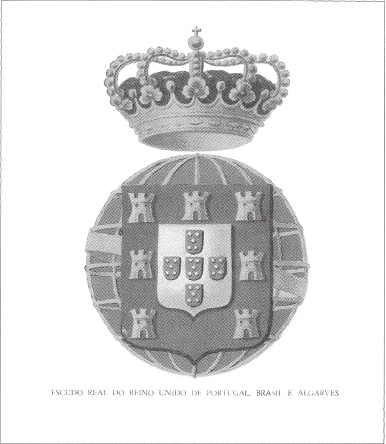
FIGURE 10: Jean Baptiste Debret, “Escudo Real do Reino Unido de Portugal, Brasil e Algarves,” from Ângelo Pereira, D. João VI, principe e rei v. 3 (Lisbon: Empresa Nacional de Publicidade, 1956). Even as the coat of arms was a symbol of the “perfect union and identity” of the residents of Portugal, the Algarve, and Brazil, guaranteed by the powerful Portuguese monarch, it could be read, as Ana Cristina Araújo has explained, as the consecration of the monarchy’s American destiny.
In 1818, then, the Acclamation, as the rite of royal succession was called, was celebrated in Rio de Janeiro as the triumph of both royal authority and the indivisible and historic unity of the three kingdoms. The novelty of the commemorations within the city, the “magnificence and beauty never before seen in Rio de Janeiro,” was circumscribed by that which was old: a ritual of monarchical power that originated with Afonso Henriques (1128–1185), the first king of Portugal. On a large veranda, “according to ancient custom,” Dom João both took and received oaths of loyalty.15 In Dom João’s procession to the royal chapel and in the festivities that followed, sumptuously decorated chambers and facades, triumphal arches, fireworks, music and allegorical tributes evoked the empire’s history and, as the official chronicler suggested, the “ecstacy” that both the United Kingdom and the Acclamation produced in all of its vassals.16
Yet, even as the United Kingdom and the Acclamation presented a conservative discursive framework in which the historical monarchy ensured the unity of the empire, this framework was also sufficiently broad as to allow for competing understandings of the consequences of recent events. Recourse to history in defining royal authority and empire in the New World, in particular, produced its own crisis of representation. For while history revealed that Brazil was, as Silva Lisboa wrote as a royal censor in 1818, “the amplification of the Mother Country (Mai Pátria) for the Lusitanian Monarchy [obtained] through just titles of discovery, occupation and conquest in accordance with the laws of nations,”17 with the transfer of the court this historical amplification of Portugal appeared to have reached an ultimate conclusion. The result was, as one playwright suggested the same year, bewildering. “Are you not my conquest?” asks the allegory of Portugal, heroic conqueror, of Brazil, “an Indian richly dressed in feathers” and “reanimated” in the “August Presence” of the king, in a drama presented to commemorate the Acclamation. Although the past could not be “denied,” Brazil responds, the status of conquest nevertheless “was ended” by the Portuguese monarch and his grace of making Brazil a kingdom. The reconciliation of these differences and “discord,” both the allegories and the audience then learn, depended on Portugal’s and Brazil’s recognition of the need to “bury once and for all ancient quarrels.”18 Rather than an indisputable lesson of history, the consequences of the transfer of the court—the end of Brazil as a conquest—would have to be negotiated.
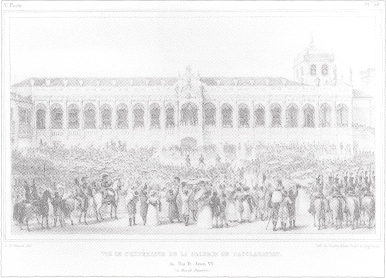
FIGURE 11: Jean Baptiste Debret, “Vue de l’exterieur de la galerie de l’acclamation,” from Debret, Voyage Pittoresque et Historique au Brésil, sejour d’un Artiste Français au Brésil v. 3 (Paris: Firmin Didot Fréres, 1839). Copy and permission obtained from the Print Collection, Miriam and Ira D. Wallach Division of Arts, Prints and Photographs, The New York Public Library, Astor, Lenox and Tilden Foundations. Following the ritual of acclamation and oath taking, and before departing for the royal chapel, Debret explained, the new king stood at the balcony “to show himself to the people and to receive his first tributes.”
This challenge of reconciling the past and the future, as well as the potential for equivocation, was also summarized in the title of one report on the “Empire of Brazil, or New Lusitanian Empire” (emphasis is mine).19 On the one hand, the “Empire of Brazil” and the “New Lusitanian Empire” were synonymous expressions of both the historic Portuguese ideal of political renewal and the European project to civilize the New World. Thus, as Silva Lisboa argued, “the Union of [the crown’s] States, with equitable political Rights” was “the most expedient and decisive Consolidation of the Greatness and Stability of the Lusitanian Monarchy, and of the place that it deserves in the Order of the Powers who most influence the progress of civilization in both Hemispheres.”20 As Gonçalves dos Santos allegorized the culmination of this progress and the moment of union, Brazil, represented by an Indian, shed his past, “the ribbons and feathers with which he was adorned until December 16, 1815,” in order to receive the monarchy. America’s “former nakedness” was finally covered by the “brilliant crown” and “the royal cloak” offered by the prince regent. America, in other words was once again redeemed from savagery and paganism by the beneficent tutelage of Europe.21
On the other hand, however, the “Empire of Brazil” and the “New Lusitanian Empire” could be read as alternatives: America or Europe. The new coat of arms itself, as Ana Cristina Araújo has noted, embodied this tension. As “a symbolic recapitulation of the history of the Portuguese colonial empire,” she explains, the sphere suggested not only the expansive Portuguese dominions, but also the emerging power of Brazil. While the quinas, in turn, recalled Portugal’s glorious past, their location within the sphere consecrated the empire’s American destiny (ponto de chegada).22 Even Gonçalves dos Santos’ well-established iconographic configuration suggested the possibility of this fundamental departure from the centuries-old trajectory of European expansion and colonization. Europe’s conquests notwithstanding, it was, after all, America who now wore the crown and to whom “powerful European monarchs” gave homage, a fact, as Gonçalves dos Santos’ himself recognized, that was dramatized for Rio’s residents in 1817 when the Austrian princess Leopoldina, “the daughter of a caesar,” arrived to assume her position as spouse of the heir to the Portuguese throne, Dom Pedro.23
Fueling this tension between Europe and America, between imperial integrity and an Americanization of the monarchy, was what the statesman and memorialist Silvestre Pinheiro Ferreira characterized as the decade’s great “question of state”: the future, and permanent, location of the sovereign himself. At stake, wrote Pinheiro Ferreira, was “nothing less than the end of the torrential evil with which the century’s revolutionary vertigo … devastated Europe, and threatened the [prince regent’s] states with dissolution and total ruin,” for both a continued absence of royalty in Portugal and the royal family’s departure from Brazil left the monarchy vulnerable to revolution. The salvation of both the monarchy and the empire, Pinheiro Ferreira surmised, therefore would require an entirely new organization of royal power. In 1814 he responded to this question by recommending that royal authority be divided within the empire, with Dom João assuming the title of “Emperor of Brazil, sovereign of Portugal,” while his son Pedro would go to Portugal as “king, heir to the throne of Brazil.” Decentering royal power and multiplying the source of political authority so as to provide for a forceful representation of that authority over a larger area, Pinheiro Ferreira sought to diminish the sense of marginality as well as the physical margins that had previously defined Brazil’s relation to Portugal and that now appeared to define Portugal’s relation to Brazil.24
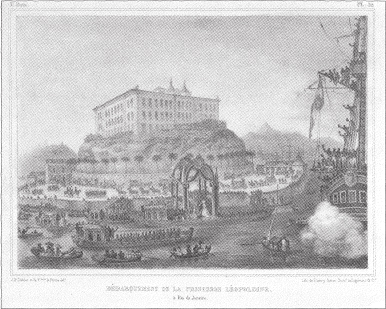
FIGURE 12: Jean Baptiste Debret, “Débarquement de la Princess Leopoldine,” from Debret, Voyage Pittoresque et Historique au Brésil, sejour d’un Artiste Français au Brésil v. 3 (Paris: Firmin Didot Fréres, 1839). Copy and permission obtained from the Print Collection, Miriam and Ira D. Wallach Division of Arts, Prints and Photographs, The New York Public Library, Astor, Lenox and Tilden Foundations. As Debret explained, the triumphal arch through which Leopoldina entered the city featured the coat of arms of the “new United Kingdom.”
In creating the United Kingdom, however, the crown left both the structure of royal governance unchanged and the future residence undefined. Instead, potential contradictions within the United Kingdom were resolved by recalling the events that had precipitated the empire’s reconfiguration. Conflicts within the monarchy and empire, in other words, were suppressed in favor of conflicts that transcended the Portuguese world. The creation of the United Kingdom and the Acclamation thus became celebrations of the defeat of the French Revolution. As one commemorative ode rendered recent events: “The Lusitanians were ruled by a light and gentle Scepter / Within the stormy Universe / Of a perverse system / the Pious Prince offered Benign shelter. … ”25 The Kingdom of Brazil also emerged as a victorious bulwark against the spread of republican insurgencies from neighboring Spanish America and a check against the influence of the United States, which, according to Silva Lisboa, “showed all the symptoms of supporting the presumptuous system of the Autocrat of France.” For a besieged old regime and empire, the path of restoration and the victory had led to Brazil. Or, as Silva Lisboa allegorized the creation of a new court, history was rendered meaningful by mythology. Rio de Janeiro was, he proclaimed, “the Promontory Peak from which were issued the rays of an active and holy war” used by “the Heavens to defeat the Titans who dared to attack Olympus.”26
THE “LIBERATION OF COMMERCE”: EMPIRE AND THE “NEW SCIENCE” OF POLITICAL ECONOMY
While following the transfer of the court, the empire was defined by the triumph of the monarchy and its United Kingdom over the French Revolution and Napoleon, it was also, memorialists argued, built upon the ruins of mercantilism. Dom João both “delivered the herculean blow to the Hydra of Jacobinism” and, as Silva Lisboa wrote, slew the “Dragon of Monopoly” that together “had attacked the vital organs of the Social Body.” Indeed, in Silva Lisboa’s new imperial geography, the most prominent feature of Rio de Janeiro’s landscape, the mountain of rock known as the Sugar Loaf, became the second Cape of Good Hope, the site from which the prince regent, in the spirit of his fifteenth-century ancestors, secured both “the salvation of Civil Order” and “the opening of Global Commerce.”27
The act to which Silva Lisboa referred with such grandiose imagery was the opening of Brazil’s ports, an act that consistently has been cited by historians as the defining moment of Dom João’s reign. In Bahia in 1808, even before his arrival at Rio de Janeiro, the prince regent issued a royal charter that dismantled Portugal’s three-hundred-year-old commercial monopoly. For the first time in the history of the empire, merchants of all powers “in peace and harmony” with the Portuguese crown were allowed to both import and export from Brazilian ports. It was an act, as well, in which Silva Lisboa himself, the future Visconde de Cairú, played a central role, for it was reportedly he who succeeded in convincing the prince regent and his counselors that the French occupation of the Iberian Peninsula made it impossible to continue to limit trade exclusively to Portugal. Opening Brazil’s ports, he explained, would allow American commerce to continue during the war. Consequently, the crown would collect required duties, revenue needed to fund its continental armies.28
The charter inspired by this line of argument thus was an “interim and provisional” wartime measure that made important exceptions for the royal monopolies of brazil-wood and diamonds as well as for wine, oil, and aguardente. In the months that followed, further restrictions limited the scope of “free trade” and the new, increased duties on direct commerce, originally applied without regard to the origin of the manufactures or the ships that brought them, were reduced in favor of Portuguese goods.29 Yet these exceptions not withstanding, supporters of the charter defined it as the first step toward creating a new “general system” for commercial exchange based on liberal principles. It was, they repeatedly insisted, an unequivocal point of no return and the harbinger of a new greater era. For after 1808, wrote a characteristically enthusiastic Gonçalves dos Santos, “Brazil [was] no longer an enclosed garden, forbidden to other mortals.” Or, as one slogan revealed at the Acclamation proclaimed, Dom João had “liberated commerce.”30
Beginning in 1808, the task for royal officials and memorialists thus became how to define the meaning of this liberation within the empire’s future: to articulate the end of imperial monopoly and the discourse of imperial unity. For some, a connection was established in the creation of the Kingdom of Brazil itself, recognized as the end of a process that open ports had initiated: the demise of what Gonçalves dos Santos called “the old colonial system.”31 Indeed, throughout the decade that followed the transfer of the court, the end of monopoly was cited together with the creation of political equity as an act that established the first solid basis for unity in the empire’s history. Opening the commerce “of this most rich portion of the New World to all civilized people,” claimed the newly arrived Portuguese military official and memorialist Francisco de Borja Garção Stoeckler, “made available to its inhabitants the most abundant source of wealth, and prosperity.” “Justice,” he explained, had “ma[de] all equal,” “elevat[ed] Brazil to the dignified status of Kingdom and ended the disastrous rivalry that existed between American and European Portuguese.”32 The Minister of Foreign Affairs, Rodrigo de Souza Coutinho, similarly asserted that open ports created a new basis for imperial integrity. “Liberal principles,” he wrote, created a “vast System of Commerce” stretching from the Atlantic to Asia, in which Europe, if no longer at the center, certainly remained a beneficiary. “Portugal will always be a natural storehouse for the products of Brazil,” he wrote in 1809, and now “the size of that production will be much larger.”33 One year later, he made the same point more dramatically. “[N]otwithstanding all the anxieties of the visionaries who follow the principles of mercantilism,” he asserted, “the emancipation of Brazil will be very useful [to Portugal].”34 Under the aegis of “liberal legislation” the potential of Brazil’s “copious and various precious resources,” noted in justifying the royal charter of 1815, would finally be fulfilled. Breaking “the chains that imprisoned commerce” would unleash ostensibly natural processes of expansion. Utility would join paradisiacal fertility to create a universal prosperity into which any divisions within the empire would be subsumed.35
Such a reconciliation of open ports and imperial unity, however, was based on the idea that the liberation of commerce produced quantitative rather than qualitative change and that the benefits of this liberation would be measured primarily within the empire itself. Indeed, Souza Coutinho’s vision of a new “System of Commerce” recalled earlier mercantilist reforms that sought to reduce particular colonial monopolies in order to invigorate Portuguese-Brazilian commercial exchange as a whole. In contrast to earlier reforms, however, Brazil’s ports were now open not only to Portuguese in Portugal, Brazil, Africa, and Asia, but to merchants of all friendly nations as well. Open ports allowed foreigners direct and legal access to resources and markets that the Portuguese crown had previously guarded for the benefit of metropolitan interests. Consequently, to redefine the new empire also required accounting for the apparent elimination of its historic boundaries.
One way to explain these changes was to redefine the empire’s center. Although Souza Coutinho earlier had claimed that following imperial reform Portugal would retain the role of entrepot, he gradually acknowledged that this position was truly occupied by Brazil. Thus, the opening of Brazilian ports could be understood as the transference to Brazil of the access to ports in Portugal that foreign merchants had enjoyed historically. In 1811 in legislation supported by Souza Coutinho that ratified the rights of merchants in Brazil to trade directly with the eastern Portuguese dominions, the crown indeed named Brazil as the “commercial emporium” between Europe and Asia.36 The problem with this redefinition, however, was that it simply inverted the hierarchies and inequalities between Portugal and Brazil that the opening of Brazil’s ports was said to have destroyed. Distinct interests within the empire continued to appear as necessarily either superior or subordinate to one another. The “old colonial system” was simply replaced by a new colonial system in which, as critics in Portugal denounced, Portugal was the colony.37
Another way of integrating open ports and the future of the empire was offered by José da Silva Lisboa. Silva Lisboa also saw this “new empire” as American, yet his imperial vision did not depend on a redefinition of center and periphery, or a new hierarchy of interests. On the contrary, recognizing the true nature of commerce, he argued, rendered these categories unnecessary. For Silva Lisboa, the opening of Brazil’s ports and subsequent debates represented the high point in a long career in royal service that was well underway when the prince regent arrived in Brazil. Born in Bahia in 1756, the son of a Portuguese architect and his Bahian wife, Silva Lisboa was sent to study at Coimbra, where he earned degrees in Greek, Hebrew, canon law, and philosophy. After leaving Coimbra he entered royal service as a professor of philosophy in Salvador, Bahia. In 1797 he was appointed Deputy and Secretary to the Mesa de Inspecção da Agricultura e Comércio (Board of Agriculture and Commerce) at the Bahian capital, a position compatible with his growing interest in commercial law and the principles of the “new science” of political economy. It was during these years leading up to the transfer of the court that Silva Lisboa established himself as the Portuguese-speaking world’s most committed disciple of Adam Smith (1723–1790), whose defense of “an independent and voluntary world market” he passionately endorsed.38 Indeed, within a historiography that has broadly defined the Brazilian reception of liberalism as incomplete, misunderstood, or misplaced,39 Silva Lisboa has the ironic honor of being criticized for having embraced the Invisible Hand too completely. Comparing Silva Lisboa and the North American Hamilton, Celso Furtado both noted that “the Brazilian more clearly reflected ideas which were to prevail in England years later” and dismissed the grounds for his conviction. Silva Lisboa “superstitiously believed in the ‘invisible hand,’” Furtado claimed, and merely “repeated: laissez faire, laissez passer, laissez vendre.”40
Silva Lisboa’s enthusiasm for political economy, however, was in fact not superstitious, but rather based on the reading and dissemination of political economy’s texts. His own reading of Adam Smith, whom he identified as the “second Father of Civilized People,” led him to write Princípios de Economia Política, published in Lisbon in 1804,41 and undoubtedly inspired his son’s translation of a three-volume compendium edition of Smith’s Wealth of Nations, published by the Royal Press in Rio de Janeiro in 1811–1812. The “most substantial principles of Political Economy,” Bento da Silva Lisboa wrote in his introduction to the first volume, should be of interest not only to statesmen, but also to “the middle classes, who have contributed so much to the good order of national wealth.” Indeed, he asserted, it “is of interest to all uninstructed citizens that the just rules of civil life, upon which industry and prosperity depends, do not remain, as they have up until now, merely arcane.”42 As this passage also reveals, for Silva Lisboa and his son political economy was conceived of not only as the administration of public revenue, but also as what J.G.A. Pocock has defined as “a more complex, and more ideological, enterprise aimed at establishing the moral, political, cultural, and economic conditions of life in advancing commercial societies.”43 In other words, the scope of Silva Lisboa’s inquiry was not contained by the “quantifiable material entities” of economy, although they were also very much a concern. Rather, as John Stuart Mill would assert some years later, his study of economic conditions belonged to a “moral and social science … the object of what is called Political Economy.”44
This “commercial humanism”—to use Pocock’s term—represented a break with both “enlightened mercantilism” and Souza Coutinho’s most recent reformism, in which commerce was held to be a simple exchange of commodities that generated wealth. For Silva Lisboa, in contrast, commerce produced not only quantitative, but also qualitative results. “Where Commerce is free,” he wrote, paraphrasing Montesquieu, “this openness brings with it the correction of transitory anomalies,”45 a fact that was evident, Silva Lisboa argued, in the redress of afflictions it afforded the United States following its war of independence.46 From this principle it followed that the end of European monopolies could not be regarded as either the cause or symptom of Portugal’s decadence. For “free trade, regulated by morality, righteousness and common good,” Silva Lisboa wrote in his Observações sobre o Comércio Franco no Brasil, published in 1808, was “the life-giving principle of social order and the most natural and sure means to the prosperity of nations.” Nor could the end of barriers to foreign trade with Brazil be regarded as the end of the monarchy’s imperial boundaries. Rather, open ports signified the infinite expansion of these boundaries; they formed “the Cornerstone of the edifice of civilization” and the basis for a “New Empire.”47
This defense of commerce as a “civilizing agency,” as Anthony Pagden has recently shown, was debated widely throughout Europe in the late eighteenth and early nineteenth centuries and summarized in a passage from The Spirit of the Laws, which Silva Lisboa himself cited: “where there is commerce, there is gentleness of customs, and where there is gentleness of customs there is commerce.”48 In the case of Silva Lisboa, this firm link between trade and civilization also meant that even as the principles of political economy dismantled “the old colonial system,” they retained the European colonial project intact. In other words, in Silva Lisboa’s ideally liberal nineteenth-century empire, free trade would supplant conquest as the vehicle through which the European “social order” would be spread. Evincing what Pagden has described as political economy’s commitment to the idea that “contemporary commercial society was the highest condition to which man could aspire and that such a society was a possible outcome—possible for peoples everywhere—of a determinate, intelligible, and, to some degree, controllable, historical process,” Silva Lisboa’s work stood, as we shall see below, as an attempt to discern and foster that process within the Portuguese empire.49
Silva Lisboa’s persistent references to “social order” also make clear his assessment of revolutionary politics. He was, as Sérgio Buarque de Holanda categorized him, a “traditionalist,” committed to defending the Portuguese monarchy, religion, and aristocracy. “The Coryphaei of impiety, libertinage and religious and civil heterodoxies,” Silva Lisboa insisted, could not be tolerated within the new empire, for these had inspired the French to usurp “established government” and, consequently, “annihilate the fundamental principles of civil order” manifest in nobility. 50 Accordingly, as a member of the Junta da Impressão Régia (Royal Press Board) in Rio, he presented a formidable although, as he himself recognized, only partially successful defense against the “opiates” of the French Revolution by censoring both imported works and manuscripts, ensuring that they were duly expurgated “of that which was most offensive to Christianity and the current establishments of civil order.”51 This commitment to a traditional order also meant that in using the principles of the “new science” of political economy to define the new empire, Silva Lisboa had both to reconcile the opening of Brazil’s ports with historic imperial unity and to explain why dismantling economic privileges did not mean the end of other (political) privileges as well. In other words, Silva Lisboa had to explain how the Portuguese empire could withstand a transformation without undermining the pillars of its historical edifice: the monarchy, tradition, and religion.
To do so, Silva Lisboa turned not to Smith, but to another critic from the British Isles, Edmund Burke (1729–1797), whose work he translated and published in Rio de Janeiro in 1812 with a dedication to the British representative to Dom João’s court, Lord Strangford.52 Burke’s claim that liberty could not exist outside the established “social order” was a principle that, as José Honório Rodrigues noted, guided Silva Lisboa’s career.53 Burke’s analysis of the French Revolution appealed to Silva Lisboa because, among other things, it rescued liberality from revolutionary liberty by reasserting its basis in “ancient chivalry” and manners.54 As Silva Lisboa explained in the preface to his translation, Burke made plain the difference between “the liberal ideas of a Paternal Regency” and “the crude theories of metaphysical speculators, or Machiavellists, who had perturbed, or perverted, the immutable Social Order.”55 Burke then further elucidated the fundamental relationship between a conservative “social order” and commerce in his claim that in the “spirit of gentlemen” and the “spirit of religion” were the principles upon which “all good things which are connected with manners and with civilization” had been based. “[C]ommerce and trade and manufacture,” Burke explained, were consequently “but effects [of manners and civilization] which, as first causes, we choose to worship.” From this claim it followed, as Pocock has explained, that to “overthrow religion and nobility” was “to destroy the possibility of commerce itself.”56 Accordingly, with Burke Silva Lisboa could firmly place the defense of monarchy, religion, and an aristocratic “intelligentsia” at the base of the new empire, making a reassuringly clear connection between the monarch’s traditional “liberality” and the “liberal” gesture of opening Brazil’s ports. His traditionalism, in this sense, represented neither a departure from, nor, as Buarque de Holanda argued, a misreading of Smith,57 but rather a reading of Smith, and of political economy in general, through Burke. As Silva Lisboa thus learned, if commerce were to achieve its civilizing mission, its own civilized origins had to be secure.
And yet there is, as may be clear, an important tension in the work of Smith and Burke, and in Silva Lisboa’s readings of their works. While Burke’s assertion, as Pocock notes, “that commerce is dependent upon manners” was shared by some political economists, Smith and others had identified the growth of exchange, along with production and the diversification of labor, as “the motor force which created the growth of manners.”58 Perhaps in engaging in these two visions of the origins of commercial civilization Silva Lisboa, like Montesquieu, wanted it both ways: “everywhere there are gentle mores, there is commerce” and “everywhere there is commerce, there are gentle mores.”59 There is, however, also a feature of Burke’s thought that allowed Silva Lisboa to elide the tension between causes and effects of commerce in his own understanding of the empire in which he lived. Burke, as Pocock explains, “anchored commerce in history, rather than presenting it as the triumph over history.”60 The same could be said of Silva Lisboa and, as Silva Lisboa would assert, of the Portuguese nation itself. The Portuguese were not, as were the French revolutionaries and the British functionaries in India who, as Uday Singh Mehta notes, Burke derided as rootless, “commercial mercenaries unmarked by the burdens and privileges” of society.61 Portuguese commerce was, on the contrary, both historic and noble. Since the fifteenth century, the King of Portugal ruled over not only his “conquests,” but also the “navigation and commerce of Ethiopia, Arabia, Persia, and India.” The monarch himself had become a merchant, or “the grocer king,” as one French monarch disparagingly referred to Dom Manuel I (1495–1521).62 Consequently, for the Portuguese it made no sense to distinguish the causes and effects of commerce and aristocratic civilization because their national character, their Montesquiean “spirit of the laws,” an ideal to which both Burke and Silva Lisboa referred to with critical regard, was mercantile and chivalrous at once.63 In the nineteenth century, therefore, a privileged elite and Dom João’s “paternal Regency” could sustain the open, commercial empire and also, as Burke had insisted, build on “old foundations.”64
Portuguese chroniclers of empire, however, had not been so eager to perceive such a harmonious integration of profit and glory in narrating what Richard Helgerson describes as “the voyages of a nation.” In the 1810s, it was thus left to Silva Lisboa to realize this imperative in his Memoria dos Beneficios Políticos do Governo … de Dom João VI, a recapitulation of the history of the Portuguese empire in which Dom João’s achievements are enumerated in dialogue with an earlier theorist of empire, João de Barros (1496–1570). In his Décadas (1552–1563), Barros had presented a history of Portuguese expansion up to 1505, including Vasco da Gama’s voyage to India and Cabral’s voyage to Brazil. For Silva Lisboa, the work of “the eminent Historian of the Portuguese Discoveries” provided emblematic links between the Portuguese empire in Asia and the Portuguese empire in America. Read in tandem with the story of Vasco da Gama, the Acclamation, the event that the Memoria commemorated, appeared as the fruition of the monarch’s American destiny inaugurated in India. The arrival of the prince regent to Rio and the Acclamation, Silva Lisboa claimed, recalled the “ecstatic” greeting that the inhabitants of India offered to “our first Discoverer of the East,” an encounter poetically rendered in a passage from Luiz de Camões’ The Lusiads (1572), which Silva Lisboa transcribed: “It is not without reason, no, hidden and dark, / That you come from the far away Tagus: / God certainly brings you, / because He intends / that You perform his Service… ,”65 As the use of Camões also signaled, both encounters were achievements of epic proportions.66
Silva Lisboa’s history of the empire thus recalled the providentialist explanations of the transfer of the court that saw the year 1808 as a divinely inspired turning point for the monarchy. In Silva Lisboa’s case, however, the aim was not to glimpse a sublime postapocalyptic future, but rather to reclaim the past and the empire’s original ethos, to return to the principles that guided the original voyages. According to Silva Lisboa, Dom João embodied these principles. His willingness to justify his actions before “the Public and all the Orders of the State” recalled “the Great Albuquerque, founder of our Empire in Asia,” whose government, as Barros had written, was one of transparent justice. The prince regent’s attempts to maintain Portuguese neutrality, Silva Lisboa also argued, reflected not only his “Character” but also the “Example of his most glorious Predecessors,” Dom Henrique and Dom Manuel, who, as Barros established, together with Portuguese colonial governors, excelled at “the ways and arts of establishing peace.”67
This exaltation of empire as the framework for quiescent material exchange, as Helgerson has observed, can be found as well in one contemporary English reading of Camões, where the historic Portuguese empire served as a symbol of the dawn of commerce itself. Dom Henrique, wrote William Julius Mickle in the introduction to his 1776 translation of The Lusiads, was “born to set mankind free from the feudal system and to give the whole world every advantage, every light that may possibly be diffused by the intercourse of unlimited commerce.”68 Such a rendering of early European expansion served to suppress the violence of the British empire, a violence directed at Britain’s colonial subjects, as well as, to a certain extent, at the Portuguese themselves, who, as we shall see below, although “allies” of the crown of England also judged that Britain sought to replace Portugal’s “peaceful” pursuit of “unlimited commerce” with their own. Yet, what Helgerson describes as Mickle’s “massively overdetermined” reading, reflective of both “two centuries of discourse prompted by trade” and the force of England’s eighteenth-century commercial enterprise, would have appealed to Silva Lisboa. Like Mickle, he effaced the violence of empire, argued that the Portuguese monarchy had given trade its limitless dimensions, and appreciated the way in which the Portuguese and British empires converged in commerce. Indeed, bringing Portuguese and British imperial rhetoric to yet another point of intersection, Silva Lisboa cited the early eighteenth-century British poet Thomson’s tribute to Dom Henrique. The fifteenth-century navigator had envisioned that “in unlimited Commerce the World embraces.” Three centuries later, Silva Lisboa concluded with satisfaction, it was Dom João who made that vision a reality. If, however, as Helgerson explains, Mickle’s “misreading” of Camões’ epic of conquest as an “epic of commerce” was intended to celebrate the triumph of a mercantilism that Camões himself sought to suppress in favor of the nobility of empire, Silva Lisboa’s “retrospective renaming” of empire entailed bringing both its aristocratic and commercial dimensions to the fore. If Camões wrote for the king and the nobility and Mickle wrote for merchants, Silva Lisboa perceived a need to write for both.”69
To persuade both royalty and merchants of the virtues of free trade, Silva Lisboa then linked the history of Portuguese commerce to an idealized origin. The Portuguese monarchs created an empire that made commerce “limitless,” he explained, because they recognized the practice to be “natural.” Once again, Silva Lisboa based his assertions on Barros, referring in one passage to his praise for the dynasty of “Ahmed, the Moorish Tartar” who, Barros had claimed, both discerned the natural principle that “men and wealth are what make kingdoms and republics most prosperous” and, accordingly, with “justice and liberality,” opened his territory’s markets to both foreign goods and currencies.70 With such a claim Silva Lisboa completed his own massively overdetermined reading of the history of the Portuguese empire. An empire that had been circumscribed by monopoly and justified by mare clausum and the right of navigation defined in positive rather than in natural law became, in Silva Lisboa’s Memoria, the champion of the natural practice of free trade.71
Such a rewriting of imperial history was, of course, strategic. Establishing that free trade was part of a “natural Politics,” historically encountered “when the Economy of Nations was not corrupted by the guile of Monopolists,” and that Portuguese expansion itself inaugurated free trade, allowed him to articulate a critique of the old colonial system and monopoly without attacking, as the French Revolutionaries had, “old foundations.” He could, as he contended of Dom João, ensure that religion remained “unscathed” and maintain “a secure Civil Order, respect for the Dignity of the Crown, a firm National Independence, solid Systems of Public Good, progressive Improvements of Society.” From this claim it followed that open ports did not undermine either the old regime or the empire, but rather restored the original and “natural” framework of Portuguese expansion in the place of what the empire had become only subsequently: a closed “colonial system.” “Good reason,” Silva Lisboa wrote, revealed that “the Economy of the State should not disturb the Order of the Ruler of Society, and the natural course of things,” an order that he defined, in turn, by citing Barros: “each one reaps from the earth that which he has sown.” “The Colonial System,” he went on to explain, “had this intrinsic defect,” whereby one group of people were, through “an indirect or direct System of force,” prevented from “working” and “developing their territorial and mental resources for the progress of industry and wealth.” Such a system, in other words, prevented the pursuit of Smithian self-interest. That the Portuguese courtiers arriving at Rio did not encounter opulence, Silva Lisboa concluded, implicitly comparing the wealthy sixteenth-century empire and the decadence that followed, proved that Adam Smith was right when he argued that for both the metropoles and their colonies free trade was better than monopoly.72
In bringing imperial history to the nineteenth century, Silva Lisboa also completed his final move in writing monopoly out of the old regime: displacing it to the old regime’s enemy. France, he wrote in an earlier pamphlet, where the “first luminaries of orthodox Political Economy, Fenelon and Montesquieu, wrote of the advantages of free trade,” had been betrayed by the “Monsters” of Revolution, who attacked civilization and debased commerce with their “barbaric physiocratic system.” Napoleon’s attempt to blockade British commerce as well revealed a hatred of “legitimate commerce” and of those who defended it: the Portuguese and the English, “followers of the Tyrians and Phoenicians.”73 However, the transfer of the court, he argued, evoking both the Bible and The Wealth of Nations, rectified these errors. It accelerated “the development of a Plan” in which “with an Invisible Hand, Providence prepared the reestablishment of an order that was at once Civil and Cosmological.” Brazil’s open ports thus were absorbed into a discourse of imperial unity in which the Portuguese political old regime was hegemonic. The “Liberation of Commerce” became synonymous with the “Restoration of Monarchy” and sixteenth-century imperial glory.74
“O JARDIM ABERTO”: THE NEW EMPIRE PRACTICED
Both the discourse of a United Kingdom and the discourse of political economy promised a restoration of former glory and prosperity based on a redefinition of imperial space as homogeneous, unified, and equitably denominated. The achievement of such a redefinition of empire, however, also required translating these discourses into practices across the empire and at the local level. How, then, were the United Kingdom and the “liberal principles” that it was said to embody practiced in the new court and open port of Rio de Janeiro? How were the ideals of unity and prosperity disseminated within the city? And, how did Rio’s residents respond to the consequences of the policies that these ideals informed?
In Rio de Janeiro, the transfer of the court and the opening of its port consolidated trends that began in the eighteenth century: the growth of the city’s population, of its merchant community, and of the volume of goods exchanged in its port and market. Between 1808 and 1821 the city’s population doubled to at least 80,000 persons. The number of retail business increased over 100%. And, in 1808 alone, four times as many ships entered the city’s port as in the previous year.75 This increase in the city’s population, together with economic growth, appeared to fulfill the promise of imperial renewal in the New World. As Silva Lisboa sustained, “the dignity of the King is found in the multitude of his people, and population makes the power of States” (emphasis in original).76
Yet, as contemporary statesmen and theorists also agreed, the status and wealth of nations depended not only on the size, but also on the nature of their population. In this case, rather than fulfilling promises, both the new court and Brazil as whole, many argued, presented problems. In the eighteenth century, as we saw in Chapter 2, viceregal officials in Rio had linked social and economic problems to the city’s African and African-Brazilian population, blaming the institution of slavery and their labor force for what they perceived to be a lack of productivity and the idleness of the population in general. In the new court of Rio de Janeiro, we saw in Chapter 4, this critique of slavery was further advanced. Although royal cabinet Minister Vila Nova Portugal argued that slavery provided much needed labor for plantations and mines, he also recognized that slavery made Brazil “intrinsically weak” because, as he explained, “half of the energy that should be applied in service to the sovereign” was spent in maintaining order among what he perceived to be a hostile population.77 Silva Lisboa, in turn, characterized slave labor as both costly and inefficient. Slavery was an institution, he asserted, that had resulted in the “inertia” of Brazilian plantations and their reliance on primitive methods. And, there were, he stressed, no extraeconomic factors that justified the maintenance of such an institution. The claim that “the heat of the torrid Zone was inhospitable to the European constitution, and that without Africans, Brazil could not flourish” was, he denounced, the “vulgar” pretense of those who “try to escape the Law of Work, wanting to live off the sweat of others.” Likewise, the mission of Christianizing Africans was, as he characterized it, nothing more than an unsubstantiated “pretext.”78
The indictment of slavery, however, was based on more than the inadequacies of the structure of labor. The ideal of the new empire was, as we have seen, a “homogeneous political body.” At the local level in Rio, this ideal was understood to mean a uniformity not only of political identities (a unity of the monarch’s “vassals”), but also of culture and color. Brazil, Silva Lisboa explained, needed “a natural, prudent and legitimate population,” rather than one that was “foreign, barbarous and abusive, as was [its population] of Africans.”79 Royal minister Tomás António Vila Nova Portugal clarified this imperative: because Brazil did not have a large population of poor whites, it did not have a “povo” (people). What Brazil did have, slaves and free and freed persons of color, did not constitute a people because, as Vila Nova Portugal further argued, they were incapable of sharing the Portuguese “National Spirit.”80 Indeed, in Brazil, Silva Lisboa similarly asserted, slavery had subverted the social and cultural basis for political viability. It “made difficult marriages between people of European extraction,” he explained, and “prevented the formation of a homogeneous and compact nation.”81
We have seen how officials in the new court contended with what Silva Lisboa characterized as a “foreign” and “barbarous” population, as those of the colony of Brazil had, with repression and social discipline, as well as the consequences of this pessimistic vision of cultural and color differences for the free people of color and the African and African-Brazilian slaves who found themselves in confrontations with the police. In the 1810s such a pessimism also inspired royal officials to search for an alternative source of peoplehood. Displacing African “foreigners” with European ones by way of voluntary, “white” immigration, they imagined, an even more complete exclusion of people of color from civil society in both the present and the future would be achieved.82 The success of this immigration, according to Silva Lisboa, depended on the end of the slave trade, which he vigorously defended, as well as on the eventual and “gradual” end of slavery itself, to which, he more cautiously predicted, the reduction in trade would lead. It was “impossible,” he explained, “that a considerable number of Europeans expatriate themselves to Brazil, as was imperative, if they [could] hope for no better fortune than to be mixed-up with Kaffirs.” The temporary economic disruption that would follow the end of the slave trade, he further pledged, would be exceeded by the results of immigration. “Experience has shown,” Silva Lisboa claimed, “that, where the importation of Africans has ended, the race does not decline … but rather [is] elevated, improves, and lightens.”83
In 1810 and 1814 the crown did agree to curtail the slave trade, but only by limiting it to its own possessions and then to below the equator; and the move, as we shall see below, was not identified with any compelling vision of reform of the population or of labor in Brazil.84 In contrast, the question of immigration appears to have inspired a more concerted response from royal officials. In the 1810s the settlement of Azorean and later Swiss immigrants as farmers was subsidized by the crown, while otherwise “useless” Portuguese arrivals were similarly settled in areas both far from and near to the city. “Improving” the nature, or “race,” of the population thus was linked to an ideal of productivity as embodied in small-scale rural enterprise. Such projects, Rio’s police intendant reported, produced “advantages” in the present and promised to yield further “good.”85 As Rodrigo de Souza Coutinho similarly promised, creating incentives for immigration such as land grants was “not in favor of Foreigners … but rather in favor of the Greatness, Population and Culture of Brazil.” For proof of “these principles,” he argued, one need look no further than the “most convincing” example, or “identical and analogous” case, as Silva Lisboa described it, of the United States, where “greatness” had been achieved in spite of an African and African-American population.86
As royal officials took inspiration from the fact that the experiences of slavery and color hierarchies were shared, as well as from the United States’ ostensible ability to surmount the consequences of these experiences, they also faced crucial disparities, and one in particular had significant consequences for the meaning of immigration in each context: the status of religious difference. Whereas in the United States various religious sects were officially tolerated, Brazil was within the sphere of a historically militant and exclusive Tridentine Catholicism. Accordingly, in recruiting European immigrants the Portuguese crown had specified that they be Catholic. In fact, however, many of those who came to Brazil were Protestant. The crown, in turn, as John Parker has observed, responded to their presence by expanding its understanding of religion as “a source of order” to include Protestantism and, in spite of criticism from the papal nuncio, paid the salary of the Swiss settlement’s minister. Although in the 1810s the scope of this new religious difference, and of European immigration in general, remained relatively limited, the symbolic implications of “officially acknowledged religious toleration” were significant.87 It meant that in the new prosperous empire, at least in official visions of the political-economic future, whiteness and the ideal of utility as embodied in the small farmer could challenge successfully the ideal of linguistic, historic, and cultural unity and religious homogeneity of a heroic Portuguese nationhood that both exiles and residents evoked in explaining the transfer of the court.
Although most foreign settlements were in the hinterland some distance from Rio de Janerio, within the city the new dimensions of cultural and religious differences were also manifest. After 1808, foreign merchants began to assume a prominent role within Rio’s growing economy, “invited by the Spirit of the Sovereign,” boasted the preacher Januário da Cunha Barbosa, “who gave them a much greater commerce.”88 This foreign population was diverse and with the end of the Napoleonic Wars came to include a sizable number of French.89 The city’s largest foreign community, however, was British. The British, after all, had the advantage of well-established trading relations with the Portuguese, some of which, following the court, were transferred to Rio. Even before 1808, by way of isolated royal authorizations and contraband, some British merchants had gained experience in Brazil. Consequently, by 1809, the year that an association of merchants with interests in Brazil was formed in London, there were over one hundred British firms in Rio. After an initial wave of speculation based more on what the British could supply than on what the Brazilian market demanded, many of those who the North American merchant Henry Hill referred to as “adventurers” returned to England. A stable community of British mercantile interests nevertheless remained: importers of linen and cotton cloth, hardware, and earthenware, and exporters of sugar, cotton, and coffee.90
This British presence in Brazil was guaranteed in a series of treaties signed by the Portuguese and British crowns in 1810. Along with establishing the specific terms for “Commerce and Navigation” between the British and the Portuguese, discussed below, the treaties also provided for a number of political arrangements. The British received indemnification for losses incurred in Portugal during the war in an allowance for cutting wood from Brazilian forests to build war vessels. It was also here that the Portuguese crown agreed to curtail the slave trade by limiting it to its own possessions. The British then further gained a reaffirmation of their right to a judge conservator as they had in Portugal, one who, as John Mawe, a British resident of Rio, noted, was “to attend solely to the concerns of the English, and to see justice done them.”91 Finally, the Portuguese crown conceded that the Inquisition would never be established in Brazil and pledged to guarantee both a “perfect freedom of Conscience” and the right to Protestant worship in homes or in churches, as long as these churches “externally resembled residential housing” and as long as no attempts were made to proselytize or “declaim against” Catholicism.92
In the early 1810s the local reception of the British in Rio de Janeiro, and of their new and more formidable presence in Brazil that the treaties authorized, was, to a large extent, shaped by the experience of the Peninsular War. The British had escorted Dom João to Brazil and a British General and British troops were at the forefront of joint efforts to expel the French from Iberia. In Portugal, as Valentim Alexandre observes, with victory appearing more imminent, the alliance between the crowns of Portugal and Great Britain was regarded as a guarantee for both Portugal’s salvation and an enhanced stature for the crown in Europe. The Portuguese periodical press, some of which was read in Rio, engaged in an “Anglomanic” celebration of the achievements of Wellington and Beresford as well as English history and literature.93 In Rio a certain Anglophilia was also evident. O Patriota reported on British politics and on the joy elicited by the visit of “Visconde Mylord Strangford” to Minas Gerais, and, as we have seen, the Royal Press published translations of Pope, Burke, and Smith along with pamphlets celebrating the wartime alliance. As one poetic satire of the French pretension to “protect” Portugal affirmed: “The British Ally / of the Sovereign Regent / forms a decisive plan / In favor of the Portuguese people.”94
Such enthusiasm for the alliance, however, could not entirely alleviate concern about the unprecedented presence of foreigners in the city of Rio de Janeiro or contain debate over the treaties’ guarantee of Protestant worship. While the advocates of European immigration insisted that religious toleration was indispensable,95 for others the presence of Protestants challenged the political viability of the Portuguese crown’s kingdoms. During the negotiations with the British, the Conde de Galveas had argued that the toleration of Protestantism “was all that was wanting to render Brazil an English colony.”96 In 1814 Vila Nova Portugal similarly attacked what he argued were British attempts to subvert the integrity of the new empire. “If the British did not have a hidden agenda for our souls,” he asked, “why did they raise the subject of religion in a commercial treaty?” After all, he continued, religion had proved to be the most effective obstacle to the seventeenth-century Dutch invasion of the Brazilian northeast. “The true politics” and “interest of the monarchy,” Vila Nova Portugal asserted in what amounted to an indictment of non-Portuguese immigration in general, consisted in “neither los[ing] one’s own vassals, nor acquir[ing] those of [other monarchs].” To nurture “the national spirit” that “made Portuguese proud to be called Portuguese,” he concluded, it was necessary to keep that spirit “separate, and different from others.” Perhaps, he suggested in another policy report, “invalid” Portuguese soldiers could be recruited in place of “dangerous” foreigners.97 By the end of the decade the magistrate Maciel da Costa, while continuing to endorse the need for European immigration, nevertheless offered a similarly defensive view of demographic transformation, acknowledging the obstacles that even the United States faced. As the United States had been opened to all with “human physiognomy,” including revolutionary refugees from Europe, he reported, it now contended with the problems of “an immense” population that was “heterogeneous, cosmopolitan and debauched in customs.” Brazil, therefore, needed to be more circumspect in recruiting immigrants. Citing one French traveler to the Caribbean, Maciel da Costa concluded “one does not, in one day, in one year, in ten years, transform a population of slaves into a population of vassals and citizens.”98
Such skepticism about immigration and the religious and cultural diversity that it implied was also manifest at the local level. In the countryside, according to Swiss Protestant reports, there were efforts to convert the newcomers to Catholicism. In the city of Rio de Janeiro, in turn, the negotiation of both new religious and cultural differences was also tense. A most public showdown was staged by the U.S. consul, who, as an expression of his republicanism, refused to kneel before the queen on encountering her in the city. Although at this first incident, the royal attendants forced the consul to kneel, at his next encounter with the queen the consul defended his position by brandishing a pair of pistols. The ongoing impasse was resolved only by Dom João himself, who responded not with force, but by dispensing foreigners from exhibiting the degree of servility before His Majesty that was required of Portuguese vassals.99 The question of foreigners’ due deference also publicly surfaced in 1810, when what the police intendant described as a “religious riot” ensued after an Englishman reportedly insulted the Catholic faith during a procession on Good Friday. In this case, however, the common status of the offender and the uniquely sacred status of the offended meant that no exceptions would be made and, subsequently, the Englishman was permanently expelled from Brazil.100
For the British merchant John Luccock, such incidents of conflict in Rio de Janeiro were to be attributed to the “military, who act as the inferior officers of Police” and, as he claimed, were both infused with a “rancorous spirit” and “much disposed to abuse their authority, and to molest our countrymen.”101 The police intendant similarly characterized relations with the British as particulary contentious although, not surprisingly, he discerned other causes of conflict. Although local magistrates were instructed to “treat well the vassals of His British Majesty,” he reported to Souza Coutinho, the British failure to reciprocate often precipitated “unpleasant confrontations,” especially at the opera and the bull ring where the British were known to “enter [private] boxes as if they were common verandas.”102 This tension and animosity between the British and Rio’s residents were noted as well by Strangford himself, who in spite of intervening on behalf of British involved in police matters, nevertheless acknowledged that “the insults … offered to [the] Prejudices, Customs, and Religion [of the ‘Brazilians’], by the English Settlers of this country” occurred daily.103
For both the intendant and Rio’s residents at stake in these confrontations was, as John Parker has argued, “the whole deferential order” that characterized Portuguese society and politics.104 Local regimes of adjudication and punishment were jeopardized, Viana noted in his dispatches to the royal cabinet, by British refusal to abide by Portuguese laws, such as restrictions on incursions into the Brazilian countryside, by their “bad humor and excessive sensitivity” when confronted with their errors, and by the arrogance with which they extended these corruptive tendencies beyond their own community.105 As Viana reported in 1812, following the arrest of a slave for throwing rocks, his English owners sought his release by claiming spuriously (considering, Viana noted, that the British were not supposed to either own or traffic in slaves) that the slave should be “handed over to their judge conservator because he held the privilege given to all members of [a British] family.”106 This pretense of privilege and impunity also extended to Portuguese vassals associated with the British, especially “the Portuguese clerks of English firms” who, Viana fumed, possessed “a conceit deserving of much correction.” One clerk, after assaulting a black woman who was, the intendant noted, a slave of “another poor black,” smugly failed to pay for her doctor and then, faced with what the intendant characterized as much deserved jail time, “allege[d] privileges of the English house” and solicited the interventions of his employer. “For the general credit of our nation,” Viana concluded in a report to the Minister of Foreign Affairs, “these clerks should be severely punished” because of the “deceit and bad faith with which they treat even the English who with the most good faith and liberality find themselves compelled” to hire these clerks “because of the need of having someone who better understands the language of their customers.”107 The British presence, in other words, created a cycle of disorder. British arrogance produced Portuguese insolence from which, in turn, British and local residents suffered alike.
As the above report also indicated, however, the residents of Rio de Janeiro contended with what they construed to be British threats to their religious, political, and cultural integrity because of a shared interest in what John Luccock described as “the prospects of commerce.” It was, after all, commerce with foreigners, rather than their ostensibly disruptive presence in the city, that the opening of ports had sought to promote. In the 1810s in the interest of advancing this commerce, cultivating “utility,” “national wealth,” and “the expansion of the market” the crown had ended prohibitions on local manufacturing and restrictions on wholesaling and retailing, created a Board of Commerce and a Bank of Brazil, extended the privilege of royal land grants to foreigners, pledged incentives for the climatization of new commercial crops, issued a number of regulations for the city’s busy port,108 sponsored Aulas de Comércio (courses on commerce), and created a course in “Economic Science,” supervised, not surprisingly, by Silva Lisboa, so that its principles could be “put in practice” and so that the prince regent’s vassals, “better instructed in them,” could “serve [him] to greater advantage.”109 Anglo-Luso commercial relations, in particular, were guaranteed in 1809–1810, when along with the treaty of alliance the Portuguese crown negotiated a “reciprocal liberty in Commerce and Navigation” with the British. British access to Brazilian markets was affirmed and Brazilian products were granted access to British markets, a particularly crucial concession, as Valentim Alexandre has noted, considering that the admission of Brazilian goods to major continental markets had been disrupted by the Napoleonic Wars.110
Yet, in spite of these reciprocities, the treaties also provided for what Alan Manchester described as a “British preeminence” in Brazil, a preferential status in the Portuguese empire’s ports that had been staked out in London before the transfer of the court, but then temporarily undercut, as Lyra observes, by the 1808 charter that opened Brazil’s ports to all nations.111 More specifically, the Treaty of Commerce and Navigation provided for import duties of 15 percent on British goods, a figure lower than that applied to both other foreign and Portuguese merchandise. Although the Portuguese crown gained the status of “most favored nation” within the British empire, Brazilian sugar and coffee, “articles similar to the products of the British colonies,” were denied direct entrance to British markets. Within Brazil, the British also gained the unreciprocated privilege of selling retail.112 Such preferences were not lost on contemporaries. As the British set out to demonstrate that, as Luccock proclaimed, in “the amelioration of Brazil” one “contemplates the benefit of mankind, and more especially of the British dominions,”113 throughout the territories of the Portuguese crown many came to doubt the commercial order that the treaties guaranteed.
Although, as Valentim Alexandre explains, in Portugal the treaties of 1810 were at first accepted as a temporary feature of the period of war and alliance, when it became clear that the new postwar regime would not feature changes that favored merchants in Portugal, who had been undercut by British access to Brazil that previously only they enjoyed, the Portuguese were beset by a profound sense of “disenchantment.”114 At the royal court in Rio de Janeiro, in turn, confidence about both the treaties and the British reportedly died with Rodrigo de Souza Coutinho in early 1811. Subsequently, the British representative Strangford found himself in conflict with the Portuguese crown over what the British believed were the violations of the treaties presented by the Oporto Wine Company monopoly and Portuguese failures to sufficiently curtail the slave trade. As Manchester explained, the British, hoping to recapture their influence, then began to encourage, and in 1814 spectacularly pressure in the form of a British naval escort in Rio’s harbor, Dom João’s return to Portugal. What even the reputedly pro-British Conde de Palmela characterized as the need to ensure “that our independence is respected by [Great Britain], just as that of the United States” prevailed, however. The crown rejected the escort, renewed the Oporto charter for fifteen years, and prohibited the transport of British goods between Brazilian ports.115 Nor did the British succeed in ending the slave trade. Although the abolition of traffic north of the equator was negotiated at the Congress of Vienna and the British later obtained agreements concerning searches and seizures of vessels in violation of these and later accords, the numbers of African slaves arriving at Brazil did not decrease.116
What did increase were expressions of opposition to what Maciel da Costa described as the British “plan for universal domination of the sea,” rather thinly veiled in the case of the slave trade, he noted, considering their own actions in Ireland and India, by “philanthropy.”117 The Portuguese, after all, had witnessed British imperial ambition at the beginning of the decade, during the chaotic days of the transfer of the court, in the British occupation of Madeira and Portuguese outposts in Asia; a subsequent proposal that the Azores could serve as payment for a debt owned to Great Britain was met with angry response in the Portuguese press.118 In Rio de Janeiro, the police intendant sensed that similar ambitions were at work in British attempts to circumvent a municipal concession to slaughter, butcher, and distribute beef within the city. Although, as Viana reported to the royal cabinet, attempts had been made to treat the “allies” well and, in accordance with “sound principles of political economy,” accommodate their demands for their own butcher, British attempts to undercut the concessioner and sell to local residents as well, he judged, amounted to an unwarranted extension of “the objects” of the treaties at the expense of municipal sovereignty.119
For one courtier the potential of British designs corresponded to nothing less than Portuguese impotence. In 1809, he recalled, a Portuguese threatened two Englishmen after, as the intendant Viana discovered, they attempted to seduce “a girl that the Portuguese maintained.” The Englishmen complained to Rodrigo de Souza Coutinho who ordered the police intendant to arrest the alleged assailant. Viana responded that, in his opinion, such an incident “did not appear to warrant the state’s attentions,” suggesting as well that the Portuguese’s position as a well-regarded slave merchant disqualified the minister’s recommendation that as a punishment for his aggression he should be drafted into the army. Souza Coutinho persisted, however, calling the Portuguese before him and warning him not to “interfere with the English.” As the courtier noted, it was an order that implied that the girl should be “ceded” to the Englishmen. Recorded in 1810, the anecdote also made reference to Souza Coutinho’s analogous complicity in the surrender of other Portuguese interests. After all, the courtier concluded sarcastically, “what would the Court of London say if the Minister of Foreign Affairs did not prefer an English over a Portuguese” in such a dispute.120
Beyond the circle of courtiers and royal officials similar criticism of British ambition was made in both the pulpit and the press. In Rio de Janeiro in 1812, in a funeral prayer for Spanish Prince Pedro Carlos, Friar João da Costa Faria gave residents a lesson on English “despotism” and Great Britain’s “political preponderance over all nations.”121 A far courser, and more threatening, critique was made the following year. While the sidewalk in front of the British Consulate on the Rua dos Ourives was being paved, the royal servant Ignacio Mello e Serra went to the middle of the street, ordered his slave to fill a pipe with rocks, and “then in front of all the neighbors began insulting the vice-consul with the most injurious names, saying that the same that he had done to the pipe, he would do to those who lived there.”122 Such an attack may have come in response to what Strangford described as the consul’s “haughty language and proceedings” that “offended” the city’s residents. Yet, the attack may also have been directed more generally at the British commercial interests that the consul and the consulate represented, for as Strangford also reported, Rio’s residents had come to view the British “as usurpers of their commerce.”123 Indeed, even works intended to celebrate the alliance with the British noted that while Portugal received “Force that help[ed] it sustain its glory,” “From Lusitanian possessions Britannia extract[ed] / Riches which [gave] it an Oceanic empire.”124 In 1815 over one hundred merchants and retailers expressed a similar sense that British prosperity came at the expense of the interests of Portuguese vassals, denouncing, in a petition presented to the crown, that the British were unscrupulous, “using … all sorts of exchange rates, and algorithms” and even itinerant peddlers “to take over” (apoderar). To restore the integrity of the laws that “sustained the independent sovereignty of the state and the nation” and to rid the city of the “usurious intrigues and swindles more common to women,” they claimed, than beneficial to “the public good,” the petitioners then requested that the crown prohibit English vendors.125
There were, however, defenders of the treaties and the British presence in the city. Although during the negotiations Silva Lisboa criticized the degree to which tariffs on British goods were reduced, after the treaties’ ratification he became their advocate and, as John Mawe noted, “greatly distinguished himself by his zeal for the English nation.”126 As a censor and a pamphleteer, Silva Lisboa sought at once to suppress criticism of the treaties and to disseminate what he regarded to be a proper understanding of political economy, which would, he surmised, reveal the local benefits of both open ports and trade with the British. While, as he explained in one censorship report, “after the decree that opened Brazil’s ports to all nations it was not appropriate to propagate contrary ideas,” it was nevertheless “in the state’s interest,” he asserted in another, “that the information about public economy be exposed to a public discussion.”127 Thus, following lines of argument staked out in Observações sobre o Comércio Franco no Brasil, in 1810 Silva Lisboa published Refutações das Reclamações contra o Commercio Inglez in which he hailed the benefits that British commerce brought to Brazil through an attack on French claims that continental manufacturing suffered due to the presence of British products in those markets.128 A rebuttal to similar criticisms of the 1810 treaties was also included in his Memoria. There he attacked lament for the so-called destruction of national interests as a disguise of private interests and monopolies. In the absence of open ports and commercial treaties, he further asserted, the crown would continue to lose potential revenue to contraband, which, given the size of Brazil’s coast, was practically impossible to prevent. To these specific observations, he then added a more principled and theoretical justification for trade with the British and its apparent inequalities. The opening of ports and the negotiation of commercial treaties, he claimed, were steps toward creating the conditions for the “exact equilibrium” of supply and demand that Smith himself had envisioned. Equilibrium, however, did not mean that the dividends of commerce were equal; rather, they varied according to investments. “As English Capital is larger,” he explained, “it is not a mystery that they have an advantage.” This overall advantage, however, did not preclude advantages for Portuguese commercial interests. British capital served to introduce Brazilian products into more European markets and in greater volume. If, as Silva Lisboa conceded, the initial price to be paid for having followed the “lesson of mercantile tyranny” was high, in the long run, he argued, “the truth of experience” showed that trade with the British and their “superior capital” would also enrich the “Nation with fewer funds.” Across the empire, he proclaimed, in both Portugal and Brazil, the “expansive, natural force” of “public opulence” would distribute, “like rays of sunlight,” the profits of the rich to the “still parasitic, industrious poor.”129
While affirming the civilizing dimensions of free and open commerce, Silva Lisboa’s conflation of criticism of the British with a lack of understanding of political economy and a more general resistence to open ports also revealed his misunderstanding of the specific nature of this criticism in Rio. For local criticism of the British was not fueled by a defense of monopoly or by a rejection of liberal principles per se, but rather by what residents charged was the British refusal to abide them. Accordingly, the principles of political economy that Silva Lisboa disseminated as part of a defense of British commerce also served to bolster arguments to the contrary. Whereas Silva Lisboa asserted that in “the Court, and its suburbs, where there are many English, there are also shining examples of public prosperity,”130 the petitioners of 1815, for example, argued that just the opposite was true. Using terms that Silva Lisboa himself would have recognized, they asserted that British merchants, vagrants without “fixed address” and “proof of their good standing,” undermined rather than served the interests of commerce and “civilization.”131 An earlier petition, in turn, similarly criticized the effects of unregulated supply and demand by arguing that British practices distorted a voluntary economy. Protesting against rent increases, almost one hundred residents argued that the problem originated not only in the arrival of courtiers and the subsequent housing shortage, but also in that “the English were disposed to pay any price.” The resulting “criminal usury” was, they claimed, detrimental to both English and Portuguese renters and did an injustice to the principle of “openness.”132 Earlier, in 1808, when over one hundred retailers petitioned the crown complaining that the recently established English merchants were running them out of business, they too justified their plea by claiming that liberal openness was at stake. “All of the commerce of this court is in the hands of the English,” they asserted, because they retailed goods “at the same time that they were the principal wholesale merchants.” In this way they “establish[ed] monopolies” that could be dismantled only if “the English were not permitted to establish retail stores or to sell in small quantities.”133
The politics of commerce and empire and the claim that it was the British who forged unliberal monopolies also surfaced in an investigation of reports of a curious plan to stage an insurrection. In 1810 Francisco Xavier de Noronha Torresão, an official in the Ministry of Overseas Affairs, reported that a merchant named Manuel Luiz da Veiga had told him that Rio’s merchants had lost confidence in “the state of government” and were planning a “revolution” in secret assemblies. Veiga, a newcomer to Brazil, may have traveled to Rio from his new home in Pernambuco, as customs and censorship records suggest, to secure the release of one hundred copies of a pamphlet he wrote and then had published in England entitled Analyse dos factos practicados pelos Inglezes com as propriedades Portuguezas. In this endeavor he did not succeed, for the pamphlet was banned in 1809 due the “calumny against the English nation and government” and the “absurdities about political economy” that it contained. Nor did Veiga succeed in obtaining a license to print a short work he had written in which he criticized the editor of the London-based periodical Correio Braziliense and, as Silva Lisboa noted in his censorship report, raised inflammatory and “unpleasant questions concerning the seizure of our ships, for which His British Majesty later ordered restitution.” Veiga then appealed, claiming that he was being unduly denied the license because Silva Lisboa was his enemy.134 Indeed, prior to the transfer of the court Veiga had published a number of works on the Portuguese economy including Reflexões críticas sobre a obra de José da Silva Lisboa (Lisbon, 1803) and Escola mercantil sobre o commércio, assim antigo como moderno entre as nações mercantis dos velhos continentes (Lisbon, 1803) in which, as José Luiz Cardoso explains, Veiga posed an older understanding of commerce as the host of activities through which human needs were satisfied in contrast to the innovative visions of economy offered by Silva Lisboa and other Portuguese engaged in political economy.135
Yet, in spite of Veiga’s unquestionably dissident voice on questions of commerce and the British, as the investigation proceeded it was Torresão who ultimately emerged as the rebel. Torresão, Veiga succeeded in convincing the police intendant, had appealed to him to supply him with information about the disposition of the people of Pernambuco, predicting that they would be willing to revolt once they learned of new taxes. Torresão had also criticized the negotiations with the British, Veiga testified, arguing that they violated the principle of free trade and that they threatened Brazil’s “independence.” When Veiga countered by arguing that as a “young nation,” Brazil could not afford to dismiss the benefits of relations with England, Torresão, he recalled, had remained unpersuaded.136 In defending himself, Torresão acknowledged that the conversations took place, but claimed that it was Veiga, rather than he, who had spoken of the commercial treaty and argued that it would leave Brazil “dependent on England.” Indeed, Torresão insisted, Veiga had explained that the treaties were bad because they went “against the doctrines of José da Silva Lisboa.”137
Whether Torresão or the police intendant were aware of Veiga’s critique of Silva Lisboa’s work, and whether it was Torresão or Veiga who told the truth, or some approximate version of it, their accounts of such an exchange suggest that both the new American empire and the “new science” of political economy entered conversations and debates within Rio de Janeiro. If, however, Silva Lisboa succeeded in disseminating the principle of commercial openness as the basis for the United Kingdom’s integrity and prosperity, he also failed to associate that openness with British commerce. The city’s residents, instead, used the discourse of political economy to express a critique of what were perceived as British violations of both its larger principles and local interests and sovereignties. For them, a restoration of the empire’s integrity and prosperity required, as Correa Henriques asserted, a further inversion of imperial discourse and practice. By 1814 it was no longer the French Revolution or mercantilism that threatened the United Kingdom of the Portuguese monarch; after all, they had been defeated. Rather, the enemy of the “liberty of Commerce and Navigation” was the “English usurpation of the seas.”138
At the end of the decade the perception of besieged economic and political sovereignties and a more general dissatisfaction with the local politics of the new political economy of empire came to a head within what Valentim Alexandre calls the “internal contradictions” of the Luso-Brazilian empire and laid bare the political limits of imperial reconfiguration. The center of the crisis, however, formed not in Rio de Janeiro but across the Atlantic in Portugal, where the crown had failed to convince its vassals of the promise of a new American future and instead left both the British postwar occupation and the opening of Brazil’s ports to be read as signs of the former metropolis’s new “colonial” status. There a growing movement to reverse the trend toward “national decadence” focused on the structure of the empire represented in the United Kingdom and, above all, on the nature of sovereignty itself.139 The spread to, and the impact of this movement on, the new royal court of Rio de Janeiro, as we shall see in Chapter 7, would shape the end of Dom João’s reign in Brazil.
NOTES
1. José Anselmo Correa Henriques, “Memorial sobre a residencia d’El Rey no Brasil,” BNRJ Ms. I-33, 28, 11, f1. In a letter to Rio’s police intendant, Henriques also wrote of the bases for an “Império Permanente” in Brazil. See Henriques to Paulo Fernandes Viana, Lisbon, December 16, 1814, transcribed in Dom João VI e o Império no Brasil, a Independência e a Missão Rio Maior, ed. Marcos Carneiro de Mendonça (Rio de Janeiro: Biblioteca Repográfica Xerox, 1984), 273–276. Henriques, who was born in Madeira in 1778 and died in Paris in 1831, was assigned to a diplomatic post in Hamburg from 1806 to 1821. Other sources indicate that during this time Henriques also spent time in London, where he had disputes with the ambassador Domingos de Souza Coutinho and the newspaper editor Hipólito José da Costa, as well as Lisbon and Rio de Janeiro, where he apparently drafted this memo. From Europe he corresponded with the police intendant in Rio and royal minister Vila Nova Portugal, often attacking the British and extolling counterrevolutionary politics. On Henriques see Ângelo Pereira, D. João VI, principe e rei v. 3 (Lisbon: Empresa Nacional de Publicidade, 1956), 296; and Arnold B. Clayton, “The Life of Tomás Antônio Vilanova Portugal: A Study in the Government of Portugal and Brazil” (Ph.D. dissertation, Columbia University, 1977), 233–234.
2. George Canning cited in Alan K. Manchester, British Preëminence in Brazil, Its Rise and Decline: A Study in European Expansion (1933) (New York: Octagon, 1964), 78.
3. “Carta de Lei,” December 16, 1815 ([Rio de Janeiro]: Impressão Régia, [1815]).
4. “Carta de Lei,” 1815; Heliódoro Jacinto de Araújo Carneiro to Vila Nova Portugal, [London], March 3, 1818, AHI Lata 180 Maço 1; José da Silva Lisboa, Memoria dos Beneficios Politicos do Governo de El-Rey Nosso Senhor D. João VI (Rio de Janeiro: Impressão Régia, 1818), 68, 114 (emphasis in original). On the history of the royal title see Janet Ladner, “John VI of Portugal: Contemporary of Napoleon and Wellington,” in Consortium on Revolutionary Europe, Proceedings 20 (1990), 869–892. The sovereign’s new title also necessitated a change in the title of his heir. See Alvará, January 9, 1817, in Código Brasiliense, Ou Collecção das Leis, Alvarás, Decretos, Cartas Régias, &c. Promulgadas no Brasil desde a feliz chegada de El Rey Nosso Senhor a este Reino (Rio de Janeiro: [Impressão Régia, 1811–1822]), which established that Dom Pedro would be “Principe Real do Reino Unido de Portugal, e do Brazil e Algarves, Duque de Braganza,” rather than “Principe do Brazil,” a title held since 1645.
5. Silva Lisboa, Memoria, 115.
6. Silva Lisboa, Memoria, 69, 116.
7. Romualdo António de Seixas, Sermão de Acção de Graças que no Dia 13 de Maio Celebrou o Senado da Camara desta Capital do Pará pela Feliz Acclamação do Muito Alto, e Poderoso Senhor D. João VI… (Rio de Janeiro: Impressão Régia, 1818), 14. Seixas’ first appearance in the new royal court was in 1809, when he was sent by the bishop of Pará to congratulate the prince regent for his arrival at Rio de Janeiro. Seixas reportedly was a talented orator and enjoyed praise from royal officials such as the Conde dos Arcos, a fact that may have facilitated the publication of three of his sermons by the Royal Press in Rio de Janeiro. See John David Parker, “The Tridentine Order and Governance in Late Colonial Brazil, 1792–1821” (Ph.D. dissertation, University of Washington, 1982), 170.
8. Correa Henriques to Viana, Lisbon, December 16, 1814, in Dom João VI, ed. Carneiro de Mendonça, 276.
9. Roderick Barman, Brazil: The Forging of a Nation (1798–1852) (Stanford: Stanford University Press, 1988), 44–45, 53–54.
10. On the late eighteenth-century crisis of representation see Antoine de Baecque, “The Allegorical Image of France, 1750–1800: A Political Crisis of Representation,” Representations 47 (Summer 1994), 111–116; and Ronald Paulson, Representations of Revolution (1789–1820) (New Haven: Yale University Press, 1983).
11. “Carta de Lei,” May 13, 1816 ([Rio de Janeiro]: Impressão Régia, 1816). Images of a sphere or spheres juxtaposed to the quinas had appeared in Portuguese royal heraldry since the sixteenth century. See Ana Maria Alves, Iconologia do poder real no período manuelino, à procura de uma linguagem perdida (Lisbon: Imprensa Nacional, 1985), figures 25–67. The language of the charter and other commentary, however, suggests that by the nineteenth century the royal heraldry was conceived as separate from the sphere, now identified with both Brazil and the city of Rio. See Januário da Cunha Barbosa, Oração de Acção de Graças que Celebrando-se na Real Capella do Rio de Janeiro, no dia 7 de Março de 1818 o Decimo Anniversario da Chegada de Sua Magestade … (Rio de Janeiro: Impressão Régia, 1818), 20. The “Sacred Quinas,” he wrote, “will be no less formidable appearing above the Sphere of Brazil, than encircled by the Castles of the Algarves.” An earlier description of a similar emblem suggests that the new coat of arms was prefigured in the celebration of the prince regent’s arrival. See Relação das festas que se fizerão no Rio de Janeiro, quando o Principe Regente Nosso Senhor e toda a Sua Real Familia chegarão pela primeira vez a’quella Capital … (Lisbon: Impressão Régia, 1810), 10: “above the Sphere the Royal Arms within, because the Arms of the City Council are a Sphere.” The sphere adorned atop with a crown was at the center of the flag of the nineteenth-century Brazilian empire, while the sphere alone appears in today’s republican flag. See José Murilo de Carvalho, A formação das almas: o imaginário da República no Brasil (São Paulo: Companhia das Letras, 1990), 104–105, 109–121.
12. Commenting on the new coat of arms, Luccock wrote: “In that which was adopted, the Government has been thought, by persons ignorant of Heraldic mysteries, to have displayed a little of its vanity, if not of its designs, and to have given to the people a lesson which they are not slow to comprehend, nor reserved enough to conceal.” See John Luccock, Notes on Rio de Janeiro and the southern parts of Brazil; taken during a residence of ten years in that country, from 1808–1818 (London: Samuel Leigh, 1820), 570.
13. Henriques, “Memorial,” ff3–3v (emphasis in original).
14. Barbosa, Oração, 8.
15. Luiz Gonçalves dos Santos, Memórias para servir à História do Reino do Brasil (1825) t. 2 (Belo Horizonte/São Paulo: Itatiaia/EDUSP, 1981), 153–156, 165. On the Portuguese tradition of the Acclamation see Maria Eugénia Reis Gomes, Contribuição para o estudo da festa no antigo regime (Lisbon: Instituto Português de Ensino a Distancia, 1985), 37. On ceremonies of the monarchy in nineteenth-century Brazil see Iara Lis Carvalho Souza, Pátria Coroada: O Brasil como Corpo Politico Autônomo, 1780–1831 (São Paulo: UNESP, 1998), 35; and Maria Eurydice de Barros Ribeiro, Os símbolos do poder. Cerimônias e imagens do Estado monárquico no Brasil (Brasília: Editora UnB, 1995), 74–88. The affinities between the Acclamation of Joâo VI and the foundation of the Portuguese monarchy were suggested by the 1818 publication of António José de Pina Leitão’s Alfonsíada. Poema heroico da fundação da monarquia portugueza … (Bahia: Manuel António da Silva Serva, 1818).
16. See Bernardo Avellino Ferreira [Souza], Relação dos Festejos, que a Feliz Acclamação do Muito Alto, Muito Poderoso, e Fidelissimo Senhor D. João VI… (Rio de Janeiro: Typografia Real, 1818), 5, 14; Gonçalves dos Santos, Memórias t. 2, 176–177, 216. See also Jean Baptiste Debret, Viagem Pitoresca e Histórica ao Brasil t. 3 (Belo Horizonte/São Paulo: Itatiaia/EDUSP, 1989), 70–71 and plates 37–39.
17. See José da Silva Lisboa’s comments on Diogo Duarte Silva, “Elogio a Sua Magestade e á nação, que por ocasião de celebrar-se a pacificação de Pernambuco recitou no dia 2 de Julho de 1817,” February 25, 1818, ANRJ Amiga Seção Histórica (hereafter ASH) Desembargo do Paço Caixa 169 Documento 19. Reviewing manuscripts by José Eugenio Aragão, Silva Lisboa also struck references to the rivalry of interests and what he considered to be “the less decorous” reference to Portugal as “a secondary or tertiary power before the transfer of the court to Brazil.” See José da Silva Lisboa to Sua Alteza Real, April 23, 1818 and February 21, 1820, ANRJ MNB Caixa 5F 205.
18. Luiz António da Silva Souza, A Discordia Ajustada, Elogio Dramatico para Manifestação do Real Busto do Senhor D. João VI … (Rio de Janeiro: Impressão Régia, 1819). The play was performed in Goiás in 1818 and published in Rio de Janeiro the following year.
19. António Luiz de Brito Aragão Vasconcellos, “Memórias sobre o estabelecimento do Império do Brazil, ou novo Império Lusitano,” ABN, 43–44 (1920–21).
20. Silva Lisboa, Memoria, 113.
21. Gonçalves dos Santos, Memórias, t. 2, 151.
22. Ana Cristina Bartolomeu Araújo, “O ‘Reino Unido de Portugal, Brasil e Algarves’ 1815–1822,” RHI 14 (1992), 250.
23. Gonçalves dos Santos, Memórias t. 2, 151. Gonçalves dos Santos defined the period between the elevation of Brazil to the status of kingdom and the Acclamation as the “second epoch,” the epoch of the “Honor of Brazil.” The Acclamation, in turn, marked the beginning of a third epoch, that of the “Glory of Brazil.” On Leopoldina in Brazil see J.F. de Almeida Prado, D. João e o início da classe dirigente do Brasil (depoimento de um pintor austríaco no Rio de Janeiro) (São Paulo: Companhia Editora Nacional, 1968).
24. Silvestre Pinheiro Ferreira, “Memórias Políticas sobre os Abusos Gerais e Modo de os Reformar e Prevenir a Revolução Popular Redigidas por Ordem do Principe Regente no Rio de Janeiro em 1814 e 1815,” in Pinheiro Ferreira, Idéias Políticas (Rio de Janeiro: Editora Documentário, 1976), 20.
25. Ferreira [Souza], Relação, 20.
26. Silva Lisboa, Memoria, 82–83.
27. Silva Lisboa, Memoria, 83.
28. Marquês de Bellas [José Vasconcellos e Souza], [parecer], transcribed in Pereira, D. João VI, 40; Manchester, British Preëminence, 70–71; Wanderley Pinho, “A Abertura dos Portos—Cairú,” RIHGB 243 (April-June 1959), 102–108; “Memória escripta por seu filho o conselheiro Bento da Silva Lisboa,” in José da Silva Lisboa, Cairú: excertos da obra inédita “O Espirito de Cairú” (Rio de Janeiro: Arquivo Nacional, 1958).
29. “Carta Régia,” January 28, 1808. The complete text of the royal charter is transcribed in Gonçalves dos Santos, Memórias t. 1, 171. As Manchester explains, direct commerce with Brazil initially was “subject to importation duties of twenty-four percent ad valorem on dry-goods and double the current duty on certain provisions (generos molhados).” Duties on exports remained the same. Only months later, however, duties on Portuguese goods were reduced, imported raw materials were granted exemptions, and, in order to favor Portuguese shipping, “coast-wise trade was closed to foreign vessels, and foreign commerce was restricted to the ports of Rio, Bahia, Pernambuco, Maranhão and Pará.” See Manchester, British Preëminence, 70–74; and Valentim Alexandre, Os sentidos do império: questão nacional e questão colonial na crise do antigo regime português (Porto: Afrontamento, 1993), 212.
30. Gonçalves dos Santos, Memórias t. 1, 347–349; Ferreira [Souza], Relação, 4.
31. Gonçalves dos Santos, Memórias t. 2, 25.
32. Francisco de Borja Garção Stoeckler, transcribed in Gonçalves dos Santos, Memórias t. 2, 196–197.
33. Rodrigo de Souza Coutinho to Prince Regent Dom João, August, 16, 1809, cited in Maria de Lourdes Viana Lyra, A Utopia do Poderoso Império, Portugal e Brasil: Bastidores da Política, 1798–1822 (Rio de Janeiro: Sette Letras, 1994), 133.
34. Souza Coutinho to José Bonifácio de Andrada e Silva, April 26, 1810, cited in Lyra, Utopia, 142–143; and “Carta de Lei,” 1815.
35. Seixas, Sermão de Acção de Graças, 14; Gonçalves dos Santos, Memórias t. 2, 25. Images of Brazilian fertility and paradise abound in writings from the 1810s. See Silva Lisboa, Memoria, 113; Tomás António dos Santos Silva, Braziliada, ou Portugal Immune, e Salvo, Poema Epico em Doze Cantos (Lisbon: Impressão Régia, 1815); and Henrique José Bernardes, in Pereira, D. João VI v. 3, 44–46.
36. In the 1790s Souza Coutinho referred to Portugal as an “entrepot”; in 1809, Portugal was a “natural storehouse”; in 1811, it was Brazil that played the role of “Commercial Emporium and Entrepot between Europe and Asia (Empório do Comércio de Entreposto entre a Europa e a Ásia).” See Alvará, February 4, 1811, cited in Alexandre, Os sentidos, 243.
37. The Marquês de Fronteira e Alorna referred to Portuguese dissatisfaction with the state of being “a colony of a colony.” See his Memórias, cited in Alexandre, Os sentidos, 452. Writing from exile in London the Franco-Portuguese merchant Jacome Ratton also articulated a sense of Portugal’s new colonial status and countered that although the potential of the Brazilian economy should be developed, Portugal, and more specifically Lisbon, should remain the center of the imperial economy. See Ratton’s article entitled “Pensamentos Patrióticos Império Luzo” (1816), published in the Investigador Portuguez, reprinted in “Lettres de Jacques Ratton a António de Araújo de Azevedo, Comte da Barca (1812–1817),” Bulletin des Etudes Portugaises (nouvelle série) 25 (1964), 219–228. In contrast, Vasconcellos, writing in Brazil, claimed that Brazil “will no longer be a maritime Colony excluded from the commerce of Nations, as until now, but indeed a great Empire, that will come to be the adjudicator of Europe, the arbiter of Asia and the master of Africa.” See Vasconcellos, “Memórias,” 7.
38. Silva Lisboa, Memoria, 119. For biographies of Silva Lisboa see the “Memória escripta por seu filho”; Alfredo do Valle Cabral, “Vida e Escriptos de José da Silva Lisboa, Visconde de Cayru,” in Silva Lisboa, Cairú, 15–54; and António Paim, Cairu e o liberalismo económico (Rio de Janeiro: Tempo Brasileiro, 1968). While, as José Luiz Cardoso explains, between 1792 and 1802 Portuguese, including Souza Coutinho and Vila Nova Portugal, first read and “assimilated” Smith’s work, Silva Lisboa was most engaged and most interested in apprehending and endorsing it “as a self-contained doctrinaire vision that accepted no correction or adaptation.” See José Luiz Cardoso, “Economic thought in late eighteenth-century Portugal: physiocratic and Smithian influences,” History of Political Economy 22, n. 2 (1990), 433–441; and idem, O Pensamento económico em Portugal nos finais do século XVIII, 1780–1808 (Lisbon: Estampa, 1989), 289–300.
39. Historians have generally argued that in Brazil liberal ideas were either not well disseminated or not meaningfully integrated into Brazilian political culture. The evidence for this failure is slavery and authoritarianism. See Sérgio Buarque de Holanda, Raízes do Brasil (21st edition) (Rio de Janeiro: José Olympio, 1989), 119; Roberto Schwarz, “As idéias fora do lugar,” in idem, Ao vencedor as batatas: forma literaria e processo social nos inícios do romance brasileiro (São Paulo: Livraria Duas Cidades, 1977). Although Schwarz recognized that Brazilian “misplacements” of liberalism could be original, he argued that in Brazil liberal ideas not only did not correspond to unliberal practices (i.e., slavery), but they also failed to hide, or falsely describe, those practices and so made them more abject. Emilia Viotti da Costa has similarly argued that in Brazil “everywhere economic and social structures set the limits of liberalism and the conditions for its critique.” See her The Brazilian Empire: Myths and Histories (Chicago: Chicago University Press, 1985), 55.
40. Celso Furtado, The Economic Growth of Brazil, A Survey from Colonial to Modern Times, trans. Ricardo W. de Aguiar and Eric Charles Drysdale (Berkeley: University of California Press, 1965), 101, 109 (emphasis in original). Furtado may have paraphrased Silva Lisboa’s Princípios de Economia Política (1804) (Rio de Janeiro: Pongetti, [1956]), 173: “Depois de segura a arrecadação dos necessários impostos para a despesa pública, o único Código racionável de comércio será: Deixai fazer, deixai passar, deixai comprar, deixai vender” (emphasis in original).
41. Silva Lisboa, Memoria, 68. Silva Lisboa wrote Princípios de Economia Política to promote the ideas of Adam Smith in the Portuguese-speaking world and, as Cardoso notes, to respond to the critique of Smith advanced by J.J. Rodrigues Brito in his Memórias políticas sobre as verdadeiras bases da grandeza das nações 3 v. (Lisbon: 1803–05). Although Brito did not reject Smith’s thought outright, Silva Lisboa charged that he was too influenced by the ideas of the physiocrats which, he argued, had been nullified by Smith. See Cardoso, “Economic Thought,” 436; and idem, Pensamento, 281–300. Also in 1804, to further disseminate his understanding of commerce, Silva Lisboa published Princípios de Direito Mercantil e Leis de Marinha para uso da mocidade portuguesa, destinada ao commercio… , republished in Lisbon in 1815 by the Royal Press. Here he declared that his audience was not men of letters who would consult the original texts that also contained these principles but rather, as he indicated in the title, “young Portuguese” engaged in commerce.
42. Compendio da Obra da Riqueza das Nações de Adam Smith Traduzida do Original Inglez, por Bento da Silva Lisboa (Rio de Janeiro: Impressão Régia, 1811), x. Two additional volumes were published in 1812. While the Portuguese edition appeared later than most translations (German, 1776; French and Italian, 1779; Spanish 1794), its appearance was timely for reasons I will address below and to the extent that, as Palyi noted, Smith supplied arguments against the Napoleonic system of continental blockade appreciated throughout Europe. See Melchior Palyi, “The Introduction of Adam Smith on the Continent,” Separata, Lectures commemorating the sesquicentennial of the publication of The Wealth of Nations (n.p., n.d.), 181.
43. J.G.A. Pocock, “The political economy of Burke’s analysis of the French Revolution,” in idem, Virtue, Commerce, and History: Essays on Political Thought and History, Chiefly in the Eighteenth Century (New York: Cambridge University Press, 1985), 194.
44. John Stuart Mill, Principles of Political Economy (1848), cited in Christopher Herbert, Culture and Anomie: Ethnographic Imagination in the Nineteenth Century (Chicago: University of Chicago Press, 1991), 77. An alternative reading of Silva Lisboa’s “economic liberalism” as materialistically instrumental, via Furtado, can be found in Alfredo Bosi, Dialética da colonização (São Paulo: Companhia das Letras, 1992), 206–207.
45. Silva Lisboa, Memoria, 145. Silva Lisboa may have been inspired by this aphoristic passage from Montesquieu: “Commerce cures destructive prejudices … Commerce has spread knowledge of the mores of all nations everywhere; they have been compared to each other and good things have resulted from this.” See Charles de Secondat, Baron de Montesquieu, The Spirit of the Laws (1748) (New York: Cambridge University Press, 1989), 338 (Book 20, Chapter 1).
46. Silva Lisboa, cited in Cabral, “Vida e Escriptos,” in Silva Lisboa, Cairú, 3.
47. José da Silva Lisboa, Observações sobre o comércio franco no Brasil (Rio de Janeiro: Impressão Régia, 1808) cited in Cabral, “Vida e Escriptos,” in Cairú, 20. It was, of course, not only in Portuguese America where visions of a new, and improved, nineteenth-century empire were formed. Before U.S. independence, Anglo elites on both sides of the Atlantic considered ways of enhancing equality and reciprocity in the British imperial economy. In the United States, however, elites would come to embrace a “republicanized version of the imperial in projecting the prosperity and freedom of their expanding union of states.” See Peter S. Onuf, Jefferson’s Empire: The Language of American Nationhood (Charlottesville: University Press of Virginia, 2000), 58. On reform in late eighteenth-century Spain and Britain see also Anthony Pagden, Lords of All the World: Ideologies of Empire in Spain, Britain and France, c. 1500-c. 1800 (New Haven: Yale University Press, 1995).
48. Pagden, Lords, Chapter 7; José da Silva Lisboa, Refutações das Reclamações contra o Commércio Inglez Extrahida de Escriptores Eminentes (Rio de Janeiro: Impressão Régia, 1810), iv: “Montesquieu observou no Espirito das Leis, que onde ha commércio, ha doçura de costumes, e onde ha doçura de costumes, ha commércio” (emphasis in original). Here, Silva Lisboa seems to have reversed the second sentence of Book 20, Chapter 1 of The Spirit of the Laws: “it is an almost general rule that everywhere there are gentle mores, there is commerce and that everywhere there is commerce, there are gentle mores.”
49. Anthony Pagden, “The ‘defense of civilization’ in eighteenth-century social theory,” in Pagden, The Uncertainties of Empire (Norfolk, G. B.: Variorum, 1994), 34. Cardoso, in contrast, reads Silva Lisboa’s work as promoting the “autonomous economic development of Brazil” rather than the empire above all. See Pensamento, 295.
50. Buarque de Holanda, Raízes, 53–54; Silva Lisboa, Memoria, 85; and idem, [censorship report on a translation of “Oberon”], November 16, 1818, in ANRJ ASH Desembargo do Paço Caixa 170 Documento 47. Coryphaei are the leaders of a Greek chorus.
51. Silva Lisboa, [censorship report on “Pensées de J.J. Rousseau”], November 19, 1817, ANRJ ASH Desembargo do Paço Caixa 169 Documento 101.
52. Extractos das Obras Políticas e Econômicas de Edmund Burke por José da Silva Lisboa 2 v. (Rio de Janeiro: Impressão Régia, 1812). The translation was supported initially by Rodrigo de Souza Coutinho, Minister of Foreign Affairs, who died before it was published. Silva Lisboa and Strangford then commiserated on the loss of an important ally for both. See Silva Lisboa to Strangford, n.d. ANRJ Arquivo Particular Caixa 1 Pasta 1 Documento 6.
53. José Honório Rodrigues, Independência: revolução e contra-revolução v. 4 (Rio de Janeiro: Francisco Alves, [1975–76]), 4.
54. Civil liberty, in other words, could not be confused with what both Burke and Silva Lisboa viewed as libertinage or with rights conjured up by abstract reason instead of inherited through positive law. See Edmund Burke, Reflections on the Revolution in France (1790) (Indianapolis: Bobbs-Merrill, 1955), 90. On the French Assembly he wrote, “Their liberty is not liberal. Their science is presumptuous ignorance. Their humanity is savage and brutal.” On Burke’s understanding of social order, and the threats to order posed by the French Revolution, see also Pocock, “Burke and the Ancient Constitution: A Problem in the History of Ideas,” in Pocock, Politics, Language and Time: Essays in Political Thought and History (New York: Atheneum, 1971); and Uday Singh Mehta, Liberalism and Empire: A Study in Nineteenth-Century British Liberal Thought (Chicago: University of Chicago Press, 1999), 159–161. As Mehta explains, in Burke’s work “political society does not turn exclusively on such individual capacities as reason, will, and the ability to choose, but also on the presence of a certain shared order on the ground.”
55. Burke, Extractos, xv.
56. Burke, Reflections, 89–90; Pocock, “Burke’s analysis,” 199.
57. Buarque de Holanda, Raízes, 51–53.
58. Pocock, “Burke’s analysis,” 199.
59. Montesquieu, The Spirit of the Laws, Book 20, Chapter 1.
60. Pocock, “Burke’s analysis,” 210.
61. Mehta, 138, 172–173. As Mehta argues, the British empire was incompatible with social order as Burke understood it. Like the Jacobins, Mehta explains, the East India Company “disorders the spacial complex that represents the accretion and effects of a long history and the feelings that are attendant on it.”
62. Richard Helgerson, Forms of Nationhood: The Elizabethan Writing of England (Chicago: University of Chicago Press, 1992), 160; and Sanjay Subrahmanyam, The Portuguese Empire in Asia, 1500–1700, A Political and Economic History (London: Longman, 1993), 47–51. As Subrahmanyam explains, the late fifteenth- and early sixteenth-century empire was shaped by both “royal mercantilism” and messianism; “those who were so religiously motivated could often be equally the persons in whose breasts the mostly fervent mercantilist spirit resided.”
63. Pocock, “Burke and the Ancient Constitution,” 225.
64. Burke, Reflections, 39.
65. Silva Lisboa, Memoria, vi–vii, 56n. The citation is from Camões’s Lusiadas, VI, 30 and 31. Elsewhere Silva Lisboa similarly bases his claim that Brazil was a “Promised Land” by citing Dom Henrique via Barros, Décadas I, Book 1, Chapter 2. This same passage was also cited by Gonçalves dos Santos. See Chapter 2.
66. Helgerson, Forms of Nationhood, 155–156.
67. Silva Lisboa, Memoria, 27n, 90–91n. Here he cites Barros, Décadas I, Book 1, Chapter 8, and Décadas IV, Book 8, Chapter 15, respectively.
68. William Julius Mickle, The Lusiad (1776), cited in Helgerson, Forms of Nationhood, 190. Mickle’s translation, advertised as “the poem of every trading nation … the epic poem of the birth of commerce,” was the second English-language translation of Os Lusíadas and would become the best known. See George Monteiro, The Presence of Camões: Influences on the Literature of England, America and Southern Africa (Lexington: University of Kentucky Press, 1996).
69. Helgerson, Forms of Nationhood, 189–190; James Thomson (1700–1748), “The Seasons,” cited in Silva Lisboa, Memoria, 58–59. As Monteiro notes, Mickle was an employee of the East India Company and he presented the translation to “the Gentlemen of the East India Company” as an “Epic Poem, particularly their own.”
70. Barros, Décadas IV, Book 5, Chapter 3, cited in Silva Lisboa, Memoria, 99–100n.
71. See Chapter 1 here. The classic seventeenth-century defense of the Portuguese empire and mare clausum is Frei Serafim de Freitas, Do justo império asiático dos Portugueses (1625) 2 v (Lisbon: Instituto Nacional de Investigação Cientítica, 1983).
72. Silva Lisboa, Memoria, 8, 99, 104, 117, 117n, 118. Here he cites Barros, Décadas III, Book 3, Chapter 7; and Smith, The Wealth of Nations, Book 4.
73. Silva Lisboa, Refutações, iii-iv; idem, Memoria, 43.
74. Silva Lisboa, Memoria, 2, 38. Silva Lisboa’s articulation of free trade and empire as historically continuous can be contrasted with discussions in Spain, where the need to remake the empire as commercial, Anthony Pagden argues, was seen as a break with a past of conquest, a “shift in the nation’s identity.” See Anthony Pagden, “Liberty, Honour, and Comercio Libre.”
75. See Joaquim José de Queirós, “Mappa da população da côrte e provincia do Rio de Janeiro em 1821,” RIHGB 33, pt. 1 (1870), where the population is recorded as 43,439 free persons and 36,182 slaves for a total of 79,321. On the growth of population and local economy see also “Almanaque da cidade do Rio de Janeiro para o ano de 1799,” RIHGB 267 (April-June 1965), 93–214; “Almanaque da cidade do Rio de Janeiro para o ano de 1811,” RIHGB 282 (January-March 1969), 97–236; “Almanaque da cidade do Rio de Janeiro para o ano de 1816,” RIHGB 268 (July-September 1965), 179–330; “Almanaque da cidade do Rio de Janeiro para o ano de 1817,” RIHGB 270 (January-March 1966), 211–370; Larissa Brown, “Internal Commerce in a Colonial Economy: Rio de Janeiro and its Hinterland, 1790–1822” (Ph.D. dissertation, University of Virginia, 1986), 61, 67; and Riva Gorenstein, “Comércio e Política: o enraizamento de interesses mercantis portugueses no Rio de Janeiro (1808–1830),” in Lenira Menezes Martinho and Riva Gorenstein, Negociantes e Caixeiros na Sociedade da Independência (Rio de Janeiro: Secretaria Muncipal de Cultura, 1992), 135. Between 1789 and 1822, the number of business establishments, warehouses, eating houses, taverns, and inns all increased by no less than 100 percent.
76. Silva Lisboa, Memoria, 163. Here he cites Proverbs. See also Vasconcellos, “Memórias,” 11, 16.
77. Tomás António Vila Nova Portugal, “Sobre a questão da escravatura,” n.d. [1814], BNRJ Ms. I-32,14,22, f2.
78. Silva Lisboa, Memoria, 163, 165–169 (emphasis in original). See also Correio Braziliense, 1814, 1815, in Antologia do Correio Braziliense, ed. Barbosa Lima Sobrinho (Rio de Janeiro: Cátedra/Instituto Nacional do Livro, 1977), 102–108, 131–136.
79. Silva Lisboa, Memoria, 163–164.
80. Vila Nova Portugal, ”Sobre a questão da escravatura,” f2. A remarkably similar argument was made by João Severiano Maciel da Costa in the late 1810s and early 1820s. See his Memória sobre a necessidade de abolir a introdução dos escravos africanos no Brasil … (1821), in Memórias sobre a escravidão, ed. Graça Salgado (Rio de Janeiro: Arquivo Nacional, 1988), 21. Maciel da Costa was a magistrate and governor of Portuguese occupied French Guiana (1809–1817).
81. Silva Lisboa, Observações sobre a franqueza da industria… , transcribed in Cairú, 104.
82. See Vasconcellos, “Memórias,” 19, 24, 31; Maciel da Costa, Memória, 44; Luiz Mott, “A escravatura: o propósito de uma representação a El-Rei sobre a escravatura no Brasil,” Revista do Institute de Estudos Brasileiros 14 (1993), 127–136; and, on Vila Nova Portugal, Clayton, “Life,” 111. Both Maciel da Costa and Vasconcellos advocated promoting immigration in European gazettes.
83. Silva Lisboa, Memoria, 157, 164. Writing in London, Hipólito José da Costa, the editor of the Correio Braziliense, also advocated European immigration. See Correio, December 1810, May 1811, March 1813, 1816, 1818, 1820, in Antologia, 54–55, 69–71, 89–90, 142–153, 200–202, 257–262.
84. Manchester, British Preëminence, 91, 170–171.
85. Viana, “Abreviada demonstração,” RIHGB 55, pt. 1 (1892), 378–379; Viana to Sua Alteza Real, November 17, 1810, ANRJ MNB Caixa 6J 78; Clayton, “Life,” 40, 176–187. Azorean immigrants were given an exception from military service. See Viana, “Registro do Ofício ao Ministro de Estado dos Negócios do Ultramar,” February 10, 1813, Códice 323 v. 3 f139v. On Swiss immigration see Martin Nicoulin, A Gênese de Nova Friburgo. Emigração e colonização suíça no Brasil (1817–1827) (Rio de Janeiro/Nova Friburgo: Biblioteca Nacional/Prefeitura Municipal de Nova Friburgo, 1996).
86. Souza Coutinho to Fernando José de Portugal, [ca. November 23, 1808], ANRJ MNB Caixa 5B 530 (commenting on the English Consul’s attempt to purchase a house that belonged to the Benedictines); Silva Lisboa, Observações sobre a franqueza, in Cairú, 102–108. Here Silva Lisboa saw “analogies” in what he regarded to be a sound and gradual promotion of industry that avoided the hazards of competing with Europe. He also endorsed immigration out of fear that otherwise Brazil would become a “Negroland.” See Memoria, 175. In a review of Silva Lisboa’s work the editor of the Correio Braziliense defended Silva Lisboa’s perception of the United States as a model (claiming that slavery was abolished there), and extended this argument to advocate an embrace of political and civil liberties. See Correio, July 1809, in Antologia, 32–41.
87. Parker, “Tridentine Order,” 185. On Vila Nova Portugal’s enthusiasm for Catholic immigrants see Clayton, “Life,” 177–180.
88. Barbosa, Oração, 18.
89. A decade after the prince regent’s arrival, Brazil was home to Dutch, Russians, Germans, Italians, and Chinese, as well as the almost 2,000 crown-sponsored Swiss immigrants who settled in the province of Rio. See “Mappa dos estrangeiros … nos livros da matricula feita pela intendência geral da polícia da côrte, e Reino do Brasil” [1817], BNRJ Ms. I 3,13,15; “Mappa dos estrangeiros …” [1819], BNRJ Ms. II 34,32,28; “Mappa dos estrangeiros …” [1820], BNRJ Ms. I 31,30,95; “Mappa dos estrangeiros que consta a polícia terem estabelecimentos no Reino do Brasil” [1818], BNRJ Ms. II 34,32,28; Os Franceses residentes no Rio de Janeiro, 1808–1820 (Rio de Janeiro: Arquivo Nacional, 1960). The figures provided by the summaries are as follows:
1817: French, 183; English, 352; Spanish, 220
1819: French, 412; English, 490; Spanish, 319
1820: French, 301; English, 443; Spanish, 310; Swiss, 1,749
Members of a small group of Chinese residents reportedly worked as peddlers, cooks, and, especially, in the cultivation of tea, which many were recruited to promote. See Carlos Francisco Moura, Os Chineses do Rio de Janeiro Requerem a D. João VI um consul e intérprete (Macau: Imprensa Nacional, 1974); idem., “Colonos Chineses no Brasil no Reinado de D. João VI,” Boletim do Instituto “Luiz de Camões” (Macau) 7, n. 2 (Summer 1973). Writing anonymously, one courtier characterized Souza Coutinho’s interest in Chinese immigration as absurd. See Pereira, D. João VI v. 3, 48–49. For a discussion of the cultural politics of Asian immigration in Brazil see Jeffrey Lesser, Negotiating National Identity: Immigrants, Minorities, and the Struggle for Ethnicity in Brazil (Durham: Duke University Press, 1999), 14–39.
90. Gorenstein, “Comércio e Política,” 137; Henry Hill, Uma visão do comércio do Brasil em 1808/ A [v]iew of the commerce of Brazil ([Salvador]: Banco da Bahia, s.d.), 55; Leslie Bethell, “The Independence of Brazil” in Bethell, ed. The Independence of Latin America (New York: Cambridge University Press, 1987), 171; Jean Franco, “Un Viaje Poco Romántico: Viajeros británicos hacia Sudamérica: 1818–28,” Escritura 4, n. 7 (1979), 129–142. On the “sanguine speculations to which [the British] were incited,” see also John Mawe, Travels in the Interior of Brazil … (London: M. Carey/Boston: Wells and Lilly, 1816), 110, 334–335. As Mawe noted, an example of the most senseless speculation was the importation of skates “for the use of people,” he imagined, “who are totally uninformed that water can become ice.”
91. Mawe, Travels, 110; Alvará, May 4, 1808.
92. The text of the treaty is in Manuel Pinto Aguiar, A abertura dos portos, Cairú e os inglêses (Salvador: Progresso, 1960) and is summarized in Manchester, British Preëminence, 88–89.
93. Valentim Alexandre, “O nacionalismo vintista e a questão brasileira: esboço de análise política,” in O Liberalismo na Península Ibérica na primeira metade do século XIX v. 1, ed. Miriam Halpern Pereira (Lisbon: Sa da Costa, 1982), 288.
94. O Patriota 4 (October 1813), 73; Joaquim José Lisboa, A Protecçao dos Inglezes: Versos (Rio de Janeiro: Impressão Régia, 1809), 4. See also António José de Lima Leitão, Ode ao Illustrissimo, e Excellentissimo Senhor Duque de Wellington … (Rio de Janeiro: Impressão Régia, 1816); Francisco Mãi dos Homens, Oração que na Real Capella desta Corte Celebrando-se as Acções de Graças pelas noticias do Armisticio Geral … (Rio de Janeiro: Impressão Régia, 1814), 22–23; 29, 37; Profecia Política Realizada no Excellentissimo Arthur Lord Wellington … (Rio de Janeiro: Impressão Régia, 1811); José da Silva Lisboa, Memoria da Vida Publica do Lord Wellington 2 v., and Appendice á Memoria da Vida de Lord Wellington (Rio de Janeiro: Impressão Régia, 1815). Faced with accusations of Brazilian antipathy for the English published in Andrew Grant, History of Brazil … (London: 1809), the editor of O Patriota criticized Grant for errors of fact and asserted that the British were well received and that the alliance was celebrated, and pledged his own admiration for Adam Smith. See “Exame de algumas passagens de hum moderno Viajante ao Brazil, e refutação de seus erros mais grosseiros, por hum Brazileiro” and “Continuação,” O Patriota 3 and 5 (September and November 1813).
95. See Vasconcellos, “Memórias,” 20, 23; “Lettres de Jacques Ratton,” May 15, 1813, December 6, 1814, January 3, 1816, and May 6, 1816. Although Ratton suggested recruiting Irish Catholic immigrants, he was against establishing the Inquisition in Brazil. The editor of the Correio Braziliense also linked the success of immigration to religious tolerance.
96. Galveas cited in Manchester, British Preëminence, 86.
97. Vila Nova Portugal, “Sobre a ratificação dos tratados” [n.d. ca. 1814], BNRJ Ms. I-32,14,22, f.l; idem, “Sobre o recrutamento” [n.d. ca. 1814], BNRJ Ms. I-3,17,21.
98. Maciel da Costa, Memória, 14, 44–47, 52. He cites J.J. Dauxion-Lavaysse, Voyage aux iles de Trinidad, de Tabago, de la Marguerite, et dans diverse parties de Vénézuéla … (Paris, 1813).
99. Parker, “Tridentine Order,” 180; Nicoulin, Gênese, 181–183. As Nicoulin explains, there were also conflicts within the Swiss community between Catholics and Calvinists.
100. See Viana to Aguiar, May 22, 1811, ANRJ MNB Caixa 6J 78.
101. Luccock, Notes on Rio de Janeiro, 249. For an analysis of the British experience in Brazil from the perspective of British accounts see Louise Helena Guenther, “The British Community of Bahia, Brazil, 1808–1850” (Ph.D. dissertation, University of Minnesota 1998).
102. Viana, “Registro do Ofício expedido ao Ministro dos Negócios Estrangeiros e de Guerra,” March 8, 1811, ANRJ Códice 323 v. 3, f26.
103. Strangford cited in Manchester, British Preëminence, 99.
104. Parker, “Tridentine Order,” 180.
105. Viana, “Registro do Ofício expedido ao Ministro de Estado dos Negócios Estrangeiros e de Guerra,” December 14 and 22, 1810, ANRJ Códice 323 v. 2, f31, f41v. See also Viana, “Registro do Ofício expedido ao Ministro de Estado dos Negócios Estrangeiros,” July 25, 1809, ANRJ Códice 323 v. 1.
106. Viana, “Registro do Ofício expedido ao Ministro de Estado dos Negócios Estrangeiros e de Guerra,” February 22, 1812, ANRJ Códice 323 v. 3, f98v.
107. Viana, “Registro do Ofício expedido ao Ministro de Estado dos Negócios Estrangeiros e de Guerra,” June 18, 1811, ANRJ Códice 323 v. 3 f54v.
108. See Código Brasiliense; Manchester, British Preëminence, 74–76.
109. “Decreto,” February 23, 1808, transcribed in Aguiar, A abertura, 173. According to Lenira Martinho, after 1808 there was a proliferation of aulas on commerce in the city. Those sponsored by the crown were modeled after a course in Portugal created by the Marquês de Pombal and followed a curriculum that included algebra, geometry, geology, geography, mining, agriculture, commerce, and accounting, using, among other texts, the works of Silva Lisboa. A royal decree granted José da Silva Lisboa the cadeira da aula pública in Rio de Janeiro. See Decreto, Bahia, February 23, 1808, BNRJ Ms. I-31,28,40; José António Lisboa, “Aula de Comércio,” RIHGB 28 (July-September 1950), anexo IV, 172–173; and Lenira Menezes Martinho, “Caixeiros e Pés-Descalços: Conflitos e Tensões em um Meio Urbano em Desenvolvimento,” in Negociantes e Caixeiros, 53–56.
110. Alexandre, Os sentidos, 210–221.
111. Lyra, Utopia, 132. The British chargé in Strangford’s absence commented that although the opening of Brazil’s ports did not “fail to produce a good effect in England … had it authorized the admittance of British vessels, and of British manufactures upon terms more advantageous than those granted to the Ships and Merchandise of other Foreign Nations, it would necessarily have afforded greater satisfaction.” See citation in Manchester, British Preëminence, 71.
112. Manchester, British Preëminence, 87–89; Alexandre, Os sentidos, 217–225.
113. Luccock, Notes on Rio de Janeiro, iv.
114. Alexandre, “O nacionalismo,” 290–291. As Alexandre reminds us, news of the treaties arrived as the French were launching their third invasion of Portugal, when the alliance seemed as crucial as ever. See David Gates, The Spanish Ulcer: A History of the Peninsular War (New York: Norton, 1986). The Correio Braziliense also published criticisms of the treaties and the British. See Correio, January 1811, in Antologia, 57–61.
115. Conde de Palmela to João Paulo Bezerra, London, November 8, 1817, in Dom João, ed. Carneiro de Mendonça, 345–353; Manchester, British Preëminence, 99–105.
116. Manchester, British preëminence, 165–185; Manolo Garcia Florentino, Em Costas Negras: Uma História do Tráfico Atlântico de Escravos entre África e o Rio de Janeiro (Séculos XVIII e XIX) (Rio de Janeiro: Arquivo Nacional, 1993).
117. Maciel da Costa, Memória, 17–19. For a similar critique see Anselmo Correa Henriques to Viana, Lisbon, August 6, 1814, in Dom João VI, ed. Carneiro de Mendonça, 267–269.
118. Alexandre, Os sentidos, 171–172; Representations of the Brazilian Merchants against the Insults Offered to the Portuguese Flag, and against the Violent and Oppressive Capture of Several of Their Vessels … to which is added, a short analysis of a work entitled, The History of the Azores, or Western Islands, etc. in which is shown the injustice of that author towards the Portuguese Nation, and the Impudence with which he proposes to the English government to seize upon those islands, as an indemnity for the debt which is owning from Portugal to Great Britain … translated from the original Portuguese Investigator (London: J. Darling, Minerva Press, 1813).
119. Viana to Souza Coutinho, February 10 and 15, 1810, ANRJ MNB Caixa 6J 78; Viana, “Registro do Ofício expedido ao Ministro de Estado dos Negócios Estrangeiros e de Guerra [Souza Coutinho],” December 13, 1810, ANRJ Códice 323 v. 2, f21v; Viana to Aguiar, November 23, 1816, ANRJ MNB Caixa 6J 83; Viana to Vila Nova Portugal, December 1 and 18, 1818, ANRJ MNB Caixa 6J 80; Luiz José Viana Gurgel de Amaral Rocha, “Memoria,” December 18, 1819, ANRJ Códice 807 Livro 22, f48–49.
120. [Anonymous], Pereira, D. João VI v. 3, 49–50. See also Viana, “Registro do Ofício expedido ao Ministro de Estado dos Negócios Estrangeiros e de Guerra,” July 10, 1809, ANRJ Códice 323 v. 1, f97v. According to Viana, no witnesses would attest to the merchant’s aggression.
121. Frei João da Costa Faria, “Oração funebre recitada em 13 de Outubro de 1812 na parochial igreja de São José, celebrando-se as exéquias do … Dom Pedro Carlos … ,” ms., ANRJ ASH Desembargo do Paço Caixa 169 Documento 95, f7v. Faria’s submission of the prayer for publication by the royal press led to a private debate with Silva Lisboa, his censor. In “Memória em sustentação da censura official á oração funebre … em resposta do reverendo pregador com protestação contra a inovação de se introduzir política no pulpito,” Silva Lisboa objected to the author’s description of England as “almost queen of both worlds” and references to its “political preponderance over all nations.” See Documento 95, f19-20v.
122. British vice consul to Viana, July 23, 1813, ANRJ MNB Caixa 6J 79.
123. Strangford cited in Manchester, British preëminence, 99.
124. [Nuno Álvarez Pereira Pato Moniz], A Gloria do Oceano, Drama que se Representou no Theatro Nacional da Rua dos Condes, em Obsequio do Fausto Dia Natalicio de S.M. Britanica El Rei Jorge III … (Reprint) (Rio de Janeiro: Impressão Régia, 1810), Scene I. For a similar slippage see Leitão, Ode ao Illustrissimo, e Excellentissimo Senhor Duque de Wellington, 9.
125. “Representação dos comerciantes desta corte contra os mascates,” April 25, 1815, BNRJ Ms. II–34,27,24 (108 signatures).
126. Alexandre, Os sentidos, 219; Mawe, Travels, 111.
127. See, for example, Silva Lisboa’s comments on Manuel Joaquim da Mai dos Homens, “Ensaio Político Histórico,” February 20, 1815, ANRJ ASH Desembargo do Paço Caixa 171, Documento 3. Silva Lisboa objected to characterizations of the English such as “with the pretense of friendship they take [our] money” and references to English “despotism” and encroachment on Portuguese Asia, such as “it is not known whether they [the Asian colonies] are Portuguese or English.” In 1815, Mai dos Homens responded by claiming that Silva Lisboa was “a man of foreign partisanship.” See also Silva Lisboa’s report on Luiz Prates de Almeida e Albuquerque’s translation of Herreschwand’s Discurso Fundamental sobre a População, May 10, 1813, ANRJ ASH Desembargo do Paço Caixa 169 Documento 77. In this case, Silva Lisboa did not stop the edition but rather insisted on the need for footnotes that placed criticisms of Adam Smith and praise of “offensive” authors in context. The translation was published by the Royal Press in 1814.
128. José da Silva Lisboa, Refutações. In 1809, reviewing Observações, the editor of the Correio Braziliense endorsed Silva Lisboa’s defense of the benefits of trade with the British, although he urged him to establish a fuller reciprocity in Portuguese-British trade. See Correio, July 1809, in Antologia, 32–41.
129. Silva Lisboa, Memoria, 97–98, 139, 142, 146–149, 152.
130. Silva Lisboa, Memoria, 150.
131. “Representação … contra os mascates.”
132. “Representação dos moradores do Rio de Janeiro contra a subida de algueis,” n.d. [ca. 1808–09], BNRJ Ms. II-34,25,24.
133. [Petition], n.d. [ca. 1808], BNRJ Ms. II–34, 27, 10.
134. See ANRJ ASH Desembargo do Paço Caixa 171 Documento 13 [1809–10].
135. Cardoso, Pensamento, 215–216. Here Cardoso contrasts Veiga’s work with that of Rodrigues de Brito with whom, as noted above, Silva Lisboa debated. See also Augusto Victorino Sacramento Blake, Diccionario bibliographico brazileiro v. 6 (1900) (Nendeln, Liechtenstein: Krause Reprint, 1969), 151; Innocencio Francisco da Silva, Diccionario bibliographico portuguez (Lisbon: Imprensa Nacional, 1858–1923), v. 6, 41–42; v. 16, 256–257. Both list the complete pamphlet title as Analyse dos factos practicados em Inglaterra, relativamente ás propriedades portuguezas de negociantes residentes em Portugal e Brasil (London: W. Glendinning, 1808).
136. “Auto de Perguntas feitas a Manuel Luiz da Veiga preso na Fortaleza da Ilha das Cobras,” October 23, 1810, ANRJ Devassas Caixa 2754.
137. “Auto das Terceiras Perguntas [feitas a Torresão],” October 25, 1810, ff2–2v, ANRJ Devassas Caixa 2754. A similar critique was made in the Correio Braziliense with which Torresão claimed to be familiar.
138. Correa Henriques to Viana, Lisbon, April 26 and December 16, 1814, in Dom João, ed. Carneiro de Mendonça, 264–265, 273–276; and idem, “Memorial,” f1v. Henriques’ concern for the effects of English ambition are also expressed in “Reflexões sucintas sobre a política inglesa, relativas aos imediatos interesses de Portugal, e do modo de ganhar a influência sobre a sua existência política,” Rio de Janeiro, September 25, 1815, transcribed in Dom João VI, ed. Carneiro de Mendonça, 305–310.
139. Alexandre, “O nacionalismo vintista,” 290–293.