
_________________________________________________
Whether liberal, socialist, conservative or Marxist, our ideologies are the legacy of a century in which Europe was aware of the plurality of civilizations but did not doubt the universality of its message. Today, factories, parliaments, and schools are springing up in every latitude, the masses are in ferment, the intellectuals are taking power. Europe, which has finished conquering and is already succumbing to its victory and the revolt of its slaves, hesitates to admit that its ideas have conquered the universe but have not kept the form they used to have in our own debates and controversies.
RAYMOND ARON, 1955
It is now necessary to ask how intellectual legitimacy and identity merged with the debates over reconciliation and the issue of violence for French intellectuals. As will become apparent, there were significant shifts in the representations of Algeria and a growing skepticism among moderate French intellectuals concerning the possibility of reconciliation. These shifts were triggered by a fundamental concern for France and its political, economic, and moral status in the world. In contrast with Camus, the intellectuals discussed in this chapter (except Jacques Soustelle) came forth on the Algerian question because they could no longer remain silent about French colonial policy or the unquestionable and immoral abuses of the French army in Algeria. Yet, as with Camus, their decision to break the silence in 1957—which made that year perhaps the most critical for the reconciliation debate during the war—ultimately related to intellectuals’ views of the integrity of France, French national identity, the role of violence, and the issue of intellectual legitimacy.
As we have seen in part 1, most anticolonialist intellectuals maintained ambivalent attitudes toward the complete separation of France and Algeria throughout the initial stages of the war. However, in the middle and final years many intellectuals realized that the chances of achieving peace were remote and that an alternative to Franco-Muslim reconciliation would have to be found.1 Important voices addressed the issue of reconciliation, entirely aware of the importance of intellectual legitimacy and of the problem of violence. However, as will be shown below, it was not only the violence of the Algerian nationalists but also the violence done with impunity by the French military that fostered a reconsideration of reconciliation.
Raymond Aron and the Ambivalence of the Third World
Perhaps no voice better captured the shifts within modern France than that of Raymond Aron. In many ways Aron represents the antithesis of Camus, for while Camus refused to bend with the winds of change, Aron experienced a monumental change of heart regarding Algerian independence. Aron’s sudden decision in 1957 to favor independence had a decisive impact on the French intellectual community.
Aron’s staunch resistance to leftist ideology and his constant, informed criticism of the Soviet regime during the postwar years had made him an intellectual emblem of sorts for French conservatives and liberals. He maintained that he was a liberal, but many conservatives felt comfortable enough with his criticism of Marxism and Communism to claim him as their own. Furthermore, because many nationalist movements had come to rely on Marxist rhetoric to legitimate their own claims for independence, Aron’s anti-Marxist position was easily interpreted as profoundly antinationalistic.
It is easy to understand why many of his critics believed that Aron was against Third World nationalism. For instance, when he published L’Opium des intellectuels (The Opium of the Intellectuals) in 1955 he argued that the French left and Third World nationalists were being led astray by Marxist revolutionary mythology. Attacking the French left in the mid-1950s had its price, however, especially before Aron was elected to the Sorbonne’s chair of sociology in 1955.2 As with Camus, Aron faced great challenges from his intellectual peers because he did not fit easily into the mainstream of French thought. Admittedly, Aron faced additional obstacles because, unlike Camus, he was both an academic and a journalist. In an era when the vast majority of leading academic intellectuals adhered to the left, being perceived as a right-wing intellectual posed undeniable complications. What made Aron particularly irritating for many French leftists was his biting challenge to their intellectual legitimacy. In Opium Aron claimed that intellectuals had become especially important. The twentieth-century revolutions, he wrote, “have not been proletarian revolutions; they have been thought up and carried out by intellectuals.”3 The paradox, Aron argued (and Paul Ricoeur later echoed), was that as intellectuals became more important in directing revolutions, they lost universality. Because French intellectuals since the Enlightenment had made special claims to be the bearers of universalism, Aron’s criticism stung. Unfortunately, according to him, intellectuals tried to compensate by relying on ideology: “This is where ideology comes in— the longing for a purpose, for communion with the people, for something controlled by an idea and a will” (323).
The ideological Marxism that had overtaken the French intelligentsia, Aron wrote, was based more on historical “optimism” than on historical materialism (xv). Like Camus, he criticized the French left (to which he claimed to belong) for its idolization of a Marxist-Hegelian notion of history that “teaches violence and fanaticism” (xv–xvi). Insofar as this optimism and violence affected decolonization,
African and Asian graduates [of universities] and intellectuals have borrowed our mistakes and our illusions together with our values and our ideas. The sanction given to Stalinism by a fraction of the French intelligentsia is not without influence on the destiny of the colored peoples. The European intelligentsia’s final emergence from its ideological captivity would certainly not be sufficient to liberate its pupils in other continents from it as well. (xix).
In 1955 there was little doubt that Aron supported continuation of Franco-Algerian relations. Instead of leaning on the crutch of ideology, Aron argued, French intellectuals should work for concrete unity, not abstract divisions. In speaking of how this applied to North Africa, he wrote:
Many of the tasks which should compel the attention and the energies of France in the middle of the twentieth century would have a significance far transcending our frontiers. To organize a genuine community between Frenchmen and Moslems in North Africa, to unite nations of Western Europe so they are less dependent on American power, to cure the technological backwardness of our economy—such tasks as these might well arouse a clear-sighted and practical enthusiasm. None would revolutionize the condition of men on this earth, none would make France the soldier of the ideal, none would rescue us from the tiny foreland of Asia with which our fate is indissolubly linked; none would have the glamour of metaphysical ideas, none the apparent universality of socialist or nationalist ideologies. By placing our country in its exact position in the planetary system, by acting in accordance with the teaching of social science, our intellectuals could achieve the only political universality which is accessible in our time….
To these immediate and attainable prospects, the French intellectuals seem indifferent. One has the feeling that they aspire to recapture, in a philosophy of immanence, the equivalent of the lost eternity, and that they murmur to one another: “What’s the point of it all, it isn’t universal?” (318).
If this was Aron’s criticism of French intellectuals, he was equally critical of Third World nationalism. Aron wrote a poignant Le Figaro article on the Bandung Conference, published a few months before his election to the Sorbonne. What troubled him was not the coming together of nations under colonialist oppression or nations recently liberated from it, but rather their inability as a bloc to denounce all forms of colonial oppression. Hence, echoing the issue of “impartiality” that eventually paralyzed the Comité d’Action des Intellectuels, he noted that the countries gathered had no difficulty condemning French imperialism but were reluctant to denounce Soviet-style aggression. For instance, leaders such as India’s Prime Minister Jawaharlal Nehru played a double game against colonialism, condemning it when it suited ideology (as in the case of French and British colonialism) and falling into silence when it did not. At the “risk of shocking our friends,” Aron wrote:
The Bandung Conference, despite its being Afro-Asiatic, strongly resembles a Western conference of intellectuals or diplomats: the same disproportion between the importance of the gathering and the weight of the conclusions, between men’s pretensions and the insignificance of unanimous motions, the same repetition of clichés, the same invoking of principles (fundamental human rights) by the same people who distrust these [principles] or violate them.4
Aron addressed the North African problem more specifically in his October 1955 Figaro articles. By late 1955 he had already noted the abundance of missed chances for Franco–North African reconciliation. Exhibiting a curious combination of French chauvinism and self-criticism, he lamented the lost opportunities. For example, having first taught the North African elite the spirit of liberty, France could have formed powerful allies by assimilating them fully into French society if it had not been for “racist ideologies,” which had kept the two communities in Algeria in an “infernal circle of hate.”5 The contradiction was obvious for Aron: France inspired a desire of liberty among the elite educated in France, but it denied liberty abroad. If France wanted to escape the violence resulting from this contradiction, Aron argued, changes had to be made, but these changes did not require unqualified abandonment of North Africa. But Aron maintained no illusions about France’s ability to deal with the changes in contemporary Algeria. Huge social forces were at work and things were already very different. Although Algerians had hoped for assimilation some fifty years ago, they were now too affected by poverty, demographic conditions, religion, and nationalism to continue waiting for a better life from France, and moderate Algerians who had supported the idea of federalism had lost credibility.
Aron and the Liberal Turn
By 1957 it had become apparent to Aron that all hopes for a Franco-Algerian solution were gone. In effect, his important work La Tragédie algérienne (published in mid-1957) was the culmination of his growing pessimism and his shocking frankness with respect to the Algerian question. It was above all its shock value that made it fall like a bomb on the French intellectual and political community. This explosion and the reactions to it tell a great deal about the constitution of the intellectual milieu in France and the visions of rupture and politics to which this vision gave rise.
Because of Aron’s unique stature in the French intellectual community, his basic argument that France could and perhaps ought to abandon Algeria provoked acrimonious debates. This was due in part to the way he presented the book. It was composed of two long essays, the first written in April 1956 for a group of friends (later he admitted that it was given to Prime Minister Guy Mollet), the second in May 1957 (and immediately placed in a drawer). According to Aron, he did not want to publish either essay at the time of writing because he felt it was already too late for them to affect French policy. When he did publish the two essays under the same cover—with criticism, not policy, in mind—they provoked a whirlwind of contradictory reactions, from glowing praise to caustic disapproval. Aron even claimed in the preface that he would never have published the book had it not been for the negative reactions to an essay he published in another 1957 book, Espoir et peur du siècle. Furthermore, Aron contended that after three years of hesitant and undirected warfare in North Africa it was his turn to tell the truth. He was, he wrote, a citizen of a country that did not “oblige” anyone to “lie for it” and he lived in a country “where the search for truth, as difficult as it is, could do nothing but add to the common good.”6
Hearkened by the sirens of truth, Aron thus believed that his work explicitly and successfully navigated through the shoals of partisan analysis. A sociologist, he claimed to present an argument based not on morality but on seemingly straightforward, positivistic “facts.” And the first fact the French had to understand was that the revolt against the “Westerners” by Asians and Africans was the symbolic rejection of all foreign domination (7).7 The revolt was as inevitable as it was justified because the West had long since proved itself indifferent to its humiliation of colonized peoples.
Liberalism was especially in peril because French liberals could not work out the contradiction between their endorsement of the right to self-determination and their support for the state’s suppression of Algerian nationalism. Liberalism was floundering theoretically and morally, and this contradiction within liberal ideology gave birth to a crippling bad conscience. A bad conscience, in turn, affected French liberals differently than it did Muslims in Algeria because the Muslims had never been fully assimilated into liberal society. Hampered by their bad conscience, French liberals needed a heavy dose of introspection. Aron intended La Tragédie algérienne to induce this introspection.
However, Aron warned that liberals should not become the straw men of the Algerian revolution. Left and right in France shared the blame because both had been responsible for the loss of North Africa.8 But now that terrorism had become a fundamental aspect of the war, Aron insisted, French sovereignty should be abandoned for economic reasons (20). In fact, the argument that Algeria was vital to French economic interests was meant to camouflage the Europeans’ “acquired interests.” The war simply cost too much and diverted otherwise productive money from France. Hence, Aron insisted, less out of a concern for liberalism than for economic rationale, that even if France could win the war it would be difficult to maintain strong relations between France and Algeria.
Furthermore, because Algerians had become politically self-conscious, Aron argued, French leadership was no longer suited to their needs. Guy Mollet and Robert Lacoste needed to accept that “integration” was “no longer practicable,” and that the “constitution of an Algerian political unity was inevitable” (25). In view of the irreversibility of Algerian nationalism, what was to be done about the French population in Algeria? However guilty they were for creating an irreparable situation for themselves, the pieds noirs could not be abandoned without dishonoring France. For that matter, could France honorably sacrifice the “Muslims who were our friends” to a “violent minority” (the FLN)? (27). The only thing France could do to avoid total humiliation and chaos was ensure the gradual and peaceful independence of Algeria. Naturally, Aron acknowledged, this position was sure to provoke furious reaction from Algeria’s French population, and they would never consent to the abandonment of Algeria by France.
Neither would the French left, and Aron made it clear that the left, although it pretended to advocate anticolonialism in the interest of the oppressed, was also responsible for creating impediments to the resolution of the Algerian “tragedy.” For example, it continued to disguise its real political motives for pandering to an ideology of internationalism by denouncing colonialism and repression. It did this by insisting that “the [Algerian] interlocutors” were “peaceful Muslims,” friends of the West, and “impregnated with French culture.” But it was necessary to admit the facts:
The ties with Algeria are not indissoluble. In recognizing the Algerian personality, one ceased to exclude an Algerian State. In recognizing the Algerian State, one can no longer exclude the independence of Algeria. The “loss” of Algeria is not the end of France. Economically, Algeria is a drain. The sole aim of war, after the independence of Tunisia and Morocco, is to find in Algeria the “inter- locutors” (yes, I employ the word), for which nationalism will not be xenophobia. It is possible that one only has the choice between pure and simple abandonment and indefinite war. If this is the alternative, one day or another, it is necessary to have the courage for a radical solution: to offer the evacuation of Algeria in voting for the millions necessary for the repatriation of the French or to maintain a French enclave on the coasts that the insurgents will not be able to take. Will we leave chaos in Algeria? It is possible, even probable. But there are limits to the responsibilities that the community can assume for a fraction of itself. Would the evacuated Algeria be invaluable for France, economically if not politically? Once again, it is probable. But France, disowned by half the French and by its allies, can no longer continue to fight without a tangible objective, even if the adversaries are acting against their own interests without knowledge. (32–33).
After the atrocities of World War II, Aron’s suggestion that reservations (enclaves) for Europeans be created along the lines of apartheid in South Africa seems rather curious, if not naive and dangerous. He could have meant the statement as a means to stress the very impossibility of resolving the present dilemma, to shock the pieds noirs into realizing that the reservation/apartheid system was the only real alternative to their repatriation to metropolitan France. Using terminology similar to Camus’s, Aron argued that it had become impossible to deny the existence of the “Algerian personality,” but the recognition of this personality implied the recognition of an “Algerian state.” Unable to stop the Algerian state, France ought to escape from the financial costs of the war as soon as possible. Prolonging inevitable independence, Aron predicted, would destroy French society and discredit France in the eyes of world opinion. Clearly, he acknowledged, France without Algeria would be different, but the only chance to restore national unity and dignity was to repatriate the pieds noirs. To a large degree, Aron was correct in arguing that French politicians were responsible for the unnecessary continuation of this undeclared war, but some of Aron’s conclusions had a troubling if not openly xenophobic quality.
Aron’s apparent cautious and apprehensive feelings toward Algerian Muslims were, ironically, borne out in his criticisms of the French resident minister in Algeria. In fact, Aron was so disturbed by Lacoste’s actions that he devoted the second part of La Tragédie algérienne to the failures of his administration. In mid-1957, it was no longer efficacious to talk about what was possible; instead, it was necessary for the French to talk about what was to be hoped for (40). More than ever before, Aron wrote, the idea of “peaceful coexistence” of the French and Muslims in Algeria constructed around the program of “pacification” was a dangerous deception (39). The French had to take an objective view of the facts, and the facts contradicted—on every level—the idea of integrating Muslims into French society. Demographically, economically, and socially the Muslim community could not be brought into a parallel existence with the French. In other words, the blind violence from both communities had ensured that peaceful coexistence would never be achieved. Moreover, and despite efforts to ameliorate the Muslim population, Islamic social practices like polygamy ensured that its birth rate exceeded chances for corresponding economic growth.9 Hence, without “Malthusian measures,” Algeria’s French and Muslim populations could never be brought to the same level (43).
In addition, as long as French capitalists refused to invest in Algerian factories, the political and social reforms envisaged by Lacoste and Mollet would remain illusory. Although Aron did not mention it by name, he condemned programs such as the Centres Sociaux because Algeria’s prospects for rapid, large-scale industrialization were unrealistic. Since such reforms were doomed, it was necessary—for France and Algeria’s sake—to aban don reformist projects currently in place. Instead of imposing the French educational system (scolarisation) on Algeria, it would have been better to ask Algerian students to learn to read Arabic over French. Pretending that Algerian and French youth would be rendered equal by placing them in the same school system was a “true injustice” (45). Evincing skepticism about progress in Algeria, Aron argued that Algeria needed a school system that corresponded more to its real needs rather than attempting to elevate Algerians to the standards of the French: “Algeria should be led by a regime different from France” (46).
Liberalism was not workable in Algeria because seeking egalitarian reform there was a sure way of leading both countries to complete ruin. In Aron’s words: “All politics inspired by egalitarian justice will be catastrophic: it will ruin France without saving Algeria. Algeria is not a part of France; it should not be; it cannot be: the large size of the population, the poverty makes it an underdeveloped country, and it should be treated as such” (43–44). Aware of liberalism’s contradictions and sure that Algeria could never be brought out of its Third World status, Aron argued that France had but one option: to grant Algeria autonomy. Recognition of Algerian nationality provided France and Algeria alike the only means of moving beyond the present impasse. The combined effect of war in Indochina and Algeria had led France into an unavoidable economic and social collapse. Its capital resources had been depleted and valuable economic projects had been diverted from production; a military force of four hundred thousand men (mostly draftees) would also be better off in France than in Algeria.
Yet, Aron claimed, France, as a Western nation, had a moral obligation to come to the aid of Algeria. Relying on the age-old notion of mission civilisatrice, he admitted that “personally” he believed in France’s mission in Africa, in its “African vocation” (50).10 But this so-called African vocation did not oblige France to reject the more fundamental right of Africans to govern themselves. France should not be seen as solely responsible for helping the Algerians escape poverty.
If the Algerians governed themselves in more than just “home rule,” where did this leave the French population? According to Aron, the rights of the French depended on social function. Since Algeria’s French constituted only a small part of the population and were concentrated in the urban sectors, Aron proposed that those in the Algerian administration should be encouraged to repatriate because their services were not essential to the functioning of a new order. The French who provided technical support should be encouraged to stay because their services and knowledge were essential to the country’s progress.
With these criticisms in mind, Aron wrote that Lacoste’s pacification program had fully discredited France’s moral and social mission. With no hope in honest negotiations, he cited actions such as the forced landing and arrest of five Algerian leaders, including Ben Bella, by French authorities as an example of the politics of “gangsters” (59). Moreover, regardless of its numbers and its immoral methods of attaining hegemony in Algeria, the FLN was an undeniable impediment for French governance. It was no longer possible, Aron insisted, for the French to “touch” this revolutionary minority who had “become conscious of itself against the French” without addressing the question of “independence” (63–64).11 The idea of independence had become part of Algerian national identity. No one could stop the Algerians’ turn inward. As a result, with the French population unwilling to relinquish its unjustifiable privileges and the Algerian population set on independence, true reconciliation was dépassé, unachievable, and even perilous.
Aron’s conclusions appeared perhaps coldhearted but pragmatic. Put simply, for Aron the Algerian crisis was “a matter of choosing between two evils” (69). Cohabitation meant pacification, which would morally, politically, and financially bankrupt France. Unfortunately, the facts had shown that the “less it is possible to have peaceful cohabitation between the two communities, the more we are tempted to prefer war to total abandonment.” Aron admitted that he could say this because he was not in Algeria and therefore not conditioned by the political hysteria there. Acquiescing to Algerian independence would, at the very least, bring an end to the bloodshed, whereas refusing independence would eliminate the possibility of a federal system. Finally, he returned to his theme of distancing France from Algeria: one would have to “ignore the universe of the twentieth century in order to imagine that the elevation of the quality of life for Algeria’s Muslims is indispensable to the prosperity of our country” (71).
In his conclusion to La Tragédie algérienne, Aron admitted that the rapid changes of the war diminished the prospects for peace (73). The FLN attack on fellow Algerians in the village of Mélouza (see chapter 6) had demonstrated to the world, he argued, the terrorist methods the FLN would employ to crush all internal resistance from the MNA. These horrendous events also demonstrated that Lacoste’s repression led nowhere. If Algerians were willing to cut a fellow Algerian’s throat, Aron clarified, they would stop at nothing short of independence.
Such strident “anticolonialism” coming from an intellectual such as Aron—who the French left believed was its nemesis—had a bewildering effect on his contemporaries. La Tragédie algérienne’s call for rupture contradicted arguments by Camus and Soustelle, which insisted that there was no Algerian nation, and it enraged people from all political spectra. It also reopened questions about intellectual responsibility that Julien Benda’s infamous La Trahison des clercs (The Treason of the Intellectuals) had provoked in 1928: Were intellectuals duty-bound to the state and were they not increasing violence, nationalism, and racism by their pronouncements?12 In this light, Aron’s criticisms of Franco-Muslim reconciliation signaled a portentous turning point in the French-Algerian War. By lending the anticolonialist movement his logic but not his heart, Aron’s depiction of the Algerian situation and his cynical representation of the Algerian nationalists furthered debates within the intellectual community over the possibility and even desirability of a Franco-Muslim identity.
Reactions to Aron’s “Intellectual Treason”
In 1957 those in favor of a French Algeria did not share Aron’s detachment. Critics quickly labeled his call for Algerian independence reckless intellectual treason. Furthermore, they claimed that it was shameful to pronounce, in the manner of the Parisian bourgeoisie, judgments on a country that he had never so much as visited.
Some of the best examples of criticism came in the form of private correspondence Aron received after the publication of La Tragédie algérienne.13 In a letter dated June 20, 1957, to Aron at Le Figaro, Roger Duchet, the secretary general of the Centre National des Indépendants et des Paysans, an editor for the right-wing, pro-French Algeria paper France indépendante and a pivotal intellectual in the May 1958 coup, charged that Aron had defamed France by asking for a policy of abandonment.14 This position could only lead to massacre, poverty, and dishonor. The French had no choice other than to see Aron’s publication as political “defection.” In response to this defection, Duchet warned Aron that the French in metropolitan France would more than ever defend Frenchmen and French interests in Algeria.
Aron quickly countered Duchet’s accusations in a private letter. What most incensed him was Duchet’s self-righteous defense of France. “Nothing,” Aron wrote in reply, “gives you the political or moral right to pronounce judgments on the acts and writings of your compatriots, to call into question their intentions, to decide between good and evil.”15 Aron also acknowledged his disdain for Duchet’s mode of expression: “What is more, if I thought it useful to enter into a discussion with you concerning the bottom of the problem, it would be easy to show you that invectives do not take the place of ideas and that blindness ismore the expression of cowardice than of courage.” Duchet acknowledged receipt of Aron’s letter, replying that such correspondence was unworthy of a man of quality such as himself; all that Aron’s riposte proved, according to Duchet, was that Aron was pretentious and insolent.16
Duchet was not the only person who criticized Aron for his “defection.” One reader of Le Figaro wrote that Aron’s book was a “nightmare” and that as “true moral cowardice,” it represented a “general treason of the intellectual [clercs].”17 Another correspondent, referring to himself as “a little (Oh! very little) francais d’Algérie,” wrote that “decadent intellectuals, political types, and corrupt journalists” such as Aron were leading to “defeatism.”18 What was worse, the man wrote, was that Aron had “pity” only for the fellaghas. Regarding veterans and pieds noirs, he continued, “We always maintained, despite the Raymond Arons of the world, a confidence in our country, which we hope will not abandon us because we too have the right to dispose of ourselves, while you would like to dispose of us like livestock with 500 billion francs.”
Other critics resorted to blatant anti-Semitism, painting Aron as a nefarious Jew whose actions were part of a larger Jewish conspiracy against France. Robert Brassy wrote that Aron’s work on Algeria had given him an uncontrollable nausea; he grouped Aron with other prominent Jews in France: the so-called tribe of Mendèsists, Servan-Schreibers, and other such specimens.19 According to him, this tribe willing to force an amputated and humiliated France to its knees was undeniably Jewish. Brassy stated simply that he rejected the right of these so-called foreign Jews to speak to France of patriotism. He concluded with a warning that Aron and his abandonment look-alikes would be largely responsible for the rebirth of anti-Semitism in France.
In a less hysterical but no less critical tone, Robert Lacoste wrote to Aron from Algiers that he often sought out opinions contrary to his own in his efforts to reach a critical understanding. However, he confessed that he could not “tolerate” the “injustice” of Aron’s work.20 With regard to the “policy of pacification,” Lacoste retorted:
You know very well that my responsibility here is to prepare the best possible conditions necessary for a political solution to the Algerian problem. You know very well that the force of terror is part of the political system of the rebellion and those who support it throughout the world. It is not possible for me to recognize that no one can abstract themselves from the realities, let alone think of shameful negotiations which would place our country in a derisory situation of a bed trampled by the feet of our adversaries….
As for your saying that you have never met anyone who has shared my confidence, that’s a lie that I would have thought impossible of you.
From this moment, you are no longer a man of science or an intellectual of good faith. You are close to too many blind and superficial politicians who do a lot of damage to France by speaking wrongly about what they do not know and by acting as if false hopes were reality.
Not all the letters Aron received after the publication of La Tragédie algérienne shared Lacoste’s sense of reality. On June 19, Jean Fabiani, the director of Combat, praised Aron and insisted that it was “impossible to demonstrate with more clarity, intelligence, and above all courage … the realities of the Algerian Tragedy.”21 Another admirer wrote that Aron’s writing was “perfect” and that it captured “the thoughts of most of the French people.”22
What did Algerians think of Aron’s sudden turn? Jean Amrouche, while confessing how the war was destroying him, wrote to Aron of his growing dissatisfaction with the way French intellectuals discussed Algeria.23 What disturbed Amrouche the most—as an intellectual and as an Algerian nationalist—was the paternalistic tendency of French intellectuals who wanted to speak for Algerians. Even Aron, Amrouche noted—but more specifically intellectuals such as Maurice Schumann and Jacques Soustelle—had to be reproached for talking of Algerians in the third person. According to Amrouche,
It is a question of them [Algerians] being referred to in the third person or even less; it is not [a question of] who one speaks of, but that one speaks of [them] as if it were a matter of things and not human beings.
The great patriots like Schumann and Soustelle still do not understand:
1st that the soldiers of the ALN are Algerian patriots
2nd that terrorism is a response and the only possible one to 127 years of repression.24
Jacques Soustelle Attacks Aron
It was no accident that Amrouche also mentioned Jacques Soustelle in his letter to Raymond Aron. In fact, the most public and polemical reaction to Aron’s La Tragédie algérienne came from the ex–governor general, Jacques Soustelle, who had since returned to his teaching position at the École Pratique des Hautes Études and to his seat in the National Assembly as a representative from Lyon. Soustelle’s vitriolic attack, under the title of Le Drame algérien et la décadence française: Résponse à Raymond Aron, returned to many of the themes that had obsessed Soustelle during his tenure as governor general. In particular, he contested Aron’s intellectual authority, questioned his patriotism, and publicly rebuffed his former friend and Resistance colleague, arguing that Aron’s thought was a symptom of the declining intelligence of the West. In Soustelle’s words, “certain intellectuals, proud of their skull,” testified, like Spengler, to the “true ‘decline of the West.’ ”25
Soustelle was particularly concerned with Aron’s change of heart because he understood that Aron was a major intellectual whose defection from the so-called French cause reflected a serious setback for French Algeria. According to Soustelle, if intellectuals such as Aron entered the conflict on the side of the Algerians, the war would be lost because the “Algerian conflict” was an “80 percent psychological war where the adversary finds his arsenal among us” (2). In condescending to the Algerian nationalists, Soustelle claimed, it was France’s own daily press and its “intelligentsia” who offered the revolution its “arguments, slogans, and propaganda themes.” Aron was guilty of aiding the enemy by joining the “phalanx” that sought to destroy the “mooring ropes” connecting Algeria to France. Even worse, according to Soustelle, Aron was far too intelligent to be unaware of the consequences of his writing, and he had dishonored France immensely by advocating the abandonment of the ideal of a Franco-Muslim community. Aron’s decision represented the ultimate intellectual and social treason because he consciously pursued this course knowing in advance what effect it would have on the Algerian debate.
If Aron was conscious of his own actions, that did not mean, according to Soustelle, that he understood the “truth.” In fact, Soustelle claimed that Aron had besmirched his intellectual status by preaching the same decadent defeatism as the French left: “A professor at the Sorbonne, a great opponent of communism, an admired oracle of the stock market and industry, a regular collaborator of a well-respected daily. In sum, a paragon of bourgeois virtues, [Aron] has just given his benediction to the thesis of abandonment and has dressed it in the measurable prestige of his speech” (4).
Hence, dressing his words in professorial prestige and so-called patriotic duty not to lie for his country, Soustelle announced that Aron’s mistake was sobering for all intellectuals because Aron did not understand that the truth should not be wielded against France. Soustelle went further in attempting to discredit Aron’s reputation as an objective intellectual: “Behind his willfully measured style is hidden an uncontrollable passion, but the passion of a non-being (passion du non-être), a belief in the degradation of France, and the revelation of decadence” (12). For Soustelle, then, it was clear that the truth could only be useful if it worked to the advantage of the French of Algeria. And if Aron truly wanted to help France out of its present impasse, he should have grasped that “no one [was] obliged to write, and [one] could be quiet for the country” (7).26 Even worse, as an intellectual and a social scientist, Aron had shown that he possessed only a “superficial” knowledge of Algeria founded on the “most conventional view.” The result, Soustelle scoffed, was that Aron had not produced a book on Algeria, but a “book on himself”:
In the mirror, which he holds up to us, we see neither the earth nor the men on the other side of the Mediterranean. Only Raymond Aron. And as others believe in paradise or hell, he believes that the truth condemns us, that the order of the world is against us, that the historical factum should run France over like the chariot of the Juggernaut.
It is a type of metaphysical revelation, a Pascalian “wager” not on God but on a nothingness, which fascinates, terrifies, and attracts at the same time. (7).
Aside from proving that patriotism was “incongruous” with abandonment, Soustelle used Aron’s writings in order to argue that, once again, the true victims of the prophets of abandonment were the Algerians. For example, in his chapter titled “Algerians, Our Brothers…,” Soustelle insisted that Aron did not “understand the Algerian people” or comprehend the specificity of the Algerian crisis (21). “Friendship,” Soustelle argued, “is a good thing, but here [in Algeria] it is a matter of family. I feel myself closer to an Arab or Berber Algerian than I do to certain people in mainland France” (22). In short, the crux of Soustelle’s argument was that Aron was profoundly ignorant of Algeria and Algerians. This bottomless ignorance, Soustelle claimed, led Aron to believe that the FLN was the true representative of the Muslim masses.
The present confusion was explicable because Aron’s ignorance and misunderstanding hinged on the issue of identity. Since Algeria was inhabited by both Europeans and Muslims, they shared a common heritage, which, according to Soustelle, was French. Put simply, holding dear to his belief in the universalism of French culture, Soustelle claimed with all the paternalism he could muster that for these “French Algerians” and “Algerian French,” France was “their nation [patrie],” and Algeria was “their country [pays]” (22–23). French and Algerian identities were bound to-gether. Allowing Aron’s “Olympian indifference” to subject the “French Algerians” to repatriation and condemning the Muslims to the “discretion of the FLN, of those killers, of those throat slitters!” would be an utterly inhuman act (45).
Ironically, as paternalistic as Soustelle was, he widened his attack on Aron by pointing out, as others had, the troubling xenophobic tone of Aron’s book. Even worse, Soustelle stated, only racism could prevent Aron from believing in Franco-Muslim reconciliation. According to Soustelle, as policy, Aron’s writings proved that he liked neither Europeans nor Muslims; furthermore, Aron’s abandonment of Algeria to the FLN illustrated that he had “succumbed” to the belief that Christians and Jews could not live in an Arab state. The future Arab state Aron supported (in Algeria) would condemn all non-Arab peoples to exile because only a regime on the scale of Stalin’s could effectively carry out the transfer of all the politically and religiously unwanted (45). The end result was so clear that Aron could not see it: with the help of men like Abdel Nasser, “evacuated Algeria would be pan-Arab, communist, or American, or perhaps the three simultaneously” (55).
In Soustelle’s opinion France could not abandon the French and Algerians to a void of hatred and division. Unwilling to relinquish the idea of the Franco-Muslim community, Soustelle insisted that France would continue to support all Algerians—whether named “Pierre,” “José,” or “Belkacem”—because the “French of Algeria” deserved France’s “affection” (61– 62). As difficult and as dangerous as it was, he continued, the French must transcend the defeatism of the “new left” (Bourdet) and the “new right” (Aron) to fulfill their national calling. The struggle to maintain the Franco-Muslim community would continue “until, inch’Allah,” France and Algeria found “together the peace and happiness they [would] never find again if they [were] separated” (63).
Soustelle’s book triggered its own responses. One of the most telling is a letter he received from de Gaulle, who wrote to his friend Soustelle that his response to Aron was eloquent and moving.27 De Gaulle expressed his appreciation of Soustelle’s courage to resist Aron’s claims and his fear that Algeria would be lost if the current tide of French opinion could not be altered. Soustelle’s book was a positive and a necessary step. For this reason, de Gaulle noted, it would be useful in the future. Rather ominously, de Gaulle concluded his letter by suggesting that no solution could be found without completely changing the current political and moral regime.28
De Gaulle was not the only one who thought that a “complete” political change was needed if a solution to the Algerian crisis were to be found. In his response to Aron’s La Tragédie algérienne, Jean Daniel argued that Aron’s pessimism was warranted if the present leaders—Bourgès-Maunoury, Lacoste, and Mollet—maintained this “diabolic perseverance in error.”29 Daniel argued that a change of “French opinion” could modify the future such that a confederation could be built. But Daniel’s objectives differed from de Gaulle’s: “It is simply necessary for France to find again the same force and the imagination to decolonize that it once had when it colonized.”
Germaine Tillion’s Changing Views on Reconciliation
Although Aron’s turn did represent a significant event for French intellectuals, there was still one other major intellectual (besides Camus) not yet willing to endorse the Franco-Muslim community’s divorce. In continuing the themes of her earlier public works for Franco-Muslim reconciliation, Germaine Tillion offered her Algérie en 1957 (Algeria: The Realities) as an alternative to Aron’s program of separation. Like Aron’s La Tragédie algérienne, Tillion’s book was originally intended for a private audience of close friends and politicians. According to Tillion, her friends considered it so important that they set about getting it published almost without asking permission.30 Her manuscript was an attempt to work through the unhealthy combination of conflicting representations of Algeria. As it stood in 1957, the information concerning Algeria was “a fantastic farrago, rather as if a careless publisher had got hold of the proofs of three or four paper-back thrillers and got them mixed up before sending them to be bound.”31
The method of Tillion’s book resembled Aron’s because it was not in-tended to provoke polemics; rather, as director of studies at the École Pratique des Hautes Études and as a Maghrib ethnologist, she intended to present an objective analysis of the crisis in Algeria. For Tillion—contrary to the recent right-wing and left-wing hysteria—there had been many “victims but few criminals” in the Algerian crisis (viii).
As a liberal intellectual, Tillion believed that to elucidate the path toward reconciliation it was first necessary to present an accurate representation of Algerians. And, if reconciliation was still possible, it was necessary to address the issue of racial categories. But how could one better represent Algerians when there were already many distortions? The answer was simple: one should stress similarities, not differences, between French and Algerian identities. For example, it was analytically and morally inappropriate to identify an inhabitant of a country as a “native.” Researchers did not refer to the French in France as “natives,” nor, for that matter, did the term “settlers” adequately represent the fewer than two thousand original settlers whose numbers had grown to over 1.2 million (4). Tillion was, however, willing to use both terms to identify the two communities, which she argued “might almost be twins” because of the characteristics they shared: “a sense of honor, physical courage, faithfulness to their word and their friends… violent dispositions, unbridled love of competition, vanity, suspiciousness, jealousy” (5). Not surprisingly, Tillion’s efforts to define her subject put her in conflict with other intellectuals such as Soustelle and Aron.32
Besides the divisions between “settlers” and “natives,” another critical obstacle to understanding Algeria was the use of the term “Muslim.” According to Tillion, efforts to classify Algerians as Muslims and non-Muslims had led to a confusion of religion with race. To overcome the tendency to represent Muslims as radically different from, if not incompatible with, European civilization, she overstressed commonality and criticized the argument (seen in Aron, Camus, and Soustelle) that the nationalist Muslims were controlled by religious fanaticism. And, although she was correct to take issue with this “racist” argument, her vision of Algeria in 1957 was somewhat close to Camus’s and Soustelle’s. Like them she insisted on traditional ties between the Muslim and French communities and emphasized the closeness of the Muslim elite to France: “I can assure you that a Moslem intellectual, and a practicing Moslem at that, whether he be professor, doctor, lawyer, or teacher, has a religious attitude far closer to that of a Christian intellectual than to that of his illiterate fellow countrymen” (7–8).33 And, although it was true that most of the Muslim populations inhabited areas that were not technologically advanced, the racist-like efforts to connect Islam with fanaticism was, she wrote, nothing more than the “nonsense that is talked about Islam” (9).
Tillion located the principal source of conflict in pauperization, a term she coined to explain the decline in the standard of living for Algerians. Many of the areas that had suffered from pauperization during the postwar epoch had very little contact with French civilization in Algeria. As a result, one could not cite colonialism’s abuses as the principal cause of pauperization, nor of the war. This did not excuse colonialism because, as she wrote, “the slave trade” was the “greatest crime of the eighteenth century,” just as colonialism was the “corresponding crime of the nineteenth century” (29). But the real crime would be the “pauperization of three quarters of the human race,” which would be ensured by the French withdrawal from Algeria. She argued that historically, just as colonialism arose from the antislavery campaigns of the eighteenth century, an incurable pauperism was going to be born from the anticolonialism campaigns of the twentieth century.
Tillion was genuinely convinced (in perhaps an overly optimistic way) that this closeness between the Algerian Muslim “elite” and Europeans could still foster an opportunity for Franco-Muslim reconciliation. In fairness to her, she wrote this in an effort to combat the charges by French politicians and some intellectuals that Algerian Muslims were engaged in a jihad against the French state. As commendable and correct as she was about the lack of a real jihad in the FLN ideology, she did not realize just how far the revolution had moved out of the control of the so-called Muslim elite to become a genuine twentieth-century mass movement.
In many ways, therefore, Tillion’s work represented a blend of sociological analysis and French humanism. Sociologically, out of a profound desire to escape from the xenophobia implied by current religious and ethnic categories, she separated Algeria’s populations into different social groups based on economic status, then made a further distinction between “archaic” and “industrial” civilizations. Nevertheless, she insisted that all civilizations, though divisible, shared a culture in contemporary Algeria. Indeed, they were so symbiotic that any fracture would lead to their complete destruction. Yet, as a firm believer in Western progress, Tillion did not think that codependency equalized the archaic and the modern. Thus, to displace the devastating efforts of the anticolonialism movement, which posed rupture as the solution to the Algerian crisis, it was necessary to recognize that archaic Algerian society (the Muslim majority) could not survive unless it could be swiftly integrated into industrial society (the French minority and metropolitan France).
Tillion’s writings demonstrate that even within the French liberal community there was no single interpretation of the Algerian “tragedy.” For example, whereas Aron had concentrated on the effects of the war on France to justify disengagement, Tillion focused on the effects on Algerians to justify cooperation and Western-oriented modernization. In doing so, she offered two principal reasons why France and Algeria should not be separated. First, France was part of a globalized technical civilization. This civilization was an overwhelming force, which could not be resisted by archaic societies. Second and equally important, more than four hundred thousand Algerian workers in France depended on the privileges of the French identity card, which would be revoked if Algerians gained independent status. The immediate and long-term outcome of this loss of employment in France, according to Tillion, would be disastrous because the incomes of the four hundred thousand Algerian factory workers in France supported more than two million Algerians in Algeria (72). The end would be catastrophic.34
For practical and economic reasons, Tillion argued, both French and Al-gerians had to accept that their ties should not be broken. Moreover, despite the harm the pieds noirs in Algeria inflicted on its archaic society, their survival there was crucial to its fragile infrastructure and the transition from archaic to modern society. Without the French there would be little if any capital investment and no means to realize this transition. Placing the French on “reservations,” as Aron had suggested, by granting the Algerians in-dependence but keeping the French minority secluded from the majority of Muslims, was an absurd and inhuman idea. This “Palestinian solution” was inhuman because it would be impossible to guarantee their safety and ridiculous because it would prevent the necessary interaction between socalled archaic and modern societies (74).
Finally, Tillion attempted to discuss how the clash of civilizations became the mechanism of violence. Through their extensive exposure to French society (one of every two Algerian men had worked in France), frustrated Algerians had seen the advantages of technical civilization without ever benefiting from it. Furthermore, technical civilization had introduced a biological revolution (a decrease in mortality and an increase in fertility) and worsened the Algerian situation because, according to Tillion, Algeria was socially and economically only halfway evolved, and the consciousness of this partial evolution ultimately resulted in violence and hatred (75). Put simply, the Algerians were forced into the resignation of revolt that resulted from exposure to (but few benefits from) technical civilization; closed off from a sense of progress, Algerians would naturally hate the French (94).
However, even Tillion could not escape the familiar penchant of French intellectuals to view Algerians through the lens of French, progressive paternalism. Refusing to acknowledge that Algeria and France should be separated, she argued that Algeria’s sickness could be treated only by becoming more Western, thus requiring a “great mutation.” Although two of three Algerians had never benefited directly from the fruits of French democracy and society, they had at least tasted them and appreciated their value.
Ironically, according to Tillion, the very deprivation that was in part responsible for their resignation had sensitized them enough to prepare Algerians better than the Asians or other people of Africa to use these democratic and economic fruits to their fullest advantage. If the Algerians were prepared and willing, she argued, they could catch up sociologically as long as France took its responsibilities seriously. Rather than using colonialism as a “scapegoat,” she agreed that colonialism’s legitimacy had long ago perished and that it was imperative to move beyond the colonial paradigm. However, simply acknowledging the death of colonialism did not relinquish France of its responsibilities toward Algeria.35 Since traditional Algerian society had been destroyed by the French, France was obliged to increase its efforts to prepare Algerians for the competitive needs of the future. The choice was simple: prepare for “immediate conversion” (to Western modernity) or “swift decline” (104).
The conversion required the French to relinquish their old privileges and assume new burdens. Likewise, Tillion argued that Algerian nationalists would be equally to blame for the impending catastrophe if the two communities were irreparably severed. In particular, nationalists had to face the fact that they had wrongly interpreted public opposition in France to the war as a sign of moral and political support for Algerians; rather, the truth was closer to Aron’s position, that the French were tired of the fiscal drain Algeria represented and were no longer willing to offer economic aid to Algeria (106). If the Algerian people opted for the illusory dreams of the Algerian nationalists who preached the separation of the Franco-Muslim communities, Tillion warned, the results would be disastrous for Algerians: they would lose their incomes from French employment and Algeria would face starvation.
In many ways, Tillion’s vision of Algerian progress was simply a revisiting of the familiar French notion of mise en valeur—written about eloquently by Alice Conklin—which became the bedrock for the French mission civilisatrice.36 For example, Tillion’s mandatory three-point reform called for Algeria to make good on its potential. Its focus was on increased spending on educational and technical training (the Centres Sociaux); agrarian reform (including legal division of land), necessary since farming had become impractical due to uncertainty over ownership; and creation of an additional three hundred thousand industrial jobs in Algeria. Tillion estimated that this plan, which was essential to the survival of the Franco-Muslim community, would require “over 2,000 billion francs’ worth of capital investment in Algeria within the next five years” (111–12). In addition, Tillion insisted that two years of “compulsory service” for some high school graduates and the guarantee of the Algerians’ rights to work in French factories—“nothing less”—was necessary to “reverse the current” (112). If both communities were willing to work together to ensure a common future, it was possible, Tillion claimed, to move Algeria into the future.
Tillion also noted that successful mutation from archaic to modern society required special effort from Algeria’s intelligentsia. If intellectuals refused to continue their alliance with France, France would have no alternative other than to prepare for the exodus from Algeria and “make room in France for whomever we want to save in Algeria, whatever their race or their religion may be” (115). There was no choice, Tillion argued, because the “Algerian boat,” as it now existed, “has ceased to be seaworthy, and there [was] no time to lose before the final wreck. But the disaster could have been avoided, and perhaps it still [could].”
Honor and the Army: Shame, Silence, or Speech?
While Germaine Tillion, Raymond Aron, and Jacques Soustelle each weighed in on the Algerian crisis in 1957, important challenges to the notion of Franco-Muslim reconciliation emerged from other well-known French intellectuals. And despite the efforts of key intellectual figures such as Tillion to keep the bridge between the two communities open, horrors of warfare could not be kept away from the floodgates of public opinion. Indeed, while Tillion insisted on pursuing reconciliation, revelations of the French army’s despicable tactics of pacification galvanized public outcries. While Camus retreated into silence and Soustelle attacked Aron for not being silent enough, other intellectuals suddenly broke ranks and insisted that revelations of torture now compelled them to speak out. Although they
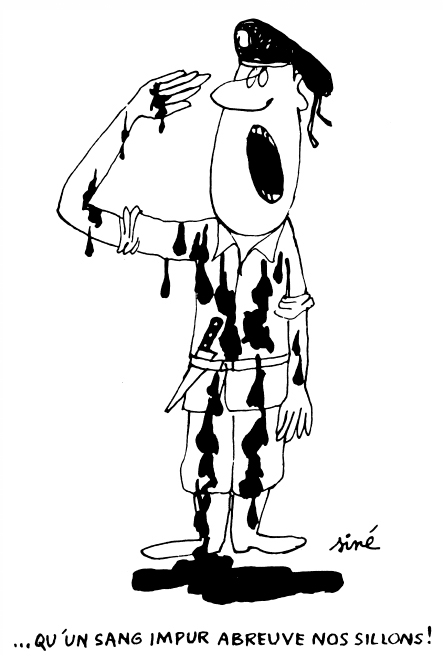
Figure 3. “May an impure blood flood our furrows!” One of eight cartoon postcards created between 1958 and 1961 by Siné (Maurice Sinet), published by François Maspéro in Paris. Courtesy of Maurice Sinet.
admitted their discomfort about speaking badly of their nation, they found the French state’s use of violence to be so revolting that they believed that silence disgraced France.
Like many, Jean-Jacques Servan-Schreiber, editor of L’Express, was initially hesitant to criticize the policies of the French state.37 After serving in the French army for six months, Servan-Schreiber found himself bound by his conscience to act, which he did on March 8, 1957, when he published the first section of his autobiographical novel about his experiences in Algeria, Lieutenant en Algérie (Lieutenant in Algeria), in L’Express. Appearing in France simultaneously with several other works about the French military involvement in Algeria, Servan-Schreiber’s depiction of his military tour (which began on July 16, 1956) provoked enormous debate in France. Above all, his high profile as editor of L’Express and frank style of writing lent his work unusual importance.
Servan-Schreiber admitted that, as a recalled soldier, it was difficult to speak ill of his country. So why did he decide to write? According to him, he did so in “the name of his quiet comrades,” the men who wanted to but who dared not.38 He claimed that he would recount what he had seen, but confessed that he had not seen everything. For example, he had not seen torture applied to Algerians, although he knew many incontestable witnesses of it. His real intent was to represent everyday military life in Algeria, an everydayness situated symbolically somewhere between the two extreme artifacts of French society now extant in Algeria: torture and the miracle of the modern skyscraper.
Servan-Schreiber’s commentary is important here because it directly addressed the eclipse of reconciliation. According to him, reconciliation was endangered in Algeria not by violence per se but by its lack of justification. The French army’s sloppy and careless aggression against innocent Algerian civilians gradually chipped away at reconciliation’s foundation. Servan-Schreiber argued that this same aggression also destroyed army morale and prevented its soldiers from acting in reconciliation’s interests. Even superpatriotic military men no longer wanted to stay in Algeria because they knew that the army was randomly destroying the country. With a few important exceptions, he continued, the French high command was irresponsibly plunging the French army deeper into an unpopular war. Real reconciliation was unmistakably jeopardized because the military’s pacification campaign generated twenty fellagha for every one killed.39
Besides the everyday harshness, his novel revealed more threatening problems by highlighting the divisions between military and civilian authority in Algeria. The military was so embarrassed by its failures and so suspicious of civil authority that even the highest French civilian authorities knew nothing of the military realities in Algeria. As Servan-Schreiber wrote, “Even the Minister didn’t know the facts: they didn’t dare tell him” (52).
Servan-Schreiber’s representation of Algerians and Franco-Muslim reconciliation was not all that different from Camus’s or Tillion’s. In fact, he suggested that, if it were not for the abuses of the French army and the French colons, Algerians might be willing to work with France. In other words, it was due to the army’s deliberate misinformation and its abuse of power that the Algerian “Arabs” were being lost to the Algerian nationalists. “What the Arabs hated was the colonial setup”—the powerful colons, “rottenness of the administration, the corrupted police, the dishonest mayors.” Perhaps reconciliation could have been possible because the Arabs “didn’t really hate France” (54). What they hated was the colonists; and they had a right to, because the local French population in Algeria also corrupted the purity of the French army.
Reconciliation was ever difficult to pursue for several reasons. According to Servan-Schreiber, although the Algerian masses did not hate France, most French soldiers saw the Algerian as a bicot (87).40 This point underscored why the army pacification plan and the politico-liberal notion of reconciliation were incongruous. Yet the problem was not entirely one-sided. The French army militated against reconciliation, but Algerian rebels did their part to make reconciliation impossible. According to Servan-Schreiber, the Algerian nationalists relentlessly persecuted Algerians who remained amenable to a Franco-Algerian community. As a result, the rebels targeted moderate Algerians because they wanted “to do the most possible harm, to destroy any attempt at reconciliation or compromise” (70). This was in part a result of what Servan-Schreiber aptly called the influence of “totalitarianism” and the Stalinists in Algeria (72).41
Servan-Schreiber portrayed the difficulties of a military presence in Algeria. Settlers and Algerians distrusted the army if it showed preferential treatment toward the other group. “This soldier should therefore be an umpire—not exclusively the defender of one side against the other” (132). This was easier said than done, given that it required soldiers to reflect on the origins of the revolt. This reflection necessitated another equally perplexing choice. The soldier had two choices. He could believe that the current revolt was led by groups of isolated gangs and was an “Islamic plot,” “armed and financed… by foreign interests” such as Abdel Nasser, “the Russians, the Tunisians, the Moroccans, even the British and the Americans through their cartels or oil kings.” Or he could believe that the revolt originated in “popular resentment, and that the only way of ending it [was] by treating the people as human beings” (133). Either way, the soldier would be demoralized by his choices.
The image of the soldier Servan-Schreiber presented was thus a man who confronted a Janus-faced Algerian; depending on the soldier’s view, the Algerian could either have a legitimate right to revolt or be manipulated by exterior Communist or religious forces. The dilemma was simple: since there was no real policy in Algeria except the settlers’ insistence on pacification, the army was a prisoner of settler politics and therefore had to ignore the Algerians’ humanity. Lacoste’s authority rested on the support of the hysterical settlers, and because he remained in power only at the mercy of the army in Algeria, there could be little doubt of his position or of the future of reconciliation.
Servan-Schreiber, in offering his fictionalized but historically accurate account, insisted that he had simply done his moral duty to his comrades: to tell their story after he resumed his position as a prominent Parisian journalist. Aware that he would report his experiences in the military after he returned to L’Express, the army and Lacoste had tried to blackmail him. According to Servan-Schreiber, he received a threat from the resident minister’s office issued by a messenger, who stated that if he attempted to criticize the French pacification policy, the army would bring out a dossier of supposed “treasonous” connections between him and the FLN. After a meeting at the French government headquarters in Algiers with a man he identified only as “Major B.,” Servan-Schreiber was also told that the military’s plan was to claim he had run a brothel for the military men. Major B. warned him how the public would react to his immoral act: “They’ll say that you used your time in uniform to go in for the white-slave trade and that you haven’t wasted your time here in view of the commission you drew from this racket” (195). In response, Servan-Schreiber claimed, “I looked at the man opposite me in fascination. I was concerned with the way in which a man, and a French officer at that, could suggest over a table a connection between what he had just said and my silence after I go back to France.”
Rather than discouraging Servan-Schreiber, the “degree of vileness” of the encounter encouraged him to tell his story. He wrote of the French high officials:
If they had become blind, it was by dint of despising people. In theory, of course, they despised only the Arab. But the Arab, however much a gook he may be, is still a man—an unalterable fact. And what you think of the gook, in the final analysis, affects the way you look at the whole world. You start by kicking an animal that looks like a man but is really of another species, and, unconscious of the transition, you end up by treating a French officer as if he were a Place Pigalle pimp and asking people at the point of a Tommy gun whether they are Catholic. The truth is that contempt for human beings cannot be rationed or controlled—because eventually it corrupts….
It made me realize how, without any Franco-style landing from overseas or any spectacular coup d’état, a subtle, progressive poisoning of the Frenchman’s way of thinking could lead from the degradation of this war to the degradation of France itself. (197).
Servan-Schreiber was not the only French intellectual to speak out against the army in 1957. In March, Jacques Peyrega, dean of the Faculty of Law at the University of Algiers, resigned from his post after he witnessed a French soldier beat and murder an unarmed Algerian suspect. Like Servan-Schreiber, Peyrega claimed it was his duty to bring abuse to the public’s attention because it harmed not only innocent Algerians but also the French nation. To ensure the public’s awareness, he sent a copy of his letter of resignation to Serge Hurtig, a maître de conférences at the Institut d’Études Politiques de Paris. Hurtig forwarded it to Pierre Mendès France, indicating that the letter was not originally intended to be made public, but that Peyrega had consented to let Mendès France publish it if he thought it would be useful.42 In response, Mendès France wrote: “I hope with all my heart that testimonies of this kind will contribute to alert the so very misinformed public opinion of our country.”43
Two days later, Peyrega’s open letter to the minister of national defense appeared in France observateur under the heading, “The Dean of the Faculty of Law of Algiers writes to Mr. Bourgès-Maunoury.”44 Peyrega relates that as he entered a boutique in Algiers he heard someone yell, “Arrest him.” Within seconds the police had trapped a Muslim suspect. After hearing a few shots, Peyrega left the boutique and approached the man as he stood with his hands against the wall yelling, “No, don’t shoot.” Minutes later, the Muslim was surrounded by parachutists and began to walk away with them. Suddenly, a parachutist smashed the man in the kidneys with his rifle butt, and the man fell to the ground just in front of Peyrega. The parachutist, still in a rage, walked over to him, pointed his machine gun at his kidneys, and fired.
Shocked, Peyrega advanced and asked why the parachutist had shot the man. The parachutist simply turned and ran away. Peyrega was even more appalled when he read the next day in the newspapers that after two “terrorists” attempted to throw a grenade in a store, one of them, Ahmed Ben Ali, twenty-two, was killed. As a professor of law, Peyrega could not countenance such willful disrespect of the French judicial system and flagrant and criminal abuse of power. It was therefore necessary to expose the injustice of these events, Peyrega wrote, because France’s methods were now approaching those of National Socialism, and it was important to have the courage to be among the “first to recognize them [the methods] and to disavow them”:
A former member of the Resistance, a reserve officer, a professor of the Faculty, a University representative, ought not to be content in a country like France to deplore such facts in thought or in private conversations, nor even in order to underline his conscience by a confidential confession to a higher authority. He should, in his attitude, his thoughts, and his writings contribute to the spiritual and mental maintenance of the moral values and juristic principles, which are the strength of France and of the superiority of our civilization….
Now how do you respond, Mr. Minister, when a Muslim, after seeing what the soldiers are doing, says to you that he is ashamed to be French? When a father of a family tells you that he is afraid for his sons? When a Kabyle declares that it is better to take a gun and shoot in order to die as a man: what do you say? When we are here, when we hear the rumors and have some examples to prove their probable veracity, we are seized by fright. We say to ourselves that even the Nazis did not know or did not want to know that they were accused of horrors, and that they thought, even they thought, that it was only a matter of a few abuses.
The timing of the letter could not have been worse for the image of the French army. Only a week earlier General Jacques de Bollardière had published a letter supporting Servan-Schreiber’s courage to depict the realities of the French military operations in Algeria. Criticisms of the French operations coming first from a distinguished military figure, then from a distinguished academic and former officer, served as important measuring sticks of public opinion. But the army’s moral case also worsened as a result of its actions. It responded to de Bollardière’s request for a transfer back to France just before he wrote his open letter to L’Express by sentencing him to sixty days of house arrest, severe punishment handed to a senior officer during the war.45
These criticisms of the French army, along with the writings of Tillion, Aron, and Soustelle, form part of a larger ensemble of visions on the possibility and conditions of reconciliation. Critics of the army were beginning to come from a more moderate spectrum of the French intelligentsia. For example, the same month that Peyrega resigned, the Comité Résistance Spirituelle published a devastating document, Des Rappelés témoignent, written by officers and soldiers who had served in Algeria.46 The testimonies in the pamphlet were assembled by intellectuals of unquestionable moral and public stature such as Henri Marrou (professor at the Sorbonne), Jean-Marie Domenach (editor of Esprit), Paul Ricoeur (philosopher), and some former members of the Comité d’Action des Intellectuals. According to the Comité Résistance Spirituelle, it assembled letters from former military men in order to show the degree to which the war in Algeria represented the collective crimes of all French people. The goal was to help arrive at Franco-Muslim reconciliation. It was possible that the “recognition of our errors may be… the key that will permit the opening of hearts to pardon and reconciliation” (5).
How could Des Rappelés témoignent ameliorate the Franco-Algerian relations? To begin, it was necessary to show that the military’s central problem related to lack of comprehension of Algerians as a people—a concern Servan-Schreiber also evidenced. As proof, it cited an excerpt of a soldier’s journal entitled “The Two Worlds Which Do Not Come Together”:
I am still incapable of a personal judgment about North Africa; it is frighteningly cruel to find yourself bewildered [désemparé] in front of the native [l’indigène] because we know neither his language nor his morals nor if he is Chaouia, Kabyle, Berber, or Arab. For the army [l’armée d’opération], there are only bicots, bougnouls, and krouyas; will we kill them, “make them pay,” one or two, because there are so many of them or because we have arrested one, a suspect? and we don’t know what else to do…. One of my platoons has killed their first Arab … but who was that man? Suspect? Fugitive? Without a doubt, an innocent like another man we have wounded. (11–12)
Story after story in Des Rappelés témoignent described the army’s cruel and inhuman violence against Algerians. Ironically, without the Comité’s awareness and contrary to its intention, each story also bore witness to the fading hopes for Franco-Muslim reconciliation. One soldier put it this way: “The situation is irredeemably screwed up. We have not known how to save one single Muslim friendship, nationalist or not. What a waste! Poor France! We have strangled all the voices of wisdom and honor, and have baptized them ‘Progressivists,’ ‘Communists,’ and what do I know? What a waste!”47 Another described a systematic search (ratissage) on a village in the Aurès as a “pigeon shoot of civilians.”48 “One day,” the same soldier wrote, “we burned a nomad’s camp in the desert, shot all the men, and left the women and kids with nothing in the desert.” With more than twenty-four such entries, Des Rappelés témoignent was a devastating condemnation of the French army. It was the first such disclosure of military abuses as a collection of former soldiers’ writings, and therefore added momentum to the argument that reconciliation was dépassé.
Throughout 1957 the French state was helpless to curb growing dissatisfaction with its policies in Algeria. This became even clearer when René Capitant, a former minister in de Gaulle’s government and professor of law at the University of Paris, suspended his course on hearing the news that a former student of his, the popular Algerian lawyer Ali Boumendjel, had suspiciously committed “suicide” in Algiers. However, as much as Capitant disliked the clear abuses of the French army and France’s postwar “political incoherence,” he refused to despair over France’s future and hoped that his actions would contribute to a clarification of purpose for the French.49 It was true, he wrote, “that the nation [had] never been as passive as today.” But this passivity could be overcome because it was part of France’s “destiny” to “open its doors to a new prosperity and a new influence and to destroy the mask that hides it from the face of History.” Arriving at this point, at history itself, required the French to revolt “against the injustices that have been committed in its name.” Returning to the theme of reconciliation and the reestablishment of French grandeur, Capitant wrote, “The mission was not to restore the domination of the Whites with the aid of Europe, but to unify Whites, Blacks, and Yellows in a new community reciprocally and equally desired. The French miracle is that, despite colonial domination, despite the atrocious wars, which have marked [colonialism’s] end, the profound desire for fraternity exists in the populations that have lived under our flag.”
As if Peyrega, Servan-Schreiber, de Bollardière, Des Rappelés témoignent, and Capitant’s suspension of courses were not already enough to question the integrity of the French military in Algeria, another publication further challenged the army’s moral wisdom. Just after Capitant suspended his course, a brochure called Le Dossier Jean Muller: De la pacification à la repression made public the letters of a Christian soldier killed during service in Algeria.50 In explaining their decision to “intervene” in the Algerian tragedy by publishing Le Dossier, the editors of Témoignage chrétien claimed that the letters of Jean Muller had stripped away their right to silence. Furthermore, and perhaps scandalously, while the editors acknowledged the necessity of publishing Muller’s dossier, they also made a remarkable confession. They were aware that the many stories concerning the army’s abuses “confirmed the extreme violence of what we call the Algerian war. Out of respect for the honor of our country,” Témoignage chrétien wrote, “we remained silent, accepting for ourselves the responsibility of our own silence.” But now Témoignage chrétien took a firm position on the war: “There is a type of moral imperative to speak; some will accuse us one more time of bringing instability to the national drama; the accusation has no more validity than it did yesterday. Before such aggressions, to speak the truth is to remain true to the honor of the country. If we had refused to publish the testimony of our friend, we would have simply reneged on our national responsibility” (3).
Le Dossier is a self-reflective look of a Christian soldier, and, as with Des Rappelés témoignent, it presented a firsthand account of the Algerian tragedy from within the military. Muller wrote: “Summary executions happen very often, that is to say that the military commanders have given us orders not to bring the men out, but to bring them to justice. This war is a dirty thing; when will we be able to stop it? We, here, are in a corner, obligated to follow the movement, we only have the recourse to refuse immoral orders” (10).
What, exactly, made the war so dirty for Muller? Lacoste’s “pacification” program, which Aron had also criticized, was making the French army into a fascistic machine. Besides the orders to kill Arabs on the spot, Muller witnessed the use of torture. One suspect, Muller wrote, had been tied to a tree all night by his feet with his back against barbed wire. He was given only dirty laundry water to drink (17). Other forms of torture Muller reported witnessing included pushing a knife slowly into the flesh of a man, suspending a man from a very high helicopter, administering electric shock, leaving a man in the hot sun in a metal cage, and severe beating. Often, torture did not stop the atrocities, and after being tortured, suspects were given back to the “paras” and liquidated (18). The consequences were obvious: “We are far from the pacification for which we were recalled to duty [rappelés],” and, Muller continued, “we are in despair when we see just at what point the French employ the processes, which calls to mind the Nazi’s barbarity.”
Trapped, Muller could not reconcile his military responsibilities with his Christian beliefs in justice, truth, and charity. He confessed that his beliefs frequently put him at odds with the French military and that the army tried to “break” him three times. Yet he also admitted that his commander had not openly attacked him in front of the men; when the army tolerated Muller’s abstention from these acts of “barbarity,” it did so because Muller’s actions were interpreted as “Christian” and not as “political” (19).
Whether Christian or political, Muller’s letters in Le Dossier and the testimonies of the soldiers in Des Rappelés témoignent resonated loudly in the world of French intellectuals. It was no longer possible for French public opinion to ignore the ignoble deeds of the French army. In April 1957, François Mauriac directed his Bloc-notes article at the French government: “We too will not accept that in covering the crimes of a few, you dishonor the army, and through it, France.”51 Sartre added his comments in an essay titled “You’re Wonderful” in the May 1957 issue of Les Tempsmodernes. Written mostly about Des Rappelés témoignent, he applauded the soldiers’ courage to write about the collective crimes and the “cynical and systematic exercise of the absolute violence” of the French army.52 Because the brochure denounced crimes witnessed directly by the soldiers, and because it demonstrated the extent of the moral plague that had overcome France, Sartre recommended that all French read the brochure to overcome this great moral sickness: “It is because we are sick, very sick; burning and prostrated, obsessed by the old dreams of glory and by the foreboding of its shame; France is fighting herself in the middle of a confused nightmare that she cannot escape or decipher” (58).
Because the French army was fighting in the name of France, Sartre argued, each French person was personally responsible for the collective crimes against the Algerians. Importantly, he added, cynicism and hate were not responsible for the demoralization of France; rather, “false ignorance” demoralized and kept the French both unaware and in line with the French government’s policy of cruelty (59). Who was to blame for this false ignorance? The French press was largely responsible because it had done a very good job portraying the massacres of the Europeans by the fellagha, but when, for example, an Algerian lawyer suspiciously committed suicide, the French public believed what it was told. Something, Sartre argued, had clearly gone awry. Moreover, he continued, an even more poignant example of how the public responded to unflattering news was Peyrega’s testimony. When he told about the summary executions, the French public believed him only because he was French. What this had proven, therefore, was that for French policy in Algeria, as shown definitively in the soldiers’ writings, there were no holidays for executioners.
The French people, according to Sartre, were confused and twice guilty as a result of the misinformation concerning the government’s policies and the desire to believe in the justness of their own government. They refused to give the government their complete confidence and, at the same time, “counted on it to dissipate” their “distrust” (64).53 Besides being guilty, the French people were condemned by the use of torture in Algeria. “But the torture? Can someone retain a friendship with someone who approves it?” Sartre asked. Since everyone remained silent and looked at neighbors with suspicion, a generalized distrust had overcome the French. “Distrust has taught us a new solitude: we are separated from our compatriots from the fear of distrusting them or of being distrusted by them.”
Perhaps worse than the distrust, a collective guilt hung over France. The testimonies had been spoken, Sartre claimed, and had removed all the protection pure innocence could secure. Not only was the military guilty, but so were the French people. “It is we,” Sartre wrote, “who are in question today” (65). Drawing an analogy from European denial of reports about Dachau and Buchenwald, he argued that current French experiences were the same as during the Nazi era because “the information was uncertain” (66). Yet with documentation now coming from Algeria attesting to torture in the name of France, it was impossible and inhuman to remain silent. “That is why I believed it necessary to call the public’s attention to the soldiers’ brochure. Here is the evidence; here is our horror: we cannot see it without tearing it from us and destroying it” (67).
There is no question that Sartre was angry and that he and others like him felt compelled to write with vigor against the injustices being committed in Algeria under the French flag. It was this turn against silence in 1957 that made Camus’s case for silence even more objectionable. The moral current within French intellectual circles was clearly moving against silence. Pierre-Henri Simon’s Contre la torture in April 1957 echoed Sartre’s concerns. But Simon’s voice registered on a different moral key in France. Distinct from the other pamphlets on torture and Sartre’s writing, Simon offered a mixture of personal testimony and intellectual reflection on the problem that loomed over the French horizon.
As a graduate of the École Normale Supérieure, a former Resistance hero, a prisoner of war, and an officer in the French Legion of Honor, Simon confessed that he wrote Contre la torture with no “gaiety of heart” because he was “never one of those intellectuals who have complained about the French army.”54 Torn by both his obligations as a citizen and a former officer, Simon admitted that like so many other intellectuals, he had decided to make public his recent experiences in Algeria because the practice of torture by the French army was “intolerable” and disgraced the uniform that inspired “love and respect” in him (16).
Since the army’s practices questioned the integrity of the French nation, and those who opposed the army risked being called traitors, it was certainly no accident that Simon made an analogy between the intellectual activity during the French-Algerian War and the Dreyfus affair. Simon claimed that, just as in the Dreyfus case, the real defenders of the army in Algeria were not the jingoistic ultras but the “rigorous moralists” like himself (16). Furthermore, since the army’s real mission was to ensure the safety of the inhabitants of Algeria and deplore the “spirit of cruelty and vengeance” that prevented “reconciliation,” the army had to play a pivotal role in mending the divisions between the French and Algerian populations.
Simon also urged Algerians not to follow the nationalists who ignorantly demanded the irreparable separation of the two peoples. Having said this, Simon was careful not to argue that unification should come at the cost of torture and disgrace. For society’s benefit, Simon insisted, the police and the army could not be allowed to “reverse the fundamental rules, which give the social pact its value” (48–49). If society were to allow for this harmful reversal, it would certainly be put more at risk by its own action than it would by its “external enemies” (49). Intellectuals and individuals had a special role to play in bringing this internal threat to the public’s attention. In fact, the individuals harbored in them a fundamental liberty; the individual had to be allowed freedom of dissension because if the “solitary conscience” were unequivocally replaced by the collective conscience, society risked becoming totalitarian.
Simon most feared that the army’s unlimited violence in Algeria would create “myopic fascism.” If the public lapsed into a “general silence,” nothing could be more damaging for French honor (108). Each French person, Simon argued in the same tone as Sartre, would first have to admit to a collective guilt in order then to fight successfully against the impending danger to French democracy. Accordingly, and in response to the Dreyfusard charges, the actions resulting from individuals’ opposition to policies of the French army in Algeria could not be interpreted as acts of treason (115).
Conversely, Simon argued, noble actions such as those of the Centres Sociaux ensured the survival of the friendship because their goals were antithetical to the effects of the French army. Unfortunately, as the social assistants worked for a “peaceful coexistence and pacification,” the police conspired to destroy this work (117). The government idea (inaugurated by Soustelle after the Philippeville massacre in 1955) that the Muslim community would have to “pay” collectively for the crimes of their compatriots who fought against the French was absurd and pushed Muslims into the enemy camp. Exhibiting perhaps more concern for the effect of torture on the French nation and French youth than for the Algerians being tortured, Simon continued:
Even if the torture of an Arab did pay, I would still say that it was criminal, that it was intolerable and a mortal stain on honor in the sense that one says that sin is mortal. Something more essential than force will have been achieved and destroyed; a defeat more intimate and more irreparable than the destruction of the army [would be] sustained. I think, in effect, that a certain ethic of total war, a certain rallying to Machiavellian methods without conscience and without pity are the only possible outcome of the criminal forgetting, in the treason of the soul, of France’s vocation. What can we fear from the boys who have fought in this war in this spirit? (122–23).
In later editions of his book, Simon was pressed to defend himself. For example, in the fourth edition’s epilogue, written on April 22, 1957, he responded to both French and Algerian misuses of his work. This edition also included two Le Monde pieces in which he defended his book against both the French ultras and the FLN militants. In the first article, “The Plot,” published on April 17, he defended himself (just as Raymond Aron was forced to do) against French superpatriots who had labeled him a defeatist and denounced his writing as a “defamation of the army.”55 If he were considered a traitor by his detractors, so be it, but then so would thousands of other men, women, and young people who had the courage to speak the truth. And, he asked, if he was really a traitor, why was he not imprisoned? Ironically, he wrote, he might have the opportunity to see Guy Mollet in the same cell, since it had been Mollet who had said he “wanted to know the whole truth” about Algeria (136). This desire for truth, he claimed, if it militated against the army’s actions, was the real origin for a treasonous plot. The truth and those who spoke it could not be guilty of treason.
In his second article, “Where the FLN Is Wrong,” published on April 19, 1957, Simon showed equal disdain for the FLN’s use of his work and claimed that the “Algerian national movement [was] trying to exploit the vague opinion against France.”56 Since it was clear that Simon never rejected the French goal of building friendships with North Africans, it should not be surprising that he attacked the FLN for trying to use the scandal over torture to back its claims of political legitimacy and destroy reconciliation. The conscience that motivated him and others to speak out against torture for the honor of the country also exercised the right to “protest if foreign propaganda” attempted to “deform the sense of their position” (138). The FLN could not assassinate and bomb innocents in cafés and then expect these terrorists to be martyred as Algerian heroes: “If on the contrary, the leaders of the Algerian revolt persist in ignoring the question posed by the choice of their means… to prefer the language of a virulent nationalism to that of a realistic politics, one will never exit this impasse” (139). As a result, the FLN would have to allow for the possibility of continued French-Algerian relations and to understand that protests against “cruelty and in-justice” did not “imply any adhesion to the Arab racism or barbarity which would only displace and accentuate them [cruelty and injustice]” (140).
The Military Responds to French Intellectuals
In April the armed forces issued a message intended for internal use titled, “The Moral of the War and the Morale of the Army.” According to the army, the problem of the war arose from a fratricidal struggle in Algeria, and it was clear that both “national interests” and “even the cause of civilization” depended on the army’s efforts there.57 As the protector of “civilization,” the army’s mission was clear: to win the war so that French interests and democracy could be preserved. The army in Algeria was not driven by the “colonialism complex” but was inspired by its “honor” not to let the French and the Muslims in Algeria be victimized by “fanatics.” In its opinion, to protect those threatened by fanatics it was above all important to recognize one significant change in wartime tactics. Ominously, the author of the note explained that the real problem for the army was the absence of a responsible civil authority. It was due to the “guilty silence of the authorities” that “the French army was forced to take initiatives…. This explains, if not justifies, any of the excesses that may have been committed” (2).
According to this report—which foreshadowed the army/settler-sponsored coup in 1958—the military sensed that civil authorities in France had distanced themselves from their professional obligation to the French army. In response, the military distanced itself from the actions of the feeble and unprepared Parisian metropolitan government. Since the void created by the absence of strong civil authorities strengthened “rebel” forces, the army thought itself obliged to fight against terrorism and protect the lives and property of both French and Muslims in Algeria.
The recent “campaign against torture,” the army claimed, was orchestrated by the press to obscure the reality of the Algerian rebellion and disgrace the army by marring it with the psychological stain of “collective responsibility.” From the army’s point of view, this effort to link individual problems arising from isolated cases to a program of “collective responsibility helped the rebels” and smelled of “political exploitation” (3). The majority of the writers involved in the campaign to disgrace the army were trying to avoid their “elementary responsibilities to their country.” It was a particularly dishonest intellectual effort because, given the degree to which “violence had become systematized” by the rebels, this new type of “subversive warfare” (terrorism) demanded the suspension of the normal legal protocol. Hence, the author concluded, it was now again up to Parliament to decide how it was going to combat the Algerian rebels and to redefine the legal structures with which it was willing to bring an end to the rebellion. The question was whether Parliament would do what was necessary to win the war.
As we have seen, by 1957 French intellectuals of all stripes were beginning to reconsider the possibility of reconciliation. Moreover, revelations of torture acted as a primary force for many moderate French intellectuals to rethink reconciliation. Torture certainly broke the barriers between anticolonialist intellectuals and the intellectuals who had tried to maintain political neutrality, but it rendered French intellectuals more cognizant of the difficulty of sustaining reconciliation. And, while the army continued to defend itself with the argument that it was protecting French and Algerian lives and property in Algeria, it was clearly also beginning to acknowledge that pacification had hardened the rebels’ hatred of France and weakened the chance for reconciliation. The emergence of the antitorture campaign fused with debates over the future of French Algeria sparked by intellectuals such as Aron, Soustelle, Simon, and Tillion. This fusion of ideas and concerns forced many to ask whether the current government was fundamentally incompetent. Could it also protect the future of democracy in metropolitan France? Any reply to this question indicated that the future of France hung in the balance with the Algerian question. As the number of intellectuals willing to engage in an open polemic against the French state grew, it was clear that the French government was uncomfortable with the sudden turn in public opinion away from the horrors of Algerian nationalists and toward the revolting tactics of the French military. With this in mind, we turn to a discussion of how the French intellectuals responded to the escalation of violence and how their responses triggered a further demise of reconciliation.