
_________________________________________________
It must be pointed out that not a single attempt at an explanation is undertaken on the level of the population of the colonialist country. Because it has no hold on the people, the democratic Left, shut in upon itself, convinces itself in endless articles and studies that Bandung has sounded the death-knell of colonialism. But it is the real people, the peasants and the workers, who must be informed. Incapable of reaching the millions of workers and peasants of the colonist people and of explaining and commenting on the realities of the drama that is beginning, the Left finds itself reduced to the role of a Cassandra. It announces cataclysms, but because public opinion has not been adequately prepared, these prophesies, inexplicable in the pre-insurrectional period, will, at the time of the explosion, be regarded as proof of complicity.
In France, among the Left, the Algerian war is tending to become a disease of the French system, like ministerial instability, and colonial wars a nervous tic with which France is afflicted, a part of the national panorama, a familiar detail.
FRANTZ FANON, 1961
When the war’s violence increased drastically in 1957, the French project of reconciliation encountered an even greater deterrent. After having taken firm positions against the torture of Algerians by the French military, French intellectuals were forced to take issue with the Algerian nationalists’ use of terrorism against other Algerians and against the French. Not surprisingly, as criticism of Algerian nationalist violence increased, Algerians offered ripostes—all of which led to the eventual collapse of the idea of Franco-Algerian reconciliation within French and Algerian intellectual communities. For this reason, we now investigate how the representations of violence ultimately devastated liberal hopes for reconciliation and led to the radicalization of identity politics during the French-Algerian War.
Massacre at Mélouza: The “Whodunit” of the French-Algerian War?
Just before the publication of Tillion’s and Aron’s books, which underscored the shifting attitudes concerning the possibility of reconciliation, a massacre of more than three hundred Muslims took place in and around an Algerian village called Mélouza at the end of May 1957.1 Mélouza was a very remote area of five small villages in a mountainous region of the southern part of Kabylia on the border of the Sétif and Médéa departments. Approximately 700 people lived in the center, known as the “mechta Kasba”; the estimated population of the total area was 3,395. According to most reports, the massacre started on the afternoon of May 28, 1957, when a group of armed men entered from the eastern part of the area and began moving through the smaller villages, killing some men, taking others, and pillaging along the way. At the end of the day, the victims (all men) were assembled in the central village. At this point, the systematic execution of all the captured men over fifteen years old began with guns, knives, and axes. The incident became known in the press as the Mélouza massacre. The French military were in the immediate vicinity but did not investigate the site until some forty hours later, giving some reason to suspect French involvement. The French government immediately blamed the FLN for this most frightful massacre in the history of the war.
Two days later, in an area known as Wagram and d’Aïn-Manaa, about twenty kilometers from the city of Saïda, in the west of the department of Tiaret, another massacre took place, also attributed to the FLN. A group of men seized approximately eighty Muslim workers on a local farm and began killing them in the same way as at Mélouza. A total of thirty-five men were killed and twenty-four wounded. About thirty managed to escape.
After the May 30 massacres President René Coty asked in a radio broadcast that the French and the international community join in denouncing these “abominations.” Addressing himself “to civilized people,” Coty pleaded to the world to reject all negotiations with the agents of this “hideous terrorism.”2 But Coty also used the opportunity to assure listeners that France would continue to protect all the “Muslim compatriots” in Algeria and would send even more military personnel there to ensure everyone’s safety.
According to most historians, the Mélouza massacre, which was in fact perpetrated by the FLN, arose from the FLN’s fear that the revolution was beginning to falter. The French SAS troops—designed to strengthen reconciliation by helping Algerian peasants with agricultural, educational, and social concerns—had begun to build confidence among the Algerian population. Meanwhile, in the region where the massacres took place, the rival MNA had developed a significant following called the Armée Nationale du Peuple Algérien, led by an Algerian named Si Mohammed Bellounis.3 Hence the FLN ordered the assassination of all Bellounis’s men at Mélouza to demonstrate its control over the revolution.
At the time of the massacre, responsibility was difficult to attribute, especially given the series of disclosures concerning the French military’s penchant for unwarranted brutality against Algerians. The French government had much to gain politically from orchestrating such an event. Moreover, in 1957 there was an equally good chance, as far as French intellectuals could know, that the French military or the FLN could have carried it out. The FLN propaganda machine did, after all, attribute the massacre to the French authorities. Given the lack of irrefutable evidence, then, it is interesting that French intellectuals so quickly accepted the French version, which happens to be true but at the time could not have been known to be so. In 1991, on Benjamin Stora’s television program Années algériennes, Mohamed Saïd, one of the leaders of the FLN in 1957, did finally admit that the FLN was responsible.4 But in 1957, in the absence of this (and other confessions), the eager acceptance of the French government’s version is illustrative of many issues relating to the representation of identity. The massacre also represented a unique moment during the war for all concerned.
Soon after the Mélouza massacre, in a secret police report dated June 24, 1957, French officials even understood that Mélouza could lead to a possible cease-fire between the Algerian MNA and the FLN. Both nationalist groups, following the public outrage over the massacre, had agreed not to engage in conflict with each other because in the upcoming United Nations session on Algeria they wanted to give the world the impression of a unified nationalist movement.5 In effect, the police report claimed that, if their cease-fire were successful, “the two rival groups think that France would not be able to stop the un from intervening in Algeria.” In other words, from the point of view of the French intelligence officers, a temporary truce between the FLN and the MNA could hurt the French efforts to block intervention by the un and the international community in the conflict. The report concluded: “Another failure of extremist nationalism at the un would cause the leaders of the FLN to modify their intransigence and to seek an accord with France.” The implications are clear: French officials in Algeria were fearful that the cease-fire would affect un discussions and turn world opinion even more against France. The report also noted that the proper authorities had been notified, and the “opinion of the Service” was: “It is not necessary to insist on the importance of this information, which can, in a large measure, influence the position that France can take before or during the unsession.” The note was transmitted to the Sûreté Nationale in Algeria on June 28, 1957.
Curiously, and despite the importance of the Mélouza massacre for French authorities, French intellectuals, and Algerian nationalists, historians have not devoted much attention to its impact on the French intellectual community and public opinion.6 Without question, representations of the Mélouza massacre and reactions to it rendered it one of the most crucial events of the war.7 The massacre caused an important and noticeable shift in the representations of Algerian nationalists and Algerian identity, depicting Algerians as more Oriental and therefore more “barbaric.” Mélouza was also quickly and effectively used by the French propaganda machine as the textbook example of Muslim extremism. In fact, as we shall see, intellectuals’ changing views on Algerian nationalists and the French government’s propaganda campaigns were closely linked. For example, Lacoste’s administration in Algeria tried to capitalize on the violence as a means of representing Algerians as “savages” who would stop at nothing to bring about their “Islamic” and “Arab” revolution. The French propaganda associated with the massacre became a key factor behind the shifting representations of Algerians; it solidified the intellectuals’ positions toward the conflict and served as a means for the French state (and indirectly French intellectuals) to recover from the moral losses resulting from the highly damaging antitorture campaign. Moreover, because the massacre was such a charged political event, it became an equally important source of conflict between French intellectuals and Algerian nationalists and helped both groups (as well as important Algerian intellectuals) move swiftly against reconciliation.
In looking at the effects of the massacre on the changing representations of Algerian nationalists and on the idea of Franco-Algerian reconciliation, it is important to point out that the FLN vehemently rejected French criticisms. Meanwhile, the French military maintained that those massacred were from the MNA. The major French dailies quickly fell in line and blamed the FLN. The FLN denied responsibility. World opinion moved against the FLN. Most French intellectuals did not believe the Algerian denials and were moved by world opinion and Lacoste’s propaganda. In fact, intellectuals’ negative reactions toward Algerians regarding Mélouza can be attributed to Lacoste’s tactics, because in a morbid bid to ensure international condemnation of the massacre he granted French and foreign journalists, and especially photographers, immediate access to the bloody site.
At the same time, leading spokesmen for Algerian nationalists, such as Frantz Fanon (the former chief of psychiatry at Blida’s hospital then writing for the FLN newspaper El Moudjahid) went on the defensive and rejected the French accusations.8 In his own propaganda move, Fanon argued that France realized that its so-called good works projects (efforts to destroy the rebellion by providing economic support) had failed to regain the allegiance of the Algerian masses. This meant that the French administration would resort to drastic means to bring about the “counterrevolutionary” currents in Algerian society. “Mélouza and Wagram developed, to an ultimate point of cruelty, methods in which rapes and massacres ostensibly perpetrated by the FLN, clean-ups of entire douars [villages] were aimed at provoking the outrage of the entire population and the condemnation of the revolutionary movement.”9
In other words, according to Fanon, the French government choreographed violence on the Algerian stage in order to turn world opinion against the revolution. It was therefore ridiculous to blame Mélouza on the FLN because Mélouza was controlled by FLN forces. Therefore the French authorities had made a significant error in trying to convince people that the MNA, not the FLN, was attacked because the “husbands of the women who had been raped were in the local FLN group” (59). Since the French did not understand FLN operations, they thought they could say that anything could happen in the mountains. As part of his proof that the FLN was not responsible, Fanon claimed that wartime logistics could not have allowed for a random FLN massacre at Mélouza. “Because they had no knowledge of” FLN logistics, “the French authorities let loose their soldiers and their harkis on the Algerian civilian populations” (60).10
According to Fanon, blaming the FLN for Mélouza was just another indication that France was unable to take the realities of the war seriously. Mélouza was a construction that lapsed into prophecy and political illusions; it denied the importance of Algerian nationalism. Depicted as a factional conflict, it represented an effort by French authorities to dispute the broad-based support for the revolution. Mélouza, for Fanon, represented a French ploy to convince the world that there was no monolithic nationalism in Algeria. And Fanon predicted that French efforts to stop the FLN would fail. Just as the FLN could not be swayed by the economic arguments, neither could it be stopped by French propaganda. Fanon concluded: “Without any grasp of reality, unable or unwilling to recognize the Algerian national will and to draw the inescapable logical conclusions, the French authorities today live under the domination of desires and prophecies” (63)
Other Algerian nationalists supported Fanon’s argument that Mélouza had been orchestrated by the French-backed harkis. For example, on June 3 L’Humanité published a declaration of the FLN representative in New York, Mohamed Yazid, which claimed that “[t]he French authorities have launched a campaign on the so-called massacre [prétendu massacre] of Mélouza.”11 Yazid asked for an international investigation of the massacre to be led by the United Nations (which he knew France would reject) and pledged the FLN’s full cooperation in the investigations: “We are certain that all impartial inquests will demonstrate the false character [caractère mensonger] of the French accusations” (3).
On the same day, a French journalist, Yves Moreau, was one of the few French intellectuals to impute responsibility for the massacre to the French military. In L’Humanité he supported FLN demands for an international commission to investigate the massacre and claimed that the “wisely orchestrated campaign” was devised by the French government to divert attention from a ministerial crisis.12 “The only solution that conforms with national opinion,” Moreau wrote, was “to end the killing and engage in immediate Franco-Algerian negotiations.” On June 4, L’Humanité published a second article that reinforced the claims that Mélouza had been the dirty work of the French army.13
Algerian nationalists certainly understood that Mélouza could damage their cause. On June 17, a lieutenant colonel of the French army’s Fifth Bureau of Psychological Action reported the interception of a document entitled “Letter to our French Friends.”14 The “Letter,” written on June 9 by Bachir Hadj Ali, secretary of the pca, urged his French “friends” not to be persuaded by the government’s propaganda concerning Mélouza.15 According to Hadj Ali, the accusations were a political smoke screen with which the ultras attempted to silence critics of torture by using “terrorism” to counterbalance the horrors of the French military. Few French people, Hadj Ali admitted, were able to see through the propaganda. He commended L’Humanité for being one of few French newspapers to refute the French government’s claims. Appealing to Marxist sympathies, he advised the French left to show more solidarity for the Algerians because the “community of interests” of those exploited by the “bourgeoisie” demanded a sense of unity among the oppressed.
As for clarifying the “facts of Mélouza,” Hadj Ali argued that the area had been too heavily patrolled by the French military for the FLN to have carried out the massacre in broad daylight without being caught. Hence Mélouza had very likely been the work of the French troops, the goumiers (Algerians serving in the French army), or the harkis. But, as he suggested, motives were perhaps the greatest proof of the FLN’s innocence. After all, he asked, was it not the colonialists and the ultras who profited most from the massacre? The colonialists had successfully diverted attention away from recent scandals. Algerians lost the most from the public’s perception of violence. World opinion, which was sympathetic to Algerians, now doubted the FLN’s judgment and condemned its violence. Furthermore, new controversies were likely to emerge among Algerian patriots, questioning the leadership of the FLN; French liberals and leftists were confused about how to proceed with anticolonialism, given the recent atrocities. Any way one looked at it, the FLN was discredited by the violence and hence could not have been behind the killing.
In a propagandistic maneuver, Hadj Ali continued, the FLN would not have massacred its own Algerian people because its cause was just and did not need these methods to triumph over the French. Having made these arguments, he acknowledged that he did not expect all French democrats to be convinced of the FLN’s innocence, but he did encourage the French to “reflect” on the issue. “The blood of our own people is too precious,” he claimed, for Algerians to kill themselves so brutally. Then he issued a call to arms: “The Algerian will no longer accept to live as a foreigner on his own soil. I prefer to die standing up than to live on my knees.” In an effort to internationalize the conflict, Hadj Ali also demanded that an international commission be created to investigate the massacre. Presumably, if the French government did not accede to this demand, it would be proof enough “that they are afraid of the truth and that their version is built on lies.”
On June 13, France observateur published the findings of a group of independent reporters not officially commissioned by the United Nations or recognized by France. The report, written by Mohamed Ben Smaïl, editor and director of the Tunisian newspaper L’Action, was based on a number of interviews with military personnel and a few survivors. Ben Smaïl determined that probably neither the FLN nor the French military actually carried out the massacre; rather, it most likely had been a band of harkis, supported by the French army, who had disguised themselves as FLN fellagha. One witness reported that the leader of the band had said repeatedly that his name was “Abdelkader Sahouni, the leader of the FLN” and that he was going to “kill the sons of bitches who had sold out to France”; the report concluded that these actions were obviously an attempt to frame the FLN.16 The claim made sense because the FLN had long since regarded anonymity as essential. Moreover, Ben Smaïl continued, since it was widely known that the psychological warfare division of the French military had already been active in recruiting “contre-fellaghisme,” it was more likely that the troops that had carried out the massacre were trained by the French.
Furthermore, there were simply too many problems with the French military’s recollection of the events. The army had waited nearly forty hours after detecting that the village was under siege before it sent in troops to investigate. Consequently, not one suspect was captured. This was unusual because the French army usually responded immediately. And since the MNA-FLN rivalry was well known in the area surrounding the massacre, this provided opponents of the FLN with “an ideal alibi,” thus making it easy to blame the Algerians.
Most important, as Hadj Ali had, the article speculated about motives. Mélouza had undeniably hurt the Algerian cause on both national and in-ternational levels. Taking into account problems with the French military’s records, the political damage that imputing the Mélouza massacre to the FLN would do to the Algerian cause, and the known psychological warfare of the French army, it was reasonable to deduce that a group of Frenchbacked harkis had orchestrated the killing. In the interests of certainty and to test the sincerity of both French authorities and Algerian nationalists, the journalists called for the creation of an international commission to investigate the massacre. This commission never materialized.
French Intellectuals Criticize the FLN
Despite the claims that the FLN was not responsible for Mélouza, the massacre was a turning point for French intellectuals. To understand just how Mélouza affected the tenor of the debates during the war, it is helpful to consider first its impact on Jean Daniel. From the beginning of the war, Daniel had been active in the anticolonialist movement, but he had never endorsed the FLN. Following Mélouza, his lukewarm position became hostile as he deplored the FLN’s “terrorist” tactics. After Mélouza, he wrote in L’Express, Algeria had become a land of “savage assassination” and everyday violence.17 What distinguished Mélouza from the everyday terror and horror of the war was the sheer number of victims and the fact that “the attitude of the FLN… did not hesitate to impute responsibility for the crime on the French units.” Blaming the French was, he claimed, even more disgraceful than the murders themselves. As for the killing, Daniel was unequivocal: the FLN could not justify its own crimes by using means more reprehensible than colonialism. As he put it, “it is not sufficient to kill a certain number to rally the others to their cause” (4). The FLN murdering other Muslims merely gave Lacoste and the ultras more justification to use excessive force; this in turn increased extremism among the Muslim population and delivered “Algerian nationalism more and more to the rebellion’s fanatics.”
Daniel was not alone in criticizing the FLN. On June 7 Joseph Folliet asked in Témoignage chrétien how one could face the “nausea of rage and disgust” when “thinking about Mélouza?”18 According to Folliet, the FLN was clearly responsible, and the massacre showed the degree to which the FLN had become a totalitarian movement bent on destroying reconciliation and its own people:
There are no excuses for this killing. It reveals neither racial passions because Algerians have sacrificed other Algerians nor religious fanaticism because Muslims have butchered other Muslims. It is only the frightening episode of a sordid political quarrel and a terrorist progression toward domination. It comes down to a question for the FLN of “reabsorbing” a pocket of the MNA in its zone of influence. A great means of defining the rivalries! And a great preface to future domination!
We are the few Christians and Muslims who have never wanted to despair for peace in Algeria, a peace of justice, of the equality of all the populations, and a fraternal collaboration in a common future. The butchery of Mélouza is the worst defeat that we have sustained since the beginning of the revolt. If certain “hardliners” of the FLN want to burn the last bridges, render all reconciliation not only impossible but inconceivable, they can rejoice: they have just marked a decisive point with blood.
Without question, Mélouza forced many French intellectuals to rethink the possibility and especially the desirability of reconciliation. The French left, despite the uncertainty of the villains’ identities, refused to listen to the Algerian denials. But just how much had Mélouza cost Algerian nationalists in the eyes of their supporters? In a communiqué issued in the June 6, 1957, France observateur, the so-called new left claimed to support ending the war in Algeria through recognition of Algerian rights, but it distanced itself from the “atrocious” means of solidifying Algerian nationalism.19 And like other groups, the new left called for an international commission to investigate the massacre.
Claude Bourdet, one of the principal leaders of the new left, acknowledged that Mélouza had placed intellectuals sympathetic to Algerians in a rather uncomfortable position. According to him, the dilemma was simple: how was it possible to provide intellectual and political support to the Algerian rebels who disgraced their own cause and the reputation of their supporters by massacring innocents? In the interest of intellectual legitimacy would it not be important for French intellectuals to condemn the FLN’s violence? The answer was certainly yes, but it was qualified. Before condemning Mélouza, he argued, it was most essential to recall that French repression and collective reprisals were really the original sources of nationalist violence.20
Algerians were in a desperate situation, Bourdet insisted, and violence could be justified as long as it came in the form of individual acts of re-sistance to French domination. In other words, there were “qualitative” differences between individual acts of violence and collective acts of violence (massacres). Mélouza was “different” because it was a massacre of innocents, not an isolated attack carried out on an individual target.
Bourdet’s distinction between legitimate and illegitimate violence was meant to keep moral pressure on the French government as well. The French army’s use of torture, systematic destruction of villages, and largescale killing were different from individual and isolated assaults on Algerian nationalists and immoral on the same grounds. For most French intellectuals, it was never a question that the army’s use of torture was immoral, but now Mélouza placed the same cloud of suspicion over the Algerians. Just as torture had done to the reputation of the French high command, Mélouza’s violence suggested the moral depravity of the FLN leaders. Rather than giving credence to the FLN’s denials, Bourdet noted that Mélouza had pointlessly provided conservative French forces with just the right excuse to “fix the problem” with even more force.
If Algerian leaders were truly interested in leading a just revolution, Bourdet implied, they would have to understand an elementary political rule: know one’s allies’ (in this case French intellectuals and the international community’s) moral limits. He made another realistic but patronizing observation: since the nationalists were not a political force with a longstanding nation-state to support them, they would have to show even more discretion than France because France could rely on its “status quo” authority in the international community and Algeria could not. He acknowledged that “theoretically” it did not make sense for the Algerians to have committed the massacre since it only “blackened” their name. But “history,” he conceded, was comprised of “facts and errors” that ultimately made little sense.
If the new left was horrified by the lack of political discretion the massacre had shown, more conservative liberals such as Jean-Marie Domenach, editor of the influential monthly, Esprit, upped the ante. Just as Bourdet had argued, Domenach suggested that Mélouza was morally “different” because it represented a collective, not an individual crime.21 Admitting that responsibility for the massacre remained uncertain, he did think that, since the FLN-MNA conflict was well known, it appeared likely the FLN had organized the massacre. He conceded that it could have been the harkis, but this would be somewhat ironic since until then, the FLN had repeatedly denied their existence out of desire to show the unity of the Algerian people against colonialism (105).
Despite the overall negative reactions Mélouza sparked in France, it would be tremendously misleading to argue that only French intellectuals condemned Mélouza. Mouloud Feraoun, for one, disapproved but was shocked to see how quickly the massacre had turned international opinion against the Algerians. On May 30, 1957, he noted that when the radio first announced the massacre in Mélouza it was given only a “small space” in the dailies “among all the other communiqués.”22 By June 3 he described how world opinion had been awakened: “Alas! All the newspapers are talking about the Mélouza massacres. Horrible photos are splashed across front pages, and world opinion, now vigilant, is beginning to express anger and disapproval. A disgrace! A disgrace, a stupid act whereby an entire nation is condemned, and its people shamelessly reveal their inhumanity.” Despite the possible “psychological” or “political explanations,” he noted that the human costs were too great: “In any case, the victim’s blood needs no explanation. There is no justification that will dry the children’s tears or blot out the unspeakable horror that hellish night fixes forever in the haggard eyes of those women” (212).
A week later, on June 10, Feraoun wrote in disgust how both French and Algerians were denying responsibility and attempting to use the massacre for propaganda. There was something tragically farcical about this propaganda war. On one hand, President Coty represented the Algerians to world opinion as “barbarians.” On the other, the FLN appealed to the pope (of all people) to stop the “genocide” in Algeria, and cited the Mélouza massacre as the most recent event in the long list of French collective crimes against the Algerian people. Added to this feast of immorality, Feraoun found the position of the French intellectuals particularly vexing. He noted with sarcasm the French pleas for Algerians to denounce the massacre. Those who refused to consent to French requests were deemed “bastards” by the French, but if by bastards the French meant that Algerians were determined to keep Algeria Algerian, then the Algerians certainly welcomed the epithet (212). He admonished the French:
—Gentlemen, for us, it matters very little whether you are this or that. And while we are at it, let us say that we are bastards, just like you. This is not the point. What matters is knowing whether or not we are at home, whether or not you are in our home, and if you want to leave us the fuck alone….
Everything else is nothing but casuistry, tragic hypocrisy. (213)
More than two months later, on August 30, Feraoun commented that he had seen a propaganda brochure compiled by Lacoste on the Mélouza massacre and noted how even then the French and the FLN shrank from responsibility: “[N]obody has the courage to admit to this crime” (222). Given the circumstances, he challenged the authority of the French government’s propaganda because all the journalists’ accounts recorded in the publication were based on official French sources (223). All this, he commented sadly, demonstrated that real chances of reconciliation had been wasted and there was nothing but the wolf left in man, since both sides were doing everything possible to destroy a common future. Regardless whether it was the “Gentlemen of the FLN or the Gentlemen of the Fourth Republic,” Feraoun asked both sides tough questions: “[D]o you think that a drop of your blood is really worth anything more than a drop of anyone else’s blood—blood that, because of you, is being shed on the scorched soil of Algeria? Do you truly believe that, with your dirty hands, you are going to build the better future that you are promising us in your hysterical speeches? You, who have manufactured our misfortune, do you think that you will not also share in it?” (223).
Demonizing the Enemy
Rather than commission an international investigation of Mélouza, as everyone had called for, Resident Minister Robert Lacoste saw an opportunity to exploit the tragic deaths at Mélouza. He wanted to discredit the FLN and turn French intellectuals, the French public, and world opinion against its leaders. Photographs and provocative text were his choice weapons of propaganda.
According to Alistair Horne, Jacques Soustelle may have had something to do with the use of photographs in the press. When he had been sent by Guy Mollet to New York as part of the un delegation to defend French colonialism in Algeria, Soustelle supposedly “complained” to Mollet that he had found in the delegation’s offices a “cupboard stuffed with unused material and photographs on the FLN atrocities, in Algeria.” Soustelle is quoted as saying: “But these were never used by us, for fear of offending the niceties of diplomacy. So could you win the diplomatic war when you were fighting with your hands tied like this?”23
Aware of the political windfall his administration could gain from swift propaganda, Lacoste followed Soustelle’s lead and immediately allowed reporters and photographers to cover the site of the massacre. Soon thereafter, horrible photographs surfaced in the French and Algerian press. Algerian corpses with crushed skulls, brains splattered onto the dirt, bodies tossed on top of each other like cattle, and body parts next to rotting corpses were omnipresent. The appearance of these shocking images was sanctioned by Lacoste’s government. But then Lacoste’s administration in Algeria decided to take the ghastly display of violence to another level when he had other more explicit photographs printed and sent to high government officials and influential persons.24
Trying to get political mileage out of the dead, in August 1957 Lacoste’s propaganda machine published a small brochure titled L’Opinion mondiale juge les sanglants “libérateurs” de Mélouza et de Wagram (World Opinion Judges the Savage “Liberators” of Mélouza and Wagram). This publication shows that the French colonial government was beginning to understand how it could exploit violence in order to redirect public attention away from the crimes of the French army and police. “On 30 May 1957, the civilized world heard the name Mélouza spoken for the first time,” the pamphlet noted; “this village was destined to be ignored by men if it had not been the theater of one of the most atrocious crimes in history: the Front de Libération Nationale has just deliberately exterminated every man over the age of fifteen.”25 It threatened that the FLN would seek power with a logic similar to Nazism and with “the most inhuman means” of “terror.” What could be done to stop this terror? It was important for world opinion to be alerted to the myth that the FLN represented liberation and democracy for Algerians. Next to a gruesome photograph showing the mutilation of the corpses at Mélouza, the editors concluded: “The words ‘democracy,’ ‘national liberation movement,’ behind which the rebels try to hide their criminal actions, sound cruel to the ears of those who have heard only once the names of Mélouza and Wagram.” The pamphlet also contained articles from the world press condemning Mélouza. One such article was signed just after the massacre by a group of some of the most vocal anticolonialist intellectuals responding to the FLN’s denial of responsibility.26 It declared that the FLN had not shown sufficient proof that the French army was responsible for the atrocities. “Without calling into question” their earlier positions against the war, they wrote, the group asked the FLN and the ALN to “publicly disavow similar means of combat” (12).
By autumn 1957 Lacoste and his administration in Algiers had put to-gether an even more revealing piece of propaganda, Aspects véritables de la rébellion algérienne (The True Aspects of the Algerian Rebellion).27 Dubbed the “Green Book” (livre vert) because of its green cover, the booklet was the most explicit propaganda effort launched during the war. Its goal was to turn readers against the rebellion, and its authors tried to achieve this through a shocking combination of gruesome photographs of massacred victims (from Mélouza and elsewhere) and textual descriptions of the Algerian “rebels” as brutal and irresponsible monsters. But according to the resident minister’s office, its goal was “to show in concrete and conclusive fashion, by irrefutable documents which can easily be verified, the methods employed by the rebels.”28 Assisted by Michel Gorlin, the technical consul to Lacoste’s cabinet, the resident minister’s office distributed the brochure to influential intellectuals and individuals across France and even abroad.
Introducing the Green Book, the government announced that it intended to destroy the “mask” of Algerian propaganda (5). On the second page the brutal truth behind the mask was reflected in a photograph of a corpse in full rigor mortis, its hands in the air around its neck, its arms covered in its own blood in a hopeless attempt to stop the flow of blood from its slit throat to the parched earth. On the chest of the corpse was pinned a simple note, stained by the victim’s blood, which read in both Arabic and French:
YOU HAVE BETRAYED THE NATIONAL CAUSE. THE TRIBUNE OF THE PEOPLE CONDEMNS YOU TO DEATH. THE BLACK SWORD IS SUSPENDED FROM YOUR HEAD. COMING FROM OUR ARMY. IT WILL PURSUE YOU AND STRIKE YOU TO DEATH WHERE YOU ARE. THE HOUR OF JUSTICE HAS ARRIVED. (7)
According to the government, this note was found on a victim named Hadj Brahim Larbi, the mayor of the village of Bouchagoune, “whose throat was cut by the rebels on the 12th of April 1957 because he refused to resign.” In order to illustrate that for the French and Algerian populations alike, Algerian nationalism translated into Islamic fanaticism and pan-Arabism, the government divided the booklet into five principal sections: (1) “The Struggle for Arabism,” (2) “The Struggle for Islam,” (3) “Servitude in the Name of Liberty,” (4) “The Struggle against Humanity,” (5) “The Struggle against Colonialism.” Each section combined brutal photographs with descriptions of how the Algerian Muslims posed a danger to France, other Algerians, and humanity.
The booklet outlined the “Definition and Characters of Arab Nationalism” with quotes out of context from sources such as one that defined Arabism in the following manner: “I, Arabism, I am a terrible force, a revolt, which cannot be extinguished, a volcano always rumbling” (13). Along with a poetic commentary on Arab unity by Ahmed Saïd taken from the Cairo-based radio program, The Voice of the Arabs, the minister’s propaganda showed a charred and mutilated Algerian corpse (15). In a subsection devoted to “Racial Hatred and Xenophobia,” Lacoste’s team mixed excerpts from other broadcasts (“The heart of every Algerian is filled with hatred for the French.” “Oh colonialists and imperialists! Leave the country, leave Arab Algeria before you are chased out, before you are thrown out like ferocious and harmful beasts”) with photographs of European men, women, and children murdered in their homes, in their beds, with their throats gashed open (21). Images in “The Struggle for Islam,” recorded the same attempt to make the conscious link between Islam and brutality by mixing quotes from radio transmissions and the like, connecting “Arab” words of violence to images of corpses. For example, the corpse of René Falourd, a French soldier, was shown with his entire right arm’s muscles shaved off to the bone. “The muscles of the right arm and forearm had been torn out, laying bare the bones,” the caption read (31). As far as the French government’s propaganda machine was concerned, the corpse’s mutilated arm was the direct result of the supposedly Islamic dimension of the struggle.
Another part of the Green Book was devoted to showing the effects of the FLN’s interdiction to work for the French administration, to smoke or drink, or to go to movies. It was a well-known FLN practice to punish those who broke such FLN prohibitions by assassination or cutting off noses or lips. To demonstrate this, Lacoste’s men printed horrifying photographs of lipless and noseless Algerians, all “victims” of “fanaticism.” One photograph profiled an Algerian whose nose had recently been chopped off; the same victim, still alive, was also missing his ears (52).
By far the most terrifying of the photographs (if it is possible to make such a distinction) were in the chapter “The Struggle against Humanity” in the subsection “Assassinations (Mutilations and Tortures).” Filled with gruesome images, this section was meant to revolt onlookers and convince readers that reports of the French military torture paled in comparison to what Algerians were capable of. For example, the book displayed a photograph of two decapitated Muslims’ heads on the ground, each mouth stuffed with a penis. The caption read: “On the 27th of May 1956, in the douar [village] of Zenata (Remchi) two Moslems, Bouhassoun Benmrah and Mohamed Beneli, were tortured by the rebels. They were decapitated with a hoe after having their penes cut off and thrust into their mouths” (112).
Algerians, according to the minister-endorsed text, would attempt to win their liberty through the most grotesque means possible. The authors pretended to present the facts of the rebellion objectively: “We have seen in what terms the rebels interpret the struggle for liberty; let us examine the way in which they seek to impose their conceptions of liberty by a terror which we leave to our readers to judge for themselves” (76). To set the mood, this chapter opened with a picture of the face of a murdered Muslim—a burned face without lips and exposed teeth, a face without a nose—with a quote from Radio de l’Algérie Libre et Combattante (Free and Combatant Algeria), the Voice of the FLN and the aln: “We are fighting for a just cause, a humanitarian cause” (75). The chapter then began with other FLN directives taken from Radio de l’Algérie Libre et Combattante dated March 13, 1957, stating that women, children, the old, religious figures, and doctors were to be assassinated (77). The photographs in this section showed dead children with vocal cords hanging out, murdered women, mutilated old men, murdered doctors and military men, other random victims, and finally victims of various massacre sites throughout Algeria.
The government’s attempts to demonize the Algerian nationalists seemed to climax with the massacres of Wagram and Mélouza in the Green Book. Making no mention of the FLN’s request for an international investigation of the massacre or the French government’s newly created Muslim concentration camps (euphemistically called “relocation camps”) in Algeria, it cited Mélouza as the worst evidence of the FLN’s monstrous behavior. According to the Green Book, the FLN simply arrived, descended on Mélouza, and murdered more than three hundred victims in an effort to stamp out the rival MNA. The administration wrote that it was clear what the FLN meant when it claimed that the masses were “solidly behind” it— only “in subjugation by terror,” the fire of a “machine gun, the hatchet or the knife” would Algerians remain loyal to the FLN (118). The Green Book concluded with further descriptions and images of urban terrorism and mass destruction and a brief comment by Lacoste’s administration restating the intent of the book: “The facts which we have presented should enable the fair-minded reader to be a better judge of the fantastic tales spread by the propagandists of the rebellion. Our aim will have been achieved if each one, after closing these pages, can discern the true face of the Algerian rebellion behind the mask of its principles and pretensions” (157).
Intellectuals Respond to Lacostian Demonizing
Most of the letters Michel Gorlin received following the mass mailing of the Green Book testified to the effectiveness of French propaganda and to the perceived need (among some intellectuals) for Lacoste’s administration to rein in the terrorists. In a letter dated November 15, 1957, Louis Marin, president of the Académie des Sciences Morales et Politiques, thanked Gorlin for the “beautiful work” that showed “what the Algerian rebels really are.”29 Louis Papy, a professor of geography, responded that the document used to “make the rebel methods” known was “sadly evocative,” and that it “had to be made known.”30 The general director of secondary education for the Ministry of National Education, Charles Brunold, applauded Lacoste’s administration for his careful “objectivity” in writing about the “atrocities committed by the rebels.”31 A member of the cabinet of the dean of the Faculty of Sciences in Lille claimed that after he and his colleagues had read the book they were “better informed on what Algeria is and they could better understand the reasons that we have in not abandoning it, and it was even in the interest of the North Africans” for the French to stay.32
Realizing that the American and British audience was especially susceptible to the Algerian demands for international recognition but that neither would endorse terrorism, Lacoste’s administration (not surprisingly) saw the Green Book as a means to disengage American and other international support from Algerians. Even F. Charles-Roux, the French ambassador to the United States and a member of the Institut de France, suggested to Gorlin on November 27 that the book was perfect for turning foreign opinion against the Algerians. “My opinion is that these booklets are very useful because of the horrors and atrocities they represent, and that it will be of great interest to diffuse them abroad, especially in America and in Great Britain.”33
Despite the euphoric optimism of government officials for their new propaganda weapon, some French disagreed with the use of the Green Book. Paul Vienney, an attorney in the Court of Appeals, wrote to Lacoste on November 16, 1957, expressing his distaste.34 Vienney admitted that he was more “sensitive” to the book than most because he had lived in Algeria for sixteen years and that he was disturbed to see the evidence of the “most atrocious aspects” of the revolution. But, he wrote, it was not in these atrocities that one would find the “bankruptcy” of the moral world because the “bankruptcy is precisely that of colonialism.” The book should have contained the “counterpart, the photographs of the ravages in villages and communities caused by the blind repression about which much was spoken—before his investiture—by President [of the council] Guy Mollet.” Vienney went further, suggesting that without much effort the government could most certainly find in the “army archives photographs of infant cadavers, old people, and native women brutally mutilated by French bullets and bombs.” These were the “truths,” Vienney concluded, that could have convinced the French people to finally end a war that had already been declared “unjust and unnecessary” by the president.
Perhaps even more despicable than the massacres themselves, Jean-Marie Domenach added, was the nauseating degree to which both the French and Algerians had used them in their propaganda efforts. “This propaganda war,” Domenach wrote, “was ignoble.” Ultimately, it discredited both sides and showed how victims could be exploited for the sake of politics. As Domenach stated, “In this day, there is no horror that cannot be used.”35
After publishing his criticism of the propaganda campaign in Esprit, Domenach must have found it ironic to receive Gorlin’s letter asking him to accept the same pamphlet designed to “make the methods of inspiration used by the rebels better known.”36 Gorlin’s letter continued:
Only misunderstandings, confusions, and errors determined by ignorance of these horrible realities which we have placed aside for a long time out of a concern for humanity, can now incite us to deliver these atrocious images to [public] opinion. We know though, moreover, that it is our responsibility to inform the enlightened opinion.
I think that, with your intellectual network and with your moral authority, you can, better than anyone, spread these truths which surge with brutality in these few pages out around you. Because this work is only meant for limited distribution, I am ready, if you think it useful, to make it known to people of your choice by sending you a few extra copies.
Domenach did not respond directly to Gorlin’s letter, but he did publish a letter written by Casamayor addressed to “an ultra.” Casamayor attacked Lacoste and Gorlin for distributing propaganda aimed at inciting hatred between the European and Muslim populations. “Mr. Gorlin,” Casamayor wrote, “hopes that we will become like him by showing us cadavers torn to bits [and that] he will arouse in us a spirit of revenge.”37 Simply by “singing the Marseillaise” and showing devastating photographs, Gorlin was hoping to turn the French against the Algerian people (276).
For Casamayor, the Green Book was simply another sign of the government’s stupidity because it continued to think of the Algerian crisis in purely militaristic terms. In “traffic[ing] the mutilated corpses,” the government was once again denying the social and political aspects and hoping to provoke enough animosity to unleash an avalanche of hatred. In short, it was clear for Gorlin and his type that, “It was not a matter of respecting the dead [des cadavres] but of mobilizing them” (277).
Casamayor’s criticisms of French propaganda did not mean that he endorsed the FLN’s political violence. His comments echoed Feraoun’s, and he argued that the French and Algerian people were wedged between two extreme enemies and were being forced to choose between two equally nefarious regimes. Moreover and equally crucial, Casamayor suggested that the war was becoming increasingly abstract because the enemy was being dehumanized. At the same time that the extremists on both sides were trying to demonize the “enemy,” Gorlin was also trying to consolidate French power by pushing the moderate French in Algeria into the ultras’ camp. In fact, Casamayor claimed, Gorlin was attempting to “fabricate the ultras” (279). The result was despicable: Algeria had become a “land of violence” where a “brutal contrast” between “the Europeans” and the “natives [autochtones]” had been ushered in by the “total incomprehension” of one group by the other. Hatred had therefore become the mediator of relations between Europeans and Algerians. With the Europeans being traumatized into “ultra robots” by propaganda campaigns, the exterior reality of the “Algeria-Object” had crumbled into irreconcilable differences (280).
After living in Algeria for twenty years, Casamayor concluded, it had become difficult, if not impossible, to address himself to a Muslim because the Muslim had ceased to exist. What was now left was a “billboard covered with slogans…. The real Muslim [l’homme musulman véritable], I do not know him. I fear that the war, if I can judge it by its effect on us, will not permit him to know himself” (287). As proof of this, Casamayor cited the rise in group and collective consciousness that had overridden the individual who carried the sacred words of “liberty and the fatherland [patrie].” Finally, because he did not know the Muslim who had become the adversary of the French, Casamayor said, he had addressed himself to the adversary he did know, Gorlin, in the hopes that by criticizing one the other would also be properly illuminated.
Mélouza and Lacoste/Gorlin’s propaganda had a tremendous impact on the French intellectual community. Although there were obvious differences among intellectuals, violence obliged anticolonialist intellectuals to reevaluate and clarify their sympathies for Algerian nationalists. Since nearly all, if not all, French intellectuals believed that the FLN was responsible for the massacre, they were forced to choose between accepting the FLN’s revolutionary methods and salvaging the idea of Franco-Algerian reconciliation. In many ways, their anger after seeing the FLN atrocities was a form of displaced anger on both sides of the colonial divide. Both the pro-Algérie française and the anticolonialist intellectuals seemed to rely too much on good faith—either in the French government or in the direction of the FLN. Certainly both attempted to make sense of and use the violence. However, although the anticolonialists did not seem to glorify FLN violence, their reactions did suggest a weakening of moral standards when confronted with direct evidence. Perhaps an uneasy awareness of their discomfort with violence was responsible for French intellectuals’ reassessment of their political alliance with Algerian nationalists. This ambivalence is probably also to blame for nationalist intellectuals’ desire to distance themselves from their French counterparts. What Lacoste and Gorlin did not realize was that in turning the French against Algerians, they would also turn them, indirectly, against the idea of French Algeria.
Frantz Fanon, El Moudjahid, and the Bad Faith of French Intellectuals
In the politicization of violence, Frantz Fanon emerged as perhaps the single most important critic of the French anticolonialist movement.38 Born in Martinique but educated as a psychiatrist in France at the University of Lyon, Fanon took a post at the Blida-Joinville Psychiatric Hospital in November 1953. A year before he assumed his new post, Fanon’s first important work, Peau noire, masques blancs (Black Skin, White Masks), was published in Paris.39 Its highly autobiographical tone captured Fanon’s personal experiences with European racism against blacks. In order to depict the impact of this racism, Fanon employed a cultural dialectic of the Self-Other. In the section titled “The Negro and Hegel,” Fanon described the principal agent of the dialectic: “reciprocity.” “In its immediacy, consciousness of the Self is simple being-for-itself. In order to win the certainty of oneself, the incorporation of the concept of recognition is essential. Similarly, the Other is waiting for recognition by us, in order to burgeon into the universal consciousness of Self” (217).
After siding with Algerian nationalists during the war, Fanon soon realized that a universal consciousness of Self would never develop under the colonial structure of oppression. More specifically, he had become aware of a shortcoming in his own theoretical work. Whereas he had previously believed that recognition was an essential element in the dialectic, the problem he encountered in Algeria was that the Homo occidentalis was not concerned with recognizing the Other. Unfortunately, the war and colonialism had demonstrated that the French were lost in Eurocentric rhetoric and concerned only with the war’s effect on the French conceptions of selfhood. Fanon phrased this in the following manner in a letter to a French friend who was leaving Algeria because of the war:
Concerned about Man but strangely not about the Arab…
For there is not a European who is not revolted, indignant, alarmed at everything, except the fate to which the Arab is subjected.
Unperceived Arabs.
Ignored Arabs.
Arabs spirited away, dissimulated.
Arabs daily denied, transformed into the Saharan stage set.40
What Fanon had not counted on in his earlier theoretical work on racism and began to work into his new theory was the denial of the reciprocal exchange of consciousness (intersubjectivity) between the oppressed and the oppressor.
With the revolution swirling around him, Fanon worked for three years to humanize health care for Algeria’s mentally ill. By 1956 he could no longer endure working in an administration he considered racist and expressed his frustration in a letter of resignation to Lacoste. It was no longer possible, Fanon wrote, to perform his duties as a psychiatrist in Algeria. He would no longer take part in efforts to reintegrate the mentally ill, since the principal source of their illnesses was colonialism itself:
Madness is one of the means man has of losing his freedom. And I can say, on the basis of what I have been able to observe from this vantage point, that the degree of alienation of the inhabitants of this country appears to me frightening.
If psychiatry is the medical technique that aims to enable man no longer to be a stranger to his environment, I owe it to myself to affirm that the Arab, permanently an alien in his own country, lives in a state of absolute depersonalization.
What is the status of Algeria? A systematized dehumanization.41
When Fanon was expelled from Algeria in 1957, he joined the FLN’s political and intellectual elite in Tunis, becoming an important contributor to the newly formed Algerian nationalist newspaper El Moudjahid. By 1957, as demonstrated in his writings on Mélouza, he was one of the most vocal critics of the French left. According to him, the French commitment to decolonizing Algeria was based on bad faith. In September, after Mélouza, he began to publish anonymous articles in El Moudjahid. One such article, “Algeria Face to Face with French Torturers,” charged that French intellectuals had to give up their double game of condemning torture in Algeria and refusing the FLN’s legitimate demands for independence.42 Torture went hand in hand with today’s colonialism and was simply a principal means of maintaining France’s continued domination of Algeria; it was “an expression of the occupant-occupied relationship” (65). Since torture was an “expression,” not an “accident, or a fault, or an error,” French intellectuals’ first duty was to admit that the claim that torture was “exceptional” was a lie (66). Only after intellectuals saw why the colonial system had to be completely overthrown could they understand that the objective of the Algerians’ struggle was “from the outset total and absolute” (72).
By December Fanon had become even more disillusioned with the French because they maintained the illusion of reconciliation. Because they believed in reconciliation, they would always interpret the revolution negatively. He unleashed an unprecedented polemic in a three-part series published in El Moudjahid. In the first of these articles he caustically reassessed the shortcomings of French intellectuals.43 Since it was clear that they were driven by democratic paternalism and would try to influence revolutionaries by criticizing the nationalists’ methods, Fanon insisted that “[o]ne of the first duties of intellectuals and democratic elements in colonialist countries is unreservedly to support the national aspirations of colonized peoples.”
Thematically, Fanon broke the French participation in the rebellion into two phases. In the first phase (which immediately preceded the rebellion), the French left enjoyed “the status of a prophet.” With Cassandra-like instincts, they sat back and predicted the impending explosion. In this stage there was a “partial communication between the people in revolt and the democratic elements” (77). The left also felt close to those revolting because in many cases they had known each other personally.44
The second phase shows evidence of a shift in the relationship between the democratic left in France and Algerian revolutionaries attributable to violence. As violence intensified, repression increased and the people in revolt had no choice but to react to the “genocide campaign” waged against them. According to Fanon, this presented a paradox for the French left when “ultrachauvinistic, nationalistic, patriotic propaganda” created an artificial opposition between the colonized and the French nation (77). To neutralize French intellectuals’ sympathies for Algerians, conservative forces used the charge of treason (see Chapter 5).
French government propaganda was able to offset intellectuals’ participation in the anticolonialist movement, but intellectuals’ arguments increasingly weakened and lost vitality. The idea of terrorism as presented in propaganda militated against the Algerian nationalists’ cause: “The propaganda [concerning terrorism] became orchestrated, wormed its way into people’s minds and dismantled convictions that were already crumbling. The concept of barbarism appeared, and it was decided that France in Algeria was fighting barbarism” (79).
The second article was more forceful in attacking French intellectuals for meddling in the affairs of the colonized. Fanon reduced French intellectuals’ behavior to the Eurocentric desire to dominate every aspect of the colonized lives. This desire ran so deep, he argued, that it was essential not to mistake French intellectuals’ apparent devotion to anticolonialism as an indicator of solidarity. This so-called solidarity, he continued, was merely the culmination of the French intellectuals’ inability to affect politics in their own country; this, in combination with their “ill-repressed desire to guide, to direct the very liberation movement of the oppressed,” led them to blackmail Algerian nationalists with ersatz humanism (80).
From this perspective, he argued, the injustices of colonialism could not be redressed by Algerian nationalists through liberal philosophies of the Self. In other words, ending colonialism could not be achieved through liberal reforms; it required independence. However, Fanon called for a rethinking of the human relations forged under colonial rule; it was necessary to reject the liberal view that colonialism was ultimately about an individual’s relation with other individuals. Since colonialism was an act of collective, not individual, oppression, he insisted that collective violence against all Frenchmen in Algeria could be justified: “Colonialism is not a type of individual relations but the conquest of a national territory and the oppression of a people; that is all. It is not a certain type of human behavior or a pattern of relations between individuals. Every Frenchman in Algeria is at the present time an enemy soldier” (81).
For France, moreover, colonialism constituted an integral dimension of French history. Since all colonial relations between the French and Algerians were predicated on the basis of force, France was de facto implicated in colonialism’s violence. Yet, for the democrat faithful to France’s historic (and imaginary) past, a past impregnated with mythic grandeur and false ideas of equality, it was difficult to understand that the very same colonialism he or she condemned as “dying” and “inhuman” had been an integral part of France’s development (83). Consequently, the French had to realize that in condemning Algerian independence and French colonialism, they were simultaneously implicating themselves in the collective guilt of political oppression, a guilt that further implied the decaying nature of French society itself.
In the third article, published on December 30, Fanon widened his criticism of French intellectuals and focused on the problem of identity. He argued that, while France’s intercourse with the continent of “Africa” had largely been a function of “property” relations, Algeria was different because the French conquest and continued domination of Algeria was determined by “the relations of identity” (84). This could be clearly demonstrated by the fact that Franco-Algerian relations had been contaminated by the ubiquitous idea that “Algeria is France,” and as a result the Algerians were “up against instinctive, passionate, anti-historic reactions” (85). These reactions conditioned the debates and weakened the French people’s resolve to act in their best interests and release Algeria from the burden of military occupation.
The problem of identity had now become critical, Fanon insisted, for both the Communist and non-Communist left confronting the problem of decolonization. For non-Communist intellectuals it was important that Algeria be kept within the Western orbit and not be allowed to fall under the control of Abdel Nasser or the Eastern bloc. But these intellectuals did not understand that Algerians were determined to liberate themselves from the “French colonialist yoke” with the aid of sympathetic nations (86). Not comprehending the urgency, non-Communist French intellectuals “implore us to combine the two efforts: rejection of French colonialism and of Soviet-neutralist Communism.”45 Paradoxically, the French Communist left made antithetical demands on Algerian nationalists, issuing an ultimatum that it would help in the Algerian liberation only if they could be guaranteed that the Algerians would remain faithful to Communist ideology and goals.
As these conflicting demands illustrated, extraneous motives for the French to engage in the anticolonialist campaign had been tainted by considerations and politics internal to French traditions. Algeria, Fanon claimed, had become a “bone of contention” between two jealous supporters. It was therefore with sarcastic irony that he asked, “For whom, indeed, is Algeria going to be liberated?” (86). The answer was just as simple: “For three years the Algerian people have not ceased repeating that it proposes to liberate itself for its own sake.”
What Algerian nationalists resented most, Fanon claimed, was the conditional nature of French intellectuals’ support. Rather than pledging to help the Algerians on principle, French intellectuals held Algerians hostage to the “restrictions” that they, not Algerians, placed on the nationalists’ objectives. The crux of the matter could be traced to the inability of the entire French left to recognize the legitimacy of the Algerians’ demand for independence. In effect, the French left wanted to ensure that the intellectual and political links between France and Algeria would remain intact. Unable to relinquish political or cultural control of Algeria, the French had devised the insidious argument that without French technology and industry Algeria would regress. This, Fanon claimed, was disguised “technocratic paternalism” (88).46 Wrapped in a contorted identity that had been falsified by the hidden desire to dominate Algeria, the French were bewildered by the nationalists’ demands for freedom. In Fanon’s words:
The colonialists tell the French people in their propaganda: France cannot live without Algeria.
The French anti-colonialists say to the Algerians: Algeria cannot live without France.
The French democrats do not always perceive the colonialists, or—to use a new concept—the neo-colonialist character of their attitude.
The demand for special links with France is a response to the desire to maintain colonial structures intact. What is involved here is a kind of terrorism of necessity on the basis of which it is decided that nothing valid can be conceived or achieved in Algeria independently of France. In fact, the demand for special links with France comes down to a determination to maintain Algeria eternally in a stage of a minor and protected State. But also to a determination to guarantee certain forms of exploitation of the Algerian people. It is unquestionably proof of a grave failure to understand the revolutionary implications of the national struggle. (88)
While their support had been admirable in many cases, French intel-lectuals had to bring it to the final crescendo of commitment by helping Algerians attain independence. This required them to struggle against their own state, but did not necessitate national betrayal. Only by completing the circle of belief in their own revolutionary past by joining rhetoric with action could French intellectuals truly help Algerian nationalists.
Philosophizing the French Way: Intellectuals Respond to Fanon
Few French intellectuals on the left appreciated Fanon’s criticisms, and, as he came to learn, criticizing these intellectuals meant opening himself (and the FLN) to a whole set of equally powerful accusations. Nevertheless, by fashioning a precise attack on the left, Fanon brought the latent tensions between the FLN and French intellectuals into the open.
François Mauriac, never shy from polemics, was one of the first French intellectuals to attack Fanon’s anonymous articles in El Moudjahid. He began by agreeing that the Algerian revolution was taking a toll on the French Fourth Republic. Fearful that France was sitting on a political volcano, he admitted that the “Algerian sickness” weakened French institutions, dishonored the French left, and fostered a fascist atmosphere in both France and Algeria. Mauriac also admitted that after a plane carrying Ben Bella and other Algerian politicians was skyjacked by the French military while traveling from Morocco to Tunisia in October 1956, the real possibilities for a cease-fire had greatly diminished.47 Ironically, Mauriac correctly noted that, by attacking the French left as El Moudjahid had done, the Algerians had created a worse situation for themselves: French right and fascist elements would make gains that would damage the possibility for peace talks. “But what do you gain?” Mauriac asked. “You deliver us, you deliver French politics to your worst enemies, the least capable of listening to reason—so obstinate that even the loi-cadre revised by Soustelle renders them furious.”48 To avoid an all-out catastrophe, Mauriac urged the FLN to come to a compromise with the French. This, however, did not mean that he fully endorsed Algerian independence. Unwilling to accept independence, he simply argued that if the FLN would relinquish this idea, the French would be willing to make a concession on the “myth of French-Algeria.” These concessions from both France and the nationalists, he concluded, were mandated by the situation because “The health of the two peoples existed somewhere between them.”
Gilles Martinet and the France observateur also did not take El Moudjahid’s criticisms lightly. On January 2, 1958, Martinet published “Response to the FLN” along with the third El Moudjahid article. According to him, the nameless author was obviously a “recent intellectual convert” [un intellectuel “rallié” de plus ou moins fraiche date] to the FLN who had a “taste for verbal outrages and psychological striptease.”49 Thinking that the articles could not possibly have been written by the same person, Martinet argued that the author of the final article appeared to be a “political man who had a sense of responsibility.”
Besides lack of continuity between the different “personalities” expressed in the articles, Martinet argued that they exhibited a poverty of argumentative sophistication. The first article had been overly polemic and naive; the last article suffered from undisciplined arguments. The portrayal of the FLN in the most recent article, he wrote, exhibited the same deprived logic as the French government. Instead of being willing to make the concessions necessary for peace, the FLN refused all compromise. This intransigence represented an important shift in FLN politics. In the past the FLN had been willing to recognize the individual rights of the colons living in Algeria, but now (with Fanon speaking for the FLN) all the French people living there were to be considered enemies of Algeria. Martinet did acknowledge the left’s weaknesses with regard to formulating a unified political stance on Algeria. However, he also commented that France observateur had already written extensively about these faults and that, although the left’s weaknesses did certainly justify some of the FLN’s new criticisms, these weaknesses did not give credence to the FLN claim that all French inhabitants of Algeria were enemies.
Investigating this critical shift away from reconciliation, Martinet asked what the chances of victory were for the opposing forces and what future Franco-Algerian relations would consist of. He argued that, although the FLN army (the aln) was capable of sustaining the conflict, it lacked the military prowess to defeat the French army. Without giving the FLN “advice,” he maintained his previous position that a compromise would have to be arranged since no direct military solution was available:
For our part, we are in favor of approaching a compromise not because we desire to save the position of French colonialism in North Africa but because, on the one hand, we believe that from the moment when negotiations are opened, the reality of the Algerian nation cannot be questioned and because, on the other hand, we think that the pursuit of the war heavily menaces French democracy and also—we will say very frankly—the future Algerian democracy.
Martinet’s question about the future Algerian democracy pressed the FLN to face the reality of reconciliation. It was common knowledge, he suggested, that the Europeans in Algeria would try to maintain their place on the basis of economic and technological functions. However, did the fact that the French right wing used this reasoning to maintain their economic and social status invalidate the argument? “Was it true or false that independent Algeria would find itself facing economic problems very difficult to resolve, and that it would benefit from the aid of other nations?” These questions could not be “evad[ed] by the FLN.” Consequently, Martinet continued, the best way to avoid what the FLN called “neocolonialism” was to confront the reality of Algeria’s problems and arrange for a possible association of the different peoples on the standards of equality. This was an extremely important point, he argued, because “total rupture” had not yet occurred between the Algerians and France, and therefore it was still possible to hope for some kind of reconciliation or relationship.
In concluding his argument, Martinet distanced himself (as a member of the so-called new left) from the traditional left, which he acknowledged was influenced by neocolonialism. In doing so, he stated that the FLN had its own idiosyncrasies to reconcile. The ultimate goal was to provide an arena in which ideas could be discussed “openly and frankly. Not as French ‘friends’ of Algerian nationalism or as Algerian ‘enemies’ of the French left, but as French and Algerians concerned with finding an acceptable path leading to true friendship between the two peoples.”
Jean-Marie Domenach’s response to Fanon’s criticism of the French left was equally bellicose.50 Fanon, identified patronizingly by Domenach as the “FLN’sphilosopher” (Domenach did not know that Fanon had authored the criticisms), had committed a serious blunder and had misread the nature of the Algerian conflict. “Did it make any sense,” Domenach asked, “to open a calm dialogue between French intellectuals who have no military or civil responsibilities and the Algerian nationalists?” Since the French intellectuals were critics and not policy makers for the French government, he chastised the “FLN’s philosopher” for overstating the culpability of the French intellectuals in the Algerian drama. More to the point, he emphasized that the “FLN’s philosopher” was naive about French toleration for violence.
The El Moudjahid articles made it more difficult, Domenach claimed, for French intellectuals to help Algerians in their struggle because the FLN had given up the goals of peace by embracing violence. Violence, as celebrated by the FLN, was nothing but a “caricature of power: it testifies only to the absence of authority that sacrificed the final goal for instantaneous shock” (248). By arguing that Algerian nationalists ought to resort to “blind terrorism” against all Europeans, the FLN alienated its supporters in France. The “FLN’s philosopher” was destroying the FLN’s support, and so demonstrating a philosophically untrained mind.
Domenach insisted that the articles demonstrated faulty logical reasoning because the “FLN’s philosopher” fabricated an unbalanced and incomplete dialectic. The “philosopher” had made two central claims in his criticism of the French left: (1) “the colonizing people are universally colonists,” and (2) in Algeria all French were to be treated as “enemies.” The result was the creation of a “totalizing dialectic” in which everything was mediated through violence. This being the case, there was no possibility for being “innocently French” in Algeria, and therefore even the “children merit the grenades that gut them on the street corner.” In effect, Domenach refused to reduce guilt to ontology.
Another of Fanon’s philosophical shortcomings, according to Domenach, had been that in condemning the French intellectual left he had condemned only a part of the French population in France. Since supposedly all French people were inherently bad in France, and since all French in Algeria merited “grenades,” the FLN was wrong to focus exclusively on French democrats, the left, and the intellectuals in France. This unbalanced condemnation, Domenach argued, represented the “degeneration of the dialectic.”
Whereas the FLN was claiming that it was necessary to expel the Europeans in Algeria on the basis of the preexisting “Algerian nation,” the FLN’s philosopher argued that the Algerian nation was “ahistorical.” The problem, Domenach wrote, was that there were undeniable “historical” facts about French colonialism. In denying the factuality of colonialism, the FLN denied the social transformations Algeria had gone through over the 125-year “invasion.” In positing this ahistorical temporality of the Algerian nation, the FLN attempted to deny Europeans’ right to live in Algeria. Ironically, Domenach continued, if it were possible to deny the historical developments of Algeria for more than a century, then it would also be philosophically necessary to deny the existence of the very conditions and foundations of modern Algerian nationalism. Hence, in response to the charge that French intellectuals undermined Algerian nationalism by constantly emphasizing the historical connections between France and Algeria, Domen ach countered that undeniable historical characteristics had to be accounted for if a solution to the Algerian drama were to be found. The FLN’s mistake, therefore, was to justify violence on the grounds of absurd and illogical arguments:
We must make liberty from what exists and not from historical impossibilities. In its second article, El Moudjahid reproaches the French left for mortgaging the liberation of Algeria in the name of necessary connections with France. It is true that we have been a little too self-indulgent in this respect. The necessities do not exist less because of this, and it is with liberty and not before, that they will be recognized. Nevertheless, it is important to say this clearly: the liberty of the Algerian nation can exist only if those who fight for it do not start by submitting it [liberty] to the exclusive determinations taken from eternal definitions. Worse than the terrorism of the necessary, there is a terrorism of essences. It is not a revolution but a parody. It prepares generic murders, total war. It is a bad philosophy, indignant of a people struggling for liberation.
Turning Fanon’s argument about abstractions against him, Domenach pointed out that the El Moudjahid writer had outdone the French in reifying the conflict. As a result, terrorism was being justified with abstractions, and while the FLN was condemning the French for their failure to see the Algerians as individuals and as humans, the flawed dialectic of Fanon’s thinking replicated the very fascist-like logic in Algeria that the FLN attacked. To avoid violence, Domenach concluded, greater clarity and political realism would have to replace dehumanizing abstractions.
Whither Franco-Algerian Identity?
Perhaps what made Fanon’s attacks so insufferable for anticolonial French intellectuals such as Mauriac was that they were not isolated incidents. For example, Mauriac in March 1957 had already rebuffed an Algerian he called the “Grand Inquisitor of French Writers,” Jean Amrouche, when he insisted that the FLN was the true representative of the Algerian people and that the Algerians needed to construct their own national identity.51 Mauriac condescendingly dismissed Amrouche’s comments and argued that Amrouche’s dual Algerian-French identity—“French himself and baptized”—betrayed his right to speak for the Algerian people. Mauriac wrote: “This is what a man of high culture thinks who carries in his mind and in his body the double, Kabyle and French filtration.”52
What Mauriac contested most with regard to Amrouche’s hybridized identity and his analysis of the conflict was the potential for breaking ties. Mauriac challenged Amrouche’s belief that Algerians wanted to rediscover their “historical personalities” and that this rediscovery necessitated the rupture of French-Algerian connections. The contradiction in the formula, Mauriac wrote, was that the national fact of Algeria (le fait national algérien) was imposed in tandem with the “fact of the Franco-Algerian community [le fait de la communauté franco-algérienne].” A resolution could not be achieved without the recognition of both “facts,” and this resolution could not be found in the violent conquest of one community by the other. “It is forbidden to us Christians to give our consent to these two confronted despairs— because that which is childish is squalid” (32). Algeria must have free elections in all areas already or about to be “pacified,” Mauriac concluded, to avoid future massacres and unnecessary violence. In order for that to happen, the FLN would have to renounce its claim to be the sole interlocutor in Algeria.
Having previously attacked French intellectuals for their paternalism and been rebuffed for it, Jean Amrouche not surprisingly emerged to defend El Moudjahid’s position. He offered one of the most lucid analyses of the relationship between the FLN and the French anticolonialist left, decried the demise of efforts to work for Franco-Algerian reconciliation, and framed his analysis around the question of identity. He began by indicating that the debate between the French left and El Moudjahid was “irritating” because instead of allowing for a fruitful dialogue, it had degenerated into serious “misunderstandings,” which would only harm the “Franco-Algerian future.”53 The most immediate point to understand, he suggested, was the truth behind the FLN’s claim that the French had “a long tradition” of excluding Algerians from their own conversation—as if the Algerians were “deaf.”
According to Amrouche, given this tradition of exclusion, the French left’s indignation at being criticized for their paternalism vis-à-vis the Algerians’ revolution was all for the better: “Rudeness is salutary, and a little violent writing is liberating.” It was salutary and liberating, he wrote, because “before every effort of rapprochement and reconciliation, it is good for the interlocutors to take a little distance and define their positions in plain language.” Once the appropriate distance had been made between the French and the Algerian nationalists, they would quickly understand that they were not at the same level. Moreover, the French language, which parodied revolutionary action, masked “innumerable traps” of comprehension. In other words, “an Algerian patriot” was not “an anticolonialist in the same manner as a man of the French left.” The difference, Amrouche wrote, could be reduced to the difference between the lived experience of suffering colonial oppression and having “sympathy” for the oppressed. No one could deny that for the French left the Algerian tragedy was a pressing concern, but it was important only as a collection of “political, social, and economic problems.” In other words, the French anticolonial left had approached the French-Algerian War as a theoretical problem, not as a lived one. The difference lay in the separation between authentic and synthetic commitment:
The French left participates in the Algerian tragedy as a doctor who helps the sick. It does not live it. For the Algerian, the Algerian war is not an armed conflict the same as any other. It is a sacred war that puts into question his entire being, his very existence, and the foundation of that existence and not only certain modalities of that existence.
This translates into a human attitude and into language. Their consciousness [conscience aiguë] of their situation adds to the extreme susceptibility of Algerians, to their excessively proud character [leur caractère ombrageux], something tight and strained.
In this debate, France does not run the risks of disappearing. For Algeria, on the contrary, which has already sacrificed hundreds of thousands of its own, it is really a matter of being or not being. This alone is enough to create a distance that is difficult to do away with between the French and Algerians.
To suggest, as Martinet had, that FLN criticisms of the French left were equivalent to a “psychological striptease,” Amrouche argued, grossly underestimated the ontological dimensions of the conflict for the Algerians. The ontological claims continually repeated themselves during the war because Algerian identity had become part and parcel of the autonomy of the Algerian nation. For this reason, the left had to understand that all paternalistic comments would be rejected by Algerians engaged in a struggle for their own country and therefore for their own existence. Rather than engaging in “paternalism” and “fraternalism” by trying to give “ ‘disinterested’ ” advice to the FLN, the left should have moved French public opinion against its own leaders who were fighting an “unjust and stupid war” (14).
In reply, Martinet acknowledged Amrouche’s dual French-Algerian identity, but insisted that the French could not be indifferent to the necessity of peace.54 Yes, there was the unquestionable racism of Europeans in Algeria, the fact that the left did not authentically “live” the conflict as the Algerians did, the irrefutable paternalism of the left, and the chauvinism of French workers. However, as a militant anticolonialist, what had “struck” him the most in the El Moudjahid articles was the predominately “negative” presentation of the French efforts by the FLN. To believe that the FLN could erase French interests from Algeria’s future was to live absurd political naiveté. Martinet admitted that some French were prone to give the FLN advice “as if they were Algerians.” But he rejected the FLN’s dismissal of French anticolonialists because these French “patriots” had worked hard to stop the war and to “profoundly transform the structure and the face of their government” (13). Furthermore, the French had other, transcending interests in the Algerian crisis:
But here precisely is the important point: our patriotism ties the future of France to the saturation of socialism, that is to say, to the victory of a cause, which is international. This is the deeper reason for our interest in the evolution of Algerian nationalism, nationalism with its origin in the proletariat and which is developing in a country where the national bourgeois is extremely weak. Different issues are possible: independent Algeria could know a system similar to Bourguiba’s, a military regime of the Nasser type, or a socialist republic. It is not a matter of indifference—to the ensemble of the French left—to know which is the solution which has the most possibility of being realized and which are the factors that are susceptible to play in favor of one or the other. (13).
In the debates between French intellectuals and Algerian nationalists, one other important French voice was unwilling to allow for the sudden erasure of France by the FLN. For the Muslims, Jean Daniel wrote in September 1957, terrorism was “profoundly unpopular,” and despite all “myths of the holy war,” Algeria’s Muslims were not ready to accept “indiscriminate and blind terrorism.”55 The reason Muslims hesitated to support revolutionary efforts (including terrorism) was their lack of conviction that the blind terrorist violence that threatened innocent Muslims was truly revolutionary violence. For the French left, the problem of terrorism was to deal with what it considered the regressive nationalist aspects of the Algerian revolution. In addition, the French were even more baffled by the claims of “authenticity” made by the revolutionaries. Hence according to Daniel, the French had difficulty accepting the “colonized telling them [the French] that they wanted the right to be ‘themselves’: but what could that mean for a member of the French left: ‘to be yourself ?’ ” (29).
Resurgent Divisions among French Anticolonialists
In one of the most important interviews with Sartre during the war, Daniel continued this line of questioning just after the publication of the El Moudjahid criticisms.56 When asked whether he agreed with the FLN’s articles, Sartre confessed an uneasiness with the question, but admitted that French intellectuals had made some significant mistakes in dealing with the FLN. For example, Sartre argued that the intellectuals had been wrong to condemn the FLN after Mélouza because the French had not understood, at the time, that it was “necessary to hide things when one plays politics. We must accept that politics implies a constraint not to say certain things. Otherwise one is a ‘good Samaritan’ [belle âme] and then one does not engage in politics” (251).
In this extraordinary statement, Sartre explained why it was necessary, if one wanted to win political games, to overlook massacres. French in-tellectuals mistakenly first “denounced the tortures among us” and then “denounced the atrocities among them.” Without knowing it, these intellectuals had played directly into the hands of the real enemies in Algeria, the French ultras. In the interest of anticolonial politics, French intellectuals ought to have looked the other way regarding Mélouza.
Daniel retorted that if these crimes “appeared unacceptable to the French intellectuals, partisans of an independent Algeria, it was not because they [the intellectuals] had suddenly become ‘good Samaritans’ but because, for the first time, they were forced to question the choice that they had made. [These were the] first doubts about the FLN” (252–53).
This exchange between Sartre and Daniel helps point out growing strains between the different factions of the French anticolonialist left. Since for Daniel the FLN’s moral authority was put in question by acts of “blind terrorism” (252), it was important that French intellectuals rethink their own motives for supporting the FLN. On the contrary, Sartre insisted that it was not an issue of supporting or not supporting the FLN: “Listen, whatever the FLN is, it is there, the Algerian Revolution is it. We have to take it how it is.” Despite his willingness to accept the FLN as the embodiment of the Algerian revolution, however, Sartre did admit his frustration with the recent FLN criticisms of French intellectuals and told Daniel that he had even gone so far as to ask the FLN not to circulate widely the issues of El Moudjahid that had attacked the French left in France. Ironically, and as an example of FLN unwillingness to listen to French intellectuals, Sartre said that the FLN responded to his request by sending him “two copies!”
This interview also demonstrates how little French intellectuals such as Sartre understood the FLN’s present and future goals. From Sartre’s comments we are able to see the degree to which some French intellectuals were willing to follow the FLN merely because it fulfilled the requirements of revolutionary action. “You know,” Sartre confessed, “we do not know what the FLN wants. The relationship with them is similar to the one we had with the communists. One day they come to see you, shake your hand, propose you some articles, and then you never see them again. Two months ago I waited for an article on the future institutions of independent Algeria. They never wrote them. Or perhaps the one who wrote them was afraid of being disavowed.”
According to Daniel, the Algerians were denying their past by pretending that the French in Algeria occupied the country as enemies: “They want to do this because they want to reconstruct their past” (253). Moreover the Algerians were fictionalizing their status as a nation by arguing that France had “denationalized” them. Because Algeria constituted a “state” but not a “nation,” Daniel rejected the FLN’s right to refuse rights to the French because they represented “the occupant” (254).
Disagreements over the Algerians’ identity also surfaced in the published conversation between Sartre and Daniel. Whereas Daniel did not want to reduce the Algerians’ revolt to psychoanalysis as Amrouche had done, Sartre argued that this dimension was important. The “Algerians’ situation is tragic. They do not know who they are. They are making themselves with the help of the past. The psychological facts [données psychologiques] are more important here than elsewhere.” Consequently, Sartre continued, their “revolutionary future” depended on France, but the question was, “which France?” Since it was obviously the “French revolutionary forces” that would help the Algerian nationalists, it was essential to ask what the French could do to advance Algerian nationalism. But the French first had to admit that their influence on Algerian nationalists had reached its limits. In other words, Sartre agreed with Fanon’s articles, and explained it to Daniel thus: “No, we are only powerless intellectuals asking them to pay attention to moral values, and they no longer have any confidence in us; they distrust us, they have treated me like a ‘worn-out intellectual’ [intellectuel fatigué]. They want a rupture. And that is because of our impotence” (254).
It was certainly not a coincidence that Sartre then cited Fanon as an example of the changing relationship between FLN revolutionaries and French intellectuals. As someone who used to visit him, Sartre lamented that Fanon no longer corresponded or visited. Fanon and others like him were “in the machine” and no longer had time for the French. But did the fact that French intellectuals had very little influence on FLN revolutionaries mean that the French should abandon the Algerians altogether? No, Sartre argued, adding that if French intellectuals were going to fight effectively against colonialism they would have to do it on their own terms and not in an attempt to control or appease Algerian nationalists.57
How did this play out in concrete terms for French intellectuals? For some, it meant that representations would become Orientalistic. The same month Daniel interviewed Sartre, Daniel also recognized the improbability of reconciliation and began to deplore the effects of the war. Because Algerian nationalism was a “contingent” and not a “necessary” fact, he argued, France once had a chance to combat the impending rupture between the “Orient” and the “West,” but the “bet was lost” because France had not in-tegrated the Algerians into the West. As a result, Algerian nationalism now appeared to be a “necessary” phenomenon.58 Furthermore, he explained that because the nationalists could give Algerians “a destiny” and France could not, the Algerian revolution had become increasingly “anti-Western.” The end result, he argued, was that, although they had initially taken arms against France in the name of the values France inspired, the revolution’s leaders were now in a powerful enough position to reject those same values. Thus the last occasion to “help build a Western Algeria” was lost (30).
Violence and French Self-Criticism
As French intellectuals gradually realized that they could do little to influence Algerian nationalists, they focused on what they could sway: French public opinion. As they confronted the rebellious and anonymous critic at El Moudjahid, two incidents—the Maurice Audin affair and the publication of Henri Alleg’s La Question (The Question)—quickly redirected attention back onto France’s internal problems.59 Both cases undermined the French government’s moral and political authority and provided intellectuals another venue with which to demand an end to the conflict.
Despite the French government’s rather vulgar propaganda efforts against the Algerian “rebels,” most French intellectuals did not take their eyes off of the growing abuses of the French army. The Question and the Audin affair did little to ease the pressure. Maurice Audin, a Communist and a mathematics professor at the University of Algiers, had been arrested the day before Henri Alleg. Alleg was imprisoned and tortured, while Audin— after being incarcerated by the French paratroopers—disappeared. The army denied the use of torture against Alleg, and after torturing and killing Audin, claimed he had escaped and was in hiding.
François Mauriac was one of the first to link Audin’s and Alleg’s cases to what he called the “new Dreyfus affair” in his Bloc-notes for L’Express.60 The efforts to embed both cases in Dreyfusard symbolism were deliberate. The historian Pierre Vidal-Naquet, who immediately published a booklet about the Audin case entitled L’Affaire Audin, later stated that the symbolism of the Dreyfus affair “was well and badly chosen” as an analogy for Audin.61 As a European intellectual, Audin and his case could mobilize French public opinion in a way that torture of an Algerian could not.62 Furthermore, Audin’s youth (he was twenty-five), the fact that he was a promising young scholar, and his affiliation with the PCF all increased the likelihood that a large portion of the French population would be shocked by his treat-
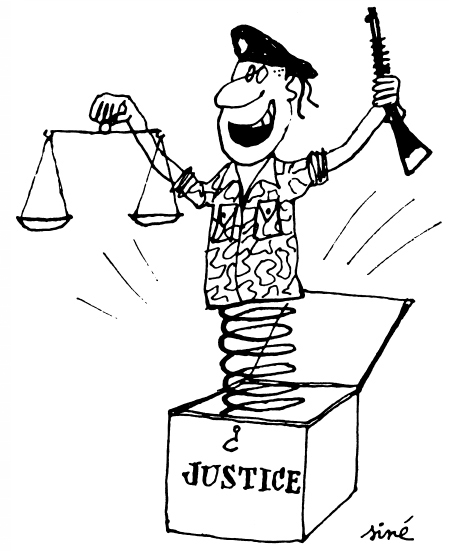
Figure 4. “Justice.” One of eight cartoon postcards created between 1958 and 1961 by Siné (Maurice Sinet), published by François Maspéro in Paris. Courtesy of Maurice Sinet.
ment. However, the Dreyfus symbolism was not entirely analogous to Audin’s case, Vidal-Naquet noted, because Audin was not truly a representative “victim of oppression in Algeria” (31). But the claims of similarities between the Dreyfus affair and the crimes committed in Algeria were powerful motivators for public opinion.
The two cases were also important for contemporary French politics because both men were Communists. The PCF attempted to appropriate the cases as evidence of the persecution of Communists. On December 12, 1957, Josette Audin and Gilberte Alleg, the men’s wives, were received by the PCF. Jacques Duclos greeted them with a speech in which he told Josette Audin she should be proud of her husband’s efforts to fight “for the cause of the independence of Algeria” and to fulfill his “communist and patriotic responsibilities.”63 According to Duclos, the actions of men such as Audin worked to “unite all Algerians without distinction to origin.” “We, French communists, we are on the side of our brothers, the Algerian communists. Our actions have contributed to bring out the truth and to organize the masses of French men and women against the tortures and the violence which have become generalized in Algeria.”
In order to clarify the circumstances and the events of Audin’s arrest, the Comité Maurice Audin was formed in November by Vidal-Naquet and the French mathematician Laurent Schwartz.64 In an article written for the January 16, 1958 edition of L’Express and used also as the preface to Vidal-Naquet’s L’Affaire Audin, Schwartz also compared the Dreyfus case to Audin’s.65 The principal difference, Schwartz argued, was that Dreyfus’s case was isolated whereas Audin’s was not. In this sense, Audin’s case was even more damaging to the French nation than the Dreyfus affair had been. Schwartz praised Vidal-Naquet’s L’Affaire Audin for its impartial analysis of Audin’s disappearance, saying that the book represented nothing less than “public opinion’s coming to consciousness of the danger of democracy disappearing in France” (56).66
Others lamented the loss of French status as reflected in these two cases. Writing in L’Humanité about a gathering of academics at the Sorbonne in honor of Maurice Audin, Georges Bouvard noted that it was a shame France was motivating intellectuals to speak out against the state’s abuses of power.67 Yet he claimed that those gathered for Maurice Audin illustrated a great level of cultivation in keeping with the Sorbonne’s highest traditions of liberty. In addition to the Sorbonne elites, French democratic opinion would continue to honor Audin’s memory and show solidarity for the young man who was sacrificed “to the worst of wars.”
Audin’s story was powerfully described by Vidal-Naquet. In contrast, what made Henri Alleg’s story so compelling was that he described his torture at the hands of the French military on pieces of paper that were smuggled out of prison. The notes, immediately published as The Question, received the dubious honor of being the first work banned by the French government since the eighteenth century.68 Alleg, besides being a member of the PCF, had been the editor of the Algerian Communist daily Alger républicain until he was forced into hiding by French authorities in 1956. He was arrested by General Massu’s men in the Tenth Paratrooper Division on the charge that by going underground he had evaded prosecution as the editor of a banned publication. The title chosen to describe his ordeal was especially significant because it invoked the outdated practice of torture known as “la question” during the ancien régime
Alleg began with a confession that “[i]n this enormous overcrowded prison, where each cell houses a quantity of human suffering,” he considered it almost “indecent” to talk about himself.69 However, in making the horrors known, Alleg believed that his story might “serve a purpose,” which was to help bring about “a cease-fire and peace” (41). At the first torture session, the paratroopers (“paras”) ridiculed him as a Frenchman who had sold out to the “rats.” This exacted a heavy penalty, which he described thus:
J-, smiling all the time, dangled the clasps at the end of the electrodes before my eyes. He attached one of them to the lobe of my right ear and the other to a finger on the same side.
Suddenly, I leapt in my bonds and shouted with all my might. Chad just sent the first electric charge through my body. A flash of lightning exploded next to my ear and I felt my heart racing. I struggled, screaming, and stiffened myself until the straps cut into my flesh. All the while the shocks controlled by C-, magneto in hand, followed each other without interruption. Between two spasms, I turned my head towards him and said, “You are wrong to do this. You will regret it!”
Furious, Cturned the knob on the magneto to its fullest extent…. And as I continued to shout, he said to J-: “My God, he’s noisy! Stuff his mouth with something!”>
J-rolled my shirt into a ball and forced it into my mouth, after which the torture continued. I bit the material between my teeth with all my might and found it almost a relief.
Suddenly, I felt as if a savage beast had torn the flesh from my body. Still smiling above me, Jhad attached the pincer to my penis. The shocks going through me were so strong that the straps holding me to the board came loose. They stopped to tie them again and we continued. (54–55).
The Question became even more important when Sartre took up his pen and introduced it to the French public. His scathing commentary, “Une Victoire” (“A Victory”) was also immediately seized by the French government.70 As he noted, The Question was the first document during the war written by a Frenchman that described being tortured by the French military. Until the publication of The Question, men returning from military service and priests were the only people capable of revealing the horrible truths about the French army. Alleg’s case was extremely important because, Sartre claimed, it demonstrated that not even French citizens were safe from torture. The lessons were obvious: that “fifteen years were enough to turn the victims into executioners” and that “anybody, at any time, may equally find himself victim or executioner.”71 This did not mean that the French were necessarily doomed. Ironically, Sartre argued that, although it was true that the Algerian revolution had focused the French people’s attention on the “whirlpool of inhumanity,” a careful look at Alleg’s book could help the French save themselves from the “vertigo” leading them to ruin.
Torture, Sartre continued, was by far the worst aspect of this vertigo, and it gave even the most dispassionate young French soldiers a fascist’s “taste for violence” (24). Torture, which he blamed on Robert Lacoste, had the capacity to destroy the fabric of society by locking both victim and executioner in the “grip of a violent and anonymous hatred” and by making the youth susceptible to becoming fascists. To protect their nation from fascism the French had to understand that they were not exempt from the same forces that plagued “totalitarian” nations. Specifically, he claimed, since torture had Lacoste’s blessing, the French nation was no better or worse than the Soviet Union under Stalin or Egypt under Abdel Nasser. In other words, “Hitler was only a forerunner” (26), and the French had to be willing to fight against their own state to keep the gangrene of torture from spreading.
Demonstrating how seriously he took his own warning about becoming a “good Samaritan,” Sartre insisted that it was necessary to clarify what was meant by torture and to distinguish it from revolutionary violence. “Torture is senseless violence, born in fear. The purpose of torture is to force from a tongue, amid screams and the vomiting of blood, the secret of everything” (29). The French had created a situation in which the only choice left to the Algerians was to affirm their identity as humans (“manhood”) by violently rejecting “French values” and “French nationality.” The Algerian nationalists’ new claims to “manhood” threatened, diminished, and cheapened the French claims to superiority by “divine right.” By claiming that there were “two kinds of human beings” (the French and the Arabs), the French could justify torture; torture in Algeria was thus an expression of French “racial hatred” for the Arabs (32). As such, it was at the “essence of the conflict” (36). This meant that the conflict could not be resolved through dialogue or reconciliation efforts. In other words, in returning to the themes of aut-ocritique, Sartre intended to show that the payoff for France came in seeing how racial and national boundaries of institutionalized racial violence were beginning to blur and migrate. Only declaring Algeria independent would resolve the conflict and free the French from spreading fascism. As Sartre wrote, “Our victims know us by their scars and by their chains…. It is enough for us that they show us what we have made of them for us to realize what we have made of ourselves” (13).
On February 23, 1958, Mauriac used The Question to attack Camus’s silence: “Camus prefers his mother to justice. I would too, I am afraid, if I were confronted with the choice. That is not the case: every injustice with respect to men, committed in the name of France, overwhelms our mother, France. But is it really a matter of our mother in the flesh, as with Camus?”72 On March 28, after another governmental confiscation of The Question, Mauriac again asked in frustration what was happening to France. This time, he focused his anger on Lacoste, who, according to him, dishonored France by repeatedly denying Alleg’s torture. By letting this disgraceful abuse continue, Mauriac stated, Lacoste and the entire French nation were to be held responsible. Although Alleg was a French Jew and not an Arab, Mauriac, like Sartre, argued that the application of torture in Algeria was carried out by Frenchmen who “hate men of other races” (53).
Unlike Sartre, however, Mauriac did not make a moral distinction between “torture” and “revolutionary action” as a means to “find solidarity with Algerians.”73 In fact, Mauriac wrote to Denise Barrat on August 24, 1957, that he wanted to end the war in Algeria and stop the abuses of the French government, but that he was equally opposed to the Algerians’ use of “terrorism”: “I am not for the murders of one side [and] against the murders of the other” (339).74 The Algerians who murdered their own, he continued, could not be defended under any circumstance. Moreover, he wrote, France could not be expected to renounce its “right in Algeria,” which was secured for it by more than a hundred years of contact. Refusing to give up the idea of reconciliation, he wrote to Barrat that he “loved” the Algerians “as people,” and he asked God for the chance to see peace delivered between the French and the Algerians before his death.
A month later, Jean-Marie Domenach described a recent confiscation of The Question as being the “last and the most flagrant testimony of the imbecility of power.”75 It had been easy to make Audin disappear, Domenach claimed, but Lacoste could not erase Alleg’s writing without seeking out every existing copy and “washing out the brain of everyone who has read it.” As impossible as it was to erase The Question from everyone who had read it, it was equally necessary for everyone to read it because it concerned all citizens. Alleg’s book, he wrote, placed everything in perspective and showed why the French could no longer tolerate the army’s abuses “without renouncing” their “dignity.”
In the army’s internal informational note, written by a lieutenant colonel in the Fifth Bureau, Alleg’s book was nothing other than leftist propaganda “orchestrated by those who fight for the systematic destruction of the established order of the Western world.”76 According to the French military, The Question was merely intended to divide France from the rest of the Western world. Even worse, the army claimed, as a Communist Alleg was allowing his work to be exploited by non-Communists in France so that it would be seen as “irrefutable testimony” to the abuses of the French army. The army concluded: “This simplification is a diabolical trap, this division of the French, this attempt to divorce France from the Western world is the work of the civil war and the tearing apart of the Christian world for the profit of the revolutionary war” (3).
The effects of the Audin and Alleg scandals on the French Fourth Republic were dramatic. One of the most telling signs was the “petition” sent to the president signed by André Malraux, Roger Martin du Gard, François Mauriac, and Jean-Paul Sartre. These four celebrated writers protested the government’s confiscation of The Question and asked for a complete investigation of Alleg’s case.77 It was Alleg, after all, who had written that he wanted the French to read him so that they would understand that the Algerians were indeed being tortured but that the Algerians were not confusing “their tortures with the great people of France” (122). The French had to know, quite simply, Alleg claimed, so that they would “know what is done In Their Name.”
While Alleg and the Audin affair no doubt helped contribute to the fall of the republic and, indirectly, to de Gaulle’s coming to power in May 1958, de Gaulle’s rise again fractured the French intellectual community. Jean-Jacques Servan-Schreiber and Claude Bourdet violently attacked his seizing the government, whereas Mauriac supported him. Sartre and members of the new left detested de Gaulle’s rise through “fascist” forces originating from the extreme right wing and the army. As Sartre stated: “The Algerian colons want to colonize France”; they were holding de Gaulle as their “hostage.”78 In order to fight against this crime, France had to be “de-mystified.” To demystify, intellectuals had to show that the French-Algerian War had destroyed the French Republic and that the colons together with the army were conspiring against the republic. Specifically, intellectuals had to inform public opinion against the travesty of justice.79 Demystification of the war by committed intellectuals would show, for example, that torture was not only criminal, it was also not useful. Since torture “destroys what is human in the Other,” and since “it will necessarily destroy it [what is human] in the Self,” torture itself had to be eradicated. All journalists and writers were obligated, Sartre concluded, to speak out in favor of the true France, the France of “the Rights of Man and Citizen” and the right of every man “to be a human and a free citizen in his own country.”80
Besides L’Affaire Audin and The Question, several other important works also pushed French intellectuals to confront the realities of torture in Algeria. Pour Djamila Bouhired, written by Jacques Vergès and Georges Arnaud, two French lawyers working at the Algerian bar, appeared in October 1957. Bouhired had been tortured extensively in April 1957 during “interrogations” by French paratroopers. An active member of the FLN, Bouhired had been caught carrying the correspondence of Yacef Saadi and Ali La Pointe— two known FLN leaders during the infamous Battle of Algiers. Her torture involved having electrodes attached to her breasts, vagina, and elsewhere. And during her interrogation Bouhired was reported to have signed a confession, which she later denied. In taking up her case Arnaud and Vergès described her treatment in detail. Bouhired was accused, along with Djamila Bouazza, of planting a bomb at the Coq Hardi in Algiers. She was eventually condemned to death; Arnaud and Vergès explained that they had written Pour Djamila Bouhired in order to provoke an outcry against her treatment and keep her from being executed.81
In June 1959 Minuit took a huge risk and published another scathing critique of French torture in Algeria entitled La Gangrène (The Gangrene). The Gangrene documented the cases of five Algerian men, most of them students, who had been arrested and tortured in Paris by the Direction de Surveillance Territoire (dst), the French secret police under Roger Wybot. That these men had been tortured in Paris, in metropolitan France, was a tremendous shock to French public opinion. The French government immediately banned the book and the French press was forbidden to mention it, which it did in great detail anyway, and criminal charges were brought against Minuit’s director, Jérôme Lindon. The book reviews by most of the French dailies and several newspapers suggested that there were disturbing parallels between the Nazi occupation of France and the DST’s use of torture in metropolitan France during the French-Algerian War. Without question, this migration of torture to metropolitan France via the DST and the de Gaulle government’s desire to suppress all such reports at any cost gave most French intellectuals reason to pause and fundamentally reevaluate the effects of the war on French society and French law. As a writer for Le Monde put it, “These students seem to have been tortured with special mercilessness, precisely because they were intellectuals. Nothing was done to prevent these acts of torture—everything on the contrary was done to facilitate them—the indifference of public opinion, and French law itself.”82
At about the time that the French government tried to counteract the damage caused by The Gangrene, Gisèle Halimi—another lawyer defending Algerians accused of revolutionary activities—received a letter from Djamila Boupacha. Boupacha (a young Muslim woman) was under arrest and being held at Camp Bousset, outside Oran. Boupacha, like Algerians in The Gangrene and like Alleg and Audin, had been tortured, but with one difference. A virgin before being arrested, she was raped by a French soldier with a bottle, after being tortured in other unimaginable ways. Boupacha’s trial and Djamila Boupacha (Djamila Boupacha: The Story of the Torture of a Young Algerian Girl Which Shocked Liberal French Opinion), a book eventually published in French and English in 1962, by Simone de Beauvoir and Gisèle Halimi, also sparked intense national and international controversy. This controversy was largely anticipated by de Beauvoir’s June 3, 1960, letter to Le Monde about the case; it amounted to a battery of attacks on the French judicial system in Algeria. Other French intellectuals came to her defense, including Germaine Tillion, and twelve important figures provided testimonies— including Henri Alleg, Josette Audin, General Jacques Paris de Bollardière, Daniel Meyer, Jean François Revel, Jules Roy, and Françoise Sagan—that were reproduced in Djamila Boupacha.83
The Jeanson Network, the Manifesto of the 121, and Treason of the French Self
Given the increasingly radicalized frustrations with the French state, it is not entirely surprising that a few French intellectuals decided to join the Algerian nationalists fully in their struggle. Nor is it very surprising that Francis Jeanson led the French intellectuals in the underground activity. Collette and Jeanson’s L’Algérie hors la loi was undoubtedly on the forefront of support for the Algerian revolution already in 1955. Jeanson continued his avant-garde support for the Algerian nationalists’ cause, eventually providing financial, intellectual, and moral support to the FLN and to deserters of the French army. He was driven underground in 1957.84 Having lived in Algeria for several years, Jeanson had also been one of the first French intellectuals to write about the impending revolution. In his articles in Esprit in 1950, Jeanson attempted to bring the French out of their “sleepwalking” with respect to the reality Algeria posed.85 As an editor at Éditions du Seuil, Jeanson had written the introduction to Frantz Fanon’s first work, Peau noire, masques blancs (Black Skin, White Masks) in 1952.86 As discussed in chapter 2, Jeanson’s involvement in the Comité d’Action had been important, especially his polemic with Jean Daniel.
While in hiding, Jeanson began to assemble a vast network capable of aiding Algerian nationalists.87 The “Jeanson network” (always referred to in the press as “réseau Jeanson”) was discovered about a month after the barricades scandal at the beginning of 1960. In total, twenty-three members of the network, seventeen French and six Muslims, were arrested, while five—including Jeanson—managed to avoid the police. Their trial, which began on September 5, 1960, provoked an unprecedented national debate on the limits of intellectual engagement and on the question of treason. For the first time since their split after Budapest, Jeanson and Sartre were joined in a common cause: motivating French public opinion and using the threat of a civil war in France to rejuvenate the French left.88
Jeanson’s decision to enter into an alliance with the FLN was therefore taken with two primary objectives in mind: ending the war in Algeria by supporting the only effective Algerian revolutionary movement, and unifying

Figure 5. “I say intellectual because I am an intellectual! I am proud to be an intellectual, from an old family of intellectuals: three generations of intellectuals! All dead for France!” One of eight cartoon postcards created between 1958 and 1961 by Siné (Maurice Sinet), published by François Maspéro in Paris. Courtesy of Maurice Sinet.
the French left in order to save French democracy. The problem Jeanson faced as a clandestine intellectual trying to achieve these two aims was simple. Since his alliance with the Algerian revolutionaries was forged underground, public opinion was not aware of his network. In his words, “our technique of clandestineness, evidently indispensable, risked keeping us in political clandestineness.”89 For that reason Jeanson created his journal, Vérités pour…, at the beginning of 1958. It was to be the vehicle for bringing the clandestine activities to the surface of French political life and showing the political unity of the French left and the Algerian resistance. This unity was particularly important because the issue for the French left was no longer merely one of cultural and political reconciliation with the Algerians; rather, unity was to be found in political and universal revolutionary activity.
The obvious risks of printing Vérités pour…, according to Jeanson, were part of its intrinsic merit. Being chased by the police only added to the validity of the publication’s claims. The French public had to have access to writings “condemned by official justice” to show that there was indeed an alternative to official justice and that this alternative was supported by solidarity between Algerians and the French (1541). To bring about this cooperation between the revolutionary French and Algerian public, Jeanson advocated political engagement not just based on “theoretical” concerns but also “inscribed within an everyday context.” It was possible to bridge the gap between “action” and “practical reflection” by illustrating to the French public that there really was “something to do” for the Algerians.
Because most French leftist intellectuals were unwilling to make the first moves toward a solution, it was now up to what Jeanson called “avantgarde” intellectuals to take the first step (1542). Since the war was France’s primary concern, the French left had to maintain “solidarity with a people fighting for its liberation” (1543). This solidarity, this “Franco-Algerian friendship,” had hitherto remained unattainable, he claimed, only because the French left defined political engagement as a “choice between clients.” The left could no longer stall by insisting that the Algerians had to present an alternative to the FLN.
Aware that taking the FLN’s side would lead to the charge of treason, Jeanson claimed that the charge was false because, according to France’s official rhetoric, the rebellion was merely a civil war in which the Algerians were considered “French citizens” (1544). The “crime” of collaborating with the Algerians was worth the penalty, he claimed, if the alternative was to admit that he belonged to the same “community” as men such as General Massu and Prime Minister Debré. Moreover, since it was indisputable in 1960 that the Algerians would achieve political independence and that France was heading toward fascism, he argued that it was in France’s political interest to guarantee future relations with the Algerian government by “sav[ing] France at the side of Algerians.” Saving France and ensuring that the French would not be condemned en bloc by the Algerians after independence would forge a new Franco-Algerian solidarity (1546–47).
In February–March 1960 Les Temps modernes published a provocative editorial titled “The French Left and the FLN,” which continued the themes of intellectual commitment espoused by Jeanson.90 Specifically, it attacked de Gaulle’s policy in Algeria and depicted him as a fascist threat to French democracy. The French left, specifically intellectuals such as Jean Daniel and Maurice Duverger (a professor of law in Paris who had criticized the French left), were intentionally misrepresenting the Algerian situation by arguing that peace should be the sole objective of French policy. According to Les Temps modernes, this was illusory because de Gaulle’s peace would destroy the French left and be unsatisfactory to the Algerians. Thus, to save France from de Gaulle’s fascism and from the “incompetent” left it was necessary for the revolutionary left to proclaim “the political solidarity of the French left with the FLN” (1172–73).
In the May issue of Esprit, Jean Daniel fired back at his attackers. Defending his position as a respectable journalist, Daniel claimed that it was in the public’s interest for him to describe and to analyze the possibilities of peace under de Gaulle.91 Unlike Jeanson and Sartre, Daniel cited the FLN’s political recalcitrance as one of the most important reasons for the stalled peace process. Moreover, he disagreed with the avant-garde’s position on violence. “Violence,” he declared, “had posed the problem; it did not suffice to solve it” (810). As far as the ultras and the FLN were concerned, violence could achieve nothing because the two sides were balanced against each other in a hideous fight to the death.
Contrary to what Sartre and the radicals believed, Daniel wrote, the left had always been on the side of imperialism and therefore “integration.” Hence Soustelle was not altogether wrong when he once claimed that “integration was a ‘thesis of the left’ ” (811). The fact, Daniel charged, was that the French left wanted to profit from the revolutionary spirit of Algerian nationalism and this “intellectual slippage was very perceivable” (811).
As for unwillingness to accept the FLN as the interlocutor of the Algerian people, Daniel again expressed his fear of the FLN’s “Arab-Islamic” orientation (812). While the avant-garde of the French left was willing to overlook this pernicious element, it had aligned the FLN with the Arab league, which “hoped for the disappearance of Israel.”
The FLN orientation especially threatened the non-Muslim community in Algeria. As a result, Daniel continued, the French avant-garde left had overlooked fundamental and disturbing facts about Algerian nationalists in order to blindly “sacralize” the FLN as a revolutionary movement. This activity was no better than “Stalinist intellectuals [who] sacralized the Parti Communiste” (813–14).
This was simply not the case, Les Temps modernes replied in its next issue.92 Admitting to desiring the unification of the left with the FLN, Sartre’s journal stated that it was important not to accept de Gaulle’s peace because “if de Gaulle makes peace, it will be good for the Algerians, but bad for the left.” Les Temps modernes did not deny that it and the avant-garde left wanted to make use of the Algerian situation; however, since “pacification” was de Gaulle’s goal, the left and the Algerians remained united in their opposition to the government’s policies. Moreover, in response to Daniel’s claim that the FLN was anti-Semitic, Les Temps modernes wrote that, although the left had fought for the Jews during World War II, it was now necessary to show the same enthusiasm to fight for people facing a similar threat of torture and execution. The real problem was simple: “Peace… did not justify the Gaullist order” (1534).
The rift between the avant-garde French intellectuals and moderate left was finally brought to full public attention on September 4, 1960, when Le Monde announced that 121 intellectuals (writers and artists) had signed a manifesto for the “right of insubordination” and draft resistance.93 It was doubly important because it was made public on the day before the Jeanson network trial began in Paris. The manifesto was intended to derail or at least disrupt the trial, and the two events had an enormous effect on France. In the words of Sartre’s biographer, Annie Cohen-Solal: “The trial of the Jeanson network was a masquerade, a farce, a circus, a political happening, a series of challenges of an insolence and a violence rarely seen in a courtroom, a vaudeville revue, and on the part of the lawyers [Jacques Vergès and Roland Dumas], a provocation of justice, the army, and the Gaullist government— in short, a platform for the partisans of the Algerian independence to voice the implacable urgency of their appeal.”94
Although circuslike in atmosphere, the trial illustrated the importance of intellectual unity. The Manifesto of the 121 had mobilized a significant group of France’s most prominent leftist intellectuals, including Robert Barrat, Simone de Beauvoir, André Breton, Marguerite Duras, Michel Leiris, Jérôme Lindon, Dionys Mascolo, Jean-Jacques Mayoux, Jean-Paul Sartre, Pierre Vidal-Naquet, and many others. For these intellectuals, intellectual legitimacy mandated that they stand together with Jeanson.
But not all prominent French intellectuals who were asked to sign the manifesto could do so, for fear that they would tarnish the movement. The highly controversial novelist Jean Genet had been involved in 1955 (along with others such as Marguerite Duras, Edgar Morin, and Jean-Paul Sartre) in creating an anticolonialist petition against the war in North Africa that was eventually signed by the likes of Mauriac, Sartre, and Françoise Sagan. Genet was “bitterly attacked in the press as a ‘professional pederast, habitual offender and thief,’ and as a ‘police informer’ whose name brought disgrace to the ‘gentle-men-ladies’ who had signed the petition.”95 Genet explained how he feared his affiliation with this 1960 manifesto supporting the soldiers’ right to desert could compromise the manifesto’s ability to mold public opinion: “I deserted twenty years ago after stealing the bonus money from joining up, then I had eight or ten sentences for theft. Therefore I don’t think that I can give moral guarantee for the men who are struggling for idealism and who could moreover take exception to my statement. In fact their morality is that of those who condemn them. Except that they—the first ones I’ve named—put this morality into practice. What could a thief, pornographer, etc., do in their midst?”96
Jean Genet regretted his inability to join his comrades on the left in support of desertion; another group, led by Merleau-Ponty, quickly countered the Manifesto of the 121 with a more moderate manifesto. This group signed a less provocative manifesto that underscored the moral choices the government was forcing on the youth, but did not advocate the right of desertion. The signatures totaled more than a thousand French intellectuals and educators, among them Raymond Aron, Roland Barthes, Georges Canguilhem, Jean Cassou, Jean-Marie Domenach, Jean Dresch, Claude Lefort, Jacques Le Goff, Maurice Merleau-Ponty, Edgar Morin, Daniel Meyer, and Paul Ricoeur. This split in the French intellectual community showed how important debates over the military had become.
Writing about the trial and the Manifesto of the 121, sociologist Edgar Morin, one of the founders of the Comité d’Action, claimed that a hidden duality in the French left’s identity had been revealed. This duality created tension between the left who wanted “peace” and the left who wanted to “adhere to the Algerians.”97 The division demonstrated the “ideological dynamism” that “adhesion to the Algerian revolution” provided. As a result, the Algerian revolution was interpreted by the French revolutionary left as the “decisive moment of socialist progress in the world,” which required immediate participation. This was why the Jeanson network and especially the youths in the university who supported the FLN had opted for this socalled committed position.
The essential problem facing intellectuals now, according to Morin, was lack of perspective. Put simply, intellectuals were making the Algerian revolution stand for something other than the mere struggle for Algerian emancipation: “[T]he Algerian war was not only the resistance of a colonizing nation to the emancipation of an oppressed nationality; it had become part of the global game” (6). Unfortunately, the Algerian people would be the ones to suffer for this “theoretical” argument, because the “radicalization of the process would not bring a ‘permanent revolution,’ but, on the contrary, would accentuate the preponderance of the system and methods of the military in the political system.” To avoid this political disaster, it was important that the “party of peace” (de Gaulle) come to its senses; likewise, avant-garde intellectuals had to come to their senses to find a solution that would avoid the dictatorship of the “party of the revolt.”
The following week, on October 13, 1960, Dionys Mascolo (a Comité cofounder) responded to Morin in a letter published in France observateur.98 In attempting to clarify the role of the manifesto, Mascolo admitted that the closeness of the dates might have led readers to believe that the manifesto was intended to support the Jeanson network. But it was intended to uniquely support those drafted into the military if they wanted to refuse compulsory service. One did not lead to the other, he claimed. It was important to understand that the right of youth to refuse military service was an “essential” step in ending the war and ensuring that the youth not be judged by the international community as the Nazis were judged at Nuremberg.
There were tremendous changes in the relationship between Algerian nationalists and French intellectuals. The first French reactions against torture in 1957, the Mélouza massacre, the Audin, Alleg, Gangrene, Pour Djamila Bouhired, and Djamila Boupacha scandals, as well as the Jeanson trial and subsequent Manifesto of the 121 all helped define the new relations and positions within the French left. Violence and the perceptions of those who employed violence were the key factors in altering alliances between the French left and the Algerian nationalists. But, as we have seen, the threat of fascist violence in Algeria and France along with the desire to use the Algerian revolution for their own ends motivated the avant-garde of the French left to reclaim this important alliance. These constantly shifting alliances deepened the divisions within the French intellectual community.
The French left began to rethink its relationship to the Algerian nationalists especially after de Gaulle came to power. By 1960, as the extreme right was beginning to demonstrate its impatience for de Gaulle’s politics of selfdetermination, the French avant-garde left had found in the Algerian revolution a means to rejuvenate itself. It was clear that the FLN would continue to reject the paternalism of the French left as it continued to meddle in FLN affairs and make moral pronouncements on the FLN’s nationalism— especially after Mélouza.
Out of this changing relationship in the French left and between the French and the Algerians, a central question emerged: Whose war was the French-Algerian War? Whether it could be truly the Algerians’ or the French left’s was a matter of great dispute. Jeanson tried to answer this question with his book published at the end of 1960, Notre guerre. Jeanson’s position, so similar to that of others like Sartre and Mascolo, was that the Algerian war had put French identity into question. It was in order “to really be French” that intellectuals like him were “now working to reconstitute a national community” by fighting alongside Algerians.99
Hence, for Jeanson, the issue was not whether the war was a French or an Algerian war, but rather how the French could engage in the war on the Algerian side in order to reconstruct their own national community without becoming less French. He did not deny the risk involved—losing one’s French identity during the struggle. In Jeanson’s words, those working with the Algerians “faced two inverse risks: that of being so accepted that we become submerged, absorbed, lost, Algerianized; and that of being rejected for having kept our distance” (14–15). The network members tried to account for this, he said, by attempting “to be totally with, and in consequence, totally ourselves…. For three years, we have worked for the FLN… without being ‘under its orders,’ or without being ‘for sale’ ” (48). Thus the problem was reduced to showing solidarity with the Algerians while maintaining autonomy from the Algerians.
Jeanson argued that the French who refused to participate in the war because the FLN was not “socialist,” because of the supposed Islamic threat, or because of FLN-MNA rivalries were only using alibis (30). It was essential to demonstrate that the French people were willing to negotiate with the FLN in order to ensure any future for France in independent Algeria.
As for the charge that the French people involved in the Jeanson network were betraying their national community, Jeanson claimed that “the real Treason was the renunciation—active or passive—of the profound resources of the country, the only chance to realize an effective community, of everything that can, in the end, constitute a real showing of France at work” (117). Only working for a warranted peace, a real peace, could assure continued cooperation and friendship between the French and Algerians and dispel the “Gaullist magic.” That was the true meaning of the war for France. It was, in fact, according to Jeanson, the only way to restore France’s real significance in the world.
For Jeanson and the French left, the realities were clear. The left had been ambushed and trapped by de Gaulle’s illegitimate rise to power in 1958. French intellectuals were trapped by the illegalities of the French army, the unstoppable use of torture and mass killing, and by a desire to take an active role in a revolution that was not their own. The paradox could be reduced to this simple question: How could the French avant-garde left not be, as Jeanson said, “Algerianized” through its involvement in the Algerian revolution?