
1
I HAD JUST SAT down and taken out my notebook when I heard a loud thud. It was a few minutes after 9 a.m. on the last Friday of January 2019. I had come to meet a prospective research assistant at the Chicken Licken in downtown Krugersdorp, about an hour’s drive from Johannesburg. A modest-but-modern fast food restaurant, clean and sparsely furnished, it was one of the most popular spots in a neighborhood that was otherwise filled with unremarkable storefronts, including several tire stores, low-price clothing boutiques, and pawn shops. Signs for quick and easy abortions adorned many of the adjacent buildings.
I noticed that the restaurant manager was hurrying around the exterior of the building, slamming shut each of the heavy exterior gates used for security after-hours. The pair of police officers who had been sitting and chatting at the table next to me had disappeared. Most of the other customers eating and drinking there that morning had also left their tables in order to gather close to the exit, huddling under the threshold as they looked out cautiously onto the street.
I stood up and joined the small crowd. We all peered out toward the action to our left and could see a loud throng of people toyi-toying. The toyi-toyi is a protest march that became popular in Black townships beginning in the late 1970s in the wake of the growing campaign against White rule in South Africa.1 On that day in January, thousands of people were hopping, dancing, singing, and yelling all along the multiple lanes of Commissioner Street. They held hand-printed placards in their hands proclaiming, “No service, no vote” and “2019 no vote.” It was still morning, but it was already getting hot in the summer sun. Sweat streamed down the protesters’ faces.
The manager was closing the metal gates because the previous week, a different protest had turned violent and rubber bullets had broken windows. She wanted to protect the new windows, the restaurant, and, presumably, any customers who remained.
Krugersdorp has long been a site of confrontation and conflict. Within a few years of its founding in 1887, it developed rapidly into a hard-drinking, hard-gambling, transient mining town and was frequently likened to the American “Wild West.”2 It was established to serve the booming gold mining industry a year after rich deposits were found in nearby Johannesburg. The allure of quick profits attracted thousands of foreigners, mostly from Britain but also from Australia, Ireland, and America, other parts of Africa, and other corners of the world. Over many generations individual explorers, groups, and sometimes even warring parties came through this town to try to carve out a better life.
For most of its history and up until the 1990s, Krugersdorp was designated for Whites only. Black people were permitted to work here only if they carried a special permit, and mostly they were relegated to the neighboring Black townships of Munsieville and Kagiso (pronounced Kah-hee-so). As early as the first few years of the twentieth century, the Krugersdorp Town Council deliberately regulated the movement of Black Africans into and out of well-demarcated areas on the outskirts of town.3 Indeed this distinction between “towns” and “townships” was fundamental to the racial ordering built up throughout South Africa during most of the twentieth century. Today, downtown Krugersdorp is filled with people from all race groups and a wide range of nationalities. By contrast, Kagiso (about seven miles south) and Munsieville (less than four miles north) remain almost all Black, though the latter also hosts Pango Camp, a small informal settlement of poor Whites.
On this day in 2019, the approximately two thousand Munsieville residents were marching to see Patrick Lipudi, mayor of Mogale City Local Municipality, which now incorporates all of these areas under a single local government. Lipudi is himself Black. In the 1970s and 1980s, he had served as a union leader, political activist, and protester; and he danced the toyi-toyi during the struggle for Black liberation. Like so many others who once led protest movements and were now serving as government officials, he had become the target of anger and frustration. The protesters were making demands for better water and electricity. It was the last weekend of voter registration for the upcoming national elections, and when interviewed later that day, the protest’s organizer said the people of Munsieville were prepared to boycott further registrations.4 For Lipudi and other government leaders, such boycotts could cost the ruling party precious votes in a close election, and they would be forced to negotiate.
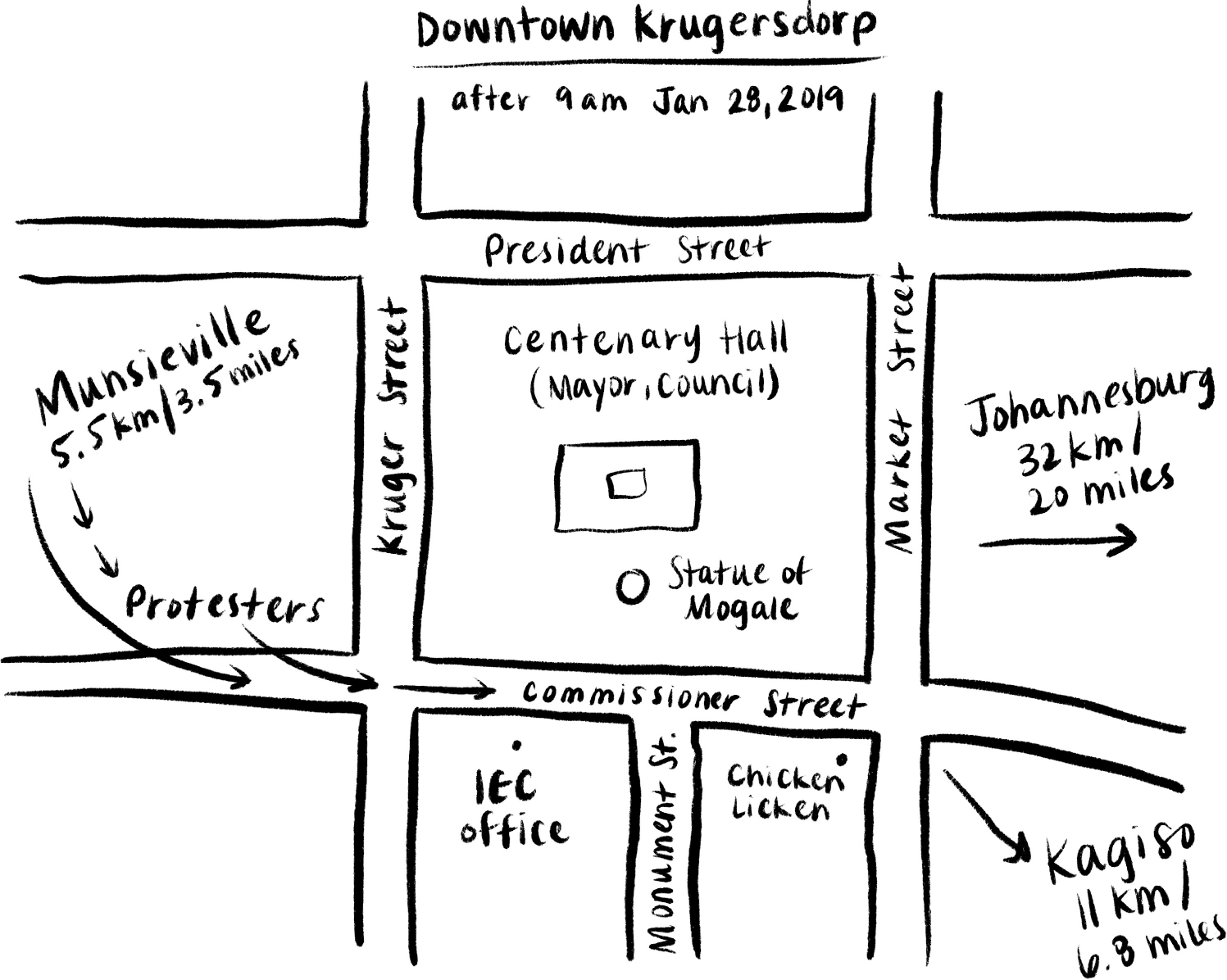
FIGURE 1.1. Site of protest outside Chicken Licken, Krugersdorp.
Democracy Up Close
I had traveled to Krugersdorp, the seat of Mogale City government, to observe the campaign for this national election. I wanted to learn more about how multiracial democracy was faring after twenty-five years.
The country’s first multiracial election, in 1994, had marked an important milestone in a highly improbable political transformation. It produced a shift in power away from an economically dominant White minority in favor of universal adult suffrage, resulting in a Black-led government. In terms of population and economic development, ending Apartheid and creating an integrated South Africa was like fusing together the relatively poor African country of Kenya and the much smaller and wealthier European country of Denmark into a single polity in just a few years’ time. Between 1989 and 1994, the size of the electorate increased by a factor of eight, from over 2.5 million to close to 20 million voters.5 During that period, the country transitioned away from civil war—a fact which itself did not bode well for democratic development if one considered the trajectories of other postconflict countries.6
And now it was time to ask: What can students of democracy and social justice the world over learn from this ambitious political endeavor?
That a large protest swept right in front of me on my first day—in fact, in the first fifteen minutes of my time in Krugersdorp—was an important reminder of the mood of many of the country’s citizens: they were frustrated, angry, and losing patience. In this chapter and in the next, I share what I observed about contemporary South African politics from the perspective of the 2019 national election as it played out in Mogale City—first the campaign, and then election day itself. This will provide an introduction to the diverse actors and concerns driving the heated political competition in the country.
I set my gaze on the midsized South African municipality of Mogale City because, at least from afar, it appeared to be a place that could serve as something of a microcosm for learning more about South Africa. It is racially diverse, prior elections tracked national trends toward greater competitiveness, and it straddles the country’s very different urban and rural areas. On the one hand, the municipality abuts South Africa’s megalopolis—the corridor between “Joburg” and Pretoria, home to over 8 million residents. Yet, even the most urbanized section of Mogale—Krugersdorp, with a population of about 140,000—is still just a town. Streets can get busy during trading hours, but there are no high-rise buildings. Just a few miles away, still very much within Mogale’s borders, lie thousands of acres of farmland. Black and White, rich and poor, urban and rural, and support for different political parties represent the most important sources of diversity in South Africa; and all are contained within Mogale.
The municipality is located in Gauteng Province, specifically in an area known as the West Rand—a reference to the Witwatersrand, an approximately thirty-five-mile rock escarpment that elevates its residents over a mile above sea level. The Rand is also quite literally the source of continental divide, as runoff from the plateau feeds the Crocodile, Limpopo, Vaal, and Orange rivers, which in turn drain into the Indian and Atlantic oceans. Wanderers and explorers came here even before the transformative discovery of great mineral wealth in the ground below. No part of Southern Africa has drawn more people into such a concentrated area. And on my drive in from Johannesburg that January day in 2019, I noticed the immodest welcome sign, “Mogale City: Cradle of Humankind,” a reference to rich archaeological discoveries within the municipal boundaries. Mogale’s northern border is drawn by the Magaliesberg mountains, the site of millions of years of human occupation, and at least hundreds of years of known trading and conflict between groups of people moving into and out of the area.
Although I never spent any significant amount of time in Krugersdorp or Mogale prior to 2019, I have been studying South African politics for my entire career and adult life. And I wanted to take stock of what had and had not been accomplished since the time of the democratic transition, especially as democracy seemed to be in peril around the world, including in my own country, the United States. Populist leaders and parties have been on the rise around the globe—in Hungary, the United States, Brazil, the Philippines, India, and elsewhere—and they have been characterized by increasingly authoritarian tendencies. South Africa was plausibly fertile ground for such appeals. Anti-immigrant and anti-elite sentiment was already strong in many pockets—and very strong in Mogale City. It would not take much imagination to organize highly racist campaigns; and any of a number of well-worn strategies to identify a culpable elite and/or additional scapegoats had the potential to win votes.
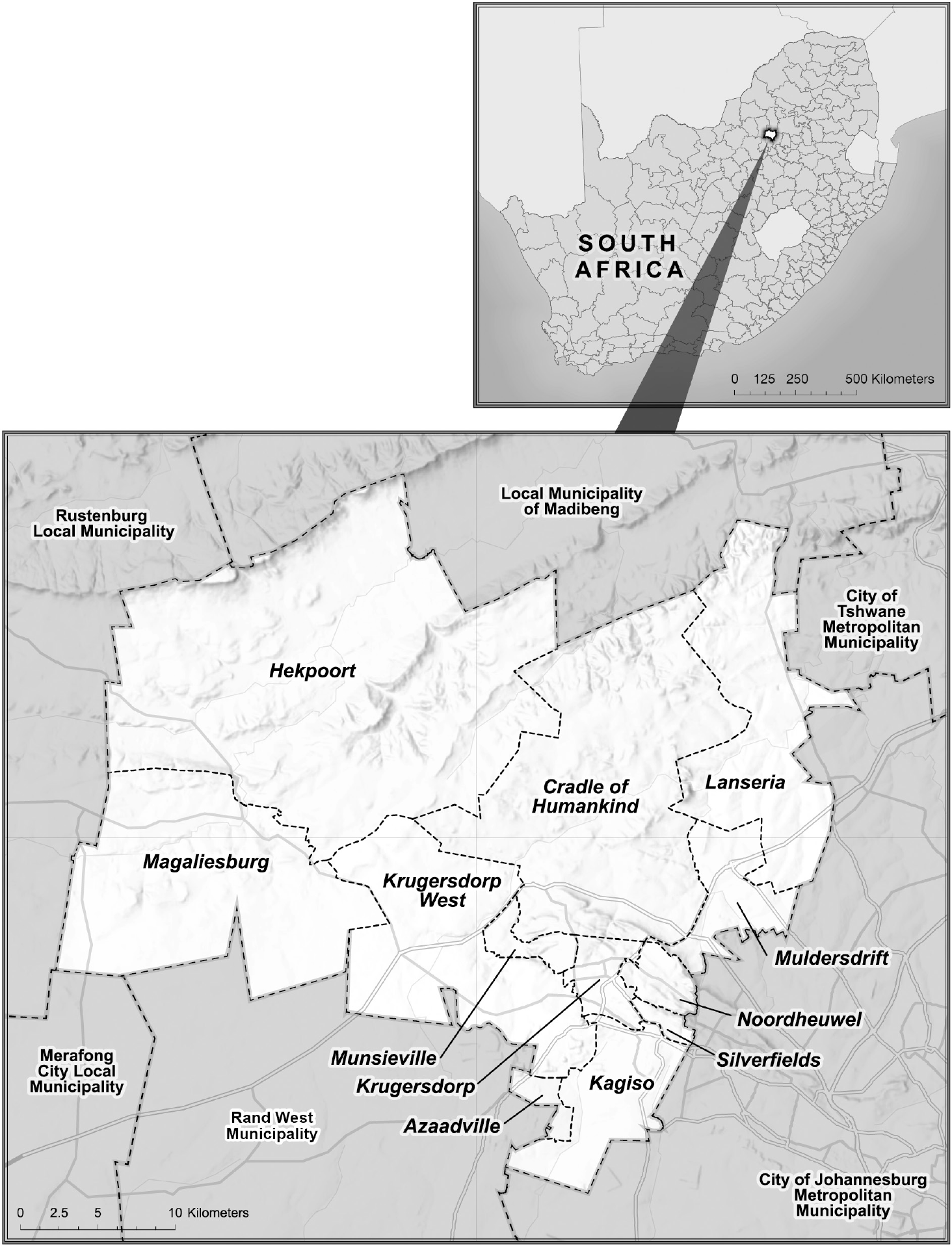
FIGURE 1.2. Map of Mogale City Local Municipality in South Africa.
Even beyond the seemingly fragile nature of liberal democracy around the globe, South Africa’s 2019 contest appeared pivotal in so many ways: the electoral choices were stark, as the competing parties offered very different candidates and visions; and more than any national election since 1994, this one appeared to be quite competitive. Democracy is about a lot more than just elections, but elections are both necessary and crucial, and I wanted to watch this one up close. I would start by simply observing the process, particularly as it unfolded in this one municipality, asking: What were the leading political parties offering as interpretations of the past and proposals for the future? How were citizens responding to those campaigns? And then I would consider the historical record, look comparatively at other countries, and try to make sense of what I observed with respect to the efforts to forge a new government and to deliver. Ultimately, my goal was to assess the strength and value of South Africa’s still young democracy.
When I arrived in Mogale City, the municipality and the nation were just three months from marking the twenty-fifth anniversary of Nelson Mandela’s historic electoral victory in the first-ever truly multiracial election, one that was celebrated as a credible promise to redress the types of indignities that befell Black township dwellers like the people of Munsieville.
It was also a quarter century, more or less, since the end of Apartheid—literally translated as apartness—a style of government launched in 1948 with the express goal of keeping people from different race groups apart from one another. Institutionalized White supremacy, including in the form of slavery, had been practiced to varying degrees throughout southern Africa almost immediately after the arrival of Dutch settlers in 1652. When Krugersdorp was formed, it was contained within the South African Republic, a landmass representing approximately one-quarter of modern South Africa. Many of that government’s harsh rules and practices, including issuing passes to control the movement of Black people, would become the foundation for sustained racial oppression.
Of course, southern Africa was not alone in its institutionalization of racial hierarchies. Most of the African continent was at some point colonized by White Europeans; and the African slave trade was built on ideas of racial supremacy. The United States and Brazil both imported massive numbers of slaves, and the lasting results of race-based inequalities are starkly evident in these countries even today. What made South Africa both truly unique and infamous was the degree to which its White government doubled down on segregation and a panoply of racially exclusionary policies during the second half of the twentieth century. When the National Party gained power in a surprising electoral victory just three years after the end of World War II, Apartheid-style government came to define South Africa as a White minority persisted in developing a vision of government and citizenship for Whites only. Apartheid planners tried to market their project to the world as one promoting national self-determination, a language that was more acceptable to postwar sensibilities as the age of empire had come to an end. And yet, there was no mistaking the fact that the Apartheid project sought to forcibly segregate and separate people of color into the least desirable territories in the region and to control them as sources of cheap labor.
All of the Apartheid laws and practices were felled in the early 1990s. And yet, the end of Apartheid was not the end of South Africa’s difficult history. Deep Apartheid and pre-Apartheid legacies remained, and while various negotiating parties agreed to adopt a multiracial democracy, its success was hardly preordained. Moreover, a quarter of a century is clearly not sufficient to redress three and a half centuries of racial hierarchy. Nonetheless, the silver anniversary of the first multiracial election presented a fitting opportunity to take stock of what had been accomplished relative to expectations, to the past, and to other countries.
In the pages that follow, I show that South Africa’s first twenty-five years of democratic government were extremely successful. Many problems remain and citizens are understandably frustrated that more was not accomplished during this period. However, we cannot lose sight of the fact that democratic practice has moderated the tensions inherent in governing South Africa’s diverse society. Successive democratic administrations have helped to improve the lives of millions across the country, in terms of housing, basic services, social security, access to education, and more, and they have done so without resorting to political extremism.
Notwithstanding these accomplishments, South Africa’s democracy remains fragile. Democracy itself is an imperfect form of government even under the best of circumstances. Hopes and expectations can quickly outpace concrete change. The machinations of democratic politics are inherently self-critical, and progress is routinely made through shining a bright light on problems, which itself feeds a sense of frustration. While often effective, these processes can contribute to an underappreciation of the enterprise.
The Issues and the Parties
The very proposition of democratic rule in South Africa has long seemed daunting because of the profound diversity of its citizenry. Even in relatively small and homogeneous societies, attempts to forge binding agreements through democratic processes—those that allow for input from and some form of veto power to ordinary citizens and their representatives—frequently prove to be challenging. Especially with four major race groups, eleven official languages, a relatively even split between those living in rural and urban areas, and the highest level of income inequality in the world, the notion of “common interest” can seem elusive.
And yet, one of the great promises of democratic competition is that in the quest for votes, electoral candidates will make appeals to large swaths of the population, forging coalitions among people with otherwise divergent backgrounds. And for the most part, the parties competing in the 2019 electoral contest advanced credible and distinct ideas concerning how to govern South Africa’s highly diverse and unequal society. They provided answers to two central questions that had been asked for over a century, including during the very 1948 election that set the stage for Apartheid.
First, there was the race question, or really, a set of race questions: How did the party propose to address the legacies of race-based inequality and conflict? Would it seek to promote integration, autonomy, or something else? And what should be the racial identity of the party’s leaders and of its core supporters?
Second, and certainly relatedly, there was the economic question. On the one hand, just about everybody wants a better life in material terms, to have more comfortable shelter, basic services, and opportunities for leisure, and to take advantage of new products and new technologies. But how would the parties address the profound economic inequalities that called into question any sense of a shared humanity? All across the country, and certainly in Mogale City, you could find neighborhoods of people living in modern homes with all the amenities available in the United States or in Europe just a few miles from those living in informal structures of corrugated metal without basic services, such as electricity, clean water, or a flush toilet, let alone access to a decent job. What role should the state play in providing economic opportunities and security? What role for the “market” and competition? Should those who were previously disadvantaged get a leg up?
Both issues spoke to a larger question of human worth or dignity. How should people across the color bar be treated by one another and by the state?
If politics is about who gets what, and how,7 the South African parties epitomized a good political contest because if nothing else, in 2019, each of the five leading political parties was offering very different answers to these questions.
At the center of the election was the African National Congress (ANC), the ruling party for twenty-five years and before that a prominent challenger to White government for eight decades. In 1963, Nelson Mandela and a group of other ANC leaders were arrested for, among other things, sabotage and conspiracy in the wake of their efforts to topple Apartheid. They served harsh prison sentences on Robben Island, but their heroic efforts at liberation were rewarded handily in the first multiracial elections in 1994.
Although its support base was overwhelmingly Black African, the party had historically appointed people from various race groups to its leadership posts. It espoused racial inclusion and compromise even if its detractors sometimes argue that it does the opposite. On the economy, the ANC’s approach has been center-left and quite moderate in many ways. The ANC had always had a highly educated middle-class elite in its leadership ranks; but through its links with unions it extended its reach to workers and was even able to appeal to rural peasants through traditional leaders. It promoted economic preference policies (aka affirmative action), but not radical redistribution; and certainly in post-Apartheid South Africa, and in the context of the global economy in the late twentieth century, the organization had bet on the power of competitive markets.
For years, Mandela had been celebrated as a saintlike figure. But by 2019, the ANC was treading lightly in its tributes to him and its focus on the organization’s role in ending Apartheid. Months before the election, new critics joined a growing chorus that challenged Mandela’s grand bargain with the very White government that had oppressed Black people. They complained that during the transition of the early 1990s, he had given away too much to Whites. Others, even Black leaders within the ANC, believed that during the first election campaign, he promised too much to Blacks. Either way, the charismatic icon who had passed away five years earlier, at the age of ninety-five, was being quietly blamed for some of the mess the country was in.
As the incumbent party, the ANC had to stand on its record. Commentators in the media and the academy shared a steady flow of criticism and sometimes described the country as being “at a precipice” or “on the brink.” Citizens were frustrated by all sorts of issues, not the least of which was the load-shedding or rolling blackouts to ration electricity that was insufficient to meet total demand. Stories of ANC corruption, violence, high rates of unemployment, and newly emboldened as well as newly formed political parties calling for change all dominated the news. In fact, one of the country’s major scandals was centered in Mogale City. It involved Bosasa, a private South African company with headquarters in Krugersdorp that, among other things, provided prison services to the government. In January 2019, the owner—a White businessman with long-standing ANC ties—was caught paying out bribes to ANC officials, all the way up to President Jacob Zuma, in exchange for comfortable government contracts and leniency with respect to affirmative action rules.8
For fifteen years, the country had confronted an almost endless battery of protests like the one that passed by Krugersdorp’s Chicken Licken. While those protests had many messages, they were mostly a rebuke to ANC rule or at least to particular ANC leaders or factions.
The main opposition going into the election was the Democratic Alliance (DA). Like the ANC, they were also a big-tent party and by 2019 had a much more racially diverse support base than the ANC. While their leader at the time of the election was a Black man—Mmusi Maimane—most of their leadership was White, and the party was born of White liberals, many of whom challenged, but also lived quite comfortably within the Apartheid system. Unlike the ANC, the DA is more explicitly pro-market, and more critical of Black preference policies, while stopping short of being rabidly laissez-faire. For years the DA had campaigned on good government, arguing that the one province it controlled (the Western Cape) and the several municipalities it governed performed better than in those provinces and municipalities where the ANC was in power. Many of the DA’s White leaders could often be attacked for flat-footed comments that failed to appreciate the challenges still faced by Black South Africans in the post-Apartheid context. When its then-leader Helen Zille tweeted in 2017 about some of the positive legacies of colonial rule, she was eviscerated on social media and faced widespread charges of racism from ANC and other party leaders and commentators.
If the DA and the ANC were fighting over a big center and a wide and diverse polity, the other major contenders in the election had much more focused constituencies and distinct answers to the questions of the day.
The Economic Freedom Fighters (EFF) was a relatively new party, but they were taking up ideas that had been around for generations, espousing a more exclusionary Black nationalism and a very central role for the state in the economy. Although its ideology was strong, the party was very much embodied in the thirty-seven-year-old firebrand, Julius “Juju” Malema, who had been expelled from the ANC, where he had been the leader of their influential Youth League. Malema had been convicted of hate speech and was a divisive figure in an ANC led by an older generation of liberation activists. He epitomized rebellion and nonconformity. He and his EFF had creatively captured the imagination of Black, disaffected urban dwellers, particularly the young, by reminding them of the persistent inequalities and indignities of everyday life in the country and by laying virtually all the blame on the ANC for such outcomes.
Malema was clearly a populist candidate in the sense of being someone who tried to appeal to ordinary citizens through anti-elite messages. But unlike many populist contemporaries elsewhere in the world, he did not seek to scapegoat foreigners. In fact, he was outspoken in his rejection of xenophobic violence, promoting instead a pan-Africanist vision. He and his party spotlighted the reality that the country remained deeply, devastatingly unequal and that there had been very little redistribution of land from the White minority to the Black majority even under ANC government.9 Malema was demanding a radical redistribution of income, wealth, and power in one of the most unequal societies on the planet.
Malema scared the ANC and he really scared South Africa’s White population, who saw him as the greatest threat since the advent of this multiracial democracy. Whites would certainly be losers in any serious redistributive scheme. To date, they had not paid dearly for the sins of the past, and in the grand scheme, their comfortable lifestyles had remained as such. And Malema would continue to remind them and the Black majority of such basic facts.
Beyond these three parties, with their respective ideas, a fourth idea was still very much on the South African political menu. Ethnocultural autonomy was advocated in different ways by two different parties—both with much smaller support bases as compared with the first three, while representing groups that are central to the South African story.
The Freedom Front Plus (FF+)10 is largely, but not entirely, the party of extreme-right Afrikaners. While numerically small today—White South Africans who speak Afrikaans at home comprise less than 5 percent of the population11—this group has always managed to carry outsize political influence through military might and tight political organization. As early as the eighteenth century, Dutch descendants, along with French Huguenots and a few other Europeans, increasingly spoke a variant of the Dutch language and came to think of themselves as a people attached to this land. Many began to self-identify as Afrikaners—or, simply, Africans. (They would also self-identify as Boers, or farmers.)
The Afrikaners developed a strong identity and political strength by mobilizing around narratives of persecution and the quest for self-rule. Indeed, Krugersdorp’s namesake, and one of the country’s most famous Afrikaners, Paul Johannes Kruger, rose to be president of one of the two Afrikaner republics that predated the formation of modern South Africa. Born in 1825, Kruger was a boy living on the Cape when his parents decided that they could no longer remain under recently imposed British rule, which included banning the use of the Dutch language. They abandoned their home and took Paul, at around the age of nine, to participate in the storied “Great Trek,” the Afrikaner migration from the Cape to the eastern and northeastern parts of southern Africa, including around modern-day Mogale City. Ultimately, the rise of the National Party, which designed and implemented Apartheid, was the product of an Afrikaner effort to wrest control from English-speaking South Africans and those with more capitalist and internationalist orientations. Arguably, one of the most far-reaching affirmative action programs ever implemented—and successful in terms of promoting economic redistribution—was that in favor of Afrikaners during the Apartheid era.12
And now in 2019, a collection of Afrikaners mobilized by the FF+ were playing a similar card decrying cultural oppression by a Black majority and Black-led government. Going into this election, the Afrikaner quest for autonomy was not expressed explicitly in terms of the inherent supremacy of one group over another, but their core political proposition was that different people, marked by language and history, share distinct values and prefer to be among themselves, and to do as they please, at least within their own community. Although they were White and generally economically privileged relative to the majority, they were using the same language of claims-making—calling for recognition and autonomy—in the manner frequently articulated by marginalized indigenous groups in countries around the world. One might say it was a bit of chutzpah.
The FF+ had not earned many seats in the national Parliament or in the Mogale City council. But in a tight election in South Africa’s particular electoral system, it could potentially play a decisive role and get at least some of what it wanted. And it continued to broadcast a foundational idea that remained strong in South Africa: address the country’s diversity by staying apart. Like the DA, they rejected affirmative action, arguing that twenty-five years was long enough for Black preference policies. The party’s leaders routinely argued that White people were “scapegoated” for the problems of the ANC government.
Also clamoring for ethnocultural autonomy was the Inkatha Freedom Party (IFP), the party most closely tied to the Zulu Kingdom, with Zulus constituting the largest language-based ethnic group in the country. Zulus could boast a long history of military might and recorded numerous strong stands against the incursions of European settlement and eastward expansion. On the one hand, the IFP drew its support from a largely poor, rural, and Black base and was less overtly at odds with the ANC government, which might make it appear quite distant from the FF+. But on the other hand, ironically, like the FF+, the IFP embraced many Apartheid-created institutions, including structures for incorporating traditional leadership and an appeal to a distinctly Zulu electorate. While the IFP certainly advocated for more social spending on the poor, particularly with regard to health care and the elderly, the party’s views on ethnic autonomy were much more aligned with those of the FF+ than with those of the other leading parties. At the dawn of the democratic era, the IFP had been a significant political force, but by 2019, its influence had clearly waned.
A Last Push for Votes
Despite my long-standing fascination with South African politics, and having traveled to the country regularly over almost thirty years, I had never been present for an election, and I was excited to observe this historic one up close and unfiltered. After my initial visit to Mogale in January and February during the South African summer, I returned in early May to cooler temperatures as winter approached.
I arrived at Johannesburg’s O.R. Tambo International Airport—so named for the celebrated, former ANC leader, Oliver Tambo—on the Friday morning before the election and efficiently made it through passport control and customs and into a rental car. Having driven from the airport so many times, I could almost take for granted the glimmering infrastructure that lines the sides of the wide and modern highway connecting the airport to various corners of the country.
I dutifully obeyed the driving instructions broadcasting from my phone, took a couple of turns off the highway, and then became suddenly much more conscious of the goings-on outside my car. My driver’s-seat view of sleek, glassy exteriors had given way to plumes of black smoke on the side of the road. The street-side stores were unevenly finished with hand-painted signs; people were burning open fires and walking across the multiple lanes of the wide street. Several stores advertised that they would either buy or sell metal scraps. The division between road, commerce, and residential life had blurred, and I slowed down as the rules of the road had clearly changed.
I was now in Alex—“Alexandra” township—which in the weeks before had been home to multiple election-related protests akin to what I had observed in Krugersdorp a few months earlier.
I continued on to ascend a small hill, and when I arrived at the top, I could see out in the not-so-far distance a set of tall office buildings. If you wanted a single image to capture the contrast between the haves and the have-nots, this was the place to take that picture. As I exited Alex, I proceeded into Sandton, one of the wealthiest areas of the country. It is where some of the leading companies—including the large mining concerns and various multinationals at the core of the country’s industrial economy—maintain their corporate offices.
Just a few days earlier, on May 1, Julius Malema stood before a packed crowd at a Workers’ Day Rally—held in Alex—in which he communicated the EFF’s aspirations, warning of the revolutionary potential born of such stark inequalities, and had this particular contrast in mind: “How do White people in Sandton sleep when they see their neighbors here in Alex living like this?” he asked. “We keep blaming government‚ yes let us do that, but what are Sandton people doing to help their neighbors? They are not doing anything, but they are staying behind high walls because they are scared of us. They are eating alone and when you are eating alone your subconscious tells you to build high walls before these people come.”13
The message was a powerful one. More than anything else, profound inequality—mostly, but not entirely, race-based—remains the source of political tension in this country. For the have-nots, the question is, who is to blame, and what is to be done about this sorry state of affairs?
The parties would need to offer compelling answers to address the frustrations associated with such questions. During the final weekend before the election, each of the three largest parties—the ANC, the DA, and the EFF—would wrap up their campaigns with rallies in Soweto, a name born as an acronym for South Western Townships. It was arguably the country’s most important Black township because of its size, its political history, and its attachment to Johannesburg, the economic heartland of the country. It abuts Mogale City’s largest Black township, Kagiso.
ANC Rally
The ANC held its rally at Ellis Park soccer stadium. It followed a well-worn approach: warm-up remarks from lower-ranking party dignitaries to build momentum, followed by a clean-up speech by the face on the ballot. Despite the party’s claim to be “of the people,” the stadium floor was filled with VIPs separated from the masses in the bleachers. From the podium, the speaker frequently shouted, “Amandla” (“Power”), extending the middle “a” out over several seconds. The crowd’s dutiful response: “Awaaaaaaay-too” (“Awethu” or “to the people”).
When the state president and the ANC lead candidate in the election, Cyril Ramaphosa, finally appeared onstage, he was wearing a T-shirt and baseball cap instead of his usual business suit.
At the time, Ramaphosa was sixty-six, and he had lived many lives. He was born in Soweto, attended university, and, like so many liberation leaders, both studied law and faced multiple bouts of incarceration for breaking unjust Apartheid laws. He helped launch a major mine-working union in the 1980s, and the chairman of Anglo American described him as the “toughest, ablest, and shrewdest negotiator he’d had to deal with during his tenure.”14 And though Ramaphosa played a central role in political and constitutional negotiations, his early post-Apartheid career was in business, not politics. In just the first few years of the new democracy, he was widely courted to run various businesses and to sit on multiple corporate boards. He went on to become a leading mining executive, a veritable business titan worth hundreds of millions of dollars. He always remained closely tied to the ANC, however, and was generally well regarded by a range of constituents from the different circles in which he traveled.
He did have one glaring blemish on his record—one that was still relatively fresh. In 2012, in the wake of a wildcat strike at the Lonmin platinum mine in the town of Marikana—less than fifty kilometers north of the northern boundary of Mogale City—Lonmin’s management asked him to play the role of “fixer” during this moment of growing conflict. Ramaphosa, the former union leader, adopted the views of management and argued that the strikers were acting as criminals, and he called in the police. Approximately 400 members of the South African Police Service arrived with assault rifles and they opened fire, leaving 78 injured and 34 mine workers dead.15 What came to be known as the Marikana Massacre triggered additional strike waves across the mining sector and left many inside and outside of the ANC suspicious of who Ramaphosa really represented. The massacre also fueled anger at an ANC already under fire from its core constituents.
Nonetheless, he worked to resuscitate his image; later that year he ran and won an internal ANC election for deputy president of the party. He would soon become deputy president of the state and, following the resignation of Jacob Zuma in 2018, president of the country.
On this sunny day in 2019, and with this crowd, he presented himself more as labor organizer and man of the people than as boardroom mogul. He respectfully paid tribute to the local dignitaries present, as well as special guests from other African countries, including the former Nigerian president, Goodluck Jonathan.
Ramaphosa acknowledged the swelling negative sentiment around the ANC. “We admit that we have made mistakes and we put ourselves before our people,” he said, adding: “but it is only those who are doing nothing who don’t make mistakes.” Those convicted for corruption would not be able to serve in leadership roles in the ANC, he promised—leaving aside the question of whether anyone would actually be investigated, let alone convicted.
What he wasn’t saying explicitly, but what was well known, was that over the previous two decades, the ANC had become a house divided. Beyond Malema’s actual split from the party, there were major factions within the party, including those who still supported former president Zuma and a style of government that rested on patronage—the granting of favors and appointments for supporters. Ramaphosa was trying to clean up the ANC’s image, to recapture supporters who had left in disgust. Along these lines, he had expressed remorse about the recent direction of the ANC almost a year before, when he reached out to the Nobel prize-winning, octogenarian, and former anti-Apartheid activist Archbishop Desmond Tutu.16 Tutu had made no public statement about whether he accepted the apology, and the uncertainty about Tutu’s vote mirrored the possible uncertainty of many Black voters.
On the other hand, Ramaphosa also would not want to fully alienate those card-carrying ANC members who had supported his rivals, certainly not a few days before the general election.
Then he pivoted to the issue of voter turnout, smiled, and offered practical advice in a gentler tone. “If you sleep with someone in your bed, wake them up and say, ‘Sweetheart, let’s go and vote.’ ”
DA Rally
The DA hosted its final rally at the stadium in Dobsonville, Soweto, childhood neighborhood of the party’s leader, Mmusi Maimane, who was born in nearby Krugersdorp. In its early years, the DA attracted mostly White and Coloured supporters. On this Saturday before the election, the audience here looked to be at least 90 percent Black African. Everyone received a T-shirt, a goody bag with snacks, and a large water bottle. One cannot underestimate the importance of the giveaways to induce attendance and create goodwill in the days before the election.
The planners smartly avoided booking one of the larger stadiums, as images of empty seats don’t play well anywhere. They seemed to just fill the 24,000-person arena. When Maimane arrived, the crowd predictably erupted. Handsome and slender, with a shaved head and trim beard, wearing a suit and open-collared shirt, he walked around the edge of the stadium. I had to give him credit—Maimane was surely comfortable in a stuffy boardroom, but when the music was blasting and he was on the spot to dance and move while greeting supporters, he appeared totally at ease. He took the stage and bellowed, “Vote us in. If we don’t do what we promise, vote us out!”
He outlined lots of policies; not all received the same level of enthusiasm. “I want to reform our politics so that people of all races can work together towards one goal, instead of retreating back into separate corners.… I want every home to have at least one job. That way all South Africans will have the dignity of an income.” I was surprised by how loudly the audience applauded his call for “secure borders.”
I had interviewed Maimane a few years earlier, and his precise and philosophical ruminations reflected his advanced degrees in theology and public administration. On this day, he adopted the voice and intonation of a traditional ANC politician, a low and guttural voice, interspersing English and Zulu, and led the crowd in a few call-and-responses of “Amandla” and “Awethu.” He surely delivered very different speeches when addressing audiences in the White suburbs. Trying to appeal to a multiracial, multiclass electorate was a tall order. Yet in a country where mixed-race marriages had long been forbidden and were still rare, the fact that he was married to a White woman suggested that maybe he could be a bridge-builder. Born to a Xhosa mother and a Tswana father, and still under forty, Maimane could be a youthful incarnation of the New South Africa.
As the rally reached a climax, the question of “who is us?” returned to the fore. Maimane proclaimed, “They want us to … fear each other.” In response, the campaign slogan is a single word: “One.”
EFF Rally
Malema started his speech at the EFF rally at Soweto’s Orlando Stadium on a somber note. His beloved grandmother had passed away the day before. And he was clearly shaken. In acts of gracious civility—but ones that were widely expected as appropriate gestures—various party leaders, including Ramaphosa and Maimane, sent notes of condolence, and he acknowledged those with appreciation. “I am because of her.… She stood by me … she always believed in my innocence … I always knew my grandmother was there to support me.” But from there he quickly pivoted to an attack against the older generation of ANC leaders: “They are old … they must all go to old age or straight to prison. They are too old.… We are the future of South Africa.”
His speech offered some concrete proposals. Focusing on his youthful core, he called on the government to shift resources from social grants to education. He argued, “That’s what we mean by economic Apartheid. Political freedom without economic freedom is meaningless.”
Malema spoke forcefully to the crowd: “I am here to talk about you … ground force of the EFF, you are amazing … you have shaken the A … N … C.” On banks, “why do they hate Black people? … When we say economic freedom, we mean Black people will own productive farms.” He returned to the metaphor he had invoked the previous week in his Workers’ Day speech—referring to food and mealtime as symbolic of material wealth. “You have been watching them eat. Now it’s your time to eat.” He promised, “We are not fighting against White. We are fighting to sit at the dinner table. White people, you will no longer eat alone. We are coming to sit [at] the dinner table, and if you are refusing us … we are going to destroy that dinner table. No one is going to eat until all of us in South Africa eat from the same dinner table.”
“Let the people of the West Rand own the mines,” he said, referring to the area including around Mogale City where the country’s wealth was generated through the extraction of gold and platinum upon which the racially unequal economy was built. I imagined that this line was playing well among some back in Mogale City but frightening others.
The EFF did not have a record of engaging in serious violence, but in his speech, Malema dared the police to shoot ANC leaders. “If you want to shoot, go to Parliament and shoot the house which is full of criminals.” Was this really a call for murder? No. But the tone and the EFF brand more generally were certainly not focused on civil engagement, and he fired up the base as they smelled political blood.
Poles and Polls
The final days of the election generated a burst of heat in the winter air.
Lamp poles sprouted signs broadcasting the parties’ respective sound bites. From the opposition parties: “Jobs not corruption.” “Jobs in every home.” “Fight back!” From the ruling ANC: “Let’s grow South Africa together.” Depending on the area, such signs would appear in one or more of the country’s eleven official languages.
Pundits on talk radio, television, and social media and in the newspapers opined over the issues and prospects for political realignment. After increasingly disappointing results in elections over the previous decade, opinion polls revealed even more apprehension about the ANC.
Just a week before the election, a widely publicized poll generated a lot of excitement and attention. It appeared that the ANC’s majority support had stunningly vanished, down to 49.5 percent, a drop of more than 5 points since a February poll; the EFF was up to almost 15 percent, and the DA was holding steady at about 21 percent.17 Other surveys gave the ANC an edge, and of course, there is always sampling error. But the specter of 49.5 percent was powerful. And the influential progressive weekly newspaper the Mail & Guardian published these results with the headline, “IRR Poll Shows National Loss for the ANC.”18
The media loves a good story. And the results showing that the ANC might not get a majority generated page clicks. Their numbers held out the possibility that the ANC would lose not just the Western Cape Province, which had long been in DA hands, but other provinces as well: KwaZulu-Natal, the country’s second-most populous province that was also former president Zuma’s home; and Gauteng, the industrial heartland, which encompasses Mogale City, Johannesburg, and several other municipalities and contains more than a quarter of the country’s population and more than a third of its economic output. And maybe, just maybe, the ANC would even lose the national election. It had the makings of a serious contest.
Under different electoral rules, or with a clear ANC majority in sight, small parties like the FF+ and the IFP might not matter very much. But if the election was actually going to be this close, a party with even 1 or 2 percentage points of the vote, translating into a few seats in Parliament, could become the linchpin in forming a coalition after the election. They would use their last days to appeal to their more narrowly defined constituencies.
Prince Mangosuthu Buthelezi was serving out his final months as head of the IFP at the advanced age of ninety. He had founded the organization in 1975 and had both worked with and opposed the Apartheid government. And he closed out the party’s 2019 campaign with a speech at a rally on May 5 in Ulundi, once the capital of the Zulu Kingdom and still populated almost entirely by Zulus. He took similar swipes at the ruling ANC as the other opposition parties did and urged his constituents to heed the words of Nelson Mandela: “If the ANC does to you what the Apartheid government did to you, then you must do to the ANC what you did to the Apartheid government.” Not once did he explicitly talk about Zulu autonomy, but he made reference to KwaZulu-Natal ten times, making a plea to vote in order to reclaim provincial leadership. He recalled his own more “pragmatic” approach to the struggle against Apartheid, including opposition to economic sanctions and destructive political campaigns in order to “protect the economy.”19
In speeches and official documents, the FF+ was more explicit in its calls for cultural autonomy. “As far as self-determination is concerned, the FF Plus strives for autonomy … in education, care for the elderly, sports, heritage conservation and other similar matters.” And as far as the economy, “The FF Plus is convinced that only the free market can fully unlock economic value.”20
And now, the voters would need to assess what they had heard and what they had seen. The elderly and the infirm would get to vote early and election officials would go to them. Most of the population would head to the polls on May 8. The voters would get to decide the future of the country, no doubt shaped by their views about democracy and Black rule in South Africa over the previous twenty-five years.