
4
MILLIONS OF SOUTH AFRICANS could hardly believe what they were hearing on February 2, 1990, when State President F. W. De Klerk announced to a sitting White Parliament in Cape Town, “The time for reconstruction and reconciliation has arrived.” In his epoch-shifting speech, De Klerk spoke of a “new South Africa” and imminent planning for a “realistic and democratic dispensation.” Although he didn’t utter the word Apartheid even once, it was clear that he was delivering the nails in the coffin for this infamous project—the one his own party unleashed on the country more than four decades earlier. De Klerk concluded by promising that Nelson Mandela and other political prisoners would be set free.
Just over a week later, on February 11, Mandela appeared in public for the first time in twenty-seven years and addressed the country and the wider world from outside Cape Town City Hall. A full battalion of police, no longer charged with keeping Mandela captive, was now tasked with protecting the still sturdy former boxer, lawyer, and revolutionary icon from the crowds and any would-be attackers. A few weeks of photo opportunities and celebrations followed, many depicting him holding the hand of his wife—a fiery political leader in her own right—Winnie Madikizela-Mandela. A global audience cheered that one of the most unjust systems of rule in modern history was coming to an end.
What was less clear was what would come next.
I was an undergraduate student at Princeton University’s Woodrow Wilson School of Public Policy at the time. Incidentally, but quite relatedly, I was wholly ignorant of Wilson’s own racist past, a legacy that would lead the university to remove his name from the school more than two decades later. In the winter of 1991, my junior year, I enrolled in a class taught by the former undersecretary of state for Africa, Donald Easum, to study the unfolding political transition in South Africa. We were presented with the incredible opportunity of traveling to the country at the end of the academic year and committed to a two-week study tour. We interviewed stakeholders and leaders from across the political spectrum and eventually published a report based on that research.1 I arranged to stay in the country on my own for an additional month, which proved to be the inspiration for my future career choice.
Flying from New York, we transferred in London—American carriers were still not traveling to the country—and had few fellow tourists on the overnight flight to South Africa. It persisted as a pariah state in many ways and the ANC, still a liberation organization and not yet a political party, continued to advocate for economic sanctions against the country. We landed early on a June morning in 1991 at the Johannesburg airport. It was then named for Jan Smuts—a complicated character who was an Afrikaner general, served as prime minister during multiple stints during the first half of the twentieth century, and was instrumental in consolidating White rule,2 while also contributing to the drafting of the International Declaration of Human Rights.3
The energy in the country was exhilarating. Each morning’s newspaper offered the possibility of a shift in momentum. In Johannesburg, I frequently planted myself in the lobby of the Carlton Hotel, which for years had been designated as an “international hotel”—an Apartheid loophole that allowed in guests from different races, making it a cosmopolitan hub. I would secure the right to a lobby table by ordering a Rooibos tea with milk, which I would sip slowly. From that perch, I watched national and international dignitaries, government leaders, executives, and civic luminaries, Black and White, moving swiftly through the corridors from one backroom negotiation to another. Leaders of various organized interests were all jockeying for a seat at the table and for their wants and needs to be met in the new order.
On June 16, our group drove up to the First National Bank soccer stadium in Soweto for a commemorative rally. Easum flashed his still valid diplomatic passport, and the guards waved us onto the floor through the VIP entrance. We joined the tens of thousands of screaming and cheering Black ANC supporters in the stands; they had packed the bleachers on this fifteenth anniversary of a famous student-led rebellion to get a glimpse of the legendary freedom fighter himself. When he arrived, again with Winnie at his side, I managed to snap a photo—no selfies back then—from about ten feet away; it was as close to a living legend as I had ever experienced. The stadium was shaking with joy and adulation. This was their messiah and he had finally come to lift them out of the misery of Apartheid. It would be hard to overstate the crowd’s optimism.
Millions of South Africans and observers around the world, including me, initially shared that sense of hopefulness for the country’s future. And yet, that sentiment was quickly clouded with anxiety as escalating conflict and violence threatened the prospects for a peaceful regime change. The political transition unfolded in fits and starts, and at times, it seemed that failure—civil war, economic collapse, the rise of a dictator, or even genocide—was as likely as peace and prosperity.
Particularly in Johannesburg, I confronted a sense of insecurity that I would not experience in my own country until the September 11 attacks a decade later: We couldn’t enter a major building without going through a metal detector, and the daily news reports recounted bomb blasts and bloody episodes across the country. Even in the speech in which De Klerk promised transformational political reform, he also declared that the government would maintain a state of emergency owing to persistent violence. I was struck by the razor-wire and electric fences that wealthy and not-so-wealthy Whites had built around their homes.
More than a year after Mandela’s release, this was not a country at peace. And in localities like Krugersdorp, still very much segregated in practice, the local newspaper was filled with advertisements for handguns and security systems, as well as reports of new consumer boycotts initiated to maintain steady pressure for ongoing political reform.
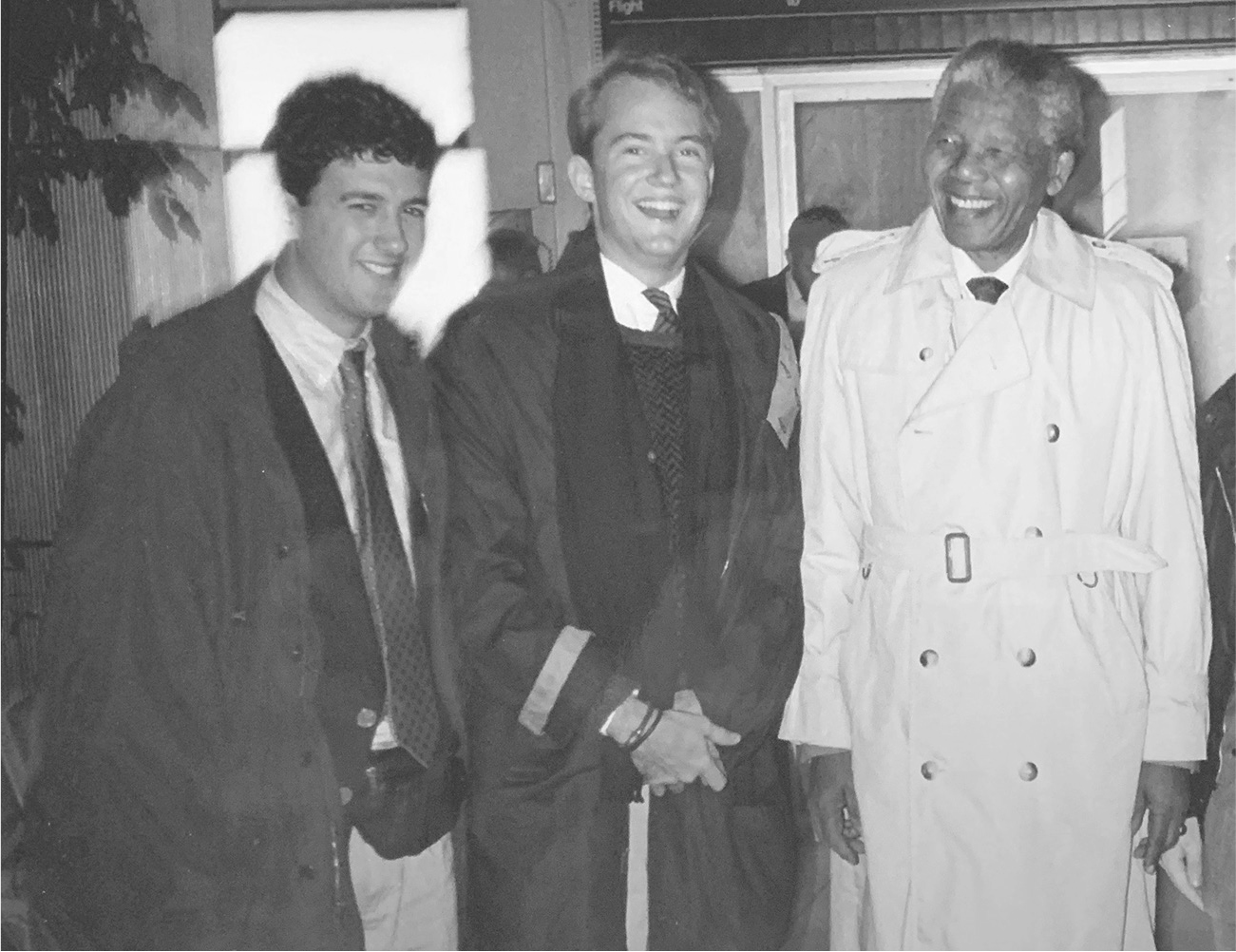
FIGURE 4.1. Michael Goldberg (left) and Evan Lieberman (center) pose with Nelson Mandela (right) in the Johannesburg airport when our flight to Cape Town was delayed on June 20, 1991. It was our second up-close viewing of Mandela, after a June 16 sighting in Soweto. Credit: Michael Goldberg.
We now know that the country made the transition to democratic government in 1994. Nonetheless, in order to fully appreciate what transpired during the first quarter century after Apartheid—the subject of all subsequent chapters—it is critical to put into context what was realistically possible and plausible from the vantage point of the BD period. That is, before democracy. And specifically, what were the social, political, and economic conditions leading up to the first multiracial elections?
I will not provide a remotely complete account of South Africa’s complex history, including the rise of and resistance to the Apartheid state, in this single chapter. Rather, I describe two sets of critical and related legacies that weighed heavily on South Africa’s future, including in the area that would become Mogale City.
The first is the construction of White government—a contested and several-centuries-long process of consolidating political power. There is no doubt that by the second half of the twentieth century, White South Africans had built a relatively strong and effective state, one that for many years promoted rapid economic development. And to a degree, this proved to be a fortuitous inheritance for the democratic era. Yet, it was an undignified development that excluded the Black majority and left indelible memories of poor treatment that would always be fodder for resentment. In creating vast inequalities between groups, it raised the stakes for subsequent political conflict. Moreover, the government deliberately fragmented the society, and political authority itself, leaving little obvious basis for future unification.
Second was the resistance movement, which of course was also quite successful in achieving its main goals, culminating in the dismantling of Apartheid. Moreover, many of the organizations and individuals central to the liberation movement led with a human rights orientation that provided a strong moral basis for the democratic order. However, the movement also became violent. Frustrated by the failures of diplomacy, many turned to a strategy that deliberately sought to undermine political order, and did so in ways that would reverberate even once the resistance campaign came to an end.
White Government
Perhaps it is trite to say this, but it is critical to spotlight a simple reality: the reason most White South Africans did not want to give up White rule is largely because this style of government delivered vast and secure material prosperity to them. When combined with a moral doctrine that justified racial hierarchy, White people could enjoy the good life, and feel good about it. And yet, the development of White South Africa came at the expense of respect for the dignity of Black people, who constituted the overwhelming majority of the population in the region.
While the origins of this system can be traced to European theories of racial superiority and the time before Dutch settlers arrived in the mid-seventeenth century, I focus on the development of the area that would eventually become Mogale City. As I mentioned in chapter 1, Afrikaners began to settle in and around the region as part of a mid-nineteenth-century migration from the southwest—the Great Trek. They encountered Black Africans in the area, including some who had been living there for centuries, and others who had arrived more recently, including through violent conquests of their own.4 Possessing greater military might, the Afrikaners quickly became politically dominant. Particularly after the discovery of gold, successive governments created institutions aimed at degrading and dehumanizing those who were not White or “European.”
In 1883, Paul Kruger, an avowed Afrikaner nationalist, became president of the Transvaal Republic,5 one of the four White-led governments that would eventually comprise the provinces of the Union of South Africa. Kruger had long professed a deep-seated racism, frequently referring to Black Africans as “savages” who ought to be ruled over with “justice and morality.”6 And this orientation proved highly compatible with the nascent mining economy of the late nineteenth century as companies demanded a steady stream of cheap labor. Kruger did not hesitate to impose new taxes or to facilitate aggressive labor recruiting practices to induce Africans to work the mines.7 The mining companies themselves offered Whites excellent opportunities for advancement, including to supervisory roles, while maintaining poor pay, harsh conditions, and professional stagnation for Blacks. And in 1895, acting on the behest of the mining industry, Kruger’s government introduced a set of laws that required Africans to hold special passes for work authorization or for any form of movement into the Witwatersrand, limiting the influx of Africans from rural areas and granting employers enormous control over their workforces.8 Such pass laws became a cornerstone of institutionalized White supremacy in twentieth-century South Africa.
From the start, life in and around Krugersdorp was racially segregated. Blacks recruited to work in the mines lived in compounds or dormitories, or in some cases squatted on White settlements,9 and all were required to shop at “native stores.” While many also participated in the often wild and lawless behavior characteristic of the mining town, they received a different brand of justice for their misdeeds: Black men were routinely apprehended, tried, imprisoned, and hanged for violent behavior, and they faced all-White juries, prosecutors, and judges. White men who committed violence against Blacks tended to be fined rather than imprisoned, and they frequently justified their actions as assaults on “laziness” and “insubordination” among local Africans, which in that context was accepted as a reasonable defense.10 In 1894, a Krugersdorp regulation prohibited Africans from walking on the sidewalks, a response to White complaints of being “jostled” on the pathways; and Whites began to demand separate queues in various public spaces. As early as 1895, White local leaders sought to keep Africans from the town center, especially from the sacred Paardekraal Monument.11
FIGURE 4.2. Map of two Boer republics and two British colonies (c. 1900).
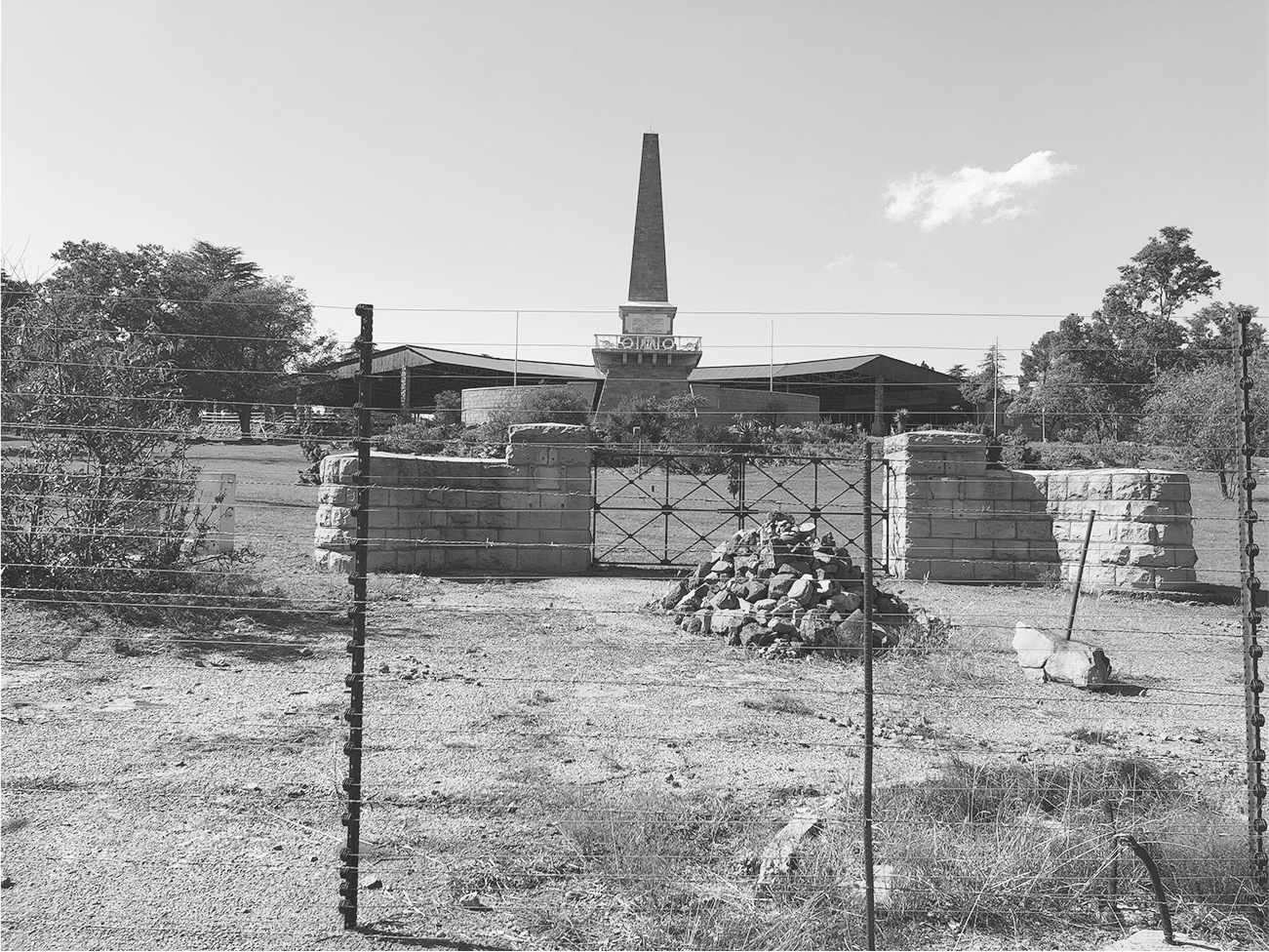
FIGURE 4.3. The original stone cairn created on December 13, 1880, in Krugersdorp by Boers/Afrikaners who sought to regain independence from Great Britain (foreground) and the Paardekraal Monument, which opened on December 16, 1891 (background). Today both are protected by electric fencing. Credit: Evan Lieberman.
Even amid shared anti-Black racism among European-descended people in southern Africa, there had never been White unity in the region. In fact, during the late nineteenth century, the pressing “race question” was the enduring conflict between the British and Afrikaners. Conflicts erupted over how to govern the highly profitable mining economy, and in 1899, the British Crown went to war with Kruger and the Afrikaner republics. In what initially appeared to be a profound mismatch between a global military power and a small, decentralized guerilla resistance, the Boer War turned out to be a bloody three-year conflagration and severely tested the prowess of the mighty British Empire.
Ultimately, the Afrikaners surrendered, but the epic battle ended with Black Africans—not even direct parties to the conflict—losing the most in the peace process. The British had previously appealed to potential Black soldiers that they should serve on their side because a decisive British victory would lead to much better treatment in the future.12 However, hopes for improved conditions were dashed as the 1902 treaty ending the war stated that “the granting of the franchise to the natives will not be decided until after the introduction of self-government.” For a place like Krugersdorp, this meant sustained exclusion, as Blacks had never had the right to vote there and would not get it now. Moreover, the new government enacted a new set of pass laws restricting African movement, and the mines cut African wages.13 Blacks were forbidden from residing in the White town except with special permission and the local government imposed a curfew prohibiting any movement during certain hours.14 It reflected just one of the many ways in which Black adults were treated in a childlike manner.
The 1909 South Africa Act establishing the new Union of South Africa largely sealed the fate of Black Africans and other people of color throughout the territory. First, only Whites—constituting less than 22 percent of the population at the time15—would be able to sit in Parliament. Second, in the new provinces constituted by the former Orange Free State, Transvaal, and Natal, only Whites would vote. And third, only in the Cape Province, at least temporarily, Blacks who met stringent qualifications would retain access to the vote, but this right would be short-lived and was removed with the 1936 Native Representation Act.16
Meanwhile, irrespective of race, no women would be allowed the vote, and I am not aware of any evidence that this was raised as a significant political issue.
Despite the economic costs of job reservations and residential segregation, the government soon committed itself to the approach. All the local White governments were authorized to do what was already being practiced in Krugersdorp under local laws: control the entry and exit of Black migrants into their towns and require Blacks to live in segregated areas.17 Other legislation codified protections for White labor with reservations for more skilled and better-paying jobs, so they would not face serious threats from an abundant Black African workforce.18 On the gold mines in and near Krugersdorp, where over 42,000 Europeans and over 319,000 people of color were employed in 1945, the wage gap was enormous: Africans working on the Witwatersrand earned approximately 42 pounds per year, while the average annual wage for Europeans was seven to ten times greater.19 During those early years, the government further legislated the “morality” of White supremacy with the 1927 Immorality Act, prohibiting sexual relations between Whites and non-Whites.
And yet it was only following the 1948 election of the National Party that the dystopian plan for Apartheid government was realized and the ideology of White supremacy was institutionalized in its most elaborate form. A month before the general election, the party’s leader, Daniel Francois Malan, criticized the ruling United Party government for failing to sufficiently regulate Black movement in the country, especially to the cities; for its neglect of the economy; and for liberal immigration policies—too many Black Africans coming in across the northern border. The “Nats” campaigned on White fears of a “Black peril” and concern for the welfare of poor Whites, a problem that was disproportionately prevalent among Afrikaners.20 Promoting such fear as justification, Malan’s party offered a “solution,” in the form of Apartheid: a series of far-reaching policies and practices that would more definitively realize the goal of a White South Africa.
The notorious Apartheid regime has reached such metaphoric status that it remains, even today, a label used beyond South Africa to describe unjust segregation, particularly in a manner that reinforces profound socioeconomic inequality. Within a few years, work, education, housing, landownership, and virtually every sector of society were regulated along racial lines in order to maintain benefits for Whites. The 1950 Population Registration Act required that all adults hold an identity card attesting to their racial classification, which itself would become a virtual internal passport for access to citizenship. In the rare circumstances when people did the same work, Africans earned substantially lower wages compared with Whites.21 Although education had never been truly integrated or equal, the Apartheid architect Hendrik Verwoerd endeavored a more thoroughgoing approach to institutionalize White supremacy. In a speech to Parliament, he targeted not just African students but also their teachers: “The Bantu [African] teacher … must learn not to feel above his community, with a consequent desire to become integrated into the life of the European community.”22 By one estimate, in 1953, the government spent 68 pounds per year to educate White students, 20 pounds for Coloured and Asian students, and just 8 pounds on African students.23
In just about every facet of life, Blacks faced higher costs and tougher constraints, and few earning and other opportunities. They paid higher food prices. They paid sales taxes in White Krugersdorp, which only contributed to the White tax base. They had little access to credit and were highly regulated in their economic activities by the White government.24
And yet, in order to begin to understand how any Black South Africans—particularly in modern Mogale City—could have recalled life under Apartheid government as even minimally acceptable in comparative terms (as discussed in the prior chapter), it is also important to recognize that the White government did provide some basic services. Starting in the 1950s and 1960s, like in several urban areas, the government built rows of very small houses, albeit initially without electricity or running water. Eventually, many Kagiso and Munsieville residents would gain access to running water, sewerage and refuse removal, postal services, education, and limited recreational facilities. The government developed an industrial zone on the edge of Kagiso, Chamdor, intended to keep Blacks out of Krugersdorp in line with a strategy of “separate development,” but it also employed thousands of workers.25
Whatever Black development might have occurred during the twentieth century in Munsieville and Kagiso, it was vastly overshadowed by the rapid increases in the quality of life enjoyed by Whites. Successive White governments throughout the twentieth century managed to build a highly effective state, one that helped the private sector prosper, particularly in the extraction of precious metals and minerals. The South African government developed one of the world’s most progressive and efficient tax systems, which in turn contributed to the government’s ability to maintain order, project power, and largely wipe out White poverty—which had been significant in the 1930s.26 GDP growth between 1960 and 1970 ranged from 4 percent to 8 percent,27 faster than that in the United States, France, and the United Kingdom, and if the goal was prosperity for Whites, Apartheid was extremely successful.
While the British Empire—epitomized by the politician and mining magnate John Cecil Rhodes—had technically won the war to control South Africa’s future, the soul of South African government became fully embodied in the fallen Afrikaner leader Paul Kruger. In 1967, the government treasury minted its first Krugerrand in an effort to market gold—and the country—to the wider world. This one-ounce coin, made almost entirely of pure gold, was a source of value, strength, and history. The front depicted Kruger’s full face and his long, lion-mane of a beard, shaven around the mouth, with no trace of a moustache. And the “rand” refers to the South African currency, which itself was named after the Witwatersrand, where South Africa’s world-class mining industry developed. It is hard to avoid the irony that this man—who sought to insulate himself and his people from the internationalist capitalist project of Rhodes and the British Empire—would adorn this coin, minted in the one true international store of value. The Krugerrand achieved iconic status, at one point accounting for 90 percent of the gold coins in circulation around the world.28
South Africa developed world-class infrastructure, a sophisticated financial sector, and a diversified economy. Throughout the twentieth century, White Krugersdorpers would increasingly enjoy paved streets, lovely houses, and an elected town council. It was not a place for the fabulously wealthy; it wasn’t filled with the famed “Randlord” mansions of Johannesburg’s leafy suburbs. Still, for the sizable White minority, it was comfortable living, largely unlike anything elsewhere on the continent north of the Limpopo River.
In its quest to reserve this bounty for Whites, the Apartheid government was wildly ambitious in its social and political engineering. The National Party developed and began to implement what came to be known as “grand Apartheid,” the creation of separate and independent homelands or Bantustans (literally, a home for Bantu people) for distinct Black African groups that, according to the White government, constituted distinct nations. The basic premise was that once a particular language or ethnic group had a corresponding government, individuals from that group would officially become citizens of that new country and be forced to forsake claims on the South African state. The plan did not take into consideration the fact that in many cases, no such “groups” existed in the sense that language was not tantamount to nationhood. Black African social and political organization in no way fit neatly into the categories that the Apartheid government wanted the world to believe existed, let alone was there a match between these language categories and the tracts of land designated as ancestral homes.
For the area around Krugersdorp, such a strategy implied that Tswana speakers, who had dominated the area long before Kruger’s arrival, would be assigned to a new country, carved from within South Africa’s borders, called Bophuthatswana. “Bop” was an absurd creation, and its arbitrary boundaries had no historical basis. In fact, because the South African government did not want to upset White property owners, it drew those national boundaries in such a way as to keep those Whites within South Africa. As a result, Bop consisted of nineteen noncontiguous fragments, some separated by hundreds of miles of South African land.29
By decree of the Status of Bophuthatswana Act of 1977, Tswana speakers in the area were overnight made into citizens of a strange new country that would not be recognized by any other state apart from South Africa.30 The South African government did not manage to move most of the tens of thousands of Tswana speakers living around Krugersdorp into this new country, but that was the plan. And it was certainly implemented at least in part, at great financial cost both to the government and to those who were moved: between 1960 and 1980, a total of 3.5 million people were resettled to Bophuthatswana, the Transkei, Ciskei, Venda, and other nascent homelands.31
Although foreign governments did not recognize the homelands as legitimate, these creations still proved consequential for the future in a number of ways. First, the homeland system fragmented the authority of government administration and gave rise to the development of a cadre of government leaders and bureaucrats who would become invested in their new jobs and, in some cases, develop an attachment to their proto-states. In fact, Bop’s president, Lucas Mangope, fiercely resisted the larger political transition and collaborated with White right-wing extremists to try to hang on to power in the early 1990s.32 And perhaps it is only fair to point out that during interviews, a few Mogale residents recalled Bophuthatswana with some fondness, as a place that was reasonably orderly and where education was valued. Of all the former homelands, Bop had the reputation of being the most efficiently administered.
FIGURE 4.4. Map of Bophuthatswana “homeland” in South Africa (c. 1980).
By creating separate homelands for particular ethnolinguistic groups, the government sowed the seeds of potential Black interethnic division. The noted legal and political scholar Donald Horowitz argued in his forward-looking 1991 book, A Democratic South Africa?, that the homelands reflected one important aspect of a multiply divided society. He concluded that “for the moment, it is obvious that, if attitudes are any guide, a nonracial society is not around the corner. Neither is a nonethnic society.” In turn, with respect to a democratic future, he warned of the “perils of wishful thinking” and the various ethnic and subethnic conflicts that might come to the fore in a post-Apartheid future.33
Resistance: Demands for Dignity and Ungovernability
The thoroughgoing and explicitly exclusionary nature of White rule gave rise to one of the most storied resistance movements in modern history. With clear hindsight, we can say that the movement was ultimately successful in bringing decisive change and bestowing an ideologically committed political leadership on the country. The liberation struggle articulated a set of values and demands that would shape many contours of the democratic era and can be used as a benchmark for success even today.
Yet, it is also important to recognize that the path to such change was itself divisive and, eventually, deliberately destabilizing. Any examination of life in South Africa in the post-1994 period must appreciate the quality and extent of the dangerous, frequently violent conditions and disruption of political order precipitated by the resistance campaign, all of which were like veritable land mines for future development.
Diplomatic and Intellectual Origins
Opposition to White rule began peacefully and diplomatically, frequently led by Black intellectuals arguing their case on the basis of appeals to the idea of universal human rights. The first, most concerted challenge to the Union government was ignited in 1912 by the proposal for a Native Lands Act. This policy promised to restrict Black African landownership to about 13 percent of the territory. A group of distraught, Black, mission-educated attorneys and tribal chiefs came together to strategize about how to block this draft bill; and they gave birth to the forerunner to the modern ANC in the form of the South African Native National Congress.
The now legendary Black intellectual, journalist, and eventual political mobilizer Solomon (“Sol”) Plaatje wrote of dashed hopes and humiliations in the face of the new Union’s approach to Black Africans. Born in 1876 to Tswana Christians who worked for White missionaries, for many years he had placed his faith in British promises of a more liberal order. Plaatje pleaded, “We have as much right as they to be governed on the same basis of humanity.”34 Plaatje became the first secretary-general of the organization and, as he did in earlier years, took the opportunity to travel to London and to appeal directly to the British, remaining ever hopeful that reason would prevail. He argued his case in the newspaper he edited, Tsala ea Bechuana, and his columns were reprinted in various White newspapers.35
And yet, the writing was soon on the wall that the new South African government would sacrifice prewar promises of racial inclusion for Blacks in favor of White unity.36 Plaatje recalled the “indescribable” disappointment following the passage of the Native Lands Act, which he politely depicted as “full of rude shocks.” He wrote, “Awaking on Friday morning, June 20, 1913 the South African Native found himself, not actually a slave, but a pariah in the land of his birth.”37
Notwithstanding such assaults, one of the steadfast contradictions of White rule in South Africa—which Plaatje himself embodied—was the persistence of a few key institutions and opportunities for Black advance that opened space for formulating coherent demands for political freedom. One institution in particular—the University of Fort Hare38—produced an unprecedented legion of visionary Black graduates. Missionaries established the university in 1916 on the site of a former British military stronghold in the eastern part of the Cape Province (today, the Eastern Cape) with just twenty students.39
One of the first African professors to join the faculty from Fort Hare’s earliest days was Davidson Jabavu, the son of a prominent political activist and journalist from Sol Plaatje’s era.40 Jabavu himself studied in London and the United States, including at the Tuskegee Institute in Alabama, the first institution of African American higher education. His wife, Florence Tandiswa Jabavu (née Makiwane), was a graduate of another noted missionary school, Lovedale College, where she briefly taught, and considered to be an educational equal to her husband, which their community viewed as an important attribute in matches.41
At Fort Hare, Davidson Jabavu wrote about the problems of racial segregation. He and the initially largely White faculty educated a remarkable abundance of South African liberation leaders, albeit with a range of perspectives about how to achieve liberation. These included Sol Plaatje’s cousin Zachariah Keodirelang “ZK” Matthews (an ANC leader and leading academic), Nelson Mandela,42 Robert Sobukwe (who would form the PAC, a breakaway organization from the ANC, one that emphasized “Africanism” over the ANC’s “non-racialism”), and Mangosuthu Buthelezi (who also began his political career with the ANC before founding and leading the IFP).
According to Mandela, it was at Fort Hare that he began his lifelong struggle with unjust authority. Despite having initially narrower ambitions of becoming a civil servant and reclaiming his family’s wealth and prestige, political engagement attracted him. For example, as a freshman he organized his fellow “freshers” to challenge a tradition that excluded their participation in community governance. He would only stay for two years, because in refusing to accede to an arranged marriage, he fled to Johannesburg. Nonetheless, at this missionary school he was first introduced to the ANC, the struggle against White supremacy, and his long-time friend and comrade Oliver Tambo.43
The small university’s reach into African liberation politics was astounding. For example, Desmond Tutu served as the school’s Anglican chaplain for a period in the 1960s. And although only approximately 10 percent of the 324 graduates in 1946 were women,44 some, including Vuyiswa “Tiny” Nokwe and Sally Maunye, emerged as dedicated freedom fighters during the decades of political struggle.45 And even far beyond South Africa, Fort Hare educated many of the continent’s liberation leaders. Seretse Khama (first president of Botswana), Julius Nyerere (first president of Tanzania), Kenneth Kaunda (first president of Zambia), Robert Mugabe (long-time president of Zimbabwe), and other prominent future dignitaries were all students there.46
Protest
While the ideational foundations for resistance—including calls for greater attention to human dignity—were established during the first half of the twentieth century, the opposition movement gained substantial momentum from the implementation of the Apartheid system. Three key protest events—all of which took place in relative proximity to greater Krugersdorp—proved critical: the launch of the Freedom Charter document at Kliptown, the Sharpeville protest and massacre, and the Soweto uprising.
The launch of the Freedom Charter was a peaceful and solidaristic declaration of goals and aspirations for liberation. Z. K. Matthews had proposed in his 1953 presidential address to the ANC’s Cape Province conference that there ought to be a democratic gathering to incorporate ideas about the type of change that was needed in the country.47 Two years later, the call for a “Congress of the People” materialized on June 26, 1955, in Soweto’s Kliptown, about twenty miles south of Krugersdorp. Approximately three thousand Black, White, Coloured, and Indian leaders and delegates from various liberation organizations gathered into a fenced-in open area, marking the most racially representative gathering in the history of the country. They took turns reading aloud the product of those solicitations, which crystallized a shared vision for the future, a demand for dignified treatment, and a fundamental reordering of an increasingly rigid racial hierarchy. The document was written by a small committee, including Matthews and others of various racial identities.48
The charter proposed, as a solution to the problem of racial oppression, a democracy rooted in non-racialism—that is, a universal humanism, rejecting the false biological notion of race.49 This idea, which also appeared in several speeches delivered by ANC leader Albert Luthuli, guided the ANC for decades. And yet, it also proved somewhat controversial because on the one hand, radicals deplored the explicit recognition of “all national groups and races” as being too close to Apartheid thinking,50 while other Black leaders rejected the inclusion of Whites in their resistance, arguing instead for a purely Africanist movement. Nonetheless, the idea of “non-racialism” captured the imagination of millions, remained central to ANC strategy, and won the sympathies of Black and White liberals inside and outside the country.
FIGURE 4.5. Proximity of politically relevant sites on the Witwatersrand.
The Freedom Charter made several explicit demands: to end segregation and discrimination; for equal rights to the productive resources of the economy and to land; to equal treatment before the law; and to rights to shelter, education, housing, jobs, and health care. These shaped the resistance agenda for decades to come. This impulse to more publicly and forcefully advocate for radical change began to permeate the lives of citizens who resented the system but did not yet fundamentally resist it.
It concluded:
THESE FREEDOMS WE WILL FIGHT FOR,
SIDE BY SIDE,
THROUGHOUT OUR LIVES,
UNTIL WE HAVE WON OUR LIBERTY
As the years dragged on without fundamental change, others who were active in the resistance movement called for more aggressive confrontation, resulting, quite notably, in the pass-burning protest in Sharpeville in 1960. In prior years, the South African government arrested millions of Black people based on invalid or unstamped passes or the failure to carry a pass—what had come to be known among Africans as dompas or “dumb passes.” On March 21, thousands of protesters—organized by Sobukwe’s PAC51—arrived at the Sharpeville police station without their passes, and some brought them simply to overtly destroy or burn them on the police premises. A scuffle prompted a violent police response against an unarmed crowd. Without warning to disperse, police fired hundreds of rounds aimed directly at the people who had gathered to protest. It was an unexpected massacre. Approximately 69 people died and 180 were seriously wounded.52 The massacre marked an entirely new chapter in the resistance movement.
The Turn to Violence
Even prior to Sharpeville, Nelson Mandela’s political star had been rising, and he increasingly promoted active defiance of the Apartheid regime. Frustrated by the lack of progress, he and others considered the possible need for a violent response. And finally in 1961, in the aftermath of Sharpeville, he joined other key ANC leaders in launching Umkhonto we Sizwe, “Spear of the Nation,” also known as MK, the militant wing of the ANC.53
On December 16, a day notable in various years of Afrikaner nationalist history including the 1838 victory at the battle of Blood River, the 1880 start of the First Boer War, and the opening of the Paardekraal Monument by Paul Kruger in 1891, MK introduced itself to the country with a series of bomb explosions in Johannesburg, Port Elizabeth, and Durban.54 Using homemade bombs, MK soldiers targeted what the famed resistance leader Joe Slovo called “symbols of the economy” like power stations and “symbols of oppression,”55 such as “Bantu Administration” offices. These locations were intentionally targeted while empty, as MK was at this time committed to only sabotage, as opposed to guerilla warfare, terrorism, or revolution, and the only known death that resulted was that of an MK soldier. The MK framed the turn to violence as a response to a “government policy of force, repression and violence,” citing the imposition of martial law and the violence of the Sharpeville Massacre.56 MK followed up with approximately two hundred similar attacks, intended—according to Mandela—to “bring the Government and its supporters to their senses.”57
Sobukwe’s PAC developed its own formidable underground military organization, Poqo, which was particularly strong around Krugersdorp in the Black townships of Kagiso and Munsieville. In 1963, four Poqo members were arrested for killing a Black police officer, a charge they denied.58 The “Munsieville Four,” as they were called, were tried and convicted of a politically motivated crime and sentenced to death. They appealed, arguing that they had killed no one and were fighting for land, but the appeal failed.59 The next year, on June 16, they were hanged by the White government, making them martyrs in their community.60
The White government spared no expense to capture MK members. This included increased spending on the police and military as well as expanding tools of control such as bannings and house arrests.61 It extended new powers to its security forces, including the right to detain and hold subjects for “one or more” twelve-day periods, without bringing them before the court.62 In 1963, the Apartheid government’s security forces tracked down and arrested sixteen MK leaders about twenty-five miles east of Krugersdorp who were hiding out in the Johannesburg suburb of Rivonia. Ten of its leaders, including Nelson Mandela, were tried on a variety of charges, including sabotage and conspiracy, in the Pretoria High Court.
From jail, Mandela became a global icon. At times the South African state government managed to convince a few Western leaders that he and the ANC were “terrorists.” But most of the world would recognize them as “freedom fighters,” and their incarceration and banning became lightning rods for opposition to Apartheid. Following Mandela’s arrest, his wife, Winnie Madikizela-Mandela, stepped up her own political activity and leadership, sometimes through violent insurgency.63
With the top ANC leaders all under arrest, the seeds of further Black resistance were more quietly sown in the development of a Black Consciousness movement, one that focused on Black self-reliance and the mental effects of racial domination. Its intellectual founder, Steve Biko—a man frequently likened to and surely influenced by Malcolm X—challenged the multiracial approach of the ANC. And these ideas and the organizations they engendered helped give rise to the ultimately critical political uprisings of the 1970s, including massive labor strikes and the Soweto revolt of 1976.64
Indeed, 1976 was a watershed year in South African political history, one that today connotes a single event: on June 16, thousands of students from Soweto-area high schools participated in what was planned to be a peaceful march and boycott against the indignities of a government decree that Black students learn in Afrikaans. Inculcated in the ideas of Black Consciousness, the student leaders hoped that their defiance would be recognized, and it was, perhaps beyond both their dreams and their nightmares.
One Mogale City resident living in Kagiso at the time recalled rising early in the morning to pick up students from various schools, organizing to march with placards in their hands. “We prepared ourselves for tear gas,” which was indeed used against the students. “But then the police started shooting. I remember when the police started shooting. We used the steel lids of the dustbins to protect ourselves.” The students resisted, many by throwing rocks, and the police escalated with live ammunition.
The extent of state repression put the country irrevocably on the global map of pariah states. One police station commander, Colonel Johannes Augustinus Kleingeld, later admitted to ordering the use of dog and baton attacks and to personally throwing three canisters of tear gas into the crowd and shooting a machine gun on the first day of the uprising.65 He was eventually absolved of responsibility for killing Hastings Ndlovu, the first casualty of that day, after shooting him at point-blank range. Furthermore, Malcolm Klein, a medical officer from the casualty unit at Baragwanath Hospital, testified that almost all the bullet wounds he attended to were above the belt.66 Police violence continued throughout much of the period of the Soweto uprising. In Alexandra, which experienced the second-highest levels, the local police killed 29 people on June 18 alone.67 Even a government investigation of the events between June 16, 1976, and February 28, 1977, indicated an official death count of 575 across various urban areas throughout the country.68 Of these deaths, at least 23 occurred on the first day and 176 in June 1976. The government’s report noted the police’s widespread use of “dangerous means” to counter protests and riots, including dogs, baton charges, and firearms.69
News of the event spread widely, and the horrific scenes of the confrontation were captured in still and video photography. One image in particular—the limp body of twelve-year-old Hector Pieterson being carried by an older activist—emerged as the iconic symbol of the entire standoff. No Apartheid apologist could deny the obvious: an innocent Black child had been shot dead by the Apartheid police. And although South Africans had just gained access to television earlier that year, broadcasts of government brutality aired overseas. It shook the world and reverberated back in South Africa as White business leaders and diplomats found themselves increasingly condemned and isolated by countries around the world.
In the years that followed, protests continued at Black schools. While Black education was already of poor quality, the loss of education for a large share of a generation of students following the 1976 uprising remains a powerful and painful legacy of that time.
The government aggressively cracked down on suspected political agitators. Within six months, many Kagiso community leaders disappeared. Six months after that, Rev. Frank Chikane, trying to investigate their whereabouts, found himself under arrest. Chikane had begun a new post ministering in Kagiso just one week before the Soweto uprising started. In the manner of Tutu before him, he became increasingly active in politics. After his arrest, he faced six weeks of interrogation and physical torture, including being forced to stand in one spot for fifty hours, sleep deprivation, and repeated assaults. He noticed that the man supervising his torture was a deacon in the White branch of his Apostolic Faith Church.70 Such cruelty became hallmark Apartheid policy. Famously, in 1977, Steve Biko died from injuries sustained from police brutality under state custody. Chikane managed to survive, despite being instructed by the police that he ought to take his own life. In January 1978, in Krugersdorp court, he was freed when an Afrikaans-speaking judge announced there was no case against him.71
By the 1980s, several strands of the liberation movement committed themselves to making the country ungovernable. Politicized youth, emboldened by the impact of the uprising, continued to mobilize, sometimes in quite destructive ways. For example, in 1984, Tshepo Nzwane—a local councillor I met in Mogale City in 2019—led the Kagiso branch of the Congress of South African Students and, in the tradition of the 1976 youth, repeatedly questioned authority at every turn. His teenage irreverence led him to take an action that he recalled to me with regret.
He explained that he was desperate to meet his heroes, including Nelson Mandela, who were serving their prison sentences on Robben Island. He could think of only one way to reach them.
I was still at school. But I made a wrong decision. That wrong decision was I bombed a school. I did a petrol bomb. Kagiso high school. The reason I did that, I wanted to be arrested so I could go and see them. To me, it was a big thing, so that I should know what has inspired them. I was advised that it wasn’t charged as being political. It was a public crime … because there’s no political motivation. They beat me. I stayed for three weeks unconscious, and then in the high court I challenged the statement that I was made to sign.
Nzwane was just sixteen when he was sent to prison.
I was the youngest person in South Africa to stay in detention in solitary confinement for two years. They linked me with a lot of terrorists. They couldn’t trust me because they knew I could mobilize because I used to mobilize people in detention. In 1985, I won the case in July. I was outside the head court and then [subsequently] arrested by someone from the special branch in Krugersdorp … and I was put back … for fourteen days, and then [the] state of emergency was introduced in 1986. Then I was in detention without trial. I would stay up until the end of the state of emergency. I stayed there 85, 86, 87, 88. [In] 89 I was released.
Even following De Klerk’s 1990 speech, conflict and violence persisted, including in the area around Krugersdorp. For example, national tensions between ANC and IFP supporters flared up in Kagiso, and deadly fights broke out.72 One of the worst such conflicts occurred in the Swaneville section of Kagiso in May 1991,73 when IFP supporters from one hostel attacked ANC members in their homes with knives, spears, and sticks. As many as fifty were killed in a massacre that was not widely reported at the time. Many others were left disabled, and houses, cars, and personal belongings were destroyed by fire.74
The PAC and ANC also remained mired in conflict. On the one hand, it was philosophical: the ANC “Charterists” subscribed to the non-racialist tenets of the Freedom Charter, while the PAC “Africanists” argued that Black leaders must champion the fight for dignity on their own. Conflicts could also devolve into parochial skirmishes at the local level. PAC leaders accused ANC members in Munsieville of systematically attacking them and driving out seventy of their members. In turn, the ANC accused the PAC of acting in bad faith and jeopardizing unity.75
Much of the anti-Apartheid movement was nonviolent, and I do not discuss here the diverse range of organizations and movements that played critical roles in the larger campaign. Such efforts were highly consequential, in fact sometimes far more central than the violent and exiled segments of the resistance movement, and they laid the foundation for potentially coherent governance during the post-Apartheid era. In particular, the umbrella organizations, the United Democratic Front (UDF) and the Congress of South African Trade Unions (COSATU), played key roles in mobilizing grassroots organizations and trade unions, respectively.76 Nonetheless, I have highlighted some of the internal divisions and the development of tactics that included promoting ungovernability and violence in order to make clear the extent to which these patterns were becoming ever more deeply rooted in the country, even as Apartheid was crumbling.
Existential Crisis and Counterresistance
By the late 1980s, South Africa was in a state of existential crisis. The government was under siege within and outside its borders, forced to defend a system decried almost universally as unjust. The South African Defense Force deployed increasing numbers of troops to fight in multiple conflicts in the southern African region, all related to the persistence of Apartheid.
Meanwhile ordinary White citizens had grown accustomed to the lifestyles afforded by a century of White government buoyed by a thriving mining industry. South Africa had become the most unequal country on the planet,77 and as Whites sat atop this steep socioeconomic ladder, many desperately wanted to hang on as they began to fear losing it all. In Krugersdorp, the town council tried to placate its White residents by sustaining various segregationist policies that were in retreat in many of the larger cities. For example, in early 1986, the council voted to maintain the local movie theater for “Whites only.”78 And it turned down the library guild’s request to desegregate.79 The best the Krugersdorp public library would offer was a separate location that Indians could use should the need arise.
Not all White Krugersdorpers resisted the pressures for change. Many were burdened by the fact that global sympathies were against them. Residents sent letters to the Krugersdorp News about the shame they felt regarding the segregationist policies as change was coming to South Africa. “Why can’t we watch movies together?” One resident highlighted that White and Black futures were intertwined and pleaded that if the policies didn’t change, the town would likely lose their one theater because American film companies were prohibiting the screening of films in segregated theaters.80
Some big businesses appealed to citizens to adapt. For example, Clem Sunter, a “scenario planner” for Anglo-American, one of South Africa’s largest mining houses, wrote a series of books and articles trying to map out the different courses that South Africa might take. In July 1988, he spoke to a packed Krugersdorp Town Hall, describing two possible outcomes, a “high road” and a “low road,” the latter being one of protracted conflict. Sunter asked whether South Africa might become a wasteland, whether the destruction of Beirut might be their future or something that resembled shared prosperity.81 The latter, he said, required compromise and for all actors to move to the “center.”
Despite the best efforts of Sunter and others, the compromise-breeds-shared-prosperity thesis did not capture everyone’s imagination. The intransigent spirit of Krugersdorp’s namesake very much lived on among a large number of Whites in the area, particularly in a man by the name of Eugene Terre’blanche, who founded the neo-fascist, Afrikaner nationalist Afrikaner-weerstandsbeweging (AWB) resistance movement in the early 1970s. Terre’blanche was born about eighty miles west of Krugersdorp. His grandfather fought in the Anglo-Boer War, and he served in the South African police force. He was fiercely disillusioned by the partial reforms being undertaken by the National Party, which he took as signs of unnecessary weakness. Like Kruger, he sported a thick beard and cut an imposing figure.
In February 1986, Terre’blanche called on AWB branches of the West Rand to form vigilante groups. In November of that year, he held a rally at the Jan Lotz stadium in downtown Krugersdorp. And where the National Party (NP) government had once been viewed as the champion of the Afrikaner, Terre’blanche now said that in its negotiations with the ANC, the NP had become traitorous. To this crowd he proclaimed that “the Government keeps giving to Blacks and the Blacks keep destroying.”82
Terre’blanche’s calls to action quickly translated into bouts of devastating violence: Whites bludgeoned a Kagiso man to death and bodies of Blacks were burned beyond recognition. Terre’blanche had previously been dismissed as a joke—a backward, harmless extremist—but he became very real, arriving with a cavalry and the banner of his AWB, eerily reminiscent of a swastika.83
Terre’blanche’s organization remained outside formal politics, but in 1982, the right wing of the National Party broke off, and its dissidents formed the Conservative Party (CP). As the prospect of the end of Apartheid as they knew it began to come into focus, Terre’blanche and his sympathizers in the Conservative Party began to discuss the idea of an inverted homeland system—one in which Afrikaners would wall themselves into their own Volkstaat.84 In essence, they wanted a return to the Boer republics of the type Paul Kruger had once governed.
By 1992, a majority of Whites nationwide said they supported De Klerk’s efforts—a sentiment that the state president elicited by holding an all-White referendum in which two-thirds of voters ticked “yes” next to the question, “Do you support continuation of the reform process which the State President began on 2 February 1990 and which is aimed at a new Constitution through negotiation?”
However, many did so begrudgingly, and a large minority was fully opposed, especially in Krugersdorp. In fact, a week after De Klerk’s speech releasing Mandela, the CP-dominated Krugersdorp council voted to persist with its segregation policies, despite being aware of the economic costs this might impose. It resolved, by a vote of 7–4,85 to keep the library and a health clinic reserved for Whites only.86
Krugersdorp’s local extremists began to use their stage to attract national attention. First, neo-Nazi Terre’blanche rode through Krugersdorp on horseback to remind potential followers and opponents of a powerful legacy of guerilla warfare against British and various Black African groups. Violence followed. In 1993, eight AWB members set up an unauthorized roadblock in Krugersdorp, murdered four Blacks and injured six others, and gruesomely cut off the ear of one of their victims as a trophy that they displayed to their commander.87
Some set their sights on much bigger targets. The most pivotal would be the assassination of fifty-year-old Chris Hani. On April 10, 1993, Janusz Waluś, a far-right Polish immigrant, shot and killed the beloved ANC and MK leader, also an alumnus of Fort Hare. Waluś and a man named Clive Derby-Lewis were imprisoned for his murder. Derby-Lewis was a CP politician from Krugersdorp who had previously expressed his desire to preserve Afrikaner supremacy by declaring support for the forced removal of Black Munsieville residents to make way for the expansion of the White Dan Pienaarville suburb.88 He had even announced he would stand for office in the next election to fill a vacant seat on the Krugersdorp council.89 However, the murder in which he conspired had exactly the opposite effect compared with what he had intended for the future of White South Africa.
Nationally, Hani’s death put the country back on the edge of unraveling. Hani had been a revered leader of the liberation movement, particularly among the more radicalized youth, and prior to the unbanning of the ANC frequently trained outside the country as an MK operative. When he returned, he took over the leadership of the South African Communist Party (SACP) and, like Mandela, favored suspension of the armed struggle in order to negotiate peace. After his death, protests erupted and Mandela, still negotiating with the White government, pleaded for calm. But if there was a silver lining to Hani’s tragic death, it was that it hastened the agreement on the timing of the first multiparty election, quickly declared to be in April 1994.
Many White Krugersdorpers still wouldn’t relent, and some claimed that Derby-Lewis was “framed” to ensure he didn’t get elected to the council.90 His wife, Gaye, argued against the “tyranny of the ANC” and called for a White resistance movement that would include cutting power and stopping trains.91 But such calls fell on increasingly deaf ears. Derby-Lewis and Waluś were both sentenced to death. (Because the death penalty was abolished in 1995 under ANC government, both sentences were later commuted to life in prison.)92
Predictions and Prognostications
By the late 1980s and early 1990s, predictions, opinions, and prognostications for the future of South Africa were conflicted and divided. One thing was certain: no one shared the optimistic euphoria of the wave of African independence from the 1960s. In those days, the promising rise of inspiring nationalist leaders in Ghana, Tanzania, Nigeria, and other countries across the continent along with first elections following the departure of colonizing Europeans were followed by decades of political and economic disarray and the collapse of democratic hopes. And indeed, it was those very failures that the White South African government had long and cynically trumpeted as a raison d’être for their sustained rule: those Black Africans can’t govern themselves, they argued.
As balanced pundits noted in the early 1990s, the South Africans certainly had several things on their side. One, ironically, was the cautionary tale of these prior failures.93 They could now more carefully consider the rules of engagement and the possible pitfalls of particular concentrations of power. Few would take for granted that the end of one unjust system would necessarily herald something better.
Moreover, South Africa boasted substantial economic resources as an Upper-middle-income country; many sectors of the government functioned well; a strong and vibrant civil society had emerged in the wake of the anti-Apartheid movement; and it had a deep class of liberation leaders, thoughtful and demonstrating strong commitment to broad principles developed over decades of struggle. Along with other speeches and documents, the Freedom Charter made clear a set of goals and aspirations for democracy, dignity, and development.
On the other hand, the challenge of managing ethnic and racial diversity in various parts of the world offered discouraging precedents of what could go wrong. For example, the other major political liberalization of the 1990s, which itself contributed to change in South Africa, was the dissolution of the Soviet Union. And as part of that transition, multiethnic Yugoslavia came apart in bloody conflict. Between 1991 and 1995, over 300,000 people were killed in former Yugoslav republics through conventional warfare and deliberate ethnic cleansing.94 The country was eventually divided into ethnically distinct countries, ironically, the very aspiration of the original Apartheid project.
In early April 1994, in the small central African country of Rwanda, a horrific tragedy unfolded. In a place that had once been lauded for its developmental prowess, the indignities of a minority having ruled over a majority were settled with ruthless violence. Hutu extremists murdered as many as 800,000 Tutsis in an intense three-month period, and the conflict, born out of decades of violence, displaced at least a million others, making them into refugees in nearby countries.95
Moreover, the United States remained mired in racial conflict. In most states, cities, and neighborhoods, Blacks and Whites lived very much apart, and huge disparities in quality of life persisted on just about every dimension. In 1992, twenty-eight years after the passage of the Civil Rights Act, sections of Los Angeles erupted in violent protest after a jury acquitted four White police officers for yet another case of excessive force against an African American man—in this case, a man named Rodney King. Because the incident had been documented on videotape—at a time prior to the ubiquity of cellphone-based cameras—the gulf between crime and lack of punishment for officers was plain for all to see. Dozens were killed and over two thousand injured in the aftermath.96
What kind of shared future could there be in a place like Krugersdorp and its surroundings, where a White local politician had, just one year earlier, been an accomplice in the assassination of a key ANC leader? Where the White council, with popular support, had for so long rejected the idea of even sharing a movie theater, let alone the council chambers, with people of color? Where a very visible White minority lived in nice houses, many with cars and lifestyles familiar to a European town, while the Black majority lived mostly in a mix of very small homes, with few services, many in iron shanties? On just about every dimension, these groups were worlds apart. And the people of this town, let alone the country, were no strangers to violence.
In the afterword of his book After Apartheid: The Future of South Africa, penned in the early 1990s, the Economist reporter Sebastian Mallaby captured the sentiment of many observers when he wrote, “It is easy to be glum about the future of South Africa.” Presciently, he pondered,
Twenty years from now, today’s pessimism may seem vindicated: if rich America has failed to cure the poverty of the underclass, there seems little chance that South Africa will. And yet there is a danger in despondency, for it may obscure much of what is good. Measured against the high spirits of Nkrumah’s generation, South Africa will indeed fail. Measured against more reasonable yardsticks, there are grounds for hope.97
In the context of the turbulent and frequently violent politics grabbing the headlines, Whites and Blacks living in South Africa proper, and in its nominally independent homelands, began to prepare for the future, however uncertain it seemed. Whites were pessimistic: in 1993, in a national poll, 65 percent predicted they would be “discriminated against” by a non-White government, with less than 20 percent predicting they would be treated fairly. In fact, the majority of Whites surveyed predicted the economy would get worse, that they would become poorer, that there would be more violence, that they would be less secure, that they would be afraid to criticize, and that there would be higher unemployment. In a follow-up survey taken within a year (of a different random sample), the majority of Whites predicted chaos, autocracy, and violence.
Unsurprisingly, the majority of Blacks surveyed about their own futures expressed exactly the opposite expectations. About 84 percent predicted that under the future government, they would be treated “fairly.” Moreover, most felt they would be more secure and more free to criticize and believed that the state would be strong. More than four times as many Blacks said they believed they would be richer (44 percent) in the future compared to those who predicted they would be poorer (11 percent). By contrast, 62 percent of Whites felt they would become poorer and just 4 percent imagined they would be richer.98
Black sentiment was almost surely too hopeful and White sentiment too pessimistic. But the future was coming, including to Krugersdorp, Kagiso, Munsieville, and the farms of Muldersdrift, where Blacks had never known social, political, or economic equality. The formerly powerless were about to see whether power, attained through democratic means, might help them realize the aspirations of the Freedom Charter, of those who burned their passes at Sharpeville, and of the youth who rose up in Soweto, let alone the likes of Nelson Mandela, who continued to echo the sentiments he expressed at the trial that landed him a twenty-seven-year term in prison. The coming election would mark the most profound political watershed on southern African soil since the formation of the Union in 1909, and perhaps even since the arrival of Dutch settlers in 1652.