
Acknowledgments
The intellectual spark for this volume came from events organized by the editors in the spring of 2009 on the theme of “the secret spaces of early modern Europe.” The first of these was a symposium held at the University of Southern California under the auspices of the USC-Huntington Library Early Modern Studies Institute, the Visual Studies Graduate Certificate Program, and the Art History Department. The second was a panel at the College Art Association’s annual meeting. We would like to thank the speakers, discussants, and audiences of these events for the vibrant exchange of ideas fostered on these occasions. Bruce Smith especially provided a response to the papers presented at USC, which helped to determine the shape of this volume. We are particularly grateful to Peter Mancall for supporting the symposium with funding from EMSI and to Amy Braden for her hard work ensuring that everything ran smoothly.
The editors would like to thank Stephen Campbell for his insightful comments on an earlier draft of this manuscript, and additionally Jo Joslyn, Sheryl Reiss, and Rebecca Zorach for assistance and advice along the way. Carolyn Murphy deserves our gratitude for helping to ensure that the contribution of Henry Dietrich Fernández saw publication here. Michael Wolfe and the anonymous readers for Truman State University Press provided numerous invaluable suggestions. We thank as well Nancy Rediger for her enthusiasm for the project and Barbara Smith-Mandell for her careful and attentive work in bringing this book to print.
We thank, above all, each of the contributors to this volume, without whose hard work and generosity of ideas this book would most surely not exist.
—————
Sean Roberts is grateful for the support of USC’s Art History Department, and especially to Nancy Troy for her encouragement of this project. The Provost’s Office provided financial support for publication through the Advancing Scholarship in the Social Sciences and Humanities program. The students of several graduate seminars, including Jeremy Glatstein, Ellen Dooley, Sean Nelson, and Rachel Amato provided thoughtful responses to both the introduction and Dr. Roberts’s essay. Alexander Marr and Vera Keller provided the opportunity to present material related to this book at the EMSI symposium, Ingenious Acts, in 2011. Likewise, Lilliana Leopardi and students at Chapman University offered a valuable occasion to discuss early modern secrecy. Along with those already mentioned, thanks are due to Eunice Howe, Naoko Tahatake, and the anonymous readers of a related article published in Renaissance Studies. The British Museum, National Gallery London, Getty Museum, and Biblioteca Nazionale Braidense generously granted permission to reproduce works in their collections.
For assistance and suggestions for both the introduction and his essay, Tim McCall would like to thank the faculty forum of the History Department of Villanova University, in addition to audiences at Rider University, Bowling Green State University, the University of Southern California, and the Penn Humanities Forum of the University of Pennsylvania. In particular—and in addition to the coeditors, contributors, and others named above—gratitude goes to Jennifer Borland, Adriano Duque, Campbell Grey, Margaret Haines, Jennie Hirsh, Marc Gallicchio, Marco Gentile, Adele Lindenmeyr, Cara Rachele, Sindhu Revuluri, Ingrid Rowland, Paul Steege, Wendy Steiner, and Alessandra Talignani. For important assistance with images, thanks are due as well to Peta Motture, Nick Humphreys, Laura Basso, Chiara Burgio, Francesca Tasso, and Annarita Ziveri. Financial support was provided by the History Department and the Office of Research and Sponsored Projects of Villanova University.
Giancarlo Fiorenza is indebted to Linda Halisky and Susan Opava, two former deans at California Polytechnic State University, San Luis Obispo, for their generous support of his research. A State Faculty Support Grant provided financial assistance for his contribution to the volume. Charles Dempsey, Paul Manoguerra, and Alexander Nagel kindly read earlier versions of the essay, while colleagues in the Department of Art and Design lent a patient ear and offered encouragement and sound advice. For the images, Sheryl Frisch was always quick to help.
Henry Dietrich Fernández passed away in September 2009. The editors wish to dedicate this volume to Henry in memory of his scholarship, intellectual curiosity, and collegiality.
[1]
Timothy McCall and Sean Roberts
Secrets in all their variety permeated early modern Europe. From the whispers of ambassadors at court to the emphatically publicized books of home remedies that flew from presses and booksellers’ shops, women and men were bound in a web of arcane and privileged knowledge. Secrecy, of course, is hardly an early modern invention. The notion, most expansively construed, that knowledge must be revealed or unveiled, that signs and symbols stand at a threshold to be peeled back by probing eyes and minds, is an integral part of an intellectual tradition that stretches back at least as far as Egyptian and pre-Socratic Greek thought and encompasses medieval exegetes and humanist poets alike. This volume, however, examines characteristics of secrecy rooted in the particular intellectual, visual, and social conditions of European cultures between the fifteenth and seventeenth centuries. Novel forms of erudition (humanism foremost among these), a certain fluidity between conceptions of public and private spheres while rigid stratification of class and rank remained entrenched, and a rapidly changing fashioning of selves spurred by unprecedented religious upheaval all might be seen as separating an early modern culture of secrecy from its predecessors and successors. Perhaps what most characterized early modern secrets, however, was the sheer quantity and vibrancy of the material and visual culture that inspired and sustained performances of secrecy. Arcane, erudite, and sometimes perplexing images and symbols were frescoed on the walls of princely palaces, woven in the threads of lavish tapestries, and emblazoned in ink and paint on the printed and manuscript pages that filled the studioli and cabinets of scholars.
Art historians, literary scholars, and historians have long labored to decipher the hidden contents of Renaissance words and images. More recently, scholars of medieval and early modern Europe have begun the crucial work of anatomizing secrecy, of disarticulating secrets to understand how they work. They have focused increasing attention on secrecy as a driving cultural force, pointing to its centrality in milieus ranging from alchemy to statecraft, medicine to theater.1 A broad range of disciplinary concerns has motivated these reinvestigations in fields from the history of science to anthropology and literary studies. While approaches have been as variegated as the objects of their inquiries, these reconsiderations of the clandestine have been united by a [2] commitment to look beyond the “contents” of secrets to shed light on the act and means of their disguise and revelation. In some cases, the secret itself gained meaning by the act of being hidden and excluded from certain audiences. In other cases, the very public presentation of information as having been previously occluded served to augment its significance. A unifying principle of much recent scholarship investigating secrecy is that the revelation of secrets was as significant and efficacious as their initial invisibility or hiddenness.
Among the best-known early examples, though hardly a unique starting point for Renaissance conceptions of secrecy, is Petrarch’s enigmatically named Secretum (The Secret). This text, comprised of three dialogues between the fourteenth-century Italian poet and the Latin church father Augustine, can tell us a great deal about how such secrets work. Petrarch explained the title of his work with a command directed to the text itself: “So, little book, I bid you to flee from public places. Be content to stay with me, true to the title that I have given you. For you are my secret, and thus you are titled. And when I think about profound subjects, speak to me in secret what has been in secret spoken to you.”2 The lessons proffered in the conversations that follow were not usefully secret in the way that battle plans, libelous rumors, or alchemical recipes might have been. Yet Petrarch’s invocation of secrecy was nonetheless tremendously significant in the clever way he emphasized moral reflection and exercised the faculty of personal judgment. The poet designated his text as a secret and thereby established a privileged community of readers, distinguished by their virtuosic erudition, their discretion, and their ability to comprehend spiritual truths best hidden from the prying eyes of the uninitiated.
The revelation and withholding of secrets, as Petrarch’s Secretum demonstrates, have often served as techniques not only of community building but, equally, of exclusion.3 A seventeenth-century Londoner coming home from the bookshop, eager to learn the carefully guarded secrets of fish, or a print collector in Nuremberg probing the enigmatic polygons and arcane glyphs of Albrecht Dürer’s Melencolia I (fig. 1) each could have imagined him or herself as possessing information hidden from others.4 If we say, “you, dear reader, we have a secret to tell you, something that no one else knows,” what information we might have for you could very well be less significant than the sense of importance you no doubt feel at being included in our intimate group, and less efficacious than the distinction and privilege granted to you at the expense of everyone else not fortunate enough to have picked up this volume. In the early modern period, no less than today, the keeping and telling of secrets were communicative acts, and the sharing, offering, and hiding of such secrets acted as a means of distinguishing between, excluding, and producing publics along an axis of criteria ranging from education and social status to gender and age.5
This image is available in the print edition
FIGURE 1. Albrecht Dürer, Melencolia I, 1514, engraving, London, British Museum.
© Trustees of the British Museum.
As Karma Lochrie has shown in her groundbreaking study Covert Operations: The Medieval Uses of Secrecy (1999), the “act of secrecy . . . is a social one that draws boundaries between ‘those who [4] ought to know but do not’ and those who know and distributes power between them.”6 William Eamon’s landmark Science and the Secrets of Nature (1996) has called needed attention to the ways in which information available to any literate European of the sixteenth and seventeenth centuries could be effectively framed as “hidden” knowledge in books like Alessio Piemontese’s Secreti (1555).7 Allison Kavey has argued that these only nominally arcane tomes moved rapidly beyond the continent, spawning a veritable industry in England as well.8 The seeming paradox of such open secrets is announced to all, boldly proclaimed in printed books like Thomas Johnson’s Cornucopiae (1596).9 The first folio of Johnson’s book promises to reveal to readers the “rare secrets in man, beasts, foules, fishes, plantes, stones, and such like.” Commonplace and often hopelessly outdated descriptions of plants and animals are presented to inquisitive readers as privileged arcana. The cultural or artistic currency of secrets often existed in their disclosure, and the keeping and sharing of secrets forged social bonds and ultimately engendered exclusive (or more usually semi-exclusive) communities of the knowledgeable.
Secrecy was and remains not simply a matter of differentiating public from private information. Secrets, of course, require disparate publics that are socially demarcated; they also require the construction of boundaries that can only be actualized by their crossing. Exclusion, distinction, and privilege are amplified through boundaries that many recognize but that few can pass through, or by boundaries that themselves suggest a plausible fiction of mediated traversal.10 One such boundary—or better, a visualized policing of a barrier that is conspicuously difficult to cross—can be found in the cadre of guards standing atop the steps leading into the court scene of Andrea Mantegna’s Camera Picta, as Evelyn Welch has perceptively suggested. “Swaggering footmen” dressed in expensive brocades mediate access to the marquis of Mantua, Ludovico Gonzaga, by blocking the stairs and reaching toward (either gesturing while speaking with or perhaps aggressively pushing back against) would-be visitors (fig. 2).11 Courtiers pleading their case seem visibly anxious to surmount the stairs, while an armed sentinel nonchalantly turns his head to keep an eye on the negotiations. Those who viewed these frescoes would have traversed actual boundaries and barriers (closed doors and similar guards at gates and stairways) and, “admiring the images of those refused imagery, their own sense of access would have been reinforced.”12 Visitors to the room would have enjoyed this pointed representation of exclusion and admission, gaining pleasure from the recognition of their own exceptional access, akin to the satisfaction experienced today by those who move quickly—and appreciate that they themselves are being seen moving—past the velvet rope. Such pleasure is heightened by the knowledge that others, whether less fortunate, esteemed, or fashionable, were left behind to wait in line and watch this conspicuous exercise of privilege, not unlike those at the bottom of the steps in Mantegna’s fresco. Other courtly frescoes might have similarly visualized exclusion in fifteenth-century Italy; particular courtiers [5] (camerieri non da camera) who were by definition not admitted into Galeazzo Maria Sforza’s interior rooms in Pavia without special permission were to be depicted in frescoes significantly located in an antechamber. These images thus would have articulated, simultaneously, these courtiers’ distinction and their “status of exclusion.”13
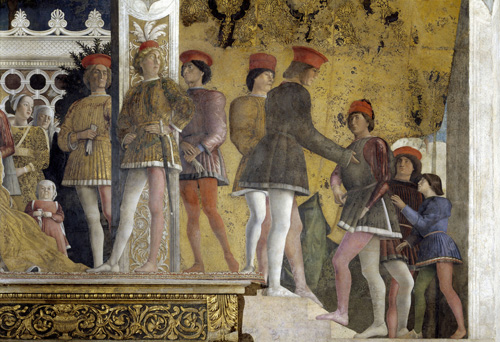
FIGURE 2. Andrea Mantegna, Footmen Regulate Access to Ludovico Gonzaga, detail from the Camera Picta, 1465–74, fresco, Mantua, Castello di San Giorgio.
Scala / Art Resource, NY.
The secret whispered into the ear of Ludovico Gonzaga by a trusted segretario (secret keeper) would have aroused interest among those not privy to the exchange (fig. 3).14 A number of questions might have followed. What could the secret be, one so consequential that it must be kept from the rest of the otherwise exclusive company of the Gonzaga and their courtiers? Who is this man flaunting his influence and access in front of audiences fictive and real, obtrusively communicating to us that he possesses sought-after information? The proximity to the prince enjoyed by this fellow—sometimes identified as Marsilio Andreasi—signified prestige and favor in early modern courts, whether in idealized representations of hierarchy such as Mantegna’s frescoes or in [7] the performance of court rituals as varied as hunting excursions, the distribution of alms, or the prince’s morning routine of dressing.15 Just as near to Ludovico is the canine courtier Rubino, no doubt the most relaxed soul in this image of the Gonzaga court and allowed a physical vicinity to his prince that would make even the most confident courtier jealous.16 Beloved animals often were rewarded with remarkably unfettered access within the closed and guarded doors of aristocratic palaces; apertures were sawed into the doors of Ercole d’Este’s rooms in Ferrara’s Palazzo del Corte, for example, so that his cats could come and go as they pleased.17
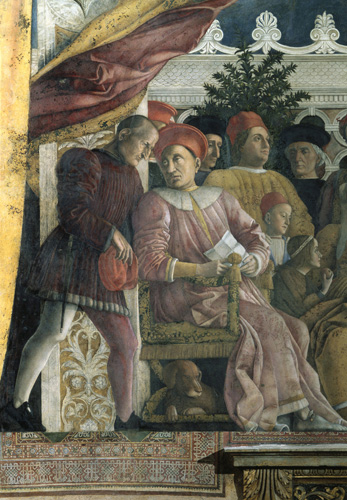
FIGURE 3. Andrea Mantegna, Ludovico Gonzaga Confers with a Trusted Secretary, detail from the Camera Picta, 1465–74, fresco, Mantua, Castello di San Giorgio.
Scala / Art Resource, NY.
The diverse case studies in this volume are united by a shared attention to the performance of secrecy and the rules that governed such performances in early modern Europe—what we identify as secrecy’s rhetorics. Karma Lochrie characterized secrecy as “a manner of rhetoric,” and it is this tantalizing observation that, in part, suggested the shape this book has taken.18 Like Lochrie, we are determined not to ask what in particular early modern Europeans kept secret, but rather to investigate the communicability of these acts and the peculiarly similar means by which staggeringly diverse sorts of secrets were kept and told. For this reason, the plural “rhetorics” seems best suited to signify practices governed by rules whose operations were circumscribed and conventional, yet hardly mechanistic or monolithic.19 We treat the secrets reliant on these rhetorics as operations, performances, and processes, as well as objects. Structurally, we understand secrecy to function dialectically, to hold in solution the indissoluble terms of binaries including keeper/teller, hidden/revealed, and excluded/included. Rather than tell secrets, we aim to elucidate secrecy, and we intend this difference to be clearly more than semantic.
In calling attention to the conventional nature of many early modern secrets, we must, however, be vigilant that we do not fall into a false dichotomy. In designating secrets as rhetorical we do not intend to signal that they were in any sense meaningless. There is a danger in associating “rhetoric” with its frequent companion “mere.” Michel de Certeau defined the secret as a particular sort of “utterance.” Like any speech act, a secret is “addressed to someone and acts upon” that person.20 Even the most conventional of written forms is capable of inciting social action and exerting literary influence. This lesson has been aptly demonstrated by Ronald Weissman’s studies of “merely” rhetorical Renaissance confraternal sermons. Once dismissed on account of their strict adherence to convention, such sermons serve in Weissman’s analysis both as dynamic agents in their own right and as rich sources for fifteenth-century Florentine attitudes on a wide array of topics.21
Likewise, the conventional nature of secrecy hardly rendered secrets hollow. Lorenzo Lotto’s esoteric, hieroglyphic intarsia panels covering scenes from Jewish scripture at Santa Maria Maggiore in Bergamo, by both concealing and revealing essential sacred truths, manifest and [8] heighten the viewer’s obligation to uncover biblical secrets through exegetical erudition and mental effort.22 When the papal secretary Paolo Cortesi recommended that rooms should be decorated with “riddles” and “fables,” it was because he believed that the mental labor of uncovering and interpreting secrets “sharpens the intelligence and [inspection of] their learned representation fosters the cultivation of the mind.”23 Even carefully guarded state secrets made use of these conventions, while apparently meaningless secrets could be used to erect very real barriers to social access for those situated at the edges and margins of society. The rules that governed secrecy were thus emphatically social. Perhaps most importantly our contributors ask who is included and who excluded when things are secreted. De Certeau observes that a secret “repels, attracts, or binds the interlocutors.”24 We investigate who these bound, ensnared, and curious interlocutors might have been in early modern Europe. That is, whom is the secret kept from and with whom is it shared? In place of seeking knowledge of secrets, the authors of these essays begin by examining to whose benefit (and just as importantly to whose detriment) secrets function. We consider asking “cui malo?” to be as productive as inquiring “cui bono?”
A fifteenth-century example will perhaps help to give some solid ground to these observations. The cartographic information found on early modern maps was often largely derivative and was frequently copied directly from previous examples. Nonetheless, under certain circumstances, even evidently conventional maps took on the status of valuable and dangerous secrets. A poignant illustration is provided by a map supposedly carried by the sculptor and medalist Matteo de’ Pasti, dispatched to Constantinople in 1461 from Italy’s Adriatic coast by Sigismondo Malatesta, lord of Rimini. Sigismondo had entered into diplomatic correspondence with the Ottoman Sultan Mehmed II the previous year and agreed to send Matteo in response to the sultan’s request for an artist to paint and sculpt his likeness. The sculptor’s ship, however, was detained en route when it stopped off in Crete and Venetian authorities on the island arrested Matteo. According to a contemporary report they confiscated a map he carried, along with a manuscript of Roberto Valturio’s De Re Militari, intended as gifts to Mehmed, deeming these to be strategically valuable.25 Possession of this map apparently rendered Matteo a spy in the eyes of the Venetians, yet there can be little question that the image—never identified by modern scholars—was of a wholly familiar sort to cartographically savvy Venetian and Ottoman viewers alike. Mehmed’s library included several Italian maps, a fact well known to the Venetians who had themselves provided him with several as diplomatic gifts in previous decades.26 Maps thus functioned as secrets by mutual agreement and recognition. Such an arrangement allowed Sigismondo to communicate his desire for access and intimacy with the sultan, and it allowed Venetian officials to take that arrangement seriously, flexing their muscle as arbiters of diplomatic relations in the eastern Mediterranean. De Certeau called [9] secrecy “a play between actors,” and this performative aspect is laid bare in the case of these cartographic secrets.27 Yet if secrecy was a kind of play, it remained one whose consequences were felt long after the curtain had fallen, particularly by those like Matteo de’ Pasti caught in the margins that such boundaries between inclusion and exclusion created.
In calling attention to how secret keepers and sharers employed these valuable commodities, we are not recognizing something that our simpler early modern cousins accepted without comment. John Florio, author of the popular bilingual English-Italian vocabulary of 1598, defined secreto as “secret, close, hid, concealed, privy, separate, solitarie, all alone, privitie.”28 This combination of the close, solitary, and separate makes explicit the simultaneous invocation of distance and proximity, occult and clandestine, that is at work in early modern visual productions and built environments. Whether in explications of statecraft, natural philosophy, or commerce, moreover, early modern Europeans openly avowed the role that the visible control of access could play in constructing value.29 Niccolò Machiavelli’s Il Principe is only the best known of numerous period musings on statecraft that recommend secrecy (or the appearance thereof) as effective strategies of rule. Crucially, such masquerade serves the prince not by concealing dangerous truths but by heightening the charismatic pomp of dissimulation.30
The widespread reliance of playwrights on dramatic irony—the narrative conceit by which information known to the audience is concealed from characters on stage—serves as another salient example of secrecy’s performative manifestation in early modern European culture. Though such devices were far from uniquely early modern constructions, their prevalence increased markedly in the period. Peter Hyland, for example, has recently explored the rising prominence of characters recognized as dissimulative on the early English stage.31 The rapidly developing comedies of early modern Italy likewise laid bare the performative function of secrets through the figures that Jackson Cope called “secret sharers” in his foundational treatment of the plays of Machiavelli and his successors.32 Many readers will be familiar with this mechanism at work in some of Shakespeare’s best-known comedies. The narrative action of Twelfth Night, for example, hinges on a triple occlusion whereby Viola’s identity is hidden from Olivia, Sebastian’s from the duke, and the siblings’ from one another. These deceptions—“most wonderful” to the astonished Olivia—will be unveiled only in the play’s final act. Yet the audience holds this privileged knowledge from the outset and serves as secret keeper and confidant for the shipwrecked twins.33
Such dramatic irony proved ubiquitous too in early modern visual culture. This narrative form of secrecy operates in a key scene from the frescoes of the camera di Griselda from Roccabianca castle, north of Parma, depicting the heartbreaking tale of patient Griselda, familiar to European audiences through versions by, among others, Boccaccio, Petrarch, and Chaucer.34 Gualtieri, the [10] marquis of Saluzzo, reads aloud to his court and to his wife, Griselda, a papal missive ostensibly granting permission to annul their marriage (fig. 4). That the letter is a forgery, however, is a secret shared between Gualtieri and the viewers of the frescoes, one cruelly kept from both his wife and subjects, and one deployed to advance the narrative by presenting yet another of the vicious trials patiently suffered by Griselda.35 The forged document enacting this secret is conspicuously displayed by the seated prince, its abusive impact answered by Griselda’s docile expression and downcast eyes. Gualtieri’s subjects and courtiers, moreover, crowd the corner of the room and pointedly remind the frescoes’ viewers of the many from whom the secret is kept. Secrets transparently drive the Griselda tale, and ultimately, to reach narrative closure, these secrets must be revealed.
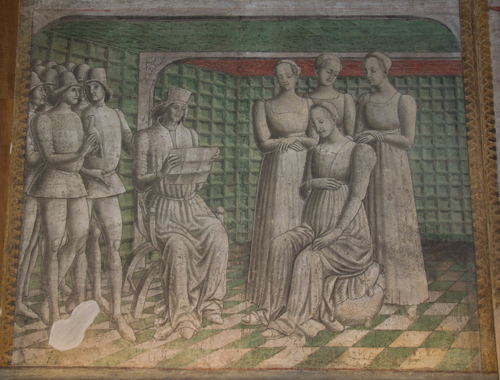
FIGURE 4. Unknown Emilian or Lombard Artist, Gualtieri Reading Fake Papal Bull to Griselda and Subjects, detail from the Camera di Griselda, originally from Roccabianca castle (Parma), ca. 1470, fresco, Milan, Castello Sforzesco, Pinacoteca del Castello.
Photo by author, © Comune di Milano, all rights reserved.
The narrative potential of secrecy found ready expression in early modern art theory, as in the second book of the Latin version of Leon Battista Alberti’s treatise On Painting:
I like there to be someone in the historia who tells the spectators what is going on, and either beckons them with his hand to look, or with ferocious and forbidding glance challenges them not to come near, as if he wished their business to be secret, or points to some danger or remarkable thing in the picture, by his gestures invites you to laugh or weep with them.36
Alberti described here what Michael Baxandall identified as choric figures (festaiuoli).37 Such figures function as intermediaries between the fictive spaces of the painting and the ground occupied by putative viewers, and they were recommended not only by Alberti, but by Leonardo da Vinci and others who proffered advice for artists.38 These painted commentators introduce worshipers to saints, serve as witnesses to narrative action, and provide emotional cues to viewers’ reactions to such events. They serve a range of functions in early modern compositions, but Alberti specifies one use with direct bearing on secrecy. This commentator wards us off with gestures and glances because he wants his “business to be secret” (“negotium secretum”). The rhetorical function of such commentators to designate as secret the thing seen is plain in Alberti’s text. These gestures attract our attention not because any great secret is actually concealed on such canvases but because many viewers understood the value of secrets and recognized the gestures and countenances that gave away their keepers.
Painted invocations of secrecy served subjects ranging from dignified portraits to jocular genre scenes and erotic fantasies. One complicated yet especially rich example of the way in which artists drew on the visual operations of secrecy is Domenico Fetti’s Portrait of a Man with a Sheet of [11] Music (ca. 1614–20) (fig. 5). In the foreground, the nearly life-size subject sits on a block of stone, outdoors among classical ruins overgrown with vegetation.39 Clothed in the dapper threads of a courtier and sporting a neatly trimmed beard and mustache, the sitter occupies the vast bulk of the painting’s foreground and is a presence nearly as solid as the masonry wall against which he is set. He holds a sheet of music in his hand and turns over his right shoulder to face the viewer. His lips are slightly parted, perhaps having been arrested by the painter either in the act of singing or opening his mouth to greet the recently arrived viewer.
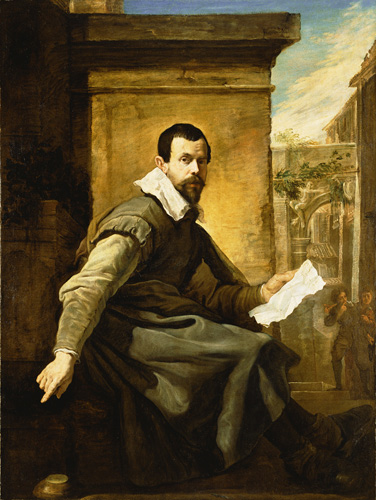
FIGURE 5. Domenico Fetti, Portrait of a Man with a Sheet of Music, ca. 1614–1620, oil on canvas, Los Angeles, J. Paul Getty Museum.
© The J. Paul Getty Museum, Los Angeles.
At the lower right corner of this canvas, two men emerge onto a set of stairs. Framed against a decaying marble arch in the deep background, the pair huddle close, one behind the other. The man in the rear points to the sitter. His companion in the lead holds a leather hat or purse in his left hand while with his right brings a single finger to his lips, his head turned to address an unseen presence beyond the frame. The intrusion of these unidentified figures confronts the viewer of [13] Fetti’s work with any number of possible scenarios, leaving more questions than answers. Are these men quietly sneaking up on the unsuspecting sitter? Does the one man seek to hush the putative viewer, some yet concealed observer, or his coconspirator within the painting? Have we, and these interlopers, wandered into a performance or have we stumbled upon the quiet contemplation of an unfamiliar composition? Perhaps there is no secret, no code, to be discovered in Fetti’s canvas. Yet, if this furtive onlooker does not quite challenge the viewer with a “ferocious and forbidding glance,” the finger placed before his lips nonetheless convinces us that something has been held back. This withholding of what is not there piques the viewer’s interest and focuses visual attention on this musician. Fetti frames our access as a kind of privilege, whether because we share a secret with these marginal interlopers or, conversely, because we, unlike them, need not approach surreptitiously. These festaiuoli erect a boundary that the viewer cannot help but cross in the very act of looking.
Agostino Carracci’s Satyr and Sleeping Nymph (late 1580s) (fig. 6) provides an example of such choric figures transposed into a rather different register.40 As the satyr approaches from the shadows at the scene’s left edge, he turns to shush viewers, challenging them “not to come near,” or at least admonishing them to tread softly if they must.41 Here, the conceit of the audience as secret keeper is staged visually, and the bestial satyr’s surreptitious approach to his slumbering prey is safeguarded by a plea to the viewer’s silence. Clearly he wishes his “business,” as Alberti might say, to be secret. A young nymph lies sleeping against a thicket of brush, unaware of the dual presence of lustful satyr and viewer alike. Her nakedness and vulnerability are emphasized by a conveniently discarded bit of drapery. This sheet, surely of sufficient size to cover her nude body, is in Carracci’s image cast aside and serves instead as makeshift bedding separating her body from the rough leaves and hard ground.42 In keeping the satyr’s secret, Carracci’s viewer—one situated by the image sharing the satyr’s sexual interest in the nymph’s body—is rendered a complicit voyeur of the sexual violence enacted by the image. Here the network produced is not so much one of the knowledgeable as of the spectacularly privileged, able to avail themselves, if only visually, of the nude female flesh on display.
This image is available in the print edition
FIGURE 6. Agostino Carracci, Satyr and Sleeping Nymph, late 1580s, engraving, London, British Museum.
© Trustees of the British Museum.
This volume emerged out of a shared interest in examining how early modern image makers designated material as secret and how these visual secrets fashioned audiences and their responses. Our contributors explore how secrets were performed and enacted and what functions they and their revelations served. The objects of these inquiries range from staircases to narrative paintings, printed books to artists’ drawings, ecclesiastical furnishings to engravers’ tools. Visual and material insinuations of secrecy invite inspection, arouse suspicion, and arrest the viewer’s attention. These procedures are insistently social acts of discrimination as much as inclusion, and indeed, the contributors to this volume are interested not only in the networks and connections created by the revelation of secrets, but equally in the exclusions generated by that process.
[15] One prevalent line along which early modern secrets worked to divide their keepers and tellers was that of gender. Unfettered access to information was often presented as the prerogative of men, too complicated or too dangerous to fall into the hands (or under the eyes) of women.43 As Katharine Park has shown this was true even, or particularly, when that secret knowledge was itself centered on women’s own bodies and on the workings of sexuality and generation.44 In her essay for this volume, Lyle Massey examines the occlusions and revelations activated by Johann Remmelin’s flap-anatomy sheet first printed in Augsburg in 1613. Massey investigates how male viewing of this highly interactive object depended on a voyeuristic gaze that situated bodies, and especially women’s bodies, as harboring secrets. In particular, she explores Remmelin’s account of the uterus as a site of alchemical experimentation, kabbalistic magic, and demonic transformation. Remmelin’s flap anatomy, Massey shows, reinforces misogynistic conceptions of the secrets harbored by the female body while simultaneously privileging the reader-anatomist as one with the power to reveal and comprehend those secrets.
As Petrarch suggested by designating a philosophical dialogue as secret, erudition and education also proved powerful criteria for distinction. For Bernardo Bellincioni, a poet at Ludovico Sforza’s court in Milan, it was precisely secret knowledge that separated apt rulers from ignorant subjects. In his sonnet “Against those who presume to judge the deeds of lords” of circa 1490, Bellincioni quipped that “Certain men, witty and blithe with words, though they know not the secrets of lords, judge like a blind man choosing colors saying ‘they should do it like this, this is the best way.’”45 Over a century later, Thomas Johnson advertised the origins of his “secret” knowledge of the natural world in the works of “divers Latine Authors.”46 Of course, this strategy was effective for establishing authorial privilege in a vernacular work. But it also served to offer those who could not read Latin access to a supposedly exclusive company of cognoscenti, and it likewise reinforced the sense that the knowledge at their fingertips was both powerful and previously available to only a select few. William Eamon’s contribution to this collection focuses on the sellers of secret cures in early modern Venice, examining the ways in which they visually enhanced the tantalizing power of their wares. Eamon particularly draws our attention to the differentiated audiences addressed by these charlatans, ranging from the learned magistrates who approved their remedies to the unlettered craftsmen who constituted both the market for their products and the public for their displays. Looking to the prevalence of the “secret” languages of Hebrew and hieroglyphics in Ferrarese painting, Giancarlo Fiorenza similarly demonstrates the way in which secrets could mark the boundary between the learned and unlearned. Inscriptions in these sacred and ancient languages appear throughout Ludovico Mazzolino’s paintings of Christ’s ministry. Fiorenza argues that these inscriptions at once reveal and conceal Christian teaching as divine wisdom, establishing and maintaining a learned and discerning audience at court.
A critical exploration of early modern secrecy also provides one perspective from which to resist the dichotomy of public and private—a binary that remains fundamental to a host of frameworks [16] through which we understand early modern visual culture. This overdetermined division is especially pronounced in considerations of Renaissance studies or studioli and in many recent and otherwise valuable studies of domestic art.47 To be sure, distinctions between public and private were invoked and deployed in early modern Europe, and often for violently coercive ends in patriarchy’s service. Yet as Alan Stewart, Patricia Fumerton, and Mary Thomas Crane have shown, ostensibly occluded and secluded spaces like studies and closets often enacted a kind of “public privacy,” placing activities including study and prayer on display.48 For much of the period here under discussion, power and even sovereignty were constituted by forces that might today seem unequivocally private, and the Habermasian divide between public and private spheres was only just developing, and irregularly.49 The contributors to this volume thus situate and historicize utterances and images within the dynamics of specific early modern power relations.50
The porous nature of early modern public and private spheres serves as fertile ground for several of our contributors. Timothy McCall examines a novel architectural furnishing from fifteenth-century Parma, the coretto of count Pier Maria Rossi. Prominently visible within a chapel in one of Rossi’s castles, this wooden box might be seen as a private sanctuary that concealed the count’s presence from prying eyes. As McCall demonstrates, however, the coretto generated multiple levels and plays of access, secrecy, and display for visitors to Torrechiara by calling attention to Rossi’s presence (or potential presence) within and hiding Rossi, only ultimately to reveal his presence to all. Henry Dietrich Fernández likewise considers an ostensibly private space that enacted its own public display, the “secret” apartments of Cardinal Bibbiena, trusted segretario (secret keeper) to Pope Leo X. Like most personal apartments, the interior of Bibbiena’s suite was closed to casual visitors. Yet, visible high atop the façade of the papal palace, of which they comprised a small component, these rooms beckoned and tantalized viewers. Fernández explores the ways in which this emphatic display of a secret space to those not privileged to gain access intensified the revelation of that same space to a community of invited guests, including Bibbiena’s protégé Giulio Sadoleto. Likewise, while the secret of Michelangelo’s infatuation with the young Tommaso de’ Cavalieri remains very much an open one, it is not its hiding to which Maria Ruvoldt productively calls attention in her essay. Rather than asking from whom Michelangelo’s letters and gift drawings were hidden, Ruvoldt instead invites us to consider to whom they were entrusted and suggests that these precious traces of the artist created hierarchical networks of intimates. By investigating the mechanics of their exchange, Ruvoldt elucidates the ways in which Michelangelo used these letters to assert his social and artistic autonomy.
The veiling of panels and canvases with curtains and covers and the concealment of precious and rare objects within cabinets and boxes were common early modern practices that made evident the power of secrecy to distinguish and exclude. Such objects have frequently been studied [17] under the rubric of curiosity or the umbrella of the history of collecting, yet the rationale for their hiddenness and the grammar of their cloistering also invite sustained attention. In her essay here, Patricia Simons calls our attention to the inseparable bond between veiling and unveiling in early modern visual culture. Simons examines the covering of erotic paintings and engravings as well as the partial veiling of nude figures within those works. While such practices are often understood as censorial acts that mitigate indecorous content, Simons instead argues that these veils constructed bodies, paintings, and prints as open secrets that not only beckoned and titillated their viewers, but also united their audiences as secret keepers.
The inherent difficulties posed by interpreting the signs and symbols of a visually erudite culture (and one in which the visual arts embraced a naturalistic approach to a vibrant material culture) have long motivated the art historical quest to decode the secrets of Renaissance painting and sculpture.51 Traditional iconographic studies have revealed secrets, but they have often told us little about secrecy and even less about why paintings should hide secrets in the first place. The anamorphic death’s head at the center of Hans Holbein’s The Ambassadors (1533) (fig. 7), has cried out to countless scholars as a tantalizing secret beckoning to be deciphered.52 Holbein’s interlocutors have often probed what this skull means, but they have only tangentially sought to understand how it means. The painter’s brush twists, refracts, and conceals the grim souvenir, yet these very acts constitute a performance that calls Holbein’s viewers to inspect the painted surface closely and to change their perception. Anamorphosis here erects a boundary that viewers cross, once alerted to the skull’s presence, through the work of active looking, experiencing the fruits of their labor as revelation.53 This process of engaged viewing is further heightened by the conceit of the fictive curtain, pulled back at the top left corner of the canvas to unveil a grisaille crucifix.
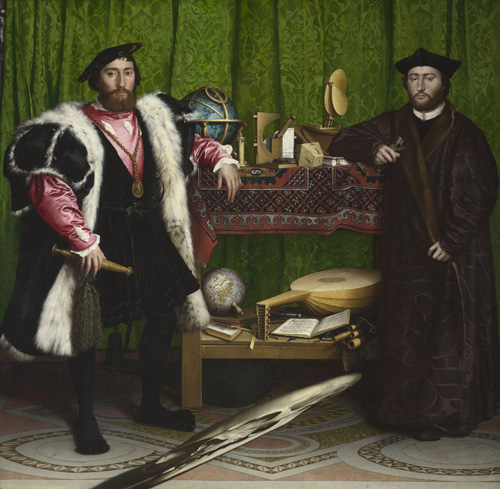
FIGURE 7. Hans Holbein, The Ambassadors, 1533, oil on canvas, London, National Gallery of Art.
© The Trustees, The National Gallery, London.
Nearly as frequently as art historians have probed the hidden symbols on the surface of paintings, they have sought the secret rules lying unseen beneath. Perspectively complex paintings with their grids of paving stones, scattered lances, and ceiling beams have often stood as emblematic of Renaissance art practices. Art historians, for their part, have often sought, even obsessively, hidden or esoteric geometric schemes underlying these paintings. Pioneered by Charles Bouleau and evaluated, ridiculed, and even rejected by scholars including Daniel Arasse and James Elkins, the notion of the “painter’s secret geometry” has remained a stubborn art historical presence.54 Nor is it only modern art historians who have framed the techniques of Renaissance art-making as esoteric or mysterious. Early modern writers often designated the technical elements of art practice as secrets, akin to those of astrologers, necromancers, and alchemists. Artists were only too eager to benefit from such beguiling mysteries. The Ferrarese painter Ercole de’ Roberti, for example, collaborated with Pandolfo Colenuccio to establish himself as an expert on the properties of the [18] pigment cinnabar, which Pliny held to be derived from a mixture of dragon and Indian elephant blood.55 Pamela Long has traced trade secrets from late antiquity, through the workshops of medieval craftspeople, and into those of Renaissance painters.56
Historians of painting, sculpture, and architecture have often privileged narratives of influence and described an effortless dissemination of invention and style in early modern Europe. A focus on trade and technical secrecy, however, can reveal the difficulties and even risks that attended to the frequently personal and intimate transmission of intellectual property and proprietary technologies. Further, art historians might productively revisit the introduction and development of technologies whose origins and operations were shrouded in mystery—the printing press and its products foremost among these. Sean Roberts’s contribution to this volume [19] investigates frequently overlooked techniques of the earliest Italian engravers of book illustrations, maps, and single-sheet prints. He examines the lengths to which engravers, including Mantegna, went to keep technical know-how secret. Printers, engravers, and woodcutters, of course, diligently guarded the tricks of the trade, including novel tools like burins and burnishers, from the prying eyes of competitors. Yet, Roberts shows that these craftspeople also designated relatively simple processes as secrets in order to discourage imitation or reverse engineering.
The period examined by these essays was also one of unprecedented change in the ways that individuals fashioned selves, to use Stephen Greenblatt’s enduring formulation.57 Historians have long identified numerous factors that contributed to this shift. Foremost among these was the reorientation of early modern subjectivity along an axis of confessional identity, culminating in the Reformation and its responses. The development of individuals defined, to a great degree, through belief rather than social performance, through orthodoxy rather than orthopraxy, also provided unprecedented opportunity both for the keeping of secrets and for the suspicion that others were doing likewise.58 Early modern visual and material culture not only reflected but also anticipated and contributed to this monumental shift. Allie Terry-Fritsch’s essay here treats the material culture of civic denunciation in fifteenth-century Florence and its environs by examining drop-boxes (tamburi) and the secret accusations they contained. She argues that these tamburi and their (potential) contents constituted communities of accusers and accused: real, potential, and imagined. These acts of surveillance and denunciation undoubtedly served to strengthen some communal bonds. Yet Terry-Fritsch also calls our attention to a culture of secrecy in flux, one in which sealed and anonymous denunciations also threatened each member of that community by replacing the social act of confession with a hidden and pervasive surveillance. These drop-boxes, as the most visible component of the process of denunciation, served as lightning rods for those who saw in these operations a dangerous breach of social cohesion. Terry-Fritsch examines the destruction and vandalism of the tamburi as indications of secrecy’s potential to disrupt the social bonds between early modern individuals.
By their very performative nature, early modern secrets called out for, even demanded, revelation. Indeed many secrets acquired meaning primarily through the possibility that they would be disclosed. Above all, then, this volume investigates why secrets were hidden and from whom, through what mechanisms they were performed and enacted, and by what means and to whom they were divulged. While acknowledging that the task at hand is an emphatically interdisciplinary one, historians of artistic, visual, and material cultures have especially important roles to play in elucidating the operations of these early modern secrets and their keepers.59 Because secrets often functioned visually, the skills of art historical intervention attuned to the sensory and intellectual experience of secrets can expose the construction and reception of classified information. The disciplinary tools now associated with visual culture studies, and the recent turn toward the study of vision, are likewise valuable. The emphasis on the process of occlusion and revelation central to early modern secrecy suggests that access to and exclusion from in-groups, networks, and communities were [20] often controlled visually, spatially, and materially. Though secrecy relies on tropes of the invisible and hidden, it is precisely their opposites, the visible and uncovered, that must alert the viewer to the secret’s presence and operation within painting, sculpture, and architectural spaces. The thing secreted must by necessity present itself by unfolding in plain sight.
Bibliography
Alberti, Leon Battista. Della pittura. Edited by Luigi Mallè. Florence: Sansoni, 1950.
———. On Painting. Translated by Cecil Grayson and edited by Martin Kemp. New York: Penguin, 1991.
Arasse, Daniel. “Il programma politico della Camera degli Sposi, ovvero il segreto dell’immortalità.” Quaderni di Palazzo Te 6 (1987): 45–64.
———. On n’y voit rien: Descriptions. Paris: Éditions Denoël, 2005.
Babinger, Franz. “An Italian Map of the Balkans, presumably owned by Mehmed II, the Conqueror (1452–53).” Imago Mundi 8 (1951): 8–15.
Baskins, Cristelle. “Griselda, or the Renaissance Bride Stripped Bare by Her Bachelor in Tuscan Cassone Painting.” Stanford Italian Review 10 (1991): 153–75.
———. “(In)famous Men: The Continence of Scipio and Formations of Masculinity in Fifteenth-Century Tuscan Domestic Painting.” Studies in Iconography 23 (2002): 109–36.
Baxandall, Michael. Giotto and the Orators: Humanist Observers of Painting in Italy and the Discovery of Pictorial Composition. Oxford, UK: Oxford University Press, 1971.
———. Painting and Experience in Fifteenth-Century Italy: A Primer in the Social History of Pictorial Style, 2nd ed. Oxford, UK: Oxford University Press, 1988.
Bellincioni, Bernardo. Le Rime. Edited by Pietro Fanfani. 2 vols. Bologna: Romagnoli, 1876–78.
Biagioli, Mario. Galileo’s Instruments of Credit: Telescopes, Images, Secrecy. Chicago: University of Chicago Press, 2007.
Boccaccio, Giovanni, and Francesco Petrarca. Griselda. Edited by Luca Carlo Rossi. Palermo: Sallerio editore, 1991.
Bok, Sissela. Secrets: On the Ethics of Concealment and Revelation. New York: Pantheon Books, 1983.
Bouleau, Charles. The Painter’s Secret Geometry. New York: Harcourt, Brace and World, 1963.
Brotton, Jerry. Trading Territories. New Haven, CT: Yale University Press, 1997.
Calzona, Arturo. “L’abito alla corte dei Gonzaga.” In Il costume nell’età del Rinascimento, edited by Dora Liscia Bemporad, 225–52. Florence: Edifir, 1988.
Camille, Michael. “Walter Benjamin and Dürer’s Melencolia I: The Dialectics of Allegory and the Limits of Iconology.” Ideas and Production: A Journal in the History of Ideas 5 (1986): 58–79.
Campbell, C. Jean. The Commonwealth of Nature: Art and Poetic Community in the Age of Dante. University Park: Pennsylvania State University Press, 2008.
Campbell, Stephen. The Cabinet of Eros: Renaissance Mythological Painting and the Studiolo of Isabella d’Este. New Haven, CT: Yale University Press, 2006.
———. Cosmè Tura of Ferrara: Style, Politics and the Renaissance City, 1450–1495. New Haven, CT: Yale University Press, 1997.
———. “Giorgione’s Tempest, Studiolo Culture, and the Renaissance Lucretius.” Renaissance Quarterly 56 (2003): 299–332.
Casale, Giancarlo. The Ottoman Age of Exploration. Oxford, UK: Oxford University Press, 2010.
Chittolini, Giorgio. “The ‘Private,’ the ‘Public,’ the State.” In The Origins of the State in Italy 1300–1600, edited by Julius Kirshner, 34–61. Chicago: University of Chicago Press, 1995.
Cope, Jackson. Secret Sharers in Italian Comedy from Machiavelli to Goldoni. Durham, NC: Duke University Press, 1996.
Cortesi, Paolo. De Cardinalatu. San Gimignano: Symeon Nicolai Nardi, 1510.
Crane, Mary Thomas. “Illicit Privacy and Outdoor Spaces in Early Modern England.” Journal of Early Modern Cultural Studies 9 (2009): 4–22.
de Certeau, Michel. The Mystic Fable. Volume 1, The Sixteenth and Seventeenth Centuries. Translated by Michael Smith. Chicago: University of Chicago Press, 1992.
DeGrazia Bohlin, Diane. Prints and Related Drawings by the Carracci Family: A Catalogue Raisonné. Washington: National Gallery of Art, 1979.
de Luca, Elena. “The Notion of Secretum in Renaissance Bologna: Toward a Sociology of Secrecy in Italian Culture.” In Raising the Eyebrow: John Onians and World Art Studies, edited by Lauren Golden, 189–207. Oxford, UK: Archaeopress, 2001.
de Vivo, Filippo. Information and Communication in Venice: Rethinking Early Modern Politics. Oxford, UK: Oxford University Press, 2007.
Eamon, William. The Professor of Secrets: Mystery, Medicine, and Alchemy in Renaissance Italy. Washington, DC: National Geographic, 2010.
———. Science and the Secrets of Nature: Books of Secrets in Medieval and Early Modern Culture. Princeton, NJ: Princeton University Press, 1994.
Elkins, James. The Poetics of Perspective. Ithaca, NY: Cornell University Press, 1994.
Engel, Gisela, Brita Rang, Klaus Reichert, and Heide Wunder, eds. Das Geheimnis am Beginn der europäischen Moderne. Frankfurt: Vittorio Klostermann, 2002.
Florio, John. Worlde of Wordes. London, 1598 and 1611.
Foister, Susan. Holbein and England. New Haven, CT: Yale University Press, 2004.
Fumerton, Patricia. Cultural Aesthetics: Renaissance Literature and the Practice of Social Ornament. Chicago: University of Chicago Press, 1991.
Galis, Diana. “Concealed Wisdom: Renaissance Hieroglyphic and Lorenzo Lotto’s Bergamo Intarsie.” Art Bulletin 62 (1980): 363–75.
Greenblatt, Stephen. Renaissance Self-Fashioning: From More to Shakespeare. Chicago: University of Chicago Press, 1980.
Grosz, Elizabeth. Architecture from the Outside: Essays on Virtual and Real Space. Cambridge, MA: MIT Press, 2001.
Habermas, Jürgen. The Structural Transformation of the Public Sphere: An Inquiry into a Category of Bourgeois Society. Translated by Thomas Burger and Frederick Lawrence. Cambridge, MA: MIT Press, 1989.
Hyland, Peter. Disguise on the Early Modern English Stage. Burlington, VT: Ashgate, 2011.
Jager, Eric. The Book of the Heart. Chicago: University of Chicago Press, 2000.
Johnson, Thomas. Cornucopiae or divers secrets. . . . London: Barley, 1596.
Kavey, Allison. Books of Secrets: Natural Philosophy in England 1550–1600. Urbana: University of Illinois Press, 2007.
Kemp, Martin, ed. Leonardo on Painting. New Haven, CT: Yale University Press, 1989.
Kenaan, Hagi. “The ‘Unusual Character’ of Holbein’s Ambassadors.” Artibus et Historiae 23 (2002): 61–75.
Leverotti, Franca. “‘Diligentia, obedientia, fides, taciturnitas . . . cum modestia’: La cancelleria segreta nel Ducato sforzesco.” Ricerche Storiche 24 (1994): 305–35.
Levy, Evonne. Propaganda and the Jesuit Baroque. Berkeley: University of California Press, 2004.
Lochrie, Karma. Covert Operations: The Medieval Uses of Secrecy. Philadelphia: University of Pennsylvania Press, 1999.
———. “Don’t Ask, Don’t Tell: Murderous Plots and Medieval Secrets.” In Premodern Sexualities, edited by Louise Fradenburg and Carla Freccero, 137–52. New York: Routledge, 1996.
Long, Elaine, and Alisha Rankin, eds. Secrets and Knowledge in Medicine and Science, 1500–1800. Burlington, VT: Ashgate, 2011.
Long, Pamela O. Openness, Secrecy, Authorship: Technical Arts and the Culture of Knowledge from Antiquity to the Renaissance. Baltimore: Johns Hopkins University Press, 2001.
Mancini, Roberto. La lingua degli dei: Il silenzio dall’antichità al Rinascimento. Vicenza: Angelo Colla Editore, 2008.
Massey, Lyle. Picturing Space, Displacing Bodies: Anamorphosis in Early Modern Theories of Perspective. University Park: Pennsylvania State University Press, 2007.
Massumi, Brian. “Everywhere You Want to Be: Introduction to Fear.” In The Politics of Everyday Fear, edited by Brian Massumi, 3–38. Minneapolis: University of Minnesota Press, 1993.
McCall, Timothy. “Networks of Power: The Art Patronage of Pier Maria Rossi of Parma.” PhD diss., University of Michigan, 2005.
McCall, Timothy, and Sean Roberts, “Art and the Material Culture of Diplomacy.” In Italian Renaissance Diplomacy: Texts and Translations (1350–1520), edited by Monica Azzolini and Isabella Lazzarini. Durham, UK: University of Durham Press, forthcoming.
Meyer, Richard. Outlaw Representation: Censorship and Homosexuality in Twentieth-Century American Art. Oxford, UK: Oxford University Press, 2002.
North, John. The Ambassadors’ Secret: Hans Holbein and the World of the Renaissance. London: Hambledon and London, 2002.
Panofsky, Erwin. Studies in Iconology: Humanistic Themes in the Art of the Renaissance. Oxford, UK: Oxford University Press, 1939.
———. The Life and Art of Albrecht Dürer. Rev. ed. Princeton, NJ: Princeton University Press, 2005.
Park, Katharine. Secrets of Women: Gender, Generation, and the Origins of Human Dissection. New York: Zone Books, 2006.
Petrarca, Francesco. The Secret. Edited by Carol Quillen. Boston: Bedford/St. Martins, 2003.
Raby, Julian. “East and West in Mehmed the Conqueror’s Library.” Bulletin du bibliophile 3 (1987): 297–321.
———. “A Sultan of Paradox: Mehmed the Conqueror as Patron of the Arts.” Oxford Art Journal 5 (1982): 3–8.
Rambuss, Richard. Closet Devotions. Durham, NC: Duke University Press, 1998.
Randolph, Adrian. Engaging Symbols: Gender, Politics, and Public Art in Fifteenth-Century Florence. New Haven, CT: Yale University Press, 2002.
Rasmussen, Ann Marie. “Introduction.” In “Gender and Secrecy,” special issue, Journal of Medieval and Early Modern Studies 30 (2000): 1–4.
Roberts, Sean. “Silence and Secrets in Domenico Fetti’s Portrait of a Man with a Sheet of Music.” Renaissance Studies 26 (forthcoming, 2013).
Safarik, Eduard. Fetti. Milan: Electa, 1990.
———, ed. Domenico Fetti, 1588/89–1623. Mantua: Palazzo Te, 1996.
Sedgwick, Eve Kosofsky. Epistemology of the Closet. Berkeley: University of California Press, 1990.
Seydl, Jon. “Domenico Fetti: Portrait of a Man with a Sheet of Music.” In Bernini and the Birth of Baroque Portrait Sculpture, edited by Andrea Bacchi, 216–17. Los Angeles: Getty Museum, 2008.
Shakespeare, William. Twelfth Night or What You Will. Edited by Elizabeth Story Dunno. Cambridge, UK: Cambridge University Press, 2004.
Signorini, Rodolfo. “A Dog Named Rubino.” Journal of the Warburg and Courtauld Institutes 41 (1978): 317–20.
———. Opus hoc tenue: La “archetipita” Camera Dipinta detta “degli Sposi” di Andrea Mantegna; lettura storica iconografica iconologica della “più bella camera del mondo.” 2nd ed., rev. Mantova: MP Marketing, 2007.
Simonetta, Marcello. Rinascimento Segreto: Il mondo del Segretario da Petrarca a Machiavelli. Milan: Franco Angeli, 2004.
Simons, Patricia. “Anatomical Secrets: Pudenda and the Pudica Gesture.” In Das Geheimnis am Beginn, edited by Gisela Engel, Brita Rang, Klaus Reichert, and Heide Wunder, 101–17. Frankfurt: Vittorio Klostermann, 2002.
Snyder, Jon. Dissimulation and the Culture of Secrecy in Early Modern Europe. Berkeley: University of California Press, 2009.
Starn, Randolph. “Places of the Image in Italian Renaissance Art: Clues, Symbols, and Signatures in Mantegna’s Camera Picta.” In Place and Displacement in the Renaissance, edited by Alvin Vos, 207–30. Binghamton, UK: Medieval and Renaissance Texts and Studies, 1995.
Stewart, Alan. “The Early Modern Closet Discovered.” Representations 50 (1995): 76–100.
Tuohy, Thomas. Herculean Ferrara: Ercole d’Este, 1471–1505, and the Invention of a Ducal Capital. Cambridge, UK: Cambridge University Press, 1996.
Valesio, Paolo. Novantiqua: Rhetorics as a Contemporary Theory. Bloomington: Indiana University Press, 1980.
Waldman, Louis. “Domenico Fetti’s Philosophers.” Source 24 (2004): 26–35.
Warburg, Aby. The Renewal of Pagan Antiquity: Contributions to the Cultural History of the European Renaissance. Translated by David Britt. Los Angeles: Getty Research Institute, 1999.
Weil-Garris, Kathleen, and John d’Amico. “The Renaissance Cardinal’s Ideal Palace: A Chapter from Cortesi’s De Cardinalatu.” In Studies in Italian Art and Architecture, 15th through 18th centuries, edited by Henry Million, 45–123. Cambridge, MA: MIT Press, 1980.
Weissman, Ronald. Ritual Brotherhood in Renaissance Florence. New York: Academic Press, 1982.
Welch, Evelyn. “Galeazzo Maria Sforza and the Castello di Pavia, 1469.” Art Bulletin 71 (1989): 352–75.
———. “Painting as Performance in the Italian Renaissance Court.” In Artists at Court: Image-Making and Identity, 1300–1550, edited by Stephen Campbell, 9–18. Chicago: University of Chicago Press, 2004.
———. “Public Magnificence and Private Display: Giovanni Pontano’s De splendore (1498) and the Domestic Arts.” Journal of Design History 15 (2002): 211–27.
Wheeler, Jo. Renaissance Secrets: Recipes and Formulas. London: V&A Publishing, 2009.
Wilson, Bronwen, and Paul Yachnin. “Introduction.” In Making Publics in Early Modern Europe: People, Things, Forms of Knowledge, edited by Bronwen Wilson and Paul Yachnin, 1–21. New York: Routledge, 2009.
[24]