
– 9 –
Lyle Massey
Early modern anatomical flap sheets have a special kind of status in the history of science and print culture. Both figuratively and literally they embody the intertwining of secret knowledge with the newly penetrating gaze of Renaissance and baroque medicine. With their tactile invitation to peel back paper layers and peek inside, flap sheets trade on the ludic possibilities embedded in the act of dissection and emphasize the idea that the physical body harbors hidden revelations. These revelations are frequently shrouded in the academic language of anatomy (Latin rather than the vernacular) and often hinge on the authority of various university physicians and surgeons who invented and augmented early modern practices of dissection. However, while authors of sixteenth- and seventeenth-century flap sheets borrowed extensively from academic sources, the hybrid visual objects they produced often circulated in and appealed to a nebulous realm of popular tastes and appetites. With few exceptions, flap sheets neither drove forward nor contributed to the anatomical corpus. The knowledge they presented to the viewer was frequently meant to appear abstruse and available only to those with a requisite vision and understanding. That is, they appeared to fashion an exclusive community of secret holders of the sort alluded to in Tim McCall and Sean Robert’s introduction to this volume. But flap sheets were also meant to appeal to a wide cross section of consumers and readers. Straddling a line between high learning and folk wisdom, flap sheets translated the difficult and puzzling aspects of anatomy into a set of images that were both enticingly talismanic and deceivingly accessible. In short, anatomical flap sheets embodied a peculiar form of secret sharing, one that was at once social in the sense of defining an exclusive public, and scientific, in the sense of defining an arcane, yet seemingly universal body of knowledge.
One of the most avidly sought-after flap sheet compilations was produced at the very end of the period in which they were most prevalent. This is Johann Remmelin’s elaborate, multiflap, multipage work, Catoptrum microcosmicum (Microcosmic Mirror). Lavishly illustrated by Lucas Kilian, a German engraver who probably designed as well as cut the plates, the Catoptrum presents anatomical information that was already out of date when it was printed.1 Nevertheless, the folio [209] engravings are not only unusually complex due to the sheer number and elaborateness of flaps (some images can be superimposed with up to nine consecutive flaps, many of them double-sided), but they are also distinguished from other flap sheets for the way they fabricate recondite associations between dissection and alchemy, and for their multiple inscriptions in Latin, Hebrew, and Greek.2
The eccentric nature of Remmelin’s Catoptrum and its presumed costliness would seem to have relegated it to a highly select and elite audience, and yet its print history reveals prodigious editions in many languages. Published initially in Latin, it was quickly translated into German, Dutch, French, and English.3 Each edition was probably limited because of the size and intricacy of the work, factors that also make it all the more surprising that the demand for translations and reproductions continued well into the eighteenth century. However, the Catoptrum also has a strange and convoluted print history involving early, possibly unauthorized editions in 1613, 1614, and 1615. The first edition that can be associated directly with Remmelin was printed in Augsburg in 1619.4 The title page of this edition identifies Remmelin as the author, Kilian as the artist, and Stephan Michelspacher as the printer, and it is dedicated to Philipp Hainhofer, duke of Parnerania (fig. 9.1). Both the earlier 1613 and the later 1619 editions were subsequently used as the basis for most translations and reprints.5 In almost all editions, the Catoptrum contains four to five printed plates: a title page, an author portrait (in some editions), and then three large plates referred to as [211] the Visio Prima (fig. 9.2) depicting male and female figures together standing on plinths on either side of a truncated, pregnant torso; the Visio Secunda (fig. 9.3) depicting a single male figure; and the Visio Tertia (fig. 9.4) depicting a single female figure.
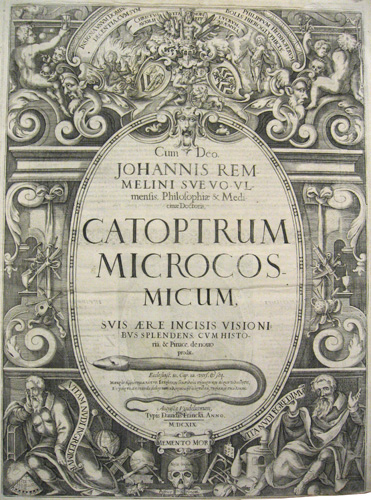
FIGURE 9.1. Title page from Johann Remmelin, Catoptrum microcosmicum . . . (Augustae Vindelicorum: Typis Davidis Francki, 1619), engraving. Galter Health Sciences Library: Rare Books (Medical) 611 R28 1619.
Courtesy of the Galter Health Sciences Library Special Collections, Feinberg School of Medicine, Northwestern University, Chicago.
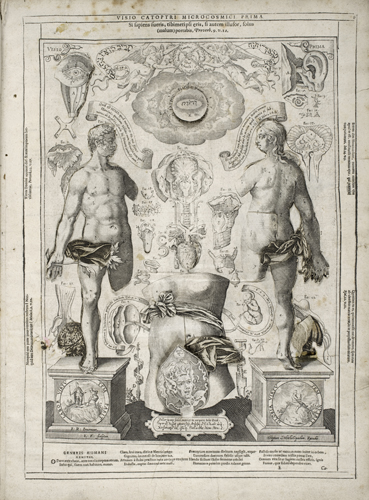
FIGURE 9.2. Visio prima, from Johann Remmelin, Catoptrum microcosmicum . . . (Aubsburg, 1639), engraving.
Special Collections Research Center, University of Chicago Library.
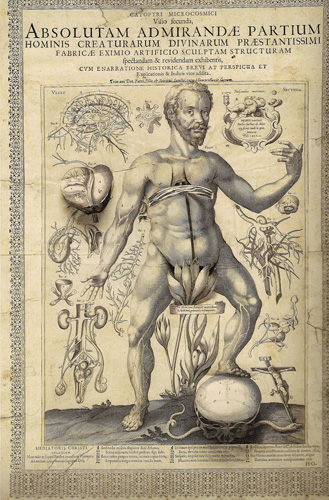
FIGURE 9.3. Visio secunda, from Johann Remmelin, Catoptrum microcosmicum (Augsburg, 1619), engraving. Galter Health Sciences Library, Special Collections, Northwestern University, Chicago.
Courtesy of the Galter Health Sciences Library Special Collections, Feinberg School of Medicine, Northwestern University, Chicago.
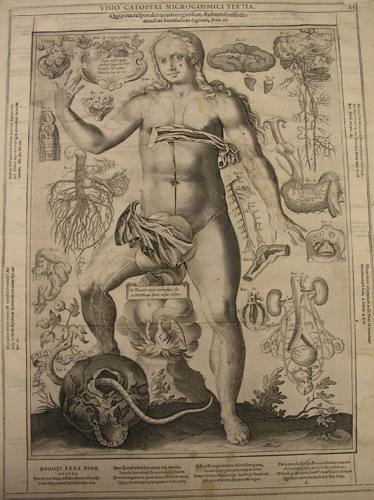
FIGURE 9.4. Visio tertia, from Johann Remmelin, Catoptrum microcosmicum (Augsburg, 1619), engraving. Galter Health Sciences Library, Special Collections, Northwestern University, Chicago.
Courtesy of the Galter Health Sciences Library Special Collections, Feinberg School of Medicine, Northwestern University, Chicago.
Some of the Catoptrum’s images and text draw from the authority of sixteenth-century anatomist Andreas Vesalius, who continued to cast a long shadow over anatomical practice in seventeenth-century European centers of learning. In his De humani corporis fabrica (often referred to simply as Fabrica), first printed in 1543, Vesalius challenged the centuries-old reliance on medieval, Galenic medical texts on anatomy, insisting that knowledge of the human body could only be arrived at through prolonged and consistent contact with it through dissection. In addition, Vesalius’s atlas constructed a new and wholly influential model for how to represent human anatomy in pictures. Many of Vesalius’s images were copied and reframed in subsequent works in order to substantiate the professional claims of later anatomists.
Remmelin was no different in this respect. He too used the Fabrica to confer legitimacy on the Catoptrum. Four of the small, detailed illustrations included in the Visio Secunda and eight in the Visio Tertia are engraved after Vesalius. These include the genito-urinary tracts for both male and female figures as well as a separate image of the uterus after an image that appears in book 5 of Vesalius’s Fabrica. However, in spite of these obvious references to Vesalius and to prevailing anatomical trends and knowledge (and the clear sense that they are meant to be recognized as such by readers/viewers), the myriad other visual and textual references that appear in the Catoptrum threaten to overwhelm any sense that the work is heir to Vesalius’s “modern” anatomy. Instead, the Catoptrum speaks to a hermetically inclined readership, one familiar with alchemical and kabbalistic references. While these aspects have often been remarked upon, what they mean in the context of the flap sheets, or what they are drawn from, has never been fully explored. While the Catoptrum offered cryptic knowledge to baroque readers who assumedly understood the context of its mysteries, the content and even intent of that knowledge remains opaque to modern historians.
One reason for this is that the varied references appear haphazard, arranged less to tell a discernible story or overarching allegory, than to provide evidence of general erudition. The only clear principle underlying the Catoptrum is that anatomy and medicine need to be understood through a framework of magic rather than through post-Vesalian inquiry. Remmelin’s Catoptrum exploits a promiscuous seventeenth-century fascination with alchemy, and overlays it on to what was known of human anatomy. With their tactile and interactive character and stitching together of high academic learning with alchemical knowledge, Remmelin’s prints exemplify what Natalie Zemon Davis calls the “blurring of cultural typologies.” As she points out, in moments of cultural transformation, “older habits enter into fresh alliance or tension with new modes of communication, old arguments are carried on in a new key, and new stakes emerge only through a process of struggle and negotiation” leading to the production of new cultural forms.6 Remmelin’s flap sheets present the human body as a battleground for discordant understandings of medicine and anatomy, but also for newly articulated distinctions between male and female bodies.
On one level, the Remmelin plates exhibit a predictable moralizing theme. It has been noted by some that there is a strong eschatological current running through the prints, one tied to a [215] long-standing tradition of treating anatomical images in terms of vanitas and memento mori themes.7 As with many preceding atlases of the human body, the Catoptrum presents its images and text under the dictum “Nosce te ipsum,” or “Know thyself,” which appears at the bottom of the frontispiece (see fig. 9.1). Vesalius was not the first to invoke this Latin version of the ancient Greek dictum associated with the Temple of Apollo at Delphi, but he explains most fully how the phrase relates to the study of anatomy. In 1543, Vesalius offers a critical reflection on “nosce te ipsum,” suggesting that the study of the human body amounts to the study of the human soul:
Yet I surmise that out of the entire Apolline discipline of medicine, and indeed all natural philosophy, nothing could be produced more pleasing or welcome to your Majesty [Charles V to whom the book is dedicated] than research in which we recognize the body and the spirit, as well as a certain divinity that issues from a harmony of the two, and finally our own selves (which is the true study of mankind) [nosmetipsos denique (quod vere hominis est) cognoscimus].8
As Peter Mitchell notes, Remmelin’s prints reiterate this theme of self-reflection, but add a soteriological element by contrasting death to the promise of salvation offered by Christ. In Remmelin’s frontispiece, “Nosce te ipsum” appears directly under a skull, above which is another inscription, which admonishes the reader to “Memento mori.” In the Visio Secunda (see fig. 9.2), which shows a single male figure, the phrase “Nascentes morimus” (Being born, we die) appears above a line from Psalm 144, verse 4, “Homo vanitati[.] Similis factus est, dies eig [sic (suae?)]. Sicut umbra, praetereunt”(Man is like to vanity: / His days are as a shadow that passeth away), while below, to the right, is a microchristus emblem that crushes a serpent’s head next to the male figure’s foot, which itself rests on a skull through which the serpent is entwined. The layered meanings point to a connection between death and Christian resurrection and to the double nature of Christ’s anatomy as both human (corruptible) and divine (uncorruptible). Anatomy, as an investigatory aspect of natural philosophy, takes on soteriological and eschatological significance in this set of contrasting images and ideas.
While this is certainly an explicit aspect of Remmelin’s prints, it by no means fully explains the significance of either the Christian iconography and multiple biblical inscriptions, or the varied alchemical and kabbalistic elements that appear throughout the prints. The presence of kabbala and alchemy in the Catoptrum may have much to do with Remmelin’s relationship with Stefan Michelspacher, the printer. That these men were connected is clear not simply through the complex and perplexing history of the Catoptrum’s publication (see note 4), but also, significantly, by the fact that Michelspacher dedicated to Remmelin his own Cabala: Spiegel der Kunst un Natur, in Alchymia (Augsburg, 1616).9 A lavishly illustrated book, Michelspacher’s Cabala also reveals his adherence to Paracelsian spiritual alchemy.10 There is, therefore, good reason to believe that these two men shared an interest in Paracelsian, alchemical medicine, an interest that is borne out in Remmelin’s Catoptrum.
[216] Michelspacher was a physician who was part of a group of Tyrolese, Protestant Paracelsians who fashioned themselves as spiritual alchemists. He ended up in Augsburg, a city known for its religious tolerance, possibly to escape the fate that met Adam Haslmayr, who was accused of heresy by Jesuits in 1618 and then executed in 1623 by Archduke Maximilian in re-Catholicized Tyrol.11 In his Cabala, Michelspacher embraces a form of Paracelsian alchemy associated with figures like Heinrich Khunrath, the German hermeticist. Drawing inspiration from Hermes Trismegistus, the mythical Egyptian founder of the arts of alchemy, Khunrath, in his most influential work, the Amphitheatrum sapientiae aeternae of 1602, explains the central mystery of Trismegistus’s meditation on the oneness of being. In Khunrath’s view, the goal of alchemy is to return man to his original state and find a path to oneness with nature. This oneness is then imbued with Christian connotations. The outcome of true hermeticism in Khunrath’s terms is to achieve a “oneing” with Christ.12 Skirting the fine edge of heresy, Khunrath and the spiritual alchemists who followed him, refigured Christ as the Philosopher’s Stone, embracing the notion of alchemical transubstantiation in which the philosopher transforms himself into the very substance of Redeemer.13 This is vividly illustrated in Khunrath’s Amphitheatrum in which Christ appears in the center of concentric circles, enclosed in a nucleus referred to by Khunrath as the “En Soph,” the kabbalistic term for God in his manifestation as the Infinite or Endless.14 The figure of Christ is posed above a phoenix, a critical emblem in alchemical writing that signified the primordial transformations enacted by fire and, like the Philosopher’s Stone, embodied the “mysterious substance by which the Great Work of transmutation is achieved.”15 If the phoenix stands for the prospect of resurrection in traditional alchemical terms, then the salvation and resurrection promised by Christ stands for the ultimate possibilities of transformation according to the logic of the Protestant spiritual alchemists and Christian kabbalism.
Michelspacher’s treatise trades on similar ideas. As Ursula Szulowkowska points out, while responding to reformulated Protestant ideas about the sacraments, the Paracelsian spiritual alchemists began to see the Eucharistic transformation as a kind of “metaphysical chemistry” in which the goal was to attain the perfect form of man as ordained by nature.16 Both Khunrath’s and Michelspacher’s images put Christ at the center of this “metaphysical” transformation. For instance, the third engraved plate of Michelspacher’s Cabala depicts a phoenix enclosed in a mountain surmounted by the signs of the seven planets of the zodiac (fig. 9.5). With the phoenix are the figures of a naked king and queen who appear in Revelations and are martyrs who witness the Resurrection.17 While this plate ascribes the powers of resurrection to the phoenix, in the end these powers are claimed only by Christ himself, as shown in Michelspacher’s fourth and final engraved plate that accompanies the text [217] of Cabala (fig. 9.6). Here Christ is the ultimate magi, seated in a fountain that is filling with his own blood as it spills from his wounds. He holds out two chalices to figures representing the sun and moon, while below, the seven metals await transfiguration.
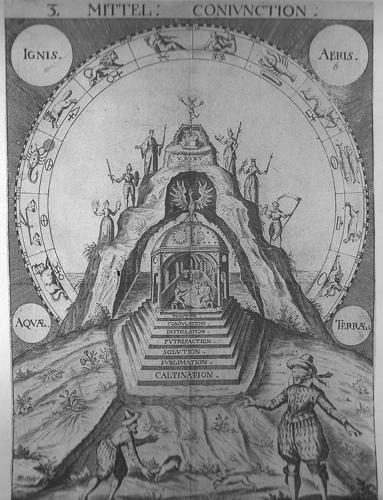
FIGURE 9.5. Plate 3 from Stefan Michelspacher, Cabala, Spiegel der Kunst un Natur, in Alchymia (Augsburg, 1616), engraving.
Photo by author.
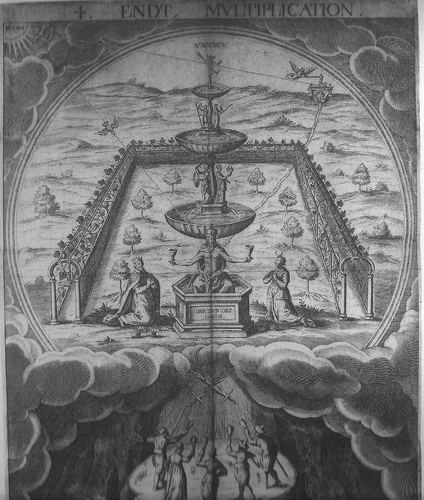
FIGURE 9.6. Plate 4 from Stefan Michelspacher, Cabala, Spiegel der Kunst un Natur, in Alchymia (Augsburg, 1616), engraving.
Photo by author.
Remmelin’s Catoptrum images reveal similar elements to those found in Khunrath’s and Michelspacher’s prints. The microchristus figure that appears in the Visio Secunda (see fig. 9.3) stands in contrast to the phoenix that appears in the Visio Tertia (see fig. 9.4). The resurrection of Christ and his promise of salvation (correlated to the Philosopher’s Stone) is associated with the male figure, whereas the phoenix of traditional alchemy is associated with the female figure. An inscription that appears over the phoenix in the Visio Tertia reads, “ut Phoenix vivit combustas: sic [218] Homo & qui fumi instar, Cinis” (As the Phoenix lives even after it has been consumed by fire: thus man who is the likeness of smoke is also ash).18 An inscription on the underside of the phoenix (it lifts up to reveal the female pudenda) is a variation of Psalm 101:4: “Quia defecerunt sicut fumus dies mei et ossa mea sicut gremium aruerunt” (For my days are vanished like smoke: and my bones [219] are grown dry like fuel for the fire).19 These inscriptions point to the phoenix as both a reminder of death and a sign of alchemical resurrection and transformation. However, what is different about Remmelin’s engravings is that the relationship between Christ and the phoenix is reformulated in the context of the Catoptrum’s aggressive sexual antithesis.
Remmelin’s male and female anatomical figures are posed as Adam and Eve, following a convention that Vesalius himself initiated in his Epitome, a highly truncated and inexpensive redaction of the Fabrica that was probably sold to medical students. In the Epitome, a male, normative nude is shown holding a skull, posed with a female nude who covers herself in a pudica gesture. The implications of Vesalius’s image were taken further by Thomas Geminus, an English physician who produced a plagiarized edition of Vesalius in 1545 that also included the Adam and Eve figures. In Geminus’s version, Adam now holds an apple and the skull appears at his feet, entwined with a serpent that is pointed toward Eve (fig. 9.7). In Remmelin’s Catoptrum, a skull and serpent similarly appear in both the Visio Secunda (see fig. 9.3) and the Visio Tertia (see fig. 9.4). But there is a clear difference in how the skull and serpents are employed in relation to the male and female figures in the two plates. In the Visio Secunda (dedicated to male anatomy), the serpent is being stamped out by Christianity. In the Visio Tertia (dedicated to female anatomy), the serpent holds an apple in its mouth, representing the moment prior to the fall of man. In some ways this type of juxtaposition is not surprising and can be said to rehearse long-standing late medieval and Renaissance moralistic divisions between the sexes based on interpretations of the fall of Adam and Eve (i.e., Bernardino of Siena’s statement that “through woman, the entire human race was lost” is one of the clearer articulations of how Eve was understood to stand for all women).20 But in the context of Remmelin’s flap sheets, that moral difference is explicitly conferred on anatomical features of the human body.
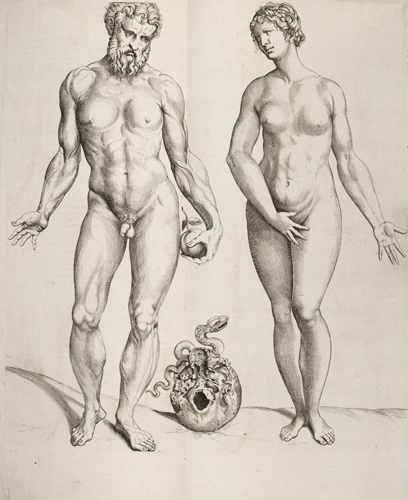
FIGURE 9.7. Adam and Eve, from Thomas Geminus, Compendiosa totius anatomie delineatio . . . (London, 1545), engraving.
Special Collections Research Center, University of Chicago Library.
For instance, a long, nonbiblical, Latin inscription that appears at the bottom of the Visio Prima invokes Adam and Eve and makes clear the principle on which men and women are distinguished.
THE LAMENTATION OF THE HUMAN RACE
O God, you alone remained before chaos, before all bodies of things, you, who do not have a limit. Illustrate [these things]. With the light land, the image of your divine mind came into being, from your immeasurable goodness. Nevertheless, the better spouse, having been taken by the trick of an evil demon, was soon led astray by his stupid wife. Behold! He neglected your divine precept, and the deplorable man bore the pernicious loss forever. Clearly, having been mocked you immediately lost the human race of Adam by the seductive speech of a serpent. Although God forbade it, eating the sorrowful fruit you caused pale death to come into the empty world. Our life fleeing just like the grass, like the smoke of fire—changes that you cause to be suddenly undone.21
[221] Throughout the Catoptrum this moral distinction is also explicitly connected to the operations of human generation. For instance, it is starkly demonstrated in the devil’s head that is frequently flapped over the female pudenda in the pregnant torso of the Visio Prima (fig. 9.8).22 Secreting a woman’s reproductive organs behind a devil’s head, the Catoptrum regressively underlines Eve’s/woman’s association with initiating and participating in sin. At the same time, however, the devil’s head acts as an apotropaic medical warning for the viewer. It can be understood as a device to ward off the risky contingencies associated with conception, a topic that was frequently discussed in the Renaissance discourse on monstrous births. For example, there was a widespread belief that a woman could cause deformity in her fetus by simply looking at disturbing images or even thinking impure thoughts during both conception and pregnancy. Ambroise Paré’s De monstres et prodiges of 1573 was one of the primary sixteenth-century medical tracts that warned of the results of just such an unchanneled maternal imagination.23
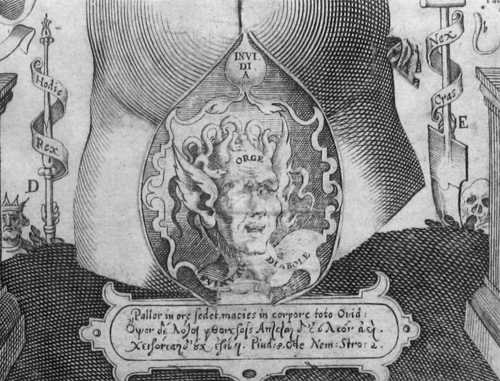
FIGURE 9.8. Detail of devil’s head in Visio prima, from Johann Remmelin, Catoptrum microcosmicum . . . (Augustae Vindelicorum: Typis Davidis Francki, 1619), engraving. Galter Health Sciences Library: Rare Books (Medical) 611 R28 1619.
Courtesy of the Galter Health Sciences Library Special Collections, Feinberg School of Medicine, Northwestern University, Chicago.
Beyond these references to the fall of man and the sins of Eve, the images and inscriptions in the Catoptrum also invoke a discourse concerning the relationship between alchemy and secrets of women. This becomes evident upon consideration of some other unique representational and textual elements in the flap sheets. The first is the roundel at the top of the Visio Prima (fig. 9.9). It typically has three flaps and four images. In some versions and editions, the first image in the roundel is a sun inscribed with the Hebrew word for Yahweh, the second is an angel, the third depicts a bearded man in a peaked hat, and the last bears a Latin inscription.24 The image of the bearded man seems likely to be Hermes Trismegistus, and it is consistent with other contemporaneous representations such as that found in Michael Maier’s Symbola aureae mensae, printed in Frankfurt in 1617, as well as earlier representations such as that found on the floor of Siena’s cathedral. The reference to Trismegistus clearly serves to remind Remmelin’s audience of the text’s alchemical authority. The Latin inscription suggests further allusions to mysterious knowledge. “A Deo est omnis MEDELA. Syr: 38. Cap.V. 2” appears to come from the Book of Sirach in the Hebrew bible, or Ecclesiasticus. Chapter 38 verse 2 reads, “A Deo est enim omnis medela, et a rege accipiet donationem” (For all healing is from God, and so he will receive gifts from the King). Ecclesiasticus is associated with Ben Sira in Jewish Talmudic tradition and the inscription seems to refer simply to the divine source of the physician’s arts. But Ben Sira was a figure also associated with kabbala. The flaps thus refer both directly and indirectly to sources on kabbala and magic. Jewish mystical and magical thought was particularly prominent in Basel, where Remmelin was trained as a physician. Basel was also a center for Paracelsian medicine and was a primary site for publications of Paracelsian texts.25 While perhaps influenced by an early exposure to Paracelsian thought and by [222] his connection to Michelspacher, Remmelin nevertheless gives clear indications in the Catoptrum of his own unique formulation of medical alchemy based on exposure to kabbala.
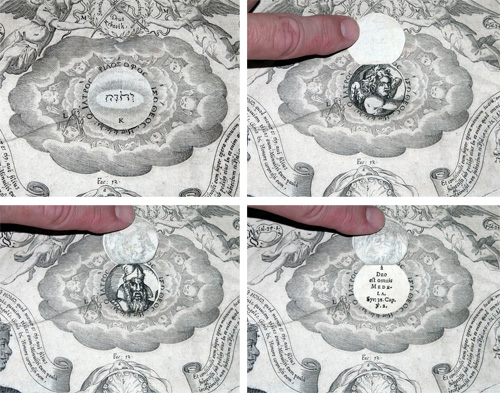
FIGURE 9.9. Roundel with flaps in Visio prima, from Johann Remmelin, Catoptrum microcosmicum (Augsburg, 1619), engraving.
University of Iowa, John Martin Rare Book Room, Hardin Library for the Health Sciences.
The layering of sources in the flaps advertises the magical, kabbalistic, and alchemical aspirations of the text. But it also alludes to demonic aspects of medicine in respect to gender. Paracelsus developed a concept of disease in which the creation of demons from semen used for improper purposes was one critical source of illness. He connected this demonic ability specifically to Lilith, the witch of Jewish folklore who could make “from every drop of such semen the bodies of demons and spirits.”26 The story of Lilith, Adam’s first wife, is given one of its most comprehensive treatments in another text circulated in the Renaissance: the Alphabet of Ben-Sira (Alphabetum Siracidis, Othijoth ben Sira), a tenth-century compilation of Aramaic and Hebrew proverbs. In Jewish folklore and the Talmudic tradition, God is believed to have created a woman prior to Eve named Lilith, a female figure who ultimately becomes associated with witchcraft, promiscuity, and demonic possession and whose mission is to corrupt men and kill all children.27 Other accounts of [223] Lilith come from esoteric Jewish texts like the Zohar and Book of Raziel, books associated with kabbala and magic in the seventeenth century. In the Zohar, Lilith is represented not just as a temptress and evil demon, but also as a carrier of disease. Extrapolating from these characterizations of Lilith, Paracelsus thus represents her as the evil that medicine must overcome, the female genius whose machinations and ability to mold and transform semen can cause disease and contaminate conception.
While Remmelin’s Catoptrum does not explicitly refer to Lilith, it does underscore the power women might have over conception and birth, a power that could have either positive or negative consequences. In the Visio Tertia (see fig. 9.4), for instance, the female figure stands over a phoenix on fire, a plume of smoke rising between her legs. The phoenix was a recognizable emblem for the Philosopher’s Stone, but in the context of the Catoptrum its magical properties of death and resurrection are also transferred by proximity to the female figure’s uterus. In other words, the printed plate visually transforms the womb itself into the Philosopher’s Stone. This visual transformation mirrors similar ideas found in Paracelsus. For Paracelsus, the womb embodies the fundamental [224] principle of transmutation or metamorphosis: it is the matrix of the microcosma (the gendered “small world” of women). In fact, Paracelsus’s identification of the womb with the microcosma may be intentionally invoked by Remmelin in the title of his flap sheet. For Paracelsus, the womb’s power is such that it is the only safe place for the generation of men to occur.28 However, the womb was also “Heimlich,” or secret, for Paracelsus, and it could involuntarily stamp on the matrix not a perfect version of man, but a monstrous product of the imagination.29 In an inversion of the medical discourse on maternal imagination and the breeding of monsters, Paracelsus and his followers were preoccupied with the question of whether the womb could be a laboratory for producing a homunculus, an experimental form of magical being.30 Thus, the power of womb was two-sided: it was both a benign haven and unpredictable laboratory. In Remmelin’s representation, the womb’s dangerous aspects are thwarted by the phoenix, the bird who, according to Jewish midrash, was allowed to stay in paradise after the fall, because alone of all the animals, he had refused Eve’s offer to eat from the Tree of Wisdom.31 The visual configuration thus suggests that the uterus is a powerful alchemical element of the female body, but it is only the male alchemist, represented by the phoenix, who can control the transformations of generation, while simultaneously resisting the demonic forces associated with Lilith/Eve.
The density of meanings carried by the phoenix in the Visio Tertia is mirrored by the allusions associated with the image covering the male genitals in the Visio Secunda (see fig. 9.3). Here we see a flowering plant rise between the male figure’s legs. The plant referred to in the inscription is colchicum, a plant of ancient lineage used to treat podagra. More commonly known now as gout, this is a disease caused by excess uric acid accumulating in the extremities of the legs, particularly the toes, causing an excruciatingly painful condition leading to death. Connected to the consumption of rich food and wine, the disease was associated primarily with patrician men. Roy Porter, for instance, has suggested that a century later, gout was recognized as “rich and nobleman’s disease,” and was often seen as a sign of social distinction or aristocratic luxury.32 In earlier centuries, gout was also an illness associated with scholarly rumination, and it was thought to inspire religious faith and noble virtues in the sufferer. This is, for instance, the view taken by the sixteenth-century Italian physician Girolamo Cardano. He characterized the disease accordingly: “What a man gout makes! Devout, morally pure, temperate, circumspect, wakeful. No one is so mindful of God as the man is in the clutches of the pains of gout. He who suffers gout cannot forget that he is mortal, because it affects him in every part of his being.”33
Remmelin’s allusion to colchicum is ambiguous however. The inscription that identifies the plant refers not to its use in treating gout, but to the unique character of the plant: “As the withered colchicum blooms: thus, too, Man, in the likeness of grass, rots [and is resurrected].”34 Referred to sometimes as autumn crocus, the plant is distinctive in that the blooms appear late in fall, when the [225] plant itself has largely shriveled. Reference to this aspect of the plant is reiterated in the long Latin inscription that appears at the bottom of the plate, where colchicum is compared to the phoenix with soteriological consequences: “Consider—just as the herb of colchis springs forth with flower from the dead vine, and the phoenix bird is born from its own ashes; thus, man, you will live happily by my [Christ’s] death, and you will be seen blooming forever.”35 Added to this is an inscription from Isaiah 40:6 that exhorts the reader to once again consider the vanitas theme: “Omnis caro foenum et omnis gloria Hominis [eius] quasi flos agri” (All flesh is grass and all the glory of it is as the flower of the field).
Remmelin’s choice of colchicum seems to bring together medicine with salvation. On the one hand, the plant invokes a disease that carries noble associations and inspires religious reflection while alluding to the therapeutic value of medical knowledge. On the other hand, it also demonstrates the correlation between resurrection in nature and resurrection in religion. Treated distinctly from the phoenix in the Visio Tertia, colchicum stands for the alliance between medicine and alchemy, and associates the resulting productive knowledge with the male body and nobility.
In contrast, female reproductive power both draws analogously from and is controlled by the phoenix, and the female figure’s lack of trustworthiness is a constant refrain. For instance, in the Visio Prima, Remmelin invokes book 2 of Ovid’s Metamorphoses as well as an oddity from Pindar. Inscribed in a cartouche underneath the truncated female torso there is first a Latin inscription: “Pallor in ore sedet, macies in corpore toto” (Pallor spreads over her face, and all her body shrivels). This comes from Ovid’s story of Hermes and the sisters Herse and Aglauros in Metamorphoses. The phrase alludes to Aglauros, who is catastrophically consumed by Envy when she realizes that the god Hermes is enamored of her sister Herse.36 The second inscription is in Greek and comes from Pindar’s Nemean Ode 8 (For Deinias of Aegina Double Footrace ?459 BC), line 21: “opson de logoi phthoneroisin aptetai d’ eslon aei, cheironessi d’ ouk erizei” (Words are a dainty morsel for the envious; and envy always clings to the noble, and has no quarrel with worse men).37 These two references to envy are clearly meant to characterize the female temperament as one prone to and driven by excess and lack of control, a set of conditions that also govern the female body. The images and inscriptions echo Paracelsus’s projection of evil female influence over wounds: wounds can be poisoned and contaminated by the looks and influence of “jealous, hateful, and perfidious women.”38 Control over the female uterus cannot be entrusted entirely to women because they themselves tend toward dissolution and can corrupt the process of healing as well as generation. That is, in women’s hands, medicine can potentially degenerate or deviate from its intended, noble purpose.
While extreme in its negative representation of female character and anatomy, even by seventeenth-century standards, Remmelin’s Catoptrum nevertheless embodies certain ideas specific to the history of medicine and anatomy. As Katharine Park has argued, Vesalius staked part of his [226] reputation as an anatomist on the idea that he had definitively unveiled the “secrets of women.”39 As she points out, anatomical inquiry from the late Middle Ages to the end of the Renaissance emphasized the idea that a woman was defined anatomically by her interior. While the male figure stood for normative anatomy in every other sense, the female figure was of interest for what she held inside: the secrets of generation itself. Thus, in anatomical images from the tenth through the seventeenth centuries, a female figure was included in atlases of the body chiefly to demonstrate female reproductive organs. This tradition of representation coincided with the development in the late Middle Ages of the “secrets of women,” a phrase that referred initially to women’s medicine administered by women and the systematic compilation of women’s complaints and treatments for them in textual forms like the medieval Trotula. But, as Monica Green has shown, the emphasis on what was defined as “secret” began to change in the Renaissance, and compendia of “women’s secrets” began to refer to those aspects of gynecology and generation that drew prurient and incriminating attention from male writers.40 In the Fabrica, Vesalius shows himself dissecting a female cadaver in the frontispiece, describing the woman herself as a criminal who tried to fake a pregnancy, only to have her ruse unveiled. Park argues that Vesalius intentionally shows himself dissecting this female cadaver to demonstrate that anatomy trumps secrets through dissection: the anatomist sees and knows everything about the body and there can be no secrets that remain under the knife. In this way, a woman’s anatomy took on “emblematic status as the exemplary object of dissection: representations of the female body came to stand both for the interior of the human body and for the powers of dissection-based anatomy to reveal its hidden truths.”41 However, as Park goes on to note, the uterus nevertheless retained special power as an “enigmatic space” where conception, generation, and knowledge itself originated and where the “male seed was mysteriously transmuted into a human child.”42
The idea that the uterus maintains special powers to transmute substances into the stuff that generates life dovetails directly with the alchemical principles alluded to by Remmelin. The uterus is refashioned in the Catoptrum as an alchemical laboratory in which magical effects and the risk of demonic transformations can occur. In contrast to Vesalius, who insists that all secrets have been or will be discovered by simply uncovering the uterus and shining the light of direct observation on it, Remmelin reinscribes the uterus in a dialectic of Paracelsian secrets, kabbalistic magic, and alchemical transmutations, while simultaneously emphasizing the demonic and unpredictable aspects of female anatomy. Thus, while the visual pairing of male and female figures in the Catoptrum mirrors the convention of Adam and Eve that was a prominent trope in anatomical works since Vesalius, Remmelin’s juxtaposition also calls up associations with the occult powers of Lilith that have been transferred to the womb. The idea of generation as an ultimate transformation, of the uterus as a Philosopher’s Stone akin to the phoenix, is conveyed in the inscription that weaves around the unborn fetus that floats in the Visio Prima near the truncated female torso. The banner around the fetus is inscribed with “Quasi morientes & ecce vivimus,” a phrase from 2 Corinthians 6:9 (KJV) [227] meaning “As dying and behold we live.” This emphasizes the idea that human life is resurrected from mute matter in the same way that the phoenix rises from ashes.
The Catoptrum microcosmicum is in many ways an unclassifiable work of visual culture. The form of the flap sheet itself invites the viewer/reader to participate in the illusion of dissecting the body, putting the viewer into the place of the anatomist. In this sense, the facture of the flap sheet is calculated to reflect the most up-to-date forms of anatomical discovery and practice. At the same time, however, the flap sheet’s alliance between alchemy and anatomy reinforces the idea that the bodies under view are hiding secrets, rather than divulging them. Representing the uterus as a space of alchemical experimentation, Remmelin produces an image that articulates the worst fears engendered by the female body’s interior inaccessibility, while also countering Vesalius’s claim that all questions have been answered. As such, the Catoptrum leaves open the question as to what it is really intended to “mirror” microcosmically. Like Vesalius, however, Remmelin also ultimately invokes the power of the male physician/anatomist to both understand and control secrets. Added to the 1619 edition is a Hippocratic aphorism in Greek, around the roundel in the Visio Prima: “For a physician who is a lover of wisdom is the equal of a god.”43
I am grateful to Jesse Weiner for his assistance in translating the longer Latin passages and Shaina Trapedo for locating the source of the Hebrew phrases. In addition, my thanks go to Maria Pantelia, director of the Thesaurus Linguae Graecae (an extraordinary online resource based at the University of California, Irvine) for her help in tracking down the origins of the Greek inscriptions.
Bibliography
Cazort, Mimi, Monique Kornell, and K. B. Roberts. The Ingenious Machine of Nature: Four Centuries of Art and Anatomy. Exhibit catalogue. Ottawa: National Gallery of Art, 1996.
Choulant, Ludwig. History and Bibliography of Anatomic Illustration. Translated and edited by Mortimer Frank. Chicago: University of Chicago Press, 1920.
Davis, Natalie Zemon. “Toward Mixtures and Margins.” American Historical Review 97, no. 5 (1992): 1409–16.
Forshaw, Peter. “‘Paradoxes, Absurdities, and Madness’: Conflict over Alchemy, Magic and Medicine in the Works of Andreas Libavius and Heinrich Khunrath.” Early Science and Medicine 13, no. 1 (2008): 53–81.
Green, Monica. “From ‘Diseases of Women’ to ‘Secrets of Women’: The Transformation of Gynecological Literature in the Later Middle Ages.” Journal of Medieval and Early Modern Studies 30, no. 1 (2000): 5–39.
Healy, Margaret. “‘Making the Quadrangle Round’: Alchemy’s Protean Forms in Shakespeare’s Sonnets and A Lover’s Complaint.” In A Companion to Shakespeare’s Sonnets, edited by Michael Schoenfeldt, 405–25. London: Blackwell, 2007.
Hillman, David, and Carla Mazzio, eds. The Body in Parts: Fantasies of Corporeality in Early Modern Europe. New York: Routledge, 1997.
Hippocrates (attr.). Of Decorum. In Hippocrates, Works, vol. 2. Translated by W. H. S. Jones. Loeb Classical Library 148. 1923. Reprint, Cambridge, MA: Harvard University Press, 1959.
Huet, Marie Hélène. Monstrous Imagination. Cambridge, MA: Harvard University Press, 1993.
Keller, Hildegard Elisabeth. “Seeing ‘Microcosma’: Paracelsus’s Gendered Epistemology.” In Paracelsian Moments: Science, Medicine and Astrology in Early Modern Europe, edited by Gerhild Scholz Williams and Charles D. Gunnoe Jr., 93–115. Kirksville, MO: Truman State University Press, 2002.
Kessler, Herbert Leon. “The Solitary Bird in van der Goes’ Garden of Eden.” Journal of the Warburg and Courtauld Institutes 28 (1965): 326–29.
Klossowski de Rola, Stanislas. The Golden Game: Alchemical Engravings of the Seventeenth Century. New York: Braziller, 1988.
McDaniel, W. B. “The Affair of the ‘1613’ Printing of Johannes Rümelin’s Catoptron.” Transactions and Studies of the College of Physicians of Philadelphia. 4th ser., 6 (1938): 60–72.
Mitchell, Peter. The Purple Island and Anatomy in Early Seventeenth-Century Literature, Philosophy and Theology. Madison, NJ: Fairleigh Dickinson University Press, 1991.
Mormando, Franco. “Bernardino of Siena, ‘Great Defender’ or ‘Merciless Betrayer’ of Women?” Italica 75, no. 1 (1998): 22–40.
Newman, William. “The Homunculus and His Forebears: Wonders of Art and Nature.” In Natural Particulars: Nature and the Disciplines in Renaissance Europe, edited by Anthony Grafton and Nancy Siraisi, 321–45. Cambridge, MA: MIT Press, 1999.
Ovid. Metamorphoses. Translated by Anthony S. Kline. Charlottesville: University of Virginia Electronic Text Center, 2004.
Pagel, Walter. Paracelsus: An Introduction to Philosophical Medicine in the Era of the Renaissance. 2nd ed. Basel: Karger, 1982.
Park, Katharine. Secrets of Women: Gender, Generation, and the Origins of Human Dissection. New York: Zone Books, 2006.
Pindar. Pindari carmina: Cum fragmentis. Edited by Herwig Maehler. Pt. 1, 5th ed. Leipzig: Teubner, 1971.
Porter, Roy, and G. S. Rousseau. Gout: The Patrician Malady. New Haven, CT: Yale University Press, 1998.
Principe, Lawrence M. Chymists and Chymistry: Studies in the History of Alchemy and Early Modern Chemistry. Philadelphia: Science History Publications, 2007.
Russell, Kenneth F. A Bibliography of Johann Remmelin the Anatomist. St. Kilda East, Australia: J. F. Russell, 1991.
Schmidt, Suzanne Karr. “Printed Bodies and the Materiality of Early Modern Prints.” Art in Print [online journal] 1 (2011): 24–31.
Szulakowska, Ursula. “The Apocalyptic Eucharist and Religious Dissidence in Stefan Michelspacher’s Cabala: Spiegel der Kunst und Natur, in Alchymia (1616).” Aries 3, no. 1 (2003): 200–223.
Tuttle, Virginia. “Lilith in Bosch’s Garden of Earthly Delights.” Simiolus: Netherlands Quarterly for the History of Art 15, no. 2 (1985): 119–30.
Vesalius, Andreas. On the Fabric of the Human Body. An annotated translation of the 1543 and 1555 Latin editions of Vesalius’ De humani corporis fabrica, by Daniel Garrison and Malcolm Hast. Evanston, IL: Northwestern University, 2003.