
– 8 –
Sean Roberts
An essay on engravings and secrets might be expected to start from a print like Albrecht Dürer’s Melencolia I (1514) (see fig. 1 in “Introduction”), representative of a new class of objects produced for often solitary, if not wholly private, contemplation, enjoyment, and even deciphering.1 Indeed, the very foundations of the iconological hermeneutic might be traced through precisely such an image, in which symbols and ciphers yield their meanings through the painstaking and deliberate work of scholarly decoding. This essay, however, treats the technical secrets of engraving and will begin instead with another of Dürer’s prints from the previous year, the Sudarium with Two Angels (fig. 8.1).2 The legend of the veronica, or sudarium, a miraculous imprint of Christ’s visage on cloth, served as the inspiration for countless devotional paintings and prints throughout the fifteenth and sixteenth centuries.3 The sacrality of this relic was tied not only, or even principally, to the fact that it preserved a record of Christ’s features, but rather to the miraculous means by which that image was transferred to cloth without the intermediary of a human craftsperson. Joseph Koerner has provocatively connected the miraculous record of the holy face on the veil to the processes of Renaissance printmaking, observing that “Dürer thus fashions the Christian non manufactum to mythicize the process and the product of printing.”4
This image is available in the print edition
FIGURE 8.1. Albrecht Dürer, Sudarium with Two Angels, 1513, engraving, London, British Museum.
© Trustees of the British Museum.
Though Koerner’s likening of the angels in Dürer’s later etched Sudarium (fig. 8.2) to printmakers hanging their fresh pages to dry has aroused skepticism, the comparison is hardly inapt.5 Like the veronica, engravings were themselves composed of marks imprinted without the direct intervention of human hands. Indeed it is a commonplace of scholarship on early modern printing to observe that the first products of the press (both texts and images) were sometimes seen as miraculous.6 Engraving, like the sudarium, could be understood as having unknown, mysterious, and for some even “mythic” origins.
This image is available in the print edition
FIGURE 8.2. Albrecht Dürer, The Sudarium Spread out by an Angel, 1516, etching on iron, London, British Museum.
© Trustees of the British Museum.
[183] It could be argued that the mysterious nature of engraving was an inevitable response to the introduction of new and unfamiliar technologies and processes. A lack of familiarity with the workings of this labor-saving technology gave the impression of a supernatural force at work for viewers and readers steeped in a scribal culture. This is a common narrative of the introduction of technology and a familiar one for historians of science. Surely the burgeoning early modern obsession with marvels, wonders, and curiosities also suggested such rubrics as frameworks for understanding technical novelty.7 Further, as Pamela Smith has shown, artisanal forms of knowledge were often de facto secrets to the uninitiated and uninterested alike.8 Within the history of printing, a sense of mystery was frequently included as one of a handful of emergent properties inherent to print culture, most influentially by Elizabeth Eisenstein in her landmark study The Printing Press as an Agent of Cultural Change (1978).9 Over the past two decades, however, historians of printing, following the lead of Adrian Johns, have launched a sustained reevaluation of Eisenstein’s paradigm. These revisionist scholars have argued that qualities long associated with print culture—the authority of print foremost—were, at least in part, built slowly through the [185] efforts of printers, authors, engravers, and all of the sundry individuals involved in the production of these texts and images.10 Following on these valuable studies, I will argue here that the apparently mysterious origins of engraving were another of these intentional rather than accidental or inherent qualities of print.
This essay posits that a rhetoric of secrecy was erected around the techniques by which fifteenth-century engraved images came into being. The technical operations of engravers were, in some of the earliest cases, actively effaced in being designated as secrets by their makers. Many of the tools and techniques that early engraving depended upon were adapted from other, long-standing craft practices, especially silver- and goldsmithing. Derived from familiar techniques performed with familiar tools, engraving was, nonetheless, far from universally understood. In his early fifteenth-century Libro dell’arte, Cennino Cennini for example displays familiarity with metalworking processes, describing a variety of burnishers and punches as well as methods for using these.11 These are the very tools that would be retrofitted, only a couple of decades later in Florence, to serve as part of the basic technologies of engraving on copperplates. Yet despite the prevalence and familiarity of such tools, their utility for engraving was anything but common knowledge in the quattrocento. Engraving produced remarkable images, and in the fifteenth century comparatively few individuals, even among artists, understood precisely how. This essay considers how that secrecy worked and what conditions made that secrecy a possibility, and most importantly, suggests who might have been the beneficiary of these secrets.
As Pamela Long has shown, technical skills were often jealously guarded as trade secrets from antiquity into early modernity. This was true even of processes that we have come to understand as rudimentary. Craftspeople protected techniques for activities including glassmaking, metallurgy, mining, and masonry. Painters and sculptors kept a watchful eye on every component of their trade, ranging from specialized chisels and hammers to recipes for paint, ink, and plaster.12 The Venetian glass industry provides perhaps the best-studied example of the careful, intentional, and unyielding protection of early modern technical knowledge from outsiders through clever obfuscation, controlled access, and custom-tailored juridical practices.13
Established practitioners of long-valued trades such as the Serenissima’s glassmakers prospered under the watchful eye of state guardianship. Many less established industries, however, had recourse to few such legal protections in early modern Europe. The issuing of privileges for technical processes was commonplace; indeed that system had developed to protect technical innovation and was certainly better-suited to the preservation of technological invention than to artistic composition. Ugo da Carpi (1455–ca. 1523) famously obtained privileges for his supposed invention of the chiaroscuro woodcut process. Certainly Ugo had good reason to seek such protections. His collaboration with Ludovico Arrighi to produce woodcuts for Arrighi’s writing manual, the Operina (1524), soured and Ugo’s name was completely effaced on the title page of the first edition of that work.14 Still, such [186] privileges were local in their scope and notoriously difficult to enforce. More usually, craft techniques were carefully protected by other means, not least through watchful attention to equipment, the regulation of guild membership, and the oral transmission of techniques from master to apprentice. The very designation of these techniques as secret, however, was another means by which their proprietary character was controlled.
The secrecy of early engraving was far from rhetorical in the colloquial sense. It served the business interests of book printers and authors, craftspeople and artists. Such interests stretched beyond the discretely commercial motivation of greater profits to include the aspirations of many connected with print production to establish themselves as pioneers in a rapidly evolving field and to stake a claim for their authority over texts, images, techniques, and processes. Secrecy functioned to construct a patina of what Pierre Bordieu has designated “distinction,” the visible mark of symbolic capital. Practitioners found it expedient to designate techniques as secret until the technologies were so diffuse that it was no longer plausible to build an aura of sanctity and mystery around them. For engraving, this shift was taking place by the early sixteenth century. Even so, such secrecy attended each new printing process introduced, up to and including competing modes of photography in the nineteenth century. An early modern case in point is provided by the apparent invention of the soft-ground etching process by Giovanni Benedetto Castiglione (1609–64) in seventeenth-century Rome.15 The secrets of that process were not discovered by another printmaker until more than a century had passed.
Like Castiglione’s invention, one that only came to the attention of scholars in 1971, some of these technical secrets have remained hidden up to the present day. In part, this is due to the fact that art historians have routinely attributed technical differences between engravings to the skill or lack thereof of individual engravers. These engravers and their works have then been slotted into a chronology of stylistic development that parallels those of painting and sculpture. The subdiscipline of print history, traditionally tied closely to the concerns of collectors and connoisseurs, has been partially to blame. Following on the evaluation of Adam Von Bartsch, painter-engravers have served as the focal point of art historical attention while so-called reproductive engravers have been consigned to the field’s margins. This is undoubtedly a false dichotomy, as Lisa Pon has eloquently argued in her study of the collaborative relationship between Marcantonio Raimondi and Raphael.16 More importantly, the assignment of the most technically accomplished early engravings to talented painters, rather than skilled professionals, derived in part from the attitudes of Franz Wickhoff, has ingrained a counterintuitive and problematic conflation of technical and compositional skills.17 What art historians often refer to by the shorthand moniker of skill, or worse, intrinsic talent, is usually a more complex set of aptitudes requiring not only innate ability and diligent practice but certain kinds of technical know-how.
One high-profile example of a trade secret long unrecognized by print historians is demonstrated by the long-standing lack of consensus regarding the two prominent techniques—usually called “manners”—used by engravers active in fifteenth-century Florence. The earliest Florentine [187] engravings, those produced in the fine manner, employ shallow, gray lines and usually produce depth and tone through dense cross-hatching.18 These qualities are evident in prophets and sibyls usually attributed to Baccio Baldini. The engraver of the Samian Sibyl from this group develops a compelling sense of volume with short, intersecting hatches, especially in describing the peaks and ravines of the figure’s mountainous garment (fig. 8.3). Prints of the later Florentine broad manner, such as those of the Mysteries of the Rosary series, instead utilize regularly spaced, deeply gouged lines. In the Annunciation from this series (fig. 8.4) the engraver—almost certainly Francesco Rosselli (1445–before 1513)—creates networks of parallel hatching, emulating the graphic qualities of drawing. Broad manner engravings, particularly in their pictorial sense of modeling, differ significantly from the earlier, Florentine fine manner prints, usually thought to have been derived from goldsmiths’ intaglio techniques for producing nielli. The transition between these techniques has often been presented as a kind of natural progression from objects conceived in the botteghe of goldsmiths to the more expressive engravings produced through collaboration with artists familiar both with innovations in Florentine painting and with the graphically accomplished works of Northern printmakers like Martin Schongauer.19 The free flow of artistic ideas and the involvement of artists in a previous craft practice have been credited with providing the spark for this compelling new mode of printmaking. David Landau, however, has convincingly shown that a technical shift was instead principally responsible.20
This image is available in the print edition
FIGURE 8.3. Attributed to Baccio Baldini, The Samian Sibyl, ca. 1470, engraving, London, British Museum.
© Trustees of the British Museum.
This image is available in the print edition
FIGURE 8.4. Francesco Rosselli, Annunciation, after 1482, engraving from the series The Mysteries of the Rosary, London, British Museum.
© Trustees of the British Museum.
Florentine broad manner prints were once believed to represent the work of dozens of anonymous craftspeople, though most print scholars now attribute nearly all of these images to the hand of Rosselli. Before adopting the broad manner, Rosselli produced several engravings that are technically quite close to fine manner prints.21 These engravings display a silvery tone and are composed of shallowly gouged lines. However, unlike most fine manner examples, Rosselli’s prints make use of parallel rather than cross-hatching. The broad manner engravings differ from these not in their graphic style but rather in the depth and shape of their incised lines. Drawing on this seemingly pedestrian observation, Landau astutely recognized that Rosselli’s broad manner plates were engraved with a different tool than those used to create the fine manner prints—a burin with a lozenge-shaped section. Unlike the round-section burin and drypoint tool used in Florence, this instrument was capable of cutting the deep lines associated with broad manner prints.22 This tool was in wide use north of the Alps and Rosselli might have had the opportunity to acquire one while working for King Matthias Corvinus in Buda during the late 1470s.
The new engraving technology with which Rosselli returned to Florence provided him with a steady source of income and remained the province of, at most, a handful of artists. Landau and Peter Parshall, for their part, posit that “Rosselli was the only printmaker in Florence to be affected by the introduction of the burin.”23 This was not a coincidence and, judging by the sheer number of engravings Rosselli produced, it was not on account of the engraver’s lack of success. Instead, it [190] would stand to reason that Rosselli protected not only his plates, about which we know a great deal since he handed these on to his son Alessandro at the time of his death, but also the tricks of his trade.24 These prized tools and techniques undoubtedly included the lozenge-section burin that he probably acquired somewhere between the Alps and Buda, a secret that resisted revelation for nearly five centuries. The implications of such mobile tools and practitioners are only now being evaluated. I have argued elsewhere that Rosselli’s burin disrupts our notion of “early Florentine engraving” by inflecting it through German and Hungarian training and technology.25 The changes wrought by such trade secrets complicate not only the categories long relied upon by connoisseurs, but more importantly, long-standing nationalistic histories of craft and technology.
The Secrets of Engraved Maps
The earliest engraved maps have frequently been discussed in terms of secrecy and even its rhetoric. J. B. Harley, above all, pointed to the role that even conventional maps played in activating fantasies of early modern territorial control through their designation as privileged knowledge.26 Certainly few cartographic historians are unaware of the role engraved maps might play in sensitive situations like the arrest of Sigismondo’s agent, Matteo de’ Pasti, recounted in the introduction to this volume.27 The technical secrecy of these maps, however, has often gone unremarked upon, or has been assumed to be a self-evident phenomenon attendant to commercial or diplomatic interests. Their techniques have never been treated in terms of an intentional secrecy or analyzed in terms of who benefited from such secrets. Fifteenth-century engraved maps serve as ideal case studies of technical secrecy because, unlike figurative engravings, they do not rely closely on differences between their designers in terms of pictorial “invention” or “style.” Instead the vast majority of early engraved maps were based on those associated with the second-century Greek Geography of Ptolemy. Despite their reliance on relatively standardized models, startling visual differences are evident in even closely contemporary projects.
Two such parallel programs of engraving are the maps for Francesco Berlinghieri’s Septe giornate della geographia, printed by the Florentine printer known as Niccolò Tedesco in 1482, and the 1478 edition of Ptolemy’s Geography produced by Conrad Sweynheym and Arnold Pannartz in Rome. Both books include twenty-seven double folio maps of the known world’s principal regions derived from those in fifteenth-century manuscripts of Ptolemy’s work. The Florentine tome augments these with “modern” maps of France, Spain, Italy, and the Holy Land. Though based on cartographically identical maps, the engravings for these two editions diverge starkly in fundamental ways. Sweynheym’s pages present carefully aligned labels composed of identical Roman capitals designating topographic features including mountains and rivers that stand in vibrant relief against the white page (fig. 8.5). In contrast, the world presented by Berlinghieri and Tedesco is littered with toponymic mistakes, employs dozens of divergent letterforms, and is marred by a [191] sometimes image-obscuring plate tone and dense webs of scratches. These are technical problems with technological solutions, yet they have, more often than not, been attributed to different levels of skill on the part of engravers.
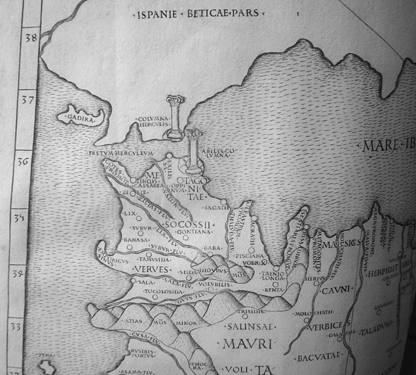
FIGURE 8.5. Third Map of Africa (detail), engraving from Ptolemy, Geography (Rome: Conrad Sweynheym and Arnold Pannartz, 1478).
Photo by author with permission of the Biblioteca Nazionale Palatina, Parma.
Probably the greatest impediment to appreciating fully these distinctions has been a failure on the part of modern viewers to recognize proprietary technical achievements. Familiar as we are with uniformly printed texts and images, we tend to underestimate how difficult, complicated, and novel early prints might have seemed. Access to implements like burnishers and specialized burins, tools often assumed to be indispensable to the engraving process, could be surprisingly well regulated.28 The seemingly miraculous appearance of the printed maps of the Roman Geography of 1478, when compared to those of the Florentine Geographia, demonstrates visually the gap between printers and printmakers who were privy to such technology and those who were kept in the dark. One carefully controlled set of tools was the metal punches employed to incise letters for map labels quickly and accurately.29 Punches also came to be used for towns and cities, political borders, and less frequently even for topographical features like mountains. They appear throughout maps of Sweynheym’s Geography (see fig. 8.5) and gave that project a distinct graphic advantage not only over Berlinghieri’s book but also over the Geography printed in Bologna in 1477.30
For the engravers of the Florentine and Bolognese maps, the lack of punches meant that each letter, for thousands of individual labels, had to be formed by hand. This led, of course, to a variety of divergent letterforms in and of itself, which hardly presented a serious problem. Nonetheless, it must have represented an extraordinary and unnecessary investment of labor, especially since the act of pushing the burin is so different from the scribal practice of copying letters. However, the lack of letter punches led to far more serious errors when coupled with another technological lacuna unique to Berlinghieri’s maps. The engravers of these massive maps lacked a suitable means to correct errors. A prominent example is provided by the Geographia’s ninth Ptolemaic map of Europe, which was mistakenly engraved with the title “TABULA NONA D’ASIA” “The Ninth Map of Asia.” Recognizing this error, or perhaps having had it pointed out, the cutter then interposed the letters “EUROPA” between those of “ASIA,” leaving the viewer with a nearly illegible jumble of Roman capitals. When the label for Giaffo (Jaffa, today a part of Tel Aviv) on the map of the Holy Land was incorrectly placed on an island directly to the west, the engraver’s only choice was to incise the label again, this time on the peninsula (fig. 8.6). The original misleading inscription, however, was not removed, leaving viewers puzzling over which of the two plots was the impostor. Elsewhere, on the book’s Ptolemaic map of Italy, the engraver apparently lost her or his bearings and continued the Adriatic Sea deep into the Italian peninsula. Again this craftsperson simply left these errant contours in place. Confronted with these glaring errors, the modern scholar of printed images only slowly reaches the astonishing conclusion that the producers of the largest and most expensive engraving project attempted in Renaissance Florence lacked not only letter punches but also a proper burnisher (or the knowledge to use it). Even this most fundamental tool [193] for correcting misplaced engraved lines seems to have been safely guarded by established practitioners as a secret of their trade.
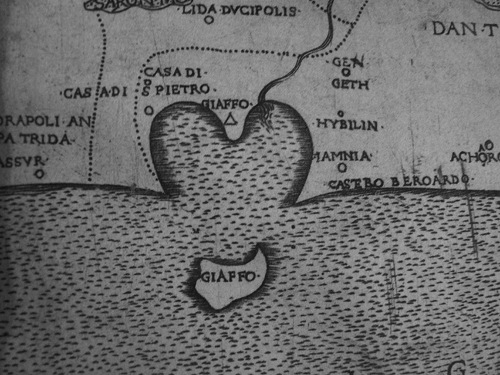
FIGURE 8.6. Map of the Holy Land (detail), engraving from Francesco Berlinghieri, Septe giornate della geographia (Florence: Niccolò Tedesco, 1482).
Photo by author with permission of the Biblioteca Nazionale Braidense, Milan.
A final problem presents itself to viewers in the form of the apparent compositional disorganization of several of the Geographia’s maps, including most notably that of modern Italy (fig. 8.7). Here, the engraving seems to have been based on a model somewhat larger than its plate could accommodate. The map significantly overlaps the border, engraved on the plate first, particularly at the image’s top edge. As a result, no space was left for a title inscription in the usual place above the map, forcing the engraver to intersperse the letters amidst a dense network of mountains. This toponymic disarray adds to an already graphically perplexing image in which figure and ground, mountains and lakes, even ocean and terra firma are not adequately distinguished from one another by the engraver’s burin. Visual confusion results, in large part, from the substantial plate tone and large number of unburnished scratches that render the entire surface of this image in varying shades of gray. Manuscript maps relied to a significant degree on color to distinguish land from water and various types of terrain from one another. The Geographia’s engraver substituted patterns for these colors and had access to only a limited range of these patterns in his or her repertoire; for instance, both the Mediterranean Sea and the Apennines are rendered with similar systems of short horizontal dashes. The result is a map whose hundreds of locations and general topography can only be discerned after great visual effort, a challenge exacerbated by the overwhelming grayness of the ground and heavy scratches.
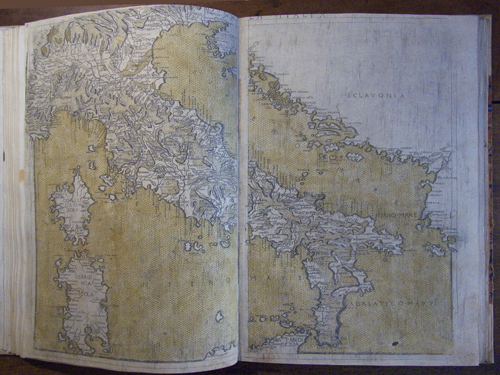
FIGURE 8.7. Map of “Modern” Italy, engraving from Francesco Berlinghieri, Septe giornate della geographia (Florence: Niccolò Tedesco, 1482).
Photo by author with permission of the Biblioteca Nazionale Braidense, Milan.
Here too technical secrets may be at play. The excessive plate tone is likely the result of a printer inexperienced in the delicate, even volatile, process of printing engraved images. Plate tone results from the adherence of ink to the unengraved plate surface and has several possible sources. Principal among these are insufficient wiping of the plate prior to printing or the mixing and application of unnecessarily greasy ink. Another source of distracting marks on many of Berlinghieri’s maps were fine cracks in the copperplates, into which ink settled. Such problems usually occur when impressions are pulled from plates that are too thin.31 The recipes and ratios necessary to mix printing ink or to choose plates of the right thickness were relatively simple ones, yet the printer and engraver of the Florentine Geographia lacked not only the tools, but also the training and experience, that would have compensated for these problems.32
Clearly some engraving techniques were understood as trade secrets in the fifteenth century. This observation need hardly suggest the rhetorical operations of secrecy. Yet we must ask what prevented Berlinghieri’s engravers (or those of other maps) from discovering these simple solutions on their own? Punches were, after all, widely used in both gold- and silver-work. Smiths had used them for decorative motifs and personal marks for decades at least. Burnishers, likewise, were common tools, described in some detail even by Cennino Cennini at least a half-century prior.33 It would seem particularly surprising that these Florentine engravers failed to recognize the utility of these metalworking tools, given the intimacy that has usually been assumed between engravers [195] and goldsmiths in that city. What, for that matter, prevented Francesco Rosselli’s rivals from understanding that his successful prints hinged on a differently shaped burin? I propose that because they were constructed as trade secrets, many printers and engravers assumed that tools and techniques were more specialized and complicated than they actually were. This rhetoric of secrecy, at least sometimes, discouraged reverse-engineering from printing’s finished products.
It might be argued that the Geographia’s author lacked the resources or motivation to secure the best-possible engravers for this project. We can be reasonably certain, however, that Francesco Berlinghieri spared little expense in bringing the Geographia, a project that represented over a decade of labor on the poet’s part, into print.34 He further possessed significant experience with the costs and demands of book printing, having financed the first edition of Marsilio Ficino’s translation of Plato’s works.35 Berlinghieri also understood that engraving depended on the personal knowledge and skills of its practitioners. In a letter (now unfortunately lost) to Bartolomeo Scala, the geographer expressed his intention to travel to Rome to speak with Conrad Sweynheym about the maps for his Geographia.36 Perhaps Berlinghieri had seen an example of the Roman edition. If so, he might have read the book’s preface describing how “calling on the help of mathematicians, he [Sweynheym] gave instructions in the method of printing from copper plates, spending three years in this up to the day of his death.”37 Aware that Florentine engravers were incapable of achieving the level of graphic complexity and clarity that these maps would require, the poet sought to learn these secrets from Sweynheym and his already experienced pool of engravers. Berlinghieri, a prolific writer of letters, evidently believed that engraving was the kind of business one discussed in person, a conversation that required discretion and diplomatic negotiation.38
Invention, Revelation, and the Control of Technical Secrets
The Geographia’s printer, Niccolò Tedesco, built his reputation on the production of technically experimental engraved books.39 While Berlinghieri’s book revealed the extent to which its printer and his engravers were excluded from some of fifteenth-century engraving’s most important technical secrets, other projects revealed that Niccolò had a few tricks up his own sleeve. Nearly simultaneously with the Geographia, Niccolò was in the process of printing Cristoforo Landino’s massive commentary on Dante’s Commedia (1481).40 The Commento was the first printed book to combine letterpress text and engraved illustrations on a single folio (fig. 8.8). Each of these pages was designed to accommodate Dante’s verse, Landino’s gloss, and illustrations probably designed by Sandro Botticelli and engraved by Baccio Baldini. This edition has been characterized by one scholar as “one [196] of the most beautiful Florentine editions of the quattrocento.”41 In many ways, however, the Commento offers close parallels to some of the technical problems that Niccolò and his assistants faced in printing the Geographia. Like Berlinghieri’s book, Landino’s commentary presented its printer with an ambitious scheme combining text and image, in this case on the same page. The Commento demonstrates the gap between the ambition of authors and financiers and the technical skills and experience necessary for printers and engravers to realize these lofty goals. Indeed, Berlinghieri’s and Landino’s books were only the second and third attempts, respectively, to illustrate a book using engraving. The first, Antonio Bettini’s Monte Santo di Dio (1477), like the Geographia, was plagued by errant burin marks and distracting plate tone despite the small size of its images (fig. 8.9).42 When the work was printed again in 1491, the new printer abandoned engraving entirely, employing a woodcutter to translate the illustrations of the problematic first edition into that medium.43 Each of these projects was printed by Niccolò suggesting that, when it came to combining letterpress with engraved images, his was the only game in town. This fact goes some way toward confirming that such engraving techniques indeed represented trade secrets at this moment.
This image is available in the print edition
FIGURE 8.8. Attributed to Baccio Baldini, illustration for the third canto, engraving from Cristoforo Landino, Commento sopra la commedia (Florence: Niccolò Tedesco, 1481), London, British Museum.
© Trustees of the British Museum.
This image is available in the print edition
FIGURE 8.9. The Holy Mountain (frontispiece), engraving from Antonio Bettini, Monte santo di Dio (Florence: Niccolò Tedesco, 1477), London, British Museum.
© Trustees of the British Museum.
Landino’s commentary was planned to include one of Botticelli’s illustrations for each of Dante’s hundred cantos. Even the most complete extant examples, however, bear only twenty-one engravings, and of these only the first three are actually printed on the same page as their accompanying text. The rest were printed on separate sheets, cut out, and affixed on the page in the space left for them, the process of aligning the sheets to be run through the press a second time having proved an apparently Herculean labor.44 In the majority of surviving copies, the frustrated printer and his assistants simply conceded defeat, leaving blank the spaces left for the engravings after the third canto.45 If the task proved beyond their technical means, Landino and Niccolò nonetheless produced a book whose pages would have born the immediate imprint of technological experimentation, suggesting that its printer and possibly even author possessed secret knowledge of these processes. How else, quattrocento readers and viewers might ask, could they have achieved (if on a limited scale) what no other printer or author had? The very appearance of illustrated books like the Commento amounted to a tantalizing display of technical knowledge and revealed that Niccolò possessed valuable secrets indeed.
The Mantuan Andrea Mantegna, and those working with him, pioneered an equally recognizable graphic feat—an expressive engraved line characterized by fluid parallel hatching largely unknown on the peninsula previously.46 The tonal system of these prints, remarkably, did not spread to neighboring Ferrara, where instead a technique closer to that of the Florentine fine manner took [199] hold. A gray tonality, built up through shallow parallel marks, predominates in works like the Ferrarese painter Taddeo Crivelli’s engravings for the Bologna Ptolemy of 1477.47 Contrary to the assumptions of traditional art history, prints did not always spread easily or rapidly. Art historians have long recognized that Mantegna’s engravings served as precious objects exchanged among a small network of friends and cognoscenti.48 We know that in late 1491, Marchese Francesco Gonzaga sent an engraving associated with Mantegna, called a quadretino—“a little picture”—as a gift to a recipient at the Sforza court in Milan.49 This intimate exchange of an engraving as a courtly gift suggests the extent to which assumptions about “print culture” can prove misleading for scholars of early and significant examples in this medium. Art history’s emphasis on influence has been especially pronounced in such scholarship on prints since they have often been assumed to serve principally to distribute the artistic ideas of their makers to geographically dispersed and impersonal audiences. Nothing could be further from the situation on the ground in late fifteenth-century Mantua, an environment in which print technology and artistic invention were vigorously protected and vigilantly surveilled.
Mantegna apparently went to thuggish lengths to protect the tricks of his trade. The plaque bearing the word INVID(IA), meaning “envy,” held by the withered crone of Battle of the Sea Gods (ca. 1470–80) (fig. 8.10), has seemed to many art historians an apt rubric for understanding the Mantuan painter’s territorial attitudes. Though the subject of the two-part engraving has been frequently contested, it is generally understood as a comment on specifically artistic envy and has been connected to the story of the Telchini, the mythic sculptors of Rhodes.50 The invidia between painters, centered on invention and skill, influence and plagiarism, have taken center stage in explanations of Mantegna’s alleged assault on an upstart printmaker in Mantuan lands.
This image is available in the print edition
FIGURE 8.10. Andrea Mantegna, Battle of the Sea Gods (left half), ca. 1470–1480, engraving, London, British Museum.
© Trustees of the British Museum.
Simone Ardizzoni of Reggio, a man who described himself as a painter and engraver, submitted a complaint to Ludovico Gonzaga, Marchese of Mantua and Mantegna’s employer, on 15 September 1475. In this legal brief, Simone recounted how he and the painter Zoan Andrea were viciously assaulted by a gang of about ten armed men. Later, Simone was denounced to Mantuan authorities for sodomy. The artist blamed both of these misfortunes on Mantegna, who had previously approached Simone to work with him. According to Simone, the painter had become enraged when he chose instead to “remake” some plates that had, along with drawings and medals, been stolen from Zoan.51 Some among Mantegna’s biographers, including Arthur Hind, Paul Kristeller, and most recently David Landau, made an interpretive leap, asserting that Zoan’s stolen plates must have been copies of designs by Mantegna.52 As Ronald Lightbown first observed, such excuses seem a “gratuitous attempt to palliate Mantegna’s conduct.”53 Others including Lightbown and most recently Suzanne Boorsch have argued that, in assaulting Simone, Mantegna was exerting a degree of control [200] over all cultural production in Mantua as part of his purview.54 Boorsch speculated that Mantegna’s rage was prompted by “the fact that Simone, without his knowledge, had been working for Zoan Andrea” and that Mantegna, as court artist, “was supposed to be in charge of all artistic matters in Mantuan territory.”55
Such dominion would have been practically impossible to achieve and clearly exaggerates Mantegna’s sovereignty as an employee of the Gonzaga. It may even go beyond what a motivated and prolific self-promoter like Mantegna would have dared to imagine. More importantly, it surely underestimates the range of artistic production in Mantua not connected to the court or its designated artistic supervisor. For many art historians, Mantegna has fully eclipsed all other artists at work in quattrocento Mantua. In fact, a great many painters are documented at work in Mantua during Mantegna’s time there, and we have no documents of similar confrontations.56 If the painter was really driven to rage by the artistic production of others, he must have raged a great deal over the course of his nearly half-century tenure at the court. It is of tremendous importance that this [201] dispute hinged on the relatively novel and technically opaque process of engraving. The protection of an artist’s “invention” in the sense usually intended by art theory has been the subject of productive reevaluation by scholars interested in the origins of modern notions of intellectual property.57 Lisa Pon, for example, has examined the clash between Albrecht Dürer and Marcantonio Raimondi on account of the latter’s unauthorized use of the famous “AD” monogram.58 Seldom overtly acknowledged in such discussions, however, are questions of the protection of technological invention.
The violent clash between Simone and Mantegna makes a great deal more sense when we understand it as a question of guarded proprietary technology. Precisely what that technology might have been, however, will likely remain a mystery without further documentation. The established painter may have been responding to Simone’s introduction of a particular piece of technology that had helped make Mantegna’s prints so graphically distinctive in Northern Italy. Something like the lozenge-section burin may be one possibility. More likely, Simone’s skill in wielding such tricks of the trade brought him to Mantegna’s attention. At the very least, something akin to industrial espionage was afoot in 1475, as is demonstrated by the episode that initiated this chain of events, the theft of Zoan Andrea’s plates. Despite some scholars’ speculations, there is no reason to believe that Mantegna was involved in the theft or that these plates had any relationship to Mantegna’s “inventions” in a compositional or intellectual sense. Only two facts are indisputable. These plates were worth stealing and Zoan lacked the ability to recreate them on his own. Zoan Andrea was not a painter whose reputation would have warranted such a theft if its principal aim had been the acquisition of his designs—his intellectual property in an artistic sense. Rather the plates themselves were stolen either to sabotage Zoan’s operations, to print from these plates at a profit, or perhaps to glean from them the technical secrets of their creation. Engraving in later fifteenth-century Mantua was as closely linked to technical secrets as it was to the rising status of artists and their poetic, pictorial inventions.
The art historical focus on influence and the wide distribution of prints, rather than on their often careful and selective circulation within exclusive networks, has also obscured the extent to which engravers, rather than simply engravings, were on the move in early modern Europe. A lack of art historical attention to itinerate artists generally has contributed to this problem.59 Rosselli, of course, worked in Hungary.60 Martin Schongauer may have visited Spain.61 The craftsman tradition of the wanderjahre allowed Dürer to travel not only through Germany and Switzerland but probably also the Netherlands, years before his much-touted sojourn in Venice.62 Mantegna’s hapless rival Simone Ardizzoni claimed to have plied his trade in some forty Italian cities.63 Some fifteenth-century engravers may have worked even farther afield. An Ottoman embassy to Florence of 1480 requested from Lorenzo de’ Medici and the Signoria, on behalf of Sultan Mehmed II not [202] only maestri “di legname, e di tarsio . . . e di squlture bronzo” but also “maestri d’intaglio,” according to the chronicler Benedetto Dei.64 This might be a request for engravers of precious metal or armor. It is equally possible, however, that it refers to engravers. A letter of 1482 from the Francesco Berlinghieri to Mehmed’s successor, Bayezid II, refers to the engravers of the Geographia’s maps as “intagliatori.”65 These and other examples are well known to historians of print, yet their implications have seldom been recognized. Early modern artisans were on the move and their luggage included not only examples of their craft but also the know-how, and often the tools, to produce new works in their new homes. The “Roman” Ptolemy of 1478 may have been engraved and printed in the eternal city, but its makers were provided with German tools and trained by Sweynheym, a German craftsman.66 Engraving techniques were jealously guarded trade secrets that did not spread rapidly but rather, like so many other technologies, through the slow and personal transmission of their practitioners’ knowledge.67 Berlinghieri’s own attempts to secure engravers from Sweynheym might have foundered on such concerns.
The Rewards of Secrecy
To return here to a question raised in the introduction to this volume, who benefited from the web of secrets woven around quattrocento engraving? Our first impulse might be to follow the money, to point to printers and financiers with vested interests in the success of luxury book projects replete with engraved images or the vendors of single-sheet prints who might reap substantial profits from their sale. The printing of texts and images was a competitive business in which individuals, partnerships, and firms fought to stay solvent.68 Despite universally admired projects like the Ptolemy of 1478, the operations of Conrad Sweynheym and his partner, Arnold Pannartz, were only saved from bankruptcy by a gift of funds from Pope Sixtus IV.69 Certainly printers like Niccolò Tedesco and Sweynheym sought ways to distinguish their own projects and to discourage competition. Indeed both men traveled far from their homes to do exactly that. There can be little question that a desire to ply their valuable secrets among the uninitiated encouraged their emigration from Ulm and Breslau to Rome and Florence. Nor should we harbor any doubt that, after these long journeys, after what must have represented substantial investment in tools and materials, these men aggressively protected their livelihoods by all means at their disposal.
Greater profits, however, were only one part of the advantages that successful printers, authors, and engravers could hope to accrue by keeping their tools and techniques under wraps. Early books illustrated with engravings were, like single-sheet prints, often manufactured for the benefit of small groups of like-minded intellectuals and patrons, both real and potential. The projects of Florentine printers like Niccolò were often funded by their authors, friends, and colleagues.70 The [203] collaboration between Niccolò and Landino to produce the Commento probably did not generate significant revenue, nor was this likely the intention of its producers. For Niccolò, who came to style himself with the Latin moniker of Nicolaus Laurentii, participation allowed him to align himself with some of the city’s most important humanist scholars. Likewise, for writers like Landino and Berlinghieri (many of whom served as their own financiers) short-term economic profits were not their principal goal. Rather, through the technical and visual novelty of having their works printed with innovative engravings, such authors hoped to distinguish their efforts from those of friends, rivals, and predecessors. Landino’s Commento is extant in several precious examples with manuscript additions intended as gifts for wealthy and influential owners.71 The most fully luxuriated copy was presented to the Signoria and featured a hand-illuminated frontispiece and historiated initials throughout. It was housed in an elaborate leather binding inlaid with narrative medals.72 Clearly Landino intended for Florence’s preeminent citizens and its very government to recognize, and be astonished by, what he and Niccolò had accomplished. Florentine readers and viewers were expected to open these novel books and ask, “How did they do that?”
Of course, the appearance of secrecy served to benefit artists and craftspeople, those who could be credited with a little-understood and even miraculous technique. As Michael Cole has recently reminded us in his study of sixteenth-century Florentine sculptors, recognized mastery of specialized and conspicuously difficult techniques, such as casting and chasing, served as powerful marks of distinction, animating artisanal rivalries.73 Francesco Rosselli made a handsome living off of the broad manner technique, which he kept out of the hands of upstart Florentine competitors until his death. When Francesco left the city of his birth for Hungary, he was deeply in debt and financially responsible for an extended household. Within two years of his return to Florence—with both the lozenge-section burin and the training to use it—he was not only solvent but also wealthy.74 The advantages engraving provided for Rosselli, moreover, were not limited to the monetary. Thanks to his later involvement in cartographic engraving in Venice, Francesco was able to fashion himself as “Franciscus Rosellus florentinus Cosmographus,” the title under which he is recorded as an attendee of Luca Pacioli’s lectures on cosmology.75 Rosselli began his career as a book illuminator, a Florentine craftsman of modest means. By 1508, the engraver was enmeshed in one of the most important circles of humanist mathematicians and geographers of the Renaissance. The impulses behind engraving’s secrecy were, like those driving so many shifts in early modern artistic practice, integrally linked to the shifting social ground occupied by artists and viewers, craftspeople and patrons. The ability to amaze and inspire wonder by wielding apparently complicated and misunderstood technologies played a significant part in such transformations.
In the long run, the technical secrecy of engraving also had far-reaching consequences that its immediate practitioners could not have foreseen. The careful protection of information regarding those who made early engravings certainly served to benefit painters like Mantegna who created [204] remarkable and innovative objects in collaboration with artisans possessing unique technologies and skills. We now know that Mantegna contracted the engraver Gian Marco Cavalli to produce prints related to his drawings. One stipulation of their collaboration was that Cavalli could not provide any third party with access to the designs the painter provided. While the unauthorized dissemination of these inventions for profit was probably one of Mantegna’s concerns, he was probably also invested in assuring that the details of such a partnership, and the collaborative origins of his engravings, would not be known.76 Such conduct ensured that Mantegna alone would be credited with the production of these prints, valued as precious tokens and gifts. Mantegna’s success in these efforts can be measured in the complicity of modern art historians who have kept such secrets thanks to the field’s long-standing lack of attention to artistic collaboration, especially in cases involving canonically significant artists.77 Only recently have we begun to consider in earnest the role that a host of artisans, including not only Cavalli but also Giovanni Antonio da Brescia and the still-mysterious “Premier Engraver,” played in the production of “Mantegna” engravings.78 Artists, printers, and humanist writers alike drew on the relative secrecy of engraved image for social advantage.
And so it was that Giorgio Vasari, when he turned his attention to the origins of engraving, proffered two different foundation myths for the process in the Vite. In the first edition of 1550, Vasari assigned the invention of engraving to Andrea Mantegna.79 Vasari had changed his mind by 1568, and the revised edition of that year attributes this remarkable discovery to the Florentine Maso Finiguerra.80 Both claims have long been regarded as fantastic foundation myths. The production of engraved images certainly originated beyond the Alps. Much might be said of Vasari’s motives for spinning these tall tales, especially of the ways in which these stories served to benefit the Aretine and his (often Florentine) patrons, and readers.81 Here, however, I want to conclude with a simple observation. That Vasari, a man trained as a goldsmith, did not fully understand the techniques of engraving or their history is remarkable. That these fabrications were, for a time and for some readers, believable is equally striking. Many of the earliest European engravings were seen as founded on trade secrets, secrets that were successfully kept by their practitioners, yet which advertised their novelty and invention through the graphic effects they made possible whether in single-sheet prints, illustrated book pages, or maps of the world. Vasari and his readers were not particularly well informed, not principally because they were unconcerned with prints but rather because early practitioners had a vested interest in protecting the secrets of their trade and in convincing outsiders of the complicated and technical qualities of even commonplace technologies.
Bibliography
Alexander, Jonathan J. G., ed. The Painted Page: Italian Renaissance Book Illumination, 1450–1550. London: Royal Academy of Arts, 1994.
Almagià, Roberto. “On the Cartographic Work of Francesco Rosselli.” Imago Mundi 8 (1951): 27–34.
Anliker, Ernest, and Wilhelm Bonacker. “Francesco di Niccolò Berlinghieri und seine Ptolemäus—Ausgabe Jahre 1482.” Schweiz Sammler 2–3 (1932): 1–10.
Anzelewsky, Fedja. “Schongauers Spanienreise.” Zeitschrift für Kunstgeschichte 58 (1995): 1–21.
Babinger, Franz. “Lorenzo de’ Medici e la corte ottomana.” Archivio Storico Italiano 121 (1963): 325–47.
Badia, Jacopo del. “La bottega di Alessandro di Francesco Rosselli mericaio e stampatore.” Miscellanea fiorentina di erudizione e di storia 2 (1894): 24–30.
Bansi, Florio. Gli Arbori della cartografia in Ungheria: Francesco Rosselli alla corte di Mattia Corvino. Rome: Biblioteca dell’Academia d’Ungheria, 1947.
Belting, Hans. Likeness and Presence. Translated by Edmund Jephcott. Chicago: University of Chicago Press, 1994.
Black, Jeremy. Maps and Politics. Chicago: University of Chicago Press, 1997.
Blunt, Anthony. “The Inventor of Soft-Ground Etching: Giovanni Benedetto Castiglione.” Burlington Magazine 113 (1971): 474–75.
Boorsch, Suzanne. “The Case for Francesco Rosselli as the Engraver of Berlinghieri’s Geographia.” Imago Mundi 56 (2004): 152–69.
———. “Francesco Rosselli.” In Cosimo Rosselli, Painter of the Sistine Chapel, edited by Arthur R. Blumenthal, 208–44. Winter Park, FL: Cornell Fine Arts Museum, Rollins College, 2001.
———. “Mantegna and His Printmakers.” In Andrea Mantegna, edited by Jane Martineau et al., 56–66. London: Royal Academy of Arts; New York: Metropolitan Museum of Art, 1992.
Brotton, Jerry. Trading Territories. New Haven, CT: Yale University Press, 1997.
Butters, Suzanne. The Triumph of Vulcan: Sculptors’ Tools, Porphyry, and the Prince in Ducal Florence. 2 vols. Florence: Olschki, 1996.
Campbell, Stephen J. “Antico and Mantegna: Humanist Art and the Fortune of the Art Object.” In Antico: The Golden Age of Renaissance Bronzes, edited by Eleanora Luciano, 27–44. Washington, DC: National Gallery of Art, 2011.
———, ed. Artists at Court: Image-Making and Identity, 1300–1550. Chicago: University of Chicago Press, 2004.
———. The Cabinet of Eros: Renaissance Mythological Painting and the Studiolo of Isabella d’Este. New Haven, CT: Yale University Press, 2006.
Campbell, Tony. “Letter Punches: A Little-Known Feature of Early Engraved Maps.” Print Quarterly 1 (1987): 111–15.
Canova, Andrea. “Gian Marco Incisore per Andrea Mantegnae altre notizie sull’oreficeria e la tipografia a Mantova nel XV secolo.” Italia medioevale e umanistica 42 (2001): 149–79.
Cennini, Cennino d’Andrea. The Craftsman’s Handbook. Translated by Daniel V. Thompson Jr. New Haven, CT: Yale University Press, 1933.
Christiansen, Keith. “The Case for Mantegna as Printmaker.” Burlington Magazine 135 (1993): 604–12.
Cole, Michael W. Ambitious Form: Giambologna, Ammanati, and Danti in Florence. Princeton, NJ: Princeton University Press, 2011.
Da Costa Kaufmann, Thomas. Toward a Geography of Art. Chicago: University of Chicago Press, 2004.
Dreyer, Peter. “Botticelli’s Series of Engravings ‘of 1481.’” Print Quarterly 2 (1984): 111–15.
Eisenstein, Elizabeth. The Printing Press as an Agent of Cultural Change: Communications and Cultural Transformations in Early Modern Europe. 2 vols. Cambridge, UK: Cambridge University Press, 1978.
Emison, Patricia. “Prolegomena to the Study of Renaissance Prints.” Word and Image 11 (1995): 1–15.
———. “The Raucousness of Mantegna’s Mythological Engravings.” Gazette des Beaux-Arts 124 (1994): 159–76.
———. Review of The Moment of Self-Portraiture, by Joseph Leo Koerner. Burlington Magazine 136 (1994): 765.
Ficino, Marsilio. The Letters of Marsilio Ficino. Translated by members of the language department of the School of Economic Science, London. 7 vols. London: Shepheard-Walwyn, 1999.
Fillon, Benjamin. Inventaire des autographes et des documents historiques composant la collection. Paris and London, 1877.
Furlotti, Barbara, and Guido Rebecchini. The Art of Mantua: Power and Patronage in the Renaissance. Los Angeles: J. Paul Getty Museum, 2008.
Gabrielli, Edith. Cosimo Rosselli. Turin: Alemandi, 2007.
Gentile, Sebastiano, ed. Sandro Botticelli: Pittore della Divina Commedia. 2 vols. Rome: Skira, 2000.
Gray, Emily. “Origins, Forms, and Function of Early Florentine Devotional Engravings, 1460–90.” PhD diss., Courtauld Institute of Art, forthcoming.
Gregory, Sharon. Vasari and the Renaissance Print. Burlington, VT: Ashgate, 2012.
Harley, J. B. “Silences and Secrecy: The Hidden Agenda of Cartography in Early Modern Europe.” Imago Mundi 40 (1988): 57–76.
Hind, Arthur M. Early Italian Engravings. 6 vols. London: Bernard Quaritch Ltd., 1938.
Hinks, R. “The Lettering of the Rome Ptolemy of 1478.” Geographical Journal 101 (1943): 189.
Ivins, William M. How Prints Look. New York: Metropolitan Museum of Art, 1943. Reprint, Boston: Beacon Press, 1987.
Jacobsen, Michael. “The Meaning of Mantegna’s Battle of the Sea Gods.” Art Bulletin 64 (1982): 623–28.
Johns, Adrian. The Nature of the Book: Print and Knowledge in the Making. Chicago: University of Chicago Press, 1999.
Keller, Peter. “The Engravings in the 1481 Edition of the Divine Comedy.” In Sandro Botticelli: The Drawings for Dante’s Divine Comedy, edited by Hein-Th Schulze Altcappenber, 326–33. Exhibit catalogue. London: Royal Academy of Arts, 2000.
Koerner, Joseph Leo. The Moment of Self-Portraiture in German Renaissance Art. Chicago: University of Chicago Press, 1997.
Kristeller, Paul. Andrea Mantegna. London: Longmans, 1901.
———. “The First Printed Edition of Plato’s Works and the Date of Its Publication.” In Science and History: Studies in Honor of Edward Rosen, 25–35. Wroclaw: Ossolineum, 1978.
Landau, David. “Printmaking in the Age of Lorenzo.” In Florentine Drawing at the Time of Lorenzo the Magnificent, edited by Elizabeth Cropper, 175–81. Baltimore: Johns Hopkins University Press, 1994.
———, and Peter Parshall. The Renaissance Print: 1470–1550. New Haven, CT: Yale University Press, 1994.
Levenson, Jay A., Konrad Oberhuber, and J. L. Sheehan, eds. Early Italian Engravings from the National Gallery of Art. Washington, DC: National Gallery of Art, 1973.
Levi d’Ancona, Mirella. “Francesco Rosselli.” Commentari: Rivista di critica e storia dell’arte 16 (1965): 56–76.
Lightbown, Ronald. Andrea Mantegna. Oxford: Phaidon, 1986.
Lincoln, Evelyn. “Invention and Authorship in Early Modern Italian Visual Culture.” De Paul Law Review 52 (2003): 1093–119.
———. The Invention of the Renaissance Printmaker. New Haven, CT: Yale University Press, 2000.
———. “Mantegna’s Culture of Line.” Art History 16 (1993): 33–59.
Long, Pamela O. Openness, Secrecy, Authorship: Technical Arts and the Culture of Knowledge from Antiquity to the Renaissance. Baltimore: Johns Hopkins University Press, 2001.
Marinelli, Giovanni. “Una dedica della Geographia del Berlinghieri.” Bolletino della Società Geografica Italiana 5 (1892): 305–10.
Marr, Alexander, and R. J. W. Evans, eds. Curiosity and Wonder from the Renaissance to the Enlightenment. Burlington, VT: Ashgate, 2006.
Pon, Lisa. Raphael, Dürer, and Marcantonio Raimondi: Copying and the Italian Renaissance Print. New Haven, CT: Yale University Press, 2004.
Raby, Julian. “East and West in Mehmed the Conqueror’s Library.” Bulletin du bibliophile 3 (1987): 297–321.
———. “A Sultan of Paradox: Mehmed the Conqueror as Patron of the Arts.” Oxford Art Journal 5 (1982): 3–8.
Radke, Gary. “Lorenzo Ghiberti: Master Collaborator.” In The Gates of Paradise: Lorenzo Ghiberti’s Renaissance Masterpiece, edited by Gary Radke, 50–71. New Haven, CT: Yale University Press, 2007.
Reed, Sue Welsh. “Giovanni Benedetto Castiglione’s ‘God Creating Adam’: The First Masterpiece of the Monotype Medium.” Art Institute of Chicago Museum Studies 17 (1991): 66–73, 94–95.
Richardson, Brian. Printing, Writers, and Readers in Renaissance Italy. Cambridge, UK: Cambridge University Press, 1999.
Ridolfi, Roberto. “Contributi sopra Niccolò Todesco.” La Bibliofilia 58 (1956): 1–14.
———. “Le Ultime imprese tipografiche di Nicolò Todesco.” La Bibliofilia 68 (1966): 140–51.
Roberts, Sean. “Francesco Rosselli and Berlinghieri’s Geographia Revisited.” Print Quarterly 28 (2011): 4–18.
———. “Inventing Engraving in Vasari’s Florence.” Intellectual History Review 24, no. 1 (2014), forthcoming.
———. “Poet and World Painter: Francesco Berlinghieri’s Geographia of 1482.” Imago Mundi 62 (2010): 145–60.
Rubin, Patricia Lee. Giorgio Vasari: Art and History. New Haven, CT: Yale University Press, 1995.
Sighinolfi, Luigi. “I mappamondi di Taddeo Crivelli e la stampa bolognese della Cosmografia di Tolomeo.” La Bibliofilia 10 (1908): 241–69.
Skelton, R. A. Cosmographia, Bologna: 1477. Amsterdam: Theatrum Orbis Terrarum, 1963.
———. Cosmographia, Rome: 1478. Amsterdam: Theatrum Orbis Terrarum, 1966.
Smail, Daniel Lord. Imaginary Cartographies: Possession and Identity in Late Medieval Marseille. Ithaca, NY: Cornell University Press, 1999.
Smith, Pamela H. The Body of the Artisan: Art and Experience in the Scientific Revolution. Chicago: University of Chicago Press, 2004.
Talbot, Charles, ed. Dürer in America: His Graphic Works. Washington, DC: National Gallery of Art, 1971.
———. “Dürer and the High Art of Printmaking.” In The Essential Dürer, edited by Larry Silver and Jeffrey Chipps Smith, 35–61. Philadelphia: University of Pennsylvania Press, 2010.
Vasari, Giorgio. Le vite de’ più eccelenti pittori, scultori, e architettori (1550 and 1568). 7 vols. Translated by Gaetano Milanesi. Florence: G. C. Sansoni, 1906.
Veneziani, Paolo. “Vicende tipografiche della Geografia di Francesco Berlinghieri.” La Bibliofilia 84 (1982): 195–208.
Warnke, Martin. The Court Artist: On the Ancestry of the Modern Artist. Translated by David McLintock. Cambridge, UK: Cambridge University Press, 1993.
Wheeler, Jo. Renaissance Secrets: Recipes and Formulas. London: V & A Publishing, 2009.
Wickhoff, Franz. “Beiträge zur Geschichte der Reproduzierenden Künst: Marcantons Eintritt in den Kreis Römicher Künstler.” Jahrbuch der kunsthistorischen Sammlungen des allerhöchsten Kaiserhauses 20 (1899): 181–94.
Woodward, David. Maps as Prints in the Italian Renaissance. London: British Library Press, 1996.
———. “Techniques of Map Engraving, Printing, and Coloring in the European Renaissance.” In The History of Cartography, edited by David Woodward, 3.1:591–610. Chicago: University of Chicago Press, 2007.
Zucker, Mark. “Fine Manner vs. Broad Manner in Two Fifteenth-Century Florentine Engravings.” Metropolitan Museum Journal 25 (1990): 21–26.
———. The Illustrated Bartsch, 24, commentary, 3 parts. New York: Abaris Books, 1994.
[208]