
– 4 –
Maria Ruvoldt
Michelangelo’s infatuation with the young Roman nobleman Tommaso de’ Cavalieri, was no secret. In December of 1532, the fifty-seven-year-old artist found himself besotted with the young man, who was probably in his teens, and quite possibly as young as twelve.1 A flurry of letters passed between them, quickly followed by the gift of a series of highly finished drawings (figs. 4.1, 4.2, and 4.3), including the Rape of Ganymede, in which the god Zeus, in the form of an eagle, abducts the young man whose physical beauty he cannot resist, the Punishment of Tityus, showing the lustful Titan eternally punished for his attempted rape of Latona, and the Fall of Phaeton, the tragic story of Apollo’s son who overreached—daring to drive his father’s chariot, he lost control and lost his life.2 Stories of divine lust and the consequences of human hubris, the drawings are narrative reflections on the attractions and dangers of desire. They were the vivid visual expression of an attachment articulated in equally effusive terms in the letters and poems that date from the same period. The creative results of Michelangelo’s relationship with Cavalieri have long been subjects of study in art history and literature. This essay seeks to explore the mechanics of their exchange, the methods that Michelangelo employed to protect the secrecy of his infatuation from some while simultaneously advertising it to a select group of friends and confidants. It will demonstrate that Michelangelo’s methods, although motivated by practical concerns, served several functions: they defined the relationship as respectable, reinforced bonds of friendship and intimacy within Michelangelo’s own circle, and allowed Michelangelo control over his inventions and communications at a time when he himself had become a desirable commodity.
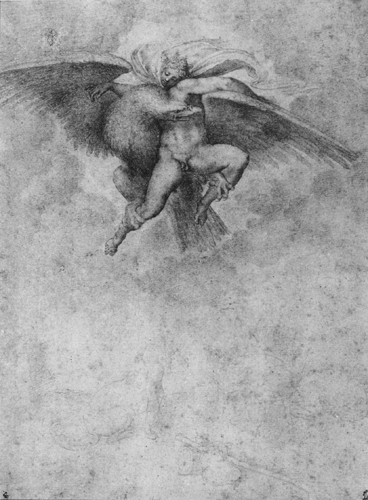
FIGURE 4.1: Copy after Michelangelo Buonarroti, The Rape of Ganymede (detail), ca. 1533, black chalk on paper, Cambridge, MA, Harvard Art Museums/Fogg Art Museum, Gifts for Special Uses Fund, 1955.75.
Photo: Alan Macintyre/Imaging Department © President and Fellows of Harvard College.
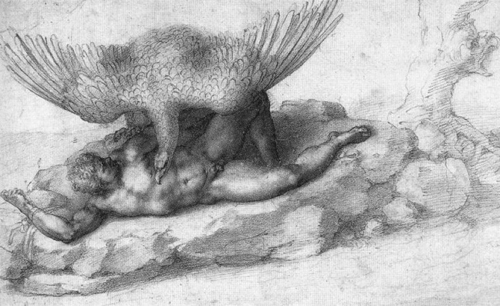
FIGURE 4.2: Michelangelo, The Punishment of Tityus, ca. 1533, black chalk on paper, Windsor, The Royal Collection.
Royal Collection Trust / © HM Queen Elizabeth II 2012.
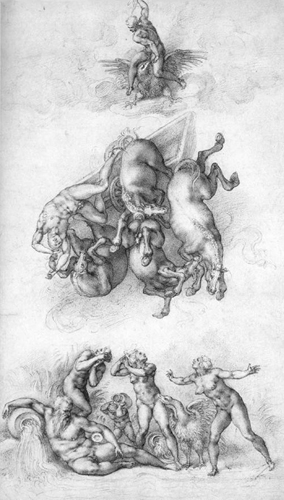
FIGURE 4.3: Michelangelo, The Fall of Phaeton, ca. 1533, black chalk on paper, Windsor, The Royal Collection.
Royal Collection Trust / © HM Queen Elizabeth II 2012.
When Michelangelo met Cavalieri, he was at an exceptionally low period in his life, both professionally and personally. Between 1532 and 1534, he was not quite settled in either Florence or Rome, moving between both cities as a consequence of his professional obligations and, more significantly, [106] of his political choices during the failed Florentine Republic of 1527 to 1530.3 His pressing artistic commitments included the unfinished tomb of Julius II in Rome, commissioned by the della Rovere pope in 1505 and practically stalled from its inception. Under pressure from Julius’s heirs, who accused him of embezzlement, and after much negotiation, he had signed a fourth contract for the project in April 1532, reducing the size and scope of the monument and moving its location from St. Peter’s to the less prominent site of San Pietro in Vincoli.4 His honor insulted, his ambitions for the project thwarted, Michelangelo longed to be “free of this obligation,” complaining that he had “aged twenty years and lost twenty pounds.”5 In Florence, he was responsible for two concurrent projects at the Medici church of San Lorenzo: the Laurentian Library and the family funerary chapel in the [107] New Sacristy.6 He had ceased his work at San Lorenzo in the wake of the Medici expulsion from Florence in 1527, incurring the ire of Pope Clement VII and his nephew Alessandro de’ Medici, who was installed as duke of Florence in 1532. Perhaps due to his political sympathies, Michelangelo never recovered his enthusiasm for this dynastic complex, returning to work reluctantly in 1532, and finally abandoning San Lorenzo altogether when he quit Florence for good in 1534. In addition to these professional challenges, Michelangelo had suffered the deaths of his beloved brother, Buonarroto, in 1528, his nephew, Buonarroto’s young son Simone, in 1529, and his father, Lodovico, in 1531. Michelangelo found himself responsible for the care of Buonarroto’s two surviving children and the maintenance of the extended Buonarroti clan as its new patriarch.
It was on a visit to Rome in the winter of 1532 that Michelangelo met Cavalieri. Despite the fame their relationship now enjoys, its origins are somewhat obscure. Michelangelo was likely introduced to Cavalieri by Pier Antonio Cecchini, a fellow Florentine sculptor who was attached to the household of Cardinal Niccolò Ridolfi.7 Ridolfi, the grandson of Lorenzo the Magnificent through his mother, Contessina de’ Medici, and thus a cousin of Clement VII, was a pillar of the [109] Florentine community in Rome, a patron of artists and scholars, and a passionate collector of books and manuscripts.8 In spite of his Medicean lineage, he became an ardent Republican after the Medici expulsion in 1527 and gathered a community of sympathizers around him.9 Michelangelo was drawn to Ridolfi’s circle by familial connection and political inclination, and found three of his closest associates in Rome—Cecchini, the political theorist and writer Donato Giannotti, and Ascanio Condivi, his future biographer—in Ridolfi’s household.10
In an undated letter, Cecchini regaled Michelangelo with stories of the delightful time he had been having with a group of young men (“quantità di giovani”).11 Cecchini reported that he had inquired after the health of “the magnificent Tommaso” de’ Cavalieri, who had apparently been ill, and had learned that he was much improved.12 He urged Michelangelo to come out for “a few laughs,” assuring him that “no one needs to know about it.”13 Cecchini’s affectionate invitation to Michelangelo is one example of many in which the artist’s friends suggested social gatherings to lift his spirits, and implies that Cecchini was aiming to broaden Michelangelo’s acquaintance in Rome.14 Cecchini promised that Michelangelo would be able “to see in fact that which I’ve told you so many times in words.”15 Dating the letter to late 1532 or early 1533, Christoph Frommel interprets it as Cecchini’s attempt to arrange the first meeting between Michelangelo and Cavalieri; Cecchini wished to let Michelangelo see for himself the magnificent young man he had already told him so much about.16 Frommel’s reading is supported by the first documented letter that Cavalieri sent to the artist on 1 January 1533, in which he acknowledges that Cecchini had praised him to Michelangelo before they met, and refers to a recent illness.17
Reportedly an “incomparable beauty,” cultivated, and charming, Tommaso de’ Cavalieri belonged to a noble Roman family whose origins in the city can be traced to the eleventh century.18 His family palazzo was located not far from Michelangelo’s Roman residence in Macel de’ [110] Corvi, and was a short distance from the palace of Cardinal Ridolfi near the northern edge of Piazza Navona.19 Later in life, Cavalieri would fulfill the promise of his noble roots, occupying significant public offices in Rome, including that responsible for construction on the Campidoglio. He assembled a collection of ancient sculpture that attracted the attention of Ulisse Aldrovandi as early as 1549 and continued to grace the Cavalieri palazzo at least until the eighteenth century.20 Perhaps with Michelangelo’s guidance, Cavalieri also formed an important collection of contemporary drawings and prints, of which drawings by Michelangelo were the crowning glory.21 Cavalieri’s artistic inclinations and aristocratic pedigree surely appealed to Michelangelo as much as his physical beauty, and the two men remained close until the very end of Michelangelo’s life, when Cavalieri stood vigil at his deathbed.22
The earliest secure communications between the two are the letters at the end of December 1532 and the very beginning of January 1533. Michelangelo wrote first, a letter that does not survive, and then wrote again, apologizing for his audacity at being the “first to move.”23 Unlike other letter writers of his day, Michelangelo did not prepare his extensive correspondence with the aim of future publication. Although a remarkable number of letters both from and to him survive, they are, as William E. Wallace has pointed out, often simply about the mundane details of everyday life, concerns about negotiating contracts, payment of workers, managing his household finances, and family matters, offering little insight into Michelangelo’s interior life or philosophical reflections on his practice as an artist.24 But his letters to Cavalieri are exceptional in his correspondence, elevated in tone and filled with emotional language such as Michelangelo’s declaration that Cavalieri was “the light of our century, unique in the world,” and his pledge that he could sooner “forget the food . . . that nourishes my body than forget the name [of Tommaso] who nourishes body and soul.”25
With all that was on Michelangelo’s mind in late 1532, it is somewhat surprising to read the effusive language of his letters to Cavalieri. The tone of the letters speaks not only to an intense emotional connection, a state of infatuation, but also to an almost desperate desire to find meaning in bleak times. Michelangelo closes the first draft of his letter to Cavalieri by marveling: “there is no more cause for wonder that Rome should produce men who are divine, than that God should perform miracles,” and later declares that Cavalieri fills his body and soul “with such sweetness, that I feel neither sorrow nor fear of death.”26 Cavalieri appears to have been a promise of hope in the middle of a very dark season in Michelangelo’s life.
[111] Despite Michelangelo’s passionate language and copious artistic output for Cavalieri, his sixteenth-century biographers insisted on the purely spiritual nature of the attachment. Giorgio Vasari declared that Michelangelo’s love for human beauty was never tainted by “lascivious or disgraceful thoughts,” and Ascanio Condivi likewise reported that the artist was free of “any unseemly or unbridled desire.”27 Modern scholars including James Saslow have pointed out that there was much at stake in defining Michelangelo’s sexuality, in drawing a clear line between passionate but chaste male friendship and illegal sexual activity.28 Michelangelo likewise insisted on the chasteness of his love in his poetry, and condemned the “evil, cruel, and stupid rabble” that failed to understand his “virtuous desire.”29
Whether or not we accept the notion that the attraction was purely spiritual, it must be said that Michelangelo’s love for Cavalieri, however deeply felt, was nevertheless conventional within the context of Petrarchan-infused Neoplatonism, which identified human beauty as a reflection of divine beauty and theorized that physical desire could initiate spiritual transcendence. As formulated by Marsilio Ficino, this theory of ideal love could be enacted through male friendship, often between an older, more experienced man and a beautiful youth who inspired his devotion. This model of eroticized friendship not only mirrored ancient practices, but also replicated the pattern of typical male homosexual relations in Florentine society.30 In 1527, for example, a few years before Michelangelo’s first encounter with Cavalieri, Benedetto Varchi, the Tuscan poet and future academician—and future commentator on Michelangelo’s poems for Cavalieri—met and promptly fell in love with the ten-year-old Lorenzo Lenzi, the son of a Florentine patrician and nephew of Cardinal Niccolò Gaddi.31 Varchi’s infatuation endured for at least sixteen years, and generated a series of Petrarchan love poems inspired by Lenzi. Their relationship is memorialized in a portrait by Bronzino of the young Lenzi holding an open book with poems by Petrarch and Varchi on facing pages.32 Cavalieri likewise served as a youthful muse to the much older Michelangelo, inspiring both visual and verbal expressions of devotion in the drawings and poems that Michelangelo produced for him.
The attachment to Cavalieri was not the first such that Michelangelo experienced, although it would become by far the most significant of his life. In the early 1520s, he became close to Gherardo Perini, with whom he exchanged letters and to whom he gave a group of drawings of ideal heads, which Vasari christened the teste divine.33 Around the time he met Cavalieri, Michelangelo also developed friendships with several young Florentine men, including Febo di Poggio, for whom he composed verses and whom he promised to serve “with faith and with love, more than any other friend you have in this world,” a certain “Simone,” who addressed him as “my most beloved Michelangelo,” and, apologizing for unknown offenses, confessed to be “tormented [112] by having lost you,” and Andrea Quaratesi, almost thirty years his junior.34 Quaratesi and the artist exchanged affectionate letters and gifts of food, and the young man repeatedly professed to love Michelangelo “like a father.”35 But Quaratesi’s promise that “I will come to dine tonight, even if I have to crawl to you on all fours,” suggests something more than filial devotion.36 More telling than these hints at a connection is the fact that Quaratesi is the subject of a portrait by the artist, a spectacular drawing in the British Museum.37 It is the only surviving portrait by Michelangelo, one of only two documented portraits by the artist. The other was a portrait of Cavalieri, now lost, described by Vasari as a half-length depiction of the young man in antique dress, holding a medal or a portrait in his hand.38
Michelangelo’s first, lost letter to Cavalieri was apparently accompanied by the gift of two drawings, generally identified as Ganymede and Tityus.39 In his reply, Cavalieri refers to two drawings (“doi vostri desegni”) that had been delivered to him by Pier Antonio Cecchini and had occupied him for hours.40 Both the subject matter and the extremely fine execution of the drawings account for Cavalieri’s absorption in them. Michelangelo chose a pair of mythological subjects as his first offering to Cavalieri, the well-known story of Ganymede and the more obscure myth of Tityus. Ganymede, variously identified as a prince of Troy or as a simple shepherd, was an exceptionally beautiful young man who caught the eye of Zeus.41 Overcome by desire, the god, in the form of an eagle, swept Ganymede away to Olympus to be his cupbearer and, according to some, his lover. Frequently represented since antiquity and allegorized in medieval sources as a Christian metaphor for divine love, Ganymede would have been instantly recognizable to Cavalieri. Tityus, on the other hand, would have presented more of a challenge. Although his story is told in a number of familiar sources including Ovid’s Metamorphoses, Tityus, the son of Zeus and Gaia, rarely appears in the visual arts.42 Having attempted to rape Latona, the mother of Apollo and Diana, Tityus was sentenced to have his perpetually regenerating liver devoured by a vulture. In Michelangelo’s rendering, the predatory bird is the twin of Ganymede’s eagle, making it possible to read Tityus as Prometheus, the Titan who brought fire to humans and who endured the same punishment as Tityus, but administered by an eagle.43 Whether Cavalieri identified Tityus on his [113] own or with Michelangelo’s help is impossible to know, but some months after receiving the drawings, he referred to them in a letter as “Tityus and Ganymede.”44
Together, these two subjects can be read as a Neoplatonic commentary on the alternate paths of desire, as Erwin Panofsky concluded; Ganymede’s transport on the wings of Zeus signifies the transformative power of divine love, in which the soul is released from the body to commune with the divine, while Tityus’s physical torment, brought on by his uncontrollable lust, represents both the agony of love and the dangers inherent in pursuing the satisfaction of physical desire.45 Having spent part of his youth in the company of Marsilio Ficino, Michelangelo continued to embrace a Ficinian model of Neoplatonic love, which posited that sexual desire was the necessary catalyst of love, but must be suppressed for the lover to progress to his true goal—a transcendent experience of the divine. In his poetry, Michelangelo endorsed the doctrine of ascent through love and emphasized the incompatibility of spiritual elevation and the fulfillment of physical desire—themes that are articulated in the pairing of Ganymede and Tityus.
The pairing of these subjects to elicit a Neoplatonic interpretation may have been intended to temper a purely homoerotic reading of Ganymede. Despite its potential as an allegory of spiritual transcendence, the myth nevertheless is the story of an older man’s desire for a beautiful youth, a model of male homosexual relations that was as pertinent in sixteenth-century Italy as it was in ancient Greece, and was particularly pointed as an analogue for Michelangelo and Cavalieri. Even Plato, who proposed a spiritual interpretation of the myth in his Phaedrus, had suggested that the tale had been invented by the men of Crete as license for the practice of pederasty.46 The figure of Ganymede as an object of homosexual desire had popular currency in the Renaissance as well, as James Saslow has amply demonstrated.47
Michelangelo’s choice of subjects was surely meant to appeal to Cavalieri on several levels. They are tales of passion, both fulfilled and thwarted, and as such send a clear message about the nature of Michelangelo’s feelings for Cavalieri. But they admit many interpretations. As Leonard Barkan has argued, the Neoplatonic theory of the paths of amor sacro and amor profano implied by the pairing assimilates the drawings to the moralizing traditions of Hercules at the Crossroads and the Judgment of Paris, presenting Cavalieri with a lesson about virtue and vice appropriate for a young man of his age and social position.48 Cavalieri may have been responding to that aspect of the drawings when he suggested that Michelangelo’s affection for him sprung from Cavalieri’s own love of virtue: “I think, in fact I am certain that the affection you bear me is because of this, that you, being extremely virtuous, or rather virtue itself, are compelled to love those who follow and love virtue, among whom I, according to my abilities, yield to few.”49 The mythological subjects must also relate to Cavalieri’s taste for classical antiquity; Henry Thode and Johannes Wilde each identified possible visual sources for the figure of Tityus in engraved gems and monumental [114] sculpture, respectively.50 Both the moralizing interpretation and the erudite classical references would have provoked the “hours [of] contemplation” Cavalieri devoted to the drawings, and would have been flattering references to his intellect and education. The multiple levels of reading that the drawings invite provide a veil of respectability to conceal what might otherwise be too explicit an expression of desire.
For his third subject, Michelangelo chose another familiar Ovidian tale that would provide a thematic complement to his prior gifts: the Fall of Phaeton.51 Informed by his mother, Clymene, that he was the son of Apollo, Phaeton sought proof of his paternity by requesting a favor of the god. Told he could have anything he wished, the daring youth asked to drive the sun god’s chariot across the sky. Apollo feared disaster and begged the boy to choose another prize, but Phaeton would not be dissuaded and boldly took the reins. His weaker hand could not control his father’s horses and he soon scorched the earth, trailing fire and havoc in his wake. Zeus was forced to act, hurling a thunderbolt to strike Phaeton and his chariot from the sky, whence they fell into the river Eridanus. Phaeton’s sisters the Heliades, inconsolable in their grief, were transformed into poplars. His kinsman Cygnus was likewise overcome and was turned into a swan. Michelangelo collapsed this complicated narrative into a single vertically oriented scene, commencing at the top where Zeus unleashes his thunderbolt, and moving through the fatal fall of Phaeton and his chariot to the group of mourners and the river god below.52
The Phaeton is unique among the drawings for Cavalieri because three autograph versions survive, two of which include inscriptions in Michelangelo’s hand. The version now in London (fig. 4.4) bears a brief message from the artist to Cavalieri: “Messer Tommaso, if this sketch does not please you, tell Urbino so that I may have time to do another tomorrow evening, as I promised you, and if it pleases you and you want me to finish it send it back to me.”53 Although the sequence of the drawings is not documented, the version at Windsor (see fig. 4.3) would seem to be the final composition, indicating that Cavalieri indeed wished to see something different.54 It is the most finished of the group and the only drawing that has no accompanying text.
This image is available in the print edition
FIGURE 4.4: Michelangelo, The Fall of Phaeton, ca. 1533, black chalk on paper, London, The British Museum.
© The Trustees of the British Museum / Art Resource, NY.
Like the Phaeton itself, Michelangelo’s first surviving letter to Cavalieri exists in no fewer than three drafts, as the artist reworked his language and perfected his “presumptuous” approach to the young nobleman.55 It reflects the pains that Michelangelo went to in order to express himself, wary of overreaching, but eager to convey the depth of his feelings. Both Michelangelo’s language and his orthography are painstaking in the letters to Cavalieri, testifying to his anxiety about making a suitable presentation.56
[116] Michelangelo’s first draft of the letter urges Cavalieri to “read the heart and not the letter, since ‘the pen cannot keep pace with my true will.’”57 The quote is from Petrarch’s Canzone XXIII, “Nel dolce tempo de la prima etade,” a poem that describes the transformative effects of the poet’s first encounter with his beloved, Laura.58 Throughout the poem, Petrarch uses imagery drawn from Ovid’s Metamorphoses, invoking the myths of Phaeton and Ganymede, among others, to cast his experience of love as a personal metamorphosis, alternately painful and exalting. Using the quote, Michelangelo simultaneously references the Ovidian themes of the drawings and signals that Cavalieri has wrought the same changes in him that Laura provoked in Petrarch.
But Michelangelo omitted the Petrarchan reference in his subsequent drafts of the letter, substituting an enigmatic postscript: “it would be permissible to name to the one receiving them the things that a man gives, but out of respect, it will not be done here.”59 Characteristic of Michelangelo’s indirect and allusive manner—what his biographer Giorgio Vasari called his “masked and ambiguous” speech—this much-interpreted passage cannot refer, as is so often assumed, to the first two drawings, which Cavalieri had already received and acknowledged.60 It may relate to another drawing or drawings sent with this letter, perhaps the first version of the Phaeton, or to some of Michelangelo’s many poems for Cavalieri.61
In his written communications with Cavalieri, Michelangelo was particularly careful, producing multiple drafts of his letters, making poetic allusions and indirect statements. The drawings offered a more immediate means of expression. Having initially presented Cavalieri with two finished drawings, Michelangelo expanded their connection by inviting Cavalieri to participate in the creation of Phaeton. On a purely formal level, Michelangelo seems to have been working out a compositional problem in the sequence of Phaeton drawings. The inscription on the London sheet indicates that Michelangelo included Cavalieri in his creative process, either as a collaborator or merely as a witness. The simple gesture of asking Cavalieri to approve the drawing transforms the nature of Michelangelo’s gifts to him. It suggests another way of thinking about the drawings, as a form of communication not only in their finished state, as messages from the artist to his beloved, but as they are in the process of being made, as a means of developing and deepening the bond through a reciprocal act of creation.
Vasari reports that Michelangelo gave the drawings to Cavalieri “because he was learning to draw,” a claim that is often dismissed as an effort to conceal Michelangelo’s more private motives.62 But it is a claim that deserves to be taken seriously. Such instruction would have been an appropriate part of Cavalieri’s education, and his earliest letter to Michelangelo indicates that Cavalieri had already produced some works, likely drawings, which had earned Michelangelo’s praise.63 Referring to “those works of mine which you have seen with your own eyes,” Cavalieri opined that Michelangelo [117] had been moved to write to him because of them, and expressed his hope that he would soon be able to see more of Michelangelo’s work.64 The letter suggests the beginning of a mutual exchange of drawings and ideas; despite the fact that Cavalieri was a young amateur rather than a practicing artist, Michelangelo apparently recognized a kindred spirit. This dynamic of collaboration helps explain Michelangelo’s deference to Cavalieri’s judgment, asking Cavalieri to either approve the “sketch” of Phaeton or send it back so that he may produce another. Their exchange was surely enhanced by the fact that both Michelangelo and Cavalieri were familiar with the visual source for the image. The central group of Phaeton and his team was inspired by an antique sarcophagus on view outside the church of Santa Maria in Aracoeli, where the Cavalieri family chapel was located adjacent to the high altar.65 William E. Wallace has proposed that Michelangelo and Cavalieri may have visited the site together, on a pilgrimage to the family chapel, and to view the church’s treasures, including the Phaeton sarcophagus and a tomb signed by Donatello.66 In that case, the Phaeton would be a sort of souvenir of that visit, binding the two men together in a shared memory. It would have been a particularly poignant gift, for while the men would have visited the church together in the early days of their acquaintance, by the time Michelangelo produced the final version of the drawing, he had left Rome, forced to return to Florence to meet his obligations to the Medici. In a letter sent to the artist in Florence, Cavalieri records his receipt of the drawing with a teasing remark that may reflect the collaborative nature of their exchange: “Perhaps three days ago I received my Phaeton, well enough done.”67
But if the Phaeton records an intimate, creative exchange between the two men, it also documents the presence of other witnesses to the process. As Leonard Barkan has observed, the great paradox of the gift drawings and poems for Cavalieri is their double nature as both private and public communications.68 Michelangelo’s missives to Cavalieri, both visual and literary, were sent through intermediaries, passing through the hands of friends and servants before reaching their final destination. This mode of transmission underscores the secret, private nature of the relationship. But it also expands the circle of its participants beyond the artist and his beloved. The message on the London Phaeton is one trace of this method of exchange. Michelangelo instructs Cavalieri, “if this sketch doesn’t please you, tell Urbino.” Urbino was the nickname of Francesco d’Amadore, Michelangelo’s trusted manservant and assistant, who had evidently been charged with bringing the drawing from Michelangelo’s residence in Rome to Cavalieri’s and returning with Cavalieri’s response.69 There is nothing particularly extraordinary about such a mundane event—letters frequently passed among friends in precisely this way, carried by a servant from one home to another—but the message is evidence of a larger mechanism of exchange that I wish to explore here.
[118] While in Rome, Michelangelo not only entrusted drawings to Urbino’s care, but also depended on Pier Antonio Cecchini to carry drawings, letters, and private messages to Cavalieri. In the first draft of his letter to Cavalieri, Michelangelo quoted Petrarch to signal his emotional state, but omitted the quote from subsequent drafts. Rather than rely on Cavalieri’s ability to recognize the quotation and its meaning, Michelangelo apparently decided to send an ambassador to help Cavalieri read the contents of his heart. All three drafts of the letter refer to Cecchini, the mutual friend who may have been the instrument of Michelangelo’s introduction to Cavalieri. In each draft, in slightly different form, Michelangelo promises that “our friend” Pier Antonio—“Pier Antonio amico nostro”—will tell Cavalieri in person all those things that remain unsaid in the letter.70 In his final draft, Michelangelo writes: “So as not to bore you, I won’t write any more . . . our friend Pier Antonio will finish it in person”—the precise phrase is “a bocha,” by mouth.71 By sending the letter and its unwritten messages through Cecchini, Michelangelo was introducing a friend into his private relationship with Cavalieri. Nor was Cecchini the only person to play such a role. From the beginning, Michelangelo’s feelings for Cavalieri had the status of an open secret, shared among a trusted circle of intimates, who delivered not only Michelangelo’s written messages, but also, and arguably more significantly, those unrecoverable sentiments he did not wish to trust to pen and paper.
Once Michelangelo returned to Florence in the summer of 1533 to resume his work at San Lorenzo under pressure from Pope Clement VII, it was no longer possible to dispatch Urbino with drawings or to pass private messages along verbally through Cecchini. Instead, the distance separating Michelangelo and Cavalieri activated a larger network of agents that included, among others, Cecchini, the poet Bartolommeo Angelini, and Sebastiano del Piombo. They oversaw Michelangelo’s affairs in Rome, providing practical assistance to maintain his household, kept him apprised of the gossip surrounding the papal court, and assisted in keeping the flame of his love for Cavalieri alive. Beginning in the summer of 1533 and continuing during Michelangelo’s absences in Florence until his final return to Rome in September 1534, Michelangelo’s relationship with Cavalieri was filtered through and managed by friends who acted as his intermediaries.
Cavalieri fretted about Michelangelo’s extended absence in Florence, fearful that the artist would forget him. Michelangelo hastened to reassure him, expressing surprise that Cavalieri could doubt the “very great, in fact immeasurable love” that Michelangelo had demonstrated in Rome.72 He teased the young man, suggesting that perhaps his worry was calculated to increase Michelangelo’s ardor. Michelangelo’s confident tone with Cavalieri is in stark contrast with his palpable anxiety in communications with others. In a letter to Sebastiano, he begged for some news of Cavalieri, to help keep his memory fresh. “For if I were to forget him,” he writes, “I believe I would immediately fall down dead.”73 He expresses a similar sentiment to Angelini, telling him that he wishes to return to Rome in order “to return to life,” for although his body is in Florence, his soul is in Cavalieri’s hands in Rome.74 Privy to Michelangelo’s anxieties about the relationship, Michelangelo’s friends served as his “ambassadors” to Cavalieri, as Angelini described himself, [119] taking the measure of Cavalieri’s devotion and reassuring the artist that he could “live happily because your desire and Tommaso’s are equal.”75 In another letter, Angelini reports that Michelangelo’s eagerness to come back to Rome is exceeded only by Cavalieri’s desire to see him: “If you are consumed with returning, he burns with desire for your return.”76
Part of Michelangelo’s motivation for the use of intermediaries was practical. In communicating from Florence with friends in Rome, he relied on courier services, and typically sent letters together in packets under a single cover.77 Michelangelo seems to have used private couriers and the services of banks that had branches in both Rome and Florence and provided postal service for a fee, and, when the opportunity presented itself, he relied on acquaintances who were traveling between the two cities to carry letters as well.78 It was more economical to send multiple letters in a single packet, and Michelangelo was notoriously stingy. Many letters to him reflect this arrangement, such as Angelini’s assurance in July 1533 that “I’ve received your letter, together with one for Sebastiano, which I’ve put directly into his hands . . . and last Saturday I sent you one of his together with one from your messer Tommaso.”79 Bartolommeo Angelini appears to have been the person through whose hands most letters passed, both from Michelangelo and to him. He faithfully reports that he has delivered letters to Cavalieri, has agreed to send Cavalieri’s letters on to Michelangelo, and has waited into the evening for a letter from Sebastiano to send along as well.80
As early as 1521, Angelini was helping Michelangelo manage his affairs in Rome, serving as Michelangelo’s agent for a commission from Cardinal Domenico Grimani and passing along correspondence from Sebastiano and other friends.81 While Michelangelo was absent in Florence, Angelini supervised the upkeep of his house in Rome, and reported on the state of Michelangelo’s garden and the conduct of Michelangelo’s cats and rooster, in much the same way, albeit more playfully, that he chronicled Cavalieri’s emotional states. By 1531, Michelangelo was sending most of his correspondence through Angelini. This arrangement had been reached in response to a crisis. On 29 April 1531, Sebastiano wrote in alarm that his letters from Michelangelo were being intercepted: “Your letter was given to me opened, which caused me great distress . . . and I have not yet found a way to be able to write and send letters to you, or you to me, in such a way that they will not be opened first.”82 But having consulted with Angelini, whom Sebastiano calls “a good man,” Sebastiano proposed a solution. In order to protect the privacy of their correspondence, Sebastiano [120] suggested that Michelangelo send all of his letters indirectly—through Angelini—and instructed the artist to have someone else address them “so that they will not be recognized as by your hand.”83
This need for secrecy and misdirection in the early 1530s likely relates to the role that Sebastiano was playing at the time as Michelangelo’s advocate at the papal court, helping to negotiate with the heirs of Julius II over his still unfinished tomb, and attempting to reinstate the artist in the good graces of Pope Clement VII. It was crucial that Sebastiano’s dealings with the artist remain confidential as he attempted to sway both Clement and the della Rovere heirs in Michelangelo’s favor.84 Sebastiano recognized that sending anything between Florence and Rome was risky due to unscrupulous couriers, bandits, and the poor conditions of the roads.85 In May 1532, he wrote of his concerns about Michelangelo’s plan to send him some drawings, worried that they might “disappear, or . . . fall into hands other than my own.”86 Concluding that the risks were too great, he warned Michelangelo that if he didn’t have a trustworthy means of sending them, he should “wait until your return and you can bring them here yourself.”87
But Michelangelo’s circle of friends provided more than the practical assistance of a secure post; they actively participated in Michelangelo’s relationship with Cavalieri. Sebastiano engaged prominent musicians from the papal court to set Michelangelo’s poems to music and shared the compositions with Cavalieri.88 He then sent the music to Michelangelo in Florence, where another friend, Gianfrancesco Fattucci, arranged for it to be performed for the artist’s pleasure.89 When the grapes in Michelangelo’s Roman garden ripened in August, Angelini sent some to Cavalieri as a gift.90 In October, he harvested pomegranates from the garden and presented them to Cavalieri, making another offering on Michelangelo’s behalf.91 These gestures were duly reported to Michelangelo. When Michelangelo sent poems for Cavalieri, Angelini felt free to read and comment on them. At least twice, Angelini reports unapologetically that he has made copies of Michelangelo’s “beautiful sonnets” for himself before delivering them to Cavalieri.92 In another instance, Angelini criticizes a sonnet destined for Cavalieri in which Michelangelo describes the restlessness that love induces in him and counters with a poem of his own as a corrective.93
Michelangelo’s drawings and poems in their explicit, if ambiguous imagery, directed their messages to Cavalieri, but their means of exchange created a larger circle of initiates who partook of the experience as well. In communicating with Cecchini, Angelini, and Sebastiano about his feelings for Cavalieri, his desire to be reunited with him, his sense that without him his body was lacking his soul, and whatever other private messages that were passed along “a bocha,” Michelangelo invited these [121] friends to participate in a relationship that reinforced their sense of intimacy, of shared knowledge among a select few. Perhaps paradoxically, Michelangelo’s passionate affection for Cavalieri was not an impediment to intimacy in his other friendships, but rather a means of strengthening those bonds of trust and affection as well. The promotion and facilitation of their relationship became a common cause that knit Michelangelo’s circle closer together. Ulrich Pfisterer describes a similar dynamic in his study of the Roman milieu of the fifteenth-century medalist known as the Pseudo-Lysippus, in which an intense emotional attachment between two men could be the axis on which a much larger circle of friends revolved.94 Relating these social dynamics to the humanist revival of antique culture and describing the role of medals and other forms of portraiture in the promotion and publication of such relationships, Pfisterer posits what he terms a “Socratic mantle,” a system of visual codes that function publicly as erudite references to classical philosophy, but privately invoke homosexual love to those “in the know.”95 Such images depend on a “performative context” of looking, designed to elicit shared emotional response and discussion among a group of viewers, allowing an ostensibly private experience of love between two individuals to bind a larger group of friends together. Michelangelo’s drawings for Cavalieri, which can be viewed as straightforward visualizations of ancient myths or as complex allegories layered with meaning, seem to encourage precisely such a context of viewing and reception.
Michelangelo’s letters produced a kind of social currency for those who received them. Angelini reports that Pope Clement continually asks Sebastiano if he has had any letters from the artist, and Sebastiano acknowledges that he has allowed the pontiff access to Michelangelo’s letters.96 Both Angelini and Sebastiano peppered their letters with gossip from Rome, and Michelangelo’s responses themselves became fodder for gossip. Sebastiano writes that he has passed one of Michelangelo’s more amusing letters around the Vatican, where “everyone in the palace talks of nothing else.”97 Michelangelo was clearly aware of and sensitive to the fact that his “private” correspondence had a public function. In a letter to Sebastiano in August 1533, Michelangelo discusses both his feelings for Cavalieri and his current work at San Lorenzo, mixing matters both personal and professional, and closes with the explicit, perhaps exasperated, direction: “Don’t show this letter to anyone.”98 The line between the private and the public communication was not always clear, and had to be marked accordingly.
By making his private feelings for Cavalieri semipublic, sharing them openly within an exclusive circle of friends, Michelangelo signaled that his motives were above reproach—Cavalieri was the source of inspiration and elevating love, not the object of immoral or illegal desire. He was particularly sensitive to the rumors of homosexuality or, more specifically, pederasty that were encouraged by his intense relationships with young men like Gherardo Perini and Cavalieri. In an angry letter to a friend, Michelangelo recounts an episode in which an importunate man encouraged him to hire his son as an apprentice, “saying that if I were but to see him I should pursue him not only into the house, but into bed. With his typical caustic wit, Michelangelo concluded, “I assure you that I’ll deny myself [122] that consolation, which I have no wish to filch from him.”99 Michelangelo’s supporters declared his total chastity, but his enemies were quick to assert the opposite and could point to the gift drawings as evidence. Pietro Aretino hinted as much when, frustrated in his own attempts to obtain a drawing from Michelangelo, he resorted to thinly veiled threats. If Michelangelo refused to give him a drawing, he warned, it would prove true the rumor “that only certain Gherardos and Tommasos are able to get them.”100 At a time when acts of sodomy were punishable by fines, public whipping, and imprisonment, such rumors were dangerous, to say the least. By framing his relationship with Cavalieri within a Neoplatonic model of ideal love, and encouraging his friends and associates to promote that model, Michelangelo was able to deflect potential criticism about it as an impropriety that truly needed to be concealed.
Michelangelo’s methods of communication about Cavalieri mirror and expand the functions of his gifts to him. Made by the artists as tokens of love for an intimate friend, the drawings were exceptional in that they circulated outside the bounds of the traditional artist/patron exchange. They could not be bought at any price. They were available only to those—as Aretino knowingly hinted—who had earned Michelangelo’s particular affection. But beyond the question of personal esteem, the drawings also represented a truly rare commodity. By the 1530s, access to an original work by the hand of Michelangelo was extremely limited—only the fortunate few like Cavalieri were favored with gift drawings as tokens of love. By the 1530s, Michelangelo was so overwhelmed with obligations that even the pope had trouble getting his wishes satisfied, while a young man like Cavalieri received unsolicited gifts of the artist’s latest inventions. Being in possession of the drawings clearly granted Cavalieri considerable social capital, allowing Michelangelo to function as the young man’s social patron. Through his network of friends, Michelangelo had folded Cavalieri into a private circle of artists and literati; through the gift of the drawings, he brought Cavalieri to the attention of some of the most powerful men in Rome, who were hungry for Michelangelo’s latest inventions. Generated by desire, the drawings quickly became objects of desire themselves, attracting the covetous attention of such exalted viewers as the Medici Pope Clement VII and his nephew Cardinal Ippolito de’ Medici.
On 6 September 1533, Cavalieri wrote to Michelangelo to report that a group of visitors had descended upon him, including Pope Clement VII, his nephew Cardinal Ippolito de’ Medici, and “everyone” eager to see all of Michelangelo’s drawings.101 The cardinal, Cavalieri tells us, was so taken with them that “he wanted to have the Tityus and Ganymede made in crystal, and I didn’t know how to speak well enough to prevent him [from taking the Tityus] . . . and now maestro Giovanni is doing it.”102 Ippolito de’ Medici commissioned the first copies after Michelangelo’s gift drawings from the gem-engraver Giovanni Bernardi, initiating a series of copies in various media that transmitted Michelangelo’s private images to a much wider audience, whose long and complicated afterlife is the focus of my current book project.103 It is important to note that Bartolommeo Angelini did not hesitate to copy and comment on Michelangelo’s poems for Cavalieri, because his [123] access to them was privileged and permissible. In contrast, Ippolito de’ Medici coerced a loan of the drawings from Cavalieri, who struggled to find the words to prevent him, and wrote to Michelangelo to apologize, because the cardinal was not entitled to them. The exchange was not limited to the artist and his beloved, but it was still exclusive.
Michelangelo’s gift drawings, poems, letters, and the network of their exchange created a hierarchy of viewers that inverted the expected social hierarchy. Included in a select circle of Michelangelo’s intimates who had privileged access to his literary and artistic inventions and to news from the artist himself, those who participated in the circulation of the drawings and the letters were elevated above other men who were arguably their social superiors. Among the most powerful men in Rome, and important patrons of Michelangelo, the Medici and men like them could not compel gift drawings or other expressions of affection and esteem from the artist himself. The traditional artist/patron relationship failed them in the face of the private exchange, and they found themselves relying on artists like Sebastiano and young men like Cavalieri to achieve access.
In conclusion, Michelangelo’s methods of communication were indirect and complex. At a time when he was under considerable pressure from the Medici pope and other patrons to complete unfinished projects and embark on new ones, Michelangelo cultivated a carefully controlled means of access not only to his private feelings for Cavalieri, but also to the artistic and literary output generated by them. The open secret asserted Michelangelo’s artistic and social autonomy at the very moment that he likely felt it most threatened.
Bibliography
Bardeschi Ciulich, Lucilla, ed. Costanza ed evoluzione nella scrittura di Michelangelo. Florence: Cantini Editore, 1989.
Bardeschi Ciulich, Lucilla, and Pina Ragionieri, ed. Michelangelo: Grafia e biografia; Diesgni e autografi del maestro. Florence: Mandragora, 2002.
Barkan, Leonard. Michelangelo: A Life on Paper. Princeton, NJ: Princeton University Press, 2011.
———. Transuming Passion: Ganymede and the Erotics of Humanism. Stanford, CA: Stanford University Press, 1991.
Buck, Stephanie, ed. Michelangelo’s Dream. London: Courtauld Gallery, 2010.
Busini, Giovanni Battista. La vita di Benedetto Varchi scritta da Gio. Battista Busini. Edited by Gaetano Milanesi. Il Borghini 2 (1864): 346–61, 414–31.
Byatt, Lucinda M. C. “‘Una suprema magnificenza’: Niccolò Ridolfi, a Florentine Cardinal in Sixteenth-Century Rome.” PhD diss., European University Institute, Florence, 1983.
Caizzi, Bruno. Dalla posta dei re alla posta di tutti: Territorio e communicazioni in Italia dal XVI secolo all’Unità. Milan: Franco Angeli, 1993.
Il Carteggio di Michelangelo. Edited by Giovanni Poggi, Paola Barocchi, and Renzo Ristori. 5 vols. Florence: Sansoni. 1965–83.
Il Carteggio indiretto di Michelangelo. Edited by Paola Barocchi, Kathleen Loach Bramanti, and Renzo Ristori. 2 vols. Florence: S.P.E.S., 1988–95.
Cecchi, Alessandro. “‘Famose Frondi di cui santi honori . . .’; un sonetto del Varchi e il ritratto di Lorenzo Lenzi dipinto dal Bronzino.” Artista: Critica dell’arte in Toscana 2 (1990): 8–19.
Chapman, Hugo. Michelangelo Drawings: Closer to the Master. New Haven, CT: Yale University Press, 2005.
Chieppi, Sergio. I servizio postali dei Medici dal 1500 al 1737. Fiesole: Servizio Editoriale Fiesolano, 1997.
Condivi, Ascanio. Vita di Michelagnolo Buonarroti. Edited by Giovanni Nencioni. Florence: S.P.E.S., 1998.
Costa, Giorgio. Michelangelo alle Corti di Niccolò Ridolfi e Cosimo I. Florence: Bulzoni, 2009.
De Tolnay, Charles. Michelangelo. 5 vols. Princeton, NJ: Princeton University Press, 1943–60.
Ficino, Marsilio. El libro dell’amore. Edited by Sandra Niccoli. Florence: Leo S. Olschki, 1987.
Frey, Karl. Die Dichtungen des Michelagniolo Buonarroti. Berlin: G. Grote, 1897.
Frommel, Christoph. Michelangelo und Tommaso de’ Cavalieri. Amsterdam: Castrum Peregrini, 1979.
Giannotti, Donato. Dialogi di Donato Giannotti de’ giorni che Danto consumò nel cercare L’Inferno e ’L Purgatorio. Edited by Deoclecio Redig de Campos. Florence: Sansoni, 1939.
Hirst, Michael. Michelangelo and His Drawings. New Haven, CT: Yale University Press, 1988.
———. “Michelangelo and His First Biographers.” Proceedings of the British Academy 94 (1997): 63–84.
Joannides, Paul. Michelangelo and His Influence: Drawings from Windsor Castle. Washington, DC: National Gallery of Art; London: Lund Humphries Publishers, 1996.
Kirkendale, Warren. Emilio de’ Cavalieri “Gentiluomo Romano”: His Life and Letters, His Role as Superintendent of All the Arts at the Medici Court and His Musical Compositions. Florence: Leo S. Olschki, 2001.
Kirschenbaum, Baruch D. “Reflections on Michelangelo’s Drawings for Cavaliere.” Gazette des Beaux-Arts, 6th ser. 38 (1951): 99–110.
Liebert, Robert. Michelangelo: A Psychoanalytic Study of His Life and Images. New Haven, CT: Yale University Press, 1983.
Marongiu, Marcella. Currus auriga paterni: Il mito di Fetonte nel Rinascimento. Lugano: Lumières Internationales, 2008.
———. Il mito di Ganimede prima e dopo Michelangelo. Florence: Casa Buonarroti, 2002.
Melillo, Enrico. Le poste italiane nel medioevo alta e media Italia (c. 475–1600). Rome: Desclée, Lefebvre e C. Editori, 1904.
Muratore, Davide. La biblioteca del cardinale Niccolò Ridolfi. 2 vols. Alessandria: Edizioni dell’Orso, 2009.
Nagel, Alexander. “Gifts for Michelangelo and Vittoria Colonna.” Art Bulletin 79 (1997): 647–68.
Panofsky, Erwin. “The Neoplatonic Movement and Michelangelo.” In Panofsky, Studies in Iconology, 212–18. Oxford, UK: Oxford University Press, 1939.
Panofsky-Soergel, Gerda. “Postscriptum to Tommaso Cavalieri.” In Scritti di storia dell’arte in onore di Roberto Salvini, 399–405. Florence: Sansoni, 1984.
Parker, Deborah. Michelangelo and the Art of Letter Writing. Cambridge, UK: Cambridge University Press, 2010.
Pfisterer, Ulrich. Lysippus und seine Freunde: Liebesgaben und Gedächtnis im Rom der Renaissance, oder Das erste Jahrhundert der Medaille. Berlin: Akademie Verlag, 2008.
Pirotti, Umberto. Benedetto Varchi e la cultura del suo tempo. Florence: Leo S. Olschki, 1971.
The Poetry of Michelangelo: An Annotated Translation. Edited and translated by James M. Saslow. New Haven, CT: Yale University Press, 1991.
Popham, A. E., and Johannes Wilde. The Italian Drawings of the XV and XVI Centuries in the Collection of His Majesty the King at Windsor Castle. London: Phaidon Press, 1949.
Raggio, Olga. “The Myth of Prometheus: Its Survival and Metamorphoses up to the Eighteenth Century.” Journal of the Warburg and Courtauld Institutes 21 (1958): 44–62.
Ramsden, E. H. The Letters of Michelangelo. 2 vols. London: Peter Owen, 1963.
Ridolfi, Roberto. “La Biblioteca del Cardinale Niccolò Ridolfi (1501–1550).” La Bibliofilia 31 (1929): 173–93.
Rivero, Albert J. “Petrarch’s ‘Nel Dolce Tempo de la Prima Etade.’” MLN 94 (1979): 92–112.
Rocke, Michael. Forbidden Friendships: Homosexuality and Male Culture in Renaissance Florence. Oxford, UK: Oxford University Press, 1996.
Ruvoldt, Maria. “Responding to the Renaissance.” In Renaissance Theory, edited by James Elkins and Robert Williams, 360–76. London: Routledge, 2008.
Saslow, James M. Ganymede in the Renaissance: Homosexuality in Art and Society. New Haven, CT: Yale University Press, 1986.
———. “‘A Veil of Ice between My Heart and the Fire’: Michelangelo’s Sexual Identity and Early Modern Constructs of Homosexuality.” Genders 2 (1988): 77–90.
Schumacher, Andreas. Michelangelos Teste Divine: Idealbildnisse als Exempla der Zeichenkunst. Münster: Rhema Verlag, 2007.
Sickel, Lothar. “Die Sammlung des Tommaso de’ Cavalieri und die Provenienz der Zeichnungen Michelangelos.” Römisches Jahrbuch der Bibliotheca Hertziana 37 (2008): 163–221.
Spini, Giorgio. “Politicità di Michelangelo.” Rivista storica italiana 76 (1964): 556–600.
Starn, Randolph. Donato Giannotti and His Epistolae. Geneva: Librairie Droz, 1968.
Strehlke, Carl, et al. Pontormo, Bronzino, and the Medici: The Transformation of the Renaissance Portrait in Florence. Philadelphia: Philadelphia Museum of Art in Association with Pennsylvania State University Press, 2004.
Thode, Henry. Michelangelo: Kritische Untersuchungen über seiner Werke. 3 vols. Berlin: G. Grote, 1908–13.
Varchi, Benedetto. Due Lezzioni di M. Benedetto Varchi. Florence: Lorenzo Torrentino, 1549.
Vasari, Giorgio. La vita di Michelangelo nelle redazioni del 1550 e del 1568. Edited by Paola Barocchi. 4 vols. Milan: Riccardo Ricciardi, 1962.
———. Le vite de’ più eccellenti pittori, scultori, ed architettori (1568). Edited by Gaetano Milanesi. 9 vols. Florence: Sansoni, 1878–1885.
Wallace, William E. “Clement VII and Michelangelo: An Anatomy of Patronage.” In The Pontificate of Clement VII: History, Politics, Culture, edited by Kenneth Gouwens and Sheryl E. Reiss, 189–98. Aldershot, UK: Ashgate, 2005.
———. “The Greatest Ass in the World”: Michelangelo as Writer. Lincoln: Hixson-Lied College of Fine and Performing Arts, University of Nebraska–Lincoln, 2006.
———. “Michael Angelvs Bonarotvs Patritivs Florentinvs.” In Innovation and Tradition: Essays on Renaissance Art and Culture, edited by Dag T. Andersson and Roy Eriksen, 60–74. Rome: Kappa, 2000.
———. Michelangelo: The Artist, The Man, and His Times. Cambridge, UK: Cambridge University Press, 2010.
———. Michelangelo at San Lorenzo: The Genius as Entrepreneur. Cambridge, UK: Cambridge University Press, 1994.
———. “‘Nothing Else Happening’: Michelangelo between Rome and Florence.” In Michelangelo’s Last Judgment, edited by Marcia B. Hall, 51–75. Cambridge, UK: Cambridge University Press, 2004.
———. “Studies in Michelangelo’s Finished Drawings.” PhD diss. Columbia University, 1983.
Wilde, Johannes. Italian Drawings in the Department of Prints and Drawings in the British Museum: Michelangelo and His Studio. London: British Museum Publications, 1953.
[126]