
One

Blackfish, also known as pilot whales, are notorious for stranding themselves on beaches. These whales have traditionally been hunted using many men and boats gathered in a semicircle behind a pod of whales that is close to shore. The men would drive the whales toward the shore, where they would become stranded and were then able to be slaughtered. (National Oceanic and Atmospheric Administration.)
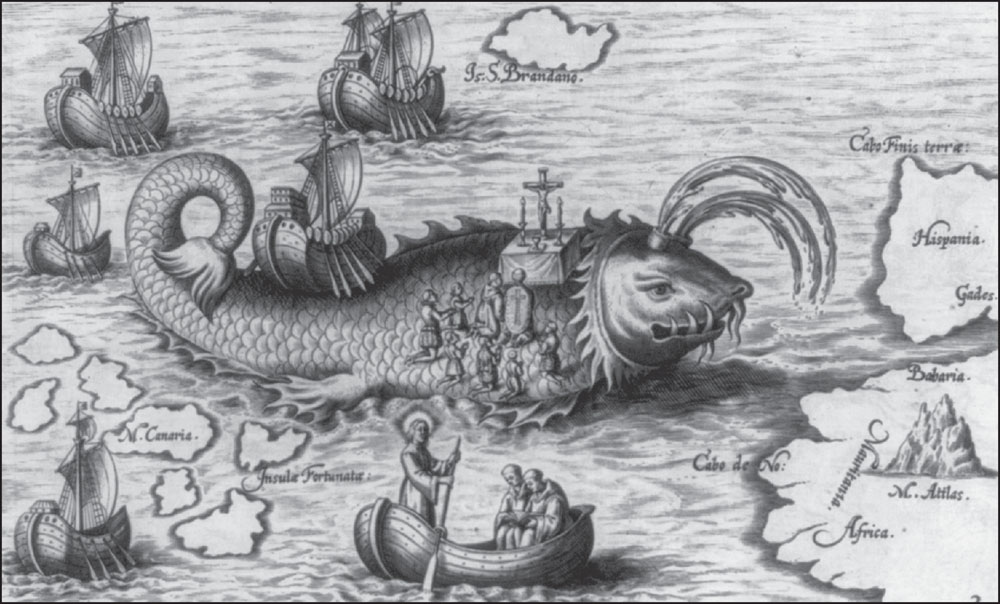
This woodcut shows Mass being held on the back of a whale during the voyage of Saint Brendan. The Voyage of Saint Brendan, which reportedly happened around 500 AD and was first recorded around 900 AD, often contains illuminations including a whale. The whale held a mystique in ancient times because of its massive size and ability to provide food, oil, and bones to people fortunate enough to find one washed up on shore. (Library of Congress.)
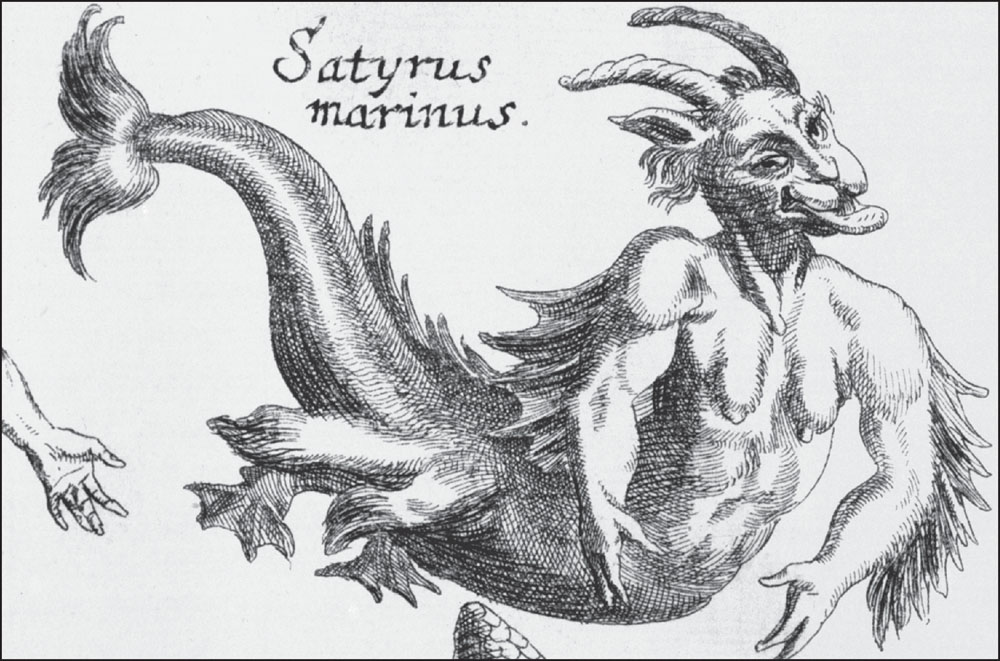
It was thought that strange creatures abounded in the oceans of antiquity, as evidenced by this merman from an early woodcut. Whales were part of this fantastic imagined undersea life. (National Oceanic and Atmospheric Administration.)

This 1851 illustration, from “Explanations and Sailing Directions to Accompany the Wind and Current Charts, approved by Commodore Charles Morris, Chief of the Bureau of Ordnance and Hydrography,” shows the different whales found in the world’s oceans. (National Oceanic and Atmospheric Administration.)

This woodcut, published in Bickerstaff’s Boston Almanack in 1784, shows a sea monster attacking a sailor. The oceans were vast areas full of unknowns and strange tales, and “sightings” of “sea monsters” were common in centuries past. (Bourne Historical Society.)

This 1845 advertisement features the skeleton of a purported sea monster or leviathan that was going to be put on display in the United States before it traveled to Europe. This offers an idea of the kinds of sea creatures that were not commonly known and were generally thought of as monsters of the deep. (Library of Congress.)
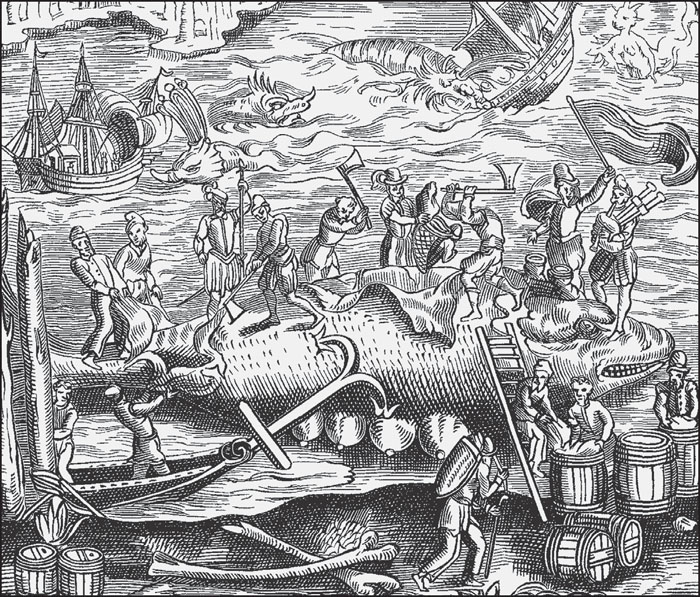
This 1574 French woodcut shows lots of activity surrounding the processing of a whale on shore, including a flag waver and a bagpipe player. Stranded whales were a happy find and were utilized as a resource for food, oil, and bone. (Library of Congress.)
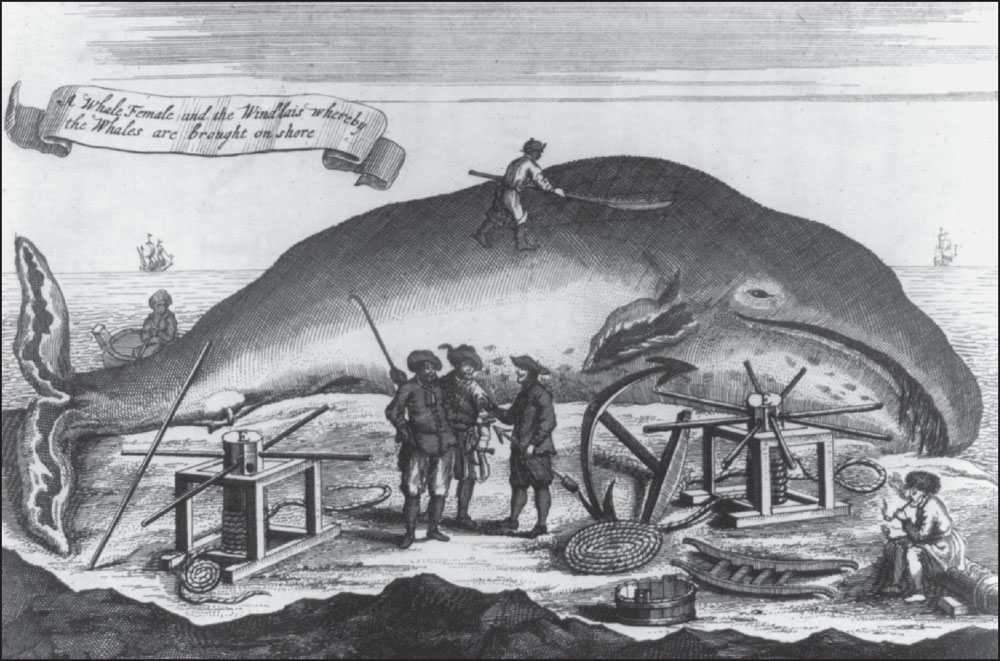
This 1744 woodcut shows the windlass, a tool used to bring a whale to shore for processing. A harpoon-like lance strikes fast to the whale, and the windlass is then used to wind in the rope connected to it, pulling the whale carcass to shore. (Library of Congress.)

This early photograph taken by local photographer Ned Nickerson in Provincetown, Massachusetts, shows the result of the chase and capture of blackfish, as pilot whales were commonly known. The oldest known method of catching cetaceans involves forcing them toward shore via people in small boats that stay between the animals and the open sea and frighten them with noise and activity, herding them shoreward in an attempt to beach them. (Library of Congress.)

This drawing by H.W. Elliott shows a form of shore fishing practiced by local peoples in various parts of the world. The small double-ended boats give chase, harpoons or spears are used for the kill, and the whale is then towed to shore for processing. (National Oceanic and Atmospheric Administration.)

This 1929 photograph shows a group of native men launching a whaleboat from shore in the north Atlantic. Whaling was integral to the culture and economy of indigenous peoples. (Library of Congress.)

This Harper’s Weekly cover illustration from June 23, 1877, was drawn by Paul Frenzeny and is captioned “A Whaling Station on the California Coast.” The man in the inset in the upper left corner of the illustration is on the lookout for whales. (Library of Congress.)

This undated photograph shows men waiting to begin the processing of the whales after a mass beaching. Beginning in the late colonial period, New England seafarers, owing to the area’s advanced shipbuilding industry, became the preeminent whalemen in the world. (Nye Lubricants, Inc.)

This sketch by J.S. Ryder shows men processing a drift whale at the pier in Provincetown, Massachusetts. The group has the tryworks set up on the dock and is hoisting pieces of blubber up to the fires for boiling it down into oil. (National Oceanic and Atmospheric Administration.)

This undated photograph shows men standing in small boats as they prepare to process a blue whale that drifted ashore. The blue whale, which can grow to a length of up to 100 feet, is the largest animal known to have existed on the planet. (Library of Congress.)

This undated photograph shows a group of men stripping blubber—a process called “flensing” or “cutting in”—from a whale that washed ashore off Cape Cod. (Library of Congress.)

In this 1864 image, men move a boat in a whaling or fishing camp in Labrador. Camps like this were used to process whale meat and oil before the advent of tryworks aboard ships. In the early days of whaling, the processing of whales was primarily done ashore. (Library of Congress.)
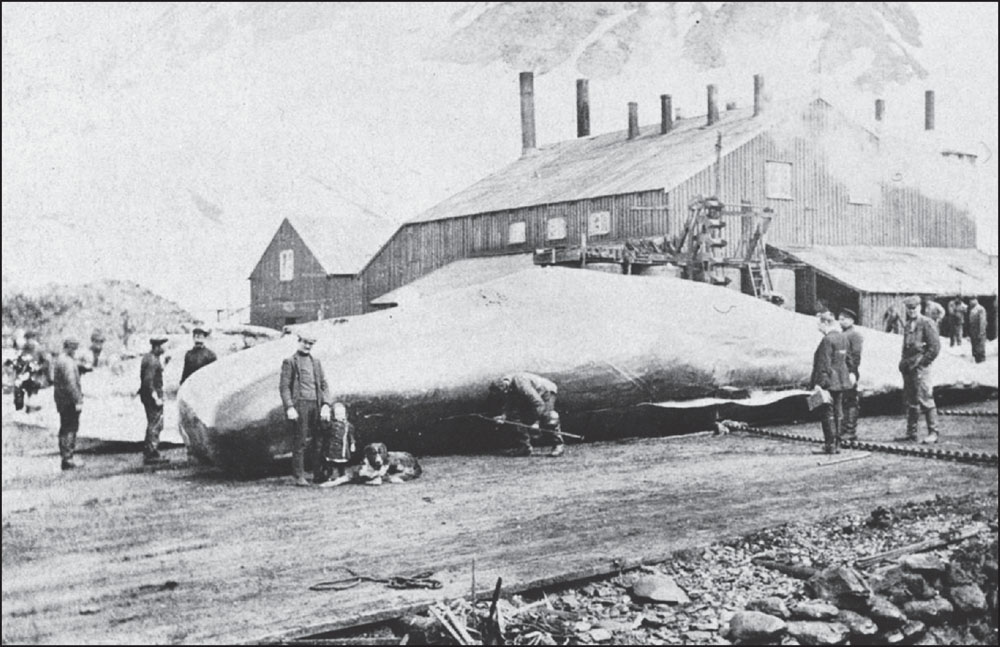
A man with a little girl and a dog pose in front of a whale being prepared for processing. With the advent of short whaling voyages that lasted weeks rather than months or years, processing camps sprang up in various places along the Atlantic coast. (Library of Congress.)

Men prepare a humpback whale for processing. The humpback, with its “humped” dorsal fin and long flippers, was found in oceans around the world and hunted to the brink of extinction. (National Oceanic and Atmospheric Administration.)

The first issue of the Whalemen’s Shipping List was published on March 17, 1843, and listed the details of whaleships as they came and went from New Bedford. This list includes the whaleship Ann Alexander, owned by George Howland, with a last reported sighting of the ship at the Galapagos Islands in “May or June” after it departed on October 25, 1841. Whalemen’s Shipping List, which was published in New Bedford from 1843 to 1914, was an essential source of information about whale boats—especially those with ties to Massachusetts. (National Maritime Digital Library.)

Workers begin peeling off the blubber from a humpback whale to boil it down for oil. Once the flensing process began, crews would work around the clock for up to three days, depending on the size of the whale, to complete the stripping and boiling down of the blubber. (Library of Congress.)
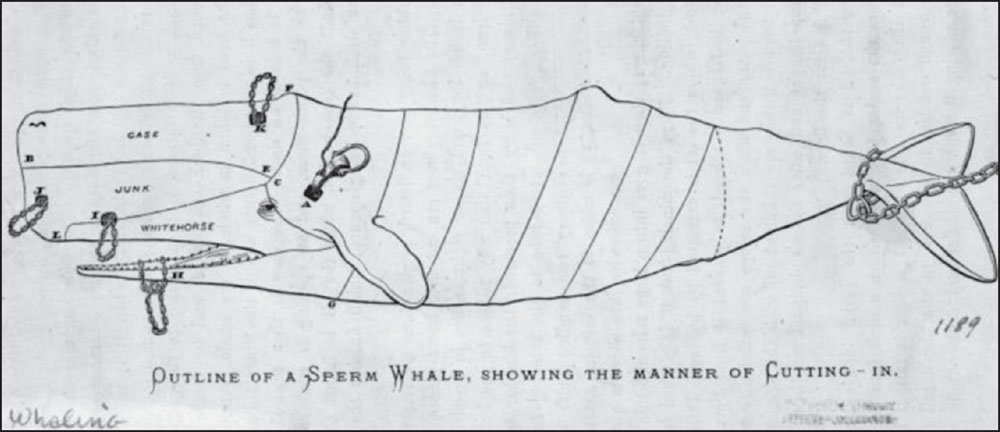
This diagram shows the process for cutting up a whale after it is caught and tied up alongside the ship. The cutting process, known as flensing, begins with spiral cuts in the middle that take the blubber off the whale in one long piece known as the blanket. The blanket is cut into smaller pieces, called leaves, that are boiled down in the tryworks aboard the ship. Pieces of wood attached to chains are inserted into holes cut into the whale in the tale and the head; these are attached to winches and lifted as the whale is cut to spread the weight so the parts being worked on do not tear. (National Oceanic and Atmospheric Administration.)

This silhouette shows whaling captain Paul Cuffe (or Cuffee), who was born on Cuttyhunk Island sometime around 1759 to a freed African man and a Wampanoag mother. He lived in Westport, Massachusetts, and is best known for his work in assisting free blacks who wanted to emigrate to Sierra Leone. In his lifetime, he became one of the wealthiest African Americans in the United States and employed a large number of freedmen. (Library of Congress.)

This portrait shows Cape Verdean native Manuel Gonsalves, who was fourth mate on the bark Europa, captained by Edward Penniman from Eastham, Massachusetts. Gonsalves went overboard during the voyage, became tangled in a whale line, and was taken down under the ocean by the whale. Although he was rescued alive, he died soon after. (Eastham Historical Society.)

This is the only known portrait of Absalom Boston (1785–1855), a third-generation Nantucket Islander who went to sea at age 15 in 1800. In 1822, he captained an all-black crew on the whaleship Industry. Captains were generally respected, but the crew of the Industry had such good feelings for Boston that they created a ballad for him. (Nantucket Historical Association.)

An entry in the logbook of the Three Brothers, built in 1833 in Rochester, gives an account of the journey as it was bound for home on June 28, 1873. Capt. James Witherell commanded the four-year voyage that brought home 1,561 barrels of sperm oil. (Bourne Archives.)

The whale stamps used in logbooks kept on whaling voyages could relay different things, like the type of whale taken and the number of barrels of oil drawn from the whale. These symbols were also listed under the name of each harpooner to document how many whales each whale boat killed after a sighting. (Bourne Archives.)