
Four
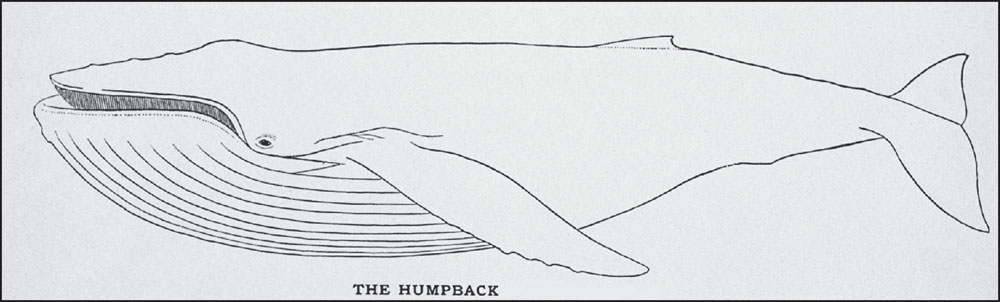
The humpback whale is a species of baleen whale that can range in length from 39 to 52 feet and weigh over 60,000 pounds full-grown. The acrobatic animal is popular with whale watchers because it is known for breaching and slapping the water with its tail. Males produce a complex song that can last for 10 to 20 minutes and be repeated for hours at a time. (National Oceanic and Atmospheric Administration.)

The whaler Charles W. Morgan, built and launched in 1841, dries sails at the dock in New Bedford around 1927. The Morgan is the last of the American whaling fleet that, at its peak, had more than 2,700 vessels. (Library of Congress.)

The whaleship A.R. Tucker, built at Dartmouth in 1851, is shown with sails askew after being hit by a storm. A Martha’s Vineyard man, George Cleveland, was shanghaied on May 4, 1895, and woke up aboard the 92-foot bark A.R. Tucker departing New Bedford under command of Capt. Andrew West. Cleveland was a twice-shanghaied Martha’s Vineyard whaler, who, in 1900, was abandoned by his employers in the Arctic tundra wilderness of Nunavut. He eventually made his way home. (Bourne Historical Society.)

This is another view of the whaleship A.R. Tucker after it was hit by a storm. Annie Holmes Ricketson, born in Fall River, was six months pregnant when she left New Bedford on May 2, 1871, with her husband, Capt. Daniel Ricketson, for a three-and-a-half-year voyage aboard the A.R. Tucker. That August, they landed on Faial Island in the Azores so she could have her baby. An excerpt from her journal reads, “August 31st: This morning I woke as happy as ever, little thinking that before night I should be in sorrow.” The baby died that day. (Bourne Historical Society.)

A voyage of the whaleship A.R. Tucker is underway. A whaleship was typically a floating store—a carpenter shop, blacksmith shop, and shipyard all rolled into one. It was essential for whaleships to carry goods and stores not needed on a merchant ship, for aside from what it required for whaling, it had to be prepared to make any necessary repairs and sustain a crew for at least three years at sea. (Bourne Historical Society.)

This 1903 photograph shows the whaling crew flensing a caught whale. The skin and thick coat of blubber underneath is peeled off and then cut into pieces that can be boiled down into oil. (Library of Congress.)

Ships’ masts and rigging are visible in this photograph of New Bedford in the early 1900s. Some 100 whaleships could be fitting out at New Bedford at one time, so the whaling industry brought a lot of work and income to Massachusetts ports. (Bourne Historical Society.)

This is a general view of the dockside area of New Bedford harbor around 1900. At that time in many New England towns, whaling was the biggest industry, and the livelihood of New Bedford and many other ports depended almost entirely on the whaling industry for sustenance. (Bourne Historical Society.)

This is a general view of New Bedford harbor with a whaleship docked at right. A list of “Articles for a Whaling Voyage,” published by New Bedford outfitter N.H. Nye in 1858, showed some 650 different articles of stores that were necessary for fitting out a ship for a voyage. (Bourne Historical Society.)

The first entry for the 1869 voyage of the bark Three Brothers starts on October 12 and was kept by first mate Cyrenius Eldridge of Buzzards Bay. The Three Brothers was built in Rochester in 1833 and lost in the Arctic in 1877. (Bourne Archives.)

The family home of Cyrenius Eldridge was located in Buzzards Bay and is shown here with Cyrenius’s wife, Mary (seated); their daughter Almeda; and sons (from left to right) Clarence, Andrew, and Cyrenius III. Cyrenius Eldridge was first mate and keeper of the log on the ship Three Brothers from 1869 to 1873. (Bourne Historical Society.)

Silas Jones, the third mate on the whaling ship Awashonks, found himself in command of the whaler when Pacific Islanders killed the captain and first and second mates while on a whaling voyage in the Pacific Ocean in 1835. (Falmouth Historical Society.)

The log of the whaling ship Awashonks records the massacre of the captain and first and second mates during an attack by Pacific Islanders in 1835. Third mate Silas Jones took command and successfully brought the ship home. (Falmouth Historical Society.)

This old whaler in New Bedford harbor has staging in the water for workmen to replace and repair the vessel. The ships were designed to carry a crew of up to 35 men who would process and store oil and bone obtained in the hunt during the voyage. (Bourne Historical Society.)

An entry from the logbook of the Three Brothers, kept by Cyrenius Eldridge of Monument, starts with a weather report (as do all entries) and notes the sighting of fin (or finback) whales. (Bourne Archives.)
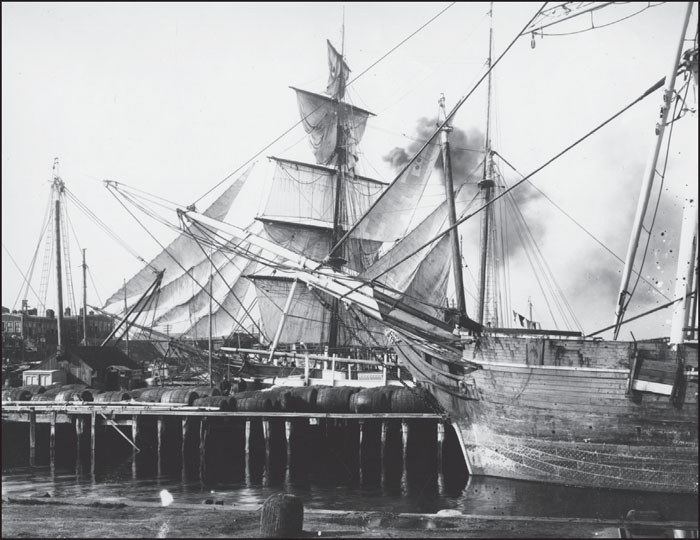
The bows of whaling ships, along with barrels for whale oil, sit at a dock in New Bedford in this photograph. Whales contributed oil for illuminants, ambergris for perfumes, and baleen for umbrellas and other products. (Bourne Historical Society.)

An entry from the logbook of the Three Brothers for March 3 and 4 records the catching of a sperm whale and subsequent loss of the “case”—the head of the sperm whale. That would have been a sore loss, as the head of the sperm whale is full of oil that is more refined and burns cleaner than oil made from blubber. (Bourne Archives.)

A workman is shown with a ship hove down for repairs at dock in New Bedford. To “hove,” which is the past tense of “heave,” is to intentionally lay the ship on its side to allow for repairs. (National Oceanic and Atmospheric Administration.)

An entry from the logbook of the ship Three Brothers, captained by James Witherell, shows days on the voyage when the crew sees whales, pursues them, then loses one after it sounds. The entry for the following day reads, “not see nothing of the whale.” (Bourne Archives.)

Capt. Edward Penniman (1831–1913) of Eastham, Massachusetts, first went to sea at the age of 11 in 1842 as a cook on a schooner, made his first whaling voyage on the bark Isabella, and in 1860, took command of the bark Minerva and sailed to the South Pacific to look for sperm whales. During his career, he also whaled successfully in the Arctic and was captain of the Cicero, the Europa, and—for his seventh and last voyage in 1881—the Jacob A. Howland. (Eastham Historical Society.)

Betsey (Mayo) Penniman, wife of Capt. Edward Penniman, accompanied her husband on numerous whaling voyages, including a June 1865 trip on the Minerva to the Arctic, where Confederate captain James Waddell and the warship Shenandoah were patrolling the area. When Captain Penniman learned of this, the whaleboats and crew were out after whales, and he had to fire the cannons to get them to hurry back to the ship so they could leave the area. In his hurry, he overloaded the cannon, and the subsequent shot broke glass and injured Betsey and their son in the cabin below. They all survived, and the couple went on to have nine children. (Eastham Historical Society.)

The home of whaling Capt. Edward Penniman was built in Eastham in 1867 and has a pair of whalebone jaws framing the rear gateway to the house. Penniman, a deepwater whaling captain, was born in Eastham in 1831, first went to sea at age 11, and had an adventure-filled and profitable career in the whaling trade. Edward Penniman’s youngest granddaughter sold this house to the National Park Service in 1963, and it is now located within the boundaries of the Cape Cod National Seashore and listed in the National Register of Historic Places. (Eastham Historical Society.)

These pages are from the logbook of the bark Three Brothers when it was out on a whaling voyage of some years. The logbook, kept in longhand by first mate Cyrenius Eldridge of Monument, includes whale stamps, which were used to keep track of whales; a couple of ink splotches, which were hard to avoid when using pen and ink on a heaving ship; and some unusual spelling. These entries are fairly typical of logbooks kept aboard ships. (Bourne Archives.)

The whaleship Leonora is shown in port in New Bedford. The Leonora, captained by the notorious William “Bully” Hayes, wrecked on March 15, 1874, during a storm off the island of Kosrae in the Pacific Ocean. The Leonora was a “blackbirder,” a ship known for kidnapping Pacific natives and selling them into slavery, and its original name was Pioneer. (Bourne Historical Society.)