
CHAPTER 3
Since its inception in the early 1930s, the Rastafari movement has experienced notable changes in its class structure. It has transcended the shores of Jamaica to include people of different social and economic backgrounds in countries all over the world, which has inspired scholars to characterize the movement as “inherently transnational in character, outlook, and composition.”1 Estimates put the total number of members worldwide at 700,000 in 1988, and 3–8 million members by the end of the twentieth century.2 The latter figures might be an exaggeration; nonetheless, there is noticeable diversity in the movement. This diversity can be attributed to various factors, such as women’s counteraction of patriarchal assumptions within the movement and their subversions of the class divisions in society. Class, it should be noted, is used here as “the economic conditions which shape” this identity, or defined “through the medium of economic values, profits, wages, investments, etc.”3 In other words, class is largely determined by relationships to the means of production, principally land and capital, and the social status or influence in society that one derives from these relationships.
Contrary to popular views, middle-class women started to join the Rastafari movement in the early stages of its development. From this perspective, we can gain a sound understanding of how women influenced the class dynamics of the early movement within the class structure of Jamaica. Here, Walter Rodney bears much relevance, as the notion of class solidarity through an association with Blackness formed the basis of diversification of the movement beyond its mostly Black peasant following while maintaining its African consciousness.4 This chapter explores the class implications of Tenet Bent’s involvement in the early Rastafari, despite operating in a patriarchal movement and society.
Bent was one of the first women to have engaged in diversifying the class composition of Rastafari in the Jamaican context. She was a middle-class woman who decided to marry Leonard Howell, recognized as a founder of the movement.5 Bent’s light-skinned complexion indicated that she also challenged the racial divisions in the society, one where “the traditional light-skinned elite and upwardly mobile black families” remained “keen for their children to ‘marry light.’”6 Further, she had broken off a previous engagement to marry a man whose family was both wealthy and considered as white. While Bent herself was also considered as “white,” she chose to marry a dark-complexioned man.7 For many middle-class Jamaicans, Bent’s decision symbolized a betrayal of her class background. She was supposed to be among what Herbert Duffus, a Jamaican judge, described as the “persons with a proper home background,” a statement he made when he was handing down the sentences of Rastafari individuals at the treason-felony trials in 1960.8 Edna Fisher, the only woman among the convicted individuals, was born poor but had joined the middle class when she was adopted by an aunt and subsequently became a successful businessperson, employer, and landowner in Kingston and St. Andrew, where she built a house that formed the basis of the Rastafari church she cofounded in 1959. Fisher is discussed further in chapter 7. Judge Duffus’s view represented a hierarchical society, one in which class took precedence in directing the social order, and it was also a testimony of the values and norms of the colonial context in Jamaica that Rastafari struggled to change based on its “socialistic” notions of social and economic equality.9
A CLASSLESS MARRIAGE: PERSPECTIVES OF THE JAMAICAN COMMUNITY
Bent was born on March 7, 1912, and within the context of Jamaica’s social strata, she was considered a person from a middle-class family. Her parents, Ellen Ebanks-Bent and Edward Bent, were the owners of approximately one hundred acres of land in Southfield, St. Elizabeth, where she and her six siblings were born and raised.10 Hélène Lee described the Bents as an “upper-class” family with “Irish, Scottish, German, and Jewish blood,” in addition to African blood.11 They were probably seen as upper class in rural St. Elizabeth, but in the wider Jamaican society, they were middle class given the amount of land they owned and the “tripartite racial” hierarchy, which was used by the colonial system to divide the population of the island.12 This hierarchy placed mainly whites on top, browns or mixed-race people, such as the Bents, in the middle, and Black people at the bottom. Bent attended Mayfield Primary School in Southfield, St. Elizabeth, which was considered a prestigious school in the parish.13 At age twelve, she was enrolled into the Hampton High School for Girls, another prestigious school in St. Elizabeth.14 The Bents were also prominent members of St. Mark’s Anglican Church in Southfield. The Anglican church was not only the church of the state; during slavery, it was considered as the “planters’ church” and widely viewed as elitist.15 Essentially, Bent’s upbringing was more representative of European understandings, which conflicted with the Rastafari movement that opposed the colonial order of Jamaica. In 1935, Howell, for example, dubbed the colonial system as “Our SLAVE MASTER,” that is, an organ of the white planter class, which accumulated its wealth from enslaving Black people.16
Bent was perhaps the first middle-class person to become a Rastafari member, though other persons of racially mixed ancestry joined the early movement. The Rastafari founder, Henry Archibald Dunkley, for instance, was mixed race but not middle class. Bent also decided to marry the most widely known Rastafari and founder of the movement, thereby declaring her entry into what many Jamaicans at that time considered a classless marriage or disgraceful union. Leonard Barrett has observed that many new Rastafari members in the 1960s came from the middle class, whereas previously, “the membership” of the movement “was essentially lower class.”17 Thus, Bent’s marriage fueled even more fears of an attempt to strengthen the movement beyond “the illiterate classes” in the 1930s.18 Bent was married to Howell in Kingston on January 31, 1937.19 Prior to meeting Howell, she had been living in Kingston and shared a friendship with a woman known as Miss Powell, the owner of a guesthouse and restaurant in the city center. Powell was mystified by Bent’s decision to marry Howell, and her decision to abandon her engagement to marry a son of the wealthy Machado family. As a result, their friendship ended.20
Bent’s assertion of her sense of freedom started from before she met Howell. She had left idyllic Southfield against the orders of her parents. A younger sister named Louise had joined her in Kingston for a while but was unsuccessful in convincing her to return home to Southfield. Their father Edward drove his lorry on a seventy-mile journey into Kingston to sell the products from his farm to wholesalers and market retailers, known as higglers, and visited Bent, but he also could not convince her to return to Southfield. In the 1930s, fewer than 300 people lived in Southfield, and it was known for its pristine natural environment, tranquility, and safety.21 Southfield’s mostly peasant poverty was hardly analogous to the squalid living conditions of the poor in Kingston, which was beset by high unemployment rates that created “growing areas of poverty and squalor.” Such places afflicted the city through their “abysmally poor filthy housing, starvation, petty crime, prostitution, disease and death.”22 Despite living mostly on her own in the city center, where she was close to its realities stemming from the growing areas of squalid poverty, Bent remained steadfast in her decision to maintain her freedom and independence from her parents. This sense of independence and freedom was also visible in her decision to abandon the engagement to a wealthy Machado, a family also considered as “white.”23
THE CHOICE OF CLASS
The Machado family owned the B. & J. B. Machado Tobacco Company, established in Kingston in 1875. Bent began working there as a “receptionist” after leaving “secretarial school” around 1936.24 Shortly thereafter, she was engaged to one of the Machado sons, which would have further elevated her social status. But while the Machado family supported Jamaica’s mainstream or creole nationalism, before it even showed signs of succeeding in the early 1940s, their business enjoyed preferential treatment on the British market, which contributed to its profitability even during the decade-long Great Depression of 1929–39. The Machados had also emigrated from Cuba at the start of a revolution which is said to have had a “powerful rhetoric of antiracism,” one that “became much more dominant in the years between the legal end of slavery in 1886 and the outbreak of the third and final war in 1895.”25 While in Jamaica, the Machados became wealthy business people who employed a mostly low-paid Black labor force, which Bent later joined, though in a relatively elevated role at the receptionist desk.26
The low wages and poor industrial relations in big businesses in late colonial Jamaica could hardly be ignored by any employee living in the 1930s. By 1938, the island’s working people embarked on a massive strike action that spread to many sections of the island. Among the main “causes of working class unrest and dissatisfaction,” wrote Richard Hart, were “low wages,” and the “arrogant racist attitudes of colonial administrators and employers.”27 A royal commission of inquiry, known as the Moyne Commission, was convened to investigate the causes of the strikes, which erupted in several other British colonies in the Caribbean. Among the commission’s recommendations was the 1944 enfranchisement of the adult population of Jamaica so that they could elect persons to represent their group interests. It was during these events that Bent chose entry into the Rastafari movement, which promoted a Black nationalist ideology for the future Jamaica and advocated a socialist vision of this future, one that conflicted with the corporate interests of families such as the Machados, who owned and had significant holdings in big business ventures. Following Jamaica’s independence from Britain in 1962, the Machados transitioned into upper-class status, a status realized through their wealth and the continued influence of the racial legacies of British colonialism, which placed “phenotypically white” families at the top of the Jamaican social hierarchy.28
Though Bent’s decision indicated the rejection of financial ease, the man she eventually married was not struggling financially, but he had to contend with the independence that Bent had already established for herself from before they met. While Howell himself may have been “an attractive man, a dressed man, a pleasable man that went around with a nice briefcase filled with attractive documents, a man with the word of God in his mouth,” he was also a business owner, and by virtue of his financial status, could qualify as a member of the bourgeoisie.29 The Gleaner reported that by 1940, he “owned a bakery in Kingston,” bought a van used to deliver its products, and owned “dozens of handcarts on the streets.”30 But as a member of the working class in Kingston, Bent also had a personal stake in the plight of workers in the city, an interest that she extended to the plight of the peasantry after learning of the Rastafari movement through Howell. She grew up around the peasantry of Southfield but was shielded from its realities by her parents’ affluence. Her consciousness of the realities of Jamaican poverty developed after leaving Southfield for Kingston. The concentrated pockets of poverty all over the city of Kingston made this poverty more detestable and often worse.
In Kingston, Bent was also surrounded by social unrest of the working class and unemployed poor accompanied by protest rallies, including those addressed by Amy Jacques Garvey, who protested the 1935 invasion of Ethiopia by fascist Italy. These rallies were held at Ward Theatre, which was only a mile away from the cigar factory at Park Lodge where Bent worked.31 While there is no record stating how Bent felt about Jacques Garvey, their similarities seem striking. Both were light-complexioned middle-class women who married dark-skinned men who were leaders of sociopolitical movements promoting African consciousness. Bent’s commitment to her family and Rastafari community also stood as signs of the “community feminism” that Taylor has applied to Jacques Garvey’s commitment to her marriage, family life, and the Black struggle.32 Among the principal motivations of such women was keeping the family together to ensure the well-being of its members, including “the woman herself.”33
In 1941, in an interview done by Len S. Nembhard, a local reporter, Bent expressed the interest she had developed in protecting the fellow Rastafari people from starvation. “Our people,” Bent asserted, “are starving, but they are afraid to go in the roads for anything” because of the police, who had raided their community, Pinnacle. She also asserted her belief “in God” as the ultimate source of her strength and was explicit about her conviction that with God’s help, their community would survive, even during her husband’s imprisonment.34 In these statements, she announced her ability and willingness to take up the mantle of leadership at Pinnacle, as Jacques Garvey also did with respect to the Universal Negro Improvement Association and African Communities League after her husband, Marcus Garvey, was convicted and subsequently incarcerated in the United States in 1924. Bent’s parents initially entertained the view that Howell “dictated her every move,” but abandoned this view when the couple visited Southfield, their only visit to the Bents’ family house. Bent’s parents realized that she was not the person they once knew, or had affectionately referred to as “little Teeny,” but someone who was increasingly enigmatic and self-assured. Ultimately, her parents became “perplexed by her superior complex behavior.”35 Not only did she not subscribe to the class rules of the society they cherished; she had developed her own understanding of how to approach one’s choices in life.
MARRIAGE AND FAMILY
The family that Bent created from the marriage bears resemblance to other middle-class families in Jamaica at the time. What had upset and blinded Bent’s parents, for example, was the fact that she had married a Rastafari man. The Rastafari religion simply conflicted with her parents’ Christianity, especially since they raised their children in the Church of England, or the Anglican church. Nonetheless, Bent’s marriage showed signs of the empowered condition of middle-class wives, based on Bent’s actions and testimony, and the scholarly statements on such families from the late colonial period in Jamaica. No systematic study of middle-class family life exists for the period of the 1930s and 1940s, but in the 1950s through 1970s, anthropologists, such as F. M. Henriques, Raymond T. Smith, Madeline Kerr, and Jack Alexander, asserted middle-class women’s maneuvering to exercise authority over their husbands and decision-making for the family.36 Thus, middle-class families showed significant signs of having the same matrifocality that the anthropologists identified among peasant and working-class families. In 1957, Smith observed, for example, that “The lack of authority of the husband-father may be marked” in the middle-class family, “particularly in a situation where it is common for men to validate their occupational status by marrying lighter coloured women, and where they may have to keep incrementing their occupational status in order to prevent the centre of status interest from swinging back onto the wife-mother.”37 In 1977, Alexander observed a similar paradoxical reality about the middle-class husband-father. Alexander pointed out that “it may be precisely the greater indispensability of the middle class male that can help to account for the image of him as marginal, for if he is perceived as deflecting his activities from the family that perception will be threatening to the functioning of the family.”38
Bent was one of these lighter-colored women who had married a darker-colored man, and although she found out about the children Howell fathered during the marriage, she used this knowledge as part of maintaining her marriage and family. Rumors that Howell had as many as “thirteen wives” fueled the opinion that Bent was being led by him.39 Lee has also suggested that the rumors of Howell’s infidelity might have resulted in Bent having a nervous breakdown in 1943.40 However, no records of a medical diagnosis of a nervous breakdown or institutionalization as a result of such condition were found. In dealing with the children Howell fathered with others during his marriage to her, Bent opened her home to these children and through a magnanimous sense of morality, swung the pendulum of moral authority and status interests in her direction. One of these children, Anell, wrote fondly of Bent during his “boyhood days,” while citing “the fun” he remembered he “use to have” at the house in Pinnacle, which Bent lived in with Howell and their sons.41 Montinol, the older of their sons, stated that he had some memory of that period, even though he was four, and remembered that his mother allowed Anell to visit the house.42 Many middle-class married women opted out of employment after they were married and used the politics of status-interests to tie their husbands’ assumptions about being the head of the family to insisting on their husbands’ adequate performance of their responsibilities to the family, including maintaining the marriage and financing the standard of living expected by their wives. Bent herself even declared that, “No matter what happens he has always been a good husband.”43
The politics of status-interests, in other words, gave middle-class women, such as Bent, opportunities to perform what were deemed to be “men’s jobs,” through an arrangement that empowered them to assume control over the children, family decisions, finances of the family and its standard of living, especially in cases where “the man is not sufficiently committed to the family,” based on standards sustained by these women.44 The fact that infidelity still occurred in these marriages should not distract from the insistence on men’s commitment to maintaining the marriage, insistence identified by anthropologists as within the women’s sphere of influence and largely resulting from the prospect of fully returning the family to the matrifocal model. Such insistence included providing for the family’s financial and emotional well-being, and the insistence of the women that these should not be jeopardized by infidelity.
As a married woman, Bent saw herself in the same light as many other married middle-class women of her time who helped their husbands succeed in their occupations, as this assisted maintaining the social status and stability of their family. Soon after marrying Howell, Bent would encounter the challenge of navigating Howell’s arrest and confinement. On February 15, 1938, Howell was “certified insane and sent to the Mental Hospital” by the colonial government and was not released until December 20, 1938.45 Within weeks of this confinement, Bent relocated to a new residence at No. 6 Sea Breeze Avenue in Bournemouth Gardens on Windward Road, Kingston, which was nearer to Bellevue, the mental hospital. She visited Howell daily and provided him with meals and emotional support and insisted that he be treated fairly. She also used her secretarial training to ensure that he stayed in contact with the Ethiopian World Federation (EWF), headquartered in New York, and the International African Service Bureau (IASB) in London. The EWF coordinated activities in the African diaspora to assist in the Ethiopian resistance to fascist Italy’s occupation of Ethiopia from 1935 to 1941.46 The IASB was an anticolonial organization with Marxist underpinnings founded by Trinidad-born George Padmore and C. L. R. James, Guyana-born T. R. Makonnen, Sierra Leone’s I. T. A. Wallace-Johnson, and Jamaica’s Amy Ashwood Garvey—Marcus Garvey’s first wife.47 Bent’s “correspondence” with these organizations would even provoke close surveillance of her by the Jamaican police.48
Owen Wright, the inspector general of police, received regular updates on Bent’s visits to Howell and the letters that she wrote and received on his behalf. The letters Bent sent bore Howell’s signature, but the grammar of these letters, intercepted by the police, were not Howell’s, as they stood in stark contrast to his only known piece of writing, The Promised Key, which had many grammatical deficiencies.49 Bent also managed the purchase of 375 copies of The Voice of Ethiopia, delivered in December 1938. This was the “journal” of the EWF, which was distributed to Howell’s followers.50 “Literature” expected from Padmore was delayed, causing Bent to also “worry,” but the police reported that Howell assured her that he would look into it upon “his release from the Asylum.”51 The literature in question was Padmore’s 1938 publication, “Hands Off the Colonies!,” published by the Socialist Party of America, which finally arrived in the early part of 1939.52 In Bent’s anxiety over the package from Padmore, we not only see her interest in maintaining the Rastafari movement, but also elements of what anthropologists called “the greater indispensability of the middle-class male that can help to account for the image of him as marginal, for if he is perceived as deflecting his activities from the family that perception will be threatening to the functioning of the family.”53 In other words, Bent recognized that maintaining a functional family was tied to Rastafari’s success. Her protection of her family materialized in helping to manage correspondence essential to the movement’s development. But Bent was also invested in purchasing the Pinnacle property.
BUILDING THE PINNACLE COMMUNITY
Both patriarchy and Bent’s class background obscured her contribution to the creation of Pinnacle, the Rastafari’s first self-sustained community. But this was not a new development. Dunkley, a Rastafari founder, also complained that even he had to contend with class prejudices in the movement that tried to connect him to the haute bourgeoisie based on his light or brown complexion. These prejudices came to light in 1937, he stated, and were from fellow founders Hinds and Joseph N. Hibbert, among other leaders, such as Altamont Reid and Cecil Gordon, who told him, “‘brown man’ can’t lead them go anywhere, ‘brown man’ can’t lead them to Africa, and Africa don’t want no ‘brown man.’”54 Some individuals in the wider Jamaican society, including other women, such as Feany Howell, Sybill Windall, and Miss M. Falconer, who contributed in significant ways to the building of Pinnacle, also had their efforts shrouded by patriarchal and classist assumptions. However, Bent was determined to help build Pinnacle not only for the benefit of her family but for that of other members in the community.
Developing the Rastafari movement was a significant challenge, but through her generosity and resourcefulness, Bent helped to materialize the Pinnacle community. Her support of the initiative to purchase Pinnacle was not explicitly stated in the records, but according to Gerald Downer and other members of the community in the 1940s, Howell combined what he had with Bent so that they could buy the property.55 She contributed financially to its establishment partly through the sale of valuable personal items, including her pearls. In August 1938, an intruder broke into her residence at Sea Breeze Avenue in the middle of the night to look at boxes of “receipts” at the premises. Except for a “wristwatch,” all of Bent’s valuables were left behind, including her pearls, and the story was published in the Gleaner under a headline stating, “Robber Leaves Pearls Behind: Lucky Woman Still Has Jewellery Valued £100” (about £6,432 in 2020). The “boxes” of “receipts” were placed at the front of the house in public view.56 The receipts described transactions which the public could interpret as lavishness or the accumulation of assets. Whatever the reason for the intruder’s exposure of the receipts, they potentially painted Bent in an unfavorable light to the public. Nonetheless, the letter to Padmore dated 1939, inquiring about the publication that Bent had started “to worry” about has also made it apparent that the pearls were used as part of the fundraising for the establishment of Pinnacle.57 Howell had expressed the wish to sell her pearls in London, where he assumed the prices would be better than in Jamaica. The following year, April 1940, Pinnacle was purchased from Albert Chang, a Chinese businessman, who was the owner of the property, known as “Palmetto Cottage and The Pinnacle,” located in the hills of the parish of St. Catherine.58 Bent was the one with “contacts” in the mainstream of Jamaican society, including Chang, whom she knew well enough to negotiate favorable terms for the purchase of Pinnacle.59 Various estimates have been provided for the size of the property, estimates that range from 153 acres to as large as 1,300 acres.60 Chang agreed to sell the land for a total of £1,200 (approximately £66,010 in 2020), but to receive payment in installments, starting with a down payment of £800 (roughly £44,010 in 2020).61
Other women involved in the accumulation of the financial resources that enabled the purchase of Pinnacle, including Feany Howell, Windall, and Falconer, were members of the executive board of the Ethiopian Salvation Society (ESS), established by the Howellites in January 1939 as a “Christian” benevolent association and charity.62 The Society was headquartered in New York, but a branch was formed in Jamaica, where its aims and objectives stated that “They had no race prejudice and the Society was formed for the benefit and advancement of the masses.”63 Feany Howell served as secretary of the ESS, and Windall and Falconer were assistant secretaries. These roles made them members of the governing board. The board members were also described as business partners in Leonard Howell’s multiple ventures, including ownership of the van and bakery in Kingston, and were “not badly off.”64
The board members of the ESS were guided by a constitution, and Bent played a role in its creation, as she was not only a board member but a central figure in the operation of the organization as its first secretary.65 This constitution supported women with children, providing grants ranging from £1 to £4, some £55 to £220 in 2020, for sick and deceased children up to the age of sixteen.66 In April 1939, the ESS held a two-day Jubilee for Rastafari members at the Garvey movement’s Liberty Hall, Kingston, attended by “hundreds of members from different parishes,” and the Gleaner report noted the “orderliness” of the people.67 In addition to its constitution, Bent’s influence could be seen in the fund that was started by the ESS for victims of the drought in St. Elizabeth in July 1939. The first area identified for the distribution of “funds and gifts to the people” was Bent’s hometown, Southfield, followed by Flaguman and Round Hill.68 The purchasing of Pinnacle in April 1940, however, was the biggest venture of the ESS. In November 1940, hundreds of women joined the exodus to the Pinnacle community, a total “of over 700” people.69 Fearful of moving there so early after the birth of Montinol, born on December 2, 1939, Bent would arrive at Pinnacle in January 1941. Within a year of moving to the community, she gave birth to a second child, William, born on January 28, 1942.70
Bent not only cared for her children but extended this care to the entire community. Lee notes that Bent “rounded all the houses where small children were living, making sure they were fed.”71 She also prioritized educating the children, motivated in part by her dream of becoming “a teacher” at an earlier stage in life.72 She helped her husband establish a school at Pinnacle, housed in the “community mess hall” where the more than 700 reported residents of the community also ate together and gathered for fellowship on Sundays.73 Though pressed for time given many other roles at Pinnacle, Bent was occasionally one of the teachers of the children at Pinnacle, children taught at arguably the most critical stage of their development, the early childhood years. Children attending the Pinnacle school were later sent to nearby colonial schools, at around age “eight or nine,” including “Mount Moreland Primary School,” which enrolled students between ages “six and fourteen.”74 In explaining the education of these children, Chevannes observed that “Pinnacle was not an isolated community. After leaving the community’s infant school, Howellite children pursued their education in the schools of nearby villages.”75 These children were prepared to take on colonial teaching after receiving their Rastafari schooling from Bent and their other teachers. Downer, who grew up at Pinnacle, also stated that the community was enriched by Bent, known as “the mother” of Pinnacle, who made the members of the community feel as though they were “living as a family.”76 Downer and his mother relocated to Pinnacle in 1940.
Within seven months of moving to Pinnacle, Bent found her life in the community suddenly upended by a police raid on July 14, 1941. The police came armed with two warrants for the arrest of Howell and a wanted man named James Nelson, whom the police had reasons to believe was hiding at Pinnacle with Howell’s permission. Howell “evaded arrest” during the raid, and remained hidden “for nearly a fortnight.”77 Several policemen interrogated Bent about Howell’s whereabouts, but she refused to disclose any information that could have helped them. Her decision to remain loyal to Howell clearly made an impression on the police, which a Jamaica Times reporter, Nembhard, realized when he visited the community four days after the raid. The police maintained their presence in the community for two weeks, and during his visit, Nembhard observed that “a Police Officer indicated a fair and frail woman sitting near the door of the deposed Chieftain’s home,” and also mentioned hearing the policeman assert, “That’s Howell’s wife over there,” and “he has also left her behind” (fig. 1).78 The description of Bent that Nembhard himself gave, however, was not one of a frail or damaged woman who felt abandoned or betrayed by her husband. Instead, Nembhard wrote that Bent’s “features were those of a stern woman. Perhaps not a cruel one, but a woman who could issue orders to many a man and see them carried through.”79
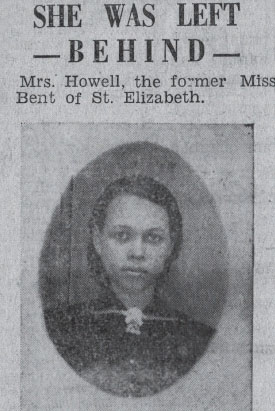
FIGURE 1.
Tenet Bent, described as “left behind” by her husband Leonard Howell during the police raid on July 19, 1941. Courtesy of the National Library of Jamaica.
Those orders included withholding information about Howell’s whereabouts, the movement, or any information that would implicate the community members in criminal activities. Bent maintained the same cautiousness during the interview with Nembhard. She “said nothing until I spoke,” he stated, “and even then replied to my query with great reluctancy.” He tried pressing her about Howell but stated that she “had been similarly interrogated so many times before, that she didn’t worry to question my authority, she just gave me the stereotypical line: ‘I don’t know,’” and was convincing too. As he stated, “I believed her. Not that I just took her word for it, but you would too, if you had heard the way she said it.”80 Howell turned himself in to the police about two weeks later and was tried and sentenced to another two years at hard labor while Bent took care of the community. Even though some members of the community referred to her as “white,” her dedication and service to the people of Pinnacle helped to reduce the negative effects of such perception. Mostly, the people referred to her as an “intelligent” person, who was “the first Martyr at Pinnacle.”81 The details on Bent’s activities at Pinnacle during the two years Howell was imprisoned have been elusive. However, the people of Pinnacle remembered her loyalty to the community, her commitment to her family, her generosity with her time, and her role as a teacher and midwife, as well as her attentiveness to feeding the people, especially other women with babies. One must also note that these roles were being performed while she was pregnant with a second child, whom she nursed.
A part of the reason there is no further information on Bent, even circumstantial, is her untimely death in December 1943. However, the vile condition in which her remains were discovered at the bottom of a ravine, “partly decomposed and crow ravaged,” indicated to the police that she did not die by accident or suicide but was murdered with exceptional brutality and her body severed and cast into the ravine.82 The condition of her remains indicated that her murder was perhaps intended as a statement. Geraldine Fong, Bent’s niece, recalled that hardly anything was left for them to identify, mostly “her bones,” and the police were so guarded about the whole “inquiry” that the news of it “did not reach them until months later” when her “Uncle Arthur was summoned to Spanish Town to identify” the remains, and they were only told at that time that her remains were found “by a farmer who was looking for his donkey.”83 Howell was suspected of her murder and imprisoned for a while based on the accusation.84
By focusing on Howell, did the police miss the chance to find Bent’s killer or killers? Whatever the answer to this question, clearly the residents of Pinnacle thought very highly of Bent, especially after the police raid, which left her to manage the community. They believed that she “lost her life for the struggle, the first major loss of life in the battle for Rastafari.”85 On April 4, 1944, Arthur Lewey, the attorney general of Jamaica, issued a statement advising the police that even though he had “no alternative but to enter a nolle” in the case of Bent’s murder, “so long as Howell’s followers observe the law, they are entitled to continue to live unmolested in whatever way they please.”86 Implicit in Lewey’s advice is that Bent’s death was such a terrible loss that perhaps the community would disintegrate on its own without the need for further police intervention. This wish, however, would not materialize. The community continued and experienced several other police raids, which are discussed in chapters 5 and 6.
The more important implication of Lewey’s statement is the admiration that residents of Pinnacle had for Bent, sentiments that they have continued to express for her over the years. Despite her middle-class background, as well as the suspicions of some Rastafari about the involvement of light-complexioned Jamaicans in the early movement, Bent earned the respect and admiration of many of Pinnacle’s residents. Downer recalled that she was considered the mother of the community, and in this role, Bent extended her conception of motherhood to include the community as a family. While such conceptions were embodied by peasant women, Bent used her prominent position as a leader’s wife to strengthen their promotion. Bent also used her skills in secretarial work and writing to help the movement maintain its connections to the African diaspora world through correspondence with the EWF headquarters in New York and the IASB in London. Bent’s work was obscured in much the same way that women’s work in the home have been overshadowed by patriarchal assumptions that have designated women as dutiful wives or servants. Nonetheless, Bent worked diligently, keeping her family together, navigating police interventions and a state hostile to Rastafari, while helping to build a community for mostly poor people seeking a better life.
How differently might the early movement look if there was ample accessible documentation and enough oral knowledge of early women, especially women who did not or could no longer fit the characterization of a peasant condition? This is not meant to imply that the early movement had numerous middle-class women or even middle-class men. But we should consider that the reach of Rastafari in the 1930s and 1940s extended beyond persons of low-income status, and this reach, as indicated by Bent’s case, was maintained by a rejection of colonial class attitudes and norms in order to embrace an African consciousness. This African consciousness was inclusive of the features of diversity, such as multiple class, ethnic, and racial profiles, that have been identified as inherent to the Rastafari movement based on its current composition. The extent of the class diversity of the early movement has the potential to modify the narrative of the genesis of Rastafari at a critical moment in the anticolonial struggle in Jamaica. This struggle has been discussed primarily through the lens of a class division composed of the leadership of the creole nationalist movement on the one hand and the radical nationalism that Rastafari’s leadership represented on the other. But what if the middle-class leadership included involvement in the Rastafari? How does this change the way we currently understand the leadership of the nationalist struggle based on class divisions?
Bent, a middle-class woman, provides us with evidence to at least begin to consider the leadership of the nationalist movement as including elements of solidarity between radical peasant and middle-class leadership. The middle-class Jamaican Marxists of the 1950s, including a woman named Ivy Harris, would attempt to foment this kind of solidarity by capitalizing on the Rastafari movement. Harris was profiled in the police surveillance of Rastafari in 1959–60, which will be noted later. In the earlier case visible through Bent’s experiences, the solidarity came from within Rastafari, or from members of the movement with middle-class upbringings and those who acquired capital, land, and business interests to qualify for bourgeois status, who gave their skills and knowledge to the movement’s development. Bent’s contributions involved helping the movement to develop its potential through its pursuits of economic, social, and spiritual development of its people. Her middle-class orientations were used to maintain the focus on community development. Still she also recognized the utility of class solidarity to communal uplift, which is akin to the cohesion of Africans and East Indians discussed by Rodney, a solidarity formed in response to the common experiences with the racial as well as cultural and economic contempt of Europeans. The middle-class dimension, which may be more accessible by looking closer at women, shows a Rastafari movement that was central to the anticolonial struggle of a wider cross-section of the population. This discussion of the impact of Rastafari on the middle class modifies the image of the early Rastafari as mainly associated with the peasantry. The next chapter discusses the thrust toward more inclusion in the early movement by considering a woman’s interpretations of its doctrine.