
CHAPTER 4
At seventy-three years old, Merriam Lennox was still preaching the Rastafari religion. She started preaching in her midtwenties to educate the people of colonial Jamaica about Rastafari and the Black liberation struggle in Africa and the African diaspora. Religion was, and still is, critical to Rastafari’s Black liberation ideology, which has guided the movement since its inception in the 1930s. In fact, many, perhaps most, persons would concur that Christianity is the backbone of Rastafari. Furthermore, a large body of scholarship on Rastafari has been produced through Christian lenses.1 Rastafari emerged from Black liberation resistance to racism, classism, and colonialism in Jamaica. However, its anticolonial doctrine is intertwined with Ethiopianism, a pan-Africanist ideology based on biblical doctrine as its validation that developed among Black churches in southern Africa in the late nineteenth century. Principally, Ethiopianism was premised on the prophesy of Psalm 68:31, which states, in part, that “Ethiopia shall soon stretch out her hands unto God.”2
Since its establishment, Rastafari has experienced notable changes that have resulted from a myriad of interpretations of the connection between its doctrine and Christianity. Such interpretations led to the development of different missionary organs or mansions within the movement, such as the Howellites, Nyahbinghi, and Bobo Shanti, which developed independently of each other.3 Most notably here, however, are the early Rastafari women such as Lennox, who interpreted Christianity to empower themselves. Lennox’s reasoning on women, especially Empress Menen of Ethiopia, was essentially guided by the Bible. In 1930, Wayzäro Mänän was crowned Empress Menen of Ethiopia alongside her husband, who was crowned Emperor Haile Selassie I.4 Lennox used her biblical interpretation of the role of Empress Menen that she preached both within and outside of the Rastafari community to stimulate doctrinal change that helped to reduce patriarchy in the movement.
As previously mentioned, the documentation generated by and about women in the early Rastafari is scarce; however, Lennox is one of the few women on record who offers much insight into women’s thoughts and experiences, including how women’s interpretation of Christianity in the early movement challenged the patriarchal nature and structures of the religion of Rastafari. Lennox saw herself as a spokesperson for early women whose voices are largely absent from the archives. Rastafari members have relied on each other for their understandings and interpretations of the movement’s religious conceptions, and they have done this mainly through their reasoning sessions with much liberty. Lennox and the researchers who observed her activities noted her interactions with mainly women in such reasoning sessions, as well as her preaching of the views she developed from them and her own understanding of the movement’s doctrine. Lennox used these views to spread the Rastafari message of equality and unification as critical to achieving Black liberation and universal human progress.
In interviews with anthropologists Renee Romano and Elliott Leib in 1979 and 1983, Lennox asserted that women and men are equal, or “from he made himself a part of a woman then it is himself” (fig. 2).5 To put it simply, Lennox believed that women and men are equal partners in a codependent arrangement that will mentally and culturally prepare them to improve their ability to overcome deprivation and resist oppression. In the 1930s, the Rastafari founders and other early leaders established a doctrine that advocated the dominance of men in the movement through the divinity of Emperor Selassie. However, by the 1940s women, such as Lennox, were engaged in activities to promote the empowerment of themselves in the movement, activities that can be associated with womanist theology, a branch of Black feminism, in which Black women saw themselves as bestowed with divine authority to act as God’s mediators. As scholars have observed, “the Bible is the highest source of authority for most Black women” in the Americas.6 Among the principal characteristics of womanist theology is its use of the women in the Bible as holding “on to life in the face of formidable oppression.”7 Womanist theology has promoted the liberation of all women from patriarchy, racism, class discrimination, colonialism, and neocolonialism.
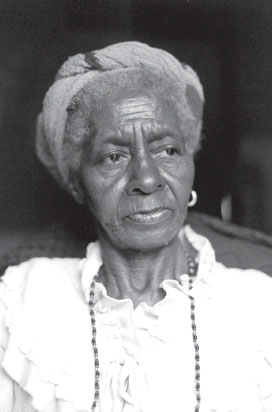
FIGURE 2.
Merriam Lennox, Kingston, Jamaica, 1983.
Courtesy of Jake Homiak. International Rastafari Archives Project, National Anthropological Archives, Smithsonian Institution.
Though early Rastafari women did not use the term womanist to describe themselves, they exuded the characteristics of womanism. That womanism remains a developing tradition also indicates its likely presence from before the term was coined during the mid-1980s by Black women writers in the United States, namely Alice Walker, who used it as part of the struggle to extend the Black liberation movement to include Black women’s resistance to the intersected oppressions of sexism, racism, classism, and neocolonialism.8 Described as Black feminism by Walker and several scholars, womanism was largely intended to differentiate Black and Afrocentric feminists from white and Eurocentric feminists, who neglected the intersections of patriarchy, racism, poverty, and neocolonialism. Another important element of womanism was its designation of Black women as agents of political and cultural uplift within their movements. “For Rastafari women,” Ella Maria Ray has observed, “the womanist perspective privileges the internal self, the sacred, and the spiritual. It highlights what it means to be a Rastafari woman and how as such, she and her co-religionists are the source of validation.”9 Walker also referred to the communal spirit of womanism, noting that except where women had to separate themselves from men for their health, safety, and well-being, womanism was committed to the “survival and wholeness” of all women, men, and children.10 Womanist theology specified Black women’s right to criticize theological knowledge and interpret the holy scriptures through their African-oriented lenses. In other words, its focus on women’s “voices and experiences of the Christian faith,” rather “than anything said or decided by men,” promoted Black and African-centered women’s “freedom of will and mature intellect.”11
Lennox used her theology to empower herself and other Rastafari women. She went beyond Rastafari men’s critical reading of the Bible as part of her personal quest for a God she could call her own. While Rastafari men used the same quest for individual divinity to empower themselves, women such as Lennox expressed their views on their own divinity to improve or customize the understandings of divinity developed by men.12 In this way, Lennox contributed to the development of the Rastafari’s “I and I consciousness,” which, as Noel Erskine writes, was developed from their literal reading of “‘I said ye are Gods,’” a biblical quote from John 10:34.13 Lennox used this notion of human divinity to argue for the equality of the sexes, or for a consciousness that was meant to serve the needs of the whole community based on a womanist understanding, an understanding that women were made equal to men in God’s image and likeness and were bestowed with the freedom of will and mature intellect to interpret God’s intentions for humanity based on their reading of the scriptures.
LENNOX AND THE CONVERSION OF RASTAFARI WOMEN
In 1933, at eighteen years old, Lennox was baptized into Christianity but became a Rastafari member in 1941 after her mother, Sister Elvie, moved from the St. Catherine lowlands to Pinnacle in the hills of the same parish. “I was baptized in the name of Jehsus Christ,” Lennox related to Romano and Leib, but in the Christian church, “Jehsus Christ” was the one “who the people call Jesus Christ.” A voracious reader of the Bible, Lennox believed that Christ, under the name of Jehsus, foretold his return and was “in no other person save His Imperial Majesty, the Emperor Haile Selassie I,” the return of “the ancient king of Israel.”14 At the same time, Howell, the main founder of the Pinnacle community, which socialized Lennox into a Rastafari woman, was seen as a prophet, healer, leader, and governor, who acted as a spiritual guide and philosopher to protect the communal spirit and the recognition of Emperor Selassie’s divinity. Howell’s leadership, however, did not inhibit Lennox’s reworking of Rastafari to facilitate the empowerment of women. Established in November 1940, Pinnacle was still in its infancy when Sister Elvie and Lennox joined the community. Each adult or each family had to work out how they would interact with or accommodate the community’s principal commitments of promoting the self-reliance and self-determination of its people. Lennox’s testimonies are more revealing of her views and work on the doctrine of Rastafari, but through such testimonies, and those of others who knew her and her family, we can gain insight on the formative years of her life as a Rastafari member, which were shaped by her years at Pinnacle.
While at Pinnacle, Lennox saw her mother, Sister Elvie, working among other Rastafari women as they tried to sustain their families through the fight against colonial poverty. Many of these women, including Sister Elvie, were single parents, despite the popular belief that early Rastafari women were lured into the movement by their male spouses. This belief helped to bury women’s voices in the early movement and popularize the view that they were merely the Rastaman women. In an interview in 2018, Kassa Hynes, a young Rastafari woman, asserted, “My generation slaughtered that concept” of the Rastafari woman as merely the Rastaman woman. The generation Hynes referred to was composed of women who entered the movement in the 1990s onward, and by “slaughtered” she meant they were the ones who exposed the notion of the Rastaman woman as merely a remnant of the patriarchy in the movement.15 But anthropologist Carole Yawney had published on the notion of the “Rastaman woman” in 1983.16 Rastafari women of the 1930s and 1940s also joined the movement without men and resisted the patriarchal tendencies of both Rastafari and non-Rastafari men.
Alphonso Gallimore, a Rastafari man who lived at Pinnacle, indicated that Lennox’s father “never” visited Sister Elvie and Lennox after they moved to Pinnacle.17 It is even possible that Lennox’s father had no knowledge of their whereabouts or had to surrender the relationship with Sister Elvie and their daughter due to Sister Elvie’s departure to Pinnacle. Many women at Pinnacle were the sole custodians of children and breadwinners of their households. As these women were from the Jamaican peasantry, they were accustomed to being matriarchs or heads of their households, even while living with men. Findings based on research done in the 1950s by anthropologists, such as Clarke and Smith, showed the popularity of matrifocality among the peasant family in the rural Caribbean. Both attribute the dominance of women in these families to poverty. Clarke, who studied Jamaica, attributed the dominance of women to the economic “conditions which make it impossible for men to perform the roles of father and husband as these roles are defined in the society to which they belong.”18 Much of these conditions were due to the often racist policies of the colonial government, which restricted access to land used by the peasantry, mostly Black, to improve their standard of living, and maintained an exploitative labor market through low wages. Smith, researching British Guiana, attributed the matrifocality to men’s inability to find jobs or self-employment that paid enough to sustain the practices of male dominance.19
The matrifocal arrangements at Pinnacle were also attributed to the women’s sense of empowerment and self-reliance, notions mentioned by both Stewart and Canute Swaby, who also lived at Pinnacle. In her account of her experiences, Stewart stated that the treatment of women was “very respectful,” meaning men did not mistreat women like they did in the wider society, a sentiment echoed by Swaby.20 “All the women” residing in Pinnacle, Swaby stated, were “Rasta,” and as such, they saw themselves as men’s “equals,” and although they saw men as “kings,” they were also seen as “queens.” The “men didn’t rule women,” he asserted. The women would accompany the men to the fields, if they wished, to “weed grass, clean it up properly.” Women were “hard worker[s],” and this was even more apparent “when the man them did gone to prison and leave the woman them. The woman them did have to work hard to mine the pickney [children] them” on their own.21 Much of Swaby’s recollection is reflective of Ray’s womanist view that the women are empowered through the sense of coreligionism of the Rastafari women and men. Further, Swaby’s recollection is also reminiscent of Lennox’s understanding that women should assert their equality with men, equality which is divinely ordained.
Lennox learned about the value of self-reliance from her mother, Sister Elvie, and other women at Pinnacle. Sister Elvie herself was a dressmaker and subsistence farmer. The lessons Lennox learned from the self-reliance of Sister Elvie and other women helped to shape her reasoning about women in the movement. Self-reliance is a principle of the Rastafari movement, a movement built on the struggle for economic independence. But it also resulted from an understanding of history that was visible in Lennox’s story. Women’s self-reliance during the period of slavery in Jamaica included examples such as the enslaved woman caricatured in the early nineteenth-century character known as “Quasheba,” who was depicted as showing “no signs of subjection” and demonstrating “great pride in her economic independence.’” In addition, wrote Mimi Sheller, the “formerly enslaved women themselves capitalized on their special position as care-givers and working family heads to challenge ongoing exploitation and protect their customary rights during the transition from slavery to freedom.”22 These rights were also developed on the basis of African traditions, retained during slavery, including the position as working family heads. During the period of transition from slavery to freedom, known as apprenticeship, 1834–38, four formerly enslaved women named Diana Hall, Eliza Hall, Elenor Hall, and Frances Thomas absconded from their work in the cane fields for two weeks, and defended their actions by asserting “that they had many children,” whom they needed to feed.23 Women who were never enslaved, such as Nanny of the Maroons, placed high value on the sustenance and protection of their families and communities. These values were transmitted to the women of the peasantry, including those who became Rastafari women. The women at Pinnacle worked with the men in the fields, burned charcoal, worked in its bakery alongside men, and collected bat manure in the caves in providing incomes for their family, incomes which sustained and uplifted their community.
Although women were self-reliant and respected in the Pinnacle community, they also had to contend with the patriarchal values and tendencies of men. Howell himself, the leader of the community, wrote that Empress Menen was always obedient to the emperor: “When He speaks to her, she obeys His Royal Voice,” Howell asserted in The Promised Key.24 Lennox reworked these notions that conflicted with the lessons she learned from Sister Elvie and other women at Pinnacle. Anthropologist Jake Homiak, who interacted with Lennox in her later years, indicated that these elder women decided to exercise freedom in directing their life in Rastafari, even though it was patriarchal. “Merriam,” Homiak related, “was like most Rastafari women of her generation,” who “found whatever place in the movement that suited them, and while it may have been patriarchal, they kind of made peace with that and figured out their place within it.”25 Lennox decided that her place in the movement was to become a Rastafari practitioner, as this was the means she believed that she could use to empower other women.
In addition to the lessons Lennox learned about women’s agency at Pinnacle, she developed her notions about gender equality from the knowledge she acquired from outside of Pinnacle during the 1940s after she began exploring other groups of Rastafari in the island’s capital of Kingston. Homiak stated that Lennox frequently visited the Rastafari communities of Trench Town and Jones Town in Kingston during the 1940s. This was while selling her ground provisions, vegetables, and seasoning in the Coronation Market, located in the city center. With visiting several groups of the early Rastafari, she widened her network and built her influence on women within the Rastafari movement. Around 1947, she encountered Ras Dermonite, one “of the Pioneer Nyahbinghi Ancients,” who was previously a dock worker in Colón, Panama.26 After returning to Jamaica, Dermonite became an associate of Joseph Myers, known as Bongo Myers, who led a group of Trench Town Rastafari, starting around 1938. Lennox also visited Myers’s group at Ninth Street in Trench Town, and it is possible that she met Dermonite through Myers’s group as she was visiting several Rastafari groups in Kingston.
Essentially, Lennox pursued her religious interests while sustaining herself and family at Pinnacle. In 1954, she would move to Central Village, St. Catherine, when the police started to disband Pinnacle, but she continued to spread her message about Rastafari while taking care of her three children, a girl and two boys. The father of the girl is unknown, but she had the two boys with Carter Weezy, also known as Brother Little, whom she had met at Pinnacle and continued a relationship with in Central Village. Although Lennox had three children, she also thought of herself as a mother to all children, especially young women who encountered men who believed in having multiple sex partners. “You the daughter is the head of his house,” Lennox asserted. “Those daughters that save and come up a fi you [is your] daughter them,” and if it is “your king man that seven daughters will run to say save me,” it is “you” who will “have to be the head of the house and seated in to save her.”27 Years later, from 1985 through 1987, Lennox resided at a Rasta Yard that housed a Haile Selassie restaurant in Port Maria, St. Mary, but was expelled from the compound due to a disagreement she had with Rita Marley. Homiak recalled hearing that the expulsion stemmed from comments Lennox made about Rita.28 That Lennox disagreed with the wife of Bob Marley, who had risen to become the most famous and richest Rastafari, was another sign of her agency and womanist ideas about the right treatment of women.
EARLY RASTAFARI WOMANISM
Although notions of the equality of the sexes figured into the scholarship on Rastafari womanism in the postindependence period, such as studies by Ray and Tricia Hepner and Randal Hepner, in 1998 and 2001, respectively, Lennox’s religious work has shown that womanism had manifested in the early years of the movement. Women who joined the movement after the 1962 political independence of Jamaica had inherited the views of the older generation of women who, on many occasions, were overt in challenging patriarchy and sexism in the movement. The later Rastafari women who demonstrated “highly variable views of gender,” as the Hepners have written, were similar to Lennox in the sense that they also stimulated conversations about gender inequality in the movement. Like many of these later women, Lennox was in her twenties when she began to “move toward a prowoman consciousness,” which essentially referred “to those sentiments shared by women who continue to struggle for their equal rights as women, though not at the expense of their relationships with men or the fulfillment they derive from motherhood.”29 Lennox’s views on women, as Yawney indicated, must not be construed as unique because other early Rastafari women also insisted on “speaking about themselves.”30 Lennox herself also recognized the same spirit in non-Rastafari women, such as Sylvia Pankhurst, the British suffragist and communist, whose newspaper she read and used in showing how misguided some men had become. As Amy Bailey, a Garveyite and feminist, wrote in 1940, men insisted that women “must follow” them.31 Similar to many Rastafari men, non-Rastafari men used the Bible to justify this view.
However, Lennox asserted, men had failed to heed the message of the Messiah in the form of the emperor of Ethiopia, who had also chosen women, including Pankhurst, to deliver God’s message to the people. The fulfillment of the Messiah’s love of the people transcended notions of class, race, and gender bias. According to Lennox, despite being “a white Anglo-Saxon girl,” Pankhurst was at “work in the King’s palace, but because of such and such she was discharge. Yet, when she was discharge from his palace, she had pronounced the words throughout the universal that it come down to us in pamphlets.”32 These pamphlets Lennox referred to included Pankhurst’s weekly newspaper, the New Times and Ethiopia News for Liberty, International Justice and Democracy, founded in 1936. Its availability to Rastafari women and men in Jamaica was mentioned by Francis Kerr-Jarrett, one of the largest landowners in St. James and the custos or official guardian of the parish, in 1956, when he expressed that he was “concerned about the number of publications and documents about Ethiopia which reach the Rastafaris.” He “pressed” Governor Hugh Foot “to communicate with those who issue these publications and to explain to them the evil practices and influence of the sect in Jamaica.”33
Nonetheless, Lennox noted that Pankhurst “send the message through the white world, white and black and pink and everyone,” because “from the beginning woman was a messenger.”34 Pankhurst herself “considered” the campaign for “the defense of Ethiopia” as her “most important political activity.”35 Writing about the Italian occupation of Ethiopia in 1935–41, for example, she asserted that “it had been left to Ethiopia alone to lead the struggle for justice” around the world, and not only was this a struggle “for the brothers of Eritrea and Ethiopia,” but for Africa as a whole. The Ethiopian sovereign was “among the first publicly to proclaim” an end to colonialism globally, starting with Africa.36 Indeed, some early Rastafari women chose to simply abide by the rules set by men in the struggle to end colonialism, but Lennox and other women committed themselves to the task of introducing women’s ideas about the doctrinal direction of the movement and their expectations. What was critical for these women was developing their knowledge of the Bible and use of it for guidance.
Lennox pointed out that her own journey as a person of faith had started in the church, but added that she “live to see and understand that the message of King James [the Bible] was written in I and I, for the half has never been told.” With this, she enunciated the womanist assertion of women’s right to independently read, interpret, and cite the scriptures. When she says “the half that has never been told,” she means that herself and other women knew a lot more, including differences in interpretation or understanding, of the Bible than what men had professed.37 Lennox and other early women also created social groups to help them to balance the status quo of male leadership in the movement. As Homiak recounted, “Merriam didn’t become someone in my circle until probably the mid-1980s, but I remember distinctly Merriam was with a large group of elder Rastafari women,” including “Sister Daphne, Ma Ashanti,” and others, but “Sister Merriam was the oldest of the bunch,” and “all of those were all at the stage where they were important sisters.” Part of this prominence came from the fact that they “could actually be connected with several” of the foundational leaders.38 But Lennox and the other women used their associations with these founders to boost their morale and their authority on knowledge of the doctrine and history of the movement.
Though it cannot be discounted that Lennox’s age, or the fact that she was a “postmenopausal woman,” played an important role in producing her prominence in the 1980s, she started to build her knowledge and influence on Rastafari from an early age. She was respected for what she had to say about the history and doctrine of Rastafari. Lennox was one of the women “called upon to speak in the Tabernacle,” which was unprecedented for women in the Nyahbinghi. Most notably, the men of this group insisted on the separation of women and men during menstruation. But Lennox, as Homiak observed, “probably had the most respect of anyone” in “the Binghi House,” and could even “smoke the chalice in the Tabernacle.”39 In 1979, Lennox was featured leading a group of early women in singing the lines, “come together sister, brother,” “time is gliding on,” and “hear the voice of Ethiopia, everyone,” in a documentary film entitled, “Rastafari Voices.” Later in this film, there was another woman who insisted that the “daughters would have to be fully committed to Rastafari to overcome the power of Babylon.” The “Daughters,” she asserted, “don’t realize themselves, they are really brainwashed by Babylon. They don’t see themselves as Ethiopians.” Another woman also added, the “Daughters are filled with the bad wine, the bad doctrine,” and “so when I and I daughters are free from the Babylonian system, they will come to know themselves.”40 These women encouraged other women to join them in opposing domination by Babylon, or what Rex Nettleford has called the machinations of the “exploiter class.”41 This class represented the mostly white elite that had benefited from the British system of slavery and colonialism, who enriched themselves and gained power by exploiting a mostly unfree African labor force and later added East Indian and Chinese indentured laborers to working conditions that bore many similarities to slavery. Such conditions included poor wages that prompted even some colonial administrators, including Joseph Beaumont, the chief justice of British Guiana from 1863 to 1868, to classify indentureship as “a monstrous rotten system rooted upon slavery.”42
Rastafari members attached various meanings to Babylon, but in sum, it was meant to represent any oppressive system that was contrived as part of keeping Black people in bondage, whether through slavery or capitalism, and in the case of womanists, such as Lennox, it also included the oppressions of patriarchy.43 With such mindset, Lennox and other women became vocal members of the early movement and among its most recognizable figures from the preindependence period of its development. Lennox herself had garnered enough respect to also motivate her to continue as a Rastafari and eventually saw herself as a mother of the entire Rastafari community, who “never” believed that “Rasta had forsaken her.”44
CONFRONTING LEADERSHIP NOTIONS
Throughout her life, Lennox was committed to reworking the Rastafari religion using the Bible. However, she had to contend with notions of the Rastafari doctrine that were established by men who were leaders or key figures in the movement, such as Howell, Samuel Elisha Brown, Emmanuel Charles Edwards (also known as Prince Emmanuel I), and John Africa. These men had written guides for Rastafari’s doctrine, which also reflected their patriarchal inclinations in their thoughts on women and gender relations in the movement. Howell outlined his thoughts on such issues in The Promised Key, published in 1935, and Brown did the same in his “Treatise on the Rastafarian Movement,” published in 1966. Edwards, the founder of the Bobo Shanti (also known as Bobo Ashtani or the Ethiopia Africa Black International Congress), published a 1979 pamphlet entitled, “Love in Black Supremacy Internationally,” and John Africa published a magazine article, “Black Woman,” in 1979. Indeed, there were men in the movement who recognized that women were critical to the development of Rastafari. However, those publications helped to entrench patriarchy in the movement by ignoring the agency of Rastafari women.
In 1934, the Gleaner reported that Howell told his followers that “in 1914 there was a war in ‘Jago’ [World War I] which proved the coming back of Jesus Christ on earth to reign as a righteous king and set up righteous laws.” Howell speculated that it was not until “November 6, 1918, a man was seen at the River Jordan, and some said He was Christ Himself.”45 Contrary to Howell’s reasoning, Lennox asserted that the Messiah was seen earlier, and this took place in Africa, on the banks of the River Nile, which runs through Ethiopia, the kingdom of Queen Sheba. The first sighting of the Messiah, she also indicated, was at the beginning and not the ending of the First World War. To substantiate her claim, she referred to her reading of publications by authors, including Judge Joseph Rutherford, one of the first persons she believed to have told “the nations” of the world about the revelation of the Messiah’s return in 1914 or just before the First World War.46 Rutherford, a Missouri judge, was also the second president of the Jehovah’s Witnesses. Having read his 1925 article, “Birth of the Nation,” Lennox concluded that the return of the Messiah occurred in Ethiopia, not anywhere else.47 Rutherford was considered a racist by Ethiopianist Rev. Fitz Balintine Pettersburgh and simply dismissed as “Judge Lucifer The Devil.”48 Howell adopted many of Pettersburgh’s conclusions in The Promised Key. Lennox rejected Rutherford’s racism but used aspects of his writings to argue that the Messiah had returned in Ethiopia and was Black.
While Howell claimed that the emperor had been crowned at the same time that Empress Menen was, he asserted it was the emperor that God had chosen as the one who was above humans and their laws. Empress Menen, he indicated, was the model of women’s obedience and deference to men. In other words, she had no powers beyond what the emperor allowed her to have, and she was there to carry out his will. Howell also professed that Adam was the “tree of knowledge,” and Eve was “the mother of evil.” While Adam was “the leper” or the victim of evil forces, these forces were due to the misconduct of Eve, “the queen in hell.”49
Writing later, Edwards, like Howell, did not consider Empress Menen as “the Black Monarch of the universal world,” only Emperor Selassie, who ruled over “the universal world of right and Justice for all black sons and daughters,” and lived “in every one sister and brother in one Royal blood.” Though Edwards referred to “Black Africa” as “our Father Mother land,” he placed men as the head of the household and limited women to making mostly a gynecological contribution to the kingdom of God.50 John Africa likewise advised women that “we could never be equal but this means we will complete each other together.” A “woman has certain functions which are more natural to her,” he asserted, “and the man has graces that are his alone,” such as “creating and seeking a new world,” with women playing a supportive role, mainly to inspire men “at no matter what cost.” Women had “functions,” while men had “graces.”51 Essentially, these views relegated women to a secondary role despite the significant contributions they were making to the movement’s survival and development.
Similarly, Lennox contended with Brown’s views on race and Rastafari’s doctrine. Brown argued that white people worshiped a different God from the God worshipped by Rastafari, since “Gods are the creation of the inner consciousness of nations.” In addition, he identified men as the only forbearers of Rastafari, or “the true prophets of this age, the reincarnated Moseses, Joshuas, Isaiahs, Jeremiahs who are the battle-axes and weapons of war.” Ethiopia, Brown believed, was “the land of David’s throne,” even though the kingdom belonged to Queen Sheba, who had handed power to her son, Menelik I, born from her relationship with Solomon, son of David.52
Lennox rejected the notion of a different God for white people, which Brown proposed. “Whether you black, whether you pink, whether you red, whether you white,” she insisted, “it is one man who is God, and it is Jah Rastafari, not another son.” Further, a woman “gives birth to the Savior,” and Lennox used this in discussing the women who saved their people by admonishing men anointed to assist the Messiah. Women who read their Bibles, Lennox professed, knew that God had blessed them to spread the doctrine as part of helping the people, women such as “Miriam,” the eldest sibling of Aaron and Moses. God imbued Miriam with the “spirit,” causing her to “develop and full up” in the same way that Rastafari women were also inspired to enter the movement.53 In Numbers 12:1, Miriam disclosed the interracial marriage of Moses to “an Ethiopian woman,” a revelation that, according to Lennox, was to be interpreted through the lens of Miriam’s womanist opposition to the marriage because Moses was unprepared for the sacred union with “an Ethiopian woman.”54 The scripture stated, “Miriam and Aaron spake against Moses because of the Ethiopian woman whom he had married: for he had married an Ethiopian woman,” but Lennox’s argument was that her Ethiopian identity indicated that the marriage required more commitment than Moses seemed prepared to give at that moment.55 Moses needed to develop his leadership of the people before entering the equally sacred role of marriage to an Ethiopian noble woman. Lennox argued that God ordained such women to be prophets and leaders in the same way that Empress Menen was ordained and endowed with the same powers as Emperor Selassie. God punished Miriam with leprosy because her intentions were misrepresented by Moses, who realized his error and asked for God’s forgiveness. Miriam’s importance as a leader herself was confirmed when she was “shut out of the camp seven days; and the people journey not till Miriam was brought in again.”56
When asked if it was “the law that say the man is both the spiritual and physical head of the woman, what does that mean,” Lennox further asserted, “he’s the said man in Queen Omego [Empress Menen] who manifest himself” and declared that “I am the Alpha and I am the Omego, the said woman.”57 As a result, women could fill any leadership position in the Rastafari movement, and women who entered the movement in later years benefited from such interpretations. Lennox’s interpretation highlighted the inherent contradiction in the Judeo-Christian intimation of the first person of the trinity as God the father, noted within the purview of the 1980s by Imani Tafari-Ama, who wrote of each Rastafari adherent understanding themselves as King Alpha or Queen Omega.58 For later women, becoming empresses signaled their defense of women’s sovereignty beyond the “market system” or economic sustenance of themselves and families.59 This sovereignty has been seen as fundamental to respecting women’s ability to engage in the same religious reasoning as men and give doctrinal directions to the movement.
Lennox and other women of her generation recognized the importance of Empress Menen as a symbol of women’s equality with men, a notion that paved the way for later women of Rastafari to adopt the title of “empress.” The same year, July 18, 1983, that Ras Iration, an elder Rastafari man, told the attendees at the Rastafari Assembly in Jamaica that women and men were interdependent from the inception of the world, Lennox informed Romano and Leib that she was also the “empress.”60 Perhaps Lennox and Iration had a discussion about gender equality. Orthodox Ethiopian women also stood as models of religious devotion for Rastafari women and, at the same time, models of cultural and political resistance. They were the first to resist Ethiopia’s colonization by Europeans and inspired their nation’s anticolonial struggles. Walatta-Petros (1592–1642), for example, resisted Jesuit conversion, which led to the failure of one of the earliest attempts by Europeans to colonize Ethiopia. She also inspired the men of her Habasha ethnic group, who eventually “joined” her in resistance to the Jesuits.61
Many years later, Rastafari women who would infer that they were empresses would use the designation to guide their relationships with men. In 1979, Sister Farcia stated, “The dread is the head but men are beneath a righteous daughter and by virtue of their corruption and loss of masculinity, cannot stand our wrath. It is written in the book of Isaiah, ‘In the last days, a woman, shall encompass a man.’ These are the last days.”62 A younger generation of women whom Ray studied in 1998 would also insist “that men live up to the high principles of Rastafari.” These women were by then “clear that creation required male and female—Alpha and Omega”—and decided “to follow the [movement’s] codes of restriction as a way to be living reminders of how Rastafari men are to behave and what they expect of them as Rastafari.”63 Empress Yuajah, which means You Are Jah (God), is another one of the many examples of later Rastafari women who felt that women and men were equal but urged that women who also deferred to men should not be seen as their men’s subordinates. Author of many self-published books, Yuajah has assumed the title of empress herself and has also used the title to give doctrinal and cultural directions to men. Her published works include How to Become a Rasta: Rastafari, Rasta Beliefs, Rastafarian Culture, in which she asserts that “a Rasta woman is only subservient to her man if it is written on her heart to do so,” but it “is not a requirement of what it means to be a Rasta woman.”64 Many years before Yuajah and the women in Ray’s study entered Rastafari, Lennox had argued that women and men needed each other to grow. As she stated, “It is a part of him that build her up,” just as she should build him up so that they could support each other, or “so that she just hoist between the irics, for they [women and men] are weak fence.”65
MATTERS ON THE BY-WALKS
Even though Lennox was not formally appointed as a Rastafari preacher, she believed that her experiences and work were of great importance to the Rastafari community and the rest of the world. In reflecting on her “life as a Rastafari woman,” she stated, “It is only because reason of strength that I am not on the out-world missionary to preach this gospel to every nation and king word and tongue and to tell them of the breaking of day.” In addition, she related that for the “forty-one years” she had “been taking part in this great revelation” of the Rastafari movement, she had been preaching her own version of the doctrine on the streets to whoever was willing to listen. She interpreted the scriptures and preached the Rastafari religion in the parishes of St. Catherine, Kingston, St. Andrew, and St. Mary. “In the early days,” she stated, “we speech on the by-walks, but we were still interfere by some other people,” who marveled at women preaching for the movement, as the assumption was that only men could be preachers.66 Lennox, however, defied what has been described by scholars, such as Tracye Matthews, as the “masculine public identity” that was normally applied to the Black struggle. Lennox exemplified the women who “worked within” the existing “constraints to serve the interests of the entire black community.”67 The other members of the wider society denounced the actions of these women who promoted and defended the Rastafari movement. As Lennox related, her preaching resulted in insults and attempts by men and women in the wider society to suppress her.
Lennox also confronted men in the movement who believed that only they should be out on the by-walks preaching. Her belief that “woman did travel with Jesus Christ,” and therefore “would be with Selassie in this time,” stimulated controversy among men in the movement.68 But growth in faith, Lennox understood, was only possible with the corporation of the sexes. Women and men not only needed each other to survive under Babylon but also to develop into faithful people who would manifest God’s intentions for the perfection of humankind in their own relationships with each other. Thus Lennox and other early women assumed responsibility to teach the younger generations of Rastafari about their destiny in the movement, which included their involvement in promoting the corporation of the sexes in the process of development and fulfillment of God’s wishes for the world. The notion “that the woman should be silent in the church” could not survive.69 Lennox insisted that God had intended this silence only for the women of Corinth, as recorded in the Bible, so that they could lead the church of Corinth out of its corrupted ways.
On the by-walks, Lennox preached that women and men should be equal partners in the household, “for wisdom hath buildeth her house, which is a woman, and understanding, which is the man.” Explaining this formulation, she reiterated that “Woman is a part of the man, a part of the man even himself.” Further, validation of these ideas, she indicated, could be found all over the Bible, which had many examples of women who showed that “a woman was made part of the man.” This simply meant that it was “his own power he manifest in the woman,” to which Lennox added that the “first man that exist is God, which is man and then woman and then children, a manifesto of a multiplication.”70 This showed the complexity of God’s work but also showed that God created men and women as equal sides of the same creation known as the human being. However, men had been using biological differences to make the case that men and women were not equal. Lennox insisted women and men were made to complement each other, and their physiological differences were meant only to ensure the continuation or “multiplication” of humanity.71
Despite her interactions with different Rastafari groups, Lennox challenged men’s dominance of the Rastafari religion in the 1940s through 1990s. While she was tolerant of different mansions of Rastafari, she argued that there were overarching principles that all Rastafari should adhere to, especially the elimination of sexist, classist, racist, and xenophobic practices. Lennox stated that she was “only one of the Rasta woman that living in Old Harbor here as a dreadlocks,” and although feeling isolated from other Rastafari who did not wear dreadlocks to “set themselves off visually as a distinct group,” she was still “travelling through.”72 In other words, she persisted in spreading her message on Rastafari. Lennox embraced what many people inside and outside the movement saw as the most radical strand of Rastafari, the dreadlocks, before it became a normative practice of the movement in the 1960s. She stated that “plenty of de old time Rastaman couldn’t tek de message of de Locks-Dread Nyahman,” but she embraced it in the 1950s.73 As a woman, she realized that anxieties in the Jamaican society about her Rastafari identity were greater due to her locks, but this did not quell her spirit or preaching.
She even gained acceptance into a community where she was the only Rastafari adherent whom people could easily identify because of her dreadlocks, but noted in her later years, “I’ve been in the country, until I leave to this village” and “love the place,” after becoming “much acquainted with the people around.” Even though her neighbors were predominantly Christians, her preaching made them “love to hear the doctrine,” which she promoted among even “the church people,” who listened to her views on Rastafari and the Bible. But Lennox also had many heated debates with these people, especially the “Adventist people,” over whether they should be Rastafari. Adventists “are people that I have most argument” with, Lennox stated, because “they know much about the King for there are book the Adventist print, it is called The Hope of the Race, and they know much about the King.”74 The Hope of the Race, by Frank Loris Peterson, was published in 1934 by the African American Adventist Church. Lennox had clearly read this book in which Peterson discussed Ethiopia as central to biblical history in the chapter titled, “Ethiopia Reaches unto God,” and in which he asserted that God “miraculously sent a message of Himself to ancient Sheba,” a reference to Ethiopia’s Queen Sheba.75
Empress Menen and Emperor Selassie granted the Adventists permission to build churches, schools, and hospitals in Ethiopia, which Lennox interpreted as a sign of the cordial relations between the Messiah and the Adventists but was disappointed by their use of these relations. In reference to Emperor Selassie, “They know him as the King,” Lennox asserted, “but they don’t serve him as God.” She decided to debate his identity with them rather than to “vex with them” and justified this decision by stating that “the writers say whosoever serve him as king shall get a king pay, and whosoever serve him as God shall get a God pay.”76 In the end, Lennox instructed them to decide which salvation was better, the one from a king, or the one from God. To become Rastafari, they needed to make this decision for themselves, just as Lennox herself had done many years before she met them. Lennox was born on August 18, 1915, and passed away on September 19, 1995, in Half Way Tree, Saint Andrew, Jamaica. Although registered as Miriam, she spelled her name as Merriam.77
Lennox’s case summons us to think about ways in which other women were possibly creators of the doctrinal diversity of the early Rastafari movement. Her case also helps to provide a framework for research that is inclusive of the voices of both women and men on issues concerning gender, sexuality, race, and African history in the development of Rastafari doctrine. While it is not yet possible to provide estimates of the number of early Rastafari women who were advocates of Rastafari’s doctrine from womanist perspectives, the observations of researchers, such as Homiak, have indicated that Lennox’s departure from men’s understanding of the doctrine of Rastafari were shared by other early Rastafari women. One of the aims of this chapter is to encourage inclusive research on the development of Rastafari by encouraging readers to think about the ways both women and men were creators of the doctrinal diversity in the early movement. Questions on issues similar to those Lennox recounted in her discussion of Rastafari doctrine can provide insightful research on women’s contribution to the foundation of Rastafari doctrine.