
PART II
5
Introduction
From the 1540s to the early seventeenth century, Welsh writers produced a diverse range of new historical works, in Latin, English, and Welsh, including the first book to be called a history of Wales. Those writers were drawn from Welsh gentry families, including clergy and professional poets. Although the gentry had contributed significantly to history writing in the later Middle Ages as both patrons and authors, they moved centre stage in the new landscape created by the dissolution of the monasteries, which had been the most important institutions for the production of historical works in Wales since the twelfth century. In some cases, indeed, the dissolution contributed to history writing as scholars laid their hands on the contents of monastic libraries: Sir John Prise is a notable example.1 Prise also exemplifies how history writing largely depended on the initiative of individual authors. David Powel was exceptional in being commissioned to produce historical works by a high-ranking patron, Sir Henry Sidney, President of the Council in the Marches of Wales, which helps to explain why these, unusually, were immediately published as printed books. Nevertheless, though mostly lacking direct patronage, the historical writing discussed in the following two chapters owed much to the opportunities provided by service to the English crown, nobility, and gentry; it also responded to the challenges posed by Renaissance learning, the Protestant Reformation, and the political incorporation of Wales in the kingdom of England through Henry VIII’s Acts of Union (1536–43).2
One consequence of these opportunities and challenges was that Welsh historical writing was shaped by contact with England to a more significant extent than had been the case in the Middle Ages. True, history writing in medieval Wales had drawn on English sources and, especially after the Edwardian conquest, devoted considerable attention to English history. However, from the early sixteenth century not only did the foundations of Welsh historiography come under unprecedented critical scrutiny as a result of attacks on Geoffrey of Monmouth’s History but the interpretation of the Welsh past had to come to terms with the legal and administrative changes introduced by Henry VIII and the imposition of a new ecclesiastical order headed by the king. Small wonder, then, that much Welsh history writing of the sixteenth and early seventeenth centuries marked a response to changes originating outside Wales, changes, moreover, in which several authors were closely involved through service to the English crown and nobility. The present chapter focuses on one aspect of this, namely the defence and reaffirmation of ancient British origins and their refashioning as instruments for legitimizing both religious and—with the accession of James I in 1603—dynastic change. In these cases, new contexts helped to sharpen the salience of long-established preoccupations, especially the belief in the unique antiquity—and thus unique status—of the Welsh as descendants of the Britons. No less reactive was a determination to counter the perceived misrepresentation and marginalization of Wales by historians of England, a vital motivation for the creation in the Elizabethan period of the first works conceived as histories of Wales, discussed in Chapter 6.
Admittedly, new kinds of English historical works covering the island of Britain accommodated Wales, notably John Bale’s mid-sixteenth-century catalogues of British authors and, above all, William Camden’s Britannia, first published in 1586 and followed by five increasingly expanded editions down to 1607, the last translated into English in 1610.3 On the whole, however, Wales attracted the attention of English historians only to the extent that it affected the kingdom of England, of which they considered it to have been a part since the Edwardian conquest. Thus, while Holinshed’s Chronicles (1577; revised edition 1587) included histories of Scotland and Ireland as well as England, they lacked a separate history of Wales, although the coverage of medieval Welsh history was fuller than that of other works of English historiography over the previous century.4 Moreover, ‘British’ nomenclature could be deployed for Anglocentric ends: thus John Clapham (1566–1619) responded to Anglo-Scottish union in his Historie of Great Britannie (1606) by giving an account of the island from Julius Caesar to King Ecgberht, ‘the first English monarch’ who ‘changed the name of Britannie into England’, by which time the ‘VValshmen (the posterity of the antient Britans) were for the most part slaine in battell, and those that survived were vtterly disarmed, and thrust into a corner of the Ile’.5
Another change in this period was the use of print as a medium for publishing books by Welsh authors in Latin, Welsh, and English. However, while the advent of the printed book marked a significant change that facilitated the dissemination of historical texts, its impact remained limited, both in terms of the numbers of works published and because most writing in this period, including history, was produced in manuscript form. Only about sixty printed items in Welsh or relating to Wales appeared between 1546 and 1604, and the printing of books was restricted to London in 1557 (though Oxford and Cambridge were later exempted); printers were established in Wales only from 1718.6 In part, this was a matter of preserving the old, as copies continued to be made of the principal medieval Welsh historical texts (Brut y Brenhinedd and Brut y Tywysogyon).7 But new works were also written and circulated in manuscript, with only a few being published in the sixteenth and early seventeenth centuries.8 Moreover, as elsewhere, boundaries between manuscript and printed books were blurred, as shown, for example, by handwritten annotations on, and copies of, the latter.9 Above all, it is important to distinguish between the form of publication and its content. The adoption of the new medium of print did not necessarily accompany, let alone engender, new approaches to history writing, any more than manuscript writing signalled a conservative commitment to reproducing the old. Printed books of Welsh history were deeply indebted to medieval understandings of the past found in manuscripts; indeed, a privileging of native, especially vernacular, sources lay at the heart of defences of the legendary history associated with Geoffrey of Monmouth which appeared in print in the 1570s. Conversely, by far the longest and most innovative Welsh historical work of this period, the chronicle of Elis Gruffudd, survives in four manuscript volumes, and remains mostly unpublished nearly five centuries after its completion in 1552.
As we shall see, much Welsh history writing of the mid-sixteenth to early seventeenth century was deeply conservative, echoing the preoccupation of medieval sources with glorious distant origins and the era of native rule extinguished by the Edwardian conquest. As such, it reflected the priorities of a historical culture sustained by professional poets and their gentry patrons. Although in decline in this period, the poets continued to evoke traditional learning about the past in their praise poetry and also devoted considerable energy to genealogy and heraldry, interests assiduously cultivated by the gentry, as numerous visitations by the herald poet Lewys Dwnn (c.1545–c.1616), appointed deputy herald for Wales in 1586, made clear. Indeed, from the early seventeenth century the gentry replaced the poets as the prime custodians of Welsh genealogical and heraldic learning.10 For Welsh poets and their patrons, then, the past was a source of status and legitimacy in the present. Indeed, the poets asserted that rules devised to reform the bardic order at eisteddfodau held at Caerwys (Flintshire) in 1523 and again in 1567 originated in a statute by the medieval king Gruffudd ap Cynan (d. 1137).11 The statute was widely copied and David Powel gave a summary of it at the end of his account of the king in The Historie of Cambria (1584).12
Of course, in many respects the focus on distant origins and the medieval past, expressed in historical narratives and treatises as well as through the cultivation of genealogy and heraldry and other visual commemorations of family history, was shared with the historical cultures of early modern England and other parts of Europe.13 This was certainly true of the persistent emphasis on the glorious descent of the Welsh.14 As the French jurist Jean Bodin (1529/30–96) observed in a discussion of the subject first published in 1566, ‘No question has exercised the writers of histories more than the origin of peoples’,15 while over four decades later John Selden disapprovingly noted ‘that universall desire, bewitching our Europe, to derive their bloud from the Trojans’.16 Such issues were especially acute in sixteenth-century France, where the Trojan ancestry claimed for the royal dynasty since the early Middle Ages faced challenges from advocates of German and also Gaulish origins in interpretations variously used in support both of royal and aristocratic power and of popular sovereignty.17
Yet while the appeal of Trojan and other distant origins was widespread, its nature was far from uniform and elicited different responses in different contexts. The rest of this chapter assesses what is revealed of one such context by sixteenth- and early seventeenth-century works dealing with the origins of the Welsh. These works were essentially apologetic and defensive and fall into two main categories: attempts to vindicate the veracity of the early history of Britain related by Geoffrey of Monmouth from the criticism of Polydore Vergil (c.1470–1555) and others, and invocations of the early British Church as a legitimizing precursor of contemporary confessional allegiances.
Defending the British History
The idea that the Welsh were the descendants of the ancient Britons who had once held authority over the island of Britain was fundamental to historical writing in medieval Wales. As we have seen, this idea attained its fullest expression in the British History, the colourful narrative elaborated by Geoffrey of Monmouth that traced the ancient history of Britain from the arrival of the Trojan Brutus to the Britons’ loss of sovereignty over the island to the English with the death of Cadwaladr in the late seventh century. Nor was the British History embraced only by the Welsh. From the twelfth century onwards, an influential historiographical tradition in England had appropriated the British History by making it the first section of a longer English history—an interpretation emphasized visually on the title page of Richard Grafton’s Chronicle (1569), which depicted ‘Brute’, ‘Albana’, and ‘Camber’ alongside William the Conqueror, Henry VIII, Elizabeth I, and three Old Testament rulers.18 Furthermore, precisely because it dealt with the whole island of Britain, the Galfridian History was deployed to support English claims to sovereignty over Scotland, featuring prominently in political rhetoric in the 1540s advocating dynastic union; this in turn engendered rebuttals from Scottish historians and other writers, who refused to accept the subordination of the English crown implied by Geoffrey’s account of Brutus allocating Scotland to his second son Albanactus, while his elder brother Locrinus was granted England and succeeded their father as king of Britain.19 Thus in his ‘History of the Scots’ (Scotorum Historia) of 1527, Hector Boece (c.1465–1536) followed John of Fordun (d. c.1363) in rejecting Geoffrey’s derivation from Albanactus and instead tracing the origins of the Scots to the Greek prince Gathelus and Scota daughter of Pharaoh.20 Likewise in the later sixteenth century several English historians and antiquaries followed the example of Gerald of Wales and drew on Geoffrey to assert Arthurian origins for the English crown’s title to Ireland, an interpretation in turn refuted by Geoffrey Keating (c.1569–1644) in his history of Ireland (Foras Feasa ar Éirinn), completed c.1634.21
However, the British History not only faced challenges from Scotland and Ireland but was subject to considerable scepticism from writers in England. Most famously, Polydore Vergil’s ‘History of England’ (Anglica Historia)—originally commissioned by Henry VII (1485–1509), extant in manuscript by 1512–13, and first published, with a dedication to Henry VIII, in 1534—gave a decidedly cool reception to the Galfridian narrative by raising doubts about the extent to which it was based on reliable sources.22 True, Polydore was prepared to draw on the British History, especially in his account of the kings of Britain before the coming of the Romans and also with respect to some of their successors, including King Arthur.23 However, this use of Geoffrey was complicated by warnings about his veracity. Not only did Polydore cite William of Newburgh’s condemnation of Geoffrey as a purveyor of fables about Arthur, but as a critical humanist scholar he also emphasized that this ‘new history’ contained ‘countless’ errors, noting in particular the implausibility of its accounts of the settlement of the island by Brutus and Brennius’s capture of Rome for which there was no corroboration in classical sources.24 Nor was Polydore alone in England, where scepticism about Geoffrey’s account was shared, for example, by John Rastell in his Pastyme of People (1529).25 Over half a century later William Camden, while not overtly criticizing Geoffrey, made clear in his Britannia (1586) that he had little faith in Brutus and Trojan origins, preferring to locate the origins of the Britons in Gaul and focusing on the history of Britain from the Roman period onwards.26
Such challenges provoked hostility from those who saw no reason to abandon a long-cherished vision of a rich and consoling past. In the case of Polydore, moreover, hostility was exacerbated by his Italian birth and sympathy for Roman writers and imperial Rome, features made all the more sensitive by the publication of his history just after Henry VIII’s break with the papacy.27 As has been astutely observed, the objection to Polydore ‘was not so much that he attacked the Galfridian history but rather that he came close to airbrushing it out of existence’.28 In large measure, such sentiments were shared by both English and Welsh supporters of the British History.29 The earliest defence of the British History came from the pen of Leland, in two tracts vindicating its depiction of King Arthur, the first composed c.1536, the second published in 1544.30 For Leland and likeminded compatriots, rejection of that History demeaned the English by depriving them of a pantheon of heroic predecessors. Welsh defenders of Geoffrey thought the same was true of the Welsh. Indeed, for Arthur Kelton (d. 1549/50), a verse chronicler from Shrewsbury who identified with the Welsh (probably by virtue of his descent), Polydore not only slandered the Welsh but thereby impugned the glorious lineage of the Tudor kings of England from Cadwaladr and Brutus (which Kelton made even more glorious by extending Brutus’s pedigree to Osiris and thence Noah, an embellishment indebted to the fabricated history composed by Annius of Viterbo (Giovanni Nanni, 1432–1502) and published in 1498 as the work of the Babylonian author Berosus).31
Kelton’s verses also highlight that, whereas the Galfridian past possessed a patriotic appeal for its English adherents by offering a more splendid ancestry than one merely commencing with the Anglo-Saxons,32 for the Welsh the stakes were even higher: to question the Galfridian history posed an existential threat to their identity as a people who believed themselves to be the descendants—rather than simply the successors—of glorious British forebears.33 Yet, despite their emotional investment in the British History, its English and Welsh defenders should not be seen merely as credulous conservatives obstinately pitted against an unflinchingly critical humanist historiography. In this case, each side in the debate was both critical and credulous. Polydore and other detractors of Geoffrey were selective in their rejection of legendary accounts of the past. For example, Polydore accepted that Christianity had been introduced to Britain by Joseph of Arimathea and subsequently reinforced, moreover, by the conversion of King Lucius and the measures he took as described by Geoffrey.34 In addition, both sides in the debate shared a fundamental assumption that knowledge about the distant past should be based on ancient authorities: disagreement turned on precisely which authorities were authoritative. This reflected much wider debates about what counted as acceptable historical evidence stimulated by Annius of Viterbo’s publication in 1498 of alleged works by ancient historians, notably the Babylonian Berosus and Persian Metasthenes, whose testimony was deployed to impugn the reliability of the Greek and Latin historians favoured by Renaissance humanists.35 Supporters of Geoffrey thus followed Annius’s example in arguing that uncorroborated sources, however dubious, might nevertheless contain testimony that was true.36 Welsh defenders of the British History offered a variation on this theme in maintaining that the work’s detractors had disregarded sources written by the Britons and their Welsh descendants and were disqualified by their ignorance of the Welsh language. Yet a shared focus on the reliability of sources also helped to open up common ground between both sides of the debate. Thus, Polydore Vergil did not dismiss the British History outright, while, as we shall see, David Powel offered a qualified defence that acknowledged the force of some of the criticisms levelled against it.
Before considering works that explicitly defended the British History, it is important to stress that one strand of sixteenth- and early seventeenth-century Welsh historical writing demonstrated support for the British History, not through engaging with its critics, but by copying medieval Welsh versions of it (namely, Brut y Brenhinedd, ‘The History of the Kings’ and related texts) and also by composing new works that adopted its framework in various ways, thereby implying that their authors believed it remained serviceable and would meet the expectations of their intended readers.37 A partial exception is Elis Gruffudd’s chronicle (1548–52), discussed in Chapter 6, which translates John Rastell’s criticism of Geoffrey of Monmouth and also diverges from the latter’s portrayal of events from the late sixth century onwards. Yet Gruffudd also praises Geoffrey and, above all, adheres to his fundamental vision of a succession of British kings beginning with Brutus.38 Other authors were unequivocal in their embrace of the British History. One was the antiquary Rice Merrick, to judge by passing observations in his account of the antiquities of Glamorgan, largely completed in 1578.39 The same is true of two late sixteenth-century histories of the Britons written in Welsh. Roger Morris (c.1550–c.1600), an Oxford-educated scholar from Coed-y-talwrn, Llanfair Dyffryn Clwyd (Denbighshire), composed an account from Brutus to Bassianus and Geta in the third century ad heavily indebted to Geoffrey of Monmouth that also drew on John Prise and Humphrey Llwyd and, like them, privileged the testimony of Welsh-language writers.40 Ifan Llwyd ap Dafydd (d. 1607 × 1609), a minor squire from Merioneth, produced a version of the Galfridian history based mainly on the late medieval adaptation Brut Tysilio.41 Ifan explained that he had been motivated by concern that his compatriots—‘the nation of the Britons of the eminent lineage of Troy’—were both ignorant of their own history and neglecting their native tongue; he had therefore tried to make ‘the stories of our country’ accessible and entertaining, while also emphasizing in time-honoured fashion that their account of the Britons offered a morally edifying example of God’s punishment of sin.42
The accession of James I in 1603 and the union of the Scottish and English crowns together with the project of creating a kingdom of ‘Great Britain’ gave a new stimulus to writing histories of Britain and also offered a golden opportunity for some, in both Wales and England, to reaffirm the British History.43 The Pembrokeshire antiquary George Owen of Henllys (1552–1613), writing in 1603, celebrated James’s arrival on the English throne as a moment of joyous restoration, since through his ‘happy and blessed coming to the imperial crown of this realm is joined together the whole Isle of Britain, never heard, or read of, since the death of Brutus, first king of the whole, being now 2710 years since’.44 The following year his friend and neighbour, George Owen Harry (c.1553–c.1614), vicar of Whitchurch, Pembrokeshire, elaborated extravagantly on that assertion by publishing a genealogy of James I that traced the king’s pedigree from Noah via Brutus and the British and Welsh rulers (see Fig. 5.1).45 While the biblical extension of the pedigree was indebted to the Pseudo-Berosus, Harry—in contrast to his contemporary John Lewis of Llynwene, discussed below—unequivocally embraced the British History, which, so he believed, revealed a providential unfolding of events. Consider, in particular, the praise of the king for
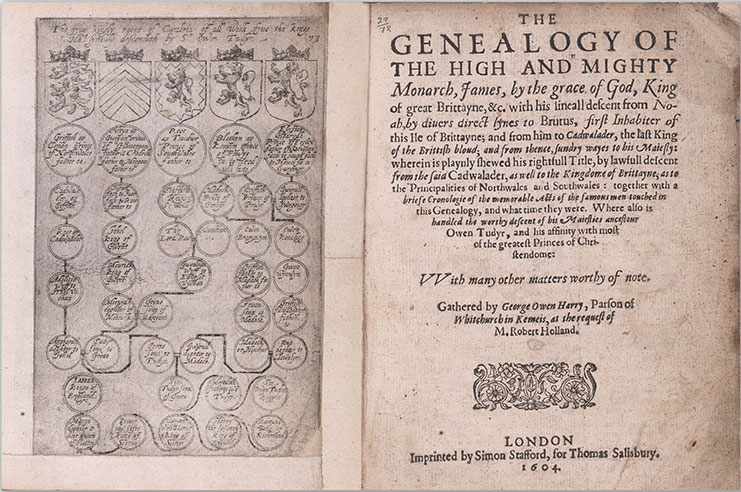
Fig. 5.1 George Owen Harry, The Genealogy of the High and Mighty Monarch, James (London, 1604), title page and facing table
vniting and knitting together all the scattered members of the Brittish Monarchy, vnder the gouernment of him, as one sent of GOD, to fulfill his diuine predestinate will, reuealed to KADWALADER, as our ancient Histories doe testify, fifteene hundred yeeres past, that the time should come, that the Heires descended of his loynes, should bee restored agayne to the Kingdome of BRITTAYNE, which was partly performed in King HENRY the seuenth; but now wholly fulfilled in his Maiesties owne person…46
Such readings of the union of crowns had their counterparts in England, too, in what has been called ‘the “Galfridian moment” shortly after James’s accession’: the Lyte genealogy, which traced the king’s pedigree back to Brutus through multiple lines of descent, is a conspicuous example. Indeed, James himself was ready to draw on the Brutus legend.47 Yet attempts to evoke the British History in support of the new monarch were controversial, not only because its veracity had been increasingly questioned but also because James’s adoption of the title of ‘king of Great Britain’ in 1604 was seen by prominent common lawyers and others as imposing an alien name on the kingdom of England that threatened its laws and, indeed, very existence.48 Francis Bacon, it is true, urged the writing of a history of Great Britain to mark what he regarded as a providential culmination of English history, and Camden emphasized the shared inheritance of the peoples of Britain since Roman times and interpreted the king’s new title as a fitting expression of the divinely ordained rule that James had achieved over the whole island.49 However, there were tensions between such rhetorical gestures of support for the creation of a unified British kingdom and their authors’ Anglocentric perspective. Thus, rather than portraying James’s accession as restoring the ancient kingdom of Brutus (whom he considered fictional),50 Camden compared it with King Ecgberht’s order, some eight centuries previously, that the territories under his authority be named England; and on other occasions he maintained that England, not Britain, remained the true name of the kingdom.51 Antiquaries in Wales were moved by different patriotic imperatives: as under the Tudors, the British History supplied a language of loyalty to the crown that also served to vindicate deep-rooted notions of identity and thus the special place of the Welsh in a multinational polity.
The rest of this chapter focuses on two aspects of Welsh attitudes to the British History: first, the defences of it mounted by Sir John Prise and Humphrey Llwyd in the middle decades of the sixteenth century, and by David Powel in the 1580s, together with the alternative interpretation of British antiquity offered by John Lewis of Llynwene in the early seventeenth century; second, the adherence to the British History in polemical writings designed to promote confessional agendas.
Sir John Prise and Humphrey Llwyd
The two most prominent Welsh defenders of the British History were Sir John Prise (1501/2–55) and Humphrey Llwyd (1527–68). Their backgrounds, careers, and approaches had much in common, though there were also significant differences: in particular, Prise was closer to the heart of the Tudor state than Llwyd but lacked the latter’s direct connection with continental European scholarship. Both men were educated members of the Welsh gentry who served the English monarchy and aristocracy, welcomed the advent of the Tudor dynasty, and praised the ensuing political assimilation of Wales with England both for conferring legal equality on the Welsh and for allowing them to enjoy greater wealth and civility.52 Their political loyalty was sustained by pride in the special status conferred on the Welsh by their British origins, combined with attempts to make these the foundations of a new British identity under the English crown, a fusion of past and present encapsulated in the self-descriptions of Prise and Llwyd respectively as a ‘Briton’ and ‘Cambro-Briton’.53 Both were provoked by Polydore Vergil (and, in Llwyd’s case, also by Hector Boece) into defending the truth of the British History through an appeal to a wide array of classical and medieval sources, including works composed in Welsh. However, they largely did so through the international medium of Latin prose aimed at educated readers beyond Wales. Just as their careers aligned them firmly with the Tudor dynasty and the kingdom of England, Prise and Llwyd sought to ensure that Welsh interpretations of the past remained central to understandings of the ancient and medieval history of Britain as a whole.
Trained as a lawyer, in 1530 Prise entered royal service under the patronage of Thomas Cromwell, and four years later married a niece of Cromwell’s deceased wife; from 1535 he was employed as a visitor and commissioner charged with overseeing the dissolution of the monasteries, which in turn allowed him to obtain possession of the Benedictine priories of St John, Brecon and St Guthlac, Hereford. The latter became his home, when, following Cromwell’s fall in 1540, Prise was appointed secretary of the Council in the Marches of Wales, revived four years previously by the first Act of Union; his continuing government service was rewarded with a knighthood in 1547. After settling at Hereford Prise had greater leisure to pursue the antiquarian and literary interests which became his predominant preoccupations during the rest of his life.54 His visitations of religious houses had already facilitated his antiquarian inclinations by giving him access to numerous medieval manuscripts, which he both preserved and studied, and his command of classical as well as medieval sources, including compilations of Welsh texts such as the Red Book of Hergest, is evident from his most important work, ‘A Defence of the British History’ (Historiae Britannicae Defensio).55 Though an early draft had been written by 1545, this only reached its final form shortly before his death ten years later, being eventually published posthumously in London by his son in 1573.56 Prise also mined medieval Welsh manuscripts in compiling the first printed book published in Welsh. Known by its opening words Yny lhyvyr hwnn (‘In this Book’; 1546), this assembled a collection of religious texts, including the Ten Commandments and the Lord’s Prayer, accompanied by a Welsh alphabet and instructions on how to read Welsh.57
The preface to the ‘Defence’, addressed to Edward VI, presents the work as an act of both historiographical and national restoration. Its central aim was to refute Polydore Vergil, whom Prise accused of ignoring ‘the most ancient history of this island’ and of seeking ‘to bury in perpetual darkness and oblivion the course of more than a thousand years of governance here’.58 By contrast, Prise would base his defence on ‘British records’, including those in the Welsh language, a task made all the more urgent since these ‘were falling more and more into disuse and being consigned to oblivion’.59 However, by describing the British History as ‘the glory and adornment of all Britons’, he insisted that the beneficiaries of this restoration were not only the Welsh descendants of the ancient Britons but all subjects of the king, who, as Prise took pains to stress, was himself descended ‘from the most ancient and distinguished stock of British kings’ through the ‘ancient princes’ of Wales.60 Ever the lawyer, Prise explained that, just as Polydore ‘brought his charge’ against the British History before Henry VIII, so he sought to give equal weight to its ‘Defence’ by bringing it before the same tribunal, represented by Henry’s son and successor.61
The work is divided into thirteen chapters of varying length.62 The first begins by maintaining that the silence of Roman writers regarding the glorious ancient history of the Britons depicted by Geoffrey was explicable by the remoteness of Britain from the Mediterranean world that was their principal concern. Nevertheless the Britons had in fact produced their own written records from the earliest times, including accounts of their antiquities: therefore, ‘British authors…are no less worthy of our trust than the Romans’.63 Chapter II briefly outlines the work’s four main topics, which form the subject matter of most of what follows. After addressing the credibility of Geoffrey’s History, which Prise took at face value as a translation of a work originally written in ‘British’, in Chapter III, there follows a discussion of the significance of the words Britannia and Britanni, including a defence of their derivation from Brutus, the etymology of other names in the island, the relationship between the Britons of Britain and those of Armorica, and criticism of Polydore for his negative view of the Britons (Chapters IV–X). Prise then seeks to vindicate two specific aspects of Geoffrey’s History: the identification of Brennus son of Dunuuallo Moelmutius with the Brennus who sacked Rome in the fourth century bce (Chapter XI), and, in the longest chapter (XII), the portrayal of King Arthur. Finally, Chapter XIII returns to the issue of sources, and specifically the testimony of Gildas. Here, Prise challenged Polydore’s objection that the De Excidio Britanniae (‘Ruin of Britain’) lacked any reference to Brutus and Arthur by denying that Gildas was its author and ascribing to him instead the early ninth-century Historia Brittonum (possibly composed by Nennius), whose author Polydore had condemned as ‘a dreadful scoundrel’—a text which did refer to those figures (an incorrect deduction based on knowledge of the Gildasian redaction of the Historia, noticed in Chapter 2).64
Like Prise, Humphrey Llwyd was both an administrator and a Renaissance scholar. Educated at Oxford, from 1553 he served in the household of Henry Fitzalan, earl of Arundel (1512–80), through whose patronage he was elected MP for East Grinstead (Sussex) in Elizabeth I’s first parliament (1559), and became ‘a member of Arundel’s close circle’, marrying Barbara, the sister of the earl’s son-in-law, the last Lord Lumley.65 Llwyd was mainly resident in Denbigh from 1563, when he was elected MP for Denbigh Boroughs and reportedly facilitated the passage through parliament of the bill authorizing the translation of the Bible and Book of Common Prayer into Welsh.66 His connections with Arundel and Lumley helped to foster an interest in books, evident from 1556 onwards, and, besides helping to assemble Arundel’s library, which testified to the earl’s keen interest in humanist learning, Llwyd possessed numerous volumes of continental scholarship of his own, including a printed edition of Froissart’s chronicles and other historical works.67 His service to Arundel also brought Llwyd into personal contact with that scholarship, since, on returning in the spring of 1567 from a visit to Italy with the earl, he was introduced to the Flemish cartographer Abraham Ortelius (1527–98).68 Thus the scholar whom the Welsh Renaissance humanist William Salesbury had already praised to Matthew Parker a year previously as ‘the most famous Antiquarius of all our countrey’ (of Wales) joined a network of friends and correspondents across western Europe who provided Ortelius with information for his pioneering atlas, the Theatrum Orbis Terrarum (‘Theatre of the World’), first published in Antwerp in 1570.69 As we shall see shortly, this friendship with Ortelius led to the reception of Llwyd’s work in European print culture and, through its inclusion in the atlas, secured a place for Wales on a global stage.
Llwyd’s interests in the ancient and medieval history of Britain and Wales are attested by a variety of works, all published posthumously. The most substantial, discussed in Chapter 6, was Cronica Walliae, completed in July 1559: a history of Wales, in English, from the late seventh to the late thirteenth centuries, largely based on Brut y Tywysogyon and other medieval sources, and published in expanded form by David Powel in 1584. This exhibits the strong commitment to the British History and criticism of Polydore Vergil also found in the author’s later works.70 Completion of those works seems to have been stimulated by the contact established with Ortelius, to whom they were all sent in the last sixteen months of Llwyd’s life. This connection also explains why the two treatises amongst them were written in Latin, rather than English, used for the earlier history of 1559.71 The shorter treatise, ‘A Letter Concerning Mona, Island of the Druids’ (De Mona druidum insula…epistola), was finished by April 1568 and first published in Antwerp in 1570 at the back of the first edition of Ortelius’s Theatrum Orbis Terrarum, being reprinted in subsequent editions of the atlas and also as an appendix to Sir John Prise’s ‘Defence of the British History’ in 1573.72 This revealed in miniature the assumptions and approaches Llwyd brought to the early history of Britain: mainly a rebuttal of Polydore Vergil’s identification of the Mona of classical sources with the Isle of Man, rather than Anglesey, it combined the testimony of ancient and medieval Latin authorities, including Gildas and Gerald of Wales, with analysis of names in Welsh. An interest in place-names is also apparent in two maps, one depicting England and Wales, entitled ‘A New Representation of England, a Most Flourishing Kingdom’, the other Wales alone, whose manuscripts Llwyd sent to Ortelius from his deathbed in Denbigh in August 1568; both were first published in the first Latin Additamentum (supplement) to Ortelius’s atlas in 1573.73 The map of Wales gave visual expression to the country’s separate identity from England, which was further underlined in the accompanying page of text, printed, following Ortelius’s usual practice, on the verso.74 This opened with key axioms of Galfridian history by declaring that Wales (Cambria) was the third part of Britain, separated from England (Lhoegria ‘or, if you prefer, Anglia’) by the rivers Severn and Dee and otherwise surrounded by the Irish Sea; that its name came ‘from Camber the third son of Brutus’; and that ‘only this part of the island of Britain rejoices in its most ancient inhabitants, who are the genuine Britons’.75 The map likewise highlighted the antiquity of Wales by giving Ptolemy’s name for two places and adding brief references, at least some of which were evidently taken from Bede and Gerald of Wales, to the legendary and medieval history of several of the places and regions depicted: thus Carmarthen was ‘the home of the famous Merlin’, Bangor Is-coed (Bangor-on-Dee) was ‘once a monastery with 2,100 monks’, and the district of Rhos in southern Pembrokeshire had been settled by the Flemish sent there by Henry I after their homeland had been inundated by the sea.76
The text accompanying the map drew partly on the treatise on Anglesey but was based mainly on another work Llwyd sent from his deathbed to Ortelius, namely ‘A Fragment of a Little Commentary on the Description of Britain’ (Commentarioli Britannicae descriptionis fragmentum), completed in 1568 and published at Ortelius’s instigation in Cologne in 1572.77 The first attempt at a topographical account of Britain, the work became best known through Thomas Twyne’s English translation, The Breviary of Britayne (1573), intended to help the English reader without Latin ‘to know the state and description of his own country’.78 Like Prise, Llwyd wrote in response to Polydore Vergil, ‘who sought not only to obscure the glory of the British name, but also to defame the Britons themselves with slanderous lies’. A second target was the Scottish humanist historian Hector Boece, whom Llwyd accused of falsely appropriating for the Scots glorious deeds achieved by the Romans and Britons.79 Yet, unlike Prise’s ‘Defence’, the ‘Fragment’ is not structured as a rebuttal of Polydore Vergil’s attack on the British History; indeed, it makes no explicit reference either to that history or to Geoffrey of Monmouth. Rather, it affirms traditional views of the British past by offering an account of the geography and ancient and medieval history of Britain from ‘a privileged Welsh vantage point’.80 This is not simply because about half of the text is devoted to Wales. More significant was the contention, also central to the treatise on Anglesey, that the Welsh language provided an indispensable key to unlocking the ancient and medieval history of Britain as a whole (a view shared by Camden, who learned Welsh in order to try and recover ancient British place-names).81 This is evident from the opening section, which offers a brief explanation of the pronunciation and grammar of ‘the British tongue…[w]hereby the true name both of the whole island and of many places therein may be manifest’.82 Then, after a short description of Britain and discussion of its name, the work treats the island’s three constituent parts: England, Scotland, and Wales, referred to by their Galfridian names Lloegria, Albania, and Cambria, in that order. Each of these sections identifies the names of regions and cities and the peoples who inhabited these in antiquity and summarizes their subsequent histories in the post-Roman and medieval periods. Finally, he seeks to disprove the aspersions Polydore had cast on ‘the glory of the British name’ by citing an array of ancient authors and invoking the deeds of British rulers from King Arthur to Llywelyn the Great.83
Thus, in common with likeminded English antiquaries such as Leland, both Prise and Llwyd framed their vindication of the British History as an act of patriotic self-defence aimed primarily at the scepticism of Polydore Vergil, whose Italian birth rendered his motives and authority suspect.84 For its Welsh and English defenders alike, the British History redounded to the glory of their peoples in the present and could not be lightly cast aside. Moreover, all supporters of the British History sought to demonstrate their ability to fight their case against Polydore on the same terrain as their opponent, both through their use of Latin, the universal language of educated discourse, and by placing the interpretation of ancient authorities at the heart of the debate. However, Prise and Llwyd went further than English antiquaries in two important respects, the first being in the emphasis they placed on the special status of the Welsh as, in Llwyd’s words, ‘the genuine Britons’, by virtue of their uniquely being lineal descendants of the ancient Britons. Linked to this, second, was the importance they attached—in common with other Welsh Renaissance scholars such as William Salesbury—to the British or Welsh language, including its use in names of persons, places, and peoples, and also (especially in Prise’s case) its literature, which, they maintained, offered authentic testimony to British antiquity.85 Thus both the ‘Defence’ and the ‘Fragment’ open with explanations of the Welsh language, which, through numerous comparisons with Greek and Latin (and also, in Llwyd’s case, Hebrew), point up how their authors not only targeted their work at a learned readership but placed Welsh on a par with the ancient languages whose cultivation was prized by members of the republic of letters.86 Indeed, Prise made the comparison explicit by maintaining ‘that, from the beginning, the Britons made use of letters and they derived them from Greece’ (citing Gerald of Wales in his support) and also that their regular orthography made them ‘hardly inferior to the writers of Greek and Latin’.87 In other words, the literacy of the Britons made them no less civilized than other ancient peoples.
Prise took this line of argument further by counterposing the evidence of British sources to that of Roman authors: in his view, the Italian Polydore had produced a distorted account through his ignorance of the former and excessive reliance on the latter.88 Moreover, Prise maintained that this bias was deliberate, since Polydore could be shown to have disregarded passages in the classical authors he favoured that redounded to the honour of the Britons.89 To support his case for the existence of British sources, Prise drew on his wide acquaintance with medieval manuscripts from Wales both to offer an overview of the bardic tradition in Welsh, which he held had continued from the time of the ancient Britons, and to demonstrate that the Welsh—and thus, by inference, their British ancestors—had kept historical records including genealogies and chronicles.90 This in turn made it perfectly plausible that Geoffrey of Monmouth had, as he claimed, merely translated ‘an ancient British book’; his work, far from being his own invention, therefore preserved an authentic ancient history by the Britons themselves, elements of which, moreover, were attested independently in other Welsh sources—an interpretation that continued to find favour among some Welsh antiquaries and historians down to the nineteenth century.91 Llwyd also implicitly treats the Galfridian history as a Welsh or British source, for example by attributing content deriving from it to ‘our chronicles’.92 However, while hostile to Polydore, the ‘Fragment’ places little emphasis on the British History, presumably in part at least because Llwyd had planned to defend it in a future work.93 In short, Prise and Llwyd insisted that the Welsh language and medieval Welsh sources were ancient authorities that deserved respect from Renaissance scholars.
David Powel and John Lewis of Llynwene
Half a century after Polydore’s ‘History of England’ first appeared in print another Welsh scholar entered into the debate it had engendered. David Powel (1549 × 1552–1598), an Oxford-educated clergyman and doctor of theology (1583) with livings in north-east Wales, wrote a series of historical works after he was asked by Sir Henry Sidney, Lord President of the Council in the Marches of Wales, whom he served as personal chaplain c.1584–6, to publish several manuscripts in his possession.94 This resulted in the printing of two books in London, one in English, the other in Latin: The Historie of Cambria, Now Called Wales (1584), an expanded edition of Llwyd’s Cronica Walliae (1559) discussed in Chapter 6, and an omnibus volume containing editions of Pontico Virunio’s abridged version of Geoffrey’s History and of the two Welsh works of Gerald of Wales.95 The volume concluded with a letter from Powel to the lawyer and antiquary William Fleetwood (1525?–1594) entitled ‘On the Correct Understanding of the British History, and its Reconciliation with the Roman Writers’ (1585).96
Unsurprisingly, The Historie reproduced Llwyd’s adherence to key tenets of the British History and attacks on Polydore,97 and Powel’s own views on these matters receive their fullest expression in the preface to the edition of Pontico Virunio and the letter to Fleetwood. Pontico Virunio (1467?–1520) published his ‘Six Books of the British History’ (Historiae Britannicae Libri Sex) in Reggio Emilia in March 1508, shortly before the appearance of the first full edition of Geoffrey’s History in Paris in July of that year, and it was reprinted in Augsburg in 1534 (this being the version reissued in turn by Powel).98 Although Virunio seems to have had access to a complete text of the History, his edition was highly abridged, being based almost entirely on the first six of Geoffrey’s eleven books, and his conclusion explains that he had chosen to focus on what pertained to Rome while omitting various marvellous elements.99 Virunio also drew on a work attributed to ‘Gildas the poet’ and added material of his own, including an assertion that the Badoer family of Venice were descended from Arthur’s butler Bedevere (Beduerus).100 A lengthy preface, omitted by Powel, comprising a dialogue between the book and its dedicatee, the duke of Soligno, occupies about 40 per cent of the volume and may be considered a work in its own right.101 Although mainly showing off Virunio’s erudition through extensive commentary on citations from Greek and Latin authors, this explains that the edition resulted from a desire to break new ground by tackling the history of foreign peoples, erroneously describes Geoffrey as a cardinal and governor general of Britain under ‘King Robert’ (presumably a garbled allusion to Robert, earl of Gloucester, one of the dedicatees of Geoffrey’s work), and affirms the truth of his History since, so Virunio held, western European rulers always employed writers to record their principal deeds for posterity.102
In a preface to his patron Sir Henry Sidney, Powel states that he had collated Virunio’s text with ‘the British book’, presumably a manuscript copy of Geoffrey’s History, in order to produce a more correct text.103 Although his success in this respect is questionable,104 the emphasis on textual accuracy was of a piece with Powel’s presentation of himself as a disinterested scholar seeking to rise above the controversy concerning the British History and committed only to uncovering the truth about the origins of the Britons. Thus in his letter to Fleetwood Powel distances himself from the polarized opinions of the diehard critics and defenders of the History, whom he accused of being more concerned to defeat their opponents than ‘to inquire into the truth of history’, and urges that the matter be left to ‘wise and moderate men’.105 Accordingly, Powel positioned himself on the middle ground, forcefully condemning what he considered to be fabulous and miraculous elements in the British History (some of which, like Sir John Prise, he attributed to Geoffrey as translator),106 while insisting that it should not be dismissed as entirely bogus and unreliable. Yet, there can be little doubt on which side of the debate he stood, as his critical stance sought to decontaminate the British History in order to preserve its fundamental vision of an unbroken line of kings extending from Brutus to Cadwaladr, a list of whom Powel inserted before Virunio’s text.107
Powel made his apologetic purpose clear on the first page of the edition of Virunio, where he declares that ‘the history of the ancient Britons…the most ancient inhabitants of this island’ should be preserved for two reasons: to allow patriotic students of antiquity to perfect the history of their fatherland, and to compel those who condemned that history too hastily either to accept it or to produce a better alternative—adding that he was ready to abandon an opinion in the light of what was ‘either truer or more probable’.108 He also took pains to defend the British History. To begin with, he maintained that its coverage of the period from the arrival of the Romans to the Britons’ final loss of sovereignty under Cadwaladr was largely consistent with the testimony of other writers, which are listed at length; furthermore, even if the story of Arthur, ‘composed in imitation of Greek frivolity’, together with the prophecies of Merlin, contained much to give offence, there were ‘many ancient records’ indicating that a powerful warrior called Arthur had existed.109 The account of the pre-Roman period was more tricky, as Powel acknowledged that this lacked corroboration by foreign writers and thus could not be proved to be correct.110 However, he argued that it was still plausible in its essentials, since ‘the most ancient writings of the Britons’ testified to a continuous series of rulers, evidence which merited weighty consideration by virtue of the principle—cited from ‘Myrsilus Lesbius’, ostensibly an ancient Greek author but in fact another invention of Annius of Viterbo—that a people and its neighbours were more credible sources than distant foreigners for that people’s antiquity and origin.111 Furthermore, Powel echoed the arguments of Prise and Llwyd by maintaining that foreign authors such as Polydore tended to err in their interpretation of British sources and to ignore the evidence of British place-names, while Roman writers focused on their own history and ignored that of outlying provinces. As for the charge that the British History was full of incredible fables, that was perfectly true, but no different from accounts of the origins of other peoples: so why should the history of the Britons be judged differently from theirs?112 More generally, Powel also emphasized the work’s durability and reception: ‘Although this History appears to be entirely invented in a number of things and completely stuffed with fabulous accounts, it nevertheless has the support of venerable antiquity and the approval and agreement of the most learned men of all ages.’113 The last point was, of course, exemplified by Virunio’s abridgement, and by publishing this Powel not only evinced his sympathy for Geoffrey’s History but implicitly enhanced its credentials by demonstrating that one Italian humanist—indeed, a contemporary of Polydore (though no comparison is made explicitly)—had deemed that history worthy of a place in Renaissance scholarship.114
In his History of Great-Britain, completed c.1612 and dedicated to James I (though not published until 1729), the recusant lawyer John Lewis (c.1548?–1615) of Llynwene, Llanfihangel Nant Melan (Radnorshire) resembled Powel in declaring of the challenge posed by the distant past that ‘[w]e must depend upon Tradition when length of Time deprives us of the certain Evidences of things’.115 However, unlike Powel, Lewis invoked this principle to voice reservations about the British History and to maintain that the Britons could boast far more ancient and glorious origins than Trojan descent from Brutus. Instead, he drew on Annius of Viterbo’s Pseudo-Berosus to argue that the Britons were ultimately descended from Noah’s grandson Gomer and also insisted, following William Camden, that their immediate forebears came from Gaul, observing that ‘it evidently appears much more honourable to be descended of the ancient victorious Gauls, than of the vanquish’d Trojans’.116 Nevertheless, rather than rejecting the British History outright, Lewis sought to accommodate it in a longer timeframe. Thus, while he complained of his compatriots that ‘their Descent from Troy will not out of their Heads’, Lewis was prepared to defend Geoffrey from his critics and, like Powel, held that the ‘powdring of the British History with Fables’ did not invalidate its fundamental veracity.117 This allowed him to preserve the Galfridian kings from Brutus to Cadwaladr, while repositioning them in a biblical line of succession originating with Gomer.118
Early British Church History and Religious Apologetic
The debates about Geoffrey of Monmouth’s picture of early British history considered so far focused on the reliability of sources and compelled Welsh scholars to address questions of historical method. Those scholars addressed themselves in Latin to a learned readership, especially outside Wales, and sought to demonstrate the merits of the British History and its relevance for Britain as a whole. A different, but no less revealing, indication of the continuing appeal of the British History in sixteenth- and early seventeenth-century Wales is its deployment by both Protestants and Catholics, writing in Welsh and English, as a means of conferring legitimacy on their confessional positions.119 As with the defences of Geoffrey of Monmouth discussed above, Welsh writers combined arguments used by their contemporaries in England with material in Welsh sources that gave their work a distinctive inflection. This in turn sounded a variation on a common theme, as Protestants (who largely set the agenda for their Catholic opponents) emphasized the need to adapt the Reformation to local and national contexts. Likewise both Welsh and English Protestant uses of early British church history fitted into a wider pattern of attempts to press the past into the service of religious change, by highlighting, on the one hand, the corruption that befell the Church after the early Christian centuries, especially after the unleashing of Satan from 1000, and, on the other, the example of the few heroic witnesses to the true Church.120
Britain appears to have been unusual, though, in witnessing attempts to justify Protestantism in terms of national history focused on the distant past.121 As with the defence of the Galfridian history discussed above, those attempts reflected an assumption, widely shared across a range of confessional persuasions, that early Britain provided a common point of origin for the national histories of both Wales and England (the latter variously understood and sometimes encompassing Britain and even also Ireland).122 Small wonder, then, that English and Welsh apologists, whether Protestant or Catholic, used this ancient past in broadly similar ways. For Protestant writers, it served to demonstrate that the Reformation was simply the restitution of the pure Christianity of the Britons, subsequently corrupted by superstitious practices introduced from Rome by Augustine of Canterbury.123 True, the precise means chosen to this end varied. William Tyndale (c.1494–1536) and William Salesbury maintained that God’s punishment of the Britons for their sins by the Anglo-Saxons, as related by Gildas, had in turn led to the imposition of Roman Catholicism that dealt a final blow to the Britons’ originally scriptural Christianity.124 John Bale (1495–1563) adopted a much longer timeframe: on the one hand, he drew on Annius of Viterbo to endow the Britons with biblical origins as descendants of Noah’s grandson Samothes, son of Japhet, while on the other he traced ‘a learned lineage’ of writers in Britain, including Wales, who had witnessed to the true faith from apostolic times to his own day.125 John Foxe (1516/17–87) similarly took a long view of ecclesiastical history in his best-selling Acts and Monuments, first published in 1563, and significantly expanded in the second edition of 1570, which paid considerably greater attention to early British history.126 There were also differences of emphasis, notably regarding the respective contributions of Joseph of Arimathea and King Lucius to the island’s conversion.127 Privileging the alleged mission of Joseph of Arimathea had the twin advantages of endowing the Church of England with origins that were both apostolic—as Joseph was said to have arrived shortly after Christ’s Passion—and independent of Rome.128 On the other hand, Lucius, supposedly a second-century king of Britain, located the origins of that Church in a royal initiative to change the kingdom’s religious allegiance through Lucius’s request to Pope Eleutherius to send missionaries, who not only converted the king and his followers but proceeded to establish a diocesan system. Furthermore, the rediscovery of a purported letter from Eleutherius to Lucius, apparently concocted in the early thirteenth century, which called the latter ‘God’s vicar in your kingdom’ provided further grist to the polemicists’ mill, especially from the 1560s, furnishing a welcome precedent for a Protestant Church of England subject to the supreme authority of a royal ‘defender of the faith’. On the other hand, his appeal to the pope also commended Lucius to Roman Catholic apologists, although these tended to overlook the alleged letter from Eleutherius with its Erastian implications.129
Yet, while Welsh Protestant scholars belonged to a wider movement of historical justification attested much more extensively by their English counterparts, they adapted such argumentation to meet expectations in Wales and situated it in a narrative of specifically Welsh history. Their interpretation turned on the premise that the Welsh were the direct descendants of the Britons and thus had a special claim on the inheritance of the latter: above all, their pure, apostolic Christianity. According to the record of his trial for heresy in 1393, this argument had been anticipated by the Lollard preacher Walter Brut, a Herefordshire laymen of Welsh descent, who asserted that the Britons were God’s elect, as they had preserved their faith intact for over a millennium following their conversion under King Lucius, and, in Gildasian fashion, also attributed the subsequent defeats of the Britons to their own sedition and treachery.130 Although there is no evidence that Brut influenced sixteenth-century advocates of the purity of the faith received by the Britons, his testimony raises the possibility that the latter’s arguments drew on earlier thinking that adapted aspects of Galfridian history in order to proclaim the privileged status of Welsh Christianity.
The leading protagonists of a Welsh historical justification for Protestantism, William Salesbury (c.1520–c.1580) and Richard Davies (c.1505–1581), were members of Welsh gentry families and Oxford-educated humanist scholars who collaborated in translating the New Testament and Book of Common Prayer into Welsh (1567); they also corresponded with Matthew Parker on matters concerning ecclesiastical history.131 Parker, though primarily interested in recovering Anglo-Saxon texts (since, so he believed, these showed that the Church of England had anticipated aspects of reformed practice before the Norman conquest), also recognized the place of the Britons in early Britain and turned to his Welsh correspondents for their expertise in the literature and history of their own country.132 For Salesbury and Davies, this antiquarian knowledge inspired not only a desire to preserve the remains of the past but also a commitment to the revival of written culture in the Welsh language, a humanist endeavour made all the more urgent by their belief that it was essential to ensuring the salvation of their compatriots through the dissemination of Scripture and Protestant religion.133 In addition, though, the fusion of patriotic antiquarianism and Protestant zeal informed these scholars’ interpretation of British and Welsh ecclesiastical history and gave it a distinctive flavour.134 This was apparent in several works published by Salesbury in mid-century, including a collection of Welsh proverbs (1547), an introduction to the Welsh language (1550), and a bilingual pamphlet which cited rules in medieval Welsh law as a historical precedent for the marriage of priests (1550), legalized by parliament two years previously.135 In the last case, Salesbury sought to link his source to the reigning monarch by noting that Hywel Dda (Hywel the Good), the tenth-century king attributed with codifying Welsh law, was ‘the eightenth auncestor from king Edward the syxtt’: a particular instance of a fundamental loyalty to the (Protestant) monarchy shared with other Welsh scholars and gentry of this period, demonstrated also by the welcome Salesbury gave to Henry VIII’s Acts of Union and Davies’s gratitude to Elizabeth I for authorizing the translation of the Scriptures.136 However, unlike several of their English counterparts, neither Welsh scholar turned to historical precedent explicitly to justify royal authority over the Church.137
The fullest attempt to invoke British and Welsh history as a justification for Protestantism was a lengthy letter by Richard Davies, bishop of St Davids (to whose composition Salesbury also contributed) that prefaced the Welsh translation of the New Testament published in 1567.138 Addressed ‘to all the Welsh’ (ir Cembru oll), this presented both the reformed religion and the translation of the Scriptures as restoring to the Welsh privileges enjoyed by ‘our ancestors the ancient Britons’.139 At its heart was a particularist interpretation of Welsh religious history that adapted the long-established narrative of the fall of the Britons from their former glory and the concomitant hope of eventual deliverance and recovery. Davies thus recast a history of political loss, finally reversed by the coming of the Tudors and the attendant benefits of legal equality with the English, as a tale of providential redemption in which the Reformation and the translation of the Scriptures, supported by the monarchy, restored to the Welsh the religious birthright of their forefathers. True, this process of adaptation appropriated central elements of Protestant apologetic in England, notably the casting of Joseph of Arimathea and King Lucius as heroic purveyors of pure Christianity whose achievements were corrupted by a villainous Augustine of Canterbury sent by the papacy (although Parker, in attributing reformed practices to the Anglo-Saxon Church, saw this as less of a turning-point than some of his English Protestant contemporaries).140 But, while implicitly claiming the legacy of British Christianity for the Church of England as a whole, Davies did not follow the example of English apologists by eliding the distinction between British and English Christianity; rather, he invoked a distinctively Welsh historiographical framework and urged his compatriots to take pride in the privilege of uncorrupted faith which God had conferred on their ancestors long before their English neighbours (albeit adding that these ‘to-day are in the right having through grace received the Gospel gladly’).141
The letter opens by explicitly identifying the Welsh with ‘the ancient Britons’ and emphasizes their glory and virtues, asserting that these were ‘more frequent and more abundant among the Britons of the old days than among the nations around them’.142 Davies then seeks to turn these commonplaces of Welsh historical thinking into a case for the reformed religion by declaring that all the other virtues of the Britons were outweighed by their reception of ‘incorrupt religion’ in the time of Joseph of Arimathea, consolidated by Lucius’s acceptance of Roman Christianity, still ‘healthy…at that time’, which they maintained by defeating the heretical teachings of Pelagius and shunning the corrupt faith introduced by Augustine.143 Eventually, though, the Britons were forced to submit to the superior military force of the English and entered on a long period of both secular and religious decline. The latter was exacerbated by the loss of books, blamed on both Edward I’s conquest of Wales and ‘the war of Owain Glyndŵr’, an argument previously outlined by Salesbury in 1550.144 Davies underlined the magnitude of these losses by locating them in the context of universal sacred history. This showed that, both before and since the time of Christ, God had periodically sent prophets and ministers to restore the true faith, including those sent ‘within the last sixty years’ to reform the Church across Europe. However, the Welsh had not benefited from these recent changes, ‘[b]ecause no one has written nor printed anything in thy language’.145 Davies continued in a passage that sums up his key message:
Behold, I have shown to thee thy pre-eminence and thy privilege of old, and thy humiliation and thy deprivation afterwards. Therefore…thou shouldest be glad, and frequent thy thanksgiving to God, to her grace the Queen, to the Lords and Commons of the Kingdom who are renewing thy privilege and honour (God grant them eternal honour for this). For by their authority and their command thy Bishops with the help of William Salesbury are bringing to thee in Welsh and in print the Holy Scriptures (thy old friend)…146
Davies developed this theme by a further appeal to history in the final section of the letter, in which, again picking up an earlier assertion by Salesbury, he argued with considerable ingenuity that the Welsh had originally possessed the Scriptures in their own vernacular, and thus not only Protestantism but the New Testament of 1567 restored to the Welsh benefits enjoyed by their forefathers.147
One striking feature of the letter is its references to sources, especially ‘histories’.148 In addition, a passage citing biblical names of churchmen and rulers in early medieval Wales as evidence for the existence of the Scriptures in Welsh notes that these are found in ‘books of genealogies and chronicle(s), old records, registers, and charters’, and demonstrates Davies’s knowledge of the cathedral archives by adding that a king of Dyfed called Noe is named in an ancient charter belonging to the church of St Davids.149 On the other hand, it is notable that the appeal to ancient British glory, while fundamentally consistent with a Galfridian vision of the past, was cast in general terms and not framed as a defence of Geoffrey of Monmouth, who is nowhere mentioned by name. Indeed, by giving the credit for the conversion of the British to Joseph of Arimathea, and according a secondary role to Lucius, Davies—like some Protestant apologists in England—differed significantly from Geoffrey, who attributed the conversion of the Britons and endowment of the Church to Lucius alone.150 In addition, Davies reinforced his argument with biblical quotations,151 and, like other Welsh humanists, turned to a variety of Welsh-language sources. Thus he cited Welsh proverbs and poetry to infer that the Britons had once possessed the Scriptures in their own language, whose subsequent disappearance was attributed, as we have seen, to a general loss of books in Welsh. Davies, then, sought to exploit the pride of the Welsh in their distinctive history and identity, playing on anti-English sentiment, in order to try and persuade his readers that they had a special claim to the reformed religion and its translated Scriptures.
The letter’s view of Welsh ecclesiastical history was highly influential, being reiterated by the Puritan Charles Edwards in the later seventeenth century and by Thomas Burgess, bishop of St Davids (1803–25).152 More immediately, it was also taken on board by Welsh writers of the later sixteenth century, including Humphrey Llwyd, David Powel, and Ifan Llwyd ap Dafydd as well as both Roman Catholic and Puritan apologists.153 Thus Welsh Catholics, smarting from their recent loss of control of the English College in Rome following bitter disputes with its English members fuelled by ethnic animosity and disagreements over ecclesiastical policy, maintained that a tombstone discovered during repairs at St Peter’s basilica in the late 1570s was that of Cadwaladr the Blessed, said by Geoffrey of Monmouth to have died in Rome in 689, whereas their English colleagues (correctly) identified it as that of Cædwalla, king of the West Saxons, whom Geoffrey had conflated with Cadwaladr (see Chapter 3).154 Particularly notable in this regard is Robert Owen’s letter to the Vatican librarian Cardinal Sirleto in 1584, which maintained that ‘both ancient and recent writers’ agreed that Cadwaladr had travelled to Rome, appending supporting documents with quotations from a wealth of medieval and contemporary authors, thereby adopting a similar method to that deployed by previous defenders of Geoffrey’s history in the sixteenth century.155 ‘The Christian Mirror’ (Y Drych Cristnogawl), of which the first part was printed secretly in a cave near Llandudno in 1586–7, likewise appealed to history in an introduction reminiscent of Davies’s letter, albeit with the aim of invoking early Welsh Christianity in support of Roman Catholicism rather than Protestantism.156 Thus its author (‘R. G.’, probably Robert Gwyn of Llŷn) addressed ‘his beloved Welsh’, and told them of the pain he felt ‘when thinking of the privilege and renown of the Welsh in time past, and their feebleness and insignificance now’.157 After briefly alluding to Geoffrey’s account of the period ‘from Brutus to the time of Christ’, he proceeded to extol the glorious Christian heritage of the Welsh, beginning with their conversion by Joseph of Arimathea and consolidated by the missionaries sent by Pope Eleutherius at the request of the Welsh king Lucius, and further distinguished by the exemplary roles of the Emperor Constantine and his mother Helen (both likewise identified as Welsh), together with the proliferation of Welsh saints, including 20,000 buried on Bardsey Island and the twenty-four saintly children of King Brychan.158 The work also struck a patriotic note by blaming the Anglicized gentry for the loss of their faith and language by the Welsh.159
The polemical utility of Welsh sacred history was also recognized by the Puritan John Penry, executed for his beliefs in 1593, in a pamphlet published in 1587 urging Queen Elizabeth’s parliament to bring about religious reform in Wales (though its prescriptions may also have been tacitly aimed at England).160 True, Penry chiefly cited Old Testament examples and parallels in support of his case. However, this biblical emphasis was reinforced by asserting that the Welsh were especially entitled to the preaching of the gospel as this was ‘the inheritance which our fore-fathers the Cymbrûbrittons many hundred years agoe possessed in this lande’; all Penry sought, therefore, was the restoration of that inheritance. In addition, he turned the subsequent contamination of the Welsh by Catholic heresy to double patriotic advantage by tracing its origins to England, where it had been ‘planted…by Augustine that proud friar’, while also maintaining that it had affected the Welsh less severely than their neighbours over the border.161
In the sixteenth and early seventeenth centuries, then, belief in the ancient British origins of the Welsh faced new challenges and opportunities which stimulated new kinds of historical writing. On the one hand, criticism of Geoffrey of Monmouth provoked defences of the British History that focused on questions of sources and method, while, on the other, both Protestants and Catholics adapted long-established narratives of early British and Welsh history in order to confer legitimacy on their confessional standpoints. In addition, the subjection of the whole island of Britain to a single monarch through the union of crowns under James VI and I encouraged several Welsh antiquaries to reaffirm the Brutus legend, and some of these and others went even further by grafting on to it biblical descent from Noah. Yet there was more to Welsh historical writing in this period than fixation on an ancient past. Works were also composed that dealt with the centuries from the early Middle Ages onwards, and it is to these we shall turn in Chapter 6.
Writing Welsh History: From the Early Middle Ages to the Twenty-First Century. Huw Pryce, Oxford University Press. © Huw Pryce 2022. DOI: 10.1093/oso/9780198746034.003.0006
1 Ker, Books, 471–96; HBD, xxv–xxx.
2 For the historical background see Glanmor Williams, Recovery, part II.
3 Cf. Greengrass and Philpott, ‘John Bale’, 278–82; Vine, In Defiance of Time, 86–90.
4 Cf. Ralph Griffiths, ‘Wales’, esp. 679–81; Tim Thornton, ‘Wales’, esp. 696–7.
5 Clapham, The Historie of Great Britannie, title page, sig. A4r, 296. Likewise John Speed, while devoting a book to Wales in his chorographical The Theatre of the Empire of Great Britain, 97–124, focused on the kings of England following the ‘down-fall of Britaine’ in the post-Roman period (described in a chapter heavily dependent on Gildas) in his The History of Great Britaine, 281–3. Cf. Woolf, The Idea of History, 56–8, 70–1.
6 Eiluned Rees, The Welsh Book-Trade, v–vi; Graham C. G. Thomas, ‘From Manuscript to Print’; Gruffydd, ‘The First Printed Books’.
7 Almost 30 manuscripts datable to c.1550–c.1625 containing one or both works are listed in Jones, HWMW, 432. See also Graham C. G. Thomas, ‘From Manuscript to Print’, 247–8.
8 As well as the books of David Powel (whose Historie of Cambria first published a treatise by Sir Edward Stradling), these publications comprised works by John Prise and Humphrey Llwyd (all published posthumously) and by George Owen Harry.
9 Cf. McKitterick, Print, esp. 11–14, 47, 51–2, 102–6, 217–19; Woolf, Reading History, 87–94, 171–2.
10 J. Gwynfor Jones, ‘The Welsh Poets’, esp. 247–54, 263–5; Francis Jones, ‘An Approach to Welsh Genealogy’, 348–51, 365–91; Graham C. G. Thomas, ‘From Manuscript to Print’, 242–3; Siddons, The Development of Welsh Heraldry, 35–8, 41–51, 304–6, 309–17; Siddons, ‘Dwnn, Lewys’. See also Ceri W. Lewis, ‘The Decline of Professional Poetry’.
11 For discussion, texts, and translations of the two versions of the statute see Wales, ed. Klausner, lxx–lxxi, cxvii–cxlix, 159–65, 172–6, 349–56, 360–4.
12 Wales, ed. Klausner, cxvii–cxix; Powel, HC, 191–2.
13 See e.g. Broadway, ‘No historie so meete’, 7, 150–68, 219–33; Broadway, ‘Symbolic and Self-Consciously Antiquarian’; Butaud and Piétri, Les enjeux de la généalogie, passim.
14 See e.g. Bietenholz, Historia and Fabula, 195–206.
15 Bodin, Method, trans. Reynolds, 334–64, quotation at 334.
16 Quoted from Selden’s notes to Michael Drayton’s Poly-Olbion (1612) in Graham Parry, ‘Ancient Britons’, 163. For other criticism of claims to Trojan origins see Popper, Walter Ralegh’s History, 179, n. 29.
17 Kelley, Foundations, 139–40, 156–7, 212–13, 220–30, 236, 291–3; Nicklas, ‘Gallier’.
18 Richard Grafton, A Chronicle; Kendrick, British Antiquity, 34–44; Ashe, ‘Holinshed’.
19 Roger A. Mason, ‘Scotching the Brut’; Armitage, The Ideological Origins, 36–46. See also MacColl, ‘The Meaning of “Britain” ’, 263–9.
20 Roger A. Mason, ‘Scotching the Brut’, 64–5.
21 Hadfield, ‘Briton and Scythian’; Cunningham, The World of Geoffrey Keating, 3, 146–7.
22 Hay, Polydore Vergil, esp. ch. 4 (with discussion of the Anglica Historia’s textual development and editions at 79–85); Gransden, Historical Writing in England II, 430–43.
23 ‘Polydore Vergil, Anglica Historia’, ed. and trans. Sutton.
24 ‘Polydore Vergil, Anglica Historia’, ed. and trans. Sutton, I.19–20, 23.
25 Kendrick, British Antiquity, 41–4; McKisack, Medieval History, 97–8.
26 Camden, Britannia, sig. A6r, 4–19. On Camden’s aims and methods see Levy, ‘The Making of Camden’s Britannia’; Rockett, ‘The Structural Plan’.
27 Woolf, ‘Senses of the Past’, 409; Schwyzer, ‘Archipelagic History’, 599.
28 HBD, xxxviii.
29 Kendrick, British Antiquity, 38–9. Cf. Curran, Jr., Roman Invasions, 25–6.
30 Carley, ‘Polydore Vergil’.
31 Kelton, A Chronycle, esp. sig. iiiv–c.iiiiv (followed by ‘A Genelogie of the Brutes’ from Osiris to Edward VI). See also Dodd, ‘ “A Commendacion of Welshmen” ’; Ringler, ‘Arthur Kelton’s Contributions’. For Annius see Kendrick, British Antiquity, 71–6; Stephens, Giants, 101–11; Grafton, ‘Invention of Tradition’, esp. 11–24; Popper, Walter Ralegh’s History, 39–44.
32 Kendrick, British Antiquity, 38; but see also Curran, Jr., Roman Invasions, 25–6.
33 Cf. Levy, ‘The Making of Camden’s Britannia’, 79: ‘To a Welshman, the British History was much more sacred than it was to an Englishman…’
34 ‘Polydore Vergil, Anglica Historia’, ed. and trans. Sutton, II. 7, 11. See also Cobban, ‘Polydore Vergil Reconsidered’, 371–4, 390–1.
35 Popper, ‘ “An Ocean of Lies” ’.
36 Popper, Walter Ralegh’s History, 43.
37 Eighteen copies, datable to c.1550–c.1625, of medieval Welsh versions listed in Jones, HWMW, 432.
38 NLW 5276iD, fols. 80v–83r; cf. Hunter, Soffestri’r Saeson, 61–5.
39 Merrick, Morganiae Archaiographia, ed. James, xxiii, 11, 12, 40.
40 R. I. D. Jones, ‘Astudiaeth Feirniadol’.
41 Nia Lewis, ‘Astudiaeth Destunol a Beirniadol’, which argues (at i–xxvii, lxvi) that at least three independent early modern copies were made of the work, composed in the last quarter of the sixteenth century, possibly c.1580–5.
42 Rhagymadroddion 1547–1659, ed. Hughes, 103–4.
43 Woolf, The Idea of History, 55–64; Peter Roberts, ‘Tudor Wales’, 37–42; J. Gwynfor Jones, ‘The Welsh Gentry and the Image’.
44 Owen, The Description of Pembrokeshire, ed. Miles, 202. In a similar vein, Sir William Maurice of Clenennau assured the House of Commons that ‘the name [of Britain] was no[t] newe but a restitucion of the old’ in a speech advocating James’s adoption of the title ‘king of Great Britain’ in which he appealed to ancient British history: J. Gwynfor Jones, ‘Welsh Poets’, 250–2, quotation at 252.
45 Harry, The Genealogy. This was based on Harry’s much lengthier and apparently unpublished genealogical work, ‘The Wellspringe of True Nobilitie’: E. D. Jones, ‘George Owen Harry’. The table in Fig. 5.1 shows descent from the medieval Welsh rulers regarded as founders of the ‘five royal tribes of Wales’.
46 Harry, The Genealogy, 39–40.
47 Hunt, Thornton, and Dalgleish, ‘A Jacobean Antiquary’, quotation at 182.
48 Galloway, The Union, 20–2, 28–9, 35–8, 60–1; Parker, ‘Recasting England’; Kanemura, ‘Historical Perspectives’, 159–64. See also Wormald, ‘James VI’.
49 Camden, Britannia, 6th edn., 101, 680; Vine, ‘Copiousness’, 228–9; Woolf, The Idea of History, 55.
50 Camden, Britannia (1586 edn.), 5–6.
51 Camden, Britannia, 6th edn., 101; Parker, ‘Recasting England’, 397–8.
52 HBD, 260–5; Llwyd, Breviary, 107–9 (partly followed in ‘Cambria sive Wallia’, in Ortelius, Additamentum).
53 HBD, 16–17, 24–5; Humphrey Llwyd, Commentarioli Britannicae Descriptionis Fragmentum, title page; Humphrey Llwyd, ‘Cambriae Typus’, in North, ‘Humphrey Llwyd’s Maps’, facing 28. Llwyd also referred to Gerald of Wales as a ‘Cambro-Briton’: Humphrey Llwyd, ‘De Mona Insula Druidum’, sig. a.iiir. For Llwyd’s term see Schwyzer, ‘The Age of the Cambro-Britons’.
54 Pryce, ‘Prise, Sir John’; HBD, xv–xxiv.
55 Ker, Books, 471–96; HBD, xxiv–xxxiv.
56 HBD, xxxix–xliii.
57 Gruffydd, ‘Yny Lhyvyr Hwnn’; Gruffydd, ‘Print yn Dwyn Ffrwyth’.
58 HBD, 26–7.
59 HBD, 30–3.
60 HBD, 28–31.
61 HBD, 30–1; cf. HBD, xlviii–xlix.
62 Summary in HBD, xliv–xlviii.
63 HBD, 58–9.
64 See HBD, xlvi–xlviii.
65 Boyle, ‘Henry Fitzalan’, 137, 167–9, 174, 179–80, quotation at 179.
66 Ieuan M. Williams, ‘Ysgolheictod Hanesyddol’, 111–24, 209–14; R. Brinley Jones, ‘Llwyd, Humphrey’; Gruffydd, ‘Humphrey Llwyd of Denbigh’; Gruffydd, ‘Humphrey Llwyd: Dyneiddiwr’, 57–74; Llwyd, CW, 1–3.
67 Ieuan M. Williams, ‘Ysgolheictod Hanesyddol’, 111–12, 116–17; Gruffydd, ‘Humphrey Llwyd of Denbigh’, 82–91; Boyle, ‘Henry Fitzalan’, 175–85.
68 Chotzen, ‘Some Sidelights’, 119.
69 Flower, ‘William Salesbury’, 9 (quotation); van den Broecke, Ortelius Atlas Maps, 9–23. See further Karrow, Jr., et al., Abraham Ortelius; Abraham Ortelius and the First Atlas, ed. van den Broecke, van der Krogt, and Maurer.
70 E.g. Llwyd, CW, 63, 64, 66, 88, 126, 222.
71 In his treatise on Anglesey Llwyd apologized to Ortelius for the standard of his Latin, claiming that he had had no opportunity to speak or write the language during his fifteen years’ service with Arundel: Llwyd, ‘De Mona Insula Druidum’, sig. a.ir.
72 Humphrey Llwyd, ‘De Mona Insula Druidum’; John Prise, Historiae Brytannicae Defensio (1573), sig. Aa.ir–Cc.iir. Discussion in Iolo and Menai Roberts, ‘De Mona Druidum Insula’; Deakin, ‘The Early County Historians’, 69–74.
73 Humphrey Llwyd, ‘Angliae Regni Florentissimi Nova Descriptio’ and ‘Cambriae Typus’, in Ortelius, Theatrum. Discussion in North, ‘Humphrey Llwyd’s Maps’; van den Broecke, Ortelius Atlas Maps, 23–42, 123–5, 128–31.
74 van den Broecke, Ortelius Atlas Maps, 43–4.
75 ‘Cambria sive Wallia’, in Ortelius, Theatrum.
76 Cf. Bede, HE, II.2; IK I.10, 11, II.8; DK I.5.
77 Ortelius explicitly states that he had prepared the text that accompanied the map of Wales from ‘the fragment of our friend Humphrey’ which he had recently given to Birckmann, the work’s publisher in Cologne: ‘Cambria sive Wallia’, in Ortelius, Theatrum.
78 Llwyd, Breviary, quotation at 43; discussion at 11–15. Citations from the ‘Fragment’ are given from this translation.
79 Llwyd, Breviary, 56. Boece’s ‘History of the Scots’ (Scotorum Historia) was published in 1527. For the work and its reception see Kendrick, British Antiquity, 65–9; Roger A. Mason, ‘Scotching the Brut’, 64–5; Roger A. Mason, Kingship and the Commonweal, 38–9, 50–1, 94–7, 181, 183, 248–9.
80 Llwyd, Breviary, 6.
81 Levy, ‘Making of Camden’s Britannia’, 95.
82 Llwyd, Breviary, 51–4.
83 Llwyd, Breviary, 130–40.
84 For attempts to discredit Polydore by emphasizing his Italian nationality see Hay, Polydore Vergil, 158–9; Ringler, ‘Arthur Kelton’s Contributions’, 354; HBD, 26–7; Llwyd, Breviary, 56, 59, 69, 138, 140.
85 For British names see HBD, 136–45; Llwyd, Breviary, 56–9, 99–105, 129. See also Ieuan M. Williams, ‘Ysgolheictod Hanesyddol’, 115; HBD, xlv–xlvii.
86 HBD, 36–43; Llwyd, Breviary, 51–4. Llwyd appears to have been influenced by the first part of Gruffydd Robert’s Welsh grammar, published in Milan on 1 March 1567 (when Llwyd was staying in the city with Arundel): Gruffydd, ‘Humphrey Llwyd: Dyneiddiwr’, 66, 68; Boyle, ‘Henry Fitzalan’, 169–74.
87 HBD, 38–9.
88 HBD, 26–7, 270–1; cf. HBD, 22–3.
89 HBD, 146–75. Though less forensically than Prise, Llwyd likewise sought to counter Polydore’s derogatory view of the Britons: Llwyd, Breviary, 130–40.
90 HBD, 42–59.
91 HBD, 62–85, quotation at 79.
92 Llwyd, Breviary, 98.
93 Llwyd, Breviary, 5, 58.
94 Fritze, ‘Powel [Powell], David’; McKisack, Medieval History, 58–9.
95 The volume has continuous pagination and a single index to the whole, but the first three works have separate title pages, each dated London, 1585: Powel, PV.
96 Powel, ‘De Britannica Historia’. For Fleetwood and his interest in early British history see Alsop, ‘Wading in “The Troublesome Seas” ’, esp. 128–31, 135–8.
97 E.g. Powel, HC, sig. A.ir–A.iir, A.ivr; cf. Llwyd, CW, 64–6, 68–9.
98 For the edition of Geoffrey’s History see Tramontana, Pontico Virunio, 32, 36–7, 51, 54, 73–4, 127, 129, 143, 150–2, 162, 182, 261–73; A. H. W. Smith, ‘Gildas the Poet’; DGB, lxii. I am very grateful to Alessandra Tramontana for sending me a copy of her book.
99 That Virunio was familiar with the work as a whole is indicated by his preface and brief excerpts from Book IX: Pontici Virvnnii Viri Doctissimi Britannicae Historiae (1534 edn.), sig. C[2]r–[3]r, G2v; DGB, lxii. Conclusion: Pontici Virvnnii Viri Doctissimi Historiae (1534 edn.), sig. G1v; Powel, PV, 43–4.
100 Pontici Virvnnii Viri Doctissimi Historiae (1534 edn.), sig. G2v (and preface, B[7]v); Powel, PV, 43. See also Tramontana, Pontico Virunio, 263, and, for Virunio’s early connection with Venice, 24–5.
101 Pontici Virvnnii Viri Doctissimi Historiae (1534 edn.), sig. A3v–C5r; detailed discussion in Tramontana, Pontico Virunio, 261–73.
102 Pontici Virvnnii Viri Doctissimi Historiae (1534 edn.), sig. C2r–C3r.
103 Powel, PV, sig. A2v–A3r; Rhagymadroddion a Chyflwyniadau Lladin, trans. Davies, 162, n. 4; Smith, ‘Gildas the Poet’, 11.
104 Marginal annotations include only a few emendations or queries: Powel, PV, 6, 7, 16, 17, 30, 36. See also Smith, ‘Gildas the Poet’, 11.
105 Powel, ‘De Britannica Historia’, 279–80, quotations at 280; translations from Ceri Davies, Latin Writers, 26.
106 Powel, ‘De Britannica Historia’, 280–1. Cf. Powel, PV, sig. A3r, A4r–v. Virunio also appears to have found the marvels related by Geoffrey distasteful, though he reported Irish marvels, including St Patrick’s Purgatory, told him by Blasio Biragio, the duke of Ferrara’s horse-dealer who had lent him a copy of the work of ‘Gildas the Poet’ acquired in Ireland: Pontici Virvnnii…Historiae (1534 edn.), sig. B[6]r–[7]r.
107 Powel, PV, sig. 4v–6r. The year of accession and length of reign are noted besides each ruler.
108 Powel, PV, sig. A.ir.
109 Powel, PV, sig. A3r–v; cf. Powel, ‘De Britannica Historia’, 280.
110 Powel, ‘De Britannica Historia’, sig. A3v.
111 Powel, PV, sig. A3v, closely following ‘Myrsilus Lesbius’, sig. aiir–v. See further Asher, National Myths in Renaissance France, 191–2; Walter Stephens, ‘Complex Pseudonymity’, 699, 703.
112 Powel, PV, sig. A4r–5r.
113 Powel, PV, sig. A3r. For contemporaneous arguments that accounts of the origins of the Frisians and Babylonians, even if containing fables, might contain some truth and should not be dismissed outright, just as Livy had shown reverentia for ancient stories, see Grafton, ‘Invention of Tradition’, 31–2.
114 The Welsh Renaissance scholar Siôn Dafydd Rhys (John Davies; c.1534–c.1620) composed another treatise defending aspects of Geoffrey of Monmouth’s History, which drew on the work of Prise and Llwyd, in 1597: NLW, Peniarth MS 118, pp. 731–864, edited by Ffransis, ‘Traethawd Siôn Dafydd Rhys’ (summarized in Gruffydd, ‘The Renaissance and Welsh Literature’, 34).
115 John Lewis, The History of Great-Britain, 8. See further Payne, ‘John Lewis, Llynwene’ (1935); G. M. Griffiths, ‘John Lewis of Llynwene’s Defence’; Payne, ‘John Lewis, Llynwene’ (1960); Woolf, The Idea of History, 62, 282 (for the date).
116 John Lewis, The History of Great-Britain, 15–25, 33, quotation at 23. Siôn Dafydd Rhys likewise followed the pseudo-Berosus, possibly via Bale, in maintaining that Britain had already been settled before Brutus, first by the Gomerians (sic) under Noah’s grandson Samothes, then by descendants of Noah’s son Ham led by the giant Albion: Ffransis, ‘Traethawd Siôn Dafydd Rhys’, 2.
117 John Lewis, The History of Great-Britain, 33, 24.
118 John Lewis, The History of Great-Britain, Books II–VI.
119 Saunders Lewis, Meistri’r Canrifoedd, 116–39; Lloyd Bowen, ‘The Battle of Britain’.
120 Gordon, ‘The Changing Face of Protestant History’; Heal, ‘Appropriating History’; Greengrass and Pohlig, ‘Themenschwerpunkt / Focal Point’.
121 Heal, ‘What Can King Lucius Do for You?’, 596 and n. 17. Early Irish Christianity was similarly invoked with respect to Ireland: Lotz-Heumann, ‘The Protestant Interpretation of History in Ireland’; Mary Ann Lyons, ‘Towards a Catholic History’, 3–19; Cunningham, The World of Geoffrey Keating, 110, 119–21. For the contrasting position in Scotland see Heal, Reformation in Britain and Ireland, 391–2.
122 MacColl, ‘The Construction of England’.
123 Glanmor Williams, ‘Some Protestant Views’, esp. 221–8; Heal, ‘What Can King Lucius Do for You?’; MacColl, ‘The Construction of England’; Cunningham, ‘ “A Little World without the World” ’; Curran, Jr., Roman Invasions, ch. 2.
124 Glanmor Williams, ‘Cipdrem Arall’.
125 Glyn Parry, ‘Berosus and the Protestants’; Heal, ‘Appropriating History’, 118 (quotation).
126 Loades, ‘Introduction: John Foxe and the Editors’, 1–5; Heal, ‘What Can King Lucius Do for You?’, 607–8; Oates, ‘Elizabethan Histories’, 171, 178–81.
127 Curran, Jr., Roman Invasions, 41, 43–53, 55–6.
128 Cunningham, ‘ “A Little World without the World” ’, 201–2, 205–7. For the assimilation of the legend of Joseph of Arimathea with the Galfridian history see Curran, Jr., Roman Invasions, 38–9.
129 Heal, ‘What Can King Lucius Do for You?’.
130 The Register of John Trefnant, ed. Capes, 285, 293–6. See further Dodd, ‘ “Commendacion of Welshmen” ’, 246–7; Glanmor Williams, The Welsh Church (2nd edn.), 204–5.
131 Flower, ‘William Salesbury’.
132 McKisack, Medieval History, 26–49; Robinson, ‘ “Dark Speeche” ’; Oates, ‘Elizabethan Histories’, 166, 176–8.
133 Cf. Gruffydd, ‘The Renaissance and Welsh Literature’.
134 Nice, Sacred History, 75, 79, 87, 93–4, suggests that a marginal note naming the sees of the seven British bishops, including Hereford and Worcester, who resisted Augustine of Canterbury sought to provide a legitimizing precedent for the jurisdiction over the English border counties of the Council in the Marches, of which Davies was a member. However, this was an isolated instance of implying an extensive British ecclesiastical jurisdiction, and defence of the Council was clearly not the principal motive for composing the letter.
135 William Salesbury, Oll Synnwyr Pen Kembero Ygyd, ed. Evans; William Salesbury, A Briefe and a Playne Introduction; William Salesbury, ‘Ban wedy i dynny’, in Yny lhyvyr hwnn, ed. Davies. See further R. Brinley Jones, William Salesbury, 12–26, 29–36, 45–9; James, ‘Ban wedy i dynny’.
136 William Salesbury, ‘Ban wedy i dynny’, sig. Aiir, Aiiir.
137 Cf. Heal, ‘What Can King Lucius Do for You?’, 599–600, 603–7.
138 D. Myrddin Lloyd, ‘Appendix: William Salesbury and “Epistol E. M. at y Cembru” ’. On Davies see Glanmor Williams, ‘Richard Davies’; Glanmor Williams, Bywyd ac Amserau’r Esgob Richard Davies; Gruffydd Aled Williams, ‘ “Ail Dewi Menew” ’.
139 Rhagymadroddion 1547–1659, ed. Hughes, 17–43, quotation at 27; trans. Albert Owen Evans, Memorandum, 83–124, quotation at 99. Discussion: Saunders Lewis, Meistri’r Canrifoedd, 120–2, 126–7; Glanmor Williams, ‘Some Protestant Views’, 226–8; Nice, Sacred History, 77–8, 92–4; Lloyd Bowen, ‘The Battle of Britain’, 139–42.
140 Oates, ‘Elizabethan Histories’.
141 Rhagymadroddion 1547–1659, ed. Hughes, 42, trans. Albert Owen Evans, Memorandum, 123.
142 Rhagymadroddion 1547–1659, ed. Hughes, 17–18 (quotation at 18), trans. Albert Owen Evans, Memorandum, 84.
143 Rhagymadroddion 1547–1659, ed. Hughes, 18–23, trans. Albert Owen Evans, Memorandum, 84–93.
144 Rhagymadroddion 1547–1659, ed. Hughes, 24, trans. Albert Owen Evans, Memorandum, 94–5; Salesbury, A Briefe and a Playne Introduction, sig. E.iir–v. See also Saunders Lewis, Meistri’r Canrifoedd, 127–30. Both Salisbury and Davies invoked the legend of the bard Ysgolan’s burning of the few remaining Welsh books preserved by Welsh leaders imprisoned in the Tower of London after Edward I’s conquest, on which see Schwyzer, Literature, Nationalism, and Memory, 81–4.
145 Rhagymadroddion 1547–1659, ed. Hughes, 26, trans. Albert Owen Evans, Memorandum, 97–8.
146 Rhagymadroddion 1547–1659, ed. Hughes, 26–7, trans. Albert Owen Evans, Memorandum, 98.
147 Rhagymadroddion 1547–1659, ed. Hughes, 30–41, trans. Albert Owen Evans, Memorandum, 103–22.
148 Rhagymadroddion 1547–1659, ed. Hughes, 17, 18, 21, 24, trans. Albert Owen Evans, Memorandum, 84, 90, 94.
149 Rhagymadroddion 1547–1659, ed. Hughes, 37, trans. Albert Owen Evans, Memorandum, 116. See also Glanmor Williams, ‘Bishop Sulien’; Brett, ‘John Leland, Wales, and Early British History’, 179–81.
150 Rhagymadroddion 1547–1659, ed. Hughes, 19; trans. Albert Owen Evans, Memorandum, 87. The passage contains the letter’s only mention of ‘the history’ (yr hystorïa); if, as is likely, this refers to Geoffrey’s work, Davies directly challenged its veracity.
151 E.g. Rhagymadroddion 1547–1659, ed. Hughes, 20, 31–2, 33, 37, trans. Albert Owen Evans, Memorandum, 88, 105–6, 109, 115.
152 See Chapters 7 and 10; Saunders Lewis, Meistri’r Canrifoedd, 116–17.
153 Chapter 6; Nia Lewis, ‘Astudiaeth Destunol a Beirniadol’, lxxxiii, xc–xciii.
154 Geraint Bowen, ‘Apêl at y Pab’; Nice, ‘Being “British” in Rome’.
155 Geraint Bowen, ‘Apêl at y Pab’, 136–41.
156 G. R., ‘Drych Cristianogawl’; Geraint Bowen, Y Drych Cristianogawl; Lloyd Bowen, ‘The Battle of Britain’, 145–6.
157 G. R., ‘Drych Cristianogawl’, 49. For Gwyn and the work’s authorship see Bowen, Y Drych Cristianogawl, iv–v, 47–56; Geraint Bowen, Welsh Recusant Writings, 28–42.
158 G. R., ‘Drych Cristianogawl’, 49–52.
159 G. R., ‘Drych Cristianogawl’, 52–4. John Lewis of Llynwene also offered a Catholic reading of Welsh Christian origins: Nice, Sacred History, 79, 92–4.
160 Penry, ‘The Aequity of an Humble Supplication’. See further Glanmor Williams, ‘John Penry’, 372–80; Lloyd Bowen, ‘The Battle of Britain’, 147.
161 Penry, ‘The Aequity of an Humble Supplication’, 30.