
6
As well as defending long-established accounts of early British history and using these to justify confessional allegiances in the wake of the Reformation, Welsh writers also produced new works that extended their narratives beyond the final loss of British sovereignty in the late seventh century. The most influential of these works, David Powel’s The Historie of Cambria, now Called Wales (1584), an edited and expanded version of Humphrey Llwyd’s unpublished Cronica Walliae (1559), followed the lead of the medieval Welsh chronicles and focused on the period down to the death of Llywelyn ap Gruffudd and the Edwardian conquest, widely regarded as marking the end of a distinctive history of Wales. However, as in the later Middle Ages, that still left space to integrate Wales within the history of the kingdom of England. One example of this approach is provided by Elis Gruffudd’s chronicle (1548–52), a world history in Welsh in which coverage of Wales is scattered among sections on Britain that increasingly focus on the kings of England. True, a few years later Humphrey Llwyd ended his history with the failure of the revolt of Madog ap Llywelyn in 1295, declaring that thereafter anything worth recording about Wales could be found ‘in the Englishe Chronicle’.1 By contrast, in publishing Llwyd’s work, Powel gave only qualified endorsement to this abrupt termination of Welsh history. Although he concluded his main narrative with Edward I’s conquest, which brought ‘all the countrie in subiection to the crowne of England to this daie’, Powel appended a history of the English princes of Wales down to the sixteenth century, which, while witnessing to English domination, also served to emphasize that Wales had maintained its separate status as a principality.2 A different perspective on the past was offered by new kinds of Welsh writing in the Elizabethan period, influenced by English models, that focused on particular localities and were less constrained than Llwyd and Powel by assumptions about the content and chronological parameters of Welsh history derived from medieval chronicles. This is reflected in the attention devoted by several of these works to the Norman settlers of Wales and the establishment of marcher lordships, as well as by the readiness of all of them to include events from the later Middle Ages onwards.
The second half of the sixteenth century thus witnessed a flowering of history writing by Welsh authors. In assessing the nature and significance of this writing the following discussion will proceed from the universal to the particular, beginning with Elis Gruffudd’s chronicle, before turning to the histories of Llwyd and Powel, and concluding with works on families and counties.
Wales in the World: The Chronicle of Elis Gruffudd
In 1552 Elis Gruffudd (c.1490–c.1556) finished the most wide-ranging and ambitious historical work ever composed by a Welsh author. Indeed, his chronicle remains probably the longest narrative text of any kind written in Welsh.3 Born in Gronant, Flintshire, Gruffudd belonged to an impoverished branch of a gentry family and left his native land in c.1510 to earn his living as a soldier and administrator in the service of the English crown and then, from perhaps 1514, of the diplomat Sir Robert Wingfield, whom he accompanied to state occasions in Henry VIII’s reign such as the Field of the Cloth of Gold (1520). From early 1524 he was keeper of Wingfield’s palace in London until he secured appointment in January 1530 to the English garrison of Calais, where he spent the rest of his days, describing himself as ‘the soldier of Calais’.4 Before embarking on his chronicle Gruffudd had compiled two other manuscript books: a miscellany of Welsh poetry and prose, including some historical material (1527), and a collection of his Welsh translations of five medical treatises in English (c.1548). The earlier compilation suggests that he had been deeply influenced by the vibrant literary culture of north-east Wales, exemplified above all by Gutun Owain (fl. c.1451–1499), and this background is important to understanding the approach he took to the writing of history.5
Gruffudd completed the chronicle in 1552 and sent it to a kinsman in Flintshire.6 Presumably he began work on it before moving to Calais, as he states that it was after arriving there that he started to gather material for contemporary events during the reign of Henry VIII.7 It survives in the author’s holograph manuscript, comprising about 1,200 large folios (2,400 pages), most of which remains unpublished.8 Modelled on medieval world chronicles, more particularly Ranulf Higden’s Polychronicon, probably in John of Trevisa’s English translation, with their chronological structure of the six ages of the world, it offers a vast panorama of the past from the Creation to 1552. However, as with Higden and other universal chronicles, its chronological and geographical coverage is uneven.9 Whereas the first quarter of the work sweeps through the first five ages of the world from the Creation to the birth of Christ, the last quarter deals in detail with just over four decades, from the accession of Henry VIII (1509–47) to the sixth year of Edward VI, including many events witnessed by the author himself.10 This emphasis on contemporary events is consistent with Gruffudd’s declaration that, after arriving in Calais, he began ‘to note the course of the world and especially the kingdom of England, whose king was still continually pursuing his love for Ann Boleyn’.11 The Anglocentric assumptions of the work are also evident in its coverage of the centuries from the post-Roman period onwards. Here, Gruffudd takes the narrative forward in a series of recurrent sections, each devoted to a particular country or polity, denoted by different letters (such as ‘F’ for France); he also tries to assist his readers to navigate their way through the work by occasionally including marginal notes summing up key points in the text and by providing genealogical and regnal diagrams.12 However, while systematically including sections on continental European polities, especially the papacy, the Holy Roman Empire, and France, he increasingly devotes most space to Britain and more particularly events connected with the kingdom of England, though he also gives detailed attention to instances where the Welsh played a prominent part in that story, notably the execution of Sir Rhys ap Gruffydd in 1531.13 Those assumptions likewise underpin the chronicle’s treatment of the Norman conquest of England in 1066 as a crucial turning-point, following the example of medieval English historians: thus the first part concludes with a chronological summary of kings of Britain from Brutus to Harold, and the second, furnished with its own preface and chronological summary, opens its narrative of English history with William the Conqueror.14 This emphasis on England was facilitated by Elis Gruffudd’s adaptation of the framework of the medieval world chronicle to accommodate the different paradigm of national history writing provided by early sixteenth-century English chronicles, several of which he relied upon extensively, including John Rastell’s Pastyme of People (1529), which in turn was heavily indebted to the chronicle of Robert Fabyan (d. 1513).15
Gruffudd comes closest to explaining why he undertook this mammoth task in the now acephalous preface to the post-1066 half of his work addressed to a kinsman in Flintshire to whom he sent the completed work. There, he compares his role to that of a ‘simple…uneducated…man’ pretending to be a ‘chief mariner’ guiding a ship full of ‘men of fine linen and honour across a wide sea’ to a land they had never previously visited, and adds that he had tried ‘to take many notable things from excellent illustrious stories (ysdoriay) of the regions of the east, which were never mentioned amongst the common people in Wales before’.16 It appears, then, that he sought to make material in English and other foreign languages accessible to readers of Welsh through a highly ambitious act of cultural translation and adaptation. This was a two-way process. On the one hand, Gruffudd brought the world to Wales, whether by recounting tales of ancient and medieval heroes such as Hercules, Alexander the Great, and Charlemagne, or by translating letters by Columbus and Cortés that witnessed to European overseas expansion.17 However, Gruffudd fashioned the material he presented to meet the expectations of his target audience, not simply through writing in Welsh, but also by drawing on Welsh literary culture, including the use of names for English places derived from Welsh versions of Geoffrey of Monmouth, notably Caerludd (lit., ‘Lud’s Town’) for London, the citing of proverbs or lines of poetry to provide moralizing commentary on the events related, and extensive references to Welsh political prophecy (W. brud).18
The use of prophecy is but one aspect of the fundamental debt Gruffudd owed to long-established Welsh understandings of the past. The clearest indication of that debt is the extensive coverage of the ancient kings of Britain from Brutus to Cadwaladr the Blessed, which is largely based on Geoffrey of Monmouth, whose History Gruffudd refused to dismiss outright while conceding that John Rastell and others had strong grounds for questioning the earlier writer’s veracity; he also undermined the History’s notion of a unified kingdom of the Britons surviving until 689 by portraying the most powerful British kings from the later sixth century onwards as rulers of only the northern Welsh kingdom of Gwynedd, which he treated on a par with the Anglo-Saxon kingdoms whose histories increasingly dominate his narrative.19 Kings and princes of Wales continue to feature down to the late thirteenth century, and attention is also paid to Owain Glyndŵr, but coverage of these is fairly thin and episodic. In part, this reflects the priorities of medieval Welsh historical writing, whereby Geoffrey’s kings overshadow their medieval Welsh successors, and also perhaps the sources to which Gruffudd had access: the deeds of King Arthur occupy over forty pages compared to the nine devoted to Llywelyn ap Gruffudd (d. 1282) in a garbled account that consistently misidentifies the prince with his grandfather Llywelyn ap Iorwerth (Llywelyn the Great).20 More fundamentally, however, Gruffudd’s treatment of medieval Welsh rulers reflects an assumption that these had lost the sovereignty of Britain enjoyed by their British predecessors and were therefore subject to the authority of the English, a subordination inscribed in the text by appending the history of the Welsh princes to the accounts of the kings of England that comprise the bulk of the sections on Britain.21 Viewed from this perspective, the increasingly Anglocentric focus of the chronicle, while facilitated by the use of English sources, was entirely consistent with a traditionalist Welsh interpretation of history centred on the island of Britain.
In terms of its methods and use of sources, Gruffudd’s treatment of the British and Welsh past exemplifies his approach to history writing in the chronicle as a whole. He constructs his narrative from a wide range of sources in Welsh, English, French, and Latin, quite often naming them, albeit with varying degrees of precision (indeed, sometimes wholly misleadingly), and is ready to cite contradictory accounts, whose accuracy he tries to assess in order to harmonize their different interpretations.22 Furthermore, he ascribes equal evidential validity to different types of sources, drawing not only on historical writing but also on romances and other literary works as well as orally transmitted folk-tales.23 Thus Gruffudd’s account of King Arthur, while largely indebted to Geoffrey of Monmouth, weaves together material from a wide range of other sources, including not only those derived from Geoffrey such as Wace’s Roman de Brut (1155) and William Caxton’s Chronicles of England (1480) but also the early thirteenth-century Prose Lancelot and other French romances, medieval Welsh prose texts, and folklore from north-east Wales.24 Legendary and folkloric material, said to be commonly known among the people, is inserted into the chronicle’s account of early British history elsewhere, too: examples include the earliest extant version of the tale of the bard Taliesin (Ystorya Taliesin), whom Gruffudd apparently identified with Merlin, the subject of a variety of other stories and prophecies in the chronicle, as well as a folk-tale concerning a ring lost by the wife of Maelgwn Gwynedd and then miraculously recovered from a fish which had swallowed it.25 Folkloric elements also dominate the portrayal of Owain Glyndŵr, including the story of his being told by the abbot of Valle Crucis that he had ‘risen up too early by a hundred years’.26
A revealing instance of Gruffudd’s approach to sources is his account of Llywelyn ap Iorwerth (Llywelyn the Great; d. 1240).27 This is preceded by a brief, and highly inaccurate, section declaring that all the author knew of the prince’s father Iorwerth Drwyndwn was that he had relocated the abbey of Aberconwy to a new site at Maenan in the Conwy valley, endowed it generously, held his court nearby at Trefriw, and been buried in the abbey at one of the two locations named.28 Gruffudd then turns his attention to Llywelyn, stating that after his father’s death he ‘took the coronet (siapled) of the principality of Wales’, and in the fifth year of King John married one of the king’s daughters, identified by ‘the English chronicle’ as the second, Elizabeth, and by ‘the Welsh chronicle’ as the third, Sioned.29 Gruffudd rapidly dismissed this difference as insignificant, commenting that it ‘hardly matters which of the two, since all the books clearly show that he married one of King John’s daughters’.30 However, the discussion of his marriage serves merely as the prelude to a story that comprises most of what Gruffudd writes about Llywelyn.31 The story clearly originated as a folk-tale, another version of which had been recorded by Gutun Owain, and relates how a spirit in the guise of his fool helped the prince to get his own back after an attempt by one of the king’s sorcerers to shame him during his wedding feast in London.32 Gruffudd offers no comment on the tale’s veracity, and implies that it is no less reliable than the preceding account of the prince’s marriage that introduces it. Nevertheless, it is striking that Gruffudd repeatedly attributes the story to one or more written texts (‘some of the books of Wales’, ‘the writing’, ‘my copy’), at least one of which seems to have provided a longer version, rather than to tales circulating orally among the people.33 Another term he uses for his source is ysdori, an English loan word often used by the sixteenth century as an alternative to Middle Welsh ystoria which also frequently occurs elsewhere in the chronicle.34 Like ystoria, ysdori (or ystori) often signified a written text and could mean both ‘story’—as related, say, in a Welsh prose tale or French romance—and ‘history’.35 Its implicit blurring of any sharp distinction between those genres points up how Gruffudd shared a fundamental assumption of the Welsh literary culture in which he was steeped. At the same time, he evidently felt a need to assure his readers that the folk-tale already existed in written form, while making clear, through his choice of vocabulary, that the sources were different from—though not necessarily inferior to—the chronicles referred to as evidence for Llywelyn’s marriage. This contrast may in turn have served to indicate that the tale about the wedding feast furnished evidence about the past of a different order to the chronicles’ reports of the marriage.
The account of Llywelyn the Great also exemplifies Gruffudd’s ability to bring pace and colour to his narrative through a vigorous, at times rather breathless, prose style, coupled with a focus on individuals, marvels, and dramatic deeds.36 Conversely, there is no attempt to assess the significance of political and constitutional developments; indeed, the chronicle disregards most of Llywelyn’s reign. Likewise, as we have seen, its treatment of Llywelyn ap Gruffudd, though longer, confuses him with his grandfather and is shot through with other inaccuracies. To judge by those examples, then, Gruffudd set little store by trying to present a coherent narrative of the Welsh princes, based on the medieval Welsh chronicles, in contrast to Humphrey Llwyd less than a decade later. This is probably explicable to a large extent by the subordinate role Gruffudd allotted to the princes by including their history as appendages to sections on the kings of England. Yet Gruffudd does sometimes attempt to convey the significance of the events he narrates. This is shown, for example, by his observations on key turning-points in the history of the Britons and their Welsh descendants. Thus, the section covering Cadwaladr the Blessed, essentially based on Geoffrey of Monmouth, opens and closes with lengthy moralizing passages, ultimately indebted to Gildas, explaining that God had deprived the Britons of their sovereignty of the island as a punishment for their sins.37 Likewise, after relating the deaths of Llywelyn ap Gruffudd and his brother Dafydd he points up the transfer of political authority to the English crown by concluding his account of the conquest of Wales with the story of the birth of Edward I’s son at the newly built castle in Caernarfon and his proclamation as Prince of Wales, commenting in both the text and a marginal note that he was the first English Prince of Wales.38 On the other hand, unlike other sixteenth-century Welsh writers, such as Sir John Prise, William Salesbury, and Humphrey Llwyd, Gruffudd did not take the opportunity to celebrate Henry VIII’s Acts of Union as having given legal equality to the Welsh. Instead, his only reference to the legislation is confined to the 1543 act, which he portrays as an administrative measure that concluded a series of law enforcement initiatives in Wales and the Marches, commenting that the king also ‘passed another act to ordain and make the whole of Wales into counties’.39
Thus, although a work of Welsh historical writing, the chronicle was not a history of Wales. That its coverage from the Middle Ages to the mid-sixteenth century devoted so much space to continental and, above all, English history is a telling indication of what Gruffudd considered interesting and significant, which in turn may have depended on the sources to which he had access, and presumably also what he thought would appeal to his potential readers. The same is suggested, on a far smaller scale, by two other Welsh-language chronicles composed in the mid-sixteenth century. One briefly records events in Wales and England between 1468 and 1551.40 More strikingly, the other, longer chronicle, composed apparently in 1568, adapts the English Brut tradition in a narrative opening with the sons of Noah that continues through Brutus, the British kings, the Anglo-Saxon heptarchy, and the monarchs of England to 1557. The work’s author, Hywel ap ‘Syr’ Mathew (d. 1581), was a Radnorshire poet and genealogist who served in Henry VIII’s forces at the siege of Boulogne (1544), and thus shared some of the same interests and experience as Elis Gruffudd.41 However, to an even greater extent than the latter, Hywel focused resolutely on England, and from the late eleventh century onwards Wales appears only fleetingly in his narrative at moments of subjugation and conquest, such as the killing of Rhys ap Tewdwr, ‘the last king of Wales’ and of Llywelyn ap Gruffudd, ‘Prince of Wales’.42
Histories of Wales
On 17 July 1559 Humphrey Llwyd completed, in English, the first Welsh account of the past conceived as a history of Wales. Conventionally known as Cronica Walliae (‘The Chronicle of Wales’), following a colophon added to one manuscript copy by Robert Cotton (1571–1631), Llwyd refers to his work as a ‘historie’ (though not a ‘historie of Wales’).43 He states that his aim was ‘to wrrite the lives and actes of the kinges and princes of Wales’ from Cadwaladr to Llywelyn ap Gruffudd (d. 1282), though in fact the narrative continues to the capture of Madog ap Llywelyn in 1295 after the defeat of his rising against English rule.44 Llwyd’s autograph copy is lost, but the Cronica circulated in manuscript by the 1570s, when two copies came into the hands of John Dee (1527–1609), and another copy, no longer extant, was acquired by Sir Henry Sidney (1529–86), president of the Council of the Marches in Wales from 1560 until his death.45 It was at Sidney’s instigation that the work was published, with additions and other changes, by Dr David Powel of Ruabon (1549 × 1552–1598) under the title The Historie of Cambria, Now Called Wales (1584). This remained the only edition until William Wynne published a revised version in 1697, of which various editions were produced until 1832.46 As the single most influential book on Welsh history until the early decades of the nineteenth century Powel’s work marked a significant turning-point in Welsh historiography. Viewed in its contemporary context, however, its solitary distinction as the only printed history of Wales for over a century suggests that demand for such works was limited, and points up the unusual circumstances of its production as a work commissioned by a high-level patron to serve the needs of a particular moment—a crucial consideration given the expense of publication in a period when printed books in Welsh or relating to Wales were few and predominantly religious in focus.47
The following discussion will begin by assessing Llwyd’s Cronica before turning to consider its adaptation by Powel.
Humphrey Llwyd, Cronica Walliae
As we have seen in Chapter 5, Llwyd completed the Cronica in London, presumably while serving Henry Fitzalan, earl of Arundel in Nonsuch Palace (Surrey), granted to Arundel by Queen Mary in 1556.48 It is likely, then, that Llwyd intended his account for members of Arundel’s circle with antiquarian interests.49 This context helps to explain why Llwyd included material on previous earls of Arundel and their estates.50 In addition, Arundel’s moderate and flexible stance towards confessional differences, reflecting the overriding priority he attached to maintaining political stability, may account for Llwyd’s generally restrained treatment of the medieval Church.51 This probably reflects his conception of the Chronica as a history of secular rulers rather than any coolness towards the Protestant cause, an interpretation supported by a rare anti-Catholic outburst following a report of Gruffudd ap Cynan ab Owain’s burial in a monk’s cowl at Aberconwy Abbey in 1200 that affirms the purity of the faith first received by the Britons, taught by Joseph of Arimathea at Glastonbury, ‘before the proude and bloodthursty monke Augustyn infected hit with his Romish doctryne’; by contrast, ‘the Britons, the first inhabitauntes of this Realme, dyd abhorre the Romishe doctryne taught in that tyme’, and the monastery of Bangor Is-coed, destroyed in the early seventh century, ‘savered not of Romish dregges’.52 Here, Llwyd resembles William Salesbury and Richard Davies by recruiting the allegedly pristine faith of the Britons to the service of anti-Catholicism, although unlike them he draws no explicit connection between that faith and Protestantism.53 But his comments on Catholicism indicate a commitment to Protestantism, further suggested by Llwyd’s apparent leading role in securing the passage through the House of Commons in 1563 of the act authorizing the translation into Welsh of the Bible and Book of Common Prayer.54
If the Cronica offered a somewhat muted apologia for Protestantism, it loudly defended the Welsh and the significance of their history. Indeed, this was the main message for its intended readers. Llwyd presents the work as an attempt to make the medieval Welsh past more widely known in Britain through writing about it in English: as in his later ‘Fragment’, his aim was to demonstrate that a Welsh perspective was essential to understanding the history of Britain and its peoples as a whole. Llwyd emphasizes the novelty and purpose of his enterprise at the conclusion of the ‘Description’ that precedes the main narrative:
…I was the first that tocke the province [Wales] in hande to put thees thinges into the Englishe tonge. For that I wolde not have the inhabitantes of this Ile ignorant of the histories and cronicles of the same, wherein I am sure to offende manye because I have oppenede ther ignorance and blindenes thereby and to please all goode men and honeste nature that be desirouse to knowe and understand all suche things as passed beetwitxt the inhabitantes of this lande from the first inhabiting therof to this daye.55
This reads very much like an attempt to counter the marginalization of Wales by historians of England noticed in Chapter 5.
That Llwyd regarded his work as pertaining to the history of all the peoples of Britain is similarly shown by his complaint that Polydore Vergil had denigrated or denied ‘the martiall and noble actes aswell of Saxons, Danes and Normanes as of the Britons, all inhabiters of this Ile’.56 Nor was this simply a matter of rhetorical gestures, since, while focusing predominantly on Wales, the Cronica sets its history on a wider British (and sometimes European) stage by relating events in England and farther afield.57 Occasionally, moreover, he turned to England in order to counter some anti-Welsh prejudices which his predominantly English readers might harbour. A prime example is a lengthy passage which opens by reciting the genealogy of King Æthelwulf (d. 858) of the West Saxons back to Adam as proof that the Welsh were not unique in their devotion to pedigrees, while nevertheless adding that they surpassed other peoples in their cultivation. ‘Therefore let suche disdaynfull heades as scant knowe ther owne grandfather leave ther scoffinge and tauntinge of Welshmen for that thinge that all the worthye nations in the worlde do glorie in.’58
The idea that Wales was an integral part of Britain was thus fundamental to Llwyd’s interpretation of its history and its presentation to an intended readership beyond the principality. Britain looms large in the Cronica as a point of reference or comparison. Moreover, Llwyd regarded the island not simply as a geographical space but also, following medieval Welsh and Galfridian tradition, as a political unit. In part, references to Britain served to flatter Wales, and especially Llwyd’s native north Wales, which he asserted was ‘the chieffest seat of the last kings of Britaine because hit was and is the strongest countrey within this Ile’.59 Local patriotism was even more evident in his description of the Clwyd valley as ‘one of the fayrest valleyes within this Ile’ and of the lordship of Denbigh as ‘one of the greatest and best lordships in Englande’.60 The latter reference is a rare instance in the Cronica of a slippage, also found in English authors of this period, between ‘Britain’ and ‘England’.61 True, Llwyd followed Brenhinedd y Saesson (‘The Kings of the English’), here drawing on the Annals of Winchester, to assert that the West Saxon king Ecgberht (d. 839) ‘was the first monarche of the Saxons…and changed the name of Britaine to Englande and called the people Englishmen and language Englishe’.62 Furthermore, in referring to the island as ‘this realme’ he tacitly equated it with the kingdom of England, which, though it incorporated Wales, remained separate from the kingdom of Scotland despite attempts to claim sovereignty over it in the 1540s (see Chapter 5).
However, while his terminology regarding Britain is ambiguous, it did not signal an Anglocentric focus similar to that adopted by most English historians in relating events from the ninth century onwards. For one thing, Llwyd presented the change of nomenclature as a moment of insular, or at least Anglo-Welsh, significance by dating it with reference to the coming of both Brutus and Hengist to Britain as well as the departure of Cadwaladr.63 And, in common with medieval Welsh history writing, he remained attached to the name of Britain, as shown, for example, by his enthusiastic comments that the extensive lands ruled by Cnut included ‘all the noble Ile of Bryttaine’ and that Henry I was ‘one of the worthiest and most victoriouse princes that ever reigned in the Ile of Britaine’.64 Likewise, in common with Sir John Prise, he applied the term ‘Britons’ not only to the ancient Britons from whom the Welsh were lineally descended but also to the island’s inhabitants in his own day, irrespective of their ethnic origin.65 Llwyd drew a connection between these two meanings in the account—which he insisted was essentially true while acknowledging its legendary accretions—of how Prince Madog, in order to escape the succession disputes between his brothers after the death of their father Owain Gwynedd in 1170, led an expedition across the sea to Florida: ‘And so hit was by Britons longe afore discovered before eyther Colonus or Americus lead any Hispaniardes thyther.’66 Here, the use of ‘Britons’ both alludes to the ancestry of the Welsh and makes them representatives of the people of Britain as a whole (or at least all those subject to the English crown). Some twenty years later one of Llwyd’s readers, Dr John Dee (1527–1609), drew out the political implications by influentially citing Madog’s alleged exploits as a legitimizing precedent for English overseas expansion under Elizabeth I.67
However, Llwyd’s commitment to an overarching framework focused on the island of Britain, indebted to medieval Welsh (including Galfridian) historical thinking, was two-edged. On the one hand, it glorified the Britons and Welsh in the distant past; but on the other, it asserted that their separate history was long over. Like the medieval Welsh chronicles Brut y Tywysogyon and Brenhinedd y Saesson, Llwyd presents the history of the Welsh kings and princes from the late seventh century onwards as successors of the kings of Britain who had lost their dominion over the island to the English. This is clear from the very beginning of the work, which opens with a brief account of how, after an angelic vision, Cadwaladr, exiled with King Alan in Brittany, abandoned his plans to try and restore British rule in Britain and instead ended his life in Rome in 688. ‘And thus ended the rule of the Britons over the whole Ile.’68 However, the continuation of British rule within the restricted bounds of Wales marked only a temporary respite, since, in line with the emphasis of both medieval Welsh history writing and the example of sixteenth-century (and earlier) historians of England,69 Llwyd believed that the distinctive history of Wales had ended with the extinction of native rule by Edward I: contingent as it was on a succession of Welsh kings and princes, the history of Wales he related was safely relegated to the past. As for some later medieval Welsh writers, this turning-point was also viewed from a Galfridian perspective, as the rulers of Wales represented a coda to almost two and a half millennia of British sovereignty over Britain. Thus Llwyd declared that Llywelyn ap Gruffudd (d. 1282):
was the last Prince of Britons bloode, which without interuption bare dominion and rule in Wales. So that rule and government of the Britons ever continued in some of Britaine from the first comminge of Brute, which was the yere before Christes incarnacioun 1136, to the yere after Christe 1282 by the space of 2418 yeres.70
That this marked an irreversible passage of dominion is subsequently emphasized by the bald statement that, through his conquest of Wales, Edward I ‘brought the whole countrey in subjection to the crowne of Englande to this daye’.71 The failure of Madog ap Llywelyn’s revolt in 1294–5 only served to underline the futility of resistance to absorption in the English realm, since ‘[a]fter this there was nothinge done in Wales worthy memory, but that is to bee redde in the Englishe Chronicle’.72 For Llwyd, then, the history of Wales under its kings and princes was ultimately a prelude to the political assimilation with England of which he was both beneficiary and eulogist; nevertheless, precisely because of that final outcome, he believed that it merited attention and respect as an essential component of the larger history of ‘the conjoined realm’ recently created by Henry VIII.73
Llwyd emphasizes that his focus will be restricted to Wales by prefacing the history with a topographical description of the country, in both the past and the present, so ‘that therby the readere may the more playnely and easely understande the woorke following’.74 This description, which David Powel erroneously ascribed to Sir John Prise, was thus intended as an integral part of the work as a whole.75 Indeed, it did more than simply provide a background to the events subsequently related in the Cronica; more importantly, perhaps, it also made the case for regarding Wales as a distinctive portion of the island of Britain on account of both its geography and its history—a case Llwyd presented visually almost a decade later in his map of Wales. In this, he may well have been influenced by Gerald of Wales’s Descriptio Kambriae (‘Description of Wales’).76 Thus, while attention is paid to physical features such as mountains and rivers, the description links the areas and places discussed to historical developments. A significant example is the River Severn. Llwyd describes this, along with the River Dee, as marking the historic border between England and Wales (a division represented visually on his later map of Wales). However, he explains that, unlike the Dee, the Severn had subsequently lost its status as a boundary after English settlers had crossed it as far as the Wye.77 The conceptualization of Wales as a historical creation, rather than simply a geographical expression, is further underlined by the structuring of the description according to medieval territorial units. At the regional level a broad division between north Wales and south Wales, attested in sources from the eleventh century onwards, is superimposed on a tripartite division between the three kingdoms of Gwynedd, Powys, and Deheubarth attributed (following Gerald of Wales and later writers) to Rhodri Mawr (d. 878).78 In addition, the description enumerates and describes the medieval subdivisions of each kingdom known as cantrefs and commotes, which he in turn relates to the more recent pattern of counties established by Henry VIII’s Acts of Union (1536–43).79 However, within this common framework coverage is uneven, as about half of the description is devoted to north Wales, comprising Gwynedd and Powys, the part of the country with which Llwyd was most familiar through birth and service to Arundel, whose estates included lands along the Welsh border with Shropshire.80
The ensuing history of Wales in the Cronica likewise bears the imprint of Llwyd’s choices and preoccupations as an author. This is worth stressing, as David Powel and subsequent commentators misleadingly described Llwyd’s work as a translation of a medieval Welsh chronicle rather than a new narrative based on a variety of sources.81 Admittedly, determining precisely which sources Llwyd had at his disposal is far from straightforward, and the Cronica could be seen to support Powel’s interpretation inasmuch as Llwyd seems to suggest at various points that his history has mainly followed a Welsh work, which he variously describes as ‘the British Cronicle’, ‘the Britishe booke’, ‘the Welsh historie’, and, towards the end, ‘my Welshe author’ and ‘myne author’.82 The last two references, in particular, strongly imply that the ‘author’ was Llwyd’s principal source. The first seeks to vindicate its trustworthiness by invoking the testimony of Matthew Paris, ‘whose noble worke I wold desire to reade as doubte of the credite of my Welshe author’, while the second states that the source ends in 1270, at the height of Llywelyn ap Gruffudd’s power, and therefore the rest of the history will rely on Latin chronicles, especially that of Nicholas Trevet.83 In editing the Cronica for publication, David Powel identified this source as a version of the medieval Welsh chronicle now known as Brut y Tywysogyon (‘The Chronicle of the Princes’), which he attributed to Caradog of Llancarfan, presumably because at the end of his History Geoffrey of Monmouth had left to Caradog the task of writing the history of the Welsh kings. Accordingly, Powel described Llwyd’s work as a translation of Caradog’s chronicle, albeit ‘partlie augmented’, especially from Matthew Paris and Trevet.84 However, while Llwyd evidently drew, directly or indirectly, on one or more versions of Brut y Tywysogyon, he also names ‘the Britishe Cronicle’ as his source for a triad in the collection Trioedd Ynys Prydain (‘The Triads of the Island of Britain’) absent from any extant copies of the Brut.85 It may be, therefore, that the references to a ‘British booke’, ‘Welsh historie’, ‘my Welshe author’, and so forth acknowledge a debt either simply to a source in Welsh (but not necessarily the same source in all cases) or, more specifically, to a single historical compilation, no longer extant, that included one or more versions of the Welsh chronicles together with other historical texts.86 The likelihood that Llwyd had access to more than one chronicle is strengthened by his later assertion that he had consulted ‘histories written in the British tongue, which of late so far as I suppose were by me first translated into English’.87 In any event, it is clear that Llwyd did not merely translate a Welsh chronicle, since, irrespective of whether he relied on one or several versions of Brut y Tywysogyon, he drew on other sources, both Welsh and English, some of which he named, including, besides Paris and Trevet, the laws of Hywel Dda, Henry of Huntingdon, and Gerald of Wales. Moreover, his use of these extended well beyond the passages where their authority is explicitly cited.88 He also inserted observations of his own, whose status as authorial digressions from the main narrative is signalled by their conclusion with conventional phrases such as ‘But to the historie’.89
Such interjections in the text are the most conspicuous instances of how Llwyd sought to shape his history. Some, like the story of Madog’s sailing to America, insert additional material. However, many comment on the narrative of political events he mainly derived from medieval chronicles. One important theme is dynastic succession. This is linked to the chronological structure Llwyd adopted which constitutes his most significant authorial intervention. In constructing his work as a royal and princely history of Wales he modified the annalistic structure of his Welsh chronicle sources by dividing the text into a series of sections each headed by the name of a Welsh ruler.90 Moreover, most rulers are presented as having succeeded their predecessor, and sometimes the beginning of the new reign is given a date—a practice almost entirely absent from medieval Welsh chronicles, which usually only recorded the date of a ruler’s death (also supplied by Llwyd).91 Possibly influenced by the division of English history into reigns by Polydore Vergil, Edward Hall, and other sixteenth-century writers, Llwyd thus sought to impose a chronological and conceptual framework on medieval Welsh history that would help to give it a comparable shape to regnally structured histories of other countries. True, this reconfiguring was fairly superficial, as the individual sections adhered closely to the annalistic structure of Llwyd’s chronicle sources and often contained a wide range of disconnected material; it could be argued, then, that the Cronica Walliae had closer affinities with the annalistic narratives that remained popular in England, as demonstrated, for example, by Holinshed’s Chronicles.92 Nevertheless, while the sections failed to provide coherent accounts of the rulers named in their headings, there is no mistaking the overall impression of regnal continuity those headings sought to convey.
Likewise Llwyd presented the rulers whose deeds he related as being subject, at least in theory, to what may be termed constitutional norms. Thus he cites both the succession arrangements of Rhodri Mawr and the laws of Hywel Dda as establishing the predominance of the ruler of Gwynedd, with his seat at Aberffraw on Anglesey, over the rulers of the two other major medieval Welsh kingdoms of Deheubarth and Powys, and of prescribing the amount of tribute they owed to him as well as the sum he owed to the king of England.93 Above all, though, Llwyd emphasized that dynastic succession was governed—or at least normally ought to be governed—by legal rules. These are nowhere defined, but Llwyd appears to privilege male primogeniture, provided that, from the late ninth century onwards, this was coupled with direct descent from Rhodri Mawr.94 Thus, where possible, the headings that open each section describe a ruler as the son of the ruler named in the previous heading, while some kings and princes are described as ‘the right heire’, ‘right enheritour’, and so forth.95 For example, Llwyd stressed that both Gruffudd ap Cynan (d. 1137) of Gwynedd and Rhys ap Tewdwr (d. 1093) of Deheubarth were lawful heirs by virtue of their descent from Rhodri Mawr: accordingly, their victory at Mynydd Carn in 1081 ensured that ‘the kingdomes of Wales came under the rule of the righte heirs againe’.96 Only rarely was disruption of legitimate succession acceptable. Llwyd comes nearest to justifying it with reference to Hywel Dda’s seizure of Gwynedd after the death of Idwal Foel (942): ‘After the deathe of Idwall dyd Howell the Good take upon him the rule of all Wales althoughe the sonnes of Idwall dyd somewhat murmure against him, yet for his godly behaveor, discret and just rule he was beloved of all men.’97 Here, virtue trumped violent usurpation. By contrast, Llwyd had no sympathy for the disinheriting of Idwal’s eldest son by his two younger brothers after Hywel’s death in 950, and declared that their subsequent killing by Hywel’s grandson Maredudd ab Owain (d. 999) showed ‘howe God punished the wronge’.98 More ambiguous is the observation that, on the death of Dafydd ap Llywelyn (1246), ‘all the lordes and barrons of Wales…called for’ Llywelyn and Owain, sons of Dafydd’s (half-)brother Gruffudd, ‘as next inheritors (for they estemed not Roger Mortymer sonne to Gladus, sister to David, and righte enheritor by the order of lawe)’. Llwyd adds shortly afterwards that Roger Mortimer ‘shulde of right [have] bene Prince of Wales’.99 Yet, Llwyd did not explicitly condemn this choice or imply anywhere else that the Mortimers had been unlawfully barred from the succession. Llywelyn, on the other hand, enjoyed sufficient legitimacy to be commemorated as ‘the last Prince of Britons bloode’,100 and his fall was attributed, not to any breach of rules of succession, but rather to the ‘pride and discorde’ of the Welsh.101
David Powel, The Historie of Cambria
As we have seen, the adaptation of Llwyd’s work for publication was the first of a series of historical works Powel completed in 1584–5 while chaplain to Sir Henry Sidney at Ludlow castle. Apart from the letter to William Fleetwood on the British History, all these works were editions of earlier texts, which Powel glossed in various ways—an approach that may have owed something to his familiarity with scriptural exegesis, a fundamental aspect of his theological studies at Oxford.102 Yet while Sidney’s commissions provided the crucial stimulus for the production of those works, the choice of Powel reflected an acknowledgement not only of his scholarly accomplishments in theology but also, in particular, of his expertise in the history of Wales—which, as we shall see shortly, he had started to research at least a decade before he was first approached by Sidney in September 1583.103 His attitude to Geoffrey’s History has been discussed in Chapter 5 with reference to his edition of Pontico Virunio and his letter to Fleetwood. Here, attention will focus on The Historie of Cambria, together with the extensive notes to Gerald of Wales’s Welsh works, which offer additional insights into Powel’s understanding and use of the past.
The form of Powel’s historical writings was, of course, not simply a matter of authorial choice, but resulted above all from their originating as commissions by Sidney.104 Whereas Llwyd seems to have written the Cronica Walliae on his own initiative, Powel was asked to prepare it for publication by a powerful patron. As the recent dedicatee of the first printed history of Ireland in Holinshed’s Chronicles of England, Scotlande, and Irelande (1577), Sidney may have intended Powel to do something similar for the history of Wales, denied separate treatment in the Chronicles—a possibility arguably strengthened by the repurposing in Powel’s Historie of blocks used in that earlier work to depict English and other kings.105 Sidney may also have hoped that publishing Llwyd’s manuscript would furnish valuable ideological support for his presidency of the Council in the Marches of Wales, subject to criticism from the mid-1570s for its alleged laxity regarding the misdemeanours of the Welsh and for its financial insolvency, and perhaps that his sponsorship of a committed Protestant would help to counteract complaints that he was too lenient towards recusants.106 In particular, Llwyd’s history could be read as evidence that an emollient attitude towards the Welsh secured their loyalty more effectively than the kind of punitive regime favoured by Sidney’s opponents.107 Yet Powel sought to improve, rather than simply reproduce, Llwyd’s text by drawing on additional sources, a task facilitated by his being very well connected with figures in the antiquarian world, including members of Elizabeth I’s government and court. Thus materials were provided by Sidney himself, Robert Glover, Somerset Herald (1543/4–88), the London antiquary John Stow (1524/5–1605), and William Cecil, Lord Burghley (1520/1–98), treasurer of England, well known for his interest in history—including his own Welsh family origins in the Herefordshire borders—and collection of manuscripts, who also facilitated access to ‘the Records of this realme’.108 Blanche Parry, chief gentlewoman of the queen’s privy chamber, lent a copy of a treatise (discussed later in this chapter) on the conquest of Glamorgan by Sir Edward Stradling, in turn one of several who supplied information on families with estates in Wales.109 It is evident, too, that Powel drew on sources in his own possession, including ‘an ancient booke’ by the Westminster monk John Bever (d. 1311?) and a certified copy of a royal document establishing a commission of inquiry into Henry VII’s paternal pedigree.110 He also used transcripts of documents at Lambeth Palace that he had seen while these were in the custody of Thomas Yale as dean of the court of arches (1567–73).111 This shows that, while Powel undoubtedly drew on new materials when composing The Historie (from September 1583 to about April 1584), he did not start from scratch.112
Powel and his patron conceived of The Historie as a printed book. This was not simply a matter of maximizing its status and thereby its prospects of circulation as a work produced in London by the printers Ralph Newbury and Henry Denham, who held the official licence for publishing ‘chronicles’.113 More fundamentally, Powel seized on the opportunity the printed medium presented to display his erudition and editorial method by prescribing the use of marginal notes and different typefaces to represent his diverse sources. He explains that references in the other sources to matters covered in his copy of Llwyd’s history are given in the margin, while additional points on Wales in those sources—both those lacking in Llwyd and explanations of events noted only briefly in his work—are inserted in smaller type prefaced by an asterisk, ‘whereby it may be discerned from the copie it selfe’.114 Accordingly, as can be seen in Fig. 6.1, Powel produced a book whose typographic variety reflected his commitment to publishing Llwyd’s work, printed in large black letter type which dominates the page, while also demonstrating, through the use of marginal references and smaller typefaces, how he had expanded and amended his principal source by drawing on numerous additional authorities. True, Powel did not adhere consistently to the scheme he described, thereby making it difficult to establish exactly how far he reproduced Llwyd’s text.115 Nevertheless, his adoption of the scheme is significant for the understanding it reveals of how print could visually reinforce the authority of a work by highlighting the sources deployed in its construction. The Historie also underlined the regnal structure pioneered by Llwyd through opening the account of each Welsh ruler on a new page, headed by the name of the ruler in large type with an accompanying portrait taken from Holinshed.116
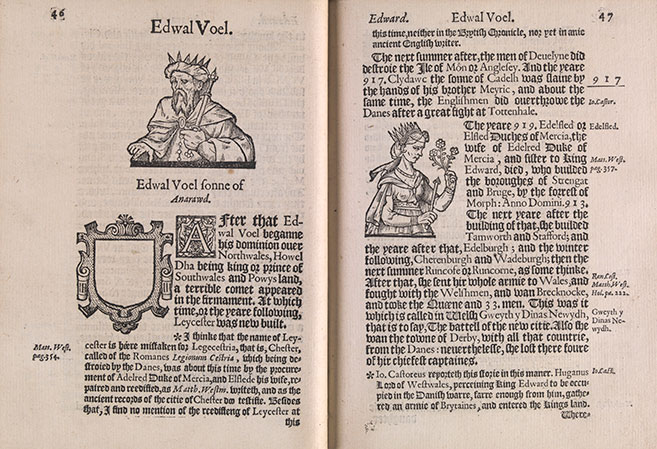
Fig. 6.1 David Powel, The Historie of Cambria, Now Called Wales (London, 1584), pp. 46–7
In presenting The Historie as a multi-layered work Powel built on Llwyd’s strategy of combining a medieval Welsh base source with other sources which expanded its narrative. Some of these were Welsh vernacular and Latin texts not used by Llwyd, including copies of the laws and the early sixteenth-century Statute of Gruffudd ap Cynan.117 However, the majority were English, thereby providing similar external corroboration to that already provided by Matthew Paris in Llwyd’s Cronica.118 Powel differed from his predecessor by explicitly identifying the Welsh source referred to by the latter with a version of the Welsh chronicles, begun, so he maintained (taking his lead from Geoffrey of Monmouth), by Caradog of Llancarfan. He added, citing Gutun Owain (fl. c.1451–1499), that after Caradog’s death in 1156, copies of his work were then updated annually to 1270 at the Cistercian monasteries of Strata Florida and Aberconwy, which normally combined their records every three years. Many copies were made of these ‘collections’, of which at least 100 survived, ‘whereof the most part were written two hundred yeares ago’—including, to judge by The Historie’s title, the history translated by Llwyd.119 Indeed, Powel possessed two copies of ‘the Brytishe booke’ and had collated Llwyd’s text with these.120 However, the nature of the copies held by Powel is uncertain. Later in The Historie, he noted that ‘the best and most perfect copie’ was written in the fifteenth century by Gutun Owain, which may indicate that Powel had seen it (and there is other evidence suggesting his familiarity with some of Gutun’s writings);121 but it need not follow that this was one of the two copies he owned. More fundamentally, as already mentioned, the identification of the Welsh chronicle(s) used by both Llwyd and Powel is problematic, as some of the material they attributed to the chronicle is absent from any of the surviving versions of Brut y Tywysogyon or Brenhinedd y Saesson. Moreover, Powel makes clear that the chronicle existed in different versions, albeit without indicating the extent of the differences. Thus, while he states that Llwyd had translated a single chronicle, apparently in a late fourteenth-century copy, and also extant in the manuscripts he possessed (described as ‘the Brytishe booke’ and similar terms),122 Powel also acknowledges that the content of those copies varied: for example, in references to details given in ‘some Brytish copies of this historie’.123
Irrespective of the precise nature of his principal source, Powel clearly wished to give the impression that his work was essentially an edition of a medieval Welsh text, whose importance he emphasized both by consulting manuscripts of it and by providing a fuller account of its composition than had Llwyd. On one level, then, Powel made accessible a monument of Welsh antiquity, which provided, at least from the mid-twelfth century onwards, a largely contemporaneous record of the events related. However, the authority of The Historie was enhanced both by citing the testimony of numerous other sources, from the Middle Ages to the author’s own day, including official documents (which Llwyd had not used), some of which are quoted extensively, and by a critical treatment of their evidence exemplifying the philological approach expected of a Renaissance historian.124
Powel also reflected, to a greater extent than Llwyd, on the value and purpose of history. Such reflections largely appear in piecemeal fashion, for example, in elaborating on the causes and significance of particular events, usually with reference to human agency, though he followed Llwyd (in turn borrowing from Henry of Huntingdon) in attributing the Norman conquest of England to divine vengeance on the English.125 In addition, while he followed Llwyd in attributing the coming of Christianity to Britain to Joseph of Arimathea,126 Powel, an ordained Church of England clergyman, was much readier than his predecessor to vent reformist and anti-Catholic sentiments, being quick to point out how history demonstrated the greed of the Church of Rome and its promotion of superstitious beliefs and practices, which, moreover, he condemned as remaining all too prevalent in the Wales of his day.127 In this respect, his approach was animated by some of the same concerns that were fundamental to the historically oriented works of John Bale, Matthew Parker, or John Foxe.128 However, unlike those Protestant writers, Powel did not conceive of history primarily as an instrument for religious ends. This is clear when he comes closest to offering a coherent apologia for the value of history, in the dedication to Sir Philip Sidney, son of Sir Henry, which prefaces the edition of Gerald’s Itinerarium Kambriae.
For what is more fitting for a noble than to unfold in his heart past memories of old times; to recall to mind the illustrious deeds of the most renowned men; to place before his eyes the forms, beginnings, growth, and condition of states; to discern the causes and consequences of events; to preserve famous histories and draw them out from darkness to light, and choose from those which are found to conform with virtue and apply them to ordering one’s life rightly?129
This defence of the value of history came in the conventional context of praising a patron.130 It was also conventional in its echoing of the classical emphasis on the exemplary value of history as a subject whose cultivation contributed to the moral improvement of its students and equipped them for public life as counsellors and servants of the state.131 Thus Powel proceeded to commend Sir Henry Sidney for exemplifying a devotion to history linked and also contributing to selfless public service in war and government; accordingly, his recovery of the past through sponsoring the publication of historical works was of a piece with his repair and restoration of castles, hospitals, roads, and ruined houses.132 Powel likewise relates the study of the past to the discharge of public responsibilities by urging Sir Philip Sidney, in his dedication of The Historie, to imitate his father in profiting from the example of ‘the acts of the famous men of elder times’, and notes that Sir Henry Sidney had devoted ‘great expenses and labour’ to obtain ‘the histories of Wales and Ireland (which countries for manie yeeres with great loue and commendation he gouerned)’.133
While clearly intended to flatter the Sidneys, such praises served a wider apologetic purpose, most evident in The Historie, namely an attempt to assert an honourable place for the Welsh in the new political order created by Henry VIII’s union legislation, which Powel unequivocally welcomed.134 For example, he concluded that, since the English had lost their former status under William the Conqueror, ‘all the ancient noble men, and gentlemen within this land, are descended either from the Normans and French, or from the Brytaines’.135 Powel likewise sought to vindicate the honour of the Welsh in his edition of Gerald’s Descriptio Kambriae, not only by omitting, without explanation, the work’s second book, which criticized the Welsh and offered advice on how they might be conquered, but by praising ‘the remnants of the ancient Britons’ in the age of Elizabeth for their intelligence, study of civil law, and understanding of politics.136 Above all, Powel wished to demonstrate that the Welsh had a distinguished history which deserved respect. Sidney lent powerful support to this idea, since he had not only collected copies of works pertaining to the history of Wales but also commissioned and financed their publication. Notwithstanding conventional declarations of inadequacy for the task,137 Powel evidently welcomed Sidney’s commissions as opportunities to pursue his own historiographical agenda.
This is particularly clear in the case of The Historie, which Powel undertook with the explicit aim of redressing Welsh history’s marginalization. First:
I see the politike and martiall actes of all other inhabitants of this Island, in the time of their gouernment to be set out to the vttermost, and that by diuers and sundrie writers: and the whole doings and gouernment of the Brytaines the first inhabitants of the land, who continued their rule longer than anie other nation, to be nothing spoken of nor regarded of anie, especialie since the reigne of Cadwalader, hauing so manie monuments of antiquitie to declare and testifie the same, if anie would take the paines to open and discouer them to the vew [sic] of the world.138
The emphasis on a wider British context, encapsulated in the description of Wales as ‘a part of the most famous yland of Brytaine’ in The Historie’s title, is consistent with Llwyd’s thinking, and further emphasized by the synchronizing of the reigns of Welsh rulers with those of kings of England by including the names of both as headings at the top of each page (for example, Edward the Elder and Idwal Foel in Fig. 6.1).139 Second, Powel wrote in order to set the record straight. Here his target was ‘the slanderous report’ of writers who turned ‘euerie thing that is done by the Welshmen to their discredit, leauing out all the causes and circumstances of the same’. In particular, Powel condemned the tendency of ‘common Chronicles’ to relate how kings of England sent armies into Wales in order to subdue ‘the proud stomachs, the presumptuous pride, stirre, trouble, and rebellion of the fierce, vnquiet, craking, fickle and vnconstant Welshmen’, yet without offering any ‘open fact’ to justify these campaigns. By contrast, ‘this historie dooth shew the cause and circumstances of most of those warres, whereby the qualitie of the action may be iudged’.140
Powel developed his critique of English historians by maintaining that Welsh resistance to the Normans, far from constituting rebellion, was merely self-defence, since ‘by the law of Nature it is lawfull for all men to withstand force by force’—a maxim derived from Roman law.141 This exemplifies a preoccupation with the legal basis of authority also witnessed in his views on William the Conqueror’s claim to the throne of England, elements of which were based on ‘[v]erie weak titles of themselues’, and his assertion that the king had granted Norman lords the right to conquer lands in Wales in return for knight service.142 Likewise he significantly augments Llwyd’s account by tracing the succession of landed families and their estates, some to his own day.143 Conversely, an instance of fraternal conflict prompts Powel to expand on the damaging consequences of partible inheritance or gavelkind, ‘the cause…of the ouerthrow of all the ancient nobilitie of Wales’ as well as ‘much bludshead and vnnaturall strife and contention amongst brethren’.144 Above all, Powel reinforced Llwyd’s emphasis on lawful succession under the native princes, while also doing much more than his predecessor to connect the principality of Wales they created with its post-conquest successor. Thus, whereas Llwyd alluded only briefly to the Mortimers being the rightful princes of Wales in succession to Llywelyn the Great, Powel asserted their title at length, citing in support both the laws of Hywel Dda and Welsh genealogies, and drew out a crucial implication: that Elizabeth I ‘by lineall descent is the right inheritrice of the Principalitie of Wales’. By contrast, ‘the title which Owen Glyndoure [Owain Glyndŵr] pretended to the principalitie of Wales was altogether friuolous’, as he was not descended from Llywelyn.145 However, Powel did not rely primarily on the Mortimer descent to justify the English crown’s right to Wales. There is no mention of that descent in the final part of The Historie he appended to Llwyd’s work, which relates the succession of English princes of Wales from the late thirteenth century to the author’s own day. Structured as a sequence of sections each headed by the name of a prince, this was clearly intended to present the post-conquest princes as the legitimate successors of the Welsh princes whose reigns had supplied the structure of the main part of The Historie. Indeed, it explicitly upholds their legitimacy by emphasizing how Edward I engineered the birth of his son Edward in Caernarfon castle, and, so Powel maintained, was thereby able to satisfy the demands of the Welsh to be governed by a Welsh prince.146
The story also reflects Powel’s association of the principality of Wales with the creation of stable government: Edward announced the birth of the prince to a gathering of Welsh notables whom he had summoned to discuss ‘the weale publike of their countrie’.147 Llwyd portrayed a Wales usually ruled by a plurality of kings and princes, though from the time of Rhodri Mawr a few of these had attained authority over the whole country, and in the thirteenth century Llywelyn ap Iorwerth, Dafydd ap Llywelyn, and Llywelyn ap Gruffudd were explicitly referred to by the title ‘Prince of Wales’.148 In his amendments and additions to Llwyd’s text Powel tried to superimpose greater constitutional coherence on this picture. True, he bestowed the title ‘Prince of Wales’ on a variety of rulers from the early ninth century onwards.149 Yet there is no mistaking his efforts to present an evolving pattern of government culminating in the establishment of the principality of Wales, which continued after the Edwardian conquest as an appurtenance of the English crown. Whereas the early ninth century ‘was a troublesome time, and as yet no staied gouernement established in Wales’,150 Rhodri Mawr (d. 878), ‘the vndoubted owner and possessor of all Wales’, had imposed regnal stability through defining the boundaries of the ‘three dominions’ of North Wales, South Wales, and Powys and establishing ‘a princelie house in euerie of them’, before leaving these territories to his sons, who thereby became ‘[t]he three crowned princes’.151 Although the allocation of North Wales to the eldest son may have implied the superiority of its prince over the other Welsh rulers, this was only explicitly acknowledged in allusions to legal rules introduced by Rhodri’s grandson, Hywel Dda (d. 950), which stipulated tribute payments from the princes of Dinefwr (South Wales) and Powys to the prince of Aberffraw (North Wales), and from the latter to the king of England.152 This formed part of a major legal reform by Hywel to ensure ‘the quiet gouernement of the people’, whose importance Powel underlined by adapting an account of the reform given in a compilation of medieval Welsh law and summarizing some of the law’s provisions.153 Yet Powel also held (correctly) that Owain Gwynedd (d. 1170) had been the first Welsh ruler to assume the title ‘Prince of Wales’, and, while adding that ‘the rest after him kept that title and stile’, acknowledged that practice had been inconsistent; indeed, he later implied that Llywelyn ap Gruffudd (d. 1282) was only the third to bear this title.154 In any case, the native princes had only laid the foundations of orderly government in Wales: its perfection fell to the Tudors. Henry VII had removed discriminatory laws, while Henry VIII’s Acts of Union had given the Welsh legal equality with the English and established a county-based administrative structure throughout Wales.155 Indeed, in his edition of the Descriptio Kambriae, Powel maintained that, through God’s mercy, the union had given the Welsh precisely ‘the moderate government of a single good prince’ which Gerald deemed essential to their prosperity.156
In addition, special praise was given to the Council in the Marches of Wales. This is treated as essentially a Welsh institution, with scant notice given to its jurisdiction over the border counties of England (perhaps because this was only seriously challenged from the 1590s), though Powel concluded his work by celebrating Sidney’s repair of the Council’s seat at Ludlow castle in Shropshire.157 However, he also implied that Sidney embodied continuity with the pre-conquest political order through tracing his maternal ancestry to both Gruffudd ap Cynan (d. 1137), ‘Prince of Northwales’, and Ednyfed Fychan (d. 1246),‘cheefe counseller and steward to Lhewelyn ap Iorwerth Prince of Wales’.158 Furthermore, Powel not only related the history of the Council from its origins under Edward IV159 but presented it as integral to Henry VIII’s policy in Wales: after describing the king’s union legislation, he added that ‘[f]urther for the keeping of the countrie in continuall obedience…there was ordeined a President and counsell to remaine within the dominion and Principalitie of Wales’.160 The history of the Council was set in the sections on the Princes of Wales that provide the framework for the period after the Edwardian conquest. However, since the Principality of Wales had been ‘incorporated to the crowne and kingdome of England’ by Henry VIII the status of Prince of Wales was no longer separate from the crown; this in turn probably enhanced the significance of the Council and its ‘Lord President of Wales’ in the minds of Powel and his patron.161 The Council represented a devolution of jurisdictional authority that was essential, so Powel held, to the effective government of the principality, as it was this, with its ‘verie wise gouernors’, which had ‘reduced the countrie of Wales to quietnesse, obedience and ciuilitie’.162 By contrast, Powel criticized the English crown’s adoption of harsh measures against the Welsh in the past, such as the punitive legislation passed in response to the rising of Owain Glyndŵr.163
Family and Locality
Powel shaped understandings of Welsh history until the nineteenth century. However, his was only one approach to the Welsh past adopted during his lifetime. Since the early Middle Ages, that past was most commonly mediated through stories, places, and families located in individual localities, perceptible through glimpses in poetry, genealogies, and narrative sources such as the Historia Brittonum (‘History of the Britons’), saints’ Lives, Gerald of Wales’s Itinerarium Kambriae (‘Journey round Wales’), and the writings of Gutun Owain. In addition, Gerald and others had written accounts that gave a starring role to marcher lords. From the 1560s, the place of the past in particular localities, especially in areas of south Wales conquered by the Normans, found expression in new kinds of texts. Like the histories of Llwyd and Powel, these were written in English by members of the Welsh gentry open to the culture of Wales as well as to antiquarian developments they pursued in common with their English counterparts.164 More particularly, much of it exemplified the new kind of chorographical writing developed in England from the later sixteenth century, wide-ranging studies of counties or other localities that combined topography and history, an approach applied to the whole island in the county descriptions of Camden’s Britannia.165
The works fall into two closely overlapping genres focused on the gentry and particular localities, namely family histories and chorographical descriptions of counties, which, as in England, mostly circulated in manuscript without being published.166 The one exception is the earliest, the ‘Winning of the Lordship of Glamorgan’, which exhibits features of both genres. It was written, probably between 1561 and 1566, by Sir Edward Stradling (1529–1609) of St Donat’s castle in Glamorgan in response to a request by Sir William Cecil (a good illustration of the networks connecting antiquarian-minded gentry in England and Wales). A wealthy landowner with a legal training and a prominent public figure in south Wales, Stradling exemplified the wide interests and accomplishments of a Renaissance gentleman: the possessor of a notable library at St Donat’s, he was famed both for his own scholarship and for his generosity to other scholars.167 His highly inaccurate account drew on a legend, attested in other versions, which may originally have been concocted in the later Middle Ages by herald poets in Glamorgan, partly in order to explain place-names in the county. It related how Robert fitz Hamon and twelve other Norman knights took advantage of dissension among the Welsh to conquer the kingdom of Morgannwg (Glamorgan), and traced the subsequent fate of the families and their estates, taking particular care to emphasize the alleged origins and the achievements of the Stradlings.168 The work was influential, circulating fairly extensively in manuscript, and became even better known after its inclusion in Powel’s Historie of Cambria, being the only one of the texts considered here to be published in the author’s lifetime.169 It also served as one model for the unpublished ‘Historie of Brecon’ mainly written, it seems, by Thomas ap John of Llanfrynach (Breconshire). Possibly composed between c.1585 and c.1625, and extant in shorter and longer versions continuing respectively to the late eleventh and early seventeenth centuries, this celebrated the county’s status as ‘a countey palantyne or a lordshipp Marcher’ and, after a brief account of the early medieval period, traced the descent of estates founded by the twelve Norman knights who had allegedly conquered the Welsh kingdom of Brycheiniog.170
At about the same time, Sir John Wynn (1553–1627) of Gwydir in the Conwy valley, another recipient of legal training and a wealthy and influential figure in north Wales who patronized Welsh vernacular culture and learning, drafted three unfinished versions in English of his family history, the earliest datable to c.1595, which he traced from Gruffudd ap Cynan (d. 1137) to the end of the fifteenth century.171 Like Stradling, Wynn sought to enhance the status of his family by endowing it with a spurious antiquity.172 However, he also went further and attributed its success to divine favour, declaring that ‘by the goodness of God we are and continue in the reputation of gentlemen…unto this day’.173 A concern with ancestry and status is also apparent in an English-language Life of Sir Rhys ap Thomas composed about a century after his death in 1525 by his descendant Henry Rice (c.1590–c.1651).174 However, this differs from Wynn’s work both in its humanist character, evident in its debt to Tacitus, Plutarch, and Erasmus, and its apologetic purpose, as Rice sought to restore the family’s reputation following the attainder for treason of Rhys ap Gruffydd in 1531 by emphasizing the loyal service his grandfather, the work’s ‘heroe’ Sir Rhys ap Thomas, had rendered to Henry VII—including the alleged killing of Richard III at the battle of Bosworth—and Henry VIII.175
The chorographical descriptions of counties extended from geography and agriculture to history, including gentry families and their genealogies. Morganiae Archaiologia (1578–84), written by Rice Merrick (Rhys Amheurig) (d. 1587), a landowner and lawyer from Cottrell in the Vale of Glamorgan, was inspired by William Lambarde’s Perambulation of Kent (1577); indeed, it may be the earliest response to Lambarde’s appeal for similar books to be written about other counties.176 Its first two books give a historical account of the county from the pre-Norman period to Merrick’s own day, while the third (which is incomplete) provides a topographical description arranged by hundreds and their parishes. (By contrast, Rice Lewis organized his survey of the same county, A Breviat of Glamorgan (1596–1600), by estates and their owners, and included pedigrees of the latter—an arrangement more typical of local history writing in early modern England.)177 George Owen of Henllys (1552–1613), lord of Cemais in northern Pembrokeshire, attempted something similar to Merrick but on a more comprehensive scale in his Description of Penbrokshire (1603), of which only the first of two projected parts was completed.178 This may well have been influenced by Richard Carew’s Survey of Cornwall (1602), whose structure it broadly resembles.179 Though like many gentry in England Owen completed his education by briefly attending one of the Inns of Chancery in London, which presumably enabled him to acquire some legal knowledge, Owen was both widely read and keenly observant and compiled numerous other antiquarian and topographical works, including genealogical collections and, in the mid-1590s, treatises on the origins and legal status of marcher lordships and on the government of Wales; he was also asked by Camden to provide the map of Pembrokeshire for the 1607 edition of Britannia.180
In varying degrees, all the works considered here may be seen as extensions of their gentry authors’ interest in genealogy; indeed, Merrick and Owen began their antiquarian studies by making genealogical compilations and the latter had close connections with the College of Arms whose influence is evident on the armorials he compiled.181 For Stradling, Owen, and Wynn, this was linked to a strong sense of family pride. However, in the case of Owen, this was less pronounced than the pride he took in his native county of Pembrokeshire typical of chorography.182 As for Stradling and especially Merrick with respect to Glamorgan, as well as for Thomas ap John in his account of Breconshire, affection for the county was sustained by a keen sense of its representing a long-established territorial entity, first as a Welsh kingdom, then, more importantly, as a marcher lordship. True, there were differences of interpretation and emphasis. Merrick is more sympathetic than Owen to the conquered Welsh, ‘defrauded’ of their kingdom by Normans, just as the treacherous Saxons had deprived the Britons of the sovereignty of England, concluding—again in Gildasian vein—that God had deprived the Welsh of the kingdom of Glamorgan as punishment for their sins.183 He also implies that, despite their subjugation, ‘the ancient Glamorganians’ had continued to shape the history of the county. Thus, the extensive regalian rights enjoyed by the Norman lords, though bestowed on fitz Hamon by William II (1087–1100), were granted ‘in as ample manner as the former lords enjoyed’, while, as a result of intermarriage, natives and newcomers were reconciled, ‘thereby secluding the difference between the victorious and the vanquished’. By contrast, very few direct descendants of the conquerors remained.184 Rice Lewis also emphasized the pre-Norman origins of Glamorgan by asserting that Henry Herbert (c.1538–1601), earl of Pembroke, to whose household steward he dedicated his survey of the county, was a direct descendant of the Welsh lord Iestyn ap Gwrgant (fl. c.1081–c.1120) and ‘the greatest Lord that ever owed landes in Glamorgan eyther before or after Justins [Iestyn’s] tyme’.185 Owen, on the other hand, attributed the distinction of Pembrokeshire to its deep-rooted Englishness. While acknowledging that the county traced its origins to the early medieval Welsh kingdom of Dyfed, he celebrated the Norman conquest and asserted that Henry I (1100–35) had established Pembrokeshire as a county palatine, thereby effectively making it part of the kingdom of England; that it had been the first part of Wales to adopt English laws; and that it could boast a longer history of loyalty to the English crown than the rest of the Principality.186 He had also previously argued that elsewhere in Wales marcher lords had exercised regalian rights as a consequence of royally sanctioned conquests, without implying any continuity from the Welsh rulers: while holding their lands in chief from the crown, those lords were exempt from royal jurisdiction and thus ‘forced…to assume & take vnto themselues such prerogative and authoritye within the saied Lordshipps, as to themselves seemed best, and were fitte for the quiett governement of anie countrie’.187 Small wonder, then, that Owen took pride in Pembrokeshire’s appellation as ‘little England beyond Wales’, or that, for all his Welsh ancestry and connections, he identified himself with ‘our Englishe nation’.188
Like the other writers discussed in this and the previous chapter, Owen looked back at the past from the perspective of a Wales incorporated into the kingdom of England by Henry VIII. This explains his emphasis on the Englishness of Pembrokeshire: the county had taken a lead over the rest of Wales by having already been united with England since the time of Henry I. Indeed, he complained of the 1536 Act of Union’s creation of a uniform pattern of counties in Wales ‘that to bring our neighbour shires more English we were forced to become more Welsh’.189 Another striking instance of Owen’s integration of Wales in the history of the kingdom of England is the implausible portrayal of Owain Glyndŵr as a defender of legitimate monarchy against Lancastrian usurpation: had the English likewise resisted Henry IV and restored Richard II ‘their lawful King’, the Wars of the Roses could have been prevented ‘and many thousands of good English subjects been saved’.190 Merrick also presented Norman conquest and Henrician union as crucial turning-points, but without suggesting that the one anticipated the other; instead he conventionally celebrated the union as heralding a new era of legal equality, order, and peace.191 Wynn took a similar line, albeit largely by way of implicit contrast with the violent disorder he highlighted in the fifteenth century.192 Their support for the union with England in turn points up how, in significant respects, writers of family history and chorography proceeded from the same assumptions as Llwyd and Powel in their national histories. Likewise, different genres of Welsh historical writing in the Elizabethan period shared a common preoccupation not only with forms of government and legitimate rule but with law and the descent of estates, the latter concerns being reflected, for example, in comments on partible inheritance or gavelkind, whose damaging consequences for landowners were lamented by Powel and Wynn.193 Writers of different kinds of histories also adopted similar methods, notably by deploying both documentary records and orally transmitted material, the latter sometimes reinforced by the author’s eyewitness testimony—Merrick had ‘seen a skull preserved in Peterston church which was reported to be Sir Matho Sor’s head cut off by Owain [Glyndŵr]’.194 There was cross-fertilization, too: Powel inserted Stradling’s account of fitz Hamon and the twelve knights of Glamorgan into his Historie, while Owen and Wynn used the works of Powel.195
Nevertheless, the family histories and chorographical descriptions considered here also point up how common assumptions and methods could sustain different ways of writing about the Welsh past. There was a fundamental contrast between the narrative priorities of Llwyd and Powel, writers from north Wales who focused predominantly on the actions of medieval Welsh princes, especially the dynasty of Gwynedd, and the emphasis of Stradling, Merrick, Lewis, Thomas ap John, and Owen on the Norman conquerors and their descendants who had established marcher lordships in the south. This of course reflected the piecemeal nature of the establishment of Norman lordships in Wales and the ensuing lack of medieval narratives of conquest encompassing the country as a whole comparable to Gerald of Wales’s Irish works, which provided a framework for early modern histories of Ireland by the conquerors’ descendants.196 In addition, writers of chorography and family history (as also, albeit within a different framework, Elis Gruffudd) extended their chronological coverage well beyond the Edwardian conquest, in most cases down to their own day.197 This chronological range is exemplified by George Owen’s summary of Pembrokeshire writers, the first collection of Welsh biographies, which was indebted to John Bale and extended over a millennium from St Patrick in the fifth century to Richard Davies (d. 1581), bishop of St Davids and New Testament translator.198 Conversely, while Merrick and Owen alluded to aspects of the British History, the distant past mattered far less to the writers discussed in this section than it did for Elis Gruffudd, Llwyd, and Powel, for whom the end of British sovereignty in the late seventh century marked a fundamental transition. By contrast, both Merrick and Owen portray the key turning-points in the history of their counties as the Norman conquests of the late eleventh and early twelfth centuries and the first Act of Union of 1536, and treat these as new beginnings in an ongoing story rather than terminal points inaugurating decline or extinction. The historical context Wynn encountered in north Wales was, of course, different. Yet, by focusing on family continuity he, too, sidestepped the barrier of 1282. Thus, although in tracing the origins of his family he drew on established interpretations of medieval Welsh history centred on the native princes, the Edwardian conquest and death of Llywelyn are mentioned only in passing and barely disrupt a narrative mainly concentrated on the following two centuries.199 As with his fellow antiquarian authors in south Wales, a focus on the local and the particular, influenced by chorographical writing in England, facilitated, indeed necessitated, different thematic and chronological approaches to the past from those of national histories whose narratives were substantially shaped by the assumptions and coverage of medieval Welsh chroniclers.
Writing Welsh History: From the Early Middle Ages to the Twenty-First Century. Huw Pryce, Oxford University Press. © Huw Pryce 2022. DOI: 10.1093/oso/9780198746034.003.0007
1 Llwyd, CW, 224. This may well refer to Caxton’s Chronicles of England (1480), ‘reprinted…well into the sixteenth century’, as is clearly the case elsewhere in the work (e.g. Llwyd, CW, 76). Quotation: Gillespie and Harris, ‘Holinshed and the Native Chronicle Tradition’, 141. I am grateful to Ceridwen Lloyd-Morgan for suggesting this identification.
2 Powel, HC, 375–401, quotation at 375.
3 Hunter, Soffestri’r Saeson, 7.
4 Thomas Jones, ‘A Welsh Chronicler’; Prys Morgan, ‘Elis Gruffudd’; Hunter, ‘The Chronicle of Elis Gruffydd’; Lloyd-Morgan, ‘Elis Gruffudd’; Hunter, Soffestri’r Saeson.
5 Lloyd-Morgan, ‘Elis Gruffudd’, 49–51.
6 Prys Morgan, ‘Elis Gruffudd’, 9, 10, 17.
7 NLW MS 3054D ii, fol. 487v, cited in Hunter, Soffestri’r Saeson, 51.
8 The manuscript was subsequently divided into two volumes (each now bound in two parts): NLW MSS 5276Di–ii and 3054Di–ii (formerly Mostyn MS 158), which respectively contain about 500 and 688 folios. Description of the latter in RMWL, 1: i–xii, 214–21. References here are to the digitized images available online at ‘Elis Gruffudd’s Chronicle’, https://www.llgc.org.uk/en/discover/digital-gallery/manuscripts/early-modern-period/elis-gruffudds-chronicle (last accessed 13 September 2021). Published extracts from the chronicle are listed in Ystoria Taliesin, ed. Ford, x.
9 Hunter, Soffestri’r Saeson, 29–31. The focus on recent events is much greater than in Higden, the last of whose seven books covers the period from William I to Edward III: Given-Wilson, Chronicles, 118. See also John Taylor, The Universal Chronicle, 39–45.
10 RMWL, 1: 214.
11 NLW 3054Dii, fol. 487v, cited in Hunter, Soffestri’r Saeson, 51, and, with translation followed here, Hunter, ‘The Chronicle of Elis Gruffydd’, 241.
12 E.g. NLW 3054Dii, fols. 379r–v, 407r; NLW 5276Dii, fols. 500r, 501r. See also Prys Morgan, ‘Elis Gruffudd’, 18; Hunter, ‘The Chronicle of Elis Gruffydd’, 212–14, 224, 228–9.
13 Hunter, Soffestri’r Saeson, 7–12, 28–35.
14 NLW 5276Dii, fols. 548v–549r (transcribed and translated in Hunter, ‘The Chronicle of Elis Gruffydd’, 255–7, 282–4); NLW MS 3054Di, fol. 5v. Cf. Given-Wilson, Chronicles, 119–20.
15 Hunter, Soffestri’r Saeson, 51–73.
16 NLW 3054Di, fol. 2r; transcribed in Hunter, ‘The Chronicle of Elis Gruffydd’, 258, with translation (adapted here) at 285. The first folio of the manuscript that contained the opening of the preface is missing.
17 ‘Ystorya Erkwlf’, ed. Jones; NLW 5276Di, fols. 145r–153r; NLW 5276Dii, fols. 451r–455v; Prys Morgan, ‘Elis Gruffudd’, 18.
18 Hunter, Soffestri’r Saeson, 15–18, 20, 108–42.
19 Hunter, Soffestri’r Saeson, 61–7; Lloyd-Morgan, ‘Welsh Tradition in Calais’, 90–1; NLW 5276Dii, fols. 378v–379r, 388r, 413r, 425r.
20 NLW 5276Dii, fols. 321r–342r; NLW 3054Di, fols. 108r–112r (transcribed in RMWL, 1: 215–19; partly transcribed, with translation, in Hunter, ‘The Chronicle of Elis Gruffydd’, 266–8, 292–5).
21 Hunter, ‘The Chronicle of Elis Gruffydd’, 216–25.
22 Lloyd-Morgan, ‘Elis Gruffudd’, 42–4, 49–52; Lloyd-Morgan, ‘Welsh Tradition in Calais’, 78–9; Hunter, ‘The Chronicle of Elis Gruffydd’, 191–7.
23 Lloyd-Morgan, ‘Oral et écrit’.
24 Lloyd-Morgan, ‘Welsh Tradition in Calais’, 79–88.
25 Ystoria Taliesin, ed. Ford; Thomas Jones, ‘The Story of Myrddin’; Patrick J. Ford, ‘The Death of Merlin’; Thomas Jones, ‘Gwraig Maelgwn a’r Fodrwy’. See also Slotkin, ‘Maelgwn Gwynedd’.
26 Owain Glyndŵr, ed. Livingston and Bollard, 228–31, quotation at 229.
27 NLW 3054Di, fols. 90r–91v; printed in Thomas Jones, ‘Pethau Nas Cyhoeddwyd’, 154–5.
28 The abbey was in fact relocated to Maenan by Edward I in 1284: Hays, The History of the Abbey of Aberconway, ch. 4.
29 Presumably denoting Joan, whom Llywelyn married in 1205: Wilkinson, ‘Joan’, 83.
30 Thomas Jones, ‘Pethau Nas Cyhoeddwyd’, 154.
31 Later the chronicle also briefly mentions the marriage of a daughter of Llywelyn to John of Scotland (heir of the earl of Chester), and the prince’s alliance with the French against the English crown: NLW 3054Di, fol. 104r.
32 NLW 3054Di, fols. 90r–91v, 104r; Thomas Jones, ‘Pethau Nas Cyhoeddwyd’.
33 Thomas Jones, ‘Pethau Nas Cyhoeddwyd’, 154–5. The reference to a longer version is implied in the phrase ‘as the writing shows at length’ (‘megis ac J mae’r ysgriuen yn dangos drwy hir brosses’).
34 E.g. Ystoria Taliesin, ed. Ford, 173, s.v. ysdori (ystoria).
35 Brynley F. Roberts, ‘Ystoria’, esp. 18–20.
36 For Gruffudd’s prose style see Prys Morgan, ‘Elis Gruffudd’, 20; Lloyd-Morgan, ‘Elis Gruffudd’, 52–3.
37 NLW MS 5276Dii, fols. 426r–431r, esp. fols. 426r–v, 429r–431r.
38 NLW MS 3054Di, fols. 111r–112r.
39 NLW 3054Di, fol. 509v; Peter R. Roberts, ‘Tudor Legislation’, 125. For a similar perception of the legislation by another mid-sixteenth-century Welsh writer see Olson, ‘Religion, Politics, and the Parish’, 531, 533. A uniform pattern of counties was established by the 1536 Act of Union and confirmed, with some adjustments, in the 1543 Act: Glanmor Williams, Recovery, 268–9, 271.
40 NLW, Peniarth MS 138 (c.1562): RMWL, 1: 872.
41 The chronicle is extant in a copy in NLW Peniarth MS 168 (1589–90): RMWL, 1: 960–2. For a transcription of the chronicle from the reign of William I onwards, comprising about two-thirds of the whole, including references to the folios of the manuscript, see ‘Cronicl Hywel ap Syr Mathew’. See also Looker, ‘Hywel ap “Syr” Mathew’.
42 ‘Cronicl Hywel ap Syr Mathew’, fols. 199v, 207r; see also ibid., fols. 202r, 206v–207r, 207v. For another Welsh-language chronicle, from Cadwaladr to 1565, perhaps written by Gruffudd Hiraethog, in NLW, MS Peniarth 212 (1565 × 1587) see RMWL, 1: 1034; Guy, ‘Historical Scholars’, 105–6.
43 Colophon: Llwyd, CW, 4: ‘Cronica Walliae a Rege Cadwalader ad an(num) 1294 Humfredo Floid authore’. ‘Historie’: Llwyd, CW, 79, 82, 86, 92, 103.
44 Llwyd, CW, 64 (quotation), 223–4.
45 Llwyd, CW, 4–10.
46 R. T. Jenkins, ‘William Wynne’; Llwyd, CW, 9–10. It is uncertain whether manuscript corrections and additions Powel made to a copy of the book signalled an intention to produce a revised edition: cf. Huws, Repertory, s.n. Peniarth Estate PB 4.
47 Jarvis, ‘Welsh Humanist Learning’, 128–30; Rheinallt Llwyd, ‘Printing and Publishing’, 93–5. Editions in England in this period normally ran to 1,000–1,500 copies and could remain available for decades after their publication: Woolf, Reading History, 207–8, 231.
48 Cf. Gruffydd, ‘Humphrey Llwyd: Dyneiddiwr’, 59–60.
49 Llwyd, CW, 24; cf. Boyle, ‘Henry Fitzalan’, 180.
50 Llwyd, CW, 24.
51 Cf. Boyle, ‘Henry Fitzalan’, 64–5, 132–61.
52 Llwyd, CW, 184–5.
53 For the passage’s debt to Davies, and thence to Bale, see Gruffydd Aled Williams, ‘ “Ail Dewi Menew” ’, 100–1.
54 Llwyd, CW, 2; Gruffydd, ‘Humphrey Lhuyd a Deddf Cyfieithu’r Beibl’. See also Parkinson, ‘Humphrey Llwyd’.
55 Llwyd, CW, 82.
56 Llwyd, CW, 65.
57 Llwyd, CW, 33–58.
58 Llwyd, CW, 89–90, quotation at 90.
59 Llwyd, CW, 77 (my emphasis). Similarly Snowdonia is ‘without contraversi the strongeste countrey within Britaine’, 70.
60 Llwyd, CW, 71.
61 Cf. MacColl, ‘The Construction of England’, 594–5, 599–602, 607–8.
62 Llwyd, CW, 87. Cf. BS, 16–17 (828); Beech, ‘Did King Egbert of Wessex Rename Britain?’.
63 Llwyd, CW, 88; Schwyzer, ‘Archipelagic History’, 602.
64 Llwyd, CW, 112, 149.
65 E.g. Llwyd, CW, 63–6, 82, 89, 168.
66 Llwyd, CW, 167–8, quotation at 168.
67 Gwyn A. Williams, Madoc: The Making of a Myth, 39–46; MacMillan, ‘Discourse on History, Geography and Law’, esp. 8–9, 11, 14–15, 22–3; Glyn Parry, The Arch-Conjuror of England, 94–6, 144–5. For Dee’s possession of a copy of Llwyd’s history, probably by 1575, see Llwyd, CW, 4, 9.
68 Llwyd, CW, 63.
69 Ralph Griffiths, ‘Wales’, 679–81.
70 Llwyd, CW, 222. Similarly, the Normans who conquered Glamorgan were ‘the first strangers that ever inhabited Wales sith the tyme of Camber’: Llwyd, CW, 126.
71 Llwyd, CW, 223 (my emphasis).
72 Llwyd, CW, 224.
73 Praise of union: Llwyd, Breviary, 108. ‘Conjoined realm’: Ralph Griffiths, ‘Wales’, 679.
74 Llwyd, CW, 64–82, quotation at 64.
75 Llwyd, CW, 12–15.
76 For Llwyd’s knowledge of Gerald see Llwyd, CW, 12, 65, 67, 69, 77, 81.
77 Llwyd, CW, 64, 67; Llwyd, Breviary, 98; Schwyzer, ‘A Map of Greater Cambria’.
78 Llwyd, CW, 67–8, 72, 77.
79 Llwyd, CW, 68, 70–4, 77–80. The likely source of Llwyd’s listing of cantrefs and commotes identified at 14.
80 Llwyd, CW, 24, 73.
81 Explicit in the full title of Powel, HC: ‘The Historie of Cambria…written in the Brytish language aboue two hundreth yeares past: translated into English by H. Lhoyd, Gentleman…’
82 Llwyd, CW, 65, 74, 82, 121, 213, 218.
83 Llwyd, CW, 213, 218. As argued in Chapter 3, Brut y Tywysogyon originally ended in March 1282. The only copy known to have ended in 1270, down to the entry after the last one referred to by Llwyd as part of his Welsh source, is a transcript of 1577: Brut, Pen20Tr, li–lii; Huws, Repertory, s.n. NLW 13211E.
84 Powel, HC, sig. ¶vr–v.
85 Llwyd, CW, 26.
86 Cf. Llwyd, CW, 17–23; Charles, George Owen of Henllys, 102 (‘some lost composite Welsh chronicle’). One early copy of CW (c.1578) is followed by a collection of pedigrees in Welsh, Achau’r Mamau (‘The Pedigrees of the Mothers’), identified in a marginal note, perhaps by Robert Cotton (pers. comm. Paul Russell), as being ‘written out of the Bryttishe bok wher the History of Humfrey Lloid is in Welsh written’: BL, Cotton Caligula MS A.VI, fols. 225r–227r, quotation at fol. 227r.
87 Llwyd, Breviary, 56 (my emphasis), translating Humphrey Llwyd, Commentarioli Britannicae Descriptionis Fragmentum, 5–6.
88 Llwyd, CW, 16, 39–59, 97.
89 Llwyd, CW, 86, 90, 103, 185.
90 Ieuan M. Williams, ‘Ysgolheictod Hanesyddol’, 120. A partial parallel is provided by the Annals of the Four Masters (1632–6), which named a king supposedly holding sovereignty over the whole of Ireland in the entry for each year, thereby adapting the annalistic structure of its medieval Irish sources in order to demonstrate the antiquity of the ‘kingdom of Ireland’: Cunningham, The Annals of the Four Masters, 80–6.
91 E.g. Llwyd, CW, 84, 89, 113, 151, 206. See Chapter 3 for the contrasting treatment of English and Welsh regnal succession in Brut y Tywysogyon.
92 Cf. Woolf, ‘Senses of the Past’, 419–20.
93 Llwyd, CW, 68, 97, 186.
94 Political disruption associated with the lack of a male heir in Llwyd, CW, 105.
95 Llwyd, CW, 87, 110, 111, 122, 123, 178, 186, 209, and cf. 27–31.
96 Llwyd, CW, 123.
97 Llwyd, CW, 98.
98 Llwyd, CW, 99, 103 (quotation). See also 106 for Llwyd’s criticism of Dafydd ap Gruffudd’s imprisonment of his half-brother Gruffudd.
99 Llwyd, CW, 209 (my emphasis).
100 Llwyd, CW, 64, 222 (quotation).
101 Llwyd, CW, 218.
102 Cf. Greenslade, ‘The Faculty of Theology’, 296–7, 314–20.
103 Powel, HC, sig. ¶vv.
104 Powel, HC, sig. ¶iiiv, vv; Powel, PV, sig. A2v, p. 51.
105 John Edward Lloyd and Victor Sholderer, ‘Powel’s Historie (1584)’; Schwyzer, ‘Archipelagic History’, 606. Powel frequently refers to the Chronicles: e.g. Powel, HC, 4, 33, 57, 91, 225, 335, 372. For the Irish Chronicle, an expanded version of Edmund Campion’s Histories of Ireland by Holinshed supplemented by Richard Stanihurst, see Lennon, ‘Ireland’.
106 Cf. Penry Williams, The Council in the Marches, 127–32, 257–74.
107 Nice, Sacred History, 75, 87; Schwyzer, ‘ “A Happy Place of Government” ’.
108 Powel, HC, sig. ¶iiiv, viir–viiv, quotation at viiv. For Cecil see Flower, ‘Richard Davies’; McKisack, Medieval History, 50–4; Rowse, ‘Alltyrynys and the Cecils’; Popper, Sir Walter Ralegh’s History, 62–3.
109 Powel, HC, sig. ¶viiir, 121, 141. Cf. Peter R. Roberts, ‘Parry, Blanche’.
110 Powel, HC, 11, 391; see also Powel, PV, 246, n. 2.
111 Powel, HC, 329, 338. Cf. Watkin, ‘Yale, Thomas’.
112 For the dates see Powel, HC, sig. ¶vv; below, n. 113. Powel’s annotations of a copy of The Historie provide further evidence of his familiarity with a range of English and Welsh sources: NLW, Peniarth Estate PB 4, Powel, HC, 23, 103, 111, 112, 121, 203 (Welsh genealogies); 304, 337, 383 (royal records).
113 The archbishop of Canterbury licensed Newbury and Denham to print ‘A historie or Cronicle of Walles’ on 1 April 1584: A Transcript of the Registers, ed. Arber, 2: 430; licence to print ‘chronicles’ at 438. For the printers see Kastan and Pratt, ‘Printers’, 32–4; and for the printing of Welsh books in sixteenth-century London, Eiluned Rees, The Welsh Book-Trade, iv, vii–ix, xiii–xiv.
114 Powel, HC, sig. ¶viir–viiir, quotation at viiir.
115 Ieuan M. Williams, ‘Ysgolheictod Hanesyddol’, 215–16; further details of Powel’s adaptation of Cronica Walliae in notes to Llwyd, CW, 225–57.
116 E.g. Powel, HC, 1, 52, 115, 246. In Fig. 6.1 Idwal is depicted by the woodcut used in Holinshed’s Chronicles for Cædwalla, king of the West Saxons. The image of Ætheflæd does not correspond to any in Holinshed, and it is unknown whether the woodcut had previously been used to depict another female ruler. See Lloyd and Scholderer, ‘Powel’s Historie’, 16–17.
117 Powel, HC, 52–7, 191–2. See also citations from the Cambro-Latin Life of St Melangell and the Welsh Life of Gruffudd ap Cynan: Powel, HC, 22–3; Powel, PV, 199–200, n. 3; cf. Pryce, ‘A New Edition’.
118 Powel also used Paris independently: e.g. Powel, HC, sig. ¶viir; 105–6, 284, 391.
119 Powel, HC, title page (‘The Historie of Cambria…written in the Brytish language aboue two hundreth yeares past’), sig. ¶vr, 206; see also Powel, PV, 185, n. 1.
120 Powel, HC, sig. ¶viir.
121 Powel, HC, 206 (quotation), 229, 391.
122 E.g. Powel, HC, sig. ¶viir; see also ibid., D22, 8, 110, 249, 327.
123 Powel, HC, 42, and see also 34, 174. Likewise a reference to ‘The Brytish booke of the Abbeie of Stratflur [Strata Florida]’ may imply that copies from other abbeys differed in their content: Powel, HC, 270.
124 Documents: Powel, HC, sig. ¶viiv, D6, 271, 309, 324–5, 328–9, 338–71, 391. Critical analysis of sources: Powel, HC, 9–12, 74–5, 222; Powel, PV, 214–16, n. 4, 245–6, nn. 1–2, 254. Cf. Popper, Walter Ralegh’s History, 54–6.
125 Powel, HC, 21, 102, 116; cf. Henry, Archdeacon of Huntingdon, Historia Anglorum, ed. and trans. Greenway, 402–3; Llwyd, CW, 39–42.
126 Powel, HC, 12–13.
127 Powel, HC, 5, 194, 271, 309; Powel, PV, 74, 75, 84–8, 93, 96, 97, 99, 200–2, 208, 214–16, 276–7.
128 Cf. Robinson, ‘ “Dark Speeche” ’; Greengrass and Philpott, ‘John Bale’.
129 Powel, PV, 49.
130 Powel, HC, sig. ¶iiir, iiiv–iiiir, 400–1; Powel, PV, sig. A2r–v, pp. 49–52. Annotated translations of the Latin prefaces in Rhagymadroddion a Chyflwyniadau Lladin, trans. Davies, 48–57, 161–4.
131 Cf. Bodin, Method, 9, 12–14; Rhagymadroddion a Chyflwyniadau Lladin, trans. Davies, 9–10; Popper, Walter Ralegh’s History, 3–4, 36–9, 45–7, 53–59, 239–47.
132 Powel, PV, 51 [recte 50]–51.
133 Powel, HC, sig. ¶iiiv.
134 Powel, HC, sig. viiir–v; see also Powel, HC, 394–5; Powel, PV, 276.
135 Powel, HC, 117.
136 Powel, PV, 261–2.
137 Powel, HC, sig. ¶iiiv; Powel, PV, sig. A2v.
138 Powel, HC, sig. vv–vir.
139 The first occurrence adds the name of Ecgberht besides those of Merfyn and Esyllt, and the practice is followed consistently from the reigns of Alfred and Rhodri Mawr: Powel, HC, 27, 33ff.
140 Powel, HC, sig. vir. The Welsh clergyman Meredith Hanmer (1543–1604) adapted this approach in his posthumously published Chronicle of Ireland (1633) in response to criticisms of the Welsh in Ireland, where he lived from 1591, by stressing their ancestors’ leading role in the conquest of the island: Rhys Morgan, The Welsh and the Shaping of Early Modern Ireland, 143–53.
141 Powel, HC, sig. viv, citing in the margin ‘vim vi repellere licet’. The rule in Roman law, ascribed to Gaius Cassius Longinus, added that ‘this right is conferred by nature’ and ‘arms may be repelled by arms’: The Digest of Justinian, 43,16,1,27, ed. Mommsen and Krueger, trans. Watson, 4: 584.
142 Powel, HC, 106, 151. Elsewhere Powel held that William had gained possession of the kingdom of England ‘by right of war’ (‘iure belli’): Powel, PV, 156, n. 1.
143 Powel, HC, 23, 141–8, 150, 211–18, 294–7, 312–13, 315–18, 378.
144 Powel, HC, 21. For an early seventeenth-century identification of gavelkind with the ‘old Britons’ and Wales see Hiram Morgan, ‘ “Lawes of Ireland” ’, 311.
145 Powel, HC, 315–18 (quotations at 318). Other criticism of Glyndŵr at 386.
146 Powel, HC, 376–7. Cf. J. R. S. Phillips, Edward II, 34–6.
147 Powel, HC, 377.
148 Llwyd, CW, 200, 206, 208, 209, 210, 217, 218.
149 Powel, HC, 21, 97, 148, 259, 278, 401.
150 Powel, HC, 20.
151 Powel, HC, 35–6, and see also 211. Powel, PV, 243–4, n. 1, emphasizes that the tripartite division itself long antedated Rhodri.
152 Powel, HC, 50, 61, 315. For Aberffraw and Dinefwr as the chief courts respectively of Gwynedd and Deheubarth see DK, I. 4.
153 Powel, HC, 52–7 (the lawbook’s diagram of hearings of the royal court is reproduced at 56). See also Powel, PV, 138, n. 5. The account of Hywel’s legal reform appears to be based on the prologue to the version of Latin Redaction E written by John Dee: cf. The Latin Texts of the Welsh Laws, ed. Emanuel, 410–11, 434–5; VGC, 18–19 and n. 83; Russell, ‘ “Divers Evidences Antient of Some Welsh Princes” ’, 410–11, 415–18. Powel’s interest in Welsh law and custom may have been influenced by William Lambarde (1536–1601), whose edition of Ine’s laws (presumably in his Archaionomia (1568)) is referred to, and who included a lengthy appendix on Kentish gavelkind in his Perambulation of Kent (1576), though the latter lacks any close parallels with Powel’s much shorter account of gavelkind in Wales: Powel, HC, 10; see also Powel, HC, sig. viiv; Powel, ‘De Britannica Historia’, 284; Lambarde, Perambulation of Kent, 388–427.
154 Powel, HC, 6; Powel, PV, 138, n. 5.
155 Powel, HC, 390, 394–5.
156 Powel, PV, 276 (note referring to end of DK I.18).
157 Powel, HC, 401. Cf. Penry Williams, The Council in the Marches, 197–204. For a different interpretation see Nice, Sacred History, 75, 82.
158 Powel, HC, 400–1.
159 Powel, HC, 389–90, 391–2, 393, 394, 395–401.
160 Powel, HC, 395.
161 Powel, HC, 396. For debates among sixteenth- and early seventeenth-century historians and antiquaries about the lack of princes of Wales after Henry VIII’s accession see Peter R. Roberts, ‘Wales and England’, 117, 123, 127, n. 53, 133. Sidney and his five immediate predecessors from Edward VI’s reign onwards were called ‘Lord President of Wales’: Powel, HC, 397–401; the titles applied to earlier Presidents emphasized their connection with the Council, rather than Wales: Powel, HC, 391, 392, 393, 394. This variety is paralleled in official documents: Skeel, The Council in the Marches, 285–6.
162 Powel, HC, 396. The history of the Council was also related by the lawyer Sir John Dodderidge (1555–1628), in an account of the Principality of Wales written c.1604, who pointed up its role in assisting the Prince of Wales as part of an attempt to persuade James I to revive the Principality: Dodderidge, The History, 22, 24, 38–9, 52–5; see further Peter R. Roberts, ‘Wales and England’, 126–7; Lloyd Bowen, The Politics of the Principality, 70, n. 118.
163 Powel, HC, 387–8; see also 336–7, 390.
164 For valuable discussion and context see Deakin, ‘The Early County Historians’; Broadway, ‘No historie so meete’; Lloyd Bowen, ‘Fashioning Communities’.
165 Mendyk, ‘Early British Chorography’; Cormack, ‘ “Good Fences Make Good Neighbors” ’, 641–3, 655–61; cf. Broadway, ‘No historie so meete’, 31.
166 Broadway, ‘No historie so meete’, 8–9, 36–9.
167 Ceri W. Lewis, ‘Syr Edward Stradling’, esp. 153–88; Graham C. G. Thomas, ‘The Stradling Library’; Ralph A. Griffiths, ‘Stradling, Sir Edward’; J. Gwynfor Jones, ‘Wynn, Sir John’.
168 ‘Sir Edward Stradling’s “Winning of the Lordship of Glamorgan” ’, in Merrick, Morganiae Archaiographia, ed. James, 150–64, with discussion at 147–50; G. J. Williams, Traddodiad Llenyddol Morgannwg, 184–90; G. J. Williams, ‘The Early Historians of Glamorgan’, 64–6, 69; Ralph A. Griffiths, Conquerors and Conquered, 19–29; Ceri W. Lewis, ‘Syr Edward Stradling’, 147–52, 184–203.
169 Powel, HC, 122–41; Ceri W. Lewis, ‘Syr Edward Stradling’, 148.
170 Deakin, ‘Early County Historians’, 178–91, quotation at 178.
171 Wynn, The History of the Gwydir Family, ed. Ballinger; cited here from Wynn, History of the Gwydir Family, ed. Jones. See also Gresham, ‘Sir John Wynn’, 24, 25–6, 32, 69–70; Huws, ‘John Wynn’s History of the Gwydir Family’.
172 For the family’s claims of descent from Gruffudd ap Cynan see Gresham, ‘Sir John Wynn’, 34–40, 50–1.
173 Wynn, History of the Gwydir Family, ed. Jones, 15–16, 31, quotation at 16.
174 Ralph A. Griffiths, Sir Rhys ap Thomas, Part II; context, authorship, and likely date (1622 × 1627) discussed at 135–43.
175 Ralph A. Griffiths, Sir Rhys ap Thomas, 140, 143, 229–30, 268 (quotation).
176 Merrick, Morganiae Archaiographia, ed. James.
177 Rice Lewis, ‘A Breviat of Glamorgan’, ed. Rees; Deakin, ‘Early County Historians’, 163–77; cf. Broadway, ‘No historie so meete’, 168–71.
178 George Owen, ‘The Description of Penbrokshire’, ed. Owen; here cited from George Owen, The Description of Pembrokeshire, ed. Miles (text in modernized orthography). The best account of Owen’s life and works remains Charles, George Owen of Henllys. See also Charles, ‘George Owen of Henllys: Addenda’; Deakin, ‘Early County Historians’, 244–67; Miles, ‘ “An Exquisite Antiquary” ’.
179 Cf. George Owen, ‘The Description of Penbrokshire’, ed. Owen, vi, n. 1, xvii.
180 Charles, George Owen of Henllys, 28–9, 107–10, 131–5, 155–9; George Owen, ‘The Dialogue of the Government of Wales’, ed. Owen; The Dialogue of the Government of Wales, ed. Jones (text in modernized orthography); George Owen, ‘A Treatise of Lordshipps Marchers’, ed. Owen. Cf. Broadway, ‘No historie so meete’, 72–3.
181 Merrick, Morganiae Archaiographia, ed. James, xxiii–xxiv; Charles, George Owen of Henllys, 107–11, 118–19, 123.
182 Cf. Cormack, ‘ “Good Fences” ’, 643, 657, 658.
183 Merrick, Morganiae Archaiographia, ed. James, 21–5, 35.
184 Merrick, Morganiae Archaiographia, ed. James, 26, 34–5.
185 Rice Lewis, ‘A Breviat of Glamorgan’, ed. Rees, 108, and see also 92, 94–5. Lewis’s support for the earl of Pembroke against the Stradling and Mansell families in Glamorgan is highlighted by Deakin, ‘Early County Historians’, 165–70.
186 George Owen, The Description of Pembrokeshire, ed. Miles, 10–12, 154, 177–82, 198–200. See also George Owen, ‘A Treatise of Lordshipps Marchers’, ed. Owen, 139.
187 George Owen, ‘A Treatise of Lordshipps Marchers’, ed. Owen, 137–40, 148–9, 155, 173–9, quotation at 139.
188 George Owen, The Description of Pembrokeshire, ed. Miles, 37, 187.
189 George Owen, The Description of Pembrokeshire, ed. Miles, 154.
190 The Dialogue of the Government of Wales, ed. Jones, 79–80, quotations at 80.
191 Merrick, Morganiae Archaiographia, ed. James, 5, 26, 67–8, and cf. 13. By contrast, Stradling has only a glancing reference to the Acts of Union: Merrick, Morganiae Archaiographia, ed. James, 151.
192 Wynn, History of the Gwydir Family, ed. Jones, xxxii–xxxv, 20–1, 28–30, 33–4, 36–46, 51–6.
193 Powel, HC, 21; Wynn, History of the Gwydir Family, ed. Jones, 15, 17, 21. See also Merrick, Morganiae Archaiographia, ed. James, 12, 15, 36; George Owen, The Description of Pembrokeshire, ed. Miles, 64–5.
194 Merrick, Morganiae Archaiographia, ed. James, 58, and see also 97, 100, 101, 106; George Owen, The Description of Pembrokeshire, ed. Miles, 194–6; Wynn, History of the Gwydir Family, ed. Jones, 10, 20–1, 27. For the readiness of sixteenth-century chorographers to use oral sources see Woolf, ‘Senses of the Past’, 414.
195 Powel, HC, 122–41; George Owen, ‘The Description of Penbrokshire’, ed. Owen, 7, 8; Wynn, History of the Gwydir Family, ed. Jones, xxv, 81, 82.
196 Cf. Lennon, ‘Ireland’.
197 Although Powel’s Historie appended an account of the English princes of Wales, this was clearly separated from the preceding ‘Historie of the Brytish Princes’ that ended in 1282: Powel, HC, 375–6.
198 Owen, The Description of Pembrokeshire, ed. Miles, 183–9.
199 Wynn, History of the Gwydir Family, ed. Jones, 7, 10, 13, 15.