
Both at the time and subsequently, the history of fifteenth-century Castile seemed to be one of cosmic chaos, a period of almost constant anarchy until Isabel ‘the Catholic’ and her husband, Ferdinand of Aragon, restored law and order in the 1480s. Observers reacted to the violence and disorder with expressions of weary incomprehension or with reflections on men’s innate greed and disloyalty. On 11 August 1465, for example, the urban chronicler, Garci Sanchez, noted in disbelief that when two men of the Saavedra lineage in Seville quarrelled with others of the Ponce de Leon faction, several thousands took to the streets, the Saavedra house was sacked and Fernando Arias de Saavedra himself escaped only by fleeing across the rooftops of his district. Nobody but the Devil, he observed three years later, was capable of understanding such feuds between factions (bandos). According to the chronicler Fernan Perez de Guzman, matters were not much better at the royal court. Politics there, he reflected, were characterised by endless imprisonments, expulsions and confiscations of wealth ‘for the praiseworthy custom of the Castilians has reached such a point that men will consent to the imprisonment and death of a friend or relative in order to have a share in the booty’. Foreigners, likewise, painted a dismal picture. In 1466 the Bohemian noble Leo of Rozmital travelled widely through the kingdom, and two of his companions described their experiences. The Basque country was ‘wretched’, its people ‘murderous’, the inns ‘evil beyond measure’ and the priests were married and unlearned. Further south they had to cross tracts of wilderness and mountainous territory, and when they visited one of the two rival royal courts, that of Enrique IV, they observed that the king ‘eats and drinks and is clothed and worships in the heathen manner and is an enemy of Christians’. But then Enrique has always been the leading contender for the title of Spain’s worst king.
What sense is to be made of this? While it is possible to concentrate on specific aspects in order to find part explanations, the historian is forced to look at the large picture. Can anything other than mindless anarchy be detected? Were the ‘Catholic Monarchs’ (Reyes catolicos) geniuses who replaced chaos with law and order, or did they build on the work of their predecessors, however imperfect that work had been?
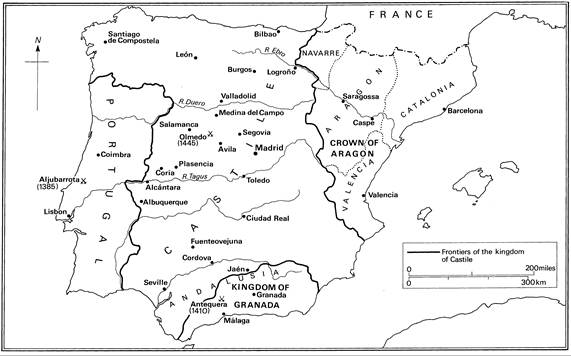
Map 13 Castile and Navarre
To begin with, it may well be asked how violent and senseless were episodes of apparent anarchy? In 1458, in the hill-top town of Alcaraz, violence had reached such a stage that Enrique IV commissioned a special enquiry to be carried out by the royal corregidor, Pedro de Silva, and one of his military commanders and royal councillors, Gonzalo Carrillo. The commissioners examined some twenty people, all inhabitants of Alcaraz and eye-witnesses of the events. Eighty-four pages recorded their evidence. The witnesses identified individuals, located the events in specific streets and houses and even gave renderings of direct speech which they overheard during the disturbances. The violence had split the oligarchical lineages of the town, and the riots and fighting which took place on the night of 10 January were viewed with great seriousness. There had been an uprising, ‘delinquents’ and ‘evil-doers’ had armed themselves to the teeth, and both sides had tried to secure control of strategic tower-houses and churches. Numerous people named in inordinate detail had rushed to provide armed support for the lineages of either side. As far as the royal commissioners were concerned, the affair was one of the utmost gravity, a classic case of urban anarchy, armed conflict and bloodshed. Yet the detailed evidence of these witnesses, observing the same events, emphasises certain features. Whatever their political allegiances, and wherever they went on the night in question, the same anarchy was described in similar ways. In fact, the royal commissioners went out of their way to ask the right sort of questions, so that the answers of any one witness could be cross-checked against the evidence of others in order to determine in detail what had happened, and who was responsible for this or that particular incident. The remarkable fact is that during the uprising in Albacete not a single person was killed or wounded, although one man was trapped, disarmed and then allowed to escape ‘dishevelled’.
The same remarkable conclusion could probably be made with respect to what was regarded as a major battle, that of Olmedo in 1445. One important victim, the infante Enrique, injured in the hand, died from his wounds several days later. And yet it would be wrong to conclude that violence did not lead to bloodshed for, as will be seen, some episodes of political unrest entailed horrific acts of cruelty. Distinctions must be made between different types of violence, and there must also be consideration of the way in which certain ‘structural’ factors affected the political activities of contemporaries.
Of the two kingdoms under scrutiny, Castile was overwhelmingly of greater significance, emerging as the dominant partner of the uneasily ‘united’ Spain established towards the end of the century, while the small realm of Navarre, retaining a precarious independence, was a mere pawn in the complicated events of the period. Any attempt to make sense of the turbulent history of the age, therefore, must perforce focus primarily on Castile, and this in turn requires consideration of two fundamental or structural features about this kingdom: its demography and its chronic monetary instability.
For a long time the kingdom of Castile had been growing in size, and that process was not yet over. The most striking expansion had taken place in the thirteenth century, and as late as 1492 it was to conquer the Muslim kingdom of Granada. Changes in the configurations of its frontiers, therefore, entailed important demographic consequences. During the thirteenth-century reconquest, after cities such as Cordova and Seville had fallen to the Christians in 1236 and 1248 respectively, the kingdom had doubled the size of its territory. Since, with minor exceptions, the defeated Muslim populations had not been assimilated by the Christians, the occupation of new territories entailed processes of repopulation and colonisation, these in turn giving rise to a shortage of manpower and a relative abundance of land. Unlike the rest of western Europe, land became available at a faster rate than it was needed, and this situation, aggravated by the Black Death and later endemic stages of plague, implied that, well into the fifteenth century, the arable economy of the kingdom was characterised by an almost total absence of demesne exploitation. Pastoralism and transhumance flourished and, at a time when colonists were still being attracted by the south, the great noble and ecclesiastical landlords had to compete for manpower by offering easy conditions of land tenure.
The problems resulting from this land:population ratio were aggravated by a history of monetary instability. Throughout the late Middle Ages debasements and devaluations had a catastrophic effect on the Castilian money of account, the maravedi, so much that it has been calculated that it lost more value than any other western European equivalent. Several factors may be adduced to explain this disastrous performance, and in terms of the political history of the period it is important to evaluate briefly their significance. Castile certainly did not escape the consequences of the bullion famine and liquidity crisis which affected the whole of western Europe during the late Middle Ages. The European famine was characterised by an inadequate stock of bullion due to a decline in silver mining, interruptions in the trans-Saharan gold trade from the western Sudan, and an unfavourable balance of trade with the Levant. Nevertheless, although Castile did not remain unaffected by the crisis, she did not suffer to the same extent as her European neighbours. Indeed, although Castilian bimetallic ratios and other sources of evidence confirm a relative shortage of silver, they also confirm a relative abundance of gold, and emphasise the kingdom’s strategic and intermediary position between the sources of supply of both metals. Yet, despite these advantages, the money of account lost value catastrophically, as may be seen by measuring its fortunes against relatively stable indicators. About 1300, for example, the Florentine gold florin was worth just under 6 maravedies; by 1500, the same florin was worth 375 maravedies. The same result emerges from measuring the fortunes of the maravedi in terms of silver: about 1300 a mark of fine silver was worth about 213 maravedies; by 1472 it had climbed to some 2,000 maravedies. Expressing the same disaster in different ways, we could say the maravedifell in value from 1.08 grams of silver to 0.115 grams, a fall of 98 per cent, during the period. Matters might not have been so bad had the maravedi been subjected to controlled devaluation, but, in fact, its history was marked by abrupt secret and open devaluations, sudden attempts at monetary reforms and a marked contrast between the full-bodied and relatively stable coins of silver and gold, on the one hand, and constantly debased base-metal coins on the other.
Apart from episodes of bullion crises, what specific factors explained the monetary chaos, and what were the consequences? Of course, the maravedi, or money of account, did not exist as a coin; it was a device which made it possible to make sense of all the variations affecting the real coins in circulation. On the other hand it was, in an accounting sense, all too real and ubiquitous, since prices, wages, debts and salaries were almost invariably expressed in its terms. The consequences for political activity were serious.
Take, for example, the so-called ‘old’ seignorial taxes or dues paid by the inhabitants of the Tierra de Campos, to the north of the river Duero in Old Castile, during the course of the late Middle Ages; the customary and fixed payments such as infurciones, fumadgas, martiniegas andyantares recorded in the famous fourteenth-century Becerro de las Behetrias. Many villages of this region paid their lords 500 maravedies per year in martiniegas, but whereas such a sum would have been worth some twenty-eight Florentine florins in the mid-fourteenth century, a hundred years later its value had plummeted to below two florins.
Yet, although these customary payments had dropped in value, they were still worth having. The dues paid by one peasant or inhabitant, usually referred to as a ‘vassal’ ('vasallo), may have been insignificant, but in their hundreds their value was considerable. When Juan II tried to buy the support of Pedro de Acuna, in 1439, he promised him 1,000 ‘vassals’, but on giving him the town of Duenas, worth only 600 ‘vassals’, he had to admit that he still owed him another 400.
None the less, these old seignorial revenues paled into insignificance when contrasted to the huge sums raised and spent from the proceeds of the new royal taxes which had appeared and been shaped into a consolidated form during the second half of the fourteenth century. Of these, the most important was undoubtedly the 10 per cent sales tax (alcabala), which by the fifteenth century was a permanent imposition accounting for well over half the crown’s regular revenue. Substantial sums were also netted through other regular taxes, such as the royal share of ecclesiastical tithes (tercias), customs duties (diepmos and almojarifazgo), the revenues raised from transhumance (servicio and montazgo), not to mention the extraordinary taxes frequently voted by a docile cortes (pedidos and monedas), the sums raised from papal indulgences or subsidies on the clergy and the tribute money (parias) paid by the Muslim rulers of Granada.
An important feature of most of the regular taxes is that they were farmed out or auctioned to individual financiers or groups of financiers, the highest bidders offering what was, in effect, the best price to the royal administration. As with others, the prices of the tax-farms tended to rise as debasements and devaluation took their toll on the money of account, with the result that royal revenue was, to some extent, protected against erosion. Even as late as 1458, for example, royal revenue was in real terms well defended against the full effects of devaluation, although it fell alarmingly during the second half of the reign of Enrique IV. It is this fact which explains one of the apparently puzzling features of the political history of the age, namely that the great nobles and their supporters did not normally seek open confrontation with the king, but tended, instead, to try to manoeuvre themselves into a position in which, by means of threats or provisional offers of support, they could obtain shares in the profits derived from royal fiscality.
There were important exceptions to this picture of a society whose nobility, including the urban nobility, were uninterested in a direct involvement in demesne exploitation, markets and economic activity. Regional variations in royal income derived from taxation, especially the amounts from the two most important sources, the sales tax (alcabala) accounting for about three-quarters of regular royal income, and customs duties for about an eighth, reflected, however imperfectly, differentials in terms of the volume of commercial transactions. The regions of greatest fiscal and commercial activity were southwestern Andalusia, where Seville was the largest city in the kingdom, and northern Castile, whose coastal towns of shippers were linked to important centres of the interior such as Burgos, Valladolid and the famous fairs at Medina del Campo. In both these regions great nobles and urban patricians were attracted by the profits to be derived, directly or indirectly, from foreign markets. A flourishing export trade in olive oil and wine in the south, for instance, involved not only foreign merchants but great magnates like the duke of Medina Sidonia, whose officials also directly administered flourishing tunny fisheries (tunny was exported preserved in oil), and supervised the preparation of ships owned by the duke for voyages to England and the Canary Islands. Similarly, at a lower but eminently respectable social level, an urban oligarch of Seville like Fernan Garcia de Santillan exported olive oil from his estates to Flanders. As for the urban oligarchs of Burgos they sent wool from the northern ports to Flanders, while from Seville, where they formed the largest colony of native merchants, they exported a wide variety of commodities, such as almonds, dyes, olive oil and leather. Evidently many of the nobles and oligarchs of south-west Andalusia were actively interested in the profits to be made from trade in primary products, an interest in economic matters reflected in other ways. The manufacture of soap, much of it exported to England, attracted their attention and gave rise to complicated dealings whereby they in effect bought shares in the enterprise. They were also certainly aware of the ways in which devaluation and inflation could erode the real value of their landed income, and so in many cases leases grew progressively shorter, allowing for the readjustment of rents with stipulations that these be paid in kind, the subsequent sales of the wheat and barley paid by tenants fetching market prices which matched (and, in some years, outstripped) the rate of inflation. In other regions of the kingdom, however, perpetual leases, fixed rents and rampant nominal inflation seriously eroded, or threatened to erode, the incomes which the nobility derived from lands.
The crisis in noble incomes provoked a variety of reactions, but the most important one, and the one with the most serious implications for the political history of the period, was the manner in which noble factions attempted to wrest wealth from the crown. The ways in which they attempted to do this largely depended on such factors as the age of the king, his ability as a ruler, the role of royal favourites, the power and influence of the king’s closest relatives, and the machinations involving the composition and powers of the royal council.
A convenient starting-point for a consideration of the main events of the political history of the period is afforded by the death of King Enrique III on 25 December 1406. He had never enjoyed good health and, at his death, his son, Juan II, was not yet two years old. But Enrique had foreseen the problems likely to be posed by a long minority, and he had already arranged for the government of the kingdom to be entrusted to his wife, Catalina (Catherine) of Lancaster, to his brother, Fernando, and to the royal council. Fernando was undoubtedly the dominant personality during the minority, and he quickly gained a golden reputation. He refused to consider any pretensions to the throne, urged on his behalf by supporters, persuaded the leading nobles and churchmen to accept his young nephew as king and subsequently enhanced his reputation by waging war against the Moors, taking Antequera in 1410, and assiduously cultivating a mystique which combined the highest ideals of chivalry (he had already founded the Order of the Jar and the Griffin) with apparent loyalty to his nephew and a profound devotion to the Virgin Mary. This mystique paid off in a spectacular way. When Marti I, the childless king of the crown of Aragon, died in 1410, Fernando ‘of Antequera’ peddled his claims to the vacant throne and was elected to the succession by the Compromise of Caspe of 1412, taking care to stress that he was the Virgin’s candidate and predestined to become king notwithstanding the election.
Of greater impact for the future, however, was the fact that Fernando not only retained his regency in Castile but that he concentrated on consolidating his family’s powers in both kingdoms until his death in 1416. His eldest son, Alfonso ‘the Magnanimous’, succeeded his father and preceded his brother, the infante, Joan, as monarch of the crown of Aragon. But the latter succeeded to vast possessions in Castile and, despite marrying Blanche of Navarre, and thus also becoming king of Navarre after the death of Charles III ‘the Noble’ in 1425, for most of his life remained primarily interested in Castilian politics. In addition, moreover, Fernando had also obtained the mastership of the powerful military Order of Santiago for another son, the infante Enrique, as early as 1409, while his daughter, Marla of Aragon, was to become the wife of Juan II of Castile, while the latter’s sister was married to Fernando’s son, Alfonso.
When Juan II of Castile married Marla of Aragon in 1418, the Aragonese party, consisting of those who supported the infantes Juan and Enrique, already controlled considerable wealth within the kingdom and dominated the royal court. Their power, however, was to meet the resistance of a subtle and determined politician, Alvaro de Luna, the king’s favourite and, indeed, virtually king in all but name.
Feared by many, despised as an upstart by his aristocratic opponents, this bastard from a relatively obscure background dominated the politics of Castile for over thirty years. Luna began his career at court as a mere squire to the young king, who soon fell under the spell of a man accomplished in all the courtly arts, who worked assiduously at improving his chivalrous image, earned a reputation as a graceful dancer and singer, wrote occasional poetry and, above all, organised glittering fiestas which, with their tournaments, ‘inventions’, complicated allegorical meanings and sumptuous banquets, were on a par with the better-known spectacles for which the court of Burgundy became renowned. It came to be widely felt that the favourite’s hold over the king, who disliked the routine tasks of government and would not sign royal documents without Luna’s approval, was excessive and, later in the century, was to take the form of an alleged attachment which had overtones of diabolism and magic.
The political history of Juan II’s reign is most easily understood in terms of a struggle for power between a rather disunited Aragonese party and Luna, not forgetting the leading nobles who affected the balance of power by changing sides to their own advantage. When the young king came of age early in 1419, the infante Juan seemed to be the obvious leader of a governing oligarchy in Castile. Surprisingly, however, the real opposition to his power came from his brother, the infante Enrique. The ambitious master of Santiago aimed at gaining a personal base of power outside his order and, by organising a coup d’etat at court in July 1420, he dislodged his brother from power, married the king’s sister and obtained the vast estates of the marquisate of Villena as a dowry. Luna, who was to exploit the divisions among the infantes with varying success, worked to build up support for the crown, but did not feel strong enough to take decisive action until 1428. First, the infante Juan, now king of Navarre, was ordered to leave the kingdom; then Luna, who had skilfully converted a domestic crisis into a foreign war, crushed the infante Enrique, and took over the administration of the Order of Santiago; finally, when the truce of Majano ended hostilities in 1430, the infantes of Aragon were forbidden to live within the kingdom without royal permission.
Luna’s powers now increased dramatically. His half-brother became archbishop of Toledo in 1434; his own control of the Order of Santiago was confirmed by the pope in 1436; his second marriage allied him to the influential Pimentel family, and he used the confiscated possessions of the Aragonese party to build up his personal support. But his successes provoked a reaction among nobles backed by the Aragonese party, and revolts ended in his defeat in 1440. Royal government was to be controlled by the king’s council, Luna was sentenced to six years of exile from the court, and the Aragonese party had triumphed. But the nobility soon realised that they had replaced one despot with another. Above all, the king of Navarre, who had already demonstrated a close interest in economic matters by, for example, acquiring the military Order of Calatrava for his son, dropped all pretence of sharing power and purged the court and central administration. The inevitable reaction followed. Within a year the king escaped from his clutches, joined forces with Luna and other disaffected nobles and, in May 1445, won a decisive victory at the battle of Olmedo.
Yet, although the favourite’s position seemed to be enhanced, his days were numbered. In the coming years he acquired the mastership of the Order of Santiago and the lands and title of the county of Albuquerque, in both cases arranging to renounce these bases of power directly to his son. Moreover, although there were signs of mounting opposition, with disaffected nobles joining the disgruntled heir to the throne, Luna dealt with these difficulties with skill. His real problems came from an unexpected quarter. In 1447, at Luna’s suggestion, Juan II had married Isabel of Portugal, in part because the favourite thought that a Portuguese alliance would counter the influence of the Aragonese party. The new queen, however, disliked Luna intensely, and he became isolated. Juan II who, despite his profligacy, had always displayed a streak of avariciousness, now began to assess the favourite’s wealth and, after a trial of sorts, Luna was beheaded in Valladolid by royal command in June 1453, an execution which caused a sensation. Little more than a year later Juan himself died.
The reign of his successor, Enrique IV, was to be bedevilled by court intrigues and unsavoury scandals. The king’s marriages and morals came to assume enormous significance, being used by his opponents as propaganda, ultimately deciding the legitimacy of Isabel ‘the Catholic’s’ succession to the throne. In 1440, while still Prince of Asturias, Enrique had been married to Blanche of Navarre, daughter of the infante Juan, king first of Navarre and then of Aragon. The marriage, however, produced no children and was dissolved thirteen years later by canonical decree, on the grounds that it had not been consummated. Enrique was free to marry again, and the unfortunate Blanche was obliged to return to Navarre.
Two years later and now king, Enrique married Joana of Portugal. For six years the marriage remained fruitless, but in 1462 the queen gave birth to a daughter, later to be known as Juana ‘la Beltraneja’. By the time that Enrique IV died, in 1474, a mixture of truth, propaganda and lies, coupled with the open assertion that Beltran de la Cueva, a royal favourite, was the father of ‘la Beltraneja’, had completely obscured the problem of the succession to the throne.
Yet, down to 1463, Enrique IV had been held in considerable respect both at home and abroad. He obtained a papal bull empowering him to administer the military Orders of Santiago and Alcantara; he drew on the abilities of civil servants; and he shrewdly attempted to deflect noble opposition by preparing a campaign against Muslim Granada. Abroad, the Catalans, in rebellion against Joan II of Aragon, actually proclaimed Enrique as their king in 1462.
These successes, however, were more apparent than real. Increasingly, power at court was being wielded by one of the king’s favourites, Juan Pacheco, marquis of Villena, whose personal ambitions and cynical amassing of royal privileges made bitter enemies among the nobility, particularly among the powerful family of Mendoza. Above all, the campaign against Granada was widely considered to have been nothing more than a misuse of cruzada revenues raised, with papal blessing, by a king who refused to launch attacks, preferring instead to play ineffectual war games or admire the presents and minstrels with which his Moorish opponents regaled him.
Already, by 1460, some of the nobility had formed a league of the ‘public weal’ (the term ‘cosa publica’ would be used shortly afterwards), and by 1463 Juan Pacheco, replaced at court by the new favourite, Beltran de la Cueva, was using his undoubted talents to win powerful allies, the most notable being the archbishop of Toledo, Alfonso Carrillo, in order to put forward a reform programme. The king was accused of favouring infidels and heretics, manipulating the coinage and surrendering his powers to worthless favourites. Presented with a long list of grievances, Enrique IV was forced to agree to the setting up of a commission of reform, the results being contained in the comprehensive judgement (sentencia) of Medina del Campo of January 1465. Within a month, however, he had repudiated the findings of the commission, and in June the rebel nobility deposed his effigy in an extraordinary ritual ceremony known as the ‘Farce of Avila’ (‘la Farsa de Avila’) and proclaimed his young half-brother as Alfonso XII. With two kings and two royal administrations, the next three years were ones of general anarchy, the situation changing only with the unexpected death of the young king.
Alfonso’s death posed two related problems, that of the succession, and that of arranging a marriage for his sister, the infanta Isabel. In September 1468 Enrique IV and Isabel negotiated an end to the civil war by the Agreement of Toros de Guisando, Isabel being recognised as heir to the throne. However, her marriage to Ferdinand of Aragon in October 1469, a marriage backed by Aragonese diplomacy and arranged against the king’s wishes, prompted a renewal of Juana’s claim to the succession.
On the death of Enrique IV in December 1474, Isabel immediately had herself proclaimed queen in Segovia, and during the following years of civil war and crisis, characterised by threats from supporters of Juana’s claim and hostility from France and Portugal, she and Ferdinand used a mixture of military force, privileges and concessions, pardons and arbitrary measures, such as the confiscation of church plate, to consolidate their position. With the entry of the defeated Juana into a nunnery in Coimbra, the dynastic crisis was over.
The remaining years of the reign of the ‘Catholic Monarchs’ were ones of almost apocalyptic success, the events of 1492 usually being accorded greatest significance as marking the transition into a more ‘modern’ age. On 1 January Muslim Granada surrendered to the Christians; three months later, on 31 March, Ferdinand and Isabel decreed the expulsion of the Jews from their realms; while in October Columbus, who had been present at the surrender of Granada, ‘discovered’ America. In the context of the period in which they happened, these events appear thoroughly medieval; their full significance would emerge with time. The point may be illustrated by alluding to chronicle accounts of the circumstances of Ferdinand’s death.
Shortly before his death on 25 January 1516, Ferdinand ‘the Catholic’ received a message from God passed on to him by a famous female visionary, Sor Marla de Santo Domingo, also known as the Beata de Barco de Avila, or the Beata de Piedrahita:
And while His Highness was in this place [Madrigalejo], his illness became much worse, and he was made to understand that he was very close to death. But he could hardly believe this because the truth is that he was much tempted by the enemy who, in order to prevent him from confessing or receiving the sacraments, persuaded him to believe that he would not die so soon. And the reason for this was that, when he was in Plasencia, one of the royal councillors who had come from the Beata told him that she was sending to tell him on behalf of God that he would not die until he had taken Jerusalem. For this reason, he would not see or send for Fray Martin de Matienzo, of the Order of Preachers, his confessor, even though the confessor himself tried several times to see him.
Sor Marla, who delivered sermons-in-trance and suffered ecstatic crucifixions, had enthralled the royal court; even the great Cardinal Jimenez de Cisneros was a devotee. What did the message about Jerusalem mean?
King Ferdinand would certainly have understood the implications, related as they were to the apocalyptic legend of ‘The Last Roman Emperor’ who, at the end of time, would defeat the Muslims, conquer Jerusalem and renounce his world-empire directly to God at the Hill of the Skull, Golgotha. In Spain this tradition, suitably influenced by Joachimite ideas and prophecies attributed to St Isidore of Seville, produced a Spanish messianic king and world-emperor, known variously as the Hidden One (Encubierto), the Bat (Murcielago) and the New David. In the Spanish context, too, the Antichrist would make his appearance in Seville, and the eschatological battles at the end of time would take place in Andalusia, the messianic forces expelling the Muslims and taking Granada before crossing the sea, defeating all Islam and conquering the Holy City of Jerusalem as well as the rest of the world. The beginning of each new reign, therefore, aroused eschatological expectations. When would the Hidden One reveal himself?
The problem was that reality had to match eschatological expectations, and this coincidence was not achieved until after 1480. Suddenly, between that year and 1513, there was an explosion of exuberance as events made eschatology credible. As the successes of the ‘Catholic Monarchs’ multiplied so, too, did the prophetic texts, commentaries and even ballads which identified Ferdinand as the Bat (or as the Encubierto) who would conquer Jerusalem and the whole world. Nor was this the work of obscure fanatics, as the letter of revelation which Rodrigo Ponce de Leon, marquis of Cadiz, circulated to the great nobles of Castile in 1486 demonstrates. In it the marquis recounted what had been revealed to him by a mystic:
the illustrious, powerful and great prince, King Ferdinand . . . was born under the highest and most copious planet that any king or emperor ever was . . . There will be nothing in this world able to resist his might, because God has reserved total victory and all glory to the rod, that is to say the Bat, because Ferdinand is the Encubierto. .. He will subdue all kingdoms from sea to sea; he will destroy all the Moors of Spain; and all renegades to the Faith will be completely and cruelly ruined because they are mockers and despisers of the Holy Catholic Faith. And not only will his Highness conquer the kingdom of Granada quickly, but he will subdue all Africa, and the kingdoms of Fez, Tunis, Morocco and Benemarin . . . Furthermore he will conquer the Holy House of Jerusalem . .. and become Emperor of Rome;... and he will be not only Emperor, but Monarch of the whole world.
What had allegedly been revealed to the marquis was hardly new, and Ferdinand was simply being made to fit into a medieval tradition which was aptly summarised in a critical way some hundred years earlier by the wise tutor who warned his noble student, Pero Nino, about such prophecies, his advice being recorded, about 1448, in the chronicle El Victorial:
If you look at the matter carefully, you will see that a new Merlin appears at the accession of each new king. It is held that the new king will cross the seas, destroy all the Moors, conquer the Holy House [of Jerusalem], and become Emperor. So then we see that matters turn out as God disposes. Such prophecies were attributed to kings in the past, and they will be made about future kings as well.
Pero Nino’s tutor was right: even Enrique IV was cast in a messianic role! The difference in Ferdinand ‘the Catholic’s’ case was that events and successes from 1480 seemed to contemporaries, including chroniclers, to make the messianic prophecies credible.
The project to take Jerusalem had other bizarre consequences. When Columbus sailed westwards and ‘discovered’ America, his destination was, in fact, Asia where he hoped to find support for a grand alliance which would encircle Islam and lead to the reconquest of Jerusalem. For it was in Asia or in Africa that the legendary Prester John, the liberator of the Holy Places, was to be found; it was in Asia, too, in Cathay, that the pro-Christian Great Khan of the Mongols resided. Earlier, in 1403, the Castilian, Ruy Gonzalez de Clavijo, had been sent by Enrique III to the court of Tamerlane at Samarkand, and when Columbus departed he duly carried a letter of introduction to the Great Khan of the Mongols with him. In doing so, he was simply continuing crusading aspirations which were thoroughly medieval.
Continuity was also evident as far as ideas about the nature of kingship and monarchical power were concerned. The ‘Catholic Monarchs’, frequently credited with introducing new notions about enhanced royal authority, even ‘absolutism’, were simply building on the work of their predecessors, particularly Isabel’s father, Juan II. Ably supported and advised by letrados (or graduates in law) as well as by Alvaro de Luna, Juan displayed an inordinate fondness for justifying his commands and policies, some of them extremely arbitrary, by simply claiming that he was acting ‘as king and lord, not recognising a superior in temporal matters, and by virtue of my own will, certain knowledge and absolute royal power’. In so doing, he openly ignored the traditional view that the king was not above the law, and that the making or revising of laws was a matter for joint action by the king and the cortes. By using his absolute royal power (poder real absoluto) he simply enacted laws which he said were to be as valid ‘as if they had been made in the cortes’. It is probably true that the practical day-to-day operation of this royal absolutism owed more to Luna than to his rather indolent master, but ultimately the policy worked in the monarchy’s favour. Indeed, when Luna was at last brought to account, royal councillors, fearful of the outcome, informed the king that only he could proceed against Luna, so that the favourite received no trial and was beheaded by order of Juan Il’s personal poder real absoluto.
Nor did the cortes provide an effective check on arbitrary royal power. For most of the century its meetings could hardly be deemed to be representative in any meaningful sense. The participation of the nobility and clergy was usually limited to those who happened to be at court, and the representatives (procuradores) of the third estate, drawn from a limited number of some fifteen royal towns (two per town), were usually noble oligarchs who had their expenses paid by the crown. In practice, therefore, the cortes were small assemblies of some thirty representatives of the third estate together with court officials and members of the royal council. Moreover, their procedures were controlled by the king and his officials. There were no regular meetings, and the summoning and dissolution of assemblies were entirely dependent on the king. The representatives usually agreed to taxation, from which they were themselves largely exempt, and only then presented petitions to the king. Inevitably, since there was no redress of grievances before supply, the royal responses to petitions were often evasive and vague. In any case, few taxes still required consent, since the chief source of royal revenue, the alcabala, had escaped the control of the cortes from the late fourteenth century onwards.
Unlike the cortes, royal councils and other administrative institutions, particularly those concerned with finance (the contradurias), functioned regularly, were serviced by letrados, royal secretaries and chancery officials, and provided the basic framework of government inherited and expanded by the ‘Catholic Monarchs’. The highest court of justice, or audiencia, for example, finally settled down in Valladolid from 1442 onwards, and corregidores, the famous and probably most disliked royal officials of regional or local administration, were already being used extensively by Juan II. Corregidores were not natives of the towns to which they were sent, and their intervention in urban government, usually bitterly resented, was supported by wide-reaching powers. Although the Catholic monarchs did not create such institutions and officials, they expanded their use to a considerable extent. For instance, they installed corregidores in all the principal royal towns, and they established additional audiencias in Ciudad Real (subsequently moved to Granada) and Santiago.
Compared with Castile, the small kingdom of Navarre in the fifteenth century presented a picture of limited resources coupled with considerable institutional sophistication and a pronounced insecurity arising from its position as a political pawn between Castile and France. The long reign of Charles III (1387—1425) was characterised by his absence and involvement in French politics; when, however, the succession passed to his daughter, Blanche, the fact that she was married to the infante Juan of Castile (Joan II of Aragon), meant that Navarre became involved in the internal conflicts of Castile. On Blanche’s death in 1441 Joan of Aragon secured control of the kingdom, ignoring the claims of his son, Carlos, prince of Viana, who died in 1461 amid rumours of poison, and in 1455 he named as his successors his daughter, Leonor, and her husband, Gaston IV of Foix. But it was difficult for Castile to accept a situation in which the ruling house of Navarre held lands in France as well, and by 1494 Navarre had in effect become a Castilian protectorate, thus pointing the way to Ferdinand’s assumption of the title of king of Navarre in 1512, and the incorporation of the kingdom in the crown of Castile in 1515.
For administrative purposes, above all as far as taxation was concerned, Navarre was organised into regions known as merindades, the royal financial administration betraying French rather than Castilian influences. By the fifteenth century a camara de comptos was already well established and charged with examining the accounts of the recibidores of the merindades, and of collectors (peajeros) of tolls on goods in transit. For long, the main source of royal revenue remained the pechas, which in theory were direct taxes related to the size and wealth of the tax-paying population, but in practice had become the fixed customary sums paid by each locality which, through time, lost their value in real terms. By the fifteenth century, therefore, it had become customary for the king regularly to request ayudas from the cortes. These were, in effect, hearth taxes, levied in accordance with information recorded in the Libros de Fuegos, which affected all the population and quickly replaced the pechas as the most important tax. In addition to these taxes the monarchy in Navarre frequently derived revenue, the so-called provecho de la moneda, through debasements of the royal coinage.
Although the tensions between Castilian monarchs and the great nobility monopolised the attention of court-orientated chroniclers, the evidence relating to political conflicts at a regional or local level tends, with important exceptions, to confirm the picture of relatively sophisticated order in the midst of apparent chaos. Political issues at court and in the localities were not, of course, divorced from one another. At the end of his chronicle about Alvaro de Luna, for example, Gonzalo Chacon provided an astonishingly detailed account of those important individuals in a lengthy list of towns who, in one way or another, supported Luna, an account so detailed that it must have been based on some sort of register. It revealed all those individuals, families and lineages who, metaphorically, ‘lived with’ Luna, ‘lived with him and received money from him’, ‘had been raised up by him’, ‘were of his household’, or even held money fiefs from him. It also revealed that Luna was fully aware how political affiliations worked out in practice. He did not exercise his influence through the formal and theoretical frameworks of royal and urban government; instead, he endeavoured to know the right people and to win them over with money, offices, titles, promotions and matrimonial alliances. The extent of his power and influence may seem to have bordered on corruption, but in fact it was limited by a system of political balances at an urban level which was remarkably sophisticated and tended to provide stability.
Valladolid provides a good example of this. From Chacon’s account it would appear that almost anyone of importance was indebted to the constable in one way or another, but in practice his influence could not penetrate right to the heart of a political system which was controlled by the two bandos of the Tovar and the Reoyo. These bandos of Castilian towns were remarkably similar to the alberghi of Genoa or the consorterie of Florence. Typically, a bando was a coalition of urban lineages which usually derived its name from the leading lineage or from the area of the town which it controlled. But it also included many who were not related by kinship links but by affinity. The Tovar bando of Valladolid, for instance, included the ‘houses’ or lineages of Fernan Sanches de Tovar, Gonzalo Diaz, Alonso Diaz, Castellanos and Mudarra, while the Reoyo bando also included five ‘houses’. Each bando, therefore, included five lineages, and it was from the total of these that the officials of the oligarchy were chosen. But the surviving ordinances of the various ‘houses’ show that access to a lineage was not restricted to kin, and that others, knights, lawyers and men of substance, were admitted, and were eligible to serve in the offices allocated to the ‘house’. The bandos and their related lineages were consequently to some extent flexible and ‘open’, and this enabled them to assimilate substantial outsiders capable of challenging the power structure of the town. Each bando controlled half the urban offices, and as these fell vacant they were allocated in turn to one of the five ‘houses’, the person assuming office being the oldest individual available in the lineage or, in the case of ‘outsiders’, the individual with the earliest date of entry to the ‘house’. This complicated system had definite advantages, and even kings were prepared to institutionalise it, as happened in Salamanca in 1390 and Bilbao in 1544. Moreover, even in those royal towns where such elaborate arrangements did not exist, power was still limited to, and shared by, two bandos which, although apparently opposed to each other, were quick to unite if a third party challenged their monopoly. Frequently, too, the conflicts between such bandos consisted of ritualised aggression which did not involve fighting or bloodshed.
Nevertheless, although the affinities of the bandos and lineages provided the normal pattern for the politics of Castilian towns, there was an awareness of alternative ways in which urban power could be organised, particularly that based on the concept of the comunidad. This was a sworn association of the heads of households (vecinos) which, in practice, tended to function only in times of crisis, that is when grave abuses were perceived to exist or when royal and urban authorities were failing in their duties. Episodes of unrest involving the comunidad of a town could be extremely violent, but a comunidad was normally well structured, and tended to follow certain traditional norms or rituals of behaviour. A comunidad perceived its violence as being entirely justified, acted as it felt the authorities should have been doing and often focused its collective activities openly and ‘lawfully’ on the main square of the town in question. A famous example of such an episode, celebrated in a play by Lope de Vega, was the uprising in Fuenteovejuna in 1476 when, on the night of 22 September, the people, led by their alcaldes and regidores, rose up as a comunidad and assassinated Fernan Gomez de Guzman, the comendador mayor of the Order of Calatrava who dominated the town.
In some of these episodes of urban unrest Italian ideals about civic government were influential. In 1433, for example, there was a conspiracy to convert Seville into a commune along Italian lines, and this was followed thirty years later by another plot, fomented by the archbishop himself, to establish a republican city-state free from royal control. In this second case there were overtones of a spirit of civic humanism and contacts with Florence, while a rebellion in Malaga in 1516 aimed at establishing a comunidad modelled on that of Genoa.
Both at the royal court and in the towns political life was made even more complicated by the religious and social issues involving the presence of Jews or conversos, namely New Christians from a Jewish background. The twelfth and thirteenth centuries had been ones of relative tolerance or convivencia, a form of co-existence characterised by Christian respect for Jewish (and Islamic) culture. During the fourteenth century, however, convivencia was to give way to a rising tide of intolerance which culminated in widespread massacres in 1391 .In that year a fanatical demagogue, Ferrant Martines, archdeacon of Ecija, already well known to royal and ecclesiastical authorities, incited the mobs of Seville to attack the Jewish community. The killings spread rapidly to nearby towns, then to Cordova, Toledo, Valencia, Barcelona and Logrono. This was the great pogrom of 1391, and scarcely a Jewish community escaped massacres and looting. In Seville, for example, the Jewish community virtually ceased to exist. Terrified Jews now accepted conversion to Christianity in large numbers. As the number of conversos rose sharply, and additional conversions were to follow, for example after the preaching campaigns of Vincent Ferrer in the early fifteenth century and at the time of the expulsion of the Jews decreed in 1492, so such conversions had complicated consequences. There was, in the first place, a social problem. Jews could not hold offices in Church and state, although the same did not apply to conversos, so that during the first half of the fifteenth century a substantial number of converso families succeeded in obtaining important posts in the royal administration, urban oligarchies and in the ecclesiastical hierarchy. Many also married into Old Christian families, and the royal secretary, Fernan Diaz de Toledo, himself a converso, described in considerable detail how a large number of noble families had acquired converso relatives by midcentury. Such rapid political and social advancement provoked resentment and hostility. Conversos were accused of corruptly buying urban offices, of manipulating royal and municipal taxation to the detriment of Old Christians, and of being crypto-Jews. In fact the religious beliefs of the New Christians were inevitably complicated. For instance, the descendants of the celebrated convert and ex-rabbi of Burgos, Solomon Halevi, who, as Pablo de Santa Marla, became bishop of Burgos, were to produce outstanding churchmen of great learning and religious conviction, including bishops of Burgos, Coria and Plasencia. However, in addition to crypto-Jews and genuine Christians, large numbers of conversos appear to have been ‘Averroists’, that is they were basically irreligious, even atheists, while others still had only the haziest notion about the Christian doctrines they supposedly professed.
In 1449, therefore, the two principal disruptive elements in Castilian political life, noble intrigue and hostility towards the conversos, fused together to produce a serious rebellion in the city of Toledo. The troubles began as a popular rising against tax collectors and conversos, but almost immediately a nobleman, Pero Sarmiento, redirected the popular fury into a rebellion against Alvaro de Luna and the monarchy. Resentment against royal taxation, accusations of municipal corruption, the declining fortunes of the nobility and the economic hardships of artisans and peasants, hatred of the conversos and their success, and the widespread perception of them as heretics deliberately undermining the religious fabric of Christian society were inextricably linked together. Acting as the leader of the comunidad of Old Christians of Toledo, Sarmiento skilfully deployed arguments justifying rebellion in written manifestos and quasi-juridical documents. Although the rebellion failed, it led to a series of urban riots which culminated in a wave of massacres in Andalusian towns in 1473.
In almost all such cases there were no leaders of the calibre of Pero Sarmiento to justify rioters who acted with extreme violence, and the resulting impression is one of senseless ferocity or ‘blind furies’, especially since descriptions of the events were penned by hostile observers. Indeed, it is difficult to account for such incidents as the way in which Miguel Lucas de Iranzo, lord of Jaen, was hacked to death by an enraged mob while he was at church attending Mass. Yet examination of some of the rites of violence involved in such incidents can provide valuable clues.
In the uprising of Toledo in 1449, the leader of the conversos, the wealthy tax-farmer, Juan de Ciudad, was killed, his body then being taken to the main square to be hanged upside down. In Toledo, again, in 1467, warfare broke out between the comunidad of Old Christians and that of the conversos. During the violent confrontations, on the night of 22 July, a leading converso, Fernando de la Torre, was caught attempting to flee the town, and his Old Christian enemies hanged him from the tower of a church, subsequently hanging his brother, as well. Their bodies were then cut down and taken to the main square to the accompaniment of a proclamation: ‘This is the justice decreed by the comunidad of Toledo for those traitors and captains of the heretical conversos. Since they attacked the church, they are to be hanged head downwards by the feet. Whoever does this will pay the same penalty.’ Accused of treason, both brothers were hanged in this ignominious fashion. But the violence had not yet ended; a ‘collective’ or ‘participatory’ mutilation of the naked corpses was to continue for several days. Once again, this was a case when the comunidad administered its own form of justice in which, as in Fuenteovejuna, everybody participated in one way or other in the city’s main square. The violence associated with such gruesome executions, which would be re-enacted down to the revolt of the comunidades in 1520 and beyond, was not senseless. Such executions were a specific sign that the victims were guilty of crimes which threatened to turn the world upside down. In the cases cited, the alleged misdeeds of crypto-Jews were described as a form of treason which threatened the very fabric of Christianity itself.
Above all, in aping the actions of royal or urban officials, and by taking the law into their own hands, the rioters in the towns were implicitly indicating what they believed the authorities were failing to do. Both Juan II and Enrique IV were forced by circumstances to approve exclusion of conversos from the oligarchies of certain towns, but it was the ‘Catholic Monarchs’ who set up the Inquisition which punished those who had previously been the victims of popular violence, thus providing official ‘texts’ for the urban populace.
To a large extent the officials of the Inquisition were engaged in what may be described as semiological detective work. The Inquisition had no jurisdiction over Jews as such, only over baptised Christians, which in practice meant conversos suspected of crypto-Judaism. However, there was no easy way in which the inquisitors could gain access to the inner beliefs of conversos, and so they looked for signs of their externally enacted behaviour which might indicate heretical intentions. Did a suspected converso go to church? If so, how often and, once there, how did he behave? What did he do on Saturdays? What did he eat, or not eat, and what sort of clothes did he wear? Did he buy his meat from a Jewish or a Christian butcher? What did he do during the time of religious festivals? Was he circumcised? And where and how was he buried? Conversos were adept at apparently fulfilling Christian religious obligations while at the same time nullifying their actions by exploiting the polysemic possibilities of ritual observance. Ines Lopez, for instance, did not go to church, and witnesses at her trial alleged that they had watched her closely and that she did not make the sign of the cross properly, confining herself to a token motion from the forehead to only one shoulder, and while invoking the name of the Father she never invoked that of the Son or the Holy Spirit. In his defence, a converso would argue that he had bought his meat from a Jewish butcher because the knives there were cleaner and sharper. Conversos did baptise their children, but on returning home would immediately ‘de-christianise’ them with an ‘anti-ritual’ which would efface the effects of the Christian sacrament. Similarly, or so it was alleged, conversos going to confession were rapidly despatched when priests found they had nothing to confess.
The predicament of the conversos also involved all manner of habits and customs which could be read as signs of a deliberate deviance and a reluctance to integrate properly. Moreover, awareness among the conversos of the tensions which existed between their outward performance of Christian rituals and their inner adherence to beliefs and customs which they could not express openly may have led some to use literature as a vehicle in which to encode attacks on the prevailing religious and social values which they despised. Fernando de Rojas was a converso whose masterpiece, the Celestina, contains much material, in the form of dialogue, asides and soliloquies, which may be interpreted as an attack on Old Christian values. Less ambiguously, Francisco Delicado, a converso and Catholic priest living in exile in Rome, wrote a novel, La Lozana Andaluza, between 1513 and 1524 (it was published in Venice in 1528) which depicted the activities and fate of the many New Christian girls of Andalusian and converso origins who fled the Inquisition in Spain to survive, as best they could, through a life of prostitution in the capital of Christendom. Appropriately, the heroine, Lozana, eventually acquires sapientia or ‘fear of the Lord’, adopts a new name, the typically Jewish one of Vellida, and leaves Rome (depicted as Babylon) just before its sack in 1527, an event which, in an epilogue, is depicted as a divine punishment.
Spain would shortly enjoy a Golden Age of territorial expansion and imperial rule. Habsburg Spain would be the dominant European, Catholic and world power, engaged in spreading its language and cultural values to other countries and continents, and championing the true religion against the dangerous threats posed by heretical Lutherans and Calvinists. However, although distinguished humanist scholars were in evidence, the intellectual leadership of Spain and its universities continued to be dominated by the theologians and Thomism. Humanists might study the Bible, but they could not challenge scholastic and religious orthodoxy. Even the publication of the six volumes of the famous Complutensian Polyglot Bible (1514—17), the project initiated by Cardinal Francisco Jimenez de Cisneros, had been made to conform to traditional and established authority notwithstanding the fact that philological knowledge indicated that mistranslations were involved.
Traditional religious orthodoxy in Spain was also reinforced by the fate of Christian humanism associated with Erasmus. Its impact was not so much due to humanism as to a desire for religious reform, following the precedents of such movements as the Observants, Franciscan mysticism and the devotio moderna. But when antipathy towards Erasmus surfaced in trials conducted by the Spanish Inquisition during the 1530s and later, the consequences for humanism were dire. So, too, were the effects of other measures designed to protect religious orthodoxy, such as the Indices of prohibited books produced by the Spanish Inquisition, and Philip II’s decree of 1559 forbidding his subjects to study in foreign universities other than the four designated ones of Bologna, Rome, Naples and Coimbra.
Naturally, such measures could be circumvented, as the career of Juan Luis Vives (1492—1540) illustrates. Given a scholastic education in Spain, he became a humanist in Paris, went to the Low Countries in 1512 and became a friend and disciple of Erasmus. Among his many practical concerns, he was interested in the duty of public authorities to provide assistance for the poor. Perhaps a form of Erasmianism surfaced in Spain as well. The anonymous sixteenth-century account of the adventures and mishaps of its eponymous protagonist, Lazarillo de Tormes, certainly plunged its readers into a sub-world characterised by hypocrisy, hunger, greedy priests and the inevitable selling of indulgences to the gullible faithful by improper methods. Why did the author prefer to remain anonymous? Was he a crypto-Jew making an obvious attack upon Catholic hypocrisy? Or an Erasmian concerned with dubious religious attitudes and practices? While either is possible, it should not be forgotten that he may have been an early representative of the change which was soon to develop in the form of the Catholic or Counter-Reformation, a movement genuinely concerned with the socio-religious problems faced by the world of its day.