
Portugal comprises two large and very distinct geographical zones, a mountainous one in the north, a lowland one in the south, the dividing line being the river Tagus. From a climatic point of view, the country displays elements of both the Atlantic seaboard and the Mediterranean: high levels of rainfall in the northern regions and striking dryness in the south. Five rivers act as gateways to the ocean and the outside world: the Douro and Tagus, whose sources lie in Spain, and the Vouga, Mondego and Sado which rise in Portugal itself. The principal urban centres, Coimbra, Lisbon, Oporto and Silves, were riverside communities, as were many lesser settlements with a history of fishing, shipbuilding and maritime enterprise. Several inland towns acted as seats of bishoprics and as centres of administration, agriculture, manufacture and commerce.
The north had always been more highly populated than the south, and it was the northern region of Entre-Douro-e-Minho which had provided the population which had moved southwards in the twelfth and thirteenth centuries as the Moors were driven out. Later, in the fifteenth and sixteenth centuries, after the discovery of the Atlantic islands and Brazil, it was still from the same region that the largest numbers of settlers came. In the fourteenth century, on the eve of the Black Death, the population of Portugal probably stood at about 1.5 million, at a reasonable European average of some seventeen inhabitants per square kilometre. In 1348, however, this figure fell between a third and a half, at which level it was maintained, with slight modifications, until about 1460, when a recovery began. By the first quarter of the sixteenth century, the pre-Black Death figure had been restored.
The last hundred years of medieval Portugal did not, in fact, coincide strictly with the fifteenth century. Where, then, should the beginning of that ‘century’ be placed? In 1415, the year of the capture of Ceuta and of the start of Moroccan expansion? Since the fifteenth century marks the shift towards the seas and the new worlds, this date in Portuguese history would be appropriate enough, for it was through Ceuta that this progress was begun. In the Portuguese context, however, a more suitable starting date is 1385, the year which ushered in the second Portuguese dynasty, that of Avis (1385—1580). Indeed, 1385 was a year of myth making for the Portuguese. Linked to a wider historical chronology through the Hundred Years War, it signalled the final independence of the country. Portugal had already ruled itself for a long time, but it was in this year of crisis that she became a nation. The consciousness of Portuguese nationalism, portuguesismo, awoke with war: the battle of Aljubarrota (14 August 1385), elaborately reported by chroniclers and further exalted by myth, marked its birth. Although patriotic sentiment developed slowly over a period of time, it can be said that, by the time the dynasty of Avis began to rule, national awareness had emerged, among the popular classes, at least. The year 1385 thus becomes an appropriate date at which to start.
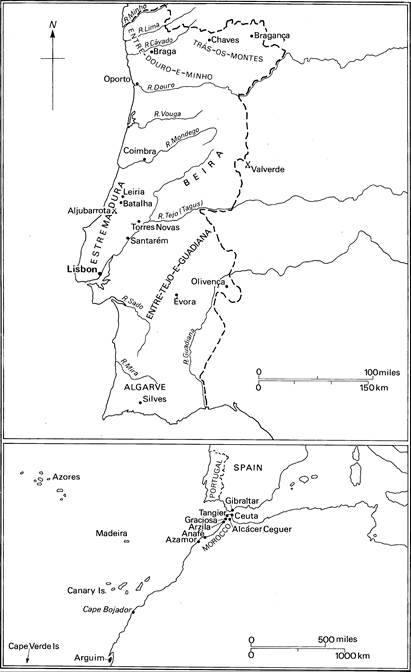
Map 14 Portugal (and the north-west coast of Africa)
By that year Portugal was already a mature country. It had been independent of Leon and Castile for over two centuries, during which nine rulers had reigned, and its boundaries had been almost finally defined since 1297. Furthermore, it had its own language, well-recognised political, administrative and social structures, a defined economic direction, a developed system of education, established international diplomatic relations, all backed by an emerging national consciousness. Yet by 1385 this country, although mature, was undergoing a serious dynastic crisis. Dom Fernando, the last king of the founding dynasty, had died in 1383, leaving no male heir. His only daughter, Beatriz, wife of the Castilian king, and Leonor, his unpopular widow, were endangering independence. The urban masses, linked in a movement of social revolt not particular to Portugal alone, were skilfully manipulated by the burgesses, intellectual elite and discontented nobility in support of what amounted to a nationalist uprising in favour of a palace revolution to regain lost honour and avenge insult. The regent widow’s lover, a detested foreign nobleman, was assassinated, and the assassin himself was declared a popular hero. With the queen’s deposition and flight went the Afonsine dynasty, the first to rule Portugal.
All this occurred in Lisbon and its outskirts in December 1383. The coup, master-minded by members of the nobility, was soon transformed into a popular and nationwide revolution, affecting both Oporto in the north and the south in its entirety. The hero gradually learned to live up to his new role. He was to be styled ‘ruler’ (‘regedor’) of the realm, then ‘ruler and defender’ (‘regedor e defensor’), and would finally be proclaimed king. Later he would earn the title of ‘Messiah, unvanquished victor, father of the Portuguese’ (‘Messias, vencedor invicto, pai dos portugueses’); later still, after two and a half centuries, there were those who would call him a saint. Such was Joao I, bastard son of King Pedro, half-brother of King Fernando, master of the Order of Avis, founder of the second Portuguese dynasty which, born of a union of Hispanic and English blood, was to be that of the future.
Between 1383 and 1495, the final century of medieval Portugal, there would be four reigns and one important regency. During about half the period under consideration, the reigns of Joao I and Duarte (1383—1438) were to witness the centralisation of monarchical power, the growth of the prestige and authority of the king and a consolidation of the state at the expense of landowners and municipal councils. Moreover, the expansion of Portuguese influence into Morocco and the Atlantic would be accelerated. The regency of the infante, Pedro (1438—48), would witness the continuation of these trends, now firmly encouraged from the centre and assisted by an alliance with the town councils, particularly with those with strong commercial interests. As a result, Moroccan expansion, associated with the nobility and costly in terms of lives and money, was to give way to an emphasis upon an Atlantic outthrust and the commercial possibilities thus opened up. However, the reign of Afonso V (1448—81), a man lacking a broad political vision, was to witness a setback in royal authority to the advantage of a revival of seignorial control by the great landowners and the Church; the crown would pay the price of the king’s neglect of political issues. In reaction, during the reign of his successor, Joao II (1481—95), centralist government was to become almost absolute, as king and state merged together. The king’s ‘Indies Plan’ was to be an indicator of the new directions towards which Portugal would now commit herself.
Of all the elements forming Portuguese political structures in the fifteenth century, the royal office was the most important. Long gone were the days when the monarch was seen as the equal of the nobility, superior to it only because of the extent of his patrimony. Since Afonso III (1248—79) such notions had been in decline. Partly through the influence of lawyers imbued with the Roman law which they had learned at Bologna, but mainly because of the growing interest in administration which accompanied the Christian reconquest of the south of the country, the transformation of the kingdom into a unified state had begun and would continue during the next hundred years. Towards this end fiscal, administrative, military, legislative and judicial measures had to be enacted. The most important of these were the confirmation of the grants of privileges to towns and villages, the creation of a national guild of archers, the institution of royal notaries public, the appointment of local magistrates, the transformation of royal councils into the cortes (or parliament), and the drawing up of laws aimed at avoiding the uncontrolled concentration of land owned by the Church. Thus, by the time that the Avis dynasty came to power, it could be said that the kingdom of Portugal was a unified state. By then it was already a political power enjoying stable geographical frontiers; it possessed permanent and impersonal secular institutions; and it was inhabited Portugal by a people who saw and understood the need for a supreme authority to which it was freely and loyally bound.
By 1385, then, the monarchy was a vital structural element within the state which, although still of limited capacity, was none the less growing. Joao I, Duarte, the infante Pedro and Joao II faced the challenge of strengthening and developing it. This would be achieved largely through the appropriation by the state of all powers of sovereignty: legislation, the execution of laws and policies, the introduction of direct and indirect taxation, decisions regarding war and peace, and the conclusion of treaties and alliances with foreign countries.
Thus, between 1385 and 149 5 the state began to grow. Yet the monarchy did not have it all its own way. The exercise of its powers was still to be opposed by what remained of traditional feudal structures, the secular and ecclesiastical landlords and town councils which, however, were themselves in the throes of bitter conflict. The secular landlords had a history which went back to before the days of the emergence of nationality; they dominated the north, around Entre-Douro-e-Minho, where countless noble families found their ancestral roots. That was why the north tended to be conservative, dominated by the nobility, scarcely urbanised, the only exception to this being Oporto, a city symbolic of bourgeois virtue and autarkic independence. The south was different, being in character largely urban and municipal, the area from which, in due time, the cortes would draw its main support. It, too, had its landlords, both secular and ecclesiastical, who, rewarded with lands, had settled there among communities in order to defend the reconquest. But they were largely members of the military orders who did not share the mentalities of the seignorial nobility of the north who were tied to their ancient, hereditary estates. While the north sent few representatives to the cortes, the lords of the south, forced to adapt to their new surroundings, chose to express their influence through that institution.
In this period much secular land, from one end of the country to the other, was in the hands of the nobility. But not all was subject to the same legal and political authority. Some nobles held land exempt from royal control, since they possessed property with rights of private jurisdiction (mero e misto impend); others had life tenures, some with the exercise of civil jurisdiction alone, others with both civil and criminal. The first form of tenure was passed from father to son, from reign to reign, kings being obliged to preserve the conditions of tenure unchanged through an oath sworn when they came to the throne; this happened until the time of Joao II, who refused to conform to precedent and turned all landlords into vassals. The second group, the lords of simple, lifelong jurisdictions, could not bequeath their titles to their heirs; nor could they preserve them by right as king succeeded king. However, out of respect for their predecessors, newly crowned kings normally confirmed such titles and, in effect, permitted hereditary succession. Since the same applied to their jurisdictions, all lands with such rights tended to be held in perpetuity. There were only two ways of incorporating these into the crown: through the so-called Mental Law (Lei Mental) of 1434, which was applied whenever the titleholder died without leaving a male heir; or through confiscation from those judicially sentenced for the crimes of heresy or treason. Both methods were not infrequently used.
On lands of private jurisdiction no royal fiscal, military or judicial power was applied until the reign of Joao II. Until that time, royal judges, even those dealing with appeals, were regularly prevented from carrying out their duties, orders and verdicts from courts of high jurisdiction being totally ignored. As we can surmise from the records of the cortes, lords went to the extreme of imposing upon their subjects taxes disguised as loans, and of requiring that they be addressed as if they were royalty. Thus the crown’s sovereign rights over these lands became non-existent. In such circumstances political power, expressed in the form of judicial and financial administration, was lost by the crown which could not control abuses. Thus secular lands with civil and criminal jurisdiction, and even the socio-political structures of the state, constituted real enclaves of power which competed with that of the king.
In the case of ecclesiastical lands the situation was worse, largely because of the confusion caused by the overlapping exercise of religious and civil authority. This was encouraged by bishops, abbots and other clergy who sought to further their extreme claims. Their abuses were the same as those of secular landlords, who were often related to them, but with the aggravating difference that they punished disobedient subjects, as well as overzealous royal and municipal officials, with interdicts and excommunications. There thus ensued this cynical paradox: churchmen used the threat of ecclesiastical censure against royal officers acting in the king’s name, while at the same time demanding that the king, as a loyal member of the Church, should punish with his secular power those whose crime had been to obey him. Kings, however, did not usually agree to such demands. Duarte, for example, was categorical on the matter, arguing that, since prelates were so quick to turn to the secular power for justice, they ought first to comply with its law, disregard of which was punishable by the secular authority. But such a judgement, however logical, proved ineffectual as a warning to ecclesiastics. Yet, because of the frequency with which it was used, excommunication as a punishment, the private weapon of ecclesiastical landlords, became discredited by virtue of being used as an instrument of political pressure. Not even in the reign of Afonso V did it regain its former effectiveness.
Evidence shows that, in most parts of the country, private secular and ecclesiastical estates covered a greater area than those of the crown, the exception being the region of Entre-Tejo-e-Guadiana, where royal property exceeded half the total. In the region of Tras-os-Montes, however, crown lands amounted to little more than one quarter. As a result, royal power, measured in terms of territorial control, was less than that of the nobility and clergy combined. None the less, because those who might have opposed him were not themselves united, the king remained in effect the most important lord in the countryside.
The great estates found at the beginning of the Avis dynasty were the traditional ones, bishoprics, monasteries and the military orders whose lands were found in both town and countryside. Among the most important were those of Oporto and Braga, which Joao I secured for the crown in 1402, when all cities came to be recognised as belonging to the crown; only Braga, seat of the primate of Portugal, eventually had its former independence restored, reverting to archiepiscopal control in 1472. Of the great monastic estates, basically rural in nature, many were north of the river Tagus. In the case of the military orders, of which that of Santiago stands out, we note that they controlled 40 per cent of the lands and rents of Entre-Tejo-e-Guadiana, 19 per cent of Estremadura and 13 per cent of Beira. It is clear that the great abbeys and the four masterships of the military orders constituted seignorial potentates who, therefore, never ceased to attract the attention of the crown. Hence abbots’ staffs and masters’ swords were placed in the hands of the monarchy’s most trusted servants. It comes as no great surprise that few dangers for the kings were born from these notionally powerful men. This succession of titleholders was kept well under control.
The same cannot be said, however, of the great secular lordships. Handed down from one generation to the next, they served to support persons ambitious for power who could threaten the prestige of kings and their freedom to rule. Joao I saw this in his constable, Nun’Alvares Pereira, the owner of riches the like of which Portugal had never seen. By marrying his son, Afonso, to the constable’s sole heiress, the king solved his own problems but multiplied those of his successors, since this marriage created the house of Braganga which, accumulating great quantities of land, was to be the cause of misfortune for the regent Pedro and, eventually, a seat of conspiracy against Joao II. When this prince ascended the throne in 1481, there were two secular lordships which were excessively powerful and potentially dangerous: that of the house of Braganga, and that of the duke of Viseu e Beja. Their titleholders, Fernando and Diogo, that year stood in the cortes in opposition to the new king who, as everyone knew, was determined to rule with a strong hand. Their daring, or their wealth, was to cost them their lives.
A brief consideration of the town councils, a further element in the structure of the state, is called for. The powers of the municipalities during this period were limited, dependent as they were on the king and the private estates. As a result, they were open to the authority of powers outside their control: royal judges, non-elected magistrates and their officials and tax collectors. The ancient freedoms and exemptions once enjoyed by the towns, and witnessed to in their charters of government, in matters concerning lands, taxation, justice and military affairs were gradually being undermined. New charters were being imposed; indirect local taxes (sisas) were being appropriated to the crown; royal judges were extending the king’s authority; weights and measures were being harmonised. Local autonomy was now increasingly restricted to matters of price-fixing, overseeing public works of a civil nature, judging minor crimes, drawing up lists of contributors to the extraordinary taxes (pedidos) and, in some councils, taking complaints and criticisms before the cortes. It is notable that it was in the cortes that the political power of municipalities flourished, and thus became a force in terms of the whole country. Although weak and divided at the local level, in the cortes, where they represented their communities and dared criticise kings and censure the nobility and clergy, the councils exerted real power capable of producing results. The reduction of their authority at the local level had the paradoxical effect of compelling the councils to seek group solidarity, which confirmed them as a political structure of the state, and the cortes as the institution in which they could exercise their influence most effectively. On several occasions, in 1433, 1439, 1459, 1472—73, 1477 and 1481—2, they acted in this way against the authority of landowners, clergy and crown in spite of their dependence, at a local level, upon each of these. Thus the effective political power of the councils as one of the state’s structures was characterised by being a force for criticism and for acting as the conscience of the nation. As such, that power had to be respected.
The two reigns of Joao I and Duarte reveal coherent continuity, a result of the fact that Duarte was associated with his father’s rule in the last third of the latter’s very long reign. By 1412 he was linked with the politically most sensitive areas of administration, those of justice and finance. Thus administrative measures as important as those decided in the cortes of 1427, or the very significant agreement (concordata) reached with the clergy in that assembly, can be attributed equally to father and son. In the cortes of 1433, the first of Duarte’s reign, it was made clear that the previous style of leadership would not be abandoned; there might be evolution and progress, but no great changes.
Joao I, elected to the throne after a troublesome interregnum, had found himself among candidates, notably Beatriz, daughter of King Fernando, and his half-brothers, Joao and Dinis, sons of King Pedro and Ines de Castro, with better claims than his. The cortes held at Coimbra, at which the supporters of Beatriz were not represented, divided into two camps. One, supported by the councils and lesser nobility, stood by Joao, Master of Avis. The other, reflecting the power of the higher nobility and, probably, the majority of churchmen, preferred Joao or Dinis. The official speaker of the cortes, the jurist Joao das Regras, clearly affiliated to the first group, argued at great length the ineligibility of the Master’s opponents, or at least the inconsistency of the fundamental motives for supporting them. His advocacy was decisive in assuaging legitimist scruples, but could not convince the followers of the infantes. Finally, after a month of indecision, the cortes unanimously elected the Master of Avis. Unanimity had seemingly been achieved. For years the new dynasty would be preoccupied with creating both within and without the kingdom an image of unblemished legitimacy, both charismatic and nationalist, sanctioned by law, by the people and, above all, confirmed by God. The work of future chroniclers and propagandists, continuously encouraged by the Avis dynasty, is clear proof of this.
It was on 14 August 1385, a few months after taking the throne, that Joao I faced the most dangerous moment of his life: confrontation on the battlefield with the Castilian king who, for the second time, had invaded the country in person with the intention of pursuing his rights to the succession, married as he was to the only daughter of the late king, Fernando. The forces on that day were very unequal, the Castilians having the advantage. Yet whether it was because the Portuguese had time to prepare the field, or because their tactics disconcerted their opponents, or because the Castilians, perhaps already exhausted, underestimated their enemy, within a few hours the conflict had been resolved; Joao and his constable, Nun’Alvares Pereira, had secured the most resounding victory in the history of their country. Still to be seen today at Aljubarrota, there lies the tomb of the victor, one of the finest monuments of Portuguese architecture, the monastery of Santa Maria da Vitoria, better known as that of Batalha (Battle). Such a victory was soon proclaimed a miracle, divine confirmation of the election made at Coimbra and of the right of the dynasty to rule. God, always on the side of legitimacy, had descended upon the field of Aljubarrota; Joao das Regras had been right.
Epic language glorified the interpretation which would be made of the facts. Such is apparent from the epitaph of Joao I at Batalha, where only two great deeds were recorded: the battle of Aljubarrota, which saved Portugal and the dynasty, and the capture of Ceuta, which avenged the honour of Christianity and of Spain. Having been defeated, the king of Castile fled. Towns and villages which had been loyal to him now quickly surrendered to the Portuguese victor. Once again Portugal had remained intact, her own king now firmly in control. Yet men would have to wait many years for a final peace: pacts negotiated in 1402 and 1411 were to be two important stages in this process.
Joao I was to go down in history as the ‘king of good fame’, this honorific reflecting dynastic propaganda as well as patriotic and political feelings. It is certain that such attitudes affected the people who, in 1451, eighteen years after his death, named him ‘Father of the Portuguese’. However, life was not easy during his reign. Until 1411 his people lived close to a state of continuous war; monetary inflation reached very high levels; according to the records of the cortes the people’s traditional complaints against the privileged persisted and even increased; the extraordinary taxes (pedidos) not only became chronic but were introduced without consultation with the cortes and were employed for uses other than for national defence; and, finally, the indirect municipal taxes (sisas), highly criticised and regarded as tantamount to robbery, were appropriated to the crown as if they were legal rights. So the description of the king as being of ‘good fame’ is highly equivocal.
The reign of Joao I can be divided into two periods. The first lasted until 1411 or 1412, the second from then to 1433. The first was marked by the war with Castile, and by the consolidation of the country; the second by the war of Moroccan expansion and the beginnings of continuous Atlantic exploration. Running through these periods were administrative developments, with the king at the centre of them all.
From the time of the success at Aljubarrota until 1411 attempts were made to reconquer the towns and districts which had shown loyalty to Beatriz and the Castilian king, a task completed in 1388. Meanwhile, as raids and even a battle in enemy territory (Valverde) were taking place, the Portuguese were also strengthening international alliances, particularly the reinvigoration of the alliance with England established in 1373. In 1386 the Treaty of Windsor was sealed, an alliance which resulted in the integration of Joao I’s own conflict into the wider Hundred Years War then dividing western Europe. Later, after many precarious truces had been made only to remain ignored by both contenders, the pact of 1402 was negotiated, declaring peace for ten years. Its terms would be observed and in 1411, at Segovia, final peace was agreed under conditions which brought hostilities between the two Iberian kingdoms to an end. Joao was now the unchallenged ruler of a country which had returned to its traditional borders dating from 1297. There was now time to consider overseas expansion.
There had been earlier forays into the Atlantic, but these had been spasmodic, almost accidental, and had met with little success. The first step towards systematic expansion was achieved by the conquest of Ceuta, in Morocco, in 1415. Alternative options for military assault, some in the peninsula (Granada and Gibraltar), others in Morocco and the Canary Islands, had already been considered. It is difficult to explain such a need to conquer. Economic, political, religious, social and historical reasons, many of which do not concern Portugal alone, must have worked together to syncretise powerful ambitions. Yet, from an economic and strategic point of view, Ceuta proved to be a disaster, a real consumer of people, goods and money. Early on, voices representing the people, the bourgeoisie and even some members of the royal circle, protested against keeping Ceuta, or at least against the political attitude which it represented. Yet Ceuta represented honour and titles; it looked back to past crusades and forward to others still to come; and it served as a sign of monarchical prestige and of Portugal’s good name in Rome and in all Christian lands. So Ceuta was retained and other strong points, equally symbolic, would be sought. Among the recommendations left by Joao to his successor was that Ceuta should continue to belong to the crown, and that Tangier should be added to it.
While Ceuta was becoming an extension of Portugal, the Atlantic was being travelled and discovered (in some parts rediscovered) to the west and to the south: Madeira (1419—21), the Azores (1427—32), the African coast as far as Cape Bojador, bordering the Mar Tenebroso (1422—33). The exploration was carried out largely by adventurers, encouraged by the man who, to this day, remains a puzzling figure, the infante, Henry, known as ‘the Navigator’. The result was that, when Joao I died in 1433, Portugal had the bounds she has today, in addition to ruling the territory of Olivenga, the Atlantic islands of Madeira and the Azores, as well as Ceuta in North Africa.
At home it was Joao’s aim to increase the royal authority over the clergy, the nobility and the town councils, and to create an aura of prestige across all Europe. It would be wrong to say that the force behind the idea was state interest; rather it was the confirmation of the king and the new dynasty which was being sought. Many texts, propagandist in character, such as the epitaph at Batalha and the moral portrait of Joao recorded by his successor, Duarte, in his work, the Loyal counsellor (Leal conselheiro), demonstrate this.
In order to free himself from those who had helped to give him power, and to keep the clergy and the nobility under reasonable control, Joao sought the support of the municipalities in twenty-eight cortes which met between 1385 and 1430. On these occasions, for example, measures were taken with regard to wage regulations, the movement of the workforce, the administration of municipal councils, the scope of influence of royal and seignorial officers, the rights and prerogatives of the privileged classes and the jurisdiction of churchmen. In addition, and in spite of the pope and the episcopate, an agreement (concordata) favourable to the monarchy and consisting of ninety-four chapters setting limits to ecclesiastical privileges was negotiated with the clergy at the cortes which met at Lisbon in 1427. In the cortes, too, the jurisdictions and rights, as well as the obligations of the nobility, were defined, mainly touching matters ranging from the payment of taxes to punishments for abuse of power over subjects. The Mental Law (Lei Mental), applied before it was ever published, clearly shows the degree of authority achieved by the king who had already placed under his close control the only other great estate competing with his own, that of the constable, Nun’Alvares Pereira. As for the municipal councils, associates with the king in the process of centralisation, they were to accept the authority of royal judges. Furthermore, as the needs of war demanded, indirect municipal taxes and traditional extraordinary taxes were also levied. The aim was to raise both sorts of levies as a normal part of royal revenue, one permanent and general, the other extraordinary, to be sought only at the king’s discretion. The first aim was achieved; the second, while it proved successful in the case of the marriage of the infantes, Pedro and Duarte, was to continue to depend upon the approval of the cortes.
Lord of the realm, Joao I did not forget the importance of establishing links with the rest of western Europe, not specifically to prevent wars or to secure support, but because it was part of the notion of monarchy, and was necessary for the fame and prestige of the new dynasty. As the chronicler, Zurara, noted, it was important to belong to the princely club of Europe. Thus through the safe and traditional process of marriage, Portugal and its dynasty came to be linked with Aragon, Burgundy and England; in the last case, ties already established by Philippa of Lancaster were further strengthened. Relations also improved with the Empire, with Hungary and with the Papacy, thanks to the exchanges of embassies and the prestige gained by the capture of Ceuta. It can thus be said that when Joao I died on 13 August 1433, there died a true king who had achieved much in spite of the opposition which he had met. Military successes had been won; independence had been finally achieved. The king merited the reputation which soon came to be accorded him by people and writers alike.
The man who had come to personify the growing spirit of national awareness was succeeded by Duarte, who ruled for five years. Little need be said about him since, as already noted, he had taken charge of important aspects of government some twenty years before inheriting the throne. Yet his achievement should not be under-rated. He continued existing policies, maintaining counsellors and high-ranking servants of the crown, as well as following already proven political policies, in such a way that there was a coherent development in the conduct of Moroccan business, in overseas expansion, in the process of royal centralisation and in the area of foreign relations. In the first cortes to meet (Leiria—Santarem, 1433) from which there survive 155 general proposals (capitulos gerais), Duarte showed himself to be a mature politician, attentive to the municipal councils, firm with the nobility, determined to suppress the abuses of jurisdiction by the clergy. Two reasons have been invoked to belittle his personality and cast a shadow over his reign: the psychological depression which seized him when, as a young man, he was first brought into contact with government; and the failure of the expedition against Tangier. Neither should be held against him. The illness from which he suffered was effectively overcome. And, while the failure before Tangier, where the Portuguese suffered the embarrassment of ‘going for wool and coming back shorn’ was, indeed, something of a military humiliation, it is clear that Duarte was not only king in name, but acted as such, consulting groups within the nation, encouraging the seeking and giving of advice, and not being afraid of accepting responsibility for decisions taken.
Duarte died of the plague on 9 September 1438. Since his heir was a six-year-old boy, he naturally left the regency in his will to his widow. The decision, however, displeased the country, not only because it feared that the regent would place the independence and peace of the kingdom in danger through the influence exercised by her Aragonese brothers, then in rebellion against the king of Castile, but even more so because it believed that the government would be better placed in the hands of a man. Hence, in the cortes convened at Torres Novas at the end of 1438, a royal ordinance was approved by all members, applicable until the political majority of King Afonso V should be reached, according to which power would be shared between the queen-regent, the infante, Pedro, and a council of nine who would all meet specifically once a year for consultation. The solution, however, proved ineffective. Within seven months the co-regents had fallen out, and the cities of Lisbon and Oporto, determined to hand over the government to the infante, actively sought to achieve this in the cortes which met in Lisbon in December 1439. In this they succeeded. The ordinance of Torres Novas was revoked and, through popular pressure, the infante, Pedro, was declared ‘protector and guardian’ (‘tutor e curador’) of the king and ‘ruler and defender’ (‘regedor e defensor’) of the realm. Supported by certain internal forces and by promise of help from the infantes of Aragon, the queen-regent tried to resist. However, when all failed, she had no choice but to go into exile in Castile, where she died in 1445.
Pedro, brother of the late king, a man of wide experience and considerable learning, had for some time shown that he possessed ideas on how to run the country. The letter which he had written to Duarte from Bruges in 1425 or 1426 was the manifesto of a statesman, expressing advanced opinions on all kinds of matters. In these he stressed the needs of the country above private or sectional interests. Yet it is one thing to offer advice from a distance, quite another to govern. The regent Pedro did, in fact, have to assume ambivalent positions.
From the start Pedro was a man imprisoned between two groups, indeed between two epochs. On the one hand were the feudal landowners among whom he had been brought up; on the other, the urban bourgeoisie whose position in the developing world of the day his practical experience had taught him to appreciate. He had achieved his position as the result of action by the town councils, particularly that of Lisbon; in the circumstances he could have allowed political demagogy to take over. Yet he refused to let this happen, blocking all attempts to make a popular hero out of him, and refusing to become a caudillo against the clergy and the nobility. In the very cortes which, through popular pressure, conferred on him the regency of the kingdom and the tutelage of the king, he stressed that he would not prejudice the privileges of the landlords and nobility. His aim, as he made it known, was not to benefit particular groups, but to serve the country and all its estates. His government would have to find a balance between the older and the newly emerging world.
Historians are divided in their appraisal of the regency. For some it was a period in which royal centralisation not only progressed but even, by separating the person of the king from the exercise of power, assumed the form of state centralisation, foreshadowing the ‘Caesarian’ model which would be confirmed by Joao II four decades later. For others, precisely the opposite happened. By such, the regent Pedro is regarded as the inaugurator of a neo-seignorialism which would be well expressed during the reign of Afonso V. Both appraisals may be exaggerated. However, a consideration of the king’s concern to give the country a coherent legal structure, of the way in which external politics were conducted, of the conduct of an expansionist movement decidedly biased towards Atlantic navigation to the detriment of exploits in Morocco, coupled to the attention bestowed upon merchants and burgesses in the cortes of 1446 in which Pedro was re-elected to the regency — all these and other indicators suggest that the first appraisal comes nearer the truth. Pedro’s government witnessed two things: first, the continuation of royal centralisation which had been gradually established over the years, particularly since Joao I, against the interests of the clergy, the nobility and the councils; and, secondly, the confirmation of the state as the vehicle of direction and control of the interests of the common good (res publica), a term now beginning to appear with greater frequency.
As for the municipal councils, although their initial fervour of 1439 began to cool off, they never really cherished any other policy or leader, preferring to see what might be achieved by tactical opportunities. So while the crowd was to criticise Pedro after his downfall, the councils kept silent. Indeed, they suffered from the departure of the regent, for his rule was to be followed by a period of revival of secular and ecclesiastical seignorialism. The proposals of the cities and towns presented to the cortes between 1451 and 1475 are witness to this, as are those offered by the clergy in 1456, together with the respective replies which annulled decades of royal effort towards centralisation. A reading of contemporary chronicles confirms this view. It is clear that, in the fifteenth century, councils did not agree with either nobility or clergy. So when the councils lost power, the law was used to the advantage of noble and clerical privilege, and the state bowed before a revival of feudalism.
Any study of Afonso V must take into account the facts of his childhood, for he was left fatherless at the age of six, and he became, in practice, motherless a year or so later. The conditions and circumstances of his formative years are, therefore, crucial. Probably the greatest political error of the regent, Pedro, should be sought in the way in which he allowed the young king, his nephew who also became his son-in-law, to be educated. It was an education for great deeds, but one pursued in defiance of reality and the pragmatism required for the proper handling of government. In 1455 , when the last crusader pope, Calixtus III, ordered an expedition against the Turks, Afonso took up the cause with enthusiasm. He summoned the cortes in order to obtain money, formed regiments of soldiers, minted coin to pay for the cost of the enterprise, despatched ambassadors to other countries, reinforced garrisons to prevent unexpected attacks from the Moors, and at the same time easily obtained imperial edicts to raise tithes and to sell indulgences. At the crucial moment, however, the great international expedition never materialised. What was Afonso to do with his army? In 1457 the decision was taken to crusade in Morocco. In the following year Alcacer Ceguer was conquered. In 1463—4 another expedition against Tangier failed. In 1471 it became Arzila’s turn. Ironically, in this same year, Tangier, now uninhabited, was occupied ingloriously. Anafe (now Casablanca) had also been conquered in 1469, but was soon abandoned because of its difficult position in the south. Here Afonso’s African conquests ended. Shortly after the capture of Alcacer Ceguer, he gave himself the title of ‘king of Portugal and the Algarves on this side and beyond the sea in Africa’, a fine-sounding title, but one lacking real substance. Economically, financially and militarily this ‘Africa’ brought nothing. Much more would be gained from Arguin, Mina and all Guinea, regions of continental Africa in which ‘the African’, as Afonso was called, showed little interest.
The expansionist policies of Afonso V appeared to have forgotten the Atlantic and the peaceful commercial contacts with Black Africa stimulated by the regent, Pedro. If anything was achieved between 1448 and 1475 in terms of Atlantic expansion, it was due to the initiatives of individuals, mostly merchants, born out of recognition that navigation brought in profits. The wealthy Lisbon merchants, Fernao Gomes, for example, bid successfully at the auction which enabled him to trade with Guinea, a step which made the advance of the discoveries to the south possible. Others, such as Martin Anes Bom-Viagem, won further monopolies. In effect, the discoveries were literally put up for public auction by Afonso, as if he were dealing with real estate to be allocated to the highest bidder. The representatives at the cortes which met at Coimbra—Evora in 1472—3 were to protest vigorously against such a way of acting. As a result the king, in 1475, handed over to Prince Joao oversight of a heavy responsibility, that of navigation and Atlantic commerce.
In that year, as Moroccan conquests were running smoothly, Afonso V halted them and initiated a new phase in foreign policy. He returned to the Iberian peninsula, cherishing the idea of becoming ruler of a united Spain and Portugal. It was an old ambition which had never been far from Castilian minds, but in Portugal it had inspired only one king, Fernando, a century before Afonso V. As on the first occasion, the project failed. The opportunity to fulfil a dream, planned, it seems, since 1465, occurred with the death of Enrique IV of Castile in December 1474. The late king, who had married a sister of the Portuguese monarch, had bequeathed the succession in his will to his only daughter, then aged eight, who, at the appropriate time, was to marry her uncle, Afonso V, who, in the meantime, would act as regent. To carry out these intentions, after taking counsel at Estremoz, convening the cortes at Evora, investing Prince Joao as his lieutenant in Portugal and securing support in Spain, Afonso invaded Castile in mid-1475. After many setbacks, he sought support in France; failing to secure it, he proposed to abdicate and become a hermit in the Holy Land. Persuaded to return home, he delegated many powers to his son, and eventually died in 1481. In many respects he had failed to recognise and come to terms with the changes which were taking place around him.
At home, Afonso pursued policies of protecting the Church and the nobility, as well as encouraging neo-seignorialism. The councils reacted persistently against such policies, in particular in the cortes; most notable were the complaints presented in 1459 and in 1472—3, and those laid before Joao II in 1481—2. By this time monarchical power was considerably weakened and diminished. Joao II summed it all up in one sentence. Ownership of the roads of Portugal, he stated, was all that his father had left him.
Joao acceded to the throne twice, once at the end of 1477 when his father abdicated while in France, and again in 1482 when his father died. Born in 1455, he was scarcely twenty when he began to govern the county as regent. Although young, he was clear minded, decisive and pragmatic, very different from his parent. When he took over government, it was as if Portuguese politics had suddenly jumped into a more modern world. The ‘perfect prince’, as he was later called, was a good military leader, a sound administrator, an able diplomat and the manager of a policy of expansionism both into north Africa and into the Atlantic. The ‘Indies Plan’ was probably his handiwork, along with the rounding of southern Africa and the negotiation of the Treaty of Tordesillas (1494). Vasco da Gama, who discovered the sea route to India, and Alvares Cabral, who discovered Brazil, were the crowning glories of the effort of the ‘Discoveries’ to which Joao gave consistent and systematic support. At the same time, the process of peaceful mercantile relations with Black Africa were resumed, the fortress of Mina was founded, and Joao II became the first European ruler to establish friendship and cultural relations with an African ruler, the king of the Congo. Yet, as a prince of the house of Avis, he also turned his attention to Morocco, and even cherished the idea of dominating the whole area commercially. This he failed to achieve, in spite of founding the town and fortress of Graciosa (soon abandoned) to the north of Arzila. But he did obtain Azamor, which would be an important name in the following reign.
In all endeavour abroad, even in Morocco, Joao preferred to achieve peaceful accords rather than to use force. None the less, force, on land or at sea, was always available for use, or as a weapon of dissuasion if required. When Spanish corsairs ventured to the south of Cape Bojador, an area declared by Joao to be ‘mare clausum’, they were systematically and unceremoniously sunk. Concerned with the transformation of his ships into a force to be reckoned with, he had sketched in his own hand a project according to which artillery used on land might function effectively on the decks of small caravels. Of this development the chronicler Garcia di Resende was to write:
to guard his coast with greater security and at less cost, [the king] devised and commended small caravels which carried great cannon ... He was the first to invent this . .. Portuguese caravels were so feared on the sea for so long that no ships, no matter how large, would dare to confront them, until they discovered how the cannon were transported.
In Portugal itself, Joao continued the policy of centralisation interrupted by his father, a policy which he took to unexpected extremes. Tactically supported by the councils, from whose energy he had learned to profit in the first cortes of his reign (1481—2), he revived the reforms, first proposed by the representatives of the commonalty ten years earlier, but which, in the meanwhile, had been put aside. These led him to decree that royal judges were to enter any jurisdiction, privileged or not; that all general confirmations of privileges and landownership were to be suspended until evidence of title had been worked out; and that charters were to be reviewed and brought up to date. All this was done after antagonising the duke of Braganga and other magnates who were obliged to take an oath in the style and according to the formula demanded of municipal governors, whereas the king, contrary to tradition, made it plain that he would take no such oath, because princes should not have to do this. In view of this action (and much else) Joao drew against himself the hatred of high churchmen and the great nobility. The result was a struggle to the death which would subside only after the public execution, in 1484, of the duke of Braganpa and the assassination, carried out by the king in person, of the duke of Viseu e Beja, along with the execution of some lesser noblemen and the imprisonment of a number of churchmen. In this way, through administrative, judicial and, on occasion, arbitrary intervention, the neo-seignorialism of the reign of Afonso was destroyed. From now on, dispensing with the support of the councils, Joao II governed the country like an absolute lord. With him the Portuguese Middle Ages ended and the modern age, that of the country’s great achievements, began.