
The system of alliances among imperial provinces and cities in the area between the Alps, the Jura mountains and the Rhine, known as the Swiss Confederation (Schweizerische Eidgenossenschaft), emerged about the year 1500 as a distinct political unit within the German Empire. The Confederation as a whole occupied no clearly defined territory. However, by 1500, the northern limits of its sphere of influence ran more or less along the Rhine as far as Lake Constance. In the east, its frontier with Graubunden was unclear; the west of what is now Switzerland was largely under the dominion of Savoy; south of the Alps, the hegemony of Milan persisted until shortly before 1500. Within the Confederation of cantons, or Orte (the traditional name for members enjoying full rights), with their widely differing structures and identities, each guarded its freedom of manoeuvre in both domestic and foreign politics, but, by 1500, did have a visible political cohesion.
The Confederation, at first just one of the numerous systems of alliances existing within the German Empire, had not succeeded in giving itself a more stable framework until after 1350, and then only hesitantly. Alongside the free imperial cities of Berne and Zurich, the centres of political power within the federation, the cities of Lucerne and Zug appear as early as the fourteenth century as full members of the Confederation. Fribourg and Solothurn already belonged to this circle well before the end of the fifteenth century, when their membership, like that of Basle and Schaffhausen, became more binding. Among the rural communes, important members of the alliance were the valley communities and imperial districts in the alpine region of central Switzerland; other rural members were Glarus and the hinterland of Zug. The three forest cantons (Waldstattee) of central Switzerland, Uri, Schwyz and Unterwalden, had formed a closer alliance towards the end of the thirteenth century, and consequently are often found acting together.
By 1500 the subject hinterlands were also part of the Confederation. Some were ruled by a single city — Zurich, Berne or Lucerne; others, like Aargau and Thurgau in the Rhine valley and (in part) Ticino, were dominated and governed jointly, as mandated territories (Gemeine Herrschaften), by more than one of the Orte. Moreover, around the geographical and political area of the confederal Orte was a whole network of more or less close alliances among a wide variety of partners. Among these associated members (Zugewandte Orte) were the Three Leagues in Rhaetia, the Upper Valais, the abbot of St Gallen, the count of Greyerz and some individual towns such as Rottweil and Mulhouse.
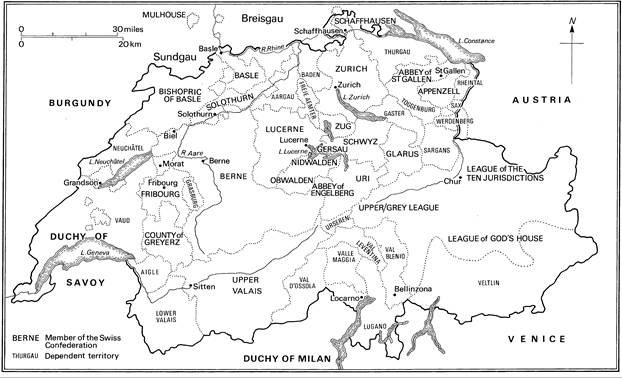
Map 15 The Swiss Confederation and it neighbouring territories, c. 1500
Most treaties among the Orte were only bilateral. Some of them went back into the fourteenth century and assured mutual assistance and supervision. The oldest extant agreements between Uri, Schwyz and Unterwalden, dating from 1291 and 1315, were primarily concerned with keeping the peace and securing the privileged position of local elites; in this, they did not differ from other contemporary treaties. Only in modern times has the covenant of 1291, the Bundesbrief, been taken as the founding document of the Confederation. Much more significant, among the bilateral treaties, is the League of Zurich (Zurcher Bund) of 1351, by which the Ort of Zurich and the forest cantons promised one another aid against the Habsburg overlord. This became the pattern for other links between members of the Confederation.
Such bilateral treaties were regularly renewed, especially in the years immediately after 1450. By contrast, comprehensive alliances including many or all of the Orte were infrequent, thus highlighting the significance of the Compact of Stans (Stanser Verkommnis) of 1481. The lack of constitutional and conceptual unity within the league of confederate towns and provinces reflects the fact that very few such all-embracing institutions existed at all until much more recent times. Can we speak of the Confederation in 1500 as a ‘state’? Only with the greatest reservations. Although the political elites may have had some notion of the Confederation as a self-governing political entity and even, in certain circumstances, some show of solidarity, the concept of ‘state’ has to be applied primarily to the individual territories.
How did this development of the state, unique in contemporary Europe, come into being? Our knowledge of political events is relatively good. The great merit of earlier Swiss historiography remains unquestioned, but the present generation of historians has assumed a certain critical distance from the nationalistic exuberance which led such writing to view the period as a time of ‘great-power politics’ and ‘vigorous maintenance of independence’. Recently, horizons have been greatly extended by an increased awareness of the political and economic environment of the Confederation, and a comparison with circumstances in the rest of Europe. Discussions of the making of the modern state have become as prominent as the drive to relate political evolution to structural changes in the economic, social and cultural environment, and in mental outlooks. Given the serious gaps in our knowledge, however, such links are often hard to make. Only slowly have historians come to realise the implications of the fact that other political developments and traditions existed in late medieval Switzerland (or in what we now call Switzerland) alongside the Confederation itself. There is still need for research into political relationships in the west and south of the country; into small ‘non-confederate’ states such as the abbey of St Gallen; and generally into the history of the former dependent territories. There are thematic gaps as well. What follows will concentrate on the changes in the old patterns of political power and on the emergence of new structures within the urban and rural communities. The consolidation of the state within the confederate communes brought integration, but it also led to internal conflict. Finally, the European role played by Switzerland, largely through its mercenaries, and the rise of national consciousness will be examined. In all this, how unique can Switzerland claim to have been?