
‘Russia’ is the state descended from the grand principality that coalesced around Moscow in the fourteenth century and began the historical continuum that extended to the Russian Empire (1725—1917), the Soviet Union (1917—91) and modern Russia. The fifteenth century was one of the most significant, and underappreciated, centuries in Russian history. At the century’s beginning the grand principality of Muscovy stretched from Mozhaisk (about 100 miles to Moscow’s west) eastward to the Suzdal'-Nizhnii Novgorod grand principality (subject in part to Moscow since 1392), from Riazan' in the south-east to the northern forests of Beloozero, Vologda and Ustiug. But its power was more tenuous than this geographical expanse would suggest. Moscow’s hold in the north and in Suzdal' was superficial; surrounding Moscow lay myriad principalities ranging from the weak Rostov and Iaroslavl' to the more potent grand principalities of Riazan' and Tver'. Powerful rivals included the city republics of Novgorod and Pskov, not forgetting the grand duchy of Lithuania. Yet by the end of the century Moscow had achieved clear dominance in this area often called north-east Rus' (in reference to the Kiev Rus' state that flourished from the tenth to the twelfth centuries and bequeathed to Muscovy some important heritages). The key to Moscow’s success lay in the means, both institutional and symbolic, that it devised to consolidate its authority and to exploit and mobilise social resources. Those means of governance and ideological constructions endured for at least the next two centuries, and resonated beyond.
Sources for fifteenth-century Russia are by no means abundant, but in some areas, such as politics and diplomacy, they are remarkably rich. Chronicles flourished, with codices being compiled in the grand duchy (Smolensk), Ukraine, Moscow, Tver', Rostov, Vologda, Perm, Novgorod and Pskov. Jan Dlugosz’s history reflects on the grand duchy; travellers to the grand duchy and the north-east offer interesting accounts (Gilbert de Lannoy, Josafo Barbaro, Ambrogio Contarini and others). Treaties survive from Novgorod, Pskov, Moscow, Tver' and the grand duchy with neighbouring powers and appanage kinsmen. Muscovite princely wills also survive. For social and economic history, extant sources are much weaker. Secular and ecclesiastical lawcodes from the Kiev era (the Nomocanon, or Kormchaia kniga; the Just Measure, or Meriolo pravednoe; the Charters of Vladimir and Iaroslav; the Russian Law, or Russkaia pravda) continued to be copied, edited and applied in the grand duchy, Novgorod and the north-east. Codifications of law and judicial procedure also appear: Pskov, 1397; the grand duchy, 1468; Novgorod, the 1470s; Moscow, 1497. The Lithuanian state chancellery records, collected in the ‘Metrika’, are rich, while for Muscovy only military muster rolls and some diplomatic records were produced at court. For north-east Rus', there survive documents of land transfer, wills, genealogies, some litigation over land, a few Novgorod and Tver' cadastres and a charter of local government (to Beloozero, 1488). Finally, saints’ lives offer details of daily life.
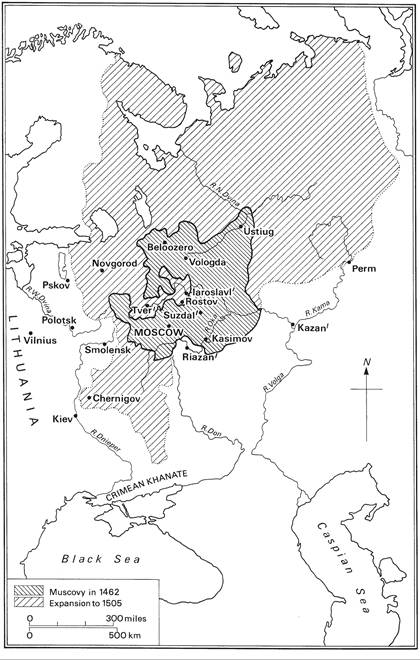
Map 19 Russia
The chronicle of Muscovy’s regional expansion and geopolitical interaction displays vividly Moscow’s successes. The dynamics of geopolitics in this century were structured by Moscow’s rivalry with the grand duchy of Lithuania. The Kipchak khanate (or so-called Golden Horde) — westernmost outpost of the Mongol Empire, populated primarily by Tatars — had disintegrated by the early decades of the century and its splinter groups played only supporting roles in the regional balance of power: the khanate of Kazan' existed by the 1440s, producing a khanate in Kasimov in 1452 that generally acted as a Muscovite pawn; the Crimean khanate was controlled by the Girey clan by 1443; the Great Horde on the lower Volga coalesced in the wake of the destruction of Sarai by Timur (Tamerlane) in the first years of the century. The arenas of geopolitics focused on the region’s two spheres of commercial activity, the Baltic and the Volga. From the mid-fifteenth century the Baltic witnessed a trading boom that lasted until the early seventeenth. It focused on grain exports from the Polish, Ukrainian and Belarus’an hinterlands, shipped at Stettin, Danzig, Konigsberg and Memel. Ports and trade centres farther north — the Livonian towns of Riga, Dorpat (Tartu) and Reval (Tallinn), as well as Novgorod and Pskov — continued to export forest products, primarily furs and wax. A prominent casualty of the heated competition on the Baltic was the Hanseatic League, whose monopoly on Baltic trade disintegrated from the pressure of various forces: national governments anxious to capture income from the Hansa towns; the competition of Dutch, English, southern German and Swedish merchants; and a breakdown of discipline within the League itself. By the second half of the century Novgorod’s economy also declined precipitously. Novgorod became embroiled in self-destructive conflicts with the Hansa; it suffered from competition in Pskov, Smolensk, Polotsk, Moscow and Kazan' (which was taking over the middle Volga and Kama basin from the Volga Bulgar khanate, which had been decimated by the collapse of the Mongol Empire at the end of the fourteenth century); Novgorod’s trade empire proved to be inflexible, for it remained based on squirrel fur when European demand shifted to luxury fur by mid-century.
The Baltic trade enhanced inland routes extending from Moscow and Tver' westward to Novgorod and Pskov or to centres in the grand duchy such as Velikie Luki, Toropets, Vitebsk and Polotsk (both on the western Dvina), Smolensk and Vilnius. With trade on the Volga river eclipsed by Tatar strife, the Dnieper returned to its Kievan-era glory. Towns of the grand duchy on the Dnieper route, such as Chernihiv (on the Desna), Smolensk, Pereiaslav and Kiev (all on the Dnieper), Turov (on the Pripet) and Volodymyr in Volhynia flourished, while north-east Rus' merchants developed trade routes through Kolomna and Riazan' (on the Oka) to the upper Oka basin and on to the headwaters of the Desna, Dnieper and Don, and across the steppe to the Black Sea. The transit of goods to and from Europe and the east — once traversing the Mongol ‘silk road’ across the steppe through an axis at the Caspian Sea — now pivoted around the Black Sea. Genoese colonies at Soldaia (Sudak, Surozh) and Kaffa not only received annual expeditions of northern merchants from towns in the grand duchy and north-east Rus', but sent their own merchants (Italians, Tatars, Greeks, Armenians, Jews) in return. The Crimean Horde’s trading centres at Ochakov and Perekop also prospered, even after Turkish conquest in 1475. It is thus no coincidence that the principal objects of contention between the grand duchy and Moscow lay on these routes: Novgorod, Pskov, Tver', Smolensk and the upper Oka basin.
The rivalry between the grand duchy and Moscow simmered throughout the first half of the century. In the first third of the century the towering figure of Grand Duke Vytautas (1382—1430) overshadowed the relationship. Driven by a desire to assert his control from the Vistula to the Volga and to safeguard the integrity of the grand duchy in its dynastic union with Poland (1385), Vytautas was the most important political figure of his generation in eastern Europe. Having failed in the first when defeated by the Great Horde at the Vorskla river in 1399, he none the less succeeded in the second goal through the Union of Horodlo (1413). By virtue of the marriage, in 1391, of his daughter, Sofia, to Grand Prince Vasilii I Dmitrievich (1389—1425) and Vasilii I’s naming him guardian of his underage son, Vytautas exerted influence in Moscow. He refrained from taking over Muscovy in 1425 when the ten-year-old Vasilii II (1425—62) inherited the throne. Instead, in the late 1420s Vytautas acted on other fronts, pursuing campaigns against Pskov (1426) and Novgorod (1428) and securing treaties of subordination from the still independent princes of Pronsk, Riazan' and Tver'. In 1429 Vytautas agreed to accept a king’s crown from the Holy Roman Emperor, but he died in 1430 while the crown was en route, blocked from reaching him by Vytautas’s anxious rivals in Poland, the Papacy and the Teutonic and Livonian Orders.
Vytautas’s death set off a succession struggle in the grand duchy which prevented it from playing an active role in north-east Rus' politics. In the 1430s and 1440s the grand principality of Moscow was similarly embroiled, the issues being dynastic succession and regional tensions. When the deaths of Vytautas and of Metropolitan Fotii (1431) deprived Vasilii II of effective patronage and mediators, the young ruler’s uncle, Iurii of Galich (with a capital at Zvenigorod), challenged him for the throne. Since early in the fourteenth century the Daniilovich dynasty had been practising de facto primogeniture (despite traditions of collateral succession in the Riurikide dynasty from which it stemmed), because heirs were few and mortality high. Prince Iurii’s claim threatened in the main the boyar clans, who had flourished under the predictability of linear succession; support for the young heir was therefore strong. The dynastic struggles flared for almost twenty years, in two phases. Prince Iurii won the Kremlin briefly in 1434, but died later that year. His son, Vasilii Kosoi, continued the challenge, but was blinded in 1435, temporarily ending the hostilities. These were renewed in 1445, when the defeat and temporary capture of Vasilii II by the Kazan' Tatars opened opportunity for Prince Iurii’s second son, Dmitrii Shemiaka. Shemiaka seized the Kremlin and Vasilii II in 1446, blinding him in retaliation for Kosoi’s mutilation. The war ended later that year with the expulsion of Shemiaka from the Kremlin and a victory for Vasilii II, his boyars and the principles of linear succession and central control.
The failure of the opposition can be attributed to its incoherence. The most consistent supporters of the Galich princes were trading centres of the upper Volga and northern territories rich in furs: Kostroma, Galich, Vologda, Beloozero and the city republic of Viatka (with its capital at Khlynov). Prince Ivan of Mozhaisk, whose lands approached the border with the grand duchy, also threw in his lot, as did Suzdal'-Nizhnii Novgorod. Although an in-law of Prince Iurii, the Lithuanian Grand Duke Svitrigaila (1430—2) was too embroiled in his own struggles for the throne in the grand duchy to help; disarray among the Tatars prevented them from playing a consistent role. Novgorod and Tver' feared Moscow too much to mount effective opposition. Novgorod tried to play both sides by sheltering both Vasilii II and Prince Vasilii Kosoi in 1434, but by the 1440s it openly supported Prince Dmitrii Shemiaka, offering him sanctuary in 1446. He died there in 1453, poisoned perhaps on Vasilii II’s orders. Tver' initially supported the opposition, but in 1446 allied with Vasilii II, affirming the alliance with the betrothal of the future Ivan III (1462—1505) to Grand Prince Mikhail’s daughter, Mariia. Finally, in 1449 the grand duchy agreed not to intervene, and renounced its designs on Novgorod and Tver'. Thus, the opposition to Vasilii II was diffuse and tentative.
One loser in the dynastic war was the Moscow Daniilovich dynasty itself, since the principle of linear succession proved to be costly. Ivan III forbade and delayed the marriages of several of his brothers, so that Iurii and Andrei the Younger died unmarried, Andrei of Uglich was arrested in 1491 with his two sons and died in captivity, and Boris of Volok Lamskii lived in constant tension with Ivan III. The majority of Vasilii II’s remaining kinsmen were persecuted after the dynastic war: two descendants of Dmitrii Shemiaka and Ivan of Mozhaisk, who had fled to the grand duchy in the 1440s, were enticed back to Muscovy in 1500 and one, Shemiaka’s grandson, was arrested with his son in 1523 (both died in prison). The loyal Prince Vasilii Iaroslavich of Borovsk was also arrested with most of his sons in 1456 and died soon thereafter. This stringent policy continued until Ivan IV (1533—84) was left with no direct or collateral male kin and the dynasty died out with his last surviving son, Fedor, in 1598.
There were two clear winners in the struggle, of which one was the Moscow boyar elite. That body’s origins can be traced to the late fourteenth century in a core of families that founded hereditarily privileged military clans whose senior members had the hereditary right to serve as boyars. That dignity gave them access to power, status, land and other largesse from the grand prince. Surviving the dynastic war, this core retained pre-eminence into the sixteenth century. The second victor in the dynastic war was the grand principality of Moscow itself. In the 1450s and 1460s Moscow consolidated its control of the remaining independent north-east Rus' principalities: Riazan', through complex marital connections from 1456 to 1521; Iaroslavl', in 1463; and Rostov Velikii, in 1463 and 1474. From the 1460s Moscow embarked on a concerted military and missionary effort to consolidate control on lands where Muscovite authority had been claimed since the 1360s: Vychegda Perm' and Perm Velikaia on the upper Kama. By the 1489 conquest of Viatka and that of the Iugra and Voguly tribes of the Urals in 1499, Moscow came to dominate these fur-rich lands.
The defeats of Novgorod and Tver' constituted Moscow’s greatest achievements in the wake of the dynastic war. Novgorod held obstinately throughout the fifteenth century to a myopic foreign policy, the product of its ruling boyar oligarchy. Reforms from the first third of the fifteenth century increased the collective mayoralty (posadnichestvo) from six to eighteen; the number rose to twenty-four and eventually to thirty-four by the end of the century. The council of lords (sovet gospod, composed of all current and past mayors and thousandmen, chaired by the archbishop), became larger still (fifty or sixty members), representing almost all of the city’s boyar families. This was a decisive turn to oligarchy, marking the mayoralty’s transformation from a political office to a corporate estate, symbolised by the use on coins of an image modelled on the seal of oligarchic Venice. After these reforms the famed town council (veche) of Novgorod became a rubber stamp.
Recognising the rising power of Moscow, Novgorod enlisted Lithuanian and Suzdal' (Shuiskii) princes as defenders of the town and developed ever stronger pro-Lithuanian parties ( although some groups advocated compromise with Moscow). After Shemiaka’s death in 1453 in Novgorod, Moscow attacked the city and exacted harsh retribution. By the Treaty of Iazhelbitsy, Moscow ostensibly agreed to maintain Novgorodian ‘tradition’ (starina, poshlina), but restricted political associations, exacted a huge fine, claimed territory in the Beloozero lands and, worst of all, imposed the grand prince’s court as highest court of appeal. In 1471, still defiant, the boyars of Novgorod agreed to accept Casimir, king of Poland and grand duke of Lithuania, as their sovereign. This apostasy prompted Moscow to mount a coalition with Tver' and Pskov against Novgorod; failing to receive help from Casimir, Novgorod fell in a bloody defeat at the Shelon' river. The Treaty of Korostyn' reaffirmed the Iazhelbitsy terms, claimed Vologda and Volok Lamskii, forbade Novgorod to consort with the grand duchy and forced the city to issue a new judicial charter in Ivan III’s name.
It has been persuasively argued that Moscow’s goals in Novgorod were merely to establish a loyal government; it was the intransigence of the pro-Lithuanian factions which drove Ivan III to more radical measures. In 1478, after an abortive military campaign, Novgorod capitulated. Ivan III took over its hinterland, dismantled the urban government, installed Moscow vicegerents (namestniki) and, over the next decade, exiled hundreds of Novgorod merchant, boyar and lesser landholding families to lands in central Muscovy, confiscating all boyar-owned property, almost all of the archbishop’s lands and about three-quarters of monastic estates, about 80 per cent of seignorial properties in all. On about half of these, Moscow introduced conditional land tenure (pomest'e). The northern Dvina lands and most of the Obonezhskaia fifth were not distributed as pomestiia because their land was inhospitable for farming and too sparsely settled. The rest were reserved for the grand prince and tax-paying communes. Finally, Ivan III summarily closed down the German Hansa neighbourhood in Novgorod in 1494 for twenty years, giving preferential treatment to his newly founded (1492) fortress and trade depot at Ivangorod on the Gulf of Finland.
Clearly, both lack of military preparedness and political mismanagement played a role in Novgorod’s defeat. It had failed to make effective alliances or to compromise with Moscow. Its intransigence is well characterised by Archbishop Evfimii (1429—58). Under him three major chronicle codices and five lesser redactions were compiled, providing an alternative vision to Muscovite all-Rus' compendia. In 1436 he initiated cults associated with the victory of the Novgorodians against the Suzdalians in 1169 (an allegory for Novgorod’s rivalry with Moscow), a victory commemorated in icons and in tales and saints’ lives, the latter commissioned from the Serbian writer, Pakhomii Logofet. In 1439 Evfimii also canonised nine Novgorod archbishops and several eleventh-and twelfth-century princes, all revered for espousing Novgorodian liberties. The most spectacular of the anti-Muscovite Novgorodian compositions of the fifteenth century was the legendary ‘Tale of the White Cowl’, which linked Novgorod with Byzantium and Kiev Rus' as the recipient of the white cowl, given by the Roman Emperor Constantine the Great to Pope Sylvester, and miraculously transported from Rome to Constantinople and then to Novgorod as emblem of the city’s claim to universal political authority.
Archbishop Evfimii also evoked Novgorod’s past in architecture, rebuilding several churches according to their original twelfth-century designs. At the same time, Novgorodian icon painting reached a zenith, continuing traditions of austere composition and subject matter, bright palette and emotional directness. Other realms of culture flourished: the Novgorodian Archbishop Gennadii (1484—1504) assembled translators and writers to make the first full Slav translation of the Bible, and to compose polemics against Moscow’s pretensions on Novgorodian church property and ecclesiastical autonomy, as well as against the Judaisers. This group of free-thinkers in Novgorod and Moscow was accused of Jewish practices and anti-Trinitarianism, but their full beliefs are difficult to ascertain due to a paucity of non-tendentious sources. In the climate of oligarchy, Archbishop Evfimii’s activities had no galvanising effect on the populace. Rather, they epitomised the stubborn wilfulness of Novgorod’s boyars, who met every victorious Muscovite embassy in 1456, 1471 and 1478 with proposals based on thirteenth-century treaties that preserved ‘tradition’ and restricted princely authority to a minimum.
As Muscovy subjugated Novgorod, tensions continued between the grand duchy and Moscow. King/Grand Duke Casimir allied with the Great Horde in the late 1460s; in consequence Moscow turned to the Crimean khanate, an alliance that endured until 1512. Expecting Lithuanian aid that never came, the Great Horde mounted a major campaign against Moscow in 1480, but was easily pushed back, presaging its final conquest by Moscow in 1502. The ‘stand on the Ugra river’ was immortalised beyond all real significance by Bishop Vassian Rylo of Rostov Velikii in the late fifteenth century and has come to signify the ‘throwing off of the Mongol yoke’, although effective authority of the Kipchak khanate over north-east Rus' had already disintegrated in the first half of the century.
Disappointed that his earlier alliances with Moscow had not yielded territorial gain in Novgorod, Grand Prince Mikhail Borisovich of Tver' allied with Casimir in 1483, securing the pact by marrying one of Casimir’s kinswomen. Ivan III responded by conquering Tver' in 1485. Since the fourteenth century Tver' had remained an ambitious and powerful centre. Its striking school of icon painting testifies to the city’s cultural achievements, paralleled by its rulers’ ambitions. Tver' Grand Prince Boris Aleksandrovich (1425—61) sponsored building projects; under him in 1455 an ambitious chronicle was compiled that placed Tver' at the centre of Christian history; it would be followed by another in 1534. He commissioned panegyrics to three ancestors locally venerated as saints for their historical greatness and enmity with Moscow. In a panegyric written sometime before 1453 by the elder Foma, Grand Prince Boris Aleksandrovich himself was exalted as ‘tsar’ and ‘sovereign’ gosudar'), titles which implied universal authority. In the first decades after conquest, Moscow accorded Tver' special respect: it was awarded as a ‘grand principality’ to Ivan III’s heir, and its administrative structure remained largely intact for a generation. Some members of its elite were welcomed into the Moscow elite, and no wholesale deportations took place. Tver'’s landed cavalrymen became a local gentry, a policy that in the long run marginalised them politically, but which at the time may have been a concession to Tverian traditions.
Meanwhile, Moscow and the grand duchy engaged in repeated border skirmishes in the 1480s to 1490s. Upper Oka princes increasingly shifted allegiance to Moscow from the grand duchy, arguing that they had suffered discrimination because of their Orthodox religion. At the death of King/Grand Duke Casimir in 1492, the grand duchy accepted peace conditions advantageous to Moscow, cementing the arrangement with the marriage of Ivan III’s daughter Elena to Grand Duke Alexander in 1495. By 1500 Ivan III, in alliance with the Crimea and Denmark (which was seeking gains in Livonia), launched war against the grand duchy and its allies, the Livonian Order and the Great Horde. That conflict ended in 1503 with no lasting territorial changes, but it initiated a century of nearly continual war, alternating with shaky armistices, between Moscow and the grand duchy.
Completing its aims of territorial expansion initiated in the fifteenth century, Moscow conquered and annexed Pskov in 1510. Pskov had continued to follow a Novgorodian political path, expanding its collective mayoralty to six or seven mayors and maintaining an exclusive council of lords dominated by fewer than ten families. The city flourished, particularly as its trading partners, the three Livonian towns, rose to dominate Baltic trade. Pskov’s vibrant architecture and icon painting testify to its prosperity. Throughout the fifteenth century Pskov developed close ties with Moscow and in 1510 the city compromised to avoid a full-scale conquest. Only secular, not ecclesiastical, land was confiscated. Nevertheless, Pskov’s town council and mayoralty were dismantled, 300 families were exiled to Moscow, while many others were dispossessed and Muscovite vicegerents assumed control in the city.
Because the harsh climate of north-east Rus' imposed limits on productivity and population growth, a discussion of its environment will serve as appropriate background to a discussion of governance. Three fundamental features shaped the physical environment, the first being northern latitude. Moscow, at 55° 45' north latitude, is farther north than London and all major American and Canadian cities save those of Alaska. Among major cities in the British Isles, only Edinburgh and Glasgow are marginally farther north, but their climates are moderated by ocean currents. No natural obstacles prevent cold Arctic air from sweeping across the flat lands of north-east Rus', which constitute an extension of the European plain. A third formative feature is lakes and rivers that, with portages, form an intricate transportation network from the Baltic to the Black and Caspian Seas. Major north- or south-flowing rivers are the Dnieper, Don, middle and lower Volga, northern Dvina and Kama; east- or west-flowing waterways include the Niemen and western Dvina, upper Volga, Moskva, Kliaz'ma and Oka Rivers. Soil and vegetation proceed south in belts of increasing fertility. Covering virtually all the Novgorod lands is the coniferous forest, or taiga. Covering Belarus’ and Muscovy, and north to Novgorod, is a belt of mixed evergreen and deciduous vegetation with brown podzolic soil; south of Moscow runs a very narrow belt of broad-leaf deciduous trees with slightly better grey forest soil. Marsh and fen are common throughout. There is one very significant patch of fertile loess soil around Vladimir and Suzdal'. Temperatures in Moscow average about —10 degrees C (13.5 degrees F) in January; the growing season is only five months per year at Moscow, with snow cover for at least five months and limited precipitation. The relative weakness, then, of soil, heat and moisture produced subsistence farming.
Certain essential factors have been seen as leading to Moscow’s spectacular rise. Attention has been drawn to its favourable geographical position; its dynasty’s system of de facto primogeniture; the military and political support obtained from the Kipchak khanate and the financial benefits related thereto; and the effect of the metropolitan see being located in Moscow from 1325. These factors are significant but, by themselves, insufficient to account for Moscow’s success: Tver' and Novgorod enjoyed some of these same, or comparable, attributes and yet they still fell to Moscow. Russian scholars have traditionally explained Moscow’s success in terms of an inevitable march of the Russian people towards unity under the banner of the Muscovite princes. But modern Russian nationalism weighs too heavily on this interpretation for it to be a satisfactory explanation. For additional insights into its success, one can look at Moscow’s responses to the challenges of the fifteenth century. For example, Moscow capitalised on the vulnerabilities of its neighbours: as the Volga Bulgars and Novgorod weakened, so it pressed its expansion into the Novgorodian north, the Kama basin and the Urals; among Orthodox princes in the upper Oka area, it fomented anti-Catholic sentiment. More importantly, Moscow devised dynamic and effective means of governance that allowed it to consolidate its authority over human and natural resources.
Fifteenth-century Muscovite society and politics were grounded in personal relationships among family, community, clients and lords. The majority of the population was juridically free and lived in communes, either urban (posady) or rural (volosti). To the grand prince’s tribute collectors (dan'shchiki), tax-paying (tiaglye) people paid the Mongol and princely tributes (the vykhod and dan' in cash or kind. To his vicegerents in towns and district administrators in the countryside (namestniki and volosteli), tax payers rendered horses and services, paid sales taxes, customs duties and other small levies, and mustered for infantry service. To specialised officials, putnye boyars, tax payers paid goods in kind: furs, honey, wax, game; for urban fortification chiefs (gorodchiki), they repaired and fortified towns; they paid the upkeep (korm) of the prince’s officials, whether resident or circuit; they were subject to the judicial authority of the vicegerent or district administrator for important crimes, although communes maintained jurisdiction over most civil issues.
By and large peasants farmed their own closed fields, sowing rye, barley and oats, supplementing their diets with berries, nuts and mushrooms and small amounts of root vegetables, fish, meat and dairy products. Taxable people shared communal meadows, forests and ponds. They rarely achieved better than a three-to-one yield on their crops. Ruin was a constant threat from crop failure, epidemic, natural disaster and the ravages of war, accounting for the fact that a substantial minority of the peasant populace was dependent on landlords as renters, indentured servants or even as slaves. Although some became dependent when their communes were awarded by the prince to a lord, and some when they fell into arrears on debt obligations, most chose the status voluntarily because of advantageous terms, in return for military or fiscal protection or if their holdings were devastated by some natural disaster. Landlords as a rule enjoyed immunities on their lands: they and their people paid few taxes, tolls or services to the grand prince, with the exception of dan' and vykhod; landlords judged their own people independently of the prince’s judicial network. Owners rarely maintained a large consolidated demesne; they exploited their holdings as ‘upkeep’ (kormlenie), just as princely officials exploited their subject populations.
The social stratum of landholders was large and various. It ranged from very small holders, such as peasants who had acquired a bit of land or families whose holdings had been reduced by partible inheritance, to wealthy princes, boyars, bishops and monasteries. The average owner was a smallholder: for example, two-thirds of over 1,600 Novgorod lay landholders recorded at the end of the fifteenth century held only 10 per cent of the land, while just twenty-seven men owned over one third of it. Both men and women could acquire land; landownership did not require service, and some did not serve, judging by a Tver' cadastre of the 1530s in which many landholders were listed as serving no one. As a rule, lay landholders served princes or boyars, retaining the right to move to another lord without loss of land or other punishment. Many smallholders received their land as grants from such patrons and in return performed various services: some served in the military retinue of the boyar, prince, metropolitan or bishop (monasteries generally did not field military retinues); some were bailiffs and major-domos; some were specialised artisans and workers such as fishermen, falconers, fur collectors, dogkeepers, equerries, cooks and bakers. The Tver' cadastre identifies about a third of its landholders as retainers of the bishops of Tver' or Riazan', of local monasteries, of large landholders or of princes who maintained some sovereign rights (the others served the Moscow grand prince or no one at all). The most eminent of such dependants were the boyars, the grand prince’s counsellors, who led his retinue (dvor) in war, served in major administrative positions and supported their own retinues on portions of their lands. Thus the army in any of the principalities was comprised of privately maintained retinues loyal to lords who themselves stood in a hierarchy of personal loyalty from humble retainer to boyar and prince.
Administration was similarly grounded in personal relationships. Local officials were awarded their posts as sources of income by the local prince. The boyars who judged the prince’s elite were themselves his dependants and servitors. Such a highly personalised governing structure functioned well in politically fragmented north-east Rus', but it could not offer rulers great wealth or military might. As long as land and service were not linked, as long as immunities were common, and as long as private retinues comprised the army, the ambitions of princes would be thwarted. Not surprisingly, the rise of Muscovy rested not only on the political victories described above, but also on administrative innovation.
Although chronologically not the first, the most prominent administrative measure was the expansion of the retinue (dvor) of the grand prince at the expense of those of private landlords, achieved by granting land in conditional tenure (pomest'e). The large-scale use of pomest'e began in Novgorod: over 1,300 pomestiia were assigned to men transferred from the centre, while the Novgorodian deportees received pomestiia in the centre (Moscow, Vladimir, Murom, Nizhnii Novgorod, Pereiaslavl' Zalesskii, Iur'ev Polskoi, Rostov Velikii, Kostroma, etc.). Such mass confiscations were exceptional. In other conquered territorities, such as Viaz'ma (1494), Toropets (1499), Pskov (1510) and Smolensk (1514), confiscations took place on a lesser scale. Gradually over the sixteenth century,pomest'e grants — from court (dvortsovye) lands, confiscated appanages and free peasant communes — brought most available lands under conditional status. It has been argued that the pomest'e system broke the back of the boyar elite by destroying its retinues and creating a new social force, the pomeshchiki (service landholders). Pomest'e distribution in the late fifteenth and early sixteenth centuries, however, shows no strict delineation between holders of conditional and allodial (votchina) land. From the very beginning in Novgorod, pomestiia were granted to princes (mainly from Iaroslavl' and Rostov), to boyars and lesser non-princely families, and also to clients of such families (who constituted 20 per cent of pomest'e recipients in Novgorod). But the pomest'e system did not thereby destroy the practice of keeping private retinues. Not only did ‘service princes’ (who retained sovereign rights) and eminent boyars continue to maintain retinues into the sixteenth century, but so also did lesser holders. The structure of military service itself supported retinues by requiring that landholders bring to battle armed cavalrymen in proportion to the land they held, whether that land was allodial or conditional. By 1556, standards for such supplementary soldiers were set. Even the 1550 lawcode tacitly recognised private retinues by setting ‘dishonour’ payments for the dependants of boyars (liudi).
Thus, the pomes'e system enriched and expanded the landholding elite as a whole; the idea of class struggle between pomes'e ‘gentry’ and votchina ‘aristocracy’ in this period has rightly been termed a ‘myth’.
Rather, political groups focused on clans and their factions, formed by dependency, friendship and marriage. The pomes'e system was a brilliant strategy because it used rather than challenged the fundamental structuring principle of society — personal dependency. It co-opted the landed elite and oriented most ties of personal loyalty — previously intricately networked in individual relationships among princes, members of ecclesiastical hierarchies or boyars — towards the grand prince himself.
The pomes'e system complemented the transformation of local administration towards more private and local centres of control. As most tax-paying peasant communes were shifted to private jurisdiction, the traditional authority of landlords to police and judge their people provided the centre with a readymade local administration. Vicegerents and district administrators gradually became superfluous, all the more so since they were prone to corruption. Their judicial autonomy was infringed by the requirement that representatives of the local populace and city administrators should oversee their courts. Some of their fiscal authority was transferred during the period 1460s—1520s to city administrators (gorodovye prikashchiki), probably chosen from among local landholders. Their police and remaining fiscal authority were conclusively eliminated in the ‘brigandage’ and ‘land’ reforms of the late 1530s to 1550s, which transferred these duties to locally selected boards. The grand prince’s boyar courts, and later prikaz courts, handled the highest ranking social groups and cases of murder, arson, theft with material evidence, land disputes, false accusation, dishonour, brigandage and other high crimes. Similarly, from the late fifteenth century, the Kremlin government captured revenues increasingly being lost from the privatisation of peasant communes by narrowing fiscal immunities. New taxes were introduced: a fee in place of service for the postal network; taxes for the ransoming of war captives, for border and town fortifications, for new military units. Fiscal immunities were granted increasingly rarely from the mid-fifteenth century on, and were generally limited in time; from the 1480s to the middle of the sixteenth century virtually no charters of fiscal immunities were issued. Thus all peasants became liable for all the major taxes.
Legislation on the alienation of land issued under Ivan III and Vasilii III (1505—33) and affirmed in decrees between 1551 and 1572 pursued another goal implicit in the preceding reforms, that of turning local cavalrymen into regional corporations. The inheritance laws limited the sphere of potential recipients of land through sale, gift or inheritance to kinsmen or in some cases to men of the same district, thus safeguarding the integrity of serving families and communities. Landholders were also forbidden to alienate property to the Church, and the right of women to own and dispose of land was curtailed, although these provisions had only limited success. In the integration of conquered territories, regional elite formation was also promoted: regional autonomies were widely tolerated (Tver', Beloozero); the grand prince’s court (dvortsovye) lands in Tver', Novgorod, Riazan' and Dmitrov were administered through local major-domos (dvoretskie). Finally, the lawcodes of 1497 and 1550 reflect a limited centralising policy: only the familiar major crimes — murder, brigandage, theft with material evidence, verbal insult, false accusation, disputes over loans — are mentioned, as well as the proper registration of slaves and limitations on the mobility of peasants. These last two social phenomena tended to drain the tax and military service base. Remaining crimes were implicitly left to landlords’ and communal courts.
Just as it nurtured provincial ‘corporations’ of landholding cavalrymen, the Kremlin also cultivated a central elite. From the late fifteenth century it integrated newly arrived or newly elevated clans into the highest ranks of service, at the same time protecting the status of established boyar families by compiling muster rolls (razriadnye knigi) that named major commanders from 1375 (chronicle excerpts were used as evidence for the period until 1475). An apparently private genealogy listing the established Muscovite clans, mostly non-princely, was drawn up at the end of the century, followed by official editions in the 1540s and 1550s which added new families, mainly princely clans from north-east Rus' and some emigre lines from the grand duchy. The goal of such official codifications was social stability, and the result was a consolidated elite representing Muscovy’s newly acquired territories and newly structured military forces.
The court’s willingness to integrate new clans and consolidate a central elite can be seen in the changing composition of the grand prince’s council of boyars. Under Ivan III the group numbered nine to thirteen, mostly from old non-princely families. Under Vasilii III the group ranged from five to twelve and included new families such as the Shuiskii princes from Suzdal' and the Bel'skii princes from the grand duchy. After Ivan IV’s minority, from 1547 to about 1555, new clans from all sides of the conflict were brought into the boyar elite in a process of reconciliation. The number of boyars more than tripled, reaching about forty. The culmination of this process — perhaps not fully carried out — was the plan, announced in the 1550s, to create a central elite distinct from the provincial cavalrymen by resettling 1,000 elite families around Moscow.
The policies surveyed above generally avoided coercive measures in their pursuit of military preparedness, elite formation and regional integration. Yet the Kremlin did resort to force when expedient. An illustration is the gradual abrogation, from at least 1433 on, of the right of a landholder to choose his lord freely and to leave service without punishment. Disgrace (opala), accompanied by confiscation of property, was frequent, although usually short-lived; they served as tools of discipline, even terror, among the elite. Less draconian measures included surety guarantees (poruchnyegramoty) imposed on individuals suspected of divided loyalties, often obliging hundreds of others to pay indemnity should the man in question flee Muscovy.
Limiting the peasants’ ability to change masters was also a decisive step in creating a viable landed service elite. Limitations on peasant movement are noted sporadically beginning under Vasilii II and were fixed in the lawcode of 1497, although it is wise to caution against exaggerating the degree of peasant enserfment in the fifteenth century. Such restrictions reflect increased competition for populated land and manpower, as do changes in agrarian life observed from the 1460s on. Landlords began replacing rent with labour demands, prompting peasants to seek new masters. Large landholders in the most populous areas (primarily the immediate environs of Moscow and Novgorod) consolidated their holdings and introduced three-field crop rotation (although some scholars claim that these trends started much earlier and were more widespread). Disputes between peasant communes and landlords over boundaries and possession rights multiplied. In sum, landlords gradually ceased regarding their holdings as autonomous sources of revenues and began to take more direct control.
The reign of Ivan III, then, was seminal in establishing institutions and policies that increased Moscow’s armed might, that enhanced its ability to exploit natural and human resources, and that integrated its disparate territories and populations. One should not exaggerate, however, the degree of centralisation achieved in the fifteenth or even sixteenth centuries. Muscovite grand princes tolerated divided sovereignty well into the sixteenth century: Ivan III, Vasilii III and Ivan IV all maintained appanage principalities for their sons and collateral kin (the Staritskii line), although they kept these princes on a tight rein. They allowed the so-called ‘service princes’ — men from the most eminent Gediminide or Riurikide lines — to keep some sovereignty well into the sixteenth century; they continued to grant fiscal and judicial immunities in the face of the policy restricting them; they tolerated boyar and princely retinues; they delegated local administrative, judicial and police authority to brigandage and land elders. However eclectic these policies seem to our modern eyes, they admirably enhanced Moscow’s power, might and wealth.
Moscow’s pursuit of its power was as single-minded in the realm of ideas as it was in the complex realm of land, administration and social engineering. Grounding the ideological construction of Muscovy was the metropolitanate, a symbolic centre and a propagator of centralising ideas. The very presence of the metropolitan’s see exalted the grand principality. In 1448 the grand prince and local bishops themselves appointed Riazan' Bishop Iona as metropolitan of Moscow, or ‘metropolitan of Kiev and all-Rus',’ as the title read, without consulting Constantinople. When Iona died in 1461, his successor took the title simply of ‘metropolitan of all Rus'’ because a see including the grand duchy had been created in Kiev in 1458. Moscow finally broke with Constantinople in reaction to three issues: the abortive union of the Orthodox and Catholic Churches sanctioned in 1439 by some members of the Orthodox hierarchy, including Moscow’s Isidore; the grand duchy’s persistent campaign for a metropolitanate, most notably the appointment of Grigorii Tsamblak as metropolitan by a council of bishops from the grand duchy in 1414; and the Turkish conquest of Constantinople in 1453.
The metropolitan’s court in the Kremlin became the centre of writings that exalted Moscow and established a pantheon of historical figures and associations depicting Moscow as supreme regional ruler. A Moscow compendium of c. 1390 and its successor, the even more comprehensive Trinity chronicle, compiled in 1408 at the metropolitan’s court, exemplified his ‘all-Rus'’ responsibilities. The Trinity chronicle drew on sources from Tver', Nizhnii Novgorod, Novgorod, Rostov Velikii, Riazan', Smolensk and Moscow, and began with the Kievan primary chronicle, in its Vladimir-based Laurentian version, thus implicitly linking Moscow with the Kievan heritage. Further ‘all-Rus'’ Muscovite codices, all drawn up under the metropolitan’s direction, followed in 1418, as well as in the 1430s or 1448 (the dating is disputed), while others followed at various stages of Moscow’s battles with Novgorod (1456, 1472,1477, 1479) and the grand duchy (1492, 1493—4, 1495). At the same time, other political centres were also turning chronicle writing to their own purposes. Novgorod and Tver' continued chronicle compilations, Pskov produced a codex in the 1450s or 1460s, as the Vologda and Perm lands did in the late fifteenth century. The court of the bishops of Rostov was active throughout the century. After Vytautas’s death in 1430, a codex was compiled in Smolensk chronicling the Gediminide dynasty. The grand duchy’s first claim to ‘all-Rus'’ authority came in the 1440s, when the episcopal workshop at Smolensk reworked a Muscovite all-Rus' codex. In the early sixteenth century the Gediminide and Smolensk chronicles were combined into a bolder claim of regional authority.
The fifteenth century also saw the construction of pantheons of local heroes, secular and saintly. Panegyrics and canonisations in Tver' and Novgorod have been mentioned. In 1457 Evfimii of Suzdal', founder of Monastery of the Saviour, was venerated as a local saint, followed by two other semi-mythical Suzdal' personages. In Iaroslavl', in 1463, the revered thirteenth-century Prince Fedor Rostislavich and two of his sons were made saints; in 1474 several clerics from Rostov were also elevated. Most interesting were legends and cults, written after Moscow’s conquest of Novgorod, depicting Moscow—Novgorod relations in a favourable light: one rewrote Pakhomii Logofet’s Life of the twelfth-century Archbishop Ioann/Il'ia to make this fierce defender of Novgorod into a partisan of Moscow. Over the course of the fifteenth century Muscovite liturgical calendars greatly expanded the number of feasts by including local saints and revivals of cults from the Kievan era. In 1547 Moscow fully incorporated into the ‘all-Rus'’ hagiographical pantheon most of the locally revered Novgorod, Iaroslavl', Rostov and Suzdal' saints, illustrating how effectively and single-mindedly the grand princes used non-coercive, symbolic tools to consolidate power.
Moscow also took deliberate steps to build its own pantheon. Through the medium of a secular saint’s life (dated by some to the 1390s, but more likely written in the late 1440s), Dmitrii Donskoi was raised to the level of patron prince-saint of Moscow, although he was never officially canonised. In 1447/8 Metropolitan Iona presided over the canonisation of three or four key figures: Metropolitan Aleksii (135 3 —78, instrumental at Dmitrii Donskoi’s court), Kirill of Beloozero, Sergii of Radonezh and perhaps Dmitrii Prilutskii (all of whom had founded influential monasteries in the fourteenth century). From the 1440s to the 1460s, Pakhomii Logofet composed lives, canons and liturgies in honour of some of these figures. He wrote a Life of Kirill of Beloozero, and reworked a Life of Aleksii written in 1447/8 and one of Sergii composed in the early fifteenth century by Epifanii ‘the Wise’. Sergii began to be depicted in icons, becoming the central figure in an icon with scenes of his life by the end of the century; Dmitrii Prilutskii was also so honoured (an icon of him c. 1503, attributed to Dionisii, survives).
The cult of Metropolitan Peter (1308—26) is particularly interesting. It had been nurtured since his death in Moscow in 1326; by the end of the fourteenth century Metropolitan Kiprian (137 5—1406) had re-edited Peter’s Life; already in 1399 and in the early fifteenth century Peter was being depicted on ecclesiastical garments, and in the early to mid-fifteenth century he was depicted as the central figure on an icon. That icon may have been painted in Tver'. Peter’s cult was widespread: churches were dedicated to him in Novgorod and Tver' in the fifteenth century; a mid-century icon cloth from Tver' depicts him and Metropolitan Aleksii alongside Saints Vladimir, Boris and Gleb. But by the late fifteenth century Peter was clearly co-opted by Moscow. A document of 1458 affirming Iona as the first independently selected metropolitan calls Peter a ‘miracle-worker’, and the 1479 Moscow codex under the year 1470 depicts Ivan III on the eve of a campaign to Novgorod making a prayerful procession to the graves of Peter, Aleksii and Iona, called ‘miracle-workers’. When the Cathedral of the Dormition in the Kremlin was rebuilt between 1472 and 1479, Metropolitan Peter’s remains were removed and replaced with great ceremony, commemorated by canons to Peter composed by Pakhomii Logofet. Similar pomp and honour attended Metropolitan Aleksii: a new church was built to house his remains in the monastery of the Miracles in 1431, and another in 1483; a new redaction of his Life was written in 1486. Sometime in the last decades of the fifteenth or early sixteenth century, matching icons of Peter and Aleksii, with scenes from their lives, attributed to the workshop of Dionisii, were painted for the Cathedral of the Dormition in the Kremlin. Metropolitan Iona himself was canonised in 1472, expanding the cult of the ‘Moscow miracle-workers’ (in the late sixteenth century Metropolitan Filipp joined the group). These metropolitans were revered for their patronage of Moscow and its dynasty and, as has been pointed out, for their loyalty to the Church as well. The choice of these saints was not casual: Peter first linked Moscow with the universal authority of the Church; Aleksii was associated with Dmitrii Donskoi, whose reign was being elevated into a founding moment of Russian history; while Iona marked Moscow’s ecclesiastical independence.
Architecture joined literature and icons in embellishing Moscow. New stone palaces and churches for the metropolitans were built in 1450, 1473 and 1484. The Cathedral of the Dormition was rebuilt by Aristotele Rodolfi Fioravanti from 1475 to 1479, and that of the Annunciation by Pskov masters in 1482. The Kremlin walls and towers were redone in brick from 1485 to 1516 by Italian engineers. Several new buildings were erected: the Treasury in 1485 by Marco Ruffo, the Faceted Palace in 1487—91 by Ruffo and Pietro-Antonio Solari, and a stone grand-princely palace from 1499 to 1508 by an Italian architect named Alvisio. The Cathedral of the Archangel Michael was rebuilt from 1505 to 1508 by a second Alvisio (‘Novyi’). Important monasteries also built new stone edifices in the Kremlin: the monastery of Simonov in 1458; that of Trinity and St Sergii in 1460 and 1482, and that of the Miracles in 1501—4. Boyars are recorded as constructing stone palaces or churches in their Kremlin courts in 1450,1471, 1485 and 1486.
Such building gave opportunity for artistic decoration which could carry political themes or simply demonstrate Moscow’s glory. The celebrated Russian artist, Dionisii, adorned the walls and iconostases of major buildings in the Kremlin and leading monasteries. From a political perspective, the frescoes done after 1509 (not by Dionisii’s workshop) in the Cathedral of the Archangel Michael are interesting; they portray life-size images of each member of the grand-princely dynasty buried in that cathedral. The Cathedral of the Dormition, finally, became a repository of Moscow’s past and future pretensions. Its iconostasis included revered icons such as the Vladimir Mother of God: a twelfth-century Byzantine work, it had been brought to Kiev in 1125, to Vladimir in 1155, to Moscow temporarily in 1395, and was now permanently installed in Moscow. Here, too, were located revered fourteenth-century icons: an image of the Saviour that had stood at Metropolitan Peter’s grave, an icon of the Trinity, an image of the ‘Saviour with the Fiery Eye’. Several newly painted icons also adorned the cathedral, including the previously mentioned hagiographical icons of Peter and Aleksii. Finally, the cathedral was the repository of the graves of all the metropolitans of Moscow from Peter on (except Aleksii). Thus the Cathedral of the Dormition symbolically depicted God’s blessing on Moscow, its antiquity and eminence and its ties to Constantinople, Kiev and Vladimir.
Moscow’s cults of saints and architectural ensembles created a ‘usable past’ that claimed succession from the grand princes of Vladimir. The claim was implicit in the modelling of the Cathedral of the Dormition (1475) after its counterpart in Vladimir, and in the reverence accorded to the Vladimir Mother of God icon. It could also be seen in genealogical consciousness: the Trinity codex (1408) traced Prince Daniil of Moscow (c. 1276—1303) to Vsevolod ‘Big Nest’ (1176—1212) and Ivan Kalita (1325—40) to his son Iaroslav (1237—46). The codex often dated to 1448 in the first chronicle of Sofiia began the genealogy of the Muscovite dynasty with the generation of Iurii Dolgorukii (1149—57). On the other hand, in the second half of the century, broader claims began to appear, claims that Moscow was the direct and exclusive descendant of the Kiev Rus' state, and that the Muscovite princes enjoyed universal political authority as ‘emperor’ (tsar), a title traditionally reserved for Byzantine emperors and Mongol khans. The grand princes of Moscow used the title gosudar vsei Rusi, or ‘sovereign of all Rus'’, on coins and in treatises from the 1440s on, in relations with Novgorod in 1477 and in diplomacy. The grand duchy conceded the title in a treaty of 1494, even though Moscow had applied the ‘all-Rus'’ phrase to King/Grand Duke Casimir as recently as 1449. In the last decades of the fifteenth century the Moscow court also adopted the doublehead eagle as a symbol, according to one theory, from the Habsburg model. In tales about the ecclesiastical council held at Ferrara/Florence in 1439, Vasilii II was frequently called tsar, and in reworkings of chronicle tales about Dmitrii Donskoi’s victory over the Tatars in 1380 and in the panegyrical Life of Donskoi, explicit links between Moscow and Kiev Rus' were asserted. Dmitrii Donskoi was associated with Saints Vladimir (himself called a ‘new Constantine’), Boris and Gleb; his rival, Mamai, was called ‘a second Sviatopolk’ (a Kievan prince reviled as traitor and killer of his brothers Boris and Gleb). Dmitrii Donskoi was called tsar, thus exceeding the limits of the Kiev Rus' analogy, and the Muscovite state was equated with the ‘Russian land’, a term in Kievan-era sources which referred to the Kievan heartland or to all the territory ruled by the Riurikide dynasty. Clearly, the goal in these compositions was to discredit the grand duchy’s claim on Rus' lands (Smolensk and the upper Oka were Moscow’s primary concern) by painting Moscow as the historically ordained ‘gatherer of the Rus' lands’ (this epithet was explicitly applied to Ivan Kalita in Dmitrii Donskoi’s Life).
Moscow reached even beyond Kiev to classical Antiquity to assert its status, a step paralleling Renaissance-era historiography throughout Europe. Significantly, one available ecclesiastical example was not used. In 1492 Metropolitan Zosima had called Moscow the ‘second Constantinople,’ presaging the theory of ‘Moscow, the Third Rome’ of the early sixteenth-century monk, Filofei, which linked Moscow with Rome ecclesiastically. The significance of this has been exaggerated; it later became influential only in Muscovite Church circles, not in secular ideology and policy formation. Rather, late fifteenth-century ideologues turned to a secular legend of classical heritage to legitimise their rule. The ideas were contained in the sixteenth-century ‘Tale of the Princes of Vladimir’, whose early redactions can be dated to the 1490s or the 1510s. This composition traced the descent of the Moscow grand princes from the Roman Emperor, Caesar Augustus, and described the transfer of symbols of sovereignty — crown, mantle, gifts — from the Byzantine emperor to the Kievan Grand Prince Vladimir Monomakh (ruled 1113—25), whence they moved to the grand princes of Vladimir, and then Moscow. The tale was generally accompanied by a derogatory genealogy of the Gediminide dynasty of Lithuania, indicating clearly the geopolitical context in which the composition was intended to play a role. The choice of this particular version of the Byzantine inheritance is significant; Ivan III’s marriage to Sophia Palaiologa, niece of the last Byzantine emperor, in 1472 provided a claim to universal political authority but, as has been pointed out, that connection was sullied by the Palaiologan dynasty having presided over the fall of Constantinople in 1453.
All these efforts make clear the concerted desire in Moscow to construct a historical myth, a pantheon of national heroes and a contemporary image that would legitimise its power. One is struck by the diversity and dissonance of these discourses. Rome, Byzantium and Kiev are all proffered as historical antecedents, while many sources focus narrowly on Vladimir-Suzdal'. Heroes like Dmitrii Donskoi and Metropolitans Peter and Aleksii focus attention on the fourteenth century, a formative era for Moscow. The overt politicisation of these discourses, each striving to suit the needs of a particular conflict and of a broadened definition of Moscow’s ambitions, should make us sceptical of the widely held assertion of direct historical continuity in Russian history from Kiev to Moscow. Moscow was not the sole continuation of Kievan history nor a privileged bearer of ‘Rus'’ ethnic identity or national pride, although many generations of ideologues have so argued, and although Muscovy itself used such artifices as explanatory devices. Moscow’s consolidation of power in the fifteenth century was structured by immediate circumstances and opportunities grounded in the patterns of international trade, geopolitics and regional development at the eastern extreme of the European plain.