
Byzantines were perhaps more concerned than most medieval people with the insecure business of measuring time and defining authority. There was not much they could do about either, but naming is a taming of the forces of nature and anarchy, and placed the humblest in relation to the stability of God. Byzantines called this order ‘taxis’. They craved taxis all the more in the fifteenth-century Anno Domini, because for Orthodox Christians, who counted by the Anno Mundi, it was, quite simply, the end of the secular world. For subjects of either, or both, emperor and patriarch in Constantinople the New Rome, the world was created on 1 September 5508 BC. Gennadios II Scholarios, Sultan Mehemmed Il’s first patriarch after the fall of Constantinople to the Ottoman Turks on 29 May 1453, put matters in cosmic proportion by foretelling doomsday on 1 September 1492, the end of the seventh millennium AM. In 1393, the first year of the last century of the world, Patriarch Antonios IV (1389—97) had put matters in taxis. Grand Prince Vasilii I of Moscow (1389—1425) had complained that while there was a Church, there did not seem to be a credible emperor in Constantinople, to which the patriarch replied that ‘it is not possible to have a Church without an emperor. Yea, even if, by the permission of God, the nations [i.e. the Turks] now encircle the government and residence of the emperor . . . he is still emperor and autocrat of the Romans — that is to say of all Christians.’
The truth was that in 1393 the Ottoman Sultan Bayazid I, who had in 1389 won his throne and the vassalage of Serbia on the battlefield of Kosovo, annexed Bulgaria and was preparing to encircle the government and residence of the Emperor Manuel II Palaiologos (1391—1425) in Constantinople, a blockade which was only broken when the sultan was captured by Timur at Ankara in 1402. The Mongols, however, soon left Anatolia, but not before reviving the nexus of emirates from which the Ottomans had sprung in what is now Turkey. Thrown into civil war until the emergence of Mehemmed I (1413—21), the Ottomans regrouped in their most recent Balkan conquests, giving Byzantium a half-century’s respite. By 1453 the city was far from being a bulwark of the west against the hordes of Asia: indeed, the reverse. In secular terms the Ottoman state already ruled far more Orthodox Christians than did the Byzantine emperor. It was as a European ruler, based in the Balkans, that Sultan Mehemmed II (1444—6,1451—81) finally took Constantinople as a preliminary to his conquest and reconquest of Anatolia, which occupied the rest of his reign.
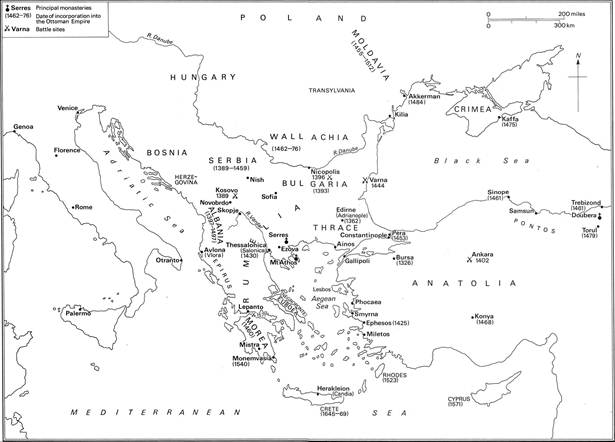
Map 20 The Roman Orthodox and Ottoman worlds in the fifteenth century
The Ottomans were not a people but a dynasty; nor did their Muslim subjects then call themselves ‘Turks’. Patriarch Antonios used the term ‘nation’ (Greek ethnos, Latin natto) pejoratively to describe such barbarians — but he did not call himself ‘Greek’ either, let alone ‘Hellene’, which meant an ancient pagan. He signed himself, in Greek, as ‘Our Moderation, Antonios, elect of God, archbishop of Constantinople the New Rome, and ecumenical patriarch’. Today we call his flock ‘Byzantines’. But this is as helpful as calling the French ‘Lutetians’, after the classical name of their capital in Paris. So far as Antonios was concerned, he and his flock were Christian subjects of the first Constantine’s New Rome. Hence use is made of their own self-denominator of ‘Roman Orthodox’ to describe them in this chapter.
In the fifteenth century, ‘Byzantines’ still called themselves ‘Romans’ (Greek Romaiot), synonymous with ‘Christians’; in Greek their Church was Catholic, or ecumenical. But Emperor John VIII Palaiologos (1425—48) had to appeal for support to an older Rome and another catholic Church against the encircling Ottomans. John would have been surprised to find himself described in the Latin version of the subsequent decree of the Union of the Churches as ‘emperor of the Greeks’, for he had actually subscribed to it in purple in Florence on 6 July 1439 as ‘in Christ God faithful emperor and autocrat of the Romans’ — his sprawling signature is in Greek. But the emperor was emphatically Roman and his people soon confirmed their Orthodox identity too — by generally rejecting the Council of Florence.
This discussion of time and title may sound antiquarian today, but is vital to an understanding of the identity of the Roman Orthodox in the fifteenth century. It coincided roughly with the ninth century of the Muslim era, when it was the Ottomans who first named Byzantines for what they were: subjects of a Church which had survived an empire, called ‘Rum’, or Roman. The definition holds to this day, most vividly when a villager in north-eastern Turkey explains that ‘This was Roman country; they spoke Christian here.’
If this chapter were limited to the Byzantine Empire in the fifteenth century, it would be halved by the fall of Constantinople in 1453 which indeed resounded in the west, where historians have made that date one to remember, without quite explaining why. In truth, the change of municipal government in Constantinople was important, not so much in the west as to those whom it principally involved: the Roman Orthodox. The arrangements made between sultan and patriarch in 1454 may have been shadowy, but they introduced a new order, or taxis, which ensured the future of Roman Orthodox incorporated in later conquests of the Morea and the Pontos. Their internal politics still depended on who said what at Florence in 1439, but Roman Orthodox bonds which survived the conquest were older and simpler: those of patronage and patris — homeland.
This chapter therefore concentrates on the Roman Orthodox in the last century of their world: AM 6901—7000, or AD 1393—1492. It concentrates on four homelands, based on Salonica, Mistra, Constantinople and Trebizond. It must exclude other Orthodox, Greek-speaking or not, under Venetian, Hospitaller or local ‘Latin’ or ‘Frankish’ (mostly what would now be termed Italian) rule along the Adriatic coast, in the Aegean and (until 1523) the Dodecanese, or (until 1571) Cyprus. It excludes Albania (conquered from 1397 to 1497), Bulgaria (1393), Serbia (from 1389 to 1459) and Herzegovina and southern Bosnia (1463—5). It excludes the lands north of the Danube which emerged from the fourteenth century as posthumous Byzantine states (and were to adopt the very name of ‘Romania’), being Wallachia (eventually incorporated as tributary from 1462 to 1476) and Moldavia (from 1455 to 1512). It must even exclude the peoples of the Crimea, whom Mehemmed II made tributary in 1475, turning the Black Sea into an Ottoman lake: Khazars, Armenians and Karaite Jews ruled by Crim-Tatar khans, Roman Orthodox princes of Gotthia and Genoese consuls in Kaffa.
By the end of the century only two eastern Christian rulers survived wholly independent of the Ottoman Empire. Ethiopia had subscribed to the Union of Florence, but its Solomonic king, the negus Na'od (1478—1508) had an Orthodoxy of his own. Moscow had rejected Florence, so was Orthodox enough; Grand Prince Ivan III (1462—1505) had even married the niece of Constantine XI Palaiologos, last emperor in Constantinople (1449—53). But New Rome did not grant Russia its patriarchate until 1589, on the grounds that Old Rome had forfeited the title, and Moscow could enter the bottom of the list as Third Rome.
At the end of the seventh millennium in Constantinople, Patriarch Maximos IV (1491—7) was spared the embarrassment which faces all who foretell a Day of Judgement which comes and goes without incident, for by AM 7000 most Roman Orthodox had adopted the western computation of AD 1492. Instead, he could say with more conviction than had his predecessor, Antonios, a century before, that while since 1453 it was demonstrably possible to have a Church without an emperor, it was now possible to have a Church with a sultan — indeed for Orthodox a sultan was preferable to a doge or pope. Patriarch Maximos urged the Republic of Venice to grant rights and freedom of worship to Roman Orthodox in the Ionian Islands which they enjoyed in the Ottoman Empire, while the Roman Orthodox Church in Cyprus had to wait until 1571 for the Ottoman conquest of the island to restore its autonomy. Under Sultan Bayazid II in 1492, the identity, survival and even prosperity of the Roman Orthodox were more assured than they had seemed to be in 1393, when Bayazid I had threatened an emperor in Constantinople.