
I SUSPECT THAT the most enduring legacy of Rome to Britain will not prove to be writing, Latin or even towns. It is something far less tangible, not unconnected with those famous straight roads. For various reasons, not the least being the need to collect taxes and for her armies to function effectively, Rome vastly improved communication throughout her Empire. This encouraged the spread of new ideas, including Christianity, first as a faith and then as a pan-national institutional Church. It was Christianity, as much as any other factor, that transformed the early medieval world, and made post-Roman Britain so different from what had gone before.
In Chapter 3 I wrote about the longue durée, or the persistence of certain ideas and practices over great periods of time. In the following chapters I also discussed how there were two Roman Britains, one to the south and east that was far more fully Romanised than the other to the north and west. I am not a great believer in archaeological distribution maps, which are often used by followers of the ‘culturehistorical’ school to prove dubious points which cannot be supported in any other way. My principal objection to them is that often they wrench sites and other information out of their actual contexts. I feel that we should not treat our precious data in this way - somehow it seems disrespectful of antiquity. With these caveats in mind, I shall use two maps here. Neither is very specific, but they make a general point.
The distribution of Roman villas and other substantial buildings, which it may be recalled Andrew Sargent took to indicate the extent of the more fully Romanised part of Britain, coincides very closely with that of so-called ‘Anglo-Saxon’ cemeteries. What this tells me is that the Romanised British population was more ready to accept the new fashions, social and political ideas of post-Roman Britain than were the people to the north and west. It’s not a question of invasion and takeover, but of attitude to life. On the side of the island where people had changed less during the Roman period, they resisted change more in post-Roman times. That seems to me to be both straightforward and self-explanatory.
I do not suppose we will ever know precisely why communities in eastern England decided to lean towards the Continent as strongly as they did, following the end of the Roman Empire. I suspect it was as much the continuation of a process that had been underway for some time as anything else. It is now quite widely accepted that supposedly ‘Saxon’ phenomena such as pottery, brooches and sunken feature buildings appeared on late-fourth-century Romano-British sites in eastern England. Thefoederatiexplanation has always been absurd; instead, I think we might be looking here at the start of a shift in political orientation towards the Continental mainland. I shall return to this theme shortly.
Modern archaeology owes an increasing debt to science. We saw in Chapter 8 how stable isotope analysis has thrown important new light on where supposed ‘Anglian’ and ‘Saxon’ people atWest Heslerton in Yorkshire and Berinsfield in Oxfordshire actually came from. I was not surprised that neither site produced good evidence for actual (i.e. ethnic) Anglo-Saxons, but I was surprised at how mobile the West Heslerton population appears to have been. It was unexpected to find that almost half the sample analysed came from west of the Pennines.
I recently heard on Radio 4 that a team from London University had proved that modern populations in towns west of Offa’s Dyke were genetically different from people in towns to the east. The report went on to say that the indigenous Celts were pushed west by a mass migration of Anglo-Saxons coming from the east. As a result, so we were told, the wholesale replacement of the British population by ‘Anglo-Saxons’ was proven.1 When I read the paper that had caused all the fuss, I was immediately struck by two things: first, the certainty of its conclusions, which were even headlined in the title: ‘Y Chromosome Evidence for Anglo-Saxon Mass Migration’.2 The second was that the long list of references did not include a single excavation or survey
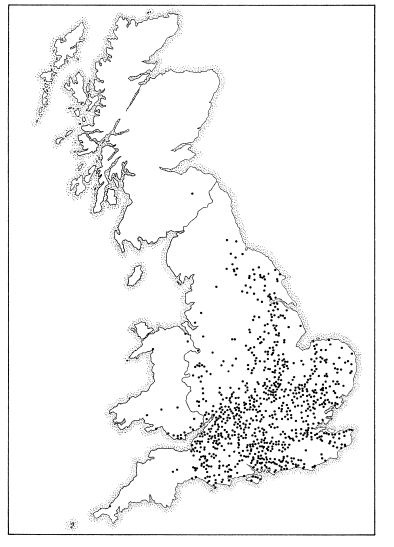
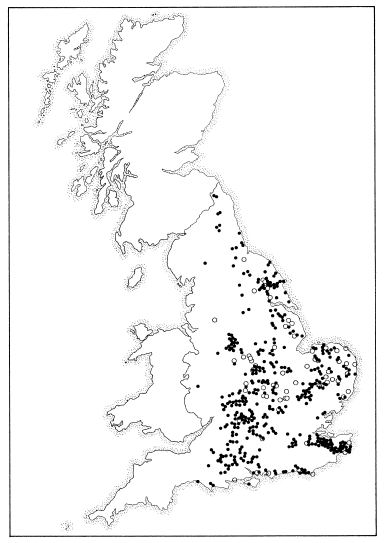
The distribution of Roman villas and their ‘substantial buildings’ (left), and ‘Anglo-Saxon’ cemeteries (filled circles, cremations; open circles, inhumations).
report. In other words, primary field evidence from cemeteries or settlements was not taken into account. I can only conclude that the authors did not feel it warranted consideration. I suppose I should have returned the compliment by omitting Y chromosomal evidence from this book - but life is too short. I have expressed my doubts about their findings elsewhere, though perhaps not quite as robustly as I should have.3
More recently, another group of genetic scientists, who collected DNA samples from 1,700 men living in towns across England, Ireland, Scotland and Wales,4 has comprehensively disproved the conclusions of the team that was reported on Radio 4 (although strangely their work has not received quite so much publicity). The leader of this second team, Dr David Goldstein of University College London, is quoted as saying: ‘The Celts weren’t pushed to the fringes of Scotland and Wales; a lot of them remained in England and central Ireland.’5 I am not at all sure how one should react to such sharply divergent findings, other than to suggest that there is more to the study of past populations than genetics alone. The old cliché about lies, damned lies and statistics probably also applies here. Having read both papers, I find the Goldstein study much broader and more firmly based in archaeology and history, although of course I cannot comment upon the genetics. It also supports my own theories - which is an enormous point in its favour.
If ancient populations were more mobile than we had previously supposed, we must be even more careful about jumping to conclusions about population replacement by specific groups, such as the Anglo-Saxons. The people involved could just as well have come from parts of northern Europe with less emotionally charged names, such as Norway or Holland. By the same token, we should also remember that the technique of stable isotope analysis only works for a single generation: as soon as new people arrive in Britain their children and all subsequent generations will appear to be ‘native’.
A paper published in 1982 by C.J. Arnold included an excellent and highly original analysis of material found in seventh-century ‘Anglo-Saxon’ graves, of which Sutton Hoo is far and away the grandest.6 It attributed the development of a hierarchical society to stress, caused initially by attack from abroad and latterly by internal strife in Britain. My reading of the evidence presented by the author is that the development of what one might term a ‘warrior aristocracy’ in the seventh century was not a response to stress at all - quite the contrary. Similar graves are found in the Earlier Bronze Age across most of southern Britain, but particularly in Wessex. In both cases - Saxon and Bronze Age - the social changes reflected by new burial rites involved military items such as swords and daggers; I would suggest that these were symbols of social status as much as weapons. I do not suppose for one moment that life in prehistoric times, or indeed the seventh century, was calm and peaceful; but it would seem that aggression, by and large, wasmanaged. Societies could not afford to lose harvests or have their flocks dispersed by large-scale warfare. So raiding would have predominated over actual pitched battle - which is not to say that these raids would not have involved death and injury to dozens of people. Much of the fighting, too, would have been to do with social status within, rather than outside, a particular group.
So if the Bronze Age example is anything to go by, I would attribute the development of a more class-based society in the seventh century to growing stability rather than to stress. In the earlier second millennium bc there is evidence that communities were becoming less mobile, and that the landscape of Britain was beginning to ‘set’: territories were defined, and regional ceremonial centres, such as Stonehenge, were becoming established. This is precisely the time when we see the emergence of the so-called ‘warrior aristocracy’.7 The Bronze Age barrows were often grouped in cemeteries, as at Sutton Hoo, and it appears likely that each was controlled by a particular clan or lineage, which in turn may have been linked to particular holdings of land. This seems to parallel what was happening at the start of the West Heslerton Anglian village and cemetery.
The symbolism behind the building of a large burial mound or barrow is to do with altering the earth and placing a human spirit physically within the natural landscape, of which he or she then becomes a part. Being at one with the landscape, but residing in the realms of the ancestors, the being or beings within the barrow were believed to oversee, or maintain some influence or control, in the way that the landscape operated. It was not a passive or a submissive act to Divine Grace, in the way a Christian burial might be perceived. Among other things, barrow burial is about territoriality and control of the landscape.8
Societies do not ‘become’ hierarchical for no good reason; there was a purpose behind the process, which may well have been connected with the control and management of resources, including land. Social stratification would therefore have been allied to changes in the way the landscape was operated, and perhaps even partitioned, which may help provide a general explanation for why landscapes at places like West Heslerton are substantially modified at the end of the Early Saxon period.
To return briefly to the centuries before the Early Bronze Age, around 2300 bc, this era was not marked by conflict and turmoil. Instead there is evidence that the farming societies of the preceding period, the Later Neolithic, were merely more mobile and more dispersed than those of the Earlier Bronze Age. So the building of the great Bronze Age monuments and the erection of so many barrows was in effect a symbol that the British landscape was beginning to be permanently parcelled up. Ultimately the process had to do with ownership and control. I suggest that something similar may have applied in the fifth to later sixth centuries in eastern Britain. Even before the collapse of the Roman monetary economy we find a shift away from towns, with perhaps greater reliance on livestock and local production.
In post-Roman times the provincial economy becomes a series of smaller economies with a far greater degree of self-reliance. During the fifth and sixth centuries these economies had coalesced into larger groupings that then emerged as the Anglo-Saxon kingdoms of people like King Raedwald of Essex. By then, societies in England had reached a degree of sophistication that gave sufficient long-term stability for jewellers and craftsmen to develop and practise their skills to a pitch that was without rival anywhere in Europe, outside Byzantium. Again, I cannot imagine that such skill ‘popped up’ as it were overnight, in the first two or so decades of the seventh century. We must be looking here at a tradition of craftsmanship that was handed on, probably from father to son, over several generations. None of this, it seems to me, could have happened in times of stress, instability and social meltdown.
To sum up, the situation we find in eastern England in the seventh century, with magnificent burials like Sutton Hoo, could not have come about if the preceding two centuries had been riven by strife. We know from prehistory that social change does not happen rapidly; the fifty-year phases proposed by Myres are manifestly absurd, but they are necessary if one accepts the ‘cultural-historical’ model of social change imposed through immigration. C.J. Arnold himself acknowledges that the social stress he uses to explain the changes he observed in seventh-century funerary rites may be more apparent than real: ‘Aggression, recorded by chronicles and, less directly, in the archaeological record, was directed towards the most developed groups’ [my italics].9 Once again we find that the circular argument has returned: it seems to be the chronicles, rather than the archaeological evidence from the ground, that dictate the way in which we interpret ‘Dark Age’ processes of change.
I cannot leave this long-term view of the ‘Anglo-Saxons’ without returning to the subject of barrows. We saw in Chapter 6 that Sam Lucy pointed out that cremation was not a rite that had been introduced afresh, as it were, from across the North Sea. The same can be said of barrows. The ‘Golden Age’ of barrow burial was in the Neolithic and earlier Bronze Age, from around 3500 to 1500 bc. But the tradition persisted, especially along the eastern side of Britain. Hundreds, maybe thousands of Iron Age barrows are known from the so-called ‘Arras Culture’ of East Yorkshire (about which more presently), and recent aerial photography has revealed a liberal scattering extending south, through Lincolnshire and the East Midlands down into Cambridgeshire. I dug a couple at Maxey, where about ten are known to have existed.
At the very end of the Iron Age we know of a series of extremely rich burials, sometimes but not always beneath barrows, which extends from Snailwell in Cambridgeshire, via Welwyn in Hertfordshire, to Aylesford in Kent. As Barry Cunliffe points out, these burials drew upon a number of themes which could be combined in a variety of ways. Most included food and imported wine (in amphorae); cups and plates were provided for their consumption in the afterlife.Weaponry is notably absent, as if these Late Iron Age chieftains were making a deliberate statement to the effect that their status did not depend on
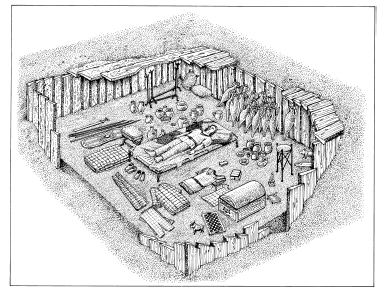
An artist’s impression of the Late Iron Age (15-10 bc) ‘royal’ burial beneath the Lexden Tumulus, near Colchester, Essex. Many of the items within the chamber reflect the taste for exotic items such as wine, which was imported from the Mediterranean region, in the amphorae seen leaning against the wall beyond the king’s head.
military prowess alone, and that they shared Roman values of civilisation. Whether they were as civilised in this respect as their grave furnishings would have us believe is of course another question entirely.
What is particularly interesting is what these rich, extremely highstatus burials can tell us about contemporary attitudes to life. There are many echoes of Sutton Hoo, especially at the finest site of them all, a cremation burial beneath a large barrow on the outskirts of Colchester. The so-called Lexden Tumulus was excavated in the 1920s, and has never been fully written up.10 A recent reassessment considers that the burial dates to 15-10 bc.11 The burial was within a plank-built wooden chamber below a barrow mound of thirty metres diameter. Although the body was not found it was accompanied by a vast array

An artist’s impression of the plank-built burial chamber below a barrow mound at Prittlewell, near Southend, Essex. The items in the chamber were still in place when they were excavated. The burial, which is pagan but contains Christian iconography, is of royal status and is closely comparable with Sutton Hoo and Lexden. Mid-seventh century ad.
of bronze objects and a suit of iron chain-mail with bronze and silver fittings that had been cut up and spread around the grave pit. There was a sheet of gold cloth and numerous other items in gold and silver. A folding stool and eighteen Italian wine amphorae were also found. The exotic items at Lexden suggest that the king - for surely this is what he must have been - looked beyond his immediate surroundings in his ostentatious display of wealth, but the deliberate destruction of his chain-mail recalls religious beliefs whose roots, as we saw at Flag Fen, were even older than the Iron Age.
Some of the finds from Sutton Hoo were already old when they were placed in the ground. The Lexden Tumulus most remarkably included a type of Middle Bronze Age axe known as a palstave, dating to around the thirteenth or fourteenth centuries bc.12 This axe was well worn, in a way which does not suggest that it had been actually used as an axe, but rather as an ancient object of veneration. Its inclusion within the burial was clearly a deliberate act, and not the result of the grave disturbing an earlier archaeological feature. Surely the presence of this ancient object within a royal grave must indicate that people were aware of their history, and thought it important. Both the royal burials at Sutton Hoo and Lexden show an interest in the past that may be connected with rites surrounding the veneration of ancestors. Again, we might be seeing the continuance of a much earlier tradition at both sites.
An even more striking parallel with Lexden has recently been discovered twenty-five miles away, on the outskirts of Southend at Prittlewell.13 This appears to be another seventh-century royal burial, perhaps two or three decades later than Sutton Hoo. In form the burial is pagan, because the body (which did not survive) was surrounded by a wealth of grave-goods, but it had been ‘Christianised’ by the addition of two gold foil crosses.What makes this discovery remarkable is that, like Lexden, it was a chamber grave. The chamber was square, measured about four by four metres, and was plank-built. Also like Lexden, it was sealed beneath a sandy barrow mound. The items buried with the king were all in situ. The inventory sounds strangely familiar, and shows yet again how wide the contacts were with other élites elsewhere in Europe. It includes glass bowls from Asia Minor, a folding throne (the Lexden example, also of probable Italian design, which is closely similar, was described as a folding ‘stool’), decorated hanging bowls from Ireland, a solid gold belt buckle, gold coins from France, a sword and shield, a Byzantine flagon, folded textiles, a lyre and much more besides.
It would be foolish to suggest that Sutton Hoo and Prittlewell of the seventh century ad formed part of precisely the same religious tradition as Lexden of the early first century bc, but the persistence of many specific and general themes (for example, chamber burial within a barrow, carefully arranged containers for exotic drink, clothing/weapons and armour and thrones/stools) and the fact that the three sites occur so close together is remarkable. Doubtless diehard Anglo-Saxonists will write these things off as ‘coincidence’. But it is not as if the tradition of barrow burial died out in Roman times in eastern England. I well recall, for example, passing by the Six Hills, six Romano-British barrows that were neatly arranged along the side of the Great North Road, on my way to school in Stevenage, Hertfordshire.14 Sutton Hoo can thus be seen to form part of a long-lived local tradition. Of course it undoubtedly incorporates a wealth of new ideas gleaned from around the North Sea basin and Scandinavia in the fifth and sixth centuries, but the central concept, of rich kingly burial beneath a barrow, does not have to have been an idea introduced from outside. Such practices must have had resonances for people living in the area, who would have understood the complex symbolism underlying them.
At various points in this book I have made reference to the debunking of hypothetical ‘invasions’ or ‘migrations’ that were supposed to have happened in Britain before the Romans. I deliberately avoided discussing one particular example, because I wanted to leave the best until last. I have already covered this case study elsewhere, so I shall summarise the main points.15
The Yorkshire Wolds in the area around the small market town of Driffield have produced some of the most remarkable archaeological finds in Britain. In great measure this was due to an extraordinary Victorian antiquary/archaeologist named J.R. Mortimer, who was remarkable for the promptness and thoroughness with which he wrote up his excavations. His greatest contribution is undoubtedly his Forty Years Researches in British and Saxon Burial Mounds of East Yorkshire (1905).16 His ‘British’ barrows are generally Bronze Age, but what is most striking is the fact that the Saxon and the British barrows very often occurred in the same places. It was as if the later sites had been deliberately positioned in the landscape, perhaps as a sort of homage to what had gone before. I need hardly add that this is not what one would expect of a recently arrived group of settlers.
Mortimer’s barrows generally occurred on the higher land of the Wolds, but the burial grounds of the intervening Iron Age were often found down in the valleys. The Bronze Age barrows were round, but those of the so-called ‘Arras Culture’ of the Iron Age were square and surrounded by a ditch. Each barrow covered a central grave, often of a warrior with a sheathed sword, who is sometimes accompanied by a vehicle, known variously as a cart, wagon or chariot. Either way it was a light carriage, resembling perhaps a gig or pony trap. The Arras Culture came into being in the fourth, and lasted into the first century bc. Closely similar barrows to those of the Arras Culture are known from northern France, in the broad Marne Valley of the Champagne district - the presumed origin of the ‘invasion’.17 Some confusion has been caused by the fact that the ‘culture’ was in fact named after a small town in the East Riding of Yorkshire, and not after the better-known town and Great War battle site on the Somme.
Most archaeologists of the mid-twentieth century belonged to the ‘culture-historical’ school, in which, as we saw in Chapter 6, it was usual to ascribe change to invasion or migration. Most of these invasions were discounted in the 1960s and seventies, but the ‘Arras Culture’ hung on for longer because it did seem, even on close inspection, to be well-founded. Square barrows had not been found in Britain before their appearance in East Yorkshire, and chariot burials and the presence of distinctive ‘anthropoid’ swords*and joints of meat in the grave were also new. With these innovations went a new style of angular pottery, which was also found elsewhere in Britain. The pottery and the barrows had obvious parallels with a well-known group of square-ditched chariot burials in the Marne Valley. Up until the 1960s, nobody doubted that the Arras Culture of East Yorkshire came to Britain from overseas.
The book that was for many years to be the standard prehistory of Yorkshire was published in 1933. Its principal author, Frank Elgee, was an avid walker, and he personally visited and recorded most of the sites he writes about. This gave his work a credibility and personal touch that I find most appealing. Nevertheless, he was a man of his time, and by Chapter 8, when he starts to discuss the ‘Arras Culture’, he was on invasion number five, ‘Gaulish charioteers’ who ‘overran East Yorkshire’. Incidentally, the people who were supposed to have invaded the Wolds belonged to the La Te`ne Culture; he was writing before the advent of radiocarbon dating, so his dates are a little recent:
La Te`ne culture was undoubtedly introduced into Yorkshire by Gaulish invaders during the third century bc. Its characteristic chariot burials have their closest parallels in Champagne, the Marne region, and especially in the Seine Valley at Nanterre near Paris. The anthropoid swords are identical with French examples, the knobbed bronze armlets similar to those from Samsois, Marne.18
This could be Myres writing about Saxon cremation urns. Elgee and he share the judicious use of closely observed parallels to make points about population movement.
Dr Ian Stead, who excavated 250 Arras barrows between 1967 and 1978, is now firmly of the opinion that they do not represent an invasion or movement of people, because only the square barrows and carriage burials have clear parallels on the Continent.19Other essential aspects of Arras funerary rites, such as crouched burials and the gravegoods buried with them, are British. Similarly, local settlements of the period have recently been excavated, and these are typically British. No British prehistorian would today accept that the ‘Arras Culture’ originated in invasion. What they would say is that the Arras graves of Yorkshire, and the widespread introduction of angular styles of pottery, provide clear evidence that eastern Britain was in ever closer contact with communities not just in north-western France, but further afield around the North Sea basin and over Europe generally. It was an early stage of a process of communication between Britain and the Continental mainland that would continue without major interruptions until post-Roman times, and later.
I see communication between Britain and the Continent as an unstoppable process, because it depended on hundreds of thousands of individual contacts over huge periods of time. Gildas lacks all credibility to me when he suggests that cross-sea contact was a rare event: three boatfuls of Saxon warriors arrive on the coast and life in Britain, it would appear, is changed forever. He must be writing metaphorically: even in the Iron Age, the arrival of three boatloads of people from over the Channel would have caused no excitement at all. It would have been entirely routine.
It would not be particularly useful to debunk the various archaeological phenomena that have been linked to invading Anglo-Saxons. The distinctive sunken feature buildings, for example, are found at Mucking and West Heslerton (to mention just two of many sites) in Late Roman contexts, at a time when Anglo-Saxon invasions are not yet supposed to have begun. The ‘culture-historical’ response to this is to invent foederati, but what on earth mercenaries were doing at out-of-the-way places like Mucking is anyone’s guess. Ultimately it boils down to a question of belief. Either you believe that England was founded by people from abroad, or you don’t. To me the notion of Anglo-Saxon invasions is an archaeologically absurd idea. It also patronises the indigenous people, because it assumes that the post-Roman inhabitants of Britain would not have been capable of ‘inventing’ England themselves. Of course they did not do this either consciously or unaided, because they were in regular contact with a host of communities abroad. But they did it nonetheless.
Like J.R. Mortimer, I have spent rather too many decades researching the archaeology of eastern England, and I have observed the remarkable resourcefulness of the people whose remains and settlements I have excavated. I am in no doubt whatsoever that they were in regular touch with their friends and relatives overseas from at least 1600 bc - the date of the Bronze Age plank-built wooden boat, now in Dover Museum, which we know from an exhaustive series of tests and calculations would have been perfectly capable of crossing the Channel. Those contacts continued and intensified in the Iron Age. In the Roman period south-eastern Britain played a major part in feeding the Roman field army across the Channel. I cannot understand why archaeologists and historians have been so persistent in their belief that maritime traffic around the south-east of Britain was in one direction only: pirates, raiders and settlers entering Britain. Apart from ignoring the two-way maritime traffic of the previous two millennia, it is a view that defies both reason and common sense.
*So called after their hilts, which were fashioned to resemble a man.