
IT IS MY BELIEF that one cannot understand what was happening in late-Roman and ‘Dark Age’ Britain unless one has a grasp of what life was like before the Roman Conquest. The Roman period was indeed important to the development of British history, but the actual number of incomers was relatively small, given a minimum estimated population in Britain then of about 1.5 million. Certainly large elements of the southern British populace were fully Romanised by the close of the period, but others outside the south-east were not. It makes no sense to discuss post-Roman events against a backdrop of Roman Britain alone. One must look farther back in time.
When the Roman legions came ashore in the first of Caesar’s two visits to Britain in 55 BC, they encountered well-orchestrated and stiff resistance. The Roman army was the most formidable military machine in the ancient world, yet the British tribesmen were able to give almost as good as they got (as Edward Gibbon would not have put it). The great Caesar’s second expedition to Britain a year later, in 54 BC, was on a much larger scale, and it met with greater military success. Then he departed. The Romans did not invade Britain again for three years short of a century, in AD 43. This time the Roman Emperor was Claudius, and the general who commanded the invading armies was one Aulus Plautius. South-eastern Britain was overrun relatively swiftly, between AD 43 and 47, which Barry Cunliffe puts down to ‘a measure of incipient Romanisation’.1 In other words, as we will see in Chapter 5, the invaders were not entirely unwelcome, especially to those tribal leaders who had already formed political alliances with the Roman Empire.
The facts, as baldly stated here, do not suggest that pre-Roman Britain was a thinly populated peasant society with a weakly developed sense of political purpose. Far from it. What emerges from a study of pre-Roman Britain is that the islands featured a diverse mix of different societies. Often these cultural groupings were in conflict - or perhaps a state of rivalry - with each other, but there are archaeological reasons to believe that they were also united by strong bonds of belief and ideology. Put another way, it seems likely that the various inhabitants of later prehistoric Britain shared a common ‘world view’ or cosmology.2 Many aspects of this world view would have been shared with Iron Age people on the Continental mainland, but in certain respects even Roman writers acknowledged that Britain was preeminent. For example the Druids, those politico-religious leaders perhaps best seen as the Iron Age equivalents of the Muslim Mullahs, helped rally resistance to the spread of Roman rule both in Britain and on the other side of the Channel.3 Graham Webster describes the stiffening effect that Druidism had on British resistance to Roman rule:
Perhaps it is not surprising that the most savage and devastating wars Rome ever fought were against the Jews and the Britons, since Judaism and Druidism had a strong political bias and the passions they aroused were directed against Rome with a fanaticism which could be broken only by a crushing defeat that destroyed the majority of the devotees.4
We will see, however, that while many of the most militant followers of Druidism were slaughtered by Roman troops, both during Boudica’s revolt in AD 60-61 and on the island of Anglesey in AD 59, it takes more than martyrdom - albeit on a large scale - to destroy a society’s long- and deeply-held religious convictions, especially if those beliefs are fundamental to one’s world view. We will also see that the religious beliefs behind Druidism had roots that may well have extended as far back as the Bronze Age, or even earlier. There is increasing evidence for the survival of prehistoric British religious customs through, and indeed beyond, the Roman period. I will discuss this further in Chapter 5.
I remember being taught at university that the Druids had nothing whatsoever to do with Stonehenge, which had been built over a millennium before the Iron Age, the period when Druidism flourished. The emphasis on this chronological separation was a way of saying that the modern Druids and their New Age fellow-thinkers had got it all wrong. How laughable, we were told it was, that the latter-day Druids dressed up in sheets and pranced around the stones on the night of the midsummer solstice. How misguided they were! Today, however, most prehistorians would accept that the religious beliefs that formed the core of Druidism had very ancient roots indeed, at least as old as Stonehenge, and probably a great deal older.5
It came as no surprise when we found that the small Early Bronze Age timber circle known as Seahenge was entirely made from oak trees. The choice of oak must have been deliberate, because other locally occurring woods such as ash, willow, alder or poplar, would have been just as suitable, and rather less work to cut down. Oak was, and still is, the best British constructional timber, and it must have been held in high regard in prehistory. It was the structural steel of its day. Barry Cunliffe quotes a revealing passage from Pliny the Elder, writing about the Druid priesthood:
They choose groves of oak for the sake of the tree alone and they never perform any sacred right unless they have a branch of it. They think that everything that grows on it has been sent from heaven by the god himself.6
Pliny goes on to describe how mistletoe is cut from oak trees, with a great deal of ceremony and the use of a golden sickle; a superb Late Bronze Age sickle, complete with its wooden handle, was found alongside a contemporary timber causeway through wet ground at Shinewater Park, near Eastbourne, and we now know of several sites in Britain where identical Bronze and Iron Age religious rituals continued without a break. When it comes to the matter of pre-Roman ritual and ideology, I’m now inclined to think that the much-derided people wearing sheets actually had a better idea of what was going on in prehistory than my lecturers at Cambridge, who were unable to take a sufficiently long or broad view of the way that prehistoric beliefs arose, developed and matured through the centuries of later prehistory.
Most prehistorians are now agreed that the modern Western distinction between the sacred and the profane - between religion and domestic life - is a product of the way we organise our time. If you like, it reflects our world view, which is largely based around the need to work - and to work with the greatest possible efficiency. In medieval times the Church impinged on domestic life to a far greater extent than it does today, and a sizeable proportion of the population, who lived in the hundreds of monastic foundations across the land, devoted their entire lives to the service of God. The sixteenth-century Reformation was to change all that. Over succeeding generations religion became increasingly confined to church on Sunday. In most households today people no longer say grace before meals - the last vestige of religion within the domestic sphere.
In pre-Roman times religion and daily life were closely integrated. People would probably not have been aware of when their thoughts were within the realms of ideology or practicality, because the distinction was meaningless. The shades of the ancestors inhabited the countryside around them. Their presence within burial mounds along the edges of communal grazing ensured that animals were not allowed to stray too often onto pastures where they were not welcome. The prevailing cosmology in pre-Roman Britain seems to have been structured around the cycle of the seasons, and the movements of the sun and moon in the sky. These things gave form not just to the great religious (archaeologists prefer the term ‘ritual’) monuments such as Stonehenge, but to the arrangement of ordinary houses, which in Britain were almost invariably circular in plan. By the same token, the interior arrangement of communal tombs, such as Maes Howe in Orkney, replicated the way that houses were laid out. The one was seen as a reflection of the other - which tells us something about the way in which the sacred and the profane were seen as being part of the same entity.
If we see integration, we also see longevity, which suggests that prehistoric religious beliefs addressed themes that were deeply rooted within society. These themes doubtless included the role of the family as a means of structuring society, the place of human institutions within the natural world, and of course the continuing cycle of the seasons - and with it the replenishment of food, fuel and shelter. Today many of these concerns can be addressed through science and secularity. Religion does not need to be invoked. Having said that, prehistoric ideologies also addressed the traditional territory of religion, which may be seen as ‘rites of passage’, to use an anthropological term: birth, puberty, marriage and death.
When we look at prehistoric ritual activity it’s hard not to see constant reiteration. There is a long-standing concern with water, for example: all sorts of things are placed in or thrown into rivers, bogs, lakes, ponds and wells - swords, shields, weaponry in general, pottery vessels, bones, bodies and so forth.7 Sometimes these things are fabulously valuable, at other times they are more humdrum. Sometimes they have been deliberately smashed before being offered to the waters, at other times they are in perfect condition. Items used in the preparation of food, and particularly corn-grinding stones, known as quern stones, are often placed in the ground or in water as offerings.
It would be a mistake to regard the items placed in the ground or in water as mere things. Certainly they could be very beautiful, but like many objects they possessed a symbolic life of their own. Thus a sword could indeed be a weapon, but it could also be a symbol of an individual’s rank or authority, so that its breaking before being offered to the waters would have symbolised that its owner had passed out of this life. Maybe the broken sword was thought to become whole again in the realm of the ancestors.
We can only speculate as to what these things originally symbolised, but there are now literally thousands - maybe tens of thousands - of prehistoric offerings known in Britain alone, and certain patterns are beginning to emerge. Water probably symbolised both separation and travel. Beneath it you died, yet it was also a substance in which you saw your own reflection - something we take for granted today, but which rarely happened in prehistory. A journey across water, whether by boat or on foot along a causeway, could symbolise the journey from this world to the next - or any other rite of passage. Prehistoric causeways which played an important ritual role often led to offshore islands, which again could be seen as symbolising other worlds or states of being. As for the corn-grinding stones, they possibly reflected the importance of the meal as a means of keeping the family together, but they could also have expressed a wealth of other ideas, including the role of women within society, motherhood or family life.
These rites first become evident archaeologically from around 4200 BC, at the onset of the New Stone Age or Neolithic period, but there is a growing body of evidence to suggest that their roots lie even further back in time - maybe even as far as post-Glacial times, around ten thousand years ago. The prevalence of certain themes over thousands of years does not indicate that a particular religion held sway for that length of time; it’s doubtful whether one could have talked of ‘a religion’ in Neolithic times. What this longevity or persistence indicates is a phenomenon termed by French anthropologists the longue durée. Practices which persisted in certain cultures over huge stretches of time owed their longevity to the fact that they were embedded or rooted within aspects of society that were seen to be essential to that particular community. In prehistoric Britain, the most persistent theme was a concern with the cycle of time and the movement of the celestial bodies.
One could speculate endlessly on what it was that made the passage of the seasons, the sun and the moon so important in prehistoric Britain, but it may owe something to the prevalent way of life, which was based on animal husbandry, a choice which in turn was influenced by the British maritime climate, which grows grass superbly well. We always suppose that the ancient arable farmer worried about the germination of the next season’s crops, and that this gave him an interest in seeing that the days lengthened after the midwinter solstice. The same goes for the livestock farmer: grass too effectively ceases to grow in winter, and the appearance of calves and lambs was, I am sure, as eagerly awaited as the first sprouts of a freshly germinated crop of wheat. Farmers have a natural concern for the passage of the seasons.
Nevertheless, I’m doubtful whether one can attribute something as fundamental as a society’s world view merely to climate or livelihood. Such things come from deep within people themselves. Fully formed ideas need time to appear, but when they do, they are taken up very rapidly if they are right for the society and the times. This is what probably happened in the Later Neolithic period in Britain and Ireland, with the first appearance of circular tombs known as passage graves, whose entrances were often aligned on the sun at solstice. Before that time (say 3200 BC), many of what were later to prove persistent ritual themes had been in existence for several centuries or more, but it was the appearance of passage graves beneath round mounds, and slightly later the erection of the great henge monuments, that gave formal expression to these long-held beliefs.
The longevity of the religious ideas of pre-Roman Britain suggests they were deeply embedded within society. They were not mere superstitions. The placing of swords and shields in a river was not the pre-Roman equivalent of tossing coins in a fountain ‘for luck’. We should think more in terms of christening, Holy Communion or the funeral service. If these rites were deeply rooted within British culture, they were also part and parcel of everyday life: they fitted that life and expressed the way people viewed themselves, their families and their world. They were, if you wish, a ceremonial or ritualised expression of the beliefs that motivated people to get up in the morning.
The idea of the longue durée also suggests that when we find pre-Roman rites surviving into Roman and post-Roman times, we are witnessing the survival of far more than mere ritual or superstition.We are actually seeing the survival of ancient patterns of social organisation, family structure and cosmology too - because you cannot separate the rituals from the societies and the belief systems that gave rise to them. Certainly some will have been modified through time and changing circumstances, but the core of the beliefs must remain constant, or the rites become irrelevant - in which case they wither and die.
With certain notable exceptions, such as Navan Fort in Northern Ireland, the religious sites of the last prehistoric period, the Iron Age, are less obviously eye-catching than the elaborate monuments of the Later Neolithic and Bronze Age periods such as Stonehenge and Avebury in England,Maes Howe in Orkney and Newgrange in Ireland.8 By this period, too, the archaeological evidence for actual settlement is becoming more prominent, largely as a result of the steady growth of the British population. In this chapter I want to give an impression of what Britain might have looked like to a visitor arriving in, say, AD 42 - the year before the Roman Conquest. I start with a simple question: was Iron Age Britain very different from Roman Britain? I believe that it wasn’t, for the simple reason that, setting aside shortlived introductions such as towns, the army and the imperial administration, Roman Britain was Iron Age Britain.
The survival of ‘native’ British culture and traditions into post-Roman times only makes sense if we understand its age and scale. Take, for example, the longevity of British society before the arrival of Roman forces in AD 43. In common with other parts of Europe there had been well-organised societies living in settled communities for at least three thousand years before Christ. Before that there were two millennia or so when societies were less settled, but no less organised. Even in the millennia after the Ice Ages (around ten thousand years ago) the British population was thin, but the landscape was already being parcelled up by the people who inhabited it. Life for hunter-gatherer groups was by no means an anarchic free-for-all.
It is simply wrong to suppose that the Romans brought civilisation to a barbarian Europe: they brought their own style of civilisation, which was founded on ideas that flourished in classical Greece in the fifth century BC, and they imposed it, with greater or lesser success, on pre-existing settled populations who possessed their own social rules and regulations. The landscapes that Caesar’s legions marched across were not dense primeval forests: most of them had been cleared of trees for several millennia. His men tramped their way through fields, roadways, farms and villages. I doubt whether the average modern person, if dropped into a rural village in pre- or post-Roman Britain, would be able to tell them apart. He would probably only spot that he was in Roman times if a visiting government or military official was in the neighbourhood, or if he happened to be shown a family’s best dinner service (which seems somewhat unlikely).
If pre-Roman society consisted of a handful of skin-clad savages eking out a frugal existence on nuts and berries, its ideas and culture could not have survived into post-Roman times. There has to be a critical mass of people for their ideas to persist if their culture is overtaken by outsiders. In the case of pre-Roman Europe that critical mass certainly existed. Any lingering notions of skins, nuts or berries should be replaced by woven cloth, wine, beer, bread, cheese, mutton, lamb, beef and pork. Estimates of Britain’s population in the last centuries BC are hard to arrive at, but few would place it much below 1.5 million, and some would put it as high as 2.5 million.9 Whatever else it was, it was not a small handful. Who were these people, and what would it have been like to have lived in Britain during the century or so before the Claudian conquest of AD 43?
The second half of the last century BC and the first half of the first century AD is sometimes seen as a period of ‘almost-’ or ‘proto-history’, because although written records had yet to develop in Britain, Julius Caesar and other Roman authors were busily writing in Gaul (France) and elsewhere; sometimes they even referred to Britain. In Britain there are early indications of writing that did not simply arrive, fully finished, from elsewhere: there are, for example, numerous examples of Iron Age coinage, some of which bear clear inscriptions, such as ‘CAM’, which we know was an abbreviation (much needed) of Camulodunum, present-day Colchester in Essex. Writing, rather like farming, seems to have been an idea that people wanted to grasp even before they understood precisely how it worked. Maybe members of élite society in southern Britain liked the concept of literacy before they possessed it fully themselves.
The great Roman general and future Emperor Julius Caesar made two visits to England in 55 and 54 BC. These expeditions were essentially to gather intelligence, and should be seen as a part of his campaigns in Gaul, which began in earnest in 59 BC. Caesar’s first expedition to Britain in 55 BC involved ninety-eight transport ships carrying two legions (each of ten thousand men), plus cavalry and many accompanying warships. The landing in Kent was resisted, and there were numerous skirmishes with the British. Eventually Caesar retreated back to Gaul. The following year he did things on a larger scale. This time there were eight hundred ships, transporting five legions and two thousand cavalry. This huge force met stiff resistance under Cassivellaunus, leader of the Catuvellauni, a tribe centred on Verlamion (St Albans) and parts of what is today called ‘Mid-Anglia’ (Hertfordshire and areas around). Caesar had a hard fight through Kent. He crossed the Thames into the Catuvellaunian heartland, and eventually British morale broke down and Cassivellaunus sued for peace. Caesar returned victorious, with many hostages, but he had met fierce opposition, and was probably relieved to leave Britain with his honour intact.
The history of relations between Britain and Roman Gaul after the second visit of Caesar is complicated. The leading authority on the period, Professor Barry Cunliffe, has distinguished two significant phases in Later Iron Age southern Britain.10 During the earlier, or Contact Period (120-60 BC), Britain was in regular contact with Europe and the expanding Roman Empire. Following the fall of Gaul and Caesar’s two visits to Britain, Rome had made two physical impacts - hence the Impact Period. Cross-Channel relations in the Impact Period became a great deal less straightforward, and depended very much on the political skill, or otherwise, of the emerging tribal leaders, or kings, of southern Britain.
The numerous Iron Age issues of British coinage provide us with useful sources of information. It is still popularly believed that the Romans introduced the idea of coinage to Britain. Even in archaeological circles, where it has long been recognised that coinage began in Britain under the influence of Continental prototypes, it was thought that so-called Celtic coins were debased and misunderstood versions of their far more sophisticated classical (i.e. Greek and Roman) counterparts. It was held that Celtic coinage was both poorly executed and undisciplined; it is hard to avoid the conclusion that this opinion reflected current views of pre-Roman society when compared with a classical ideal. All that was changed, however, by a detailed study of British pre-Roman coinage by the numismatist R.D. Van Arsdell.11
The earliest coins imported to Britain arrived around 125 BC, and the first British-minted insular issues appeared just twenty-five years later. These were cast bronze coins, made in Kent. Another twenty-five years later the first struck British coins were produced. Casting is a crude method of producing coins, each one of whichmust be produced in an identical mould. Struck coins are produced using a design inscribed onto two dies, which are negative images of the coin face in a metal harder than the coin itself. The dies are hammered onto the front (obverse) and back (reverse) of each coin blank, which is of a specific weight and composition. The first actual coin die from pre-Roman Britain has recently been discovered near Alton in Hampshire.12 It’s a die for the obverse of the coin, and it shows a lively horse with a charioteer holding something looking like a lance, with a long shaft.
It used to be believed that British Celtic coins were not minted to controlled (i.e. specified) weights and compositions. In effect this meant that they could not have been used as money. Van Arsdell
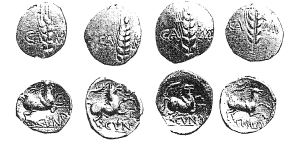
Four examples of pre-Roman ‘Celtic’ coins with prancing horses. These are examples of Cunobelin so-called Wild Type (ad 10-20).
however convincingly showed that their weights and denominations were strictly controlled. It was also thought that the design of Celtic coinage, which often appears as a surreal but strangely harmonious disintegration of heads and legs, was uncontrolled, chaotic and barbaric. Again, Van Arsdell revealed that the art of the coins conceals messages that are relevant to their value. He has also shown, as we knew from other aspects of Celtic art, that Iron Age art in Britain was not simple. The artists were not attempting to draw an image that looked exactly like, say, a horse. Like Picasso and other modern artists, they were more concerned with illustrating what horses stood for: their grace, speed and ability seemingly to fly when jumping obstacles. In other words, their art had more to do with impression and expression than representation pure and simple.
Celtic pre-Roman coinage clearly illustrates the sophistication of Later Iron Age societies. The coins in question are numerous, possibly numbering tens of thousands. This suggests that maybe a hundred or a thousand times more than that were originally minted, indicating highly sophisticated, populous and well organised societies. This was the culture which the Romans sought to control. Thanks to their military might they were generally successful in this, but control should not be confused with the erasure of pre-existing societies. Roman control of large parts of the British Isles - most of Scotland, Cornwall, all of Ireland and parts of Wales - was tenuous or non-existent. In areas of southern Britain where their rule was most effective, they simply added a new layer to what was already there. They certainly affected the development of life in southern and central Britain, but by no means did they destroy British society.
If we regard the way that coinage was adopted as a response to a growing and widespread phenomenon that élite groups in Britain wanted to become involved with, there were other aspects of the Roman and classical world that also appealed to the same classes. In particular the personal appearance of British élites was changing. Quite literally, they were cleaning up their act. In the Late Iron Age we see the widespread appearance of items to do with personal hygiene: small bronze scoops for removing earwax, tweezers, razors and miniature pestles and mortars for grinding make-up. I found one of these tiny Roman pestle and mortar sets within the posts of the Bronze Age causeway at Flag Fen, presumably offered to the waters as a deliberate act - otherwise it is difficult to explain why the two things were found together. Personal appearance was now something that mattered, and was required to be taken seriously.
The British Museum Iron Age specialist J.D. Hill has made a study of these changes to people’s appearance in the Late Iron Age.13 Not only were they paying greater attention to personal hygiene, their clothes must have altered too. In the next chapter we will see examples of safety-pin- (or fibula) style brooches from an Iron Age and Roman site at Maxey, near Peterborough. These were by no means isolated finds. In the final centuries of the Iron Age we see the widespread adoption of these new Continentally-inspired ornaments, that must have been accompanied by a change towards finer clothing, if only for special occasions such as weddings. Hill has referred to this change as the ‘fibula event horizon’. The important point to note here is that these changes marked more than just a new fashion. They marked a new attitude not just to personal appearance, but to personal perception: ‘the end of one kind of body and the beginning of another kind of body’, to quote the title of Hill’s paper. We will see later that there was an equivalent of the ‘fibula event horizon’ in the fifth century AD, although this time the influences were to be from northern Germany rather than Roman Gaul.
We are now fully within the era of proto-history, verging indeed on history. During the Impact Period, contacts with the Continent grew stronger as Roman rule gave much-needed stability to Gaul. The Roman army was busy tackling Germany, and Britain, after Caesar’s two bloody expeditions, was left alone. The result was prosperity and a measure of stability. Starting very early in the first years AD, a remarkable man called Cunobelin arose as High King of the Catuvellauni, ruling his kingdom from a new capital at Camulodunum (Colchester). His domain consisted of a confederation of tribes comprising most of East Anglia south of Norfolk (home of Boudica’s Iceni), plus Kent and parts of southern England. His reign lasted over thirty years, which was no mean achievement - and very much longer than any of his contemporaries. He died some time around AD 40, and instability returned to the tribal kingdoms of southern Britain. Doubtless this political uncertainty was a significant factor behind the Roman decision to invade three years later.
At some point during the Impact or Contact Periods it seems probable that a sense of ‘Britishness’ developed among certain of the élites of southern Britain. This may not have amounted to a sense of shared belonging or solidarity, as in the modern Celt; nevertheless, informed people must have been aware that they lived on an island, and that the Continental mainland was different - it was an ‘other’, the scene of tumultuous political events. Maybe their sense of being British amounted to no more than a feeling of opposition to, or admiration of, the Romans. Perhaps it was no more than a feeling of opposition to that ‘other’ across the Channel. Certainly unity amongst the various tribal kingdoms that had emerged during the Contact Period is hard to find: each had its own policies with regard to the Romans, and radical policy shifts could happen overnight. It was a fickle world.
Attacks on Brittany in 57 BC as part of Caesar’s campaign against Gaul effectively finished off the flourishing trade that then existed between Britain and the Continent, which was not to resume for some time. When it did, the focus shifted from the south-west of Britain eastwards towards the Thames estuary, to Hertfordshire, Essex and Kent, which were becoming politically and economically more important. While Britain tended to provide raw materials and slaves in exchange for wine and other high-status commodities, it was not always as simple as that. Simon James describes how the contacts between Britain and mainland Europe were complex; the British provided ideas and political inspiration for their cousins across the Channel.14
By Late Iron Age times and into the first years AD, Roman authors record that the Druidic religion flourished in Britain, and had an important influence on the Continent.15 Certainly the Romans saw it as a threat, and after their conquest they made strenuous efforts to stamp it out - efforts which culminated in a battle and massacre on Anglesey in AD 59. We must assume that the Druid religion described by Roman authors arose out of the diverse regional and tribal religions of the Middle Iron Age. This process of amalgamation would have been hastened by the conquest of Gaul by Julius Caesar between 60 and 50 BC. Conquest can provide a strong catalyst for political and other changes, and it would be a mistake to treat the Druidic religion of the half-centuries before and after Christ, as recorded by (hostile) Roman sources, as being wholly representative of what had gone before. Whatever else they originally might have been, the Druids of the Impact Period were highly politicised.
In pre- and post-Roman times we are not dealing with a free market economy as we understand the idea today. Goods that were bought from abroad would mostly have been acquired for purposes of display or conspicuous consumption. Fine wines from the Mediterranean region came to Britain in large ceramic vessels known as amphorae. This was a trade that continued throughout the Roman period and into post-Roman times, mainly in west and south-western Britain.
Does this trade indicate merely a continuing taste for wine, or something more significant? The longue durée argument might apply: the consumption of wine in western Britain lasted for so long because it was embedded within some social practice that mattered to people. Certainly wine was enjoyed by those who could afford it, but its public consumption, probably during feasts, was important, just as in medieval times it was important that the Lord and his family occupied the high table in a staged, artificial fashion. Medieval mealtimes in the great hall were about more than eating, just as wine was about more than merely status: both were reflections of the way society was organised; ultimately they played an important role in the maintenance of social stability and security. That was why they mattered.
The amphorae came from Italy, Spain and the Mediterranean region. They were large and robust containers that were in widespread use for trade in Roman times. They mainly held wine, but could also be used for olive oil and a fermented fish sauce much beloved of the Romans, known as garum.16 Britons were trading with the Continental mainland for maybe three thousand years before Christ, but these contacts seem to have become more frequent, if not regular, during the Earlier Bronze Age (say from 1700BC).17By the Iron Age, roughly a millennium later, cross-Channel contacts were more formalised and took place at specific ports of trade which initially were located in south-western Britain. The earliest such port we know about is at Mount Batten (Plymouth, in Devon); it was succeeded as the main port of trade by Hengistbury Head (on the south side of Christchurch Harbour, a few miles further along the south coast, on the Dorset-Hampshire border).18 The switch from Mount Batten to Hengistbury Head took place around 100BC.
Recent excavations at Hengistbury Head have shown that trade between Britain and Gaul covered a wide variety of goods.19 In many respects the range of materials exchanged reflected trade patterns in the much later British Empire, with luxury goods coming in and raw materials going out: into Britain came wine, figs, glass and other luxuries that have left no archaeological trace; these were exchanged for corn (wheat and barley), hides, cattle and metals (copper, tin, lead and the tin/copper alloy, bronze). Roman authors also mention the export from Britain of slaves and top-quality hunting dogs.
Barry Cunliffe has demonstrated that trade on the south coast was effectively controlled by a Gaulish tribe known as the Veneti, who were based in Brittany and who probably had actual outposts - trading settlements - in the British ports of trade.20 It was the Roman presence in southern France (Provence) from about 125 BC which hugely increased the penetration of Roman culture northwards into Gaul. At this stage the penetration was cultural and economic, but after Caesar’s conquest of Gaul, trade with Britain changed its pattern, shifting eastwards towards the new centre of British tribal political influence, the areas around the Thames and the extreme south-east.
Wine was made in Britain during Roman times, but only on a limited scale, as varieties of early-maturing grapes had yet to be developed. Most wine consumed by high-status Britons or Romano-Britons was imported. Before the conquest it came first via the Mount

Patterns of trade between Britain and Continental Europe before (above) and after (below) Caesar’s Gallic (French) campaigns of c.60 BC.
Batten/Hengistbury Head route, then through ports in the south-east; in Roman times amphorae are found in many places, but most probably entered the country through Londinium, or London, which was at the hub of the Roman road system. Large numbers of Spanish amphorae, mainly in the form of fragments, or sherds, are known from Britain in the first two centuries ad; thereafter political problems caused the British wine trade to shift north, towards France and southern Germany. Then, as now, stiff competition for imported wine was provided by British beer.21
I shall finish this rapid review of southern Britain before the Roman Conquest with two case studies of the landscape. The first is rural, the second is approaching urban.
Hillforts are a characteristically Iron Age class of site, consisting of one or more large ditches and banks placed around the crown of a hill. The up-cast from the ditches forms the banks which are positioned uphill of the ditch. Together the two form a wall-like defence, known as a rampart. Often the wall-like effect was heightened by strengthening the banks with an internal wood or stone framework which allowed the outer face to be vertical, or nearly so. The top of the bank would frequently be capped with a defensive wall, again in either wood or stone. Sometimes hillforts would have just one set of ramparts, but the larger examples nearly always had two or three.
Clearly the entranceways into a hillfort were a major point of weakness, and great efforts were made to render them more secure. Usually this involved the construction of additional ramparts and of baffles, walls and palisades to give the entranceway a maze-like configuration which included many positions from where the defenders could rain slingstones, spears and arrows down on any attacking force. Hillforts tended to be sited on prominent hills, and it is no coincidence that frequently their locations also happened to have been important in earlier times. Often, as for example in the case of Britain’s best-known hillfort, at Maiden Castle in Dorset, the hilltop itself had been a religious and ceremonial centre for two or three millennia prior to the erection of the Iron Age ramparts.22 These were special places with long histories. They would have been far more than mere refuges in times of trouble; indeed, the larger hillforts, such as Danebury on the chalk downs of Hampshire, would probably have been tribal capitals. Their initial construction and subsequent enlargement and elaboration were a major communal effort that must have been motivated by more than just fear for the future: they were important symbols of communal identity, and it is no accident that their presence usually dominates the surrounding landscape.
Hillforts and smaller defended settlements are very much a feature of Atlantic Europe, which of course includes Britain, but they are also found elsewhere on the Continent. Most were constructed in the Iron Age, although a significant proportion have roots extending into the Later Bronze Age. Large and elaborate hillforts are found on the hills and downs of south-west and central-southern England. Their construction seems to have begun in the late sixth and the fifth centuries BC. Barry Cunliffe sees this as a significant social change, probably brought about by population growth and competition between various communities for resources. At first there were many hillforts, each of which was surrounded by its own territory of fields or more open pasture. As time passed there was a process of consolidation, in which many of the smaller hillforts were incorporated within the enlarged landscapes that were now controlled by an emerging group of much bigger forts. Danebury is an example of such a large, successful hillfort. It was excavated by a team under Barry Cunliffe, and today we probably know more about Danebury and its hinterland than any comparable landscape in Iron Age Europe.23
Danebury was first occupied after about 550 BC, and almost came to an abrupt end around 100 BC, when the main fortified gate was burnt to the ground. Like all the larger hillforts in central-southern England, the defences of Danebury were massively elaborated every few generations, with particular attention being paid to the entranceways. Clearly the intention was to impress as much as to defend.
Having entered by the eastern gateway, the visitor to Danebury would find himself standing on a chalk road which ran in a gentle curve across the interior to the western entrance. This was Road 1. To the left were Roads 2 and 3, which were lined on both sides by a ‘ribbon development’ of post-built square granaries. At the centre of the enclosure was a temple or shrine which was reached via Road 4. Two further roads (5 and 6) serviced the main body of roundhouses which extended along the northern part of the interior. The organisation
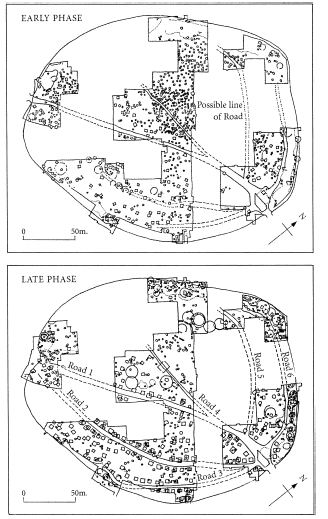
The interior of the Iron Age hillfort at Danebury, Hampshire, in its early phase, 550-300 BC (top), and late phase, 300-100 BC (bottom). The circular shapes are the foundations of roundhouses, the small squares are four-post grain stores, and the larger square structure towards the centre is a shrine or small temple.
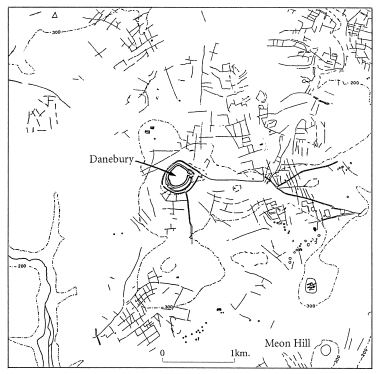
Danebury hillfort, Hampshire, and the surrounding field systems (550-100 BC). The presence of long and round barrows (3500-2000 BC) shows that the landscape was already long-established by the Early Iron Age, when the first fortifications on top of Danebury hill were constructed.
of the interior changed through time: in the early phase, which ended around 300 BC, the north-central area was largely given over to a mass of deep grain-storage pits and there were fewer roundhouses. In the later phase pits seem to have been replaced by post-built granaries, which were now far more common than in the early phase. There were also many more roundhouses. The human population would have been between three and five hundred at any single period.
The hillfort was clearly positioned at the hub of its landscape. By the Iron Age many of the livestock-based economies of southern Britain were being replaced by systems of farming that were more flexible and productive. These involved the keeping of livestock, but also the growing of cereals, such as wheat, oats and barley. Danebury was important for many reasons, but its role as a vast grain store must have been crucial to the region’s economy. Many of the fields around the hillfort were used for livestock - air photos clearly show stockyards, handling areas and droveways. But they were also used to grow crops, many tons of which would have been processed and stored in the hillfort. So Danebury was not just an empty symbol of wealth and power - it actually contained and protected it in the real, physical form of grain.
We do not know for certain whether Danebury is typical of larger hillforts in the central-southern zone, but field surveys and more limited excavations at South Cadbury (Somerset), Chalbury andMaiden Castle (Dorset) suggest that it probably is.24 This pattern of intensive settlement with roundhouses and numerous grain-storage pits seems to be a feature of larger hillforts in the central-southern region. Elsewhere in Britain, in Wales, northern England and Scotland, the interiors of Iron Age hillforts included very large open spaces; they never begin to resemble small towns, as Danebury does in its later phases of life.
Was Danebury ever a small town, or did it merely begin to resemble one? My feeling is that its population of five hundred people makes it too small to be considered truly urban. But there is more to it than that: the development of hillforts in Britain was a phenomenon that peaked before the Roman Conquest of AD 43. Had Julius Caesar invaded Britain successfully in 54 BC, the controversy surrounding hillforts and their urban status would be more clear-cut. As it is, we know that they were in decline as regional centres from the last century BC. Danebury, for example, effectively ceased to be a significant focus for settlement after 100 BC, although the landscape around it continued to prosper well into Roman times, most probably thanks to the effective politics of Cogidubnus, client king of the Atrebates, who was able to ward off some of the less friendly aspects of the new imperial regime. It would seem that the enlarged hillforts were a response to a particular set of social circumstances that prevailed in central-southern England in the Middle Iron Age - and as such they were relatively short-lived.
Whatever was happening on the hilltops, I suspect that the vast majority of the population actually lived in undefended farmsteads and villages on the lower-lying land surrounding the great hillforts. Today ‘rescue’ archaeology ahead of the construction of factories, roads and pipelines is revealing an extraordinary wealth of Iron Age settlement sites in southern Britain.25 The landscape around Danebury was composed of fields, roads and trackways that were carefully and well laid out. The origins of this particular landscape, and hundreds like it across southern Britain, go back several millennia, to when the primeval forests were initially cleared to make way for crops and animals. What we see in the Iron Age is the culmination of a process that was already very ancient indeed.
We have seen how the focus of political and economic power shifted towards the south-eastern corner of Britain after the fall of Gaul to Caesar’s forces. So this, if anywhere, is where we should expect to find evidence for bona fide urban life before the Roman Conquest of AD 43. So now I will turn my attention a little north and some distance east for my second case study, which centres on the north Chiltern Hills of Hertfordshire.26
As far as we know, most Roman towns were built either on or near significant centres of Later Iron Age trade and settlement. This in itself suggests a very considerable degree of continuity between preand post-conquest times. I want now to take a closer look at the way one of these places developed, and I have chosen a group of settlements in the northern part of the south-eastern region, around the gently rolling Chiltern Hills north of the Thames in my own county of Hertfordshire. This landscape lies within the part of Britain that began to grow in importance very rapidly in the Late Iron Age, and particularly after Caesar started his military campaigns across the Channel from about 60 BC. My case study will centre on the Late Iron Age settlements and the landscape around Verlamion, the British name for the subsequent Roman town of Verulamium, or St Albans.
London aside, only a small proportion of Roman towns and their Iron Age antecedents have been excavated to modern standards.27 There were, it is true, larger-scale excavations in the nineteenth century, but these should be treated with some caution, as the archaeologists of the day did not possess the wealth of scientific techniques that are commonplace today. In some instances archaeologists, such as Professor Mike Fulford at Silchester, are re-excavating these old digs, and are finding important ancient deposits that still lie undisturbed. It would be a mistake to regard the pre-Roman towns of Britain as wattle-and-daub equivalents of their cement-and-stone Roman counterparts.* As we will shortly see, they were nothing of the sort.28 So what were they like?
The short answer is that each one appears to have been different: there was no universal pattern to their layout, which instead would appear to have come about through a process of unplanned or organic development. Our case study, Verlamion, was positioned at the edge of the light, readily ploughed, loam terrains of south-eastern England. This change in soil marks a natural boundary between regions, and it is at such neutral, boundary areas that centres of exchange and trade spring up. The Later Iron Age saw quite a rapid expansion of population, and many areas once considered marginal were taken into agriculture. Verlamion was founded on such newly won farmland.29
There has been a lot of archaeological activity along the Chiltern Hills, and when this is combined with more recent aerial photographic surveys, it becomes clear that Verlamion did not sit on its own, but was part of a huge spread of Later Iron Age settlement with a number of major concentrations. Many of the more significant of these larger settlements have been excavated, and we now possess a remarkably complete picture of this important pre-Roman landscape.30 If we look at these main concentrations closely we find that they consist of many earthworks bounding smaller individual territories, and there is also evidence for housing, much industry, various shrines, many cemeteries (often with high-status graves) and an élite or upper class of richer people. There is also an enormous amount of evidence for farming, both of crops and livestock. This is surprising, because the farming seems to have been integrated within the other activities in the densely settled areas. Farms and fields stood alongside houses and industry.
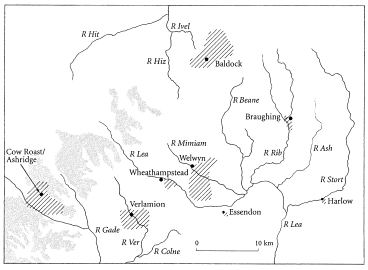
Major Late Iron Age settlements in Hertfordshire and the north Chiltern Hills.
It was a way of structuring social and economic life that worked: field systems and settlements grew steadily in size, and to judge from the amounts of rubbish they left behind them, people became better off.
The country around Baldock is a case in point,31 and I have to admit a special fondness for it, having spent my youth and childhood on the chalk downs that overlook the town. This, however, is not dramatic country: there is no mighty bluff on which a Maiden Castle might be erected. But there are hills, albeit gentle ones, and there are two hillforts, at Arbury Banks and Wilbury Hill. These do not dominate the centre of the landscape so much as mark its periphery. Of course we cannot be certain that they are in fact on the boundaries of what the Iron Age inhabitants of Baldock would have regarded as their territory, but it seems quite possible. The hillforts aside, what strikes one most about Baldock and the other landscapes of the region is the general lack of defences: people were not at each other’s throats, and raiders from outside were not expected. This was a peaceful landscape in which the residents felt confident of their personal security.
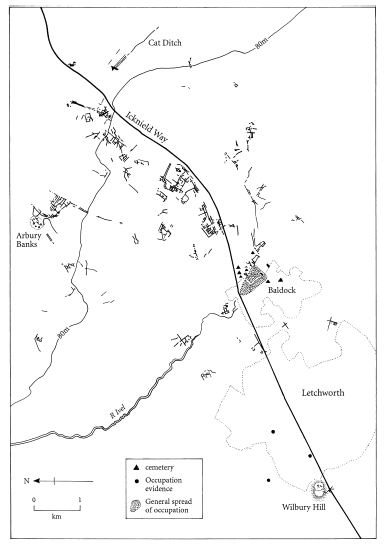
The main archaeological sites and features of the Baldock Iron Age complex. The approximate extent of the Iron Age settlement and Roman small town of Baldock is shaded.
Turning to Verlamion itself, with so many people living in the area and growing in prosperity, it is not surprising that earlier (Bronze and Iron Age) traditions of building great earthworks to mark the bounds of one’s estate were rekindled. As time passed, doubtless too there was much competition for social status. I do not believe that these earthworks were defensive, pure and simple: it makes no sense to erect a defence through a heavily settled landscape that has previously shown no indications of internal, or intra-communal, strife. It seems more likely that what we are looking at here is something akin to the walls that bound the parks around British country houses. These walls would not have deterred a poacher, but they would have warned the casual visitor to keep out, and by following them round to the main entrance to the estate, the legitimate visitor would find his or her way to the great house. So they served a practical purpose of sorts, but their main role was to impress.
If the earthworks of Verlamion are plotted out, it becomes apparent how much larger was the Iron Age settlement, or oppidum (Latin for a town), than the Roman one. The term oppidum is generally used to describe large town-like settlements of Iron Age date in Britain and the Continent,32 and I’m not altogether convinced of its usefulness. It’s a word which lumps together a huge variety of very different sites which are united only by their size. Size is a reflection of other things, such as simple population growth combined with a trend towards the development of more stratified, hierarchical societies. But one factor that does seem to unite oppida in many parts of Britain and the mainland of Europe is that they were centres of trade and exchange.33
Verlamion was an Iron Age oppidum before it became a Roman town.What was life like within the oppidum? At face value the archaeological evidence would suggest that the various sites were merely concentrations of unusually intensive rural settlements, plus a fair sprinkling of earthworks and industry. If that were indeed the case, one might expect social life within them to have been organised on an essentially rural pattern, based on ties of family and kinship. It was family relationships - possibly quite elaborate, extended ones - that had provided the social ‘glue’ which held British rural society together for millennia. They were a way of uniting societies in regions which did not have a strong central or established hierarchical authority.
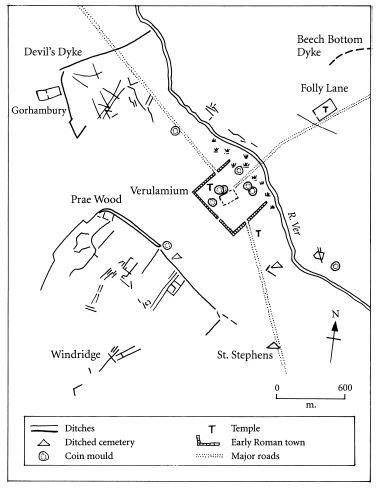
The Roman town of Verulamium (St Albans, Hertfordshire), surrounded by the earthworks and other features of the Late Iron Age settlement of Verlamion.
However, a recent study has suggested that shortly before the arrival of the Roman army some profound changes were beginning to happen within the most populous parts of Verlamion.
Excavations at the Iron Age and Roman King Harry Lane cemetery of Verulamium showed a decline through the Iron Age in the number of grave-goods buried with each body. This went hand in hand with a shift from graves that were placed within clearly bounded family enclosures to burials outside enclosures of any sort. It has been argued from this that the old rural network of strong social relationships was beginning to be replaced by a new pattern.34 People who moved into the oppidum could escape from the strong bonds of country life into something freer and with fewer obligations. Their social networks became smaller, more flexible and more cosmopolitan. With these changes came greater social mobility and the beginnings of an altogether different way of life.
I do not want to give the impression that the oppida were chaotic. Theywere not. Theywere organised in an organic, rather than a planned fashion, and have been described as polyfocal (many-centred) settlements. Modern London is a good example of a polyfocal settlement, with finance and commerce in the City, entertainment in the West End, government in Whitehall and religion around Westminster and Lambeth. There are also distinct residential areas and swallowed-up villages, such as Chelsea. A similar pattern applied to Verlamion, where some areas were given over to farms, settlements and fields, while others were reserved for communal activities such as burial, religion and metalworking. But was Late Iron Age Verlamion, or indeed Roman Verulamium which followed it, a true town as we understand the word today? That is a question which is crucially important if we are to understand what happened to the population when Roman rule began to disintegrate in Britain. It is a subject I will return to in Chapter 7.
*Wattle-and-daub was the standard pre- and post-Roman building material. It consisted of a woven wattle (usually hazel) framework which was daubed (smeared) with a mixture of clay, cow dung and straw. This material (which in some parts of the country is known as ‘cob’) had to be kept dry, unlike true lime mortar, which was introduced to Britain by the Romans.