
19
Multiply your supplications and prayers in the sight of God with joy and thanksgiving, since God has manifested His mercy in fulfilling by our hands what He had promised in ancient times.
From a letter of Godfrey of Bouillon, Raymond of Saint Gilles, and Archbishop Daimbert to Pope Paschal II, September 1099.
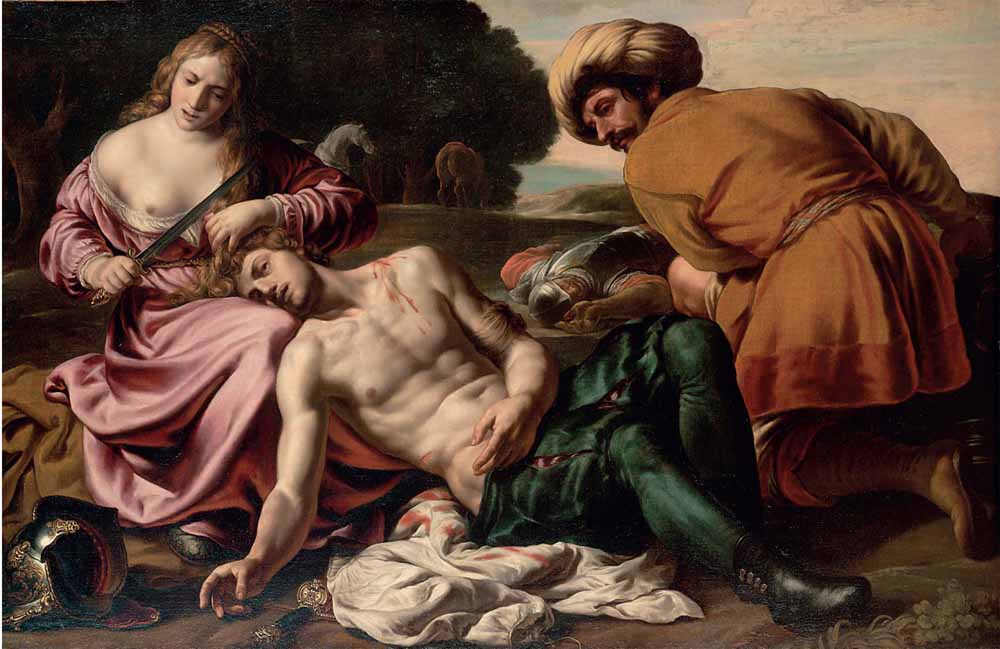
Tasso’s poem La Gerusalemme Liberata has the charming Muslim girl Erminia abandoning her Muslim people to tend Tancred the Norman and to bind his wounds with lengths of her own hair. Nothing remotely so romantic occurred during the city’s fall.
By the second week of July, the Crusaders were ready with towers and ballistas, and they had filled the city’s moat. The Fatimid garrison had been busy too, maintaining an archery assault on any Crusader brave or thirsty enough to approach the one unpoisoned spring beyond the walls, as well as upon any religious processions the Franks dared to attempt around the city’s walls.
On 14 July 1099 the attack began and Ibn al-Athir succinctly explains the mechanics of the city’s fall:
They built two towers, one of which, near Zion, the Muslims burnt down, killing everyone inside of it. It had scarcely begun to burn before a messenger arrived to ask for help and to bring the news that the other side of the city had fallen. In fact Jerusalem was taken from the north …
The Crusader assault on the city had been planned as a simultaneous attack on both the north and south walls, but Godfrey of Bouillon, leading the north wall’s forces, had also outmanoeuvred the Fatimid defenders. Godfrey’s tower had been swiftly dismantled during the night of 13 July and moved a kilometre down the walls from its original position. The Fatimids were unable to move enough artillery quickly enough to effectively repulse Godfrey’s attack. That Godfrey’s stratagem was a stroke of genius is evident from the fact that, two days later, the Fatimids were able to completely raze a tower that Raymond of Toulouse brought into action at the southern Zion Gate. Raymond of Aguilers tells us what it was like to stand in the path of this firestorm:
As the machines [of war] came close to the walls defenders rained down upon the Christians stones, arrows, flaming wood and straw and threw mallets of wood wrapped with ignited pitch, wax and sulphur, tow and rags on the machine. [This] kindled fires which held back those whom swords, high walls, and deep ditches had not disconcerted …
The Fatimid artillerymen also managed to set fire to a vast battering ram, but it still destroyed the north-side curtain wall on 14 July. The next day they failed to torch Godfrey’s tower, despite the use of a ‘flamethrower’ when the tower was within a sword’s length of the inner wall – at this point the tower was too close for the wall-mounted mangonels to fire at it, and the piped and piston-driven fire-sprayer was the city’s last artillery defence.
A section of the walls then went up in flames, as the Crusaders also employed fire as a weapon, and the northern wall’s defenders panicked. Crusaders, under Godfrey’s leadership, deployed from the tower and onto the walls. News of the breach caused a collapse of courage among the defenders of the southern wall too. Apart from a desultory resistance at the Temple Mount and the retiring of the Fatimid governor and his bodyguard to the Tower of David, from where they were able to negotiate their surrender and safe passage to the port of Ascalon, there was little else to interrupt the Crusaders’ sack and slaughter.
Tancred undertook a small act of chivalry, well below the level that the Tancredi of Tasso might have achieved, when he guaranteed the lives of ‘pagans’, Jews and Muslims who had been pushed in desperation to seek sanctuary on the roof of the Dome of the Rock as Crusaders rode through the streets around the Temple Mount ‘in blood up to their knees and bridle reins’. These unfortunates’ lives were, however, taken by other knights beyond the Norman’s control.
Jerusalem, like Antioch, now belonged to the Catholic world. Pope Urban II, the instigator of the expeditio would never have known of the triumph. He died on 29 July 1099, before word could reach him.