
20
Then our leaders in council decided that each one should offer alms with prayers, that the Lord might choose for Himself whom He wanted to reign over the others and rule the city. They also ordered all the Saracen dead to be cast outside because of the great stench, since the whole city was filled with their corpses; and so the living Saracens dragged the dead before the exits of the gates and arranged them in heaps, as if they were houses.
From the Gesta Francorum.
The Crusaders faced a dilemma. Jerusalem had been conquered under the banners of many secular lords and the one man who might have claimed authority over the venture as both a warrior and as a representative of God’s church, Bishop Ademar of Le Puy, had died in Antioch.
Was Outremer to be a messianic community committed to the will of the Church or a ‘traditional’ kingdom under a lord or even king by right of conquest? Neither were satisfactory given that force of arms had delivered Jerusalem and armed men could be the only defence of this exposed island of Christendom in a hostile land, whilst no king could surely sit legitimately upon the throne that rightly belonged to the Lord Jesus Christ.
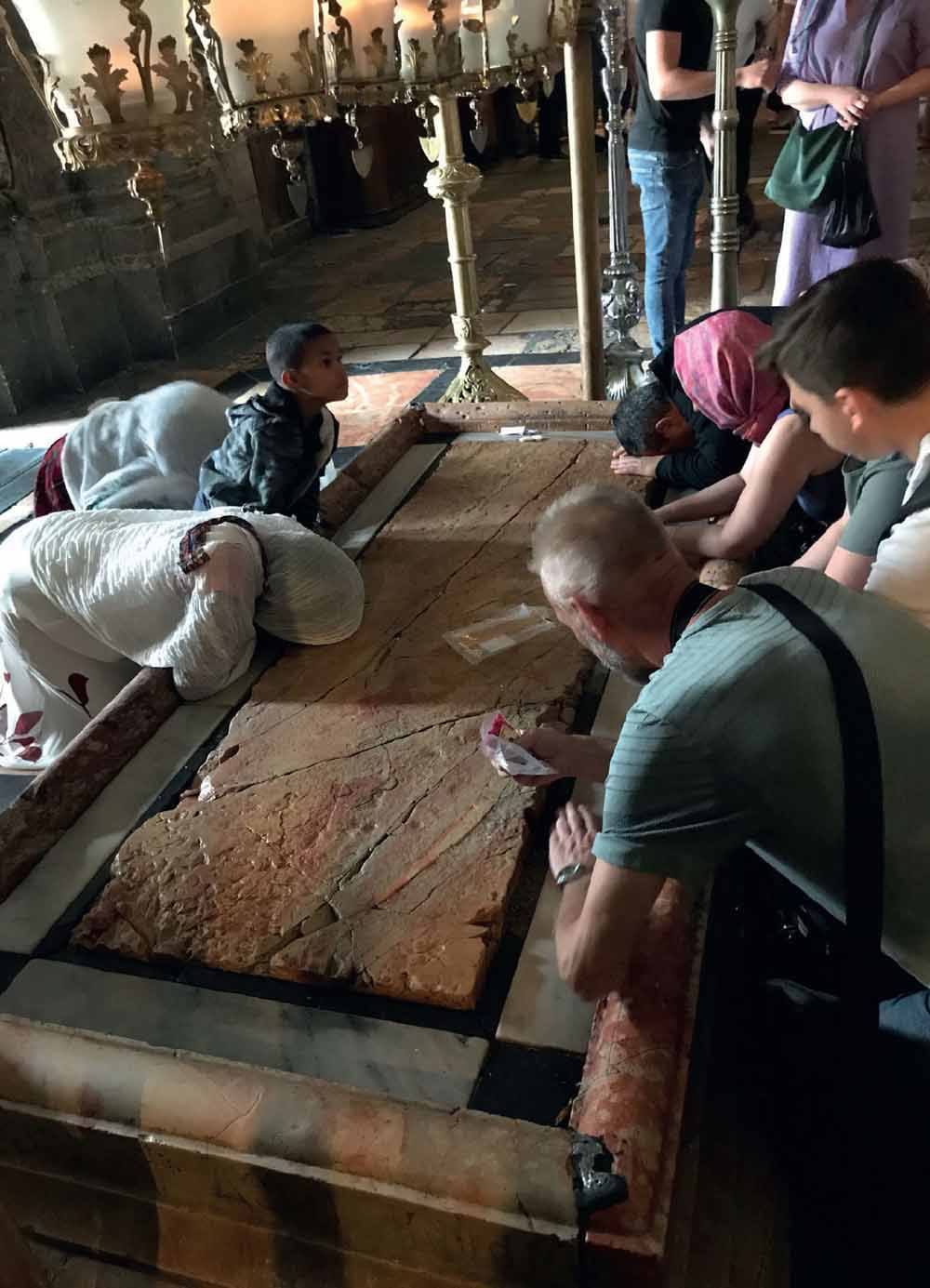
A compromise was in fact found within only eight days. The need for defence of the newly-won lands seems to have been uppermost in the minds of the lords as they elected Godfrey of Bouillon, who was undoubtedly a superb soldier, and who, as we have seen, was benefiting from his brother Baldwin’s possession of Edessa as he could support more vassal knights and lords than any other contender for the ‘throne’. The French jurist Beaumanoir succinctly describes how ‘the lord is quite as much bound to be faithful to his man as the latter is bound in regard to the lord’. Godfrey had supported many desperate knights during the darkest hours of Antioch and the march to Jerusalem.

Godfrey was also undoubtedly pious and the initial resistance of the Latin Church’s representatives in the city were perhaps partly overcome by his decision to be titled not as king but as Advocatus Sancti Sepulchri. The Church was also weak in leadership at this point as the Bishop of Orange had died before Jerusalem’s capture and the Bishop of Matirano had been captured by the Turks after claiming Bethlehem as his diocese. Archbishop Daimbert of Pisa arrived only later, and notably tried to block the accession of Baldwin of Edessa to the throne after Godfrey’s death.
The established ‘practice’ of feudal law may also have decided the matter in favour of the secular rather than the spiritual lords of the new territory. Having a ‘ready-made’ government apparatus, however flawed, would have been an important factor in the creation of a rapid and effective administration and defence of Outremer, just as it had been in the Norman conquest of England. Raymond of Aguilers describes how much of the horse-trading and negotiations between the lords centred on who ‘should collect the tribute of the regions, to whom the peasants of the land could turn, and who would see to it that the land was not further devastated’.
Devastation was potentially at hand. Egypt had finally been stirred to stern action, and had dispatched an army against the nascent Crusader state. There was a rapid election of Arnulf, the chaplain of Robert of Normandy (a supporter of Godfrey in the elections for ruler), as Patriarch of the city. His ‘incontinence’ during the pilgrimage and the fact that he had never held a significant office in the Church led to much mutterings from the higher clergy and the singing of many a ribald song about the new spiritual leader of the celestial city. What swung the election in his favour was his discovery of fragments of the True Cross that had been hidden away by a Syrian Christian monk and which were then reshaped through many days of industry into a miniscule imitation of the instrument of Christ’s death. This act guaranteed his acceptance by the laity.
The tiny artefact was further enriched with silver and gold and carried through the streets into the Holy Sepulchre. Muslims had commonly mocked Christians as being Abd al-Salib, Slaves of the Cross, but as we will see, a Crusader army with the Cross as its vanguard was capable of deeds far beyond its numbers.