
CHAPTER VIII
In retrospect the closing years of the reign of Charles V can be seen as the last occasion when the war might have been decisively concluded on France’s terms. That it was not was due to two serious misjudgments on the part of the King of France. The decision to reignite the civil war in Brittany by annexing the duchy to the Crown’s domain gave England a fresh opportunity to prolong the war in France’s Atlantic provinces. It provoked what proved to be the last great English campaign in France in the fourteenth century. This final push, on which the English expended much treasure, ended in a humiliating failure. But it cost France two critical years and its government a serious loss of face. The virtual abandonment of the attempt to eject the English from Gascony was a less dramatic and perhaps less obvious mistake but in the long term proved to be even more significant. Louis of Anjou’s failure to press the invasion of Gascony to a conclusion encouraged England’s latent supporters in the south-west and brought back to the English camp most of the trimmers who had made their peace with the Duke of Anjou after the victories of 1377. It was a missed opportunity which France would not make good until the middle of the fifteenth century. The struggle between the two countries subsided by 1380 into a tired stalemate, followed by two decades in which public opinion became increasingly hostile to the war in both countries. Governments presided over by incapable monarchs were weakened by internal dissension, deficits and the distracting personal ambitions of the princes who stood behind the thrones: Louis of Anjou and Philip of Burgundy in France, John of Gaunt and Thomas of Woodstock in England.
*
In the closing days of the campaign against Charles of Navarre’s garrisons in Normandy, in June 1378, a royal official passed through Brittany, reading out in the public places of the towns a summons requiring John de Montfort to appear in Paris to answer charges of treason. The proclamation passed almost unnoticed at the time. John was in England and did not hear of it for several months. But it proved to be among the most controversial decisions of the King’s reign, dividing his Council, his family, his supporters in Brittany and political sentiment in France. The trial opened on 4 December 1378 in the great chamber of the Parlement of Paris before the King and the handful of the peers of France who had not sent their excuses. The King’s proctor read out a formidable list of treasonable acts extending back to 1370, while the ushers went through the motions of calling out the Duke’s name in the courtyards outside. The outcome would have been a foregone conclusion even if John had been there to answer. On 18 December 1378 he was condemned in default and the duchy was pronounced forfeited into the King’s hands.1
In one sense all this was an empty formality. The French royal chancery had referred to John as the ‘former’ duke ever since he had renounced his homage in 1373. French armies had already overrun the whole of the duchy except for the western extremity of the peninsula which was controlled by the English garrison of Brest. But for all that the King of France did not control Brittany. It remained an autonomous duchy even in the absence of a duke. The ducal demesne, which included John’s castles and the principal towns of the peninsula, was administered by the Viscount of Rohan in effect as regent for the next duke, whoever that should be. The duke’s courts continued to operate. There was a shadow administration in the castle at Nantes, staffed by former clerks of his government. Most of the Breton leaders seem to have assumed that John de Montfort would eventually make his peace with the King and return to his duchy. But there was a significant minority who favoured the transfer of the duchy to the house of Blois, which still commanded a good deal of emotional support in parts of the duchy. By the terms of the treaty of Guérande the heirs of Charles of Blois were entitled to succeed John de Montfort if he should die without male heirs. Since John was now nearly forty years old and had no children by either of his marriages this seemed much the most likely outcome.2
Charles V had accepted this state of affairs for five years after his break with John de Montfort. But in 1378 he resolved to bring matters to a conclusion. The genesis of this decision is obscure but there are good reasons for associating it with two of Charles’s closest councillors in his final years, his First Chamberlain Bureau de la Rivière and that restless spirit, Olivier de Clisson. With the death of many of Charles V’s older councillors Bureau had emerged as the guiding figure on the royal Council, overtly exercising the influence which he had always had in private. Olivier de Clisson, whose charm and military ability had made him an influential member of the royal circle, was probably at this stage the King’s main source of information and advice about Brittany. Several of the allegations made against John de Montfort at his trial reflected Clisson’s particular grudges.3
Why did Charles choose to bring an end to the awkward interregnum of Brittany and annexe it to his demesne? There seem to have been two main factors at work. In the first place there was no plausible claimant to the ducal title. The King was determined not to let John de Montfort return. The only alternative contender was the house of Blois which suffered from a major disability. Its candidate, John of Blois, was a prisoner in England. In 1378 John of Blois must have been in his late thirties. For a quarter of a century he had known little else but the walls of the grim state prisons of Devizes and Nottingham. He knew little or nothing of Brittany and few Bretons had set eyes on him. The danger was that John de Montort might die while his heir was still under English control. But to obtain his release it would be necessary to do a deal with Richard II’s ministers, a bargaining counter which they could be expected to exploit for all that it was worth. At one point a proposal was canvassed for disinheriting John of Blois and promoting the candidature of his younger brother Henry. But legitimacy mattered too much in fourteenth-century minds for this idea to take root. Henry did not even have the support of his mother. She was determined to try to ransom her eldest son and had no compunction about negotiating with the English if she had to.4
There was a second reason for Charles’s action in 1378. He was under severe financial pressure. With no end to war in sight he was having to spend large sums on military and naval operations while at the same time trying to build up his reserves. He had reached the limits of his subjects’ taxable capacity. Even present levels of taxation were not likely to be maintainable for long. Charles’s failing health added to his concerns. The oppressive fiscal regime which he had created troubled his soul and threatened to leave his young son with an inheritance of bitter public hostility when eventually he mounted the throne. Other sources of revenue had to be found. In his last years Charles increasingly turned to the royal demesne, badly damaged by war, reduced by grants to friends and councillors and inefficiently managed by his servants. The confiscation of Charles of Navarre’s possessions in Normandy had shown the way. The annexation of Brittany would be the largest accretion of territory to the Crown since the annexation of Languedoc a century before. It would enable him to appropriate the ducal revenues, whose management was even poorer than his own but which were potentially very lucrative. And it would enable him to levy war taxes in the duchy on the same basis as other provinces which were directly governed by the Crown.5
Charles V does not seem to have anticipated the fierce resistance which his project was bound to arouse among the Breton nobility. The first to declare her opposition was Jeanne de Penthièvre. She was outraged, for the confiscation decree would extinguish not just John de Montfort’s rights but also those of her son as his heir presumptive. When the Parlement was considering the charges against John she instructed her lawyers to oppose the proceedings. But their objections were brushed aside. Jeanne had many allies. The principal noblemen of Brittany had been conspicuously loyal to the Crown ever since John had thrown in his lot with the English but they were also strong supporters of the duchy’s political autonomy, on which their local influence largely depended. They declared that they had no desire to see Brittany absorbed into the intrusive administrative and fiscal regime of France, ‘like Normandy’. The leaders of the opposition in Brittany were John, Viscount of Rohan, and Guy, lord of Laval, both of them long-standing supporters of the house of Blois and experienced politicians with great domains in eastern and central Brittany. They had as much to lose as anyone if the duchy was extinguished as a political entity.6
In the spring of 1379 the English government was grappling with a financial crisis of its own. The double subsidy of 1377 had been intended to finance a decisive offensive against France during the following year. But by the time that the ineffectual Chancellor, Adam Houghton, Bishop of Saint David’s, rose to address the Parliament of October 1378, it had all been spent. Parliament was meeting at Gloucester, an unpopular venue which had been chosen mainly to avoid the anger of the London mob. The proceedings were overshadowed by John of Gaunt’s defeat at Saint-Malo. It was a difficult time at which to ask for another subsidy. Much of Houghton’s address was devoted to undignified recriminations against the tide of ‘bacbyters’ who were spreading calumnies against the King’s officers.
The defence of the government’s position fell to the Steward of the royal household, Richard Lord Scrope of Bolton, a conspicuously able politician who was widely respected. Faced with a hostile Commons Scrope adopted a mixture of firmness and tact. His main theme was the number and geographical spread of England’s enemies. Scrope understood the anxiety and insecurity provoked in England by the raids of the French and the Scots. He suggested that the war was essentially defensive and emphasised the heavy cost of garrisons: £24,000 a year at Calais, £12,000 at Brest and ‘great sums’ at Cherbourg, Bordeaux and Bayonne in addition to the growing expenditure on the defence of Ireland, the Scottish march and the south coast of England. Every penny of the lay subsidies and wool duties, Scrope said, had been spent on legitimate operations of war. The Commons were incredulous. They called for the accounts and appointed a committee to examine them. These more or less bore out what Scrope had said but only served to open up fresh lines of complaint about strategy. The Commons acknowledged that the high cost of John of Gaunt’s expedition to Saint-Malo was money properly expended in an honourable venture in spite of the disappointing outcome. But like so many critics of war expenditure, before and since, they could not accept that a large proportion of any war budget is inevitably consumed by overheads rather than offensive operations. They identified no less than £46,000 of improper expenditure, about thirty per cent of the whole. Most of it had gone on garrisons and embassies. Such operations, they declared, were not the kind of ‘grant voiage et forte guerre’ that they had had in mind in granting the double subsidy. Scrope protested that the coastal garrisons in France were essential forward bases and that their presence was the main thing that stopped the French from taking the war into England. The Commons were sceptical, perhaps rightly so. They pointed out that the government had had two years’ worth of lay subsidies and they declined to grant another after only a year.
The King’s ministers took it badly. According to one report, they threatened to issue commissions of trailbaston, a profitable but highly unpopular procedure which had not been used for many years, by which the King’s judges were empowered to tour the counties imposing rough justice for real or alleged incidents of violence. If this threat was really uttered their bluff was called. The government received only a modest and temporary increase in the rate of the wool duty, which was reckoned to be worth no more than £4,000 in a full year. The main outcome of the Gloucester Parliament was the resignation of Chancellor Houghton a week into the sittings, followed by the removal of the entire continual council and its replacement by a new one, the third to hold office since Richard’s accession. The assembly was hurriedly dissolved in mid-November before worse befell.7
The result was that no military operations were planned for the summer of 1379. When the Great Council, which traditionally applied itself to strategic planning in the new year, met rather later than usual in February 1379, they were told that the Treasury was empty and that nothing could be done. Yet even without aggressive plans England could not stand still. There had been a brief but embarrassing incident at the end of November, when a handful of Scottish borderers tunnelled their way by night into the cellars of Berwick castle, the principal English fortress of the Scottish march, and overcame the garrison as they slept. The raiders were disavowed by the Scottish wardens of the march. The Earl of Northumberland retook the place by storm within ten days and executed the culprits. But the affair was a dramatic warning of the danger of allowing garrison strengths to decline. The cost of maintaining Calais was rising. Cherbourg and Brest were in urgent need of resupply. Sir John Neville in Gascony, with fewer than 1,000 troops at his disposal, most of them tied up in garrison service, was pleading for reinforcements and money.8 At Westminster the Great Council regarded the war at sea as having first call on its limited funds. Two new English Admirals had recently been appointed, both chosen from among the most experienced commanders in English service, Sir Thomas Percy and Sir Hugh Calveley. Calveley was already the keeper of the Channel Islands. The two Admirals were now made joint captains of Brest and given authority over the garrison of Cherbourg, in what was obviously an attempt to create a unified Channel command operating from both sides of the straits.
The problem of finance was for the moment deferred. The Great Council advised that Parliament would have to be summoned in the spring. In the meantime, they suggested, the government would have to borrow. A great campaign of forced loans was launched at the end of February 1379. The peers present at the Council were the first to put their hands in their pockets. The representatives of the Corporation of London were summoned to declare how much they would find for the King’s needs. Commissioners toured the country with blank summonses executed under the privy seal in which they filled in the names of men reported to be rich enough to pay. Cash-rich war contractors, like Sir Robert Knolles, invested their profits in government loans against good security and promises of interest rates exceeding fifty per cent. More than £13,000 was raised. Most of it was spent on raising a fleet for Percy and Calveley.9
How far the English followed events in Brittany and Paris over the winter is not at all clear. But they began to take notice during the six weeks which followed the dispersal of the Great Council. In March 1379 the master of Jeanne de Penthièvre’s household arrived in England to hold preliminary discussions with Richard II’s Council about the situation in the duchy. The main purpose was to obtain the release of John of Blois. The course of the discussions is impenetrably obscure but it is known that Jeanne’s agents had John transferred to the royal castle of Marlborough and obtained permission to interview him there. The discussions came to nothing. The English had no reason to sell their help cheaply. They were certainly not willing to release the sons of Charles of Blois while there was any chance of restoring their own candidate to the duchy. By the end of March the Council at Westminster had resolved to support a fresh invasion of Brittany in the hope of exploiting what seemed to be highly promising developments there. Preliminary plans were made for an expeditionary army of 4,000 men provided that some means could be found to pay for it.10
Charles V probably got wind of these discussions, for before anything could come of them he resolved to bring the burgeoning crisis in Brittany to a head. Early in April 1379 the French King appointed four commissioners to take possession of the duchy in his name. Their leader was Louis, Duke of Bourbon, one of the peers who had sat in judgment on John de Montfort. The others were the indispensable Bureau de la Rivière, the Admiral of France Jean de Vienne and the Marshal Louis de Sancerre. A small force of men-at-arms was placed at their disposal and plans were made to invade the duchy from the south-east by way of the ducal capital at Nantes. Charles V did not expect to encounter any serious resistance.11
Bertrand du Guesclin and the leading Breton magnates, Rohan, Laval and Clisson, were summoned before the King in Paris. There was a chilly interview in one of the council chambers of the palace on the Île de la Cité. The King informed them of the steps which he was taking to enforce the judgment of December and asked them whether they intended to co-operate. Through gritted teeth they said that they would. When the King required them to swear an oath they did that too. But in the event only Olivier de Clisson, who had supported the confiscation from the outset, honoured his word. Rohan and Laval fled back to Brittany, claiming that they had sworn in fear of their lives. Bertrand du Guesclin, who commanded a number of important royal fortresses on the north-east march of Brittany, was in a difficult position. He was the principal military officer of the Crown. But his heart was with Rohan and Laval. He stayed sullenly in Paris.
Towards the end of April 1379 a large part of the Breton baronage gathered in the presence of Rohan and Jeanne de Penthièvre, probably at Rennes. They put their name to a document in which they swore to oppose the French invasion and created a league to organise the defence of Brittany. Four of their number were elected as marshals to recruit an army. The handful of royal garrisons in the peninsula were expelled and their castles occupied by the rebels. A hearth tax of one franc was ordered to be levied throughout the duchy to finance its defence against the Crown. Finally, after some further deliberation, the Bretons resolved to send an embassy to John de Montfort in England to invite him to return as soon as possible to his duchy. Neither Laval nor Rohan formally acceded to the league although many of their kinsmen and friends did. Their consciences were probably troubled by their oaths. Whatever they may have thought about the man whose alliance with England had caused such outrage five years before, all of these men were realistic enough to see that he was now the only champion of Breton autonomy available. Some of them were even prepared to contemplate the return of an English army. When, at about this time, Sir Hugh Calveley landed a raiding party from the sea to pillage villages on the Breton coast, he was astonished to find himself welcomed as a liberator. Jeanne de Penthièvre’s attitude was particularly remarkable. She did not formally join the Breton league, perhaps because of her close relations with the court. But she gave it her blessing and seems at one point to have agreed to her third son, Henry, assuming the nominal command of the Breton army. Charles V had succeeded in uniting the whole political community of Brittany for the first time in nearly forty years.12
While the Breton leaders were deliberating Olivier de Clisson arrived in Nantes with a small troop of soldiers and royal officials to secure the city in the path of the French army. Clisson was the captain of Nantes and its citadel was held by his men. But the town and the vital bridge over the Loire were firmly under the control of its inhabitants. They were courteous but inflexible. They told Clisson that they had no intention of admitting the English but neither would they acknowledge Charles V’s commissioners. Over the following days they expelled all royal officers from the town and forced Clisson to withdraw. The Duke of Bourbon had mustered his small army at Le Mans on 30 April and was already on his way. Clisson met him in the fortress of Champtoceaux on the Loire at the border of the duchy. He recounted the scale of the Breton rebellion and his own failure at Nantes. Shortly afterwards, a delegation arrived from the Breton league. They left Louis of Bourbon in no doubt that any attempt to enter the duchy would be resisted. With the modest forces under his command there was no question of forcing the issue. Bourbon withdrew to Angers and then north into Maine to wait for further instructions.13
The English Parliament met at Westminster on 25 April 1379. They were once again addressed by Richard Scrope, this time as Chancellor. Scrope spoke on the now-familiar text of heavy expenditure, public danger, and poor tax yields. But he had not forgotten the suspicions of the Commons at Gloucester. He invited them to nominate a commission of peers to examine the government’s finances for themselves. All the accounts would be laid before them, he said. They would have power to enter government offices without warning to pursue their investigations. They would find no hidden caches of money, no undisclosed sources of revenue and no corrupt transfers to the King’s household. The commission was duly nominated and passed the best part of a month buried in the government’s accounts. They seem to have been satisfied.
The turning point came with the arrival at Westminster in the middle of May of the ambassadors of the Breton league. The Bretons found John de Montfort sitting as Earl of Richmond among the Lords. They seem to have had no difficulty in persuading him to fall in with their plans. The more delicate question was what role the English would play in his return. John could not appear in Brittany at the head of an English army without alienating most of the Breton nobility and probably all of the towns. On the other hand he did not wish, once he was back on Breton soil, to be left at the mercy of his new friends, some of whom had been his worst enemies only a few months before. His first instinct was that it was too dangerous to go back to Brittany without a large armed force of his own. This was also the view of the Duke of Lancaster and Richard’s other councillors. They were naturally more concerned with England’s interests than John’s. Within a few days of the Bretons’ arrival they were talking in terms of sending John de Montfort back to Brittany with the projected expeditionary army of 4,000. In return for this assistance and shipping to get it to Brittany, they proposed to appoint him as Richard II’s lieutenant in the duchy and to require him to carry the fight into France as soon as he was secure in his possession of it.14
Assuming that the army was paid for six months’ service, a campaign on the scale envisaged was expected to cost £50,000 on top of the government’s other commitments. This was a substantial sum, the equivalent of a standard Parliamentary subsidy and a corresponding grant from the Church. A difficult and long-drawn negotiation began with the representatives of the Commons. Finally they were persuaded that the opportunity was worth the cost. On 27 May 1379 they granted not a standard subsidy but a poll tax, the second experiment of its kind. Like its predecessor of 1377, the new tax was to be levied at the rate of four pence a head. But, remembering the unpopularity of the earlier poll tax, the Commons made some changes. They raised the qualifying age from fourteen to sixteen years and exempted married women. They also added a crudely graduated income tax on the better-off. Twenty-two categories of taxpayer were identified who were thought to be able to afford more than four pence. These were assessed at rates which were designed to mulct the commercial and professional classes in the towns, who did not do military service and were believed to have got away lightly under the old regime of standard taxes on moveables. The rates varied from five pounds for a judge (more than twice the rate of the richest advocate, be it noted) to a shilling for the keeper of a small inn. An earl paid four pounds and a knight one. John of Gaunt and John de Montfort occupied a special category of their own. They paid ten marks (£6 13s 4d) each. The Church, which had done well from the previous poll tax, was pressed into granting an equivalent income tax of its own at steeply graduated rates which bore heavily on the bishops and greater monastic houses. The government’s financial officers were very confident. They were brought before Parliament to swear an oath that at these rates the tax would yield enough to finance the Breton campaign as well as the repayment of the forced loans. They were just as optimistic about the timing. The assessments were expected to be completed and the first half of the subsidy collected within a month.15
In the course of June 1379 John de Montfort’s negotiations with his subjects came to the attention of the French government. Charles V revoked the powers of his commissioners. In their place he appointed his brother Louis of Anjou, who had been in the north since the spring. Anjou was assigned an army of nearly 2,500 men-at-arms. Part of this force was placed under the command of the Duke of Bourbon and immediately ordered to Avranches, where he could cover both the Cotentin and the north coast of Brittany if the English tried to land troops. Eight Castilian galleys, which reached the Gulf of Saint-Malo in July, were set to guard the approaches to the peninsula by sea. In the arsenal at Rouen shipwrights were working hard to complete the construction of new oared barges and to repair and equip the rest. But in spite of these warlike preparations the Duke of Anjou’s instructions were more pacific. Better, it was said, to try to soften the resentment of the Bretons with tact and recover the castles of the duchy with money. This almost certainly represented Louis of Anjou’s own preference. His misgivings about the confiscation of Brittany were well known. He also had many friends and kinsmen who were now prominent in the ranks of the rebels, including his mother-in-law Jeanne de Penthièvre. At the beginning of July he established his headquarters in the border fortress of Pontorson on the north-east march of Brittany and opened negotiations with the leaders of the Breton league. Louis’s diplomatic approach provoked divisions among the Breton nobility, as no doubt it was intended to. The league’s most powerful supporters were the first to secede. Rohan and Laval, who had never formally adhered to it but had publicly supported its objects, were persuaded to return to their previous alliance with the Crown. The doubts about whether John would return in time and the prospect that he would come with a large English army are likely to have been the main factors in their decision. Jeanne de Penthièvre might have followed their example if she had been able to. She was passing through Dinan with her son Henry on her way to Pontorson when the local leaders of the league invaded the town with their retainers and refused to let her leave.16
In England the plans for John de Montfort’s return to Brittany were encountering the usual administrative and financial obstacles. The poll tax, the first instalment of which was due in late June, did not begin to come in until August and early reports from the collectors suggested that the amounts would fall a long way short of the confident predictions of the Exchequer. The Council attributed this to the laxness and incompetence of the assessors. But all the evidence suggests that it was in fact due to gross misconceptions on the part of the Commons and the Exchequer officials who advised them. They had under-estimated the effect of raising the qualifying age and exempting married women and had greatly over-estimated the number of higher-rate tax payers. The full extent of the disaster took some time to become apparent, but the total assessment ultimately proved to be only £19,304, not much more than the cost of repaying the forced loans raised to finance the fleet. The result was that by July there was no money left to pay for the Breton expedition and neither ships nor troops had been recruited for it. The embarkation date had to be deferred until the autumn.17
Seeing the prospect of a triumphant return slipping away, John de Montfort took the greatest gamble of his career. In about the middle of July 1379 he announced his intention of leaving for Brittany immediately, almost unescorted. He proposed to take hostages from the Bretons for his own safety and to bring just seventy English soldiers, a handful of Breton retainers and no horses. Richard II’s Council appears to have accepted this change of plan with some misgivings. They assigned two representatives of their own to accompany him: Sir Richard Abberbury, until recently captain of Brest and something of an authority on Breton affairs, and the civil lawyer Walter Skirlaw, a rising star on the diplomatic side of the English royal Chancery. John had to agree to be ‘guided’ by these men. Their real function was to keep an eye on him and to negotiate a deal with the Breton league which would serve the wider strategic interests of England. According to reports later circulating in Brittany, which were almost certainly true, the Council also exacted a promise that John would return to England in September to assume the command of the larger expedition. On 22 July 1379 John and his small company sailed from Southampton with the two Admirals and thirty-nine ships of the Channel fleet on what had originally been planned as a routine coastal raid in the estuary of the Seine. On 3 August, in the late afternoon, they arrived in the great open roads off Saint-Malo.18
The English fleet sailed in line past the town with a following wind, making for the channel which led into the estuary of the River Rance. The Castilian and French galleys appear to have been beached, either in the inner harbour or south of the town in the inlet of Bas Sablons. They made no attempt to intercept the leading ships, which were large fortified hulls under the command of Sir Hugh Calveley. But once these had gone past they made for the transports, most of them simple cargo barges which were following on behind with the Duke’s furniture, armoury and treasury. The galleys assailed the transports with cannon, terrifying the crews and doing serious damage. Disaster was only avoided when Calveley turned his ships back and, tacking into the wind, succeeded in rejoining the rest of the fleet. There, their greater height gave them the advantage over the galleys. The French and Castilian crews suffered heavy casualties from arrows shot from the towers and masts of the English ships and were eventually forced to withdraw to the shelter of the harbour. Cannon had been mounted on ships for some years, but this was one of the earliest recorded naval engagements in which they played a significant part. It also illustrated the weakness of an all-galley fleet, even in the age of gunpowder, when pitted against large sailing ships with searoom and wind. By nightfall the whole of the English fleet was anchored in the Rance by the keep of Solidor, which was firmly under the control of the Breton league. John had dropped a messenger ashore in Normandy to tip off the league’s local leaders. Within a short time the beach had been secured by Breton troops and invaded by a crowd of well-wishers from the region around.19
The sudden appearance of John de Montfort in Brittany took the French by surprise. The first contingents of Louis of Anjou’s army were just beginning to muster on the border some twenty-five miles away. Anjou himself had left for consultations with the King and his councillors at the royal castle of Montargis, south of Paris, where the government had temporarily taken refuge from the plague which was raging in the capital. The only prominent representative of the Crown in the region was the Constable, who was in the citadel of Saint-Malo with a retinue of just 200 men-at-arms, enough to defend the town but not enough to interfere with John de Montfort’s progress on the mainland. From Montargis Anjou wrote hurriedly to the Viscount of Rohan, ordering him to make at once for Saint-Malo and drive the ‘former duke’ back into the sea. Rohan did not receive this missive until 6 August and it took him three days to raise his retainers. Few other Breton noblemen could have achieved even that much. On 9 August Rohan set out from his castle at La Chèze at the head of 400 men-at-arms.20
John de Montfort played his cards with consummate skill. As soon as he had landed he despatched a circular to the baronage of Brittany, announcing his return and calling on them to come before him at Dinan, a walled town at the head of the estuary of the Rance some fifteen miles south of Saint-Malo. On 6 August John entered Dinan and installed himself in the house of the Franciscans. Most of the nobility of the region was already in the town. About ninety more arrived over the next few days, bringing their military retinues with them. On the 9th John was able to preside over a council which could have passed for a general assembly of the Breton nobility. The only famous names who were absent were Olivier de Clisson, who was sulking in the citadel of Nantes, and the Viscount of Rohan, who was a day’s march from the town with his men and whose intentions were still uncertain. Rohan did not take long to realise that it was too late to drive John de Montfort back into the sea. With the strength of the rebellion growing daily even the greatest noblemen were obliged to bend with the wind if they were to conserve their influence and their followers. Guy de Laval had already resiled from his deal with the Duke of Anjou and submitted to John de Montfort. When Rohan reached Dinan on the 10th he sized up the situation and did the same, putting his whole force at John’s disposal. Both of these men were clearly terrified by their own boldness and desperate to avoid an irrevocable breach with the King of France, at least until the direction of events became clearer. Even after they had submitted to John de Montfort they were writing to assure the Duke of Anjou that it was all dissimulation. Disentangling the truth from the lies is not easy.
Some of the men who were with John de Montfort at Dinan would no doubt have abandoned him at the first signs of failure. But, as the bandwagon gathered speed and Louis of Anjou failed to intervene, it became increasingly difficult for them to withdraw. John gave them few excuses and did much to disarm old criticisms. He promised to govern by the advice and counsel of the nobility and to abandon his English advisers. ‘I’ll believe that when I see it,’ Bertrand du Guesclin remarked when this was reported to him. Yet on 10 August, the day of Rohan’s submission, John felt strong enough to dispense with Calveley and Percy and send the fleet back to England. On 16 August the assembled Bretons listened in the packed church of the Franciscans to a rousing speech in which the Duke recounted the injustices which he had suffered at the hands of Charles V and robustly defended the historic independence of the duchy. Jeanne de Penthièvre appeared before the crowd to support him. Plans were announced for an army to hold Brittany against the French. Nearly 1,000 men were promised from the retinues of those present. Rohan alone committed 300.
On 20 August John de Montfort entered Rennes, the principal city of eastern Brittany. Its captain, Thomas de Fontenay, a former officer of Charles V’s household, was not a signatory of the league but had been among the first to offer his submission. He opened the gates upon John’s arrival. Here John de Montfort began to behave like a ruler. The rudiments of an administration were put together. Instructions were despatched to ducal officials in every part of the duchy. An attempt was made to address the rebels’ chronic shortage of funds by doubling the rate of the hearth tax. All available troops were summoned to assemble before John’s marshals at Vannes. From Rennes John set out on a month-long tour of his duchy, passing through the great Penthièvre fief in the north, the vast Rohan domains of the centre and along the south coast. On 26 September he entered Vannes in triumph. He had been in Brittany for less than two months.21
Charles V’s councillors at Montargis watched these events from a distance with growing incredulity. Accusations of treachery and connivance were already being made against Bertrand du Guesclin at the beginning of August. Bureau de la Rivière was foremost among the Constable’s detractors. He would probably have said the same about Anjou if he had dared. And it is true that neither of the two principal executants of royal policy in Brittany had his heart in the job. The Constable had no wish to see another civil war in Brittany. Nor did his followers, who deserted his standard at an alarming rate during the autumn. Du Guesclin maintained his contacts in the rebel camp and looked for openings that might lead to a compromise. He even came down to the beach as the English fleet was leaving to talk to Sir Hugh Calveley from the water’s edge. The two men were old enemies and friends. Du Guesclin had been Calveley’s prisoner in the Breton wars of the 1350s and his companion in arms in Castile in the following decade. They were men of the same bent of mind who had always got on well. The English, Du Guesclin reported, seemed willing to consider a negotiated solution. The first approaches from John de Montfort’s camp reached the Duke of Anjou in mid-August when two prominent members of the Breton league came before him with proposals. Louis’s response is not known but he certainly did not reject them out of hand. He was obviously in no hurry to resort to force. He did not leave Montargis until the third week of August and then dallied for several days in Anjou while the Duke of Bourbon and his men kicked their heels uselessly on the Breton march. When he finally arrived back at Pontorson at the end of the month he embarked on a long series of discussions with the Bretons.
On 17 October 1379, without a blow being struck, a truce was agreed, initially for a period of a month, to allow for a conference between the principals. Under the terms of this agreement both sides agreed to submit to the mediation of the Duke of Anjou and John de Montfort’s long-standing protector Louis de Mâle, Count of Flanders. In point of form nothing had been resolved. But everyone knew that the decree of confiscation was a dead letter. On 18 November 1379 the French army at Pontorson was disbanded and no further attempt was made against the Bretons. The French government retained one significant town, Saint-Malo, and a handful of small garrisons scattered across eastern Brittany. Apart from Brest, which was still securely held by the English, and Nantes, which declined to deal with either side until the outcome was clear, the whole of the rest of the peninsula was in the hands of John de Montfort. If the recollections of an old man, recorded many years later, are to be trusted, Bertrand du Guesclin believed that the debacle had cost him the confidence of the King. He even endeavoured to return his sword of office.22
If John’s bloodless triumph was a reverse for the French it was ironically just as problematic for the English. He had recovered almost all of Brittany with very little assistance from them, and no agreement had been reached with the Breton league for future operations against the French Crown. John’s English advisers, Abberbury and Skirlaw, followed him about his duchy until mid-September when they returned empty-handed to England. In his current situation it was very much against John’s interest to lift a finger against the King of France. Once he had sealed his truce with Anjou he was not in a position to do so. This left the status of England’s great expeditionary army rather uncertain. The requisitioning of shipping had been in progress since June but no troops had been recruited for lack of funds to pay their advances. On 9 September another Great Council met at Westminster to review the government’s military plans in the light of the continuing problems with the poll tax. The strength of the army of Brittany was reduced by two-thirds from 4,000 to 1,300 men and its cost was cut to less than half the original estimate. As reports of events in Brittany reached England there were further changes. The command was switched from John de Montfort to the Marshal of England, John of Arundel, and the destination was changed from Saint-Malo to Brest. No one seems to have applied their minds to the strategic purpose which this army was now supposed to achieve.23
*
In any case another, more unusual, project was now competing with Brittany for the attention of the Council and the limited resources of the Treasury. This arose from some characteristically devious dealings between the King’s ministers and a prominent French prisoner of war. It is a romantic story. Waleran de Luxembourg, Count of Saint-Pol, was a rash young man who had been captured in a skirmish in the Pas-de-Calais in 1374. He had had great difficulty in ransoming himself, partly because he was one of the richest territorial magnates of Picardy and his captors were expecting a steep ransom; and partly because of the unwillingness of the French government to exchange this raw soldier for more distinguished prisoners. Increasingly resentful of his fate, Saint-Pol was bought and sold and finally acquired by the King, who allowed him to live at court at Windsor castle. There he fell in love with a young widow, Matilda Courtenay, ‘la plus belle dame de toute Engleterre’ according to Froissart. Matilda was Richard II’s half-sister, the child of his mother’s earlier marriage to Sir Thomas Holand. Public opinion disapproved of the match and the Queen Mother shared their opinion. But the Council had their own ends in view. They agreed to ransom the Count for 100,000 francs (£16,666) and to allow him to marry his betrothed on highly unusual terms. Saint-Pol agreed to renounce his homage to the King of France, to do liege homage to Richard II for all his domains and to hold his many fortresses in Picardy and the march of Flanders at the disposal of the English government. Within fifty days of his release he was required to seize the town and castle of Guise, one of the major fortresses of the Vermandois, which belonged to his relatives of the house of Châtillon and to make war on the French Crown from its walls and those of his own castles in the vicinity. For this purpose he was to be supplied with a small army of 300 English men-at-arms, supported by 300 mercenaries from the Low Countries under the command of a turncoat of an earlier generation, Thierry (‘Canon’) Robesart.24
The plan came to grief as almost all such adventures did. The Count of Saint-Pol was taken to Calais and released in September 1379. But rumours about the terms of his liberation had already reached the ears of the French ministers. At the beginning of October royal officials seized the Count’s castles in Picardy and Enguerrand de Coucy put royal garrisons into the fortresses of the Vermandois. The Count and Robesart got as far as Hainault, where they planned to begin recruiting their mercenaries. But Robesart was arrested by the regent of Hainault at the request of the French government and locked up in the castle at Mons. The Count fled back to Calais and returned to captivity in England. He eventually married Matilda Courtenay in the following year and succeeded in paying the rest of his ransom. But he was banished from France until after death of Charles V. ‘Age and maturity’, it was said when he was finally pardoned, ‘would soften his impulsive spirit.’25
With the return of the Count of Saint-Pol to England events moved from farce to tragedy. The English army of Brittany gathered in the Solent in October only to find that there were not enough ships to carry even the reduced numbers with their horses and equipment. Bored and frustrated, the men mutinied and took to looting the villages and churches of Hampshire while the Admirals’ officers combed the ports of England for more ships. By the beginning of December about ninety ships had been found, most of them quite small, plus thirty-five larger hulls hired in Bayonne and the Low Countries to carry the horses. It was a difficult time of year, with long nights and unpredictable weather. John of Arundel’s sea captains thought that a storm was coming and advised him to wait. But he was under strong pressure to make up for lost time. He felt he had waited long enough. On 6 December 1379 the English fleet sailed out of the Solent. On the following night the storm struck. The ships were scattered before the wind and driven out into the Atlantic, then back onto the coasts of Ireland, Wales and Cornwall. At least seventeen troop-carrying ships were wrecked off Ireland. Nineteen more, laden with horses, foundered on the coast of Cornwall. Sir Hugh Calveley, a man now well into his fifties, survived clinging by a cable to a broken mast. John of Arundel was drowned trying to reach the shore. Hundreds of soldiers and seamen lost their lives. It was several years before England’s self-confidence as a naval power recovered from this blow.26
*
The French ministers were preoccupied with their own problems. The Duke of Anjou was still at Pontorson when a messenger arrived with news of a serious rebellion against his authority in Languedoc. The background to this event was a tragedy which was only beginning to be understood in Paris. Languedoc had for years been taxed more heavily in proportion to its resources than any other part of France with the possible exception of Normandy. It had borne substantially the whole burden of prosecuting the war against the English in Gascony and of fighting off the companies operating on the fringes of the region. It had also had to fund the cost of maintaining Louis of Anjou, a royal prince with a magnificent household and international ambitions. The tax base from which all this had to be financed was shrinking rapidly as successive censuses showed a steep and persistent decline in the number of taxable households. In the three seneschalsies of Languedoc the number fell from about 84,000 in 1370 to about 31,000 nine years later. Medieval tax censuses were notoriously fallible but on any view these were remarkable figures. Part of the fall was due to the three great agents of depopulation: plague, famine and war. There is also anecdotal evidence of large-scale migration into neighbouring regions which were more lightly taxed. But the main factor at work is likely to have been the progressive impoverishment of both town and country, resulting in a high proportion of households falling below the threshold of ten livres’ worth of moveable property at which liability to pay tax began.
In the face of this catastrophe the Duke of Anjou was determined to maintain the absolute level of his tax receipts. He responded with a sharp increase in the rate of taxation. In the early part of the decade the Estates-General of Languedoc had generally met twice a year, granting hearth taxes at a rate which amounted to about five francs per hearth per year. In December 1377 the Estates-General, meeting at Toulouse, was induced to grant a new fouage at one franc per hearth per month, more than double the traditional level. Since this coincided, as it turned out, with the virtual suspension of large-scale military operations on the march of Gascony it proved extremely difficult to get the grant renewed at the same rate in the spring. No fewer than three meetings of the Estates-General were required before Louis of Anjou got his way. Even then the city of Nîmes refused to agree until the Duke threw their representatives in prison and suspended their consulate. When, in October that year, Louis of Anjou demanded the extension of the tax at the same rate for a full year, the cowed representatives at Toulouse did not dare to challenge him. But the tensions generated by these debates were felt well beyond the churches and palaces in which the Estates-General met. Urban mobs were less easily intimidated. Overt signs of resistance multiplied. Le Puy erupted into riots in April 1378 as the bailli and chief judge of the Velay discussed the collection of the tax with the consuls of the town. In November 1378, after a poor harvest had left men with no means of paying, the inhabitants of Alès assaulted the town hall. A ‘nest of thieves’, they called it.27
Instead of moderating his demands Louis of Anjou responded by trying to dispense with the Estates-General altogether. In the autumn of 1379 he demanded an extension of the tax for yet another year. Commissioners were appointed to browbeat each communityindividually. These proceedings brought ill-feeling in Languedoc to a new pitch of intensity. A number of towns sent delegates to the north to protest to the King. Louis of Anjou, who was engrossed with the negotiations with the Bretons, brushed their complaints aside. He told his brother that the complaints were exaggerated and that he would deal with them when he had time. Time was not to be given to him. On 21 October 1379 six of Anjou’s commissioners, led by his chancellor and his treasurer, arrived at Montpellier with a large escort of clerks, officials and servants. Montpellier was the largest city of the province after Toulouse and had once been the richest. But it had probably suffered more than any other place by the misfortunes of Languedoc. The town had had more than 10,000 taxable households in 1345 compared with fewer than 1,000 now. The consuls had protested against the current tax, declaring that the inhabitants had not enough to live on. On the day after their arrival the Duke of Anjou’s commissioners met the consuls in the chapter house of the Franciscan convent and presented their demands. The consuls declined to answer at once. They said that they would think about it and return with their answer. When they returned it was with a large armed mob at their backs. There was an ill-tempered argument. As voices rose the crowd forced its way into the building. They fell on the Duke’s officers and commissioners and their staff and lynched them. Many were hacked to death as they lay on the ground. Their bodies were dragged through the streets and thrown into wells. The carnage continued all night. Then in the sober morning they set about putting the city in a state of defence and called upon the other cities of the province to rise with them in defiance of Anjou’s government.28
For a few days it looked as if the rising might spread to other cities. The consuls of Nîmes reported ‘murmurings’ throughout the province. The King’s proctor there had his house sacked. The consuls temporarily suspended all taxation for fear of imminent revolution. At the edge of the plain, twenty miles from Montpellier, the inhabitants of Clermont de l’Hérault rang the tocsin, set fire to houses and assaulted the castle of the Count of Clermont, shouting: ‘Kill all the rich like the men of Montpellier did.’ The slogan, although hardly an accurate statement of the motives of Montpellier, was a reminder that underlying many tax rebellions there were profound social divisions. The root cause was that the tax census was used as a measure of the taxable capacity of the whole community, not as a basis for collecting from individual households. The money was in practice paid to the government by the municipal authorities and recouped from the inhabitants on principles which were decided locally by urban elites who knew how to look after their own interests. Montpellier was comparatively unusual in recouping the cost with a mildly progressive income tax. Local sales taxes on commodities, which bore particularly hard on the poor, were far more common. Latterly, the Duke of Anjou had exploited these internal divisions, encouraging the use of indirect taxes by municipal authorities. It was easier to obtain their consent if the full weight of the tax fell on others. As a result when violence broke out in the towns it was often directed as much against fellow citizens as against the local representatives of the government. The riots at Le Puy and Clermont-de-l’Hérault in 1378 had both been aimed at the consuls and the rich. How are we to feed our children, the rioters prayed to the famous black statue of the Virgin in the cathedral of Le Puy, in the face of taxes ‘inflicted on us by the rich to lighten their own burden’?29
The repression, when it came, was savage. In January 1380 Louis of Anjou, accompanied by 1,000 men-at-arms and a large force of crossbowmen, was received into the city of Montpellier by a crowd of women and children prostrating themselves on the ground and crying for mercy. A few days later the Duke decreed the penalties of lèse-majesté from a vast scaffold in a carefully contrived ceremony every detail of which had been agreed in advance. Six hundred citizens who had been involved in the rebellion were to be executed: 200 would be beheaded, 200 hanged and 200 burned alive. Montpellier would lose its consulate and part of its ramparts. The assembled consuls removed their robes of office and surrendered the clapper of the town bell and the key of the gates to give symbolic effect to these decrees. As for the rest of the citizenry, they would be required to pay an indemnity of 600,000 francs to the King in addition to payments to the kinsmen of the dead men and the cost of endowing chapels to pray for the repose of their souls. On the following day most of these penalties were remitted. The executions were limited to a small number of ringleaders and the indemnity, which the town had never had the least prospect of paying, was reduced to 130,000 francs. Even the reduced penalties were remitted in the following reign.30
The government received a shock. Charles V did not overlook the real lesson as Anjou had. In January 1380 a delegation of the principal cities of Languedoc travelled to Paris to put their grievances before him. Their intervention seems to have been decisive. In April 1380 the King removed the Duke of Anjou from the lieutenancy of Languedoc after sixteen years in the job. Shortly after his recall the delegates reached agreement with the King on a new tax regime. The rate of the gabelle du sel in Languedoc was doubled, but the aides were halved and the hearth tax was reduced to three francs per year, a quarter of the rate which Anjou had demanded. The King also undertook that the revenues derived from these taxes would be applied exclusively to the prosecution of the war. It may be that even Anjou came to acknowledge the adverse impact of his rule, for among the many acts of reparation for public and private misdeeds which later appeared in his will was a bequest of 50,000 francs (£8,333) to the poor of Languedoc on account of their sufferings under his government. Anjou remembered in particular the victims of his onerous taxes and the men and women who had abandoned their homes rather than pay them, ‘for which things we may have been responsible’. In his agreement with the towns of Languedoc Charles V undertook not to burden the province again with a prince of the royal family as his lieutenant but to appoint a competent captain of lesser rank to conduct the war on the marches in his name. Shortly afterwards Bertrand du Guesclin was nominated as Captain-General in Languedoc with most of Anjou’s functions.31
It was a significant retreat which must have been profoundly wounding to the King’s brother. Yet Languedoc was far from unique. In the neighbouring provinces of Auvergne and Bas-Berry the records reveal the same shrinking tax base, aggravated by far more serious physical damage from routier operations. The number of taxable house holds in Auvergne fell during the 1370s by about a third and in parts of the province by more than half. Depopulation caused by disease, war and emigration to the more peaceful and lightly taxed domains of the Duke of Bourbon were all significant factors. As in Languedoc, however, the major cause seems likely to have been the impoverishment of those who stayed behind but disappeared below the tax threshold. The Duke of Berry, whose appanage included these provinces, had responded in the same ruthless fashion as his brother in Languedoc by tightening the fiscal screw yet further. In the course of the 1370s, as the wealth and population of Auvergne diminished, the frequency and rate of hearth taxes rose inexorably. By 1378 the towns of Auvergne were paying hearth taxes at approximately the same rate as those of Languedoc in addition to the aides on essential commodities and the gabelle on salt. The Duke reacted to the protests of the Estates of Auvergne by ordering the arrest of the protesters, who were held in prison until they consented to further grants. It was one thing to extract consent from terrified representatives in the provincial capital but another to collect it from their constituents. Large numbers of peasants and townsmen fled from their homes into the hills and forests of Auvergne, where they formed themselves into bandit armies known as tuchins, often commanded by indigent noblemen with their own grievances against the government. According to the fullest contemporary account to survive they were united by ‘awful oaths never to bow their heads to the yoke of taxes’. By the end of the 1370s the tuchins had become almost as great a menace in Auvergne and northern Languedoc as the Anglo-Gascon companies.32
Most popular resistance to taxes occurred not in provincial assemblies or even in the streets of the towns but in the face of the collectors and the officers whose job it was to enforce payment against defaulters. According to the petition of the Estates of Auvergne to the King in 1379 a poor man who had been unable to pay could be confronted at his door by ten or twelve ‘sergeants, commissioners and bailiffs’ whose ruinous charges would be added to the sum due. The system invited violence on both sides. In Languedoil, the recorded opposition to taxation took the form of attacks on collectors and the occasional articulate personal protests which are recorded in the registers of the French Chancery because over-zealous officials charged the offender with lèse-majesté. Such incidents became more common as fiscal pressure on the population intensified and the brutality required to extract payment increased. Charles V’s financial officers in Paris were well aware of the problem and their master was more sensitive to it than his brothers. For the past three years the King and the Chambre des Comptes had been trying to lighten the burden without conceding the principle, by granting temporary or localised exemptions and reducing the number of hearths for which the worst-affected communities were assessed. On 21 November 1379 Charles V published a great ordinance on the reform of the French tax system, which declared in its opening paragraph the King’s desire to relieve the ‘grief and oppression’ of his subjects. Yet these reforms were too capricious in their incidence. The administrative measures consisted only of moderating or sometimes punishing the abuses of officials and trying to address the imbalance between rich and poor taxpayers. They barely scratched the surface of the underlying grievances. The day would come when the protests would coalesce into large-scale rebellions, even in the traditionally loyal cities of the north.33
*
The English Parliament which opened at Westminster on 16 January 1380 was overshadowed, like so much political discussion in France, by financial crisis. Addressing the assembled Lords and Commons in the presence of the young Richard II, Chancellor Scrope declared that the government was bankrupt. He recounted the history of the poll tax of 1379, which had raised less than half its expected yield. The wool duties had been reduced to a trickle by unrest in Flanders. The forced loans raised to anticipate the receipt of the poll tax were still outstanding. There was no money to pay garrisons on the Atlantic seaboard of France or the march of Scotland and nothing to defend the coast of England, let alone to finance a campaign on the continent. There were no hidden reserves. The Commons were angry and frustrated. They pointed to the scale and frequency of Parliamentary taxation, going back to the early years of the previous reign. The burden, they said, could not be sustained indefinitely. Unless the war came to an end shortly the realm would be ruined. They demanded another special commission to examine the accounts and to review the whole financial history of the war. They called for the dismissal of the ‘continual council’. The government bowed before the storm. The ‘continual council’ resigned en masse and was replaced by the five principal officers of state with a smaller council of administrators and members of the King’s household. Chancellor Scrope was dismissed in favour of the amiable and honest but ineffectual Archbishop of Canterbury, Simon Sudbury. The financial commission was duly appointed and given extensive powers of inquiry. But there was no escaping the facts, which were substantially as Scrope had described them.34
In spite of their lack of funds, the English King’s Council had vast strategic ambitions, focussed on Gascony and Brittany. Sir John Neville had been pressing for money and reinforcements for Gascony ever since his arrival in the duchy in September 1378. The march had been comparatively stable for two years and Neville himself had made remarkably effective use of the tiny forces at his disposal. He had harassed the forward positions of the French, recapturing some of the smaller places close to the city and taking a great quantity of prepositioned stores and artillery which Anjou had left in readiness for a future offensive. An extra 400 troops had been sent out from England in the previous autumn, bringing the total strength of English forces in the duchy to just over 1,000 men, still a pitifully small number. But the enemy was uncomfortably close to Bordeaux and no one believed that the present torpor on the front would last. In the longer term the security of the city depended on recovering control of the lower valleys of the Dordogne and the Garonne, and that called for a major campaign in the south-west.
Richard II’s ministers were devising an ambitious plan for co-ordinated campaigns against the French, with an English army operating from the Gironde and an Aragonese army operating simultaneously from Roussillon. This was an old dream which successive English ambassadors had canvassed in Barcelona for years. In the autumn of 1379 Geraud de Menta, the Gascon diplomat responsible for these negotiations, had been in England for consultations. It had been decided that the time had come to press the project to a conclusion. It would be the main military enterprise of 1380. Gerald returned to Barcelona with a promise that the plan would be put before Parliament.
But how were the English to get an army to southern France? The sea route was ruled out by want of shipping. The long overland route via the Massif Central was regarded as impossible after John of Gaunt’s experience in 1373. The English would need an accessible port in Brittany and access to the city of Nantes with its great bridge over the Loire. When Geraud de Menta left England for Barcelona in October 1379 John of Arundel’s fleet was about to sail for Brittany. But by the time he reached Aragon it had been destroyed at sea. Before any major expedition to Gascony could be contemplated it would be necessary to complete the business of the previous year and re-establish control over the Breton peninsula.35
Once again Charles V eased the English government’s difficulties by throwing the Bretons into their arms. The long-delayed mediation between John de Montfort and Charles V had just come to the end of its opening session in the northern town of Arras, having probably got no further than the opening statements. Frustrated by the obduracy and dilatoriness of French diplomacy, John de Montfort appointed ambassadors to conclude a military alliance with England. There is little doubt that he had the support of the Breton nobility for this move. The leading figure in his embassy at Arras was Jean de Beaumanoir, an old partisan of Blois who had been a leading light in the leagues of the previous year. Beaumanoir arrived at Westminster towards the end of January and was in the English capital for more than a month. On 1 March 1380 a perpetual alliance between England and Brittany was sealed. Both sides had learned some lessons. This time, John de Montfort’s ambassadors did not commit him to participating in an English invasion. But it was agreed that an English army would be received in the peninsula and that English troops would be given transit rights through John de Montfort’s dominions on their way to France or Gascony. In return John received a guarantee of English military assistance in the event of a French invasion of his duchy. The command of the new expedition was conferred on the Earl of Buckingham. Twenty-five years old and with little military experience, Buckingham was not an ideal choice. But his deficiencies were to some extent made good by the formidable group of veteran captains which was assigned to accompany him. They comprised almost all the notable English commanders then living, including Sir Hugh Calveley, Sir Robert Knolles, Sir John Harleston, Sir Thomas Percy and William Lord Latimer. The size of the army was eventually fixed at 5,000 English troops, in addition to a force of mercenaries which it was proposed to recruit in the German Low Countries. It was expected to serve on the continent for a full year.36
Buckingham’s retainer and friend Sir John Gildesburgh, a veteran of Crécy and Poitiers, was Speaker of the House of Commons. He laboured mightily to procure the necessary finance. The Commons eventually succumbed, as their predecessors had so often done, to the instinct that one more spasm of financial exertion, one more tremendous military offensive might enable the war to be brought to a close on acceptable terms. They granted a standard subsidy and, unusually, a further half-subsidy which was to be collected with the rest but treated as an advance on any tax which might be granted in the next Parliament. The proceeds of these impositions, together with the arrears of the poll tax of the previous year, were strictly reserved for the proposed expedition. And, the Commons warned, they would have to be enough for that purpose. There was to be no new Parliament before the autumn of 1381. As for the cost of garrisons, that would have to be met from the modest proceeds of the additional wool duty voted in the previous year. The Commons were interested only in large-scale offensive operations. It is clear that great hopes were invested in Buckingham’s enterprise. He was charged, said his letters patent of appointment, to ‘bend all his efforts to the bring the war to its ultimate conclusion’.37
*
The planning of the Earl of Buckingham’s expedition to France brought the English government up against the abiding problem of the new maritime strategy. Although the English had successfully acquired the bases in France they never acquired the shipping resources which were necessary to make effective use of them. The decline of the King’s own fleet was symptomatic. In 1369 Edward III had owned twenty-seven ships and barges, including five with a carrying capacity of more than 200 tons apiece. By the time of his death this had been reduced by losses and decay to four sailing ships, four barges and a galley. In 1378 only the great 300-ton sailing carrack Dieulagarde was fit for service. Two years later, in 1380, the Dieulagarde had been given to Sir William Elmham and the remnants of the fleet had been sold to pay the debts of the office of the King’s ships. This marked the end of the ‘royal’ navy until the next century.
Much the same fate had befallen the fleets of oared barges which Edward III had ordered from the principal maritime towns in 1372. Some of them had served in the fleets of the following year but very few of them reappeared later. The experiment was repeated in the autumn of 1377 by the authority of the October Parliament but the results were no better. Forty-two cities and towns were commanded between them to build twenty-seven small barges (‘balingers’) of forty to fifty oars each and to meet the cost by levying contributions from their richer inhabitants. This was a substantial burden for most of them. Cambridge, for example, commissioned its barge from a London shipbuilder at a cost of £142. This was three times the town’s contribution to a standard Parliamentary subsidy and had to be paid on top of the double subsidy granted by the same Parliament. The balingers were destined to serve in the fleet of 1378 and some of them reappeared in 1379. But thereafter they vanished as completely as their predecessors. The ministers of Richard II ordered an inquiry into what had become of them. The truth was that most of them had rotted away. The English government had no specialised repair facilities, such as the French maintained at Rouen or the Castilians at Seville. They had a storage depot and a yard at Ratcliffe in Stepney, the London suburb where most of the commercial shipbuilding and repairing trades of the capital were concentrated. But it was probably no more than a group of open docks cut out of the mud and was never properly funded or manned. However, the decisive factor in the decline of the royal fleet is likely to have been a shortage of crewmen. England had no native tradition of operating oared vessels. Conscripting seamen merely diverted the available manpower from requisitioned merchantmen without achieving any net increase in the number of operational ships. Without adequate crews it was hardly worth spending money on maintenance.38
More fundamental than the problems of the royal and municipal fleets was the continuing decline of the English merchant marine, measured in both ships and seamen. In the course of the 1370s the number of English ocean-going hulls available for requisition declined from about 250 at the beginning of the decade to about 190 at the accession of Richard II and about 120 three years later. The reality was even worse than these figures suggest, for the average carrying capacity of the surviving ships declined from 70 to 55 tons over the same period. It is clear that losses and depreciation were not being made good, particularly among the largest ships.39
Many shipowners responded to the heavy loss rates among traditional deep-hold ships by abandoning the trade and investing in oared vessels instead. Barges accounted for about a quarter of requisitioned ships in the early years of Richard II. These were small, short-lived vessels whose growing importance in the English merchant fleet was due mainly to the fact that they were cheap to build and offered some prospect of a return even if half the year was spent in the service of the King. The more robust of them could be used for commercial service, like the Maudelayne, which Chaucer’s shipman traded ‘from Grootland to the cape of Finistère’ and in ‘every creek in Brittany and Spain’. But their main value was that they could also be used for privateering expeditions against foreign cargo ships, an increasingly profitable alternative to trading. At the end of 1379 a commercial syndicate led by the rich Dartmouth shipowner John Hawley put together a small private war fleet of two sailing ships and five oared barges, which was commissioned to cruise off the south coast of England and western France. The system was extended and formalised in 1382 when the west country ports from Southampton to Bristol clubbed together to defend their coasts. These groups of naval entrepreneurs paid all their own costs in return for the spoil and the local proceeds of the tonnage and poundage duties. In the following year a similar deal, covering the Channel and the North Sea, was agreed with another commercial syndicate organised by the London ironmonger Robert Parys. For the government, privateers were cheap. But they had serious disadvantages. They were not amenable to strategic direction and were apt to embroil the King with neutral powers.40
In the longer term the solution was for the government to pay hire to English shipowners as it already did to foreign ones. After years of holding out against this reform, a hesitant step was taken in March 1380. Responding to the latest Parliamentary petition from the beleaguered shipowning community, Richard II agreed to pay them for the use of their ships at 3s 4d per ton per quarter from the day the vessel arrived at the designated assembly point. Even at that low rate the burden proved to be beyond the cash-strapped English government. Hire was discontinued in subsequent years and only reintroduced in 1385 at the even lower rate of 2s per ton. It would take many more years to remedy half a century of indifference to the plight of shipowners. In the meantime, as a naval power England spent its capital at home and looked for shipping abroad. Bayonne was an occasional source of fighting ships and seamen. Ships were regularly chartered by English agents in the Low Countries, generally for carrying horses. But even with these additions to England’s naval strength the ‘lift’ of English fleets in the early 1380s was only about 4,000 fully equipped troops, about 1,000 less than it had been in the last years of Edward III and less than a third of the corresponding figure in the 1340s. The Admirals’ officers succeeded in requisitioning only 123 English ships for Buckingham’s army in 1380, the lowest point to which the merchant fleet sank in the late middle ages. Even this required a good deal of barrel-scraping. Some of the ships taken were as small as ten tons. Thenumbers were made up by chartering at great expense no fewer than 156 merchant ships in the Low Countries in the course of March and April, much the largest foreign contingent which had ever served in an English fleet.41
The original plan was to embark Buckingham’s army at Plymouth and Dartmouth in May 1380 and sail directly for Brittany. This would probably have required more ships than the government could produce, even with the addition of chartered foreign tonnage. But in the event it proved to be impractical for other reasons. On 4 February 1380 the Castilian ambassador in France, Pedro Lopez de Ayala (also one of the principal chroniclers of his time), had sealed a new naval treaty with Charles V. This provided for the Castilians to furnish France with a fleet of twenty galleys with a total complement of 4,600 seamen and soldiers, more than twice the squadron which had served in previous years. The treaty also envisaged the possibility that the Castilian vessels might over-winterin French ports, instead of returning to their home bases, thus considerably extending the campaigning season. When the news of these arrangements reached England in the second half of April, the Council lost its nerve. Their confidence had been undermined by the fate of John of Arundel’s fleet. They were afraid that Buckingham’s transports might be dispersed by bad weather on the passage and its scattered fractions picked off by the more agile galleys of Castile. So they resolved to carry the army in relays to Calais instead. This meant that Buckingham would have to reach Brittany by the long land route round the north and east of Paris. It also meant switching the port of embarkation to Sandwich and postponing it while the ships were repositioned. These difficulties, which would delay the army’s arrival in Brittany by more than three months, must have provoked a fresh round of reflection about England’s strategic vulnerability at sea. They were among the main reasons for a sudden revival of English interest in Portugal.42
*
Of all Castile’s unequal relationships with its neighbours, none was more problematical than the relationship with Portugal. Henry of Trastámara had twice humiliated Portugal by force of arms. The country had for practical purposes been a client of Castile ever since the treaty of Santarém in 1373. Don Fernando had accepted his diminished status with apparent good grace but inward fury, a difficult pretence for this impulsive and unstable ruler to maintain. The Portuguese King was discreetly rearming throughout this period. The walls of Lisbon and the citadel of San Jorge, whose dilapidated state had proved to be his greatest weakness in 1373, had been entirely rebuilt. An ambitious programme of fortification was undertaken in the main provincial towns and castles. Much attention was devoted to the organisation of Portugal’s military nobility and urban levies. Ordinances were issued for their re-equipment along the lines of the French troops, whose service in Henry of Trastámara’s armies had made such an impression on the Portuguese. From 1377 the maritime towns were encouraged with commercial and fiscal privileges to build ocean-going ships which would be available to the King for naval service in wartime, concentrating on the largest ships of 100 tons burden or more. Twelve of these ships were built for the King’s own account in addition to his fleet of specialised war galleys. Don Fernando was waiting for the chance to use them.
The death of Henry of Trastámara in May 1379 changed many things. His son and successor was a very different kind of man. Twenty-two years old at his accession, John of Trastámara was morbidly religious and introspective, somewhat unsure of himself and subject to frequent and debilitating bouts of illness. He was surrounded by his father’s ministers and advisers and remained loyal to his father’s policies, but he had none of his father’s iron determination and few of his skills as a military commander. Within days of his accession Fernando cast off the mask. He withdrew the five Portuguese galleys which were being fitted out for service with the Castilians in the Channel. Then, without consulting his council, he began to devise plans for reviving the ill-fated Anglo-Portuguese alliance of 1372 and making war on his neighbour with English assistance.43
There was more to Portuguese policy in these years than opportunism and a frustrated desire for revenge. Don Fernando, then aged thirty-five, had been afflicted for a number of years with a severe wasting disease which seems to have been a form of tuberculosis. His illness intermittently deprived him of control over the affairs of his kingdom and concentrated the minds of those about him on the succession. The King’s only legitimate child was a daughter, Beatrice, born in 1373. His will designated her as his successor and appointed the Queen, Leonora de Teles, as regent until she was of age. But the prospects of both mother and daughter once Don Fernando was dead were extremely uncertain. Leonora was an ambitious, manipulative and grasping parvenue who was no more popular now than she had been when her marriage to the King had provoked riots in the streets of Lisbon. As for Beatrice, she was a child of seven of whom little was known. She had been betrothed to a bastard of Henry of Trastámara, Don Fadrique, since she was three. She faced formidable rivals in Don Fernando’s half-brothers, the Infante João and his younger brother Dinis. These two princes were the sons of King Pedro I’s tragic second marriage to Inez de Castro.* Dinis had lived in exile in Castile under the protection of the Trastámaran court for years and the Infante João would shortly be forced to join him there. João was a kingly figure, then in his late twenties, with a strong following among the Portuguese nobility and the Lisbon mob. The one constant theme of Don Fernando’s inconstant final years was the determination of the Queen to find a protector with the strength to assure Beatrice’s succession and to support her own position as regent. On the face of it the obvious answer was a dynastic alliance with Trastámaran Castile. There would have been some support for this among the Portuguese aristocracy and the higher clergy. But it would have been personally repellent to Don Fernando and risked provoking a civil war upon his death. S. Fernando and Leonora persuaded themselves that an alliance with an English prince might provide another way of securing Beatrice’s inheritance while conserving the independence of Portugal from its larger neighbour.44
In the autumn of 1379 the Portuguese King had made contact with his old favourite Juan Fernández Andeiro, the Galician adventurer who had negotiated the Anglo-Portuguese treaties of 1372 and 1373. Andeiro was now living in exile in the Duke of Lancaster’s household in England. Fernando suggested to him that he should use his influence with the Duke to persuade him to bring an English army to Portugal. It was probably at the same time that Fernando first mooted the possibility of a marriage between Beatrice and the seven year-old son of Edmund Langley, Earl of Cambridge. Andeiro took up the Portuguese King’s proposal with enthusiasm. It seems likely that his first approach was met with either rejection or evasion. The Duke of Lancaster had been losing interest in the Iberian peninsula for some time. His claim to the Castilian throne must by now have been recognised in England for the grave political blunder that it was, and John of Gaunt himself had done little to further it since 1374. Geraud de Menta in Barcelona was actively trying to settle the dispute between England and the Trastámaran dynasty. Peter IV of Aragon, who was John of Trastámara’s father-in-law, had offered to act as mediator. In March 1380 Peter approached the King of Castile with a veiled proposal, apparently endorsed by John of Gaunt and Richard II’s Council, that the Lancastrian claim should be dropped in return for peace between England and Castile and the abandonment of Castile’s military alliance with France.45
Early in 1380 Andeiro was instructed to carry the English response back to the Portuguese King. The text has not survived, but whatever its terms it caused Don Fernando to conclude that there was no alternative to a dynastic match with Castile. Fernando, whose health was now visibly declining, could not afford to wait for the slow evolution of Lancastrian foreign policy. In about April 1380 he let it be known that he would be willing to cancel Beatrice’s betrothal to Don Fadrique and to promise her instead to John of Trastámara’s six-month-old son and heir Henry. On 21 May 1380 the two kings concluded a treaty in which it was agreed that Beatrice would be married to Henry as soon as they were both of age. What was envisaged was nothing less than the union of Portugal and Castile within a generation. The point was driven home by another provision. If Beatrice should die before the marriage was solemnised, leaving Don Fernando with no other heir of his body, John of Trastámara himself would succeed him as King of Portugal. The unspoken bargain was that the King of Castile would connive in the exclusion of the children of Inez de Castro from the Portuguese throne.46
Meanwhile English attitudes were undergoing a fundamental change. John of Trastámara rejected the King of Aragon’s attempt at mediation and ratified the naval treaty with France. Frenetic preparations for a naval campaign against England were in progress in the arsenal of Seville and the port of Santander in the spring of 1380. A Portuguese alliance began to look more attractive in English eyes. Portugal was a significant naval power with a galley fleet which was as large as Castile’s even if it was not as professionally managed. A war between Castile and Portugal could be expected to detain the Castilian fleet far from the Channel. And even if it did not, the galleys would have to make their way from headland to headland up the hostile Portuguese coast for more than 500 miles in order to get from their base in Seville to the Bay of Biscay. In a short time John of Gaunt moved from a position of resigned indifference to the affairs of the Iberian peninsula to one of energetic enthusiasm. According to the chronicler Thomas Walsingham, a prejudiced but well-informed source, it was Gaunt who pressed on Richard II’s councillors the value of a Portuguese alliance as a means of parrying the naval threat from Castile. Like most later historians contemporaries probably assumed that he had his own interests in mind as much as England’s. There was something in this. With the Navarrese passes now firmly closed to English armies, a Portuguese alliance would open up another route into Castile which could transform John of Gaunt’s claim from a legal abstraction to a serious strategic venture. His obsession with what came to be known as the ‘path of Portugal’ became one of the dominant themes in English political discussion about the war. In late May 1380, at about the time that Don Fernando’s representatives were sealing their agreements with John of Trastámara, Juan Fernández Andeiro was told to return to Portugal, this time with a more accommodating message, an armed escort and extensive diplomatic powers on behalf of both Richard II and John of Gaunt.47
Andeiro conducted his mission in the cloak and dagger fashion which became him. No one wanted to see a repetition of the debacle of 1372, when the Anglo-Portuguese alliance had been prematurely disclosed and Castile had launched a pre-emptive invasion before help could arrive from England. So Andeiro discreetly disembarked at Oporto in the north of the kingdom and made his way unannounced to the thirteenth-century fortress of Estremoz in eastern Alemtejo, where the King and Queen were staying. Here he was received in the utmost secrecy and accommodated in their private apartments while the business was discussed. Andeiro’s mission was as successful as John of Gaunt could have wished. No doubt much of this was due to the ambassador’s natural persuasiveness. But it seems likely that the main reason for his success was the influence which he acquired over Queen Leonora. Those who knew of their relations ‘kept their thoughts to themselves’, wrote the well-informed fifteenth-century chronicler Fernão Lopes. There is little doubt that during his short stay at Estremoz Andeiro made the Queen his mistress. On 15 July 1380 the Portuguese King renewed the Anglo-Portuguese treaty of June 1373. At the same time he entered into a number of additional agreements. These were crudely drafted documents leaving many matters undefined. They bear all the marks of a private negotiation conducted without any of the usual legal and bureaucratic assistance. Beatrice, who had been betrothed successively to three Castilian princes in her short life, was now promised to the seven-year-old son of the Earl of Cambridge. The Earl was to come in person to Portugal bringing with him his son and an army of 2,000 men, which the Portuguese King undertook to pay at the usual English rates for three months. Andeiro had obviously been told not to promise more than England’s resources of shipping could perform. It was therefore agreed that they would come without horses or bulky equipment, which Fernando would provide for them at reasonable prices when they arrived. The Portuguese King and the Earl of Cambridge would then mount a joint invasion of Castile in the name of John of Gaunt.48
Andeiro and Fernando set about covering his return to England with a theatrical gesture. The ambassador travelled secretly to the river port of Leiria, north of Lisbon, and announced himself to local officials as if he had just arrived by sea. The King then ordered his arrest, had him pulled from his bed in a local hostelry and pretended to expel him from his dominions on pain of death. To reassure the Castilians Fernando sent his ambassadors before the Castilian Cortes, which was about to meet at Soria. There they solemnly confirmed the betrothal of Beatrice and the Infante Henry which the Portuguese King had already committed himself to repudiate. Don Fernando’s council were not let into the secret until after Andeiro had left Portugal. It was probably in September 1380 that the King summoned them to the castle of Santarém, the scene of his humiliation at the hands of Henry of Trastámara in 1373. He told them that it was time to get even with Castile and disclosed the substance of the arrangements which he had made with the English. The councillors were aghast. They demanded time for reflection. When they reconvened after three days of discussion they were unanimous in their opposition. All of them had sworn to honour the treaties with Castile, as indeed Don Fernando himself had done. Castile, they said, was a much stronger kingdom than Portugal. It had prevailed over stronger kings than Don Fernando. His last alliance with the English had been followed by a Castilian invasion from which Portugal had only recently recovered. All of this was sound advice. But Don Fernando brushed it aside. He had not asked them, he said, whether to make war on Castile but only how to do it.49
*
Amid the alarms of the summer of 1380 the death of one of the greatest soldiers that France had produced caused barely a ripple in the strategic calculations of each side. In the spring Bertrand du Guesclin left to take up his appointment as Captain-General in Languedoc. On his way south he paused to lay siege to a company of routiers occupying the castle of Châteauneuf-de-Randon in the Gevaudan. While he was there he contracted dysentery and died on 13 July. It was an inglorious end. His body, unskilfully embalmed by local apothecaries, was borne through the mountains of Auvergne, drawing crowds of the curious and the stars-truck on the way. His bones were eventually brought across the Beauce and the Île de France only days before the same regions were wasted by the army of the Earl of Buckingham. They were laid to rest by the King’s order next to the place in the abbey church of Saint-Denis which Charles had appointed for his own tomb.50
*
The Earl of Buckingham’s army, with its horses, equipment, wagons and stores was laboriously ferried in relays across the Channel from Sandwich to Calais in the course of June and July 1380. The Castilian galley fleet arrived too late to interfere. They did not reach La Rochelle until 8 July and were obliged to pause there for several days for orders and supplies. Then, as they made their way round the Breton peninsula with their small escort of French ships, they were blown off course by a storm and driven onto the Irish coast near Kinsale. As a result it was not until the end of July that they arrived at the principal French naval base at Harfleur. Whether the outcome would necessarily have been different if they had arrived earlier is not at all clear. The French tended to regard seapower mainly as an instrument of economic attrition and strategic retaliation. The Castilian captains’ orders from the outset had been to devastate the Channel Islands and the Isle of Wight and to burn English coastal towns, not to engage the English fleet or to co-ordinate their operations with the army on land. On 24 July 1380 all twenty galleys, accompanied by five smaller oared ships fitted out by the French, sailed out of Harfleur on the first of a series of hit-and-run raids in the English Channel. A prisoner who had been captured at sea and then escaped brought the news to England just as the last of Buckingham’s troops and horses were being unloaded at Calais.51
In the last few days of July 1380 the Castilians and their French auxiliaries landed in Sussex, in Rye Bay, burned Winchelsea and moved up the Rother valley, destroying a large number villages on the way. Although the English had had several months’ warning the defences failed completely. The Earl of Arundel, who was the local commander in Sussex, commandeered some ships and tried in vain to attack the raiders from the sea. The Abbot of Battle, who had successfully defended Winchelsea in 1377, arrived with his troops too late and was put to flight.52 After returning to resupply their ships in the Seine the Castilians launched a second raid in the last week of August. This time they entered the Thames estuary and penetrated upriver as far as Gravesend, within twenty miles of London. They boarded two ships lying in the river, pillaged some cargoes of cloth and did a great deal of damage on both the Kent and Essex shores. In London there was an outburst of indignant patriotism. The aldermen arrayed their men in the streets. A pair of stone towers was ordered to be built downstream of the Tower, one on either side of the river, from which chains could be stretched across the water to stop enemy ships. John Philpot, the wealthy London grocer and one of the dominant figures of the city’s politics, indulged his own brand of demagogic capitalism, lending £1,000 to the government’s rapidly draining war chest and paying for one of the two defensive towers out of his own pocket.53
When the French government came to review the naval operations of this year they concluded that they had got poor value for money from the Castilians. In terms of spoil this was true. The declared yield was only about 2,000 francs (£333). The galleys were said to have been small and old. Their endurance had proved to be only about two weeks before it was necessary to return to their bases to take on supplies. There was therefore time for only two raids before they had to leave for Castile to avoid the winter gales. The French ministers complained about the long transit times between France and Castile and the short period of service in the Channel. It compared unfavourably, they said, with the record of the Genoese fleets employed by Philip VI and John II a generation earlier. The idea of over-wintering the fleet in the north, which had been canvassed with Ayala in Paris in February, came to nothing. The strategic benefit, however, was greater than the French realised. The mere threat of a Castilian fleet had forced Buckingham to take a long and circuitous route to Brittany instead of the direct crossing by sea, and would shortly lead England into an expensive and ultimately fruitless adventure in Portugal. The raids on the south and east coasts provoked angry protests in Parliament and in the longer term accelerated the trend in England towards a more defensive strategy. These were substantial advantages.54
Moreover they were achieved at minimal cost. The French King had agreed to pay half the operating costs of the Castilian fleet, which came to just 62,000 francs (about £10,000). By comparison the great sums invested over the years in building up an indigenous war fleet in the arsenal at Rouen brought him hardly any return at all. The Admiral, Jean de Vienne, has acquired a historic reputation as the architect of French naval power which is hardly borne out by the facts. In spite of their excellent repair facilities the French were no better at maintaining their fleet in good condition than the English. In the previous year they had built seven new oared barges in the arsenal at Rouen but allowed eight more to rot away in lay-up at Harfleur. There were only five serviceable French galleys in 1380, most of which were fitted out at their own cost by the seamen of Harfleur. The arsenal had only one seaworthy vessel to offer. Among the naval powers of the fourteenth century it was only the southern Europeans, Venice and Genoa and the Italian-trained navies of the Iberian peninsula, who really understood the importance of continuous maintenance and knew how to organise galley fleets efficiently.55
*
The Earl of Buckingham was already marching through France when the Castilian raids struck England. He had finally set foot in Calais on 19 July 1380 and raised his standard at the edge of the pale three days later on the 22nd. A forward company commanded by Sir Thomas Percy had already secured the first major river crossing on the army’s route, sixty miles away at Cléry on the Somme west of Péronne. The main body of the army set out across the plain of Artois and Picardy, where abandoned fields, burned out buildings and fortified church-towers testified to thirty years of continual raid and counter-raid. Buckingham, says Froissart, had never previously been in France unless his two brief visits to Brittany counted. He was curious to see the powerful walled towns of the war zone, with their thickets of bell-towers, their walls built up with timber outworks bristling with archers and men-at-arms and great fortified gateways of a kind which was only just beginning to be seen in England. In the first few days of August the English army crossed the Somme and headed south-east towards Champagne, following much the same route as Robert Knolles had done in 1370 and John of Gaunt in 1373.56
The French King’s ministers were initially taken by surprise. The English had closed their ports since early May to prevent reports of Thomas of Woodstock’s preparations from reaching the continent. As a result the French were still expecting the main landings to occur in Brittany. Even after the first companies landed at Calais, it was thought to be no more than a diversionary raid. Enguerrand de Coucy was sent to the Somme to contain it. The true scale of the English operation did not become apparent until the arrival of Buckingham himself. Overall direction of the defence was then passed to the Duke of Burgundy. He was appointed Captain-General of all French forces in France. In early August, as soon as his army was strong enough, Burgundy set out in pursuit. Both sides employed the strategy which had become familiar from past English chevauchées in France. The French garrisoned the towns and defensible castles in the invaders’ path. The open country was emptied of valuables, animals and consumable stores and the population herded into the walled places. The English burned crops and villages for miles around and conducted demonstrations in front of the walls in the hope of provoking a battle. But the French refused to be drawn. At first the Duke of Burgundy’s army, at about 3,000 men, was much smaller than Buckingham’s. It followed the English cavalcade at a cautious distance on parallel courses in two divisions, one on each flank, preventing the enemy from foraging for supplies, picking off stragglers and isolated companies, but avoiding all engagements with the main body of the enemy. The English were passing through some of the richest landscapes of France but they had great difficulty in replenishing their stores. They marched in disciplined ranks and battle order. Froissart thought this admirable, but the truth was that they had no choice.57
The familiar story of destruction and ruin is traced in the records of the towns and churches of Picardy. After the whirlwind had passed by, the Benedictine monks of Mont-Saint-Quentin left their refuge behind the walls of Péronne to survey the damage. The English army had advanced across a front at least twenty-five miles wide, leaving in their wake barns, farmhouses, mills and bakehouses reduced to burned-out stumps. Hundreds of acres of prime farmland were wasted so completely that it was years before tenants could be found for them. Villages had been abandoned by their inhabitants which would not be reoccupied for a generation. When the English army reached the open plain of Champagne they took to demanding food from walled towns as the price of leaving the villages around untouched. There was no response, and the destruction continued unabated. The smoke rising from sixty villages whose inhabitants had taken refuge in Reims failed to persuade the city to send out supplies. As the English marched on, the scale of the destruction mounted. In mid-August the town of Vertus was reduced to a charred waste as the inhabitants looked on from the walls of the citadel, the second time in a generation that this had happened to them. The fine suburban properties which they destroyed included the home and vineyards of the courtier and poet Eustache Deschamps. All that he had there was ‘burned and charred, captured or destroyed’.58
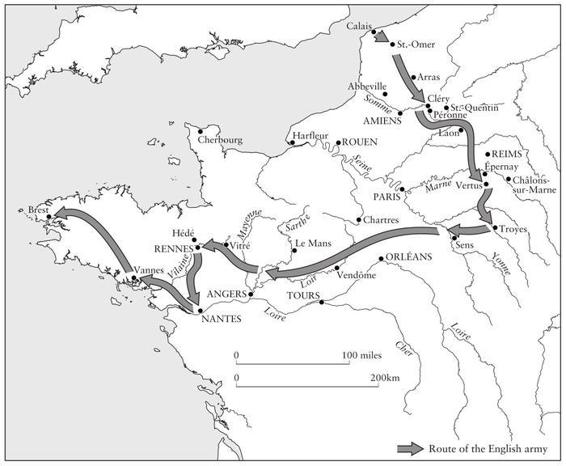
15 The Earl of Buckingham’s campaign in France, August 1380—May 1381
On the evening of 24 August 1380, after four weeks on the march, the Earl of Buckingham’s army forded the Seine and arrived before the walls of Troyes, the cathedral city at the southern edge of the great chalk plain of Champagne. The Duke of Burgundy had crammed all his troops into the city. With him were Enguerrand de Coucy, the Dukes of Bar and Lorraine, a Marshal and the Admiral of France and a host of famous knights. The Dukes of Berry and Bourbon joined them there with reinforcements from the central provinces. The total strength of the French army had by now risen to about 4,000 with more reported to be on the way. The French leaders were under strong pressure from their men to fight the invaders. They had sent a messenger to the King to seek his permission to offer battle. In the English camp expectations were high. That night an order of battle was agreed between the captains. New knights were made from ambitious squires and bannerets from knights. The sun rose on the following morning, 25 August, to reveal the English army drawn up in three broad lines of men-at-arms with the archers stationed behind them, all advancing slowly on foot across the flat, empty plain towards the French positions. In front of the main gate of Troyes a timber fortification had been constructed, behind which the French lines were filling up as men poured out from the city. The Duke of Burgundy watched from the gateway in full armour, holding an axe in one hand and a banner in the other. But before anything happened he changed his mind. His forces, he decided, were not strong enough. As the French withdrew back into the city, some detachments of the English army broke ranks and charged the timber barrier behind which the French men-at-arms were manoeuvring, only to be driven back by arrow fire. The rest of the English army waited in their lines. After about two hours, when it was clear that the French would not offer battle, they turned away and marched west towards Sens and the Gâtinais.59
The Duke of Burgundy followed Buckingham’s march with the main body of his army on a parallel course to the north. In the west a second French army was gathering around Chartres. The Duke entered the cathedral city on 6 September 1380 and paused for a few days to concentrate his forces. On 8 September the English reached Vendôme. The French commanders, who had so far confined themselves to hemming Buckingham’s army into their line of march, now resolved to block its route to Brittany. The plan was to hold the line of the River Sarthe, then a broad and fast-flowing river with few fords or bridges. During the following days the bulk of the French army crossed the Sarthe at Le Mans to take up their positions on the west bank. These manoeuvres were still in progress when, on 14 September, the news arrived that the King had suffered what appears to have been a severe heart attack on the previous night. Two days later he was dead at the age of forty-four. The final act of Buckingham’s campaign was destined to be played out against a background of mounting political crisis in Paris.60
*
‘When great men die everything changes,’ wrote Christine de Pisan. Like many of her contemporaries she would one day look back on the death of Charles V as ‘the gateway to all our later misfortunes’. The King had died at the royal manor of Beauté overlooking the Marne east of Paris. The body was brought back to Paris for burial and remained for a week in the abbey church of St. Antoine by the eastern gate of the capital while the royal dukes, Anjou, Berry, Burgundy and Bourbon gathered. The new King, Charles VI, was a little less than twelve years old when his father died, slightly younger than his distant English cousin Richard II. He had passed the whole of his short life amid the public rituals of the French court, seen by thousands but observed by none. Physical strength, a sunny temperament and a precocious interest in hunting, armour and weaponry are the only personal characteristics of the young Charles VI which are known. Everything else is obscured by the conventions of princely life and the overbearing presence of his father, uncles, tutors and household officers. As yet he was little more than a symbol of authority.61
The dead King had given much thought to the government of France during a minority. Yet, when the time came, he bequeathed a poisonous legacy to his son. In August 1374, shortly after his health had begun to fail, Charles had issued an ordinance fixing the age of majority of the kings of France at thirteen, as compared with the traditional age of fourteen for kings and twenty for noblemen. The King cited thirteen as the ‘age of discretion’ and recalled the example of Louis IX, who was said to have taken the government of the realm into his hands at that age. But his real motive was his fear of a regency and the uncertainty and instability that went with it. A series of ordinances followed in the autumn of 1374 whose main object was to achieve a carefully contrived balance of power within his family. Louis of Anjou, the oldest of his brothers, was to be Regent, while the Dukes of Burgundy and Bourbon were to act jointly as the young King’s guardians and tutors. In principle the Regent was to have all the powers of the Crown. But the revenues of the royal demesne in Paris, Normandy and the Île de France were to be assigned to the King’s two guardians to pay the expenses of his household, while the other public revenues of the realm were reserved for meeting the cost of administration and defence. The late King’s favourite, Bureau de la Rivière, was given a pivotal role in the new regime. He was the principal executor of the late King’s will. He was to serve as First Chamberlain to the new King until he came of age. Nothing of importance affecting the young Charles VI or his brother Louis was to be decided without his approval. He was also given custody of the King’s personal treasury. These complex arrangements called for a degree of co-operation between the late King’s brothers and ministers of which they were no longer capable. They were also completely unsuitable for a nation at war.62
The obsequies of the dead King took place over three days between 24 and 26 September 1380. The four royal dukes followed the coffin through the streets of Paris from Notre-Dame to Saint-Denis and stood at the grave in the abbey church, next to the one which had recently been made for Bertrand du Guesclin. In a world where symbols sometimes counted more than facts the burial of a king conventionally marked the true end of his reign. As soon as the ceremony was over the survivors fell to quarrelling over the spoils of power with a fury intensified by the suppressed jealousies and antagonisms of the previous reign. The Duke of Anjou, still smarting from his disgrace earlier in the year, relished the chance of power too much to accept the limitations placed on him by his dead brother. The Duke of Burgundy claimed precedence at public ceremonies as the first peer of France, the Duke of Anjou as the senior member of the royal family. Their retinues almost came to blows on a famous occasion when the two men tried to sit in the same seat next to the King. The Dukes of Burgundy and Bourbon, supported by the Duke of Berry, claimed to be entitled as the King’s guardians to appoint his principal officers while the Duke of Anjou claimed the same right as Regent. This issue quickly came to a head since it was necessary to choose a Constable to succeed Bertrand du Guesclin, an urgent item of business with an English army marching through France. Before his illness Charles V had decided on Bertrand’s fellow Breton and long-standing brother-in-arms, Olivier de Clisson. But his appointment was only confirmed after a bruising row between the King’s uncles. Finally there was the delicate status of the Duke of Berry, who had been regarded by the late King as a political incompetent and ostentatiously excluded from any part in the minority. He was bent on obtaining a place in the councils of the realm in keeping with his rank. As for Bureau de la Rivière, he was brushed aside. Years of whispering in the late King’s ear had won him too many enemies. The royal dukes regarded him as a manipulative upstart. The Duke of Berry cordially loathed him.63
These apparently trivial disputes were based on more than personal animosity and wounded pride. Behind them lay the opportunities which the death of the single-minded Charles V had opened up for his three brothers. All of them had personal ambitions which depended to a greater or lesser degree on their being able to lay hands on the resources of the French Crown. The Duke of Berry wanted to be lieutenant in Languedoc, an appointment which, when added to his appanage in Berry and Poitou and his existing lieutenancy in Auvergne, would give him the resources of about a third of France. The Duke of Burgundy was constantly looking over his shoulder at Flanders, destined to be his wife’s inheritance and the main pillar of his own fortune. However, the most ambitious and destructive of the royal dukes’ personal ventures was, characteristically, the Duke of Anjou’s. For some months Anjou had been secretly negotiating to acquire the succession to the Kingdom of Sicily, the latest of his many attempts to find a realm of his own. The Kingdom of Sicily was the name given to the great southern Italian territory ruled by the descendants of Louis IX’s brother Charles of Anjou, although Sicily itself had not formed part of their domains for a hundred years and the kingdom was ruled from Naples. The Queen, Jeanne of Anjou, still childless at fifty-three in spite of her four marriages, had been gravely weakened by the divisions in Italy which followed the papal schism. Her steadfast support for the Avignon Pope had exhausted her treasury and cost her a good deal of support among her subjects. It had also naturally earned her the venomous hostility of Urban VI, who set about destroying her.
In the autumn of 1379 Urban found a formidable champion in the royal house of Hungary. In the longer term the engagement of the Hungarian dynasty in the affairs of southern Italy was to be a fateful step for the papacy. But at the time its advantages seemed more obvious than its disadvantages. Hungary was the most powerful and expansive state of eastern Europe. The King, Louis the Great, was himself descended from a cadet branch of the Angevins of Naples and had for some time had designs in Italy. His armies had recently penetrated into northern Italy, where they had conquered the region of Friuli from the Venetian Republic. Louis of Hungary was no friend of Jeanne of Anjou. His brother had been her first husband and the effective ruler of her kingdom until he was murdered with her connivance in 1345. He resolved to overthrow her. Louis’s chosen instrument was his cousin Charles of Durazzo, a young man of twenty-five who had been brought up at Jeanne’s court and was married to her niece but had made his career in Louis’s service. Charles was then in north-eastern Italy, where he was serving as the King of Hungary’s captain and viceroy. He was a skilful diplomat, a cunning and ruthless politician and an effective military commander as well as a natural focus of loyalty for Jeanne’s many domestic enemies. Urban VI offered to transfer the crown of Naples to him if Louis of Hungary would provide him with the troops to conquer it. By early 1380 the deal seems to have been done.
In Avignon Clement VII responded by turning to the Duke of Anjou. Clement had everything to gain by tempting the house of France into Italy. French intervention in the peninsula offered the only prospect of dislodging his adversary on his home territory. Negotiations began in January 1380 and by June had resulted in an agreement in which Jeanne adopted Louis as her son and declared him heir to all her dominions in southern Italy and Provence. In return Louis undertook to arm a small squadron of war galleys at his own expense for the defence of Naples and, if her dominions were invaded, to help her with troops and money. Even with the generous subsidies promised by Clement VII these undertakings were far beyond Louis’s personal resources. They proved to be the beginning of a long and costly entanglement of the French state in Italy which would last in one form or another until the middle of the sixteenth century.64
Immediately after the funeral of Charles V the late King’s brothers met in the palace on the Île de la Cité in the presence of a great gathering of courtiers, prelates, officials and lawyers. Their spokesmen traded demands. Cabals were formed. Gossip began to spread through the city. No decision was reached. On about 28 September it was finally agreed to submit their disputes to a body of arbitrators. The arbitrators devised a solution which was untidy but probably the best available. It was decided to declare the young King to be of age and to have him crowned at Reims at once. It was not of course anticipated that he would actually govern. The declaration of majority was simply a legal device for bringing all of Charles V’s arrangements for the regency to an end and terminating Bureau de la Rivière’s authority over the royal household and treasury. Instead the four royal dukes agreed to partition the government among themselves. The Duke of Anjou would continue to call himself Regent while the Dukes of Burgundy and Bourbon would continue to act as the King’s guardians. Anjou was to have the day-to-day conduct of the government and control of all the financial resources of the Crown which were not required for the upkeep of the King’s household. But all important decisions would be made by the four royal dukes jointly with the assistance of a council of up to twelve others chosen by them. It was probably part of this deal that the Duke of Berry should have the lieutenancy of Languedoc, for the appointment was announced shortly afterwards. These awkward compromises did little to calm the ill will between the strong personalities involved. Within days of the agreement the Duke of Anjou seized the personal treasure of the late King, consisting of plate and jewels in the Hôtel Saint-Pol and 200,000 francs in cash which had been lodged in the tower of Vincennes. Learning that there was more concealed in the castle of Melun, he forced the official responsible for its safe-keeping to disclose its whereabouts and took that too. Froissart says that he wanted the money to fund the defence of Naples, which may well be true. What is known is that for the next six weeks, until Anjou partially backed down, government business was paralysed as every council meeting was dominated by the furious demands of the Duke of Burgundy for its return. Part of it was never accounted for.65
The task of Charles V’s successors would have been difficult in any circumstances, but he had left them another problem which was entirely unexpected even by his closest advisers. About two hours before his death Charles had decreed the abolition of the hearth tax and remitted all outstanding arrears. He had long been troubled by the growing signs of revolt against the weight of royal taxation and the legacy of disorder which he was storing up for his successor. But this was not an act of considered policy. It was the gesture of a frightened man who knew that he had little time left in which to efface the sins of power. The ambiguous record of his words suggests that if he had had his way he would have abolished the aides as well. But, even in the attenuated form represented by his ministers’ drafting, the King’s final act of personal expiation was a disaster from which the French state took three years to recover. The instrument was at first kept secret, but it was a valid act and in October the new government decided that it would have to be published. The news spread rapidly across France. Official copies were sent to all the main provincial centres. Unofficial rumour exaggerated the news elsewhere.66
The abolition of the hearth tax not only removed the most important single source of war finance. It gravely unbalanced the French tax system. The hearth tax, however imperfect, was the only direct tax. It represented the most effective means of reaching the pockets of the better-off and of the mass of the population residing in the countryside. Without it the government was almost entirely dependent on the two indirect taxes, the aides and the gabelle du sel. Both of them fell mainly on the populations of the towns, where most salt was consumed and where the wholesale markets for food and wine were located. They also bore heavily on the poorest members of the urban community, who spent a relatively high proportion of their income on food and drink. In many places it was believed that all taxes, direct and indirect alike, had been abolished. The public crier of Montpellier went through the streets announcing the end of the gabelle. In Nîmes there were processions to mark the end of all royal taxation. The Estates of Auvergne took the news of the dead King’s ordinance as their excuse to reject all war taxes. In some of these places the wish was probably father of the thought. But when the truth became known there was a spontaneous and violent protest. The first signs of trouble occurred in the north. In the towns of Picardy and the Île de France men rose up and threw out the collectors of the aides. At Compiègne and Saint-Quentin rioters took over the streets. At Saint-Denis the dead King had hardly been buried before mobs invaded the market-place and attacked the collectors of the aides. Tensions rose in Paris. Collection in most parts of France ground to a halt. In one of their first acts the Council resolved to summon the Estates-General of Languedoil to meet in the following month. They counted on the atmosphere of goodwill that would be generated by the coronation of his successor. With good management the assembly might be persuaded to re-grant at least part of the taxes abolished by Charles V.67
*
Meanwhile the King’s treasury was bare. The French army abandoned its stations on the River Sarthe. Some companies melted away. The rest made their way, leaderless and confused, to Paris and encamped in the suburbs, demanding their pay, looting the villages and barns and the traffic on the roads and shouting support for one or other faction of the royal family. On 13 October 1380 Louis of Anjou disbanded the army and dismissed the men unpaid to their homes. The only organised forces now remaining under French command were a company of a few hundred men under the command of Olivier de Clisson and the scattered garrisons of Anjou and the Breton march.68
The English army was able to ford the Sarthe without opposition and crossed the swamps of the Mayenne, advancing west towards Brittany. In early October 1380 they entered the duchy south of the fortress-town of Vitré and moved slowly towards Rennes. Here they were surprised and vexed to find that no arrangements had been made to receive them. There was no Breton army with which to join forces. The towns closed their gates in Buckingham’s face. John de Montfort, the ally whom Buckingham had come to support, was at Hennebont in the south-west of the peninsula. He seemed to be in no hurry to welcome Buckingham. The truth was that the death of Charles V had changed everything. The new government was unlikely to be as stiff-necked in its opposition to John de Montfort as Charles V and Bureau de la Rivière had been. John enjoyed reasonably good relations with the French royal dukes. The Duke of Anjou had been personally committed to finding a negotiated solution to the Breton problem since the previous October. Philip of Burgundy’s wife was John’s cousin and his father-in-law was John’s principal protector. Now, charged with the government of France but without troops or money to defend it, the royal dukes had little choice but to do a deal with him. John’s private preferences are not known. But he was under strong pressure from his baronial supporters to dispense with English military assistance and heal the breach with France. So he did as Charles of Navarre had so often done in his heyday. He used Buckingham’s presence as a bargaining counter to help him strike a deal with the French and as an insurance against the possibility of failure.69
For the moment nothing could be done in Paris. The princes were too preoccupied with the struggle for power and the approaching coronation of the King. So John played for time. He sent Buckingham his excuses. He promised to meet him to discuss plans, but not yet. He travelled slowly. The English army passed most of October kicking their heels around Rennes, moving on every three or four days as they exhausted the supplies around them. It was not until the end of October 1380 that the two men finally met. The scene was the thirteenth-century fortress of Hédé, north of Rennes. John was suave and full of reassurance. After several days of forced conviviality Buckingham managed to pin him down to operational detail. It was agreed that in the next few days the English army would lay siege to Nantes. The city was of vital interest to both men, to John because it was one of the few places that was still refusing to admit his officers, to Buckingham because of its important bridge over the Loire. The English proposed to march on it at once. John would join them with his own army within two weeks of the opening of the siege. He also undertook to organise a fleet of armed barges in the Loire to prevent the city from being resupplied by river. But even as he discussed these things with the English commander John was preparing to double-cross him. In his private chamber in the citadel of Rennes he put his seal to a curious notarial act of a kind which he had more than once employed to ease his conscience before some gross breach of faith. In it the Duke recited all that he owed to the advice and support of the kings of England over the years, declaring to the notary and perhaps to posterity that if he were now to break his word to the English and strike a deal with the French it would only be because his hand had been forced.70
Three hundred miles away, on the morning of 4 November 1380, Charles VI of France was being anointed and crowned in the great Gothic cathedral of Reims, a spectacular ceremony sanctified by tradition, which he can only dimly have understood. The banquet which followed was interrupted by the arrival of three successive messengers from Brittany with the news that the English were marching on Nantes. The dukes and the military officers of the Crown discussed what to do amid the revelry and noise. There was a small garrison in the citadel of Nantes which was answerable to Olivier de Clisson but was certainly not large enough to fight off an assault alone. There were thought to be about 400 men available in garrisons of the Breton march. Two officers of the Duke of Bourbon who were present at the banquet were ordered to leave at once for the west to bring these men into the city before the English invested it. They did their work well. The first English troops reached Nantes on the morning of Sunday 4 November 1380. By the time that the rest of Buckingham’s force arrived the French had put some 600 professional troops into the city.71
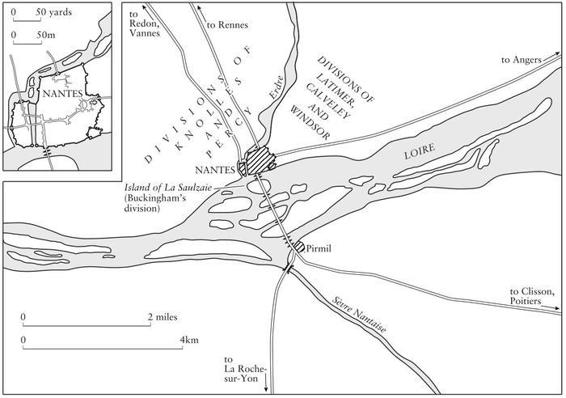
16 The siege of Nantes, November 1380—January 1381
Nantes was a rich city, living well on the trade in wine and salt, which had suffered comparatively little from war damage. It was a difficult place to besiege. It had a powerful and complete circuit of walls. It was relatively compact, not much more than a thousand yards in circuit, which meant that it could be defended by a modest garrison with the support of the citizens. The town and the plain north of the walls were divided by the River Erdre. The Loire, then unembanked and more than a mile wide, was divided into fast-flowing branches running between a number of large islands. The Earl of Buckingham was obliged to divide his army around Nantes into three more or less independent forces. Latimer, Calveley and Sir William Windsor encamped on the eastern side of the town. Knolles and Percy covered the west beyond the Erdre. The Earl himself occupied La Saulzaie, an inhabited island in the Loire directly opposite the river gate of the town. None of these divisions were in a position to reinforce each other quickly in the event of an attack and even with 5,000 men they were unable to seal off the whole city. At the outset of the siege the Earl sent a hurried appeal to England for reinforcements. He said that he needed at least 2,000 more men urgently. While the Council struggled to provide them, his operations depended on the promises of the Duke of Brittany. But John de Montfort was nowhere to be seen. The Earl sent him a stream of messages, none of which was answered. In Paris the newly crowned King made hisjoyeuse entrée into the capital on 11 November, welcomed by ecstatic crowds and by innumerable petitioners waiting for the ordinary business of government to resume. Among the petitioners were the ambassadors of the Duke of Brittany. As soon as the festivities were over they agreed an indefinite truce with the French royal Council. On 19 November 1380 John de Montfort appointed four prominent noblemen, all of them associated with the Breton league of the previous year, to negotiate in the utmost secrecy a permanent settlement with the Regent.72
*
John’s hand was strengthened by the developing financial crisis of the French government. On 14 November 1380 the Estates-General of Languedoil met for the first time since 1369 in the palace on the Île de la Cité. The four royal dukes presided impassively as the Chancellor, Mile de Dormans, outlined the government’s dire financial situation. The proceedings of the assembly are poorly documented and its decisions are difficult to reconstruct from the terse formulae of the closing ordinances and the misleading gossip of the chroniclers. But some common themes emerge from all the national and provincial assemblies which would meet during the first year of the new reign to grapple with the problems of war finance. It was generally accepted that financial assistance to the Crown in time of war was an obligation of every subject. The complaints were not so much about the principle of war taxation as about the way in which Charles V had transformed the grants of the 1360s into permanent taxes. The assemblies were determined to re-establish the principle that taxation was not a prerogative of the Crown. It was a grant from its subjects, made for a limited period and subject to review and to the redress of their grievances. The real division was between the majority which accepted that the current crisis justified a grant of taxation and a small but powerful minority which considered that in its present state France could bear no extraordinary taxation at all. They thought, like the Parliamentary opposition in England, that the King should be compelled to live off the ordinary revenues of his demesne. The leaders of this group were the city of Paris, which traditionally dominated the deliberations of the third estate. They were supported by a powerful caucus of the nobility. However, before the Estates-General could reach a conclusion, the issue was taken out of their hands by the Paris mob.73
In spite of war and plague Paris was as populous at the end of the fourteenth century as it had been before the first outbreak of the Black Death. The new rampart of Charles V had roughly doubled the area of the city on the right bank of the Seine, enclosing ancient suburbs, allotments and vineyards and provoking a prolonged building boom. Apart from the cemeteries, the gardens of the monasteries and aristocratic mansions and the drained marshland still known as Marais, almost every available space within the walls was built over by 1380. Houses rose two, three and sometimes as many as six stories above tiny plots of ground, separated by dark and filthy lanes. Some 200,000 people lived in this place, one of the densest concentrations of humanity in Europe. Even in more ordered times Paris had always been an intensely political city. Its main business was government, as it always has been. Its economy was sustained, directly or indirectly, by the service of the King; the great noblemen and ecclesiastical princes who attended on him; and the judges, lawyers, administrators and courtiers who waxed rich on the business of the Crown. The King, the Dukes of Anjou, Berry, Burgundy, Bourbon and Brittany, the Counts of Alençon, Artois, Armagnac, Flanders, Hainault and Auvergne, a dozen other noblemen and nearly thirty bishops and abbots maintained their own palaces in the capital, some of them built and staffed on the grandest scale. These men were actors on a national stage. They were visible symbols of power, targets for social grievances and political complaint. More than a hundred bell-towers tolled the great occasions of the political and ecclesiastical calendar. Rumours and grievances magnified among the tightly packed residents of the alley tenements. Crowds quickly gathered in the few open spaces within the walls. The fortunes of war heightened public emotions, threatening the security of the city and interrupting the distant network of suppliers which fed its immense population. Sharp contrasts of wealth and poverty were all too obvious where slums grew up beside palaces, noblemen pushed through the crowds on horseback escorted by liveried outriders, and the fortunate of whatever origin exhibited their prosperity with coloured silks and jewellery and extravagant hats and shoes. In the 1380s a rising tide of migration into the city combined with economic contraction to produce high levels of unemployment among the mass of insecure journeymen and labourers and mounting class hostility among the poor and the young. Hard times made yesterday’s workmen into today’s mobsters, the carrion of tomorrow’s gallows.
Charles V had passed more of his time in his capital than any of his predecessors, and the tumults of the 1350s had taught him the power of the mob. He had devoted much attention to the security of the city. The main agent of royal control in Paris was the Provost. The office was held from 1367 to 1381 by the formidable and authoritarian Hughes Aubriot, a self-made man of modest origins whose father had been a Dijon money-changer. He made a bigger difference to the appearance of the capital than any one man before Baron Haussmann and, like Haussmann, most of his acts were directed in one way or another to holding down the city of revolutions. He was responsible for a raft of ordinances and decrees regulating disorderly conduct, idleness, prostitution, taverns and gaming houses, and the bearing of arms in the streets. A reformed police force, consisting of 220 sergeants serving in shifts, was based at the Châtelet. Their efforts were supplemented by the sergeants employed by the various abbeys exercising criminal jurisdiction in the city, and at night by the watch, a militia drawn from the richer householders and organised by the city guilds in units of ten and fifty. But even in Aubriot’s time the government had no way of confronting a serious outbreak of urban violence without raising an army to overawe the city from the outside. By the time of Charles V’s death the city’s defences, which Aubriot largely rebuilt, were directed as much against the inhabitants as any external enemy. The Louvre lay well within the new rampart but survived, rebuilt and enlarged as a garrisoned refuge, prison, treasury and arsenal. The towers of the Châtelet looked down on the butchers’ quarter, famous to generations of Parisians as the home of its most violent mobs. Opposite, on the left bank, Aubriot had constructed a smaller urban fortress, the Petit Châtelet, to allow the authorities to seal off the riotous students of the university quarter of the left bank from the rest of the city. At the eastern edge of the city the intimidating mass of the Bastille Saint-Antoine, whose foundation stone had been laid in 1370 by Aubriot himself, was rising from its foundations.74
On the morning of 15 November 1380 a large crowd gathered in the Place de Grève to protest against the burden of war taxation. Many of them were wearing parti-coloured hoods and tunics of green and white, the city’s colours. On the eastern side of this large open space stood the Maison aux Piliers, the seat of the Provost of the Merchants and the four échevins, a body drawn from the higher ranks of the Parisian guilds who over a period of more than a century had gradually come to assume the powers of a municipality. These men represented the aristocracy of the city’s trades. Most of them had done well by the Crown’s policies in the past two decades and their interests had been well satisfied by the abolition of the hearth tax. But their main concern in November 1380 was to preserve their own authority, caught as they were between the demands of the government and the anger of the masses. The Provost of the Merchants came to the front of the building to address the crowd. He tried to persuade them to disperse and leave the issue to their betters. He was greeted by a ferocious harangue from a leather-dresser in the crowd. This man inveighed not just against taxes but against the rich of the city and the conspicuous consumption of the royal court. ‘Will we never see an end to the mounting greed of these lords?’ this man asked according to the appalled chronicler of Saint-Denis. They ‘feed off our goods, these people whose only thought is to decorate themselves with gold and jewellery, surround themselves with trains of flunkeys, put up superb palaces and devise fresh taxes with which to crush this city.’ He finished with a call to arms. About 300 men surged forward with weapons in their hands. They seized the Provost of the Merchants and marched him across the bridge to the palace on the island, where the Estates-General was meeting. They invaded the courtyard and then the great hall, shouting their demands so that they could be heard by the young King and his four uncles, gathered in an upper room with their advisers and officials.
Whatever else might be said of the Duke of Anjou he did not lack courage. Accompanied by the Dukes of Berry and Burgundy, the Constable and the Chancellor, he entered the hall and confronted the mob. The Provost of the Merchants made a long speech. He described the misery and poverty of the population in graphic language. He called for an immediate end to war taxation. The Provost was a reluctant protester but he played his part well. A great roar of approval went up when he had finished. The Duke played for time. He told them that their case would be considered by the Council. The truth was that the Council was divided. Many of its members were concerned about the precedent which would be set by yielding to threats of violence. What would the mob demand next? Their doubts were silenced as the crowd outside grew larger and more menacing. The Chancellor emerged once more, this time to pronounce the abolition of the fouage, the aides and the gabelle. An ordinance confirming the decision was hastily prepared.
The Council’s judgment of the mood of the mob was borne out by what followed. After the shouts of ‘Noel!’ and ‘Montjoie! Saint-Denis!’ came the cry ‘Aux Juifs!’ The main Jewish quarter of Paris lay on the right bank between the Place de Grève and the Châtelet, a district of narrow lanes and crowded tenements. The crowd streamed across the Pont aux Changeurs and invaded the Juiverie, killing Jews, forcibly baptising their children, wrecking their houses, tearing up loan books and carrying off jewellery and plate left as pledges. They were urged on from the streets outside by the young noblemen who were the Jews’ main clients. The rest of the Île de France took their cue from Paris. As the news of these events spread across northern France, in one town after another the celebrations turned into pogroms against the Jews.75
The Council had no intention of accepting the situation. The abandonment of taxation was plainly not an option for a nation at war. They viewed their concessions as no more than a tactical retreat and greatly resented the threats by which they had been obtained. They resolved to try again, this time in stages. The Estates-General was reassembled and persuaded to agree to the principle of war taxation. But they were invited to consult their constituents about its exact form. On 17 November 1380, as the representatives returned to their homes, orders went out to all the baillis of northern France requiring them to convene local assemblies to consider the financial needs of the government away from the pressures of the Parisians. The idea was to set the provinces against the capital. Unfortunately the government had under-estimated the intensity of public hostility, which was by no means confined to the poor of Paris. In many towns of northern France the assessments were believed to have been distorted in favour of the wealthy mercantile elite and social resentments were as strong as anywhere. ‘By God’s Blood, the fur-hats never pay their due,’ one man shouted through the streets of Sens. The government’s cause was not helped by exaggerated reports about the size of the dead King’s hoarded treasure and the widespread knowledge of the Duke of Anjou’s thefts from it. The threat from England did not always seem to be a good answer to men who had never understood the logic of avoiding battle. In Normandy the assembly met in the archbishops’ palace at Rouen on 10 December 1380. They were pressed by the King’s commissioners with the urgent need to raise an army of 8,000 men against the English. The clerical contingent was stuffed with royal officials and the nobility with men had been prominent in the wars of the Cotentin and the Breton march. They urged their colleagues to accept a sales tax, if not at the traditional rate then at least at a reduced one. But the towns and a substantial part of the nobility would have none of it. ‘Rien, rien!’ they cried. If Normandy, with its close association with the Crown, could not be persuaded, there was not much chance of a better answer elsewhere. None of the local assemblies whose proceedings are recorded was prepared to make a grant. They all referred the decision back to the next meeting of the Estates-General.76
The representatives reassembled in Paris shortly before Christmas 1380. Their deliberations, which extended over about two weeks, are not recorded. But the outcome can be deduced from successive ordinances issued in the first three months of 1381. It was a firm reassertion of the principle of control over taxation by representative assemblies. The government had to submit to the abolition not just of the fouages covered by the dying declaration of Charles V but of the aides, the gabelle and all other taxes levied on the Crown’s authority going back to the beginning of the century. In return the King was granted a war tax for a limited period of one year, starting from 1 March 1381, to cover the cost of a standing army of 4,000 men-at-arms and 2,000 crossbowmen. The precise basis of assessment was left to the Estates of each province to decide and might differ from one province to the next. The assessment and collection of the new tax, moreover, was to be left in the hands of local officers answerable to their own provincial assemblies and not to the King. These people were charged with ensuring that every penny collected was spent on the prosecution of the war and the cost of the King’s household. Nothing was to be diverted into the pockets of the King’s relations and ministers. The ordinances, if they had lasted, would have marked the dismantling of the system of national taxation devised by the ministers of John II and Charles V in the 1360s, which had been the foundation of France’s military recovery. There would have been a reversion to the old system which had applied before 1360, when for practical purposes grants of the Estates-General had operated as decisions in principle only, to be followed by a wearing and time-consuming round of local negotiations. Few men outside the Chambre des Comptes can have recalled how far that process had paralysed successive French kings in every crisis. On this occasion, even with a large English army besieging Nantes, it was to take more than two months to negotiate a variety of different regional taxes in several provincial cities with different groups of interested parties, each with their own grievances to be redressed, before any funds came into the Treasury. Some local assemblies insisted that the proceeds of local collections should be reserved not just for war expenditure but for particular kinds of war expenditure of specifically local concern. Thus the taxes of Champagne were earmarked for the defence of the northern frontier, opposite Calais and Flanders; and those of Normandy for the garrisons on the Cherbourg front. These concessions no doubt had to be made to get the tax grant through. Even so receipts must have fallen far short of the minimum required to defend the frontiers of France. The Estates-General of December 1380 marked the shift of power by insisting on the King’s formal confirmation of the charters and liberties of every province of Languedoil. It was a symbolic act but an important one nonetheless. Most of these instruments dated back to the rebellions of 1314—15 which had followed the death of Philip the Fair. They were still remembered as the high-water mark of regional autonomy in France.77
*
By the end of 1380 England’s financial and military resources were more tightly stretched than they had been at any time in the past forty years. In addition to the 5,000 English troops serving under the Earl of Buckingham in France, there were about 2,000 men distributed between the garrisons of Calais, Cherbourg and Brest, and another 1,000 in Gascony, making a total of about 8,000 men serving in France. The Council was also having to meet growing demands for troops at home. A deteriorating situation in Ireland had made it necessary to send Edmund Mortimer, Earl of March, there with 1,000 men, the largest English garrison force to serve in the island for many years. A far graver threat, because it was closer to home, had erupted on the Scottish march. In reprisal for the loss of two of their merchant ships at sea, the Scots captured Ralph Lord Greystoke and his entire retinue of 120 men in the Glen valley south of the border as he was on his way to take up his duties as captain of Roxburgh castle. The haul also included a great quantity of tapestries and plate with which Greystoke intended to decorate his austere quarters. This incident was followed by a large-scale Scottish raid into Cumberland, led by the Earl of Douglas, which resulted in the almost total destruction of Penrith and a retaliatory raid by the English wardens into the western lowlands. Faced with the prospect of a breakdown of the truce in the Scottish march Richard II’s Council decided to take the conduct of affairs out of the hands of the border lords. In September they appointed John of Gaunt as royal lieutenant on the march and sent him hurriedly to the north with as many troops as could be found. By the end of October there were some 3,000 men serving on the Scottish march in addition to the locally recruited hordes of the Percys and Cliffords. This brought the total number of troops maintained in arms by the English government to about 12,000, divided between four fronts, an exceptionally high proportion of the tiny section of the population with skills and aptitudes to fight as men-at-arms or archers. It was the most difficult possible moment to have to meet further demands from lieutenants and allies. Yet the government was now committed to sending another 2,000 men to reinforce Buckingham in Brittany and at least 2,000 more to Portugal in the following spring.78
Encouraged perhaps by early reports of the troubles of France, the English government had assumed some exceptionally heavy financial commitments. The cost of the Earl of Buckingham’s campaign had been grossly under-estimated. About £76,000 had already been spent on the expedition up to the end of September 1380 including shipping costs. If it lasted the full year envisaged by the men’s indentures, the final bill would be twice as much even without the promised reinforcements. In addition about£40,000 had to be paid out on claims for soldiers’ and seamen’s wages accumulated from past campaigns dating back to the beginning of the reign and in some cases even earlier. The rest of the government’s military commitments brought the total to about£280,000. This figure was roughly comparable to the annual war budget of France. It was more than England had spent in any comparable period since the campaigns in the Low Countries which had bankrupted Edward III in the early years of the war. To meet it, the government had revenues available for war expenditure amounting to about £100,000. A combination of high overheads, over-ambition and lack of candour in its dealings with the Commons had put Richard’s Council in an impossible position. The Parliamentary subsidy of March 1380 had represented a substantial commitment by the Commons, which they had given on the express understanding that they would be asked for no further funds until the autumn of 1381. In August 1380, less than a month after the Earl of Buckingham had marched out of Calais, the Council was obliged to summon a new Parliament for early November, a full year before the appointed time.79
The assembly opened on 8 November 1380 in the unfamiliar surroundings of the Cluniac priory of St. Andrew’s in Northampton, which had been chosen, like Gloucester two years earlier, in order to escape the London mob. It was not a happy choice. Winter storms and flooding had made it hard to get to. Accommodation, food, forage and fuel were all in short supply. When Chancellor Sudbury rose to explain why the assembly had been summoned his opening address mentioned no figures. But he left no doubt about the gravity of the crisis. The Council had already spent more than the entire proceeds of the last subsidy on the Earl of Buckingham’s army. Their wages for the second six months of the campaign would fall due in December. The pay of the King’s garrisons in France, Scotland and Ireland had fallen far into arrears and some of the men were threatening to desert. The coasts were defence less. The King’s creditors were demanding repayment. Some of them had liens over the King’s few remaining jewels and were threatening to sell them. A further large grant, said Sudbury, was unavoidable. The loyal Sir John Gildesburgh, who was once again elected Speaker, came before the Lords and asked the King’s councillors for a precise statement of the government’s financial needs. The Commons, he said, wanted a figure in which they could have confidence, not something that would simply serve as the prelude to further demands later. He was given a copy of a schedule prepared by the King’s financial officers. It showed that there was a deficiency in the government’s war accounts of £160,000. This figure broadly accords with the surviving financial records.80
The Commons were stunned. The government’s demands were ‘outrageous and insupportable’, they said. They represented between two and three years’ worth of war subsidies at the customary rates. The Commons insisted that the figure should be reduced and invited the Lords to consider how this could be done. They seem to have expected the Lords to consider what military expenditure could be dispensed with. In fact the peers responded with alternative proposals for raising the whole sum. One was the traditional tenth and fifteenth on moveable property. At least three tenths and fifteenths would have been required. This was, as always, profoundly unpopular with the interests represented in the Commons because of the anomalies associated with the antique assessment of 1334. The second possibility was a general sales tax after the model of the French aides, which would have fallen disproportionately on the towns and required the creation of a new and expensive fiscal administration. The third was a graduated poll tax assessed on each community at a flat rate of four or five groats (1s 4d or 1s 8d) per head but distributed among individuals according to ability to pay. After much deliberation the Commons decided on the poll tax. At the beginning of December 1380 they resolved upon a grant of 100,000 marks, or £66,666. They proposed that the clergy should contribute half as much again, making a total of £100,000. The poll tax of 1377 had been levied at an average rate of four pence a head and had produced a total assessment of £22,586. So the Commons simply trebled the rate and imposed an average payment of twelve pence a head. At the same time they withdrew the expensive concessions which had reduced the yield of the tax of 1379: the age of eligibility was reduced from sixteen to fifteen and the exemption for married women was abolished. The result was a highly regressive tax, born of the Commons’ conviction that traditional taxes let wage earners off too lightly at a time of strong wage inflation. ‘All the money of the realm has passed into the hands of labourers and craftsmen,’ as they had complained two years earlier. The Commons at Northampton declared that, within every community, the strong should aid the weak. But there was no graded table of contributions as there had been in 1379, and no other mechanism for requiring the rich to pay more. In the poorest communities there simply were not enough rich taxpayers to carry their neighbours’ burden.81
The size of the grant made by the Northampton Parliament, coming so soon after the generous grant made earlier in the year, was a measure of the commitment which the English political community still felt to the war. If the grant fell well short of what the government had asked for it still represented the maximum that the Commons thought that taxpayers could bear. The proceeds were to be strictly reserved for the Earl of Buckingham’s army in France, for the defence of England and for operations at sea. The Commons at Northampton were no more interested in England’s continental ‘barbicans’ than their predecessors had been and presumably did not regard the expedition to Portugal as being in anyone’s interest but John of Gaunt’s. The clergy were pressured into making their own grant more promptly and generously than had been their habit. The convocation of Canterbury met in the parish church of All Saints, Northampton, immediately after the dissolution of Parliament. To raise the £33,334 expected of them they had to authorise a poll tax at even higher rates than those payable by the laity: 6s 8d for every monk, nun or priest in the land with a reduced rate of a shilling for those in deacon’s or other lesser orders. Thus was born one of the most hated and destructive taxes in England’s history, whose very name could be invoked to discredit other capitation taxes more than six centuries later.82
Measures to reinforce Buckingham’s army in Brittany were put in hand as soon as the King’s ministers and officials had returned to Westminster. Sir Thomas Felton, the former Seneschal of Gascony, was appointed to command a force of 2,000 men to sail to the Loire. He was to take with him a fleet of armed barges to close off Nantes from the river and £10,000 in gold coin to be distributed among the men already there. Felton’s expedition was not, however, the only military enterprise planned for the following months. In spite of the Commons’ misgivings and the fact that funds had not been voted for it, the Council decided to go ahead with the expedition to Portugal. Indeed they increased its size from the 2,000 men promised by Juan Fernández Andeiro to 3,000. Both of these forces were expected to leave in the spring from the ports of Plymouth and Dartmouth. The attempt to pursue both enterprises at once proved to be too ambitious.83
It soon became clear that Felton’s army would be too late. The Earl of Buckingham was already having great difficulty in maintaining the siege of Nantes. The French garrison in the city fought off one assault after another and began to launch sorties into the besiegers’ encampments, some of which inflicted heavy losses. The English tried to undermine the walls of the city, only to find their mines destroyed by French counter mines. The new Constable, Olivier de Clisson, and the Marshal, Louis de Sancerre, arrived in December 1380 with fresh troops to harass the English lines from the outside and attack foraging parties which strayed too far from their bases. Supplies continued to flow into the city by river while the besiegers starved. English morale sank to new lows every day. It was a bitterly cold winter. Frequent night attacks deprived the men of sleep. During December dysentery began to spread through the army. By the beginning of January 1381 Buckingham was faced with disaster. He had lost a fifth of his men and almost all of his horses to disease, exposure, desertion and battle casualties. On about 6 January 1381 he abandoned the siege.84
There was worse to come. On 15 January 1381 John de Montfort reached agreement with the council of regency in Paris. The terms were the fruit of more than two months of negotiation between his representatives and a group of royal councillors led by that other sometime ally of England, Enguerrand de Coucy. John de Montfort agreed to come before Charles VI to do homage for the duchy of Brittany and obtain the King’s pardon for his many acts of treachery. For this he was to pay an indemnity of 200,000 francs (about £33,000). The French government for its part agreed to recognise the liberties and immunities of the duchy of Brittany as they had stood before the decree of confiscation. The towns and castles which the French still occupied in the duchy would be surrendered. The great border fortress of Champtoceaux on the Loire would be restored to the Duke, together with all the domains which had been confiscated from him in other parts of France. The treaty marked the surrender of the Crown on every point of substance. But for all that it was a diplomatic masterstroke. John was required to renounce all his agreements with England, to dismiss all Englishmen in his employment apart from his household officers and personal servants, and to turn his arms against his erstwhile ally and ‘damage them in every possible way’. The only qualification, recorded in a secret clause, was that John would not in practice be required to fight personally against the English. At a stroke the foundation of England’s strategy in France was shattered. A shrewder man than the Earl of Buckingham might have guessed that some such thing was afoot when John de Montfort declined to lift a finger to help him during the siege of Nantes. But there is no reason to doubt the reports of the chroniclers that he was thunderstruck when the news was brought to him.85
The immediate question was what to do with the English army. It was nominally the strongest armed force in France and likely to remain so while the French government’s current financial crisis persisted. But it was broken, as completely as John of Gaunt’s army had been after its long march through France in 1373. For a few weeks Richard II’s Council at Westminster refused to recognise facts. They appear to have thought that, with pay in the men’s pockets and fresh troops and horses from England, Buckingham could simply resume the siege of Nantes in the spring. They pressed on with their plans as if nothing had changed. Felton’s men were signed up to their indentures and received their advances. Ships began to assemble at Plymouth. Horses were procured across England and arrangements were made to ship them to the Loire. In late March and early April 1381 Felton and his fellow captains were ordered to proceed to their ports of embarkation. But there were not nearly enough ships for them, let alone for the army of Portugal as well. They were obliged to wait idly by the seashore for several weeks while the Admirals’ officers tried to find more.86
The Council had misjudged the mood of Buckingham’s men, possibly because Buckingham himself had misjudged it. At least one company, Hugh Calveley’s, withdrew at the beginning of February and made their way back to England. The rest waited despondently for orders. Without money they could not buy food. Without horses they could not even steal it. Finally Buckingham decided to march on the seat of John de Montfort’s administration at Vannes and confront the Duke in person. John met him on the road. It must have been a difficult encounter. The Duke of Brittany explained that he had had no choice but to strike a deal with the French. The towns and the Church had been adamantly opposed to the English alliance. The nobility were occupied in defending the frontier of the duchy. Without a deal with the French there was no prospect of his being able to maintain himself in power. Buckingham was unimpressed. There were ‘grandes paroles’ between the two men. But there was nothing that the Earl could do other than negotiate the best possible terms for his orderly departure for England. In early March Sir Thomas Percy and William Lord Latimer agreed a deal. They promised to withdraw peacefully in return for 50,000 francs (£8,333), 30,000 of it in prompt cash. Part of this money was spent in hiring ships in the ports of southern Brittany for the army’s return to England. The rest was promised by Whitsun. Two days were passed in jousting with selected champions from the ranks of the French army according to the elaborate procedures of the heralds, the kind of event which Buckingham loved all his life. The results of these heroic exhibitions of strength and skill were as dismal for the English as the real war had been. In about the second week of March the English army marched off west towards Brest.87
Buckingham’s agreement with the Duke of Brittany provoked much irritation at Westminster. On about 15 March 1381 the Council decided to send the money collected for Buckingham’s army to Brittany in advance of Felton’s army. Sir John Kentwood, the Steward of the duchy of Cornwall, sailed from Dartmouth with two Exchequer officials, an escort of archers and a chest of gold at the end of March and landed at Brest. His instructions were to find out how many troops Buckingham still had and to persuade them to stay in France until their indentured service was complete in June. No money, they insisted, was to be paid to any captain who refused. At Brest Kentwood found the Earl of Buckingham installed in the fortress and delivered the Council’s unpalatable message. The Earl was immoveable. He had given his word to the Duke of Brittany. His army was fed up. Part of it had already sailed for England in Breton ships. Shipping was being found for the rest. On 30 April Kentwood gave up. He paid over the money to the Earl and watched the last of the English army boarding the ships in the harbour beneath the castle walls. On 2 May 1381 Buckingham landed with his men at Falmouth in Cornwall. The campaign had been Buckingham’s opportunity to do great deeds in the image of his dead father and brother. Its failure was to weigh on him for the rest of his life. Thirteen years later, when he founded the college of secular priests which was destined to be his principal monument, its statutes called for daily masses for the souls of those who had died in the army of 1380—1.88
English policy was now a picture of disarray. The 2,000 troops of Felton’s army of Brittany were kept at Dartmouth for several weeks while the Council considered what to do with them. The possibility of shipping them to Gascony appears to have been considered. Felton’s men were joined on the Devon coast in the course of May by the Earl of Cambridge and some 3,000 troops of the army of Portugal who milled about the town competing with them for food, shelter and shipping space. No firm plans had been made when Gaunt, the moving spirit behind both the Portuguese and the Breton projects, left for talks with the Scots on the northern march. In June Felton’s army was disbanded. As for John de Montfort he became a loyal but unenthusiastic vassal of the King of France, protected by Charles VI’s uncles and treated as a pariah by his old enemy Olivier de Clisson and the party at the French court who clustered round him. The English never forgave John for deserting them. His close personal connection with the English royal family, his English peerage and his friendship with prominent figures at the English court only aggravated the sense of betrayal. Until the Anglo-Breton alliance was revived in the next generation relations between England and the court of Brittany remained extremely cool. The government confiscated John’s honour of Richmond and forfeited the property of the handful of Englishmen who remained in his service. The English clung on to their expensive outpost at Brest, although events had now greatly reduced its value to them. They intrigued with Olivier de Clisson and from time to time toyed with the idea of promoting the claims of John of Blois. Even the Duchess, Joan Holand, the English King’s half-sister, became a focus of the new antagonism. She stayed in England in spite of John’s attempts to have her returned. Joan would not rejoin her husband in Brittany until late 1383, when she was dying. Medieval marriages are hard for a historian to penetrate. Convention, duty and discretion make an opaque barrier, especially among those whose marriages were essentially political acts. Like Enguerrand de Coucy, another French nobleman who had once been prominent at the English court and married an English princess, John found that their relationship would not bear a change of allegiance.89
Notes
1 Saint-André, Libvre, 505—6; ‘Extr. J. Trésor’, 384n2; ‘Chron. Brioc.’, 49; Gr. chron., ii, 349—53, *iii, 213—19.
2 Pocquet (1967), 152—3; Morice, Preuves, ii, 408.
3 See *Gr. chron., iii, 216—18 and Henneman (1996), 90—2.
4 Chron. premiers Valois, 283—4. John of Blois: PRO E403/447 (4 Mar.); E403/449, m. 16 (13 July); E403/461, m. 29 (13 Feb.); E403/471, m. 21 (17 Mar.).
5 Cazelles (1972), 539—40; Cazelles (1982), 560—8; Vuitry, ii, 653—64.
6 Gr. chron., ii, 355, *iii, 215, 218—19; ‘Chron. Brioc.’, 49—50; Chron. premiers Valois, 283 (quotation); ‘Chron. Brioc.’, 52. Jeanne’s arguments are reflected in B. d’Argentré, Histoire de Bretagne, 3rd ed. (1618), 588—90; Songe du vergier, i, 261—3.
7 Parl. Rolls, vi, 71, 73—9, 80—1 (9, 15—26, 29), 110—11 (5), 147—9 (10); Walsingham, Chron. Maj., i, 246; Hist. Vitae, 52; Eulogium, iii, 345; Foed., iv, 51. Date of dissolution: Tout (1920—37), iii, 342n2.
8 Council: Parl. Rolls, vi, 110—11 (5). Berwick: Letters N. Reg., 419—20; Anonimalle, 125—6; Walsingham, Chron. Maj., i, 264—6; Fordun, Chron., 382. Calais: Parl. Rolls, vi, 73—4 (15). Cherbourg: PRO C76/63, m. 10; E101/318/10; Foed., iv, 57—8. Brest: PRO E101/38/28. Gascony: *Froissart, Chron., xviii, 550—2 (April 1380).
9 Doc. Clos des Galées, ii, nos. 1069—96; Foed., iv, 49, 51—2, 56; CPR 1377—81, 168; PRO E101/38/26; E403/472, m. 15 (1 Apr.). Finance: Parl. Rolls, vi, 110—11 (5), 124 (30), 148—9 (10); Foed., iv, 57—9; Cal. Letter Books H, 119—21, 122—3; CPR 1377—81, 635—8, 390; Antient Kalendars, ii, 4 (no. 2); Steel (1954), 18, 39, 40; PRO C76/63, mm. 6, 4, 3; Walsingham, Chron. Maj., i, 270.
10 PRO C76/63, m. 3; E403/471, m. 21 (17 Mar.); PRO E403/472, m. 16 (1 Apr.).
11 ‘Chron. Brioc.’, 49, 52—3; Morice, Preuves, ii, 402—3, 406, 408—9.
12 Gr. chron., ii, 355—61, 363; ‘Chron. Brioc.’, 52—3, 214—18; Walsingham, Chron. Maj., i, 270; *Hay du Chastelet, 468, 469—70.
13 *Moranvillé (1888), 319—20; ‘Chron. Brioc.’, 52—3; Morice, Preuves, ii, 402—3, 406, 407, 408, 409.
14 Parl. Rolls, vi, 110—12 (3—7), 113—14 (11—12); 148 (10); Froissart, Chron. (SHF), ix, 138; Morice, Preuves, ii, 220—3.
15 Parl. Rolls, vi, 114—17 (13—18), 148 (10); CFR, ix, 139—40, 145, 158—9.
16 Morice, Preuves, ii, 223—5, 226—7, 392—4, 396—410; Doc. Clos des Galées, i, nos. 1078, 1082, 1084, 1089, 1094—1117; Gr. chron., ii, 363—4.
17 Steel (1954), 40; Fenwick, Poll Taxes, i, p. xx, xxv—xxvi; CFR, ix, 162—4; Oman, p. xii n6.
18 Walsingham, Chron. Maj., i, 294; Morice, Preuves, ii, 221, 224, 226, 230; PRO E101/39/1; E101/318/21; E364/13, m. 2 (Stanley), 4d (Skirlaw). ‘Guidance’: Foed., iv, 67; and draft treaty in John IV, Actes, i, no. 307. The fleet made first for the Seine: *Hay du Chastelet, 480 (letter dated 28 July off the mouth of the Orne).
19 Walsingham, Chron. Maj., i, 294—304; Morice, Preuves, ii, 225; *Hay du Chastelet, 480; Letters B. du Guesclin, no. 866.
20 Morice, Preuves, ii, 224—5, 396—410; Gr. chron., ii, 362—3; ‘Séjours’, 262. Anjou was at Montargis on 7 Aug.: Hist. gén. Lang., ix, 870.
21 Correspondence of Louis of Anjou in *Hay du Chastelet, 467—80, Morice, Preuves, ii, 223—31, and Letters B. du Guesclin, nos. 866, 868—9, 875; Walsingham, Chron. Maj., i, 294—304 (apparently based on a news-letter from an Englishman with the Admirals); ‘Chron. Brioc.’, 53—5; itinerary in John IV, Actes, i, 64. The fleet returned to Southampton on 14 Aug.: PRO E101/39/1.
22 Letters B. du Guesclin, nos. 866, 868; *Hay du Chastelet, 474—5, 480; BN Fr. 10238/126; John IV, Actes, i, no. 325; Morice, Preuves, ii, 233—6, 394. Desertions: Contamine (1972), 169—70. Anjou’s movements: *Hay du Chastelet, 478; BN Clair. 90/3731. Du Guesclin’s attempted resignation: Chron. Bourbon, 112—15; cf. Deschamps,Oeuvres, ii, 331 (ll. 196—212).
23 PRO E101/318/10, 21; E364/25, m. 4 (Hambrugg); E403/472, mm. 17, 18 (6 June, 16 July, 1, 6 Aug.); Foed., iv, 65—6.
24 Foed., iv, 67—8, 69; PRO E364/13, mm. 6—6d (Rous, Brocas, Codford); Cambridge, UL Ms. Dd. III.53, fol. 89 (Robesart’s letters of credence to the rulers of Flanders, Brabant, Hainault and Juliers). St.-Pol in England: Foed., iii, 1024, 1025; Anonimalle, 76—7; Walsingham, Chron. Maj., i, 348—50; Froissart, Chron. (SHF), ix, 135—6.
25 PRO E364/13, mm. 6—6d (Rous, Brocas, Codford); Chronographia, ii, 369; Gr. chron., ii, 370—1; Chron. Tournai, 215; Froissart, Chron. (SHF), ix, 137; Chron. premiers Valois, 281. Coucy’s service began on 1 Oct.: Morice, Preuves, ii, 408. St.-Pol’s fate: Walsingham, Chron. Maj., i, 348—50; Gr. chron.., ii, 370—1; Chron. r. St.-Denis, i, 36.
26 CPR 1377—81, 420—1; Parl. Rolls, vi, 165 (27); PRO E101/38/30, mm. 1—3; Anonimalle, 131—2; Walsingham, Chron. Maj., i, 324—40; Froissart, Chron. (SHF), ix, 209—11. Arundel died on 15 or 16 Dec.: Cal. Inq. P.M., xv, 179—89. Cornwall: PRO E101/38/30, m. 4.
27 Tax base: *Hist. gén. Lang., *x, 1440—3; BN Lat. 9176, fols. 121—125vo. Anjou’s demands: Dognon, 611—14; Mascaro, ‘Libre’, 71; Hist. gén. Lang., ix, 866—9, *x, 1588—90 (misdated), 1602, 1609—12, 1630—2; BN Lat. 9175, fols. 241—53; Arch. Montpellier, i, no. 3928, ii, nos. 82, 85, 90, 841—2; *L. Menard, iii, 14—16, 19; Douze comptes d’Albi, i, 270 (482); Bardon, 107—9. Messenger: BN Coll. Languedoc 159, fol. 157.
28 BN Fr. 10238/126; *Hist. gén. Lang., x, 1443, 1444; A. Germain (1847), 7; *A. Germain (1851), 388—401; Petit Thalamus, 398; Mascaro, ‘Libre’, 71, 72; Gr. chron., ii, 368—9.
29 L. Menard, iii, 19—26 (esp. 23), 36—45, *64; *Hist. gén. Lang., x, 1432—9, 1605, 1609—12; Arch. Montpellier, i, nos. 683—4 (income tax).
30 Arch. Montpellier, i, no. 2746; Petit Thalamus, 399; Gr. chron., ii, 371—6; Chron. premiers Valois, 281—2; AN JJ119/147, 121/185.
31 Mascaro, ‘Libre’, 73; *Blanc, 206—8; Gr. chron., ii, 376—7; Chron. r. St.-Denis, i, 92—4, 572; Thes. nov. anecd., i, 1601 (will).
32 Mandements, nos. 1899—1900; Troubat, i, 714—16, 725—31, *229—33; Inv. AC Montferrand, i, 406, 408. Tuchins: Chron. r. St.-Denis, i, 306—8; Reg. St.-Flour, 80—1, 98, 106; Boudet (1895), 20—45.
33 *Troubat, i, 233; Cazelles (1982), 566—7; Ord., vi, 442—9.
34 Parl. Rolls, vi, 147—52 (10—15). Scrope: Foed., iv, 75; Higden, Polychron., Cont. (iv), 402.
35 *Froissart, Chron., ix, 510—11, xviii, 550—2; PRO E403/472, mm. 19, 20 (9, 23 Sept.); PRO E364/15, m. 4d (Neville), m. 5 (Stratton), m. 6d (Trailly), m. 12 (Roches), m. 12 (Sandys and Craddock); E364/16, m. 5d (Lamb); E364/17, m. 5 (Etton); E364/23, m. 3d (Trivet); Dipl. Corr., 12, 183—4, 194.
36 John IV, Actes, i, no. 326, 333—4; Hanserecesse, ii, 217; *Hay du Chastelet, 479; Foed., iv, 77—8; Morice, Preuves, ii, 241—2; PRO E403/478, mm. 21, 22 (21, 23, 28 May). Buckingham’s expedition: Anonimalle, 132; PRO 364/15, mm. 13 (Calveley), 13 (Basset), 13d (Buckingham), 13d (Holgrave); E364/16, mm. 1d (Percy), 2 (Stassa & Merkeryn), 3d (Drayton & Frank); E364/19, m. 6 (Hastings), m. 6 (Wenk), m. 8 (Verteyne); and the companies of Latimer, Knolles and Harleston (no audited accounts) to whom advances were paid: PRO E403/478, mm. 21, 22, 29 (21, 23, 28, 29 May).
37 Parl. Rolls, vi, 153—4 (16,17); Foed., iv, 92 (‘travailler pur final esploit de notre guerre’). On Gildesburgh, Controversy Scrope Grosvenor, i, 217—18; Hist. Parl. 1386—1421, iii, 186—7.
38 King’s fleet: PRO E101/36/14; E101/37/25, m. 1; E101/37/27 (52, 149); E101/38/13, 24; CPR 1377—81, 543—4; PRO E364/20, m. 3 (Lincoln). Barges: Foed., iv, 24, 106; PRO E101/37/25, mm. 1—5. 1379; E101/38/30. There is no sign of the barges in the (unfortunately damaged) fleet account for 1380: PRO E101/39/2, mm. 1—2, 7—8. Facilities: PRO E101/38/24.
39 255 ships had been requisitioned in 1369: PRO E101/36/14. 158 ships were requisitioned at different times in 1377: PRO E403/463, mm. 12, 16—18 (26 May, 20 June), E101/37/14—20, 24; 188 in the summer of 1378, the largest number requisitioned in the early years of Richard II: PRO E101/37/24, 25; 155 in the winter of 1378—9: PRO E101/38/18; ca. 90 in the autumn of 1379: PRO E101/38/30, mm. 1—3; 123 in the summer of 1380: PRO E101/39/2, mm. 7—8. Tonnages calculated from the fleet lists of 1369: PRO E101/36/14; and 1380: PRO E101/39/2.
40 Barges: e.g. fleets of 1378 (PRO E101/37/25, mm. 1—5) and 1380 (PRO E101/37/25); Canterbury Tales, Prologue, ll. 408—9 (in Works, iv, 13). Privateers: CPR 1377—81, 405; PRO E364/18, m. 3d (Hauley); Parl. Rolls, vi, 274 (15); Foed., iv, 170; PRO C76/68, m. 25; CCR 1381—5, 367—8, 380; Westminster Chron., 40. On Hauley: see Hist. Parl., iii, 328—31; New Maritime History of Devon, ed. M. Duffy et al., i (1992), 91.
41 Parl. Rolls, vi, 179—80 (47), vii, 23—4 (28), 51 (30). Foreign charters: e.g., in 1373, BL Add. Mss. 37494, fols. 21—23; in 1378, PRO E364/11, m. 8 (Craling); E101/318/10. Fleet of 1380: PRO E101/39/2, mm. 2—5, 7—8.
42 Foed., iv, 82; Walsingham, Chron. Maj., i, 364; Hist. Vitae, 59; PRO C76/64, m. 11; E364/15, m. 13d (Buckingham). Treaty: *Terrier de Loray, PJ. no. 67. Measures were taken to defend the Isle of Wight (one of the targets specified in the treaty) against a Franco-Castilian galley fleet on 22 April 1380: CPR 1377—81, 510.
43 Lopes, Crón. D. Fernando, 303—10, 317—24; Ayala, Crón., ii, 125.
44 Dias Arnaut, 19—26; Lopes, Crón. D. Fernando, 347—84.
45 Lopes, Crón. D. Fernando, 417—18; *Russell, 566.
46 John of G. Reg. (1379—83), no. 327 (pp. 109—10); Cambridge, UL Ms. Dd. III.53, fol. 33vo; Ayala, Crón., ii, 131; *Dias Arnaut, 296—324.
47 Walsingham, Chron. Maj., i, 408; Foed., iv, 86—7; Cambridge, UL Ms. Dd. III.35, fols. 33vo, 35vo. Portugal had at least 21 galleys and a galiot in 1381: Lopes, Crón. D. Fernando, 439.
48 Lopes, Crón. D. Fernando, 418—19, 487; Foed., iv, 93—5.
49 Lopes, Crón. D. Fernando, 419—20; Col. doc. Murcia, xi, no. 37; Ayala, Crón., ii, 131—2.
50 Petit Thalamus, 400; Gr. chron., ii, 377—8; Inv. AC Montferrand, i, 411; Chronographia, ii, 393; Chron. Bourbon, 118—19; Froissart, Chron. (SHF), ix, 232—3;
51 *Terrier de Loray, PJ nos. 67 (p. liv), 71 (pp. lxi, lxii); Walsingham, Chron. Maj., i, 368—70 (exaggerated); Mandements, no. 1940; Doc. Clos des Galées, i, no. 1145; PRO E403/481, m. 11 (11 Dec.) (reporting 25 galleys). Buckingham: ibid.
52 *Terrier de Loray, PJ. no. 71 (p. lxii); Walsingham, Chron. Maj., i, 372—4; Hist. Vitae, 60.
53 *Terrier de Loray, PJ. no. 71 (pp. lxii—lxiii); Foed., iv, 97; Higden, Polychron., Cont. (ii), 241; Ayala, Crón., ii, 130; Cal. Letter Books H, 153; Mems. London, 444—5. On Philpot: Walsingham, Chron. Maj., i, 224—8, 364—6; Steel (1954), 21, 38, 43.
54 Parl. Rolls, vi, 200 (34).
55 *Terrier de Loray, PJ. no. 71; Doc. Clos des Galées, i, nos. 1078, 1082, 1084, 1089, 1094—1117, 1162, 1134, 1136, 1143.
56 Froissart, Chron. (SHF), ix, 238, 239, 240, 243, 247, 251, 253—4; PRO E364/16, m. 1d (Percy). Froissart’s dates are corroborated by record evidence. Discharge from the ships was completed on 22 July: PRO E403/481, m. 11 (11 Dec.). The army was at Aire (38 miles from Calais) on ‘27 or 28 July’: Inv. AD Pas-de-Calais, ii, 121.
57 Mandements, no. 1935, 1937; *Plancher, iii, PJ., no. 69; Petit, 359—60; Gr. chron., ii, 379; Froissart, Chron. (SHF), ix, 242—4, 246—7, 248, 250, 251. Ports: Foed., iv, 86. Coucy: BN Clair. 30/2221; cf. 13/847, 14/923, 31/2344, 35/2640, 59/4565, 99/34, etc.
58 Desobry; Froissart, Chron. (SHF), ix, 252—5; Deschamps, Oeuvres, v, 5—7, 17, 42—3.
59 Froissart, Chron. (SHF), ix, 255, 256, 258—68; Chronographia, ii, 393—4; Inv. AC Montferrand, i, 411; Chron. premiers Valois, 286; Walsingham, Chron. Maj., i, 382—4. Date: Itin. Ph. le Hardi, 148. Knighthoods: PRO E101/39/7.
60 BN PO 549, Bueil/14, 18, 22; 845/Conti 3; 1775, de Lure/7; 1798, Maille/43; BN PO 1868, Martel 32; 2861, Tour d’Aubergne/18; BN Clair. 8/479, 9/543, 12/131, 747, 22/1547, 1605, 30/2191, 32/2385, 35/2609, 36/2677, 70/5461, 71/5557, etc.; Petit, 360—1, 449; Inv. mobiliers Bourgogne, ii, no. 459; Froissart, Chron. (SHF), ix, 277, 284, 286; Comptes Tours, ii, no. 943. Death of King: BN Coll. Bourgogne 24, fol. 45vo; Gr. chron., ii, 382.
61 Christine de Pisan, Advision Cristine, 98; Gr. chron., ii, 382; Comptes hôtel, 35, 37, 208, 210; Chron. r. St.-Denis, i, 22—4.
62 Ord., vi, 26—30, 45—54; Charles’s will at *Gr. chron., iii, 183—99, 219—24 (esp. 196—7, 199). Cf. P. Dupuy, Traité de la majorité de nos rois et des régences dy royaume (1655), 190—2; O. Martin, Histoire de la coutume de la prévôté et vicomté de Paris, i (1922), 172—3.
63 AN X1a 1471, fol. 382—382vo; Gr. chron., ii, 382—3; Chron. r. St.-Denis, i, 8, 24—6, 30—2, 36—8, 40; *Hist. gén. Lang., x, 1646. Clisson was appointed on 1 Oct. 1380: AN K57A/17.
64 Berry: Chron. r. St.-Denis, i, 90. Naples: Gatari, Cronaca Carrarese; RISS2, xvii. 1, 181—3, 185—6; Niem, De Scismate, 39—42; Jarry (1906).
65 Chron. r. St.-Denis, i, 6—16, 26—8, 40—2, 90—2; AN X1a 1471, fol. 382vo; Ord., vi, 529—32; Froissart, Chron. (SHF), ix, 287—8; Luce (1875). Vincennes cash: Mandements, no. 1956.
66 Notices et extraits BN, i, 342; Ord., vii, 710—11; Finot (1889); Mirot (1905)[1], 5n1.
67 Arch. Montpellier, i, no. 1823; *L. Menard, iii, 32; Inv. AC Montferrand, i, 415; Chron. r. St.-Denis, i, 20—2; Arch. St.-Quentin, ii, no. 754 (p. 349); Choix de pièces, i, 20; Chronographia, ii, 397; Mirot (1905)[1], 21n1; Gr. chron., iii, 1.
68 Chron. premiers Valois, 289; Froissart, Chron. (SHF), x, 1; Chron. r. St.-Denis, i, 14, 16—18, 40; BN Clair. 23/120; Morice, Preuves, ii, 257—62, 291—2; Chron. Bourbon, 120.
69 Froissart, Chron. (SHF), ix, 268—70, 279—80, 287—8, x, 1—3, 18—19; Walsingham, Chron. Maj., i, 388; Chron. r. St.-Denis, i, 56—8; Froissart, Chron. (SHF), x, 18—19.
70 Froissart, Chron. (SHF), x, 4—9; Higden, Polychron., Cont. (iv), 403—4; Morice, Preuves, ii, 294—6.
71 Gr. chron., iii, 1; Chron. r. St.-Denis, i, 28—30; Chron. Bourbon, 119—20; ‘Chron. Brioc.’, 56; Froissart, Chron. (SHF), x, 9.
72 Chron. Bourbon, 121; Froissart, Chron. (SHF), x, 13, 17—18. Reinforcements: Parl. Rolls, vi, 188 (4); PRO E403/481, mm. 20—1 (28 Feb., 2 Mar.). CCR 1377—81, 485 suggests that Buckingham’s call for reinforcements had reached England in early Nov. Nantes topography: Leguay, 171—2 and plan of the 15th-century city at 262. Paris: Gr. chron., iii, 1; Chron. r. St.-Denis, i, 34; ‘Chron. Brioc.’, 57; John IV, Actes, no. 354.
73 Gr. chron., iii, 1—2; Chron. premiers Valois, 291.
74 Déprez, 9—29; Geremek, 23—29; Chron. r. St.-Denis, i, 100; Le Roux de Lincy, 180; Gr. chron., ii, 143.
75 Chron. r. St.-Denis, i, 44—56; Gr. chron., iii, 2—3; Chronographia, iii, 2—3; Chron. premiers Valois, 291—2; Ord., vi, 527—8. Date: AN X1a 1471, fol. 443; Mirot (1905)[1], 36 and n4.
76 *Coville (1894), 390; *Froissart, Chron. (KL), xviii, 558; Chron. premiers Valois, 292—3; Mirot (1905)[1], 41—5. Reports: see Chron. r. St.-Denis, i, 40; Choix de pièces, i, 58—9.
77 Ord., vi, 552—4, 564—6. Grant: Arch. admin. Reims, iii, 512—16; *Hist. gén. Lang., x, 1646; Gr. chron., iii, 11; Chron. premiers Valois, 293—4; Istore, ii, 172; Choix de pièces, i, 9—13; *Coville (1894), 391—5; Mirot (1905)[1], 51—6.
78 Ireland: Doc. Affairs Ireland, no. 265; PRO E403/475, mm. 18, 22 (12 Oct., 23 Feb.); Higden, Polychron., Cont. (ii), 241, Cont. (iv), 402—3. Scotland: Northern Petitions, nos. 115—17; Bower, Scotichron., vii, 380, 396; Hist. Vitae, 59, 60—1; Foed., iv, 96—7, 100; PRO E364/14, m. 7 (Waltham), m. 8d (Segrave and Beauchamp), 9d (Skirlaw); PRO E403/478, mm. 25, 26, 26—7 (25 July, 17 Aug., 8 Sept.).
79 Cost of Buckingham’s army. War wages for six months (£60,807): PRO E403/475, m. 23 (22 Mar.); E403/478, mm. 21, 22, 23, 27, 29 (21, 23, 28, 29 May, 26 June, 10, 12 Sept.). Shipping costs (£15,639): PRO E403/475, m. 23 (17 Mar.); E403/478, mm. 18, 19, 22, 23, 24, 28 (30 Apr., 1 May, 2, 18 June, 6 July, 12 Sept.); E403/481, mm. 1, 11 (1 Oct., 11 Dec.). Back wages: PRO E403/475, mm. 23, 24 (12, 23 Mar.); E403/478, mm. 18, 22, 28, 29, 30, 31 (30 Apr., 30 May, 12, 13 Sept.). Other commitments: the estimate assumes £10,000 on reinforcing Buckingham (PRO E403/481, mm. 20—21, 22, 24 (28 Feb., 2, 13 Mar., 1 Apr.)) plus an estimated £2,000 on associated shipping; £24,000 p.a. on Calais (Parl. Rolls, vi, 73 (15)); £5,500 p.a. on Brest and £8,000 p.a. on Cherbourg, for which see above; £10,000 due under the Earl of March’s indenture for Ireland, to Feb. 1381 (PRO 101/246/13); £6,000 on Scotland (PRO E403/478, mm. 25, 26—7 (25 July, 8 Sept.)); and about £20,000 on Portugal (PRO E403/481, mm. 20, 24 (23, 26 Feb., 5, 6 Apr.), E403/484, m. 1, 2, 12, 13 (23, 30 Apr., 2 Aug.)). Total: £278,000. Revenue: Ormrod (1995), 147 (fig. 23) (full figures at ESFDB/orm/engd030); Ormrod (1999), 164 (full figures, net of collection costs, at ESFDB/orm/engd007). Parliament: CCR 1377—81, 477—8.
80 Walsingham, Chron. Maj., i, 400; Parl. Rolls, vi, 187—8, 190 (1, 3, 4, 10, 11); Foed., iv, 99.
81 Parl. Rolls, vi, 190—2 (12—16). Quotation: Eulogium, iii, 345. For the earlier assessments, see Oman, p. xii n6.
82 Parl. Rolls, vi, 199 (30); Rec. Convoc., iv, 40—3. The northern province granted a similar tax in January: CFR, ix, 252; Rec. Convoc. xiii, 202.
83 PRO E403/481, mm. 19, 20—1 (14, 23, 26, 28 Feb., 2 Mar.); E403/484, m. 13 (2 Aug.); E101/68/8 (200), E101/68/9 (201—12); E364/23, m. 8 (Hannay), E364/30, m. 1d (Welle); Foed., iv, 103—4.
84 Chron. Bourbon, 122—7; Froissart, Chron. (SHF), x, 19—24; Higden, Polychron., Cont. (ii), 240—1; Walsingham, Chron. Maj., i, 390; ‘Chron. Britannicum’, 114. French reinforcements: Morice, Preuves, ii, 297—8. Desertion: CCR 1377—81, 485.
85 Morice, Preuves, ii, 280—1, 298—301; Froissart, Chron. (SHF), x, 42.
86 PRO E101/68/8 (187, 200); E101/68/9 (201—12); E364/21, m. 3 (Veel & Passelew); E364/22, mm. 5d (Roches), 7d (West); E403/481, mm. 20—1 (28 Feb., 2 Mar.); C76/65, m. 16; cf. Foed., iv, 106, and CPR 1377—81, 607 (impressment of smiths). Barges were being prepared for the siege until at least 17 March: PRO E364/16, m. 10 (Orwell).
87 PRO E364/15, m. 13d (Buckingham); E364/16, m. 1d (Percy); E364/15, m. 13 (Calveley); John IV, Actes, no. 362; Froissart, Chron. (SHF), x, 25—8, 34—9, 42—3; Chron. Bourbon, 130—5. Buckingham arrived at Vannes before 27 Feb. 1381: CPR 1377—81, 235; John de Montfort left Vannes before 5 March: Actes, no. 356.
88 PRO E364/15, m. 13 (Basset); E364/15, m. 13d (Buckingham). Cf. E364/16, m. 1d (Percy), m. 6 (Wenk), m. 8 (Verteyne); E364/19, m. 6 (Hastings); PRO E101/318/32; E364/16, m. 10 (Orwell), m. 10d (Orwell). College: R. Gough, *The History and Antiquities of Pleshy (1803), 180.
89 Felton: PRO E364/21, m. 3 (Veel & Passelew), E364/22, mm. 5d (Roches), 7d (West); John of G. Reg. (1379—83), nos. 522—3, 1095. Cambridge: PRO E403/481, m. 25 (6 Apr.); Foed., iv, 118. Gaunt: Foed., iv, 110—11; John of G. Reg. (1379—83), nos. 500—1, 1223; PRO E403/484, m. 3 (10 May); E364/14, m. 11d (Bp. Hereford). Montfort:CFR, ix, 274—5; Cal. Inq. Misc., vi, no. 23; PRO E364/21, m. 3 (Veel & Passelew). Clisson: Froissart, Chron. (SHF), x, 169; Jones (1972), 13—19. Joan: PRO C76/66, m. 30; Morice, Preuves, ii, 380; Foed., vii, 360, 414; PRO C81/481/2881.
* Inez de Castro’s life is one of the great medieval romances. She was the illegitimate daughter of a Galician nobleman, who came to Portugal as a lady-in-waiting of Don Fernando’s mother, Constance of Castile. She became the mistress of Don Fernando’s father, the future Pedro I, and secretly married him after Constance’s death. In 1355 she was murdered on the orders of Pedro’s father, Alfonso IV, after Pedro had refused to abandon her. Something of Inez’s beauty can be seen in the exquisite limestone tomb which stands close to Pedro’s own in the Cistercian church of Alcobaça, north of Lisbon.