
CHAPTER VII
Richard II came to the throne of England in the middle of one of the gravest military crises of the war. On 29 June 1377 the French and Castilian admirals landed at dawn beneath the ruins of Winchelsea. The invaders beached their ships and made their way in the early light along the marshy estuary of the Rother to fall on Rye. Rye was vulnerable, as those who remembered the French raid of 1339 knew. It was a small river port which then stood about a mile inland on a low cliff above the river estuary, gnawed by the tides on its eastern side. The municipality had levied money to build a circuit of walls but the defences were still incomplete when the French returned. The inhabitants at first resisted with ferocity. But after the first assault, in which many of them were killed, the rest fled into the country around or surrendered to the invaders. The French Admiral, Jean de Vienne, occupied the town. He sent most of his army back to the ships to continue their cruise west towards Hastings. He himself planned to dig his force in at Rye and use it as a base for wasting the surrounding region. He expected to be able to hold his own for a good ten days before the English succeeded in concentrating their forces against him. He would then withdraw and repeat the operation elsewhere. In fact he lasted less than two days.
The English system depended on having men armed and ready in their homes to be called out for a swift counter-attack before the invader had securely established himself ashore. In this at least it was moderately successful. The local commissioner of array was Hamo of Offington, the Abbot of Battle, a prominent figure in the county ‘beneath whose monkish habit’, says a contemporary, ‘was a soldier of mark and a stout defender of home, neighbours and coast.’ On the day after the landing, Hamo occupied Winchelsea. The town, which had been abandoned since the French raid of 1360, stood directly above the beached galleys and barges of the French fleet. Faced with a threat to his ships and his line of retreat, Jean de Vienne immediately moved against Winchelsea. His first step was to parley with the Abbot. When this got him nowhere he launched a full-scale assault on the defenders’ positions. The departure of most of his force and the need to use others to guard the ships appears to have left him insufficient manpower for this operation. After several hours of fighting his men were forced to retreat. That evening Jean de Vienne ordered his men to withdraw to their ships. The decision was not popular with some of his companions but French coastal raiders tended to be nervous of being stranded in enemy territory. In the early evening of 30 June the French systematically set fire to Rye, reducing the town to ashes. They then took forty-two casks of wine and their richest captives and sailed away.1
The price that the English had to pay for Hamo’s success at Winchelsea was the destruction of Hastings. While the battle was being fought at Winchelsea, the other detachment of Jean de Vienne’s army landed outside the town. Hastings was a much decayed community. Its great days as one of the leading members of the Cinque Ports were long since past. Its harbour was almost entirely silted up and its trade had been lost to its rivals. Like Winchelsea and Rye, it was unwalled. The inhabitants fled inland as the raiders approached. The French and Castilians were able to burn the town without resistance. During the next few days the two squadrons of the enemy fleet were reunited and the ‘army of the sea’ carried out a third landing at Rottingdean, just east of what was then the insignificant village of Brighton. The defence here was supposed to be the responsibility of Richard Fitzalan, the young Earl of Arundel, who was the leading magnate of Sussex, a commissioner of array and the owner of the principal castle of the district at Lewes. But Lewes was undefended and its castle in disrepair. The Earl was away, engrossed in the preparations for the forthcoming coronation at Westminster. In his absence the defence of the district was taken in hand by another martial cleric, John of Charlieu, Prior of Lewes. That this role should fall to him was ironic, for John was probably by birth a Frenchman and some of his personal retinue certainly were. He was assisted by two experienced English knights, Sir John Fawsley, a retainer of the Earl of Arundel, and Sir Thomas Cheyne, famous as one of the men who had captured Bertrand du Guesclin at Nájera. They tried to stop the French on the beaches. But they arrived too late with only 500 men and walked straight into an ambush. A hundred of the English force lost their lives in the ensuing battle and all three captains were taken prisoner. The Prior remained in captivity in France for a year before being released against a ransom of 7,000 nobles France for a year before being released against a ransom of 7,000 nobles (£4,666), thereby saddling Lewes priory with a liability which would cripple it for a generation. The French marched inland as far as Lewes, which they entered without difficulty and burned before retreating to the coast to leave by the next tide.2
Edward III’s body lay in state in St. Paul’s cathedral and Westminster Hall as the news came in of successive French landings on the south coast. On 5 July 1377 the old King’s body was escorted across the palace yard to be interred in Westminster Abbey in the presence of most of the lay magnates and prelates of the kingdom and the whole of the royal household. Eleven days later his ten-year-old grandson was anointed and crowned King in the same place in a ceremony at once traditional and embellished with symbolic statements of the God-given authority which the child was incapable of exercising. Immediately after the coronation the new King created four earls, among them his uncle, Thomas of Woodstock, who became Earl of Buckingham and Marshal of England, and Henry Percy, who became Earl of Northumberland. The ceremonies were overshadowed by the threat of the French fleet which was now believed to be heading for the Thames. Forty miles away at Sheerness and Shoebury Ness, watchmen with drums and trumpets stood by the huge beacons which had been built to warn of an enemy attempt to force the estuary. In the riverside villages at Greenwich, Woolwich, Thurrock and Gravesend, men were preparing to resist a landing near the capital.3
Edward III had made no provision for a regency. To devise one after his death would have provoked a serious political crisis. John of Gaunt would have been an unpopular choice and does not seem to have pressed for it. No one else had the necessary status and authority. Instead the prelates and lay peers who had attended the coronation gathered on the following day and conferred the day-to-day conduct of government on the two principal officers of state, the Chancellor and the Treasurer, assisted by a ‘continual council’. These arrangements, which amounted to a regency in all but name, remained in place until the beginning of 1380. The Council was a coalition on which both sides of the political divisions of the past eighteen months were represented. But the most influential and cohesive group in the new government were the former friends and retainers of the Black Prince. The Queen Mother, Joan of Kent, had taken charge of her son’s affairs after her husband’s death and had done much to keep the Prince’s household together. She remained a discreet but powerful presence behind the scenes. Former clerks and officials of the Black Prince and his widow moved into positions of influence across the whole of the government service. Simon Burley, the new King’s tutor, who carried the boy back to the palace in his arms after the coronation ceremony, had been the Black Prince’s childhood friend and one of his few confidants during the years in Aquitaine. He remained the most powerful man at court for a decade. The opinions of these men, most of whom had never previously tasted power, are impossible to discover. But many of them had personally experienced the bitterness of defeat in France and it is hardly conceivable that it had not left its mark on them. Burley had been a prisoner of the French for three years and had then lost everything in the debacle of 1372. Sir John Devereux, another councillor, had served as one of the Prince’s last lieutenants in Limousin and fought at La Rochelle. Bishop Harewell of Bath and Wells, who had been the Prince’s chancellor in Aquitaine at the time of the rebellion of Albret and Armagnac in 1368, joined the Council in October 1377.4
The most notable absentee was John of Gaunt, whose rule thus came to an abrupt end after barely eight months. There is nothing to suggest that the Duke tried to cling to power. He was weary of the grind of active government and distressed at the unpopularity which his vindictive and high-handed ways had brought him. He obtained leave to withdraw to his estates and gave himself up to hunting with hawk and hound. Gaunt would never lack influence. His position as a prince of the blood guaranteed that. But he never again dominated the government as he had done since October 1376. The new Council moved swiftly to undo his work. They ordered the seizure of Alice Perrers’s assets within days of the old King’s death. They made peace with the Londoners. William of Wykeham was pardoned and restored to his confiscated temporalities. Peter de la Mare was released from Nottingham castle and given a hero’s welcome in the streets of London. The Council later characterised his imprisonment as ‘irrational’ and paid him compensation.5
The Council had no alternative but to prosecute the war as vigorously as it could afford, a course which in any event corresponded to the instinct of most of its members. They reinforced the county levies and commissioners of array with experienced captains and paid troops in the places thought to be most vulnerable to attack. More troops were sent to Pembrokeshire, where the government was still troubled about the possibility of a landing by Owen of Wales. The Earl of Cambridge was put in command of 1,000 men and sent to hold Dover castle and the Kent coast. The Earl of Salisbury was put in charge of the coast of Hampshire and Dorset. John of Arundel, the brother of the Earl of Arundel, was made keeper of Southampton which was regarded as the prime target. He entered the town at the beginning of July, accompanied by a large body of soldiers including a company of Genoese crossbowmen and an artillery train.6
The exact movements of the enemy fleet cannot be traced behind the generalised lament of the chronicles about the wasting of the south coast. The rather sparse evidence that exists suggests that their ships penetrated into the west country as far as Plymouth but achieved nothing more of note after the sack of Lewes. In the second half of July 1377 they returned to Harfleur to rest their crews, land prisoners and spoil and take on stores for a second cruise which was expected to last for six weeks. Jean de Vienne attended a conference with Charles V and his advisers early in August. It was decided that the main purpose of the second cruise would be to support the Duke of Burgundy’s operations against Calais. But the Duke’s army had not yet mustered for the campaign. In the meantime, therefore, it was proposed to concentrate the fleets against Southampton.7
As the French and Castilians completed their preparations for the second cruise the Scots, sensing a new vulnerability in English affairs, began to mount raids into the surviving English enclaves of the Scottish lowlands and the counties of Cumberland and Northumberland. There was an escalating series of incidents on the border in July 1377, inflaming tensions on both sides. The man behind these raids was George Dunbar, Earl of March, the most powerful magnate of East Lothian, who was then one of the Scottish wardens of the east march. Ostensibly, his grievance was the failure of the English to give redress for a brawl at the Roxburgh fair some weeks earlier, in which his chamberlain had been killed. But the timing of the raids and the fact that a French herald had recently been captured on the march suggest that the initiative may have come from France. Dunbar surrounded Roxburgh before dawn on 10 August 1377. When the sun rose he broke into the town, massacred the inhabitants and burned the place to the ground. It was almost certainly his men who ambushed and killed much of the English garrison of Berwick as they rode through the country north of the fortress a few days after this. Sir Thomas Musgrave, the English captain of Berwick, was among the prisoners. Writing to the English government to justify his operations, March threatened to take Berwick, which ‘stands in Scotland, the which town ye call yours’. These incidents led to a ferocious and inconclusive sequence of reprisals. Within two weeks Henry Percy, Earl of Northumberland, was harrying Dunbar’s lands with several thousand borderers at his back. The escalation of the crisis provoked alarm at Westminster and prayers across the whole of England before a tense truce was eventually restored on the border in the course of September.8
Percy’s first report from the north, which was received at Westminster on 19 August, coincided with the news that the French and Castilian ‘army of the sea’ had landed on the Isle of Wight. In fact Jean de Vienne had not planned this. His ships had been driven onto the island by high winds and his men forced to disembark there. The island was strongly defended and its garrison had enough warning of the attack to assemble close to the shore. But they lost this advantage by a serious tactical misjudgment. They decided to allow part of the French and Castilian force to land before attacking them on the beach, in the belief that they could defeat them in detail before the rest had landed. The enemy thwarted this plan by storming the beach with their whole force at once. The defenders found themselves heavily outnumbered. They turned and fled inland. Jean de Vienne’s men pursued them, killing and burning as they went. A subsequent royal inquiry found that every substantial settlement in the east and south of the island was ‘utterly burned and destroyed’. The only serious resistance was at Carisbrooke castle, the principal fortress of the island, where the captain, Sir Hugh Tyrell, led his garrison in a bold sortie as the enemy approached and inflicted heavy losses on them. He then withdrew behind his walls as they burned the town beneath his nose. After passing several days on the island the French negotiated the payment of patis of 1,000 marks (£666) and re-embarked on their ships.9
The sack of the Isle of Wight was a victory of sorts, but it lost Jean de Vienne whatever chance he ever had of surprising Southampton. By the time that his ships penetrated into Southampton Water John of Arundel and Robert Knolles were waiting for them. Their troops could be seen from the ships following them along the shore. A landing was attempted near Southampton but it was repulsed at the water’s edge. Another attempt, at Poole, was frustrated by the troops of the Earl of Salisbury. In the last days of August 1377 the fleet turned east along the coast of Sussex and Kent where they did no better. The French finally succeeded in landing a raiding force at Folkestone on 31 August. They burned much of the town before they were driven off by local levies under the command of the Abbot of St. Augustine’s, Canterbury. The Abbot followed along the coast as the ships cruised east towards Dover. The French ships waited for three days here, looking for a chance to land. But the great royal fortress at Dover was one of the few castles in England which had been kept in proper repair, and there was a large garrison on its walls in addition to the Abbot’s host. We cannot know how long the stand-off would have continued. On about 3 September 1377 the Duke of Burgundy invaded the Pas-de-Calais and the French and Castilian fleets sailed across the Narrows to support his operations from the sea.10
The Franco-Castilian campaign of 1377 was the most powerful naval assault on England since the reopening of the war. The physical damage, although worse than anything since the burning of Southampton in 1339, was comparatively modest. But the effect of the raids on the course of the war was far greater than its immediate military impact. The French became more confident of their ability to cross the ‘moat defensive’ which had for decades protected their enemy from effective retaliation. Over the following years their projects would become bolder. In England the defence of the coasts had been a source of concern for many years but the sudden realisation of these fears still came as a shock. Public anger broke out in venomous bursts of indignation against anyone who could be blamed and many who could not. Several citizens of Rye were hanged for failing to defend the place energetically enough. The men of Kent blamed the leading landowners of the county, who had left their castles unrepaired and ungarrisoned. This was obviously a widely held view. The Earl of Arundel was abused for failing to garrison Lewes. Scurrilous and almost certainly untrue stories circulated about the insouciance of John of Gaunt, who was in the north when the French landed, ‘enjoying his parties and hunts’, according to Thomas Walsingham. He was supposed to have declared that for all he cared the French could wreck his castle at Pevensey. He was rich enough to rebuild it. Gaunt was sufficiently stung by these grumbles to put a garrison into this ancient and indefensible pile for the first time in many years. In the longer term French coastal raids were probably the largest single factor behind a fresh shift in English attitudes to the war towards a predominantly defensive outlook and ultimately to a weary resentment of the war. There was a further increase in the proportion of English war expenditure which went on the defence of the south and east coasts. More and larger fleets patrolled the Channel for longer periods in spite of all the experience which showed that forward defence was virtually impossible against coastal raiders. For the first three years of the new reign no major continental campaign was undertaken or even planned.11
Across southern England a rash of castle-building marked a substantial investment in fixed defences by both the King and his subjects. The concern was that next time the raiders would not content themselves with mounting smash-and-grab raids on small coastal towns but would attempt a permanent occupation, ransoming the home counties as the English and Gascons had done in so many provinces of France. Kent and the neighbouring areas of East Sussex saw some of the heaviest expenditure. As the Commons pointed out in 1378 this area was thick with unmanned and dilapidated castles, most of which could easily be surprised by night with the aid of a few men and a local guide. There is a good deal of evidence to support this complaint. It was so long since there had been any persistent warfare in the south of England that most of the castles and town walls of Kent dated from the twelfth and early thirteenth centuries. A few, such as Gaunt’s castle at Pevensey, dated from Roman times. Probably only Dover and Queensborough had permanent garrisons. In the next decade the town walls of Winchelsea, Rye and Sandwich would all be strengthened. Canterbury was surrounded by an almost entirely new circuit of walls, constructed between about 1378 and 1390, in which gun-ports made one of their first appearances in England. The castle of the archbishops at Saltwood received a massive towered gateway. Sir Edward Dalyngrigg, successful man of war, confidant of John de Montfort and household knight of Edward III and Richard II, was licensed to build the fortress of Bodiam ‘in defence of the surrounding country against the King’s enemies’. Sir Roger Ashburnham’s moated castle at Scotney was built at the same time, probably for the same reason. John Lord Cobham, veteran of the Bruges conference, made no secret of his reason for building Cooling Castle in the north Kent marshes. ‘I am made in help of the country,’ proclaims the inscription in enamelled copper which can still be seen on the front of the gatehouse. Kent was the extreme example but not the only one. In the following year the Council began a systematic survey of coastal castles in all counties south of the Trent and of walled towns as far inland as Oxford. Important works were undertaken at the royal castles near the Solent and in Cornwall. Southampton, which was already well-walled by English standards, was continuously strengthened during the 1380s and equipped with gun-ports. A new citadel was ordered to be ‘quickly made’ on Castle Hill by the greatest English architect of the day, Henry Yevele. This great cylindrical keep has long since vanished but in its time it was regarded as one of the wonders of English castle-building, ‘large, fair and very stronge, both by worke and the site of it’, as the Elizabethan antiquary Leland described it.12
The frame of mind in which these defences were constructed was reflected in a growing fear of foreign spies and fifth-columnists, an abiding characteristic of insecure societies at war. ‘Whenever there is war and whenever there is fear of war,’ wrote Philippe de Mézières, one of Charles V’s councillors, ‘the first and chief rule is to arm yourself with information from loyal spies.’ Dedicated agents could be sent into enemy territory. Merchants from neutral countries, especially Italians, could be used to gather information or to spread misinformation. Men could be sent to mingle with the crowds who pressed about the open courts of medieval kings or hang about their armies. A generation later Christine de Pisan recorded in her eulogy of Charles V that spies were thought to be specially important in advance of naval raids to report where the defenders were thinnest on the ground. There undoubtedly were real French spies in England as well as a much larger number of imagined ones. The English ministers, who used all of Philippe de Mézières’s techniques themselves when they could, were well aware of the threat and went to some lengths to meet it. Bailiffs in the ports kept watch on unusual comings and goings. Innkeepers were required to be native Englishmen and expected to report foreigners and other suspicious persons. It may have been an innkeeper who denounced the Frenchman found near Salisbury in July 1377 and his two compatriots arrested in Southampton in December 1378. They were interrogated by the Council as spies, which they probably were. So, without doubt, was the Englishman Robert Rillington, who was convicted before the King’s justices in 1382 of serving in the crew of a French raider and ‘leading them secretly by night to inspect the town and castle of Scarborough’; and Hughlin Gerard, a merchant of Bologna settled in London who confessed to reporting the ‘secrets of the realm’ to his Paris correspondent.13
The pressure to find out enemies within the realm came mainly from below and resulted in a large number of baseless accusations. The Commons had always believed that the heads of alien priories, however long naturalised, were ‘French in their bones’ (fraunceys en lour corps). They were convinced that these men reported on English coastal defences to their superiors in France. In 1373 they had petitioned for the removal of all those living within twenty leagues of the sea. In 1377 they called for their complete expulsion. A single foreign monk with a knowledge of the coast-line and the tides, they later declared, could organise the landing of a thousand enemy troops on a tide or two thousand at night. There had in fact been one notorious case, which the Commons did not allow the government to forget, involving John Boquet, the French prior of the Benedictine monastery on Hayling Island in the Solent, who was removed to an inland house after he had been found with incriminating correspondence in his possession in 1369. But there was no evidence of widespread treachery among foreign churchmen and the government had hitherto been content to exact an oath from them that they would not ‘reveal the state, affairs or secrets of the realm to any foreigner’. Even Boquet, who was probably a fool rather than a traitor, was eventually allowed to return to Hayling on giving security for his good behaviour. The Benedictine Prior of Pembroke, John Rougecok, who came from Normandy, was arrested and sent to London for interrogation in April 1377 at a time when the French were thought to be about to land in South Wales, but nothing seems to have been found against him. He too was allowed to return.
There was, however, a notable change of mood in the autumn of that year after Jean de Vienne’s raids on the south coast. In December the government reluctantly agreed to expel foreign clergymen with the exception of heads of houses, employed chaplains and beneficed clergymen who were ‘known good and loyal men not suspected of spying’. The exceptions ironically covered most of the more prominent targets of the Commons’ ire including Boquet and Rougecok, both of whom stayed behind. But some hundreds of others sailed from Dover early in the following year, ‘violently expelled’ as a Norman abbot complained to the Pope.
Thus ended another of the many cultural and economic links which had joined English and French society since the eleventh century. It was characteristic of the popular animosities behind this policy that most spy scares of the following years were the result of denunciation rather than official action. Walter Wareyn, an archer from Warwickshire who had fought at the battle of La Rochelle, found himself arrested as a spy when he returned with a French accent after six years of captivity. His relatives vouched for him but others were less fortunate. They were arrested on suspicion and held in prison indefinitely because they were friendless strangers or too poor to find sureties. In 1380 it was reported that Newgate prison in London was packed with a ‘great number’ of these wretches. The sheriffs eventually called on anyone who had any evidence against them to produce it. This resulted in just eight of them being prosecuted, all of whom were acquitted. According to the sheriffs’ report nothing was found against any of them except that they were strangers in the city at a time when enemy galleys were known to be cruising off the coast and that they were ‘running hither and thither about the place like spies’.14
*
The first major offensive since 1350 against the English positions at Calais opened at the beginning of September 1377. The Duke of Burgundy appeared with his army at Thérouanne on the edge of the English pale on 2 September 1377. Plausible English estimates put its strength at 2,600 men-at-arms, 700 Genoese crossbowmen and a horde of infantry and hangers-on from the villages and towns of a region that had suffered for a generation at the hands of the English of Calais. The French and Castilian fleets were recalled from the Kent coast and on the following day anchored off the town with another 3,000 to 4,000 troops on board, most of them bowmen. The Duke’s combined strength must have been between 7,000 and 10,000 men. He had also brought an impressive siege train comprising at least six and probably nine cannon, one of them designed to fire projectiles of 130 pounds; and what the English described as a ‘trebuchet of unimaginable size such as we have never seen in these parts’. The campaign was to be a classic illustration of the truism of fourteenth-century military commanders that great fortresses were usually taken by psychological pressure, not by force.15
The garrison of Calais had expected to be attacked since April. Yet the simultaneous appearance of these great forces by land and sea plainly shocked them. The defence was in the hands of Sir Hugh Calveley, still a formidable military figure, who had been captain of the town for the past two years. He commanded one of the strongest fortresses in Europe. The town itself was surrounded by a circuit of walls and towers on which Edward III had lavished money year after year ever since he had captured it thirty years before. Beyond the walls of the town lay a water-filled moat and an expanse of soft, marshy ground which made it difficult for an attacker to approach and almost impossible to set up siege equipment. The harbour, which was outside the walls, was defended on the seaward side by a long spit of sand known as the Rysbank, built on artificial foundations and culminating at its eastern end in a stone tower. On the landward side a ring of garrisoned castles, linked by a network of rivers and canals, guarded all the approaches. These places would have to be captured if a way was to be opened to the town and a besieging army supplied there. By the time that the Duke of Burgundy arrived Calais had been heavily reinforced. It was defended by about 1,800 men of whom rather more than half served in the town and castle of Calais itself and the rest in the outlying forts.16
On 4 September 1377 the Duke of Burgundy laid siege to Ardres, the largest of the outlying forts of the Calais pale. Ardres stood on flat ground south-east of Calais separated from the town by ten miles of bleak scrub and marsh. Its situation was not strong. But substantial sums had recently been spent on strengthening the walls and barbicans and the place was apparently well victualled. The garrison had been progressively increased over the years and now stood at the considerable figure of 360 in addition to the inhabitants of the town. In the opinion of sound judges the place was twice as strong as it had been in 1369 when Sir Ralph Ferrers had successfully defended it against the French for more than three months. The captain of the place in 1377, however, was a very different kind of man. Jean de Jauche, lord of Gommegnies, was a soldier of fortune from Hainault who had been in English service since 1369 and had served as captain of Ardres for most of that time. He regarded the place mainly as a base for kidnapping andcattle-rustling and had no desire to risk his life and fortune in a heroic defence. He was badly rattled by the sight of the French setting up their artillery and preparing their assault. A messenger from the Duke of Burgundy added to his unease, appearing at the barriers in front of the gate to tell the garrison that no prisoners would be taken if Ardres fell. Gommegnies assembled the garrison and the leaders of the town and told them that the place was too weak to withstand an assault. Some of the defenders were surprised and tried to argue with him. Undeterred, on 7 September he surrendered the town to the Duke of Burgundy without striking a blow.
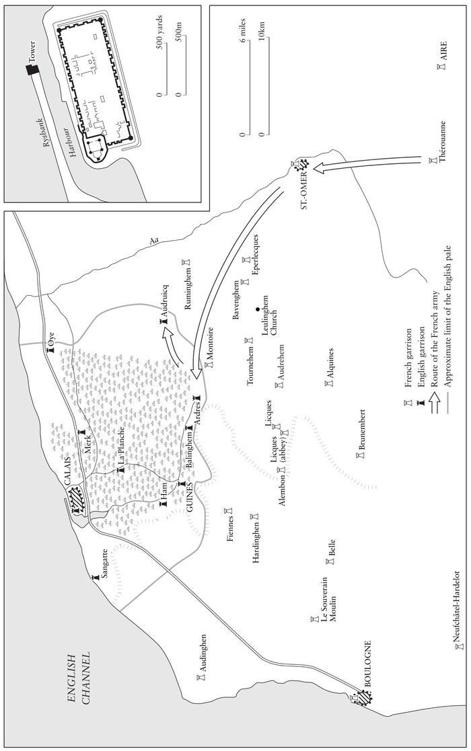
10 Calais and the Pale, September 1377
The French occupation of Ardres made much of the eastern sector of the march indefensible. Two small forts nearby surrendered on the same day and a third was abandoned by its garrison. The only other significant place in the sector was Audruicq, a castle built on rising ground about five miles east of Ardres, which was now cut off from Calais by French troops. Audruicq was commanded by a squire called William Weston with a garrison of fifty men, half what he considered to be necessary. He had asked Calveley for more but had been told that none could be spared. After three days of continuous assaults the French artillery had wrecked part of the walls. Their sappers had drained the moat and filled it in at three points. More than a quarter of the garrison had been wounded or killed. When the sun rose on 11 September the defenders found that during the night the French had brought up their artillery to the edge of the moat and had piled up their scaling ladders in full view of the walls. Weston’s courage failed him. On the following day Audruicq surrendered in its turn. These humiliations profoundly shocked English opinion. Gommegnies was arrested by Sir Hugh Calveley when he reached Calais with his men and sent back to England under guard. Weston would have aroused more sympathy if it had not come to light that the French had paid him 2,500 francs (about £400). He claimed that this represented the value of his prisoners and stores but contemporaries were not convinced. Both men were imprisoned in the Tower of London and later charged with treason.17
With the road to Calais now open from the east Sir Hugh Calveley assumed that the Duke of Burgundy would advance on the town. But although the Duke had been in the Pas-de-Calais for only ten days he was already encountering serious difficulties of his own. His army was equivalent to the population of a large provincial city. The region around had been stripped bare by the raids and counter-raids of the last three months. The campaign was being fought in heavy and continuous rain which impeded efforts to bring in supplies. It also flooded the causeways across the Calais marshes and made it impossible to deploy heavy equipment. At about the time that Audruicq fell a terrible storm dispersed the French and Castilian fleets from their anchorages outside Calais harbour and caused serious damage to some of the ships. On about 13 September the army abandoned the campaign and marched away. The fleet sailed south for its bases almost immediately afterwards.18
*
The French campaign in Aquitaine began before the attack on Calais and continued for long after it had fizzled out. The Duke of Anjou famously disliked long military campaigns. This one, however, proved to be the most sustained and successful of all his attacks on the English duchy. It was mounted simultaneously from the north and east. The greater part of the army mustered at Poitiers in the last days of July 1377: rather more than 2,000 men under the command of the Duke himself and Marshal Sancerre. On 1 August Anjou marched out across the rich open plain of Poitou, unfurled his banners at Nontron in northern Périgord and moved down the valley of the Dronne, sweeping away the small Gascon garrisons in his path. The defenders burned their castles and fled or put up a perfunctory resistance before accepting terms. This was a region which had been controlled for years by the garrisons and guerilla bands of Raymond de Montaut, lord of Mussidan. But even Raymond’s great fortress at Bourdeilles resisted for only seven days before the garrison sued for terms and opened their gates. In the next few days Louis of Anjou was joined by a smaller army coming up from Languedoc under the command of the Seneschal of Beaucaire. The combined force, now nearly 3,000 strong, marched across the heavily wooded valleys of western Périgord towards Bergerac, the main English garrisoned town on the Dordogne.19
Like the defenders of Calais, the English in Bordeaux had had several months’ warning of what was afoot, but like them they received the news of the enemy’s arrival with something like panic. In Bordeaux, however, there was better reason for it. A year of stalemate and two years of truce had done nothing to improve the duchy’s defences or the parlous state of its finances. The English Exchequer was responsible for paying about 250 English troops in Gascony, distributed between the garrisons of Bordeaux and Bayonne. In addition John of Gaunt, who was the lord of Bergerac, paid for the garrison of its castle from the revenues of his English estates. Otherwise, all military expenses had to be met from local revenues. In 1377 the Constable of Bordeaux, the duchy’s chief financial officer, could afford to pay only two garrisons, at Saint-Macaire on the Garonne and Dax on the Adour. The remaining castles of the duchy were defended by their lords and the towns by their inhabitants with locally recruited troops. Some of them received a subsidy from the duchy’s revenues, which is likely to have been substantially less than the cost of defence and was generally paid late or not at all. It was of course in their interest to defend themselves anyway. But unlike the English they had the alternative of submitting to the King of France.
Even the cash-strapped ministers of Edward III realised that urgent steps would have to be taken to send money out to Bordeaux. Since the Italian banking network no longer extended to wartime Bordeaux this had to be done laboriously and expensively by sending coin and bullion across the Bay of Biscay in heavily armed ships. A total of £5,755 in coin was scraped together at Westminster, which was probably all that could be spared. The Great Council which met in April 1377 had their own ideas on how this money should be spent. They thought that to pit a field army against the Duke of Anjou was unrealistic. They told Felton that the money was to be used for static defence and proposed that he should raise an extra 700 troops to boost the garrisons in the duchy. They even specified the places where these troops were to be posted. Whether this was the wisest way to run a campaign 500 miles away may be doubted but Felton was an experienced enough soldier to ignore the Council’s prescriptions when he wanted to.20
When the money arrived at the end of May he was getting confused messages from his spies about the Duke of Anjou’s plans. But early in June he learned that the main French objective was the valley of the Dordogne and by early July he knew that they intended to lay siege to Bergerac before advancing down the valley towards Bordeaux. To meet this threat Felton disposed of just 860 men-at-arms and an uncertain number of archers, perhaps about a thousand men in all, of whom about half were Gascons. Some of those present must have reflected on the decline of England’s affairs since the Black Prince had fought with 4,000 Gascons at Poitiers and nearly twice as many at Nájera. Felton reinforced the garrison of Bergerac. But he was obliged to withdraw troops from most of the remaining garrisons to create a small field army. Even this rapidly exhausted his funds. The money from England was swallowed up in arrears almost as soon as it arrived. By mid-August Felton was desperately urging the Constable of Bordeaux to find more money by whatever means he could before even this small army deserted him.21
In these difficult conditions the continuing loyalty of the Gascons was very much an unknown factor. Felton was in the same position as Sir Oliver Ingham had been forty years before. Bordeaux and Bayonne were thought to be reliable, although there had been obscure plots and treasons even in Bordeaux. Left to themselves, most of the smaller towns of the duchy would have been happy to make terms with the stronger power. The nobility had closer links with the English administration, but they were staking all that they had on a successful English defence against a much stronger enemy. For some the risk seemed too great. In March 1377 Guillaume Sans de Pommiers, whose family had a long tradition of loyalty to the English duchy, secretly agreed to admit 300 French soldiers into his castles including the strategically vital fortress of Fronsac on the north bank of the Dordogne opposite Libourne. He had been worked upon over several months by the lord of Albret. The King of France, said Albret, intended to take Bordeaux and all the territory around it in which Guillaume Sans’s lands were located. If he changed sides in time he would keep what he had and receive a grant of 20,000 francs as well as a pension large enough to garrison all his castles against the English. In one form or another these arguments must have occurred to every prominent Gascon nobleman in the English allegiance. After much hesitation Guillaume Sans succumbed. But he was the only one. And before he could do anything Felton appeared without warning at Fronsac and arrested him. He was tried in Bordeaux in April and beheaded.
Felton could not have carried out this swift and brutal act of repression unless he was confident of the support of the rest of the nobility, many of whom were jurors at Guillaume Sans’s trial. Their position is a reminder that beyond a point political allegiance cannot be analysed simply in terms of self-interest. Men like the new Captal de Buch, Archambaud de Grailly, came from families which had never deserted the cause of the English kings even in the darkest hours of the duchy’s history. Archambaud’s father had died in a French prison rather than reach an accommodation with Charles V. He himself had attended the coronation of Richard II at Westminster. Raymond de Montaut, lord of Mussidan and Blaye, was the standard-bearer for the English cause in Périgord. He had visited England, mixed with the English nobility, lived well on grants and borrowed money and trafficked in prisoners of war. He returned to fight for Richard II against the Duke of Anjou in 1377. Yet he might have served his own interest better by abandoning the English long before.22
The Duke of Anjou arrived before Bergerac on 22 August 1377. Bergerac was a compact walled town of some 1,500 souls on the north bank of the Dordogne, which was situated in the most fertile part of the valley and controlled the only bridge over the Dordogne in Périgord. Its brick houses and public fountains proclaimed its prosperity to the world. But in spite of its wealth and its strategic importance very little had been done to improve its defences since the Earl of Derby had overwhelmed them in a few hours in 1345. They consisted of the joined up facades of buildings with gaps filled by a low, thin brick wall protected by an earthwork and a water-filled ditch. At critical points there were fortified gateways and curious free-standing towers which had been built as refuges from raiders but were useless against a properly equipped army. The citadel, which stood at the water’s edge upstream of the bridge, was an ancient structure dating from the eleventh century. But it was well-manned and equipped with stone-throwers and cannon. The captain of Bergerac, a Gascon retainer of John of Gaunt, was away in England. He had left the castle to be defended in his absence by a kinsman. But the leading figure in the defence was the routier captain Bertucat d’Albret. Bertucat had purchased his release from the Duke of Anjou’s prisons at about the end of 1376 and put himself at Felton’s service as soon as the truce had failed. Felton put him in command of the town with about 270 men-at-arms, most of them belonging to his own company. In addition several companies of Gascons who had abandoned their garrisons in northern Périgord took refuge in the town and joined in the defence.23
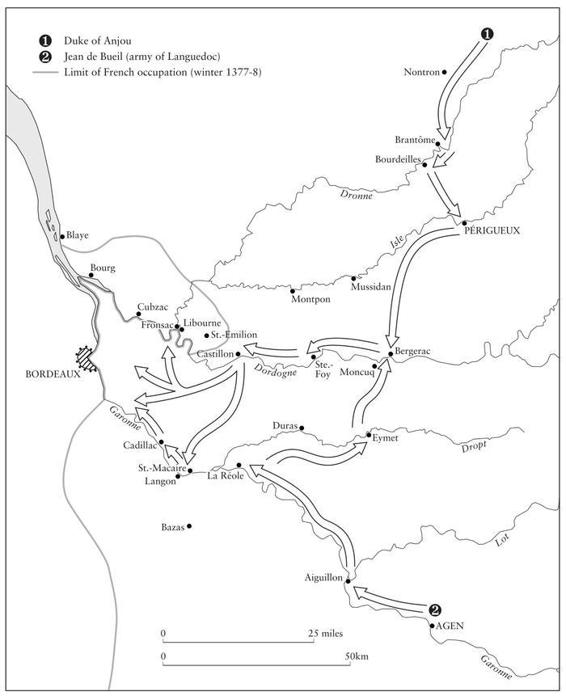
11 The Duke of Anjou in Gascony, July—October 1377
Disaster struck the English and their Gascon allies almost immediately. The first assault, against the Porte de Clairac, by the river in the south-east corner of the town, was repulsed with heavy French casualties. The Duke of Anjou ordered Jean de Bueil to bring heavy siege equipment from La Réole. This involved dragging cumbersome machines, trebuchets and the massive covered battering rams knows as ‘truies’, across some thirty-five miles of poor roads between the Garonne and the Dordogne. The main obstacle in their path was the rocky, fast-flowing stream of the River Dropt. It had to be crossed by a long stone bridge beyond the bastide of Eymet, about fifteen miles from Bergerac. Jean de Bueil had been provided with 400 men-at-arms to escort the siege train. Sir Thomas Felton collected together about 700 men, virtually all that he had available, and set up an ambush near the bastide. Felton’s movements had been noticed. The French escort force was doubled before it reached the river. It now included some of the most famous knights in Louis’s army: apart from Jean de Bueil himself there were his brother Pierre, the elderly paladin Le Bègue de Villaines, Bertrand du Guesclin’s long-standing Breton adjutant Thibaut du Pont, and Owen of Wales. When the two armies came in sight of each other they both dismounted. There was a fierce soldiers’ battle between well-matched enemies with roughly equal numbers. The decisive moment came when the French pages, who had been sent to the rear with the horses, appeared on the field and the English thought that a fresh corps had arrived to reinforce their enemies. They fell back, trying to disengage. But they were overwhelmed. A large number of Felton’s troops were killed. Many of those who escaped from the battlefield were drowned in the river as they tried to get away. Only about 200 survived. Felton himself was taken prisoner, along with Raymond de Montaut, lord of Mussidan; Bérard d’Albret, lord of Langoiran, the only member of his clan apart from Bertucat who had maintained his English allegiance; and the lords of Duras and Rauzan, who were the leading Anglo-Gascon barons of the Agenais.
When the news reached the defenders of Bergerac, Bertucat d’Albret tried to persuade them that all was not lost. They were not convinced. Two days later, on 3 September, the citizens awoke to find that the artillery from La Réole had been erected in front of their walls and that trumpets were sounding in the French camp to signal the assault. Bertrand du Guesclin sent a parlementaire into the town to persuade them that further resistance would only lead to their town being sacked. The citizens briefly deliberated among themselves and agreed. Bertucat was not consulted but he could see which way events were moving. He gathered his men and rode out of the town across the stone bridge onto the unguarded south bank. From there they fled to the nearby fortress of Moncuq. As they left the French entered Bergerac.24
The Duke of Anjou called a council of war in his tents. He decided to press on westward down the Dordogne towards Bordeaux. The situation was unusually favourable. In contrast to the north, where Philip of Burgundy had been driven from the field by bad weather and supply problems, southern France was enjoying fine weather and one of the most bountiful harvests in recent memory. Fresh troops were on their way from the north and more had been summoned from Languedoc. Towards the end of the first week of September Edward III’s son-in-law Enguerrand de Coucy arrived from the Île de France with 700 men-at-arms. Enguerrand had admired Edward III and refused to break with him while he lived. These ties would never be inherited by the child-king of England. Charles V had persuaded Enguerrand to enter his service within a fortnight of the death of the old King. As he prepared to fight against his former friends he sent his English page north to deliver a letter to Richard II renouncing his English lands and his membership of the Order of the Garter. It was his duty, he declared, to fight for the King of France as his ‘natural and sovereign lord’. His wife, Edward III’s daughter, who had been in England when the truce expired, joined him in France after Edward III’s funeral, but ultimately returned to England early in 1379 shortly before her death. Of their two daughters, the elder was brought up in France and married into the French nobility while the younger stayed in England, becoming Countess of Oxford and a prominent figure at the court of her cousin. It was a symbolic division.25
The Château de l’Ombrière in Bordeaux was a scene of confusion and panic when Bergerac fell. The Seneschal’s Council met on 3 September. They issued an appeal for help to the nobility and towns and sent urgently to England for instructions. The strongest personality among them was Sir William Elmham, the governor of Bayonne, who seems to have appointed himself as acting Seneschal. His main priority was the defence of Bordeaux. He gathered together the remnants of Felton’s army and the few remaining garrison troops. From these he formed two companies to defend the western and northern approaches to the city. One, under his own command, was to hold the walled towns of Libourne and Saint-Emilion at the western end of the Dordogne valley where the main thrust of the Duke of Anjou’s offensive was expected. The second, under two of his lieutenants, Edmund Cresswell and William Chandler, was ordered to hold the north shore of the Gironde at Bourg and Blaye. This strategy was forced on Elmham by lack of manpower. But it tacitly abandoned the whole of the Dordogne valley above Saint-Emilion to the French. It also left Bordeaux itself ‘without captain or garrison’, as the Council acknowledged. The city would have to be defended by its citizens. They hired men-at-arms wherever they could find them but had no money with which to pay them. Unless they received 4,700 livres bordelais (about £630) immediately, the jurats of the city declared, the defence of the city would collapse. The Council told the Constable that somehow or other this sum would have to be found. Somehow or other it was.26
Money, however, was no longer the Council’s main problem. As the implications of the loss of Bergerac and Felton’s army sank in, the loyalty of the Gascon nobility and towns began to drain away. The Gascon prisoners of Eymet were taken before the Duke of Anjou in his camp after the battle. Several of them later claimed that they had been threatened with death unless they abandoned their English allegiance. This was probably untrue. But Anjou is known to have bought them from their captors in order, he said, to ‘turn them to the King’s and our allegiance’. He may well have applied to them the policy which Charles V had applied to the Captal de Buch, refusing to let them ransom themselves unless they submitted. For whatever reason they did submit within a few days. The two barons of the Agenais, the lords of Duras and Madaillan, took their new homage lightly in the fickle tradition of the region from which they came. They returned to the English fold almost immediately in return for a bribe of 600 livres bordelais (£80). ‘Better to perjure ourselves to the Duke of Anjou than to the King of England, our natural lord who has been so good to us,’ they reasoned according to Froissart. Bérard d’Albret and Raymond de Montaut of Mussidan were more considerable figures, long-standing allies of the English whose defection was a serious and public blow. Bérard delivered up the powerful castle of Cubzac on the north shore of the Dordogne, a serious impediment to Elmham’s efforts to hold the lower reaches of the river. He also made himself responsible for recruiting fresh converts to the French cause in the Entre-Deux-Mers east of Bordeaux, where his main influence lay. Raymond de Montaut delivered up much of western Périgord to the French. When Cresswell and Chandler arrived with their troops at Blaye, Montaut territory for many years, the citizens shut the gates in their faces. They later submitted to the Duke of Anjou. Defection is contagious. Soon after withdrawing to Moncuq Bertucat d’Albret, whose career in English service dated back to the 1350s, made his own submission to the French Crown, undertaking to hold as many as twenty-seven castles on the Gascon march for the Duke of Anjou. This, the most remarkable submission of all, was certainly voluntary. It was Bertucat’s judgment of the way things were going.27
The French army swept effortlessly down the Dordogne. Sainte-Foy surrendered the morning after the French arrived. Castillon, although virtually abandoned by Elmham, was defended by its inhabitants for twelve days. It surrendered only after the lower town had been lost and the great double keep had been severely battered by the French trebuchets. Anjou sent raiding forces downstream to try out the defences of Libourne and Saint-Emilion. But instead of trying to force his way past Elmham’s companies he unexpectedly turned south and marched cross-country towards the Garonne. This move wrong-footed Elmham, whose forces were distributed along the north shore of the Dordogne and the Gironde, well away from the Duke’s new line of attack. The Garonne was hardly defended at all. The last notable fortifications on the Garonne east of Bordeaux were the twin towns of Saint-Macaire and Langon, with their great thirteenth-century keeps standing on either side of the river some thirty miles away from the capital. The Council in the Château de l’Ombrière hurriedly recalled Cresswell and Chandler from Bourg and commandeered ships to carry their men upriver to Saint-Macaire. Elmham marched after the Duke and shut himself in the bastide of Cadillac, a short distance downstream. The south bank of the river was abandoned. Langon remained entirely undefended except by its inhabitants. In the third week of September the French army appeared before Saint-Macaire for the second time in two years. This time, the inhabitants of the lower town entered into negotiations as soon as the Duke arrived. The town surrendered after four days. The garrison plundered the town and retreated with their spoil into the citadel, an enormous square keep with walls ten feet thick built on a projecting rock at the western extremity of the town. Anjou erected eight large trebuchets around the keep which battered the walls day after day. The garrison finally surrendered on about 7 or 8 October after two weeks of this. Langon, on the opposite bank, opened its gates without waiting to be attacked.28
The French army was now reaching the limits of its endurance. Winter was closing in. Supply problems intensified. At the siege of Castillon forage parties had had to range more than thirty miles from the army to find food. By October horses were dying for want of fodder. The Duke of Anjou decided to call an end to the campaign. The last episode was an act of personal revenge. On 9 October 1377 he appeared before Duras, the castle of the lord of Durfort. The great square castle of the Durforts, with its four corner towers, was impressively strong but of little strategic value. Yet Anjou spent three weeks battering it into submission with his artillery and launching bloody assaults against the walls. The survivors of the garrison retreated to a tower after the rest of the castle had been overrun and finally surrendered at the end of October 1377. Louis of Anjou then turned for home.29
In the midst of his Italian preoccupations Pope Gregory XI found time to write to the Duke of Anjou from his summer palace at Anagni, south of Rome. He was fulsome in his congratulations. The capture of so many places in so short a time and of almost all the leaders of the enemy army had caused him ‘inexpressible joy and satisfaction, for which we give thanks to the Lord, hoping only that He has destined you for some yet greater triumph.’ It had been an exceptionally well-managed campaign which had skilfully exploited the weaknesses of an admittedly outnumbered enemy. The whole of the valley of the Garonne was opened up to future French armies. Bordeaux, the main political pillar of the English duchy, became a frontier town. Detachments of Anjou’s army raided across Entre-Deux-Mers and the western Bazadais and into the Médoc, forcing the surrender of many smaller places. According to the official count no fewer than 134 castles and walled towns were taken. The result was to consolidate the Duke’s grip on a great swathe of territory all round the city. When he turned for home in mid-October, instead of paying off the whole of his army as he had done in 1374, he put part of it into winter quarters, distributing men among garrisons close to Bordeaux. The bastide of Cadillac, abandoned by Sir William Elmham, was turned into a depot for stores and equipment waiting for the great siege which Anjou intended to undertake the following year.
In due course, Anjou’s garrisons were succeeded by the lords of countless small towns and castles who received them as confiscated lands. They carried on the unending war of raid and reprisal which had been an ordinary feature of the life of Périgord, Quercy, Rouergue and Auvergne for two decades. The estate accounts of the archbishops of Bordeaux, who were among the largest landowners of the region, tell the story in the laconic marginal notes which their clerks addressed to the auditors. This tenant has not paid his dues because ‘everything has been destroyed by the French’; that estate produces ‘no revenues on account of the war’; another has been ‘wasted by the French’ and lies empty and uncultivated, the grapes rotting on their stalks; many are marked with the increasingly familiar refrain, ‘deserta est’ (‘abandoned’). The accounts of the papal collectors in the region tell the same tale: ‘a wasteland’, ‘utterly abandoned’, ‘devastated by war’. A large part of the diocese of Bazas, lying south-east of Bordeaux, was described in 1379 as ‘charred and ruined’. Some of these places did not recover for more than a generation. In 1384 the Soudan de Trau, one of the biggest lay landowners of the Bordelais, explained to Richard II’s officials why he could not repopulate the deserted parishes of his demesne. This man looked back on the fall of Saint-Macaire and the defection of Bérard d’Albret as the turning point in the fortunes of the district. The inhabitants had fled. Raiders of both sides were apt to appear without warning. The soldiers of the duchy had demolished the only castle in which the peasants could take refuge. So land once yielding 300 marks a year had become worthless. There were many other tales like his. Surveys carried out at the end of the fourteenth century were still reporting farms invaded by brambles which had gone out of cultivation twenty years before. It is true that the picture was not uniform. The Médoc north of Bordeaux largely escaped the problems elsewhere. And between the wrecked farms there were islands of prosperity where men still made a living from the land. But part of the problem was the very caprice of war, which left buildings intact in sight of burned-out shells and neatly tended rows of vines next to hillsides from which everything had been grubbed up by soldiers.30
*
During the first few months of the reign of Richard II the English government, frustrated by the problems of reinforcing Gascony and frightened by the coastal raids of Jean de Vienne, adopted the strategy which was to dominate their conduct of the war with France for the next decade. They set about acquiring a chain of garrisoned fortresses, clones of Calais, along the Atlantic coast of France: Brest, Cherbourg, Le Crotoy and Saint-Malo. Brest and Cherbourg were successfully occupied and held against the French for many years. Two major attempts against Saint-Malo failed. Designs against Le Crotoy were abandoned. The Channel Islands, after a long period of neglect by the English Crown, were built up as a victualling centre and a staging post for operations in Normandy and Brittany, developments which had already provoked powerful raids against the islands by French commanders. By 1377 the two major castles of the Channel Islands, Castle Cornet on Guernsey and Gorey on Jersey, both had substantial garrisons. A future English Chancellor would refer to all these places as England’s ‘frontiers and barbicans beyond the sea’. As the phrase suggests, the authors of English policy thought of the ‘barbicans’ as the first line of defence against French attacks on England. They served as bases from which to control the English Channel. They maximised the threat from English expeditionary armies, which now had a choice of places by which to enter France, thereby tying down large French forces in their own country.31
Whether this scheme was coherently thought out from the beginning or came about by trial and error as opportunities arose, is a question which the sources, always fuller on actions than designs, do not directly answer. It was certainly a policy deliberately promoted and to some extent financed by powerful mercantile interests, mainly in London, which had lost heavily by French piracy and naval raids and were keen to reassert English control of the narrow seas. But it also reflected long-standing frustrations among those who were concerned with the fortunes of the land war. The easiest point of entry into France was through Calais and Picardy. The short sea crossing required only local command of the sea and could be achieved with relatively modest fleets of transports operating in relays. But England’s strategic interests were now concentrated in the Atlantic provinces of Normandy, Brittany and Gascony, which were difficult to reach from Calais. The lower reaches of the Seine and the Loire, with their broad, fast-flowing streams, represented an impassable barrier for an army. Brittany could be reached from Calais only by taking the long way round, north and east of Paris as Edward III had done in 1359 and Knolles in 1370 and as the Earl of Buckingham would do in 1380. To reach Gascony, as John of Gaunt learned in 1373, an even more circuitous route was required through the upper valley of the Loire and the western slopes of the Massif Central.
The first objective was Brest and its outlying harbours in western Brittany. The fortress had been held by English garrisons for many years. But its captains were answerable to John de Montfort, who was in principle responsible for paying their wages, maintaining the defences and directing operations. In 1377 he was in no position to do any of these things. Shortly before the expiry of the truce, the English government sent an armed escort to collect him from Bruges, where he had been living in exile for the past year, and bring him back to England through Calais. He arrived a ruined man. His only English asset, the honour of Richmond in Yorkshire, was mortgaged to Sir John Neville as security for the great sums which were owed to him for his service in the duchy before 1374. Brest and Auray were the only places in Brittany where his flag still flew. Neither of them seemed likely to survive for long. Auray was besieged by Olivier de Clisson at the beginning of July 1377. Its English garrison opened their gates to the French within a month and took ship back to England. At Brest, the bastides in front of the gates had already been reoccupied by Olivier de Clisson’s Breton companies. A squadron of Castilian merchant ships arrived to blockade the harbour from the sea. If the English Council had not taken swift action the place would almost certainly have gone the way of Auray. They paid off part of his debt to Neville, redeemed Richmond and assumed responsibility for the cost of defending the fortress. In return John de Montfort was obliged to cede the town and castle and the famous harbour to the English for the duration of the war. A squire, John Clark, was sent out to the town at the beginning of September with supplies, reinforcements and orders for the garrison. He was to be followed by a large seaborne expedition in October. The object was to break the blockade, lift the siege on the landward side and occupy as much as possible of the territory in western Finistère which had traditionally been controlled from Brest. For shipping, the Council proposed to use the fleet which had been assembled in the Thames in June. It was still being held there under requisition, abandoned by its crews and depleted by desertions. A fresh round of requisitions was put in hand to reinforce them. The Admirals concentrated on the larger vessels that could be built up for fighting at sea. Press gangs were sent through the maritime communities to find seamen. Nearly 4,000 troops were recruited.32
The chief figures behind this enterprise were Edward III’s youngest son Thomas of Woodstock, Earl of Buckingham, and Richard Fitzalan, Earl of Arundel, two men who were to be closely associated with the new naval strategy. They had much in common. Arundel had recently succeeded to his father’s earldom at the age of thirty. Intelligent and ruthless, Arundel was one of the richest men in England, with ambitions to match his fortune. Buckingham, who was to command the expedition to Brest, was a more enigmatic figure. Only twenty-two years old at Richard’s accession, he had hitherto lived in the shadows of the royal court. There is some evidence that the old King thought ill of his abilities. He had been dubbed a knight comparatively late and became an earl only at his nephew’s coronation. Although he had been Constable of England since 1376 he had acquired no military or political experience at all in his father’s time and never had an endowment to match his status. Yet throughout his life he had a stately manner and a strong attachment to the conventions of chivalry and the forms of courtly behaviour. He spoke ‘like a king’s son’, said Froissart. Thomas of Woodstock was perhaps the extreme example of the young noblemen of his generation who struggled against the frustrating limitations of English power that deprived them of the chances of glory that their fathers and grandfathers had enjoyed. The frustration was intensified in his case, as it was for so many of his contemporaries, by expensive tastes, a profound sense of lineage and a perennial shortage of money. ‘The best of men’ was the chronicler Walsingham’s judgment of him. But his career shows him to have been an assertive and quarrelsome man with a high opinion of his own talents which was never entirely justified by his acts.33
The first Parliament of the new reign opened at Westminster on 13 October 1377. It was, perhaps inevitably, affected by the unresolved tensions of the past. A large number of the knights of the shire who had sat in the Good Parliament were re-elected to the Commons, including Sir Peter de la Mare, who was once again elected Speaker. Their instincts were in some respects a reversion to those of 1376. Alice Perrers was once again brought before Parliament to hear herself banished and her property forfeited. The Commons grumbled about Lyons’s pardon, which they blamed on Alice. They procured the removal of their old enemy William Latimer and a number of his friends from the continual council. Their hostility to John of Gaunt was unspoken, but palpable. The Commons’ radicalism, like that of their predecessors, was founded on strong support for the war and on a conviction that the ministers of Edward III had been half-hearted about prosecuting it. With memories of the French raids on the south coast still fresh, this proved to be one of the most warlike assemblies of the late fourteenth century. They complained about the decline of ancient chivalry, about the losses of the warrior class in France, about the end of what they supposed to have been England’s former mastery of the seas. They were merciless in their judgment of recent failures, which they were inclined to blame this time on captains in the field rather than the comparatively new ministers at Westminster. The defenders of Ardres and Audruicq were tried in Parliament for treason and sentenced to death. They were only saved by the intervention of John of Gaunt.34
The real test of Parliament’s support for the war, however, was its willingness to pay for it. Richard II had inherited an empty treasury from his grandfather. Richard’s ministers told Parliament that they needed no less than 400,000 marks (£266,666) to refill his coffers and prosecute the war. The Commons responded, as they had so often done, with suggestions that more money could be derived from the royal demesne and the Church. They prepared a rather unrealistic table to show what riches these sources could be expected to produce but they were finally persuaded to make a grant of two tenths and fifteenths. These were declared to represent two years’ worth of direct taxation. But they were to be collected in one payment by 2 February 1378. It was less than the government had wanted but still the largest single tax payment which the Commons had ever authorised.
True to their instincts, the Commons did not trust the government to spend it well. They made it a condition of the grant that the entire proceeds of the tenths and fifteenths as well as the wool subsidy and the clerical tenth should be paid to two special treasurers acceptable to themselves, who were to make disbursements only against warrants for military expenditure. William Walworth and John Philpot, who were appointed to perform this office, were both prominent London financiers who were among the members sitting for the city in the Commons. Walworth was a former mayor who had made his fortune as a victualler and wool merchant. Philpot was a rich and well-connected grocer. Both men belonged to the well-organised group of Calais staple merchants which had dominated the city’s government for years and had a direct interest in the policy of concentrating resources on the war at sea. In the first three years of Richard’s reign about three-quarters of the total receipts of the English state passed through their hands and were applied to war purposes. This was a substantial increase on the proportion, generally about 60 per cent, which had hitherto been normal. It was achieved mainly at the expense of the royal household and the ordinary internal administration of the country, both of which were severely squeezed. The absolute sums involved were high by historic standards. Between 14 December 1377, when they took up their functions, and 4 February 1379, when they delivered their first accounts, the special treasurers spent £145,651 on the war, the largest figure for any comparable period since 1370. For a brief period England was able to spend money on the war at a rate not far short of that of France.35
The Earl of Buckingham had originally planned to sail to Brest with the annual wine convoy bound for Gascony, which usually left in early October. He missed the convoy, which sailed without him, taking some of his troops and most of his ships with them. As a result, the Earl was forced to postpone his expedition until the end of the year. He decided to make use of the ships and troops still waiting in London by taking them on a plundering raid against the Flemish port of Sluys, where a large number of Castilian merchant ships were reported to be waiting, laden with cargo, for a favourable wind. Since the English government was endeavouring to maintain good relations with the Count of Flanders and his subjects, this was not a wise decision and it is quite possible that Buckingham consulted no one but his fellow captains. In the event they never reached Sluys. In the last week of October Buckingham and his companions mustered their men outside the half-finished buildings of Edward III’s Cistercian foundation of St. Mary Graces, east of the Tower of London, and further down the Thames at Ratcliffe, a bleak area of wharves and boat-yards in Stepney Marsh. The men were crammed onto thirty large warships and a number of smaller barges and supply vessels. They put to sea on 7 November 1377. After three days they encountered a terrible storm. Driving rain and gale-force winds scattered the fleet. Several of the supply ships took in water and were abandoned by their crews, who took refuge on the crowded decks of the warships. The survivors limped home with broken masts and torn sails. The fiasco was rather unfairly blamed on the two Admirals, both of whom were removed at the beginning of December after only a few months in office. They were replaced by the Earls of Arundel and Warwick, who were expected to bring more energy to their task.36
Buckingham’s fleet was repaired and reunited at Sandwich in the course of the following month and sailed again in the middle of December 1377. Shortly afterwards it successfully joined forces with the western fleet in the Channel. The combined armada then headed south for Brest, between sixty and eighty strong. The ships must have reached the town at about Christmas-time. They found the approach to the harbour blocked by the Castilian squadron lying off the town. Seeing the great carracks ahead of them, a large part of the English fleet mutinied and refused to fight. One of Buckingham’s subordinate commanders was threatened with death by his crew unless he agreed to turn back. Undeterred, Buckingham sailed ahead with the rest of his ships and broke through the enemy line. Eight armed Castilian merchantmen were captured in this fight and a number of others put to flight. When Buckingham and his companions entered the harbour they encountered opposition of a more unexpected kind. The garrison in the castle consisted mainly of Englishmen, commanded by a former associate of Robert Knolles called John Lakenheath. They were in an ugly humour. They claimed to be owed more than 22,000 francs (about £3,700) in back wages and refused to open their gates unless it was paid. The leaders of the army had to guarantee this sum personally before they were allowed to take possession. Once inside, Buckingham appointed Robert Knolles as temporary captain. He filled the stores of the castle from the supplies which he had brought with him. He increased the garrison’s strength. He began to push out the limits of the garrison’s effective control in Finistère. The new base was swiftly turned into a centre for English commerce raiding. Cargoes were commandeered from passing ships to add to the garrison’s stores. Making north into the Channel with a galley and two barges, Sir Thomas Percy was able to disperse a convoy of fifty unarmed Flemish and Castilian merchantmen, sinking several of them and capturing at least two entire cargoes. This short campaign was one of the most successful naval enterprises of the English since 1369. On 25 January 1378 the fleet returned in triumph to England.37
Brest was destined to remain in English hands for just over twenty years. It never did serve as a point of entry into France. The sea journey always proved to be too long for the carriage of a large army. The fortress played a modest part in supporting English naval operations in the Channel and maintaining communications with Gascony. Like Calais, it became a largely military town, economically dependent on its garrison. Knolles held the town and castle with 240 men and the garrison was probably maintained at something like that level until the end of the 1380s. The local civilian population was progressively driven out by the hardships of frequent French raids and sieges and persistent requisitioning and billeting by its English captains. Victualling and supply proved to be a major operation, managed by the King’s receiver, a full-time official, and by a network of suppliers in Dartmouth and Fowey, Bayonne and Bordeaux. Regular works had to be carried out on the walls and towers. Gunpowder artillery was manufactured in England and laboriously hauled to the coast to be shipped out to the town. At least two ships were kept permanently in the harbour to maintain communications with the mainland and capture prizes at sea. Whether all this justified the expense may be doubted. In the first few years the net cost of the English occupation of Brest was between £6,000 and £8,000 a year, which was substantially more than the English government spent on Gascony over the same period.38
The main beneficiaries of the occupation of Brest were its captains. Much of the seaborne commerce of western Europe was carried past the fortress and it offered rich spoils. Inland the garrison gradually established a ransom district extending north to the coast and south as far as the Bay of Bénodet. Knolles’s successors as captains of Brest, who relieved him in June 1378, were two Oxfordshire knights close to the King, Sir Richard Abberbury and Sir John Golafre. These men, neighbours at home, had probably entered into a partnership to exploit the profits of war together. They entered into a fixed-price contract with the King under which they agreed to man and defend the fortress at their own expense in return for an annual fee of 10,000 marks (£6,667), plus a proportion of the spoil which was calculated according to a complicated formula leaving them with about half. During the eleven-month tenure of the fortress by Abberbury and Golafre the spoil declared to the King’s receiver came to £1,727, of which rather more than half was derived from patis and the rest came from ships and cargoes captured at sea. Of this sum £875 went into the captains’ pockets, a considerable fortune by the standards of the time. Abberbury and Golafre were followed by another business partnership of Sir Hugh Calveley and Sir Thomas Percy, who took the contract at a slightly reduced fee with a larger share of the spoil. These were all essentially financial transactions. The captains of Brest rarely visited the fortress and generally performed their duties through deputies who accounted to them for the profits. Calveley and Percy declared less than half the spoil that their predecessors had done but must have made far more. In 1384, when Percy held the contract alone, the Bretons claimed that the garrison was taking patis from 160 parishes and reckoned the proceeds at 35,000 francs (about £5,800) a year in cash and 1,200 barrels of fish, meat and grain. There is no record of the costs incurred by the early captains of Brest, but the fact that the government was able to drive a much harder bargain with their successors suggests that they did very well for themselves. Richard Abberbury was already a rich man when he went to Brest, but it is not fanciful to see the grand gatehouse of Castle Donnington in Berkshire, which was ostentatiously rebuilt for him in the 1380s, as a monument to the profits of a successful war contractor even at a time when English fortunes were waning.39
*
With Brest and its hinterland under English control Richard II’s Council turned their attention to the Cotentin peninsula and its absent lord, Charles of Navarre. Charles was now fifty-five years old, an embittered figure who had passed most of his adult life in exile in Navarre. He had not given up hope of recovering the great appanage in southern Normandy which he had enjoyed until the civil wars of the 1360s. According to his secretary and chamberlain, whose confessions in the following year are the main source for his acts in this period, Charles of Navarre still thought of himself as the rightful King of France. He still hoped for some catastrophic event, perhaps a great defeat or the death of the King, which would plunge France back into the civil disorders of the 1350s and create an opening for his ambitions. From his castles at Pamplona, Estella and Olite he maintained a regular correspondence with the citadel of the town of Évreux, where a small group of soldiers and administrators ran what remained of his French domains and handled his difficult relations with the court of France. But Charles had long ago lost what friends and influence he had ever had in Paris and was increasingly out of touch with events there. Distance and frustration magnified his illusions. As a well-placed observer remarked during a candid exchange with the King of Navarre’s representatives in Paris, the truth was that Charles of Navarre was profoundly hated at the Hôtel Saint-Pol and too far away to need appeasing. The hatred was fully reciprocated. The King of Navarre had made at least two attempts to have Charles V poisoned since his return to Navarre in 1372 and had encouraged a variety of obscure and unsuccessful plots. His only real bargaining counter was his capacity to make trouble by intriguing with the English and even that was a weapon to be used with caution. Charles of Navarre’s French domains were poorly defended and vulnerable to reprisals if he should press his chances too far. Even in his Navarrese kingdom he was exposed to attack from Castile, an ancient and powerful enemy and a compliant ally of France, whose hostile presence on his southern border always inhibited his more aggressive plans.40
As far as the English were concerned Charles of Navarre was an untrustworthy politician who had double-crossed them several times. But he possessed important harbours in Lower Normandy, in particular Cherbourg and Barfleur, which made him worth courting in spite of the risks and frustrations involved. In the spring of 1377, with the end of the truce of Bruges in sight, the King’s councillors at Westminster began to take a more active interest in him. Sir Edward Berkeley, a former retainer of the Black Prince who was to become something of an expert on southern Europe over the following years, spent the best part of a year in Gascony and Navarre trying to pin down the slippery King of Navarre. Charles played his usual game of hinting at an alliance with England without actually making one in the hope of persuading the French King to buy him off with fresh concessions. He received Berkeley with every outward show of warmth while in Paris his agents covertly renewed their demands on the French King, offering a military alliance against the English. In August 1377 Charles’s tactics changed. A profoundly gloomy report arrived from his agents in Paris, followed in due course by the French King’s official rejection of all of his demands. Suddenly he declared his willingness to join forces with England. He began to press forward with his plans with an impatience and enthusiasm that must have taken Berkeley by surprise. He would return to Normandy, he said, with a corps of Navarrese troops, 300 or 500 men, in ships that the English government in Gascony would be expected to find for him in Bayonne. He would put the harbours of the Cotentin and the Navarrese castles of southern Normandy at the disposal of an English army for a joint invasion of France. As an earnest of his intentions Charles proposed a marriage between his daughter and Richard II.41
In about early October 1377 these proposals were carried to Westminster by one of Charles of Navarre’s Norman squires. His arrival coincided with the opening of Parliament. The Parliamentary peerage was enthusiastic. They were even prepared to waive a dowry for Charles’s daughter, an extraordinary concession bearing in mind that Richard was one of the most eligible princes of Europe. Progress, however, was slow. Communications across the Bay of Biscay in winter were difficult. The emissary sent with the English answer, a Gascon squire called Garcie-Arnaud de Salies, left as soon as he could for Bordeaux, accompanied by an English knight, Sir John Roches. But it took them nearly two months to find a passage to Bordeaux. In Pamplona Charles of Navarre became nervous. The long silence from England troubled him. The French government, although lacking precise information, had already become suspicious of the diplomatic bustle around Navarre and began to stir up trouble on Charles’s southern front. The French Admiral Jean de Vienne was in Castile at the end of the year. There were rumours of Castilian troop movements south of the Ebro. Regular messengers passed between the Duke of Anjou and Henry of Trastámara, many of whom had to go through Navarre. Some of them certainly had their letters opened by Charles of Navarre’s officials. On 6 January 1378 Henry of Trastámara declared himself. From Toledo he issued orders for the invasion of Navarre in the spring. The army was ordered to muster at Logroño on 1 April. This time, Henry said, he would not just harass Charles of Navarre’s kingdom but annex it to his own.42
These machinations in Charles’s rear forced him to drop his plans to go to Normandy in person. In the new year he decided to send to France in his place his eldest son, also called Charles, an inexperienced youth of eighteen whose arrival, he thought, would seem less threatening than his own. The young prince was given a retinue so grand that Charles’s Navarrese subjects had to submit to a special tax to pay for it. But the purpose of his visit was characteristically obscure. The young prince appears to have known nothing of his father’s dealings with the English. The real business of the mission was left to his entourage who did. One of them was carrying a satchel of documents for Pierre du Tertre, the King of Navarre’s secretary, who had been involved in Charles’s covert dealings with the English for nearly a decade and was currently based in western France. His task was to fill the store-rooms of the Navarrese castles in Normandy and make sure that their garrisons held fast behind their walls until the English arrived. The King of Navarre proposed to send his chamberlain, Jacques de Rue, to join him with his final instructions as soon as he had done the deal with the English. He would also be joined by one of Charles’s French wardrobe servants, who was going to insinuate himself into the royal kitchens in Paris and poison the King of France.43
On 6 January 1378, the day that the Castilian mobilisation orders were sent out, Charles the Younger set out from Navarre with his companions. A few days later Garcie-Arnaud de Salies finally arrived in Pamplona with the English Council’s proposals, only to find that they had been overtaken by events. The King of Navarre’s most urgent need now was for help in defending his southern frontier against Castile. He wanted reinforcements from England or Gascony to be sent to him across the Pyrenees. He clearly entertained quite unrealistic notions about how long they would take to get there. So Garcie-Arnaud was sent straight back to England with pressing demands for military assistance. With him went yet another Navarrese emissary, Charles’s councillor the lord of Garro. He brought with him powers to reach agreement on all outstanding matters.44
*
At Westminster the English King’s ministers were devising their plans for the coming season. Their ideas were on a scale to match the lavish financial resources recently made available by Parliament. At the end of January 1378 it was resolved to raise an army of 6,000 men. Part of this host was to be put on board some large vessels of Bayonne and employed in patrolling the south coast of England in the hope of intercepting French raiders. The rest was to be mobilised in two stages. The first contingent would be employed in a purely naval operation in the Channel. Some 2,700 troops, about half of the English army, were assigned to this operation and placed under the temporary command of the Admiral of the West, Richard Earl of Arundel. The plan appears to have been to launch a pre-emptive strike against the French fleet while it was still at its home ports in Normandy. The second stage of the campaign was expected to open a month later in the middle of April. Arundel’s squadrons were to return to England and join forces with the rest of the army and fleet at Southampton. The whole fleet would then sail out from the Solent on what their indentures called a ‘great expedition’ under the command of the Duke of Lancaster. The English administrative sources are extremely discreet about the objective of Gaunt’s ‘great expedition’. The contemporary chroniclers clearly did not know, which suggests that only a handful of the participants did. But it is clear that the plan was to land his army at the newly acquired base at Brest and invade Brittany. Between March and June 1378 seven ships were continuously engaged in ferrying Gaunt’s victuals and war stores to the port.45
In March 1378 this already overloaded programme was burdened with a fresh project when the King’s ministers were forced to turn their attention to Gascony. The duchy had been leaderless and almost denuded of troops for some six months. The French were expected to resume their offensive in the south-west in the summer. The issue could not be put off any longer. A new Lieutenant was appointed, Sir John Neville. He had already shown himself in Brittany to be a skilful organiser of rearguard actions. It was proposed to assign to him an army of 1,000 men, bringing to 7,000 the total for which shipping would have to be found. It was a modest force with which to face the hordes likely to be available to the Duke of Anjou. But the Council planned to strengthen Neville’s hand by co-ordinating his operations with those of the companies operating beyond the Gascon march. Several prominent Gascon routier captains were in England over the winter of 1377—8 to discuss the possibility of mounting diversionary raids on the Duke of Anjou’s northern flank, the first time that these irregulars had been so formally acknowledged as part of the English King’s forces in France. Bertucat d’Albret had ostensibly made his peace with the Duke of Anjou and stayed away. But two of his principal lieutenants, Bernard Douat and Perrot de Galard, were at Westminster. They commanded two important fortresses in Quercy: Montvalent, high above the Dordogne east of Souillac; and Balaguier, on the left bank of the Lot near Figeac. Between them these places controlled about a dozen satellite garrisons and could raise a raiding force of up to 500 mounted men. With Galard and Douat in England were at least two other significant figures from the shadowy world of the Gascon free companies: the notorious Limousin brigand Mérigot Marchès, one of a handful of English partisans who were still resisting the officers of the French King in his native province; and Raymond de Custon, one of the captains of Charlus-Champagnac, an ancient castle of the Viscounts of Turenne dominating the gorges of the Dordogne in Bas-Limousin.46
Given the unhappy history of large-scale requisitioning programmes in England the arrangements for the Earl of Arundel’s Channel fleet proceeded with unusual efficiency. Most of the troops assigned to him were ready at the ports by the end of March 1378. By early April nearly sixty requisitioned ships and barges were available. Nicholas Hakenet, a Norman spy in English service, had passed much of the winter watching for signs of activity in the French Channel ports. He returned to England in late April to report. Yet nothing happened. It is possible that Arundel was waiting for the French galley fleet to leave the arsenal at Rouen before sailing for the French Channel ports. But this is speculation. Public opinion, which had been led to expect great things and knew nothing of all this, began to grumble against the leaders of the army ‘as common people are wont to do as their moods change’, wrote the snobbish Thomas Walsingham, who actually agreed with them. There was unconcealed anger when the Scottish adventurer Andrew Mercer, son of the famous merchant of Perth, began to raid along the coast of north-east England with a squadron of ships put together from the ports of Scotland and from French and Castilian merchant ships in Flanders.
In late April, while the Earl of Arundel was still waiting with his ships in the Thames, groups of adventurers began to put to sea to pursue their own private enterprises. The London merchant John Philpot took some ships and about a thousand seamen and soldiers north and captured Mercer at sea together with several Castilian merchant ships of his squadron. The Bayonne squadron, which was probably by now being employed to escort Gaunt’s victualling ships to Brest, broke off to prey on Castilian merchant convoys entering the Channel. The seamen of the Cinque Ports carried out a series of hit-and-run raids around Fécamp on the coast of Normandy. One of them even succeeded in recovering the bells of Rye church, carried off by the French the year before.47
*
While the English plans hung fire a major political crisis developed in France. At the end of March 1378 the French government uncovered the whole of Charles of Navarre’s plans for joint operations with the English in Normandy. This appears to have happened because of some ham-fisted diplomacy by English agents in southern France. In February Sir John Roches was in Béarn trying to involve Gaston, Count of Foix, in the Anglo-Navarrese scheme. He seems to have upset his host by threatening reprisals if he failed to co-operate. As a result Gaston sent a confidential message to the French King appealing for protection and disclosing the King of Navarre’s ‘horrible and detestable’ plot against the Crown. He also told him that he thought that Jacques de Rue, then travelling through France, was part of it. Charles V knew by now about the armies gathering in southern England. When he received Gaston’s message in the first week of March he assumed that they were intended for Normandy. This sealed Charles of Navarre’s fate. Charles V immediately ordered the French garrisons in winter quarters east of Bordeaux to be prepared to go to the Count of Foix’s assistance if he was attacked. The fleet of galleys and oared barges based at the arsenal of Rouen was told to put to sea as soon as it could be made ready. Commissioners were sent to ensure that all royal fortresses in Normandy were provisioned and garrisoned against an invasion. Meanwhile the royal baillis were instructed to scour the roads for Jacques de Rue and his party. Within a few days they were found at an inn at Nemours, south of Paris, and arrested. In their baggage the King’s officers found a roll containing copies of draft treaties and correspondence which disclosed much of Charles of Navarre’s recent dealings with the English government. Jacques himself was taken first to the castle of Corbeil on the Seine and then to the Châtelet prison in Paris. Here in a succession of confessions he admitted the plot to poison Charles V. He revealed the plan to put English garrisons into the Navarrese castles of Normandy and described with a wealth of circumstantial detail the story of his master’s negotiations with the English going back to 1369, much of which the French King and his councillors were now learning for the first time.48
At the end of March 1378 Charles V summoned Charles the Younger before him. The scene was the old twelfth-century palace of Louis VI at Senlis north of Paris, whose ruins can still be seen rising above the ramparts of the town. The young prince of Navarre appeared under the protection of a safe-conduct. He was accompanied by the Bishop of Dax, a learned Norman cleric who had travelled with him from Navarre, by the Navarrese military governor of Normandy, Ferrando d’Ayens, and by several of his father’s officials and captains in France. The Navarrese prince came ready to complain about the arrest of Jacques de Rue. But he was abruptly reduced to silence by the King’s councillors. One of them produced the document recording Jacques’s confession. He took the prince through the history of his father’s plots, all of which appears to have been news to him. The King of France, he said, had decided to take over the seven principal Navarrese fortresses in Normandy including Cherbourg and Avranches and to install his own garrisons in order to prevent them falling into the hands of the English. The Duke of Burgundy had already been appointed to receive their surrender. All those present in his entourage would have to swear to open their gates when they were summoned to do so. The captains of the remaining Navarrese garrisons would be left in possession, but only if they swore not to admit the King of Navarre or the enemies of the realm or to make war against France.
Charles the Younger and his companions, evidently taken aback, swore the oath demanded of them on a copy of the Gospels and fragment of the True Cross, the holiest relic that could be found. Most of the young prince’s attendants were then released to tell the garrison commanders what to do. But the prince himself and Ferrando d’Ayens were held at Senlis to accompany the Duke of Burgundy into Normandy. Charles was a willing guest. He was obviously shocked by the contents of Jacques de Rue’s confession and over the following weeks he threw his lot in with his uncle. He was handsomely rewarded for his loyalty with an income, a retinue and a mansion in Paris. Ferrando d’Ayens was a different quantity. He had been the principal Navarrese captain in France during the civil wars of the 1350s and was known to be close to the English. Indeed he had once briefly been a mercenary in their service. He was arrested as soon as he had sworn his oath and accompanied the French army as a prisoner.49
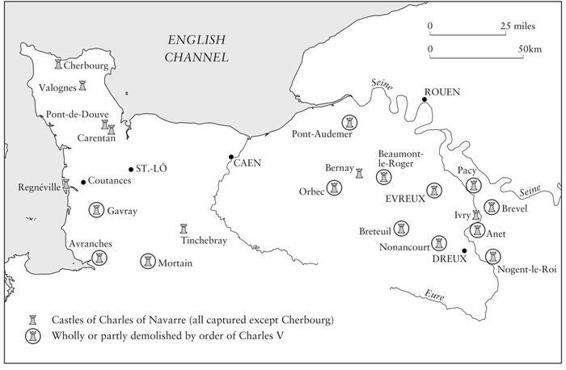
12 The conquest of the Navarrese castles of Normandy, April—June 1378
The pre-emptive strike against the Navarrese castles in Normandy had been improvised at very short notice and took some time to gather pace. Philip of Burgundy had to send to Dijon for his body armour and to borrow horses from the King’s stables. Initially he had no more than a few hundred men and a modest artillery train. He opened his campaign on 12 April 1378 at Breteuil, some twenty miles south of Evreux. Breteuil was the strongest of the group of Navarrese fortresses in eastern Normandy. The King of Navarre’s second son, Pierre, had taken refuge there with most of the officers of the King of Navarre’s French domains. Two other detachments of Philip’s army laid siege on the same day to the Navarrese headquarters at Evreux and the fortress of Beaumont-le-Roger. On 14 April it was the turn of Bernay. In spite of the oaths which had been sworn at Senlis, none of these places would comply with the prince of Navarre’s orders to surrender. But none of them resisted for very long. Some of the Navarrese troops were prepared to fight but by and large the King of Navarre’s Norman subjects were not. Evreux, which had never been a strong place, had already been abandoned by most of its defenders. Its Navarrese captain persuaded his companions to open their gates. At Bernay the basse cour of the castle surrendered as soon as the French arrived. The keep was defended by the King of Navarre’s secretary, Pierre du Tertre. He knew what fate would be in store for him if he fell into the French King’s hands. But he could not persuade the garrison to hold out. On 19 April, after the walls had been battered by trebuchets for two days, Bertrand du Guesclin arrived with reinforcements to mount an assault. The defenders sent Pierre out to parley with the French and then pulled up the drawbridge behind him so that he could not return. The garrison surrendered later that day. Pierre was arrested and sent to Paris to be delivered to the jailers of the Temple prison. The Constable and the Duke of Burgundy had promised to put in a good word for him and no doubt did so. But any inclination of Charles V to be merciful was quickly dispelled by the clerks who examined the contents of Pierre’s chests in the keep of Bernay. They included much of Charles of Navarre’s correspondence with his representatives in France over the past year, its meaning only lightly disguised by a crude code in which pseudonyms were substituted for proper names. Pierre du Tertre filled the gaps out in the cells of the Temple with an even fuller account of his master’s secret diplomacy than the earlier revelations of Jacques de Rue.
The resistance of the eastern group of Navarrese castles came to an end at the beginning of May 1378. Breteuil surrendered for cash on about the 3rd. Beaumont followed a few days later. The former Navarrese captain of Evreux came before the gate of Pacy and persuaded the garrison that further resistance was hopeless. They abandoned their posts without striking a blow. In the whole of the Seine valley the only place which continued to resist was Pont-Audemer, then an important river port. Pont-Audemer was blockaded from the south by garrisoned bastides constructed by the Admiral, Jean de Vienne, and from the river by four galleys of Monaco. Its Navarrese captain declared that as long as Charles of Navarre was alive he would surrender only on his personal instructions. But even he was not willing to chance his life for long. At the beginning of June the French brought up cannon against the walls and increased their strength around the town. The defenders surrendered on the 15th in return for pardons, three months’ wages in their pockets and safe-conducts to Cherbourg.50
In the Cotentin the French invasion began in the last week of April 1378. It was conducted by about 1,000 local troops recruited in Lower Normandy. The principal towns, Carentan, Valognes and Avranches, surrendered rapidly. They were all substantial places whose populations probably refused to defend them against a royal army. In most cases the King of Navarre’s captains in the citadels were bought off. The only resistance came at the smaller places whose garrisons were less dependent on popular support for their defence. The castle of Gavray, which housed Charles of Navarre’s Norman treasury, was defended by a garrison of just thirty-four men for nearly a month. The defenders sold the place at the end of May but only after its powder magazine had blown up and its food stores had been exhausted. By June only Mortain and Cherbourg still held out for the King of Navarre. Mortain was already under siege and preparations were in hand for an attack on Cherbourg.51
After four civil wars in a quarter of a century Charles V had resolved to be finished with Charles of Navarre. On 16 June 1378, as the campaign in the Seine valley was drawing to its close, the King presided at a public session of the Parlement of Paris, attended by the whole royal Council, many of the leading noblemen of the French court and representatives of the municipality of Paris, the usual chorus summoned to witness the great occasions of the French state. The notarised confessions of Jacques de Rue and Pierre du Tertre were read out to the assembled gathering. Copies were distributed among the crowd outside. The two men were brought in to acknowledge the truth of their contents. They were then condemned to be beheaded in the market of Les Halles and their dismembered bodies exhibited at the four principal gates of Paris.
As the King of Navarre’s ministers were taken to the scaffold the last Navarrese garrison to hold out against the French onslaught was coming to the end of its resistance. The defenders of Mortain sued for terms after artillery had been brought up and sappers had undermined the walls and towers. Of the twenty-one fortresses seized by royal forces, fourteen were wholly or partly demolished over the next two months and royal garrisons were put into the others. Ferrando d’Ayens, who had proved either unable or unwilling to procure the surrender of a single castle, was locked up in the citadel of Caen and then in Rouen castle where he appears to have passed the rest of his days.52
*
With his French domains facing extinction at the hands of Charles V and his Navarrese kingdom threatened with invasion from Castile, the King of Navarre was now in a desperate position. The military forces at his disposal were divided between Normandy and the Ebro frontier of Navarre, and were too weak to defend either. Charles’s nephew Charlot de Beaumont was sent into Gascony in April to recruit men among the routier companies. The companies of Bertucat d’Albret and several other Gascon captains, together with a handful of English and Aragonese, were hired for service on the Ebro front during the summer. Artillery was mounted on the walls of the principal towns and castles, the first time that it had been seen in Navarre. Emissaries were sent in all directions with appeals for help: to Aragon, to the Count of Foix, to the English council in Bordeaux. These were all powers with a natural interest in containing the overweening strength of Castile in the Iberian peninsula. But none of them was strong enough to save Navarre on its own. At the beginning of May 1378 Henry of Trastámara was reported to be marching north with substantial forces and a powerful siege train to join the Castilian troops already gathered on the Navarrese march. The King of Navarre and his councillors fled over the Pyrenees to the small town of Saint-Jean Pied-de-Port, where his dominions met those of the King of England and the Count of Foix. Here at least he was safe from capture and better able to follow the complex diplomatic traffic which he had set in motion.53
Charles of Navarre’s latest emissary to the English court, the lord of Garro, had arrived at Westminster in March 1378. Since he had left Navarre before the arrest of Jacques de Rue his instructions were already out of date. But even without instructions it must have been clear to him that unless the English intervened quickly his master’s domains in Normandy would be lost. The English Council knew that too. They drove a hard bargain. They offered to send supplies and reinforcements urgently to Cherbourg and to lend the impecunious King of Navarre 25,000 francs (about £4,200) to help him confront his enemies in Spain. They were also willing, although this would take longer, to send an army of 1,000 men to Gascony to be placed at Charles’s disposal for up to four months if the Castilians invaded Navarre. But they were not prepared to depend on the King of Navarre’s goodwill. The price of their help was the immediate transfer of Cherbourg to English control for a period of three years, together with any other Navarrese fortresses in Normandy that survived the French onslaught.
Cherbourg was a great prize. The walls of the town had been largely rebuilt in the 1360s. The immense wedge-shaped castle dominated the harbour from the eastern end of the town with its great keep, the twelve towers of the curtain wall, the lines of ditches and the cavernous stores, all just seventy miles by sea from England. It was one of the strongest places in western France. The lord of Garro appears to have agreed with the English proposals. But he could not commit Charles of Navarre without his authority. In about the middle of April, as the Duke of Burgundy’s officers negotiated the surrender of Evreux, Breteuil and Bernay, the lord of Garro left England for Navarre on a fast armed merchantman of Bayonne.54
It shortly became clear that there would not be time to wait for the King of Navarre’s answer. So the English Council resolved to take control of Cherbourg in any case. In this they were abetted by the Navarrese captain of the town, Ramón de Esparza. His garrison was too small to defend the place against a large French army even with the aid of the refugees flooding in from other Navarrese castles in Normandy. His stores were also perilously low. At the end of April 1378, shortly after the lord of Garro’s departure, Ramón sent one of his lieutenants to England to plead for help. The Council were only too pleased to take the opportunity of putting their own troops into Cherbourg. Sir William Farringdon, a knight of the royal household, and Garcie-Arnaud de Salies, the former English ambassador to Navarre, were sent to the town on a fact-finding mission and returned, accompanied by Ramón himself, towards the end of May. While Ramón toured the apothecaries of London buying sulphur and saltpetre to replenish his stores of gunpowder, Farringdon and Garcie-Arnaud set about recruiting troops.55
On 1 June 1378 a Great Council gathered at Westminster. The situation before them was very different from the one which they had contemplated when their plans were first laid earlier in the year. The Earl of Arundel’s fleet was still idle in its ports. The Duke of Lancaster’s ‘great expedition’ had been delayed by shortage of shipping. The Admirals had been able to requisition a total of 211 transports, which were scattered between half a dozen ports from Norfolk to Devon. But it was not enough to carry John of Gaunt’s army to Brest with its horses. Some of the ships were still without crews as press gangs struggled to fill their quotas from the reluctant youth of the east coast ports. There is no record of the deliberations of the Council, but the outcome is known from the stream of instructions which issued from the King’s ministers as soon as it dispersed. The Earl of Arundel was ordered to proceed with his operations against the French fleet immediately and then to take possession of Cherbourg. Troops to reinforce the town and castle would follow as soon as stores could be collected to support them. The landings at Brest were cancelled. Gaunt’s ‘great expedition’ was redirected against Saint-Malo in northern Brittany, an operation which would require fewer horses and therefore less shipping space. At the same time the Council proposed to try to occupy another ‘barbican’ further north, namely the small but strategically valuable fortified harbour of Le Crotoy, at the mouth of the Somme in Picardy. Le Crotoy was to be attacked by Sir Hugh Calveley with a raiding force from Calais, probably in conjunction with part of the English fleet. Sir John Neville was instructed to proceed urgently to Bordeaux to take up his lieutenancy and charged to support the defence of Navarre against Henry of Trastámara. Since only thirty-four ships could be spared to carry Neville’s men with their horses and stores, his retinue had to be reduced to about half the strength originally planned. Somehow or other he would have to find 1,000 men to send to the defence of Navarre when he got there.56
The Earl of Arundel and that veteran of past marine expeditions, William Montague, Earl of Salisbury, sailed from Southampton in the first few days of June 1378 with all the ships and men which were ready at Southampton. There were about 2,000 soldiers, carried on some eighty vessels. On about 7 June the English fleet entered the estuary of the Seine and appeared off the French naval base at Harfleur. Arundel landed at least part of his army near the town and began to try its landward defences. The French had no coast-guard system comparable to the one which operated in southern England. The old marshal, Mouton de Blainville, who was in command in Pays de Caux, was taken completely unawares with only 100 men-at-arms under his command. But he valiantly fought off Arundel’s force from the walls of Harfleur. With no siege equipment the English were unable to make any impression on the modern defences of the town. On about 21 June they retreated to their ships, pursued by sortie parties from the town which inflicted heavy casualties on the encumbered soldiers as they struggled through the water to clamber over the ships’ sides. From Harfleur, Arundel sailed westward across the great bay of the Seine towards Cherbourg. There Ramón de Esparza let them pass into the harbour and admitted them to the castle. A few days later a small squadron from Bayonne arrived, bringing the lord of Garro back from Navarre with Charles’s authority to agree to what had by now become a done deed. With him came Charles’s nephew Charlot de Beaumont and some Navarrese troops. On 27 June the Navarrese agents formally handed possession to the English King’s commissioners in the name of their master. The first English garrison troops arrived in the town shortly afterwards.57
Arundel had been lucky. It was only in the last few days of his cruise that he encountered any serious opposition at sea. The mobilisation of the French galleys and barges had been severely delayed. The oarsmen were in the process of mustering. The ships themselves were probably still in the covered halls of the arsenal at Rouen. The Castilians arrived in the Channel in about the middle of June and beached their ships at Saint-Malo, but they did not receive their orders until the end of the month. It was only at the very end of June that they caught up with part of Arundel’s fleet as it withdrew from Cherbourg. Early in August, as John of Gaunt completed the final preparations at Southampton for the departure of his armada and Neville mustered his men at Plymouth to sail for Bordeaux, the Castilian galleys descended on the west country. The English had expected them to attack the ports of embarkation and had called out the levies of the coastal counties to defend them. But the Castilians preferred booty and easy targets. They carefully avoided both ports. A number of landings occurred along the Dorset coast. But the brunt of the enemy’s attack fell on Cornwall. With almost all their ships and seamen pressed into the King’s service elsewhere, the Cornish harbours were wide open to the invader. Several of them were burned, including the important river port of Fowey. Others had to pay heavy ransoms to be spared the same fate.58
*
John of Gaunt’s army finally sailed from the Solent on about 10 August 1378 with some 5,000 troops on board and probably about the same number of seamen, in addition to pages and varlets, artillery and stores. Judging by the size of the fleet only a small part of this great host can have been mounted. When the English entered the great bay of Saint-Malo they achieved complete surprise. They boarded the merchant ships in the roads, pillaged their cargoes and burned the hulls. Then they landed on the eastern shore of the bay, took possession of the spit of land which linked the island town to the mainland and began to deploy their artillery against the walls. Saint-Malo was protected by modern ramparts and, at the eastern end facing the spit, by a powerful castle held by a large French garrison. At first the inhabitants panicked at the sight of such a large host and sued for terms. Then they recovered their nerve and broke off negotiations. On about 14 August the English delivered their first assault. They were thrown back with heavy losses. Several more assaults followed but all were unsuccessful. The English then set to work at the slow business of undermining the walls. Their mine was almost finished when a night-time sortie from the town destroyed it. Dissensions began to arise in the English camp. John of Gaunt fell out with the Earl of Arundel, whom he blamed for the disaster of the mine.59
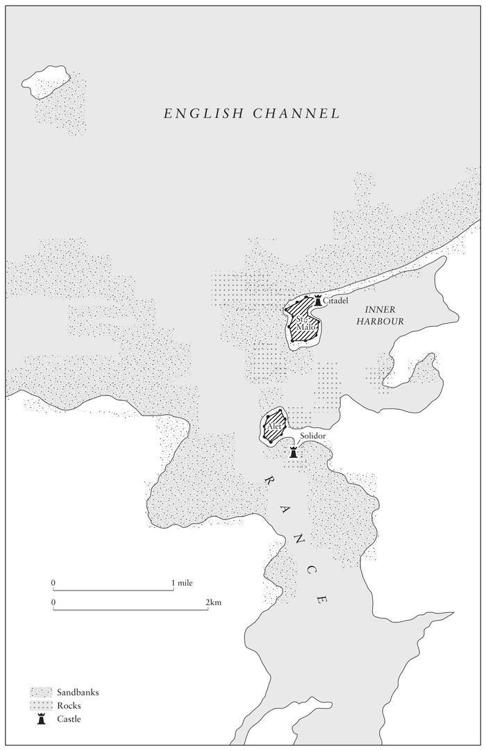
13 The assault on Saint-Malo, August—September 1378
For the first two weeks after their arrival the French did very little to interfere with John of Gaunt’s operations. The Castilian fleet was away burning the villages of Cornwall. The French galley fleet had by now been mobilised but has left no record of its deeds and was certainly not present at Saint-Malo. The Constable of France was with his army in the Cotentin, where the main thrust of the English attack had been expected to come. He was forced to bring his men hurriedly south to meet the new threat. On about 24 August Du Guesclin arrived at Dinan, at the head of the estuary south of Saint-Malo. He was joined there by Olivier de Clisson with more troops raised in Brittany itself. Their combined strength was about 1,500 men, about a third of the size of the English army. They occupied the south of the bay and sent mounted raiders across the sands at low tide to carry out raids in the English rear.
John of Gaunt now found himself severely hampered by the size of his own army, which was far too large for the operation in which it was engaged and required an enormous flow of supplies to maintain it. Foraging inland became exceptionally difficult once the Constable had occupied the shoreline opposite. The victuallers ferrying in supplies from the south of England and the Channel Islands were unable to keep up with the demand. Gaunt was running out of time. He had set out late in the season. The shipmasters would have to be back by the beginning of October to join the wine fleet for Bordeaux. In September the whole campaign was abandoned. Some retinues had already gone home, probably because of supply problems. The rest reboarded their ships in the middle of the month and sailed away. The planned attack on Le Crotoy was quietly abandoned. It was an anti-climactic end to the ‘great expedition’. The general view in England was that they had been defeated by ‘incompetence and inertia’. John of Gaunt, who had not only commanded the expedition, but played the leading role in planning it, received most of the blame. He never commanded an English army in France again.60
*
Once the English had withdrawn from Saint-Malo Charles V ordered the Constable to resume his operations against Cherbourg. This had by now become a much more formidable task. Between September and November 1378 the English poured men and supplies into the town. Fresh reinforcements from England during the autumn brought the peak strength of the garrison to 760 men. Twelve shiploads of victuals and supplies were brought in from Southampton. Vast amounts of wine, dried vegetables and salted meat and fish were accumulated in the castle’s stores. An armoury of crossbows and longbows was created with large stocks of spare bolts and arrows. A foundry was set up in the town which forged ten cannon, firing 15- or 24-inch stone balls and requiring great quantities of powder. Stocks of sulphur and saltpetre were laid in to make it, and piles of cut stone balls accumulated. The wine fleet returning from Bordeaux was diverted into the roads to hold off French attempts to seal off the town from the sea. At the beginning of November 1378 John of Arundel, the Earl’s brother, arrived to take command of the defence.61
Bertrand du Guesclin’s preparations were conceived on an equally impressive scale. The harbour of Saint-Vaast-la-Hougue and the town of Carentan became advanced depots, to which great quantities of war materials were shipped by sea or carted overland. At least twenty large cannon were ordered from foundries across Normandy. Great swathes of the forest of Montfort were felled to heat the furnaces. An army of craftsmen and labourers dragged them through the Cotentin and into position about the town. Massive mobile shelters made of timber were built to protect the assault parties. Between 17 and 20 November 1378 the French army mustered at Valognes. There is no reliable record of its strength but it must have been considerable, for the cost of their wages came to well over twice what the English had spent on occupying, supplying and defending the town since the summer. As at the siege of Saint-Sauveur the burden of financing the host fell on the communities of Lower Normandy, who had most to lose by the existence of an English garrison in their neighbourhood. They were relentlessly squeezed for cash grants, requisitioned materials and pressed labour.62
The French siege went badly from the start. The advance guard of the Constable’s army was ambushed as it approached the town and more than sixty men-at-arms captured, including his brother and his cousin. Du Guesclin eventually set up his headquarters in the ruins of the twelfth-century abbey of Notre-Dame du Voeu on the west side of the town, protected by lines of trenches and palisades. But repeated sorties from the town caused heavy losses and much damage to tents, shelters and equipment in the unprotected French encampments. The supply train failed within days. Food began to run out. The Constable was not used to failure. He lost his temper with Jean le Mercier, the official responsible for the supply organisation, who was abused as a ‘shit, a thief and a traitor’. In the first week of December the English garrison was reinforced by another 200 men. Hunger, bitter cold and high winds finally broke the morale of the besiegers. Less than three weeks after the start of the siege Du Guesclin suspended operations.
In the hope of at least containing the English garrison Du Guesclin fortified the abbey buildings of Notre-Dame du Voeu and left a garrison there under one of his lieutenants, Guillaume des Bordes. But the abbey’s improvised fortifications were weak and its garrison too small to hold its own against the powerful English force in the castle. Not long after the end of the siege Guillaume des Bordes abandoned it to the enemy and retreated to a line about fifteen miles south running across the Cotentin peninsula through Valognes and the abbey town of Montebourg. Immense works were undertaken in the new year to transform Montebourg into a garrisoned fortress to serve as his new headquarters. More than 1,000 French troops were assigned to him to hold it. But the new line proved to be little more defensible than the old. The garrison of Cherbourg was able to launch foraging raids deep into French-held territory with impunity. In July 1379 a French force of 500 men-at-arms and 600 crossbowmen tried to cut off John of Arundel’s successor Sir John Harleston as he returned from one of these raids with a thousand head of plundered cattle in his train. Although the French heavily outnumbered their enemy they suffered a costly defeat near Saint-Vaast-la-Hougue, with more than a hundred men killed and many more captured, including Guillaume des Bordes himself. Pitched battles were rare in this period and this one must have served as an unpleasant reminder of the devastating effect of massed longbowmen on men and horses. The French were forced to abandon Montebourg and withdraw their forces further south while the English garrison acquired practical control over most of the territory between Cherbourg and Carentan. As for Guillaume des Bordes, he was sold to the English government who gave him to Sir Thomas Felton as a contribution to the cost of his own ransom.63
Cherbourg became another frontier town like Calais, Brest or Berwick, whose main business was the service of a large military establishment and the trade in looted goods. At the time of the siege there was still a large number of Navarrese in the garrison as well as some of Charles of Navarre’s Norman retainers. But the Norman soldiers were ambivalent about the English occupation and almost all the Navarrese returned to Navarre with Charlot de Beaumont early in 1379. They were replaced by Englishmen, rubbing shoulders with a population that remained entirely French. Charles V commanded all his subjects in Cherbourg to withdraw after the arrival of the English or be treated as traitors. A few of them complied, adding to the number of empty shops and abandoned houses in what had once been a thriving commercial port, but most of the inhabitants had nowhere else to go. They stayed as long as they could still make a living. They reached an unheroic but workable compromise with the English captains. They received guarantees for their possessions and limited commercial privileges in England. They negotiated terms for the billeting of soldiers in their houses, always a delicate problem in garrison towns. They submitted to a modest duty on wine, which was certainly less onerous than the taxes they would have paid to the King of France. They did watch duties for the English captains just as they had done for Charles of Navarre.64
How much Cherbourg contributed to England’s war effort was a controversial question even at the time. The English government thought well enough of the place to hang on to it until 1394. It became a staging post for English naval operations in the Channel and a base for mounted raids into France. It also tied down French forces who would otherwise have been available for service on other fronts. But Cherbourg never fulfilled its promise as a point of entry into France any more than Brest did, in spite of being larger and closer to England. Its defence was extremely expensive. For the first eighteen months of the occupation the garrison was maintained at 560 men, more than twice the garrison of Brest. In addition to their wages there was the regular drain of money to pay for building works and repairs, victuals and equipment, most of which had to come from England, and for ships and crews which were constantly employed in ferrying goods and men to and fro across the Channel. In the first year after the end of the siege Cherbourg cost the English government about £10,000. Thereafter the garrison was reduced and the cost fell to about £8,000 a year until the end of 1382 when dramatic reductions were achieved by putting the captains onto fixed price contracts. The profits of Cherbourg went into the captains’ pockets. They must have made even larger profits than those of Brest, for the loot of the Atlantic sea lanes was just as plentiful and the Cotentin was a richer region than Finistère. Although there are no figures for profits at Brest their value can be judged from the fact that Sir Hugh Calveley, one of the shrewdest military entrepreneurs of his day, at one point agreed to take the Cherbourg contract at 5,700 marks (£3,800) a year, less than half what the government had been paying to defend the town. In 1386, after complaints in Parliament about the cost of England’s continental barbicans, it was successfully let at just £2,000 a year. As at Brest these contracts were essentially financial transactions. The prominent public figures who obtained them rarely if ever commanded the defence in person. They took the profits, sometimes paid their men and performed their duties through deputies.65
*
Sir John Neville’s fleet, carrying the new Lieutenant, 560 English troops and £6,000 in cash, arrived off Bordeaux on 7 September 1378 as the bells of the city’s churches were ringing for vespers. Neville found the duchy in a state of exhausted stalemate. Since the capture of Sir Thomas Felton a year before, the King’s affairs in Bordeaux had been in the hands of a caretaker administration in which the leading figure was the acting Seneschal, Sir Matthew Gournay. Gournay was a professional soldier with more than thirty years’ experience of fighting in France who had been at every great battle of the previous reign from Sluys to Nájera. Since his main centre of operations was the southern city of Dax his direction of business must have been remote. But there was in any event very little for the administration to do. Much of its staff had been laid off for want of funds. Military expenditure was reduced to keeping skeleton garrisons in a handful of walled towns and paying modest subsidies to help the territorial lords of the Bordelais to defend their own. The few military operations undertaken by the Anglo-Gascons had been essentially private enterprises, funded by loot. The citizens of Bordeaux, who had been told that the government could do nothing for them, were obliged to organise their own defence. They did it with verve and some success. At the end of June 1378 they had launched a remarkable campaign of their own against the French garrisons along the Garonne which resulted in the recovery of the fortress-town of Langon. Further east a group of lords of the Agenais led by Gaillard de Durfort, lord of Duras, even reoccupied the cathedral city of Bazas.66
Gascony owed its survival mainly to the distractions of the Duke of Anjou. He had professed since the end of the previous year to be planning the great campaign that would achieve the ‘final conquest of the duchy of Guienne’ and had obtained unusually generous grants of taxation with which to fund it. But it is clear that Anjou had lost interest in Gascony. Much of the summer of 1378 had been taken up with the Duke’s latest plan for acquiring a kingdom for himself, a quixotic design to seize the Aragonese territory of Mallorca and make himself its King. There is no evidence of any serious preparation for a campaign in Gascony until July. It is unlikely in the circumstances that his army was particularly strong and his progress was certainly exceptionally slow. His intention, according to reports reaching Bordeaux, was to lay siege to the city. This operation would have called for a fleet to blockade the Gironde and a very elaborate supply operation, no easy task in the difficult conditions of Languedoc that summer. At the beginning of August Anjou opened his campaign at La Réole. Then instead of marching towards Bordeaux he turned aside to recapture Bazas, a place of secondary importance whose defenders resisted for about three weeks and then sold out. By the time Bazas fell Neville was in Bordeaux. Neville’s army may have been too small to challenge the Duke in the field. But it represented a substantial garrison for a city with a modern circuit of walls and direct access to the sea. In about the middle of September Anjou abandoned his campaign and withdrew to Toulouse.67
Like the Earl of Derby in 1345 and the Black Prince in 1355 Neville resolved to make an impression on the French before they had time to concentrate their strength against him. North of Bordeaux, on the opposite shore of the Gironde, the French Marshal Louis of Sancerre was engaged in the siege of the coastal fortress of Mortagne. This place had been a thorn in the side of the French administration in Saintonge and a major source of disruption on its roads ever since the French had reoccupied the province in 1372. Apart from the cliff-top castle of Talmont, a little further north, it was the last foothold of the English on the north shore of the estuary. The place was defended by just forty men-at-arms commanded by its owner, the Soudan de Trau, ‘one of the world’s most valiant knights’ according to a sound judge, and now the only notable English ally left in Saintonge. Neville resolved to mark his arrival in the duchy by breaking the siege. Within two weeks of disembarking he had doubled the size of his army by drawing on the handful of English troops serving in garrisons in the Bordelais, on the retinues of the Gascon nobility and the corps of crossbowmen hired by the city of Bordeaux. A fleet of more than fifty vessels was collected from ships waiting for the vintage in the Garonne ports. In the last week of September 1378 Neville sailed north down the Gironde. In spite of the scale of his preparations his arrival seems to have taken the besiegers of Mortagne by surprise. They abandoned their bastides around the town and melted into the countryside. Some of them fled to a nearby priory and took refuge in a fortified tower. The English destroyed the bastides and stormed the priory. Neville then led his men back across the estuary and conducted a sweep of the French garrisons in the Médoc north of Bordeaux, capturing them all one after the other.68
The relief of Mortagne made a considerable impression on the Gascon nobility, especially in Saintonge where ambitious men had written off the English since the disasters of 1377. Shortly after the relief of Mortagne Raymond de Montaut, lord of Mussidan and Blaye, who had defected to the French after the battle of Eymet, returned to his old allegiance bringing both of his principal lordships with him. Raymond had always said that his original defection was forced on him by threats to his life. But there is little doubt that his real reasons for doing a deal with Neville were the revival of English arms on the right bank of the Gironde, where his interests were concentrated, and the enormous bribe (more than £1,000 sterling) which the Seneschal paid to bring him and his many kinsmen and clients back to the English side.69
The struggle for Mortagne was famous for another reason. It was the occasion for the death of one of the best-known soldiers of fortune in French service, Owen of Wales, who was assassinated by an agent of the Council in Bordeaux in early September. The assassin was an impecunious Scottish squire by the name of John Lamb, who had been planted by the English in Owen’s company in the early stages of the siege. He stabbed Owen in the back as he sat on a tree trunk combing his locks in the early morning sun. This unchivalrous proceeding was much criticised by the flamboyant Welshman’s many admirers in France, including the chronicler Froissart and the Soudan de Trau. But Neville had no time for this kind of sentiment. Owen was a traitor whose activities in France and Castile and in Wales itself had been followed with fear and anger in England. He rewarded Lamb handsomely and sent him back to England to tell his tale in person to the young King. Owen was laid to rest by his companions in a nearby chapel which has long since vanished. The Welsh companies, however, did not vanish as they had perhaps been expected to. They were taken over by Owen’s companion-in-arms Jack Wyn, who had probably always been the main organising force. Wyn died in about 1385. But the Welsh companies continued to fight as an organised corps in French service until the 1390s. Owen’s memory lived on and when, at the beginning of the next century, a far more terrible Welsh leader arose to challenge the English with French support, he claimed to have been inspired by his example.70
*
The main purpose of Sir John Neville’s presence in Gascony was to organise an expedition to prop up the kingdom of Navarre. But by the time he reached the duchy the Castilian invasion was already in its third month and Charles of Navarre’s affairs had come to a critical pass. Henry of Trastámara, who was in declining health, had left the conduct of the campaign to his eldest son John, a delicate young man of twenty now exercising his first military command. In June 1378 John had reached the western march of Navarre with about 4,000 cavalry and a large number of infantry and archers. The King of Navarre was bereft of allies. He was on bad terms with his neighbour and brother-in-law the Count of Foix. The English had not yet appeared. The King of Aragon would do nothing without an English lead and a reasonable assurance of success. At about the beginning of July 1378, the Castilians crossed the frontier of Navarre.71 Charles of Navarre was able to muster about 1,450 men in his kingdom. In addition he had about 500 Gascon, Béarnais and Catalan mercenaries in his pay, about half the number who had contracted to serve him earlier in the year. The rest had taken their advances and sent their excuses when the time came. In the first week of July Charles still hoped to make a stand at the royal castle of Olite south of Pamplona, where most of his army was concentrated. But at the last moment the King changed his mind and decided to spread the available manpower thinly among a large number of garrisons with a few larger contingents in the main towns. He himself retreated north to Pamplona. In the last week of July 1378, as the Castilians closed in around his capital, Charles abandoned the defence to Roger-Bernard of Foix, Viscount of Castelbon, the mercenary captain who served the unmilitary King as his ‘lieutenant in time of war’. Taking with him his principal advisers and a small escort, he fled north across the Pyrenees. For the next four months he lived at Saint-Jean-Pied-de-Port while the Castilians occupied most of the southern and western part of his kingdom. The only determined resistance which is recorded occurred at Estella and Pamplona, where predominantly Gascon garrisons, supported by some English archers and Gascon crossbowmen hired in Bordeaux, fought off the Castilians from the walls.72
The Castilians spread out across the plain of Navarre, seizing walled towns and castles, destroying villages, barns and crops. It was the first time for half a century that the country had suffered systematic looting and destruction on the scale of which a great army was capable. In the province of Estella, one of the most fertile regions of Navarre which accounted for nearly a quarter of its taxable wealth, the peasants’ stories are told in the reports of the tax collectors who passed from village to village after the invaders had gone. Out of nearly 200 parishes all but ten were unable to pay and had to have their assessments reduced by amounts which varied from twenty to a hundred per cent. The accounts explain why in the usual laconic phrases: ‘destroyed by war’, ‘nothing to eat’, ‘all their goods carried off’, ‘everything lost’. The country around Pamplona fared even worse. More than thirty suburban villages were razed by the invaders. Some of those who took their animals and goods into nearby castles for safety lost everything when the castles were stormed. Only the mountains of the north offered any refuge.73
14 Campaigns in Navarre, June 1378—March 1379
The new English Lieutenant in Gascony was preoccupied by the problems of the duchy for some time after his arrival. As a result Navarre received very little attention until late October, when Charles turned up in person in Bordeaux to press his case. The dire state of his fortunes must have been obvious from his appearance. He had lost all his horses on the journey across the Landes. He was obliged to send his secretary to borrow money about the city. Neville did what he could to help but he was unable to spare more than 400 of the 1,000 men who had been promised to the Navarrese ambassadors at Westminster. The man appointed to command them was the erstwhile defender of Saint-Sauveur Sir Thomas Trivet, a resourceful captain with a sharp eye for the chance of enrichment, who had accompanied Neville from England. Trivet’s task was to escort the King of Navarre back to Pamplona before the Pyrenean passes were blocked with winter snow and to help break the Castilian siege which was still in progress there. It was agreed in Bordeaux that when he had done this he would take command of the great border fortress of Tudela on the Ebro. The choice of Tudela as Trivet’s base was probably dictated by its close proximity to the Aragonese frontier. Peter IV of Aragon was building up his own forces in the region and Charles of Navarre is likely to have known this. Neville plainly hoped to make up for the small size of Trivet’s army by enlisting Aragonese support for an attack on Castile. Early in November an embassy departed for Barcelona, led by Geraud de Menta, a Gascon lawyer on the Lieutenant’s council who was regarded as the duchy’s principal expert on Spanish affairs.74
Sir Thomas Trivet must have left Bordeaux in the last week of October 1378. He led a motley company south across the windswept Landes. In about the middle of November he joined the King of Navarre at Saint-Jean-Pied-de-Port. From there they filed south through the pass of Roncevalles. But when they descended into the plain of Pamplona they found that the Castilians had gone. The Trastámarans had learned to be wary of fighting pitched battles against English armies, even with the advantage of numbers. It is probable that they had also received exaggerated reports of Trivet’s strength. There were some among John of Trastámara’s advisers who feared that they would look like cowards if they did not stand and fight. But they were in the minority. John of Trastámara retreated to Logroño and paid off his army for the winter, leaving garrisons behind in the more important conquered towns of Navarre. He expected to be back in the spring.75
The King of Navarre returned to his capital at the beginning of December 1378 and set about the work of reconstruction. A hastily convened assembly of the Navarrese Cortes granted him a war subsidy of 60,000 florins (about £8,500), the largest single grant that Charles’s small kingdom had ever made and well beyond the population’s capacity to pay in the current state of the country. His mercenary companies ate up his available funds without having very much to do now that the enemy had withdrawn. After resting at Pamplona, most of the Gascon companies were assigned to garrison duties. On about 11 December 1378 the rest marched out of Pamplona with the King, the Viscount of Castelbon and Sir Thomas Trivet. The whole force must have numbered between 800 and 1,000 men including about 400 Englishmen. In about the middle of December they crossed the great thirteenth-century bridge over the Ebro and entered the fortress city of Tudela.76
Tudela was the second city of Navarre. A population of about eight or nine thousand people, Christian, Jewish and Muslim, was crammed into a maze of brick streets on the south bank of the Ebro, surrounded by high walls and heavily fortified gateways and overlooked by the great royal castle crowning the hill on which the town was built. The city was the capital of the southernmost of Navarre’s merindades (or provinces), a salient which extended south of the river across the flat plain towards the sierras of northern Castile. Bounded on one side by the kingdom of Aragon and on the other by Castile, it was at once the wealthiest and the most vulnerable part of Charles of Navarre’s kingdom. Trivet was assigned the castle of Tudela itself while the Viscount of Castelbon took his own company and part of Trivet’s and garrisoned the important fortress of Cascante about five miles away on the Aragonese border. The Catalan soldier of fortune Raymond de Pailhas installed himself in the castles of Corella and Cintruénigo on the River Alhama which marked the border with Castile.77
Trivet was restless for action and, no doubt, for loot. On Christmas Eve he rode out of Tudela with both his fellow captains and about 300 mounted men. Their objective was the Castilian town of Soria, some sixty miles away by the headwaters of the Duero, which was (and is) the nodal point of the road system of the region. The raiders had reckoned without the treacherous climate of northern Spain. They left the plain of Tudela in weather so warm that it was possible to eat outside in the winter sun. But as they rode up into the sierras the temperature dropped. Trivet decided to ride through the night to surprise Soria in the morning but he was caught in a snowstorm. His guides lost their way. His men were scattered over a considerable distance. By the time they reached the town, late on Christmas morning, the defenders were ready for them. There was a violent skirmish at the gates in which both sides suffered casualties. The invaders, seeing that they had lost the advantage of surprise, withdrew and arrived exhausted at Cascante on the following day. Charles of Navarre was there to welcome and congratulate them but apart from the burning of some Castilian border towns Trivet had achieved nothing. His next venture, a few days later, was hardly more successful. The objective this time was closer at hand, the small town of Alfaro on the Ebro, just beyond the border. Trivet drew the garrison out of their gates into an ambush and killed and captured a large number of them. But the women of the town succeeded in closing the gates before he could force his way in. Once again he returned empty-handed to Tudela.78
In Barcelona the English embassy had arrived in about the middle of December. The King of Aragon, who had been expecting Neville himself, was unimpressed by Geraud de Menta’s appeal for armed support. The small scale of England’s military intervention so far cannot have helped. In any event the immediate threat to Navarre had passed with the withdrawal of the Castilians for the winter. Peter said that he would consider the English request again in May. At the beginning of January 1379 Charles of Navarre sent the Viscount of Castelbon and several members of his Council to Barcelona to intercede with Peter. They brought with them proposals which would have been attractive at any other time. But they fared no better than Geraud de Menta.79
On 12 February 1379 Henry of Trastámara announced his intention of sending his son back into Navarre in the spring. His army was ordered to appear at Logroño in April. At this the King of Navarre resolved to abandon the fight. He sent a messenger to the Castilian King to ask for terms. He was accorded a truce of six weeks for talks. The negotiations were conducted at Burgos in the course of March. Charles of Navarre’s principal representative was Juan Ramírez de Arellano. He was a prominent figure at Charles of Navarre’s court, who had spread his loyalty widely in the course of his long career. He had commanded Navarrese armies in France and served the English as a contract captain in Brittany. He was also in high favour with Henry of Trastámara, having fought for him in the Castilian war of succession. But however warm Ramírez’s welcome at Burgos he could do nothing to disguise his master’s nakedness. Henry’s terms were a terrible humiliation for the defeated King of Navarre. The Castilian King was determined that Navarre should be disabled as a political power. Charles was required to enter into a military alliance with Castile and France against every other power, ‘especially the King of England’. As security for his good behaviour he was to surrender twenty of the principal fortresses of southern Navarre, including Tudela, for ten years. Estella was to be surrendered to Ramírez himself and held on behalf of both kings. All of these places were to receive Castilian garrisons. These measures effectively put Charles of Navarre at the mercy of Castile and France if ever he should threaten the security of either country again. The terms required Charles to expel the English and Gascon companies from Navarre as soon as possible. Henry of Trastámara lent Charles 20,000 doblas in order to pay their arrears and speed them on their way. On 31 March 1379 the plenipotentiaries of the two kings sealed the treaty containing these terms in the village of Briones on the Ebro, close to the Navarrese border. On 18 April the King of Navarre came to Tudela to complete the formalities and to engage in the skin-deep expressions of goodwill which were expected of defeated princes on such occasions as these. John of Trastámara escorted him from the frontier to the Castilian pilgrimage town of Santo Domingo de la Calzada where his father was staying. There the two men ratified the treaty and feasted together for a week.80
For the English the treaty of Briones was a serious strategic setback. It meant that for as long as the Anglo-Castilian war continued the only practicable route by which they could attack Castile overland was closed to them, while the Castilians were in a position to enter Gascony across the Pyrenean passes at will. Charles’s English and Gascon captains were furious. Trivet had begun to raid in Navarrese territory around Tudela as soon as the preliminary truce was announced. He challenged the Castilian governor of Logroño to an arranged battle with 100 men on each side. He even made contact with Peter IV of Aragon in the hope of continuing the war under his auspices. But Peter had no intention of provoking the rampant lion in its moment of triumph and refused. So Trivet withdrew from Tudela in May and hung about the treasury offices in Pamplona while his accounts were settled. By July 1379 he was back in Bordeaux.81
The treaty, one of Henry of Trastámara finest moments, was also his last great public act. Although only forty-six years old, Henry was worn out by a lifetime of fighting and hardship. Shortly after the feasting at Santo Domingo he fell ill and on 28 May 1379 he died. With his dying breath he ordered the release of all his English and other Christian prisoners of war and urged his son to ‘be for ever loyal to the house of France’. Charles of Navarre still had eight years to live but the treaty of Briones marked the end of his political career. He had retained his crown. But he had lost almost everything else: Cherbourg to the English and the rest of his Norman domains to the King of France. Navarre was economically ruined for a generation and his control over it had to be shared with the officers of the King of Castile. His heir was a pensioner of France, living in Paris and fighting in French armies. Charles felt the loss of status keenly. He became increasingly bitter about it, dreaming impossible dreams of murder and revenge and even, in brief moments of anger, returning to his old conspiratorial ways. In January 1387 he died prematurely, aged fifty-five, when a servant accidentally set fire to his bed with a candle. ‘I have few friends in France and many enemies,’ he had said a few years earlier to a passing English musician who played for him at dinner in the hall of the castle at Olite. ‘Some of my enemies are your enemies too,’ he added; ‘for I have had a great deal to do with the English in my time and lost much of what I had on their account.’82
*
On 27 March 1378 Pope Gregory XI died in the Vatican palace in Rome just fourteen months after arriving in the city from Avignon. He was buried on the following day in the church of S. Maria Nuova (now S. Francesca Romana) in the Forum where, two centuries later, a grandiose marble tomb would be erected to honour the Pope who brought the papacy back to Rome. Gregory’s death precipitated a major crisis in the affairs of the Latin Church which was destined to have a profound effect on all the participants in the European war. The return of the papacy had been a very personal ambition of the Pope’s. But in the course of the fourteenth century the power of the college of cardinals had immeasurably increased and they had appropriated a growing proportion of the papacy’s resources. Overwhelmingly French, richly endowed and comfortably installed in palaces at Avignon and Villeneuve, the cardinals had never shown the same interest in returning to Italy. After more than seventy years in France the rest of the papal court was as French as the college of cardinals. The ruinous condition of Rome, the disorders of central Italy and the dying spasms of the war with Florence all combined to accentuate their insecurity. The Romans knew as well as anyone that when the cardinals met to elect Gregory’s successor there would be a strong movement to find a candidate who would lead them back to France.
On 7 April 1378 the cardinals entered the conclave in the Vatican. There were sixteen cardinals present, of whom eleven were French. The preponderance of Frenchmen would have been even greater if seven cardinals, all of them French, had not been away, either in Avignon or on diplomatic business. The French cardinals in Rome could have carried the day without their absent colleagues if they had been united behind a single candidate. But they were not. The seven ‘Limousin’ cardinals, who were either related to the last two popes or came from the same region of France, formed a faction within the French group which was bent on the election of one of their own number and succeeded in alienating the rest. A two-thirds majority was required. No one faction had a sufficient majority. These differences had to be resolved in exceptionally difficult conditions. Ever since the announcement of Gregory’s death the streets of the borgo around St. Peter’s had been filled with roving mobs of armed men, their numbers swollen by peasants from the surrounding Campagna, baying for a Roman or at least an Italian pope. The city authorities, who were responsible for the security of the conclave, said that they could not guarantee to maintain public order unless they got their way. As the doors to the conclave were being sealed the Roman mob broke into the Vatican palace and occupied the chambers beside and beneath the conclave, shouting and beating on the walls and floors throughout the night and the following day. On 8 April the cardinals lighted upon a compromise candidate, Bartolomeo Prignano, Archbishop of Bari. As the conclave ended the crowd finally broke down the doors of the conclave and the proceedings lost their last shreds of dignity. A group of cardinals took it into their heads to placate them by seizing an aged Roman cardinal and presenting him to the Romans with the tiara on his head and the papal robes thrown over his shoulders while their colleagues fled in the confusion.83
Over the following years several careful investigations by national governments and other bodies failed to produce a conclusive answer to the question whether Prignano was lawfully elected. But most of the evidence suggests that he was. He had been identified as a suitable candidate with some support among all factions several days before the conclave in the course of preliminary discussions among the cardinals. The atmosphere of the conclave, although certainly intimidating, does not seem to have had a decisive effect on the electors. The worst scenes of violence occurred after Prignano had been chosen. The cardinals participated in his enthronement, ten days after the conclave, and later put their seals to the letters which announced his election to the world. The main reason for the crisis which followed was not the manner of the new Pope’s election but his rebarbative personality.
Bartolomeo Prignano, who took the name Urban VI, was a Neapolitan canon lawyer of humble origins, then aged about sixty, who had been a senior official of the papal chancery for many years. He was an able administrator and a learned man of irreproachable morals who was known to all the cardinals but not well enough to have made enemies among them. They may well have thought that he would be easily dominated. If so they were quickly disabused. Prignano had not been a cardinal and within a very short time of his election it became apparent that he strongly disapproved of the cardinals’ magnificent way of life, their grand palaces, their trains of attendants and courtiers and their princely incomes. There were plenty of people who could have been found to support his views in Rome and elsewhere. But Urban was not one to choose his time or his language. He was a squat, rude man with a loud voice and a foul temper. He addressed those who stood in his way with ‘a face red as a lamp and a voice hoarse with rage’, according to a curial official who had often witnessed such scenes.84 From the moment he was crowned Urban made his views about the cardinals known in a succession of venomous outbursts in private, in consistory and in his public sermons. These were accompanied by overt threats to curb their privileges. The natural resentment of the aristocratic French cardinals was aggravated by their ill-concealed contempt for the undignified bearing and crude manner of the jumped-up Italian official whom they had elected. But there was much more to the cardinals’ resentment than snobbery and defensiveness. Urban VI was in fact wholly unfit to govern the Church. He lost no time in making enemies not only among the French cardinals but among their Italian colleagues, the princes of Europe, their ambassadors in Rome, numerous bishops, and influential figures of all nationalities in the papal administration. His impulsiveness and lack of self-control, his ignorance of affairs and his impatience of advice, all of which were revealed within days of his enthronement, would lead him and his supporters to the brink of disaster more than once in the course of his twelve-year reign.
The cardinals shortly concluded that they had made a serious mistake. The prime mover in the events which followed appears to have been Jean de la Grange, Cardinal of Amiens, a pensioner and former councillor of Charles V of France, whose princely manner was imposing even by the standards of his colleagues. He had been in Tuscany at the time of Gregory’s death and reached Rome about a fortnight after the election. According to the evidence later collected for the King of Castile, La Grange was irritated that his colleagues had not been able to procure the election of a Frenchman.85 He also found himself almost immediately embroiled in a series of bruising arguments with the new Pope, in whose eyes he represented everything that was worst in the college of cardinals. La Grange’s palace in Trastevere became the meeting place of ambitious clerics and soldiers with whom he floated the idea of declaring the decision of the previous conclave void and proceeding to a fresh election. One by one the cardinals left Rome over the following weeks and repaired to the small town of Anagni east of the city, where they installed themselves in the old palace built at the end of the thirteenth century by the last Pope to reign in Italy. On 2 August 1378 the twelve French cardinals in Italy and the Cardinal of Aragon issued a declaration from Anagni calling on Urban to abdicate. This was followed by an inflammatory manifesto and a circular addressed to the princes of Europe, denouncing Urban as ‘antichrist, demon, apostate and tyrant’ and declaring his election void on the only ground known to canon law, namely that it had been imposed on them by force. In the next six weeks they were joined by three of the four Italian cardinals.
The decisive consideration now was the attitude of the King of France. Charles V did not receive a full account of the cardinals’ position until August, when an emissary arrived in Paris from Italy. He gave the King their version, suitably embellished, of the circumstances in which Urban had been elected in April. He was followed within a few days by two more emissaries from Anagni. Their instructions were to tell the King that the cardinals proposed to repudiate Urban and proceed to another election. They needed to know whether he would support them. Charles V, who had previously been inclined to temporise, was now forced to a decision. His relations with the French cardinals were close. As he himself acknowledged, ‘he had many friends among them, several of whom had been his ministers and others his pensioners.’ His brother Louis of Anjou was a determined and avowed partisan of the cardinals. Before August was out Charles V had resolved to support them in their defiance of the Pope. The decision was not made public. But it was communicated to them in a private letter written in the King’s own hand. At the same time the French King arranged for 20,000 francs to be sent to Italy for the cardinals’ physical protection and ordered the Breton companies quartered in the papal state to be ready to go to their assistance if they were needed. Charles cannot have known, any more than the cardinals did, that they were starting a schism that would last for forty years. These men were concerned only with the immediate issue. They thought that Urban VI would quickly be ousted from Rome and his election expunged as the mistake which it undoubtedly was.86
In late August 1378 Urban VI fell out with Jeanne of Anjou, Queen of Naples, his only important protector in Italy apart from the people of Rome. She transferred her support to the cardinals, who left Anagni for the small cathedral town of Fondi at the southern extremity of Latium close to the boundaries of her kingdom. Events then moved rapidly. On 18 September 1378 Urban VI appointed twenty-nine new cardinals, twenty of whom were Italian. It was a decisive shift in the balance of the papal court. On the same day the King of France’s letter reached Fondi. Two days later, on the 20th, the dissident cardinals, French, Italian and Aragonese, held a new conclave in the palace of the Counts of Fondi. Their choice fell on Robert, Cardinal of Geneva, a man as different from Bartolomeo Prignano as it was possible to be. A bishop at nineteen and a cardinal at twenty-nine he had made a charmed progress through the ranks of the Church. He was still only thirty-six years old at the time of his election. To the world at large he was notorious as the papal legate in the Romagna who had been one of the chief authors of the massacre of the population of Cesena. But it is not difficult to see why the cardinals should have chosen this supremely political priest at this crisis of their affairs. Robert was an intelligent diplomat with a commanding presence and an excellent grasp of languages. He could be expected to sympathise with the aspirations of the French cardinals and to outmanoeuvre Urban VI in the royal courts of Europe, especially that of France. Indeed there is some evidence that the choice had been made much earlier and discussed with Charles V in August.87 On 31 October 1378 Robert was enthroned in Fondi cathedral. He took the name Clement VII.
Once the cardinals had taken the irrevocable step of electing a second pope the issue necessarily moved to the international stage, where decisions were guided by the political interests of the main actors. There was never any real doubt about the outcome in England, where scarcely a single voice was raised in favour of Clement VII. The visible and powerful position which the French government and its representatives had enjoyed for decades at the papal court in Avignon was notorious in England. It was widely assumed that the cardinals had turned against Urban because he was not French. There were even reports that they had fallen out with him because of his sympathy for England. He was said to have criticised the diplomatic activities of the Cardinal of Amiens at the conference of Bruges, where he had been one of Charles V’s ambassadors. These were fanciful notions and Richard II’s ministers no doubt knew better. But the end of the French domination of the papacy after three-quarters of a century can only have been welcome to them. Their discussions are not recorded but their actions speak for themselves. In October a prominent Gascon clergyman who had once served in the administration of the Black Prince, arrived in England as the official emissary of the cardinals of Fondi. This man was well-placed to get a hearing if anyone was but he was arrested by the sheriffs of London and sent under guard to appear before the Council, who had him locked up in Gloucester castle. His attendants were thrown into Newgate prison. The English bishops declared without hesitation for Urban. Parliament, which was then in session, endorsed their decision and the government proceeded to enforce it not only in England but in those parts of France which it controlled.88
Charles V had a more difficult task. Opinion about the merits of the issue was much more sharply divided in France than it was in England. A group of bishops and scholars whom the King had consulted in September, before the second election, declared the question of Urban’s legitimacy to be ‘moult haulte, perilleuse et doubteuse’ and declined to express a view until the facts were better known. Very few of them knew how far their King had already committed himself to Clement VII. As time went on the Urbanist version of the events of April 1378 began to circulate in France and the cardinals’ case began to look somewhat threadbare. The University of Paris reported that its members and faculties were unable to agree. Its internal debates probably mirrored those of the rest of the clergy. Most Frenchmen who had an opinion on the subject appear to have assumed that Urban VI was the true pope, nine out of ten according to reports reaching his rival from Avignon. ‘Misguided they may be,’ wrote Clement’s informant, ‘but this Bartholomew has a lot of supporters.’ On 16 November 1378 an enlarged session of the royal Council met in the King’s presence at the castle of Vincennes, to which the King invited selected churchmen. Charles no doubt made his wishes clear. The outcome was the formal recognition of Clement as Pope and an order to publish his election in all French churches. The decision was said to have been unanimous, but not everyone was convinced. In the following year it was necessary to convene a much larger assembly at the Louvre at which no fewer than three Clementist cardinals related their experiences during the conclave of April 1378. It was one of those tremendous public occasions at which Charles V and his ministers were so adept: superbly stage-managed before a carefully selected audience. Among the noblemen, prelates and lawyers present, there was an impressive show of unity. The churchmen ‘shared the King’s opinion’, a contemporary recorded, ‘for fear of losing their benefices’. The assembly was followed by grandiose ceremonies in front of Notre-Dame cathedral in which Clement was declared to be the true Pope and all who declined to acknowledge him condemned as schismatics.89
Charles V denied that political calculation had anything to do with these decisions. He would have supported any properly elected candidate, he said, ‘even an Englishman’. It is probably true that he was persuaded by his friends in the college of cardinals that their hand had been forced when they elected Urban VI. He may even have believed that this would be as obvious to everyone else as it was to him. But he cannot have overlooked the great diplomatic advantages which he and his predecessors had derived from their close relationship with the six French popes who had reigned at Avignon. Certainly his brothers and ministers did not. The timing of the conference at Vincennes was largely dictated by the need to bolster Clement’s position internationally. England’s support for Urban was a foregone conclusion. So was that of Rome and much of Italy. The German Emperor, Charles IV, had declared for Urban a month earlier. He was followed by the great majority of the lay and ecclesiastical princes of Germany. No one had yet declared for the French Pope apart from France and the Angevin kingdom of Naples. Unless action was taken quickly it would be too late. As soon as the Council had dispersed ambassadors were despatched to every country in which France might be thought to have any influence in order to press Clement’s case.90
Clement VII’s problem was that to establish himself as the undisputed head of the Church he had to snuff out his rival’s cause in Italy. In particular he had to extinguish it in Rome. This proved to be Clement’s earliest and most damaging failure. He depended entirely on force. The Castel Sant’ Angelo had been held since the death of the last Pope by a French nobleman with a largely Breton garrison. Their frequent sorties and artillery fire from the walls had made the Vatican borgo uninhabitable. A steady flow of funds from the King of France and the Duke of Anjou enabled Clement to recruit heavily among the Gascon and Breton companies in central Italy at the beginning of 1379. In April Clement increased his dependence on French arms still further by entering into a secret deal with the agents of the Duke of Anjou of which even the cardinals were unaware. Under the terms of this agreement Louis agreed to enter Italy with a large French army to expel Urban from Rome and install Clement in his place. In return Louis’s long-standing dream of a kingdom of his own was to be gratified by the creation of the ‘Kingdom of Adria’, a new central Italian state which was to be carved out of the northern and eastern provinces of the papal state.91
In the event there would be no time for these plans to mature. On 30 April 1379 the French captain of the Castel Sant’ Angelo surrendered to the Romans after withstanding a siege of more than six months. On the same day a relief force commanded by Clement’s French nephew Louis de Montjoie and comprising between 500 and 1,000 Breton and Gascon routiers was wiped out by the Italian mercenaries of Urban VI, the first major engagement of the fourteenth century in which Italians had triumphed over foreign mercenaries. The battle occurred at Marino, south of Rome on the shores of Lake Albano. Montjoie, Sylvester Budes and Bernard de la Salle were all captured, together with some 300 of their followers. Many of the rest were killed. Urban VI’s legates across Europe had good reason to crow about this ‘fortunate massacre’ (felix extermin[at]io). Within a few days of the battle Clement fled by sea to Naples. There he was greeted by Queen Jeanne on the quays of the Castel dell’Ovo, the great royal fortress projecting into the Bay of Naples. But the Neapolitans had not forgotten that Urban VI was one of them. They erupted in violence. French property in the city was looted. The Clementist archbishop was driven from the city and replaced by Urban’s nominee. On the foreshore the mob yelled ‘Death to the Antichrist’ at the windows of the Castel dell’Ovo and made preparations to storm the walls. After three days Clement was forced to re-embark on his ships. At the end of May he left Italy for good on a fleet of galleys hired in Provence and Catalonia and escorted by what remained of the Breton company of Sylvester Budes. With him went the French cardinals who had elected him and much of the French personnel of the papal court. On 20 June 1379 Clement re-entered the city of Avignon which Gregory XI had left nearly three years before.92
Amid these great events the gradual dissolution of the Breton and Gascon companies which had fought in Italy since 1376 passed almost unnoticed. The captains were swiftly ransomed after the disaster at Marino but most of their followers were dispersed or dead. Sylvester Budes returned to a life of brigandage in France and was beheaded by order of the bailli of Mâcon early in 1380. Some of his followers who had stayed in Italy reformed themselves into new companies. They were still active in Tuscany in 1381, but eventually faded into the military underworld of the peninsula. Jean de Malestroit and Bernard de la Salle entered the service of the Queen of Naples with what remained of their companies. Malestroit died in Italy in 1382. La Salle passed the rest of his life in Italy and in the Provençal territories of the crown of Naples. He eventually married an illegitimate daughter of the despot of Milan, Bernabò Visconti, thus becoming a brother-in-law of that other successful adventurer, Sir John Hawkwood.93
Seated in the great palace of the popes on the east bank of the Rhône, Clement VII was visibly the creature of France which, in English and German eyes, he had always been. Beyond Provence and the valley of the Rhône Europe divided along lines which more or less corresponded with its existing political divisions. Clement VII was acknowledged in countries that were aligned with France but almost nowhere else. The French Queen of Naples supported him from the outset. Scotland was among the first to place itself in the French camp. The French rulers of Savoy and Cyprus followed suit. In Germany Clement had very little support but what he had came from clients of France. The rest of Germany and the Latin churches of central Europe were overwhelmingly for Urban VI. At the imperial Diet at Frankfurt in February 1379 the ambassadors whom Charles V had sent to press Clement VII’s cause among the German princes found themselves lectured on their errors at the public sessions and cold-shouldered at banquets, where they were made to sit at a table on their own like lepers or heretics.94
In two regions, Flanders and Spain, the dilemmas arising from the schism were directly related to political problems generated by the Anglo-French war. Flanders was legally part of France. Its territory was divided between four French dioceses, all of which had Clementist bishops. The Count, Louis de Mâle, may have been inclined initially to adhere to Clement VII like his French kinsmen. But he knew that he could not deliver the support of his subjects and hardly tried. In June 1379 Louis accepted the decision of an ecclesiastical council meeting at Ghent to acknowledge Urban VI.95 His decision reflected the same political imperatives which had kept him out of the Anglo-French war for thirty years. The stability of his government depended on the populations of the industrial cities, pre-eminently Ghent, where suspicion of France was a long-standing tradition and economic and political ties to England were strong. Clement VII never had much support in Flanders.
The situation was more complicated in the Iberian peninsula where opinion was divided at every level. All four Iberian kingdoms initially adopted a policy of neutrality, in most cases for genuinely conscientious reasons. Yet all four were ultimately shifted from it by pressures arising from the war between England and France. Don Fernando of Portugal was the most inconstant of the Iberian rulers and the most overtly opportunistic. He declared for Clement VII at the beginning of 1380, contrary to the sentiments of most of his subjects and to the advice of most of his councillors, at a time when he hoped to forge a closer relationship with Castile and France. The main proponent of this policy in Don Fernando’s council gave a flowery account of the decision to the French court later in the year, in which he acknowledged that relations with France had been a major factor. Yet within months Fernando was already trying to revive the English alliance and negotiating secretly with Rome. Portugal was destined to change its allegiance three times in five years in response to the exigencies of diplomacy and defeat. In Castile John of Trastámara commissioned much the most thorough investigation of the circumstances of Urban’s election but then ignored its results. When he finally recognised Clement VII in May 1381 it was because of relentless pressure from France on which the Castilian King depended for his defence against the increasingly aggressive plans of John of Gaunt and Don Fernando. John of Trastámara’s decision, like Don Fernando’s, was controversial in his own country and made against the advice of many of his councillors. The chronicler Ayala, a noted francophile who served several times as John’s ambassador to France, took little trouble to conceal his disgust at a decision which was designed for an audience outside Castile. Only the kings of Aragon and Navarre managed to avoid a final commitment. Both rulers, however, had heirs who were closely aligned with France and who brought their countries into the Avignon camp as soon as they came to the throne.96
The papal schism destroyed the international influence of the papacy for more than a century by turning both contestants into clients of the states which chose to recognise them. This was a serious setback to the cause of peace. The Avignon popes, for all their partiality, had been responsible for the only serious attempts at a diplomatic settlement between England and France over the past forty years. The final chapter in the peace conference at Bruges had occurred in the last weeks of Gregory XI’s pontificate. The exiled Poitevin baron Guichard d’Angle, now Earl of Huntingdon, represented Richard II. He was accompanied by the usual group of lawyers. Opposite them sat the Bishop of Bayeux with his own lawyers. But they were only there for form. Both sides had major military enterprises in hand. The proceedings broke up in May 1378 after the news arrived of Gregory’s death. Nothing was agreed other than the arrangements for the next meeting. These were quickly overtaken by the schism. Of the two legates, Pileo da Prata was later made a cardinal by Urban VI and became one of his most active agents. His colleague, Guillaume de l’Estrange, threw his lot in with Clement VII. He made a heroic attempt to carry on the process on his own and a series of inconclusive conferences occurred under his auspices on the march of Picardy and Calais. It was a hopeless task.97
The schism not only marginalised the one institution with the prestige to force talks on the warring parties. It contributed to a significant diplomatic realignment among the leading European powers. It created new bonds between England and Germany, thirty years after the last alliance between a king of England and a German emperor. And it revived the old political alliance between England and the cities of the Low Countries, which were strongly Urbanist, widening the ancient breaches between France and Flanders. These developments were sedulously encouraged by both of the rival claimants to the papal tiara, each of whom hoped to prevail through the armed force and diplomatic influence of his secular champions. At a popular level there is little doubt that the travails of the Church added another source of venom to the relations of England and France, as the official propaganda of each side branded the other as patrons of schism and heresy and as each Pope blessed the wars of his own sponsors, offering crusading indulgences to their soldiers and excommunicating their opponents.
Notes
1 Chron. premiers Valois, 262—3; Higden, Polychron., Cont. (ii), 229; Walsingham, Chron. Maj., i, 132, 162; Anonimalle Chron., 107; Rot. Parl., iii, 70 (5). On Hamo: CPR 1377—81, 40; Westminster Chron., 34; E. Searle, Lordship and Community. Battle Abbey and its Banlieu, 1066—1538 (1974), 342n14. Walls of Rye: CPR 1367—70, 203; CPR 1377—81, 74—5.
2 Walsingham, Chron. Maj., i, 162—4; Chron. Bourbon, 71—2; Froissart, Chron. (SHF), viii, 234—6; CCR 1377—81, 135; Cal. Pap. R. Letters 1362—1404, 396. On Lewes castle: Saul (1986), 29—30, 35—6. On John of Charlieu (‘de Cariloco’): Heads of Religious Houses. England and Wales, ed. D.M. Smith and V.C.M. London, ii (2001), 222, 235. On Fawsley: Goodman (1971), 111, 17. On Cheyne: Foed., iv, 122—3.
3 PRO E159/154 (Brevia directa baronibus); Anonimalle Chron., 106, 114; Walsingham, Chron. Maj., i, 152. Defence: Foed., iv, 3—4; cf. PRO E403/463, m. 1 (1 July).
4 Foed., iv, 10; Tout (1920—37), iii, 326—32, 342—5; iv, 189—95; v, 397—400; Given-Wilson (1986), 161—2.
5 Walsingham, Chron. Maj., i, 124—30, 156, 164—6; Foed., iv, 13—14; Steel (1954), 37; CCR 1377—81, 7; PRO E403/468, m. 10 (5 Aug.).
6 CPR 1377—81, 4, 6; Foed., iv, 3, 4, 12; PRO E101/37/5; Froissart, Chron. (SHF), viii, 233; PRO E101/36/23; E403/463, m. 1 (29 June).
7 *Moranvillé (1888), 311; Mandements, no. 1414; Doc. Clos des Galées, i, no. 1028. Southampton: Chron. premiers Valois, 263. Jean de Vienne was in Paris on 8 Aug.: *Terrier de Loray, PJ no. 33.
8 Northern Petitions, no. 113; Rot. Scot., ii, 2; Foed., iv, 11; BL Cotton Vespasian F.VII, fol. 17; Walsingham, Chron. Maj., i, 158—60; Wyntoun, Oryg. Cron., iii, 9—12; Bower, Scotichron., vii, 368—73; Cal. Doc. Scot., iv, nos. 242, 252, 851; PRO E403/463, m. 6 (15 Sept.). Herald: PRO E403/463, mm. 2, 4 (11 July, 19 Aug.).
9 PRO E403/463, m. 3 (19 Aug.); Walsingham, Chron. Maj., i, 160—2; Higden, Polychron., Cont. (ii), 229; Cal. Inq. Misc., iv, nos. 128, 136, 384; CCR 1385—9, 365. On Tyrell: Foed., iii, 1019—20.
10 Froissart, Chron. (SHF), viii, 233—4; Chron. premiers Valois, 263; Walsingham, Chron. Maj., i, 158; PRO E403/463, m. 4 (12 Aug.); Thorne, Gesta Abbatum S. Augustini, cols. 2152—3; Chron. premiers Valois, 263; Froissart, Chron. (SHF), viii, 237—8. Dover garrison: PRO E403/463, mm. 1, 3, 4 (2, 23 July, 7, 19 Aug.).
11 Rot. Parl., iii, 70 (5); Parl. Rolls, vi, 98 (64). Gaunt: Walsingham, Chron. Maj., i, 164—6; PRO DL28/3/1, m. 7.
12 Parl. Rolls, vi, 98 (64); Turner, 148—52, 162, 164, 177; O’Neill, 8—9; Brown, Colvin & Taylor, 237, 394, 623, 789—90, 843—7; Platt (1973), 127—9; Kenyon, 146—7. Bodiam: CPR 1385—9, 42. Scotney: CPR 1377—81, 596. Surveys: PRO E403/468, mm. 9, 12 (9 July, 12 Aug.); Foed., iv, 30.
13 Mézières, Songe, ii, 404—6; Christine de Pisan, Livre des fais, i, 241. Spies: Parl. Rolls, vi, 38 (58); PRO E403/463, m. 3 (28 July); E403/471, m. 13 (22 Dec.); CPR 1381—5, 190—1; CCR 1385—9, 501.
14 Alien monks: Parl. Rolls, v, 48—50 (91), 128—9 (40), 286 (32); PRO C76/61, m. 11; CCR 1369—74, 63; CFR, viii, 13, 346, ix, 16, 161; PRO E403/462, m. 3 (21 Apr.) (Rougecok); Matthew, 110—11, 162—70; Cal. Pap. R. Letters, iv, 239—40. Other scares: CCR 1374—77, 139, 416; CCR 1377—81, 201, 514; Cal. Inq. Misc., iv, nos. 54, 152, 346.
15 Itin. Ph. le Hardi, 136; Parl. Rolls, vi, 22 (39); Parl. Rolls, vi, 22 (39); *Garnier, 8—13; Inv. mobiliers Bourgogne, i, no. 3229.
16 PRO E403/462, m. 1 (7 Apr.) (message to all major garrisons); Parl. Rolls, vi, 22—3 (39); Froissart, Chron. (SHF), viii, 237—8. Defences: Brown, Colvin & Taylor, 434—6. The ‘normal’ garrison strength was ca. 1,200 men: PRO E101/179/12, fols. 4—5vo; E101/180/4, fols. 4vo—8vo. The townsmen contributed another 300: Parl. Rolls, v, 381 (209). At least 200 reinforcements arrived in June under Sir Thomas Percy: PRO E403/462, mm. 10—11, 13 (16 May, 1 June).
17 Ardres: Compte Gunthorp, 46—7; PRO E101/180/5; PRO E101/68/6 (139); E101/180/4, m. 6vo; Parl. Rolls, vi, 23—6 (40); Froissart, Chron. (SHF), viii, 244—7; Gr. chron., ii, 192; Walsingham, Chron. Maj., i, 166. Gommegnies: Foed., iii, 882, 891, 982, 1016; PRO C76/61, m. 29. Balinghem, La Planque, La Haie: Gr. chron., ii, 192—3; Froissart,Chron. (SHF), viii, 247—8. Audruicq: Parl. Rolls, vi, 22—3 (39); Froissart, Chron. (SHF), viii, 248—9; Mandements, no. 1456. Charges: CCR 1377—81, 20; Parl. Rolls, vi, 21—6 (38—40).
18 Gr. chron., ii, 193; Istore, ii, 143—4; Froissart, Chron. (SHF), viii, 238; Cochon, Chron., 129; *Terrier de Loray, PJ., no. 36.
19 AN KK 242, fols. 61, 65vo, 68; KK252, fols. 137—8; BN Fr. n.a. 7414, fols. 265—265vo; Istore, ii, 146; Gr. chron., ii, 184—6; Chronographia, ii, 392; ‘Chron. Pays-Bas’, 265; Inv. AC Périgueux, 26, 57; BN PO 2012, Moncontour/3; Rec. titres Périgueux, 439. On Jean IV de Bueil: Gall. Reg., i, no. 2959; Anselme, viii, 62.
20 Sir Thomas Felton’s retinue (based at Bordeaux) was 120 strong: PRO E101/181/1 (24) (assuming an equal number of archers and men-at-arms); Sir William Elmham had 100 men-at-arms at Bayonne: PRO E403/460, m. 23 (31 July). Finance, Bayonne: PRO E403/460, m. 23 (31 July); E403/461, m. 34 (21 Mar.); E403/468, m. 11 (5 Aug.); E403/478, m. 26 (3 Sept.). Finance, Bordeaux: PRO E403/461, m. 4 (21 Mar.); E403/472, m. 18 (16 Aug.). Finance, Bergerac: PRO DL28/3/1, m. 6. Finance, other garrisons: PRO E101/180/9, fols. 33vo, 36—36vo, 50vo, 77—80. Subsidy of 1377: PRO C61/90, mm. 3, 2; E403/461, m. 34 (21 Mar.); E403/462, mm. 3, 5 (21, 28 Apr.); E364/15, m. 2 (Rotour); E364/25, m. 4d (Lumbard); E101/181/1 (23, 24). Council: PRO E403/462, mm. 1—2 (9 Apr.); C61/90, mm. 3.
21 PRO E101/181/1 (23—5, 45); E101/181/5 (2, 6, 8, 12).
22 Bordeaux: PRO E101/180/9, fols. 72vo, 74; Froissart, Chron. (SHF), ix, 2—4. Pommiers: AHG, xxvi, 149—63. Greilly: Froissart, Chron., viii, 239—41; Foed., iv, 10. Montaut: Anselme, vi, 222; PRO C61/89, mm. 6, 4, 3; E403/460, m. 19 (9 July); Foed., iii, 1061—2.
23 Rec. titres Périgueux, 439; PRO E101/181/5 (8, 9); E101/181/1 (24); E101/181/4 (18); Chronographia, ii, 392. Hélie: John of G. Reg. (1372—6), no. 6; Jurades de Bergerac, i, 34; PRO DL28/3/1, m. 4. Bertrand de Buade had been in command since 1375: PRO 101/180/9, fol. 17vo, 36vo; E101/181/5 (6, 8, 9). Topography: AHVF Bergerac.
24 Istore, ii, 147—8; Rec. titres Périgueux, 439—40; Gr. chron., ii, 186—8; Anonimalle Chron., 116; Jurades de Bergerac, i, 54; Froissart, Chron. (SHF), ix, 11—12.
25 Froissart, Chron. (SHF), ix, 13; AD Hérault A6/118 (troops of Languedoc); BN Fr. n.a. 7414, fols. 267—8. Coucy renounced his homage on 26 Aug. and would not have fought against Richard II before then: Foed., iv, 18, 60; CFR, ix, 31; PRO C76/61, m. 31; GEC, ii, 69—70. Weather: Petit Thalamus, 395.
26 PRO E101/180/9, fols. 48, 51, 52, 52vo; E101/181/1 (65, 66).
27 ‘Petite chronique’, para. 72; Froissart, Chron. (SHF), ix, 14—15; Jurades de Bergerac, i, 53—4; Gr. chron., ii, 189; Doc. Durfort, no. 1287; BN PO 2624, Sancerre/29. Duras, Madaillan: Gr. chron., ii, 189; PRO 101/180/9, m. 50vo. Bérard: PRO E101/180/10 (41); C61/85, m. 10; Trés. Chartes Albret, i, nos. 631—2. Montaut: PRO E101/180/9, fol. 52; E101/181/1 (60); Gr. chron., ii, 191. The Montauts and Blaye: PRO C61/70, m. 4; AHG, xii, 340. Bertucat: Gr. chron., ii, 188; Chronographia, ii, 392; ‘Chron. Pays-Bas’, 266.
28 Gr. chron., ii, 188—9; Istore, ii, 148—9; Froissart, Chron. (SHF), ix, 14, 16—17, 19—20; PRO E101/180/9, fol. 51; E101/181/1 (54, 55, 56). Defence of Castillon: PRO E101/180/9, fol. 79. Siege of St.-Macaire was in progress on 24 Sept. and 8 Oct.: Trés. Chartes Albret, i, nos. 631—2. Anjou was at La Réole on 8 October: BN PO 2624, Sancerre/29.
29 Gr. chron., ii, 191; Froissart, Chron. (SHF), ix, 16, 20—4.
30 Gregory XI, Lettres (France), no 2060; Gr. chron., ii, 188—92. Winter garrisons: AHG, n.s., i, 3—4 (Duras, Marmande, Montségur, Langon, Landiras, Créon, Ste.-Foy); BN PO 2639, Saulaye/2 and 2690, Ver/9, 14 (St.-Macaire); BN Fr. n.a. 7414, fol. 274 and *Froissart, Chron. (KL), xviii, 551—2 (Cadillac); PRO E101/180/10 (41) (Cubsac); Foed., iv, 131 and Anonimalle, 120 (St.-Mambert near Pauillac, and nearby places); Froissart, Chron. (SHF), ix, 24—5. Destruction: Comptes arch. Bordeaux, ii, 288, 298, 300—2, 305, 370; Denifle, i, no. 487, ii, 646—7; PRO C61/98, m. 8 (Soudan); Boutruche, 214, 308—9.
31 Parl. Rolls, vi, 279—80 (3). Ch. Islands: PRO E101/31/23; E101/89/26B; BL Add. Mss. 37494, fol. 31; C76/56, m. 29; E101/89/27, 28.
32 Richmond: CPR 1377—81, 74; CPR 1377—81, 74. Auray: Gr. chron., ii, 183, 192; *Moranvillé (1888), 311. Brest: Foed., iv, 34—5 (terms negotiated before 13 Oct.: Parl. Rolls, vi, 20 (34)), 36; Morice, Preuves, i, 417; PRO E403/463, m. 1 (3 July); E403/465, mm. 2, 10 (7 Oct., 12 Dec.); Froissart, Chron. (SHF), viii, 252. English mobilisation: PRO E403/463, m. 5, 6 (28 Aug., 15, 16 Sept.); E403/465, mm. 1, 2, 6 (1, 5 Oct., 4 Nov.); C76/61, mm. 29, 28, 27; E101/37/17; E101/37/16, 23; E101/68/7 (149—153); Foed., iv, 18, 19.
33 Parl. Rolls, vi, 11 (16). Arundel: Goodman (1971), 3—4. Buckingham: PRO C76/61, m. 21; Froissart, Chron. (SHF), x, 34; Goodman (1971), 4—5, 74—104; Walsingham, Hist. Angl., ii, 226 (quotation).
34 Parl. Rolls, vi, 10—11, 12, 13, 21—30 (13—18, 22, 38—43); Walsingham, Chron. Maj., i, 168; CFR, ix, 45; CCR 1377—81, 20; Froissart, Chron. (SHF), viii, 251. Membership: Roskell (1981—3), ii, 10.
35 Parl. Rolls, vi, 15 (27); CPR 1377—81, 24, 25, 99, 327; CFR, ix, 52—3, 61; Foed., iv, 22; Anonimalle, 116; Prestwich (1984); Given-Wilson (1986), 123—4. Cf. clerical subsidy: Rec. Convoc., iv, 7—8, 11, 12—13, xiii, 190—3.
36 PRO C76/61, m. 28; CCR 1377—81, 88; Anonimalle, 116—17; Walsingham, Chron. Maj., i, 170—2; Higden, Polychron., Cont. (iv), 395. Date of return: PRO E403/465, mm. 7, 9 (11, 20 Nov., 10 Dec.). Ships: E101/37/23; Anonimalle, 117. Troops, London: PRO E403/465, mm. 1, 1—2, 6 (1, 5 Oct, 4 Nov.); E101/36/26 (Ferrers); E101/26/27 (J. Pole); E101/36/30 (Knolles); E101/36/31, E101/38/1 (Buckingham); E101/42/13 (John de Montfort); E364/12, m. 4 (Cobham); E364/13, m. 2d (Hales); E364/15, m. 4d (M. Pole); E364/17, m. 8 (Talbot). Troops, west: E364/12, m. 3d (J. de Arundel); E364/13, m. 1d (Brian); E364/15, m. 12 (Roches); E364/16, m. 8d (Sandes); E364/22, m. 7 (Devon). New Admirals: PRO C76/61, m. 9.
37 PRO E403/465, m. 9 (10 Dec.). The captains recorded at Brest in January included men from both eastern and western fleets: see note 36 above and PRO E403/465, mm. 18, 22; E101/37/27 (66). Campaign: Walsingham, Chron. Maj., i, 212—16; Anonimalle, 117; Foed., iv, 36; PRO E403/468, mm. 16, 20, 21 (28 May, 12 June); E364/12, m. 4d (Knolles); E101/36/30; E364/14, m. 2d (Armesthorpe & Philpot). On Lakenheath: CPR 1367—70, 475; CCR 1369—74, 359. Return: PRO E101/36/31, E101/38/1.
38 PRO E364/12, m. 4d (Knolles). Townsmen: Foed., vii, 656. Victualling: PRO E101/37/1; E403/465, mm. 21 (5 Apr.), E403/468, 16, 21 (28 May, 12 June); E403/471, m. 13 (23 Dec.); E403/475, m. 24 (23 Mar.). Victualler: PRO C76/62, m. 9; E101/37/27 (67). Defences: PRO E364/18, m. 5 (Norwich); E101/38/8 (7, 18); C76/62, m. 8; Foed., iv. 32. Cost: Jones (1970), 221 (App. E) (to 1381) (figures do not include victualling, munitions and shipping); Parl. Rolls, vi, 73—4 (15).
39 Jones (1970), 169 and n3. Abberbury, Golafre: Foed., iv, 37; PRO E101/37/30; E364/13, m. 3 (Abberbury and Golafre); E101/68/7 (171). On them: Hist. Parl., ii, 13, 14—15, iii, 199; CPR 1385—9, 156; VCH Berkshire, iv, 93—4. Calveley, Percy: PRO E101/38/26. Deputies: PRO E364/18, m. 5 (Norwich); E101/38/26; CCR 1377—81, 411; John IV, Actes, no. 418; Parl. Rolls, vii, 25 (35); Morice, Preuves, ii, 450 at 455; cf. 30,000 francs estimated in 1393, PPC, i, 49. Later captains of Brest took all the spoil, but the fee was reduced to between 2,000 and 4,250 marks per year: Jones (1970), 219 (App. C); Foed., iv, 133; E101/68/10 (237).
40 Secousse, Preuves, 378—9 (confession of Jacques de Rue), 411, 412—13, 429—30 (confession of Pierre du Tertre); Charon, 87—100.
41 Foed., iii, 1057, 1069, 1070, 1074, 1076; PRO E101/317/33; Secousse, Preuves, 407, 418, 419—22 (confession of Pierre du Tertre); Charon, 100—4. On Berkeley: Reg. Black Prince, iv, 403, 497; PRO C61/81, m. 5.
42 Secousse, Preuves, 381—2 (confession of Jacques de Rue), 407, 421, 422, 423 (confession of Pierre du Tertre); Mandements, nos. 1468—70, 1819; PRO E364/11, m. 7 (Roches), E364/15, m. 13 (Roches). Roches was still at Bristol on 28 Nov. 1377: PRO E403/465, m. 8 (28 Nov.). J. de Rye: Mandements, nos. 1468—70; *Suarez Fernandez (1959), 143. Castilian muster: Col. doc. Murcia, viii, no. 225.
43 Cat. Arch. Navarra (Comptos), xi, nos. 138, 156, 162; Secousse, Preuves, 379, 382 (confession of Jacques de Rue), 402, 407, 420—1 (confession of Pierre du Tertre); Doc. norm., 381—3.
44 Mandements, no. 1819; Secousse, Preuves, 381—2 (confession of Jacques de Rue), 407 (confession of Pierre du Tertre); Russell, 259—60.
45 Bayonne: Walsingham, Chron. Maj., i, 218; PRO E403/465, mm. 12, 13, 14 (7 19, 23 Jan., 4, 5 Feb.); and two further vessels added in March: E403/465, m. 22 (5 Apr.); E101/37/27 (36). Arundel’s 1st cruise: PRO E403/365, m. 20 (5 Apr.); E101/68/7 (169); C76/62, m. 24. Service of men assigned to 1st cruise expressed in pay records to be for a month before John of Gaunt took command of the whole army: PRO E364/13, mm. 1—1d (W. Neville), 1d (W. Neville, Clanvowe), 3d (Vere, Devereux). ‘Great expedition.’: PRO C76/62, m. 16; PRO E101/68/7 (162—7); PRO E101/37/25, m. 14.
46 Anonimalle, 119 (the reference is to the Great Council which met in London on 26 March: PRO E403/465, m. 17 (19 Mar.)). Douat, Galard: PRO E403/468, m,. 3, 17 (17, 28 May); E101/37/27 (82, 142). Their operations: AC Martel CC5, fol. 32, 33vo; *Denifle, 822; Alauzier (1957/1), 98—100, 101; *Comptes Rodez, ii, 470, 486; ‘Doc. St.-Antonin’, 290. Marchès: *Thomas, 383—4. Raymond de Custon, lieutenant of Pierre de Custon, captain of Charlus-Champagnac, was retained by Neville in England on 18 May 1378: PRO E101/180/9, fol. 67; cf. E101/180/10 (56). On Charlus-Champagnac: Inv. AC Montferrand, i, 403, 404; *Troubat, i, 230, 231; Chron. Bourbon, 104.
47 Mobilisation: PRO E403/465, m. 22 (5 Apr.); E364/13, m. 1—1d (W. Neville), m. 1d (W. Neville and ors), m. 3d (Vere, Devereux), m. 6 (J. Pole); E364/15, m. 10 (Salisbury); E364/15, m. 12 (Arundel); E101/37/25, mm. 11—14. Hakenet: PRO E403/463, mm. 5, 6, 8, 10, 13 (28 Aug., 21 Sept., 23 Nov., 12 Dec., 29 Jan.); E403/465, mm. 8, 10, 13 (23 Nov., 12 Dec., 29 Jan.); E403/468, m. 1 (26 Apr.). Operations: Walsingham, Chron. Maj., i, 218—28; Foed., iv, 40; Parl. Rolls, vi, 126—7 (37).
48 PRO E364/11, m. 7; AHG, n.s., i, 3—4; Chronographia, ii, 348—9; Gr. chron., ii, 284—5, *iii, 210—11; *Moranvillé (1888), 316—17; Secousse, Preuves, 374—87 (confession of Jacques de Rue).
49 Gr. chron., ii, 305—8, *iii, 211; *Froissart, Chron. (KL), xviii, 549—50. Date: ‘Séjours’, 256—7. Rewards: Doc. norm., no. 1449; AN KK326, fol. 3vo.
50 AD Côte d’Or B1452, fol. 15vo; Secousse, Preuves, 403 (confession of Pierre du Tertre); Gr. chron., ii, 308; Morice, Preuves, ii, 380—1; BN PO 232, de Baveux/8; 621, Caudecotte/3; 765, Cintray/3, 4, 5; 781, de Clere/19; 1064, Esneval/11; 1133, Ferron-en-Bretagne/8; 1280, de Garencières 15; 2040, Monteuil/4; BN Clair. 152/3807, 203/8649. Breteuil: Secousse, Preuves, 403 (confession of Pierre du Tertre), 440—1; Gr. chron., ii, 309; BN PO 232, de Baveux/8; 765, Cintray/3, 4; 1280, de Garencières/15; 2040, Monteuil/4; BN PO 2076, Moustier/24; BN Clair. 176/8. Évreux: BN PO 1064, Esneval/5; AN JJ113/6—11, 120/155. Beaumont: BN PO 621, Caudecotte/3; 765, Cintray/5; 781, de Clere/19; Secousse, Preuves, 440—1. Bernay: Secousse, Preuves, 404—5 (confession of Pierre du Tertre). Pacy: AN JJ114/268, 120/155. Pont-Audemer: *Terrier de Loray, PJ., nos. 39—40; Doc. norm.. no. 1200; BN PO 12, Agneaux/11; 1495, Hay/3; 1377, Gournay/7; 1915, Mellemont/5; 1947, Mesnil-en-Normandie/64; 2647, Sauvigny/3, 4; 2747, etc.; BN Clair. 165/55, 59, 203/101; BN Fr. 26015/2214. Chron. premiers Valois, 267; Chron. Bourbon, 69—70; Secousse, Preuves, 447; Cochon, Chron., 149. Bastides: BN PO 348, le Bigot/5; Mon. hist., no. 1568. Fate of du Tertre: Secousse, Preuves, 389, 404—5 (confession of Pierre du Tertre); Gr. chron., ii,
51 Morice, Preuves, ii, 381—4. Carentan: Terrier de Loray, 119. Valognes: BN PO 1496, Haye-en-Normandie/31. Avranches: Letters B. du Guesclin, nos. 780, 853; BN PO 2903, d’Urssue/7, 9, 11, 20, 23. Gavray: Letters B. du Guesclin, nos. 778, 782, 784—5, 828; Mandements, no. 1743; *Hay du Chastelet, 403, 463; Chron. premiers Valois, 266—7;Chron. Bourbon, 67—8. Mortain: Mandements, no. 1705; Letters B. du Guesclin, no. 854; Cochon, Chron., 149—50; Chron. premiers Valois, 275; Doc. norm., nos. 1234, 1344; BN Fr. 26015/2422. Cherbourg: Letters B. du Guesclin, no. 792.
52 Gr. chron., ii, 315—17; Secousse, Preuves, 431—3; Mon. hist., nos. 1572, 1575; Frag. chron. norm., 10. Garrisons: BN PO 1117, du Fayel/5; 1560, d’Isque/8; 1561, d’Ivry-en-Normandie/10 2703, Siffrevart/7; 3021, Villiers/25. D’Ayens: Gr. chron., ii, 317, *iii, 224—5; Chron. premiers Valois, 278; BN PO 598, Blainville/56.
53 Cat. Arch. Navarra (Comptos), xi, nos. 219, 253—4, 267, 276—7, 302, 308, 348, 359, 361, 365, 371, 384, 397, 405, 415, 417, 427, 438, 520; xii, 46, 47, 510; Yanguas, i, 67—8; Russell, 259—61.
54 PRO E101/37/27 (64); E101/37/27 (64). Terms ultimately agreed in July: Foed., iv, 47; Anglo-Norman Letters, 204—6. On Cherbourg: Masson, 10, 73; 15th-century description in Blondel, Oeuvres, ed. A. Héron, ii (1893), 254.
55 PRO E101/37/27 (68, 118—19, 123—5, 132); E101/68/7 (173); E364/13, m. 8d (Farringdon).
56 PRO E403/468, m. 6 (4 June). Shipping: PRO E403/468, mm. 3, 6, 15, 16, 17 (20, 28 May, 5 June); E101/37/25, mm. 1—6, 11—14; E101/37/27 (36); E101/318/10; E364/11, m. 8 (Craling); Foed., iv, 41. Cherbourg: PRO E364/12, mm. 1d (J. de Arundel), 9d (J. de Arundel) (orders given on 13 June); E101/37/25, m. 7 (advance paid on 12 June). The troops were ready in mid-June: PRO C76/62, m. 2; E364/13, m. 8d (Farringdon). Le Crotoy: PRO E403/468, m. 19 (12 June); E101/37/27 (137). Neville: Foed., iv, 45; Dipl. Corr., 1, 181—2; PRO E101/38/19; E101/37/25, mm. 5—6. His numbers: PRO E403/468, m. 15 (28 May); E364/23, m. 3d (Trivet).
57 PRO E101/36/39; E101/37/25, mm. 1—5; E101/38/17 (13, 15); E403/468, m. 20 (12 June); Chron. premiers Valois, 272—3; Cochon, Chron., 149; Walsingham, Chron. Maj., i, 228; Cat. Arch. Navarra (Comptos), xi, no. 476. English reinforcements: PRO E364/12, m. 9d (J. de Arundel); E364/13, m. 8d (Farringdon).
58 Doc. Clos des Galées, i, no. 1060; Morice, Preuves, ii, col. 392; Walsingham, Chron. Maj., 220—2; Hist. Vitae, 50; PRO C76/63, m. 8; E101/37/27 (143); E101/38/11 Foed., iv, 46, 47—8; Walsingham, Chron. Maj., i, 234—6; CPR 1377—81, 306; Parl. Rolls, vi, 89—90 (41).
59 Anonimalle, 120; Froissart, Chron. (SHF), ix, 73—4, 93—5; PRO E403/465, m. 20 (5 Apr.), E403/468, m. 15 (28 May). Dates: PRO 101/37/25, m. 6 (pay clerk of fleet returns to London on 12 Aug.); E364/16, m. 6d (Suffolk) (new knighthoods on 14 Aug.). Topography: Pocquet (1967), 157—8, 159—60.
60 Walsingham, Chron. Maj., i, 234; Chron. premiers Valois, 274—5; Higden, Polychronicon, Cont. (iv), 397; Froissart, Chron. (SHF), ix, 73—4, 81—5, 92—5. Constable’s movements: Morice, Preuves, ii, 390; AN KK252, fol. 181vo; Letters B. du Guesclin, no. 863. Withdrawal: PRO E364/13, m. 6 (Pole); E364/18, m. 7d (Trussell); E101/37/25, mm. 1—5, 11—14.
61 *Masson, 82—3; Morice, Preuves, ii, 185—7, 390. Defence: PRO E364/12, m. 9d (J. de Arundel); PRO E101/37/25, mm. 6—9; E101/38/15; E403/468, m. 20 (12 June); E403/475, m. 20 (10 Dec.). Wine fleet: PPC, i, 93 (misdated).
62 *Masson, 82—4; Letters B. du Guesclin, nos. 835—6, 840; Doc. norm., nos. 1254, 1257, 1259—1315, 1318—19, 1328, 1330, 1341; Mandements, no. 1786. Cost, cash grants: Masson, 23; Mandements, nos. 1802—6.
63 Chron. premiers Valois, 275—8; Froissart, Chron. (SHF), ix, 96—9; Mandements, nos. 1802, 1803. N-D du Voeu: Letters B. du Guesclin, no. 845. Reinforcements: PRO E101/38/15. Valognes: Mandements, no. 1920. Montebourg: Doc. norm., nos. 1335, 1354, 1394, 1412, 1414, 1419—20, 1477; *Moranvillé (1888), 320; Anonimalle, 129—30; Walsingham, Chron. Maj., i, 282—8; Frag. chron. norm., 10; Istore, ii, 160; CPR 1377—81, 495; Masson, 24, 27. Bordes: PRO C76/64, m. 24; E403/487, m. 2 (10 Oct.).
64 Garrison: PRO E101/37/27 (134); Foed., iv, 55—7. Townsmen: AN JJ 148/167; Masson, 25—6, 76, *86, *85—7, *89—90.
65 PRO E101/37/27 (134); E101/38/17 (8, 24); E101/68/8 (178); E364/12, m. 9d (J. de Arundel); E364/13, m. 8d (Harleston); E364/29, m. 6—6d (Windsor); E101/68/9 (222, 225); E101/68/10 (244). Profits of war: the King’s claim to a share of ransoms was rejected by a court of chivalry in 1378, apparently on the ground that Cherbourg was held for Charles of Navarre: Given-Wilson (1981), 18—20. Only John Harleston (April—Dec. 1379) agreed to account for spoil, but he was not in practice required to do so: PRO E101/68/8 (178); E364/13, m. 8d (Harleston). Deputies: Parl. Rolls, vii, 25 (35); Walsingham, Chron. Maj., i, 732 (John Walsh); *Masson, 89, 90 (John Pritwell, John Austin).
66 Anonimalle, 120; PRO E403/468, m. 15 (28 May); E364/23, m. 3d (Trivet); PRO E364/15, m. 2 (Rotour). Gournay at Dax: PRO E101/37/27 (30); E101/180/9, fol. 50vo. Annual expenditure on administrative salaries, previously about 6,000 pounds of Bordeaux (about £800 sterling) fell to about 2,200 pounds of Bordeaux (about £300 sterling) in 1377—8: PRO E101/180/9, fols. 10—11vo, 29—31, 46—47vo. Military expenditure: PRO E101/180/9, fols. 50—53. Operations: Anonimalle, 120 (identifiable as Langon from PRO E364/15, m. 5 (Stratton)); Bernis, ‘Chron.’, 440; PRO E101/180/9, fol. 79vo.
67 *Hist. gén. Lang., ix, 868, x, 1588; Lecoy, ii, 253—4, *396—400, *416—39, esp. 426, 428—9, 432—3. Campaign: PRO E101/181/1 (70); Hist. gén. Lang., ix, 868—9; BN Coll. Languedoc 159, fols. 158—158vo; Bernis, ‘Chron.’, 440; Anonimalle, 121.
68 Anonimalle, 120—1; Froissart, Chron. (SHF), ix, 74—5; Foed., iv, 130—1. Wyn: BN Fr. n.a. 7414, fol. 278. On the Soudan: Chron. Bourbon, 222. English positions in Saintonge: PRO C61/90, m. 3; Favreau (1986), 31. On St.-Mambert: Gardelles, 80n3.
69 Jurades de Bergerac, i, 53—4; PRO E364/15, m. 4d (Neville); Froissart, Chron. (SHF), ix, 119—20.
70 Issues Exch., 209; Foed., iv, 131; *Owen, 18—19; Froissart, Chron. (SHF), ix, 77—9. For Welsh operations in 1379: Mandements, no. 1830 (p. 896); BN Fr. n.a. 7414, fol. 282vo; Fr. 9501, fol. 273vo. In 1380—1: Rec. doc. Poitou, v, 201. In 1382—4: BN PO 3055, Wyn/3—7; Liv. mirac. Ste.-Catherine, no. 58. In 1384: Rec. doc. Poitou, v, 254. In 1385: ibid., v, 254n1. In 1386: BN Fr. 7858, fol. 274. In 1990—2: ibid., pp. 30, 37—9, 84, 92—3, 96—7, 98—9, 104—7, 108—12, 244—7. In 1394—5: BN Fr. 32510, fol. 330. Their fate: e.g. CPR 1381—5, 235, 381; AN JJ123/74, 85. Inspiration: Chron. r. St.-Denis, iii, 164.
71 Ayala, Crón., ii, 91—2, 93; ACA reg. 1261, fol. 120vo. Manrique: Secousse, Preuves, 376 (confession of Jacques de Rue); Cat. Arch. Navarra (Comptos), xi, nos. 423, 426, 432—3, 439—40, 525, 529, xii, nos. 99, 113, 160, 208, 248, 325, 530, 578, 586.
72 Cat. Arch. Navarra (Comptos), xi, nos. 420—567 passim, 483, 487—528, 539—815 passim, 820, 868, 941; xii, nos. 82—7, 315, 356, 388, 429, 1051; l, no. 771; Cat. Arch. Navarra (Cart.), nos. 750—1; Yanguas, i, 377, 586—7; ii, 174, 315, 319; iii, 117—18, 370; Ayala, Crón., ii, 92—3; Froissart, Chron. (SHF), ix, 99. Cat. Arch. Navarra (Comptos), xi, nos. 435, 438, 445, 476, 512, 539, and xii, no. 185 record payments to 461 Gascons and Béarnais serving in July 1378, plus the Vic. of Castelbon’s company, whose strength is not disclosed. Contracts and advances are recorded for a further 520 men of Gascon, Béarnais and Aragonese companies who were engaged but appear to have defaulted:ibid., xi, nos. 267, 276, 383, 581. The Gascon squire Lope de S. Julian commanded at Pamplona until 1 Oct. 1378: Cat. Arch. Navarra (Comptos), xi, 504, 643, 786. The King’s lieutenant Roger-Bernard, Vic. of Castlebon (see ibid., xi, no. 911, xii, no. 984), and the Bastard of Armagnac were both in Pamplona for the siege: ibid., xi, nos. 806, 808, 879. Bowmen: Cat. Arch. Navarra (Comptos), xi, no. 886, cf. 302.
73 Ayala, Crón., ii, 93; M. Berthe, Famines et épidémies dans les campagnes navarraises à la fin du moyen age (1984), 384—91.
74 PRO E101/180/10 (34, 48); PRO E101/37/29; Foed., iv, 131—2; Dipl. Corr., 181—2. Charles in Bordeaux: Cat. Arch. Navarra (Comptos), xi, nos. 782, 806, 808, 879, xii, no. 742. Aragon: Russell, 269—70.
75 PRO E101/37/29; Foed., iv, 132; Froissart, Chron. (SHF), ix, 108—10.
76 Cat. Arch. Navarra (Comptos), xi, nos. 824, 832, 868—78, 911, 915, 917ff, 920, 940—1, xii, no. 274; Froissart, Chron. (SHF), ix, 110.
77 Cat. Arch. Navarra (Comptos), xi, 911, 915, 920, 940—1, xii, no. 628; Froissart, Chron. (SHF), ix, 110. On Tudela: B. Leroy, ‘Tudela en 1381—3 à travers le régistre du notaire Martin Don Costal’, Principe de Viana, xlvii (1986), 723—37.
78 Froissart, Chron. (SHF), ix, 110—15; Cat. Arch. Navarra (Comptos), xi, no. 909, xii, no. 63.
79 Dipl. Corr., 181—2; Cat. Arch. Navarra (Comptos), xii, nos. 197, 391, 401.
80 Col. doc. Murcia, viii, no. 247; Ayala, Crón., ii, 101—3; Cat. Arch. Navarra (Comptos), xii, no. 421, 509, 562, 602, 617, 652, 661, 665, 691, 782. On Ramírez: Cat. Arch. Navarra (Comptos), ii, no. 1074, iii, nos. 1121, 1123; PRO E403/380, mm. 6, 7 (24, 27 May); Valdeon Baruque, 284; Yanguas, iii, 8—9.
81 Russell, 277—8. Trivet: Cat. Arch. Navarra (Comptos), xii, nos. 767, 902.
82 Ayala, Crón., ii, 103—5; Froissart, Chron. (SHF), xiv, 187—8; Chron. r. St.-Denis, i, 470—2; Secousse, Preuves, 499.
83 Unless otherwise stated, the following account of the contested papal elections is based on Valois (1896—1902), i, Ch. 1 and W. Ullmann, The Origins of the Great Schism (1948).
84 Niem, De Scismate, 9, 85.
85 Gayet, Schisme, ii, 164.
86 Gr. chron., i, 318—22; Valois (1896—1902), i, 90—3, 96—7, 100—1, 101n1.
87 Valois (1896—1902), i, 106—8.
88 Anonimalle Chron., 118—19; Walsingham, Chron. Maj., i, 248—50; CCR 1377—81, 163, 164, 173; Parl. Rolls, vi, 104 (78); Perroy (1933), 103—28.
89 Gr. chron., ii, 320—1; Chart. Univ. Paris., iii, 561; Chron. premiers Valois, 280; Cochon, Chron., 132; Valois (1896—1902), i, 94—6, 114—28, 132—7. ‘Misguided…’: F. Bliemetzrieder, ‘Ein Aktenstück zu Beginn des abendländischen Schismas’, Studien und Mitteilungen aus dem Benediktinerorden, xxviii (1907), 30—7, at 34.
90 Valois (1896—1902), i, 133 and n4, 262—303; Gr. chron., ii, 344—6.
91 Valois (1896—1902), i, 18 and n3, 71—2, 97—8, 98n4, 149n3, 157—8, 162—3, 166—9; Niem, De Scismate, 30, 38—9. Durrieu (1880)[2], 11—14, 29—31.
92 Valois (1896—1902), i, 169—73;*L. Fumi, ‘Un nuovo avviso della battaglia di Marino’, Studi e documenti di storia e diritto, vii (1886), 57—8; Urkundenbuch Strassburg, v, no. 1354; Cron. siculum, 35—6; Diurnali Monteleone, 22—3; Chronographia, ii, 374—5; Vitae paparum, i, 476—7. Budes: Mirot (1898), 300; Chron. premiers Valois, 282.
93 Chron. premiers Valois, 282—3; Froissart, Chron. (SHF), ix, 157—8; Donato di Neri, Cron. Senese, ed. A. Lisini et al., RISS2, xv.6 (1937), 679; Labande, 90, 94—5, 104—5, 110—11, 118—21; Mirot (1898), 300; Durrieu (1885), 137—71.
94 Pap. L. Scotland, Clement VII, 27; Valois (1896—1902), i, 196—7, 269—71, 273—93; Chron. premiers Valois, 278—80; Perroy (1933), 133.
95 Gr. chron., ii, 365; N. de Pauw, ‘L’adhésion du clergé de Flandre au pape Urbain VI et les évêques urbanistes de Gand (1375—1395)’, Bull. Comm. Royale d’Histoire, lxxiii (1904), 692—702.
96 Portugal: J.C. Baptista, ‘Portugal e o cisma de occidente’, Lusitania Sacra, i (1956), 65—203, at 109, 114; Lopes, Crón. D. Fernando, 409—10; ‘Dispacci di C. da Piacenza’, 302—3. For the diplomatic background: Valois (1891); Perroy (1933), 215—17; Russell, 296—300; *Valois (1891), 513—15. Castile: Ayala, Crón., ii, 140—50; the treaty of Bicêtre between Castile and France had been made (by Ayala) a month before, Choix de pièces, i, 14—20. Aragon: Vitae paparum, iv, 302—4. Navarre: J. Zunzunegui, El reino de Navarra y su obispado de Pamplona durante la primera epoca del cisma de occidente (1942), 139—42.
97 Gr. chron., ii, 283; *Froissart, Chron. (KL), xviii, 545—7, 553—4; PRO E101/318/1, 2; Mandements, nos. 1631—3, 1635, 1638; *Lecoy, ii, 450; PRO E364/13, mm. 2d, 3 (Cobham), 4d (Skirlaw), 5, 5d (Segrave); ‘Voyage de N. de Bosc’, 307—27.